“Cup tie fever! Who is it who has not been affected with it at some period of another? It is an epidemic which always occurs in a virulent form about the same time each year… Its principle characteristics are a blind, unfaltering belief in the capacity of one’s own team to win “The Cup”… I am afraid the supporters of the Bohemian Club are in no way immune from the ravages of this disease”
These words were written by Dudley Hussey, a founder member of Bohemian Football Club in one of the first histories of the club. Though this history was written some 110 years ago the words remain true to this day, indeed his references to epidemics and disease carry an additional significance!
By the time of writing Hussey had seen a club he helped found prosper from humble beginnings in the Phoenix Park to residents of Dalymount and become serial Leinster Senior Cup champions. However, the prize that they most desired was the Irish Cup.
Bohs had been members of the Irish League since the 1902-03 season, the first Dublin club to join, and also regularly competed in the Irish Cup, becoming the first Dublin side to make the final in 1894-95. However, that cup final was to be a bitter disappointment with Bohs incurring a record 10-1 defeat to Linfield. Bohs would reach the final twice more in subsequent years, a narrow, controversial defeat to Cliftonville 2-1 in 1900 and a 3-1 defeat to Distillery in Dalymount Park in 1903. In 1906 Shelbourne became the first Dublin side to lift the trophy, defeating Belfast Celtic 2-0 in the final in Dalymount Park, surely the Cup couldn’t elude Bohs for much longer?
As an amateur side Bohs were often at a disadvantage against the big Belfast clubs who could afford professional players or who could give their stars cushy sinecures with companies connected with the side. Bohemians often travelled north with many of their best players unavailable due to work commitments and league form was patchy at this time. However, they believed that when they could field their strongest XI they were more than a match for any team in Ireland. The 1907-08 cup campaign would prove just that.
As a member of the Irish League; Bohs were exempt from the first round of the cup and were drawn to face Glentoran in the Oval in the second round. Leading 2-1 with minutes remaining in Belfast, the Glens were awarded a late penalty to secure a replay in Dalymount. A week later Bohs made no mistake, running out easy 4-1 winners with Dick Hooper scoring a hat-trick.
The next round pitted Bohs against league champions Linfield in Windsor Park, again a lead was squandered, Bohs being pegged back from 2-0 in driving rain and sleet to be held for a 2-2 draw after another penalty award, and so to another Dublin replay. In a close and hard-fought match in Dalymount Bohs won out 2-1 and were through to the semi-finals of the Cup.
Lying in wait were Belfast Celtic, and once again Bohemians were drawn away, necessitating another trip north to Belfast. In a thrilling game Bohs were 2-0 down inside the first half after giving away yet another penalty, however, an amazing feat of dribbling by Dinny Hannon where he ran the length of the pitch to score, followed by a second half penalty by Willie Hooper secured a replay in Shelbourne Park. The Belfast Celtic performance was far below their standard of the previous week and Bohs ran out easy 2-0 winners. The final was set – for the first time ever two Dublin clubs, Bohemians and Shelbourne would fight it out for the Cup.
On the 21st of March 1908 the first final took place in Dalymount. First final? Because of course even the final would go to a replay after 1-1 draw. Bohemians goalkeeper Jack Hehir was the hero of this match, producing the “most brilliant display of goalkeeping ever seen in Dublin” by saving two penalties over the course of the game.
The following Saturday was to be the 8th and final match of Bohs epic Cup quest. This was a talented Shelbourne side, among their starting XI were the likes of Billy Lacey and captain, Val Harris both of whom would be lining out for Everton as they finished runners up in the English first division the following season. Bohs were not to be overawed however, and tore into Shels from the outset, Hehir was once again impressive in goals but it was the Hooper brothers who ran riot, Dick Hooper scoring after only eight minutes before grabbing a second on the half hour while just before the interval Jack Slemin played in Willie Hooper to put Bohs 3-0 up.
Shels rallied in the second half, putting in some rough tackles and as a result several Shelbourne players were cautioned, one such tackle forced Bohs captain Jimmy Balfe from the pitch for treatment and while Bohs were reduced to 10 men John Owens scored a consolation goal for Shelbourne. But it was to be Balfe’s day, returning to the pitch after treatment it was he who would life the Cup for Bohemians and fulfil what could only have been a distant dream of Hussey and the other founders when the met in the Phoenix Park in 1890.
Teams as shown in the Dublin Daily Express on March 30th
Bohemians Cup Final XI:
Jack Hehir, Jimmy Balfe, P.J. Thunder, William Bastow, Tom Healy, Mick McIlhenney, William Hooper, Dinny Hannon, Dick Hooper, Harold Sloan, Jack Slemin
Originally published in the Bohemian FC match programmein 2021.
In a soccer column in the pages of a regional newspaper there is a short, sad story, based on a message passed onto the author by a local man. In among the snippits about Waterford’s form going into their game with Finn Harps and the need for more referees in the junior leagues, there is a report of a frail, ill man in his seventies, feeling lonely in a hospital in Liverpool. It ends with the line “and now comes word that he would welcome hearing from old friends in a difficult time”. It was a sad situation for anyone to find themselves in, but when one considers the man in question was one of the greatest footballers of his era, beloved by crowds for his skill, trickery and cheekiness then it seems even more strange that he should find himself in that situation.
The man in question was Alex Stevenson. Mention of his plight appeared in the pages of a Waterford newspaper in November of 1984, the heart issues with which he was suffering sadly didn’t abate and by September 1985 Alex Stevenson had passed away in Liverpool aged 72. One of those who did reach out to him before he passed away, and perhaps recorded the last ever media interview with the Everton legend was Irish journalist Seán Ryan.
Irish Independent headline on 3rd September 1985 – the day after Alex Stevenson died
This last interview was published in the Irish Independent the day after Alex’s death under the headline “The football mystery that Alec Stevenson never solved”. While Stevenson spoke with Ryan about various aspects of his successful career the main point of concern from Stevenson was addressing speculation as to why he had to wait fourteen years between his first and second caps from the FAI. As one of the most feared and skilful inside-forwards in Britain, a league winner in both Scotland and England, surely there must have been some other reason for his non-selection? Was it down to the clubs he played for? Was it down to his religion?
I was accused of refusing to play for the FAI because I was a Protestant… but religion never came into it for me. The funny thing was I was never picked by the FAI until after the War but I got all the blame for it!
Alex Stevenson quoted to Seán Ryan in the Irish Independent – 3rd September 1985
We’ll explore the reasons why but first some more background on Alex’s life.
In Dublin’s fair city
Alexander Earnest Stevenson was born in Dublin’s Rotunda Hospital on the 12th of August 1912 as the fourth child of Alexander and Rosalina (often listed as Rosaline) who were living on Richmond Road at the time. While the family moved around quite a bit, with addresses at Cadogan Road, Fairfield Avenue, Northbrook Avenue they always remained close to that same North Strand-East Wall district. Both Alexander Stevenson and Rosalina Caprani were from the area and they didn’t move far from their respective families who had been neighbours on Leinster Avenue. They were married in North Strand Church in 1905 in a Church of Ireland service. The Stevenson and Caprani families were deeply connected, Alexander’s younger sister Robina later married Rosalina’s brother Henry in 1914.
“Palace View” Terrace, Richmond Road – where Alex Stevenson was born
Alexander Senior (our footballer’s father) was the son of yet another Alexander, a Scottish Presbyterian who had likely moved to Ireland in the late 1870s or early 1880s and took up work in Dublin’s extensive printing trade. Rosalina was the daughter of Joseph and Anna Caprani. Joseph was a Catholic, born in Como, northern Italy who likely arrived in Dublin in the early 1860s, while Anna (sometimes listed as Hannah) was originally from Cork and was a member of the Church of Ireland. Their children seemed to be baptised into either religion without any particular pattern, some sons and daughters were listed as Catholics, others, such as Rosalina were Church of Ireland. Based on the current FIFA eligibility criteria Alex Stevenson could have played for Ireland, Scotland – through his paternal grandfather, or Italy – through his maternal grandfather. It is an interesting idea, Stevenson the Irish Oriundo, playing for the Italian world cup winning teams of the 1930s, he certainly had the talent.
Joseph and many of the Caprani family were involved in the printing and compositing trade, another connection apart from geography which linked them with the Stevensons, scions of the family would achieve levels of fame and notoriety for various reasons; Joseph Desmond (J.D.) Caprani (1920-2015) was captain of the Irish Cricket team, while Vincent Caprani (b. 1934) is a poet, writer and historian who has also helped to mythologise figures from Ireland’s sporting past in his stories. Alexander and Rosalina raised their children in the Church of Ireland, Alexander having migrated from Presbyterianism. He would later become involved with local football, with the St. Barnabas club who were based out of the Church of St. Barnabas on Sheriff Street, as well as with the Leinster Football Association, serving on various committees.
St. Barnabas Church of Ireland – Sheriff Street, Dublin
As a teenager Alex began playing with St. Barnabas, alongside his older brother Henry, it didn’t take long for them to find success. While still just 17 Alex, along with Henry, helped St. Barnabas to victory in the 1930 Leinster Junior Cup final win over Seaview after two gruelling replays. Within a year Alex was being called up for an Irish Junior international against Scotland in Falkirk. A battling performance saw Ireland lose 3-2, with Stevenson one of the stand-out performers. There were plenty of clubs interested in his signature including Shamrock Rovers and Hearts, but Arthur Dixon, the shrewd player-manager of Dolphin had spotted Stevenson and secured his signature before the Junior international match was played. Alex’s starting wage was £3 a week with a £1 bonus for win but it meant he got to leave work as a docker and focus on his football full time.
Swimming with the big fish… and Dolphins
Alex was to spend just a year with Dolphin but it was to be an eventful one. Dolphin were one of the glamour clubs of Dublin in the 1930s, originally founded in Dolphin’s Barn, but by Alex’s time playing out of Harold’s Cross they had a reputation for good football and for bringing in quality players from Britain. Arthur Dixon, an English man who had spent most of his career in Scotland with St. Mirren, Rangers and Cowdenbeath was obviously brought in as player-manager to help with this recuitment. Aside from Alex, most of the Dolphin side were Scottish players, usually paid £5 a week rather than the £3 Alex was getting. There were a few other locals in the side however, including Larry Doyle, capped that season against Spain, and Jeremiah “Sam” Robinson, another international who had been part of the all-conquering Bohemians team of the 1927-28 season.
The diminutive Stevenson soon began demonstrating his skills surrounded by these more experienced pros. A lightweight inside-forward who would later draw comparison with the likes of Hughie Gallagher, Alex James and Patsy Gallagher, Alex possessed great ball-control, a range of passing, and bags of tricks. Also for a man only 5′ 5″ tall and weighing just 10 stone he possessed a deceptively powerful shot. In that one full season Stevenson helped Dolphin to a 3-0 victory over Shelbourne in the Leinster Senior Cup, while they also reached their first ever FAI Cup final. They lost a tight game 1-0 to Shamrock Rovers, with the mercurial Paddy Moore scoring the only goal of the match as Rovers extended their stranglehold over the cup.
Moore was from the same area around the North Strand as Alex and was only three years older, they likely would have known of each other growing up. Both men are emblematic of a certain type of Irish footballer – the small, skilful, flamboyant, “street footballer” of Dublin’s inner city. Perhaps the most recent comparable modern footballer in terms of size and style would be Wes Hoolahan, born some 70 years after Stevenson. Wes grew up in nearby Portland Row and would have honed his talents on the same streets as Moore and Stevenson.
Both Moore and Stevenson would line out for Ireland towards the end of that season, just weeks after the Cup final. Amsterdam was the destination and the Dutch national team were the opposition Paddy Moore had made a scoring debut for Ireland the previous year and would win his second cap, Alex would win his first and both played well in a 2-0 win for Ireland with Moore and Brideville’s Joe O’Reilly getting the goals in front of a crowd of 30,000.
Moore, O’Reilly and Jimmy Daly were all signed up by Aberdeen after their performances in that game, within weeks Alex Stevenson would be following them to Scotland.
An intrepid Ranger
In July of 1932 Arthur Dixon returned to Ibrox as a trainer to become part of Bill Struth’s backroom team. He had been part of a hugely successful Rangers side as a player in the 1920s, making over 300 appearances and winning six league titles with the Glasgow club, and he wasn’t returning to Ibrox empty-handed. A month after Dixon arrived back Alex Stevenson was signed on his recommendation. A fee of £250 was reported with Rangers also agreeing to play a game in Dublin against Dolphin with the proceeds being split.
To date he is the only player capped by the FAI at senior level to be signed by Rangers, a club whose Irish recruits had tended to come more from Belfast than from Dublin. It has long been alleged that Rangers, from the 1920s onwards had operated a policy of not signing Catholics, a policy, along with the strong Irish connections of their rivals Celtic that tended to make Rangers unpopular to many Irish football fans. Dixon when signing Stevenson would have known he was a Protestant due to his association with the St. Barnabas club and their connection to the Church of the same name. Among various theories suggested for the fact that Alex went so long before winning a second cap from the FAI was of an anti-Rangers bias because he had chosen to sign for the club.
Things started slowly at Rangers, there were suggestions that some thought him too lightweight for first team football, and he only made one league appearance for the first team in the season he signed. He did however, play in the match against Dolphin arranged as part of his transfer. This game was held in Dalymount in April 1933 and Rangers featured a strong starting XI including their stars Alan Morton, David Meiklejohn, goalie Jerry Dawson, and the Irish (IFA) international striker Sam English. It was English who scored twice in a 3-1 win for Rangers, though the scores were tied with less than ten minutes to go in the game.
The following season would prove more successful, in eleven matches at inside forward he scored seven goals and was described as having all “the craft that goes to make a star”, such was his success that interest soon developed from other clubs, especially Everton who were tracking him closely from the end of 1933. Initial reports on Stevenson had expressed concerns about his small physique but eventually these were dismissed as Stevenson continued to impress. While Everton were readying to make a move Stevenson was selected for all three of the Home Nations games by the IFA, the highpoint being a 2-1 win over Scotland, a game where he first lined out with his future Everton teammate Jackie Coulter.
Rangers meanwhile signed Scottish international Alexander Venters as a replacement for Stevenson as the latters move to Everton was being ironed out. It would take until the start of February 1934 for Alex’s move to Merseyside to be confirmed but the Toffees had finally gotten their man. After 18 months in Scotland his transfer fee had risen from the £250 plus a friendly paid by Rangers to the £2,750 paid by Everton. He had also done enough that season to secure himself a Scottish League winners medal before his move. Some later reports incorrectly stated that the fee was a whopping £37,000, however this would have meant that the Stevenson transfer would have broken the then world record by £14,000!
Mickey Mouse goes to Dixieland
Alex was joining an elite side, Everton were F.A. Cup holders when he joined and had been league Champions the season before that, expectation was high. They featured the great Ted Sagar in goal, one of the longest serving players in Everton history, the classy wing-half Cliff Britton who had helped inspire them to the Cup, Irish international Billy Cook who had won both the Scottish Cup and F.A. Cup and of course there was William Ralph “Dixie” Dean, or just Bill to his friends.
The 1933-34 season was to be a tough one for Dean, he spent most of the year ravaged by injury, only managing twelve league appearances and nine goals, his lowest return for a full season with Everton. Dean would return as the team’s top scorer the following year and he and Stevenson developed a strong rapport, Dean feeding off Stevenson’s clever passes and returning the favour as Dixie nodded down crosses for Alex to unleash one of his trademark, cannon-like strikes. One other player to join just weeks after Alex was Jackie Coulter, who had featured at outside left in the game against Scotland. They were to become the first of a number of great double-acts during Alex’s career.
While Alex was small and lightweight, Coulter was a somewhat more imposing physical specimen especially with his huge size 12 boots. He was dubbed the “Jazz winger” by the Goodison faithful and he and Stevenson developed an excellent almost telepathic understanding. It also endeared them to the crowds that both men were born entertainers, full of individual skill and trickery that was magnified by their play as a duo.
A cartoon featuring Coulter and Stevenson from the Liverpool Echo
If Coulter was the “Jazz Winger” then Stevenson was dubbed “Mickey Mouse” because of his small stature. His Ireland teammate, the legendary Peter Doherty referred to Stevenson as the “Mighty Atom”, a sobriequet used for the another talented Irishman full of trickery from an earlier era, Celtic’s Patsy Gallagher. To many other Evertonians he was just “Stevie”.
Coulter and Stevenson combined in perhaps one of the most famous F.A. Cup ties in history, a fourth round replay against Sunderland in January 1935 witnessed by a crowd of 60,000 in Goodison Park. In a game full of incident the Irish left wing partnership of Coulter and Stevenson were on fire and with 16 mintues left to play two goals from Coulter and one from Stevenson gave Everton a 3-1 lead. Stevenson even provoked laughter from the crowd by trying to barge (the much larger) Sunderland keeper Jimmy Thorpe into his own net. Something still common in the rough and tumble English game at the time, (indeed tragically Jimmy Thorpe would die a year later after being kicked in the head during a game against Chelsea at Roker Park). With Alex this perhaps showed both his committment as well as his ability to play to the crowd. And while Stevenson “controlled the show, delighting the home crowd with his trickery and skill”, Sunderland began to rally, scoring two late goals to take the match to extra-time, Coulter got his hat-trick but Sunderland equalised again before two late goals from Albert Geldard sealed the victory for Everton.
In that first full season with the Toffees Stevenson played 41 games and scored 18 goals in all competitions. His signing was hailed as the bargain of the decade as he immediately cemented his place in the first team while making his name as one of the most skilful and entertaining inside forwards in British football. In the 1936-37 season as Everton were stuggling in the lower half of the table Alex had one of his best seasons, playing 44 games and scoring 21 goals, second only to Dean in the scoring charts. Everton were also a team in transition, the great Dixie Dean was slowing after years of injuries, from football and a motorcycle crash as a younger man. Tommy Lawton was brought in as his long term replacement. Jackie Coulter moved to Grimsby Town, a leg break while playing for Ireland against Wales took him out of the game for a year and sapped some of the magic from his game. T.G. Jones, an elegant and skilful centre half was signed from Wrexham and a young Joe Mercer was establishing himself in the team.
After some mediocre seasons by their recent standards, towards the end of the 30s Everton were ready to challenge for honours again, and Alex Stevenson had a new partner at left wing, Wally Boyes, signed from West Brom and even smaller than Stevenson at only 5′ 3″ , they formed a fantastic new partnership, while Tommy Lawton was now securely installed as Dean’s successor at centre forward. The 1938-39 season would be one of Everton’s best, they would finish as league champions, Lawton scoring 34 from 38 league games and Stevenson finishing with 11 goals, the third highest scorer in the side. His teammate Lawton was in no doubt of Stevenson’s talents, describing him as:
“A great player, greater to the player close to him than to the crowd perhaps… and is one of the finest footballers who have ever kicked a football on an English ground.”
Lawton on Stevenson
The title race was tightly balanced with Wolves pushing Everton all the way. Coming into the final stretch the Toffees faced three matches in just four days during April. In the first game Everton beat Sunderland 2-1 in a Good Friday fixture at Roker Park. There then followed a lengthy train journey to London, where Everton faced Chelsea the following day. Everton laboured and with twenty minutes remaining the scores were still goalless. Then Stevenson intervened with what Lawton dubbed the ‘miracle’ of Stamford Bridge – . Alex had scored the opener after a knockdown from Lawton, before Torrance Gillick secured the victory with a late second. Two days later Everton trounced Sunderland 6-2 in Goodison with Alex again on the scoresheet. The title was all but secured 5 days later after a draw with Preston North End. Recalling Stevenson’s goal against Chelsea his teammate Gordan Watson remembered it as “a great moment because Stevie had played so well all season, he was probably our most consistent player – and that’s saying something because we were a great side”. That title-winning season with Everton was perhaps Alex’s career highlight.
Alex Stevenson wheels away after scoring against Arsenal (source @theleaguemag )
By this stage Stevenson has also established himself as first choice with the IFA selectors and by the mid-30s they possessed a formidable pair of supremely talented inside-forwards in the shape of Stevenson and Peter Doherty. By the time he had become a League champion with Everton, Alex had been awarded 14 caps by the IFA (who continued to select players born in the Irish Free State for a further decade) and had scored four goals.
Alex Stevenson was just 26 when he lifted the English league trophy, an established international and viewed by his peers and the public as one of the most skilful players in Britain. He must have felt confident that his best years were ahead of him. He had got married in 1937 and his with Ethel was pregnant by the beginning of the following season, a bright future on the horizon. However, with the 1939-40 season just three games old all football was suspended, the World was at War.
An Ireland XI (IFA) v Scotland 1938 featuring Stevenson and Coulter on the left of the attack.
Wartime action
With football suspended and the footballers of Britain effectively out of work there were few options for the players. Many joined the armed forces and fought during World War II, others found employment in war industries like munitions factories, there was also a newly appealing option for footballers who wished to continue playing League football. The League of Ireland continued, uninterrupted as the Irish Free State adopted the policy of neutrality during the War. Internationals like Willie Fallon and Bill Hayes returned from England to play for the likes of Shamrock Rovers and Cork United respectively. The later months of 1939 were full of rumours about which star player was next going to turn up in Ireland – Jackie Carey? Peter Doherty? And even Alex Stevenson?
While Carey would make a couple of wartime appearances for Shamrock Rovers, he Doherty and Stevenson would all joined the armed forces, in Carey’s case it was the British Army while in the case of Doherty and Stevenson, it was the RAF. Stevenson, who had been linked with moves back to Ireland to either Shelbourne or Limerick signed up with the Royal Air Force in November of 1940. A journalist with the Evening Express was moved to remark;
“One of the finest inside-forwards football has seen in a decade goes to do his bit. I wish him the best of luck – and many more games with his beloved Everton.”
Evening Express – November 14th, 1940
And there were indeed plenty more games, despite his committments as a ground crew member of the RAF Stevenson still played plenty of football during the war years, some 206 games (and 91 goals) with Everton in the war time competitions, as well as guesting for the likes of Tranmere and Blackpool and lining out for various representative sides as part of matches within the armed forces. Like many footballers Alex lost some of the best years of his career to the War, while competition could be haphazard and the standard of opposition clearly wasn’t as high he still competed against many of his former adversaries in the wartime leagues and Everton performed well. Observers at the time stated that Alex played some of his best football during this period.
Towards the end of the War Alex ended up based in India for a short time and didn’t return to England until the end of 1945. League football didn’t return until the 1946-47, and though the 1945-46 season did feature a return of the FA Cup but league football was still regionalised.
Peacetime and the Greening of Goodison
As the 1946-47 season began Everton were in the unusual position of being defending Champions after a gap of seven seasons, they returned to the league with several of those who had been part of that title-winning team, however many of those players were now diminshed in their footballing capacities. Also several key men from the title-winning campaign had left the club – centre forward Tommy Lawton had moved to Chelsea, while Joe Mercer, then coming into his prime was was sold to Arsenal before the end of the season. Both of these moves were at least in part motivated by the prickly and divisive Everton manager Theo Kelly. Lawton, Mercer and Dean before them, had all fallen foul of Kelly with Dean describing him as “an autocrat and despot“.
Despite his nature Kelly had done a good job as manager in maitaining Everton’s finances and he had recruited new, young players to boost the squad. With Lawton’s departure more firepower was required and Jock Dodds, a prolific scorer for Blackpool before and during the War was recruited after a short spell with Shamrock Rovers. Also recruited from Rovers were Peter Farrell and Tommy Eglington, for a combined fee of £3,000. Eglington would displace Wally Boyes on the left wing and he and Stevenson would form an all-Dublin left-flank for the Toffees.
Everton finished a disappointing 10th that year while their city rivals Liverpool compounded matters by winning the title. The 34 year old Alex Stevenson remained one of the side’s better players that year, playing thirty games and scoring eight times and helping Eglington establish himself in the first team, in what was perhaps his third, and final, great Everton partnership – Coulter – Boyes – Eglington. Stevenson even introduced his young Dublin partner to the joys of golf on Bootle golf course.
There was also a call-up from the FAI. Alex Stevenson would win his second cap 14 years after his first – still a record – and the opposition couldn’t have been more significant. It would be the first time that England would play against Ireland since the split from the IFA in 1921.
Rangers? Sectarianism? – and the exclusion of Alex Stevenson
But why was Stevenson not selected for 14 years? Already an international by the time he left Dolphin he had won a League title with Rangers and one with Everton while establishing himself as one of the most skilful and entertaining forwards in Britain. We can certainly rule out a lack of talent on Stevenson’s behalf. He had also been capped 14 times by the IFA in the intervening period.
We also know from later interviews that it was nothing to do with Stevenson himself refusing a call-up, he had approached both Theo Kelly of Everton and Joe Wickham of the FAI to seek clarity on the issue.
“To clear up the mystery I remember approaching Theo Kelly who was Secretary-Manager of Everton and asked him if they would release me but he wouldn’t discuss the matter… in the 50’s I tried to clear the matter up by speaking to Joe Wickham but he never divulged anything. It’s still a puzzle to me.”
Stevenson interviewed by Seán Ryan in the Irish Independent 3rd September 1985
The answer lies in the, now-digitised, records of Everton Football Club. The minute books reveal that the FAI made regular and repeated attempts to call-up Stevenson to international squads throughout the 1930s but at each point were refused by the club’s management. As early as February 1934, just a month after joining Everton, the FAI requested his release for the World Cup qualifying match against Belgium. This was the famous 4-4 draw in Dalymount where Paddy Moore scored all of Ireland’s goals. It had been noted in the Everton minutes that:
“Irish Free State v Belgium. Application from the Irish Free State F.A. for release of A.E. Stevenson to play in this match on the 25th inst. was refused. Chairman reported that the Football League were not desirous of players to be release for this match.”
Everton minute books
A further request was made by the FAI for Stevenson’s release which was again rejected. If, as suggested above, the Football League had issued a notice to the effect that players should not be released then it is clear to see just the sort of challenges that the FAI faced to putting out their strongest international team. The Chairman of the Football League at this time was in fact an Irishman, John McKenna, born in Co. Monaghan in 1855 he had moved to Liverpool as a young man. In Liverpool he met John Houlding, and through him began an involvement with. first, Everton and later Liverpool F.C. that would later see him become, Secretary and then Chairman of Liverpool. In correspondence with Everton later in 1934 about the release of Stevenson for a match with Hungary, the FAI secretary Jack Ryder pointed out that FAI delegates had been assured personally by John McKenna that the Football League would not prevent players born in the Irish Free State (contrary to the message communicated to Everton, of which the FAI were no doubt unaware) from representing their country. These entreaties fell on deaf ears. Stevenson was not released and the true attitude of John McKenna and the Football League towards the release of players seemed to be against the release of players to the FAI.
The Belgium game was far from a one-off, applications had been made for Stevenson’s services by the FAI for matches throughout the decade. Release for games against the likes of Switzerland, Germany, Hungary and others were refused by Everton. This was not necessarily all that uncommon, as mentioned there was a general lack of support across many British clubs for the release of players to the FAI, Jimmy Dunne went six years between his first and second caps, this period coincided with the best football of his career with Sheffield United and Arsenal. He won the majority of his FAI caps when he was back in Dublin playing for Shamrock Rovers.
There was also the complicating factor that because the IFA continued to select players from the 26 counties the same players’ services could be requested for two different dates by two different Associations. In the 1930s and 40s there were not agreed international breaks and because the IFA continued to compete in the Home Nations Championship, which were held on dates agreed by the IFA, SFA, FAW and English FA, they were always likely to be the beneficiaries. Added to this mix was the personality of Theo Kelly the Everton Secretary-Manager, while his name might suggest an Irish connection Kelly’s father was from the Isle of Mann and his mother was from Cornwall. He also had a track record of complaining about losing players to international call-ups and even wartime charity matches!
While Theo Kelly would remain in charge of Everton until the early 50s the attitude towards the releasing of players for matches under the jurisdiction of the FAI changed after the War. Both Stevenson and Eglington were released for the game against England in 1946. By this stage the FAI were more than 25 years in existence and perhaps the fact that there were now several players in the squad who would want to play for their country changed the thinking of the Everton management? Another possible reason was an improvement in relations between the English FA and the Football League, with the FAI in 1946 after a conference meeting in Glasgow. Agreements were made at this conference regarding the regularisation of transfer of players between the leagues, the recognition of “retained players“, as well as the scheduling of representative games between the various leagues and the League of Ireland. By 1950 the issue about the same player being selected by both the FAI and IFA had also ceased after the FAI requested FIFA’s intervention.
Whatever the precise reasoning Alex Stevenson was to make up for some lost time, he would make six appearances in two years, starting with that game against England in Dalymount. The English fielded a strong side featuring Frank Swift in goal and the likes of Billy Wright, Neil Franklin, Raich Carter, Wilf Mannion, Tom Finney and Alex’s old teammate Tommy Lawton. Ultimately, the English would triumph, a Tom Finney goal scored eight minutes from time was enough to secure a win that many in the English press thought would come easily (England had beaten the IFA XI 7-2 just days earlier). However, the Irish had rattled them, and Alex Stevenson had rattled the crossbar with a rocket of a shot which almost put Ireland ahead in the second half. Summing up the match Henry Rose wrote the in the Daily Express that
“If ever a team deserved to win Eire did. They out-played, out-fought, out-tackled, out-starred generally the cream of English talent, reduced the brilliant English team of Saturday to an ordinary looking side that never got on top of the job.”
Aside from the England game perhaps the most noteworthy of Alex’s subsequent matches was a 3-2 victory over Spain in 1947 in front of over 40,000 fans in Dalymount. Alex, joined by Everton teammates Farrell and Eglington battled back from a 2-1 deficit and defeated Telmo Zarra and Co. thanks to a goal from Paddy Coad and a brace from West Brom striker Davy Walsh. Alex, by then 36 played his final match for Ireland was in December 1948, in a 1-0 defeat to Switzerland in Dalymount.
Goodison goodbyes
Although he still appeared regularly for Everton the number of games became less frequent, over his final two seasons Alex played thirty-seven times for Everton and chipped in with five goals. He had also begun his coaching career, taking on duties with the Everton reserve team. One of Alex’s last significant matches for Everton was also Goodison Park’s biggest, literally. It was the Merseyside derby which set a Goodison attendance record that will never be broken. On 18th September 1948, Alex Stevenson, captain for the day, led out Everton in front of 78,299 people, thousands more were locked outside. In a tight game Liverpool took the lead through Willie Fagan but Jock Dodds equalised for the Toffees with the game finishing 1-1.
Alex (Everton, left) and Jack Balmer (Liverpool, right) lead out their teams at the record-breaking 1948 Merseyside Derby – Liverpool Echo
Alex played his final Everton match on May 7th 1949, a 1-0 defeat away to Bolton on the final day of the season. His Everton career in numbers was 271 appearances and 90 goals in all competitions. If wartime matches are included this totals as 477 appearances 181 goals. The most he ever earned while at Everton was £9 a week, the maximum wage paid at the time within English football. While he had the opportunity to stay with the club in his coaching role Alex still wanted to play, and by the following year he became player-manager of nearby Bootle in the Lancashire Combination while also running a newsagents. As a parting gift to Everton he had scouted and recommended the club sign a 17 year old from Dublin’s Bulfin United named Jimmy O’Neill, he was the man who would ultimately succeed Ted Sagar in the Everton goal.
A Dublin homecoming
Despite relative success with Bootle, as well as helping develop players for top-level football, he left the job in August of 1952 and returned to Dublin a year later to take over the role of Irish national team coach. A role that probably sounds more impressive to modern ears. When Alex was awarded the role the Ireland squad and starting XI were still selected by FAI Committee and with many senior international players based in Britain Alex got to do very little actual coaching, and what coaching he did do seemed to be limited to series of evening lectures. It was a role he soon grew tired of. Only months into the job and he was looking for a way out, one which was presented to him via the offer of a two year contract to be player-manager of St. Patrick’s Athletic. The FAI didn’t stand in his way and by the start of February 1954 Alex was player-manager of St. Pats with a longer contract than the one offered by the FAI as well as a residence in Dublin provided by the club.
His impact at Pat’s was instantaneous, in one of his first games they demolished Dundalk 6-1 with Stevenson scoring twice, his left wing partner, an 18 year old named Joe Haverty was also on the scoresheet. The Irish Independent called it a victory “urged on by the skill and football brains of Alec Stevenson”. By the end of the season young Joe Haverty had been signed by Arsenal and while Pat’s finished towards the bottom of the table they had made the final of the FAI Cup after hard fought victories over Jacobs, Evergreen and in the semi-final, Cork Athletic. Stevenson did cause controversy however, when he dropped star striker Shay Gibbons for the final. According to Stevenson
“Shay had been playing but was not consistent. He had bags of speed and could hit the ball with his right foot but he wasn’t a great header and lacked heart so I left him out. I took a bit of stick over that. Even the chairman didn’t agree with my decision because Gibbons was a big favourite in Inchicore, but I did what I thought was right.”
Alex Stevenson on dropping Shay Gibbons for the 1954 Cup Final – from “The Official Book of the FAI Cup” by Seán Ryan
In the final and without Gibbons, Pat’s lost 1-0 to Drumcondra due to an own goal by centre half Dessie Byrne.
Despite that defeat this was a Pat’s team on the up for the 1954-55 season, and as with Haverty the focus was on bringing through younger players as well as developing those already at the club while adding one or two players in key positions. The signing of Tommy Dunne from Shamrock Rovers was something of a coup while Dinny Lowry became the first choice keeper, while Ronnie Whelan Snr. and Paddy “Ginger” O’Rourke came to prominence. Shay Gibbons had his best ever season for the club, scoring 28 goals to help St. Patrick’s Athletic to their second ever league title, perhaps making a point about his “consistency” as well. Twenty-eight goals in a league season remains a club record for St. Pat’s to this day. Stevenson himself continued to make occasional appearances as a player until at least 1955, at which point he would have been almost forty-three, some twenty-four years after his first league appearance for Dolphin. It also meant that Alex had now won leagues in Scotland, England and Ireland.
St. Pat’s repeated the trick the following year, Gibbons topped the League scoring charts with 21 goals and won a recall to the Irish team, while his teammate “Ginger” O’Rourke chipped in with 17. One disappointment was that the League of Ireland teams chose not to enter into the earliest editions of the European Cup which denied Alex the chance of leading out Pat’s for their European debut.
After this success in Inchicore it was some surprise that in the summer of 1958 that Alex was prized away by Waterford to become their new manager. There was some newspaper speculation as to personal differences between Stevenson and the St. Pat’s board but the exact cause of his departure seems unclear. However, their loss was Waterford’s gain, newspaper reports confirming that Stevenson would “have complete control of selection, signing of players, training and coaching programmes etc.” – very much a manager in the modern understanding of the term.
Just as during his time with Pat’s success was almost instantaneous; Waterford triumphed in the first major competition of the season, winning the League of Ireland Shield, as well as finishing third in the League, they even made their way to the FAI Cup final. There they faced Stevenson’s old club, St. Patrick’s Athletic, and despite taking the match to a replay Waterford would lose the rematch 2-1. As with the Cup final in 1954 Alex made a controversial decision that had reprecussions for the final, playing star player Alfie Hale in a League match just before the final. Hale suffered a serious knee ligament injury and was out for six months. Alfie as well as being the team’s star was also its penalty taker, with him unavailable his brother Richard (also known as “Dixie”) took over spot-kick duties and fired a penalty over the bar in the final.
Headline in praise of Stevenson in the Waterford News and Star (1959)
Despite this initial success the following season was to be Stevenson’s last at Waterford and his last in football management at any significant level. Waterford finished the 1959-60 season with an average enough eighth place finish in the league and failed to replicate the initial season’s success in any other competitions. Key players like Peter Fitzgerald and Alfie Hale were leaving for new pastures as well, Fitzgerald joining Sparta Rotterdam and Hale joining Aston Villa. However, Stevenson was busy at work developing local coaching and scouting networks in Waterford to unearth the best young, local talent, he had a year left on his contract and must have been planning for the coming season. However, he was replaced in summer 1960 by the return of local hero Paddy Coad after his years of success with Shamrock Rovers. Coad and Stevenson had been international teammates and it was Coad who would eventually deliver a league title to the city on the Suir in 1966.
Later years
The Shropshire Arms – a pub in Chester was the next port of call. The footballer turned pub landlord is a well trodden path, Alex’s teammate Dixie Dean had run a pub in the same town some years earlier. But things didn’t go well.
“That was a mistake. My wife hated pub life and we separated. Later we were divorced. I stuck the pub for four years then got an assembly line at Vauxhall’s where I had charge of the firm’s football teams too.”
Alex Stevenson in The Liverpool Echo 15 January 1974
The Shropshire Arms, Chester (source Tripadvisor)
From the assembly line Alex turned his hand to labouring on construction sites (working on a block of flats was “the only time I got to look down on anyone”) and an eventual return to Bootle where he joined the local Council, laying flagstones, driving laundry vans and monitoring the canal banks for vandalism. In interviews the trademark wit that made him so popular with fans and teammates alike was still obvious, but there must have been some sadness, one of the great players of his generations spending his 60s looking for graffiti on canal bridges, with failed marriages behind him and living alone in small flat on Merton Road, Bootle. He wasn’t forgotten by Everton or its supporters however, He shared a table with Dixie Dean and Tommy Lawton at a dinner celebrating Everton’s league triumph in 1970, cracking up his former teammates with his jokes and stories. He was popular at Everton Supporter’s Club fuctions and a cabaret night was held in his honour in 1979 attended by Everton stars of a more recent vintage such as Brian Labone and Mike Lyons.
In 1984 Stevenson began suffering from heart trouble, he spent much of the next year of his life in hospital before passing away on the 2nd of September 1985. In the tributes to him that followed there were as many stories of his wit and humour as of his brilliance on the football field. His partnerships with Coulter and Boyes were often the subject of nostalgic reflection as was the Sunderland Cup match, the title winning season and the story of the day the diminutive Alex played centre forward against Arsenal and frustrated and taunted their towering centre half Leslie Compton so much with his skill and trickery that he provoked Compton into fouling him and giving away a penalty.
No less a figure than Brendan Behan, born a few years after Stevenson and only a few streets away, reminded Dublin’s inner-city Protestant community to “If you are a Protestant remember these are the people of Saint Barnabas’ parish homeland of your illustrious co-religionsits Sean O’Casey, Alex Stevenson who played for Barnabas soccer team and my friend, Ernie Smith who battled in the ring for Ireland in the Olympics.” Brendan’s brother Dominic recalled in his memoir “Teems of Times and Happy Returns” an Everton supporters club on Dublin’s Russell Street in the 1930s arranging trips to Liverpool to see Alex and Everton play. Though forgotten, or perhaps even misremembered today, Stevenson was one of Ireland’s greatest players. Every country has the mythology of its “street footballers” – Stevenson, from Dublin city, small, skinny, skilful, cheeky, a showman, seems to be the Platonic ideal of the Irish street footballer as espoused by the likes of Eamon Dunphy, born a generation later on the same street as Alex.
I’ll leave the closing words to an anonymous football fan in the letters pages and his description of Alex Stevenson. He said that “Everton without Stevenson… is just the same as Joe Louis without his punch.”
A hard tackle on a bare, wintry, public pitch and two players go down in a tangle of limbs. Both rising, angry words, then fists, are thrown – the referee intervenes and both players, one aged 17, the other 23, are sent from the pitch. Not the finest example of the beautiful game, but not exactly an uncommon occurrence across the parks and playing fields of Ireland. It is what happens afterwards, the minute or two of frenzied violence that is unusual and shocking, moments of chaos that leave a young man dead and will see three amateur footballers stand trial in a Dublin court for murder. This is the story of the death of Samuel O’Brien.
The Fifteen Acres
The Fifteen acres of the Phoenix Park has a legitimate claim to be the footballing heart of the city. Located in the expanse between the Magazine Fort and the Hibernian Military School (now St. Mary’s Hospital) it occupies land that were once the parade grounds and firing ranges of the British Army in Dublin. A short distance away at the North Circular Road gate-lodge the Bohemian Football club was founded in September 1890, there are reports that early members of the club included some from the Hibernian Military School among their number. Bohs first pitches were at the nearby Polo Grounds, on the other side of Chesterfield Avenue.
In 1901 the Commissioner for the Board of Public Works agreed to lay out a number of playing pitches in the area of the Fifteen Acres. Out of the thirty-one available pitches twenty-nine were used for soccer. This meant that clubs with limited means or without a pitch of their own had somewhere close to the city to play. Among those to host their early matches on the Phoenix Park pitches were St. Patrick’s Athletic from nearby Inchicore. The park pitches remain in almost constant use to this day, and their footballing significance has even made it into the public shorthand (perhaps unfairly) for poor or amateurish play, via the utterances of the likes of Eamon Dunphy declaring that “you wouldn’t see it in the Phoenix Park”.
Map held by the National Library of Ireland showing the layout of the park during the 1929 Centenary commemorations of Catholic emancipation.
This part of the park has also seen it’s share of violence. At the edge of the Fifteen acres close to Chesterfield Avenue and almost opposite to the Viceregal Lodge (now Áras an Uachtaráin) on a spot of ground now marked by a discreet commemorative cross, one of the most infamous murders in Irish history took place when, in 1882 The Invincibles murdered Lord Frederick Cavendish and Thomas Henry Burke with a set of surgical knives. Cavendish was the newly appointed Chief Secretary for Ireland, having arrived in Dublin just that day, while Burke was the Permanent Undersecretary, the most senior Irish civil servant.
During the 1916 Rising the Magazine Fort was targeted by the Irish Volunteers led by Paddy Daly. Hoping to sieze weapons and destroy British stocks of ammunition and explosives, the members of the Volunteers posed as a football team, passing a ball back and forth as a diversion, until they were close enough to rush the guards and secure the fort. One of the sentries of the fort suffered a bullet in the leg, while George Playfair Jnr. – son of the Commandant of the fort was killed by bullet wounds to the abdomen when he tried to raise the alarm. In more recent times the area just east of the fifteen acres near the Wellington monument was the site of one of the notorious GUBU murders carried out by Malcolm MacAthur when he bludgeoned to death a young nurse, Bridie Gargan, while she lay sunbathing on the grass on a summer afternoon in 1982.
The scene on matchday 1924
Returning to the match in question – a Leinster Junior Alliance division four match between Glenmore and Middleton, two Dublin teams, in the Phoenix Park. Middleton held their club meetings at 35 North Great George’s Street in the north inner city but featured several players from the southside of the inner city. Glenmore (sometimes styled as Glenmore United) were from south of the Liffey and used 30 Charlemont Street as their address.
The game took place on the 7th December 1924, on pitch 28 of the Fifteen acres, an area that remains a focal point for amateur football in Dublin City. It was a fine, dry day for the time of year, though there was a strong breeze blowing in from the west.
Taken from Football Sports Weekly this plan from the 1920s shows the pitch layout of the Fifteen acres as the Glenmore and Middleton players would have known it.
The game itself seems to have been proceeding relatively without incident when according to referee James Rocliffe, with a quarter of an hour remaining, Samuel O’Brien of Middleton was going through with the ball when he was tripped by Patrick Lynam of Glenmore. The referee called a foul and O’Brien, obviously aggreived at the challenge got up in “a fighting attitude” and he and Lynam rushed at each other, trading blows. At this point Rocliffe separated the pair, sent off both players and prepared to restart the game.
However, his action in sending off both players hadn’t eased tensions. The pitches of the Fifteen acres not being served with individual pitch-side dressing rooms both players went behind one of the goals after being sent from the field. Here, tempers flared again with Lynam and O’Brien trading punches and other players rushing from the pitch to intervene, just as Rocliffe was trying to restart the game.
The fatal blow?
What happened next becomes a matter for debate, one which I will try to tease out and present for the reader based on the court testimonies of those present on the day. The version of the story changes with each retelling and with each narrator. What seems to be generally agreed on is that as Lynam and O’Brien set at each other again after their sending off, other players joined the fray, ultimately O’Brien was knocked to the ground and it seems it was then that he was kicked in the head, or possibly struck his head heavily off the ground as he was knocked over. This according to the medical examiner was likely the cause of his death, aged just 23.
In the aftermath the referee retreated to the relative safety of the nearby pavillion, while Thomas Ralfe, a teammate of O’Brien, seeing that his friend was badly injured rushed to the nearby Hibernian School, then in use by the National Army, and sought help. He returned with two army officers who gave O’Brien first aid as they waited for the Dublin Corporation ambulance to arrive to take the stricken footballer the short journey to Dr. Steeven’s hospital.
The approximate location in the Phoenix Park where Samuel O’Brien was assaulted. The buildings behind the tree-line are St. Mary’s Hospital, formerly the Hibernian School.
Samuel O’Brien, arriving at the hospital unconscious, was met by the house surgeon Dr. W.A. Murphy just after 3pm that day. Murphy described O’Brien as being in a state of “profound collapse” and growing steadily worse. Despite medical intervention Murphy would pronounce O’Brien dead later that day at 7:45pm. In the post-mortem report the cause of death was identified as “paralysis of the respiratory centre caused by the compression of the brain by haemorrhage”. To the untrained eye O’Brien appeared to show just minor, superficial injuries; bruising to the right eyelid and a couple of minor abrasions around the same eye. There were no other obvious injuries or bruising to suggest trauma to major organs. It was only upon the opening of his skull that the violence he had suffered was laid plain. The entire of Samuel O’Brien’s brain was covered in blood. The haemorrhage that had killed him caused by significant trauma to the head.
Inquest
The following day, Monday, December 8th 1924 – Dr. Murphy had the opportunity to present his findings to an inquest held in Dr. Steevens’ Hospital chaired by City Coroner, Dr. Louis Byrne and a jury, to decide if the death of Samuel O’Brien should proceed to trial. When describing the injuries recieved by the deceased, Murphy stated that they could be caused by “a person being struck in the face and falling to the ground”.
Present at the inquest apart from Doctors Byrne and Murphy were a Mr. Clarke, representative of the Chief State Solicitors Department, Inspector Patrick Guinan of the Bridewell, Dublin Metropolitan Police and the three young men suspected of causing injury to Samuel O’Brien – they were Patrick Lynam, aged 17, a bookmakers clerk from St. Patrick’s Terrace off the North Strand, Michael Doyle, aged 18, at the time unemployed and living at 14 Richmond Cottages in Summerhill, and Thomas Lynam (no relation to Patrick), aged 17 from 2 Aberdeen Terrace, off the North Strand who worked in the printing business. At the inquest Patrick Lynam was at that stage the only one of the three with legal representation, in the form of a solicitor named Christopher Friery.
Dr. Steevens’ Hospital, site of the inquest
Also present at the inquest were a number of other witnesses including Samuel’s older brother William, the family member who had identified his brother’s body the previous day. He testified that Samuel had left in good health and spirits from the family home on Bride Street the previous day, which backed up the medical testimony which ruled out some underlying medical condition as being a possible cause for Samuel’s death. It was also at this point that Samuel’s profession was disclosed, he worked for the Irish Independent’s distribution section. Indeed their sister paper, the Evening Herald carried extensive coverage of the inquest that evening on its front page.
Other witnesses at the inquest included a number of O’Brien’s Middleton teammates; Thomas Ralph (24) and Edward Maguire (20) who as well as being fellow players were also neighbours of O’Brien on Bride Street, and Edward O’Dwyer of Palmerston Place, Broadstone, the self-described “inside-right” of the team. The other key witness was James Rocliffe (30) of 18 Summerhill, the referee on the day of the match.
It was Rocliffe who next gave evidence after William O’Brien. He noted how he knew neither team nor the men involved personally, he had merely been tasked with refereeing the game by the Association. He detailed the foul on O’Brien by Lynam and their subsequent fight which resulted in both players being sent off. Rocliffe then testified that as he was restarting the match he noticed several players rush off the field in the direction of O’Brien and Lynam, at this point he stopped the game and went to the nearby pavillion. Rocliffe testified that there was only one spectator and his two linesmen at the game that day. Rocliffe did not see further blows struck by either man and had not seen anyone else apart from Patrick Lynam strike Samuel O’Brien as by this stage he had retreated to the safety of the pavillion. When asked if he had seen blows struck like this before he replied:
I often saw rows and blows struck by men fighting on the street. It did not very often occur at football matches.
James Rocliffe quoted in the Evening Herald – 9th December 1924
It was the subsequent testimony from O’Brien’s teammates that was to be most incriminating, Thomas Ralph swore that upon seeing players running towards O’Brien and Lynam he witnessed two opposition players knock O’Brien to the ground and kick him. These two players were identified by Ralph as Thomas Lynam and Michael Doyle, and Ralph would later describe the accused issuing two “unmerciful kicks” to O’Brien, which he would state “were meant” intimating that they were deliberate, though both Lynam and Doyle denied this. Edward Maguire and Edward O’Dwyer confirmed that that they witnessed Michael Doyle kick O’Brien which Doyle strenuously denied at points during the inquest, loudly interjecting to profess his innocence and deny that he kicked O’Brien.
Summing up, the coroner Louis Byrne was moved to say that there had been no pre-existing animosity between the teams or individual players, and he looked upon Samuel O’Brien’s death as,
a tragic result of the blood of these boys “getting up” in the excitement of the game. He would be slow to attach any guilt to any party there on the evidence. His only regret was that when these young men went out to play football that they had not a better spirit of sportsmanship
Freeman’s Journal – December 10th 1924
The inquest jury found that the death of Samuel O’Brien was the result of injuries sustained on the football field. The case was referred to the Dublin District Court where Patrick Lynam, Thomas Lynam and Michael Doyle were to be charged with murder.
The courts
The initial hearing took place later that day with Justice George Cussen presiding, all three were charged with murder and placed on remand for a week with a substantial bail set in each case. All three young men denied the charges with Thomas Lynam saying “I never laid a hand or foot on him”.
When the case reconvened the following week similar evidence to the inquest was presented, however this time all three of the defendants had legal representation and Justice Cussen referred the murder case to the Dublin Circuit Court.
Irish Times headline 10th December, 1924
The Circuit Court hearing took place in February of 1925 with Justice Charles Drumgoole presiding. The state prosecution was entrusted to William Carrigan.
A prominent barrister from Tipperary – Carrigan was later made chair of the Government’s Committee on the Criminal Law Amendment and Juvenile Prostitution Acts – the Carrigan Committee for short. Carrigan was entrusted with examining the “moral condition” of the country and he heard testimony that highlighted issues such as child abuse, prostitution and the suggestions of their root causes; overcrowded tenements shared by large numbers of men, women and children with little privacy or security. Little of this made it into Carrigan’s report, though it’s findings were still too much for the Government to consider publish – the report was shelved by the Fianna Fáil Minister for Justice James Geoghegan.
But in February 1925 this was all still ahead of William Carrigan, his priority the three young men on trial for the alleged murder of Samuel O’Brien. Carrigan begins by questioning the character and attitude of the accused, stating that
The attitude of at least one of the prisoners was far from showing any regret… Their demeanour towards the court showed very little respect. It did not redound to their credit that they should meet the case with such levity as had been observed.
Cork Examiner – 26th February 1925
What “attitude” or “demeanour” was presented or how they were disrespectful is not specified. Once again the key witnesses examined were Dr. Murphy, house surgeon of Dr. Steevens’ Hosptial, the referee James Rocliffe and Middleton team-mates Thomas Ralph and Edward Maguire. Ralph and Maguire both stated that O’Brien had been kicked when on the ground, that O’Brien had tried to rise but collapsed into unconsciousness from which he would never awaken. And significantly both agreed that Michael Doyle had kicked O’Brien, while Ralph said that Thomas Lynam had also kicked him.
The focus of the defence was on medical evidence, honing in on the limited visible, superficial damage to the face of Samuel O’Brien, they asked Dr. Murphy whether it was possible that a fall after being struck in a “fair fight” could have caused the trauma which led to his death, rather than a kick to the head. Something Dr. Murphy agreed was possible.
Patrick Lynam testified that after being sent off he went up to offer O’Brien an apology and “make friends”, which O’Brien refused with the words “We’ll settle it here” before adopting a fighting stance, Lynam claimed this was the cause of the renewed row on the touchline behind the goal.
Michael Doyle claimed in his defence that he had gone to Patrick Lynam’s aid, wanting to take Lynam’s place as he felt that the, smaller Lynam, was “not a match” for O’Brien. Doyle strenuously denied kicking O’Brien but did recall being hit twice about the head by Thomas Ralph, claiming this dazed him and left him unable to remember anything for several minutes.
Ralph for his part admitted to hitting Doyle but claimed that he only did so in an attempt to protect O’Brien after he had been kicked, it was Ralph who then ran to the Hibernian School and returned with two National Army officers who administered First Aid to the unconscious Samuel O’Brien. It appears upon the realisation that O’Brien was seriously hurt, with the attendance of the Army officers and the calling of the ambulance the riotous scenes quickly dissipated. Thomas Lynam and Michael Doyle, perhaps suddenly realising the gravity of the situation even travelled in the ambulance with O’Brien and Ralph to the hospital.
Despite the earlier accusations made by William Carrigan about their demeanour the accused at both the circuit court trail and earlier had expressed their sorrow and commiserations on the death of Samuel O’Brien, and this was expressed by their Counsel in court. Carrigan, as prosecutor then decided to leave the case in the hand of the Judge rather than seek the verdict of a jury.
Judgement
This turn of events was one welcomed by Justice Dromgoole, saying that he was glad a jury had been “spared the necessity of trying to come to a conclusion in the case”, his judgement was reported as follows in the Irish Times:
These young men had no intention of inflicting any serious injury on the unfortunate young man, O’Brien; but at the same time, it was a pity that these games were not played in a little more sportsmanlike manner. These young men, he thought, had learned a lesson that would make them sportsmen and make them “play the game”. No one wanted to brand these young men as criminals, and it was greatly in their favour that two of them accompanied the deceased in the ambulance to hospital.
The three accused were bound to keep the peace by the judge and were charged the sum of £20 each, they were then discharged as free men.
A melancholy epilogue
Whether the family of Samuel O’Brien felt that they were served justice is unrecorded. We know that on the one year anniversary of his death Samuel’s family placed a remembrance notice to “our dear son, Samuel O’Brien… killed while playing football in Phoenix Park”, in the December 7th issue of the Evening Herald, their full notice readwhich reads:
Evening Herald – 7th December, 1925
A second notice appears beneath that of grieving parents Bridget and Samuel Snr. It is also in memory of Samuel and signed off “by his ever-affectionate Ann”, little other information is mentioned to help identify this likely girlfriend of Samuel’s but it contains a touching snippet of verse from “The Heart Bowed Down” taken from Michael William Balfe’s “The Bohemian Girl”.
Memory is the only friend,
That grief can call its own.
The O’Brien family had already suffered their fair share of tragedy by the time of Samuel’s death. His young cousin, Paul Ludlow, who also lived in the same Bride Street tenement building as the O’Brien family had died in February of 1924 of the pulmonary infection aged just 17. He was obviously particularly close to Samuel and Bridget O’Brien who continued placing notices in newspapers mourning their nephew years after his death.
OSI historical Map showing the section of Bride Street where the O’Brien family lived as it appeared in the early 20th Century
Further tragedy struck the family in later years, when, just after 10 o’clock of the morning of the 1st June, 1941, their home in 46 Bride Street collapsed with many of the O’Brien family still in their top floor flat at the house. Samuel O’Brien senior, by then 72 years of age and pensioned off from his job with Guinnesses was killed in the collapse by falling masonary. His wife Bridget and daughters Georgina and Elizabeth were also injured, and of the three only Elizabeth was well enough to attend her father’s funeral three days later.
Also killed in the house collapse were Bridget Lynskey and her six month old son Noel. Bridget’s husband Francis had applied several times to the Corporation for a new home, and in a cruel twist of fate the Lynskey family had just received keys to a new Corporation house on Cooley Road in Crumlin and were due to move there in the coming days.
Image of Bride Street from the Irish Times the day following the collapse
The story of the tenement collapse on Bride Street is perhaps less well remembered than similar events which occured on Church Street in 1913 or on Bolton Street and Fenian Street in 1963. Perhaps because the Bride Street collapse happened just a day after the bombing of the North Strand by the Luftwaffe which may have overshadowed events and dominated popular memory. Indeed the bombing of the North Strand and the impact of the Nazi bombs was cited as one possible cause for the collapse of the more than 100 year old buildings on Bride Street. Neighbouring buildings at 45 and 47 Bride Street were torn down by Dublin Corporation with many of the displaced residents moved to recently developed houses in Crumlin and Drimnagh, including the surviving O’Brien’s who eventually settled in Galtymore Road. An inquest extended sympathy to the relatives of the deceased and agreed that vibrations from the North Strand bombing coupled with the age of the house were the likely causes of the collapse, they found the landlords, the Boland family, not to have been at fault. The site of the collapsed tenement is now occupied by the National Archives building.
Almost 17 years apart Samuel O’Brien, father and son met their end in violent and unexpected circumstances, and cruel chance. One wonders if the O’Brien family having suffered so much felt they had experienced justice for their losses.
Tim Carey’s excellent book “Dublin since 1922” mentions both the Carrigan report and the Bride Street tenement collapse and is well worth a read. Michael Kielty was helpful as always in finding out details relating to Glenmore and Middleton football clubs.Thanks also to Andrew Lacey, and Amanda Lacey (née O’Brien) for further information on the O’Brien family. You can listen to this episode in podcast form here.
The following is a condensed version of the talk given in the Jackie Jameson bar on December 7th 2019
After a gap of eight years the 2020 season will see Bohemian FC return to European competition, given the club’s name and its history it could be argued that this is merely a return to its rightful position as for more than a century the Bohemian Football Club has looked beyond the borders of Ireland for challenge and opposition.
Bohemian internationalism really dates back to the development of Dalymount Park as the club’s permanent home. This base allowed them to invite the cream of British talent to Dublin to try their luck against the Bohemians, in those early years Preston North End, Aston Villa, Celtic and Sheffield United were among the early visitors. In 1908 Bohemians played Queens Park in Glasgow on New Year’s Day in an annual fixture which was the world’s most prestigious amateur club match usually contested against English side Corinthians. With them being unavailable to travel Bohemians were asked in their place and contested the game in front of over 20,000 spectators in Hampden Park.
After the split from the IFA the footballing landscape for clubs based in the new Free State was very different, the emerging FAI sought membership to FIFA and clubs like Bohemians also began to look to the Continent. In 1923 the first Continental side to play in Ireland since the split from the IFA arrived to take on Bohemians and an FAI XI, they were Gallia Club of Paris who played out a draw with Bohs.
From further afield came the South African national team, embarking on a tour of Britain and Ireland, the first opponents on this tour were Bohs in Dalymount Park and the unusual situation arose as two South African captains faced off against each other. Because the captain of Bohs for that 1924 season was Billy Otto, born on Robben Island he had left South Africa as a teenager to fight in World War I before ending up working in Dublin as a civil servant. A talented and versatile footballer he captained Bohemians to the League title before moving back to South Africa with his Irish wife in 1927.
By 1929 Bohemians were embarking on their first European tour themselves, competing in the Aciéries D’Angleur – an annual invitational tournament held around Liege in Belgium. Bohs played four games in all, including friendlies, winning every one and emerging victorious in a tournament which also featured Union Saint Gilloise, Standard Liege and RFC Tilleur. During this visit to Belgium the club also performed diplomatic functions on behalf of the Irish State such as flying the tricolor (at the first game the club had been mistakenly introduced under a Union Jack) and laying a wreath at the tomb of the unknown soldier.
Further continental success would follow three years later in the 1932 Tournois de Pentecôte held in Paris in the Stade Buffalo ahead of the first full professional season of the French League. Bohemians triumphed again by beating Cercle Athlétique de Paris (aka CA Paris/Gallia who we encountered earlier) and Club Français and winning the tournament and securing a second European trophy in three years. These were no mean achievements as both sides featured a number of French internationals who had competed in the 1930 World Cup and who had scored a stunning victory over England only a year earlier.
A year after the trip to France, Dalymount Park welcomed the first ever South American touring side to visit Britain or Ireland. This was the combined selection from Peru and Chile – the “Combinado del Pacifico” who also visited Scotland, England, the Netherlands, Czechoslovakia, Germany, France, Italy and Spain
There was significant interest and media attention paid to the game, with an official reception by the Lord Mayor of Dublin etc. The success of Uruguay in recent Olympic games (1924 & 28) and at the 1930 World Cup had sparked interest in South American football and despite the talent within the squad, including several future Copa America champions Bohs were able to hold out for a more than credible 1-1 with the touring side.
Bohs didn’t even taste defeat on European soil until April 1st 1934 when they were made to look the fools, losing the opening match of another European tournament against Dutch side Go Ahead in Amsterdam. The tournament also featured Cercle Bruges and Ajax. While the Gypsies bounced back and defeated Cercle Bruges 4-1 and secured a draw against ADO Den Haag there was sadly to be no match against that emerging force of Dutch football, Ajax.
While it would be the 1970-71 before Bohs would enter an official UEFA competition let nobody tell you that we don’t have a long history in Europe.
This piece first appeared in the Bohemian FC v Fehérvár match programme in August 2020.
A recording of the talk I gave on Bohs in Europe – the early years in Liberty Hall in December 2019, now available on all the main podcast platforms for you to listen to below. Also enclosed is a slideshow of photographs relating to the games and personalities that are mentioned. With thanks to Dubin City Council Libraries, Bohemian F.C. and Simon in Con Artist events.
We’re all stuck at home, talking a good game about catching up on our reading or perhaps finally completing that DIY project, more likely if you’re anything like me you’re mindlessly scrolling on your phone, or binge-watching lurid TV series on Netflix. Things are obviously a lot different if you are a frontline worker, in one of our hospitals, a member of our emergency services or working in essential retail businesses. The stress is very real. But this is not unique or unprecedented. This too shall pass.
Just over 100 years ago Ireland faced a not dissimilar epidemic. While the Spanish Flu was something of the misnomer, it was very real, and very deadly. Conservative estimates place the Irish death toll from the virus at over 20,000 from Summer 1918 to Spring 1919. Consider also that this came towards the end of the First World War which claimed the lives of perhaps 50,000 Irish people and saw a country in a state of turmoil on the topics of nationhood, conscription, poverty and on the brink of a violent War of Independence. We can perhaps sympathise with their plight.
Unlike today however, the people of Dublin in 1918 and 1919 had football. Despite schools closing, and many businesses shutting due to illness and self-quarantine measures, football continued in something akin to its usual patterns. To set the scene; at the end of the 1914-15 season due to rising costs, loss of players and supporters to the war-effort and the general disruption brought by the War, the Irish League split into regional competitions for the rest of the War. Bohemians and Shelbourne, the two Dublin sides in an eight-team league dominated by the main Belfast clubs, returned to the Leinster Senior League, and this in effect was our main league for the War and its immediate aftermath. The main Irish Cup competition still ran on an all-Ireland basis, though the early round draws were regionalised, while other trophies such as the Leinster Senior Cup were major priorities.
If anything, the years 1918 and 1919 brought almost a return to normality for Bohemians, the club had lost dozens of players to the War and many more in terms of supporters. At a conservative estimate some 50,000 Dubliners ended up in the battlefields of the First World War and perhaps 8,000 of them never made it home. This impacted not just Bohemians but every football club in Ireland. The Leinster Football Association (LFA) saw a reduction in affiliated clubs which declined by 50% during wartime and by 1919 the LFA had to go cap in hand seeking a grant or loan from the IFA to try and keep the Association afloat. A major concern for Bohemians (and many other clubs) was getting players released from their regiments in order to play for the team. In several games Bohs were hamstrung because of missing key players due to the refusal of the British armed forces to release players for matches, even after the armistice.
A clipping from Sport showing Bohemian FC player Harry Willitts in army uniform in 1917
Despite all this upheaval there were still notes of optimism to be found, Bohemians won the Leinster Senior League – the highest level played by clubs outside of Belfast, in the 1917-18 season and came second to Shelbourne the following year. It should be noted that Bohs, despite the loss of numbers due to the War, were still fielding at least two teams at the time, with a Bohemian “B” side competing at Leinster Senior League Division Two against the like of St. James Gate and Glasnevin F.C.
The influenza epidemic first noticeably hit Ireland in early summer of 1918 as the football season was ending, but arguably had its peak in Dublin in October and November 1918, as well as continuing into the Spring of 1919. There were perhaps three different peaks of the epidemic. One theory for the surge in cases in November 1918 was that people congregated en masse to celebrate the end of the War and inadvertently helped spread the virus. Unlike most of the Covid-19 cases at present the “Spanish flu” (thus described because neutral Spain reported the first cases, it had been rife in the trenches of France and Belgium months earlier) seemed to affect younger, healthier people, with many in their 20s and 30s dying and leaving young families without parents.
One report in The Irish Times on November 16th 1918 noted that between September 28th and November 9th some 756 people had died of the influenza virus in Dublin City alone. Two days later Shelbourne beat Bohs in the league in front of what was described as “a record crowd of the season”. It was a good time for Shels at this point, they seemed to have the upper hand over their main Dublin rivals, the famous Bohemians, in both 1918 and 1919 they knocked Bohs out of the first round of the Irish Cup. In February 1919 they won their Cup match in Dalymount (at another resurgent point for the flu epidemic) in front of a crowd of over 8,000, which was described as a record attendance in Dublin since the outbreak of War.
Indeed, not happy with just the usual run of fixtures Bohs decided to host an alternative Cup final on 29th March 1919. On the same day that Linfield were playing Glentoran in the first of three finals (two drawn games followed by an eventual Linfield victory on the 7th of April) Bohs agreed to host beaten semi-finalists Belfast Celtic in front of a bumper crowd in Dalymount. The Bohs would triumph 2-1 on the day.
Belfast Celtic teams of the era
While the Dublin public were waylaid from all sides by death, whether from War, revolution or disease, somehow football continued, in the case of Bohemians the club saw suffering and death in the war, former players like Fred Morrow, Harold Sloan, Francis Larkin and others had died in action and many more were seriously injured. But during the Spanish Flu epidemic, partially spread by the return of so many soldiers from the front in 1918, while some quarantine measures and closures of businesses and schools did take place football continued as usual.
This article originally appeared in the Bohemian F.C. lockdown match programme which you can read in its entirety here.
Given that Gibraltar are one of the newest members of UEFA you wouldn’t expect there to be much of a footballing history between the tiny British Overseas Territory and Ireland, but what if I told you there was a prominent footballer from Gibraltar playing in Dublin at the very dawn of organised football? That man was Gonzalo Canilla and he was a fixture on the Dublin sporting scene of the 1890s, lining out for both Bohemian F.C. and Freebooters F.C. as well as excelling on the cricket pitch.
Canilla was born in Gibraltar in 1876, he came from a pious Catholic family, with his uncle and namesake having been made Catholic bishop of Gibraltar in 1881. The younger Gonzalo was sent to England to further his education, where he attended the prestigious Catholic boarding school, Stonyhurst College in Lancashire, and this is where his connection with Irish football first emerges. Among his fellow classmates were many young men from prominent Dublin families, including Oliver St. John Gogarty and the Meldon brothers George and Philip.
Gogarty found his greatest fame as a writer but was also a talented athlete, he was a strong swimmer and was also a Leinster Senior Cup winner with Bohemians as an outside right, while Phillip Meldon, one of the founding members of Freebooters F.C, became an Irish international footballer. Freebooters, one of Dublin’s earliest clubs, were based in Simmonscourt, near the present-day Aviva Stadium and were also founding members of the Leinster Football Association.
Canilla, played for both clubs after leaving Stonyhurst for further studies in the Royal College of Surgeons in Dublin. He even took his preparatory exams in Bell’s Academy on North Great George’s Street. Several students at Bell’s Academy had been among the founders of Bohemians in 1890. It’s during this time that an 18 year old Canilla first appears for Bohemians as a full back against Athlone in January 1895. By then Canilla was also playing cricket for Phoenix Cricket Club. This was quite common at the time and many of his footballing teammates were also colleagues or opponents on the cricket pitch. By 1897 there are reports of Canilla lining out for Freebooters and by the end of the following year he had formalised this by switching his registration to them, from Bohemians. The club, with Canilla in their side at full back finished in second place in the Leinster Senior League.
By 1899 however, having successfully completed his final examinations in the RCSI, Dr. Gonzalo Canilla departed Ireland for his native Gibraltar. Newspaper reports described him as someone “long and favourably associated with cricket and football” and that a “large crowd of sportsmen” gathered to see him off from Westland Row station to the strains of Auld Lang Syne. In total Gonzala Canilla’s Irish sporting career lasted about four years which saw him play at the highest level in Dublin at the time.
Canilla married his wife Antonia in 1904 and they had at least two children. Gonzalo practiced medicine in England until 1916 then becoming the Rio Tinto mining company doctor in Huelva, Spain. He played competitive cricket in Spain and then recreational golf until his retirement, he passed away in 1955.
His grandson David Cluett was also a successful footballer, he won 69 caps as a goalkeeper for Malta, including an appearance in a 2-0 defeat to the Republic of Ireland in 1989 as well as winning numerous honours in the Maltese game, primarily for the Floriana club.
Dr. Canilla is in the front row holding the cricket bat
With special thanks to the Canilla/Cluett family for their assistance. This piece featured in the Ireland v Gibraltar match programme (June 10th 2019) and has also been shared on Bohemians.ie
In February 1937 Seán Lester, the noted Irish diplomat became Deputy Secretary of the League of Nations, a forerunner organisation to the modern-day United Nations. As a result of his promotion he left his role as High Commissioner in the Free City of Danzig (modern day Gdansk in Poland) and moved to the Swiss city of Geneva where the League’s headquarters were based.
His time living in Danzig had been fraught, he had witnessed first hand the rise of Nazi Germany and clearly understood the threat it could pose to the independent port city of Danzig and to wider Europe in general. When speaking about his biography of Lester, his son in law Douglas Gageby described him as “the first western diplomat to receive the full force of Hitler’s hatred” due to his opposition to the Nazi regime. Lester spent the remainder of his time before and during the War trying to stop the League of Nations falling under the the control of the Axis powers. The efforts of this brave Irishman seem to have gone virtually unnoticed by Irish football’s governing body (and many others) however, just months before the outbreak of War the Irish national team played the German national side (which now included players from post-Anschluss Austria) in Bremen and performed a Nazi salute prior to the game in an infamous moment in Irish sport.
Perhaps less well-known is another game that took place in Dublin just two months after Lester’s departure from Gdansk. It was a match between Bohemian F.C. and the crew of the German battleship, Schleswig-Holstein. This was this same battleship that in September 1939 sailed to Gdansk under the pretext of a diplomatic engagement before firing the first shots of the Second World War, attacking the city that Lester had known so well, as German marines over-ran the once Free port city.
This is a brief account of the visit of the Battleship Schleswig-Holstein (pictured above) to the port of Dun Laoghaire in April 1937 and the huge popular reception they received from the Irish people. Among the film-screenings, dinners, tours and parties that were undertaken to welcome the ship to Dublin there was even time for that game of football.
The battleship itself was launched in 1906 as an early part of Kaiser Wilhelm II’s plan to develop and modernise the German navy and make the nation a world naval power. By the time of the ships’ completion the German navy had already seen further technological development as they had begun the roll out of the German dreadnought class of even larger battleships. However the Schleswig-Holstein still saw action during World War I, taking part in the Battle of Jutland where it was damaged and had three of its men killed after being struck by a British shell.
After the First World War the Schleswig-Holstein was one of the ships that the German navy sought to retain under the terms of their disarmament agreements and when Hitler came to power and began to redevelop the German military machine the Holstein became a training vessel for the many new German cadets recruited for a growing Navy. As part of one of these training missions the ship went on a seven month voyage into the Caribbean and south Atlantic calling at ports in Brazil, Venezuela, Costa Rica and Bermuda among others. Their stop at Dun Laoghaire was their first stop-off back in Europe before their return to the naval base at Wilhelmshaven. On board were 31 officers and 785 petty officers and crew which included over 170 naval cadets.
The Schleswig-Holstein arrived into Dun Laoghaire on the 9th April 1937. Due to heavy fog the ship was two hours late in arriving but was still greeted by a 21 gun salute from an artillery battery near Dun Laoghaire’s East Pier. The battleship returned the salute by blazing its cannon in reply and soon after hoisted the Irish tricolour from its mast-head where it fluttered next to the German standard emblazoned with the Nazi swastika at its centre. Several hundred people were gathered at the harbour to see the ship berth, including a sizable contingent from the German legation in Ireland, there to welcome their fellow countrymen. Among them was Erich Schroetter, the head German diplomat in Ireland. Schroetter later fell foul of the influential Dublin-based, Nazi Adolf Mahr and would be replaced within months of the ship’s visit by Eduard Hempel. Mahr, as well as being the Director of the National Museum of Ireland was also head of the Nazi party in Ireland. He was represented on Dun Laoghaire pier that day by his Dutch wife Maria.
This welcoming party was only the first in a cavalcade of social engagements for the ship’s officers and crew. On the afternoon of their landing a deputation from the Schleswig-Holstein, along with members of the German legation visited with the Irish Army Chief of Staff, Lieutenant General Michael Brennan and the Minister for Defence, Frank Aiken in Army Headquarters before stopping off at the Mansion House to drop in on the Lord Mayor of Dublin, Alfie Byrne. The Lord Mayor would pay a return visit to see the German battleship in Dun Laoghaire before the end of their stay and even Taoiseach Eamon De Valera took time out on the Saturday after the battleship’s arrival to meet it’s Captain Günther Krause along with the aforementioned Erich Schroetter.
During their brief stay the crew were not left short for entertainment. While members of the Dublin public were allowed to take tours around the battleship the German sailors quickly became a common sight in both Dun Laoghaire and Dublin City Centre. During the week of their visit they were invited to the Pavillion Theatre in Dun Laoghaire for a special showing of a German film production of the popular opera The Gipsy Princess. Afterwards there was a screening of an Irish tourism short, painfully entitled Top of the Morning. They visited Portobello Barracks (now Cathal Brugha Barracks) where they were introduced to the Irish Army’s own German officer, Friedrich Wilhelm “Fritz” Brase. “Fritz” was the head of music for the Irish Defence Forces and had also briefly been Chairman of the Nazi party in Ireland until advised to step down by his Irish military superiors, at which point he was replaced by Mahr.
Apart from their musical engagements there were excursions arranged for crew members to Dublin’s most prominent tourist attractions, many would still be on most tourists’ itinerary today, namely, St. Patrick’s Cathedral, Trinity College and the Guinness brewery.
Other excursions meant travelling slightly further from the city which allowed Adolf Mahr to indulge his passion for ancient Irish history. He lectured the visiting Germans on monastic Ireland at Glendalough and also provided guided tours to Newgrange and the historic ruins of Monasterboice. Several of the ship’s compliment even climbed the 168 steps up the column of that British naval hero Horatio Nelson to get a better view of O’Connell Street from the top of the pillar.
Somehow among this myriad of social engagements, tours, parties and public concerts by the ship’s band, a selection of the crew also got to squeeze in a football match against Bohemian F.C. in Dalymount Park. There was a good sized crowd in the ground for a Tuesday afternoon as Bohs fielded a fairly strong side against the visiting Germans. Some 120 of the German officers and sailors attended the game among thousands more local spectators. When one considers that contemporary reports stated that over 10,000 locals visited the battleship at berth in Dun Laoghaire it is no exaggeration to say that perhaps more than 20,000 Dubliners must have been to see the German’s either aboard ship or at another event such as the football match during the six days of their visit.
Despite the fact that Bohemians had a league fixture against Shamrock Rovers the following day they named a competitive side including some veterans and “B” team players. Among the starting XI were Irish internationals like Harry Cannon (who was a Captain in the Irish Army and who would work through “The Emergency”), Kevin O’Flanagan and Fred Horlacher (himself the Irish-born son of German immigrants). Despite the pedigree of the Bohs side the German XI put on a good display and only lost by the odd goal in three. Their goal was scored by their midfielder Bischaf while a Barry Hooper goal and a header from Kevin O’Flanagan had given Bohs the victory. The match had been refereed by Johnny McMahon, a former Bohemian player and a member of An Garda Siochána.
After the game the Germans put on a display of “field ball” which by photographs and reports seems like an 11-a-side version of Olympic handball played with a full sized football. It was reported to be a sport favoured by the German armed forces as a way of keeping fit and developing muscle mass.
Image and caption from The Irish Times
The teams on the day were as follows: Bohemian F.C. – Capt. Harry Cannon, Kevin Kerr, Jack McCarthy, Barry Hooper, Ivor Hooper, Fred Horlacher, Kevin O’Flanagan, Billy Dennis, Paddy Ennis, Tommy Fitzpatrick, Joe Mullen
Four of that side (Kerr, Barry Hooper, O’Flanagan and Horlacher) would play against Rovers the following day and, perhaps not unexpectedly given the circumstances, lost 3-0.
The Germans left for their home port of Wilhemshaven on the Thursday after the game. Large crowds gathered to see off the German battleship from port and “Deutschland uber alles” was played followed by the Irish national anthem, which were both greeted by cheers from the quayside. The previous afternoon Captain Krause had entertained several guests at a farewell lunch aboard ship. Along with members of the German legation in Ireland were Free State Government Ministers, Frank Aiken and Seán Murphy. The coverage of the battleship’s visit was overwhelmingly positive. Captain Krause praised the hospitality of the Irish and he and his crew seem to have been viewed as minor celebrities during their week in Dublin.
Captain Krause upon returning to Germany was replaced in command of the Schleswig Holstein by Captain Gustav Kleikamp, and Krause was soon rising up the naval command chain. Krause had always seem blessed with his timing, he had been a U-boat commander during the First World War and had twice been awarded the Iron Cross. During his period in command of the submarine UB-41 in 1917 he had sunk eight enemy ships but less than a month after his transfer the submarine was sunk by a mine with the loss of all hands. The Captain who had so charmed the Dublin public would end the Second World War as a Vice Admiral in the Kriegsmarine and survived the War unscathed, living to the grand old age of 93. He was well departed from the Schleswig-Holstein by the time its crew had to scuttle it in the waters of the Baltic sea in 1945 in order to stop it from falling into the hands of the advancing Soviet Armies.
This couldn’t save the ship from its ultimate ignominious fate however. Once a flagship of the German Navy, the Schleswig-Holstein that so impressed the crowds who had gathered to see her in Dun Laoghaire was raised by the Soviet Navy in 1946 and spent the next two decades off the coast of Estonia being used for Soviet target practice. What became of the eleven sailors who played a match in Dalymount, or their colleagues who climbed Nelson’s pillar to gain a bird’s eye view of Dublin we don’t yet know.
During their Dublin visit criticism of the sailors or of the violently repressive Nazi regime and military that they represented was non-existent in the press reports of the major papers. This is interesting to note as on the same pages that gave over considerable column inches to photos and articles about the German sailors there were also articles detailing the escalating tensions between Nazi Germany and other nations including the United States and the Vatican. The Irish people could not realistically claim complete ignorance of such matters. But such issues do not seem to have bothered the general public who flocked to see what by naval standards was already an old and somewhat obsolete battleship, or the newspapers (particularly The Irish Times and Irish Press) who lavished coverage on the German visitors.
Perhaps the only nod to any controversy or discomfort surrounding the emergence of the Nazi state was when one columnist in The Irish Times noted that whatever-
“views the citizens of Saorstát Eireann may have upon the political philosophy of contemporary Germany – and we do not think that there is much doubt on that score- they demonstrated in the clearest possible way that politics are not permitted to interfere with the cordial – even enthusiastic – reception of our German guests.”
The only other qualm that seems to be expressed in relation to the German visit was that O’Connell Street was a trifle too dirty and that the visiting sailors may have been unimpressed with the levels of litter in Dublin City Centre. There were however some protests a year later when two ships from the Fascist Italian navy docked in Dublin, although again on this occasion the visiting parties were offically treated as honoured guests and were shown hospitality by both Taoiseach Eamon De Valera and Lord Mayor Alfie Byrne.
By the close of August 1939, just two years after her Dublin visit, the Schleswig-Holstein sailed to Danzig under the pretext of a courtesy visit, but this one was very unlike the one she had enjoyed at Dun Laoghaire. On September 1st at 4.45am she began to shell the Polish garrison at Westerplatte with its 15cm cannon from near point-blank range as the shock troops hidden in her hold spilled forth to attack the Polish garrison. World War II had begun.
As often is the case, thanks again must go to Bohemian F.C. historian Stephen Burke for his assistance in identification of several players involved for Bohs on the day of the match. For more on Adolf Mahr it’s worth checking out Gerry Mullins’ biography of him entitled “Dublin Nazi Number 1”.
A great distance separates the Pacific coast of South America with the more modest expanse of Dublin Bay yet it connects the lives, and the deaths of two former football teammates who died within months of each other more than 100 years ago.
I came across the premature demise of these two Shamrock Rovers players while doing some research on an upcoming piece focusing on the development of the great rivalry between Bohemian F.C. and Shamrock Rovers when I started looking at the earliest recorded meeting between the two sides over 100 years ago in January 1915. As often happens with such investigations I got sidetracked down a different path and onto a tragic tangent of the lives and deaths of James Sims and William Skinner in 1914-15.
William was born in 1880 and grew up in Thomas Street in Ringsend, a street which has since disappeared and which is now roughly occupied by the Ringsend Library. He was son to Laurence, a Dublin born labourer and Lizzie a housewife originally from Co. Wexford. Lizzie gave birth to 14 children during her lifetime but sadly just six of them would survive beyond childhood.
William was listed as a labourer in the 1901 census but just two years later when he was getting married to Catherine (Kate) McDonnell, who also grew up on Thomas Street, he listed his profession as a “sailor on a Man of War”. William had obviously joined the Royal Navy by this stage. When we next encounter William it is in the 1911 Census and he is back in civilian life working as a Hailing Man in Dublin Port and had moved just north of the River Liffey to Russell Avenue in East Wall. He had also become a father to two children; Laurence, born in 1907 and Mary born in 1909. By 1913 the family had moved once more this time to St. Joseph’s Square in Clontarf. This perhaps shows improving fortunes for the family, moving from a smaller, single-storey cottage, to a two storey, terrace in Clontarf.
1914 would be a year of significant change both globally and locally. July saw the outbreak of the First World War. More locally Shamrock Rovers reformed at a meeting in Sam Beatty’s barber shop in Bridge Street, Ringsend, some eight years after they had folded and withdrawn from the Leinster Senior and Junior League due to difficulties securing both a home ground and sufficient player numbers.
In 1914 William and his younger brother James would be listed as Rovers players, William was described as “a very useful forward” while James was mentioned as “a reliable forward with an accurate and speedy shot”. However, 1914 would also see William return to the Royal Navy. He immediately re-enlisted once war was declared.
William’s war was not going to be a long one, at 34 at the time of enlistment and with his previous experience in mind he was already somewhat of a veteran. He was posted aboard the HMS Good Hope. In August 1914 the Good Hope was ordered to reinforce the 4th Cruiser Squadron and became the flagship of Rear Admiral Christopher Cradock. In October the British learned from intercepted radio messages that the Germans planned to attack shipping on the trade routes along the west coast of South America. Cradock’s small squadron was sent to prevent this from happening. On the 1st November 1914 the German Vice Admiral Graf Maximilian von Spee, commander of the East Asia Squadron, identified the light cruiser HMS Glasgow, (part of the British Squadron under Cradock) at the Chilean port of Coronel and pursued the ship in order to engage it. The ensuing encounter was one of the first major naval battles of the War and became known as the Battle of Coronel.
The German squadron of armoured cruisers, SMS Scharnhorst and Gneisenau and the light cruisers SMS Dresden, Leipzig and Nürnberg engaged Cradock’s squadron with the Good Hope as the flagship after its initial pursuit of the HMS Glasgow. The Scharnhorst hit the Good Hope with one of its early salvos causing severe damage. Cradock’s ship was at a disadvantage to the Germans in terms of the range of their guns so his only available tactic was to head directly for the German squadron in order to get them in range by charging down their flagship. The Germans concentrated their fire on the Good Hope and at close to 8pm that night, with much of the ship aflame, their forward ammunition magazine exploded. The force of the blast severed the ship in two and it sank in the darkness. The Good Hope (along with the HMS Monmouth) was sunk with all hands in the chill waters of the ironically named Pacific Ocean. It was the first defeat the British Royal Navy had suffered in combat in more than a hundred years. A total of 919 officers and enlisted men lost their lives including Able Seaman William Skinner from Ringsend.
A year later William’s younger brother James joined the Army Service Corps as a driver. He had been certified as a “Chauffeur” by the Irish Automobile Club and saw action in Egypt and Greece, ended up contracting Malaria, surviving, and being sent to London to work as a driver at the munitions docks at Woolwich before being eventually discharged in 1919.
The HMS Good Hope (source wikipedia)
Much closer to home is the story is that of James Sims, highlighted in the photo above. Born in 1892 in Ringsend, James became a star midfielder with Rovers after their re-emergence in 1914. He was the centre-half in the side that had defeated Derry Swifts 1-0 in the final of the Irish Junior Cup in April of 1915. Sims was not part of that first Rovers side that took on Bohemians in the first of those great derby games (Bohs won 3-1 by the way) in January 1915, but he appeared regularly in team line-ups from February of that year onward.
In August of 1915 at a meeting of the Leinster Senior League Shamrock Rovers were elected to the top division, unlike the situation in 1906 the revived Rovers were better equipped this time to fulfill their fixtures. They played a warm-up match against neighbours Shelbourne on August 28th, James Sims started that game at centre half. Their first Senior League fixture was a game against Strandville on September 18th followed by a League match against Bohemians the week after. Just eight days before the League kicked off James Sims was dead.
Like many men in Ringsend at the time, given its close proximity to the city docks James “Sailor” Sims made his living as a hobbler and occasional fisherman. Hobblers were intrepid, entrepreneurial sailors who set off in groups of between 3 and 6 men in lightweight skiffs or hobbling boats. The purpose of these boats was twofold, to lead cargo vessels into Dublin Port and to be the boat that unloaded the incoming vessels onto the quays.
“Hobbling” was a very competitive business, the small, lightweight boats could be out for hours or even days in attempts to get a ship coming into port. When a ship was spotted it was a rush between the different hobbling boats to get to it first and agree a price with the ship for their services. Hobbling was also dangerous work, as well as the usual dangers of being at sea, the small lightweight boats were trying to load large cargo at sea from winches and cranes, a mistake could mean a severed limb or a capsized boat.
At five in the morning on the 10th of September 1915 James Sims was in a hobble boat with John Lawless (who owned the boat) and John Lynch about two and a half miles beyond Poolbeg Lighthouse when they spotted a steamer coming into port. It was the Huanchaco, named after a Peruvian town, which plied a route from the west coast of South America, including the port of Coronel. It would likely have traveled much the same route as William Skinner’s final journey many times.
The exact details of what happened next to James Sims and his friends is not completely clear. It seems that the 390-foot Huanchaco, either refused their hobble, or were in discussions about a fee when the small skiff got caught in the backwash of the far larger ship. The result was that the smaller vessel got dragged behind the Huanchaco and into its huge propeller. The reports are thankfully more restrained than much modern reportage, but the smaller boat was cut in two, Lynch and Lawless were able to jump into the sea and then scramble back onto what was left of their craft before being rescued by a pilot boat led by a man named Michael Tallon and brought to the safety of Dun Laoghaire harbour. James Sims however was not so lucky, he,was struck by the propeller and killed outright. He met his gruesome end at just 23 years old.
Shamrock Rovers were due to play Orwell F.C. the following day but the game was called off as a mark of respect. At a specially convened meeting Shamrock Rovers issued a notice of condolence with the Sims family and there was a large, well-attended funeral for James in the Ringsend area.
Just two days after James had been killed the Huanchaco was involved in another accident leaving Dublin Port. The Huanchaco under the command of Captain Pierce crashed into the Irish Steam Packet company steamer the Lady Martin badly damaging its starboard bow. Two incidents in the space of three days seems to suggest either extreme bad luck or shows just how dangerous shipping could by at the time even away from the heat of battle.
In 1934 the practice of “hobbling” was finally prohibited although the modernisation of the port also played a part. The main catalyst for this decision was the death of three young men from Dun Laoghaire; brothers Henry and Richard Shortall and their friend John Hughes, all drowned when their boat capsized when they were attempting to hobble a boat into port. A decision that came some 20 years too late for James Sims.
These weren’t the only tragedies to affect Rovers at the time, the Great War dominated the decade, and as I’ve highlighted at other clubs like Bohemians and Shelbourne, claimed its fair share of young sportsmen. In Rovers case one of their early heroes from their beginnings at the turn of the century was full-back James Keogh. Like many he joined the Royal Dublin Fusiliers but never made it back from the battlefields of France.
These men left families and friends behind, they also never got to see the club they re-founded go on to enjoy success as Rovers progressed within ten years from Junior football to League and Cup champions.
For more on life in Dublin Port check out “The Dublin Docker” by Aileen O’Carroll and Don Burnett. Also a thank you to Rovers historian Robert Goggins for proof reading this piece.
The above photograph features my grandfather and namesake Gerard Farrell. Well at least I think it does, I’m fairly sure he’s the guy in the back row, fourth from the left, standing next to the goalkeeper. The photo was found as with wider Farrell and Taylor clans sat in a pub in Cabra looking through various albums and mementos that had belonged to my grand-aunt Betty whose funeral we’d just attended that morning.
A close look at the crest on the jersey seems to confirm it is the now defunct Saint Saviours football team who were based around the Dominick Street area of Dublin’s north inner city. The crest relates back to the Dominican order and the impressive Saint Saviours church and priory complex that remain on Dominick Street to this day. The most notable success of Saint Saviours F.C. was their winning of the FAI Junior Cup in 1959 although the team would fold only a few years later.
My father played for Saint Saviours under-age sides in the 50’s before moving to Drumcondra F.C. and later Bohemians. From talking to both my Dad and my auntie Betty I know that my grandfather Gerard Farrell also played for Saint Saviours and was by all accounts a prolific centre-forward for them. This would have been somewhere roughly between 1937 and 1940. This would have been the era when the photo was taken.
Last week was the first time I’ve ever seen this photo. I don’t know of any other family connections who would have resulted in this photo ended up among my aunt’s belongings. I’d love to find out more about the members of this team and confirm for definite that it is my grandfather in the back row but there are so few people left who would remember or recognise members of a local side from more than 70 years ago.
If anyone does know more about the Saint Saviours team from this era, or indeed recognise and Farrell’s in the photo please do get in touch.
Update – March 2018
My aunt passed on the above, even older photo. This is the St. Saviours team from the 1933-34 season complete with player names. This photo is from the Sodality Cup Final of 1933 played against Mountjoy Rangers. My grandfather, and namesake, Gerard Farrell was the team’s centre forward and he’s pictured in the middle row, second player from the left.
Also pictured in the back row wearing the shirt and tie on the very left is Matt O’Leary the team’s trainer, after whom the Matt O’Leary cup is named after. This competition is still played to this day in the Amateur football league in Dublin, the 2017 winners were Finglas United.
I’d love to hear more from anyone who has any other connections with those in the photo. Clearly visible is a Father Courtney, no doubt a priest in Dominick Street. Also part of the team appear to be a number of brothers, the Greers and the Ormsbys. If you know more please do get in touch.
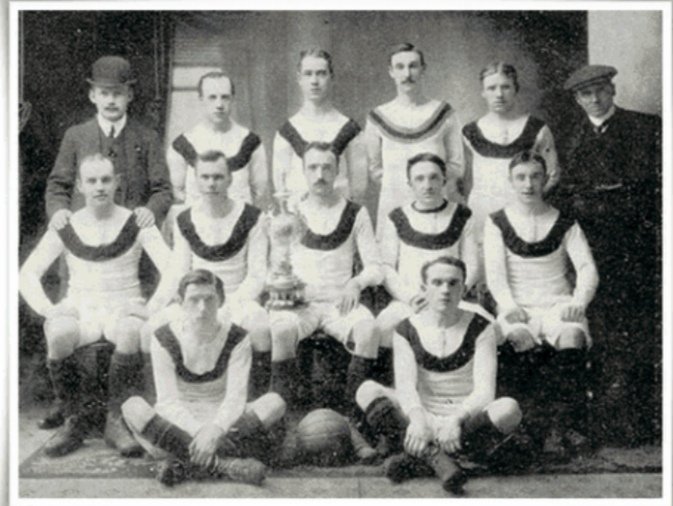
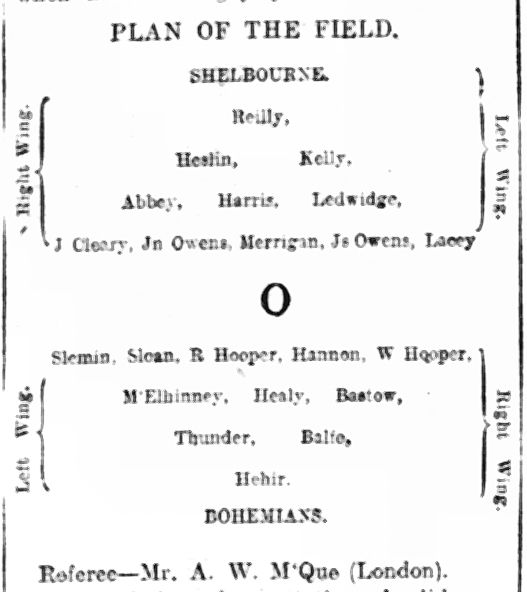


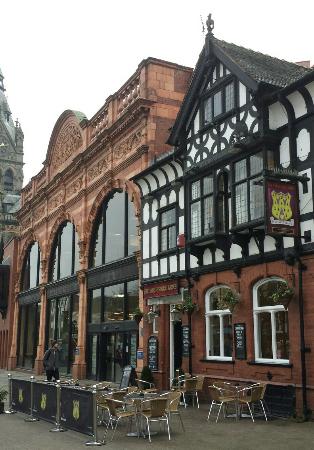


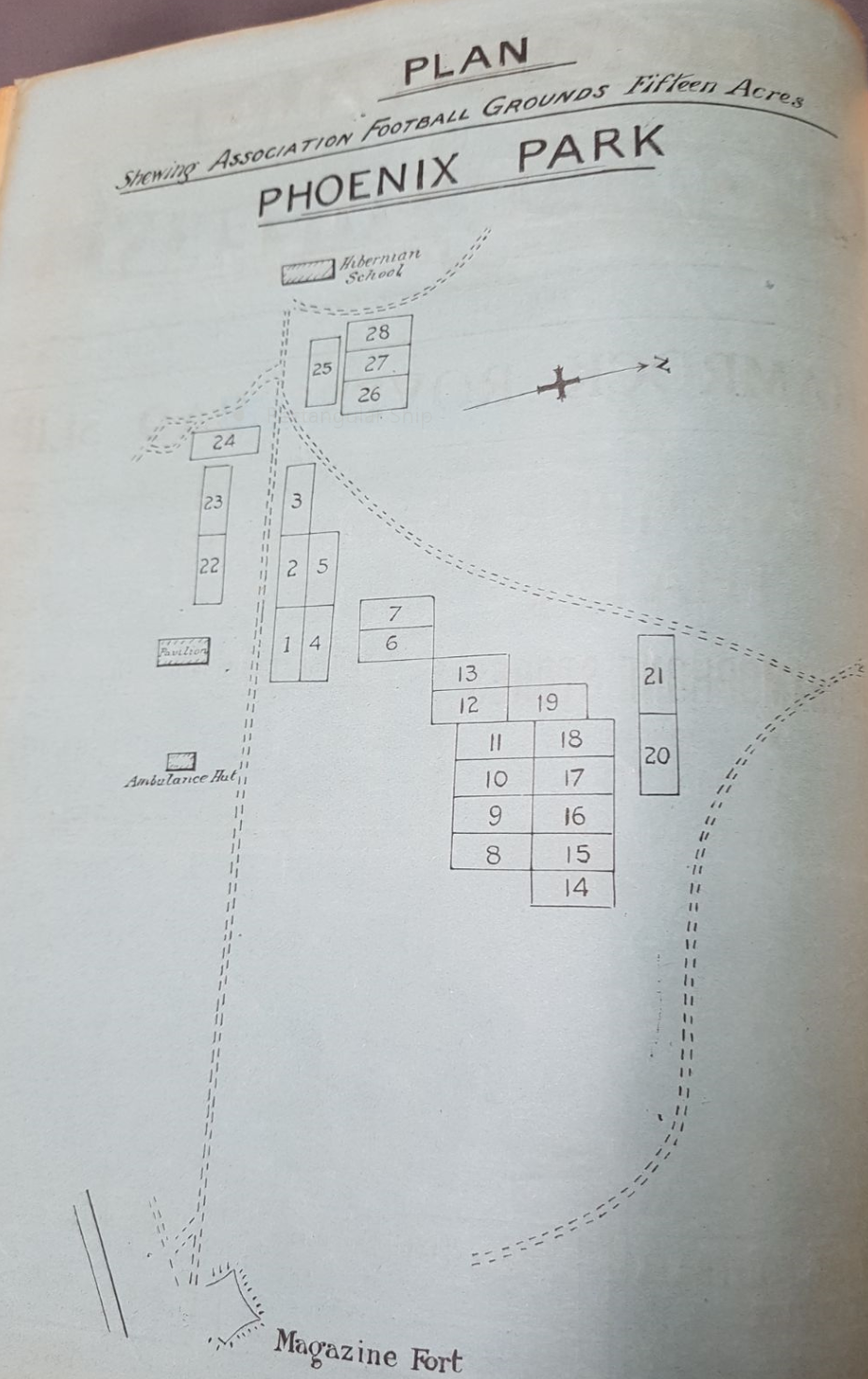

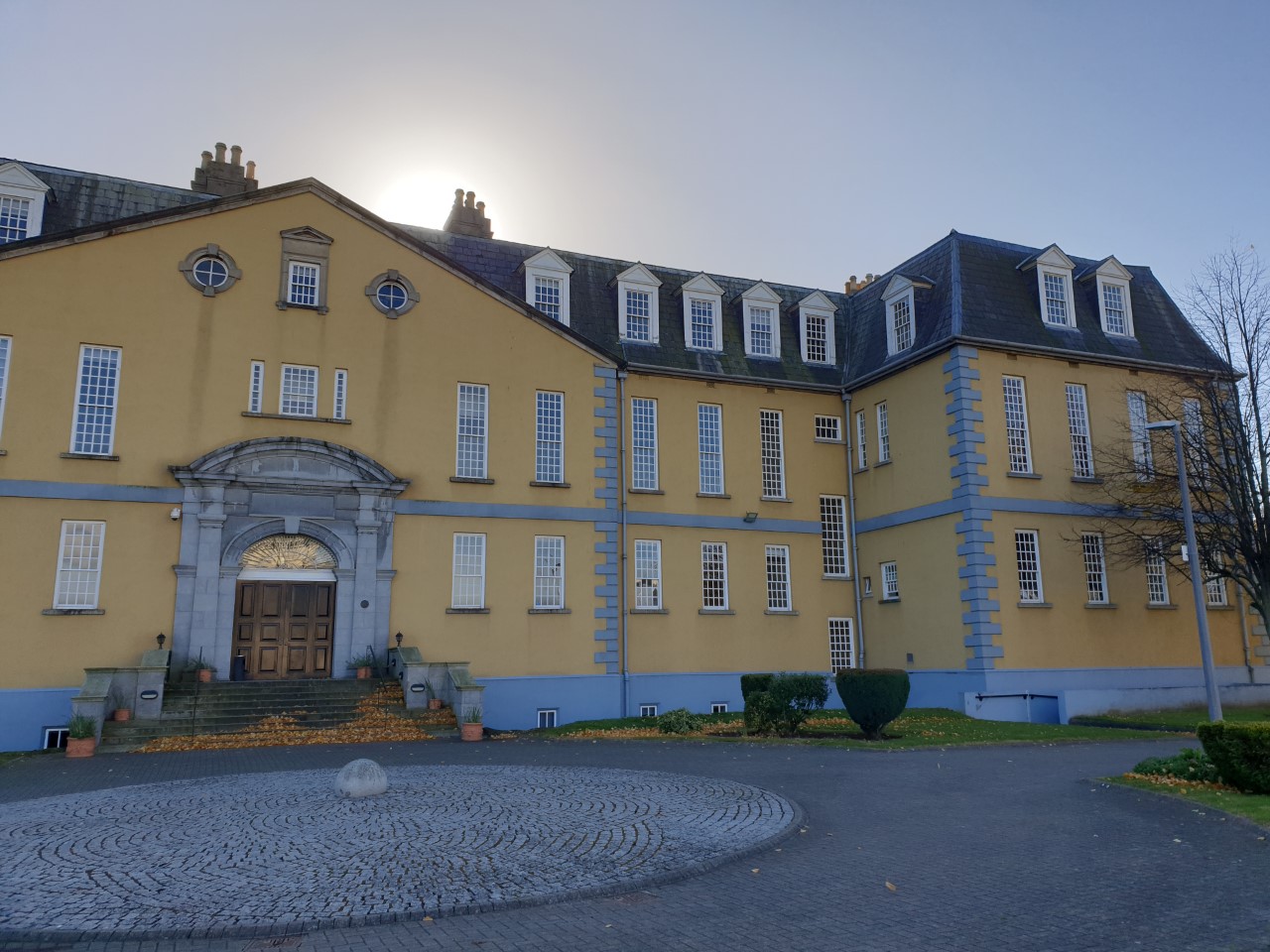


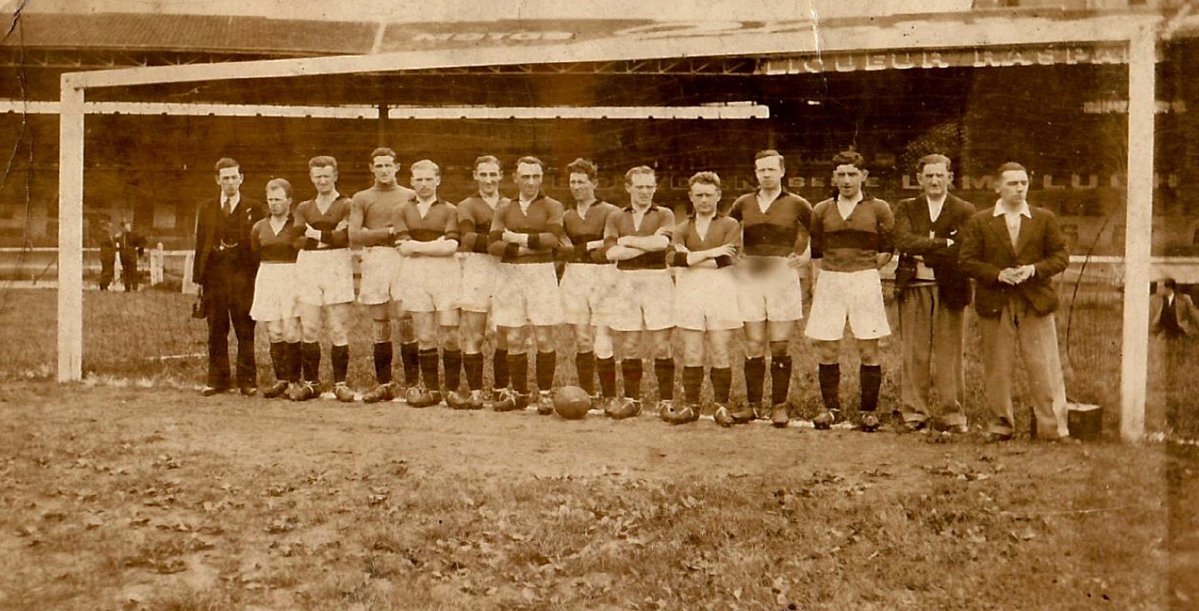


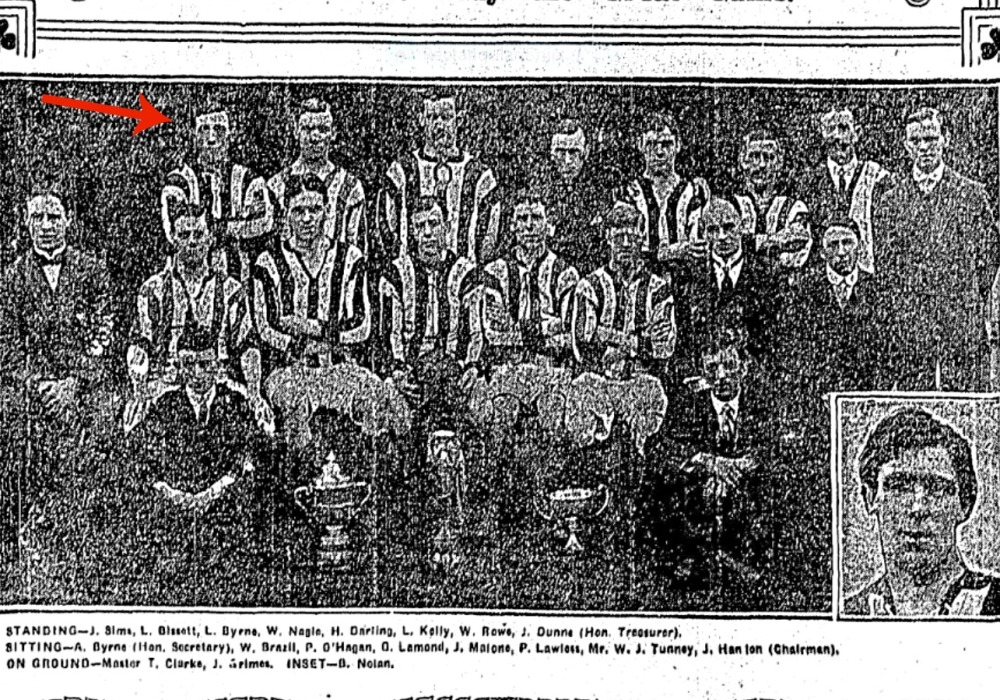


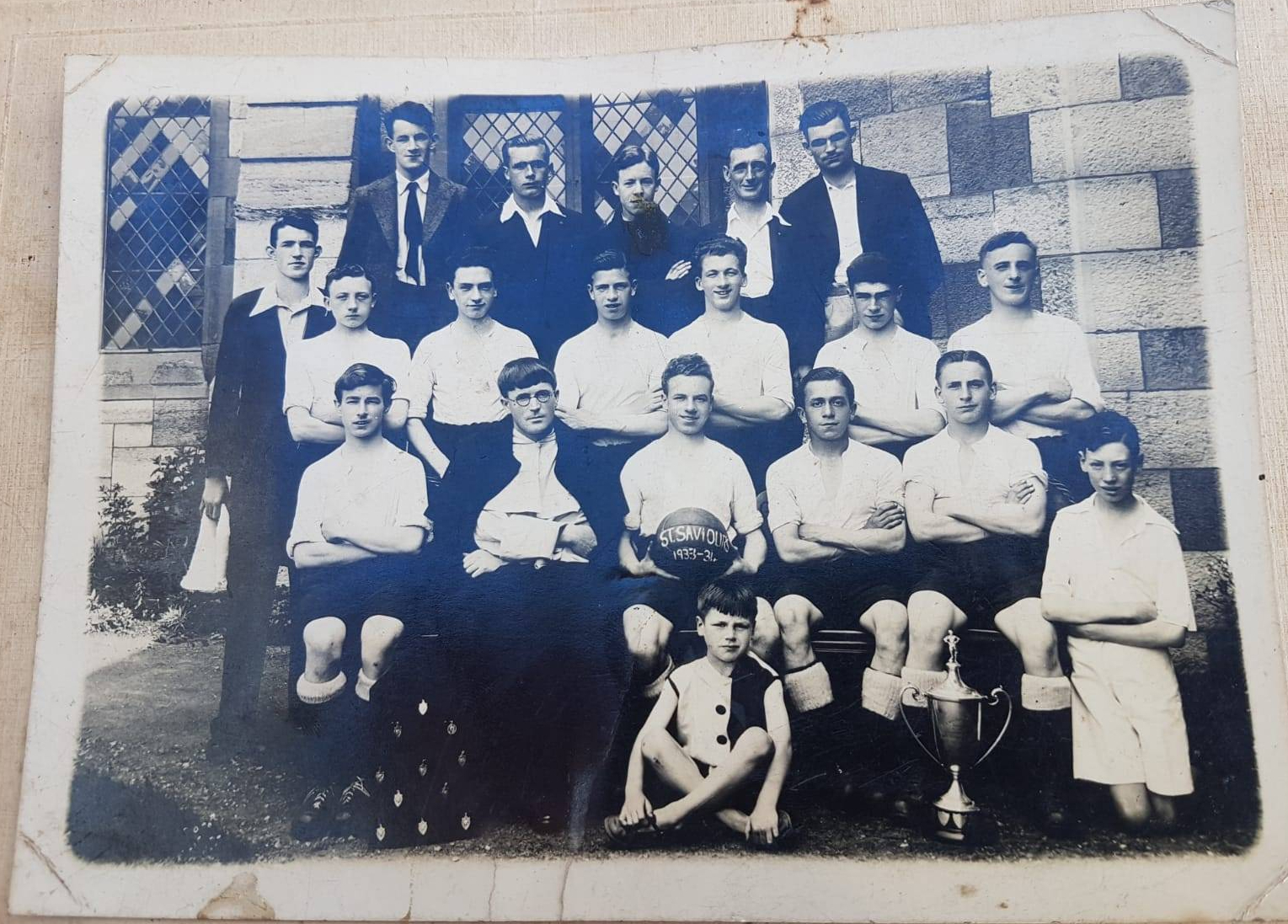
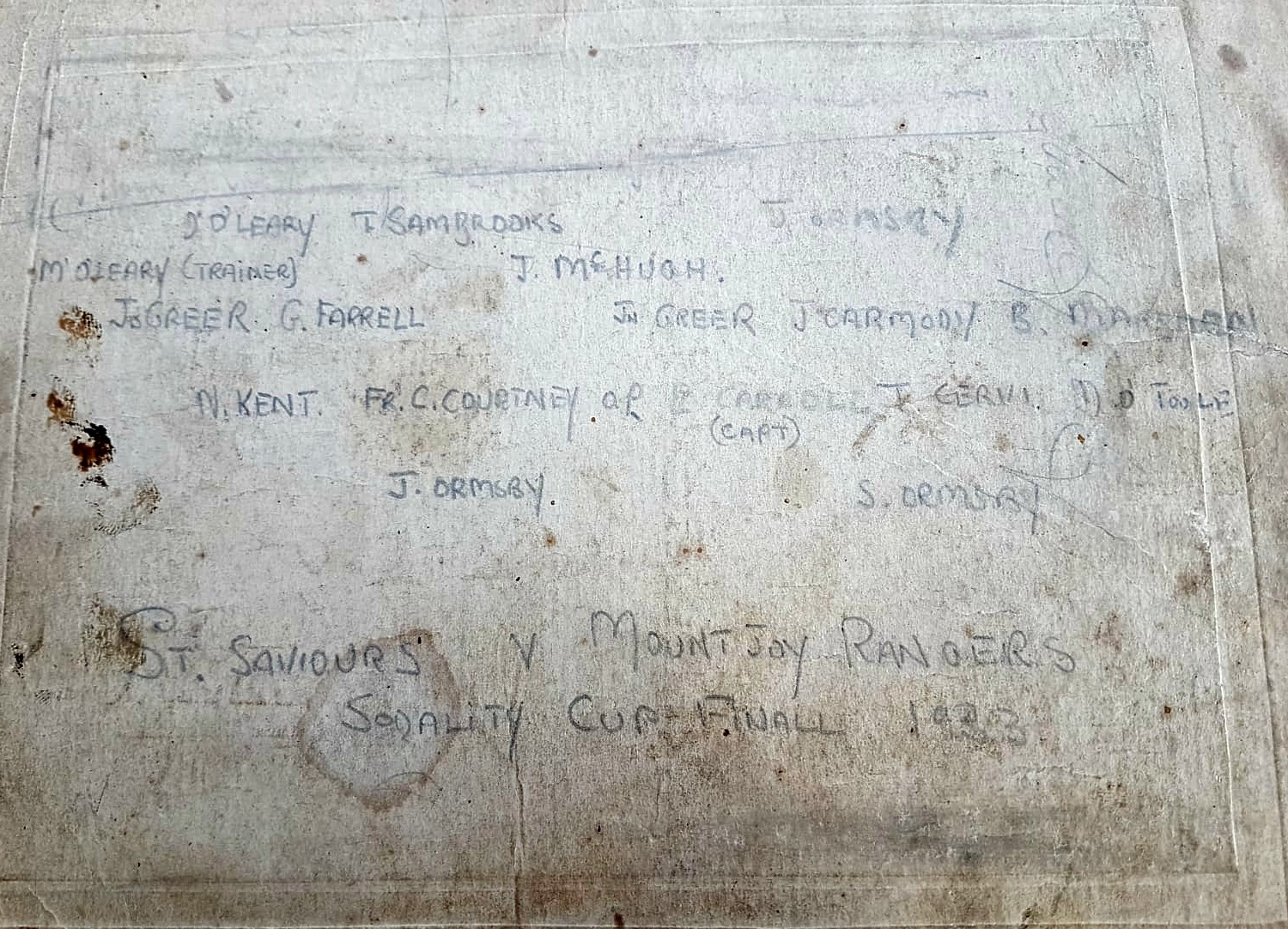
 A Bohemian Sporting Life