Second and third place finishes saw Bohs begin the first years of the League of Ireland as nearly men, despite being one of the most well-established sides in the new league. The third season however, would finally deliver some major silverware to Dalymount in the form of the clubs first League title as well as winning the League of Ireland Shield.
Joining an experienced group were some newcomers; adding firepower to the Bohs’ forward line was Englishman Dave Roberts who had previously played for Walsall and Shrewsbury Town. Roberts would finish the league season as its top scorer with 20 goals, followed by his teammate, the skilful inside forward Christy Robinson with 12. There were goals throughout the Bohs side that year with Mick O’Kane registering eight, and another recent arrival Billy Otto getting five from midfield.
Otto, the captain for that title winning season, had been born on Robben Island just off Cape Town and had ended up in Ireland via the trenches of the Somme and later a Civil Service job in Dublin. He led Bohs to victory as they would finish four points clear of their nearest rivals Shelbourne, clinching the league title by beating St. James’s Gate with a game to spare.
Dublin United, Olympia and Rathmines United had all exited the league that season, with only Brooklyn (named after Brooklyn Terrace off the South Circular Road) joining what was now a 10-team league. In the Cup it was Athlone Town who triumphed in the St. Patrick’s Day final, they defeated Cork side Fordsons 1-0 with a goal coming from their veteran forward Dinny Hannon who had been a part of the Bohemian side who had won the Irish Cup way back in 1908. Athlone had knocked Bohs out in the semi-final that year and amazingly won the cup without conceding a goal in the entire competition.
At international level February 1924 saw the first League of Ireland XI play an inter-league match, an exciting 3-3 draw with the Welsh League at Dalymount, the LOI side featured five Bohemians that day; Bertie Kerr, Johnny McIlroy, Christy Robinson, Harry Willits and Dave Roberts who scored two of the League’s three that day. Of those players Robinson and Kerr would be selected to represent Ireland in football at the 1924 Olympics along with their fellow Bohemians Jack McCarthy, Johnny Murray, John Thomas and Ernie Crawford. Ireland opened the tournament with a 1-0 victory over Bulgaria thanks to a Paddy Duncan goal before exiting at the quarter final stage to the Netherlands who won 2-1 after extra time.
Ireland v USA in Dalymount, 1924
Further international games were arranged by the FAI including a 3-1 win over Estonia in a friendly in Paris directly after elimination at the Olympics as well as a first home international, another 3-1, this time over the United States in Dalymount in June 1924. The star of the show was hat-trick hero Ned Brooks of Bohemians who had helped the club to success in the League of Ireland Shield a few months earlier.
With Bohs having finished the debut League of Ireland season in 2nd place we were hoping to go one better the following year and secure the club’s first ever league title. The challenge would be all the greater as the league had swelled from an initial eight teams to twelve, which included the first non-Dublin side in the form of Athlone Town.
Also added to the league were Midland Athletic (associated with the Midland Great Western Railway company), Pioneers, Shelbourne United (no relation to the other Shelbourne, but you see how this can be confusing), Shamrock Rovers, and finally Rathmines Athletic. The Rathmines side were a late addition, initially UCD were going to enter a side but pulled out just before the beginning of the season, allowing Rathmines the chance to play their one and only season of LOI football. It was an inglorious season for the Southsiders as they finished bottom of the table, pulling out of the league even before they’d played their final fixture against Dublin United.
At the other end of the table, it was a three-way fight for supremacy between Bohemians, Shelbourne and newcomers Shamrock Rovers. While Bohs were table toppers at the halfway point, and ran up some spectacular scorelines, including a 7-0 win over Pioneers and an 8-0 drubbing of Olympia, costly defeats to the likes of Shelbourne and Midland Athletic at crucial points in the season meant Bohs had to settle for 3rd place.
The title went to Shamrock Rovers in their debut LOI season, fired to victory by the goals of Bob Fullam, banned at the start of the season for his part in the previous season’s Cup final fracas, Fullam scored 27 times as Rovers lifted the league title.
In the Cup there was a huge surprise win when Alton United, a Belfast team affiliated to the Dublin based FAI, defeated heavy favourites Shelbourne in the final with former Belfast Celtic forward Andy McSherry grabbing the winning goal.
Alton United
Two weeks later Bohemians played their first match against Continental opposition, drawing 1-1 with French side Club Athletic Paris Gallia, who became the first European team to visit Dublin since the split from the IFA. While it was a season that ultimately ended without a trophy Bohs were putting together a talented squad which now included South African midfielder Billy Otto, the talented and tricky inside forward Christy Robinson and a new striker from England named Dave Roberts allied to a core of experienced players such as Harry Willets, Johnny Murray and Johnny McIllroy, they’d have reason to be optimistic.
I’ve begun writing a series for each Bohemian FC match programme giving a short history of the key events in Irish Football season by season, beginning with the first League of Ireland season in 1921-22. I’ll be adding them to the blog for anyone who cares to read them. Part one begins below.Thanks to Alan Bird for the suggestionto write it in the first place.
In the first of a new series, we look at the major points of interest during a League of Ireland season from the past, and for the first in the series we’re going way back to the first ever season in the League, the 1921-22 season.
That first season is a bit of a misnomer the entire fixture list of 14 games (featuring just eight, Dublin-based, league sides playing each other twice) was completed in the three months between September and December 1921. Bohemians and Shelbourne, as the two sides from outside of Ulster who had competed in the Irish League against the giants of Belfast football, started among the favourites for the title. Bohs v YMCA game was the inaugural league fixture to kick off, in what was described as a “poorly filled” Dalymount, those who did turn out though witness a masterclass from Bohemians. It was Bohs’ striker Frank Haine who had the honour of scoring the first ever LOI goal, getting the opener in a 5-0 win. However, league honours ultimately fell to St. James’s Gate, the brewers pipping Bohs to the title by two points.
Frank Haine of Bohemians
It shouldn’t have come as that much of a surprise though, as the Gate had won both the Leinster Senior Cup and Irish Intermediate Cup just a season earlier. Several of that successful James’s Gate side would go on to represent Ireland but it would be the Paris Olympics in 1924 before they’d have the chance to pull on the green jersey. Among the Gate players from that season were Charlie Dowdall, like Ernie McKay and Paddy “Dirty” Duncan who joined five Bohemians in the squad. It was Duncan who would get the first goal in an international competition for the Irish Free State, grabbing the only score in a 1-0 Olympic victory over Bulgaria.
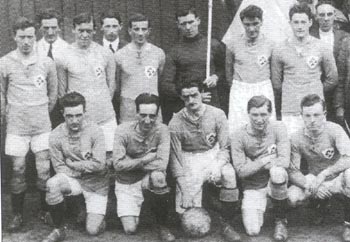
Joe O’Reilly and Charlie Dowdall with the Cup years later
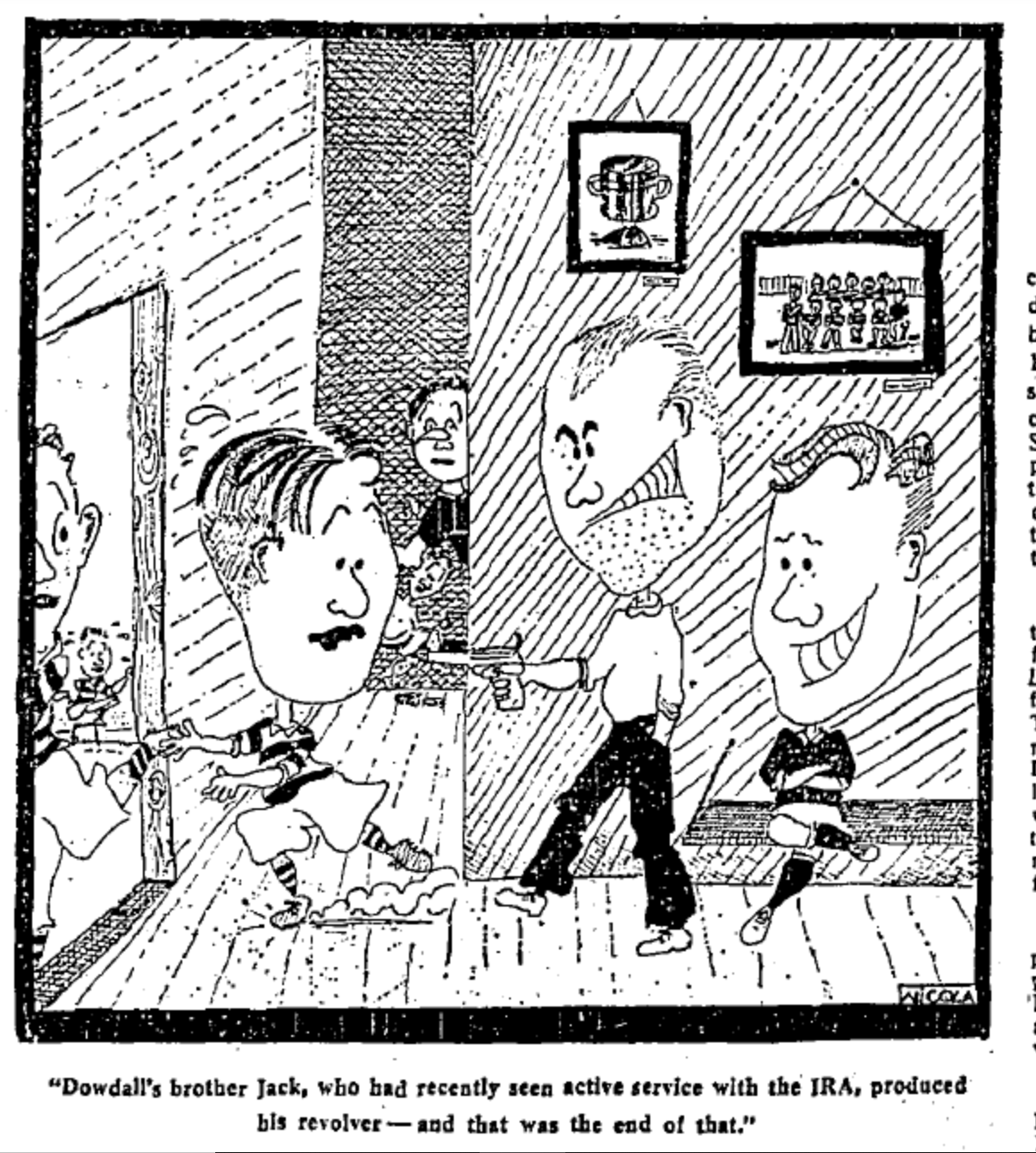
Of course, the political tumult in the country was never far removed from football, Bohemians began the season playing a pair of friendlies in Dublin and Belfast to help raise funds for the workers locked out of the Belfast shipyards, expelled because of their religion or their politics. The season then ended with pistols drawn in a Dalymount dressing room at a Cup final replay. St. James’s Gate won the double beating Shamrock Rovers (the of the Leinster Senior League) after an ill-tempered game which ended with infuriated Rovers players storming the Gate’s dressing room.
Bob Fullam of Rovers advanced on Charlie Dowdall when Charlie’s younger brother (and an IRA volunteer) Jack stepped forward and produced a pistol. Fullam and his Rovers teammates were outnumbered, and now out-gunned and they sensibly beat a retreat from the James’s Gate changing rooms!
Newspaper cartoon depicting the dressing room scene after the Cup final.
Did you know that Karl Marx played football with the KGB in East Germany?
Bit of a trick question obviously but there is a grain of truth in it. As Bohemian Football Club progressed to the last 16 of the European Cup they were drawn against Dynamo Dresden, champions of East Germany and the dominant team there throughout the decade. It was a daunting mission, as we’ll see the Dresden side were packed with internationals and had reached the quarter finals of both the UEFA Cup and European Cup within the previous three years. Being drawn against Dynamo Dresden also meant another trip behind the “Iron Curtain”, something Bohs were getting familiar with having faced Eastern bloc sides in the past such as Polish Cup winners Śląsk Wrocław three years earlier. As well as a trip to face Gottwaldov in Czechoslovakia in the club’s first ever European tie.
But returning to Karl Marx, this was the moniker given by RTÉ commentator Philip Greene when watching one of Bohs’ young stars in action. It helped that Terry Eviston player on the left-wing, and that he was fairly hirsute in those days with a mop of curly hair and a beard, not unlike the famed German political-philosopher. As for the KGB? Well, that was a joking reference to a social group of the Bohs squad who palled around together, the K-G-B stood for (Tommy) Kelly, (Eamonn) Gregg, (Joe) Burke, the defensive backbone of the successful Bohs side of the 1970s.
But before the KGB could grab a couple of German lagers there were still some issues facing Bohemians that needed to be resolved. Having defeated Omonia Nicosia on away goals in the previous round Bohs now faced a difficult and expensive journey to Dresden, coupled with the fact the UEFA ban on using Dalymount for the home leg was still in place. The “home” game against Omonia Nicosia had taken place in Flower Lodge in Cork City and the Bohemians directors had been busy in the meantime trying to gain permission from UEFA to host the home leg closer to Dublin. They appealed against the diktat that the game must be played 150km from Dublin and successfully reduced the distance required as part of their ban to 80km.
According to the press reports the game in Flower Lodge, which attracted a crowd of roughly 4,500 had according to the club, cost Bohs £5,000 and hopeful of a successful appeal the club had already reached an agreement with Dundalk for the use of Oriel Park for the upcoming second round, first leg fixture against Dynamo Dresden. Luckily for the club, less than two weeks before the game their appeal was granted by UEFA President Artemio Franchi. Bohs were going to Oriel Park to face Dynamo Dresden and manager Billy Young encouraged the Bohs faithful, as well as the local Dundalk population to come out in force to support Bohemians.
At the forefront of the mind for Young, and the Bohemians’ Directors was the issue of finance. As mentioned, the previous tie in Cork had ended up costing the club £5,000 and this, coupled with the costs of getting to Dresden was eating into the profits made from the previous year’s league win, bumper gate against Newcastle and sale of winger Gerry Ryan. There costs weren’t insignificant, it is worth noting that the £5,000 quoted for arranging the home tie in Flower Lodge was more than the annual salary for someone on the average industrial wage at the time. Now, thankfully with a home venue secured and the distance to travel for the home games reduced Bohs could actually focus on the task at hand, trying to defeat Dynamo Dresden.
As for Dynamo Dresden they had a similar result to Bohemians, losing away, but winning at home to Partizan Belgrade, but with the scores from both legs finishing at 2-0 a penalty shoot-out was required to separate the teams. Ilija Zavišić missed the decisive penalty for Partizan while Udo Schmuck proved he wasn’t that type of Schmuck by scoring his spot kick for Dresden. It appeared that Dynamo weren’t taking Bohs lightly, in the week before the game they sent two club officials to scout on Bohs as they played Shelbourne in Tolka Park and were even planning on taping the game to analyse it. The Irish Press reported that this would have cost the German club in the region of £1,000 and of course the Dresden officials were referred to as “spying” on Bohemians. For his part Billy Young had been in contact with Liverpool’s Bob Paisley. Liverpool had knocked Dresden out of Europe the previous season 6-3 on aggregate, winning at Anfield but losing in Dresden. Paisley noted how strong they were at home as well as commentating on Dresden’s pace, intense fitness and good technical ability.
In the opening game in Oriel Park Bohs lined out as follows: Mick Smyth, Eamonn Gregg, Austin Brady, Tommy Kelly, Joe Burke, Padraig O’Connor, Gino Lawless, John McCormack, Turlough O’Connor, Paddy Joyce and Terry Eviston. The first half was fairly even as Dynamo seemed to be somewhat nervous, but as the second half progressed the East Germans began to push forward a bit more, winning a series of corners without ever really threatening Mick Smyth’s goal and being restricted to speculative long-range efforts. The media reports gave special praise to the solidity of the back four of Gregg, Burke, McCormack and Brady.
Next up was the daunting task of the away leg. That Bohs had failed to score and hadn’t looked particularly likely to threaten, coupled with the fact that Dresden were expected to be much tougher at home meant that most commentators had understandably written off Bohs chances of progressing. The squad flew out to Dresden with a stopover in Schipol. The over-riding first impression of Dresden in October was one of greyness, modern brutalist buildings alongside memorials to the Second World War seem to be particularly striking, all those spoken to for this piece mentioned the ruins of the Dresden Frauenkirche – an 18th Century Church destroyed in the infamous incendiary bombing of the city by Allied forces in 1945 that had killed as many as 25,000 people and utterly destroyed the city. The ruins of the Church had been left as a memento to these events before eventually being reconstructed after German unification.
Match programme vs Dynamo Dresden
As for the squad’s accommodation they were billeted in a set of holiday chalets outside of the city, usually a spot for families to flock to during the summer they were deserted as winter approached. Crucially they were also somewhat remote and secure and were under constant armed guard. The Bohs party were assured that this was for their protection. The squad also had official plainclothes chaperones to assist them, and keep an eye on them during their stay. Despite these efforts Terry Eviston recalls a leather jacket-clad character who approached the squad with promises to get them products of their choice in return for dollars or other western currency.
The armed guard and various official chaperones who were there to “protect” the team were by all accounts friendly enough though with limited command of English, and according to Billy Young graciously allowed the squad a bit of time to explore the city unsupervised in exchange for a bottle of Jameson whiskey. In fact the players seem to have had plenty of freedom with Tommy Kelly, Joe Burke and Eamonn Gregg (the KGB) managing to nip out for a pint and a bite to eat a couple of days before the game to a local restaurant, only to have to hide themselves behind a curtain in an alcove in the back when Billy Young and journalist Noel Dunne walked in!
What was highly impressive though to the Bohs players and management were the facilities available to Dynamo Dresden. While the club were nominally amateurs, Dynamo being a nationwide sports club for the East German police, meant that all the players were technically policemen or working in the wider police organisation, they were for all intents and purposes professionals, in receipt of better pay, better housing, cars as well as the opportunities for international travel that came with being part of one of the states elite Fußballclubs. A designation afforded only to the elite football teams in East German.
The team played out of the 33,000 capacity Dynamo Stadion, a huge open bowl which had four iconic floodlight pylons towering above it at an angle. The stadium had medical facilities on-site as well as gyms and dormitories nearby. A far call from Dalymount despite the nominal “amateur” status of Dynamo’s players.
This wasn’t the first time that Bohs had played against German opposition in Europe, though of the Western variety, the early part of the decade had seen Bohemians face FC Köln and Hamburger SV in consecutive seasons in the UEFA Cup. As with Dresden the players were blown away by the facilities available to the German clubs, though in this case the Köln and Hamburg players were overt professional outfits.
Tommy Kelly recalled a post match meal after being knocked out of the UEFA Cup by Hamburg, opposite Tommy was the Hamburg captain and German international Georg Volkert, with little English most of the conversation was carried out through a younger Hamburg player who asked Kelly and his Bohemian teammates how much they earned. Kelly recalled that his wages at Bohs were roughly £20 a week at the time, not unusual at a club were most of the players had day jobs. Deciding to inflate the figure he replied to Volkert that he earned £50 a week, when translated this drew surprise from Volkert who reportedly stated with a Naomi Campbell flourish, that he wouldn’t get out of bed for £50 a week. For context it’s worth noting that three years later Hamburg would break the German transfer record to sign Kevin Keegan, offering him a better salary than he was earning at Liverpool.
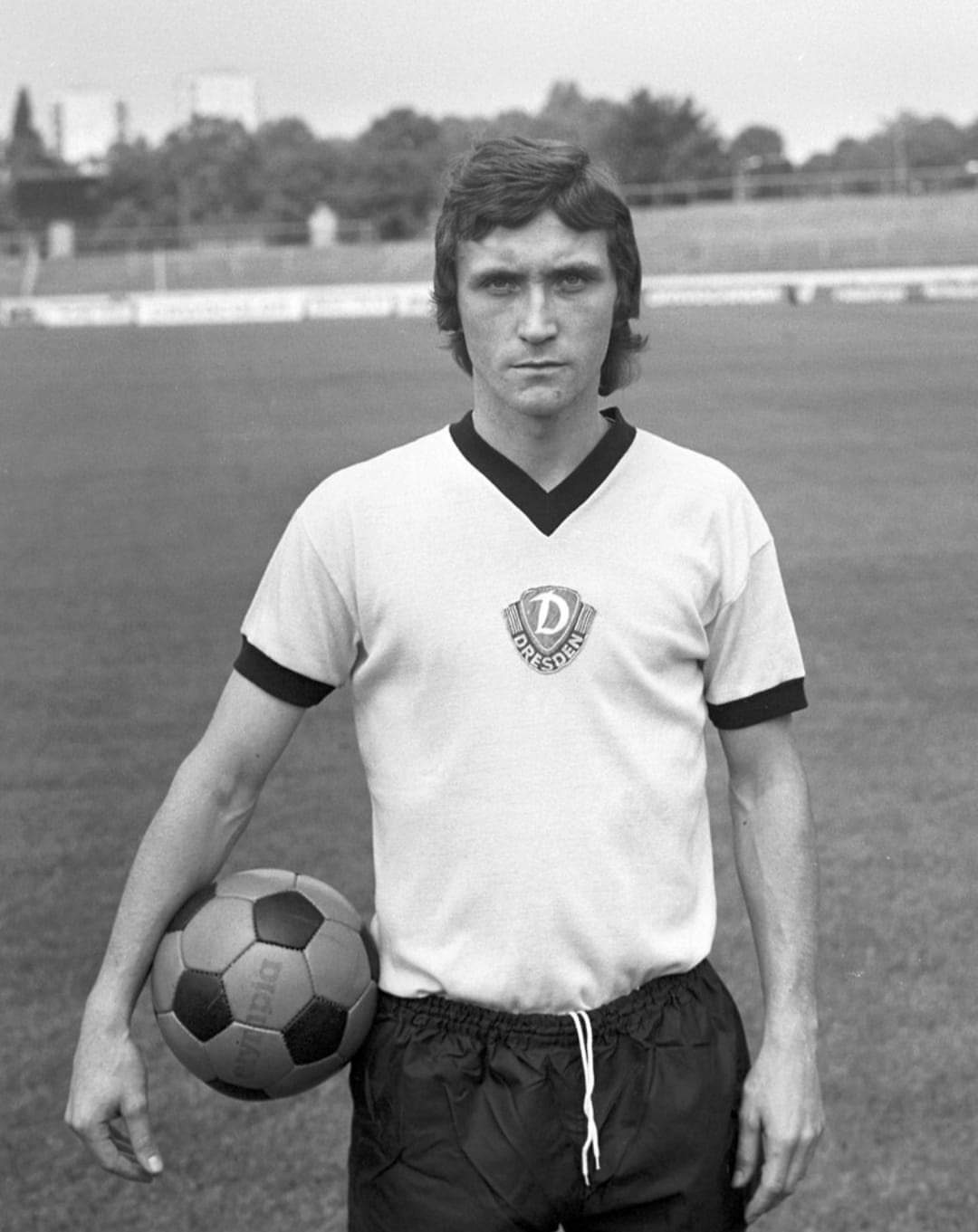
Dresden were of a similar standard as those sides, six of the gold-medal winning East German squad at the 1976 Monteal Olympics were provided by Dynamo Dresden. They defeated strong (nominally amateur) sides like the Soviet Union and Poland in the semi-final and final respectively. Dresden’s star sweeper Hans-Jürgen “Dixie” Dörner was routinely described as the “Beckenbauer of the East” and eight of the side that faced Bohemians were internationals.
The differences in the home and away legs was stark. During the first half Bohs had been solid in defence as Dynamo, cheered on by a capacity crowd who had begun flooding in hours before kick-off, had begun to exert greater and greater pressure. Bohs had been ably assisted by the oldest man on the pitch, goalkeeper Mick Smyth who had been pressed into service early and produced some remarkable saves. However, the valiant rear-guard action was finally breached by 19 year old Andreas Trautmann in the 29th minute after a goalmouth scramble. Dixie Dörner made it 2-0 with a shot from just inside the box just before half-time and it seems that Bohs knew their race was run by that stage.
In the second half Dynamo ran riot with a goal from Schmuck, a second from Trautmann, and two penalties scored first by Dieter Reidel and then by Peter Kotte. The Irish Press ran with the questionable headline of “Dresden, left in rubble after a bombing raid in 1945 saw another blitz last night when Bohemians were ripped apart”. While the wording may have lack sensitivity Bohs were indeed ripped apart in the second half, as can been seen even by the short clips of footage available. Dynamo Dresden can be seen moving with speed, purpose and precision as they head towards goal.
Billy Young was philosophical after the result, pointing out how well the team had done until conceding the first goal and praising the “blistering pace” of Dynamo Dresden, describing them as “undoubtedly the best side we have ever met in European competition”. Speaking to Billy recently that is a view he still holds to this day with one exception, that of Jim McClean’s Dundee United who so impressed the Dalymount faithful when they played in Dublin in 1985. Eamonn Gregg, who had just won his third international cap a week earlier described Dresden as “better than a lot of international teams I have seen. They always seem to have two or three players in space looking for the ball”.
Dresden in 1978 – photo courtesy of Terry Eviston
All that remained was the traditional post match dinner, held in one of the fine buildings of Dresden’s old town, rebuilt after the devastation of the war, there the players were introduced to the pleasure of quail egg soup while the club were presented with painting as a memento. Young left with the quote that he felt that Bohs had “learned a lot from the game which will help us at home in the championship”. Bohs would ultimately finish second that year, just two points behind Dundalk. This was of course the main benefit of Europe, exposure to good quality sides and new tactics and approaches as well as an excuse for a trip away and some team bonding. At the season’s close the costs of Europe were clear, the lack of proper “home” games and the cost of travel had reduced the club’s financial surplus from almost £45,000 to just under £17,000 a year later. The second place finish that year did however, secure a sixth consecutive season of European football which was ended after a 2-0 aggregate defeat to Sporting Lisbon in the first round despite and impressive scoreless draw in Portugal. Bohs wouldn’t return to European competition until the infamous games against Rangers in the 1984-85 UEFA Cup.
As for Dresden, perhaps they didn’t realise it but their decade of dominance was coming to an end. Their star striker Hans-Jürgen “Hansi” Kreische, who had played in the 1974 World Cup, had retired at the end of the previous season, he had been blacklisted by the national team because of a bet he had made about who would win the 1974 World Cup. The problem was less the bet (for five bottles of whiskey) but who he had made it with; Hans Apel, the new West German finance minister. Further fallings out with coaches and club officials at Dresden hastened his retirement aged just 30.
Apart from the loss of Kreische there was the small matter of Erich Mielke, head of the Stasi. As Dynamo were a police club they fell to an extent under his personal remit. In the 1950s Mielke had wholesale relocated the successful Dynamo Dresden squad to Berlin to play for Dynamo Berlin. Predictably Dynamo Dresden, shorn of their title-winning players were relegated and had to spend years in the wilderness until they were promoted back in 1962. Their further development and success in the 1970s did not please Mielke who wanted a successful club in Berlin, which he eventually got. From 1978-79 Dynamo Berlin would win ten straight league titles amid much controversy and accusations corruption, intimidating referees and preferential treatment of the club from the capital as Dynamo Berlin found success, but also hated outside their small, devoted fanbase.
Two other players involved in the games against Bohemians had careers cut short or diminished due to political decisions, midfield Gerd Weber and striker Peter Kotte, the man who had scored the sixth and final goal against Bohemians. As Alan McDougall writes, in 1981, while waiting to travel with the East German national team to South America, Weber, Kotte and another Dresden player Matthias Müller were arrested on suspicion of Republikflucht, i.e. attempting to defect from East Germany.
Weber, a gold medal winner in Montreal, was also a Stasi informant, who sent in over 70 reports on his teammates during his time as a player. This was not uncommon and there are estimates that up to a quarter of the players and coaches of top club sides in East Germany had been recruited as Stasi informers, however Weber had apparently used a recent UEFA Cup game against FC Twente to discuss a possible defection and move to FC Köln. Kotte and Müller were accused of knowing about this plan and failing to inform the authorities.
Gerd Weber
Weber was sentenced to almost two years in prison, serving nine months, was expelled from Dynamo and from his police job, and had any other privileges that he had accrued due to his position as a well known footballer removed, and was barred from football for life. Kotte and Müller would only spend a few days in jail but they were barred from playing football in the top two division for life.
While Dynamo Dresden would win two more East German titles in 1988-89 and 1989-90 and even make the semi-finals of the 1988-89 UEFA Cup, the reunification of Germany was not kind to them or to any of the Eastern clubs. After early seasons in the Bundesliga, huge debts saw the club relegated to the regionalised third tier, even dropping down a level further for a time in the early 2000s. At the time of writing the club are top of the third division, hoping to be promoted back to the second tier.
The 17th of September marks another landmark moment in the history of Bohemian Football Club, and indeed the League of Ireland as a whole. On that date one hundred years ago the League of Ireland kicked off, and Bohemians played our first League of Ireland fixture against the YMCA. While Bohemians (along with Shelbourne) had been among the very few clubs from outside of Ulster to compete in the Irish League, there had been a significant gap between 1915 to 1920 when football was regionalised due to the War. In June of 1921, the Leinster Football Association, after several disagreements with the IFA, including over venues for Irish Cup matches, formally decided to split from the IFA and later that year they would form the FAI.
It is a testament to how swiftly things were changing that a new League and Cup were arranged so by September, though all of the eight teams in that initial season were Dublin based, most having formed part of the Leinster Senior League prior to the split from the IFA. Alongside recognisable names like Bohemians and Shelbourne, were St. James’s Gate, Dublin United, Jacobs, Frankfort, Olympia and YMCA.
The fixtures on that opening day were Bohemians v YMCA; Shelbourne v Frankfort; and St James’s Gate v Dublin United. The other fixture due to take place had been between Olympia and Jacobs in Donnybrook but this match was postponed at relatively short notice.
The Bohs v YMCA game was the first to kick off, in what was described as a “poorly filled” Dalymount, those who did turn out though witness a masterclass from Bohemians. The Bohemians XI for that first league game was as follows – George Wilson, Tom Parslow, Albert Kelly, Mike Stafford, Tom O’Sullivan, Billy Otto, James Marken, Edward Pollock, Frank Haine, Harry Willitts, Johnny Murray. An eclectic bunch, Parslow was an Irish hockey international, Willitts was a WWI veteran who was originally from Middlesborough, while Billy Otto had been born in the Leper Colony on Robben Island off the coast of South Africa.
It was Haine (a former IFA amateur international) who opened the scoring in the first half after some sustained Bohemian pressure, as a result becoming the first goal-scorer in League of Ireland history. YMCA then gave away two penalties in quick succession for a foul on Pollock and later a handball. Marken duly dispatched both to give Bohs a 3-0 lead. Johnny Murray and Harry Willitts rounded out the scoring to give Bohemians a 5-0 win on the season’s opening day.
Bohs would ultimately finish that season in second place, two points behind inaugural St. James’s Gate who would go on to do the double by beating Shamrock Rovers (then a Leinster Senior League side) in a replayed FAI Cup final. As for YMCA, they finished bottom in what was their only season in the League of Ireland.
First published in the Bohemian FC v Maynooth Town match programme.
“Cup tie fever! Who is it who has not been affected with it at some period of another? It is an epidemic which always occurs in a virulent form about the same time each year… Its principle characteristics are a blind, unfaltering belief in the capacity of one’s own team to win “The Cup”… I am afraid the supporters of the Bohemian Club are in no way immune from the ravages of this disease”
These words were written by Dudley Hussey, a founder member of Bohemian Football Club in one of the first histories of the club. Though this history was written some 110 years ago the words remain true to this day, indeed his references to epidemics and disease carry an additional significance!
By the time of writing Hussey had seen a club he helped found prosper from humble beginnings in the Phoenix Park to residents of Dalymount and become serial Leinster Senior Cup champions. However, the prize that they most desired was the Irish Cup.
Bohs had been members of the Irish League since the 1902-03 season, the first Dublin club to join, and also regularly competed in the Irish Cup, becoming the first Dublin side to make the final in 1894-95. However, that cup final was to be a bitter disappointment with Bohs incurring a record 10-1 defeat to Linfield. Bohs would reach the final twice more in subsequent years, a narrow, controversial defeat to Cliftonville 2-1 in 1900 and a 3-1 defeat to Distillery in Dalymount Park in 1903. In 1906 Shelbourne became the first Dublin side to lift the trophy, defeating Belfast Celtic 2-0 in the final in Dalymount Park, surely the Cup couldn’t elude Bohs for much longer?
As an amateur side Bohs were often at a disadvantage against the big Belfast clubs who could afford professional players or who could give their stars cushy sinecures with companies connected with the side. Bohemians often travelled north with many of their best players unavailable due to work commitments and league form was patchy at this time. However, they believed that when they could field their strongest XI they were more than a match for any team in Ireland. The 1907-08 cup campaign would prove just that.
As a member of the Irish League; Bohs were exempt from the first round of the cup and were drawn to face Glentoran in the Oval in the second round. Leading 2-1 with minutes remaining in Belfast, the Glens were awarded a late penalty to secure a replay in Dalymount. A week later Bohs made no mistake, running out easy 4-1 winners with Dick Hooper scoring a hat-trick.
The next round pitted Bohs against league champions Linfield in Windsor Park, again a lead was squandered, Bohs being pegged back from 2-0 in driving rain and sleet to be held for a 2-2 draw after another penalty award, and so to another Dublin replay. In a close and hard-fought match in Dalymount Bohs won out 2-1 and were through to the semi-finals of the Cup.
Lying in wait were Belfast Celtic, and once again Bohemians were drawn away, necessitating another trip north to Belfast. In a thrilling game Bohs were 2-0 down inside the first half after giving away yet another penalty, however, an amazing feat of dribbling by Dinny Hannon where he ran the length of the pitch to score, followed by a second half penalty by Willie Hooper secured a replay in Shelbourne Park. The Belfast Celtic performance was far below their standard of the previous week and Bohs ran out easy 2-0 winners. The final was set – for the first time ever two Dublin clubs, Bohemians and Shelbourne would fight it out for the Cup.
On the 21st of March 1908 the first final took place in Dalymount. First final? Because of course even the final would go to a replay after 1-1 draw. Bohemians goalkeeper Jack Hehir was the hero of this match, producing the “most brilliant display of goalkeeping ever seen in Dublin” by saving two penalties over the course of the game.
The following Saturday was to be the 8th and final match of Bohs epic Cup quest. This was a talented Shelbourne side, among their starting XI were the likes of Billy Lacey and captain, Val Harris both of whom would be lining out for Everton as they finished runners up in the English first division the following season. Bohs were not to be overawed however, and tore into Shels from the outset, Hehir was once again impressive in goals but it was the Hooper brothers who ran riot, Dick Hooper scoring after only eight minutes before grabbing a second on the half hour while just before the interval Jack Slemin played in Willie Hooper to put Bohs 3-0 up.
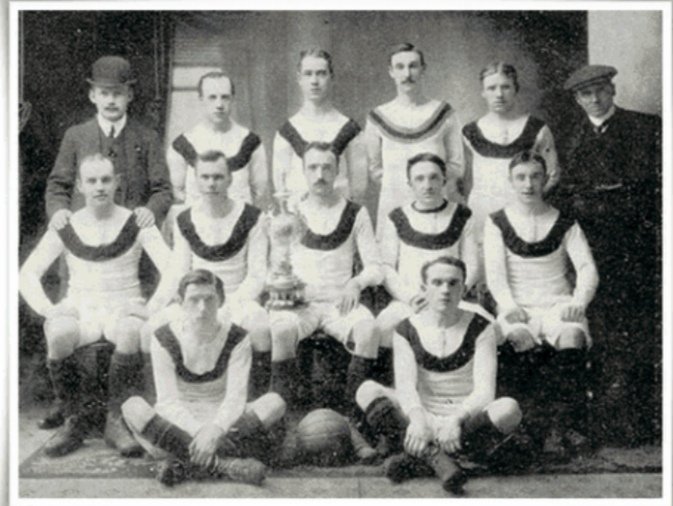
Shels rallied in the second half, putting in some rough tackles and as a result several Shelbourne players were cautioned, one such tackle forced Bohs captain Jimmy Balfe from the pitch for treatment and while Bohs were reduced to 10 men John Owens scored a consolation goal for Shelbourne. But it was to be Balfe’s day, returning to the pitch after treatment it was he who would life the Cup for Bohemians and fulfil what could only have been a distant dream of Hussey and the other founders when the met in the Phoenix Park in 1890.
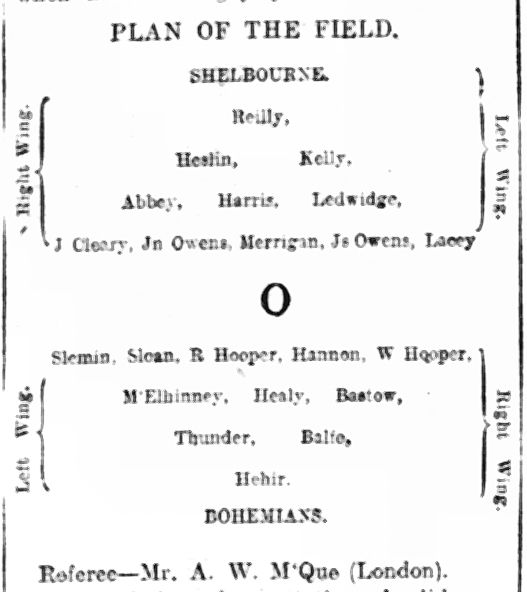
Teams as shown in the Dublin Daily Express on March 30th
Bohemians Cup Final XI:
Jack Hehir, Jimmy Balfe, P.J. Thunder, William Bastow, Tom Healy, Mick McIlhenney, William Hooper, Dinny Hannon, Dick Hooper, Harold Sloan, Jack Slemin
Originally published in the Bohemian FC match programmein 2021.
The 1940-41 title race was a nail biting affair that went almost down to the wire with two great teams, Cork United and Waterford battling it out for supremacy. While the majority of the rest of Europe was engulfed in the violence and destruction of the Second World War the League of Ireland continued as usual, or as usual as possible under the circumstances. In fact, the War had the effect of improving the standard of player in the League of Ireland as many Irish players returned home from Britain where league football had been effectively postponed until the cessation of hostilities.
Cork United, had only been in existence for a season by that stage, formed immediately after the dissolution of the original Cork City, they were an ambitious club who were about to begin a period of league dominance. They were a full-time outfit from the outset and they made a statement of intent by bringing back to Ireland players who had had experience in England, such as Irish international Owen Madden, Jack O’Reilly signed from Norwich, while the goalkeeper berth was taken up by Jim “Fox” Foley, an Irish international who had played for Celtic and Plymouth Argyle. The following year they went further and signed Bill Hayes, a top international full-back who had been plying his trade with top-flight Huddersfield Town in England.
Cork had also recruited wisely from the local area for that 1940-41 season, signing a teenage striker from Dunmanway called Sean McCarthy who despite his tender years would chip in with 14 goals in the debut campaign of what was destined to become a prolific goal-scoring career.
Waterford were no slouches either, although they had struggled both financially and on the pitch in the previous two seasons they still retained a core of veterans who had helped win them the cup in 1937 and finish runners up in the 1937-38 season. Among them were Tim O’Keeffe, an Irish international left winger with a ferocious shot that earned him the nickname “Cannonball” who had just returned after a spell in Scotland, and Walter “Walty” Walsh at left half. Also among their number was a 20 year old local lad who played at inside forward named Paddy Coad who was already making a name for himself as one of the most skillful players in the league. John Johnston, a Derry-born centre forward, was also signed from Limerick to help lead the Waterford attack. Johnston and O’Keeffe would finish the league as joint top scorers that year with 17 goals apiece.
Waterford in 1937
Cork had a slow start to the season but as the league approached Christmas they went on a ten-match unbeaten run which was only ended by their title rivals Waterford. Over 8,000 fans packed into the Mardyke to see this Munster derby and it was the men in blue of Waterford who emerged triumphant. In fact in both league games played that season Waterford came out on top, winning 2-1 and 4-0 over Cork.
Of the two sides it was Waterford who were the more attacking, by the end of the 22 match series of league games Waterford had scored 62 goals compared to Cork’s 50, though the Leesiders had a somewhat better defensive record. Goal difference between the two sides was ultimately +4 in Waterford’s favour but it would be more than 50 years before the League of Ireland employed goal difference to separate teams so a league playoff was decided as the fairest way to split the two teams.
By the time this match rolled around Cork United had already defeated Waterford 3-1 after a thrilling and fiery replay in the FAI Cup final at Dalymount, Sean McCarthy, the youngest man on the pitch opened the scoring and although Johnstone equalised, a Jack O’Reilly brace brought the cup to Cork. They now had their sights set on making history as the first club from outside of the capital to win a cup and league double.
The teams were due to meet again some weeks later on May 11th in Cork’s ground, the Mardyke, for a test match to decide the outright championship winners after both sides finished level. Sensationally, that play-off never took place as seven Waterford players, who were offered bonuses of £5 for a win and half that amount for a draw, demanded the draw bonus be paid even if they lost. Waterford’s directors rejected the demand and suspended all seven, including three Cork-born stars, Tim O’Keeffe, Thomas “Tawser” Myers, and goalkeeper Denis “Tol Ol” Daly. The Cork United directors, fearing the loss of an estimated £1,000 gate, intervened and offered to pay the bonuses, but Waterford, on a point of principle, refused the offer and subsequently withdrew from football. The seven players were then banned from league football for the following season.
With Waterford unable to field a team Cork United were awarded the League title, although despite winning both the league and the cup the loss of the expected bumper gate for the playoff game meant that they finished the season incurring a small financial loss. Despite this minor setback that victory set in train a period of dominance for Cork United which saw them win four of the next five league titles and another FAI Cup. For Waterford however things were very different.
Waterford withdrew from the league for the following season and would not return to League of Ireland football until the beginning of the 1945-46 season. When they returned their squad was mostly made up of local players and they brought in former Irish international Charlie Turner as a player coach for a spell. The stars from 1941 were long departed, Paddy Coad (pictured left as a cup winner for Shamrock Rovers), although suspended from league games, signed for Shamrock Rovers and played only in cup matches in his first season at Milltown. He would go on to become a legendary figure as a player and coach for Rovers. Poor Tim O’Keeffe who had helped win the club the cup in 1937 was less fortunate, he signed for Cork United for a brief spell after his suspension but died from cancer in 1943 at the age of just 33.
In the longer term it was Waterford who would prevail, despite their great success Cork United went bust and left the league in 1948 and were duly replaced by Cork Athletic. Waterford endured a fallow time in the 40’s and 50’s but became a dominant force in the League of Ireland in the 60’s and early 70’s winning six league titles and never having to make do with playoffs in any of their victories.
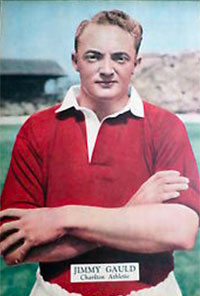
When Dundalk dominated a couple of seasons ago there were many accolades thrown in the direction of the team and its players as they progressed to a historic double. Among the awards amassed was that of top scorer in the league for their prolific striker, Patrick Hoban who fell just one goal short of the 30 mark. A hugely impressive achievement. In fact the last time someone hit the 30 goal mark in the League of Ireland was way back in the 1954-55 season. That man’s name was Jimmy Gauld, and his thirty-goal haul for Waterford was only one dramatic chapter in a life full of intrigue and incident.
Gauld was born in Aberdeen in 1929 and although he lined out as a youth player for his hometown club he never made a first time appearance, instead he plied his trade in the Highland leagues before being signed by Waterford in time for the beginning of the 1954-55 season. The Blues obviously had been keeping an eye on the Scottish game as they also signed ‘keeper Tom Hanson from Greenock Morton on a trial.
Gauld joined an exciting Waterford side who were on the up and featured plenty of talented players in their ranks, including three of the Fitzgerald brothers, the Hale brothers George and “Dixie”, and Scottish-born, United States international, Ed McIlvenney who had been signed from Manchester United.
Stocky, tough and with an incredible burst of acceleration (Jimmy had been a useful sprinter in his youth) Gauld could play anywhere across the front five but tended to line out at inside right for Waterford. He made an immediate impression on the league, within a month of joining Waterford Gauld had been selected to represent the League of Ireland against the Football League in front of an estimated 35,000 spectators at Dalymount Park. The Football League were convincing winners on that day with a certain Don Revie netting a hat-trick, ably assisted by team-mates of the calibre of Stanley Matthews and Billy Wright.
Jimmy Gauld however would have more success on the domestic scene however, over the course of a thrilling season Waterford pushed St. Patrick’s Athletic close for the league title, Pats eventually winning the title race by three points. It was however, an amazing season of goals for runners-up Waterford. In a 22 game league campaign they scored 70 goals, and they broke the 100 mark in all competitions. Gauld got 30 in the league and an incredible 42 in all competitions to beat St. Pats centre-forward Shay Gibbons into 2nd place for the top scorer award. In particular he developed a fine understanding with Jack Fitzgerald and their partnership brought huge crowds to Kilcohan Park with their attacking style of play. Jimmy would also feature again for the League of Ireland XI, this time starring alongside four of his Waterford teammates in a 2-1 victory over the Irish League.
Gauld scores against St. Pats’ from the Irish Press – 28th March 1955
Jimmy Gauld’s scoring exploits didn’t go unnoticed across the water. Charlton Athletic who were enjoying a spell in the top-flight earmarked Jimmy Gauld as the man to replace their departing superstar striker Eddie Firmani who was on his way to Sampdoria. A fee of €4,000 was agreed with Waterford and Gauld enjoyed immediate success in the English First Division, scoring an impressive 17 goals in his first season with Charlton. His good form continued into the early weeks of the following season which prompted a big money move to Everton for over £10,000. Apparently Gauld was upset by dressing room criticism of his style of play from Charlton teammates who accused him of not doing enough in terms of his defensive duties. According to a number of accounts he was also a good friend of Everton captain Peter Farrell who had begun his football career with Shamrock Rovers.
Gauld only lasted a season at Everton, playing 26 games and scoring 8 goals but by the 1957-58 season illness and injury had seen him dropped from the Everton first team. This helped Plymouth Argyle manager Jack Rowley pull off something of a coup by getting him to sign for the club who were then in the Third Division. Gauld’s style of play, goal-scoring ability and searing pace quickly endeared him to the Home Park faithful and he helped the club to promotion to the Second Division, scoring 21 goals in that promotion season of 1958-59. Once again however, Jimmy and the club management had a failing out.
Perhaps enamoured by their star striker’s success and hoping to cash-in on a player who had just hit 30 goals, Plymouth made it known that they would entertain offers for Jimmy’s services. Gauld was upset by this treatment, as were his many fans of the Argyle. There were offers for him to move into a player-coach role at Gloucester City but Plymouth insisted on a significant four-figure transfer fee which the Southern League club couldn’t afford. Ultimately Jimmy’s next port of call was Swindon Town who signed him for a club record fee of £6,500.
Despite a respectable return of 14 goals from 40 games in his only season for Swindon it was around this time that rumours first started to swirl about Jimmy in relation to match fixing. He was released at the end of the season after accusations that he helped to fix a match in April 1960 versus Port Vale, which Swindon lost 6-1. Four years later, he admitted that “Swindon were comfortably in the middle of the League, with nothing to win or lose, so it didn’t seem such a terrible thing to do”.
It turned out that Gauld was able to make good money convincing teammates to throw games while at Swindon which saw him rack up betting earnings of up to £1,000 per game. Huge money when the maximum wage in football was still in place and even the best players couldn’t earn more than £20 a week. Gauld and his colleagues in the Third Division would have been earning considerably less than even that modest amount.
Despite being released by Swindon there were still demands for Gauld’s services in 1960. The match-fixing side of his life hadn’t come to public prominence yet and there was interest in Jimmy from the likes of QPR, Peterborough and from Irish Champions Limerick who surely remembered his record-breaking season just five years earlier and wanted him to lead the line ahead of their first season in European football.
It wasn’t to be however, rather than return across the Irish Sea Jimmy went back to his home country of Scotland and signed for St. Johnstone. After a very brief spell north of the border he was back in the Football League with Mansfield Town in the old Fourth Division. Jimmy had a good start scoring three times in his first four games, but in the last of those games he broke his leg and despite attempted comebacks his career as a player was effectively ended aged just 31.
In 1964 a shock exposé by The People newspaper named Gauld as the ringleader in a bribery scandal which shook British football to its core. It showed that he was at the heart of a scam which had fixed up to three matches per week by utilising contacts from his years in the game, most of whom never knew each other nor who was in on the scam.
One of the most high profile matches that Gauld was involved in fixing was the meeting between Sheffield Wednesday and Ipswich Town which he arranged through his former Swindon teammate David Layne. Wednesday midfielder Tony Kay, who was capped by England and later moved to Everton, recalls Layne approaching him about the game saying;
‘What do you reckon today?’ I said, ‘Well, we’ve never won down here [Portman Road].’ He said: ‘Give me £50 and I’ll get you twice your money.’ I thought that was a good deal.
The story of my bet eventually came out after I was transferred to Everton. I was in a Liverpool nightclub one Saturday night [in 1964] and a friend said to me: ‘You’re all over the front page of the Sunday People about the Ipswich game. They’re saying you bet on the match and the bookmakers have been screaming because they lost £35,000 that week.’
Kay was ironically named Man of the Match in that 2-0 defeat to Ipswich. After the revelations became public he was doorstepped by Jimmy Gauld, who he claimed to never have met previously. Gauld fired a rapid barrage of questions at him about the game and match fixing before leaving his house. It turned out he had secretly been recording Kay and used those taped recordings in the subsequent trial. He also sold his story to the Sunday People newspaper for a reported fee of £7,000.
After pleading guilty Gauld served four years in jail and was fined £5,000 for his illegal activities which also saw nine other players imprisoned, including England internationals Peter Swan and Tony Kay. The judge stated at the hearing in January 1965 that,
“It is my duty to make it clear to all evil-minded people in all branches of sport that this is a serious crime. You are responsible for the ruin of players of distinction like Swan, Layne and Kay.”
After prison Jimmy Gauld did return to Ireland, living on Co. Mayo in the 1970’s, he worked as a driver and assistant to the wealthy industrialist Denis Ferranti who owned Massbrook House on the shores of Loch Conn. Locals remember him as a popular and sociable character, he was well-liked by the local youngsters due to his habit of giving them copies of Shoot magazine, a rare commodity in rural Mayo. He later returned to London where he passed away in 2004. He remains the last player to score 30 goals in a League of Ireland season but this impressive statistic is lost obscured by his key role in organising one of the biggest betting scandals in British sporting history.
A special thank you to Frank Gibbons for information on Jimmy Gauld’s later life on Co. Mayo.
Irish emigration to the United States is not a new phenomenon, Annie Moore from County Cork became the first immigrant to pass through Ellis Island, New York in 1892 but by that stage there had already been millions of Irish immigrants who had set up home throughout the USA. It is estimated that as many as 4.5 million Irish arrived in America between 1820 and 1930. Between 1820 and 1860 alone, the Irish constituted over one third of all immigrants to the United States.
With this number of Irish immigrants it should not be surprising that there are many Irish names to be found within the early years of US football history, names like Cahill, Peel, Farrell and Cunningham who were either Irish-born or the children and grandchildren of emigrants. Even the club names bear witness to this with plenty of Hibernians and Shamrocks being used as suffixes back into the 1890s. There was even mention of a team called the Philadelphia Irish Nationalists back as far as the 1870s.
However by the 1920s something different was happening: along the Eastern seaboard a professional soccer league was emerging, the ASL (American Soccer League), which began its inaugural season in 1921-22 featuring clubs from in and around New York, New Jersey, Massachusetts and Pennsylvania, areas with strong concentrations of Irish immigrants. The debut season was won by the Philadelphia Field Club who were mostly made up of players formerly of the Bethlehem Steel Football Club. However, after this early success Philadelphia soccer took something of a nose-dive, with the club struggling towards the bottom of the league in subsequent years.
At this point, Irish interest re-emerges in the form of Irish-born, Brooklyn based businessman Fred Maginnis, who took over the struggling Philadelphia Field Club and boldly rebranded them as Philadelphia Celtic ahead of the 1927-28 season of the ASL. The change of name was not just a nod to his homeland; Maginnis had intended to bring across the cream of Irish footballing talent to join his squad. His hope, apparently, was that the significant Irish community in and around the city would come out in big numbers to support this Irish branded football team.
Maginnis got rid of most of the previous year’s squad, though he did keep former Irish League players Billy Pitt, once of Newry Town, and Hugh Reid, a promising defender who had previously been on the books of Glentoran. Both Pitt and Reid had been highly rated during their Irish League careers. Pitt, was a Belfast-born wing-half who had been part of the first Newry Town squad to compete in the Irish League, and he and young Reid had been selected for an Irish League XI for an inter-league game against a League of Ireland XI in 1926.
Billy Pitt proved to be especially useful for Maginnis in recruiting new players for the Philadelphia Celtic directly from Ireland. Pitt’s footballing connections, and Maginnis’ promises of free passage to America and $55 a week in wages, turned a lot of heads and players of varying talents made the journey. Of the more prominent figures convinced to journey across the Atlantic were Ards players Jimmy McAuley and Eddie Maguire, as well as the much-travelled forward Arnold Keenan, who had featured for Fordsons in the Free State League, Glentoran in the Irish League, and for Crystal Palace in England. Others who travelled from the League of Ireland included Michael Maguire, an inside-right, and Paul O’Brien, an outside-left who had played for Brideville, and Larry Kilroy, an inside-right from Bray Unknowns. Also included was Shelbourne player William Burns, who broke an FAI suspension from football to go and play in the United States.
Perhaps the two most famous players who travelled were Free State internationals Denis “Dinny” Doyle and Bob Fullam of Shamrock Rovers, who were joined by fellow Rovers team-mate Alfie Hale (father of the Waterford footballing legend of the same name). By the time of their journey they were both Irish internationals, having represented the Irish Free State in two games against Italy. While Doyle only featured in the home fixture against the Italians, Fullam played in both Turin and Dublin games and got on the score sheet in the home match.
Fullam was one of the best known figures in the League of Ireland. A talented inside forward, he had a rocket-like left-foot and had already been central to Shamrock Rovers’ three league titles and an FAI Cup win. Such was his importance to the team that the popular terrace cry of “Give it to Bob” became common among Rovers fans any time their team were on the back foot.
Fullam had played outside of Ireland before, lining out for a short time for Leeds United but the trip to Philadelphia was a bigger jump into the unknown. Billy Pitt would have faced Fullam in that inter-league match in 1926, and he would certainly been aware of him by reputation when he approached him about the trip to America. It was Fullam in turn who convinced Dinny Doyle to travel. Some newspaper reports suggested that Fullam and co travelled in August 1927, ostensibly as part of a touring Irish exhibition side to the United States, though this seems to have something of a cover story for their true intentions.
What was clear however, was that the Philadelphia Celtic, although rapidly assembled, could certainly hold their own in the professional ranks of the American Soccer League. Although they lost their opening game, they followed this up with a draw and then two victories over the impressive Fall River Marksmen and the Boston team. All was not well in the camp however, as the Boston result was overturned because Philadelphia had made an improper substitution. The lack of any proper coach or manager no doubt was partly to blame, as well as the mounting financial problems.
The ethnic marketing of an Irish Philadelphia side was not creating as big a stir in the city of Brotherly Love as Fred Maginnis might have hoped: even games against strong sides like Boston and Fall River were only drawing crowds of 2,000 – 3,000. Results were very unlikely to improve, as quite quickly the players realised that the riches they had been promised weren’t materialising. Whether Maginnis’s strategy had been to use money raised from expected big gates to pay the squad’s wages, or whether he was just a poor businessman without a Plan B isn’t clear, however, the Irish players quickly realised that the $55 a week they’d be promised wasn’t going to turn up, nor even a fraction of it.
There had been problems with payments from the beginning, and the ASL had come in and taken over the running of the team on an interim basis while they told Maginnis to find a buyer to take over the club. Maginnis, however, didn’t seem to be trying very hard. The Philadelphia franchise being deliberately over-valued put off potential investors, however, Maginnis did seem keen to strike a deal to sell the majority of the club’s playing staff to the Fall River Marksmen club. The league objected to this, and there were even discussions about whether the players could move. Eight of the players had work permits sponsored by Philadelphia Celtic (describing their profession as artists) which would then have to be endorsed by the new club that they would join.
It all came to a head before the end of October 1927 after only 10 games for Celtic, when the League Commissioner Bill Cunningham announced that Philadelphia Celtic had folded and that as far as they were concerned the players who had remained were free agents who could move to a club of their choosing. Some of the Irish contingent decided that they’d had enough; they’d struggled financially due to Maginnis’s mismanagement and by November William Burns and Paul O’Brien had already returned to Ireland. Bob Fullam had a short sojourn with the wonderfully named Detroit Holley Carburettor FC before eventually returning to Shamrock Rovers ahead of the 1928-29 season. Others like Kilroy, McGuire and Alfie Hale would return to Ireland after a matter of months. Billy Pitt, who had helped recruit many of the players for this Philadelphia experiment, would stay a few years longer, playing first for Fall River and later the New Bedford Whalers, Bethlehem Steel and the Pawtucket Rangers. He eventually returned to the Irish League in 1931 where he signed for Glentoran, after some disagreement regarding his transfer from his former club Newry Town. Pitt had left Newry for the States without a transfer being paid and personally faced a significant fine of £50 for breach of contract, it was only after Glentoran agreed to pay this fine that the transfer was sanctioned.
Fullam’s erstwhile team-mate Dinny Doyle had, however, taken to American living and to the ASL. After initially being frustrated in his attempts to sign the Philadelphia players, Sam Mark, owner of the Fall River Marksmen, was successful in signing not only Doyle and Pitt but also Arnold Keenan and Jimmy McAuley. Doyle would go on to be a league Champion with Fall River the following season, as they became one of the most dominant American soccer teams of that era. Dinny Doyle made his life in North America, passing away in his home in Canada in the late 1980s. He was the last surviving member of that first Shamrock Rovers side to win the league title.
The idea of importing an Irish soccer team wholesale into a professional American league was a novel one, it played to the ethnic target marketing that was common in American soccer at the time, but it was ultimately doomed to failure due to the unscrupulous behaviour of an Irish-American businessman trying to get one over on footballers eager for a better life.
While the Philadelphia Celtic quickly failed and many of their players returned to their careers in Ireland, it was not to be the last time that an Irish side was parachuted into an American soccer league…
The research of Steve Holroyd and Michael Kielty has been especially useful in preparing this article.
Raised on songs & stories Heroes of renown/ The passing tales & glories that once was DublinTown
The opening lines of “Dublin in the rare ould times” are a distillation of nostalgia at its purest for many Dubliners. The Pete St. John song found fame on the ballad circuit of the 1970’s and for my money the definitive version of the song will always be the Dubliners’ version with Luke Kelly on lead vocals. This song appeared on The Dubliners 1979 release “Together Again”, it marked the return to the band of Ronnie Drew and it would be the last album to feature Luke Kelly who would pass away less than 5 years later.
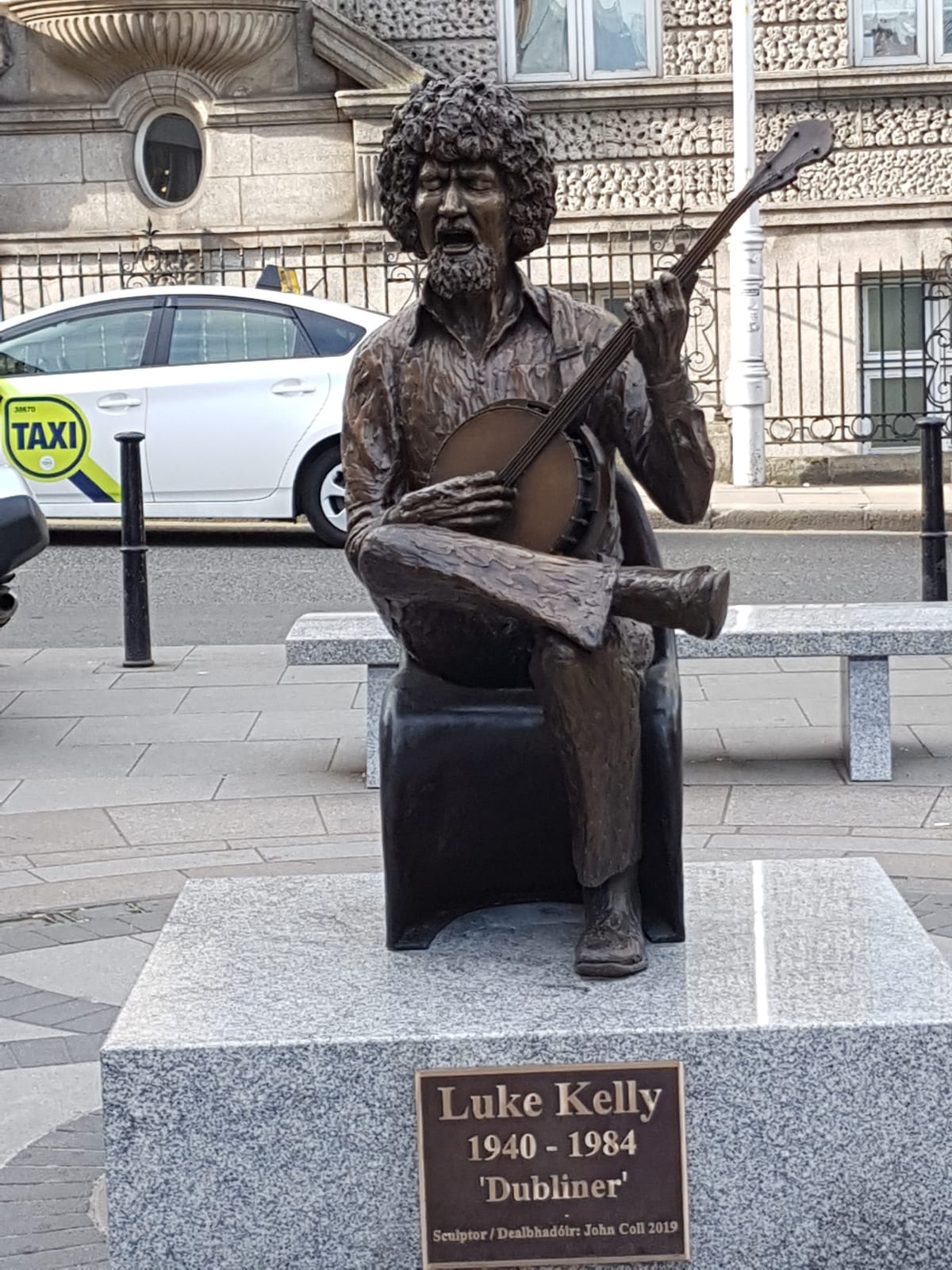
A rousing version of the song was performed in January of last year by Damien Dempsey accompanied by Kelly’s former bandmate John Sheahan on South King Street, a short walk from Grafton Street and Merrion Row and many venues that were home to performances by the Dubliners during the so-called “ballad boom”. This performance coincided with the 35th anniversary of Kelly’s death, aged just 43, but more positively it also announded the unveiling of a new bronze statue of the troubador and activist.
The unveiing of two pieces of public art celebrating the life and work of Luke Kelly provoked much fond reminiscence of him by friends and family, one area of his life that was discussed in detail was Luke’s love of football which was detailed in an excellent piece by David Sneyd in the Irish Mail on Sunday. The article had mentioned Kelly’s time as a schoolboy when he lined out for the famous Home Farm club, playing alongside future League of Ireland legend Billy Dixon.
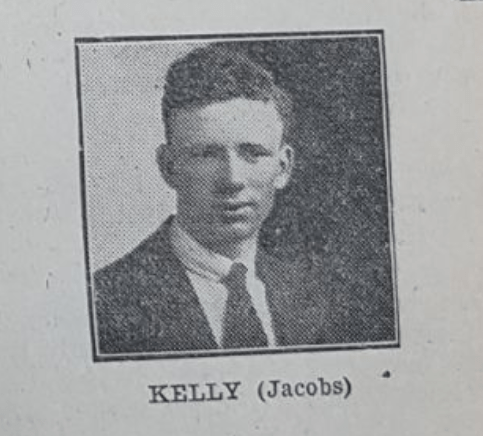
It also mentioned the playing career of his father, Luke Kelly Senior who played in the League of Ireland for Jacob’s F.C. In a piece for the “Lost Clubs” series on this website I focused on the history of Jacobs and in the course of my research had come across Luke Kelly Senior. A talented half-back or “pivot” in the Jacob’s teams of the late 1920’s. Reports at the time describe him as a “tireless worker” , a “typical tackler and spoiler” and “most consistent”, though he was mentioned as being a shade on the small side. He was however, no brutal hatchet man, plenty of reports mention his range of passing and ability to switch the play and begin attacks.
The “pivot” role so commonly ascribed to him was one which had developed as part of the old 2-3-5 formation. The “centre-half” was not yet a central defender, but played in a more advanced role as an instigator of attacking play who could also drop back and assist in defensive areas. Hence he functioned as the “pivot” between defence and attack. This would change gradually over the 1920s, especially after Arsenal had success with withdrawing a centre-half into a more definsive position of a third defended, helping create what became known as the W-M formation.
Luke Senior was born on 1st September 1904 in Ryan’s Cottages on Marlborough Place in Dublin’s north inner-city. He was the son of Paddy and Christina Kelly who had been married nearby in Dublin’s Pro-Cathedral in 1898. Paddy Kelly had been born in Bealnamulla, Co. Roscommon just outside Athlone back in 1867, he in turn was the son of another Luke Kelly also from Bealnamulla. Luke Sr. married Julie Fleming in September of 1934 in St. Laurence O’Toole’s church which sits next to Sheriff Street, a part of the city to be forever associated with his son, Luke Kelly the singer who was born nearby in 1 Lattimore Cottages, Sheriff Street less than six years later.
Football was obviously deeply engrained in Luke Kelly Sr. from an early age, in an interview many years later when his son was at the height of his fame, he remembered playing football in Fairview Park when he and his pals spotted a brigade of the Scottish Borderers marching towards the city. Kelly recalled in the Irish Independent that he and his friends followed them all the way into the city, jeering at them and throwing stones.
What the young Kelly did not realise then was that the Scottish Borderers regiment had been called into the city centre on serious businesses. Earlier that day the Irish Volunteers had taken possession of a cache of weapons brough by boat into Howth harbour and which were en route to the city. The Dublin Metropolitan Police had been ordered to confront the Volunteers but many would have had sympathy with the Nationalist cause.
As prominent Irish Volunteer and IRB member Bulmer Hobson noted “A considerable number of the police did not move and disobeyed the order, while the remainder made a rush for the front Company of the Volunteers and a free fight ensued, in which clubbed rifles and batons were freely used. This fight lasted probably less than a minute, when the police withdrew to the footpath of their own accord and without orders.”
As a result the Borderers were sent to disarm the Volunteers, they also failed in this task and eventually a growing crowd stoned and jeered them as they marched back to Richmond Barracks along the Dublin quays. The troops opened fire on this taunting crowd on Bachelor’s Walk, killing three bystanders and injuring 37, including a 9 year old Luke Kelly as the youngest victim.
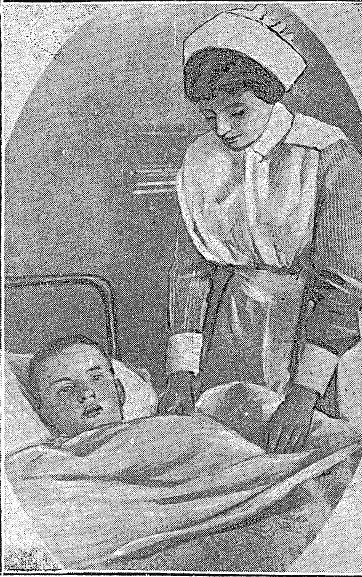
Kelly was shot in the back and a priest was called to administer to him as the staff in the nearby Jervis Hospital feared for his life. However Kelly was lucky and made a full recovery. A photo of him in his hospital bed even appeared in an edition of the Irish Independent a few days after the attack.
Photo taken from the Irish Independent July 28th 1914: Luke Kelly, a little schoolboy, a victim of the Borderers fusilade, in a ward in Jervis Street hospital
Kelly joined the Jacobs factory as an employee at the age of 16 and continued working for them for 46 years, until his passing in 1966. During his time with Jacobs he was an accomplished athlete, he ultimately played seven seasons in the League of Ireland with Jacobs, and although at one stage he was linked with a move to Fordsons in Cork, he remained with the Biscuitmen as a player even after they dropped out of the League of Ireland and returned to the Leinster Senior League.
Though Jacobs struggled for much of Kelly’s time as a player there are numerous reports that mention Kelly as their stand-out individual performer. Such was the high regard in which he was held as a player he was also selected to play in a number of high profile friendly matches, such as a charity game in aid of St. Vincent de Paul at Christmas 1927 as well as being picked to play for Shelbourne as a guest in a benefit match against Linfield for their star player, the Irish international, Val Harris.
Jacobs were justifiably proud of the sporting achievements of their employees, apart from a football team they also constructed a swimming pool for employees, based on the example of a pool built by Heinz for their workers in Pittsburgh. Kelly was also an able swimmer, though it did get him into trouble on one occasion. In May 1932 Luke Kelly senior (then aged 27) was arrested by a Garda Burns and charged with attempted suicide by drowning in the River Liffey.
Kelly’s defence to this charge was that he had been out with friends for a drink on Sunday and after some significant alcohol consumption a bet was proposed as to whether Kelly could swim across the Liffey from Custom House Quay. As part of Kelly’s defence it was stated that he was an excellent swimmer as evidenced by the fact that although he was wearing a hat at the time it had remained dry throughout. The Judge at the hearing of the case let Kelly off on the condition that he took the pledge and kept the peace.
To return to the opening lines of this piece, the words of Pete St. John as sung by Luke Kelly, it always struck me that they apply equally well to how we hear about football and its players when we are young, father’s, olders siblings, relations and bar-room bores regaling youngsters about scarcely believeable feats of skill from years gone by. Luke Kelly Senior was a friend of John Giles’ father Dickie and one can imagine that both Luke and John heard many romanticised tales from their respective fathers about their exploits on and off the field.
Raised on songs & stories Heroes of renown/ The passing tales & glories…











 A Bohemian Sporting Life