This is the story of Jocelyn Rowe, Joss to his friends, a man born in India, raised on the outskirts of the great Metropolis of London, who became a boy soldier, ended up in Dublin, joined the Bohemian Football Club, got poached by Manchester United sparking a controversy, defied death on numerous occasions on the battlefields of France and Belgium during World War I, only to return to football, becoming a mentor to younger players, holding his own with the best but never giving up his status as an amateur.
Jocelyn Rowe was born in Prayagraj (then more commonly referred to as Allahabad) in North East India in 1886. He was the son of Henry Smith Sutley Rowe and Elizabeth Rowe (neé Burt), Henry was a Sergeant in the 1st East Surrey regiment and Joss would have been born in the barracks where the family lived. The Naval Military Record noted that “Even as a small boy he was a keen football player”, and he was still a boy when he enlisted, following in his father’s footsteps joining the East Surrey regiment as a member of the band just two days after his 14th birthday.
The East Surrey regiment was an infantry regiment and the 1st Battalion, of which Joss was a member, remained in India until 1903 with their last posting being at Lucknow. They were then recalled to England and were posted to Aldershot, before moving to Jersey in 1905 and to Plymouth in 1909. During his time at Plymouth, Joss was able to indulge his love of sports, playing hockey for Devon against Navy teams while also lining out on occasion as a footballer for Plymouth Argyle.
By late 1912 the Easy Surrey’s were on their way to Dublin, there was a vibrant football scene already established in Dublin at this time, the top clubs such as Bohemian FC and Shelbourne were represented in the Irish League which was dominated, by and large, by the bigger Belfast sides, but there was also the Leinster Senior League which featured representation by Shelbourne and Bohemians as well as numerous other clubs from Dublin and the surrounding area including several of the better regimental teams.
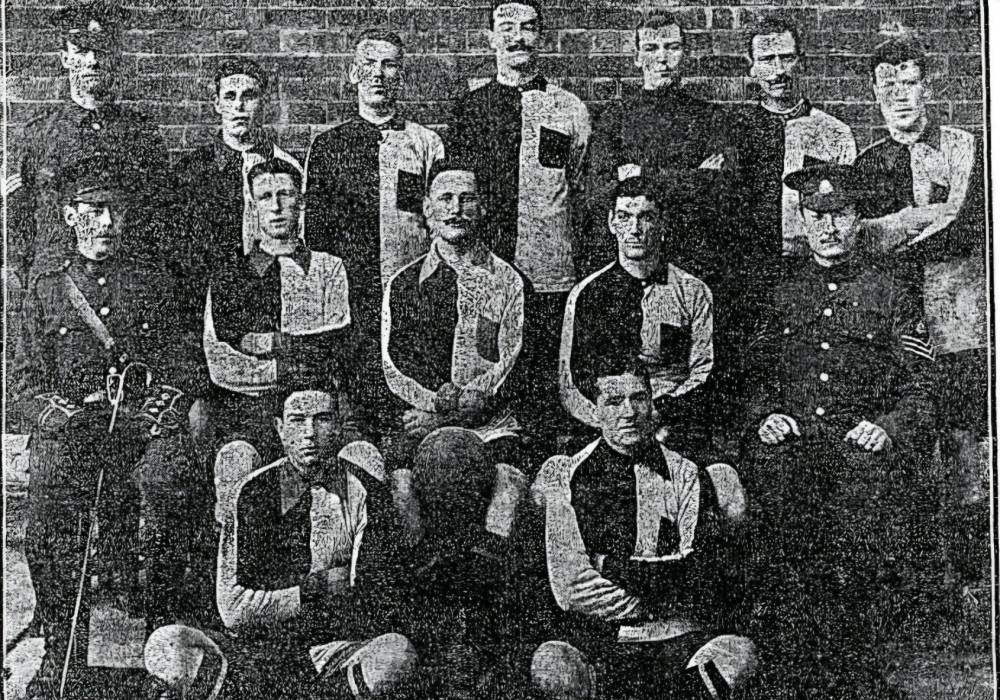
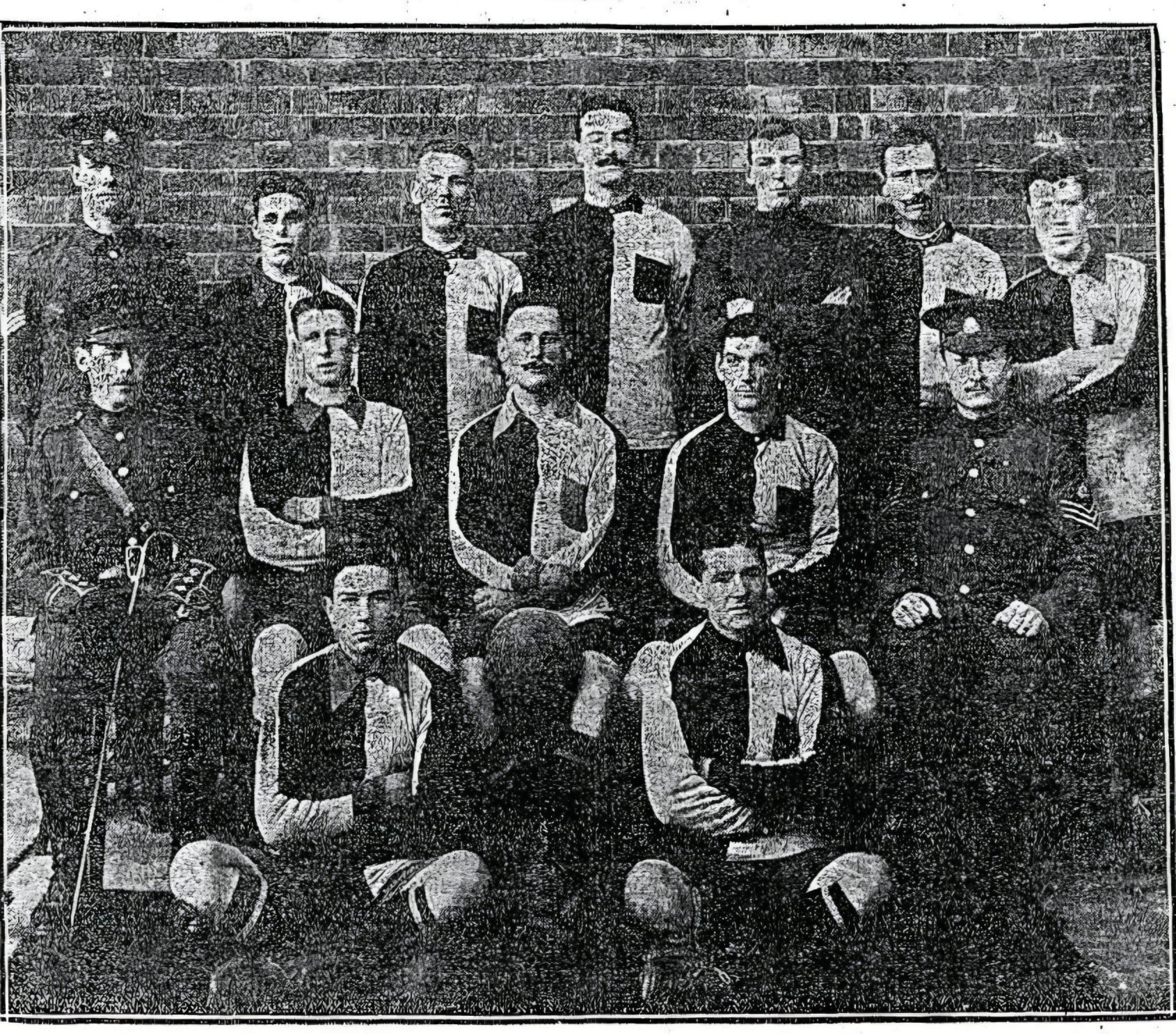
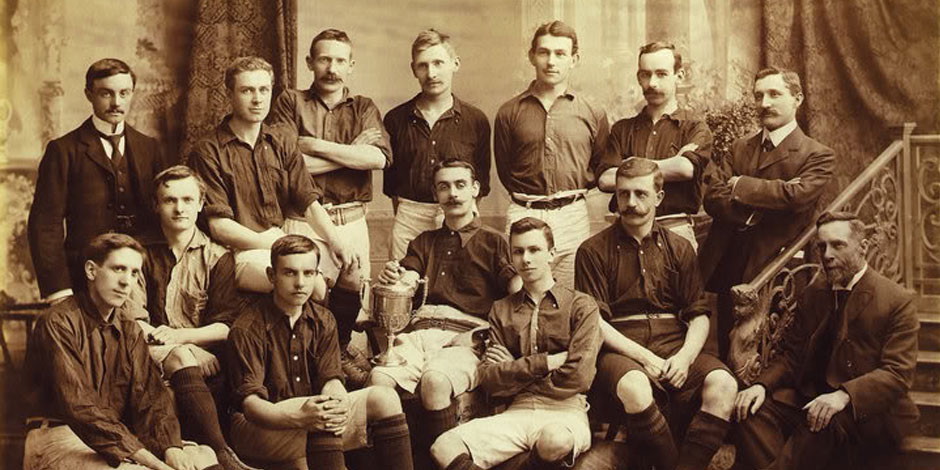
A Saturday Herald image of the 1st East Surrey football team from December 1912. Jocelyn Rowe is the tall man with the moustache, centre in the back row, he has the rank of Sergeant and is listed as the team captain.
The East Surrey’s were too late to register a side for the Leinster Senior League but did immediately play some Army Cup matches as well as a number of friendlies against civilian sides, the only game they lost in those early months in Dublin was against Bohemians and Joss Rowe was the regiment’s star full back.
By the time the photo above was printed in December 1912, Joss Rowe was already lining out for Bohemians as well as his regiment. In a report on 26th October 1912 in the Saturday Herald, Rowe featured in a 3-0 win over Shelbourne, scoring a goal in an Irish League game. Bohemians were without several stars such as Harry Willitts, Battie Brennan and Bill McConnell but were “strengthened by the inclusion of such celebrated internationals as Smith and Rowe” – this was a reference to Jocelyn Rowe and Alfred Smith who had already at that stage made representative apprearances in Army internationals.
The praise of Rowe throughout his time at Bohemians, and indeed throughout his career is fullsome and effusive, described as “a giant of a man, standing over six feet and magnificently built”, and as any casual view of the Surrey team photo shows, Rowe was indeed a well-built man and in some cases a head taller than his teammates, however match reports do not describe a bruiser full-back but point to a player noted for the timing of his tackling as well as the speed and precision of his passing to create counter-attacks from full-back.
Within a year of first appearing for Bohemians, Joss had been selected by the Irish League for a representative game against the Southern League which was played in Dalymount and won by the visitors. The Southern League were those clubs in the south of England who were outside the Football league, for that match in Dalymount this included representatives of clubs like Norwich, Brighton, Millwall, Crystal Palace, QPR and in the case of Bertie Bowler, a former teammate of Joss from Plymouth Argyle.
In 1913 Rowe was a member of the Bohemian side that appeared in the inaugural football match at Shelbourne Park, the new home of cross-city rivals, Shelbourne, that game ended in a 1-1 draw but was most famous for the events around the stadium which formed part of the wider 1913 Lock-out labour dispute. This game and the surrounding incidents are covered in more detail elsewhere on this site, but it is worth noting that among the Shelbourne team was Oscar Linkson, a defender signed that season from Manchester United. Linkson had been born in New Barnet and had made over 50 appearances for United over the previous five seasons, he had also recently married and his teenage wife Olive and a young son Eric came to Dublin with him. Just three years later Oscar would go missing during the Battle of the Somme, his body was never recovered.
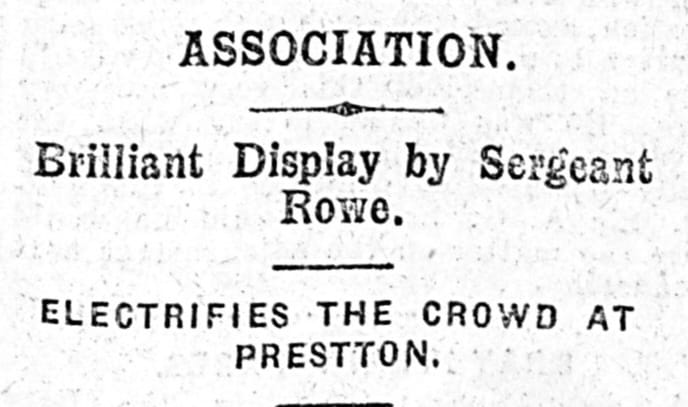
This was not to be Joss Rowe’s last connection with Manchester United however, the English club would recruit the Bohemian solider to their starting XI on 5th March 1914, with Rowe, appearing under an assumed name as “Howe” featuring as a full-back in United’s 4-2 defeat to Preston North End. Despite the result the match reports were universal in their praise for the mysterious new United full-back and he was expected to retain his place in the side for United’s next match against Aston Villa. Some reports went so far as to say “Sergeant Rowe, East Surreys and Bohemians… is quite on the cards that a new right full has been unearthed for England for her closing internationals. We can also mention that Rowe is equally at home at left full, or in any position in the middle line”. Despite playing under an assumed name against Preston, Rowe was spotted by a soldier of his acquaintance and his true identity quickly became known by the pressmen in Britain and Ireland and his performance was widely remarked upon. Even that talk of an international call-up!
Headline from the Evening Herald on March 6th, 1914
Despite the expectation that Rowe would line out again for Manchester United and his seeming enthusiasm to continue playing for them, quickly there were signs that this was not likely to happen. The Evening Despatch in the day before the scheduled game between Manchester United and Aston Villa mentioned that there was “interference by another association” that was preventing Rowe from taking his place in the team.
Rather than play for United on March 14th there were reports in the Westmeath Independent promoting the St. Patrick’s Day friendly match between Bohemians and Athlone Town in Athlone. Rowe was mentioned by name as the player who “created a sensation some days ago in English League football”. By the end of the month Manchester United were playing their first game in Dublin, beating Shelbourne 1-0 at in a friendly at Shelbourne Park on March 28th, but once again without Joss in their ranks. A couple of days later news came that Manchester United had been fined £20 by the FA for selecting Rowe for the match against Preston without giving notice to Rowe’s commanding officer, it was hoped that the heavy fine would deter other such approaches by clubs for the playing services of soldiers and sailors. Other football associations it was noted were also asked to play their part and prevent players from the armed services being selected without permission. Nottingham’s Football News went so far as to allege that Rowe’s true identity was leaked by a Dublin journalist who was on the same boat and who had attended the United game as a spectator, noting that “the identity of a good footballer is easily ascertained”.
Joss finished out the 1913-14 season with Bohemians while Manchester United had to look elsewhere for solutions having finished the season 14th in the top flight, they signed a new player from Hull that summer, Patrick O’Connell, a Dubliner from Drumcondra, although they continued to struggle the following season, but by the 1914-15 season’s close and in controversial circumstances football may have been of a secondary concern for the Manchester United players, they certainly were for Joss Rowe.
Britain’s entry into World War I was confirmed at midnight on August 4th, 1914. Immediatedly the 1st battalion of the East Surrey Regiment, Jocelyn Rowe included were mobilised, and by August 13th they had landed in Le Harve as part of the British Expeditionary Force. The British experienced some quick reverses on the battlefield which prompted what became known as the “Great retreat” or the “Retreat from Mons” named after the Battle of Mons which ended in a victory for the German forces. It was later reported that Rowe was injured during the retreat and his regiment the East Surreys were involved in heavy fighting throughout this period.
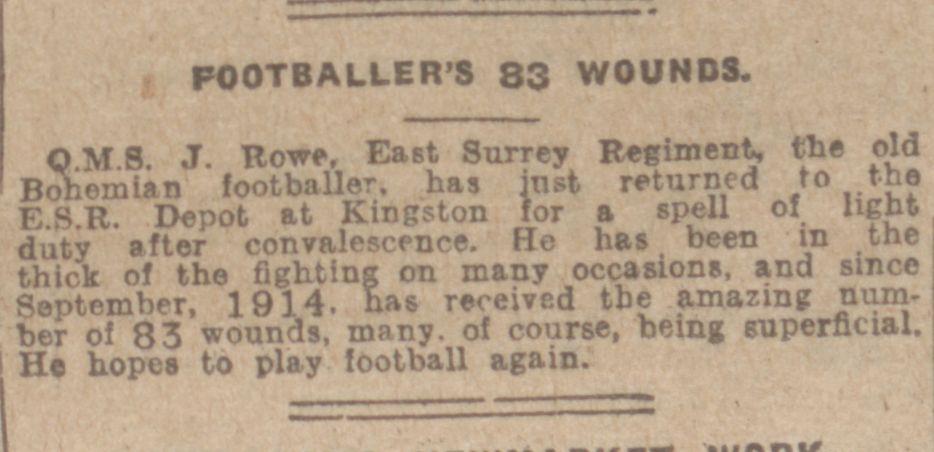
Joss recovered from his initial injuries and in December 1915, while on furlough back in Surbiton, Kingston upon Thames he managed to find time to marry his fiancé Margaret Thompson, both giving their addresses as 11 Cleaveland Road, Surbiton, a turn of the century terrace home that survives to this day. There was little chance for a honeymoon for the couple however as Joss was granted just eight days leave before he was back to the front and was severely wounded on New Year’s Eve of 1915, his regimental record listing a gun shot wound to the head, back, right leg and left hand. Amazingly Joss survived! The clipping below from an issue of the Irish Independent from March of 1916 details that Joss had received an astounding 83 wounds during his service, mostly from shrapnel, but not only had he survived, that “He hopes to play football again.”
Irish Independent from 30th March 1916
Joss did indeed play football again, although it was some time before he lined out again for Bohemians, returning in March 1917 in an Irish Cup semi-final against Belfast Celtic in the Oval, Belfast. Sadly, Bohemians lost 4-0 in the game, with the opening goal deflecting off Joss and passed Con Drumm in the Bohs goal to give Celtic the lead. This would seem to be one of the last games that Joss played for Bohemians. In an August 1919 edition of the Athletic News there was discussion about Bohs fortunes for the coming season and hope was expressed that the return to demobbed soldiers such as Harry Willits would boost Bohs chances for success and Joss was among those mentioned as being expected to return to the club.
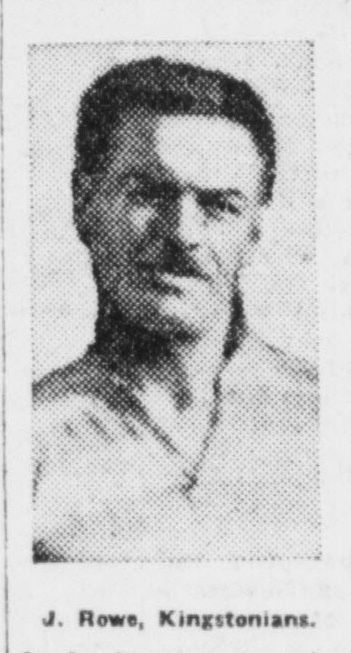
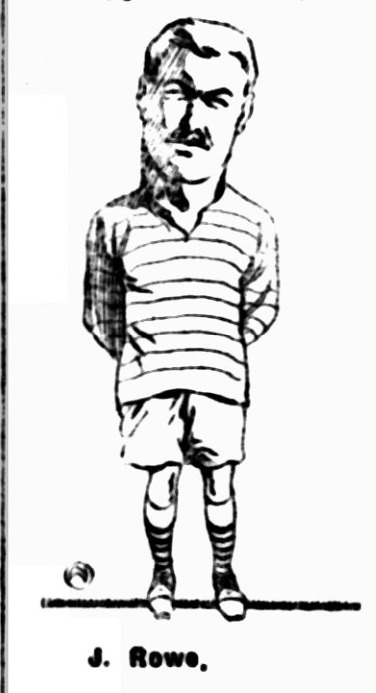
Much was changing in Joss’s personal life, finally away from the battlefield in May 1918 Joss and Margaret had welcomed a son, Anthony into the world, followed by a daughter, Margaret, in September of 1921. After the end of the War the 1st regiment continued in active service around the world, but Joss seems to have found himself back at barracks in Kingston upon Thames and from October 1920 was found playing for Kingstonian F.C. in the Athenian league having spent the previous year playing only Army football for the East Surrey depot.
Image from the Sunday Express, February 4th, 1923
While at Kingstonian he continued to excel, and played in several locations around the pitch, including in the forward line despite the fact that he was by now in his mid 30s. Josh continued on playing with Kingstonian until the 1923-24 season when the club made it as far as the London Senior Cup final, reports at the time stated that he was still playing at a good level but preferred to play in the reserves rather than deny a first team place to a younger player.
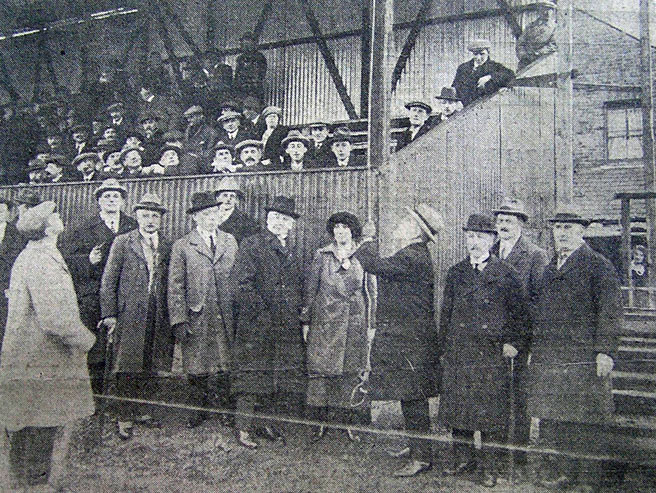
One late career highlight for Joss was captaining Kingstonian in a friendly match against FA Cup holders Huddersfield Town in 1922. Kingstonian had just purchased their Richmond Road ground and set about building a new stand that season, and among the club’s star performers was young striker Len Marlow who was snapped up by Huddersfield Town, then under the stewardship of revolutionary manager Herbert Chapman. As part of the transfer a friendly was to be played and Huddersfield also brought the FA Cup trophy to display before the game. In front of a record crowd of 8,000 Joss Rowe’s non-league Kingstonian defeated the FA Cup holders Huddersfield 1-0.
While he finally stepped away from football in 1924 Joss remained with the East Surrey regiment, only retiring in 1934 after 34 years of service. He continued living in the Kingston upon Thames until his death in May 1956, aged 70. During his sporting career, despite playing at the highest level in both England and Ireland he had remained strictly an amateur, though his selection for an Irish League XI and the enthusiastic pursuit of his services by Manchester United demonstrate that he certainly could have pursued a professional career if he had chosen to. The fact, that he lived to the age of 70, and played football at a good level into his late 30s is somewhat amazing considering the injuries he had suffered during the First World War, with varying reports describing either 83 or 86 bullet and shrapnel wounds.
We’re all stuck at home, talking a good game about catching up on our reading or perhaps finally completing that DIY project, more likely if you’re anything like me you’re mindlessly scrolling on your phone, or binge-watching lurid TV series on Netflix. Things are obviously a lot different if you are a frontline worker, in one of our hospitals, a member of our emergency services or working in essential retail businesses. The stress is very real. But this is not unique or unprecedented. This too shall pass.
Just over 100 years ago Ireland faced a not dissimilar epidemic. While the Spanish Flu was something of the misnomer, it was very real, and very deadly. Conservative estimates place the Irish death toll from the virus at over 20,000 from Summer 1918 to Spring 1919. Consider also that this came towards the end of the First World War which claimed the lives of perhaps 50,000 Irish people and saw a country in a state of turmoil on the topics of nationhood, conscription, poverty and on the brink of a violent War of Independence. We can perhaps sympathise with their plight.
Unlike today however, the people of Dublin in 1918 and 1919 had football. Despite schools closing, and many businesses shutting due to illness and self-quarantine measures, football continued in something akin to its usual patterns. To set the scene; at the end of the 1914-15 season due to rising costs, loss of players and supporters to the war-effort and the general disruption brought by the War, the Irish League split into regional competitions for the rest of the War. Bohemians and Shelbourne, the two Dublin sides in an eight-team league dominated by the main Belfast clubs, returned to the Leinster Senior League, and this in effect was our main league for the War and its immediate aftermath. The main Irish Cup competition still ran on an all-Ireland basis, though the early round draws were regionalised, while other trophies such as the Leinster Senior Cup were major priorities.
If anything, the years 1918 and 1919 brought almost a return to normality for Bohemians, the club had lost dozens of players to the War and many more in terms of supporters. At a conservative estimate some 50,000 Dubliners ended up in the battlefields of the First World War and perhaps 8,000 of them never made it home. This impacted not just Bohemians but every football club in Ireland. The Leinster Football Association (LFA) saw a reduction in affiliated clubs which declined by 50% during wartime and by 1919 the LFA had to go cap in hand seeking a grant or loan from the IFA to try and keep the Association afloat. A major concern for Bohemians (and many other clubs) was getting players released from their regiments in order to play for the team. In several games Bohs were hamstrung because of missing key players due to the refusal of the British armed forces to release players for matches, even after the armistice.
A clipping from Sport showing Bohemian FC player Harry Willitts in army uniform in 1917
Despite all this upheaval there were still notes of optimism to be found, Bohemians won the Leinster Senior League – the highest level played by clubs outside of Belfast, in the 1917-18 season and came second to Shelbourne the following year. It should be noted that Bohs, despite the loss of numbers due to the War, were still fielding at least two teams at the time, with a Bohemian “B” side competing at Leinster Senior League Division Two against the like of St. James Gate and Glasnevin F.C.
The influenza epidemic first noticeably hit Ireland in early summer of 1918 as the football season was ending, but arguably had its peak in Dublin in October and November 1918, as well as continuing into the Spring of 1919. There were perhaps three different peaks of the epidemic. One theory for the surge in cases in November 1918 was that people congregated en masse to celebrate the end of the War and inadvertently helped spread the virus. Unlike most of the Covid-19 cases at present the “Spanish flu” (thus described because neutral Spain reported the first cases, it had been rife in the trenches of France and Belgium months earlier) seemed to affect younger, healthier people, with many in their 20s and 30s dying and leaving young families without parents.
One report in The Irish Times on November 16th 1918 noted that between September 28th and November 9th some 756 people had died of the influenza virus in Dublin City alone. Two days later Shelbourne beat Bohs in the league in front of what was described as “a record crowd of the season”. It was a good time for Shels at this point, they seemed to have the upper hand over their main Dublin rivals, the famous Bohemians, in both 1918 and 1919 they knocked Bohs out of the first round of the Irish Cup. In February 1919 they won their Cup match in Dalymount (at another resurgent point for the flu epidemic) in front of a crowd of over 8,000, which was described as a record attendance in Dublin since the outbreak of War.
Indeed, not happy with just the usual run of fixtures Bohs decided to host an alternative Cup final on 29th March 1919. On the same day that Linfield were playing Glentoran in the first of three finals (two drawn games followed by an eventual Linfield victory on the 7th of April) Bohs agreed to host beaten semi-finalists Belfast Celtic in front of a bumper crowd in Dalymount. The Bohs would triumph 2-1 on the day.
Belfast Celtic teams of the era
While the Dublin public were waylaid from all sides by death, whether from War, revolution or disease, somehow football continued, in the case of Bohemians the club saw suffering and death in the war, former players like Fred Morrow, Harold Sloan, Francis Larkin and others had died in action and many more were seriously injured. But during the Spanish Flu epidemic, partially spread by the return of so many soldiers from the front in 1918, while some quarantine measures and closures of businesses and schools did take place football continued as usual.
This article originally appeared in the Bohemian F.C. lockdown match programme which you can read in its entirety here.
An introduction to just some of the Bohemian F.C. members who swapped the playing fields of Ireland for the killing fields of Europe.
Fred Morrow was only 17 when he took to the pitch for Bohemians at the curtain raiser at their great rivals’ new home, Shelbourne Park. The Bohs v Shels games were known then as the Dublin derby and as with many derbies, passions were inflamed. But this game’s atmosphere was even more heightened and it wasn’t just to do with the 6,000 spectators packed into the ground. Even in just getting to the ground Morrow and his teammates had seen over one hundred Dublin Tramway workers picketing the game.
The 1913 Dublin lock-out was only a few days old and Jim Larkin had declared that there were players selected for the game who were “scabs”: Jack Millar of Bohemians and Jack Lowry of Shelbourne were the names identified during the strike. The striking tramway workers subjected the players and supporters to (in the words of the Irish Times) “coarse insults” and had even tried to storm the gates of the new stadium. Foreshadowing the events of the next day, there were some violent altercations with the officers of the Dublin Metropolitan Police, with 16 arrests made and over 50 people suffering injuries.
This can’t have affected the teenaged Morrow too badly as he scored Bohs’ goal in a one all draw that day. Although less than 5’5” in height, the youngster was shaping up to be quite a prolific centre forward. Fred had started his career early, lining out for his local side Tritonville FC based in Sandymount, and while with the club he had won a Junior cap for Ireland, scoring in a 3-0 victory over Scotland in front of over 8,000 spectators in Belfast. The following season he’d been persuaded north of the river to Dalymount, and he was to enjoy a successful season including scoring a hat-trick in an unexpected 3-1 victory over title holders Linfield.
The Shelbourne side that Bohs faced that day included in their ranks a new signing of their own, Oscar Linkson, who had just been signed from Manchester United. Linkson had made almost 60 appearances for United and had been at the club when they won the FA Cup in 1909 and the League in 1911. Quite the coup, then, for Shels. Oscar moved to Dublin with his 17 year old wife Olive and his son Eric, who would be joined by a baby sister just months later. He faced Fred Morrow that day as part of the Shels defence.
Within a year of this game, War would be declared. Both Fred Morrow and Oscar Linkson volunteered to serve in the British Army, Oscar with the famous “Football Battalion” of the Middlesex Regiment alongside a whole host of star players which included the Irish international John Doran. Neither Fred nor Oscar would return, by the end of 1917 both were dead on the fields of France.
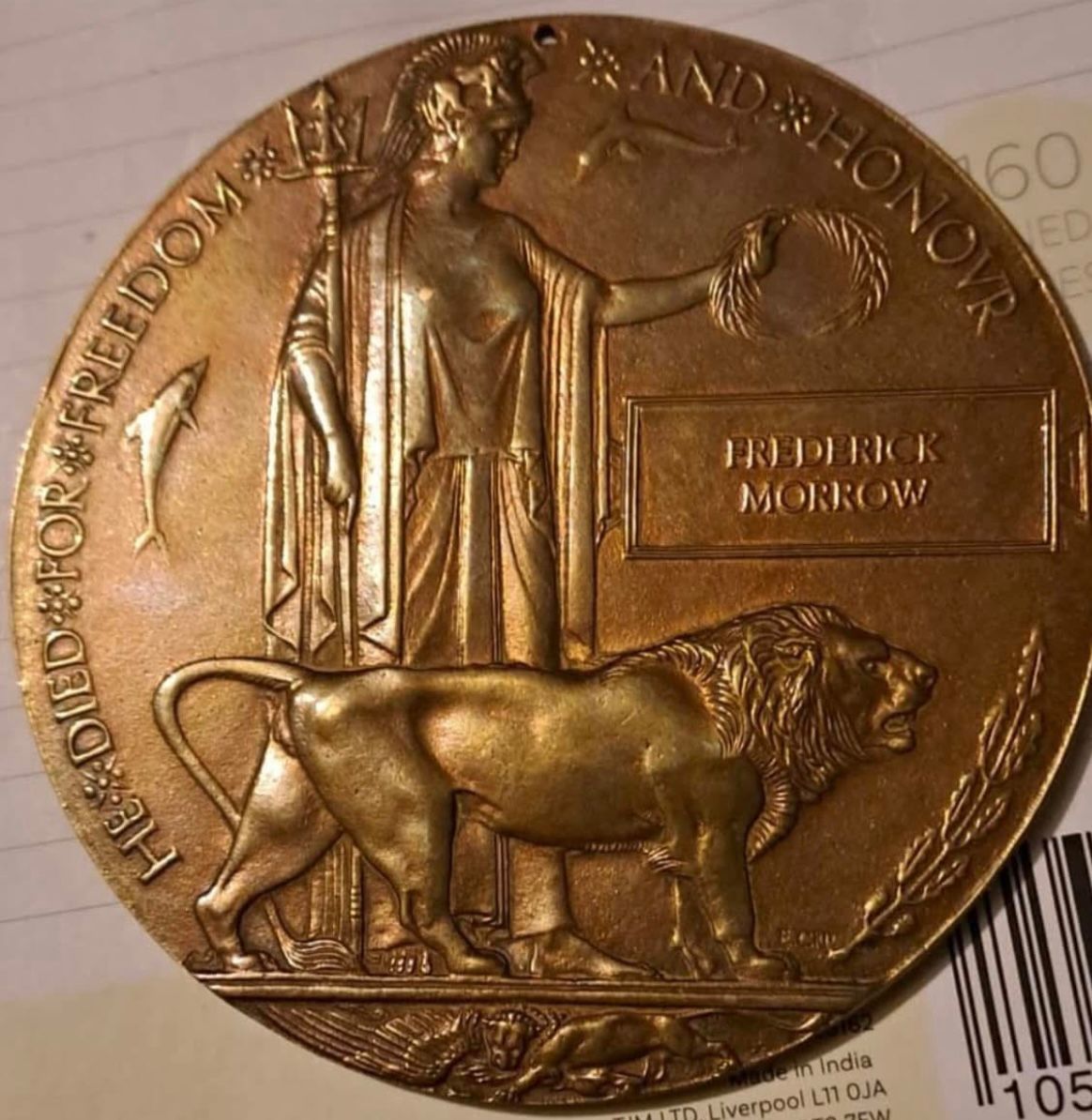
The Memorial plaque or “Death penny” issued to Fred Morrow’s family
The events that the players had witnessed leading up to that Bohs v Shels game had far-reaching consequences, with the violence in the adjoining Ringsend streets at the game growing worse over the following day, culminating with violent clashes between the Dublin Metropolitan Police and striking workers on Sackville Street (now O’Connell Street). Hundreds were wounded amid baton charges and three striking workers were killed. The dramatic events convinced Union leaders James Connolly, James Larkin and Jack White that the workers needed to be protected, and that an Irish Citizen Army needed to be formed for this purpose. Ireland’s decade of lead had begun.
A year earlier in 1912, in response to the passing of the third Home Rule bill, and the possibility that Home Rule would finally become a reality in Ireland, hundreds of thousands of Irish Unionists signed what was known as the Ulster Covenant, where allegiance was pledged to the King of England. They stated that Home Rule would be resisted by “all means necessary”. This included the very real possibility of armed resistance, as demonstrated by the Ulster Volunteers (formed in 1912) importing thousands of rifles into the port of Larne from Germany in April 1914. In response, the Irish Volunteers, supporters of Home Rule formed in order to guarantee the passage of Home Rule bill, also imported German arms into Howth in July 1914; just days before the outbreak of the First World War. This mini arms-race in Ireland mirrored the greater stockpiling of armour and weaponry by the great European powers in the lead-up to the First World War; the whole Continent was in the grip of militarism. Violence seemed, to many people, to be unavoidable.
Clashes on Sackville Street during the 1913 lock-out
Over 200,000 Irish men fought in the First World War. To put this in perspective, the total male population of Ireland at the 1911 Census was just over 2.1 million. Those who fought did so for many reasons. Some, including many members of the Irish Volunteers, heeded John Redmond, the leader of the Irish Parliamentary Party who called on Irishmen to go and fight to help secure Home Rule, as a gesture of fidelity to Britain, in support of Catholic Belgium and in defence of smaller nations.
Redmond asked Irish men to prove “on the field of battle that gallantry and courage which has distinguished our race” in a war that he said was fought “in defence of the highest principles of religion and morality”.
Some men went in search of adventure, unaware then of the horrors that awaited them. Many Dublin men joined up as a way to financially support their families, the city at the time had a population of 304,000, with roughly 63% described as “working class”, the majority of whom lived in tenement houses, almost half with no more than one room per family. The army might offer death but least it offered a steady income.
What we also know is that many Bohemians joined up. Some like Harry Willits or Harold Sloan may have simply joined out of a sense of duty, that this was the “right thing to do”. Most joined in what was known as a “short service attestation”, meaning that they were only joining for the duration of the war, which many mistakenly assumed would be over quickly. In one edition of the Dublin based weekly paper Sport, it was estimated that Bohemians lost forty members to War service, among the highest of any club in the whole country, although we know that there was also significant enlistment from other Dublin clubs such as Shelbourne and Shamrock Rovers, while the loss of players to military service was cited as one of the reasons for the withdrawal from football of the original Drumcondra F.C.
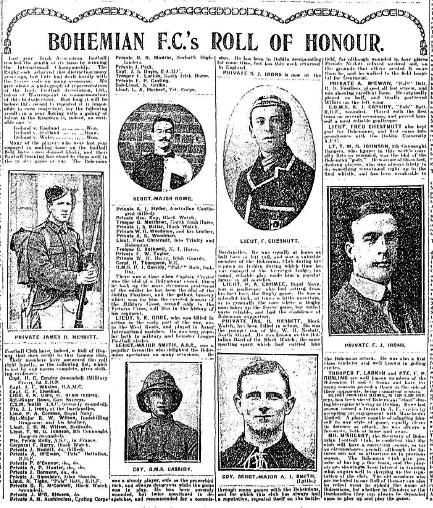
Bohemian F.C. Roll of Honour – Evening Herald, September 1915 source @Cork1914to1924
Some like Harry Willits did return to resume their football career. Several did not return at all. Corporal Fred Morrow, who we met earlier as Bohs centre-forward, was a member of the Royal Field Artillery in France when he died of his wounds in October 1917. His mother had to write formally asking for the death certificate that the armed forces had neglected to send so that she could receive the insurance money for his funeral.
Private Frank Larkin was only 22 when he died just before Christmas 1915. He had been a Bohs player before the war. At this time, due the growing popularity of both the club and football generally in Dublin, Bohs often fielded several teams. Frank featured for the C and D teams, but like many Bohemians, was a fine all-rounder. He played cricket for Sandymount and rowed for the Commercial Rowing Club. He and two of his colleagues from the South Irish Horse were killed by a shell on December 22nd in Armentieres, Belgium. His will left a grand total of £5 14 shillings and 2p to his two married sisters.
Thomas Johnson as pictured at Royal Lytham & St. Anne’s Golf Club in his later years
Thomas Johnson, a young Doctor from Palmerstown was just 23 when the War broke out. He had won an amateur international cap for Ireland and was a star of the Bohs forward line, usually playing at outside right. He was a hugely popular player who the Evening Herald described as “always likely to do something sensational”. He was another fine sporting all-rounder with a talent for both cricket and golf. Johnson became a Lieutenant in the 5th Connaught Rangers during the War and later brought his professional talents to the Royal Army Medical Corps. He was awarded the Military Cross for his actions at Gallipoli. He received numerous citations for bravery, for example at the Battle of Lone Pine during the Gallipoli campaign the Battalion history notes “Second-Lieutenant T.W.G. Johnson behaved with great gallantry in holding an advanced trench during one of the counter-attacks. Twice he bound up men’s wounds under heavy fire, thereby saving their lives”.
While his medical skills were a great asset in saving lives Johnson also was a fierce soldier during the most brutal and heavy fighting. He was awarded the Military Cross specifically for his actions around the attack on the infamous Battle of Hill 60 where so many Irishmen perished. The battalion history states that on August 21st 1915
“Lieutenant T.W.G. Johnson went out to the charge, with rifle and bayonet, and killed six Turks. He shot two more and narrowly missed killing another one. Later, although wounded severely, he reported to the commanding officer, and showed exactly where the remaining men of his company were still holding their own, in a small trench on “Hill 60.”
It was by this means that these men eventually were carefully withdrawn, after keeping the Turks at bay for some hours.” . Hill 60 of course was for many years the name by which Dubliners knew the terrace at the Clonliffe Road end of Croke Park, it was only in the 1930’s that it became known as Hill 16 and later the apocryphal story emerged that the terrace had been built from the ruins of O’Connell Street after the Easter Rising.
Herbert Charles Crozier – back row far left. Harold Sloan – front row third from the right
Other Bohemians suffered serious wounds but managed to make it through to the armistice. One of the most prominent of these was Herbert Charles “Tod” Crozier. He had joined Bohemians as a 17 year old and took part in the victorious Leinster Senior Cup final of 1899. In 1900 he appeared for Bohs on the losing side in an all-amateur Irish Cup Final, which was won 2-1 by Cliftonville. Crozier was described as one of the most “brilliant half-backs playing association football in Ireland” and he formed a formidable and famous midfield trio of Crozier-Fulton-Caldwell who were still revered for their brilliance decades after their retirement. “Tod” had a long association with Bohemians and was also a prominent member of Wanderers Rugby Club. He grew up on Montpellier Hill, close to the North Circular Road and not far from Dalymount.
Major H.C. Crozier
His Scottish-born father was a veterinary surgeon but “Tod” became a career military man with the 1st battalion of the Royal Dublin Fusiliers. In 1908 he was awarded the Bronze Star by the Royal Humane Society while serving in Sudan for trying to save the drowning Lieutenant Cooper from the River Nile. It was noted that he behaved with great bravery despite knowing of the “dangerous under-current and that crocodiles were present”. He was a Captain at the beginning of the War and was part of the Mediterranean Expedition Force that travelled to Gallipoli. It was here that he was wounded, and as a result of his actions was awarded the Military Cross, and later, after a promotion to the rank of Major, the Military Star. Despite the wounds he received at Gallipoli he returned to Montpelier Hill in Dublin and continued to attend football and rugby games. He was still enough of a well-known figure that he was the first person quoted in a newspaper report about Bohs progression to the 1935 FAI Cup Final. He lived to the age of 80, passing away in 1961 and was buried in Mount Jerome Cemetery.
One man who returned from the War and then joined Bohemian F.C. was the legendary Ernie Crawford. Born in Belfast in 1891 Ernie was perhaps best known for his endeavours on the Rugby pitch. He starred for Malone in Belfast and later Lansdowne Rugby Club and won 30 caps for Ireland, fifteen of them as Captain. He would later be named President of the IRFU. His obituary in the Irish Times listed him as one of the greatest rugby full-backs of all time, he was honoured for his contribution to sport by the French government and even featured on a Tongan stamp celebrating rugby icons.
Ernie Crawford in uniform, on a Tongan stamp and as an Irish Rugby international
He was, however, a successful football player who turned out for Cliftonville and for Bohemians. Ernie, a chartered accountant by trade, moved to Dublin to take up the role of accountant at the Rathmines Urban Council in 1919, and this facilitated his joining Bohemians. Despite his greater reputation as a rugby player, Ernie, as a footballer for Bohs, was still considered talented enough to be part of the initial national squad selected by the FAIFS (now the FAI) for the 1924 Olympics. In all, six Bohemians were selected (Bertie Kerr, Jack McCarthy, Christy Robinson, John Thomas & Johnny Murray were the others and were trained by Bohs’ Charlie Harris), but when the squad had to be cut to only 16 players Ernie was dropped, though he chose to accompany the squad to France as a reserve. The fact that he was born in Belfast may have led to him being cut due to the tension that existed with the FAIFS and the IFA over player selection.
That he could captain the Irish Rugby Team and be selected for the Olympics is even more impressive when you consider that during the Great War Ernie was shot in the wrist causing him to be invalided from the Army and to lose the power in three of his fingers. He had enlisted in the 6th Inniskilling Dragoons in October 1914 and was commissioned and later posted to the London Regiment (Royal Fusiliers), becoming a Lieutenant in August 1917. He was a recipient of the British War and Victory Medals. Ernie later returned to Belfast where he became City Treasurer. It was in Belfast in 1943 that Ernie encountered Bohs again, as he was chosen to present the Gypsies with the Condor Cup after their victory over Linfield in the annual challenge match. He passed away in January 1959.
So who were these men who went to war? From looking through the various records available (very much an ongoing task) it is clear to see that they were of a variety of different backgrounds. Most were from Dublin, though some like Sidney Kingston Gore (born in Wales) were only in Dublin due to Military placement. Some like Harry Willitts came to Dublin as a young man, others like Crozier and Morrow were children to parents from Scotland, Belfast or elsewhere. They were of various religious beliefs with Catholics, Church of Ireland and Presbyterians among their number.
By the outbreak of the War Bohemian F.C. was not yet 25 years old, some of those who had helped to found the club as young men were still very much involved. The employment backgrounds of the men who enlisted seem to have connections back to those early days when young medical students, those attending a civil service college as well as some young men from the Royal Hibernian military school in the Phoenix Park helped found the club. There were a number who are listed as volunteering for the “Pals” battalion of the Royal Dublin Fusiliers, in this case more than likely the 7th battalion. This battalion was made up of white collar workers and many civil servants, they were sometimes referred to as the “Toffs among the toughs”.
The 7th Battalion also featured a large number of Trinity College graduates, as well as many Rugby players encouraged to join by President of the Irish Rugby Football Union, F.H. Browning, a number of those who joined would end up dead on the beaches of Gallipoli. Browning later died after encountering the Volunteers on return from maneuvers at Mount Street Bridge during Easter 1916. The medical profession is clearly represented by men such as Thomas Johnson and J.F. Whelan. There were also characters like Alfred Smith and Tod Crozier who were career military men.
We know that like many Bohemians they were great sporting all-rounders, many being talented Rugby players, rowers, tennis players and cricketers in addition to their talents on the football field. In most cases they were young; Fred Morrow was still a teenager when he joined up, Frank Larkin only 21. Even the prematurely bald Harry Willitts looked much older than his 25 years.
Those who did return from the trenches came back to an Ireland that was changed utterly. The events of the Easter Rising, the growth in Republican Nationalist sentiment and the gathering forces that would soon unleash the War of Independence meant that those who returned may well have felt out of step with the Dublin of 1918-19. Those mentioned above are only a small selection of the Bohemians who took part in the First World War, there are many more stories; of Ned Brooks the prolific centre forward posted to Belfast who ended up guesting for Linfield, of Jocelyn Rowe the half-back who had also played for Manchester United who was injured in combat. There are many others forgotten to history. Those men described above often only appear in the records because of their death or serious injury, many more passed without comment. For men like Harry Willits and Tod Crozier, they could return to familiar surroundings of Dalymount Park whether as a player or just as a spectator. Some of those who returned, like Ernie Crawford, were yet to begin their Bohemian adventure. Among this latter group was a dapper Major of the Dublin Fusiliers named Emmet Dalton. He was a man who had won a Military Cross for his bravery in France and trained British soldiers to be snipers in Palestine. On his return to Ireland, he would join Bohemians as a player along with his younger brother Charlie. Both men would also join the IRA. They would play a central role in the War of Independence and the Civil War though they weren’t the only Bohemian brothers with this distinction as I’ll outline in my next piece.
A partial list of Bohemian F.C.members who served in World War I
Captain H.C. Crozier (wounded, recipient of the Military Cross) 1st Royal Dublin Fusiliers. Later promoted to Major.
Lt-Colonel Joseph Francis Whelan Royal Army Medical Corps, recipient of the Distinguished Service Order for his actions in Mesopotamia (Bohemian player, committee member and club vice-president). Later awarded and O.B.E. as well as an Honorary Master of Science degree by the National University.
Surgeon Major George F. Sheehan, Royal Army Medical Corps. Awarded the D.S.O.
Lieutenant Sidney Kingston Gore, 1st Battalion Royal West Kent Regiment (killed in action). He died after being shot in the head on 28th October 1914 near Neuve Chapelle he was a talented centre-forward who was particularly strong with the ball at his feet.
Sgt-Major Jocelyn Rowe, 1st Battalion, East Surreys (wounded in action). Rowe was born in Nottingham and had briefly played for Manchester United. A report in the Irish Independent of 30th March 1916 stated that Rowe had been wounded an astounding 83 times but was still hopeful of playing football again.
Company Sgt-Major Alfred J Smith, Army Service Corps, (amatuer Irish international, wounded in action)
Private Joseph Irons, on guard duty at the Viceregal Lodge during Easter 1916 he later served duty in the Dardanelles campaign. Irons was born in England and was considered one of the best full-backs in Irish football, he worked on the staff of the Viceregal Lodge (now Áras an Uachtaráin) before being called up to the army from the reserve on the outbreak of War.
Lieutenant P.A. Conmee, Royal Navy (a former Rugby player and a goalkeeper for Bohemians)
Sgt-Major B.W. Wilson Inniskilling Dragoons
Lieutenant JRM Wilson, Bedfords (brother of above)
Reverend John Curtis, Royal Army Chaplains’ Department
Lieutenant Thomas William Gerald Johnson, 5th Connaught Rangers and later Royal Army Medical Corps (wounded in action, awarded the Military Cross for his actions in taking the infamous “Hill 60” during the battle for Gallipoli). Also an Irish amateur international player.
Private Frank Kelly, Army Service Corps
Lieutenant Ernie Crawford, Inniskilling Dragoons and Royal Fusiliers
Corporal F. Barry, Black Watch
Second lieutenant Charlie Webb, King’s Royal Rifle Corps. He was captured in March 1918 near Nesle in Northern France and saw out the war from a Prisoner of War camp near Mainz. Webb was an Irish international forward who was born into a military family in the Curragh Camp, Co. Kildare. He played for Bohemians between 1908-09 but is most associated with Brighton & Hove Albion where as a player he scored the winning goal in the 1910 Charity Shield Final. He later became Brighton’s longest serving manager, beginning in 1919 and continuing until 1947, a span that covered over 1,200 matches.
Private James Nesbitt, Black Watch (killed in action 16/07/15) the son of W. H. and Jeannie Nesbitt, of 54, North Strand Road, Dublin. James was a Customs and Excise Officer at Bantry, Co. Cork, at the outbreak of war. Although badly injured he directed medical attention to other wounded men. He walked back to the field hospital but died soon afterwards. Nesbitt was also a member of the Irish Parliamentary Party who sat on Blackrock Urban Council. He was known as the “Battalion Bard” as he amused the other troops by writing and singing “topical songs”. Nesbitt mostly played for the Bohs C and D teams.
Sergeant Harrison McCloy, Tank Corps. (Killed in action) McCloy was born 12th December 1883 in Belfast. He continued a common tradition of being a footballer for Clinftonville before joining Bohemians. He was a player for Bohemians from 1902 to 1905 including appearing for the first team in the Irish League. He later moved into an administrative role and was a club Vice President for Bohemians from the 1905-06 season through to 1911-12, He was also mentioned as having been Honorary Secretary of the Irish League in 1911. He had been part of the Young Citizens Volunteers before transferring to the Tank Corps serving as a Quartermaster Sergeant during World War I. His main role was supervision and security of tanks used in battle pre or post engagement. He was killed in Belgium by enemy shellfire on the 21st August 1917 whilst engaged in such duties. He was 33 years old. Buried in the White House Cemetery St-Jean-Les-Ypres. His gratuity was left to four of his siblings.
Harrison McCloy, who was killed aged 33
Corporal Fred Morrow, Royal Field Artillery (formerly of Tritonville F.C. Bohemian F.C. and Shelbourne), killed in action 1917.
Private Angus Auchincloss from Clontarf joined the Army Cycling Corps in 1915 and transferred to the Royal Irish Rifles in 1916. He was discharged in 1919 and died in Eastbourne, England in 1975 at the age of 81.
Lieutenant Harold Sloan, Royal Garrison Artillery killed in action January 1917.
Major Emmet Dalton, Royal Dublin Fusiliers. On returning to Dublin Dalton became IRA Head of Intelligence during the War of Independence and later a Major-General in the Free State Army.
Lieutenant Robert Tighe, 5th Battalion Royal Dublin Fusiliers
Private G.R. McConnell, Black Watch (wounded)
Trooper Francis Larkin, South Irish Horse (killed in action)
Major Fred Chestnutt-Chesney, 6th Lancashire Fusiliers (former goalkeeper for Bohemians and for Trinity College’s football team). Later a Church of Ireland Reverend. Wounded in combat by a gun shot to his left leg.
Private J.S. Millar, Black Watch
John C. Hehir, the star goalkeeper for Bohemians until January 1915. He was also capped by Ireland in 1910. Hehir played rugby for London-Irish and also won a Dublin Senior Club championship medal with the Keatings GAA club in 1903. He left Bohs to take up an “important role” with the War Office in London
Lieutenant William James Dawson, Royal Flying Corps. Injured in 1917 he returned to action but died in 1918. He was also a member of the Neptune Rowing Club and the Boys Brigade.
Private F.P. Gosling, Black Watch and later the Machine Gun Corps
Lieutenant L.A. Herbert, Veterinary Corps
Private Bobby Parker, Royal Scots Fusiliers. Parker was the English First Divisions top goalscorer in the 1914-15 season as he helped Everton to the League title. However, after league football was suspended Parker enlisted and was wounded in early 1918. Despite attempts to continue his playing career the bullet lodged in his back essentially meant his time as a player was over at the age of 32 after a brief spell with Nottingham Forest. Parker moved into coaching and in 1927 was appointed coach of Bohemian FC, a position he held until 1933. He led Bohemians to a clean sweep of every major trophy in the 1927-28 season.
Private William Woodman, 7th Battalion Royal Dublin Fusiliers and his brother Private Albert Woodman, Royal Engineers. After the war Albert returned to his job at the General Post Office, working there until his retirement. During World War II, he worked as a censor and redactor. He bought a home on Rathlin Road, in Glasnevin. Albert passed away in 1969, at the age of 78. For more on the Woodman family see here.
Private Stephen Wright served with the Leicestershire Regiment and the Royal Army Medical Corps during World War I. Born in Leicester he had two spells with Bohemians, before the outreak of the war, and again in the 1919-20 season. He would also appear for Bolton Wanderers, Norwich City and Brighton and Hove Albion. He returned to Ireland as a coach after breaking his leg while at Brighton, taking up a role at Dundalk in 1930 and leading the Louth club to their first ever league title in the 1932-33 season.
Private F. W. Taylor
Corporal H. Thompson, Royal Engineers
Trooper Griffith Mathews, North Irish Horse
Part of a series of posts on the history of Bohemian F.C from 1913-1923. Read about Bohs during Easter 1916 here or about the life and career of Harry Willits here.
When Harry Willits finished his first season as Bohemian captain in spring 1916 he had other major responsibilities on his mind. He had joined the Royal Dublin Fusiliers in late 1915 “for the duration of the war” and soon he would be sent to the western front in France during the Battle of the Somme.
He had followed his friends and several Bohemian colleagues in signing up for the army. His choice was the Commercial Battalion of the Dublin Fusiliers, established to cater for young men of the “commercial class” and farmers.
Willits was not the military type, according to his daughter Audrey, still living in the family home aged 93. But English-born and a civil servant, he moved in circles where enlisting for military service would have been regarded as a matter of duty.
He was promoted to corporal in February 1916, three months after enlisting. According to military records he became a sergeant in July 1916, though he was already identified in a June 1916 report of a cricket match between King’s Hospital and 10th Dublin Fusiliers as “Sgt Willetts”, bowled out for a duck.
He had a short period – three months – of active military service, yet he lived all his days with the consequences of it. In October or November 1916 he was wounded in the thigh, and he spent several months in hospital in southern England before returning to Dublin, and to Bohemians. His injury was serious enough for amputation to have been considered.
He missed all of the football season, 1916-17, as he recovered from his injury. The mark of the wound remained visible and the strain of playing in a weakened condition took its toll on his health in later life.
Harry Willits was born in Middlesborough in 1889 and already made a strong impression as a footballer in his teens, when he played for Middlesbrough Old Boys, Cambridge House and the famous South Bank club where a team-mate was later English international George Elliott.
Willits’s father was headmaster of Middlesborough High School when Harry and George were pupils there. But it was apparently in order to get away from his over-bearing father that Harry sat the civil service examinations and then, when he was admitted to the service, chose to take up a post in Dublin. He worked in the Post Office stores and later, over several decades, in the Registry of Deeds.
He joined Bohemians just after the club had captured the Irish Cup for the first time in 1908. He was a regular first-team player over the following years in the forward line, at inside-left or outside-left, alongside internationals Harold Sloan and Johnny McDonnell.
In spring 1916 he played football and cricket for the Dublin Fusiliers as well as captaining Bohemians. When he resumed service with Bohemians in late 1917, he was profiled in the Dublin weekly newspaper, Sport, as The Darling of Dalymount. The writer claimed there were many who came to Dalymount specifically to see Willits play.
A feature on Harry in a 1917 edition of Sport
Tall and prematurely balding, he was a striking figure. He was best-known as a skilful passer and crosser of the ball, but also contributed goals, including some from the penalty spot. Willits and Johnny West were a potent partnership at inside- and outside-left. (West was also a popular baritone singer, who performed at summer evening ‘promenades’ in Dalymount during the war years.)
Willits lived for a time near the Botanic Gardens with his mother, who had moved to Dublin following the death of Willits’s father. In 1919, however, Harry married Annie ‘Cis’ Wilson and with her inheritance they bought a house in Lindsay Road that remains in the family nearly a century later. The furniture includes a large dining-room sideboard that was a wedding gift to Harry and Cis from Bohemians, and a mark of the high esteem in which the club held him.
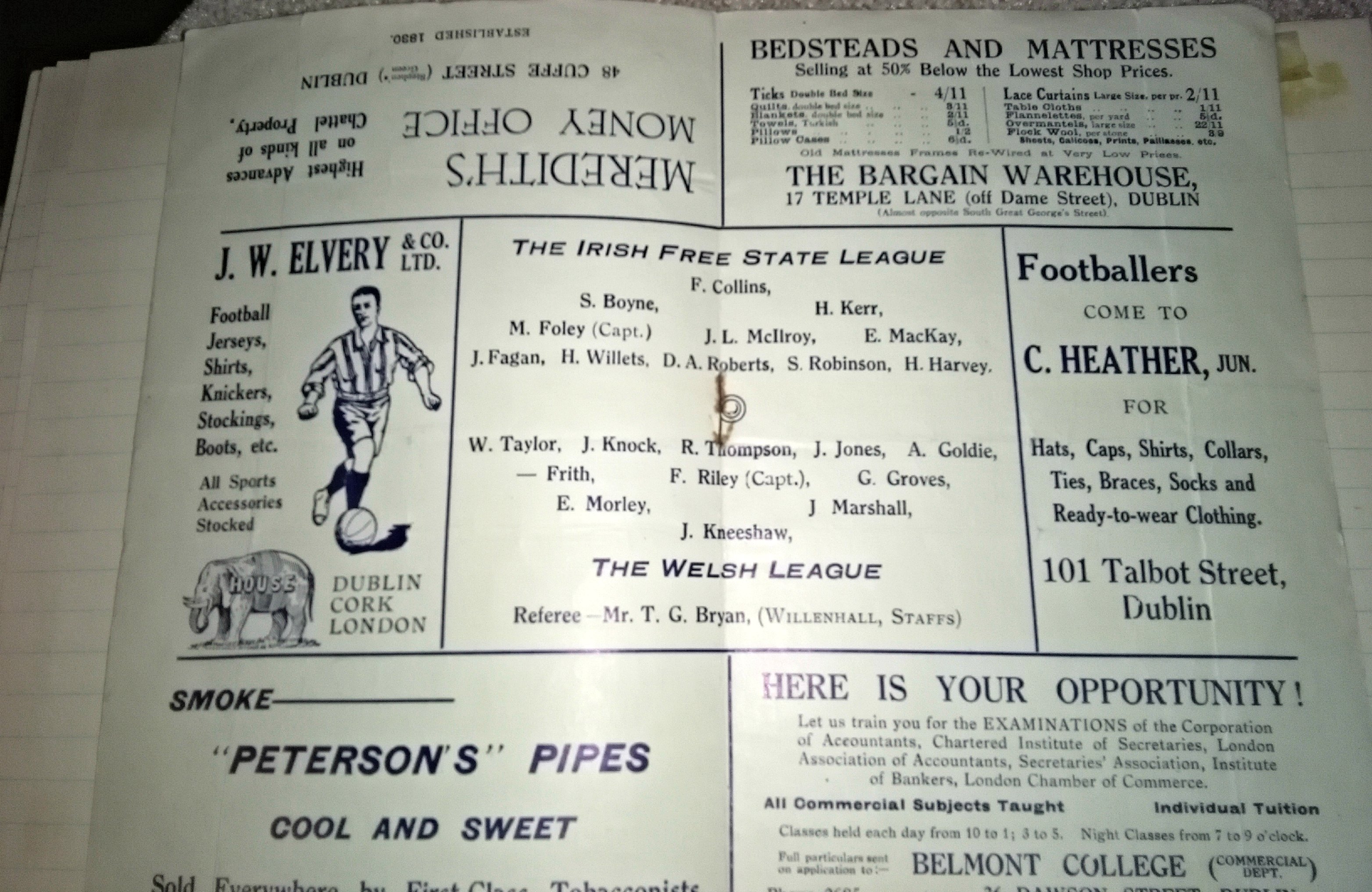
Willits was Bohemian captain again in 1920-21, when he was reported to have had a “new lease of life” as a footballer. Now in his thirties, he was prominent also in the Bohemian team that won their first League of Ireland title in 1923, and was selected with four other Bohemians for the new league in their first representative match against their Welsh counterparts in 1924. Willits played for club and league alongside Christy Robinson, who had a very different military record as a member of the IRA during the War of Independence.
Harry stars in the first ever inter-league game against the Welsh League
Some newspaper correspondents suggested that, but for his English birth, Willits might have been selected for Ireland. From 1925 onwards, he was playing with Bohemians’ second team and scored in a 4-0 win over Dublin University (Trinity College) in 1929, when he was 40. He featured in a short Bohemian’newsreel’ of 1930 as a “model Bohemian” who was “still going strong” and “a sportsman to the core”. Nearly fifty years old, in April 1938, he lined out for an Old Bohs team in a charity match in Dalymount against an Old Rovers side.
Even before his playing days with Bohemians finally ended, Willits became involved with the club’s Management Committee, also later the Selection Committee, and he served as Vice-President.
From the 1920s Harry Willits was a keen and competitive tennis player, being club champion in Drumcondra Tennis Club several times over the period 1923-33. He served also as club president and vice-president.
A man of routines, he always had two books on loan – one fiction, one non-fiction – from the Phibsborough Library. He dressed formally, in suit, tie and hat, and walked from his home to the Registry of Deeds in King’s Inns, responding to the frequent greetings of Bohemian fans in the streets. He practised calligraphy and did charcoal drawings.
His daughter Audrey and son Alec were both kicking footballs with their father in the family’s Glasnevin garden from early days. Alec played briefly for Bohemians first and second teams in the 1940s, but could not live up to what was expected of him as his father’s son. He later played for the Nomads.
Audrey applied her kicking skills to keeping goal for Pembroke Wanderers hockey teams for many years, appearing also for Leinster provincial teams and serving many years in the club’s committees.
From 1937, as Audrey recalls, Harry Willits developed asthma due to the strain of living with a war wound and this had a serious impact on his quality of life, also taking a financial toll. Harry had to reduce his work to half-time, which also meant half-pay, and Audrey remembers that the family often struggled to get by.
Despite this, Willits continued his involvement with Bohemians, as club officer and selector, and even – up to the age of 60 – as a coach. He was actively associated with Bohemians in one capacity or another for over forty years. He died in April 1960, aged 70, and is buried with his wife in Mount Jerome Cemetery.
This post originally appeared on the official Bohemian F.C. website in May 2016. Co-written and researched with Brian Trench as part of an ongoing series on Bohemians players from the First World War to the end of the Irish Civil War
The split between the footballing associations of the FAI and the IFA has had many consequences for football on our island, many hours have been whiled away with “what if” scenarios with barflies imagining an Irish side of the 60’s featuring the likes of John Giles and George Best. Another less discussed consequence of the split between the two associations was for many the loss of any sense of identity with the all Ireland side that had competed from the 1880’s through to 1921. Any connection with the history of this 32 county team has for most football fans in the Republic, (and indeed some in the North) been severed and there is little sense of identification with the players and their achievements pre -1921.
I for one think that this is a great pity, it ignores the history of the sport and the rich and interesting personal stories of those involved. It also means modern fans in the Republic often feel little pride or connection to the victory by a truly representative Irish team in the Home Nations Championship of 1914. At the time the Home Nations Championship was viewed, in the British Isles at least, as the foremost International football competition in the world with the winners rating themselves as the best international side in the world. While this is obviously an isolated and arrogant viewpoint it is reasonable to say that the winners could legitimately claim to be among the very best international sides in the world.
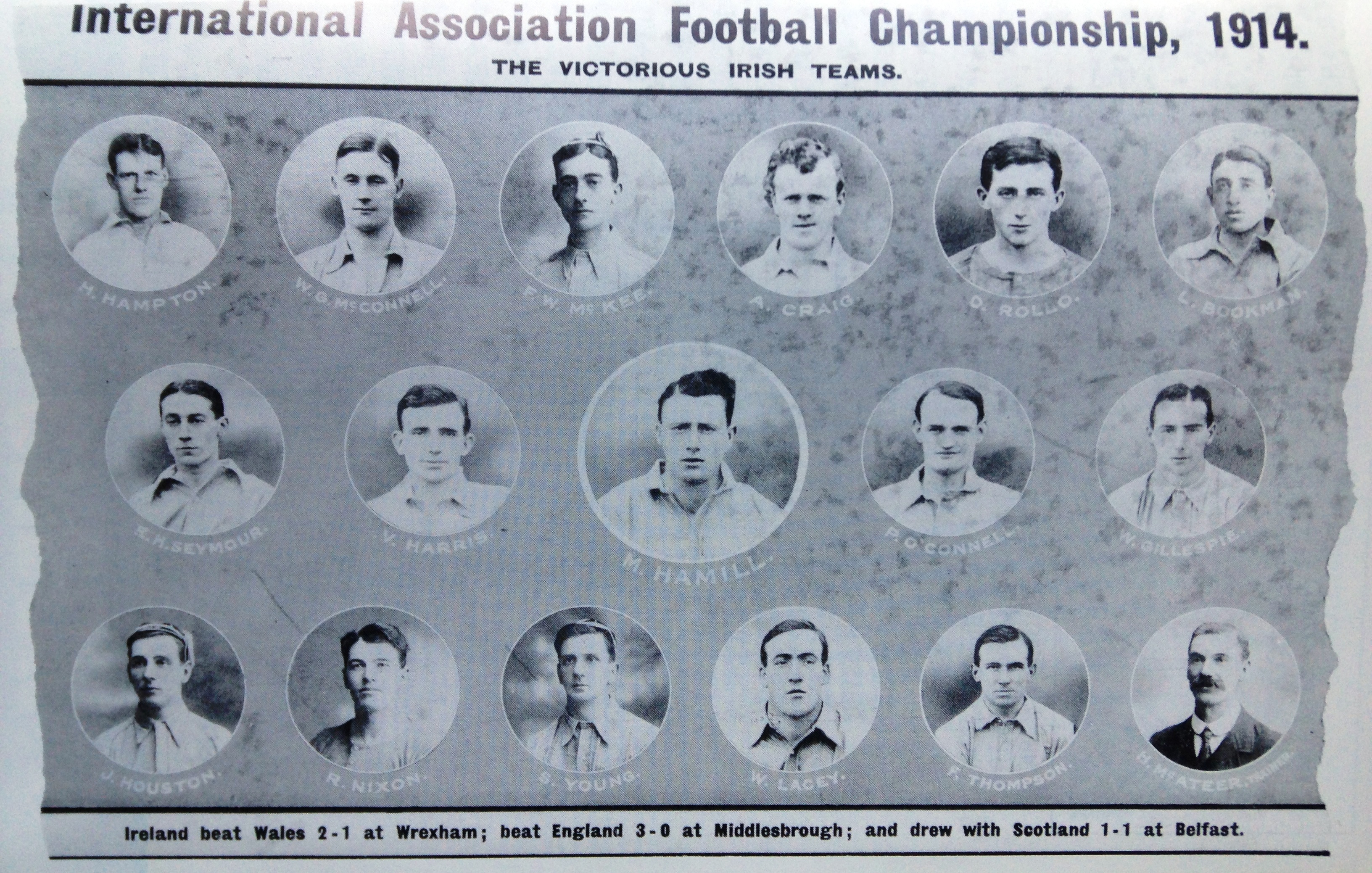
The side that triumphed in 1914 was a young, impressive and truly representative team. While in previous years there had been a great deal of tension and legitimate criticism about Belfast based players being favoured ahead of Leinster based players, the squad for the 1914 Championship was a truly all island affair. It featured players from the footballing hotbeds of Dublin and Belfast but also players born in the likes of Wexford (Billy Lacey), Galway (Alex Craig) and even Lithuania in the case of Louis Bookman who was born in what was then part of the Russian Empire. Bookman’s family fled to Dublin when he was a boy to escape the persution of Jews then taking place, he began his footballing career for Belfast Celtic before moving to England with Bradford City, in course becoming the first Jewish professional footballer in Britain. Bookman was playing for Bradford when he was called up in 1914 but the squad was a mix of players who were plying their trade in both Ireland and Britain, it also included two players from Bohemians, William McConnell and Ted Seymour.
1914 Home Nations Champions
Both players were of course amateurs in keeping with the traditions in place at Bohs which meant that they were in a minority even by 1914 as most of the major teams in Ireland had already embraced professionalism by that time. The two main exceptions being Bohemians and Cliftonville. Seymour was an outside-right for Bohemians and one of the stand-out forwards for the Gypsies at the time, the son of an RIC officer who lived in the nearby Phoenix Park he won his first amateur cap for Ireland by 1912 scoring in a 3-2 victory against England, the same year he would win the Leinster Senior Cup with Bohemians. His lone senior cap would come in Ireland’s opening match of the Home Nations Championship, an away fixture against Wales which Ireland won 2-1 when he was called up as a replacement for Everton’s injured winger John Houston. Sheffield United forward Billy Gillespie got both goals in that game but Seymour obviously impressed over the course of the match as he was quickly signed up by Cardiff City on the strength of his performance.
The Irish amateur team which defeated England 3-2 in 1912. The side featured three Bohemian F.C. players; William McConnell, Ted Seymour and Dinny Hannon.
William McConnell had a somewhat more extensive career at International level. Regarded as one of the best full backs in Ireland McConnell was a strong and physically dominant defender for Bohemians and Ireland. A member of the Bohemians team that lost out in the 1911 Cup Final to Shelbourne he also won a pair of Leinster Senior Cups with Bohemians and represented the Irish League on three occasions. At International level McConnell won six senior caps and was only on the losing side once, in a 2-1 defeat to Scotland in 1913. McConnell made his debut in 1912 in a 3-2 win over Wales and was part of an historic victory in only his second cap as Ireland beat England for the first time ever. Billy Gillespie grabbed both goals in a 2-1 victory in Windsor Park as McConnell lined out alongside his Bohs team-mate Dinny Hannon. Despite that landmark victory the Irish side still finished bottom of the Home Nations Championship but things were to be much different the following year. McDonnell was an ever present in the successful Home Nations campaign starting every game at full back.
The Ireland side before the opening game against Wales
The campaign opened with the aforementioned 2-1 win away to Wales and was followed by another away fixture, this time against England in Middlesboro’s Ayresome Park. Proving that the previous victory against England was no flash in the pan the Irish trounced the English on home soil, two goals from the ever versatile Billy Lacey, then of Liverpool and a third from Billy Gillespie eased Ireland to victory over a stunned England. The Donegal born Gillespie would end the tournament as its top scorer with three goals and was arguably one of the greatest players in the world at this time. He would captain Sheffield United to victory in the 1925 FA Cup final and play on for them until he was more than 40, towards the end of his career his role at the heart of the Blades attack would be taken over by another Irishman, Jimmy Dunne who would later coach Bohemians in the 1940’s. At international level his 13 goals for Ireland/Northern Ireland would remain a record until it was eclipsed by David Healy in 2004.
However Gillespie would miss the final match that could guarantee Ireland the 1914 Championship, as Sheffield United had to replay an FA cup tie they refused to release Gillespie for the game against Scotland in Belfast’s Windsor Park. This would require a significant reshuffle on behalf of the Irish with Samuel Young of Linfield coming into the forward line and Billy Lacey taking over Gillespie’s role in the attack. McConnell continued as usual alongside Alex Craig (Greenock Morton) in a defence that had proven solid over the previous two games.
William “Bill” McConnell
The match would be the only home game for Ireland that year taking place in Windsor Park, but under far from ideal conditions. Not only was Gillespie unavailable but there was a downpour the day before the game which continued through to the game meaning that both sets of players were ankle deep in mud. The view of the press at the time was that this would suit a more physically imposing Scottish side. Worse was to come for the Irish as the conditions and the hard-fought nature of the game began to take their toll and injuries on the Irish side began to mount. Paddy O’Connell, then of Manchester United and later manager of Barcelona picked up a knock as did McConnell who had to leave the field of play. However the Bohs man wasn’t out of the action long as the Irish keeper Fred McKee of Cliftonville suffered a broken collar bone during the first half. McKee managed to struggle on until half time but once the second half commenced McConnell took to the field in his place in a sodden goalkeeper jersey that was supposedly “two sizes too small” . As substitutions were not in use at the time Ireland were down to ten men with Lacey dropping back from the forwards to take McConnell’s place at full back.
This was not the first time Ireland had found themselves in this situation, Lacey had been forced off in the Welsh game yet Ireland had triumphed and now he was in defence helping protect McConnell in goal. Forced into making a couple of saves early on McConnell seemed to be doing alright in his unfamiliar position but a mis-timed run forward meant he gave possession to the onrushing Scottish forward Joe Donnachie who had a simple finish to give Scotland the lead. It seemed like all could be lost in the cruellest fashion. The team without its main goalscoring threat in Gillespie and down to ten men looked doomed but with just eight minutes remaining a fine pass from Patrick O’Connell sent Sam Young free and he blasted the ball home to send the crowd wild. Despite the terrible weather the huge crowd had been in full voice behind the Irish team and Windsor Park saw record gate receipts of £1,600 on the day. The supporters had gotten their moneys worth, the underdog team, shorn of their best player, having finished two of their three matches with only ten men were now outright Champions for the first time.
This victory was met with great joy and optimism on behalf of the footballing community throughout Ireland. Having defeated England in their last two outings and having won the Home Nations Championship outright there were high hopes that the team could push on from this achievement and defend their title the following year. Other matters were to intercede however.
While the outbreak of War did not bring about a halt to all football it did end international matches. Players were encouraged to set a good example to other young men and enlist. Football clubs in all parts of the country faced tough times losing both players and fans to the trenches of France and Belgium while the league would split for the course of the war creating regional leagues focusing on Dublin and Belfast.
By the time peace was restored to Europe several of the squad had passed their prime and although players like Lacey and Gillespie were still top performers for their clubs in England the split between the Irish football associations which led to the formation of what we know today as the FAI meant that the potential of a united Irish XI would never be realised.
For those players with a Bohemians connection their careers were varied. Ted Seymour’s stay in the Welsh capital was brief and included works in a Welsh munitions factory to support the War effort, he left Cardiff City in 1915 and returned to Ireland with Glentoran for whom he lined out for much of the War years. Despite twice winning the Irish Cup (once with Glentoran and later with Linfield) Seymour was never again selected to represent Ireland.
McConnell also transferred to Britain, signing for Bradford Park Avenue who were then in enjoying their best ever league season, finishing 9th in the Football League in 1914/15, McConnell would have a limited role however, making only 4 league appearances. He would spend a brief sojourn in Belfast with Linfield before returning to Bohemians in 1916 where he played a handful of games. This was not to be the end of his sporting career however, he found significant success as an amateur golfer being successful enough to triumph in the 1925 and 1929 West of Ireland Amateur Championships. Some Pathé newsreel footage even survives of McConnell playing a round at a new golf course in Dun Laoghaire.
Though the war would disrupt the career of Billy Lacey he would still go on to have considerable success in the 1920s as a player for Liverpool, winning back to back titles. Lacey would return to Ireland to finish his playing career at Shelbourne and then as player-coach of Cork Bohemians. It was in 1930 during this spell in Cork that he would win his final cap for Ireland at the age of 41, he remains to this date the oldest player ever capped by the FAI. With his playing career finally over Lacey brought his considerable experience to the Bohemians of the Dublin variety. During his five years at Dalymount Park (between 1933 and 1938) Lacey would lead Bohs to two league titles and an FAI Cup as well as a host of other minor honours. During this stint Lacey would also provide his coaching talents to the Irish national side.
While the split remains as wide as ever between the FAI and the IFA and relations between the associations have been strained over players like James McClean and Darron Gibson electing to play for the Republic, it is worth remembering a time when a truly all-Ireland team triumphed against the odds and the role that key figures in the history of Bohemians would play in that victory.
If you are interested in further reading on the subject I’d suggest David Owen’s article in The Blizzard Issue 8. Neil Garnham’s “Association Football and Society in pre-partition Ireland” and also Cormac Moore’s “The Irish Soccer Split”. Finally a special thanks to Stephen Burke of Bohemian F.C. for providing additional information on the career of Bill McConnell. For more on Louis Bookman and his fascinating life try “Does your Rabbi know you’re here?” by Anthony Clavane.










 A Bohemian Sporting Life