Finn margins in World Cup qualifying 1950

The 1950 World Cup would enter popular memory for the wonder of the Maracanã, the vast and noisy crowds that turned up to follow their Brazilian heroes, and of course the shock result in the “final” which saw Uruguay win their second World Cup by defeating the hosts in what became known as the Maracanzo – A result which seemed to traumatise the Brazilian nation like few others.

It was also the first World Cup to be held in twelve years due to the savagery of the Second World War, and slowly a decimated Europe returned to the football fields and to World Cup qualifying groups. Most groups were two team affairs, simple home and away fixtures with the winner progressing, however Ireland were drawn in a group of three, alongside Sweden and Finland. It was to be Ireland’s first meeting with both nations.

The Swedes would have been strong favourites for the group, they had triumphed in the football tournament at the 1948 Olympics in London and featured stars like Nils Liedholm and Gunnar Gren who would find greater fame in Italy with AC Milan. The Finns, however, were something of an unknown quantity with Irish newspaper previews detailing the struggle faced by Finish football due to the harshness of the climate and the ongoing recovery from the ravages of the Second World War.

For the visit of Finland to Dublin in September of 1949, the Republic of Ireland opted for experimentation. Having been well-beaten by a strong Spanish side in a recent friendly, there was a more youthful look to the Irish team against Finland with several debutants, especially in the attack. A brand-new front five was named, with Johnny Gavin, Arthur Fitzsimons, Jim Higgins, Peter Desmond and Tommy O’Connor all listed to start. Higgins had enjoyed a blistering start to the season with Dundalk, scoring six times before August was out but had to cry off with an injury, his place being taken by Shelbourne’s Brendan Carroll.

It was to be a further changed front line as Carroll had to go off injured after 25 minutes and Paddy Daly being the only outfield player (the 12th man) available as his replacement. This prompted another reshuffle, with the ever-versatile Con Martin moving from centre-half to the centre forward role and Daly taking Martin’s place. Despite the disruption to the team there seemed to be no ill-effects on the pitch. Johnny Gavin opened proceedings with a goal direct from a corner, 21-year-old Gavin was just beginning to make his name at Norwich but he would go on to become the Norfolk club’s record goal-scorer, a distinction still held to this day.

Two more goals followed, Peter Desmond was fouled which drew a penalty and was dispatched by Con Martin before victory was sealed, this time Martin again proving his worth as a striker flicking in a header in the 68th minute from an Ireland corner. A relatively comfortable 3-0 win in front of 23,000 in Dalymount.

The return leg in October was to be a different affair, Finland’s football season was coming to a close and the harsher winter weather was already in force, Ireland were playing in a biting wind with temperatures hovering just above freezing. The FAI had spared no expense, paying over £1,000 to fly an Aer Lingus charter flight to Helsinki and despite the conditions the Irish team must have been optimistic, they had just beaten England in Goodison Park a month earlier and regular centre forward Davy Walsh was back in the starting XI.

Walsh looked to have scored early on but Dutch referee Jan Bronkhorst disallowed it for a supposed foul on the Finish keeper. Ireland did however take the lead through Everton’s Peter Farrell, slipped in by Drums’ Tim Coffey, Farrell beat his man before unleashing a fierce shot into the Finnish net on 65 minutes. Ireland remained in the lead until the last minute when Jorma Vaihela managed to bundle the ball, and a number of Irish players, into the net. The Irish team quickly protested to the referee that the Finns had fouled in the lead up to the equaliser but their laments fell on deaf ears.

Finland decided to withdraw from qualifying after the game and never faced Sweden in the group. Ireland knew they would have to beat the Swedes to force a play-off but these narrow hopes were dashed by a Calle Palmér hat-trick in Dalymount. The Swedes would go to Brazil where they would finish third behind Uruguay and the hosts while it would be another 40 years before Ireland would grace World football’s greatest stage.

This article originally featured in the match programme for Ireland v Finland in November 2024. Banner photo from the Irish Press showing Con Martin bearing down on Finnish keeper Thure Sarnola in the September 1949 game.

Ireland’s first world cup qualifying campaign

The 1930 World Cup, held in Uruguay, had been an open invitation affair. Indeed, so keen were the organisers to get nations to participate that they offered to pay for travel expenses for competing teams. Despite their generosity only four European teams could be coaxed into making the long voyage to South America and ultimately thirteen teams overall would compete in the tournament which saw the hosts crowned as victors.

Fast forward four years and things were a bit different. 32 nations expressed an interest in taking part in the 1934 World Cup which was to be held in Italy, with Ireland among them. Though, holders Uruguay, feeling snubbed by the lack of European participating in the 1930 tournament did not enter. It was decided that to whittle down numbers to a more manageable 16 teams at the tournament some form of qualifying matches had to take place.

Somewhat uneven groups were drawn, some featuring three teams, some with only two, some teams (such as Bulgaria or Turkey) withdrew from qualification or did not complete their fixtures. Even hosts Italy had to play a qualifying game – the Italians won 4-0 at San Siro, with two goals coming from Guiseppe Meazza in a stadium that would one day bare his name. The Greeks declined to play the second leg which secured Italy’s qualification.

Ireland were drawn in a group alongside Belgium and the Netherlands with the simple qualification formula that each team played against each other once and then the group winners and runners-up would qualify. The Irish must have been optimistic, they had played Belgium three times before 1934 and won all three encounters. They had only faced the Dutch once before, in 1932 in Amsterdam, but that game had ended with a 2-0 victory to the Irish.

The opening game against Belgium took place on February 25th 1934 in Dalymount Park. The new competition and qualifying format had obviously captured the imagination of the public as over 35,000 spectators crammed into the Phibsborough venue. While they may have been disappointed with the scoreline they can’t have been let down for a lack of drama. The crowd that day saw an eight goal thriller, and witnessed one of the greatest individual performances by an Irish player as Paddy Moore, then of Aberdeen, scored all four goals in in a 4-4 draw with the Belgians. After an hour of play, Ireland had been trailing 4-3 but with 15 minutes remaining Moore had grabbed the equaliser.

Paddy Moore

While Ireland may have been disappointed not to win against Belgium they knew that a victory in Amsterdam against the Dutch would secure World Cup qualification. The Dutch FA certainly weren’t taking any chances in their preparation, going so far as to ask the FAI for photos and fact-files on their main players under the premise of using this information for promotional material ahead of the game. The FAI duly obliged, with photos and details of Ireland’s star striker Paddy Moore appearing in Dutch newspapers ahead of the game.

Ireland fielded a mostly domestic based XI with Cork City’s Jim “Fox” Foley kept goal, he had just won the FAI Cup with Cork and was about to make a move to Celtic. Bohemians, who had just been on tour in the Netherlands had two players in the squad – Billy Jordan who started the game but was injured in the first half and was replaced by his club-mate Horlacher just before half-time. This meant that Horlacher made history by becoming the first substitute used by the FAI in an international match.

Just before half time Johnny Squires of Shelbourne had equalised for Ireland after Kick Smit had opened the scoring just minutes earlier. In the second half with the sides tied at 1-1, Paddy Moore scored a controversial goal just before the hour mark when he pushed the Dutch keeper Adri van Male over the goal line when he had the ball in his hands. This tactic of barging the keeper was not uncommon in Irish or British football at the time but it was not something the amateur Dutch players had experienced before. The goal was awarded much to the dismay of the record crowd of almost 40,000 packed into the Olympic stadium in Amsterdam. Ireland were now 2-1 up with just over half an hour to play. A win would have sent them to their first ever World Cup.

But it wasn’t to be. The controversial goal spurred the talented Dutch side into action, they scored four unanswered goals in 23 minutes to claim a 5-2 victory and qualify for the 1934 World Cup. Ireland’s World Cup dream was over.

A record crowd at the game in Amsterdam

This first appeared in a 2021 Irish match programme

The whistle of Langenus

In the summer of 2018 as the elated French champions cavorted and the Croatian players lay prone and disconsolate a group of men in fluorescent light-blue jerseys went to the podium to collect their medals, they were referee Néstor Pitana and his team of officials. This was surely the sporting pinnacle for Pitana, who had celebrated his 43rd birthday just a month before and had begun his career refereeing in the Argentine second tier back in 2006.

But Néstor Pitana is but the latest link in a chain that stretches back almost 90 years to John Langenus, the Belgian official who had refereed the chaotic first World Cup final in 1930, as well as games in the 1934 and ’38 tournaments and the 1928 Olympics. Such was Langenus’s international reputation that he was in high demand for club games outside of his native Belgium, and it is here that the Irish connection appears, because just three months before he refereed in the Amsterdam Olympics of 1928 and two years before the World Cup final, he was in Dalymount Park for the Free State Cup Final between Bohemians and Drumcondra.

Bohs won that Cup final 2-1 in front of a crowd of over 25,000 on St. Patrick’s Day, 1928 to secure a clean sweep of all four domestic competitions that season. Their goals came from Jimmy White and Billy Dennis which cancelled out John Keogh’s opener for Drums. Match reports record that the Bohs were deserved winners with Drumcondra offering little in attack after their opening goal. Of the referee’s role The Irish Times noted that “while feelings ran high at intervals, the referee, Mr. Langenus of Belgium, handled the game splendidly and that nothing unseemly occurred to mar the enjoyment of the huge crowd”.

Langenus was something of a Pierluigi Collina of his day, well-known, popular and well-respected throughout the sporting world as well as being visually arresting, as a tall figure with slicked back hair who took to the field in a shirt, tie, jacket and a pair of plus-fours. It was this reputation that led him to Dalymount Park in 1928. Then as now there were constant debates about the quality of referees and plenty of criticism was aimed at the men in the middle during the early years of the League of Ireland. This meant that for high profile games such as Cup finals the FAI had established the practice of bringing in referees from outside of Ireland.

Usually this meant an English referee, Ireland still looked to England as a bastion of the game and it made sense to use an English speaking referee. For example, in 1927  J.T. Howcroft from Bolton had taken charge of his second FAI Cup Final. A prominent English referee, Howcroft had also officiated the 1920 FA Cup final between Aston Villa and Huddersfield. However, John Langenus had two things in his favour, he was a fluent English-speaker and in addition to his native Flemish he also spoke French, German, Spanish and Italian. The second reason that it should not be such a surprise that he refereed the Cup Final was that a year earlier he had been in Lansdowne Road to referee the Ireland v Italy international which Italy had won 2-1 thanks to two goals from Juventus striker Federico Munerati.

At a banquet following that Ireland match held in the Hibernian Hotel on Dawson Street where John Langenus and his wife were guests, the Honourary Secretary of the Association John S. Murphy toasted Langenus and described him as “one of the best referees they had ever seen in Dublin”. This surely helped with his appointment to the following year’s Cup final.

The paths of the Irish national team and John Langenus would cross on several further occasions, he took charge of Irish matches against Spain, the Netherlands, Hungary, Switzerland and finally against Czechoslovakia in 1938. Langenus himself had many happy memories of his trips to Dublin. He committed some of these to record in one of his memoirs Whistling through the world printed in 1942.

In his book he recalls witnessing the St. Patrick’s day parade on the morning of the FAI Cup Final,  as well as his chats with Lord Mayor of Dublin Alfie Byrne, and his visits to the main tourist attractions; Dublin Zoo, the Botanic Gardens and St. Michan’s Church where he saw the famous preserved bodies in the church crypt. But his main memories are of Irish social culture, and Irish drink! John Langenus took a particular interest in Irish whiskey and would go directly to the distilleries to buy 90 and 100 year old bottles that wouldn’t usually be found on general sale, these he would keep as special gifts for friends (and perhaps a couple for his own collection). He was lucky on one occasion that he managed to bluff his was through English customs checks with two bottles of vintage whiskey in his suitcase.

Similarly he remembered the good humour of the after-match banquets, once again his beloved Irish whiskey makes an appearance though he mentioned that the only way he could tell his Irish hosts were getting a little drunk was that they tended to sing more. In winning or losing he recalls the good mood of his hosts remained the same.

Not all of Langenus’s sporting engagements were to be as enjoyable. His most famous role, that of World Cup Final referee was as far from the relaxed surroundings of a Dublin banquet as was possible. As the great Brian Glanville wrote of Langenus during that final match in Montevideo’s Estadio Centenario “The prospects of dealing with twenty-two players, each of whom was capable of disputing any and every decision, to say nothing of the nearly 100,000 spectators who, once they had paid their money, felt entitled to behave as they pleased, would have daunted men of lesser experience and courage than Langenus”.

Doubtless that Langenus was experienced and courageous but he was also pragmatic, he would no doubt have heard the chants and songs thousands of passionate Argentine fans as they streamed from their ferries across the River Plate and into the stadium hours before kick-off, he would have heard their Uruguayan counterparts fanatically chanting their own calls to arms, including the ominous “Victory or death!”. Who’s death exactly? In such cases often it’s the referee in the firing line and Langenus had sought assurances from the Montevideo police that a swift, armed escort, direct to their ship should be arranged right after the match for him and his team of officials should this be required.

Although the match was intense and undoubtedly passionate Langenus escaped the ire of either set of supporters, in fact he was involved in solving the biggest point of conflict even before kick-off. With both sides insisting that a football manufactured in their own country be used, Solomon-like, Langenus agreed that a ball from Argentina would be used in the first half and a ball from Uruguay in the second.

On that day, as Uruguay celebrated victory in the maiden World Cup, in front of their own home fans, John Langenus must have realised he had reached the apex of his refereeing career. He would return again to officiate in the next two World Cups, signing off his last World Cup match officiating the 3rd place play-off in 1938 which saw Brazil claim bronze, defeating Sweden 4-2.  While he continued to referee international games for another year the outbreak of World War Two effectively ended his career as an international referee though he continued to referee matches in the Belgian League throughout the War until finally the league was suspended for the 1944-45 season. By that stage Langenus was 53 years of age.

According to one source, as a teenager he had played youth football for AS Anversoise but was already a referee in the Belgian top flight since at least 1912, refereeing his first international match in 1923 aged just 31. Throughout his career he was a committed amateur. He worked as a public servant in his home city of Antwerp for his whole working life and was also an occasional sports journalist. While on international duty only his expenses were paid and he refused any fees to referee games though often in such instances medals, cut glass, watches or decorative cups were given as mementos. He also had the perk of  being able to bring back the likes of whiskey from Ireland or cigars from Spain. His positively Corinthian idealism is evident even just by looking at him with august bearing and almost formal attire.

His talent for writing was something that he put to good use in his retirement, writing a memoirs and two other football related books. He passed away in his native Belgium in 1952 aged 60.

With thanks to the people behind @WC1930blogger and @RefereeingBooks for their assistance.

It’s called the World Cup for a reason

The World Cup is only in its second day but already there has been plenty of comment from people identifying as journalists about the teams that aren’t even there. This is mainly because a tidy, if ineffectual Saudi Arabian team were well beaten by Russia which prompted several of the blue-ticked Twitterati to exclaim how unfair and unjust it was that the USA, the Netherlands, Italy or Chile were not at the World Cup but that Saudi Arabia were.

This was then broadened out by other users of the social media platform to mention teams like Morocco or Iran or Tunisia. Do you see a trend here?

First of all lets point out that this is in fact a WORLD CUP, not a Europe and South American cup with a couple of others we deem worthy thrown in Cup. The first World Cup in 1930 was an open invitation competition, most European nations didn’t even bother turning up. The English national team didn’t bother entering the tournament until 1950, when they qualified they were beaten by Spain and also 1-0 by the United States thanks to a goal scored by a Haitian student in a team captained by a Scottish journeyman. But then that’s the joy of the World Cup, the underdog beating the heavily-favoured, football aristocrat.

Egypt played in the 1934 World Cup, while the Dutch East Indies (now Indonesia) played in 1938 but representatives from Africa and Asia were rare. In 1966 every team in the African confederation boycotted qualifying for the World Cup because they were offered only half a place at the World Cup. Effectively one African side would have to play-off against the winners of the Asia/Oceania group for a place in England. This boycott meant that North Korea qualified and went on to famously beat Italy 1-0 and drew with Chile which saw them through to the Quarter-finals.

In that quarter final the North Koreans took a surprise 3-0 lead before being eventually overhauled by the personal brilliance of Eusébio who scored four of the Portugal’s five goals in a memorable comeback. Eusébio was of course born in Mozambique, (still a Portuguese colony in 1966), as were team captain Mário Coluna and central defender Vincente.

Things did gradually begin to change however, the FIFA President Stanley Rous ran for re-election in 1974 but was roundly defeated by João Havelange, mainly because Havelange has actively canvassed the support of the AFC and CAF with the promises of greater access to the World Cup tournament.

Whatever one says about Havelange and his debatable legacy, he did follow through on his promise and expanded the World Cup to 24 teams in 1982. With each nation having an equal vote Rous’s reluctance to campaign, coupled with his support for keeping apartheid South Africa as a member of FIFA (he famously said if “South Africa applies segregation in soccer, that is its own concern”) meant that his Eurocentric viewpoint was never going to see him elected to another term and practically guaranteed Havelange victory. Havelange was of course later succeeded by his protege Sepp Blatter, perhaps if Stanley Rous had taken the African and Asian confederations more seriously then FIFA wouldn’t have been defined by the hyper-commercial forces that Havelange and Blatter unleashed? It’s just a thought.

’82 saw steady progress for African sides, Cameroon were unlucky to be eliminated having not lost a game, while Algeria, despite impressive performances were also knocked out after the Disgrace of Gijón when Austria and West Germany conspired to play out a mutually beneficial 1-0 win for the Germans which saw both sides progress.

Subsequent tournaments saw further progress and African and Asian sides created several stand-out performances, in my own lifetime I can think of Cameroon in 1990, Nigeria in 1994, South Korea in 2002, Ghana in 2010 as campaigns from African and Asian sides with a special resonance. South Korea got as far as the semi-finals in 2002, which helps show that a regular high standard of competition can indeed help develop football performance of a nation and indeed a Continent.

Due to a number of factors, historic, colonial and industrial among them, European nations developed a football culture, and crucially professionalised and formalised the sport early, this gave them a certain advantage that subsequent generations of men like Rous fought to preserve.

If a World Cup is to be worthy of it’s name it should of course be about crowning the greatest national side on the planet but it should also be a way to celebrate and grow the game globally. That means competitive football for teams from all corners of the world. Representation is important, younger generations seeing their nation compete, even if and when they lose have something to aspire to. Ireland enjoyed a participation boom in football after Euro 88 and Italia 90 which helped embed the sport in areas which previously might have been a cold house for the Association game. It’s also worth noting that Ireland were dismissed and even derided as England’s “B” team by sections of the football media at both tournaments. No doubt if Twitter had existed users would have bemoaned our qualification for a World Cup ahead of the likes of France or Portugal?

And finally the true mark of a great team, one who deserves to lift the World Cup is that they win games, African and Asian teams who participate this year won their qualification matches, often going through arduous groups and play-offs to get to the World Cup. Saudi Arabia finished higher than Australia, who beat Honduras in a play-off to qualify. Honduras in turn finished higher than the USA in qualifying, though you won’t hear many US pundits mention that.

If people want to see Italy or the Netherlands at the World Cup that’s understandable, but those teams also need to, you know, win matches to get there.

A 48 team World Cup -reasons to be supportive

The confirmation by FIFA that it is to restructure the World Cup to accommodate 48 teams has been met with a largely negative response, especially across Europe. The most prominent arguments being as follows; that a 48 team world cup is bloated and will diminish overall quality. That it will be impossible for a tournament this size to be held reasonably in any one country and in any case it’s simply part of a cynical exercise on the part of FIFA to rake in more money. There have been some arguments put forward as well that the proposed three team group stages will be unworkable and might need the introduction of penalty shoot-outs to avoid arranged draws like the infamous West Germany v Austria game at the 1982 World Cup.

The most prominent criticism seems to be simply that people don’t like change and the current 32 team format is widely popular. But how fair are the criticisms about the bloated nature of the tournament and the expected drop in overall quality? Does a 48 team tournament devalue it through a cheapening of the qualification process? That if it isn’t hard to get there is it really worth being there? First let’s look at qualifying history over time and what other options have been explored.

The first World Cup was an invitational tournament held in Uruguay, all the games took place in capital city Montevideo with 10 of the 18 overall matches taking place in the Estadio Centenario. While certainly handy for getting around this is obviously not something that anyone expects us to return to. The first post war World Cup in 1950 could have been Ireland’s first ever appearance after a number of withdrawals by other teams. Scotland had been one of the teams to withdraw as they had only finished second behind England in the Home Nations Championship (a defacto qualifying group), they had pledged to only attend if they won the tournament even though second guaranteed qualification. The FAI turned down the offer due to the expected cost of travelling to Brazil. The peculiar layout of the 1950 tournament meant that hosts Brazil only needed to draw against Uruguay to win the tournament as there was no straight knock-out format. If a three team group stage is being cited as one of the major drawbacks of an expanded tournament then it would still be considered superior to these previous formats. No one is suggesting that these previous formats and haphazard qualification routes would be preferable but those who site history and tradition tend to refer to the period in their own lifetimes.

Regarding the 3-team groups and the introduction of automatic penalty shoot-outs for draws was something that did exist previously in leagues like the NASL and the early years of the MLS. While certainly a break with tradition they would reduce the amount of dead-rubber games and reduce the risk of a repeat of West Germany v Austria ’82 or dare I say a Republic of Ireland v Netherlands 1990 game.

904c4c40d518d2e514ae17f98dfd187f

1950 World Cup poster featuring the flags of competing nations.

The first World Cup of my lifetime was in 1982. This was the first World Cup to use the 24 team format that would remain in place until 1998. At the time of qualifying for Spain ’82 there were 109 members of FIFA competing for those 24 places. For a number of reasons, not least the collapse of the Soviet Union into its individual constituent nations in the early 1990’s by 1998 the number of FIFA members had risen to 174, an increase of almost 60%. At present FIFA has 211 member associations, meaning it now has more members than even the United Nations.

Understandably as membership has grown so have the numbers of teams participating in qualifying and the World Cup proper. This poses the question as to what is the purpose of the World Cup? I’d propose two answers.

First, To determine which national team is the best in the world. Second to provide a genuine opportunity for the most global of team sports to be represented at one competition and to raise the levels of quality and competitiveness around the world.

The World Cup has only ever been won by teams from either Europe or South America, they have well established and highly competitive football leagues and advanced infrastructure, however few pundits would suggest that the World Cup should be open only to teams from these Confederations. A weighting is applied so that 13 teams qualified from UEFA and 6 (including Brazil as hosts) qualified from CONMEBOL for the last World Cup. We can see this as an attempt to genuinely have the best teams while also being representative enough by including sufficient teams from other confederations to truly be a World Cup. Within FIFA of course this is also tied to networks of power. While qualification may be weighted to feature the strongest teams the votes of all associations are equal, something that many, though not all FIFA Presidents have appreciated. Access to the World Cup and the prestige and wealth on offer have swung elections in the past, as was the case in 1974 when the incumbent FIFA President, the Englishman Stanley Rous lost to João Havelange. The Brazilian Havelange had toured over 80 nations during his campaign, occasionally accompanied by Pelé, and promised greater access to an expanded World Cup. At the time African teams had only one place available at the 16 team tournament, Asian and Oceania teams had to compete for a single place. In purely sporting terms the the performances of nations from outside of Europe and South America at the 74 World Cup had been poor to say the least. Zaire had lost all three games, including one match 9-0 to Yugoslavia, Haiti likewise had lost all three games including a 7-0 hammering to Poland, only Australia managed to gain a single point, a scoreless draw with Chile.

On the basis of their performances at the tournament there seemed little argument that the representation of teams from Africa, Asia, North America etc. should be expanded, however Havelange saw that football could grow in each continent by allowing a realistic opportunity for teams outside of Europe and South America to get elite level competitive experience against the world’s best. His promises of an expanded World Cup were understandably well received, especially in Africa. For decades many of Africa’s best players ended up representing European teams, many players from Algeria representing France, stars from Angola and Mozambique representing Portugal. By the 1970’s with most African nations newly independent from colonial rule there was a feeling that African football gave a sense of pride to a nation on a world stage, in FIFA throughout the 1960s these newly independent African nations began to seek membership of FIFA. By 1974 the CAF was the second largest confederation in terms of members, and crucially votes.

Havelange by expanding the world cup to 24 teams in 1982 and bringing in massive new commercial sponsorship to supplement the expansion of the tournament was delivering for whole continents who rarely had the chance to sit at football’s top table. While many, many corruption allegations would later emerge about Havelange he came offering change compared to a man like the eurocentric Stanley Rous who, for example, had strongly opposed any bans on South Africa competing in international football due to their refusal to integrate their football teams and the brutal system of apartheid much to the opposition of other African FAs.

By the end of the 1982 World Cup Africa’s two qualified nations had impressed, the quality a significant improvement on the showing of Zaire in 1974. Cameroon went home unbeaten, after three draws they were unlucky not to make it out of a tough group with goals scored was all that separated them from eventual champions Italy. As previously mentioned only the infamous West Germany v Austria match, where each side knew a 1-0 win for the Germans would see both nations through, prevented the Algerians from advancing.

As with African teams from the 1980s onward it has to be acknowledged that an expanded World Cup can give smaller nations or those from confederations beyond Europe and South America a chance to develop and improve in competitive environments, the best teams will still qualify and the dominant nations will likely continue to win for the foreseeable future but an expanded World Cup will be truly global and be more representative of a larger and growing FIFA membership. To paraphrase Charles Stewart Parnell no man should have the right to fix the boundary to the march of a Nation. FIFA’s remit in theory is to grow the game of football globally, in expanding the World Cup and allowing more nations experience high-level competitive football they are simply following this course, by not expanding the tournament in line with an expanding membership would they not be fixing the boundaries a little too tightly?

The tournament itself will still take the same amount of time to complete and the winners will still play seven games in total. The elite clubs of the world will therefore not really be any more affected than they are now by the change in terms of duration or fatigue though they may loose more players to international tournaments as more nations now qualify. However more tournament places could eliminate a certain number of play-offs thus reducing the overall amount of qualification games.

It seems that a tri-nation bid for the 2026 World Cup from Mexico, USA and Canada is already among the hosting favourites, they certainly would have the facilities to host 48 teams. But considering the expanded size there is no reason why say a single nation like England not host such a tournament. The Premier League boasts 20 modern stadia that could be suitable, add in Wembley and other grounds from outside the top flight (St. James Park, Villa Park etc.) and this could certainly meet the criteria without much additional investment in stadium infrastructure. If not, then the re-emergence of joint-bidding for the tournament means that the expanded competition could still be accommodated while  two or more  nations share the burden of hosting the games. The World Cup in Japan/South Korea were successful from a fan point of view and led to fewer “white elephant” stadiums than subsequent single-host World Cups that took place in South Africa or Brazil.

Finally, the other great complaint is that this is a cynical exercise from FIFA to curry favour and increase revenue. Well of course it is. Few would be naive enough to believe an expanded World Cup is purely for some idealised “good of the game”. Due to the deluge of scandals in recent years it is hard to view FIFA as anything other than a corrupt plutocracy, but the greatest test of its new leadership will be if the expected increased windfall of a bigger tournament finds its way back to the associations and into funding for new facilities, coaches and youth tournaments and not siphoned off into the back pockets of dodgy administrators.


World Cup of Hockey- Toronto 2016

If your old enough you might remember a bit of a fad in the early to mid 90’s for Ice Hockey in Ireland, well when I say Ice Hockey I really mean roller hockey; kids on roller-blades in oversized Chicago Blackhawks jerseys skating around suburban cul-de-sacs with hockey sticks. There were a few possible explanations for this fad, the growth in popularity of inline skates, the Mighty Ducks film franchise, as well as hockey cropping up in the likes of Wayne’s World, even that brief moment when super-baggy Ice Hockey jerseys were fashionable for about a month in 1995. For me the hook was the Sega mega-drive and the video game classic that is NHL 94, all Hockey Organ music and 16-bit power play bliss. The game was so popular it even crops up in the Vince Vaughan/Jon Favreau comedy Swingerwhere Vaughan’s character notes the exceptional video game talent of Chicago’s Jeremy Roenick.

Following actual live, non-sega based American sport was a bit harder for an Irish kid in the 90’s. There was the time difference, there was trying to find NHL or the NBA on television. For basketball there was sporadic coverage on Channel 4 and I seem to remember Eurosport(?) showing the NCAA Basketball championships for a couple of years. Dial-up internet wasn’t exactly ready for live streaming of sports so anything else tended to be going around to friends houses where they had good Sky Sport packages to see the odd game.

However I’d always kept a passing interest in the NHL and have been known to indulge in slightly boozy hockey conversations with Canadian tourists in some of Dublin’s finer hostelries. On that basis I had to try and catch a game on a recent trip to Toronto. It was mid September and most days were balmy mid 20’s so not exactly Ice Hockey weather and it was still a few weeks out from the start of the NHL season so no chance to see the Toronto Maple Leafs. The Maple Leafs are one of the “Original Six” founding members of the NHL and have 13 Stanley Cups to their name, though they haven’t won the title in the fifty years since the expansion of the League.

The Maple Leafs play their home games in the impressive indoor arena of the Air Canada Centre, located in downtown Toronto just behind Union Station. The arena also hosts Canada’s only existing NBA team, the Toronto Raptors. They can apparently change over from one sport to another in the space of just six hours. During my visit the Centre was also hosting the Ice Hockey World Cup, that’s the entire World Cup schedule, kind of like the idea for the Centenario in Montevideo for the first football World Cup in 1930.

a9f7051e-e55c-44e5-beb3-acdaffa6bf25

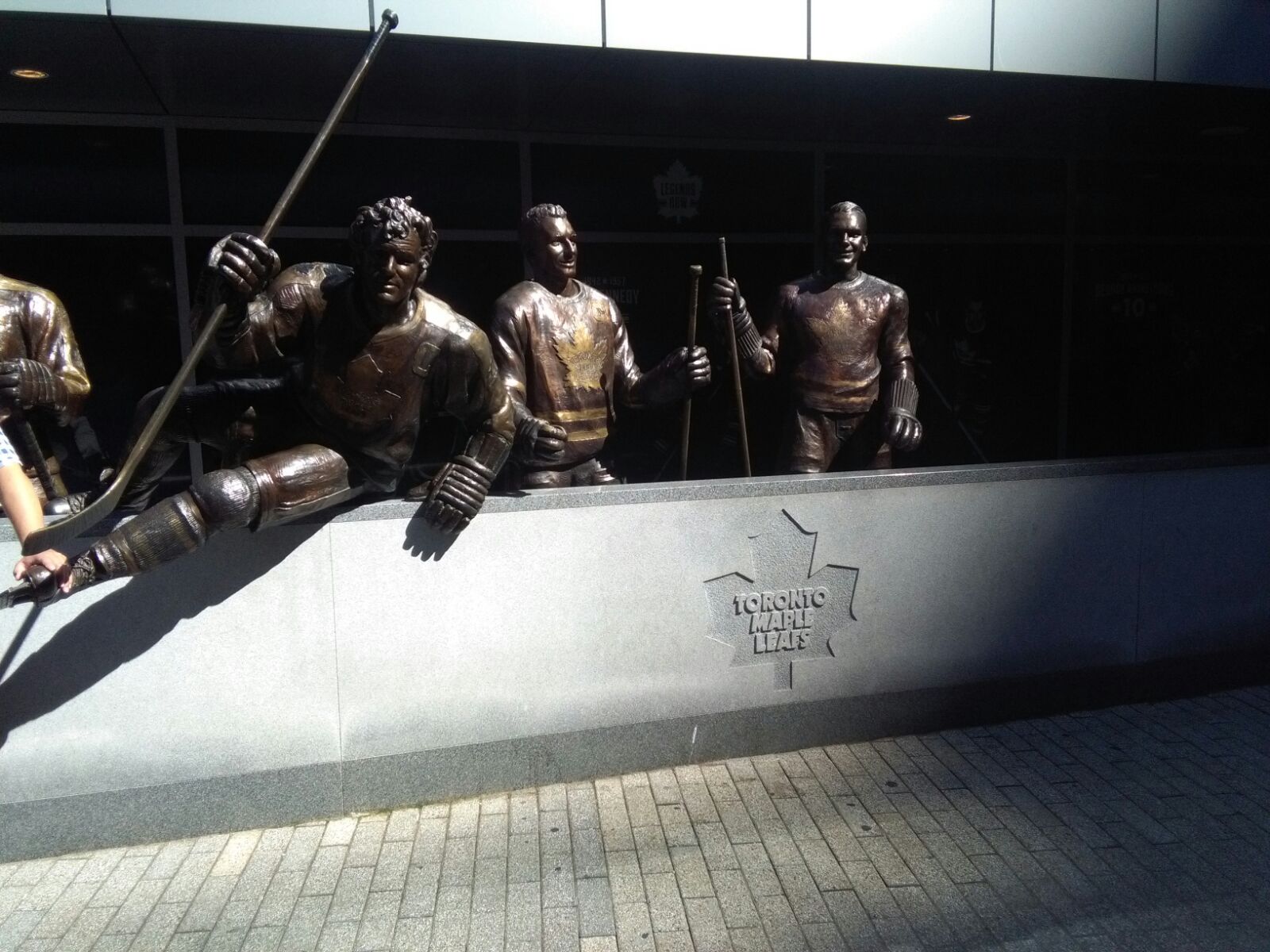
Toronto Maple Leafs hall of famers

The hockey World Cup isn’t really comparable with the current version of the FIFA World Cup however, it features only 8 sides for a starter, it occurs somewhat irregularly and features a couple of what you might term hybrid teams. This edition was the first World Cup held since 2004 and only the third ever overall. The World Cup itself was a successor to the invitational Canada Cup tournament that had been held from the 1970s onward. The idea is that in future the World Cup will be held regularly in four year cycles in the month of September. There are a few obvious advantages to this, the International Ice Hockey Federation’s (IIHF) annual World Championship tends to take place during the playoffs of the NHL season meaning that many top players are not released to take part. As the World Cup is organised by the NHL before their pre-season begins it will avoid this conflict and in theory ensure the best players can compete.

Those taking part in the tournament include International Hockey’s “Big Six” of the USA, Canada, Russia, Czech Republic, Sweden and Finland as well as “Europe” a team made up of the best of the rest European players from Austria, Denmark, France, Germany, Norway, Slovakia, Slovenia and Switzerland. The eighth side was North America, a Canada/USA selection of players aged 23 or under which also had the effect of making the individual Canadian and USA teams to be made up of players aged 24 and over.

57e3baec-e727-4427-b69b-e877c81fee5a

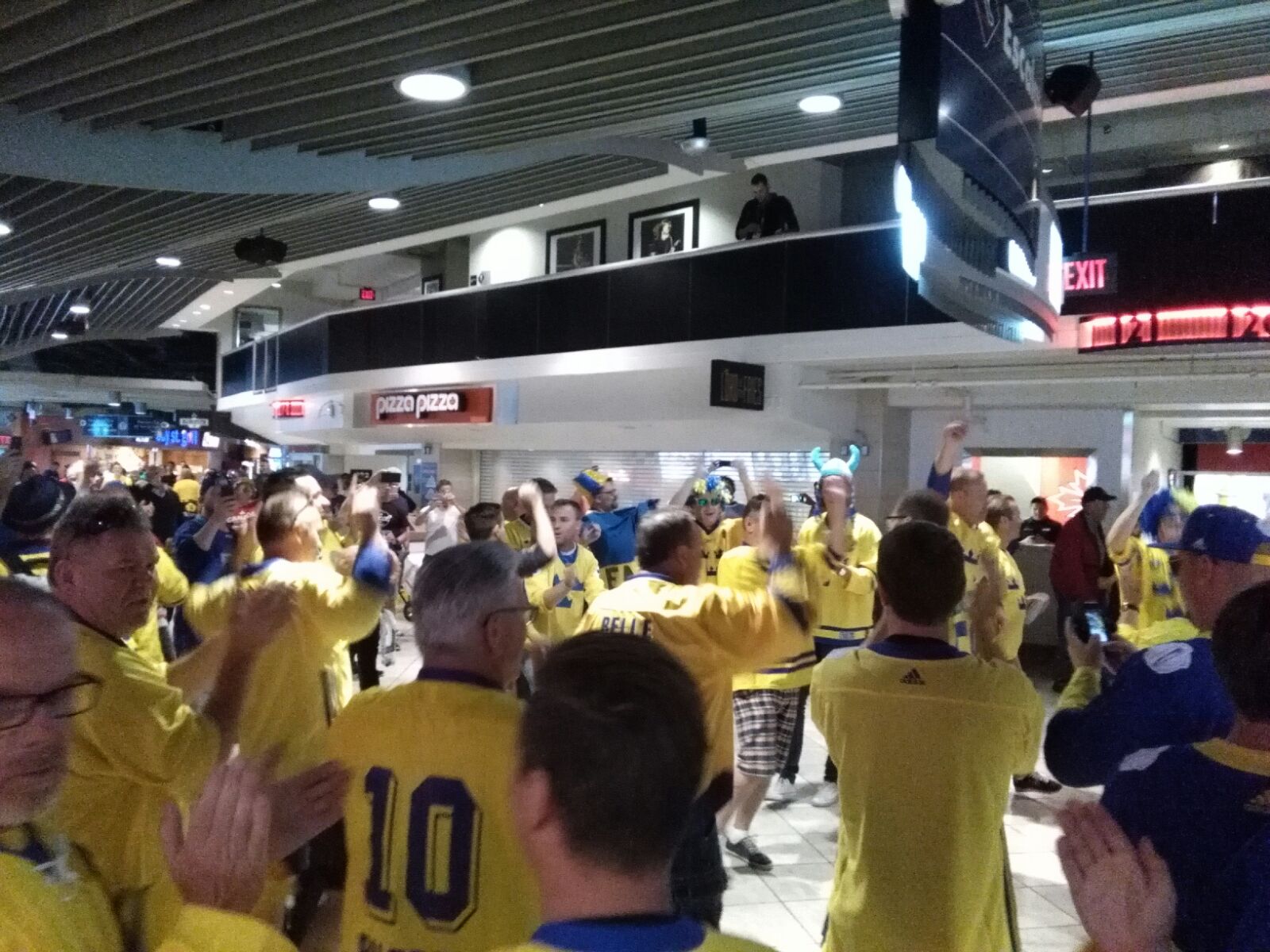
Swedish fans singing before the game

It was refreshing to be in a North American city and experience something close to the atmosphere you might find in a European city ahead of a big qualifying game in football, if not quite a full-on tournament atmosphere. There were plenty of yellow and blue clad Swedish fans along with reds of the Czech Republic and the blues of Finland populating the bars and patios of downtown Toronto and they were in full voice. Any game involving Canada, the USA or indeed the North America side were all sold out but we did manage to get tickets for the nosebleed seats for the Sweden v Finland game.

79a5f077-2f20-4adb-9887-3999b92ad328

The puck drop was set for 3pm and it felt we were swamped with Swedish fans. This being a modern 20,000 seat venue in North America there were plenty of places to grab merchandise and a drink. They do of course allow you to supersize that, you could get a 25oz beer which is a close to about two pints I think.

As I said the arena capacity is just under 20,000 so it was disappointing that the crowd was only around the 12,000 mark. I’d blame the pricing, we’d been cheapskates and got tickets for about $30 each and the seats all around us were full with a fair few locals in among the Swedes and Finns. However the more expensive seats, in the $100+ price range remained mostly empty.

bb7f0f92-4217-40df-9657-6158a9e81446

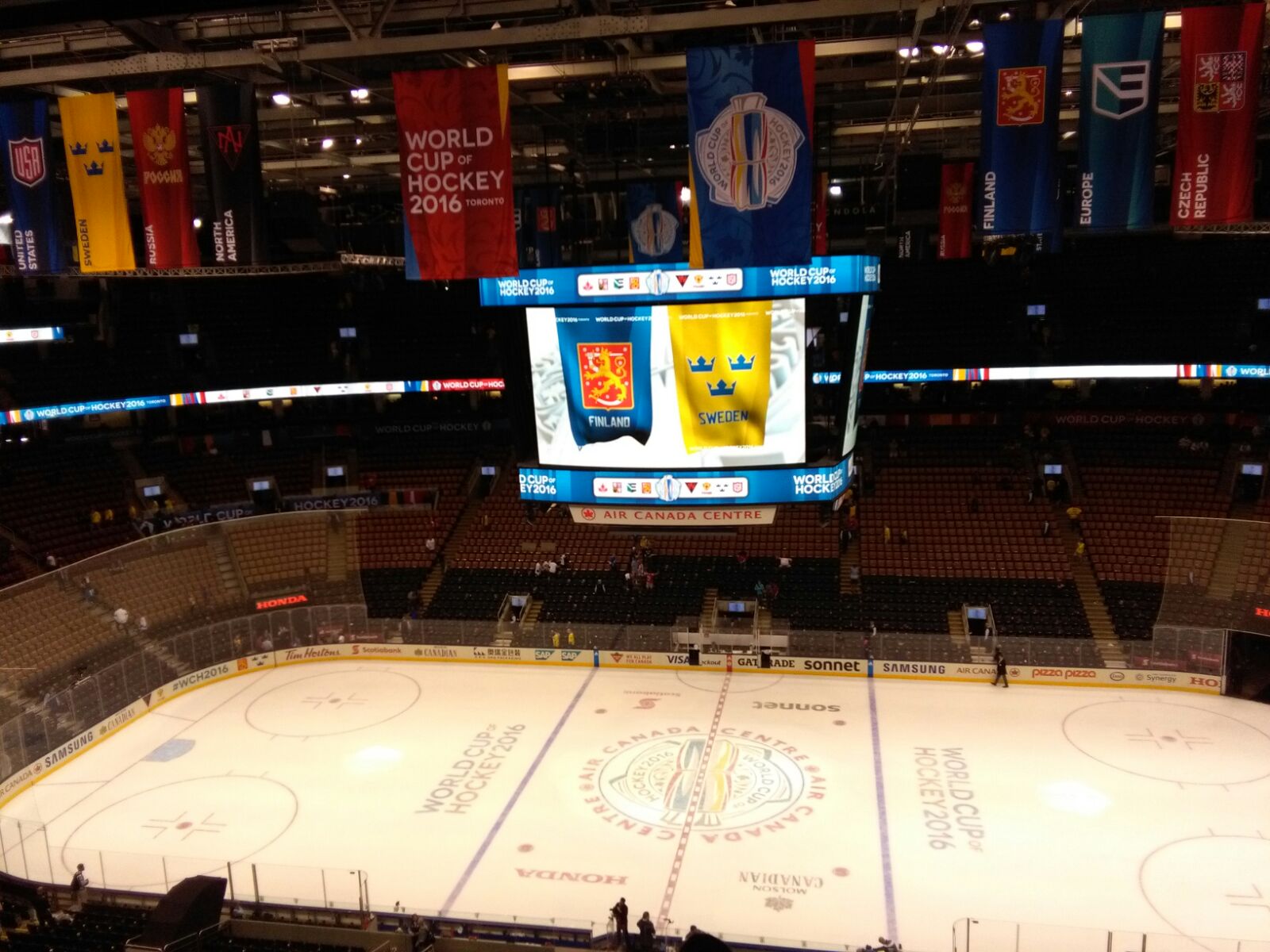
Team line-ups

Both squads (apart from a couple of Russian based players in Finland’s party) were comprised of NHL based players. The most prominent probably being the Swedish twin brothers Henrik and Daniel Sedin who both play for the Vancouver Canucks and for Finland it would probably be Minnesota Wild captain Mikko Koivu or goaltender Tuukka Rask.  The Finns started the brighter and seemed to play the better hockey in the first period but we weren’t to be provided with a goal. We were kept interested with another round of beers and some chanting from the predominantly Swedish crowd.

In the second period the Swedes came into the game a bit more with the Sedin brothers combining to set up Anton Strålman for the first goal. While Finland came back into the game and forced Sweden’s goal-tender, Henrik Lundqvist of the New York Rangers into a number good saves. The Finns continued to press for an equaliser in the final period, even committing Rask their goalie forward only to be caught out by a very late Swedish counter-attack with Loui Eriksson of the Vancouver Canucks scoring into the open goal. The win guaranteed the Swede’s progression from the group stages while Finland needed a miracle, something their crestfallen fans seemed well aware of.

319dfca6-cfb0-4281-a2fd-d906406ede16

Some disappointed Finland fans

Sweden would be knocked out the semi-final be the Europe selection, who would be defeated in the final by the heavy favourites Canada. It gives a Canada some what of a clean sweep as they are now World Champions, World Cup winners and Olympic Gold medallists and clearly the most dominant hockey team in the World. If the World Cup does gain some traction and some manages to become a regular fixture and not just a glorified warm-up to the NHL season then it could be the international competition with the highest player quality levels.

While not quite a global festival of sport it was still a chance to see some of the best players of the sport in international competition. Watching and reading the media coverage of the tournament there did seem a genuine pride and indeed novelty for the players taking part, many of whom had previously had scant opportunity to represent their nations.