
The playoff that never was
The 1940-41 title race was a nail biting affair that went almost down to the wire with two great teams, Cork United and Waterford battling it out for supremacy. While the majority of the rest of Europe was engulfed in the violence and destruction of the Second World War the League of Ireland continued as usual, or as usual as possible under the circumstances. In fact, the War had the effect of improving the standard of player in the League of Ireland as many Irish players returned home from Britain where league football had been effectively postponed until the cessation of hostilities.
Cork United, had only been in existence for a season by that stage, formed immediately after the dissolution of the original Cork City, they were an ambitious club who were about to begin a period of league dominance. They were a full-time outfit from the outset and they made a statement of intent by bringing back to Ireland players who had had experience in England, such as Irish international Owen Madden, Jack O’Reilly signed from Norwich, while the goalkeeper berth was taken up by Jim “Fox” Foley, an Irish international who had played for Celtic and Plymouth Argyle. The following year they went further and signed Bill Hayes, a top international full-back who had been plying his trade with top-flight Huddersfield Town in England.
Cork had also recruited wisely from the local area for that 1940-41 season, signing a teenage striker from Dunmanway called Sean McCarthy who despite his tender years would chip in with 14 goals in the debut campaign of what was destined to become a prolific goal-scoring career.
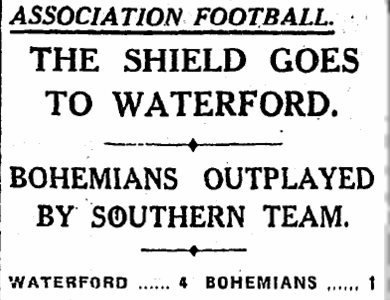
Waterford were no slouches either, although they had struggled both financially and on the pitch in the previous two seasons they still retained a core of veterans who had helped win them the cup in 1937 and finish runners up in the 1937-38 season. Among them were Tim O’Keeffe, an Irish international left winger with a ferocious shot that earned him the nickname “Cannonball” who had just returned after a spell in Scotland, and Walter “Walty” Walsh at left half. Also among their number was a 20 year old local lad who played at inside forward named Paddy Coad who was already making a name for himself as one of the most skillful players in the league. John Johnston, a Derry-born centre forward, was also signed from Limerick to help lead the Waterford attack. Johnston and O’Keeffe would finish the league as joint top scorers that year with 17 goals apiece.
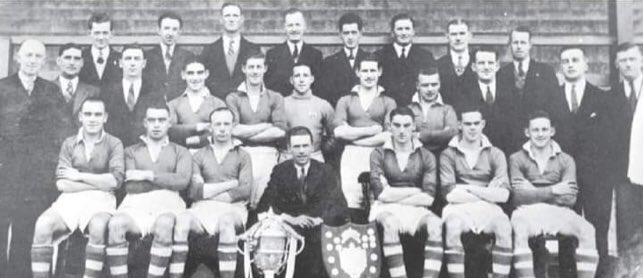
Waterford in 1937
Cork had a slow start to the season but as the league approached Christmas they went on a ten-match unbeaten run which was only ended by their title rivals Waterford. Over 8,000 fans packed into the Mardyke to see this Munster derby and it was the men in blue of Waterford who emerged triumphant. In fact in both league games played that season Waterford came out on top, winning 2-1 and 4-0 over Cork.
Of the two sides it was Waterford who were the more attacking, by the end of the 22 match series of league games Waterford had scored 62 goals compared to Cork’s 50, though the Leesiders had a somewhat better defensive record. Goal difference between the two sides was ultimately +4 in Waterford’s favour but it would be more than 50 years before the League of Ireland employed goal difference to separate teams so a league playoff was decided as the fairest way to split the two teams.
By the time this match rolled around Cork United had already defeated Waterford 3-1 after a thrilling and fiery replay in the FAI Cup final at Dalymount, Sean McCarthy, the youngest man on the pitch opened the scoring and although Johnstone equalised, a Jack O’Reilly brace brought the cup to Cork. They now had their sights set on making history as the first club from outside of the capital to win a cup and league double.
The teams were due to meet again some weeks later on May 11th in Cork’s ground, the Mardyke, for a test match to decide the outright championship winners after both sides finished level. Sensationally, that play-off never took place as seven Waterford players, who were offered bonuses of £5 for a win and half that amount for a draw, demanded the draw bonus be paid even if they lost. Waterford’s directors rejected the demand and suspended all seven, including three Cork-born stars, Tim O’Keeffe, Thomas “Tawser” Myers, and goalkeeper Denis “Tol Ol” Daly. The Cork United directors, fearing the loss of an estimated £1,000 gate, intervened and offered to pay the bonuses, but Waterford, on a point of principle, refused the offer and subsequently withdrew from football. The seven players were then banned from league football for the following season.
With Waterford unable to field a team Cork United were awarded the League title, although despite winning both the league and the cup the loss of the expected bumper gate for the playoff game meant that they finished the season incurring a small financial loss. Despite this minor setback that victory set in train a period of dominance for Cork United which saw them win four of the next five league titles and another FAI Cup. For Waterford however things were very different.
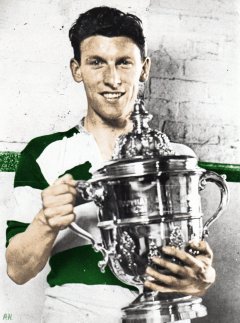
Waterford withdrew from the league for the following season and would not return to League of Ireland football until the beginning of the 1945-46 season. When they returned their squad was mostly made up of local players and they brought in former Irish international Charlie Turner as a player coach for a spell. The stars from 1941 were long departed, Paddy Coad (pictured left as a cup winner for Shamrock Rovers), although suspended from league games, signed for Shamrock Rovers and played only in cup matches in his first season at Milltown. He would go on to become a legendary figure as a player and coach for Rovers. Poor Tim O’Keeffe who had helped win the club the cup in 1937 was less fortunate, he signed for Cork United for a brief spell after his suspension but died from cancer in 1943 at the age of just 33.
In the longer term it was Waterford who would prevail, despite their great success Cork United went bust and left the league in 1948 and were duly replaced by Cork Athletic. Waterford endured a fallow time in the 40’s and 50’s but became a dominant force in the League of Ireland in the 60’s and early 70’s winning six league titles and never having to make do with playoffs in any of their victories.


 A Bohemian Sporting Life