Voyage from Olympia – Ireland against Estonia and the USA

The FAI delegation were busy at the Olympics, it had been a challenge to even get the football team to Paris, considering the cost and a lack of administrative or State support. And while the Irish side had put in a credible display, only losing out at the quarter final stage to the Dutch after extra time, the officials were keen to make the very most of their time in Paris making new connections with other FIFA members and renewing acquaintances with those nations that had supported the Free State in taking its seat at the top table of world football.

It is against this backdrop that two further games were organised, one in Paris, against Estonia, and another back in Dublin against the United States. Immediately after elimination against the Dutch the Irish delegation had arranged another match, this time against the Estonians on June 3rd , which gave an opportunity to give some game-time to those players who hadn’t previously had the opportunity to feature. The likes of Tom Murphy, Charlie Dowdall, John Thomas and Christy Robinson all got to play as the Irish side recorded an impressive 3-1 win. Level 1-1 at the break thanks to a Paddy Duncan goal, second half strikes from Robinson and Frank Ghent gave Ireland the win.

Surprisingly, the Estonia game, a friendly match, was the best attended of the Irish matches played in Paris with over 3,000 spectators turning up. The crowd numbers were significantly helped by the fact that Ireland didn’t have to compete for public interest against other matches kicking off simultaneously in Paris as had happened with the previous games against the Netherlands and Bulgaria. Also of significance was the appearance of Bohs’ Christy Robinson, four years later his brother Jeremiah (Sam) Robinson would win his first cap, versus Belgium, this would mean that they became the first set of brothers capped by the FAI.

Less than two weeks later, on June 14th , Ireland played their first home international, hosting the USA in Dalymount Park. The USA had eliminated Estonia at the Olympics but had been knocked out by eventual winners Uruguay. They too stayed on for an extra match, beating Poland 3-2 in Warsaw before journeying to Dublin. The USA had supported Ireland’s membership to FIFA, and their journey to Dublin shouldn’t be too surprising as the American soccer party were led by Peter Peel, a Dublin-born, Limerick-raised, sporting all-rounder who had moved to Chicago as a young man. Research by Michael Kielty has shown that Peel retained a profound, active interest in Irish affairs while also running a successful sports medicine practice and being dubbed the “Soccer King of Chicago”.

There was perhaps an added incentive for the Americans to spend a full week in Ireland as the USA was in the middle of its prohibition era and it is believed that the United States party enjoyed the social life available to them in Dublin during their stay. Whether this had any impact on their performance is uncertain, perhaps more likely is the impact of the journey across Europe from Warsaw to Dublin.
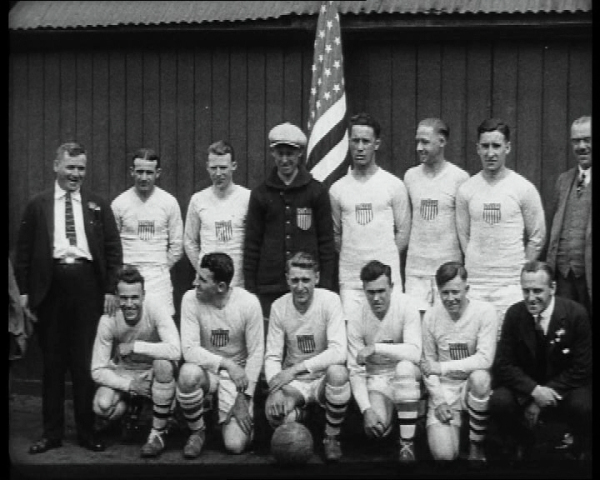
USA team in Dalymount

Regardless, the United States, although a fit and physically imposing side were well-beaten 3-1 in front of a somewhat disappointing crowd of only around 5,000 for the summer friendly in the football off-season.
Ireland included several players, who because of previous experience as professional footballers hadn’t travelled to the Olympics, and it was one of these, Ned Brooks of Bohemians who made the biggest impression. Brooks, on his debut, scored a fine hat-trick, pouncing on an early mistake by Arthur Rudd before rounding off the 3-1 win with two fine strikes. Sadly, this would be Brooks only international cap.

It would be 1926 before Ireland would play another international, and while Brooks was selected to start against Italy, tragedy struck days before he was due to travel when his seven-year-old son Harold ran across a busy street in Rathmines to ask for a penny from his father when he was struck and killed by a car. Despite being rushed to hospital and being given a blood transfusion by his father, young Harold succumbed to his injuries. I feel that the story of Ned Brooks, his brilliance and tragedy shows why it is so important that we honour the memory and achievements of the players of 1924.

Originally published in the Ireland v Hungary match programme May 2024
Bohemians in America (Podcast)

A podcast recorded with sports researcher Michael Kielty – a lively discussing which covers early patterns of emigration by Irish footballers, the emergence of  the New York Bohemians in the 1920s, as well as the stories of unique characters like Billy Synott and Joe Stynes.


This slideshow requires JavaScript.

My United States of first ever

Back in 2000 the then Enterprise Minister Mary Harney told a gathering of the American Bar Association that Ireland was “a lot closer to Boston than Berlin”. At the time that statement provoked plenty of debate and whatever your views its accuracy it held a certain truth in the very early days of the FAI. There was certainly a greater footballing closeness with the Americans than with our near neighbours in Britain. When the Football Association of Ireland formed out of the split from the Belfast-based IFA they entered a very inhospitable footballing climate. They were no longer part of the British Championship and their requests for fixtures with neighbouring Associations were rebuffed. Looking further afield international recognition came from FIFA in 1923 and the following summer the FAI sent an amateur international side to compete in the Paris Olympics in what was to be the nascent Association’s first foray into International football.

A victory over Bulgaria in the opening round, followed by a quarter final exit after extra time to the Dutch was a credible performance for a new and poorly funded side. But there was little on the horizon in terms of a home international. Here however enter the Americans; another side who had likewise been knocked out in the Olympic quarter finals would be heading Ireland’s way shortly after.

The USA had been knocked out by eventual winners Uruguay and had taken the opportunity to play a couple of friendly games before the long journey back across the Atlantic. After defeating Poland 3-2 in Warsaw on June 10th the Americans were swiftly on a boat to Cork and then by train to Dublin to play the Irish on June 14th 1924 in Dalymount Park.

It was a game of many firsts. It was a first home match for the FAI, indeed it was the first Irish international to be held in Dublin since 1913. It was one of the first football matches to feature the playing of Amhrán na bhFiann as the national anthem (an official decision had not been made on a post-Independence anthem and other songs such as Let Erin Remember had been used before), and it recorded the first hat-trick for the young Free State side as the Irish ran out 3-1 winners.

The side that had travelled to the Olympics had been all amateur but there were to be some changes ahead of the American game. St. James’s Gate’s Charlie Dowdall for one was unavailable. He had gone to visit relatives in England on his was back from Paris!

In goal Frank Collins joined the side. Collins has spent a season as a professional with Glasgow Celtic and had already been capped by the IFA but he was back working as a baker in Dublin in 1924 and playing for his employers Jacob’s in the League of Ireland. Another who was making a debut appearance was the hat-trick hero Ned Brooks of Bohemians, like Collins he had also been previously capped by the IFA.

The USA game was to be his only appearance for Ireland which means he has an enviable goals per game ratio. He started at centre-forward which meant that Paddy Duncan of St. James’s Gate was withdrawn into the midfield which seemed to have the desired affect against the Americans. The side in this first home international was captained by Brooks’ Bohemian team-mate Bertie Kerr.

Brooks ad

Ned Brooks featuring in an advertisement

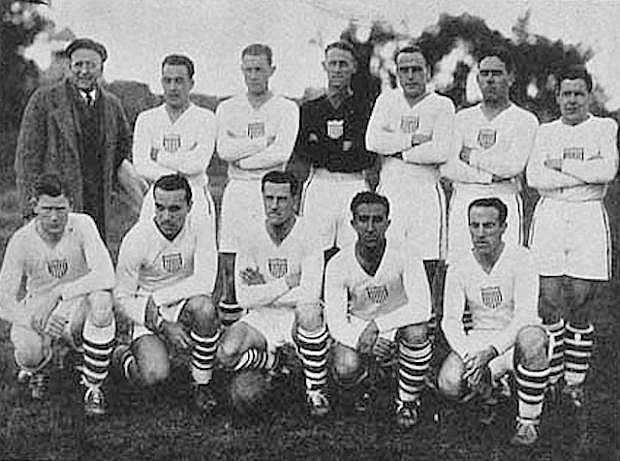
Most of the USA players were active in the American Soccer League (ASL), an early professional soccer league based mainly around the states of New York, New Jersey and Pennsylvania. Many of the participating clubs would have found similarities with the likes of Jacobs and James’s Gate as they too were works teams. The side’s star player on the day was their goalkeeper, Jimmy Douglas who would have a relatively long international career with the USA, featuring for them in the semi-final of the inaugural World Cup in 1930 (see banner pic). A goal from James Rhody of Harrison F.C. and that fine performance for Douglas in goal was as good as it got for the USA on the day.

Pathé newsreel footage of the game can be seen here.

There was also an Irish connection with the USA party, their Association President Peter J. Peel was in Dalymount Park in 1924 and it was sure to have been a familiar sight. Peel had been born in Dublin and moved to Chicago as a young man. He was a sporting all-rounder, prominent in the fields of golf and tennis in his home city. Such was his devotion to football that he was convinced that it would outstrip baseball in the competition for American sporting affections within five years. Peel obviously had the Irish gift of the gab matched with an American sense of indefatigable optimism though with the continued growth of the MLS who is to say that the predictions of a Dubliner some 94 years ago may yet come to pass?


This article first appeared in the June 2018 match programme for the Republic of Ireland v USA international friendly match.