Early football players of colour in the League of Ireland

As some readers may be aware I’ve had the opportunity to write a number of articles on the life and career of former Drumcondra footballer Ray Keogh. Indeed recently I was lucky enough to be asked by Dublin City Council libraries to give a talk on the subject, which you can listen to here.

Ray’s life and career were filled with plenty of drama and highlights which would have been worth recording no matter his background, but the fact that initially I thought that Ray may have been the first person of colour to play in the League of Ireland meant that I felt that his story really needed to be recorded and told while he was still with us. Sadly Ray died in August 2019 but I was lucky enough to meet him before he passed away, I was also fortunate enough to speak with members of his family, former teammates and others who remembered him from his playing days.

In the course of this research I learned that although Ray was one of the first people of colour to play football in the League, he was not the very first. This short article will give a little bit of background on some of the other players who featured, albeit often fleetingly, in Irish football in the years before Ray made his debut. Ray played that first senior game for Shamrock Rovers in 1959 but there was at least one other player who appeared for a League club before then.

One early black player who was brought to my attention by Bohemian FC historian Stephen Burke was Francis Archibong, who had a brief career with Bohs more than ten years before Ray made his debut for Rovers. Francis Archibong was born in Nigeria and came to Dublin in the late 1940s to study English in University College Dublin. During his spell studying in Dublin he lived on Coulson Avenue in Rathgar but found time to line out for the Bohemians on a number of occasions during the 1948-49 season.

In total Francis Archibong’s Bohs career amounted to four games; two for the Bohemian “B” team in the Leinster Senior League and two for the first team in the League of Ireland Shield, a competition played ahead of the commencement of the main league season. Bohs lost all four matches in these competitions:- to Shamrock Rovers “B”, Jacobs, Waterford and Sligo Rovers respectively, with Francis playing as centre-forward in these games but failing to find the net in any of the contests.

I’ve made the assumption that Archibong may also have lined out for UCD AFC who were not a league side at the time but I’ve yet to find any definite evidence of this. Though there are newspaper reports of his Shield appearances for Bohemians against Waterford and Sligo which mention the novelty of a black African footballer appearing in the game, most reports are not particularly complimentary about his performances, or that of the Bohs side as a whole. The Munster Express was perhaps the most generous in their appraisal of Archibong’s performances who noted the warm welcome afforded to him by the Waterford crowd.
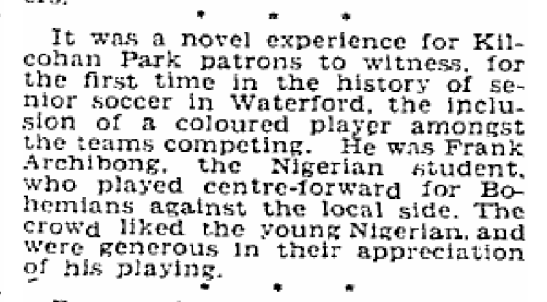
Archibong snippet

Munster Express 15th October 1948

While Francis’s Bohs career was short he did feature alongside players of note such as Brendan O’Kelly who would represent Ireland in football at the 1948 Olympics and Frank Morris. He also played against the likes of Ireland internationals Fred Kiernan and Sean Fallon who were lining out for Sligo. And if his football career didn’t perhaps live up to hopes then his professional life saw huge success.

He graduated with a degree in English from UCD in 1950, his thesis was entitled A history of the criticism of King Lear from Condell to Coleridge. Francis returned to Nigeria in October 1950 on board a plane packed with European missionaries, thereafter he devoted his career to educating young people in his home country. Francis Archibong ended up working for the Nigerian Ministry of Education and was involved in large scale literacy projects in the 1960s and even represented Nigeria at meetings of UNESCO.

Apart from Francis Archibong there were a number of subsequent people of colour with UCD connections who appeared in Irish football in the years after Francis’s brief sporting career.

UCD tended to be a Leinster Senior League side who also featured in the FAI Cup early

Pic of Obakpani

Francis Obiakpani

rounds, it would be 1979 before UCD AFC would be elected to the League of Ireland. UCD generally had a small number of foreign students at this time, including several from West Africa. A few years after Francis Archibong had graduated the UCD football team featured two Nigerian players in a Metropolitan Cup semi-final against Jacobs in 1956; they were Frank Obiakpani and Fidelis Ezemenari. They lost that game 3-1 with Ezemenari getting the consolation goal.

By that time Obiakpani was a medical student who had just graduated, he had been starring for the UCD side since 1953 and had helped the college to triumph in the Collingwood Cup.  While Ezemenari was studying Zoology. It was mentioned in one report that the two young men had known each other before their arrival in Ireland.

Among their teammates for UCD was a talented attacker named Brian Lenihan (see photo below) who won an amateur international cap for Ireland and who would later become Minister for Finance and run for office as President of Ireland, also on the side was Willie Browne, an accountancy student who would later win three caps for Ireland and captain Bohemian Football Club.

Lenihan UCD

Back in 1953 Obiakpani had faced off for UCD against a friend who was playing for UCC, listed as A. Ezenwa who was described as a talented centre-half who had played football with Obiakpani back in Nigeria, he was also a useful athlete away from the football pitch, excelling in the Long Jump. While in Cork he was studying Science. That UCC side were captained by Tommy Healy who was a star player for League of Ireland side Cork Athletic. Writer Cian Manning has written previously for Póg mo Goal about Francis/Frank Obiakpani and what happened to him after his graduation, he has suggested that Obiakpani may have been killed during the Biafran War in 1967.

I would love to know more about these players, while they did not feature at League of Ireland level they were playing at a high standard and alongside present and future League of Ireland stars. However, the information I’ve been able to find still leaves unanswered questions, even down to simple details like the first name of players like Ezenwa.

If you know more I’d love to hear from you.

UCD – teaching a football lesson?

Something I did up for The Football Pink on the unique place occupied by UCD in Irish football.

It’s a strange situation when the most famous player ever to play for your club didn’t actually do so; but then that’s the League of Ireland for you. The player in question was the louche, chain-smoking, erudite Brazilian genius Sócrates and the story went that while studying medicine at UCD (University College Dublin) he joined the College football team (UCD AFC) and played in the unremarkable surroundings of the League of Ireland B division. It’s a lovely image, a young Sócrates, maybe 20 years old playing against the reserve sides of League of Ireland teams in front of a couple of hundred spectators on a muddy pitch in Belfield, the University’s sports grounds. The only problem is it never happened. Sócrates did indeed study medicine and was a qualified Doctor but he studied in the state of Sao Paulo and not in the leafy suburbs of south Dublin.

socrates

While the concept of a University team playing league football is not unique, UCD are a bit of a quirk in Irish football. A rock of stability in the financially turbulent League of Ireland, UCD – because of their connection with Ireland’s largest university and their focus on providing sports scholarships to aspiring students – have a “business model” that has always been different from some of the more established League of Ireland clubs.

While no Brazilian philosopher-footballers have turned out for the Students there have been some well-known players who’ve donned the blue and navy of UCD. Peter Lorimer played a handful of games for them before his second spell with Leeds United while Irish international Kevin Moran also played while studying for his degree. There are other points of interest with the club; their Executive Vice President is the remarkable Josef Veselsky; a formidable table tennis player in his youth in his home city of Bratislava, he joined the Czech resistance when the Nazis invaded before relocating to Ireland in the 1940s. Even UCD’s rare forays into Europe have been of note; back in the 1984-85 Cup Winners Cup, the Students were the width of a crossbar away from knocking Everton out of a competition they would eventually win.

Then, of course, there is the “fan culture” of the club. One of the team’s most famous fans was University alumnus Dermot Morgan, better known to international audiences as Fr. Ted Crilly from Channel 4 sitcom Father Ted. In typical Morgan style, when asked why he supported UCD he is reported to have replied “because I don’t like crowds” – an apt response. UCD’s ground; the Belfield Bowl has a seated area of 1,500 and can accommodate more standing but the ground stewards are rarely troubled with capacity crowds. A couple of hundred students and alumni attending games is par for the course for UCD which is low even for the First Division where they currently reside; indeed it is not unusual for opposition supporters to outnumber home fans.

belfield

This has raised the question as to what UCD bring to the league. In terms of boisterous travelling support and match day atmosphere not a great deal, but in other areas they offer a lot. The scholarship system has offered talented young footballers the chance to play league football while pursuing further education. Though not a scholarship student, UCD’s most famous ex-player – the former Manchester United and Ireland defender Kevin Moran – has often said that delaying his move to England until after he completed his Commerce degree meant both that he was more mature when heading over and also less worried about his future, as he had his degree to fall back on. The most recent Ireland international to come through the UCD scholarship system has been Conor Sammon, (dubbed the “Sammon of College” during his stay there) who’s currently on-loan at Sheffield United from Derby County while many other League of Ireland of clubs have benefitted from UCD’s approach.

Dundalk, for example, have just won their second league title in a row and central to this latest triumph has been midfielder Ronan Finn, who won a football scholarship to UCD while one of the star performers who helped St. Patrick’s Athletic win last year’s FAI Cup was Conan Byrne, another UCD past man. UCD aren’t expected to challenge for trophies and are not reliant on generating big gates or chasing prize money, they expect their best performers like Finn and Byrne to get poached by other clubs offering decent wages which means they have always been the club to give youth a chance and to develop quality young players.

At the time of writing, UCD occupy a play-off spot in the First Division having been relegated from the Premier Division last year, yet despite this state of affairs 2015 has seen UCD secure one of the greatest financial windfalls of any League of Ireland club. The University side qualified for the Europa League this year by the Fair Play award route. UCD have always focussed on trying to play expansive, passing football – perhaps best exemplified by previous coach Martin Russell – and eschewing the more physical side of the game which has ultimately benefitted them. While many in Irish football expected UCD to be humiliated in Europe, they surprised many commentators when their young side defeated F91 Dudelange of Luxembourg 2-1 over two legs. Star of the tie was 19-year-old striker Ryan Swan, the third generation of the Swan family to play in the League of Ireland; his father Derek had finished his career at UCD and his cousin Tony McDonnell was the clubs’ erstwhile captain. Progress through the first qualifying round meant the Students met Slovan Bratislava in the next phase, but a heavy home defeat meant that UCD would progress no further. The blow was softened as the club banked over €400,000 in UEFA prize money during their European adventure. To put this into context Dundalk won just €100,000 in prize money for winning the league title. A club that was relegated and only got to play in Europe due to the Fair Play league got several multiples of that amount, and this sums up the dilemma in the League of Ireland.

swan

Dundalk, so impressive over the last two years, were on the brink of going bust only a year earlier and the club is still in dispute with their former owner over lease arrangements of their ground, Oriel Park, and their youth development facilities. UCD and other clubs such as Cabinteely F.C. and especially Wexford Youths present an alternative model to the more established sides in the league. While Wexford, Cabinteely and UCD might lack the trophies and support levels of other clubs, their focus on the youth development of mostly amateur players raises a dilemma for the league.

Dundalk, Bohemians, Shelbourne, Shamrock Rovers, Cork City, Drogheda United, Derry City and others have all chased, and in some cases achieved, on field success but have very nearly gone out of business in the process due to overspending, mostly in terms of player wages. A discussion is now whether the aim for clubs should be one of full professionalism of players and coaching staff with a focus on European progress and using such successes to grow existing fan bases, or a return to a mostly amateur player set up with resources focused more on local area player development.

Wexford Youths are newly crowned First Division champions and UCD may yet join them in the Premier Division next year via the play-offs. Some League of Ireland fans are asking themselves if these clubs are good for the nation’s top flight; they are not going to bring legions of travelling fans nor are they likely to entice the sceptical armchair football fans of Ireland through the turnstiles of Irish clubs in the way that the stylish football of Richie Towell, Daryl Horgan and co. have brought crowds back to Dundalk games.

That is unlikely to be of concern to UCD, their European windfall has helped to secure the future of the club even further and they are likely to continue offering young men the chance to play league football while pursuing further education. Those same players are likely to be hoovered up by League of Ireland sides with bigger wage budgets and UCD will begin again, as they always do – with a minimum of fuss.