Rodriguez of Richmond Road – Alvarito at Shelbourne

It’s not all that often that an international from one of the bone-fide European football powers ends up playing in the League of Ireland. But just that did happen in the mid 1960’s when Spanish international Alvaro Ros Rodriguez, better known simply as Alvarito joined Shelbourne in 1965.

Alvarito was born in 1936 in the small town of Ujo in Asturias, an industrial area synonymous with the coal mining industry. He was a two-time Spanish international who featured in away matches against Chile (a 4-0 win) and Argentina (2-0 loss) in 1960. For Spain in these games he played alongside the likes of Alfredo Di Stéfano, Luis Suarez, Juan Segarra and his Atlético Madrid teammate Enrique Collar.

Alvarito played for Oviedo early in his career but spent his best years at Atlético Madrid, winning two Spanish Cups (Copa del Generalisimo as it was during the Franco dictatorship) as well as the 1961-62 Cup Winners Cup against that competitions inaugural Champions, Fiorentina.

Despite this success Alvarito was never a regular with Atlético, he suffered injuries including a severe leg-break in a game against Valladolid, and was mainly understudy to Spanish international Isacio Calleja when he returned from injury. That injury not only limited his club career but also put paid to whatever hopes Alvarito might of harboured of a recall to the Spanish national team ahead of the 1962 World Cup.

He did start in the final of the 1959-60 Copa del Generalisimo, a famous 3-1 win over city rivals Real Madrid in a packed Santiago Bernabéu. Atlético went into that game as complete underdogs, not least because their rivals the great Real Madrid that had demolished Eintracht Frankfurt 7-3 in the final of the European Cup final just a month earlier. That famous victory meant that Real had won the first five European Cups and their side was full of stars including Ferenc Puskás, Paco Gento, Alfredo Di Stéfano and José Santamaría. However the Atlético humbled their city rivals and lifted the cup after scoring three unanswered second half goals after Puskás had giving Real an early lead.

Alvarito’s experience of the League of Ireland with Shelbourne was short-lived. Upon leaving Atlético Madrid he spent a single season with Real Murcia before joining Shelbourne as a player-coach in 1965, while studying English in Dublin. Because of injury he hadn’t played much competitive football for five months prior to having signed for Shelbourne, he was also not completely unfamiliar with Shels and their players having seen them play against his former club Atlético in the Inter City Fairs Cup only a month before he joined. Alvarito made his debut in a 2-1 win for Shels over Dublin rivals Drumcondra.

Some impressive performances followed with Alvarito operating in both full-back positions but a combination of recurring injury and difficulties with the language meant that his stay was brief. What followed after leaving Shelbourne was over 20 years of coaching in the Spanish lower leagues, something that Shels can look on with a little bit of pride as they gave him his first coaching role in the game.

Directly after his spell with Shels Alvarito took up an offer from his friend and former international teammate Ferenc Puskás to cross the Atlantic and join the Vancouver Royals in the NASL where Puskás had recently been installed as head coach. Alvarito’s English lessons must have done him some good as he spent a number of years coaching in the United States before returning to Spain to continue his coaching career. He became most associated with UD Melilla, a team based in a autonomous Spanish city of Melilla, on the coast of North Africa.

Alvarito passed away in June 2018 at the age of 82 in the Spanish city of Melilla.

Ireland at Euro 1964: First time to the last 8

Dublin hosting the European Championships, what once was the sort of thing speculated about during the excess of the Celtic Tiger years, usually as part of some sort of All-Ireland, pan-Celtic bid, will come to pass in 2020. The Irish Capital has been chosen as one of 13 “host cities” for a 60th anniversary celebration tournament. We will of course have to qualify if there is to be any chance of seeing an Irish team in action on home soil.

However the idea of hosting all tournament matches in the same one or two countries is relatively recent. When the first Euros were held in 1960 in France only the semi-finals, finals and 3rd/4th playoff were played in the host country while only in 1980 did the tournament grow to eight teams. The qualifying was somewhat more straight-forward in those days as UEFA was a much smaller place. The Soviet Union had a single team, the Czech Republic and Slovakia had not separated and Yugoslavia hadn’t splintered into its constituent parts.

In 1964, during the second ever tournament, Ireland even got as far as the quarter-finals which were two-legged affairs, home and away. These quarter-final games took place in March and April of 1964 before the semi-finals and finals took place in the host country of Spain in the middle of June.

Ireland had had an inauspicious start during the first Euros in 1960. With 17 nations entering and a straight knock-out style of qualification without a group format, one pair of nations would have to play a preliminary round to even up the numbers. Ireland were drawn with Czechoslovakia and despite a promising start in the home leg with Ireland winning 2-0 they were eventually eliminated 4-2 on aggregate by an improving Czech side that would make it all the way to the World Cup final only two years later.

Four years later in 1964 there was thankfully no preliminary round for the Irish but the qualifying format continued as a straight knock-out competition. Round one pitched Ireland against Iceland with Ireland drawn at home first with the game starting well with Newcastle’s Liam Touhy getting Ireland off the mark after just 11 minutes and while Ríkharður Jónsson equalised for Iceland Amby Fogarty of Sunderland restored Ireland’s lead before half time. In the second half Noel Cantwell extended Ireland’s lead to 4-1 with two goals before Jónsson grabbed a consolation before the final whistle. Cantwell usually lined out at full back for his club Manchester United but was often employed as a centre forward for Ireland. Tall and well-built Cantwell made a good target man and also had a strong shot, he was Ireland’s usual penalty taker and scored an impressive 14 goals in 36 appearances, a record for Ireland that wasn’t broken until the heyday of Don Givens in the 1970s.

iceland v ireland

Ireland v Iceland with Noel Cantwell on the programme cover

A weakened Irish team made the journey to Reykvanik for the return leg, the side were without Giles in midfield and Tony Dunne in defence and had to settle for a 1-1 draw, Tuohy again on the scoresheet. This 5-3 aggregate victory set up a meeting with Austria in the second round.

Now Austria have never been Ireland’s easiest opponents, David Alaba’s fantastic strike in qualifying for Brazil 2014 will be fresh in the memories of Irish fans. Many of us will also remember the pair of 3-1 losses late in Jack Charlton’s tenure, including Ireland’s infamous pre-match preparation of a visit to Harry Ramsden’s fish and chip restaurant the day before the home game. Back in 1963 our record was not much healthier, it read played 4, won 1, lost 3, including a 6-0 shellacking way back in 1952. However, things would be different this time round.

Ireland were drawn away in the opening leg and were not at full strength, and there was significant trepidation ahead of the trip to Vienna with certain newspapers suggesting that a weakened Irish side would need a miracle to get a result and that the focus should be one of damaged limitation and preserving national pride. Ireland were without Cantwell and Tony Dunne who were not released by Manchester United and there would be three débutantes for the game, Bohemians’ right back Willie Browne (until Joey Lapira the last amateur capped by Ireland), Ray Brady of QPR in the centre of defence alongside Charlie Hurley and Ronnie Whelan Snr of St. Patrick’s Athletic at inside forward. The conditions however suited Ireland with the game being played in a downpour and Ray Brady in particular impressing. Well, impressing the Irish fans at least, the Austrians were not pleased with what they viewed as Brady’s rough play. His combative style also upset the Austrian players, so much so that he was kicked by one of the Austrian forwards who was luckily quick enough to escape retaliation from a furious Brady before the referee intervened to calm things down. Apart from Brady an inspired performance by Alan Kelly Snr. in goal denied the Austrians on numerous occasions and they were unable to force a goal and the game ended 0-0.

The controversy didn’t end with the away leg, while Ireland would be ultimately successful against Austria in Dalymount Park the game very nearly could have been called off. There are plenty of examples from Ireland’s football history of unjust decisions going against us in games and stories of hotels serving dodgy food or rowdy fans creating so much noise that the Irish players couldn’t sleep before a game. This time however it was the Irish fans who were the ones doing the intimidating. Over the course of the game, which Ireland won 3-2 there were no less than four pitch invasions! The old Phibsboro ground was packed with over 40,000 people, including a number who clambered up the floodlight pylons to get a better view so its not too surprising that there might have been some incursions onto the field.  The most controversial was the pitch invasion just before the final whistle. Ireland had been just awarded a penalty when a Joe Haverty cross was handled in box in the 89th minute. The crowd spilled onto the pitch yet again and had to be herded back by Gardaí and stewards just as had happened earlier when they encroached on the pitch at half time and also to celebrate the second Irish goal.

ireland-1963-crop

Ireland team v Austria

Duly intimidated by the boisterous Irish crowd the Austrian keeper Gernot Fraydl dived the wrong way and Noel Cantwell’s second goal sealed a famous victory for the Irish. They were through to the quarter-finals of the European Championships. It had not been a pretty game, Ireland had effectively played much of the match with only ten men after Blackburn’s Mick McGrath was kicked in the head early in the first half, McGrath had to get seven stitches in his scalp and although he togged back out for the second half he was pretty much a passenger for the rest of the game, stuck out ineffectively on the right wing. The Irish too, knew how to dish it out and the Irish Times correspondent described their tackling as “verging on the unorthodox”. The Austrians were furious after the game and their Coach Karl Decker threatened to appeal to UEFA to overthrow the result and force a replay due to the pitch invasions. The result stood however, and despite the intimidating atmosphere Ireland had played well with Millwall’s diminutive winger Joe Haverty coming in for special praise, Brady and Hurley had performed well in defence with the result that Alan Kelly in the Ireland goal was not unduly tested apart from Austria’s two strikes. While the central Europeans were perhaps the better footballing side the weather had been against them in the first leg and the Irish had out-competed them in the return fixture. Next up for the Irish were the Spaniards in the last 8.

The Spaniards were hosts of the ’64 semi-finals and finals with games split between Camp Nou in Barcelona and the Bernabeu stadium in Madrid. In 1960 despite boasting some scintillating talents and numerous stars from the all-conquering Real Madrid side the Spaniards had essentially withdrawn from the inaugural European Championships (or nations cup as it was then known)  when they had been drawn away to the USSR. Just two days before the game was to be played the Spanish team withdrew and when a furious Alfredo Di Stefano confronted the President of the Spanish Football Federation, Alfonso de la Fuente Chaos as to why they were not travelling to Moscow he was told, “Orders from above,”. Franco himself had intervened. The Soviets, who had militarily backed the Republican side against Franco in the Spanish Civil War would see their side progress. They would eventually become the tournaments inaugural winners, beating Yugoslavia after extra time in the final. It had been a disaster for the reputation of Spanish football and even for Franco himself, they would have to make amends in ’64.

The first leg of the quarter final would take place on 11th March 1964 in the Sanchez Pizjuan stadium, home of Sevilla. The Spanish national team had used this stadium as a home base many time before and since due to the undoubted passion and volume of the local Andalusian crowd. Things did not start well for Ireland, due to the FA Cup sixth round tie between Manchester Utd and Sunderland going to a second replay which was to take place two days before the Spanish game United refused to allow Tony Dunne and Noel Cantwell to travel. It also meant that Charlie Hurley who had been at the heart of the Sunderland defence would have to play his third game in five days.

It would be Hurley’s tired legs that would give away the first goal, he played a square ball which was intercepted by the pacey Real Madrid forward Amancio who easily converted past Kelly in the Irish goal. Josep Maria Fusté of Barcelona then added a second only a few minutes later. Ireland did try to get back in the game, a clever chipped pass from Giles sent Andy McEvoy away and the Blackburn striker converted his chance in the 22nd minute to get his first for Ireland. McEvoy was in the best form of his career at the time, he would finish that season as the 2nd top scorer in England’s top flight just behind Jimmy Greaves, however he had been crowbarred into previous Irish XI’s as a half back.

Amancio.jpg

Amancio of Spain & Real Madrid

The game belonged to Amancio, the Real Madrid right-winger was running rings around the Irish defence which included the exhausted Hurley and debut cap Theo Foley of Northampton Town. He grabbed his second of the evening on the half-hour mark before setting up Zaragoza striker Marcelino for Spain’s fourth on 33 minutes. Marcelino would add a second goal just before the final whistle, a shot deflecting off Tommy Traynor and past Kelly into the Irish goal. The game finished 5-1. The home leg in Dalymount could only be a formality, Ireland were out.

Despite the crushing defeat 40,000 Irish fans turned up in Dalymount the following month perhaps in some mad, deluded hope that a stronger Ireland side with home advantage might make a miraculous comeback. Tony Dunne and Cantwell were made available by Manchester United, there were recalls for Willie Browne of Bohemians and Johnny Fullam of Shamrock Rovers to add steel to the team, and best of all Spain were without the services of Amancio who had caused the Irish defence such difficulty in Seville. It was not to be though, Pedro Zaballa, the Barcelona winger in for Amancio scored two goals in what would be his only senior cap for Spain to secure them passage to the semi-finals. While the Irish had been committed and work hard throughout it says much that the stand-out player was once again Alan Kelly in goal.
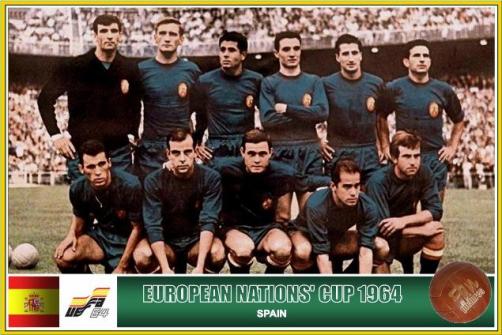
Spain 64

The victorious Spain side of 1964

Spain would go on to win the tournament on home soil, defeating the USSR side that they had refused to play four years earlier in the final. The final score was 2-1 with the winner scored by Marcelino, the same striker who had put two past Ireland in Seville. Amancio would end up coming third in the voting for that year’s Ballon D’Or award, his international captain Luis Suarez came second. And Franco had his win against an arch-enemy. Upon their return the USSR coach Konstantin Beskov and team director Andrei Starostin, were summoned to a meeting at the Soviet Football Federation after a furious Nikita Khrushchev had watched the game on TV and seen pictures of a smiling Franco beamed around the Soviet Union. They were both fired from their posts.

As for Ireland they would meet Spain again the following year in qualifying for the 1966 World cup, losing out in a controversial play-off leg in Paris. For the next European Championships qualifying groups had been introduced but the Irish team that had promised so much was now in decline. Players like Joe Havery, Amby Fogarty, Noel Cantwell and Charlie Hurley who had all been so influential were in their 30’s and coming toward the end of their careers. Ireland were also severely restricted compared to other nations, as we’ve seen there were no guarantees that key players would be released by British clubs, the team manager Johnny Carey was little more than a glorified trainer with little power except to give a pep talk to his hastily gathered players before the game. The Irish team was still selected by an FAI committee and it wasn’t until 1969 that this changed with the appointment of Mick Meagan as manager. It wouldn’t be until 1988 that the Republic of Ireland would have a side that would reach the last eight of the European Championships again.


This first appeared on backpagefootball.com in June 2016


Catalonia: Mixing football and politics

I wrote this on Catalan independence back in 2012 but in light of recent elections in Catalonia with claims that Catalonia could be declared independent in 18 months I thought this might still be relevant.

Few places on the planet meld the worlds or football and politics together as much as Catalonia and its biggest city Barcelona. As Catalonia goes to the polls in less than two weeks’ time; at stake will not just be the parliamentary seats of the regional government from one of Spain’s 17 provinces but possibly the future of Catalonia and Spain itself.

Catalonia is in a contradictory fashion both one of Spain’s most indebted regions while also being the region that pays the highest amount of taxes to Central government. Disagreements between regional premiere Artur Mas and Spanish Prime Minister Mariano Rajoy over the ability of Catalonia to have more direct control over spending and taxation have led to the hot topic of the regional elections due to take place on November 25th being that of Catalan independence.

This has been demonstrated by large scale pro-independence street marches on the streets of Catalan towns and cities and in the great cathedral of Catalan nationalism the Camp Nou. During last month’s Clasico match with Real Madrid the whole stadium was turned into a giant Catalan flag while the crowd chanted “Independence, Independence”. During their recent visit to Parkhead the Celtic staff greeted their visitors not with the Spanish flag but the Catalan one flying from the stadium flagpoles, a nod and a wink from the Scots who are due to have their own referendum in 2014. Despite the international nature of FC Barcelona’s founding fathers the club has become a focal point for Catalan nationalism, Camp Nou being described as the one place in Catalonia where the Catalan language and political dissent could be vocalised during the Franco regime Its club presidents view the leadership position at the club and on-field success as important political tools and are often aligned with the Catalan nationalist movement, former President Joan Laporta was an MP with Democricia Catalana for example.  The current president Sandro Rosell is the son of former Chief Executive Jaume Rosell who was involved with the club in the final years of the Franco regime in the 1970’s. As the story goes upon hearing of the death of the dictator Rosell and a colleague began tossing a plaster bust of the Generalissimo back and forth to each other before Rosell fumbled and dropped the bust to the floor where it smashed to pieces. It’s a very Barca story.

However it’s worth thinking about where a successful independence movement would leave not only Barcelona but all of Catalan and Spanish football. Projections are suggesting that Catalan Independence parties could gain a majority in the regional parliament this month and would be in position to push for a referendum on Catalan independence. Rajoy and the rest of the Spanish National Government won’t countenance this action, declaring it illegal and beyond the powers of the regional parliament, they have also stated that any new Catalan republic would be barred from entry to the EU, something that Artur Mas has strongly contested in Brussels.

A situation could arise whereby Catalonia would almost be a rogue state within Western Europe, recognised by some but not by others, perhaps in the same way that nations like Kosovo or South Ossetia are treated depending on the political outlook of the nation in question. Even if Catalonia were to universally recognised there would be a situation where in footballing terms the new nation would have to seek membership of UEFA and FIFA as well as set up a separate league system as happened in countries like Croatia after the breakup of Yugoslavia. Although there is a separate Catalonian football association, (they have played over 200 international matches) this body is not affiliated with FIFA and the games that they have played are basically challenge matches against guest teams organised during the Christmas break in the Spanish Football calendar.

It would mean that the appeal of Barca could be greatly diminished, they would the major player in a rump league that would feature some teams of prestige, such as Espanyol but the overall quality would drop significantly. Barcelona would be the big fish in a much smaller pond, their titanic clashes with Real Madrid a thing of the past as far as league and cup games are concerned, and without their rivals, without the great competitive edge fuelled by that desire to get one up on the all-white grandees from central Spain would they be the same team? A rump Catalan league would surely hit Barcelona (and it must be said Real Madrid) in the pocket too; Girona FC are not as appealing an opponent as Real Madrid, Athetic Bilbao or Sevilla for either the stadium spectator or the TV marketing executive. A reduction in league competition could mean that Barcelona’s own exacting standards are lowered and that players, whether cantera products or foreign signings could look to other “bigger” leagues as their desired end destination. Could Barca go from from epochal super-team to stepping stone in a matter of years? The other option would be for Barcelona (and others) to seek to remain in the Spanish league. There is some precedent with this in that teams from the neighbouring principality of Andorra already compete in the lower leagues in Spain. The question then becomes whether the financial and competitive advantages of being part of Le Liga triumph over the traditional Catalan nationalist leanings associated with the club. And let us not forget that it was Jaume Rosell that said “Barça is more than a club, but above all it’s a club for all social classes. Barça includes all ideologies because it represents the whole Catalan people”, the questions of who they represent, and where do they represent them would have to be answered by the Barca board, and it is likely their response would not be greeted with universal approval by the supporters.

And what of the national teams of Spain and Catalonia? As mentioned previously there are annual Catalan international challenge matches played each year in December. Last years’ squad featured the likes of Victor Valdes, Carlos Puyol, Gerard Pique, Xavi, Sergio Busquets, and Cesc Fabregas, all World and European Champions with Spain. A formidable core to have in any international team, but how many of them would be likely to declare for the new Catalan national side, it’s one thing to play a challenge match in the knowledge that you can go back and join your World Champion team-mates during the next international break, it’s quite another to walk away from the most successful international side in the modern era. Despite the rivalry and occasional aggression between Real Madrid and Barcelona, the national team replete with Catalans, Castillians and Basques has been harmonious, the players have stressed that regional divides and identities mean little and this attitude has brought them unprecedented success. Players face similar choices in Ireland with players born in Northern Ireland presented with the option of playing for the North or the Republic. Patriotism, a sense of community, identity and belonging, career advancement all play a part in a players’ decision to declare for either team. The same complex choices could face the footballers of Catalonia and Spain.

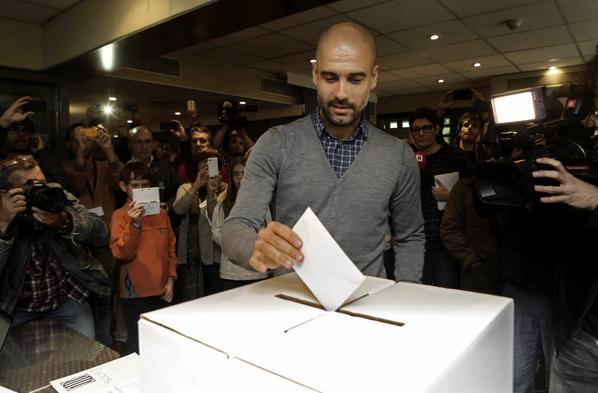
Pep

The international dilemma brings us back to Catalan nationalism, despite over 1.5 million people taking to the streets in Catalonia calling for independence, many from the region are migrants, or children of migrants from other parts Spain especially the south, or indeed a more recent influx of migrants from areas like North Africa who moved to the larger, wealthier cities of Catalonia to earn a living. For them is Catalan nationalism  as much of a priority? They were the outsiders coming into an area that spoke a different language, Catalan and they had to adapt to their surroundings.

One of those ways was through football; Barcelona as well as being a symbol or perhaps even a vehicle for Catalan nationalism are also the club of the foreigner, their founders included Swiss and Englishmen, their heroes have had names like Kubala, Cruyff and Stoichkov, they celebrated an openness internationalism at the height of Spain’s post war isolation and are the global dream team for millions. Barcelona is rightly lauded for focus on home-grown talent but it is also a bit about Argentinian, Brazillian and Dutch brilliance. The immigrants and their children are as much a Barcelona cule as the died- in-the-wool Catalan nationalist, will they appreciate a marginalising of their club or the potential weakening of their all-conquering national team?

Spain has been down paths like these in the past. In the early 80s the country was still in the nascent phases of democracy after the death of General Franco, they were also preparing to host their first World Cup in 1982. Although awarded to Spain as part of a voting pact back in 1966 (some things never change) it became a chance for Spain to continue its reintegration into the Western world after the years of dictatorship with membership of the EEC also on the horizon. However, in other matters there were similarities with modern day Spain as it was also a time of huge economic stagnation, massive unemployment, regional tensions over the devolving of powers; including an active terrorist campaign from Basque separatist group ETA.

Against this background an attempted coup was launched by right wing and military forces in Spain and on 23rd February 1981, 200 armed guards entered the Spanish parliament led by Lieutenant Colonel Antonio Tejero. The swift and determined intervention of King Juan Carlos I who made a televised address denouncing the coup and calling for a return to the proper running of the democratic government saw the coup collapse by the early hours of February 24th. Only a week later Barcelona striker Enrique Castro Gonzalez, better known as Quini was kidnapped at gunpoint shortly after he had helped Barcelona to a 6-0 victory over Hercules. Although the kidnapping turned out to be the work of common criminals and economically motivated  (Quini was eventually released unharmed after 25 days in captivity), early reports suggested that Quini was kidnapped by a Spanish nationalist group who did not want a “separatist” team like Barcelona winning the title.

As ever football and politics seem to be uneasy yet constant bedfellows in Spain, whether the current talks or referenda on Catalan independence is a political ploy, a bargaining chip to gain greater authority over finance, or a political pledge soon to be realised remains to be seen, the fate of a nation and the greatest club and national teams in a generation hangs in the balance.

Originally posted on backpagefootball.com in November 2012