Get your Crosses in

On a cold day in October 1980 a teenaged Grainne Cross, a versatile midfielder, was sent on as a substitute to try and break the deadlock in an international friendly against Belgium at Dalymount Park. With 15 minutes gone in the second half and the score still tied at 0-0 a ball was lofted into the box, Cross got onto the end of it and scored with a beautiful header but was crashing into by the onrushing Belgian goalkeeper. Both players were taken by ambulance to be treated for their injuries and it was only later that Grainne learned she had in fact scored the winning goal of the game. For, Grainne it was one of her, surprisingly, favourite memories from a sporting career that included a move to Italy, playing in Wembley and starting at scrum half for Ireland in a Rugby World Cup!

Grainne was born into a large, sports mad, Limerick family, her father had been a good rugby player and hurler, and her brothers all played rugby as well. However, Grainne and her sisters really excelled at football, Grainne, Tracy and Rose would all be capped by Ireland during their sporting careers.

Grainne began playing in her teens and her talent was quickly spotted, women’s football in the area was mostly focused around factory teams and Grainne appeared for De Beers in Shannon where her mother and sister worked, as well as lining out for other factory teams like Krupp’s and regularly guesting for other sides such as Green Park.

Grainne was talented, (she won her first cap as a 15 year old) and she grabbed the attention of American Colleges who were interested in offering sports scholarships but Grainne followed a different path. Inspired by the success of Anne O’Brien in Italy she contacted the Italian Federation stating her interest in playing in Italy. Amazingly, this paid dividends, what Grainne thought was going to be week-long trial with ASD Fiammamonza in the city Monza, near Milan, turned into a contract offer and chance to pit her wits against the likes of Anne O’Brien, Rose Reilly and Carolina Morace, all gracing the Italian game at the time.
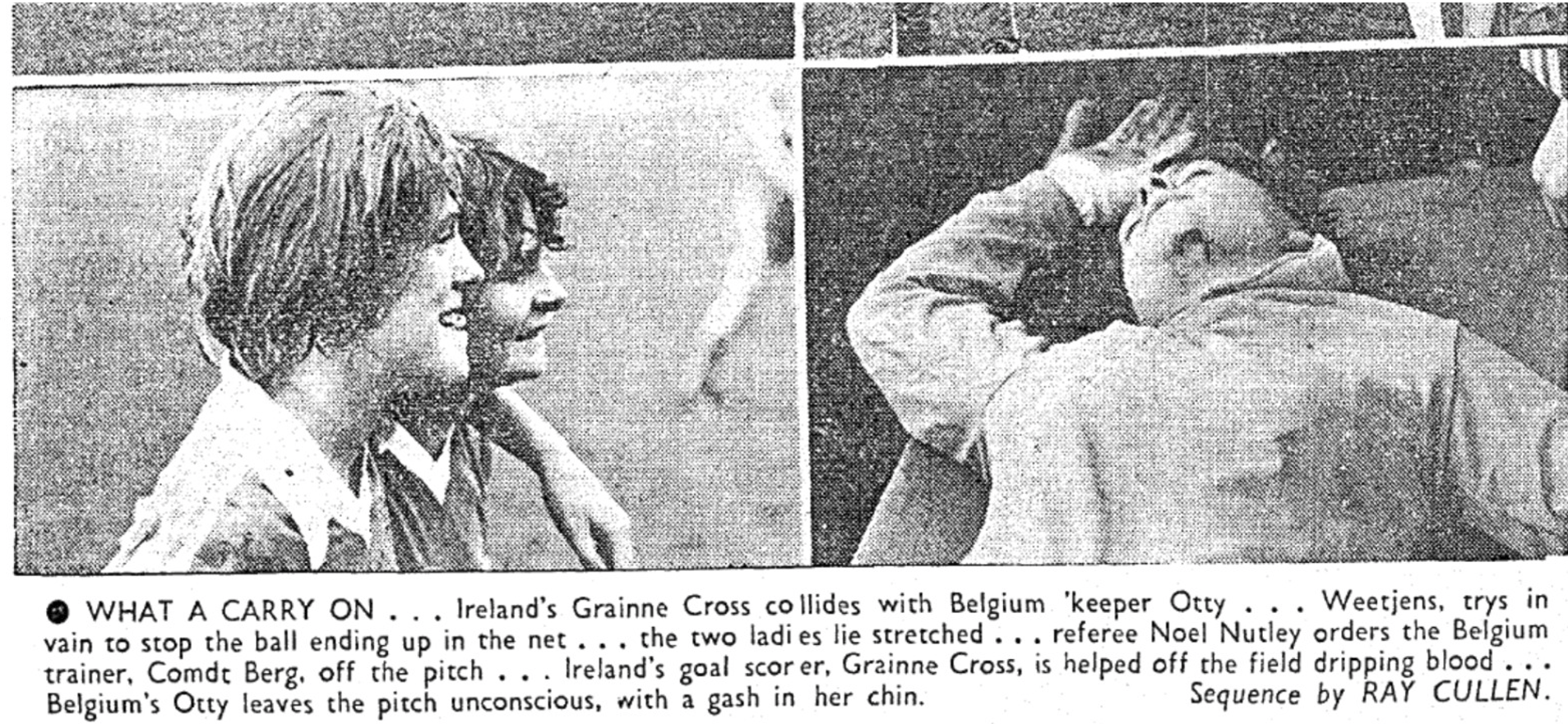
Cross in action as a teenager during an international friendly against Belgium in Dalymount Park

Grainne recalls the professionalism she encountered in Italy, simple things like good playing surfaces, bigger stadiums with crowds of up to 10,000, and not having to wash her own kit. She also remembers the step up in quality as she faced the some of the best players in Europe. Ultimately homesickness ended her stay in Italy after a season, she had initially had to live with her coach and his family, and expecting only to be on a trial hadn’t had a chance to learn much Italian before she left for Monza.

Her career continued with Ireland and she got the chance to play in Wembley in 1988, where as part of the Football League Centenary celebrations she played against her English League counterparts and remembers bumping into the likes of Bryan Robson and Paul McGrath who were playing for Manchester United in the centenary celebrations that day. While Grainne continued to play football her work commitments, including spells working in England and the United States limited her availability for Ireland matches.

In her late 20s as Rugby became more accessible to women Grainne began playing for Old Crescent helping the club to considerable successes, so much so, that she was selected as part of the squad that represented Ireland at the 1998 Rugby World Cup, starting as a scrum half against the Netherlands before an injury limited her participation in the tournament. She’s even been known to dabble occasionally in the GAA codes, a real sporting all-rounder.

To this day Grainne remains an enthusiastic supporter of both football and rugby and is hopeful for the future of the Irish national team.

With thanks to Grainne Cross for taking the time for this interview which first featured in the Irish international match programmes.

Ernie Crawford he’s our friend

Regular attendees to Dalymount Park may have noticed a new flag appearing around Block F. It features a bare chested man with a Charlie Chaplin moustache and bears the legend Ernie Crawford – He’s our friend, he hates Rovers. But who, you may ask was Ernie Crawford?

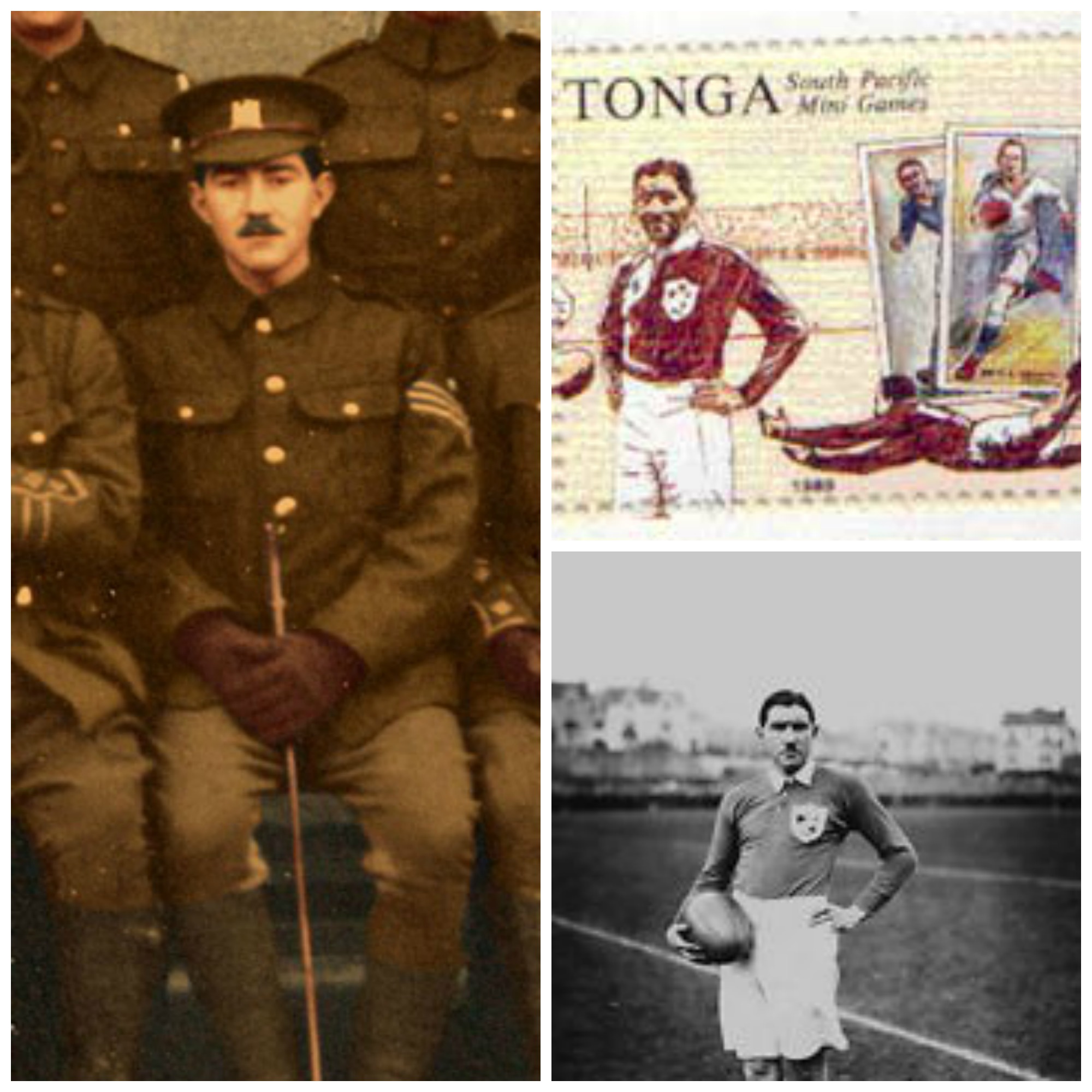
Born in Belfast in November 1891 Ernie was perhaps best known for his endeavours on the Rugby pitch. He starred for Malone in Belfast and later Lansdowne Rugby Club and won 30 caps for Ireland, fifteen of them as Captain between 1920 and 1927. After retirement he was heavily involved in administration as President of Lansdowne Rugby Club between 1939 and 1941 and President of the IRFU in the 1957/58 season as well as being an Irish team selector between 1943 and 1951 and again between 1955-1957. His obituary in the Irish Times listed him as one of the greatest rugby full-backs of all time, he was honoured for his contribution to sport by the French government and even featured on a Tongan stamp celebrating rugby icons.

He was also a successful football player who turned out for Cliftonville, for Bohemians and on a number of occasions for Athlone Town. He was even a passable cricket player. Ernie was a chartered accountant by trade and moved to Dublin to take up the role of accountant at the Rathmines Urban Council in 1919, and this facilitated his joining Bohemians. Despite his greater reputation as a rugby player, Ernie, as a footballer for Bohs, was still considered talented enough to be part of the initial national squad selected by the FAIFS (now the FAI) for the 1924 Olympics in Paris. In all, six Bohemians were selected (Bertie Kerr, Jack McCarthy, Christy Robinson, John Thomas & Johnny Murray were the others and were trained by Bohs’ Charlie Harris), but when the squad had to be cut to only 16 players Ernie was dropped, though he chose to accompany the squad to France as a reserve. The fact that he was born in Belfast may have led to him being cut due to the tension that existed with the FAIFS and the IFA over player selection. However, even as a travelling supporter, he caused some controversy. He was stopped by customs officials en route to Paris and had to explain the presence of a revolver in his possessions. Ernie’s reply was merely that he brought the gun for his “piece of mind”. Not that this was Ernie’s first experience with firearms.

Crawford collage

Ernie in military uniform, appearing on a Tongan postage stamp and in rugby kit

Ernie had served and been injured during the First World War. That he could captain the Irish Rugby Team and be selected for the Olympics is even more impressive when you consider that during the Great War Ernie was shot in the wrist at Arras, France in 1917 causing him to be invalided from the Army and to lose the power in three of his fingers. He had enlisted in the 6th Inniskilling Dragoons in October 1914 and was commissioned and later posted to the London Regiment (Royal Fusiliers), becoming a Lieutenant in August 1917. After his injury he finished his war service on the staff of the Ministry of Munitions. He was a recipient of both the British War medal and Victory Medal.

Ernie later returned to Belfast where he became City Treasurer in 1933. It was in Belfast in 1943 that Ernie encountered Bohs again, as he was chosen to present the Gypsies with the Condor Cup after their victory over Linfield in the annual challenge match.

One of the reasons that his memory has lasted nearly a century with the Bohemians faithful and why a group of us decided to get a flag made up bearing his image centres around a minor cup tie. Ernie, due to his Rugby and also his professional commitments tended to not be a regular starter for Bohemians, his appearances tended to be because of the injury or suspension of other players or as part of reduced strength sides in smaller cup competitions.

As we all know however, when it comes to games against Rovers there are no “smaller ties”. After one particularly tough cup game against Shamrock Rovers an angry Crawford removed his jersey challenged Rovers star forward Bob Fullam to a fight in the middle of the pitch. It’s this moment that the image on the flag imagines!

Fullam himself was no shrinking violet, as well as being an accomplished footballer who was capped twice by Ireland he supplemented his income as a docker in Dublin Port. He finished the 1922 FAI Cup final amid a mass brawl after Rovers were beaten by St. James Gate. The fighting only ceased when the brother of the Gate’s Charlie Dowdall reportedly confronted Fullam with a pistol.

Ernie himself seemed to have been one of those “larger than life” characters, quite aside from bringing a gun to the Olympics and bare-chested on-pitch scraps he also fell foul of Rugby referees one of whom complained about Crawford’s back-chat and claimed that such was the roughness of his play “that the definition of a “tackle” should be sent in black and white to him”. On another occassion an English rugby opponent remembers Crawford treating him and his wife to dinner and giving them a lift back in his car which didn’t happen to have any working headlights. Ernie in an attempt to beat traffic tried to get between a tram and the pavement without much success, badly denting the side of his car and scratching up the paintwork of the tram car. The angry tram driver jumped from the vehicle but on recognising that the other driver was non other than Irish rugby captain Ernie Crawford he let the car pass unhindered, taking off more paint as he went.

In 1932 he became the first man from Britain or Ireland to be awarded the silver medal of honour by the French ministry of sport and physical education for his contributions to the world of sport. Apart from sport he was obviously professionally successful, being City Treasurer of Belfast until his retirement in 1954, he was also trained as a barrister and took an interest in economics. He died in 1959 and was survived by his wife and three children.

Ernie Crawford, he’s our friend.

Ernie is pictured below on the back row, far right as part of the Bohemian FC squad of 1920-21.

Bohs 192021 EC

Useful resources on Ernie’s career include Paul Rouse’s History of Irish Sport, Tadhg Carey’s When we were Kings and David Needham’s Ireland’s first real World Cup and the Dictionary of Irish biography.

The Flying Doctor & the free-scoring Publican – the famous O’Flanagan brothers

Along Marlborough Street, opposite the Department of Education and a 100 yards or so from the Pro-Cathedral, stands the aptly-named Confession Box pub, a small intimate venue where one could air your concerns over a pint that once belonged to former Bohemians and Ireland centre-forward Mick O’Flanagan.

The pub has its own sporting legacy quite apart from its former proprietor, it was there in 1960 that the Soccer Writers’ Association of Ireland was formed, and it was there that Mick O’Flanagan received the phone call that would make him an Irish International.

It was, as O’Flanagan recalled, around two o’clock in the afternoon of 30th September 1946 when a call came to the pub from Tommy Hutchinson, the Bohemians member of the FAI selection committee which chose the Irish International team.

Ireland were due to play England at 5:30 that afternoon, a historic meeting between the two nations as this was a first time the English national side had agreed to play an FAI selected team since the split with the IFA in 1921.

After decades of being ignored and ostracised by the English FA the FAI had finally secured a fixture against a formidable English side in Dalymount Park. In the minds of the FAI committee of 1946 this was the biggest game in its relatively short history. There was only one problem, their centre-forward, West Brom’s Davy Walsh had pulled out through injury.

This was the purpose of Hutchinson’s call to Mick O’Flanagan, the 24 year old Bohemian striker was being asked to line out against the inventors of the beautiful game at the last minute.

As O’Flanagan remembered:

“I went home to Terenure for a bite to eat, had a short rest and then headed off to Dalymount. It was not really sufficient notice as only the previous evening I had brought a party of English journalists to Templeogue tennis club and I hadn’t got home until nearly two in the morning.”

Despite a laughable lack of preparation, the Irish side put it up to their illustrious opponents who had hammered an IFA selection 7-2 just days earlier. It was only a Tom Finney winner eight minutes from time that sealed victory for the English.

Henry Rose in the Daily Express was moved to write:

“If ever a team deserved to win Eire did. They out-played, out-fought, out-tackled, out-starred generally the cream of English talent, reduced the brilliant English team of Saturday to an ordinary looking side that never got on top of the job.”

Not only did Mick O’Flanagan line out against the likes of Finney, Billy Wright, Tommy Lawton and Raich Carter, he did so alongside his older brother, and fellow Bohemian, Kevin (pictured).

Brothers Kevin and Mick O’Flanagan are unique in world sport as not only did they play international football for their country, they both were capped by Ireland at Rugby, making them the only pair of brothers in the world to play for their nation in both codes.

Mick was capped against Scotland in 1948 as part of the last Irish Grand Slam winning side until 2009, while Kevin had been capped a year previous to that against Australia. This unique achievement is one that isn’t likely to be repeated anytime soon.

Despite this singular accomplishment the sporting careers of the brothers could have been even more illustrious had it not been for the outbreak of World War 2. Both were lining out for Bohemians when hostilities commenced in 1939, Mick a 17-year-old just beginning his career, his older brother Kevin at 20 had been a first-teamer for four years, had already captained Bohemians and had seven Irish caps and three goals to his name as well as being selected to play for Northern Ireland.

While the League of Ireland would continue during the war years, international football would cease for Ireland until 1946. Similarly, Olympic competition would cease which would rob Kevin the chance of competing in the Olympiads of 1940 and 1944. Kevin, at the time was a medical student in UCD, was Irish sprint champion at 60 and 100 yards as well as being national long jump champion.

He had even been a promising GAA footballer, lining out for the Dublin minor panel alongside Johnny Carey (Carey and O’Flanagan would both make their international debuts as teenagers against Norway in 1937) before being dropped because of his involvement with the “Garrison game”.

Young Michael would also miss out, his best goal scoring season would be 1940-41 where he finished as the League’s top scorer with 19 goals for Bohs. Had war not been raging across Europe he might rightly have expected to have more than his solitary international cap.

The brothers remained committed to the amateur ethos of the club which explains the duration of their stays at Bohemians. Mick as a publican in the city centre and Kevin as a medical student and later a Doctor weren’t likely to be swayed by the offer of a couple of extra quid a week from a rival club.

Indeed Kevin took his commitment to the Corinthian ideal to the extreme. Upon qualifying as a doctor in 1945 he had been offered a position as a GP in Ruislip, London. Despite this move he kept up and even increased his sporting activities, he signed on with Arsenal as an amateur while also lining out as a Rugby player for London Irish, when Arsenal invited him to submit his expense claims, they were shocked that he asked for just 4p, the cost of his tube journey from Ruislip to Arsenal.

Bernard Joy, a team-mate of Kevin’s at Arsenal, and a fellow amateur, noted in his history of the club that the then secretary Bob Wall quipped that Kevin “did not want to know anything about tactics. I play football the way I feel it should be played’, he would say.”

Arsenal coach Tom Whittaker said that O’Flanagan could have been “one of the greatest players in football history” if only he could have gotten him to train properly. Despite only spending one full season with the Arsenal first team (for whom he scored three times) Kevin would make a big impression.

No lesser an authority than Brian Glanville described him thus:

“A fascinating, amateur, figure in those Arsenal teams between 1945 and 1947 was the powerfully athletic Irish outside right, the hugely popular Dr. Kevin O’Flanagan. Coming from Dublin to London to take up a general medical practice, he demonstrated pace, strength and a fearsome right foot. He attained the distinction of playing soccer for Ireland on a Saturday, rugby for them the following Sunday.”

Between them, the O’Flanagan brothers would spend almost 20 years as players for Bohemians, while their younger brother Charlie O’Flanagan, a winger, would also line out for the club in the 1946-47 season.

Kevin would return to the Dalymount in another role, that of the club’s Chief Medical Officer and despite his retirement as a player he would remain hugely busy as a sporting physician and sports administrator. He was a member of the International Olympic Committee for almost 20 years before being made an Honorary Lifetime member upon his retirement and was the Chief Medical Officer of numerous Irish Olympic teams throughout the 1960’s and 70’s.

Despite missing out as a competitor, “The Flying Doctor” would manage to make a huge contribution to the Olympics and to Irish Sport in general.

Although they spent almost twenty years service in the red and black of Bohs and scored almost two hundred goals  between them the honours list for the two brothers was relatively short. Both brothers combined to help Bohs win the Inter-City Cup in 1945 in somewhat controversial circumstances.

A year later after Kevin left for London, Mick scored an astonishing six goals in Bohs 11-0 victory over local rivals Grangegorman in the Leinster Senior Cup final, a record not likely to be broken any time soon by a Bohemian player in a cup final.

So much about the brothers’ careers is unique or exceptional, so in this our 125th year it’s worth remembering two of the greatest all-round sportsmen that Ireland has ever produced.

Originally posted on the official Bohemian FC website in August 2015