
Who you calling scab? – Bohs, Shels and the 1913 lockout
I grew up always knowing never to cross a picket line. My father had been Chairman of a Trade Union, my mother had been a shop steward, they had both been involved in strikes during their working life, it was something I was instilled with from an early age and have always abided by. Which is why, when researching the history of Bohemian F.C. I was troubled by the accusations of scabbing levelled at players of the club during the momentous beginnings of the 1913 Lock-out. Despite this event occuring some 107 years ago the allegations still cast a small stain on the good name of the club and is invoked as an insult at regular enough intervals by supporters of rival teams, even to this day.
I did however, want to know more, who were the players involved? Could we speculate as to their circumstances? What happened to them afterwards? What had prompted Jim Larkin to call for action in a speech to the public during the early days of the lockout?
The more I researched these events, the harder it was to find definite answers to these questions, in fact, the more I researched the more confused things seemed to become. At this point it might be worth relating the story as conventionally told of the Bohs scabs accusations.
On Friday August 29th 1913, a day before Bohemians and Shelbourne were due to play a friendly match to inaugurate Shelbourne Park, James Larkin made a speech on Beresford Place to a crowd of almost 10,000 people, including many striking tram workers. Larkin had just learned that the proposed mass meeting scheduled for that Sunday (what would soon become known as one of Irish history’s many Bloody Sundays) had been banned by a Dublin Magistrate. Larkin burned the judge’s proclamation and in a lengthy speech, covering many topics he mentioned the upcoming football match with Bohs and Shels. Quoting Larkin the Evening Herald reported his words as follows;
Mr. Larkin said that Millar and Hastings of the Bohemians were scabs. “I want you” Mr. Larkin continued, “to assemble in O’Connell Street at twelve o’clock to-morrow, board the tram cars, go out as far as you can and pay no money. Then if they want to prosecute you give your name and address. Moral persuasion and pay no rents are our weapons”
There are other sources that report on this meeting and Larkin’s speeches, writing for the Come Here To Me blog, Donal Fallon shared the following extract from Arnold Wright’s first hand account of events in Disturbed Dublin ;
The opening scene, in what was to prove a prolonged and sanguinary drama, was enacted in the Ringsend district. In his speech on Friday night Mr. Larkin had referred to a football match which was to be played on Saturday on the Shelbourne Ground at Ringsend between two local clubs. ‘ There are ” scabs ” in one of the teams, and you will not be there except as pickets,’ he said, in language whose menacing character was understood by those who heard him. In obedience to the implied command, a large body of members of the Transport Workers’ Union gathered at the time announced for the match near the entrance to the grounds.
Arnold does not mention the players by name as the report in the Herald does and neither does it identify which team was accused of having scabs. After the meeting had ended there were clashes with those attending the rally and the Dublin Metropolitan Police which set an ominous tone for what was to unfold over the coming days.
Writing in his excellent and authoritative study of the Lock-out, Lock-out, Dublin 1913, Padraig Yeates writes the following, also citing the Irish Times,
The trouble began outside the new grounds of Shelbourne Football Club. About six thousand spectators had come to watch a match with Bohemians, the team that Larkin had accused of using ‘scabs’. A picket of about a hundred tramway men stood outside the gate and were jeered by some of the football crowd. The pickets retaliated in kind and were in joined by growing numbers of sympathetic locals. ‘The members of the Bohemian team, who pluckily drove to the scene of the match on outside cars through a hostile crowd of roughs were assailed with coarse epithets’, the Times reported.
The historian Neal Garnham in his history of football, Association Football and Society in Pre-partition Ireland, also mentions the match but sows the first real seeds of doubt as to the identity of the scabs and the teams they played for, he writes;
On 30 August 1913 the Irish Worker, the official newspaper of the Irish Transport and General Workers’ Union denounced two Dublin players – Jack Millar of the Bohemian club and Jack Lowry of Shelbourne – as scabs.
Here, for the first time we see mentioned the full names of the two supposed scabs, the Millar mentioned in the Herald report is revealed to be a Jack Millar while the other player is identified not as a Bohemians player, but as a Shelbourne one, Jack Lowry, there is no mention of a “Hastings”. Crucially Garnham also mentions a new source, the Irish Worker, the newspaper of the ITGWU, the Union that represented the tram workers, and a paper that Larkin had founded, edited and featured in regularly. Having read the relevant issues of the Irish Worker cover to cover (it’s Covid, what else would I be doing) I found the reference to Jack Lowry of Shelbourne in the edition of the 30th September and a mention of a Jack Millar in the edition on the 27th. Under the heading “Retail dept. O’Connell Street (scabs)” it includes among a list the name “Jack Millar, Phibsboro’ Bohemian AFC”.

It is important to note that Lowry is not mentioned as being a Shelbourne player, merely a “prominent member” while no further information is given on Millar other than the fact that he lives in Phibsboro. In-club trial matches were played by both Shelbourne and Bohemians a week before the game, and before any scabbing accusations – there is no mention of a Lowry nor Millar (or Hastings) among the forty-four players used by both clubs across these games, or in the final line-ups selected for the much anticipated game to inaugurate Shelbourne Park on Saturday August 30th 1913.
Shelbourne had become the first Dublin side to begin the practice of paying players, though the club was not full time and would have still featured amateur players and others who would have day jobs away from the football field. The new 1913-14 season had seen them invest heavily in cross-channel talent, signing defender Oscar Linkson from Manchester United, David Neave from Merthyr Town, Robert Carmichael from Clyde while Andrew Osbourne, a British soldier had signed up as their new centre forward. Osbourne was part of the 16th Queen’s Lancers who were then based in the Curragh.

As Yeates noted in his account there was indeed trouble outside the ground, pickets were formed, and those on the pickets tried to force entry to the ground at one stage, and some even successfully gained entry and “hurled vile language” at the players. It was also claimed that incidents involving a crowd attacking trams was only brought to an end when “one of the passengers jumped from the tram, produced a revolver, and effectively dispersed the crowd.” as the Irish Times reported. A Sergeant Keane of the DMP spoke about crowds of perhaps 1,000 gathering in Ringsend who were “hostile to the club” in all reports in which Keane is interviewed the week following the riots there is no mention of Bohemians and the hostility is stated to be directed towards Shelbourne, or perhaps Keane not appreciating the nature of the game and just assumed this as they were the home team?
But who were the players subjected to this “vile language”? While I have introduced some of Shels new signings, English and Scottish professionals among them, there were of course no professionals in the Bohemians team as the club was at that point still strictly amateur. Could one of the Bohs players have been the Millar mentioned by Larkin, but merely called out under a mistaken name, could there still have been a scab?

After much research I believe I have identified all the Bohemians players listed and their occupations, this is based on earlier research on players who served during World War I as well as reviews of the players listed at Bohemians in 1913 from their team line-ups. I have given them a quick biographical outline below:
Goalkeeper: J. Cooke – an interesting one to begin with as this is an alias, Cooke was the name of the Bohemian trainer, George Cooke, usually the trainer’s name would be used as a cover as Bohs players did on occasion miss work duties to play a match. Could this be the Millar that was mentioned by Larkin under an assumed name? This would be highly unlikely. Bohs two main goalkeepers at the time were Jack Hehir and Fred Chestnutt-Chesney. Hehir, who had won an international cap in 1910 and was club captain for 1913 and well established at Bohs, he worked as a Civil Service clerk in the estates office and later in 1915 was transferred to London to work in the War Office.
Fred Chestnutt-Chesney was a Trinity College student studying Divinity. He later became a Church of Ireland Reverend in Belfast and then London. Chestnutt-Chesney had also commanded a company at the battle of Passchendaele and reached the rank of Major. In 1920 when working in the parish of Ballymacarrett in East Belfast he helped organise volunteer groups to try and stop rioting and protect Catholic residents during the riots after the shooting of RIC Inspector Oswald Swanzy.
Full back: William George McConnell was a commercial traveller in the drapery trade at the time. He and his family established the McConnell’s advertising agency in 1916 which continued to trade up until 2010. McConnell won six international caps for Ireland and was an important part of the squad that won the Home Nations championship of 1914. McConnell also found significant success as an amateur golfer being successful enough to triumph in the 1925 and 1929 West of Ireland Amateur Championships.
Full back: Joseph Irons worked on the staff at the Viceregal Lodge (now Áras an Uachtaráin) and was a member of the Army reserve and on the outbreak of the First World War was called up. He didn’t go far initially, being was on guard duty at the Viceregal Lodge during Easter 1916 though he later served time in the Dardanelles campaign. He was also a useful cricket player.
Half back: Jocelyn Rowe was born in India in 1886 and raised in Kingston upon Thames, he had briefly played for Manchester United. He was a professional soldier and was a Sergeant in the 1st Battalion, East Surreys Regiment and was wounded in action during World War I.
Half back: Alfred J. Smith, born in Ireland, Smith was a professional soldier (rank of Sergeant Major) in the Army Service Corps and was wounded in action during World War I. He had been capped at amateur level by Ireland in a 3-2 win over England in 1912. He scored in that match along with his Bohs teammates Johnny McDonnell and Ted Seymour.
Centre back: Bartholomew “Battie” Brennan, was a railway clerk for the Great Southern & Western Railway. This means that Brennan is the only player with any connection to the transport industry. However, the Great Southern was a completely separate company to the Dublin United Tramway Company (DUTC) whose drivers and conductors were on strike. William Martin Murphy the owner of the DUTC used his own former drivers and office staff to fill the roles of the striking workers. Brennan’s name also bears no similarity to the names Millar or Hastings and is unlikely to be confused with them. Brennan was a high profile member of the Bohs squad, he had been a regular for the club since 1910 and had scored against Wales in a 3-2 win for Ireland in 1912. He later set up his own company, Dublin Wholesale Newsagency, who imported and sold newspapers, they were based on Abbey Street.

Outside right: Thomas William Gerald Johnson, only 20 at the time of the match was a medical student from Rathmines. He was another fine sporting all-rounder with a talent for both cricket and golf. During the First World War Johnson became a Lieutenant in the 5th Connaught Rangers and later brought his professional talents to the Royal Army Medical Corps. He was awarded the Military Cross for his actions at Gallipoli. He received numerous citations for bravery, for example at the Battle of Lone Pine during the Gallipoli campaign the Battalion history notes “Second-Lieutenant T.W.G. Johnson behaved with great gallantry in holding an advanced trench during one of the counter-attacks. Twice he bound up men’s wounds under heavy fire, thereby saving their lives”. After the War he worked as a GP in both Ireland and England.
Inside right: Fred Morrow was born in Belfast but grew up in Sandymout, Dublin, one of the youngest men on the pitch at only 17. He was still at school and would later play for Shels while also briefly working as a clerk before joining the British Army (Royal Field Artillery) in 1915. Corporal Fred Morrow died of his wounds in France in October 1917 aged 21.
Centre forward: Johnny McDonnell, not the popular former St. Pat’s manager but the prolific centre-forward of Bohemians. McDonnell had won his fourth and final Irish cap in January of 1913. He also scored more than 150 goals for Bohemians during his career. He was originally from Athlone and was a talented Gaelic footballer and hurler for Westmeath. McDonnell worked for more than fifty years in the Post Office, transferring from Athlone to Dublin and later becoming Private Secretary to the Minister for Posts and Telegraphs and by 1926, after the formation of the Free State, he ended up in charge of programming for Raidió Éireann.
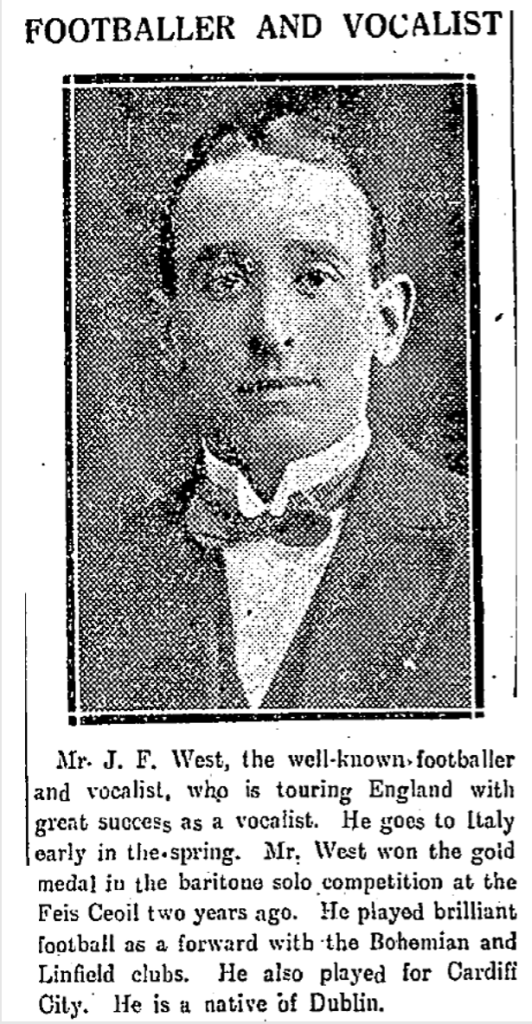
Inside left: Johnny “Dodger” West was 24 at the time of the match, he’d been playing for Bohemians since at least 1909. West was born in England, but grew up in Glasnevin, Dublin, his father was a Cork man who worked in the Ordnance survey and John followed in his father’s footsteps in this regard. In the 1911 Census his job is listed as an Ordnance Survey Temporary Civil Assistant Computer. In the early 1920s, owing to his fine baritone voice he pursued a singing career and would tour England and Italy while also featuring on the stage of major Dublin venues like the Theatre Royal.
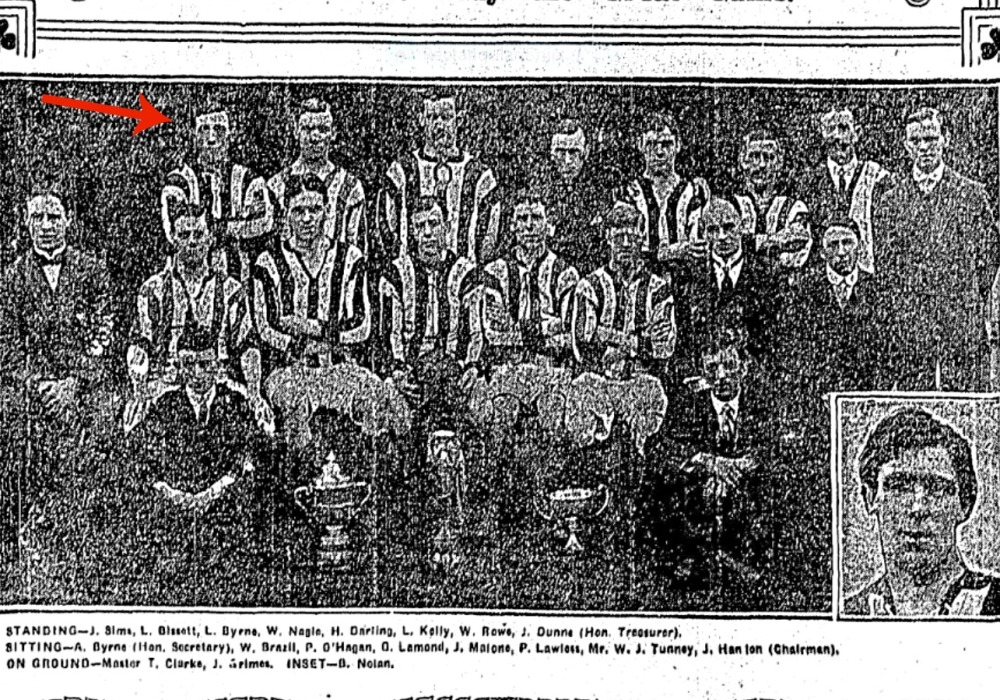
Outside left: Harry Willits was born in Middlesborough, England in 1889 but moved to Dublin in 1908 to take up a Civil Service post and quickly joined Bohemians, staying involved with the club as a player and administrator for decades. Willits initially worked in the Post Office stores before eventually moving to work in the Registry of Deeds where he stayed until retirement. For further reading on Willits see here.

As is demonstrated there is no Millar and no Hastings in the Bohs first team, nor one in the wider squad either that played in the earlier trial game ahead of the season opening friendly match. There are no Millars or Millers or Hastings in the Bohs “B” team which played in the Leinster Senior League system that I could find either. Nor are there any Millar/Millers or Hastings listed in any senior management or committee role at the time with the club. Digging deeper and going back to the previous seasons the only mentions I could find are of two players (perhaps brothers) with the surname Millar occasionally playing for Bohemian “C” and “D” teams, though neither ever progressed higher than that level and are not recorded in any match report that I could find for the 1913-14 season even at “C” , “D” and “E” team level.
Each of the players who played that fateful day in Shelbourne Park was in another form of employment, mainly as clerks and civil servants with a couple of soldiers and students thrown in. None were in any role or profession that could lead them to being accused of scabbing during the tram strike.
Further mysteries then? Well, one more tantalising lead appears in the 20th September 1913 edition of the Irish Worker, some three weeks after the Bohs match, under the heading “Shelbourne Football Grounds”, this short article seems to be an attempt to explain, apologise or simply win back fans to Shelbourne games. No players are mentioned by name although the “engagement of players who were blacklegging” is mentioned. It further states that an “understanding has been arrived at, and we may state that Shelbourne Football Club were in no way to blame for what occurred.” No detail is given on what “understanding” was reached while the line stating that the club were in no way to blame is vague and unspecific.
Did this mean that Shels are denying that there were scabs on their team? This seems unlikely as they acknowledge that players were engaged “who were blacklegging” ? It perhaps seems more likely to be a move to show that the club was unaware of any players blacklegging/scabbing and to excuse themselves of any blame? The message is not signed off on behalf of any club director or member so its specific origin is unclear, though it ends with the rousing call to arms – “Comrades, assemble at all matches.”

The exact truth of what happened may never be known. Larkin and the ITGWU were, by the end of August 1913, already in a fierce battle with William Martin Murphy, and soon other major employers, the courts and the media, much of it controlled by Murphy himself. The pages of Murphy’s newspapers revelled in reports which painted pictures of full trams heading to the RDS for events around this time, staffed by scab labour and patronised by an apathetic Dublin populace. The Irish Worker fought back denouncing Murphy and anyone viewed to be in league with him, or sympathetic to him. Many of those who are accused of scabbing are not only named in his paper but given small pen-pics, with nicknames and personality traits being described in cutting detail.
All we know of the Jack Lowry that is mentioned is that he was a “member” of Shelbourne, and of Millar that he lived in Phibsboro, there is little biographical detail to work with. It should be noted that the Irish Worker did get things wrong, there are also retractions in the paper with individuals or businesses called out in the pages of the Worker that are later found to be fair employers or to have been unjustly labelled as scabs. Could this be the case here?
Was the mention of the football players as scabs perhaps part of a protest tactic by Larkin? Consider that he had just heard that a court proclamation had been issued preventing him from holding a meeting and he knew the following day that a major sporting event, well-serviced by trams would be taking place. The opening of Shelbourne Park had been well publicised and thousands were expected. Was this Larkin seeing a clever way of creating a scene, of challenging the employers’ cabal by focusing on a large public event for maximum publicity. Did he create the scab footballers? Or perhaps exaggerate a claim or hearsay? Or were there people who were scabs associated with Bohemians and Shelbourne, perhaps not as first team players but prominent in some other way, members, former players, other well-known supporters?
We may never know but I would be interested to hear from any reader who has more information on this historic match and the tumultuous scenes that surrounded it. Despite these remaining uncertainties I hope I have done justice to the names of the eleven Bohemians who took the field over a hundred years ago, they may have been many things but scabs they were not.
My thanks to the following for their assistance in researching this piece, Donal Fallon, Ruaidhrí Croke, Stephen Burke and Aidan Geraghty. The work of Padraig Yeates has also been of significant benefit.

 A Bohemian Sporting Life