It could happen to a Bishop – John Curtis in faith and football

A Bohemian history of the 20th Century: An examination as to whether it is possible to write about the key events of the last century through reference only to those people who played for Bohemian Football Club of Dublin. A difficult task but the more I read and research, perhaps not an impossible one. Thus far there are Bohemian connections to the 1916 Rising, the War of Independence and the Civil War in Irish history, and in a wider context there were the global conflicts of World War I and II which I have mentioned in previous posts. But how about Chinese missionaries and the rise of the Maoist interpretation of Communism? Well to tell that story we have to go back to Dublin in 1880.

John Curtis was born in 1880, as the eldest son of Thomas Hewson Curtis and Margaret Curtis. Thomas was a clerk and later a manager in the corn exchange near to Christchurch Cathedral but as a youngster John lived with his family on Montpellier Hill its steep incline rising to the North Circular Road gate of the Phoenix Park where Bohemian F.C. would be founded in 1890 by a group of men only a few years senior to young John. By that time the growing Curtis family had moved the short distance to Blackhall Street, residing in a house next to the Law Society buildings at Blackhall Place which were then occupied by the King’s Hospital school. Eventually the family moved to Hollybrook Road in Clontarf as Thomas’ career continued to progress. The young John was educated not in King’s Hospital but at Benson’s Grammar School in Rathmines which was founded by Rev. Charles William Benson on the lower Rathmines Road, the school also educated the likes of George Russell (AE) and members of the Bewley family.  John then graduated to study in Trinity College Dublin.

It was around this time that a teenage John Curtis first made an appearance for Bohemians. He appears in the first team in the 1897-98 season. He played most of his games for the club at inside-left, and in that first season his partner at outside-left was none other than Oliver St. John Gogarty. The pair starred together as Bohemians won the 1897-98 Leinster Senior Cup final, defeating Shelbourne 3-1 while also progressing to the semi-finals of the Irish Cup.

The following season showed a similar pattern, another Leinster Senior Cup win and another lost Irish Cup semi-final (this time to Linfield) for the Bohs and John Curtis. Though not yet 20 Curtis was already a star player, in the 18 games he played that season he scored an astonishing 21 goals. Bohemians wouldn’t join the Irish league until the 1902-03 season so Cup competitions such as the Leinster Senior Cup and the Irish Cup, as well as the Leinster Senior League, would have taken precedent at the time and Bohemians were clearly the strongest side outside of Ulster at that juncture.

The 1899-1900 season saw further progress in the Irish Cup, this time Bohs got all the way to the final. John Curtis was instrumental in getting them there, scoring a vital equalising goal in the semi-final against Belfast Celtic before Herbert Pratt scored the winner in a match played in the Jones Road sports ground, now better known as Croke Park. John lined out against Cliftonville in the final in Grosvenor Park in Belfast in front of 5,500 spectators. Alas it didn’t turn out to be a first cup win for Bohemians.

Bohs had made it to the cup final once before in 1895 when they were hammered 10-1  by Linfield, but the 1900 final was to be a much closer affair with Bohs being defeated 2-1 with George Sheehan getting the goal for the Dublin side. The newspaper reports described a tight game with Bohs deemed to have been highly unlucky to lose, indeed many observers thought that Cliftonville’s second goal was a clear offside. Matters weren’t helped by four Bohemian players picking up knocks during the course of the match.

On a personal note for John Curtis it seemed that just a week prior to the Irish Cup final  he might be honoured with an international cap. A first ever international game was to be staged in Dublin’s Lansdowne Road and Andrew Gara, the Roscommon born, Preston North End forward was earmarked for a spot in the Irish attack, however just days before the game Gara was injured and the Irish Independent reported that his place was to be awarded to John Curtis. This didn’t come to pass however, the sole Dubliner in the line-up was John’s team-mate George Sheehan who was given the honour of captaining Ireland in a 2-0 defeat to England. The closest John would come to an international cap would be representing Leinster in an inter-provincial game that season against an Ulster selection.

While John Curtis would continue to line out for Bohemians his appearances were reduced in number over the coming years, he had sporting commitments with Trinity College as well, representing them in as a footballer in the Irish Cup while also enjoying games of Rugby.
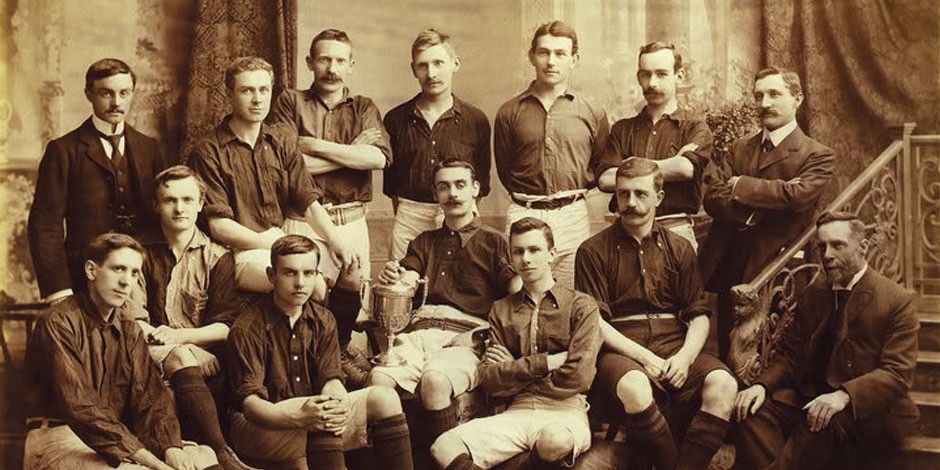
Bohs with Sloan Crozier

John Curtis is the big bloke with the moustache and his arms folded in the back row.

He features in a team photo from the 1902 Leinster Senior Cup winning photo but lined out for the club less frequently, he did appear in a couple of prestigious friendly matches in the early years of the century however, when Bohemians were keen to invite the cream of British football to their new home in Dalymount Park. John played against Celtic in 1901 and against Bolton Wanderers the following year.

By 1903 John had finished his studies in Trinity College and was ordained as a Reverend, his first parish being that of Leeson Park in Ballsbridge. By this stage his two younger brothers Edward (Ned) and Harry were both playing for Bohemians, though with less distinction than their older brother.

While his footballing life might have been coming to somewhat of an early close the even more remarkable parts of John Curtis’ story were only beginning. After only three years in his Dublin parish John Curtis was setting sail for missionary work in China and embarking on a whole new chapter in his life.

John was bound for the Chinese province of Fujian on the southwest coast of the country. The first Protestant missionaries had only begun working in China in 1807 and among the early missionaries was another Irishman, William Armstrong Russell who arrived in China in the 1840’s. Despite these earlier arrivals John’s journey was still very much a leap into the unknown and certainly a long way from leafy south- Dublin parish work.

John arrived in Fujian in 1906 and later, while working there met fellow missionary Eda Stanley Bryan-Brown, she had been born the daughter of a clergyman in Australia, and in 1914 they were married. In 1916, – perhaps out of a sense of duty? – John returned to Europe in the midst of War, this meant separation from his wife and his missionary work. Curtis joined the British Army Chaplains and shared the dangers of the combat troops in trenches and on battlefields. He spent time in Greece and also would have ministered to members of the Royal Dublin Fusiliers during his service. As one journalist who knew him well observed of his character “one cannot picture him holding back from that cataclysm”. Indeed despite his obvious religious devotion most descriptions of John Curtis focus strongly on his energy and fearlessness, whether on the sports ground, or the battlefield or in his missionary work.

Luckily John survived the War and in 1919 received the Victory medal, however he swiftly returned to his work in China. Since arriving in China in 1906 John had witnessed crowning of the child emperor Puyi in 1908 as well as his forced abdication, the end of Imperial rule, and the founding of the Republic of China just a few years later. His post-war return witnessed further upheaval. In 1927 John and his missionaries would no doubt have been aware of the first major engagements of the Chinese Civil War between the Kuomintang (or KMT, the major political party of the Republic) and the Red Army of the Chinese Communist Party. There was a major battle for control of the city Nanchang in the neighbouring province of Jiangxi which ultimately saw the Communist forces flee in defeat, many of their surviving troops marched hundreds of miles to take refuge in Fujian, the province where John and his family were living.

By this stage John and Eda had become parents to a son, John Guy Curtis in 1919, Arthur Bryan Curtis in 1924 and followed by a sister, Joan. It was a restless time to have a new family but there was further change for John as in 1929 he became Bishop of Zhejiang, replacing his fellow Dubliner Herbert Moloney. This meant that John and Eda moved to the beautiful city of Hangzhou, referred to by some at the time as the “Venice of the east” due to its location on the Grand Canal of China and sections of the Yangtze river delta. By this stage Eda had brought the children to England in 1927 to live with one of her brothers though both parents visited every year up until the outbreak of the Second World War. In their young lives the children had witnessed a great deal of violence. Joan recalled as a four year old hearing “soldier and their cannon” from the Missionary school. On another occasion in 1922 Eda and her two young children were obliged to undertake a long journey up river, during the course of which her oldest son John  by then only three years old at the time developed laryngeal diphtheria. When it looked like he might succumb to his illness she was forced to perform a tracheotomy, her only instruments being a pen-knife and some hair-pins. It was perhaps not surprising that the calm of rural England would seem a better place for the children to grow up.

Drama and upheaval followed the Curtis family to this new setting of Hangzhou  and as Christmas 1937 approached so too did the forces of Imperial Japan. The Second Sino-Japanese war had broken out that summer and on Christmas day 90,000 Japanese troops entered Hangzhou after fierce fighting. A week earlier the Japanese had advised all foreign consuls to evacuate any of their citizens from the area due to the danger of the fighting, in all there were only 31 foreigners in Hangzhou in 1937 and John Curtis was the only Irishman.

Journalist and Church of Ireland priest, Patrick Comerford notes that “living conditions deteriorated in the city, Curtis constantly visited the hospitals, medical camps and refugees, his overcoat pockets bulging with bottles of milk for the children. On what he called his ‘milk rounds,’ he also shepherded large numbers of frightened women and children to the safety of the refugee camps.”

He continued to administer to his Church’s followers throughout his vast diocese despite the restrictions caused by the Japanese invasion, and the subsequent outbreak of World War II.  By September 1942 more than nine months after the Japanese attack at Pearl Harbour many missionaries were called in for questioning. John Curtis was arrested in November and taken to the Haipong Road Camp in Shanghai and then held in Stanley Internment Camp, Hong Kong. Comerford writes that on one occasion, “the Japanese threatened to shoot him if he continued to criticise their treatment of his fellow prisoners, but it was said that in internment he was a great asset to the morale of the camp.”

The Curtis’s would remain in prison of war camps for the remainder of the War, it was in such a camp that they would learn of the death of their oldest son John, in January 1943. John, whose life Eda had saved as a toddler, was only 23 when he died in a flying accident while on service as an RAF pilot. When finally released from the camp at the end of the war both John and Eda were in their 60’s and had suffered cruelly during their captivity. Eda had continued her medical work, helping other prisoners inside the  camp and her thoughts were about returning to Hangzhou to continue her work at the mission hospital, which they managed to do with support from the Red Cross. After the war more missionaries did come out to China from Ireland and Britain however their work was made increasingly difficult under the rule of Chairman Mao Zedong. Eventually in 1950 John and Eda left China for the last time and returned to England.

John became a vicar in the small village of Wilden, north east of Stourport-on-Severn in Worcestershire before he eventually retired to Leamington in 1957 at the age of 77. Although struggling with arthritis it was noted that he remained in good spirits when in conversation with his old friends, and he kept in contact with his many old acquaintances and was eager for news from Dublin, indeed he had continued to visit Dublin regularly even while working in China. John was highly thought of as a  missionary and often during his returns to Dublin he was asked to speak about his work and travels. And despite the passing of time his reputation as one of the best Irish footballers of his generation lived on for decades as well.

John passed away suddenly in 1962 and Eda died just 18 months later. They had truly lived full, dramatic and difficult lives. Their daughter Joan got married and ended up living in Sligo while their surviving son Arthur Bryan Curtis, who had studied at Oxford and also served in World War II ended up emigrating to Rhodesia (now Zimbabwe) to become a school headmaster.

The sporting connection begun with John Curtis all those years ago for Bohemians continued with his son. John had been a handy Rugby player in his Trinity days and Arthur Bryan also excelled with the oval ball, playing for Oxford University and London Irish. In 1950 he won three Irish international caps as a flanker. Arthur’s son David also represented Ireland at Rugby, winning 13 caps and appearing as a centre during the 1991 Rugby World Cup, David was also a useful cricket player and represented Oxford University in that sport. Continuing a family tradition David’s sons Angus and Graham are currently playing Rugby with Ulster and Angus has already been capped for Ireland  at under-20 level.

But however exceptional the sporting careers of the younger Curtis men might be it cannot match the drama of their ancestor, the famous Bohemian John Curtis, or his wife the fearless Doctor, Eda Stanley Curtis.

Many thanks to Stephen Burke for providing information on John Curtis’s playing career. Also for more on Irish missionaries in China check out Patrick Comerford’s blog.

I am the Lord Thy God. Thou shalt have no other Gods before me – From Messi to Messiah


The Spanish Conquistadors brought much to South and Central America; a lust for conquest, cannon and Spanish steel, deadly European diseases and indeed Christianity. But there were things that they found in New Spain that were new to these violent colonisers as well. Just picture the scene; a scorching hot day in the glorious Aztec capital of Tenochtitlán, surrounded on all sides by lakes and swamps it is the site of the modern metropolis of Mexico City. In a formal cordoned off rectangular space beneath tiers of grey stone steps populated by the masses of the city, ordered by social rank, a group of men compete fiercely in a ball game. The two teams face off, the purpose of the game is to get the hard, heavy, solid rubber ball through a circular hoop or goal at either end of the field. The players can’t handle the ball but propel it with amazing skill with their hips, knees and buttocks. This is sport but not as we know it today, instead it is part ritual, part religious rite.

Andreas Campomar in his encyclopaedic study, Golazo! on the history of football in Latin America emphasises the sheer importance of these sort of ball games not just to the Aztecs but to the Mayans and other pre-Colombian civilisations. For example thousands of rubber game balls were paid as tribute to kings, the myths of great societies featured stories of ferocious ball games played against gods and monsters, and most frighteningly of all there was a very real connection between these ball games and forms of religious human sacrifice. There are stories of losing sides in games being beheaded in ritual sacrifice in the civilisations of Veracruz. Stories of racks of human skulls being kept pitch-side displaying the chilling fate of previous competitors, and artworks showing fountains of arterial blood bursting forth from the neck of recently decapitated players. The Christian Spaniards saw these ancient ballgames as forms of witchcraft but the Mesoamerican people viewed them with much greater awe and significance, in many cases the ball itself seems to have had an almost spiritual quality, this circular orb flying through the air in games providing a metaphor for the orbit of the sun and the stars. Another view was that their ballgames were a form of proxy war, literally competitions of life or death or of communing with the divine.

ballcourt

An example of a Mesoamerican ballcourt

While the ancient games of the Mayans were part of religious ritual, those who codified the game of football; the British Victorians, also viewed their sport as having a religious element. Sports were part and parcel of the ethos of “muscular Christianity” that found favour in the public school system of 19th Century Britain. Health and wellbeing, exemplified by the gentlemanly virtues of team sports were seen as an absolute “moral good”, taking inspiration directly from the Bible, for example the passage in Corinthians which noted:

  1. What know ye not that your body is the temple of the Holy Ghost which is in you, which ye have of God, and ye are not your own?
  2. For ye are bought with a price: therefore glorify God in your body, and in your spirit, which are God’s.

While the conquering Spaniards saw the ballgames and customs of Latin American as one of many vices to be expunged by colonialization and the introduction of Christianity the Victorians viewed the role of sport in muscular Christianity as a great virtue and to some measure as part and parcel in the manufacture of robust soldiers and sailors for the British military and hence the creation of the British Empire. The competitive nature of team sport, its focus on defence and attack in unison, and its obvious role in physical development helped form a generation of officers for the British military. To take the most critical viewpoint of this movement would be to say it formed a part of an outlook not dissimilar to the American concept of “Manifest Destiny” or the earlier notions of the “virtuous” Crusaders of the 11th , 12th and 13th Centuries, a “Born to rule” mentality.  The author James George Cotton Minchin when writing on the influence of the British Public School system was moved to speak of “the Englishman going through the world with rifle in one hand and Bible in the other” and added, “If asked what our muscular Christianity has done, we point to the British Empire.” George Orwell, himself a former Eton schoolboy was highly critical of what he saw as the recent and cultish growth in sport, he wrote the following after the tour of Dynamo Moscow to Britain in 1945 on the topic of “serious sport” and football in particular: “It is bound up with hatred, jealousy, boastfulness, disregard of all rules and sadistic pleasure in witnessing violence: in other words it is war minus the shooting.” Perhaps closer to the brutal games of Mesoamerica with their emphasis on sport as a proxy war than we might like to admit?

If the role of team sports like football had a part to play in the creation and spread of the British Empire and militarism, and the idea that this had a certain divine authority, then religious organisations were also keen to use football to promote the causes of their Churches and the social causes that they supported. The more appealing side to the notion of “muscular Christianity” would be that these muscular Christians had a duty to protect the weaker and more downtrodden in society.

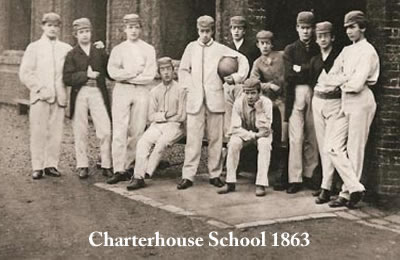
charterhouse-school-1863

Students at Charterhouse Public school 1863. Past pupils formed Old Carthusians FC who won the FA Cup in 1881

During the age of industrial upheaval towards the end of the 19th Century and into the 20th Century many saw sport as a way to support the working classes who faced terrible living conditions, poor sanitation and were excluded from many areas of society. As Peter Lupson notes in his book Thank God for Football many of the most historic clubs that make up the top divisions in England today were founded as part of Church groups, whether it was Aston Villa, Tottenham Hotspur, Bolton Wanderers or Everton, whose Goodison Park stadium has a church between its famous Gwladys Street End and Goodison Road stand. Manchester City were formed out of St. Mark’s West Gorton FC, founded by the public school educated clergyman Arthur Connell and his proselytising daughter Anna. Concerned about the violence and alcohol abuse that were rampant in the West Gorton area of Manchester, St. Mark’s was established as a way to get the men of the area to focus their energies elsewhere, first in cricket and then later in football. There were many such links with church groups and sports clubs and often with a specific connection to the temperance movement of the late 19th and early 20th century.

From the ancient ballgames of Central America and their religious, ritualistic significance, to the Victorian use of football and other team sports to create a notion of the muscular Christian (whether as soldier and imperialist or as a social and sporting evangelists for the disadvantaged in society) we can see how religion and sports were crucially interlinked, however the point would come when football would move beyond religious links. With the rise of Communism in the early part of the 20th Century there was a move, nominally at least, towards atheistic societies. As Karl Marx famously said:

Religion is the sigh of the oppressed creature, the heart of a heartless world, and the soul of soulless conditions. It is the opium of the people. The abolition of religion as the illusory happiness of the people is the demand for their real happiness”

In some ways the early view of football in Communist nations was not dissimilar, there was an opinion that football was a distraction from the issues that should have been of greater concern to the disenfranchised working classes. That football was another “opiate” just like religion to use the phraseology of Marx and de Sade. We can turn again to George Orwell on this matter and take a quote from his seminal piece of dystopian fiction 1984 in which he described the future of the working classes as; “Heavy physical work, the care of home and children, petty quarrels with neighbour, films, football, beer and above all gambling filled up the horizon of their minds. To keep them in control was not difficult” [my emphasis]

It was not long however before Communist nations realised the propaganda value of sport. Rather than acting as a distraction to the masses why could football not work as the perfect exemplar of the successful Communist state? An example not of individual dominance but of cooperation, planning, teamwork and self-sacrifice for the greater good. One high profile clash between a supposedly atheist Communist state, Yugoslavia and the Republic of Ireland took place in 1955 in Dublin. Much of the controversy surrounded the Croatian Cardinal Aloysius Stepinac who had been imprisoned by Josip Tito’s government, ostensibly on the basis that he had collaborated with the fascist Ustaše group during World War 2, however critics of Tito’s regime claimed that Stepinac’s trial and imprisonment was a show trial brought about because the Cardinal had been critical of the new Communist post-war regime in Yugoslavia. Although Stepinac was released in 1951 it was viewed that Yugoslavia, and Tito in particular were actively persecuting the Catholic Church.

It should be noted that the Ireland of the 1950’s was not necessarily a bastion of freedom either. The modest economic growth and modernisation that would take place under Sean Lemass’ tenure as Taoiseach (Irish Prime Minister) were still some years in the future and Ireland of 1955 was an impoverished nation with a high rate of unemployment and mass emigration. The social and intellectual sphere was limited, in literature alone despite there being a glut of talented writers emerging in Ireland at the time many fell afoul of draconian censorships laws (such as Brendan Behan, Liam O’Flaherty and later Edna O’Brien) which meant their works were banned from publication never mind the works of non-Irish writers (Balzac, Huxley, Salinger et al). Furthermore the Irish Constitution of 1937 protected freedom of all religions but made special mention of the Catholic Church:

The State recognises the special position of the Holy Catholic Apostolic and Roman Church as the guardian of the Faith professed by the great majority of the citizens. – Article 44.1.2 of the Irish Constitution (1937)

It was no surprise that the “special position” of the Catholic Church was recognised in the Constitution as Fr. John Charles McQuaid was one of the key advisors on the creation of the document to his old schoolmate, Taoiseach Eamon de Valera. This same Fr. McQuaid would within three years of the Constitution being ratified become Archbishop of Dublin. It was in his role as Archbishop of Dublin that McQuaid helped scupper a modest 1951 proposal from Health Minister Dr. Noel Browne to provide free health care to Mothers and children. He stated that the “Mother & Child scheme” was against the moral teaching of the Catholic Church which led to Browne’s resignation from Government.

It was against this background that in 1952 McQuaid persuaded the FAI to cancel a proposed match with Yugoslavia, however the football association decided to arrange another game against the Yugoslav’s three years later. McQuaid called for a boycott of the game and urged the FAI to cancel the match but the Association persisted with the fixture scheduled for Dublin’s Dalymount Park on Wednesday 19th October 1955. McQuaid’s view was in contrast to the recent instructions of Pope Pius XII who recommended against the Church or politics taking any stance on sporting events.

This game was never likely to pass without controversy. It was alleged by FAI board member Peadar Halpin that he had agreed to the arrangement of the fixture against the Yugoslavs on the advice that Archbishop McQuaid had been consulted and given his approval. Upon learning that the Archbishop was opposed to the game he still backed the match to proceed but only because to do otherwise would cost the FAI a significant chunk of cash. The call for a boycott of the game had other consequences, the FAI could not secure a band to play the anthems on the day after the Irish Army No. 1 band withdrew so they resorted to playing a recording of both nations’ anthems over a record player in the stadium.  The regular trainer for the Irish national side, Dick Hearns of Dublin club Shelbourne also withdrew his services from the team and had to be replaced by Shamrock Rovers trainer Billy Lord. It was ensured by de Valera that President Sean T. O’Kelly (notionally at least the First Citizen of the State) would not attend the game in an official function, nor would de Valera himself or any of his senior Ministers. The voice of football at the time on RTE radio, Philip Greene also made himself unavailable to cover the game. It was suggested that this was in part a direct response to a call from Archbishop McQuaid not to cover the match and lead to the infamous headline “Reds turn Greene Yellow”. The lone political representative of note in the ground that day was Oscar Traynor TD who was also President of the FAI and a noted former footballer with Belfast Celtic. He received a rapturous welcome.

Despite the various organs of the theoretically separate Church and State boycotting the match a decent crowd of 22,000 turned out. Although larger attendances of around 35,000 were recorded at other home matches around this time it is worth noting that the Yugoslavia game was a midweek friendly played in wet and overcast conditions. The FAI were at pains to point out that no tickets were returned on foot of the Bishopric denunciation and it is striking that in a country so under the influence of the Catholic Church that 22,000 football fans ignored the condemnations and calls for boycott of one of the most powerful men in Ireland. In doing so they had to pass a cordon of irate, anti-Communist, placard-carrying Legion of Mary members. Not only were there fans in the ground but newspaper reports state that they gave the Yugoslavs a warm reception and a rousing ovation at the end of the game. The Yugoslavs had put on a fine attacking display and run out easy 4-1 winners against the Irish, a display that had obviously impressed the home crowd.

Shamrock Rovers young forward Liam Touhy who made his debut that day summed up the opinion of the players when he said their only concern about playing Communist Yugoslavia was that the game might be called off and the players might miss out on a cap. Tuohy was also quoted as saying that many of the Yugoslavs blessed themselves upon entering the pitch and that “there were nearly more Catholics on their side than there were on ours”. The Yugoslavs for their part were bemused at the involvement of the Catholic Church having not encountered previous calls for the boycott of matches. North of the border in Belfast, Unionist politicians cited the interference of the Archbishop as another example of the dangers of having Dublin involved with any of the affairs of Northern Ireland due to the strength of influence of the Catholic Church in the Republic.

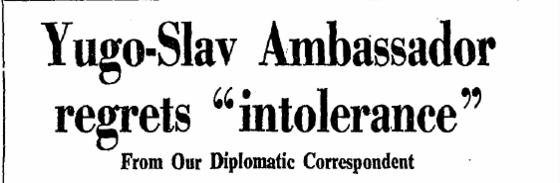
yugoslav headline

Headline from The Irish Times the day before the match – October 1955

It would be decades before the scale of the abuses of power perpetuated by the Catholic Church in Ireland would emerge; in the culture of silence that existed the simple act of attending a football match after the Church had called for a boycott was a powerful statement, against the influence of the Church but also in support of the beautiful game. This wasn’t sport in service to religious ritual as in Central America, or sport in the service of Christianity as in Victorian Britain but sport as a form of protest against religious power and hypocrisy. Perhaps the next evolutionary step would be football as religion and footballers as icons or even messianic figures?

Such comparisons between football and religion are as obvious as they are simplistic, the stadium as Cathedral, the chants of fans as psalms or hymns, even collective footballing passion and hysteria could be seen as having religious counterparts whether that is spiritual possession or speaking in tongues. There is also a devotional and messianic aspect, a form of footballer worship, many players have engendered a certain cult around themselves, developed followings convinced of their significance but even of their divinity? The most extreme example is probably that of Diego Maradona, a man who has inspired his own devoted Church and following, the Iglesia Maradoniana. While El Diego is not averse to religious comparisons himself, the Hand of God being the most obvious example, the creation of a religion complete with prayers, ceremonies, works of devotional art and even its own calendar; (we’re in the year 55, the calendar starts in 1960 the year of Maradona’s birth), is another step entirely! While many feel uncomfortable with this worship of a hugely talented but highly flawed human being, some viewing it as blasphemy, others are happy to pass on their Maradona related creed to succeeding generations, to their sons (many named Diego) and their daughters. The “religion” unsurprisingly borrows heavily from the Christian faith and Roman Catholicism in particular, there is an “Our Diego” prayer modelled on the Our Father and there are Ten Commandments to live by. Such syncretism with Judeo-Christian faiths can create further searches for parallels between Maradona’s life and that of Jesus Christ. Would Claudio Caniggia be the apostle John, the favoured disciple? Or could Diego’s infant grandson, the son of Man City star Sergio Aguero, be a “Second Coming” of the divine? While the Iglesia Maradoniana is an extreme example of the footballer as saviour or messianic figure the form of secular devotion and religious comparisons drawn with football are plain to see. That’s without even mentioning ex-footballers who might think themselves as saviours. The ex- Coventry and Hereford United goalkeeper David Icke infamously declared at a 1991 press conference that he was “Son of the Godhead”.

Football; from the ancient ball games of Central America which were part of religious ritual to the 19th Century role of religious organisations in the early growth and development of the game as social good, the interaction between the game and religion has developed over time. While religious institutions helped to create circumstances for the growth of football they were not necessarily prepared for rejection by the newly popularised game, even in good Catholic Ireland football could become a rare form of resistance against dominant religious interference. Today, at a great remove from the Corinthian, public school, class-orientated view of “muscular Christianity” one would imagine that Thomas Hughes or any of the other propagators of that phrase would struggle to recognise the highly commodified, modern professional game. They would certainly balk at the idea that professional footballers would be idealised, and dare we say worshipped as secular idols well beyond the confines of their mega-stadiums and into the homes of their acolytes around the world. While not every footballer will have his own Church or followers like Diego Maradona, for an increasing number of people the ritual of following their football team is the closest they will come to a religious experience. Now altogether

Our Diego, who is on the pitches,
Hallowed be thy left hand….

This article first appeared in issue 10 of The Football Pink  with some original artwork from Kevin McGivern the new issue 11 is out now which also features one of my articles.