It was on a still, sunny November afternoon last year on the approach to the Aviva Stadium (Lansdowne Road as was) that I spotted Paul McGrath. Paul was, like the rest of the crowd, on his way to the FAI Cup final between Derry City and his former club, St. Patrick’s Athletic. He is of course no stranger to the old ground; he strode its turf with gazelle-like grace over the course of his 12 year international career, and it was his performances in a green shirt that have ensured his status as a sporting legend in Ireland. Despite his much publicised personal problems, or perhaps because of them, Paul is not only respected by the Irish public, but genuinely loved. It is that hint of vulnerability that was so at odds with his commanding, assured performances, that has struck such a chord with football fans.
He was my footballing hero growing up, my early childhood helpfully coinciding with an unprecedented level of success for the Irish national team. Paul was of course a key part of that success, a national talisman, and a rock during the nations’ first tournament involvement; Euro 88, Italia 90, where the team reached the quarter-finals, and USA 94. For many, the opening game in World Cup 94 was Paul’s defining moment in a green shirt, when an ageing McGrath, dodgy knees, painkilling injection in his shoulder, dominated an Italian attack featuring Giuseppe Signori and Roberto Baggio. If the World Cups were the peak of his career, then his presence at Lansdowne Road last November was a reminder of his more humble beginnings as a professional footballer.
Despite playing only a single season for St. Pat’s (1981-82), Paul remains a legend at the club based in the South Dublin suburb of Inchicore. It was pleasing to see by his attendance at the final that Paul hadn’t forgotten his roots. Such was his popularity with the Pat’s faithful that Paul became known as “The Black Pearl of Inchicore”, a reference to Benfica legend Eusebio. Paul was the first player to be given that moniker by the Pat’s fans, but not the last, as both Curtis Fleming (later of Middlesboro and Crystal Palace) and Paul Osam were sometimes given the “Black Pearl” sobriquet.
Though perhaps the most prominent person of colour to play for the national team, Paul was not the first. The first mixed race player to don the green jersey in a senior international was Spurs’ Chris Hughton back in 1979, six years before Paul’s debut. Like Paul he would also feature in Euro 88 and World Cup 90. As for the first player of colour in the League of Ireland? Well we have to go back a little further…
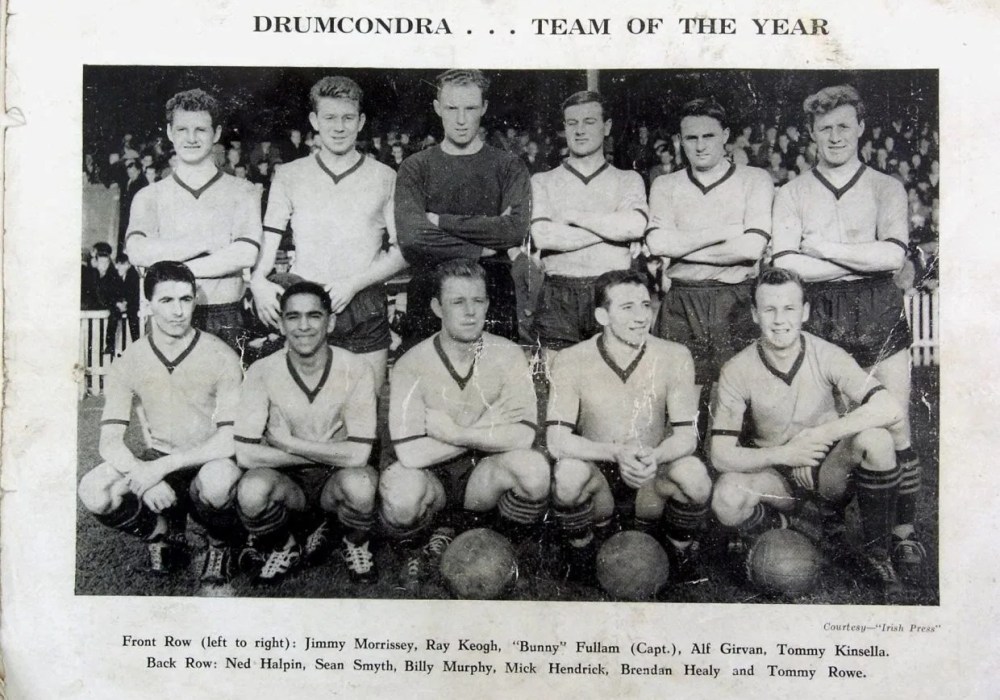
In fact we’ll have to go back to May 1961, back to the FAI Cup final, this time held in Dalymount Park, and as in 2014 St. Patrick’s Athletic are one of the teams in action. Pat’s would win the final in 2014, as they would also triumph in 1961 though in the intervening 53 years, the Saints would contest seven cup finals and lose them all. One other thing that the finals of 2014 and 1961 had in common was that my father was in attendance at both. We sat together in the south stand in 2014, but back in 1961 he was in Dalymount Park as a member of Drumcondra F.C.’s under-18 team watching their senior counterparts lose 2-1 to St. Pats. As an outside-right he would have been paying special attention to the senior player in his position, a 21 year old full of skill and trickery named Ray Keogh.
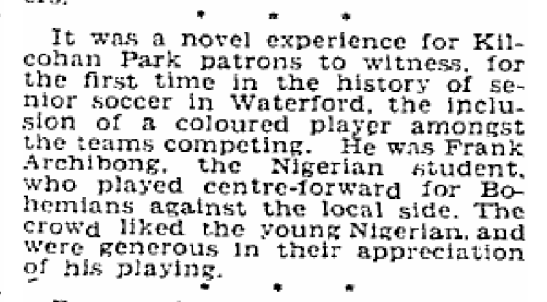
Ray, as far as any League of Ireland historian or statistician can confirm was the first black player in the League of Ireland. British football has, in recent years started to pay attention to the contribution made by players of colour in the early years of football’s development. Men like Andrew Watson, Walter Tull and Arthur Wharton have begun to have their input to the game recognised, and there is a growing understanding that the early decades of British football were not as white and homogenous as once portrayed. However in Ireland there has been little discussion on similar subjects. In the absence of any earlier players being mentioned I’d like to talk a little about Ray’s career in the League of Ireland.
Ray was raised in a white family in the Dublin suburb of Milltown in the 1940s. The area was in close proximity to Glenmalure Park, the then home of Shamrock Rovers, one of the country’s biggest clubs. Ray joined them as a teenager after playing schoolboy football with Castleville and the famous Home Farm club, and made appearances for the Rovers’ reserve side in 1958 before making his first team debut a year later. Some reports incorrectly stated that Ray was part of the Rovers team in 1957 that took on Busby Babes era Manchester United early in their tragic European Cup campaign, mistaking a 17 year old Ray for the similarly named Shay Keogh. Despite his talent and versatility, primarily as an outside right (though he played in a variety of positions), first team opportunities at Rovers were limited for Ray. They had been League Champions in the 56-57 and 58-59 seasons, and their forward line was full of Irish internationals such as Paddy Ambrose, Liam Tuohy, Tommy Hamilton, “Maxie” McCann and experienced player-manager Paddy Coad.
A move was needed and initially it was a trip north-west to Longford Town in the 59-60 season. Longford were a “B” division side at the time playing against reserve sides of the likes of Shamrock Rovers and other smaller and regional sides. His stay with Longford was brief, however, as he moved back to the top-flight of Irish football and to Drumcondra F.C. Based in the north Dublin suburb of the same name, “Drums” had been Shamrock Rovers’ great rivals throughout the 50’s. The club had been home to players of the highest quality such as Alan Kelly Sr. (a Preston North End legend with a stand named after him at Deepdale) as well as League of Ireland stars like Jimmy Morrissey and Christy “Bunny” Fullam.

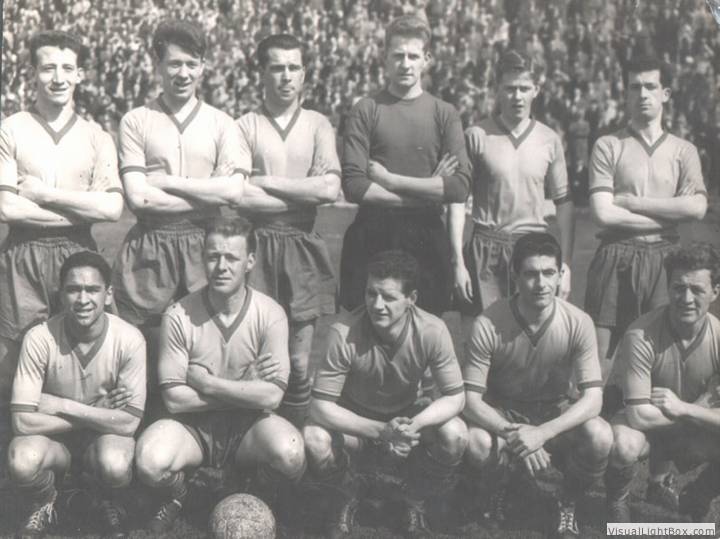
Drumcondra FC before the 1961 FAI Cup final. Ray Keogh is bottom left. (source http://drumcondrafc.com/)
While Drums lost out in that 1961 final, they qualified for the European Cup as League Champions for 1960-61, which was Ray’s first full season with the side. Ray would feature in the European Cup defeat at the hands of German champions FC Nurnberg in the first round, but would fare better the following year in the Inter-Cities Fairs Cup, when Drumcondra made football history by becoming the first Irish side to win a European game on aggregate, defeating Danish side Odense 6-5 over two legs, with Ray playing both games. They were drawn against Bayern Munich in the following round. Ray didn’t feature in the heavy 6-0 defeat in Munich, however he did return to the starting line-up for the home leg and helped restore some pride as Drums beat Bayern 1-0.
He would also win representative honours representing the League of Ireland selection on a number of occasions. Inter-league games were usually against British and occasionally mainland European league sides, and were considered to be highly prestigious at the time. The fact that Ray, on several occasions, was judged to be among the best players in the league and worthy of selection is testament to his ability. He made his debut in 1961 against a Scottish XI in a 1-1 draw and would make several appearances for the league before a move to his next club, Ards based in the County Down town of Newtownards in Northern Ireland.
The Northern Irish league was traditionally dominated by the bigger Belfast sides like Linfield and Glentoran, though Ards had enjoyed a league title success in the 1957-58 season. Though signed by Johnny Neilson the manager for the majority of Ray’s stay north of the border was George Eastham Sr., a former Bolton Wanderers player and father to Arsenal and Newcastle star George Eastham Jr. The town of Newtownards was overwhelmingly Protestant and it must have been somewhat daunting for a black, Catholic Dubliner venturing over the border in 1964. Although the horrific violence of “the Troubles” was still a few years off it was still a time of tension in Northern Ireland. The IRA’s ill-fated border campaign, which led to the use of internment on both sides of the border had only ended two years previously, while the beginnings of the Civil Rights Movement would soon be heard in the city of Derry. Ray would spend two seasons with Ards with the team itself struggling at the lower end of the Irish League table as well as brief unhappy spell with Portadown.
His next move would take him to the other end of the island, moving almost 700km south to Cork, where he would spend a season lining out for Cork Hibernians before moving again after the arrival of former Irish international Amby Fogarty as player-manager. This move was to Drogheda F.C. During his time with Drogheda, Ray worked with some notable managers, first former Middlesboro player Arthur Fitzsimons who had previously coached the Libyan national team, and later, player-manager Mick Meagan; the tireless former Everton defender who combined these roles with his position as manager of Republic of Ireland national team. Meagan would bring in other experienced players such as Ronnie Whelan Sr. to add to the emerging young stars at the club such as Mick Fairclough. Despite the talent at the Lourdes Stadium, the best that Drogheda would achieve during Ray’s stay would be a 5th place league finish in 1967-68. They would make it to the Cup final of 1970-71, but by that stage Ray had moved on to pastures new.
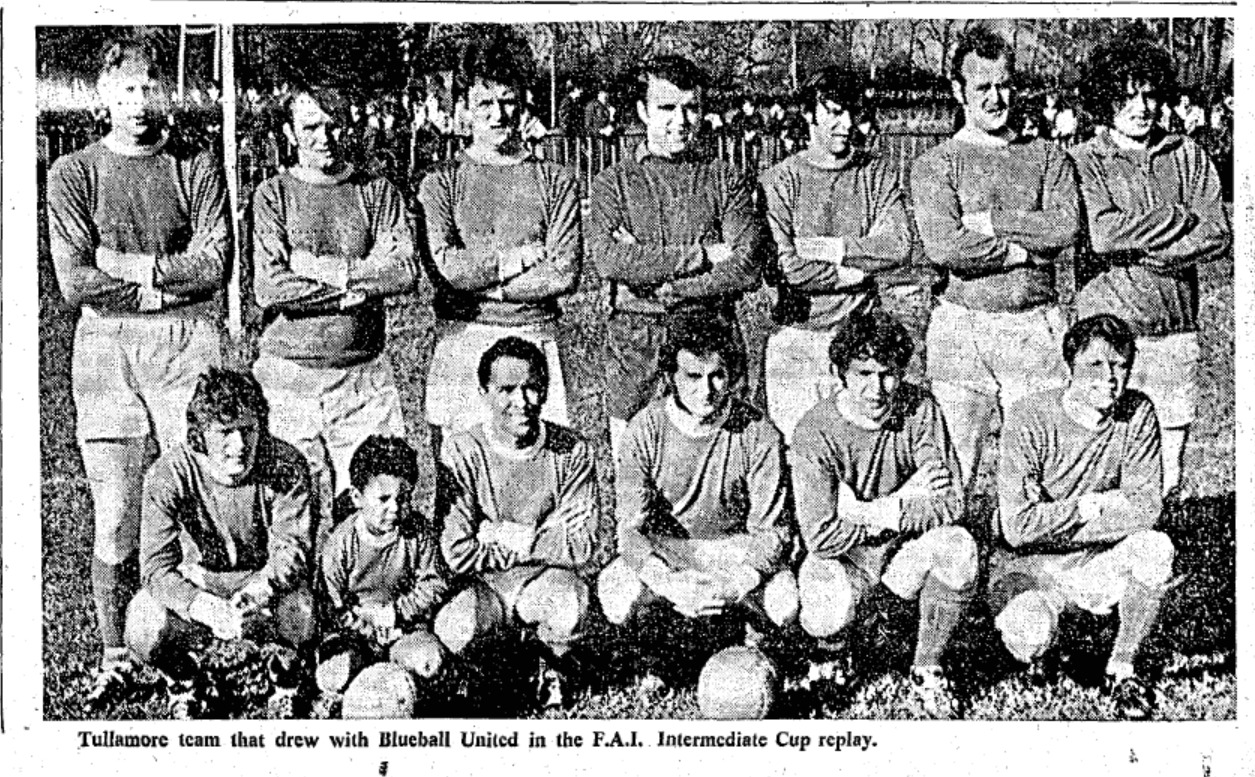
By then on the wrong side of 30, Ray would drop out of senior football and move into coaching, first with Tullamore Town where as player-manager he would win the Intermediate Cup and the League of Ireland “B” division, and then on to Parkvilla F.C. based in Navan. Despite the drop down from senior football ranks, Ray, as both player and manager would still encounter players of real quality. In the FAI Cup they would come close to a giant-killing, forcing a replay against Shamrock Rovers. While Parkvilla’s title rivals Pegasus featured a young defender, one Kevin Moran, who would go on to make his name at Manchester United. Another rival side were Dalkey United who featured a young full back by the name of Paul McGrath. Dalkey is a well-healed south-Dublin coastal town that also happened to be home to one of the orphanages where Paul grew up. It is tempting to see Parkvilla versus Dalkey United, an unglamorous amateur tie probably watched by a couple of dozen spectators, as somehow significant: Ray, a trailblazer in his own way but now in his late 30s, encountering an 18 year Paul McGrath at a point before his career took off. Two black Dubliners who would help to change the perception of what the traditional, homogenous view of what it means to be Irish at a time when to be Irish seemed to be synonymous with words like white and Catholic, denying the pluralism (albeit stifled and hidden) that has always existed in Irish society.
So what sort of player was Ray and how was he treated by spectators of the day? From talking to those who watched him and who played alongside him, his main attributes were his passing ability and dribbling, fast without being lightning quick he was also excellent on set-pieces. Newspaper reports are full of descriptions of him humiliating fullbacks, constantly beating his man and delivering excellent crosses. While usually employed as an old-fashioned, chalk-on-your-boots right winger, Ray was versatile playing across all of the old front five positions, his awareness and passing ability assisting his role as an inside forward, reports referring to him as a “delightful ball player”. He also played centre forward with some success, no small feat for a man described as “diminutive” even by the standards of the day and he also played as a sweeper during his later years as a player-manager. The fact that he was black didn’t seem to cause much comment either, a few early reports noted the talents of the young “coloured” player and while at Longford he was referred to as “Nigerian forward Ray Keogh”. He did attract some bizarre and offensive nicknames such as “Darky” Keogh and the more esoteric “Blessed Martin” after Saint Martin de Porres, the 16th Century Peruvian monk who was the mixed-race son of a Spanish nobleman and a freed Panamanian slave.

Ray’s senior playing career coincided with the golden age of the League of Ireland, the 50’s and 60’s were an era of big crowds, bigger clubs often having gates of over 20,000 while cup finals could see over 40,000 in attendance. The League was also able to keep more of the better quality Irish players in the country. The maximum wage remained in place in England until 1961, and even after the limit was lifted it was still often more financially beneficial for a player to stay in Ireland than to go to England. Domestic players were truly local heroes, especially at clubs like Shamrock Rovers and Drumcondra, who enjoyed a great popular sporting rivalry through the 50s and 60s. Ray got to play in front of big crowds, win league titles, compete in cup finals, play in Europe against the likes of Bayern Munich, and represent his league in prestigious games. He was a local icon but because of the era he played in, the strange role that domestic football played in Irish society at the time, and the lack of surviving TV footage, Ray is mainly remembered these days by groups of ageing Drumcondra fans who hold on to memories of a club that disappeared from senior league football back in 1972.
When the Irish national team enjoyed its own golden age, reaching its peak at Italia 90, players like Chris Hughton and Paul McGrath were household names. The constant replaying of the penalty shoot-out against Romania, Kevin Sheedy’s equaliser against England and the pain of Bonner’s parry and Schillaci’s finish means that the players of that era are never likely to be forgotten. Nor will the way that Jack Charlton’s side helped that process of redefining Irishness. That men from Dublin, Cork and Donegal could line up alongside men from Glasgow, London and Manchester, be they black or white, Catholic or Protestant and still represent Ireland and the green jersey with pride had a profound effect on how we viewed our nation and diaspora. And in a small way we should remember the contribution of a man named Ray Keogh to that process.
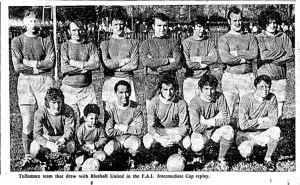
Tullamore FC in 1971 – the author’s father Leo Farrell (ball at his feet) is pictured to the right of Ray Keogh
This article was first published in edition 8 of The Football Pink magazine. They do good work so do check them out. If any readers out there have more information on Ray or his career please get in touch.




 A Bohemian Sporting Life