Rodriguez of Richmond Road – Alvarito at Shelbourne

It’s not all that often that an international from one of the bone-fide European football powers ends up playing in the League of Ireland. But just that did happen in the mid 1960’s when Spanish international Alvaro Ros Rodriguez, better known simply as Alvarito joined Shelbourne in 1965.

Alvarito was born in 1936 in the small town of Ujo in Asturias, an industrial area synonymous with the coal mining industry. He was a two-time Spanish international who featured in away matches against Chile (a 4-0 win) and Argentina (2-0 loss) in 1960. For Spain in these games he played alongside the likes of Alfredo Di Stéfano, Luis Suarez, Juan Segarra and his Atlético Madrid teammate Enrique Collar.

Alvarito played for Oviedo early in his career but spent his best years at Atlético Madrid, winning two Spanish Cups (Copa del Generalisimo as it was during the Franco dictatorship) as well as the 1961-62 Cup Winners Cup against that competitions inaugural Champions, Fiorentina.

Despite this success Alvarito was never a regular with Atlético, he suffered injuries including a severe leg-break in a game against Valladolid, and was mainly understudy to Spanish international Isacio Calleja when he returned from injury. That injury not only limited his club career but also put paid to whatever hopes Alvarito might of harboured of a recall to the Spanish national team ahead of the 1962 World Cup.

He did start in the final of the 1959-60 Copa del Generalisimo, a famous 3-1 win over city rivals Real Madrid in a packed Santiago Bernabéu. Atlético went into that game as complete underdogs, not least because their rivals the great Real Madrid that had demolished Eintracht Frankfurt 7-3 in the final of the European Cup final just a month earlier. That famous victory meant that Real had won the first five European Cups and their side was full of stars including Ferenc Puskás, Paco Gento, Alfredo Di Stéfano and José Santamaría. However the Atlético humbled their city rivals and lifted the cup after scoring three unanswered second half goals after Puskás had giving Real an early lead.

Alvarito’s experience of the League of Ireland with Shelbourne was short-lived. Upon leaving Atlético Madrid he spent a single season with Real Murcia before joining Shelbourne as a player-coach in 1965, while studying English in Dublin. Because of injury he hadn’t played much competitive football for five months prior to having signed for Shelbourne, he was also not completely unfamiliar with Shels and their players having seen them play against his former club Atlético in the Inter City Fairs Cup only a month before he joined. Alvarito made his debut in a 2-1 win for Shels over Dublin rivals Drumcondra.

Some impressive performances followed with Alvarito operating in both full-back positions but a combination of recurring injury and difficulties with the language meant that his stay was brief. What followed after leaving Shelbourne was over 20 years of coaching in the Spanish lower leagues, something that Shels can look on with a little bit of pride as they gave him his first coaching role in the game.

Directly after his spell with Shels Alvarito took up an offer from his friend and former international teammate Ferenc Puskás to cross the Atlantic and join the Vancouver Royals in the NASL where Puskás had recently been installed as head coach. Alvarito’s English lessons must have done him some good as he spent a number of years coaching in the United States before returning to Spain to continue his coaching career. He became most associated with UD Melilla, a team based in a autonomous Spanish city of Melilla, on the coast of North Africa.

Alvarito passed away in June 2018 at the age of 82 in the Spanish city of Melilla.

Puskás, Di Stefano…Prati – the career of a Milan legend

Only three players have ever scored a hat-trick in a European Cup or Champions League final. Alfredo Di Stefano scored three in the famous Hampden Park final of 1960 when Real Madrid defeated Eintract Frankfurt 7-3, his team-mate Ferenc Puskás scored the other four in that game. Puskás would score a hat trick two years later but it was all to no avail as a Eusébio inspired Benfica retained the Cup beating Madrid 5-3. Puskás and Di Stefano, the attacking stars of one of the greatest club sides ever, the storied five in a row Real Madrid, men justifiably regarded as amongst the greatest players ever.

How many remember the third of this three-goal scoring triumvirate? The final member of the triptych was Italian international Pierino Prati who, in the 68-69 final, at the age of 22 scored three against the emerging force of Cruyff’s Ajax in a 4-1 victory for AC Milan. That hat-trick capped off an astonishing two year string of triumphs for Prati. From the beginning of the 1967-68 season to the end of 1969 season the young striker won a Serie A title, the Cup Winners Cup, the European Cup and the Intercontinental Cup for Milan, the 1968 European Championship for Italy as well as picking up the coveted Capocannoniere award for Serie A’s top scorer for the 1967-68 season.

What makes this run of successes all the more remarkable was that Prati had spent the previous season on loan at Serie B side Savona where, despite scoring 15 goals for the Ligurian side they were relegated to Serie C. It was only after the re-appointment of Nereo Rocco as coach of AC Milan that his prospects would change.

Prati was born in December 1946 in the small town of Cinisello Balsamo just north of Milan. He was on the radar of AC Milan at an early stage and played with various Milan youth teams. The then head coach Nils Liedholm was apparently alerted of his talents by another Milan player, Luigi Maldera who spotted the young striker’s talent in a youth tournament. Before he would make his Milan breakthrough though he had to begin his senior career in 1965-66 on loan with Serie C side Salernitana where he scored ten goals (despite suffering a serious injury) to help them attain promotion to Serie B. Prati returned to Milan but only made a couple of appearances before his loan move to Savona began. By this stage there was considerable change at managerial level leading to the appointment of Rocco, a man most synonymous with the defensive system of catenaccio.

prati78

Prati after suffering an injury playing for Salernitana

Rocco had achieved great success with Milan in the early 60’s winning both the league and the club’s first European Cup before leaving for Torino. His return signalled a revival in the fortunes of the club and would mark a turning point in Prati’s career. Not that it started out so smoothly. Rocco asked for the young forward to be recalled from Savona and he arrived at the club with long hair, jewellery and wearing a pair of flares. Rocco is reported to have reacted by saying “I asked for Pierino Prati the footballer, not Pierino Prati the pop singer”. By the end of his career he’d be known as “Prati the pest” due to his driven and persistent style of play.

Any concerns that Rocco may have had were allayed in that first full season when Prati became Serie A top scorer as Milan strolled to the title, nine points clear of second placed Napoli. Prati formed part of a formidable attack along with the Brazilian born Angelo Sormani, newly-arrived, experienced winger Kurt Hamrin and the legendary Gianni Rivera with whom he developed a close on-field partnership. Behind this array of attacking threat was a solid midfield based around the more defensively focused Giovanni Trappatoni and Giovanni Lodetti, a man whose style of play allowed Rivera freedom as the creative fulcrum of the side and led to him being known as Rivera’s “third lung”. Behind them was a defence that only conceded 24 times in 30 games with either Pier Angelo Belli or the newly arrived Fabio Cudicini in goal and German international Karl-Heinz Schnellinger in defence alongside the likes of Roberto Rosato, Saul Malatrasi and Angelo Anquilletti. Early on it was difficult to find a role for Prati. Sormani was the first choice centre-forward, but in one game the right-footed Prati was asked to fill in on the left side of the attack and given the no. 11 jersey, he scored in that game and didn’t stop thereafter. He’d found his place in the side.

ac milan 1969

By May 1968 Prati had added the Cup Winners Cup to his accomplishments, starting
the final in Rotterdam against the Hamburg of Uwe Seeler which was decided by two early goals from Kurt Hamrin. Such was the success of his breakthrough season that Prati was called up by the Italian national team for Euro 1968. The Azzurri had comfortably topped their Euro qualifying group without Prati’s help but his form ensured that he made his debut in the competition’s two legged quarter final against Bulgaria due to an injury to regular starter Luigi Riva. He impressed, scoring in both legs as Italy advance 4-3 winners on aggregate, securing their place at the four team tournament proper hosted on Italian home soil.

Prati1

Prati in action against SV Hamburg in 1968

The Italians were drawn against the Soviet Union in the semi-finals, a tough task as the Soviets had been the side to knock them out of the World Cup two years earlier. It was tight game and Italy were beset by injury problems, first Rivera was forced from the field for lengthy treatment. Then as the match entered injury time Giancarlo Bercelli also had to go off injured, and with no substitutions allowed Angelo Domenghini was withdrawn from the forward line to left back. Prati had a good chance to seal the win but shot wide and there was to be no separating the sides. In the days before penalty shoot-outs the game was to be decided on the toss of a coin. Team captains Giacinto Faccetti and Albert Shesternev joined the referee in his room inside the stadium and Faccetti correctly called tails. He sprinted out to his team-mates on the pitch, his celebrations confirming to all that they were through to the final.

Prati would retain his place for the final against a strong Yugoslavia side who had just defeated England and featured the exceptionally talented winger Dragan Džajić. As with the semi-final, the first final was a very close affair. Džajić had opened the scoring in the first half and Italy, without the injured Rivera were struggling to find a breakthrough. It looked as though Italy might lose the final in Rome’s own Stadio Olympico but ten minutes from the final whistle Angelo Domenghini of Inter thumped a free kick past Pantelic in the Yugoslav goal to secure a replay.

With two consecutive games going to extra time the Italy coach Ferruccio Valcareggi made significant changes to his side for the replay of the final. In came Mazzola and Di Sisti to the midfield while Sandro Salvadore started as a fifth defender. Crucially for Prati and for his whole future international career, his place in the attack was taken by fit-again Luigi Riva of Cagliari. It would prove a decisive change, Riva opened the scoring after only 12 minutes with one of his trademark powerful left-footed drives, on the half-hour Pietro Anastasi, much improved from the first final, notched a second. With Tarcisio Burgnich marking Džajić out of the game Yugoslavia were unable to find a way back in. Italy won Euro 68 in their Capital city. Riva was the hero, he could have scored a hat-trick in the game given the number of chances that fell to him.

For Pierino after his first full season in Serie A he was a League Champion, Cup Winner’s Cup winner and now a European Champion with Italy. However much of his subsequent international career would be lived in Gigi Riva’s shadow.

While 67-68 had been Prati’s breakthrough season when he finished as Capocannoniere this achievement was bookended by Riva’s scoring exploits as it was he who had finished as top scorer in 66-67 and would again in the 68-69 and 69-70 seasons. As a result Prati was left out of the starting line up for most of Italy’s World Cup 70 qualifying despite the fact that he had continued his excellent form into the 68-69 season. The one game he did play, a 2-2 away draw with East Germany saw Italy line-up with a front three of Riva-Mazzola-Prati with Rivera in behind. Riva scored both of Italy’s goals.

Despite a scoring record that showed 38 goals in 70 games over the previous two seasons, including the goals that won the 1969 European Cup, Prati was not in the original squad for the Mexico World Cup in 1970, it was only some locker room hijinks that got him on the plane to Mexico. The Juventus forward Pietro Anastasi, at that time the most expensive footballer in the world, was in the Italian pre- World Cup training camp, he was a bored 22 year old with too much energy and was spending his time winding up the team masseur Tresoldi. The masseur had had about enough of Pietro’s messing when he turned around swiftly and hit Anastasi square in the testicles. Anastasi hit the deck but it was only later that night when the pain became too much to bear that Anastasi realised something was seriously wrong. He was rushed to hospital for surgery, his World Cup was over before it began.

The Italian coach Valcareggi had been pinning his hopes for success on the perfect strike combination of Anastasi and Riva, but with this unexpected injury he called up two forwards to replace one; Roberto Boninsegna of Inter and Prati, while he sent home Prati’s team-mate and Rivera’s “third lung” Giovanni Lodetti to make room. While Boninsegna would have a major impact on the finals, scoring against Germany in the semi-final, providing an assist for Rivera in the same game as well as scoring Italy’s consolation goal against Brazil in the final. Prati meanwhile spent the entire tournament either on the bench or in the stands. Despite the physical demands on the rest of the squad of the Mexican altitude, the heat, and the semi-final against Germany going to extra time Valcareggi kept faith with a core group of players with no space for Prati.

prati7

Prati as a spectator at a show in Mexico

It was Prati’s misfortune that his international career overlapped with that of Riva, a man whose national team goalscoring record (35 goals in 42 games) has remained unbroken for over 40 years. Riva was a true star of the European game, he had propelled little Cagliari to their only ever league title in 1969-70, the same year he finished second for the Ballon d’Or behind his international team-mate Rivera. Even despite Prati’s exceptional form it was also an injury to Riva that gave Prati his first starts for Italy, his return to the Azzurri jersey after the disappointment of the 70 World Cup also coincided with Riva suffering a serious leg injury while playing in a friendly which caused him to miss much of the 1970-71 season. In his absence Prati helped Italy top their qualifying group for Euro 72, scoring in both of their games versus Ireland, as well as netting against Austria, however he was dropped for the quarter-final games against Belgium when Italy were knocked out.

By the 72-73 season Prati’s time at Milan was coming to an end. Milan had just won back to back Coppa Italia’s and while Prati had been central to their success throughout 72 where played regularly through to the final he wasn’t involved at all in the 1973 edition of the cup. There was increased competition at Milan from the likes of Romeo Benetti, Alberto Bigon and the latest arrival, Luciano Chiarugi who would score 22 in his first season. The following year, after 209 appearances and 102 goals for Milan in all competitions, Prati was on the move. He was on his way to the capital to join his old coach Nils Liedholm at Roma.

At Roma Prati become the focal point of their attack and would be the club’s top scorer for each of the next two seasons as they steadily improved; finishing 8th and then 3rd, but as the 70s progressed and Prati entered his 30s, games were harder to come by and niggling injuries began to take their toll. He joined Fiorentina for the 77-78 season but played only eight times without finding the net. It was to be his last year in top flight Italian football. He would spend the rest of his career (apart from a short spell in the NASL with the Rochester Lancers) with one of his earliest clubs, Savona, by then lining out in Serie C2. He retired in 1981 having made 458 appearances for his various clubs, scoring 205 goals, for Italy he won just 14 caps, scoring seven times.

In a league noted for the miserly nature of its defences, especially during the heyday of catenaccio as espoused by the likes of Rocco and the Inter Milan sides of Helenio Herrera, the scoring exploits of Prati are worthy of praise. He was a versatile forward, capable of playing through the middle and on either wing. At just shy of six foot and blessed with a powerful leap he was a handful in the air while possessing a formidable right foot which saw him score his fair share of goals from distance, including a certain speciality with thunderous free kicks. It was noted that at the time that it was common for Italian strikers to drop deep, afraid of being isolated further up the pitch or being caught on the counter-attack, Prati went against this completely and played a high line, always looking to get forward. in his style of play he was likened to the great striker of the 30s and 40s Silvio Piola by no less an authority than the infamous Gianni Brera.

And of course he is the last man to score a hat-trick in a European Cup final. His set of skills were demonstrated ably by the three goals he scored. His first on seven minutes a powerful head from ten yards out as he meets a Sormani cross. The second and third goals showing his intelligence, positioning and most of all his on-field connection with Rivera. The second shows Rivera in possession with Prati feinting as if to head for the left touchline, before quickly changing direction, losing his nominal marker Barry Hulshoff to take possession off a delicious Rivera back-heel. Now finding himself in acres of space 20 yards from goal he lets fly with a right foot rocket into the Ajax net just before the end of the half. The final goal sees Rivera in possession again, sending Ajax defenders one way and the other as he waits for support to arrive, charging through the centre comes Prati, Rivera deftly chips in a cross right onto his forehead as he heads home from six yards to seal a 4-1 victory over a side that will dominate the early 70s.
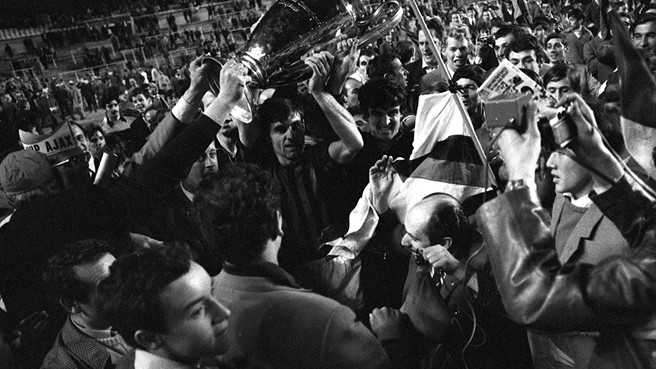
Prati EC 1969

Milan celebrate their European Cup victory in 1969

The Magyar martyr- the killing of Sándor Szűcs

There are certain teams that occupy a space in the popular imagination of the football fan not because of the trophies that they’ve won but due to their style of play and to an extent the romanticism of their glorious failure. The two that most readily spring to mind are the Dutch side of 1974 and the Hungarian side of 1954, both beaten by West German teams in the World Cup Final.

Even more than 60 years later there is a certain mystique around the Hungarian side of the 50s, the Magical Magyars or the Aranycsapat (Golden Team) as they were know in Hungary. Foremost in the minds of football fans surely are names like Ferenc Puskás, the goalscoring “Galloping Major” who would later star for Real Madrid and score 4 goals in the 1960 European Cup final. Other key figures included the wing half József Bozsik after whom the stadium of Honvéd is named, or Nándor Hidegkuti who revolutionised attacking play in his role as a deep lying centre-forward which gave free reign for the exceptional talents of inside-forwards Puskás and Sándor Kocsis to raid forward to devastating effect.

Despite losing the 1954 final in surprising (and according to plenty of Hungarians, controversial circumstances) the modern reputation of the Golden Team lies with their numerous other achievements, not least their twice systematic dismantling of the English national team (6-3 in Wembley in 1953 and 7-1 in Budapest in 1954) which did away once and for all of the notion of innate British superiority or the idea that England could not lose to Continental opposition on home turf. This Hungarian side were also Olympic gold medallists in 1952, Central European Champions in 1953 after defeating Italy, and went over four years undefeated in international football.

Golden_Team_1953

The Hungarian National team circa 1953- Ferenc Puskás is crouched front and centre.

Hungarian football had emerged from the war strongly with a new generation of stars who it was felt could deliver international success. This team was born from a time of violence and into one of political tension and civil unrest from which even the brilliance of their play could not be a defence.

The Hungarians had lost out 4-2 to Italy in the 1938 World Cup final, by 1945 with the War in Europe complete, Hungary witnessed the international début of an 18 year old Puskás while the other stars of the Golden Team would follow in their débuts within the next few years. Despite the terrible damage caused by the battle of Budapest in 1944-45 which claimed the lives of over 45,000 people Hungary witnessed free elections at the end of 1945, despite the powerful influence of the Soviet Union, and a coalition government was formed, with some Communist officials in positions of significant influence. For these first few post-war seasons professional football existed in Hungary and the emerging star players could earn decent money.

However as time progressed the political situation began to change. Mátyás Rákosi, the chief secretary of the Stalinist Hungarian Communist Party slowly set about removing political opponents from positions of power and influence while consolidating his own power base. He later boasted that he removed his supposed partners in government one by one, “cutting them off like slices of salami”. By 1949 there was a change in constitution, Hungary became the People’s Republic of Hungary and the nation officially fell behind the Iron Curtain. With this change of government came a change to how football was run in the country. Kispest, the club of Puskás and Bozsik became Honvéd the team of the Hungarian army, while Újpest FC became the team of the team of the police. Among the star players at Újpest was the international defender Sándor Szűcs. He’d be executed in secret within two years.

Szűcs was born in November 1921 in the town of Szolnok about 100km from Budapest and began his football career with local side Szolnoki MÁV. Already an international by the time he moved to Újpest in 1944 he would win three consecutive league titles with the Budapest club between 1945 and 1947 playing alongside team-mates like Gyula Zsengellér, who had played in the 1938 World Cup final and would later move to AS Roma, and Ferenc Szusza who still holds the record as the Hungarian League’s highest goalscorer and after whom Újpest named their stadium. Szűcs was also an established international by the time Puskás would make his scoring international début against Austria, both men playing in a comprehensive 5-2 victory.

However things started to go wrong for Sándor after the change of government and a chance meeting with a young, and crucially, a married woman. In 1950 a passionate Újpest fan invited Szűcs and some of his team-mates back to his house for a get together, it was that fateful night that Sándor met Erzsi Kovacs the 21 year old wife of their generous host. The young Erzsi was already becoming well known in Hungary as a popular jazz singer and the two apparently fell for each other immediately.

Sándor, then only 29, was also married and a popular international footballer playing for a club then just coming under the control of the police was in a hugely difficult position and tried to hide their affair to avoid a scandal that seemed inevitable. In fact due to the re-allingment of the club with the police force Sándor had technically become a policeman in the same way that Puskás and his Honvéd team-mates were army officers. That didn’t stop Erzsi being called for questioning by the AVH, the notorious secret police about the affair. After the interview Sándor recieved a chilling phone call advising him to cease the relationship or else he would end up somewhere where his footballer’s legs couldn’t help him.

The couple resolved to flee the country. Under the new Rakosi regime everything that they had in Hungary was reliant on the good will of the state. Szűcs received better clothing and food than the regular working person and was able to benefit from additional income through the black market. As a form of bonus top Hungarian athletes were able to bring in black market goods from away internationals and foreign tours to supplement their income, the state security forces would conveniently look the other way. However in the current circumstance all that was at risk.

Their plan was to cross the border into Yugoslavia and from there into Italy. Sándor knew that the Italian side Torino had been interested in him in the past and he would have known that former team-mates like Zsengellér had found some success as a player in Italy but this bold plan carried a serious risk. An illegal attempt to cross the border carried the death penalty.

They resolved to borrow a car and to pay a smuggler a fee to arrange safe passage across the border and into Italy. They were to leave in March of 1951. Sándor had to be careful, he couldn’t risk telling his team-mates seeing as Újpest was the police club and a player, a team-mate, could turn informer to the dreaded AVH. The club were certainly not immune from AVH interference, indeed the club had only signed their new star striker Ferenc Deák after he got into a fight with two AVH men who threatened him with serious jail time if he didn’t move from Ferencváros to Újpest.

The young couple set out on March 6th, the person who agreed to smuggle them out had advised Sándor to take along a pistol as an added precaution, however this seems to have been just another part of an elaborate trap. The couple were stopped by a security patrol on the way to the border, at first everything seemed to be alright, they merely asked for their ID before sending them on their way, however a few kilometres later they were surrounded by AVH men, the smuggler had been a plant and they were waiting for the young couple all along. The gun that Sándor had been told to carry was seized and he and Erzsi were taken to the AVH headquarters at 60 Andrássy Avenue, commonly known as the House of Terror. Both were brutally interrogated before Sándor was charged with illegally attempting to cross the border and with high treason. He was tried in a Military Court in May 1951 with a court appointed lawyer that he did not know, the sham trial found him guilty of all charges and sentenced him to hang along with the confiscation of all his property. Erzsi was sentenced to four years in prison.

Former team-mates including national team players József Bozsik , Ferenc Szusza and Ferenc Puskás petitioned the National Defence Minister, Mihály Farkas for clemency on behalf of Szűcs but they were refused. Puskás had in the past been able to use his influence to get team-mates and friends out of trouble but now his pleas fell on the deaf ears of the new Stalinist regime. On June 4th 1951 Sándor Szűcs was executed in secret. Erzsi didn’t learn about his death until her release in 1954 and details of the execution and the location of Sándor’s grave did not emerge publicly until 1989.

One theory explaining the severity of the sentence and the elaborate set up of Szűcs and Kovacs was that aside from the fact that their relationship offended a conservative Stalinist regime the execution of Szűcs would act as a deterrent to other sports stars or entertainers who might consider defecting. This is only a theory but perhaps it did work. We know that Puskás was offered a huge salary by Juventus which he turned down and he wasn’t the only player offered such inducements. Part of the reason for this could well have been the brutal treatment meted out to their erstwhile colleague Sándor Szűcs. It was only after the vicious reprisals against those who took part in the 1956 Uprising that players defected en masse. This was aided by the fact that Puskás and his Honvéd team-mates were out of the country, in Spain to play a European Cup match against Athletic Bilbao. Ultimately Puskás would have a hugely successful “second” career in the white of Real Madrid, international team-mates such as Koscis and Czibor would also find success in the blaugrana of Barcelona.

Erzsi was released towards the end of 1954 and after a short time was able to resume her singing career and found popular success in Hungary in the 1950s and 60s before moving abroad and performing around Europe as well as on cruise ships. She eventually returned to Budapest and continued recording music well into her 70s. She passed away in 2014 at the age of 85.

A later album of Erzsi Kovacs

With the collapse of Communism in Europe, Hungary held free, multi-party elections in May 1990, as part of this return to democracy the crimes of the country’s past could be redressed and the execution of Sándor Szűcs came back to the fore publicly. In 1989 his death sentence was revoked, he was posthumously promoted to the rank of lieutenant-colonel in the police force and today a school is named after him as is a stand at the Ferenc Szusza Stadium where Újpest play. He was the only professional footballer killed by the regime although many more fell victim to the AVH and the House of Terror. Sándor Szűcs is now better remembered in modern Hungary but his death casts a dark shadow on the glory of the Golden Team.

Szuszastadion.jpg

The Ferenc Szusza stadium, home of Újpest