Voyage from Olympia – Ireland against Estonia and the USA

The FAI delegation were busy at the Olympics, it had been a challenge to even get the football team to Paris, considering the cost and a lack of administrative or State support. And while the Irish side had put in a credible display, only losing out at the quarter final stage to the Dutch after extra time, the officials were keen to make the very most of their time in Paris making new connections with other FIFA members and renewing acquaintances with those nations that had supported the Free State in taking its seat at the top table of world football.

It is against this backdrop that two further games were organised, one in Paris, against Estonia, and another back in Dublin against the United States. Immediately after elimination against the Dutch the Irish delegation had arranged another match, this time against the Estonians on June 3rd , which gave an opportunity to give some game-time to those players who hadn’t previously had the opportunity to feature. The likes of Tom Murphy, Charlie Dowdall, John Thomas and Christy Robinson all got to play as the Irish side recorded an impressive 3-1 win. Level 1-1 at the break thanks to a Paddy Duncan goal, second half strikes from Robinson and Frank Ghent gave Ireland the win.

Surprisingly, the Estonia game, a friendly match, was the best attended of the Irish matches played in Paris with over 3,000 spectators turning up. The crowd numbers were significantly helped by the fact that Ireland didn’t have to compete for public interest against other matches kicking off simultaneously in Paris as had happened with the previous games against the Netherlands and Bulgaria. Also of significance was the appearance of Bohs’ Christy Robinson, four years later his brother Jeremiah (Sam) Robinson would win his first cap, versus Belgium, this would mean that they became the first set of brothers capped by the FAI.

Less than two weeks later, on June 14th , Ireland played their first home international, hosting the USA in Dalymount Park. The USA had eliminated Estonia at the Olympics but had been knocked out by eventual winners Uruguay. They too stayed on for an extra match, beating Poland 3-2 in Warsaw before journeying to Dublin. The USA had supported Ireland’s membership to FIFA, and their journey to Dublin shouldn’t be too surprising as the American soccer party were led by Peter Peel, a Dublin-born, Limerick-raised, sporting all-rounder who had moved to Chicago as a young man. Research by Michael Kielty has shown that Peel retained a profound, active interest in Irish affairs while also running a successful sports medicine practice and being dubbed the “Soccer King of Chicago”.

There was perhaps an added incentive for the Americans to spend a full week in Ireland as the USA was in the middle of its prohibition era and it is believed that the United States party enjoyed the social life available to them in Dublin during their stay. Whether this had any impact on their performance is uncertain, perhaps more likely is the impact of the journey across Europe from Warsaw to Dublin.
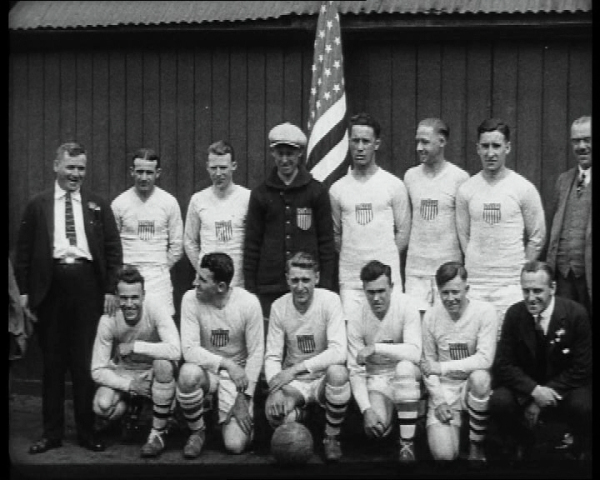
USA team in Dalymount

Regardless, the United States, although a fit and physically imposing side were well-beaten 3-1 in front of a somewhat disappointing crowd of only around 5,000 for the summer friendly in the football off-season.
Ireland included several players, who because of previous experience as professional footballers hadn’t travelled to the Olympics, and it was one of these, Ned Brooks of Bohemians who made the biggest impression. Brooks, on his debut, scored a fine hat-trick, pouncing on an early mistake by Arthur Rudd before rounding off the 3-1 win with two fine strikes. Sadly, this would be Brooks only international cap.

It would be 1926 before Ireland would play another international, and while Brooks was selected to start against Italy, tragedy struck days before he was due to travel when his seven-year-old son Harold ran across a busy street in Rathmines to ask for a penny from his father when he was struck and killed by a car. Despite being rushed to hospital and being given a blood transfusion by his father, young Harold succumbed to his injuries. I feel that the story of Ned Brooks, his brilliance and tragedy shows why it is so important that we honour the memory and achievements of the players of 1924.

Originally published in the Ireland v Hungary match programme May 2024

Antwerp 1920 – a final finished before half-time

John Lewis was just twenty when he and an old school friend formed Blackburn Rovers in 1875, in his lifetime he would see the club he helped create win two league titles and five FA Cups. Lewis would go onto hold prominent positions in the FA and by the end of the 19th Century was one of the most well-known referees in English football, having thrice been given the honour of refereeing the FA Cup final during the 1890s. Clearly such was his prominence that even at the age of 65 he was selected to referee the football final of the 1920 Olympics, held in Antwerp, Belgium, and to be contested by the host nation and Czechoslovakia.

Assisting Lewis on the line that day was another Englishman, Charles Wreford Brown, a gentleman amateur who played football for Corinthians and England as well as being a talented cricketer and the man who (possibly apocryphally) coined the term “soccer”! Much to the surprise of the other competing nations the previous gold medallists from Great Britain were knocked out in the opening round of the tournament by Norway. Hosts Belgium received a first-round bye and faced Spain in the second round who themselves had dispatched the much fancied Danes. A 3-1 win saw Belgium progress and then defeat neighbours the Netherlands in the semi-finals to make it to a home final.

On the other side of the draw and playing an additional first round game, the free-scoring Czechoslovakia side ran up comfortable victories over the Kingdom of Yugoslavia. Czechoslovakia was a new State, born out of the post-war disintengration of the Austro-Hungarian Empire. The Olympic Games would make a fine setting to announce themselves to the world. Having beaten Yugoslavia next up to be dispatched were England’s conqueror’s Norway, and then France in the semi-final to set up a final encounter with the hosts. In this final it was Lewis, rather than any of the players, who received the most prominence.

The Belgian team in the final. Swartenbroeks is top left.

In front of a packed house in Antwerp, with crowd estimations between 40 to 50 thousand, mostly partisan Belgian fans, crammed in, and many more locked outside the Olympic Stadium, the Belgians raced into an early lead thanks to Lewis who flagged for a penalty for hand ball in the sixth minute. Robert Coppée of Union Saint-Gilloise, who had scored a hat-trick in the earlier game against Spain duly converted but only after extensive protests from the Czech players who protested that their goalkeeper Rudolf Klapka had been fouled in the build up to the penalty being awarded.

After 30 minutes Henri Larnoe had made it 2-0 with a fine strike, but less than ten minutes later the game itself was over. Again, it centred around a decision by Lewis who sent off the Czech full-back Karel Steiner for a violent foul on the penalty-scorer Coppée. The Czechoslovakian captain Karel Pešek of Sparta Prague left the field in protest and was quickly followed by the rest of his teammates.

Antwerp, selected as the site of the first Olympics since the cessation of the First World War in part due to its symbolism as a location of resistance to German aggression. Indeed many of the players in the Belgian side were World War I veterans like the Daring Brussels defender Armand Swartenbroeks who had lost his brother at the front and spent his furlough time during the War organising charity matches for his injured fellow-soldiers.

However, on the day of the Olympic football final Antwerp witnessed a mass pitch invasion by the Belgian fans and the Belgian army had to go onto the pitch and help the Czechoslovakian players make a safe exit. The Czechoslovakian delegation protested against the result and the standard of refereeing by John Lewis – stating: “The majority of the decisions of the referee Mr. Lewis were distorted” – but their appeals fell on deaf ears and Belgium were declared gold medallists while Czechoslovakia were disqualified and a playoff was hastily arranged to decide the silver and bronze medals, won by Spain and the Netherlands respectively.

Despite the fact that the match didn’t even make it to half time the gold medal remains the only senior honour won by the Belgian men’s national team to this date.

A version of this article appeared in the March 2024 Ireland v Belgium match programme.

Ernie Crawford he’s our friend

Regular attendees to Dalymount Park may have noticed a new flag appearing around Block F. It features a bare chested man with a Charlie Chaplin moustache and bears the legend Ernie Crawford – He’s our friend, he hates Rovers. But who, you may ask was Ernie Crawford?

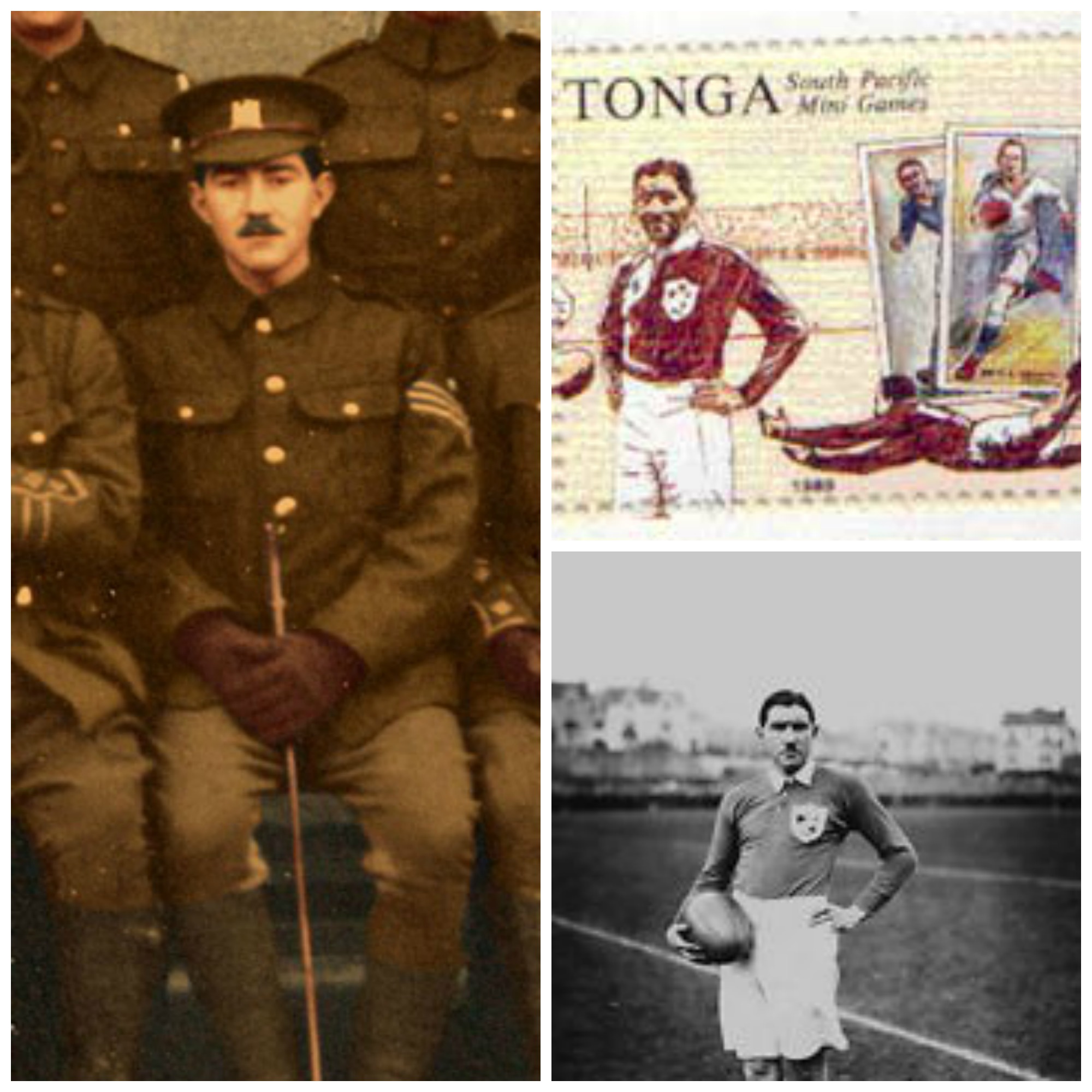
Born in Belfast in November 1891 Ernie was perhaps best known for his endeavours on the Rugby pitch. He starred for Malone in Belfast and later Lansdowne Rugby Club and won 30 caps for Ireland, fifteen of them as Captain between 1920 and 1927. After retirement he was heavily involved in administration as President of Lansdowne Rugby Club between 1939 and 1941 and President of the IRFU in the 1957/58 season as well as being an Irish team selector between 1943 and 1951 and again between 1955-1957. His obituary in the Irish Times listed him as one of the greatest rugby full-backs of all time, he was honoured for his contribution to sport by the French government and even featured on a Tongan stamp celebrating rugby icons.

He was also a successful football player who turned out for Cliftonville, for Bohemians and on a number of occasions for Athlone Town. He was even a passable cricket player. Ernie was a chartered accountant by trade and moved to Dublin to take up the role of accountant at the Rathmines Urban Council in 1919, and this facilitated his joining Bohemians. Despite his greater reputation as a rugby player, Ernie, as a footballer for Bohs, was still considered talented enough to be part of the initial national squad selected by the FAIFS (now the FAI) for the 1924 Olympics in Paris. In all, six Bohemians were selected (Bertie Kerr, Jack McCarthy, Christy Robinson, John Thomas & Johnny Murray were the others and were trained by Bohs’ Charlie Harris), but when the squad had to be cut to only 16 players Ernie was dropped, though he chose to accompany the squad to France as a reserve. The fact that he was born in Belfast may have led to him being cut due to the tension that existed with the FAIFS and the IFA over player selection. However, even as a travelling supporter, he caused some controversy. He was stopped by customs officials en route to Paris and had to explain the presence of a revolver in his possessions. Ernie’s reply was merely that he brought the gun for his “piece of mind”. Not that this was Ernie’s first experience with firearms.

Crawford collage

Ernie in military uniform, appearing on a Tongan postage stamp and in rugby kit

Ernie had served and been injured during the First World War. That he could captain the Irish Rugby Team and be selected for the Olympics is even more impressive when you consider that during the Great War Ernie was shot in the wrist at Arras, France in 1917 causing him to be invalided from the Army and to lose the power in three of his fingers. He had enlisted in the 6th Inniskilling Dragoons in October 1914 and was commissioned and later posted to the London Regiment (Royal Fusiliers), becoming a Lieutenant in August 1917. After his injury he finished his war service on the staff of the Ministry of Munitions. He was a recipient of both the British War medal and Victory Medal.

Ernie later returned to Belfast where he became City Treasurer in 1933. It was in Belfast in 1943 that Ernie encountered Bohs again, as he was chosen to present the Gypsies with the Condor Cup after their victory over Linfield in the annual challenge match.

One of the reasons that his memory has lasted nearly a century with the Bohemians faithful and why a group of us decided to get a flag made up bearing his image centres around a minor cup tie. Ernie, due to his Rugby and also his professional commitments tended to not be a regular starter for Bohemians, his appearances tended to be because of the injury or suspension of other players or as part of reduced strength sides in smaller cup competitions.

As we all know however, when it comes to games against Rovers there are no “smaller ties”. After one particularly tough cup game against Shamrock Rovers an angry Crawford removed his jersey challenged Rovers star forward Bob Fullam to a fight in the middle of the pitch. It’s this moment that the image on the flag imagines!

Fullam himself was no shrinking violet, as well as being an accomplished footballer who was capped twice by Ireland he supplemented his income as a docker in Dublin Port. He finished the 1922 FAI Cup final amid a mass brawl after Rovers were beaten by St. James Gate. The fighting only ceased when the brother of the Gate’s Charlie Dowdall reportedly confronted Fullam with a pistol.

Ernie himself seemed to have been one of those “larger than life” characters, quite aside from bringing a gun to the Olympics and bare-chested on-pitch scraps he also fell foul of Rugby referees one of whom complained about Crawford’s back-chat and claimed that such was the roughness of his play “that the definition of a “tackle” should be sent in black and white to him”. On another occassion an English rugby opponent remembers Crawford treating him and his wife to dinner and giving them a lift back in his car which didn’t happen to have any working headlights. Ernie in an attempt to beat traffic tried to get between a tram and the pavement without much success, badly denting the side of his car and scratching up the paintwork of the tram car. The angry tram driver jumped from the vehicle but on recognising that the other driver was non other than Irish rugby captain Ernie Crawford he let the car pass unhindered, taking off more paint as he went.

In 1932 he became the first man from Britain or Ireland to be awarded the silver medal of honour by the French ministry of sport and physical education for his contributions to the world of sport. Apart from sport he was obviously professionally successful, being City Treasurer of Belfast until his retirement in 1954, he was also trained as a barrister and took an interest in economics. He died in 1959 and was survived by his wife and three children.

Ernie Crawford, he’s our friend.

Ernie is pictured below on the back row, far right as part of the Bohemian FC squad of 1920-21.

Bohs 192021 EC

Useful resources on Ernie’s career include Paul Rouse’s History of Irish Sport, Tadhg Carey’s When we were Kings and David Needham’s Ireland’s first real World Cup and the Dictionary of Irish biography.