South Africa were there from the beginning of organised football in Africa, the game arrived from Britain in the late 19th Century and the national association first affiliated to FIFA in 1910.
As an early African member of FIFA in the 1950’s they agitated for greater representation for African football and in 1957, along with Egypt, Ethiopia and Sudan they were founders of CAF (Confederation of African Football) and were almost among the original participants in the African Cup of Nations, however it was at this point that the thorny issue of Apartheid intruded on proceedings.
As the Sudanese delegate Abdim Halim Mohammed recalled at the time, the South African delegate was:
A chap called Fred Fell, not an Afrikaner but British. We accepted him and accepted South Africa. He accepted we would host the first African Cup of Nations in Khartoum…Then we came to that “area”. He said the government had told him it is either a pure white team or a black team. We said we don’t accept that. We want black and white.
South Africa were understandably disqualified as a result of their intransigence on the issue of a mixed national team and it would be almost forty years before a South African side would compete in the Cup of Nations.
When they did enter the competitions it was as hosts in 1996, Nelson Mandela was President, and a multicultural South African team would emerge as Champions with Mark Williams grabbing both goals in the final against Tunisia.
Since the 90s post-apartheid South Africa has competed in, and hosted a further Cup of Nations as well as the 2010 World Cup. However their long, controversial and turbulent international history began not in Cape Town or Johannesburg, or even on the continent of Africa, but on a trip to Ireland and in the cities of Dublin and Belfast.
Back in 1899 a football team from the Orange Free State had toured England, notable for the fact that it was an all-black team, while in 1906 a white side had toured South America and played in both Brazil and Argentina, however the Union of South Africa was only formally established in 1910 bringing together four previously separate British colonies.
The new football team of this new nation would join FIFA but wouldn’t play a formal international until September 1924 when “The Springboks” came to Europe. Their first port of call for the all-white touring side was Dublin, and their first opponents Bohemian F.C.
By that stage the South African government had already brought in one of first pieces of Apartheid legislation, the 1913 Natives Land Act which limited the ownership of land in South Africa by the majority black population to just 8% of the total area of the country.
While the majority of apartheid legislation was introduced in the late 40s be Prime-minister DF Malan the preceding decades had seen the steady erosion of the rights of the black South African population. Despite these rulings the sporting relations between Britain (and Ireland) with South Africa were flourishing in 1924.
Not only was the football team visiting but in rugby, the British and Irish Lions were on tour in South Africa, while the South African Cricket team was just completing a summer tour of England.
The visiting football team would play three games in Ireland, the first on 30th August versus Bohemians before travelling north of the recently created border to take on the Irish National Team (the IFA selection which from this point on will be referred to as Northern Ireland) in Belfast and a North-West XI playing in Derry in September.
The split between the Belfast based IFA and the recently formed FAI of the Free State was still a sensitive issue, with both associations claiming exclusive use of the name “Ireland” while each association continued to select players from the whole of the island. As just one example of the complexity of this cross-border situation the Free State FAI Cup holders at the time of South Africa’s arrival were the Belfast based Alton United.
There were now two leagues and two national teams on the island of Ireland and although the FAI had sent a side to compete in the 1924 Olympics that summer the fledgling association had yet to play a FIFA recognised match. It was under these circumstances that South Africa; an amateur side at the time would take on not the Free State XI but the reigning League of Ireland champions (and fellow amateurs) Bohemians.
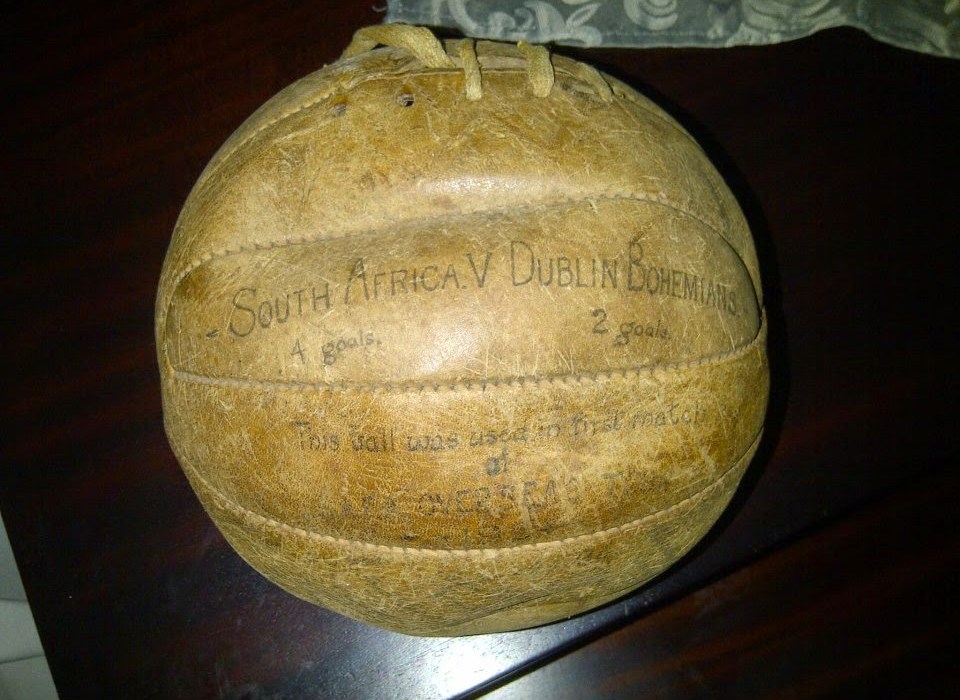
They would meet in Dalymount Park and the touring side would get off to a great start in front of a large Dublin crowd with the South Africans eventually running out 4-2 winners. Bohs were without the influential Bertie Kerr who was injured but did have players of quality such as Paddy O’Kane, Dave Roberts and Jack McCarthy in their side who would all go on to win full caps for Ireland. Incidentally Bohemians were captained by Billy Otto, who had been born in South Africa.
The South African goals would come from Eric Stuart of Western Province, Jim Green of Transvaal and a brace from a 20-year old-striker named Gordon Hodgson.
Hodgson, the son of English emigrants, had worked as a boiler maker in his native South Africa while also lining out for the Transvaal side. Like many of the touring South African side he was physically imposing, standing at six foot one and weighing over 13 stone.
Early reports of the South African tour suggest that their forwards were somewhat rough diamonds in terms of finishing, their good attacking play being undone by some poor marksmanship, Hodgson, however, would certainly prove to be a formidable goal-scorer.
The South African side would spend three months touring Ireland, England and the Netherlands and their teams’ performances, including wins over Chelsea, Aston Villa, Liverpool and Everton would generate significant interest in a number of the Springbok players and several would pursue professional careers in England.
Gordon Hodgson would join Liverpool and make the biggest impression, along with him goalkeeper Arthur Riley and Glasgow-born fullback Jimmy Gray would all join the Reds in 1925. Gray would make a single appearance before joining Exeter City where he played until 1936, while Riley would have to bide his time at Anfield as he would have to replace the legendary Elisha Scott in goal.
Scott was (and remains) Liverpool’s longest serving player and an Anfield hero and was also first choice keeper for Northern Ireland. It would be the 1928-29 season before Riley got any sort of extended run in the Liverpool team though he would eventually amass over 300 appearances for the club.
Hodgson would become a record breaker on the red half of Merseyside, becoming Liverpool’s record goal scorer, a title he would hold for three decades before the arrival of Roger Hunt in the 1960s. Initial interest in Hodgson was piqued when he scored a hat-trick in front of the Kop for South Africa against Liverpool during their tour, something guaranteed to catch the club’s attention.
He would score 233 league goals for Liverpool (including a still standing club record 17 hat-tricks) during his 11 years at Anfield, before, at the age of 32 he was signed by Aston Villa for £3,000. His spell at Villa would be short and he would move to Leeds United for £1,500 in 1937, eventually scoring an impressive 53 goals in 85 appearances for the Yorkshire club.

Gordon Hodgson of Liverpool, South Africa and later England
Hodgson still sits fourth on the all-time top flight scoring chart in English football, by his retirement he had 288 league goals, five above Alan Shearer, and only behind Jimmy Greaves, Steve Bloomer and his contemporary, and city rival Dixie Dean.
It is perhaps because of Dean that Hodgson is not more well know. Liverpool have had their fair share of prolific forwards but what separates Hodgson from the likes of Hunt, Keegan, Dalglish and Rush is that those later era strikers were all trophy winners.
Hodgson played for Liverpool during a trophy-less period, made all the worse by the fact that Everton would win two league titles and an FA Cup during Hodgson’s time there, with Dean being recognised as the greatest centre forward in the world and one of sports’ biggest names.
Despite the obvious scoring prowess of Hodgson he failed to find the net in his next game in Ireland after his brace against Bohemians. In fact contemporary reports mentioned his poor finishing in the game against Northern Ireland; the game that would go down in South African football history as their first international.
The match would take place in Solitude, the home ground of Belfast club Cliftonville in front of a crowd of 6,000, generating the princely sum of £254 in gate receipts on the 24th of September 1924. The South Africans had made some changes to their starting line-up since the match at Dalymount, in came Williams, Touhy, Jacobi and Murray. Out went Howell, Hicking, West and Walker. They had played four games in the London area in the intervening three weeks, their most recent match a 4-2 win over Second Division Chelsea with Hodgson grabbing two.
The Northern Irish didn’t field their strongest side for the game. There was no Elisha Scott to face his Liverpool successor, nor was their star forward, Sheffield United’s Billy Gillespie in their line-up. In fact as a cost saving measure the IFA chose to select only players from the Irish League to save on travelling costs.
This all-domestic XI did cause some confusion as to the status of the game both at the time and subsequently. Some reports, including the Irish Times, referred to the Irish side as an Irish League XI rather than a full national team and for many years the IFA did not list the match as a full international, recognising it only as an amateur match.
The South Africans would also play both the English and Welsh amateur sides on their trip but these would not count as full internationals.
However the game against Northern Ireland has been recognised as a full international since 2001. While the Irish side were all home based there were paid professionals among their ranks including Thomas “Tucker” Croft who had scored the winner against England only a year earlier.
They wore the St. Patrick’s blue jersey of the full International side rather than the green jerseys associated with the Irish amateur side and the match was advertised at the time as a full international by the IFA.
The Irish side took the lead early through Frank Rushe who got on the end of a free kick after ten minutes. Rushe was born in Bessbrook in County Armagh. At the time of the South Africa match, his only senior cap, he was playing for Distillery in the Irish League but had spent the previous season with Dublin side Shelbourne who had finished runners-up to Bohemians in the Free State league.
The South Africans would strike back though, just before half time David James Murray getting them back on level terms before Jim Green, who had also scored in Dalymount, grabbed the winner 15 minutes from time.
Irish football correspondents noted the improvement in play from the South Africans since the match in Dublin and the physical disparity between the well-built Springboks and the less robust Irishmen was commented upon by a number of columnists.
It was also noted that the margin of victory could have been greater for the South Africans if it had not been for their wasteful finishing, with particular mention for young Hodgson who seemed to be having a rare off day.
The South Africans would spend the next three months touring Britain and the Netherlands, including another full international, a 2-1 defeat to the Dutch national team in Amsterdam, though these would be the last games played for the national team by men like Hodgson and Riley.
As mentioned, Hodgson would even line-out three times for his new homeland, England. While he and Riley would have successful careers in England, making almost 800 league appearances between them.
It would be almost thirty years before a black South African would play professionally in Europe when Steve Mokone signed for Coventry in 1955 before playing in Holland, Italy and Spain. Two years after Mokone’s move to Coventry his fellow countryman David Julius would sign for Sporting Lisbon.
Due to the racist policies of apartheid South Africa and the various bans, suspensions and boycotts that resulted, neither man would ever play for the land of their birth, Julius would end up donning the red of Portugal rather than the green and gold of South Africa.
While Hodgson scored for England against Wales during the second of his three caps he at least had the opportunity to play for South Africa against Northern Ireland and the Netherlands. In many ways the tour of 1924 was a false dawn in international footballing terms for South Africa.
The ruling government’s refusal to allow mixed teams meant their expulsion from CAF, FIFA, the Cup of Nations and the World Cup. It was only in the mid-90s that the football isolation of the nation would properly end.
While the record books show that South Africa made its international debut in Belfast in 1924 perhaps that game should have an asterisk against it, and not because the IFA selection they faced included only domestic based players.
Despite the quality of players like Gordon Hodgson and Arthur Riley a truly representative South African XI wouldn’t make its international bow until the Bafana Bafana defeated Cameroon in Durban 68 years later.
Originally posted on backpagefootball.com


 A Bohemian Sporting Life