Devlin’s of Parnell Street

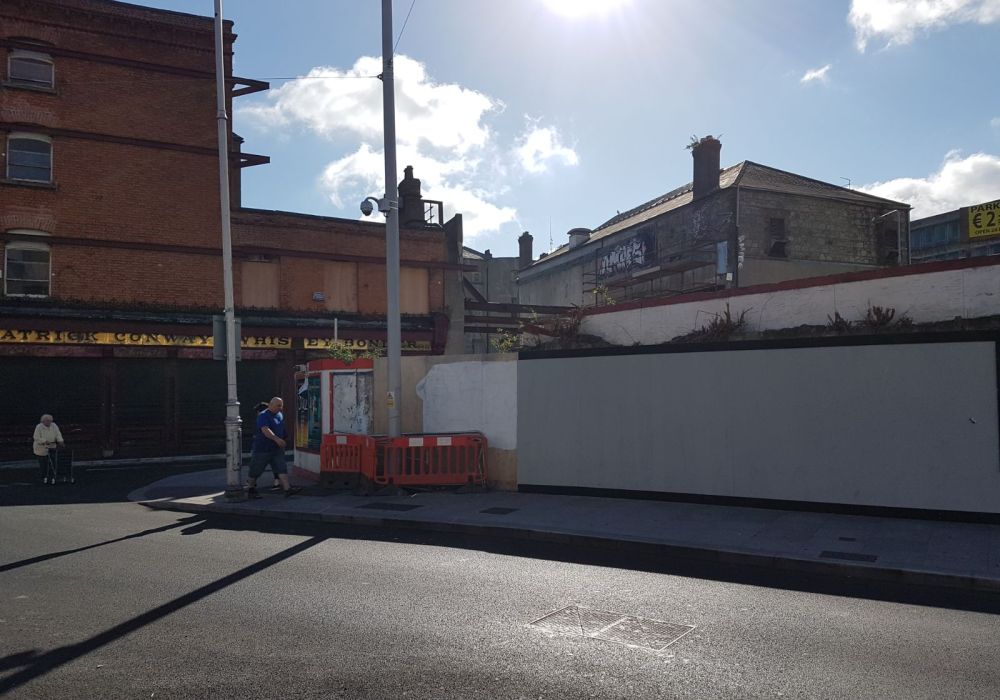
Walk down Parnell Street towards the Rotunda hospital and you’ll pass the junction with O’Connell Street, followed by the Parnell Heritage Pub (formerly the Parnell Mooney) and then at the corner you’ll reach Conway’s Pub which is closed at present. Opposite Conway’s across the junction with Moore Lane is a hoarded off site.  Wooden panels and advertising boards hide an empty space fronting out onto Parnell Street. Behind that is a small surface car-park and next door is the Jury’s Inn hotel.

It’s a fairly featureless site, but one with a certain weight of history associated with it. This site, 68 Parnell Street was formerly home to Devlin’s pub and hotel. A building of huge significance during the War of Independence and the subsequent Civil War.

The building itself was once a four-storey structure with a bar at ground floor level and rooms to hire on the floors above. It was bought by Liam Devlin and his family in 1920.

Devlin's Parnell Street

Devlin’s as it appeared in the Irish Times in 1924. Conway’s pub is visible to the left.

In his Bureau of Military history witness statement Frank Thornton, the Deputy Assistant Director of Intelligence to Michael Collins spoke about how Liam Devlin had taken over the licenced premises in mid-1920 and began running it with his wife. Devlin was originally from Derry but had moved to Greenock in Scotland and had become involved with the Irish Volunteer movement while based there. He moved to Dublin around 1918 and took over the running of what became Devlin’s pub in 1920 along with his young family. Liam Devlin’s son Denis Devlin (born 1908) would later gain a certain literary fame as a poet while also working for as an Irish diplomat in Italy during the 1950’s.

Through his existing connections with the Gaelic League and the IRB Liam Devlin came to be introduced to Michael Collins and quickly offered Collins and his Intelligence staff the use of his premises as a safe-house and meeting place.

Collins used a number of city centre premises as offices and meeting places during the time of the War of Independence, many in the Parnell Street and Square area such as Vaughan’s Hotel and Jim Kirwan’s. Information would be sent to him in these locations, and he would also use them to meet new recruits and make plans for upcoming operations. Devlin’s soon became a sort of unofficial HQ for Collins and his men.

Again as Frank Thornton’s witness statement noted;

We used Devlin’s extensively and every night Mick, [Collins],  Gearóid O’Sullivan, Liam Tobin, Dermot O’Hegarty, Piaras Beaslaí, Frank Thornton, Tom Cullen and Joe O’Reilly met there, the events of the day were discussed and plans were made for the following day. Any particular Column leader or Brigade Officer arriving in town was generally instructed to report to Devlin’s.

Eamon “Ned” Broy, the infamous double agent who was nominally a “G-man” intelligence officer with the Dublin Metropolitan Police but was in fact feeding information to Collins also remembered Devlin’s well. He remarked that it was known by the men as the “No 1 joint” at the time. It was to Devlin’s pub that Broy went to meet Collins after he had been released from prison. Many expected Broy to be killed and were delighted to see him safe and well, Collins celebrated his release in a somewhat unusual manner, Broy remembers Collins marking their reunion “by demanding a wrestling bout with me”.

The benefits of a welcoming city centre location were obvious but the hospitality of the Devlin family was an added bonus, while the premises’ status as a pub provided a good cover. As Thornton noted:

Mrs. Devlin acted in the capacity of a very generous hostess. Visitors from the country never left without getting a meal and in quite a large number of instances a bed for the night. It can be readily understood that a headquarters of this kind in the heart of the city was valuable to the movement generally and particularly to the Intelligence end of things, for, being a public house, no notice was taken of people continually going in and out.

This helps show the role of Devlin’s in the War of Independence and it was of clear importance and use to Collins personally, however it also had a significant role at the end of the Civil War. After the cessation of hostilities between the pro and anti Treaty forces in May of 1923 a general election was held in August of that year which elected the new Cumann na nGaedheal government led by W.T. Cosgrave. One immediate issue facing the government was how to demobilise a national army that had grown to a great size during the Civil War but was no longer needed in peacetime.

A hardcore of army officers, many of whom had been members of the Dublin Guard such as Liam Tobin, feared for their own positions under this demobilisation and some viewed themselves as being unfairly treated in relation to some former British Army officers who had joined the pro-Treaty forces during the Civil War. On the 7th March 1924 an ultimatum was sent to Cosgrave signed by Tobin and Colonel Charles Dalton demanding an end of the demobilisation.

This was understandably viewed as a mutinous act from a section of the armed forces. Immediately afterwards a number of recruits refused to parade and arrest warrants were issued for Tobin and Dalton. By the 18th of March a group of roughly 40 armed men, including Dalton and Tobin decamped to Devlin’s to plan their next move and in response Kevin O’Higgins, the Minster for Justice who had token over the de facto leadership of a government divided by the issue sent lorry loads of loyal Army troops straight to Parnell Street. Two Cumann na nGaedheal TDs, Joseph McGrath and Daniel McCarthy attempted to negotiate with the surrounded mutineers to deescalate the situation. Tobin and Dalton, knowing Devlin’s well from their days there with Collins escaped along the building roofs and ultimately any threat of a wide scale army mutiny or even a coup d’état soon disappeared. The 1924 mutiny resulted in Richard Mulcahy resigning from his role as Defence Minister as well as nine TD’s resigning their seats from the Cumann na nGaedheal government.

More importantly it demonstrated that after almost a decade of death and violence, and only months after the end of a bloody Civil War, that it was elected government, and not the military that held the power in Ireland. It may be argued that the gun began to leave Irish politics after a period of intense militarisation on a spring night on Parnell Street outside a long demolished pub.

August 2019 update

The Devlin’s site is currently being cleared and excavated in preparation for the construction of a new hotel. Below are a couple of photos taken on 29th August 2019 which show the cellars of what presumably would have been Devlin’s pub.

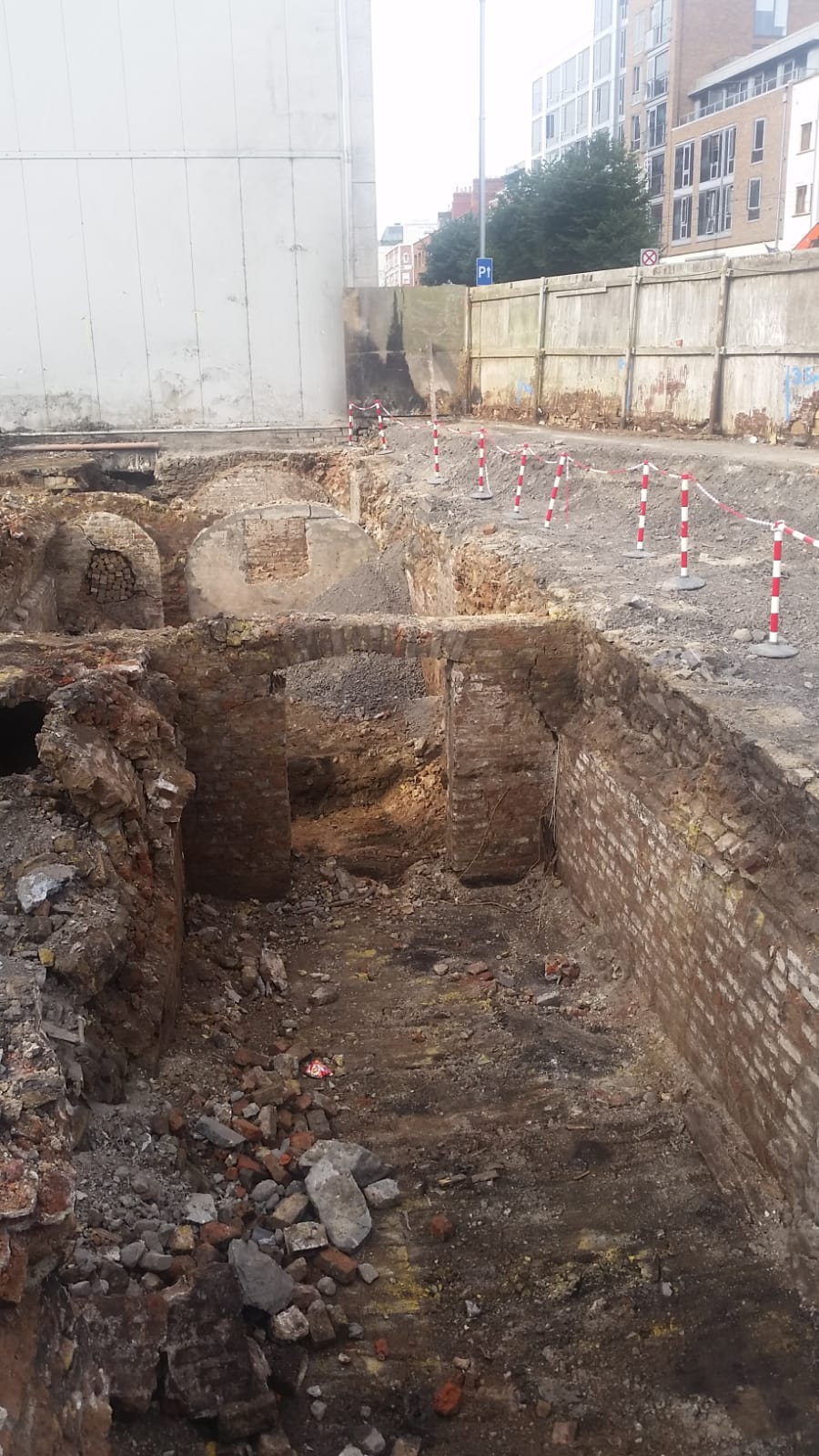
Devlins1Devlins2

April 2024 update

100 years on from the Army mutiny the site of Devlin’s Pub is now the Point A hotel which is currently being expanded. a plaque was unveiled here on 5th April, 2024 by the Lord Mayor of Dublin Daithí De Róiste.
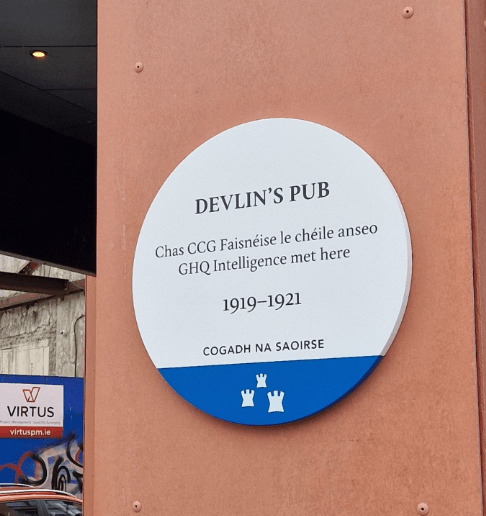
Devlins

The pubs of 1916 and beyond

During the long history of various Irish independence movements the Dublin Pub has always been a focal point for public meetings, clandestine gatherings and developing networks. Michael Collins’ knowledge of Dublin pubs and network of helpful publicans is legendary. Several famous bars in the city even still bear the scars of bullet and shell from the days of the Rising. Below is a short list of Dublin pubs with connections to the independence movement.


Davy Byrne’s

Davy-Byrnes

Situated just off Grafton Street this pub is famously associated with Joyce’s famous character Leopold Bloom who drops in for a bite of lunch but during the War of Independence and Civil War the premises was visited regularly by Michael Collins and Arthur Griffith. Davy Byrne’s nationalist sympathies were evident, permitting as he did the upstairs room to be used for meetings of the Irish Republican Brotherhood (IRB) and the outlawed Provisional Cabinet of the State, of which Collins was Minister for Finance. On one occasion, an officious barman clearing the premises at closing called: “Time, gentlemen please,” to which one customer replied, “Time be damned! The Government is sitting upstairs.”


The Duke

The-Duke

The Duke has a long association with Home Rule and Republican politics. As far back as the 19th Century when Charles Stewart Parnell, the leader of the Home Rule party tended to spend his Dublin sojourns in a hotel on nearby Dawson Street. Many of his Parnellite followers used to meet and socialise in the tavern then run by the Kennedy brothers at 9 Duke Street. From 1900 onward, and just next door to the pub the famous Dive Oyster Bar operated and in 1904 it was taken over by the Kiernan family of Granard, Co. Longford. Their daughter Kitty would famously become the fiancé of Michael Collins and the pub would become one of Collins’ many safe houses in the city.


The Grand Central Bar

The-Grand-Central

Although its only been a licensed premises since 2003 when the former branch of AIB became the latest addition to the Louis Fitzgerald Group, this fine and impressive building dates all the way back to the early 19th Century and was very much in the middle of the action in Easter 1916. The building at no. 10 Sackville Street (now O’Connell Street) was owned by Alderman William McCarthy, a Unionist politician on Dublin City Council, and during Easter week 1916 the building was heavily damaged by the many shells fired by the Royal Navy gunboat the Helga II into the Sackville Street and Abbey Street vicinity. After the Rising the building was so thoroughly repaired that by the following year Aldreman McCarthy was in a position to sell no. 10 and 11 to the Munster and Leinster bank which would later become part of AIB.


The Old Stand

The-Old-Stand

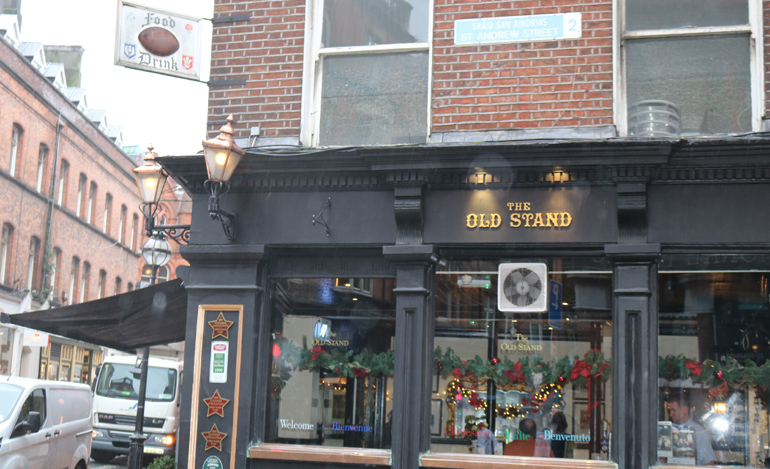
During the War of Independence, the premises was frequently visited by Michael Collins, who had an office nearby at 3, St Andrew Street (now the Trocadero Restaurant). From time to time, Collins held informal meetings of the outlawed I.R.B. (Irish Republican Brotherhood) in the premises and in true Collins tradition, he was less conspicuous while in the midst of the public. A handsome commemorative plaque and a portrait of “the Big Fella” hang in the pub to remind modern customers of these clandestine meetings.


The Swan

The-Swan-Bar

The Swan pub on Aungier Street, then owned by Tipperary man John Maher was occupied during Easter 1916 as it sat close to the Jacob’s biscuit factory (now part of the National Archives) which was captured by the rebels under the command of Thomas MacDonagh. Numbered among the ranks of the Volunteers was Peadar Kearney who would later write the words for the Irish national anthem. One of the last garrisons to surrender when the rebels were making their escape and Michael Molloy, a Volunteer stated

“Orders were also given that we were to burrow through from Jacob’s to a public house at the corner facing Aungier Street. We had two masons in our party and the burrowing was made easy. Strict instructions were given that no Volunteer was to take any drink from the public house. And although I am not a drinking man myself I must say that this order was strictly obeyed”

The pockmarks of artillery fire were still visible for many years on the walls of the premises.


The Oval

The-Oval-Bar

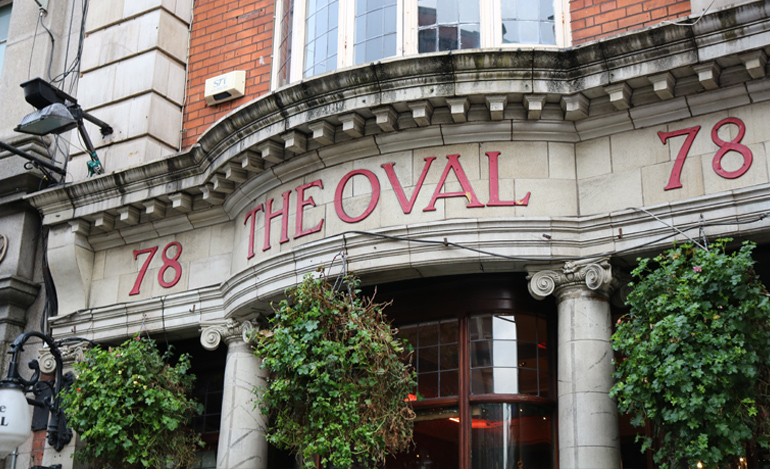
In the years leading up to 1916 this pub found favour with more that the members of the fourth estate from the nearby Irish Independent offices. Uniformed members of the Irish Citizen Army and the Irish Volunteers frequently dropped in to The Oval after manoeuvres while waiting for trams. A busy pub in a busy city centre was the perfect meeting place for members of the I.R.B., who blended in with a swelling clientèle.

Easter Monday, April 24th seemed a day like any other at The Oval until the Irish Volunteers captured the nearby GPO and proclaimed the Irish Republic. The week that followed would bring chaos, devastation, death and destruction both to the city of Dublin and to The Oval. By Wednesday the HMS Helga II had sailed up the Liffey and commenced shelling Liberty Hall and the GPO. At precisely 10am on Thursday April 27th the fate of The Oval was sealed. New trajectories were set on the Helga and the GPO and surrounding buildings were all hit. Fires blazed in Sackville Street and Abbey Street. Before long an inferno had engulfed the city centre. The Oval and surrounding buildings were destroyed. Abbey Street and Sackville Street smouldered for days as ruin and rubble scattered the pavements.

The pub’s owner John Egan set about rebuilding the pub and it was able to re-open its doors for business in 1922. It is this pub that customers see when they visit today but a brass plaque at the entrance commemorates the pubs historic destruction.


The Confession Box

Confession-Box

The reason for the name of the pub dates back all the way to the Irish War of Independence (1919-1921). During that conflict the last know excommunications from the Catholic Church in Ireland took place and were directed against the men involved in the ongoing rebellion. At the forefront of issuing these excommunications was Bishop Daniel Cohalan of Cork and it was rumoured that many of those who were excommunicated, including that famous Corkonian Michael Collins, would drop into what was then the “Maid of Erin” pub and would receive Communion and Confession from sympathetic priests from the nearby Pro-Cathedral. Thus the pub earned the nickname of “The Confession Box”.


The International Bar

The-International-Bar

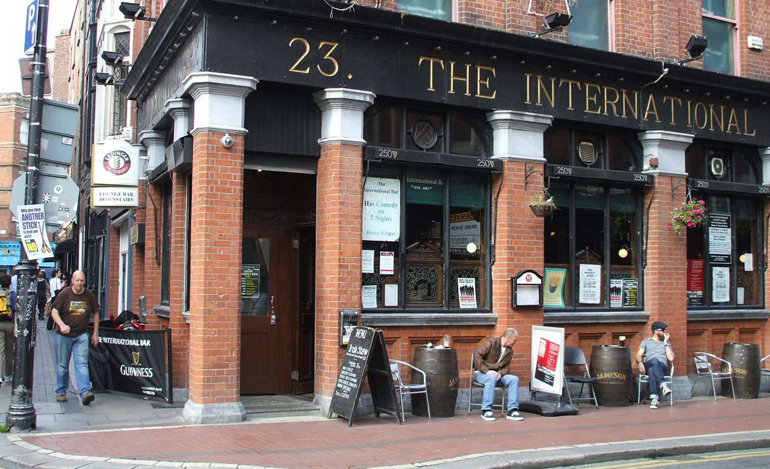
The International was another of Michael Collins’ many haunts and has played host to many authors, musicians and artists over the years. It has also been in the possession of the O’Donohoe family since way back in the 1880’s! I’ve left this to the last on the list as it has a very modern connection with 1916 in that the International, at the corner of Wicklow Street and Andrew Street is the meeting point for the hugely popular 1916 Rebellion Walking tours which run seven days a week.

Originally published for DublinTown in January 2016