Bert Pratt’s Bohemian story

A mildly amusing or unusual name is often the thing that stops me when looking through old Bohs teamsheets. Many names are familiar and repeated, numerous brothers playing for the club from its earliest days, the Blayneys, the Sheehans, the Murrays, the Hoopers. Some more or less common names, but there are fewer Pratts in Dublin, especially at the turn of the 20th Century so the name stuck.

The more I searched the more the name began appearing. H. Pratt regularly getting among the goals. H short for Herbert, Bert to his friends. Born in the small town of Woodstock in Oxfordshire in 1878 to parents Mary and Henry Pratt, Bert was one of a large family of eight. His upbringing seems to have been comfortable, his father running a hotel and mentioned as having served a term as Mayor of Woodstock. His father’s profession necessitated a move to the relatively nearby, midlands town of Worcester where his father ran a busy hotel next to the main railway station.

The younger Bert learned his trade in the emerging profession of electrical engineering, and there is reference to him briefly attending Oxford University, but he also seems to have maintained an interest in football, being listed as being on the books (as an amateur) of Wolverhampton Wanderers as a teenager. We can only speculate but it seems that perhaps it was his profession rather than a sporting transfer that brought the young Bert to Dublin. Bohemians were a strictly amateur side when Bert signed for them during the 1898-99 season at which point he would have been roughly 19 or 20 years of age. He appears on the 1901 Census, living as a boarder in a house at 99 South Circular Road with the Rudd family, an older couple in their 60s. Also present in the house was a Reginald Timmins, who like Bert was English born and was also an electrical engineer. All the residents of the house were members of the Anglican Church, apart from the one servant, Mary Lynch who was a Roman Catholic.

By this stage Bert was already a well known player, in fact he was probably regarded as one of the best forwards in Ireland. A big man for his day, at around six foot and strongly built, the main adjective used to describe Pratt’s play is “clever”, it’s a word used again and again from very early in his Bohemian career. He mostly played at inside-right but also featured as a centre-forward and even in a more deep-lying midfield role. He was variously described as “the most dashing and brilliant inside man in the country”, and the “finest forward in Dublin”.

And Bert’s career was indeed successful, in the 97 games in which he featured for the Bohemians he had an excellent strike rate of 70 goals, including scores in some hugely important matches. By the end of his sojourn in Ireland he was considered among the best forwards on the island. It was also a time of huge change and maturation for the Bohemian Football Club. By the time of Pratt’s arrival the Leinster Senior League and Leinster Senior Cup had been established and while with Bohemians Pratt would win both as the Gypsies demonstated their superiority as the strongest team in Dublin.

During his time in Dublin, Bohemians would become the first team from the capital to join the Belfast dominated Irish League, in 1902. Pratt was also part of the Bohemian teams that twice reached the Irish Cup final, in 1900, where Bohemians were narrowly defeated 2-1 by Cliftonville and again in 1903 as Bohemians lost 3-1 to Distillery in the first ever final played in Dalymount Park. Despite finishing on the losing side in that game it was Bert who had been the star in the semi-final rout of Derry Celtic and it was he who got Bohs’ consolation goal just before the whistle in the final.

In 1901 Bert Pratt had been among that famous first eleven Bohemians who lined out in the inaugural match at Dalymount Park against Shelbourne. When he joined the club were playing their games in the grounds of Whitehall Lodge on the Finglas road (roughly opposite the modern main entrance of Glasnevin cemetery) but within a matter of years not only had the club secured its new grounds but this new stadium was already hosting cup finals.

All told, during his Bohemian career Bert won three Leinster Senior League titles, three Leinster Senior Cups, finished runner-up twice in the Irish Cup and also featured in Bohemians first ever Irish League seasons. He was also selected by the Irish League to represent them in the prestigious inter-league games against the Scottish League and the English League as well as being part of the first Bohemian team to welcome a British side to Dalymount when Bohs hosted Preston North End in their new home in 1901.

By 1900 Bert had already featured for Leinster in the regular inter-provincial challenge matches against Ulster and in 1902 was selected for the first time by the Irish League to face the English League in front of a 10,000 crowd in Solitude, Belfast. The Irish League performed commendably and were only defeated 3-2 by a late goal from Steve Bloomer, the star forward of Derby County and probably the best centre-forward in the world at that time. Bert was selected again the following year when he was picked for the visit of the Scottish League to Grosvenor Park, where in front of an even larger crowd Bert Pratt scored the only goal of the game to record only the third ever victory by an Irish League side in a representative game.

After these successes the sports pages wistfully remarked that due to his English birth it was a great pity that Bert could not represent Ireland at full international level as he was clearly considered one of the best players in the country. In fact, Bert was moving around a bit, even while on the books of Bohemians. In 1902 he was apparently spending part of his time in Lancashire and got mired in a minor transfer saga when he signed for Blackburn Rovers after his impressive performance against the English League. However, his registration (in English football at least) was still held by Wolves from his time with them as a teenager. While it seems that this was eventually sorted out Bert’s stay at Blackburn was brief. There was reported interest from both Preston North End and Manchester United but Bert quickly found himself back at Dalymount.

The 1903-04 season was to be Bert’s last in Dublin, despite all his success there was nearly a tragic coda to his time in Ireland as he was struck down with a serious bout of pneumonia in January of 1904. Luckily, considering the strong medical connections with Bohemian Football Club, his medical team-mates, the various Doctors Blayney were able to nurse him back to health. It is around this time that Bert moved more permanently to England, relocating to Liverpool and staying in the shadow of Anfield. By September of that year he would be signing for Liverpool as an amateur. Despite playing some pre-season games his short spell with the Reds was limited to eleven appearances for the Liverpool reserve side who were then playing in the Lancashire Combination.

During this time Bert also made the newspapers for a non-sporting reason, while attending the Theatre Royal in Birmingham in December 1904, along with his brother Robert the two were reported to the police for some drunken and unruly behaviour in the Theatre bar and for refusing to leave when requested. Things turned heated, when upon the arrival of the police, Bert’s brother Robert became violent. The whole affair ended up in court and both men were lucky to escape with a fine, Robert who seemed to be the more aggressive of the two facing a 60 shilling fine or face a month in prison while Bert got off more lightly, having to only pay 40 shillings.

By the time of the theatre incident Bert had thrown in his lot with Old Xaverians, an amateur side in Liverpool who were enjoying some success at the time. In 1902 they had been one of the first English amateur sides to tour Europe and did this again in 1908 with Bert as team captain on a visit to Belgium. Bert enjoyed great success at this level, he received further representative honours, representing Lancashire amateur sides in games against similar teams from Leicestershire and London. He did however make one more appearance for Bohemians, having the honour of captaining a Bohemian side in 1905 when they hosted Aston Villa at Dalymount.

The combined Bohemian and Aston Villa teams. Bert is seated in the front row in the darker jersey with the ball at his feet.

Bert would have been just 30 years old when he was captaining Old Xaverians on the tour to Belgium in 1908. He had graudally moved back in his playing role, from the forward line to a centre-half, or pivot role, effectively a central midfielder in the modern parlance. Old Xaverians were prospering at their level, winning regional amateur cups and being toasted by the Lord Mayor. However, less than a year later they were stunned when Bert was to pass away suddenly in September 1909 at the age of just 31.

There were glowing tributes paid in Ireland and England, The Irish Times calling him “one of the most popular players in the Irish metropolis” while the Liverpool Daily Post called him a “splendid exponent of the game”. There was a large funeral and Bert was buried in Kirkdale Cemetery in Liverpool, his sizeable family were joined by many from the local football scene including the Liverpool manager, Tom Watson as one of the mourners. Incidentally, the photo from the top of this article is from an In Memoriam section of a joint Liverpool-Everton match programme from 1909 expressing sympathy at Bert’s passing.

While perhaps forgotten in the mists of time Herbert Pratt was a crucial player in the early years of the Bohemian Football Club, a star forward, a fan favourite and a prolific goalscorer as the club became a dominant force in the city and moved up to challenge at the highest level in Ireland by joining the Irish League while also being part of the first Bohs side to make Dalymount their home.

With thanks to Rob Sawyer, Stephen Burke, Jonny Stokkeland and Kjell Hanssen for their assistance in the research for this article.

The Scouser with the Munster Name

By Fergus Dowd

The name Callaghan derives from the Irish gaelic Ceallachan synonmous with the 10th century King of Munster who was eventually dispossed of his 24,000 acres of land by the Cromwellian Plantation. Plantations took place in Ireland in the 16th and 17th centuries and involved the confiscation of all Irish owned land by the English crown and the colonisation of these lands by settlers from British shores.

By October 1791 inspired by the French Revolution the Society of United Irishmen in Belfast led by Theobald Wolf Tone were formed, the group sought to secure a reform of the Irish parliament by uniting Protestant, Catholic and Dissenter into one single movement. It would lead to the rebellion of 1798 which was quashed and led to the 1801 Act of Union which brought Britain and Ireland closer and both this and the famine of the 1840s led to millions leaving the emerald isle.

Due to poverty the bottom one-third of the population were exclusively dependent on the potato for sustenance, the daily intake was enormous 4 to 5 kilos daily per adult and the consequences of repeated failures was devastating. In the publicly financed soup kitchens which replaced the public works, established under the Irish Poor Law of 1838, three million people were fed at their peak in early 1847. For those who could afford it escape from the famine came through a boat most were destined for the port of Liverpool more than two million people would land on its shores many with not enough finances to continue their journey.

The Liverpool Mercury newspaper reported in 1847:

“The fact is that in the cold and gloom of a severe winter, thousands of hungry and half naked wretches are wandering about, not knowing how to obtain a sufficiency of the commonest food nor shelter from the piercing cold. The numbers of starving Irish men, women, and children—daily landed on our quays is appalling; and the Parish of Liverpool has at present, the painful and most costly task to encounter, of keeping them alive, if possible…” in that same year 80,000 Irish would find themselves living in dog-kennells and cellars in Liverpool 60,000 alone would perish from fever.

In January 1981 Jerry Harris paced the arrivals lounge in Cork airport, secretary of Cork United he was waiting for a man with the Munster name of Callaghan.

That winters’ evening in polo neck and fur coat Ian Callaghan of Toxteth Liverpool landed in southern Ireland, only three months earlier seven Republican prisoners went on hunger strike in the Maze prison as Margaret Thatcher’s government sought to criminalise both Republican and Loyalist prisoners removing special category status that summer of ’81 the streets of Toxteth would burn in revolt against the same government.

On the afternoon of April 16th, 1960, Ian Callaghan stood at the bus stop among his own, that evening he would wear the red of Liverpool, as the bus opened its doors ‘Let Cally get on first… he is playing tonight…’ came the call as they all journeyed to the red cathedral of football in unison. That night in the cauldron of Anfield Callaghan would wear the famous no. 7 shirt it was like a tent hanging from his slim shoulders, as Liverpool football club demolished Bristol Rovers four to nil. The faithful from the kop to the main stand gave the baby-faced Callaghan a standing ovation as he left the hallowed turf.

Callaghan’s arrival had been predicted by the great Billy Liddell, the Scot had signed professional terms at Anfield in 1939 on the recommendation of Matt Busby, then Liverpool captain. Billy’s parents had only agreed to him signing once he could continue his accountancy studies, he would line out 534 times for the reds netting 228 goals; himself and Bob Paisley made their debuts against Chester City in the FA Cup on the 5th of January 1946.

During the war Liddell had guested for Linfield, he was also asked to play for Belfast Celtic by Liverpool legend Elisha Scott but declined the offer of playing at West Belfast’s paradise.

As the 1960’s beckoned Liddell was asked how Liverpool woud replace him? His answer:

“There is a 17-year-old called Ian Callaghan who looks like taking over from me. I played with him twice, watched his progress and I believe he’ll be a credit to his club, the game, and his country,”

The youngster had to bide his time but by November 1961 as Elvis Presley sang about ‘His Latest Flame’ Callaghan became a permanent fixture on Liverpool’s right wing as pomotion to the first division was gained in the summer of 1962. Under the stewardship of Bill Shankly, Callaghan blossomed. The Scot of mining stock once proclaimed, ‘If there were 11 Callaghan’s at Anfield there would never be any need to put up a team sheet.’ 

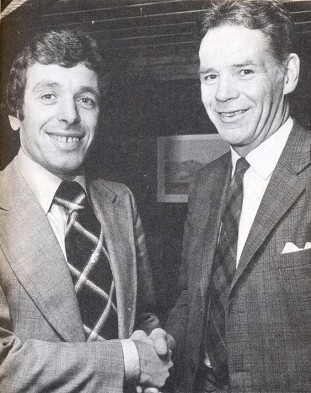
Callaghan and Liddell

Within two years Ian Callaghan, aged 22 was a First Division champion as Bill Shankly and his players walked towards the Spion Kop with the championship trophy and the sounds of the mersey beat in their ears. A year later Callaghan walked out onto the Wembley turf for the FA Cup Final of 1965 against Don Revie’s Leeds United; Yorkshire’s finest had defeated league champions Manchester United one nil in a semi final replay to reach the twin towers.

The Reds had never won the FA Cup and had beaten Chelsea two nil at Villa Park in the other semi final. It was their third effort at trying to lift the blue riband cup of English football losing in 1914 and in 1950 when Liddell had played. As one hundred thousand watched on both teams struggled to create goal chances with the most significant incident being Gerry Byrne’s third minute injury after a hefty challenge by Leeds captain Bobby Collins.

Byrne broke his collar bone but with no substitutions allowed had to play on as the game ended scoreless after ninety plus minutes and went into extra time. In obvious pain Byrne who had also arrived like Callaghan at Anfield aged 17 continued his marauding runs from left back and in the third minute of extra time he found himself on the oppositions by-line centering for Roger Hunt to stoop and head the ball past Gary Sprake. Shankly would later remark about Byrne ‘It was a performance of raw courage by the boy.’

On the stroke of the 100th minute Leeds equalised Norman Hunter crossed for Jack Charlton to head the ball down for Scot Billy Bremner to volley passed the hapless Tommy Lawrence in the Liverpool goal. However, with only three minutes left as the rain fell Callaghan jinked passed Willie Bell and sent in a low cross which Ian St John arched his head to finding the back of the net to send the Liverpudlians into raptures.

In his all-red strip Ian Callaghan climbed the steps to the Royal Box to collect his winners medal, Shankly’s idea of all red was a psychological one he felt his players would look and play like giants – red for danger, red for power. The following day Ian Callaghan and his teammates landed in Lime Street train station with the cup as thousands lined the streets, they were paraded on a bus to the town hall. On the balcony of the town hall as the five hundred thousand crowd swayed to the chants of ‘Liverpool’ Callaghan lifted the trophy.

Callaghan won his second First Division medal as Liverpool were crowned champions of England 1966 with Revie and Leeds runners up, six days later the team would lose 2-1 to Borrussia Dortmund in the European Cup Winners Cup Final at Hampden Park, all of this led to a World Cup call up. After playing one of the group games against France with England winning two nil and teammate Roger Hunt netting twice, Callaghan found himself surplus to requirements. As Alf Ramsey, following the group games, decided to go without wingers and to add more woe only the eleven men who lined out against West Germany in the final received winning medals.

It would take forty-three years for Callaghan, Byrne, and Jimmy Melia the Liverpool squad contingent to get their medals after a succesful campaign made FIFA perform a U-turn – Roger Hunt the other Liverpool squad member played in the final.

In 1970 Callaghan suffered a knee injury on his return Shankly moved him into the centre of midfield it would prolong his career for seven years. More success came in the form of League and Uefa Cup victories in 1973 and 1976 with a further league medal in 1977. FA Cup glory was achieved in 1974 over Newcastle United Bill Shankly would announce his retirement soon after, Ian Callaghan that same year would become Liverpool’s first Footballer of the Year. Shankly was replaced by his side kick Bob Paisley who led Callaghan and Liverpool to European Cup glory in 1977 defeating Borussia Mönchengladbach 3-1 in Rome.

Liverpool celebrating their Cup Final victory in 1965

By 1978, as Liverpool were winning back-to-back European titles with a one nil victory over Brugges of Belgium with Kenny Dalglish scoring at Wembley, Callaghan had lost his place to Graeme Souness. All in all, the boy from Toxteth spent nineteen seaons at Anfield playing 857 games he would break the man he replaced Billy Liddell’s record of 534 appearances for the reds.

After spells with Fort Lauderdale in the States and Swansea under the stewardship of John Toshack Callaghan landed in Cork making his debut that January of 1981 in a three one away victory at Home Farm.

The honeymoon would only last one more game before Callaghan departed, like many League of Ireland clubs Cork United (or Albert Rovers as they were known originally) were besieged with financial problems and could not improve their mid table mediocricy. As well as Callaghan they also signed Irish international Miah Dennehy and Chelsea FA Cup winner Ian Hutchinson but there would be no success.

Cork United and its secretary Jerry Harris put their eggs in one basket that being a lucrative friendly with Manchester City, a request for then City Irish internationals Michael Robinson and Tony Grealish to line out for Cork fell on deaf ears. The event would cost United £15k Irish punts with City requesting an £8k guaranteed fee, the game went ahead with former Republic of Ireland manager Martin O’Neill netting for the blues in a comfortable four nil victory over their Irish counterparts.

Sadly, United didn’t make the profits they envisaged after only 2,000 spectators paid in, United were unable to settle Manchester City’s fee of £8,000. Amid mounting debts, they were expelled at the end of the season, leaving Cork without League of Ireland representation for the first time since 1924.

Dixie Dean of Everton who also spent the twilight of his career in the League of Ireland at Sligo Rovers was once asked if he could replicate his 60 league goals in a season in modern times his reply:

If I could play between Ian Callaghan and Peter Thompson, I’d still get my 60 goals a season.’ 

Dick Forshaw – Waterford pioneer and troubled soul

Waterford has had its share of visitors over the centuries, ever since the Vikings first set up shop there back in the 9th Century. The football team have been no different, whether it was former World Cup winner Bobby Charlton, Polish international Piotr Suski or the Coventry born duo of Johnny Matthews and Peter Thomas who would enjoy great success down on the south coast, all playing in the blue of the city at one stage or other.

In his recent, meticulously researched history of soccer in Munster, David Toms goes into some detail in the development of the sport in the southern province and he focuses especially on developments in urban centres like Cork, Limerick and Waterford. What Toms’ research shows is that the Waterford predilection for a British footballing import has a long history. In 1930, despite the city suffering significant unemployment levels as well as the economics effects of the Great Depression the city’s business community and local football supporters embarked on a significant fundraising venture. Their aim? To provide sufficient funds to have a competitive Waterford team in the League of Ireland.

To compete with the likes of Shelbourne, Bohemians, Dundalk and Shamrock Rovers it was felt that Waterford FC would need to invest in bringing in some quality professional imports to play along home grown stars like Alfie Hale Sr. and future Ireland international Tom Arrigan. Brought in as player-coach was former Brighton and Man City player Jack Doran who had been capped three times by Ireland and he used his connections in the game to recruit a number of players with experience of the English league.

In fact for Waterford’s opening fixture in league football seven out of their starting XI were players who had some experience of cross-channel football. That opening game was in front of 10,000 spectators in the Dundalk Athletic Grounds on August 24th 1930 where the fledgling Waterford site were defeated 7-3 by the home side. It was somewhat of an inauspicious start for the Munster side but their undoubted star on the day was an Englishman named Dick Forshaw who scored Waterford’s first goal in league football. Forshaw opened the scoring in the match against Dundalk and was unlucky not to grab a second as he struck the post late on in the second half. He’d grab two goals the following week in Waterford’s first home league fixture as they secured their first win of the season, a 3-2 victory over St. James’s Gate.

That Forshaw was such as instant success should not be that surprising, although he had just turned 35 before he made his Waterford debut he had until very recently been playing in the English second division for Wolves. Prior to that he had enjoyed an illustrious and record-making career with both Liverpool and Everton.

Born in the Lancashire town of Preston in 1895, Forshaw had joined the British army as a young man and spent some time during World War I stationed in the British colony of Ceylon (modern day Sri Lanka), at the time a fairly favourable posting as the area was spared the sort of brutality endured on the like of the Western Front. Upon returning to Britain he was signed by Liverpool manager George Patterson and made his debut for the Reds in September of 1919 with the Evening Telegraph describing him as a hockey and tennis enthusiast who was destined to “develop into a top-notcher”. Forshaw was a skillful right sided inside-forward, his early seasons for Liverpool weren’t prolific in goal scoring terms but he did tend to enjoy “purple patches”, for instance he grabbed a hat-trick against Derby County in his first season.

Dick’s progress in those early seasons was steady, he became a first team regular as Liverpool enjoyed consecutive fourth place finishes, it was however in the 1921-22 and 1922-23 seasons that Forshaw would really make his name. It was in these seasons that Liverpool would win back to back titles and Forshaw wouldn’t miss a single league game for those two years, chipping in with an impressive 36 goals from 84 matches, second only to centre forward Harry Chambers in the club’s goalscoring stakes. One of his team-mates in that Liverpool side was Wexford man Billy Lacey who he would encounter again as player-manager of Cork Bohemians during Forshaw’s sojourn with Waterford.

Although further titles would elude Liverpool for the next two decades Forshaw continued his good form including a knack of scoring hat-tricks against Manchester United. In fact he scored three against United at Anfield two seasons running in 1925 and 1926! In all he scored seven hat-tricks in his time at Anfield and also jointly holds the record (with John Aldridge) for scoring in the most consecutive games (9 in case you’re wondering) in one season.

It wasn’t just with Liverpool that Forshaw made history, he made history by leaving the club as well. Despite playing well during the 1926-27 season (he was on 14 league goals at the time of his departure) the club sold him for £3,750 to city rivals Everton in March of 1927. While this was a significant sum at the time (the transfer record was the £6,500 Sunderland paid for Bob Kelly) especially for a man that was nearly 32, it still came as somewhat of a shock to the Liverpool faithful and to Forshaw and his family. As was the style of the time this was something agreed by the Directors of the two clubs with no discussion with the player. His wife was said to have declared  “I have never been an Evertonian and I don’t know what I shall do about it.” By the time he left he had scored 123 goals in 288 games for the Reds in all competitions.

Success followed Forshaw to Goodison Park however and he made history by becoming the first, and so far only man, to win league titles with both Everton and Liverpool when he was part of the triumphant Everton side of 1927-28. Central to this achievement of course was “Dixie” Dean who would score his record breaking 60 league goals that season, he was helped in part by his forward partner Forshaw.

However by the start of the 1929 season Forshaw was on the move again, aged 34 he signed for a “substantial fee” to second division Wolves. He was only there a matter of months before he handed in a transfer request and began somewhat of a peripatetic existence, popping up at non-league sides like Hednesford Town and Rhyl Athletic (now simply Rhyl FC) for short spells. It was in this set of circumstances that John Doran was able to sign Forshaw for Waterford, only two years after he was playing alongside Dixie Dean and winning a Championship with Everton.

Dean of course, would also enjoy a spell in the League of Ireland in the 1930s, spending some time on the books of Sligo Rovers in 1939 and scoring a club record 5 goals against a hapless Waterford side, however by that stage Forshaw was long gone and his life after football was filled with more tragedy than joy.

Within a year of leaving Waterford Forshaw was up in court charged with defrauding an acquaintance of his, one Richard Green. In April 1932 Green had given Forshaw £100 to place a bet on a horse at Ascot, the horse won and Green of course expected to collect his winnings of over £2,000, however Forshaw was nowhere to be found. Not expecting the horse to win Forshaw had doctored betting slips to make it appear that he had placed the full wager when in fact he had only placed a couple of £2 bets and kept the remained of the stake money for himself.

Forshaw had acted, according to the judge, with “peculiar meanness”, and he gave little consideration to Forshaw’s justifications about needing the money. Now aged 36, Forshaw claimed that due to an accident he had been forced to give up on his playing career, he had tried his hand at other trades and at the time of his trial was living in Kilburn, London and running a Fish and Chip shop with his wife. This carried little weight and the unfortunate ex-footballer was sentenced to 12 months of hard labour for his offence.

His difficulties did not end here, within months of completing his sentence Forshaw was back in court, when in November 1933 and listing his livelihood as a salesman, he pleaded guilty to four counts of theft and was sentenced to a further 17 months of hard labour. The next few years would repeat this pattern, release from gaol before almost immediate re-arrest, mainly for offences like theft. In 1937, then he was in the dock on two counts of theft. Only hours after release from his previous sentence Forshaw had gone out drinking, he had stolen some silverware from a London hotel before drunkenly stealing two suitcases from Euston train station. At the trial the magistrate spoke to Forshaw, a married man, father of three who was now stuck in a cycle of crime and punishment, he said the following to Forshaw as he told him he was likely to face imprisonment with hard labour;

“I want you to take warning from this. Can’t you pull yourself up before it is too late?”
Forshaw  replied– “That’s what I want to do.”

Forshaw would pass away in 1963, in what was an era of dominance for his former clubs, Everton winning the league in 1962-63 and Liverpool bringing the title across Stanley Park the following year. Waterford too were improving, they finished second in the 1962-63 season with Mick Lynch taking up the role as the side’s main attacking threat. Lynch, who was a friend of Coventry City manager Jimmy Hill used that connection to bring over the likes of goalkeeper Peter Thomas and Johnny Matthews to Waterford where they would help (along with the likes of the returning Alfie Hale) bring unprecedented success to the south coast by the end of the decade.

Waterford Shield

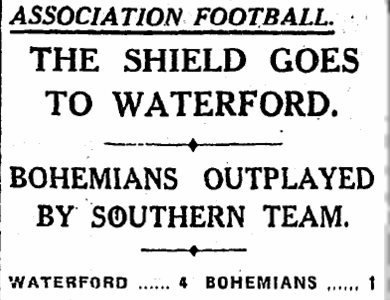
Forshaw played a small part in helping to establish a league footfall foothold in the city, Waterford finished a credible 9th in their first season of League football and even picked up some silverware with a victory of the League of Ireland shield. Despite the hardship of his later life it’s worth remembering his small contribution to the growth of football in Ireland.

There is some great further reading available at the excellent http://playupliverpool.com/

A Springbok ran in Solitude – South Africa’s international debut

South Africa were there from the beginning of organised football in Africa, the game arrived from Britain in the late 19th Century and the national association first affiliated to FIFA in 1910.

As an early African member of FIFA in the 1950’s they agitated for greater representation for African football and in 1957, along with Egypt, Ethiopia and Sudan they were founders of CAF (Confederation of African Football) and were almost among the original participants in the African Cup of Nations, however it was at this point that the thorny issue of Apartheid intruded on proceedings.

As the Sudanese delegate Abdim Halim Mohammed recalled at the time, the South African delegate was:

A chap called Fred Fell, not an Afrikaner but British. We accepted him and accepted South Africa. He accepted we would host the first African Cup of Nations in Khartoum…Then we came to that “area”. He said the government had told him it is either a pure white team or a black team. We said we don’t accept that. We want black and white.

South Africa were understandably disqualified as a result of their intransigence on the issue of a mixed national team and it would be almost forty years before a South African side would compete in the Cup of Nations.

When they did enter the competitions it was as hosts in 1996, Nelson Mandela was President, and a multicultural South African team would emerge as Champions with Mark Williams grabbing both goals in the final against Tunisia.South Africa 1996

Since the 90s post-apartheid South Africa has competed in, and hosted a further Cup of Nations as well as the 2010 World Cup. However their long, controversial and turbulent international history began not in Cape Town or Johannesburg, or even on the continent of Africa, but on a trip to Ireland and in the cities of Dublin and Belfast.

Back in 1899 a football team from the Orange Free State had toured England, notable for the fact that it was an all-black team, while in 1906 a white side had toured South America and played in both Brazil and Argentina, however the Union of South Africa was only formally established in 1910 bringing together four previously separate British colonies.

The new football team of this new nation would join FIFA but wouldn’t play a formal international until September 1924 when “The Springboks” came to Europe. Their first port of call for the all-white touring side was Dublin, and their first opponents Bohemian F.C.

By that stage the South African government had already brought in one of first pieces of Apartheid legislation, the 1913 Natives Land Act which limited the ownership of land in South Africa by the majority black population to just 8% of the total area of the country.

While the majority of apartheid legislation was introduced in the late 40s be Prime-minister DF Malan the preceding decades had seen the steady erosion of the rights of the black South African population. Despite these rulings the sporting relations between Britain (and Ireland) with South Africa were flourishing in 1924.

Not only was the football team visiting but in rugby, the British and Irish Lions were on tour in South Africa, while the South African Cricket team was just completing a summer tour of England.

The visiting football team would play three games in Ireland, the first on 30th August versus Bohemians before travelling north of the recently created border to take on the Irish National Team (the IFA selection which from this point on will be referred to as Northern Ireland) in Belfast and a North-West XI playing in Derry in September.

The split between the Belfast based IFA and the recently formed FAI of the Free State was still a sensitive issue, with both associations claiming exclusive use of the name “Ireland” while each association continued to select players from the whole of the island. As just one example of the complexity of this cross-border situation the Free State FAI Cup holders at the time of South Africa’s arrival were the Belfast based Alton United.

There were now two leagues and two national teams on the island of Ireland and although the FAI had sent a side to compete in the 1924 Olympics that summer the fledgling association had yet to play a FIFA recognised match. It was under these circumstances that South Africa; an amateur side at the time would take on not the Free State XI but the reigning League of Ireland champions (and fellow amateurs) Bohemians.

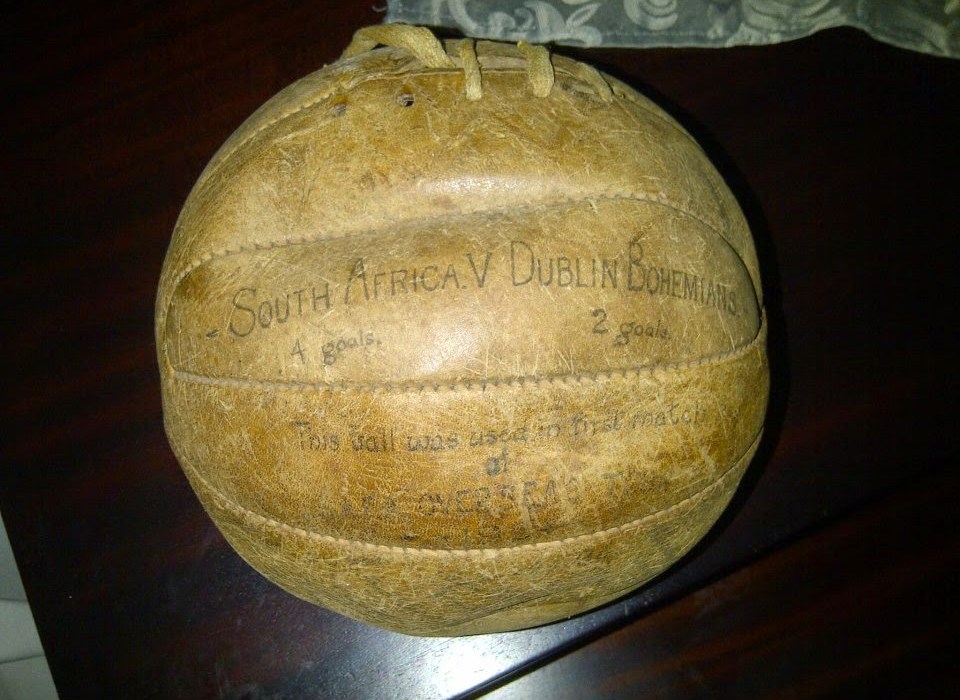
They would meet in Dalymount Park and the touring side would get off to a great start in front of a large Dublin crowd with the South Africans eventually running out 4-2 winners. Bohs were without the influential Bertie Kerr who was injured but did have players of quality such as Paddy O’Kane, Dave Roberts and Jack McCarthy in their side who would all go on to win full caps for Ireland. Incidentally Bohemians were captained by Billy Otto, who had been born in South Africa.

The South African goals would come from Eric Stuart of Western Province, Jim Green of Transvaal and a brace from a 20-year old-striker named Gordon Hodgson.

Hodgson, the son of English emigrants, had worked as a boiler maker in his native South Africa while also lining out for the Transvaal side. Like many of the touring South African side he was physically imposing, standing at six foot one and weighing over 13 stone.

Early reports of the South African tour suggest that their forwards were somewhat rough diamonds in terms of finishing, their good attacking play being undone by some poor marksmanship, Hodgson, however, would certainly prove to be a formidable goal-scorer.

The South African side would spend three months touring Ireland, England and the Netherlands and their teams’ performances, including wins over Chelsea, Aston Villa, Liverpool and Everton would generate significant interest in a number of the Springbok players and several would pursue professional careers in England.

Gordon Hodgson would join Liverpool and make the biggest impression, along with him goalkeeper Arthur Riley and Glasgow-born fullback Jimmy Gray would all join the Reds in 1925. Gray would make a single appearance before joining Exeter City where he played until 1936, while Riley would have to bide his time at Anfield as he would have to replace the legendary Elisha Scott in goal.

Scott was (and remains) Liverpool’s longest serving player and an Anfield hero and was also first choice keeper for Northern Ireland. It would be the 1928-29 season before Riley got any sort of extended run in the Liverpool team though he would eventually amass over 300 appearances for the club.

Hodgson would become a record breaker on the red half of Merseyside, becoming Liverpool’s record goal scorer, a title he would hold for three decades before the arrival of Roger Hunt in the 1960s. Initial interest in Hodgson was piqued when he scored a hat-trick in front of the Kop for South Africa against Liverpool during their tour, something guaranteed to catch the club’s attention.

He would score 233 league goals for Liverpool (including a still standing club record 17 hat-tricks) during his 11 years at Anfield, before, at the age of 32 he was signed by Aston Villa for £3,000. His spell at Villa would be short and he would move to Leeds United for £1,500 in 1937, eventually scoring an impressive 53 goals in 85 appearances for the Yorkshire club.

Gordon Hodgson of Liverpool, South Africa and later England

Gordon Hodgson of Liverpool, South Africa and later England

Hodgson still sits fourth on the all-time top flight scoring chart in English football, by his retirement he had 288 league goals, five above Alan Shearer, and only behind Jimmy Greaves, Steve Bloomer and his contemporary, and city rival Dixie Dean.

It is perhaps because of Dean that Hodgson is not more well know. Liverpool have had their fair share of prolific forwards but what separates Hodgson from the likes of Hunt, Keegan, Dalglish and Rush is that those later era strikers were all trophy winners.

Hodgson played for Liverpool during a trophy-less period, made all the worse by the fact that Everton would win two league titles and an FA Cup during Hodgson’s time there, with Dean being recognised as the greatest centre forward in the world and one of sports’ biggest names.

Despite the obvious scoring prowess of Hodgson he failed to find the net in his next game in Ireland after his brace against Bohemians. In fact contemporary reports mentioned his poor finishing in the game against Northern Ireland; the game that would go down in South African football history as their first international.

The match would take place in Solitude, the home ground of Belfast club Cliftonville in front of a crowd of 6,000, generating the princely sum of £254 in gate receipts on the 24th of September 1924. The South Africans had made some changes to their starting line-up since the match at Dalymount, in came Williams, Touhy, Jacobi and Murray. Out went Howell, Hicking, West and Walker. They had played four games in the London area in the intervening three weeks, their most recent match a 4-2 win over Second Division Chelsea with Hodgson grabbing two.

The Northern Irish didn’t field their strongest side for the game. There was no Elisha Scott to face his Liverpool successor, nor was their star forward, Sheffield United’s Billy Gillespie in their line-up. In fact as a cost saving measure the IFA chose to select only players from the Irish League to save on travelling costs.

This all-domestic XI did cause some confusion as to the status of the game both at the time and subsequently. Some reports, including the Irish Times, referred to the Irish side as an Irish League XI rather than a full national team and for many years the IFA did not list the match as a full international, recognising it only as an amateur match.

The South Africans would also play both the English and Welsh amateur sides on their trip but these would not count as full internationals.

However the game against Northern Ireland has been recognised as a full international since 2001. While the Irish side were all home based there were paid professionals among their ranks including Thomas “Tucker” Croft who had scored the winner against England only a year earlier.

They wore the St. Patrick’s blue jersey of the full International side rather than the green jerseys associated with the Irish amateur side and the match was advertised at the time as a full international by the IFA.

The Irish side took the lead early through Frank Rushe who got on the end of a free kick after ten minutes. Rushe was born in Bessbrook in County Armagh. At the time of the South Africa match, his only senior cap, he was playing for Distillery in the Irish League but had spent the previous season with Dublin side Shelbourne who had finished runners-up to Bohemians in the Free State league.

The South Africans would strike back though, just before half time David James Murray getting them back on level terms before Jim Green, who had also scored in Dalymount, grabbed the winner 15 minutes from time.

Irish football correspondents noted the improvement in play from the South Africans since the match in Dublin and the physical disparity between the well-built Springboks and the less robust Irishmen was commented upon by a number of columnists.

It was also noted that the margin of victory could have been greater for the South Africans if it had not been for their wasteful finishing, with particular mention for young Hodgson who seemed to be having a rare off day.

The South Africans would spend the next three months touring Britain and the Netherlands, including another full international, a 2-1 defeat to the Dutch national team in Amsterdam, though these would be the last games played for the national team by men like Hodgson and Riley.

As mentioned, Hodgson would even line-out three times for his new homeland, England. While he and Riley would have successful careers in England, making almost 800 league appearances between them.

It would be almost thirty years before a black South African would play professionally in Europe when Steve Mokone signed for Coventry in 1955 before playing in Holland, Italy and Spain. Two years after Mokone’s move to Coventry his fellow countryman David Julius would sign for Sporting Lisbon.

Due to the racist policies of apartheid South Africa and the various bans, suspensions and boycotts that resulted, neither man would ever play for the land of their birth, Julius would end up donning the red of Portugal rather than the green and gold of South Africa.

While Hodgson scored for England against Wales during the second of his three caps he at least had the opportunity to play for South Africa against Northern Ireland and the Netherlands. In many ways the tour of 1924 was a false dawn in international footballing terms for South Africa.

The ruling government’s refusal to allow mixed teams meant their expulsion from CAF, FIFA, the Cup of Nations and the World Cup. It was only in the mid-90s that the football isolation of the nation would properly end.

While the record books show that South Africa made its international debut in Belfast in 1924 perhaps that game should have an asterisk against it, and not because the IFA selection they faced included only domestic based players.

Despite the quality of players like Gordon Hodgson and Arthur Riley a truly representative South African XI wouldn’t make its international bow until the Bafana Bafana defeated Cameroon in Durban 68 years later.

Originally posted on backpagefootball.com