Bohemians entered the new season as champions and were fancied to retain their crown after their clean-sweep the previous year. The league remained at 10 teams with Athlone Town, who had finished bottom and been on the end of a number of drubbings failing to be re-elected to the League and their place being taken by Drumcondra who had been Cup winners in 1927 and beaten finalists a year later.
It was one of the tightest title races ever with a ding-dong battle between Shelbourne and Bohs for the Championship, despite only losing once and drawing twice in the League campaign Shelbourne pipped Bohs to the title by a single point. David “Babby” Byrne and Jock McMillan supplying the goals while Shels had also added Bob Thomas, a star of the all-conquering Bohs the previous season to their midfield where he’d play alongside his brother Paddy.
For Bohemians Billy Dennis was once more top scorer but getting in among the goals was a young inside-left named Fred Horlacher who made his debut that season and would go on to become one of the greatest players in the club’s history. The son of a Mormon, German, pork-butcher Freddie Horlacher would play in numerous positions for Bohs as well as making several appearances for Ireland in a career that would see him become one of the club’s highest ever goalscorers.
Top scorer in the League overall however, was Eddie Carroll (left), a former Northern Ireland international who had spent the previous seasons playing in Scotland for Aberdeen and Dundee United, Carroll was in his first of three spells with Dundalk.
There was further disappointment in the Cup for Bohemians, despite knocking out St. James’s Gate, Jacobs and Drumcondra on the way to the final, we were ultimately defeated in a replay by Shamrock Rovers as they won their first of five consecutive Cup titles. The initial final had been played at Dalymount and ended in a 0-0 draw, however the replay was moved to Shelbourne Park and Rovers would triumph on the southside 3-0, with two goals from John Joe Flood and one from veteran forward Bob Fullam.
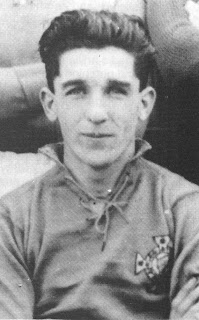
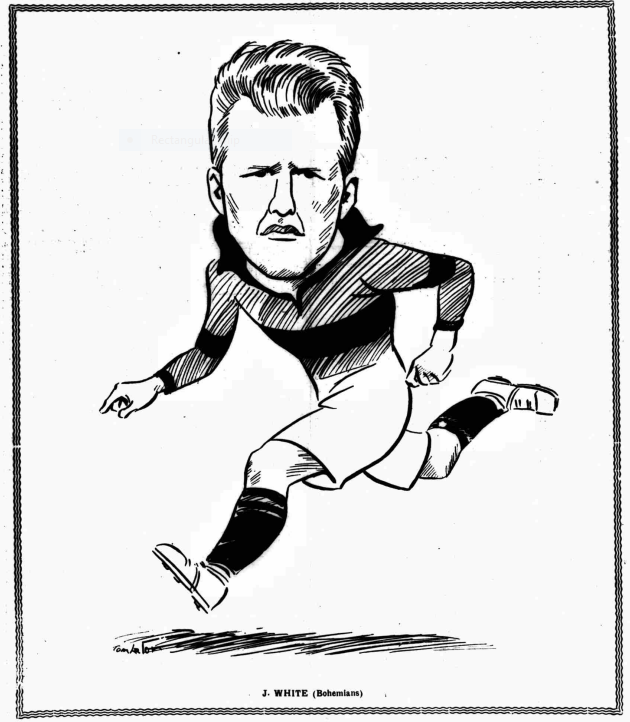
Bohemians would get a modicum of revenge when they defeated Shamrock Rovers 2-0 in a test match to settle the winner of the League of Ireland Shield later that season. Although Bohs were comfortable winners in that game with Jimmy White grabbing both goals it was Rovers teenage forward Paddy Moore who caught the eye of a Cardiff City scout who signed up the prodigious talent the following month.
At Inter-league level the LOI had mixed fortunes, beating the Welsh League 4-3 in Dublin, with Johnny McMahon and Peter Kavanagh of Bohs getting three of the goals, but then losing to the Irish League 2-1 later the same season. At international level Ireland only played one game, a resounding 4-0 victory over Belgium in April 1929 front of 30,000 fans in Dalymount. John Joe Flood scored a hat-trick with Babby Byrne getting the other goal. Jimmy Bermingham was the sole Bohemian in the starting XI for Ireland that day. Just four months later Bermingham and his Bohs teammates would be part of a visit to Belgium that would see them enjoy further success.
Jimmy White who scored the decisive goals to secure the Shield for Bohemians.
This Saturday (January 14th) Dalymount Park, specifically the Member’s Bar, will host a League of Ireland football history conference to mark the publiction by Routledge of it’s new academic collection The League of Ireland: An Historical and Contemporary Assessment which is edited by Conor Curran.
I have a paper included which looks at several case studies highlighting the complex patterns of migration of players into the League of Ireland over the last century. The conference is free to attend and you might even get a cup of tea and a sandwich.
Conference schedule
9.30-10 am: Conor Curran (Trinity College Dublin) – Introductory Comments
10-10.30 am: Julien Clenet (University College Dublin) – Association football in Dublin in the late Nineteenth Century: an Overview
10.30-11 am: Cormac Moore (Dublin City Council Resident Historian) – The Formation of the Football Association of Ireland
11.00-11.30 am: Aaron Ó Maonaigh (Independent Scholar) – ‘In the Ráth Camp, rugby or soccer would not have been tolerated by the prisoners’: Irish Civil War attitudes to sport, 1922–23.
11.30-12 pm: Conor Heffernan (Ulster University) and Joseph Taylor (University College Dublin) – A League is Born: The League of Ireland’s Inaugural Season, 1921–1922
12-12.30 pm: Conor Curran (Trinity College Dublin) – The cross-border movement of Republic of Ireland-born footballers to Northern Ireland clubs, 1922–2000
12.30-1.30 pm Lunch
1.30-2 pm: Gerry Farrell (Independent Scholar) – One-way traffic? – 100 years of soldiers, mercenaries, refugees and other footballing migrants in the League of Ireland, 1920 -2020
2-2.30 pm: Tom Hunt (Independent Scholar) – Ireland’s Footballers at the 1924 and 1948 Olympic Games: Compromised by the Politics of Sport
2.30-3 pm: Michael Kielty (Dublin Business School): Peter J. Peel: The Soccer King
3-3.30 pm: Ken McCue (De Montfort University) – Who’s SARI now: Social enterprise and the use of the medium of sport to further human rights in society
3.30-4 pm: Helena Byrne (Independent Scholar) – Breaking new ground: The formation of women’s football governing bodies in 1970s Ireland
4-4.15pm Closing Comments
Papers will be for the duration of twenty minutes, with ten minutes afterwards for questions.
You can attend for free by registering through eventbrite.
Ted Sagar was an Everton legend, a league and cup winning goalkeeper, an England international, and the holder of the record amount of league appearances for the club for some forty years until it was broken by the Toffees other legendary keeper, Neville Southall. It is quite the impressive CV. Sagar’s Everton career ultimately lasted for an amazing 24 years but as time comes for all of us, with Ted approaching his late 30s the Everton manager Cliff Britton was on the lookout for a replacement for his veteran custodian. His eventual long-term successor, a man who would make over 200 appearances in more than ten years at the club was discovered in the most unusual of places, the south Dublin suburbs playing for “Bulfin United under 17s, Division 2.”
This young man was Jimmy O’Neill, as well as over a decade of service with Everton he enjoyed a successful spell at Stoke City where he was hugely popular and would win 17 caps for the Republic of Ireland. At just 5’9″ and willowy thin he didn’t conform to the stereotypical physique of the goalkeeper. This is the story about how his journey from the schoolboy leagues of Dublin to the Everton first team in the course of just over a year was facilitated through an unusual source, a League of Ireland club official and Dublin shopkeeper who had also been a revolutionary from his teens, was imprisioned during the War of Independence and had remained an active member of the IRA during and well after, the Civil War. It is the story of Michael Douglas.
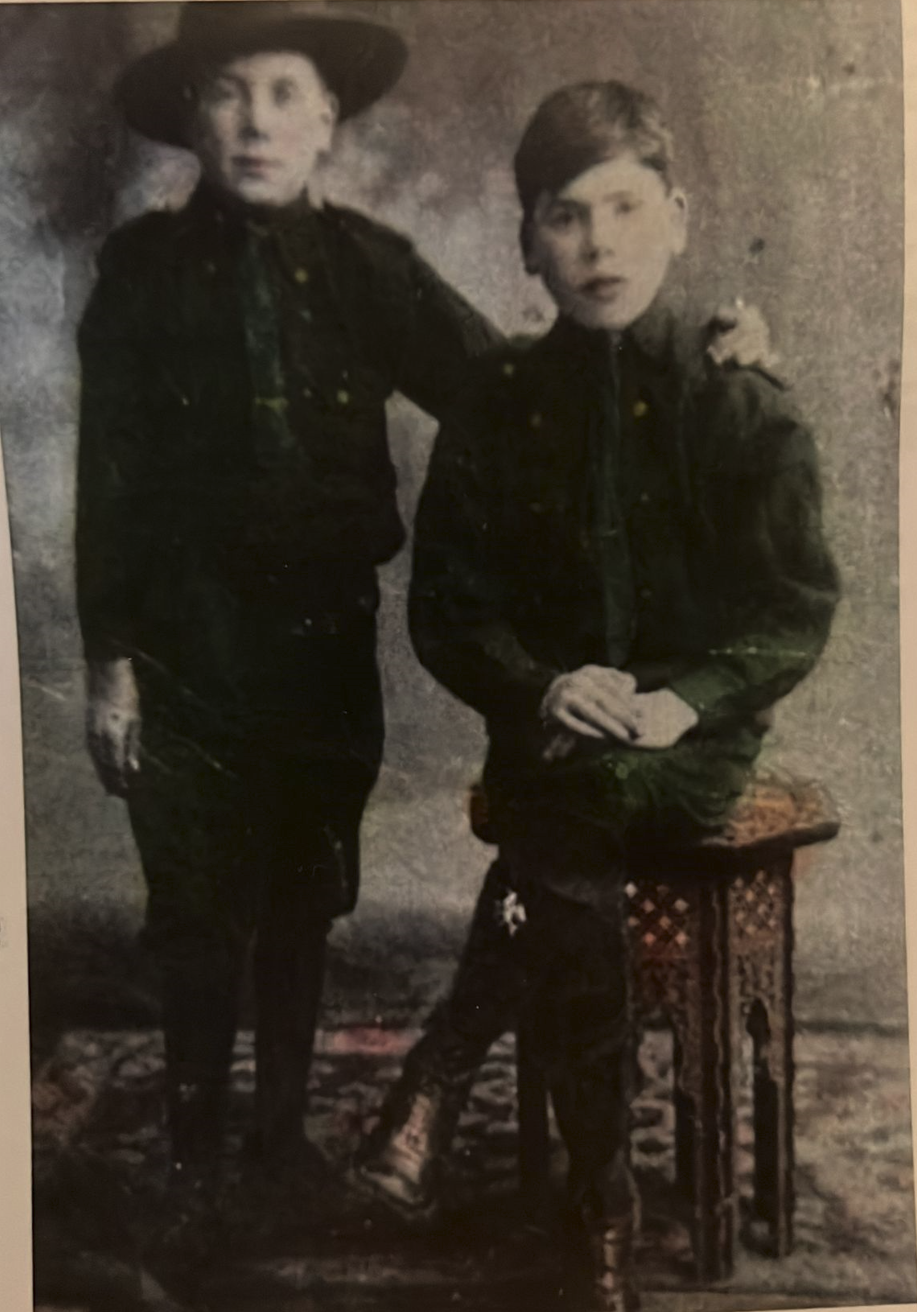
Michael Douglas was born in Dublin’s North Inner City in 1901, growing up on Stafford Street (now Wolfe Tone Street) and later on Granby Place, his parents, James and Lizzie were both born Dubliners, James beginning a family tradition of working for the City Council, his job being a paver. By 1917 young Michael was a member of Na Fianna Éireann, the Republican boy scout movement, where he was later joined by his younger brother Willie, both are pictured below. Also, by this stage the teenage Michael had followed his father into employment with the City Council.
By the end of 1917 Michael had become a fully fledged member of “G company” of the Dublin Brigade of the IRA, parading with them at the enormous public funeral of Thomas Ashe, a 1916 veteran who had died in Mountjoy prison after being force-fed while on hunger strike. Later during the War of Independence Michael continued to parade and provide guard duty at various functions while also being involved in well known raids including the one on Monk’s Bakery, North King Street which left three British soldiers dead but also resulted in the capture, and later execution of Kevin Barry. In another footballing connection with that incident, one of the other members of the Dublin Brigade involved was Christy Robinson who would later represent Bohemian FC and travel to the 1924 Olympics with Ireland.
By 20th November 1920 (a day before Bloody Sunday) Michael had been arrested as part of a wide crackdown by Crown Forces, he was found with Sinn Féin literature in the family home in Granby Place and was sent by steamer to Ballykinlar internment camp in Co. Down. Michael stated that the Crown Forces had not found any weapons in the raid but claimed that £29 (a considerable sum at the time) had been taken from his father’s house during the raid.
Ballykinlar was a former army base turned into an internment camp and which grew to bursting point by the end of 1920 as raids and arrests escalated in November and December of that year. There were upwards of 2,000 men interned from all across Ireland at its peak. Many were active in the Independence struggle, others were unlucky, not actively involved perhaps merely sympathetic to the Republican cause but arrested all the same as part of sweeps by Crown Forces.
While interned in Ballykinlar in July 1921, Michael’s sister Kate was injured in an altercation with Crown Forces around Dominick Street in the north inner city. On two occasions Crown Forces removed an Irish tricolour from the street where it had been strung between houses, on the first occasion a group of local women managed to wrestle the flag back and restring it across the street, however the Military patrol returned later that night to successfully remove the flag and Kate was injured by a revolver bullet as the local women harassed and jeered the soldiers from the street.
Michael requested leave to visit his injured sister, however as a truce was called shortly afterwards gradually the prisoners of Ballykinlar were released. It is around this time after his release that Michael seems to have taken a more keen interest in football and his own letters identifies the early 1920s as around the time he became involved with Shelbourne FC.
Michael’s interest in the national movement did not end after his release however, he remained actively involved, briefly being part of the group of anti-Treaty IRA who were occupying the Four Courts in 1922 just before the outbreak of the Civil War. Michael remained on the anti-Treaty side after the official outbreak of hostilities and was arrested by the Free State forces in November 1922, although he was released a month later. Michael remained inactive as the final months of the Civil War ground on although he did return to IRA activity in 1924 after the effective end of the Civil War and the issuing the of the “Dump arms order” in May 1923.
Perhaps the most significant incident in this period of his involvement was the bombing, in November 1928 of the equestrian statue of King William of Orange on College Green. It had been “first erected in 1701 to commemorate William’s victory over King James at the Battle of the Boyne in 1690″, the statue was always controversial, some felt that even Trinity College was being disrespected as Billy’s horse, White Sorrel, was positioned so its arse faced the University. Even by the end of the 18th Century the statue had been subjected to vandalism, and later in the 19th Century suffered from significant neglect and poor maintenance from an apathetic City Council.
King William’s statue on College Green (pic courtesy of Donal Fallon/Come Here to me)
On Armistice Day, 11th November 1928 in the early hours of the morning the statue was attacked yet again, it was blown up by the IRA. John Dorney explains the significance of the event as follows:
It was a part of a campaign by republicans, casting about for ways to remain relevant following their defeat in the 1922-23 Civil War, against Armistice Day in Dublin in which the Union flag was flown and ‘God Save the King’ sung by war veterans and unionists. On the same day, another bomb was placed at the statue of King George on Stephen’s Green. Rioting also took place between republicans and Poppy wearers in the city centre.
John Dorney, the Irish Story
Such was the damage to the statue that it was ultimately removed permanently by the City Council the following year. Among those responsible for the destruction of the statue was Michael Douglas, working under the supervision of former IRA Quartermaster and explosives expert Paddy Saunders. It is noted in the reports at the time that despite the blast taking place around 5am, with thankfully no injuries to anyone other than the leaden William, there were members of An Garda Síochána nearby who gave chase to those responsible for the bombing, they were chased up Trinity Street before a number of shots were fired at their pursuers. Interestingly in Michael’s military pension application the mention of Saunders (written as Sanders) is crossed out. Possibly because at the time of Michael’s application in the late 1930s Paddy Saunders had joined the ranks of An Garda Síochána himself!
By the 1930s Michael was married to Mary O’Neil and living in Little Ship Street with a growing family, right by the walls of Dublin Castle where he ran a small shop. He was also being referenced as a promintent member of Shelbourne Football Club, appearing in newspaper clippings representing the club at various functions, funerals etc. Moving forward a little later Michael is mentioned and photographed for the Shelbourne Golden Jubilee programme of 1945. Michael is mentioned as being a member of the Ways and Means committee of the club. The committee looked after matters such as the publication of the match programme, and the more social aspects of club life such as organising dances, events and fundraisers.
Douglas as part of the Shelbourne Ways and Means committee, 1945
It is perhaps in this context that Michael encountered Jimmy O’Neill, in a series of correspondence beginning in January 1949 he contacted Cliff Britton the Everton manager to recommend the young goalkeeper to him. Perhaps O’Neill was a relative through his wife and known to him that way? Or perhaps he had gotten to know young Jimmy through his work for Shelbourne? Either way he decided to approach the Everton manager, Britton who had been a star player for the Toffees in the era of ‘Dixie’ Dean and was also capped nine times by England. After enjoying some success with Burnley as a manager in the post war years Everton appointed him as manager in 1948. Everton also had a number of prominent Irish players at this time including Tommy Eglington and Peter Farrell and enjoyed quite a bit of support in Dublin at the time.
First contacting Britton on 25th January 1949, Douglas wrote, apparently with no prior connection with Britton, in order to
“recommend to you a boy who is playing goalkeeper for a schoolboys’ team and he is certainly playing great. I know of two League of Ireland Clubs who are interested in him but he is not inclined to sign for either of them. He has informed me that if he got the chance he would like a trip across.
He is 17 years, 3 months old: height – 5′ 9″: weight – 10st. 10lbs.I should like to mention that I am officially connected with a League of Ireland Club for the past 27 years and, for this reason, whether you are interested or not, I should like you and your Dublin representative (Scout) to treat this matter as strictly confidential.”
Letter from Michael Douglas to Cliff Britton
Reply to Michael Douglas from Cliff Britton
Britton replied within two days, asking for more detail on O’Neill and where he could have him watched. Douglas replied the following day, recommending that Everton have O’Neill watched in Bulfin United’s upcoming cup match against a strong Home Farm team before signing off wishing Everton success in their own Cup tie against Chelsea, a fourth round FA Cup match that Everton lost 2-0.
Everton duly had O’Neill scouted by no less a figure than former Goodison and Ireland great Alex Stevenson and in May 1949 Everton completed the signing of Jimmy O’Neill for the princely sum of £100 from Bulfin United. As for Michael he continued in conversation with Everton and recommended they scout Mortimer “Murty” Broderick, then plying his trade in the League of Ireland for Cork Athletic. He also had to chase Everton for a payment promised arising out the transfer of O’Neill. Eventually in October 1949, five months after signing Jimmy O’Neill, Everton paid Michael Douglas £5 for his part in recommending the club’s new goalkeeper.
Below you can see the fee of £100 paid for O’Neill (left) while on the right the £5 earmarked for Michael Douglas. Both taken from the excellent Everton Collection website
Everton never did sign Murty Broderick although they had played a friendly against Cork Athletic in 1949 and perhaps were not sufficiently impressed, Broderick would later join Sheffield United in 1950 and I can find no further contact or mention of Michael Douglas in club minute books after the signing of Jimmy O’Neill.
Writing an obituary for Jimmy O’Neill in 2007, The Independent’s Ivan Ponting described him as “the sort of goalkeeper that football fans love to watch. Whether plunging acrobatically to repel shots on his line or springing skywards to pluck crosses from the heads of rampaging centre-forwards, the slim, almost willowy Republic of Ireland international was a natural crowd-pleaser.”
He won 17 caps for Ireland playing in World Cup qualifiers and Ireland’s first ever games in European Championship qualification, a popular figure for both Everton and Stoke City but without the personal intervention of Michael Douglas he may never have reached those football pinacles. His almost 20 year professional football career owes a debt to the man who blew King Billy of his horse in College Green.
With a special thank you to the Fox and Carroll families for sharing Michael’s story and to Sam McGrath for assistance in the research of Michael Douglas’ and Paddy Saunders pension files.
Controversy about refereeing decisions and the appointment of referees is nothing new in football. In the League of Ireland especially perceived biases, supposed club alliances, city of origin, and indeed refereeing ability all play into the arguements fans make about the unsuitability of a referee to take charge of a game. Of course their club of choice is uniquely victimised by Ireland’s officials while their rivals of course recieve favoured status – “sure doesn’t the ref support X team” or “doesn’t his young lad play for their under 15s” etc. etc.
This was a topic hotly discussed in the early days of the League of Ireland, with occassionally dramatic and even violent results and a pattern began whereby officiating Cup Finals and other high profile games became almost the exclusive preserve of referees from outside of Ireland. Bringing in referees (mostly from England) did help with tackling percieved bias that a referee might have held for or against any club and in many cases those taking charge were well known and respected in the game, even including men who had refereed World Cup and European Cup finals.
The first three FAI Cup finals were all refereed by Irish officials but by 1925 things had changed. Jack Howcroft of Bolton was brought in to take charge of the final due to be held on St. Patrick’s Day, 1925 in Dalymount Park. There was initial resistance to this from domestic referees, including the calling of strike action in the run-up to the Cup Final. Howcroft refused to break the strike but a Cup final without a referee was averted after the Evening Herald journalist William Stanbridge, who wrote under the sporting byline of “Nat” arranged a meeting between the disputing parties. Ultimately the referees association capitulated and recognised the FAI’s authority in appointing the referee for any competition and Howcroft was able to take his place as the man in the middle for the final between Shamrock Rovers and Shelbourne.
Howcroft was an experienced referee who had already taken charge of the 1920 FA Cup Final between Aston Villa and Huddersfield Town as well as 18 international matches by the time he made the journey to Dublin. He’d also taken charge of a match between Glentoran and Belfast Celtic some years earlier when he was greeted upon arrival by “a salute of umpteen revolvers” being fired in the air. Despite that experience Howcroft had no qualms about taking charge of the FAI Cup Final.
There was a record final crowd that day in Dalymount as attendance numbers breached 20,000 for the first time, and those present witnessed Shamrock Rovers 2-1 victory over their Ringsend rivals Shelbourne. Howcroft was well received and the crowd were in good spirits , despite, or perhaps because, the Government had just begun the practice of closing the pubs for St. Patrick’s Day. It wasn’t to be Howcroft’s last appearance at an FAI Cup final. Despite the fact that the FA, since 1902 had maintained the practice that a referee was to only be given the honour of refereeing a Cup final once, the FAI took a different approach and were happy to appoint referees to take charge of a final on multiple occasions.
Howcroft would return in 1927, while a year later his place in the middle was taken by Belgian referee John Langenus. Two years after taking charge of that Cup final clash between Bohemians and Drumcondra, Langenus was refereeing the first World Cup Final in Mondevideo. I’ve written about Langenus and his fascinating footballing journey, including his visits to Ireland elsewhere.
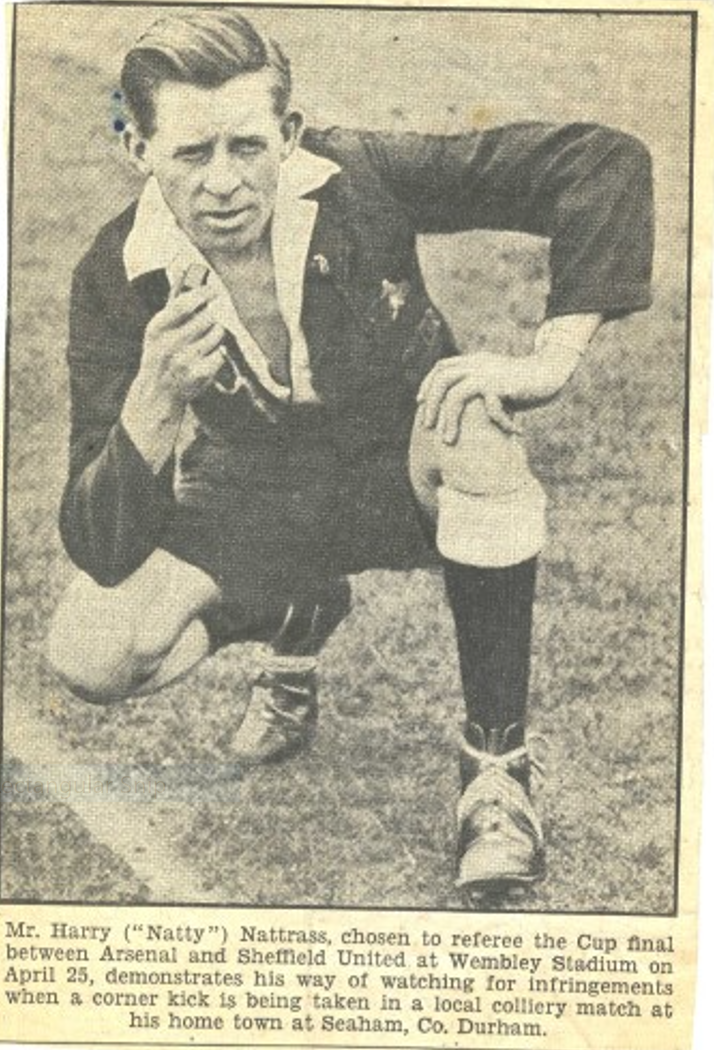
Harry Nattrass – image provided by Dr. Alexander Jackson
Non- Irish referees took charge of every subsequent final between 1925 and 1940 apart from the 1937 final which was refereed by John Baylor from Cork. Baylor was chosen ahead of English referee Isaac Caswell but this decision did not prove popular with everyone as finalists St. James’s Gate lodged a formal protest at his selection.
Harry Nattrass, from County Durham took change of the 1940 FAI Cup final between Shamrock Rovers and Sligo Rovers in front of a then record 38,000 supporters, Nattrass had refereed the FA Cup final just four years earlier, however despite his willingness to brave a crossing of the Irish Sea to take charge of the final in Dalymount the remaining finals during the War years would be the domain of Irish referees only. The escalation in the conflict and the danger to shipping from the German Kriegsmarine was obviously a major contributing factor, however, it is worth nothing that even after the War had ended it was 1950 before another non-Irish referee took charge of a Cup Final.
The 1950 final was in itself slightly unusual as it was the first final to go to a second replay. For the first two finals W.H.E. Evans of Liverpool took charge of the first two games between Transport and the favourites Cork Athletic, however he was replaced for the second replay by his fellow countryman Tom Seymour. Transport shocked Irish football by winning their first, and only Cup, and Tom Seymour would return the following year when Cork Athletic once again reach the final and eventually won on the replay 1-0 against Shelbourne.
The 1950s remained a decade when the FAI looked to England to provide referees for prominent games. This wasn’t confined to FAI Cup finals but also happened in semi-finals, prominent League of Ireland games, Shield games, Leinster Senior Cup games and more.
View of Dalymount Park for the 1950 FAI Cup Final (Irish Press)
This was not always popular with all members of the public. In 1932 two English referees, shortly after arriving in Dublin, were “requested” not to officiate two games involving Shelbourne over two consecutive weeks. First, Tom Crew of Leicester was visited ahead of a Shels games against Cork and the following week Tommy Thompson from Lemington was visited before a game against Drumcondra. Both referees did take charge of each of the games although Thompson did alert the Free State League committee. The League condemned these visits to referees and committee member Basil Mainey of Shamrock Rovers stated that the “attempts at intimidation were made by irresponsible persons.” The Gardaí, League and the FAI were reported to be investigating the matter by the Irish Press. Mainey did comment further, making a somewhat awkward justification for the use of English officials while also giving an idea of the rates of pay being offered in the early 1930s. He said;
“No one should get the idea that we employ English referees for the love of them or their country. It costs us four of five guineas every time and a local man would only cost about one guinea.”
The League committee stated at the time that with bigger games in the League of Ireland regularly attracting over 20,000 spectators that it was “desirable” that a “stranger acted as referee”, again returning to the idea that an English referee would be seen as impartial and unbiased. Not that there weren’t moments of friction, three years before those visits were paid to referees Crew and Thompson there was a spat between referee Albert Fogg and Dundalk FC over an article he had written in the English sporting press describing a league match he had refereed between Dundalk and Drumcondra. Fogg had described the Dundalk crowd as the “wild Irish” and a complaint was made by PJ Casey on behalf of Dundalk FC. Incidentally, Irish referee JJ Kelly wrote to the FAI in support of Fogg and complained that the Dundalk supporters were “the mostly cowardly lot of blackguards that ever attended a football game”.
Fogg was well used to taking charge of games in Ireland, he had refereed the 1926 FAI Cup final and was another man afforded the dual honour of taking charge of Cup Finals in both England and Ireland when he refereed the 1935 FA Cup final. As with Fogg, Langenus and Howcroft the majority of referees who came to Ireland were quite high profile, many refereed international matches and important league games and Cup Finals in England, and in the case of Langenus even the World Cup final. Among the other well-known refs who came to Ireland during this period from the 1920s through to the early 1960s were men like Albert Prince-Cox a former football manager, player and referee, boxer, and boxing promoter who had also designed Bristol Rovers distinctive blue and white quartered kit.
Perhaps the most well-known figure in this period would be Arthur Ellis. Ellis was in charge of the 1953 FAI Cup Final and its replay and also the 1955 FAI Cup Final. By that stage he had already been a linesman in the Maracanã for the 1950 World Cup final, and would referee at both the 1954 and 1958 tournaments. A year after refereeing Shamrock Rovers victory over Drumcondra in 1955, Ellis was entrusted with refereeing the first ever European Cup final, a classic game which was won in thrilling fashion 4-3 as Real Madrid defeated French side Stade de Reims. One of Ellis’s assistants in that European Cup final was Thomas H. Cooper who would referee another Shamrock Rovers v Drumcondra final in 1957, this time the Drums prevailed. Ellis himself became better known to a later generation as a media personality, being the referee in the TV gameshow It’s a Knockout.
As you can see from several examples above the FAI did not follow the English tradition of a referee only getting to take charge of a Cup Final once, Howcroft, Seymour, and Ellis all refereed two FAI Cup finals, although the record for a foreign referee is three, which is held by Isaac Caswell from Blackburn. Caswell was a Labour Councillor and was also very involved in organising (and delivering) Church services for sportsmen. He was the man in the middle for the 1932, 1934 and 1936 FAI Cup finals. It could have perhaps even been more were it not for the fact that Argentina were experiencing a similar situation to the League of Ireland and wanted British referees to take charge of league games there while also instructing and education local referees.
Jack Howcroft (right)
Caswell journeyed to Argentina in late 1937 and stayed until 1940, refereeing matches and training local officials. Caswell seems to have been popular in Argentina and like Ireland was seen as an impartial adjudicator although as with games in Ireland there were still moments of conflict. In 1938 there were reports that Caswell had been assualted during one game, although broadly speaking it was seen that his time there was a success. So much so that in the late 1940s there was a request for more British officials to take charge of fixtures in Argentina. Eight men departed for Argentina in 1948 with allowances made for their wives and children to travel with them
This group weren’t always as popular as Caswell had been and similar to the 1925 incident with James Howcroft there was a threatened strike by the Argentine match officials in 1950 while there were still some tumultuous scenes on occasion, with referee John Meade and his officials having to barricade themselves inside a dressing room during a game between Huracán and Velez Sarsfield.
In both Ireland and Argentina the use of referees from outside of their own Associations gradually came to an end. The last Englishman to referee an FAI Cup final was D.A. Corbett who took charge of Shamrock Rovers v Cork Celtic and the subsequent replay in 1964. Since that time the FAI Cup has been the preserve of Irish referees, however for a span of almost forty years British referees (and one Belgian) took charge of 26 FAI Cup finals as well as innumerable semi-finals, finals of other Cup competitions and prominent League and Shield games. Many of these referees had a reasonably high profile, took charge of international matches and tournaments, European club ties and English top flight games and FA Cup Finals, and while not always welcomed they were broadly viewed as neutral parties, freeing games of any sense of bias and bringing their expertise in the laws of the game to bear.
A special thank you to Dr. Alexander Jackson of the National Football Museum in Manchester for his assistance.
Go stand in the members bar and look at the pitch side wall and you’ll see that a huge, framed photograph dominates the wall. It shows 25 men with four trophies seated in front of the old main stand of Dalymount. Of those 25 only twelve are the footballers of Bohemian FC, the remaining gentlemen are committee members as well as the coaching team of Bobby Parker and trainer Charlie Harris. Parker was a Scottish centre forward who went to War as the English First division’s top scorer and returned with a bullet in his back, while Harris had been a top athlete in his youth who also trained the O’Toole’s Gaelic Club and the Dublin County team on occasion.
The all-conquering Bohemian FC team
This is not only one of the greatest Bohemian teams of all time but arguably one of the greatest League of Ireland sides in history. This was a side that swept all before them, winning the League, FAI Cup, Shield and Leinster Senior Cup. Seven of that squad had, or would be, capped by Ireland while Johnny McMahon from Derry was selected by the IFA. Others, like the English born Harry Willits and Billy Dennis were selected to represent the League of Ireland on numerous occasions.
The record for that season for all competitions reads – played 36, won 29, drew 5, lost 2 – Goals for 108, goals against 35. While the team photo does show only 12 players several more were utilised during that remarkable season, however it is true to say that the team starting XI was fairly fixed and six players played in all 36 matches while goalkeeper Harry Cannon played in 35.
Among those players to feature in all 36 games were the Robinson brothers, Christy, at inside forward, and Sam at right back. Both men had been actively involved in the War of Independence, Christy being involved in the raid on Monk’s Bakery when Kevin Barry was captured, while Sam (real name Jeremiah) had been a late addition to Michael Collins’ “Squad”.
Sam almost missed the FAI Cup final when some dressing room hijinks saw a bucket of scalding water tipper over his leg after yet another victory. However, the attentions of Dr. Willie Hooper ensured that Robinson was fit and read for the final against Drumcondra. Despite Drums taking the lead Bohs never panicked and goals from Jimmy White and Billy Dennis secured the victory.
Dennis scored 26 goals in all competitions that season although with only 12 in the league he was some way behind Charlie Heineman, Fordsons’ English centre forward who topped the league scoring charts with 24 goals. In the Shield, which only consisted of eight games, Bohs won seven, only drawing once, while in the Leinster Senior Cup Shelbourne were dispatched 4-1 in a replayed final.
Ireland’s only international that season was in Liège against Belgium, where an Irish side featuring Bohemians Harry Cannon, Jack McCarthy as captain, Sam Robinson and Jimmy White won 4-2 with White grabbing two second half goals for Ireland. Little did they know but many of those players would be returning to Belgium the following year to enjoy more success.
There was change again in the 10-team League of Ireland as Pioneers raised a glass of squash and bid adieu after four seasons. This side, which began as a sporting branch of the Pioneer temperance movement are still around today playing in the Leinster Senior League. Pioneers place was awarded to Dundalk GNR – the GNR standing for Great Northern Railway and the team would have worn amber and black stripes rather than the more familiar white jerseys that we associate with Dundalk today. In that debut season Dundalk used no fewer than 47 different players, including many with experience in the Irish League, ultimately, they finished in 8th position.
The Dundalk team from that season
Bohemians battled it out with their Dublin rivals for the title, finishing 3rd behind defending champs Shelbourne in 2nd place and Shamrock Rovers who claimed their third title. Shorn of the goals of Billy “Juicy” Farrell, Rovers turned to the diminutive, young, striker David “Babby” Byrne who finished that season as joint top alongside Shelbourne’s Scottish striker Jock McMillan with 17 goals.
For Bohemians Dr. Jim O’Flaherty and Ernie Graham were the top marksmen but a young English forward, once of Port Vale, named Billy Dennis was also beginning to make his mark. One of the more unusual scorers for Bohs that season was goalkeeper Harry Cannon who scored his solitary goal from the penalty spot. Cannon tried the trick again on a short midseason tour undertaken by Bohs but missed in a game against London Caledonians, that match was quickly followed by another games against Tottenham Hotspur a few days later.
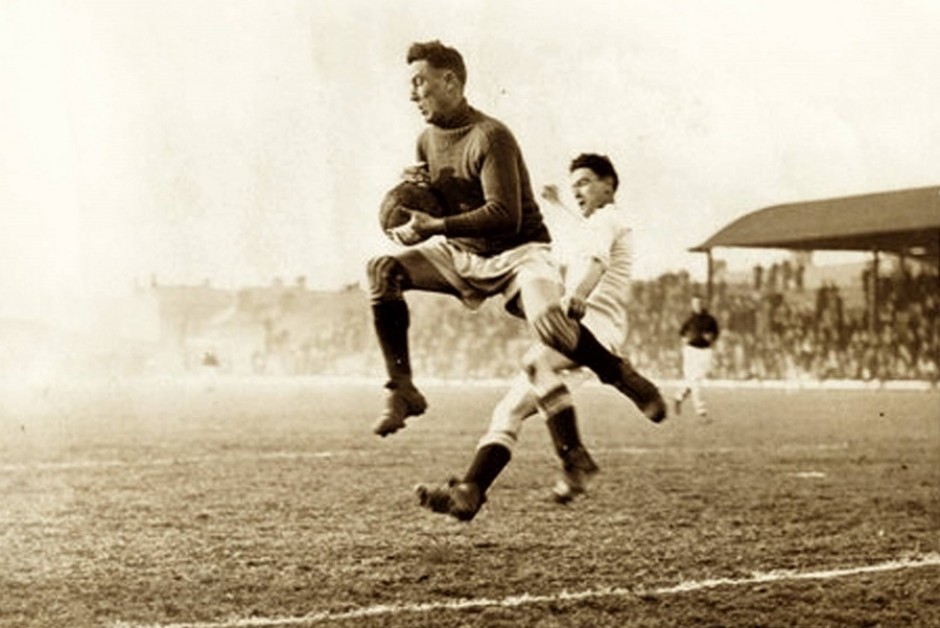
Harry Cannon in action
In the FAI Cup there was to be something of an upset as Leinster Senior League side Drumcondra FC, who had only been re-founded in 1924, defeated League of Ireland side Brideville in the final. Granted, Brideville had finished bottom of the league that year but they were still heavy favourites despite the fact the Drumcondra had already accounted for league sides Jacobs and Bohemians en route to the final. The match went to a replay and with the scores tied at 0-0 after the second 90 minutes extra time was played, it was former Bohemians player Johnny Murray who final grabbed the late winner and insured that Drums could bring the trophy back to their Tolka Park home.
On the international front Ireland hosted the return fixture against Italy in Lansdowne Road, again the Irish were on the losing side, but did get on the scoresheet thanks to Bob Fullam, the score finishing 2-1 to Italy but not before Fullam had come close a second time with a free kick that was struck so hard that it knocked an Italian defender unconscious.
While Bohemians finished the season empty handed an impressive squad was being developed that was on the verge of greatness that would be fully realised the following season.
The 1925-26 season was a last exit for Brooklyn as the southside club withdrew from the league, being replaced by another Dublin side, Brideville FC who were the original League of Ireland side to compete out of Richmond Park in Inchicore.
Shamrock Rovers were defending champions but there was stiff competition expected from other quarters, mainly from the Fordsons team who started the season strongly and had added Bohemians striker Dave Roberts to their ranks, as well as from Shelbourne for whom John Simpson and Fran Watters provided the bulk of the attacking talent.
Despite all the striking talent in the league in the goalscoring stakes it was once again Billy “Juicy” Farrell of Shamrock Rovers who topped the scoring charts with 24 league goals. An all-round sportsman, Farrell excelled at hockey, cricket, Gaelic football and even billiards. However, the 25-26 season would be the last one in which he would play regularly, a broken leg after a serious motorbike accident in May 1926 prematurely curtailing one of the most promising careers in the League.
For Bohemians their top scorer was the South African, Billy Otto, pressed into service more often as a centre forward after the departure of Roberts, with the likes of Dr. Jim O’Flaherty (another in a long line of Bohemian doctors), Jimmy Bermingham, and Joe Stynes (a prominent Republican during the Civil War and former Dublin county footballer) all chipping in through the season. Between the posts the Irish Army Officer, Harry Cannon had made the goalkeeper spot his own.
As mentioned Fordsons had a particularly good start to the season but it was Bohemians who became the first side to win against them in Cork, securing an impressive 2-0 win. However, this win and the two points that came with it were overturned and awarded to the Cork team after a protest that veteran Bohs player Harry Willits had been listed on a team sheet for the game as “Henry” Willits. The league committee awarding Fordsons the victory due to the mis-spelling of the name of one of the league’s best known and longest serving players.
Despite that dubious victory Fordsons would only finish 3rd in the league, Shelbourne capturing the title for the first time in their history with Simpson and Watters scoring 33 goals between them to propel them to victory. In the Cup however it was to be Fordsons year, they defeated Shamrock Rovers 3-2 in the final in front of a record crowd of 25,000 in Dalymount.
Key to their victory was their goalkeeper Billy O’Hagan, the Donegal born former IFA international saved a penalty from Bob Fullam with the scores tied at 2-2 to inspire his team onwards, and with five minutes to go Paddy Barry scored the winner to bring the cup to Leeside for the first time. Harry Buckle, (who we met in the last issue) made history by becoming the oldest player at 44 years old, to win the cup, a record that still stands to this day.
In terms of trophies Bohemians had to be content with the Leinster Senior Cup which they won 2-1 in a replayed final against Shelbourne, Dr. Jim O’Flaherty grabbing both the goals in the game played on April 19th as one of the final matches of the football season.
A month earlier the League had secured its first inter-league victory, defeating the Irish League 3-1 in a comfortable victory in Dalymount in the first ever meeting between representative teams from the island’s two leagues.
And just a week after that history was made as an Irish international side under the auspices of the FAI took to the field in Turin to face Italy. Despite a 3-0 reverse it was an important first step in world football for the national side, among the starting XI that day were Bohemians Harry Cannon in goal and Jack McCarthy in the defence.
The split from the IFA and the formation of the FAI in 1921 was an acrimonious one, and the bad blood seeped beyond our own island as the English, Scottish and Welsh football associations roundly supported their colleagues in Belfast. This placed the nascent FAI in a difficult position, it had to look further afield for opponents leading to them joining FIFA, entering a team in the 1924 Olympics and inviting clubs from the Continent to visit Ireland. They knew however that the bigger draw for the sporting public were always going to be for teams from the British associations and if a full international match couldn’t be secured, then the next best thing would be an inter-league game. With an improvement in relations with the other associations after a conference in Liverpool in 1923, this was something that for the first time seemed achieveable.
In February 1924, almost three years since the split from the FAI, an inter-league match was scheduled against the Welsh League, with the match due to take place in Dalymount Park. This was the first time since the creation of the FAI that they would have any sort of representative game. All that would be needed now was to select a team…
There was much discussion about the make-up of the team and not all Irish football supporters were happy. The newspaper letter pages at the time we’re deluged with criticisms and alternative XIs (they had to do something without Twitter) but ultimately side was picked by a Free State league selection committee and was made up of players from Bohemians, Shelbourne, Jacobs, St. James’s Gate and Shamrock Rovers. The Welsh, for their part selected four Cardiff players, three from Llanelli Town and one each from Swansea, Newport, Mid Rhondda and Pontypridd. Neither the League of Ireland team nor the Welsh side limited themselves to Irish or Welsh players only. For the Welsh League the likes of Cardiff’s English goalkeeper Herbert Kneeshaw or forward Jack Nock were selected. Similarly, the League of Ireland side featured English players, the Bohs’ forwards Harry Willitts and Dave Roberts were both born in England. Roberts had even had a brief career in the English league with the likes of Shrewsbury and Walsall.
It was quite an eclectic League of Ireland side, completing the Irish forward line alongside Willitts and Roberts were Hugh (Jimmy) Harvey, Jack (Kruger) Fagan and Christy Robinson. Harvey was a winger for Jacobs who, like Willitts had served in the British Army in World War I, he would later go on to have a career as a music hall performer and comedy actor. Robinson and Fagan, two of the younger players in the side, from Bohemians and Shamrock Rovers respectively, had both been involved with the IRA during the War of Independence.
The side was captained by Shelbourne’s Mick “Boxer” Foley (they loved a nickname back then) who was among the more experienced players on the side having been on the books of the now defunct Leeds City for almost ten years either side of the War. One player who was picked but who would have to be replaced late-on was Val Harris, at almost 40 Harris was back with Shelbourne after a distinguished career in England with Everton, however a late withdrawal saw his place taken by Bohs’ Johnny McIlroy. On the bench was Charlie Harris, the Bohemian FC trainer who also moonlighted as a trainer/physio for O’Toole’s GAC and occassionally the Dublin County GAA side, including on the infamous occassion of a match against Tipperary in Croke Park on Bloody Sunday 1920.
Teamsheet from the match programme.
The night before the game the Welsh delegation were treated to tea in Clery’s department store tearooms followed by a show across the river at the Theatre Royal.
The match itself was a success, a sizeable crowd of 15,000 generated gate receipts of £850, a record soon broken when Glasgow Celtic visited Dalymount to play the League selection later that month. The St. James Brass & Reed band provided entertainment and English referee T.G. Bryan (who would go on to referee the 1928 FA Cup final) was brought to Dublin specially for the match. The crowd were given the best possible start to proceedings when Ernie McKay of St. James’s Gate, and a worker in the GPO for his day job, open the scoring early on, McKay earned special praise for his performance in the game and was complimented for rising to the occasssion and showing leadership in midfield. For the Welsh side Jack Nock quickly equalised before Jimmy Jones of Cardiff put them in front.
Deep in the second half the Welsh did well to preserve their lead but with just 12 minutes to go Bohs striker Roberts who had been having a quiet game scored twice in quick succession to briefly give the Irish the lead. Jones however scored his second of the day which meant that this first ever representative game organised under the auspices of the FAI would end 3-3 and history was made.
Bios of the players involved:
Frank Collins: Collins had two spells with Jacobs, either side of a a short spell at Glasgow Celtic where he saw little first team action, he was restricted to just two first team appearances due to the primacy of regular Celtic custodian Charlie Shaw. While at Celtic he was capped by the IFA in a game against Scotland. He returned to Jacobs in 1922 and continued to play with them for a further ten years. The fact that Collins had played professionally in Scotland probably meant that he missed out on an appearance at the 1924 Olympics, however, he was capped by the FAI in a 3-0 win against the USA in Dalymount directly after the Olympics as well as the 1927 game against Italy.
Stephen Boyne: Boyne and his brother Eddie were both regulars for Jacobs around this time. They were from Bride Street and Stephen worked as a van driver for the Jacobs factory. He had received a significant ban in 1920 after altercations that took place during a game against Olympia.
Herbert (Bert) Kerr: Beginning as a a youth player with Drumcondra, Kerr later joined Bohemians when Drums disbanded during the First World War. Kerr represented Ireland at the 1924 Olympics and won three caps in total. He later became a club captain and a prominent member of the Bohemian FC management committee. A younger brother, Kevin Kerr, also later captained Bohemians. In 1920 he set up his own insurance and bloodstock agency. Bertie had a love of horses and Kerr and Company remain in business to this day. He purchased and sold on four horses that later won the Aintree Grand National as well as a Kentucky Derby winner. He passed away in 1973 aged 77.
Mick (Boxer) Foley: Born in Dublin in 1892 Foley made his name at Shelbourne from where he was purchased by Leeds City along with two of his teammates in 1910. Foley made more than 120 appearances over the next ten, war-interrupted years, for Leeds before the club dissolved in 1919 due to financial irregularities. Foley quickly re-signed for Shelbourne winning the IFA Cup on his return. His grandson Paul played in the League of Ireland and in Australia.
Johnny McIlroy: Another one of the veteran players in the team, McIlroy had made his name with Belfast Celtic, appearing in both the 1917 and 1918 IFA Cup finals. He featured for the Falls League XI in a friendly match against Bohemians in 1921 and was soon signed by the Dublin club for whom he would have great success, winning league titles in 1924 and 1928 as well as the 1928 FAI Cup.
Ernie McKay: The son of a Scottish soldier, McKay was born in Richmond Barracks in Templemore, Tipperary, now the Garda training college. McKay played for St. James’s Gate but did not work for Guinness, instead he spent decades working in the GPO on O’Connell Street, as a teenager he was working there as a telegram boy when the Easter Rising broke out. It was around this time that he first became involved with St. James’s Gate as a footballer. Like other members of this XI he also featured in the 1924 Olympics. McKay won the double with the Gate in the first season of the Laegue of Ireland and formed an imposing half-back line alongside Frank Heaney and Bob Carter. He later retired to Essex and was one of last surviving members of the team, passing away in his later 90s.
John (Kruger) Fagan: “Kruger” as he was known in tribute to one of the heroes of the Boer War, grew up around the Markets area of Dublin. During the 1916 Rising he assisted rebels in the Four Courts in getting to safety and arranging for a safe house. A diminutive forward at just 5’2″ Fagan became part of Shamrock Rovers famed “Four Fs” forward line alongside Bob Fullam, Billy “Juicy” Farrell and John Joe Flood. He was capped by Ireland in the 1926 game against Italy in Turin and made history when his son Fionan, who starred for Manchester City was also capped by Ireland, making them the first father and son to achieve this honour. A talented all round sportsman he won a Leinster title in handball and later worked as an assistant to the first Dáil librarian before moving to the Werburgh Street offices of the Department of social welfare.
Harry Willits: Harry Willits was born in Middlesborough in 1889 and already made a strong impression as a footballer in his teens, when he played for Middlesbrough Old Boys, Cambridge House and the famous South Bank club where a team-mate was later English international George Elliott. He moved to Ireland in 1908 to work in the Civil Service and began playing for Bohemians around this time.
He joined the British Army in late 1915 and was seriously wounded in the leg in 1916. Despite this he returned to football and was an intergral part of the Bohemian side that won the league in 1924. Even before his playing days with Bohemians finally ended, Willits became involved with the club’s Management Committee, also later the Selection Committee, and he served as Vice-President.
Dave Roberts: From the English midlands Roberts had spells at both Walsall and Shrewsbury before moving to Bohemians. He had also served briefly in the British army before his footballing career in Ireland. He was top scorer in the 1923-24 season as Bohs won the league, later moving onto Fordsons in Cork. Roberts had a wife and two children living in Birmingham at this time and in 1925 while playing in Cork he was sentenced to a month in prison for child neglect for failing to pay the Birmingham Guardians £172 for the care of the children. At the time Roberts claimed his salary was only £3 and ten shillings a week. Roberts continued with Fordsons until 1927.
Christy Robinson: Born around the markets area on Arran Street in 1902, Robinson was a skillful inside left and one of the stars of a Bohemian side which won the league in 1924 and a clean sweep of trophies in 1928. He also had spells at both Bendigo and Shelbourne. Prior to his involvement with football he had been an member of Na Fianna Éireann and later a member of the First Battalion of the Dublin Brigade during the War of Independence. During this time he was involved in the raid on Monk’s Bakery where Kevin Barry was captured. He would later name one of his son’s Kevin in his honour. He was a Captain in the Free State army until his departure from it in 1924. Robinson was another player who travelled to the 1924 Olympics and featured in a friendly match against Estonia directly after Ireland’s exit from that competition. His brother Jeremiah (Sam) would also play for Ireland and would have a successful club career alongside his brother at Bohemians before moving onto Dolphin. Christy Robinson passed away in 1954 in Dover, England. He is incorrectly listed as S. Robinson on the match programme pictured above.
Hugh James Harvey: Hugh James Harvey, was better known as Jimmy Harvey and was born in Dublin in 1897. He had been a physical instructor in the British Army during World War I and had played for Shelbourne on his return to Dublin, featuring in the 1923 FAI Cup final where Shels had surprisingly lost to Belfast side Alton United, Harvey had the unlucky distiction of being the first player to ever miss a penalty in a FAI Cup final in that game. Harvey was useful in several positions across the forward line but found a new lease of life after his sporting career. During his time as a Jacob’s player records list him as a labourer. However, his father (also Hugh) was a “Variety artist” and the younger Hugh, decided to follow his father into show businesses. He excelled as a comedian as part of a comedy troupe known as the “Happy Gang” who performed in many theatres around Dublin and was also an accomplished singer, dancer and actor.
Name a footballer who has won a cup winners medal in three different countries across three separate decades? Quite the pub quiz brain teaser but if you answered – Jimmy Delaney award yourself 5 points. Delaney the scintillating and pacey Scottish international winger, won a Scottish Cup with Celtic in 1937, the FA Cup with Manchester United in 1948 and the IFA Cup with Derry City in a twice replayed final against Glentoran in 1954. Delaney came within 12 minutes of winning a fourth cup medal, in 1956 with Cork Athletic, but fate, and Paddy Coad intervened.
With Cork leading 2-0 with 12 minutes to go (Delaney then aged 41 had put Cork ahead after 34 minutes) a tactical change by Shamrock Rovers player-manager Paddy Coad helped get them a late lifeline through Tommy Hamilton and two more goals followed between then and the final whistle to deliver the cup to Rovers. The Cork players, including their veteran player-coach Delaney were left in a state shock. Such had been their confidence one of the Cork directors had left Dalymount early to buy bottles of champagne! Delaney had his own theories as to why Cork Athletic lost the cup – mainly around the team diet. As quoted by Seán Ryan he stated that “Soup, spuds, cabbage, meat was their usual diet while I had a poached egg or something light. They ate too much but they were a grand bunch.”
Despite that down-note at the end of his career Delaney, born in Cleland near Motherwell to Patrick and Bridget in an area populated mostly by generations of Irish immigrants, enjoyed great success on the biggest stages. Signed by the legendary Celtic manager Willie Maley, Jimmy made his Celtic debut as a 19-year-old as part of a squad that included the likes of Celtic’s record goalscorer Jimmy McGrory. Delaney was a key component of a Celtic revival in the late 1930s winning two league titles and the aforementioned Scottish Cup, while thrilling crowds with his skill, pace and workrate down the touchline. A severe injury to his arm in 1939 would put him out of the game for a time but would also have likely have exempted him from military service as the Second World War broke out soon after. He did however, work in the mining industry to support the war effort while continuing to line out for Celtic in war time games.
After the hardship of War the opportunity to join fellow Scot Matt Busby at Old Trafford proved too good even for a die-hard Celt like Jimmy to resist and in 1946 he joined Manchester United and became an integral part of Busby’s first great post war team. He played an important role in the 1948 Cup Final as Manchester United, captained by Irishman Johnny Carey, defeated Blackpool. Jimmy set up the opening goal for Jack Rowley with one of his pinpoint crosses.
Just after his move to United he enjoyed one of his finest moments in a Scotland shirt, when in April 1946 he scored the only goal as Scotland defeated England in a post-war “Victory International” in front of a crowd of over 130,000 in Hampden Park. He finished his War-interrupted international career with 15 caps and six goals for Scotland, often playing in front of record-breaking crowds. He was posthumously inducted into the Scottish Football Hall of Fame in 2009
After finishing up at United aged 38 further spells with Aberdeen and Falkirk were followed by Jimmy’s Irish adventure in Derry and Cork. Football also continued in his family, his grandson was Celtic centre back John Kennedy whose career was curtailed by injury but who has since successful moved into coaching with Celtic FC.
This piece first appeared in the 2022 Ireland v Scotland match programme.
For the 1924-25 season the League of Ireland remained a 10- team league, Midland Athletic – the railway works team withdrew from the league, as did Shelbourne United, who withdrew just after the season had started. The League however, took on a more nationally representative characteristic with two non-Dublin clubs joining. The wonderfully named Bray Unknowns, (though still playing just over the county border in Dublin before reverting to the Carlisle Grounds a few seasons later), and Fordsons of Cork City.
Fordsons had been beaten in the previous season’s Cup Final and were associated with the Ford Factory, but they may never have become a sporting power if it wasn’t for Harry Buckle being thrown in Belfast Lough. Buckle was an Ireland international (IFA) who had starred for Sunderland but was back in his native Belfast working for Harland and Wolff. As a Catholic he had been subjected to sectarian attacks and decided to swap the shipyards for the Ford Factory. While there he helped re-establish the Munster FA and drive forward Fordsons to become Cork’s first (but not last) league of Ireland side where they’d finish a credible fourth in their debut season. His son Bobby Buckle, and great-grandson Dave Barry would also enjoy soccer success on Leeside.
Harry Buckle
At the top of the League it was Bohs and Rovers battling it out for supremacy and despite only losing once during the 18-game season Bohemians had to settle for 2nd place in the table. Shamrock Rovers went through the league season undefeated, with their famous “Four F” forward line propelling them to victory with a +55 goal difference. Top scorer that year was Billy “Juicy” Farrell with 25 goals and the other “F”s being Bob Fullam (who we met in an earlier instalment) Jack “Kruger” Fagan and John Joe “Slasher” Flood. Footballers and fans of the 20s clearly enjoyed the use of nicknames! Bohs top scorer that year was Ned Brooks, who we met in the last article after he had scored a hat-trick against the USA on his Ireland debut.
In the Cup Rovers made it a double with Fullam and Flood scoring in a 2-1 win over Shelbourne in front of 23,000 in Dalymount Park on St. Patrick’s Day 1925. Both teams were still playing in their original homes around Ringsend so the cup final made for something of a super-local derby.
Just three days before the Cup final the LOI had played its second ever inter-league game, once again the Welsh League provided the opposition with Bohemians’ Dave Roberts getting the only goal for the league as they lost 2-1 to their Welsh counterparts.
Roberts was to have an eventful season the following season but most of it would be spent away from Dalymount.









 A Bohemian Sporting Life