On an island in the sun – UD Lanzarote

As any League of Ireland fan knows we have one of the longest football off-seasons anywhere in Europe. The last game of the season was the FAI Cup Final won by Dundalk FC on the 8th November 2015 and the new season won’t kick off again until March 4th 2016. It’s a long gap between live football matches, especially as a I missed a few of Bohs later fixtures last year.

This lacuna in live football got me to reminiscing about this time last year when I was able to get away for some winter sun in the Canary Islands, specifically Lanzarote. It was the first time I’d gone away to the sun at that time of year but I’d heartily recommend it. It was something to look forward to after the inevitable post-Christmas comedown and it broke up the drudgery of bleak, dark January evenings.

Any time I get away I try to catch a game, or if it’s the off season even just visit the local stadium. I dropped by to see a game between UD Lanzarote and UD Telde from the neighbouring island of Gran Canaria. Both teams play in the regionalised Tercera division which is officially the fourth tier of the Spanish football pyramid and is split into 18 different regional groups. The Canary Island teams feature in Group 12.

The match was played in the local municipal sports ground, the Ciudad Deportiva de Lanzarote in the main city of Arrecife. In keeping with the rest of the architecture on the island it is low-rise and whitewashed collection of buildings, and has a running track surrounding the pitch. The capacity is listed at around 6,000 with most accommodated in a main stand opposite the primary entrance to the ground. The entrance fee was a modest €5.
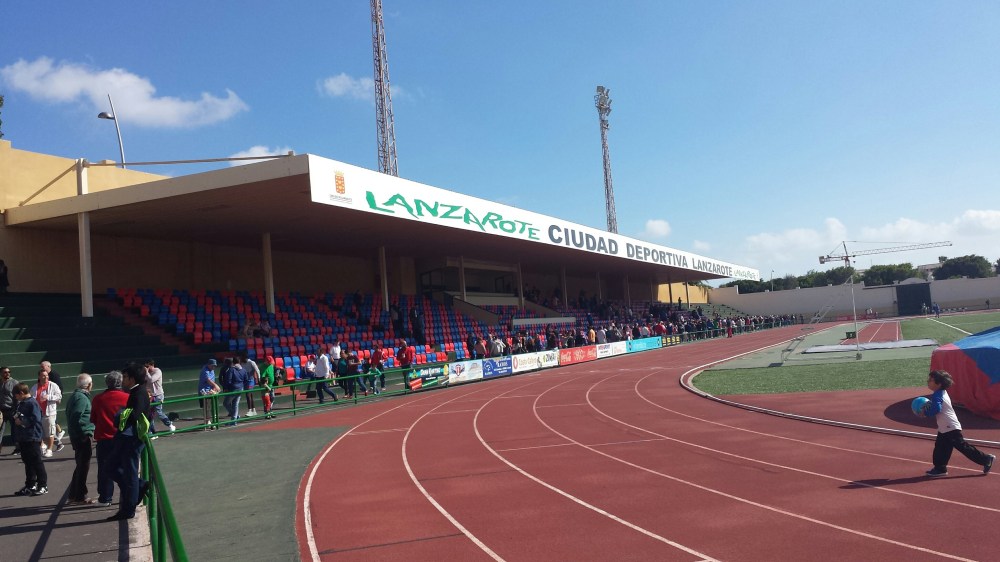
20150125_135957_resized

On the day there were may 700-800 supporters present, I was trying to get a handle on the make-up of the support, there seemed to be a few tourists like myself, some ex-pat British and Irish who’d probably retired to the sun and a fair number of local Canarians, one of whom, a somewhat older, man was highly vocal and had a habit of banging the advertising hoarding for the slightest of reasons. I know that a lot of the marketing and promotion of the club is done by an English ex-pat named Ian Lane and he was to be found running the Lanzarote club shop at half-time. This consisted of a patio table selling jerseys, scarves and other souvenirs along by the track (there is a good interview with Ian in issue 6 of the Football Pink by the way). Nearby was a red food and drinks kiosk that did up some tasty fried pork sandwiches and some ice cold beer, which thankfully you could take back to the shade of the stand. Despite this generous concession there was no mass drunken uproar in the stands for the beginning of the second half, just a thought.

20150125_140133_resized

As for the level of football, that’s a hard call. It reminded me quite a bit of League of Ireland standard, a certain mix of players, some obviously playing at the very height of their ability and the handful of players of certain quality probably wondering how they ended up playing at this level. However, there were some serious defensive lapses and the quality of goalkeeping from both sides was especially poor.  There was a midfielder lining out for Lanzarote who particularly looked the part, a constant attacking threat, he was hard to miss with his Fellaini-like mop of hair. The game ended 2-2 and there were some lovely moments of skill and two cracking goals from distance.

It’s now the middle of January, the heat is on in the house, there’s ice on the ground and no live senior football in Dublin. This year I’ll be off to the home island of UD Telde, Gran Canaria, and hopefully to catch a La Liga game featuring the islands’ only top flight side Las Palmas. I can’t wait.

The fall and rise of UD Salamanca

You could say that the footballing history of most countries began with an Englishman. The national football story of many nations begins with an English engineer, sailor or student stepping off a boat or train with a ball under his arm and a poorly organised kick-about with friends and locals invariably follows.

For many years the Englishman remained the expert, the teacher, and even up to the 1950s the English trainer, manager, football missionary was highly influential. The lives and careers of men like James Richard Spensley, Jimmy Hogan, Vic Buckingham, Fred Pentland and George Raynor are testament to the formative role that these English footballing proselytisers had on the global game.

The role of the Irish is somewhat less obvious, though people like Paddy O’Connell, Jack Kirwan and Monaghan-born Anna Connell (who played a significant part in Manchester City’s foundation) have had some influence beyond our borders. However some of those that influenced the development of the game abroad remain unknown to us to this day, as is the case with the group of Irish students who helped introduce the game to the city of Salamanca and founded the predecessor of Spanish side UD Salamanca.

The first football club in the Spanish city of Salamanca (located about 200km west of Madrid) was founded by Irish students in 1907. This isn’t as strange as it might first seem, Ireland has a greater connection with Salamanca than simply the name of a Dublin tapas restaurant. Salamanca, as one of Spain’s oldest University cities was home to an Irish College, part of a series of educational institutions that were founded throughout Europe during the 16th Century.

These institutions became home to one of the first waves of the IrishUD Salamanca emigrant diaspora after the political turmoil of the times; (the Munster and Ulster plantations, the Nine Years War, the Confederate War and the Cromwellian conquest) drove many of the Gaelic Irish and Old English into the Catholic armies and seminaries of mainland Europe. Indeed many of these colleges still exist or perform some similar role today, the Irish College in Rome still trains Catholic clergy while the Irish College in Paris is now a Cultural centre for Irish students and artists. That Irish students were present in early 20th Century Spain to form the Salamanca Football Team which competed in the early editions of the Copa del Rey shouldn’t surprise us.

While we even know the café where the club was founded the names of the Irish students involved sadly remains unrecorded. Although the early team folded a new side was formed in 1923 as Unión Deportiva Salamanca, they were a yo-yo club for much of their existence but managed to spend 12 seasons in the top-flight and were Segunda division champions on three occasions. However there are to be no more seasons at Spanish football’s top table as the club ceased to exist in the Summer of 2013, the 90th year of their being.

The story of their demise is a familiar one, and one that is likely to be repeated again in the near future. Relegated from the Segunda at the end of the 2010-2011 season, struggling Salamanca’s debts rose. Following the drop to regionalised football, UD Salamanca’s financial problems worsened and by the time the club entered liquidation in June 2013 they owed €23 million to creditors. This raised the very real prospect that the city could have been without a football team for the first time in nearly a Century.

It is into this territory of uncertainty entered Juan José “Pepe” Hidalgo, a local businessman made wealthy through his Globalia company which deals in tourist flights and a chain of hotels. Only days after the liquidation of UD Salamanca a new club, Salamanca Athletic was formed and Argentine coach Gustavo Siviero, formerly in charge at Real Murcia was appointed to manage the fledgling side.

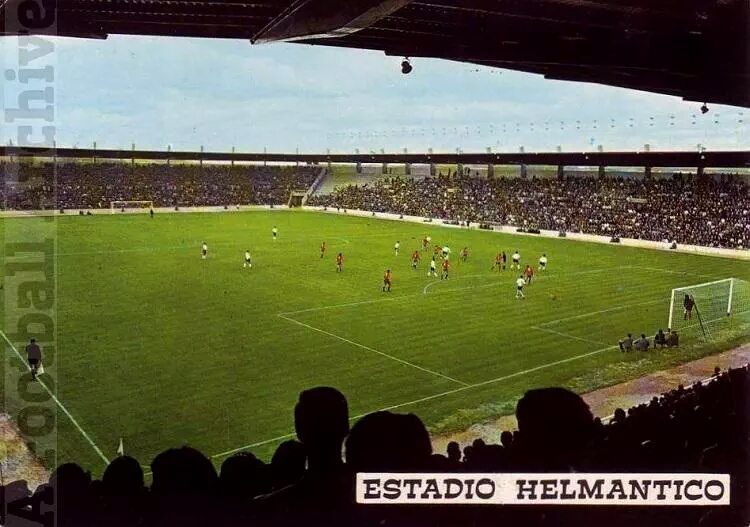
After much wrangling between the Spanish Football Federation and the local judiciary (the football federation initially blocked the new club taking UD Salamanca’s place in the Segunda B division,a decision that was subsequently overturned by the courts) the historic town of Salamanca looked like it would have a football team in place for the 2013-14 season, and looked likely play in UD Salamanca’s old home the Estadio el Helmántico

However this new club never played an official match and looks unlikely ever to do so. A second new club Unionistas de Salamanca CF emerged as a fan owned club made up of former UD Salamanca supporters. The include among their number a local hero in the form of Vincente del Bosque. In their first season secured promotion from the sixth tier of Spanish football into the Primera Regional for Castille and León.

In the chaotic and financially turbulent world it is pleasing that over a Century after some Irish students introduced football to the city, Salamanca will still have a team to support.

Originally posted on Backpagefootball.com in August 2013