Taking a Lax attitude- George & the magic magnetic board

The dim light of the training lamps strung along the old main stand illuminated the thin strip of touchline as the players sprinted by, full tilt. They were trying to impress the coach with their pace and athleticism before turning into the darkness of the shed end. The floodlights that would come to define Dalymount and become a landmark in the Dublin skyline wouldn’t be installed for another year and the majority of the pitch was in complete darkness. As the players, all amateurs, reached the Connaught Street side some of the more experienced ones stopped. Now subsumed into the darkness the only light was the faint amber glow of embers as they lit up their cigarettes. Their plan was to wait until the rest of the team had made their next lap of the pitch and save their energies for another sprint past their coach. The man that they hoped to impress, who unlike his charges was a professional football man, was a middle-aged Yorkshireman in thick glasses by the name of George Lax.

George had first encountered Bohemians as they encountered a period of comparative decline. In the opening decades of the League of Ireland Bohemian F.C. enjoyed more than their fair share of successes. Foremost among these triumphs was the “clean sweep” of the 1927-28 season when the Bohs won every competition available to them. Three further league titles, an FAI cup and an array of other trophies made their way to Dalymount of the following ten years but by the end of the 30’s things were beginning to change.

The end of the 30’s and into the 40’s other teams were coming to dominate the major prizes in Irish football, Shamrock Rovers, Shelbourne, Drumcondra, Dundalk and especially a rampant Cork United side were collecting league titles and cups. Bohs were increasingly being left behind. After winning the league title in 1935-36 Bohs could only finish 7th the following year, and 9th the year after.

The Gypsies policy on remaining an amateur club was beginning to affect their performances on the pitch. While the club, even by this stage had a long and proud history, one of the best stadiums in the league, and a strong record of bringing through talented players, unsurprisingly many of these same players would leave for other clubs prepared to pay them.

While amateur on the pitch the Bohs management committee looked to take a more professional approach to training and management of team affairs. To this end they brought in an English coach not long finished his playing days, George Lax, for the beginning of the 1938-39 season. Important to realise was that while Lax would be responsible for training, coaching and physio work with the players, the starting XI was still primarily decided by a selection committee and this would remain the case until the 1964 appointment of Seán Thomas as Bohs first manager in the modern understanding of the word.

Early days

George Lax was born in Dodworth, a coal mining village near Barnsley in South Yorkshire in 1905. Unsurprisingly young George began his professional life with Frickley Colliery near Wakefield having come from a mining family. The Colliery, one of the deepest coal mines in Britain had a strong sporting tradition, they had swimming baths, cricket clubs, athletics clubs and of course a football club, Frickley Colliery F.C. founded just after George was born. A teenage George lined out for the team at right-half and in his early 20’s was spotted by the legendary Wolves manager Major Frank Buckley and signed by them for the 1929-30 season.

Lax immediately became the sides’ regular right half as Wolves finished in the top half of the second division and continued a good run of form into the next year. His good fortune continued and during his spell at Wolves he also got married, tying the knot with his fiance Kathleen Hill in the Spring of 1932. However, a series of injuries including a badly broken jaw and later a broken ankle began to limit his first team opportunities at Molineux. This saw George move back to his birthplace to sign for Barnsley in 1932 after making 66 appearance for Wolves, although it would not be his last time working with Major Buckley. Further moves, first to Bournemouth and later to non-league sides like Evesham Town and Worcester City. As his playing career wound down he was beginning to get involved as a manager and coach alongside his playing duties.

In 1938 Lax was on the move again, this time having hung up his boots, he was off to Dublin to take over the management of Bohemian Football Club from the former Liverpool star and Irish international Billy Lacey. Lax had benefited greatly from working with Major Frank Buckley, a character with a fearsome reputation who had led the Footballers regiment during the First World War and had fought at the Battle of the Somme. Buckley’s teams were well known for their robust and very direct, physical football but this belied the fact that he was also somewhat of a pioneer and moderniser in other aspects of the game.

Buckley had placed great emphasis on fitness and diet (and allegedly the use of stimulants and animal gland injections) and contrary to popular wisdom at the time had encouraged players to do plenty of ball-work in training. He had also helped Wolves gain promotion to Division One and greatly improved their scouting network and youth system which would help lay foundations for the success enjoyed by Stan Cullis’ Wolves teams in the 1950’s. Lax borrowed heavily from Buckley’s methods and was also one of the first participants in the FA’s early coaching courses.  While Bohs amateur status might have seemed a throwback to a bygone age, even by the 30’s, in their choice of trainer they were selecting a man in his early thirties whose coaching methods were cutting edge for their time.

Among the modern elements of the game that Lax brought to Bohs was his “magnetic demonstration board”. While such coaching aids as a tactics board are hardly unusual today its use in the League of Ireland in the 1930’s seems to have raised more than a few eyebrows. He also brought with him a number of other tactical innovations such as “The Switch” which entailed the swapping of roles between the outside-right (usually Kevin O’Flanagan) and the team’s centre forward (Frank Fullen at the time). While this may not seem that groundbreaking to a modern football audience, the idea of swapping a centre-forward with a right-winger as part of a usually rigid W-M formation employed by the vast majority of British and Irish teams was revolutionary. It no doubt helped that O’Flanagan was an exceptional and versatile sportsmen and one of the best forwards in the country. These tactical innovations bore closer resemblance to the type of tactical experiments being tried out by coaches in Hungary or Austria.

George Lax board

It is worth remembering that it was only in 1953 when Hungary’s wandering centre-forward Nándor Hidegkuti helped dismantle the English national teams defense as they destroyed Billy Wright and Co. 5-3 that such tactical experiments began to get greater credence in Britain and Ireland.

Such was the success of this tactical innovation (no doubt worked out on the infamous magnetic tactics board) that other Irish sides soon started copying the ploy with Belfast Celtic using their international winger Norman Kernaghan in the O’Flanagan role.

Call of battle and the return to English football

Lax had two spells with Bohemians, joining in 1938 before leaving in 1942 at the height of the Second World War to enlist in the RAF. As someone resident in neutral Ireland at the time he could have conveniently avoided the danger of the conflict but instead chose to enlist. He was eventually demobilised some months after the end of the War in February 1946. The high-points of his first spell as coach of Bohs included a 3rd place league finish in the 1940-41 season as well as back to back League of Ireland shield wins (1938-39, 1939-40) and a Leinster Senior Cup win also in 1939-40.

George’s first spell at Bohs would see him succeeded by Sheffield United and Ireland legend Jimmy Dunne who had fallen out with Shamrock Rovers where he was previously player-coach. Once he was demobilised George was straight back into his sporting involvement, first with non-league Scunthorpe United where he was coach but also an occasional player while serving at the RAF station at Lindholm and then onto second division Hull City as a “trainer-coach”.

George’s job at Hull was secured by the intervention of his former mentor Major Frank Buckley who wrote to club Chairman Harold Needler stating that Lax was a “grand servant, of irreproachable character, keen, willing and loyal”. Buckley also boasted that it was “on my recommendation that he went as trainer-coach to the famous amateur Irish club, the Bohemians of Dublin. He gave grand service to them and it was the war that caused their severance”.

George was joined by his mentor Buckley as manager at Hull just a month later in May 1946. Hull were stuck in the unglamorous world of the English Division Three North, however they certainly had ambition, over the course of the next few seasons Hull sought promotion to the second division, succeeding by winning Division Three North in 1948-49. By that stage Major Buckley had already moved onto Leeds United where he would help start the careers of John Charles and later Jack Charlton.

His trusty lieutenant George Lax remained on Humberside working for Raich Carter who took over as player-manager. Carter had been one of the most highly-regarded and stylish inside-forwards of his era and over the coming years he brought some big names to Hull’s new ground at Boothferry Park. Joining Carter were players like England centre-half Neil Franklin, Danish international Viggo Jensen and an up and coming young forward named Don Revie.

Carter retired in 1952 and his role was taken over by Bob Jackson, a league winning manager with Portsmouth only a couple of years earlier. George Lax stayed on as part of his coaching team although Hull, despite all their ambition couldn’t do better than lower mid-table finishes in the second tier. After almost ten years with Hull as coach, trainer and physio among other roles George left for a new challenge. During his time at Hull he’d played second fiddle to some of the most famous and successful English managers in the game but perhaps he wanted to be in charge of himself again.

George had been a player-manager at Evesham before he had even hit the age of 30. During his time there he’d helped to launch the career of players like future West Brom and England forward Jack Haines. He was used to being his own man. Still it was with some surprise that in 1955 he moved the short distance to take over the management of Goole Town of the Midland league. During his brief tenure George led the club to the third round of the FA Cup, their best ever result in that competition.  George’s time in Goole was short and by 1957 he was heading back to Ireland, but this time not to Dublin but to a new club from Cork.

A return to Hibernia

In 1957 yet another Cork football club went the way of the dodo, this time it was the short-lived Cork Athletic. Although they had won back to back titles and two FAI cups around the turn of the 50’s, and had even coaxed George Lax’s old boss Raich Carter out of retirement to lead them briefly as player-manager, by 1957 financial difficulties saw them withdraw from the League. Their spot was taken by another Cork based club, this time it was Cork Hibernians. Their first manager was to be George Lax.

A tough first season for the Hibernians finish bottom of the 12 team division but gradual progress was made in the following seasons with Hibs finishing 9th and then by 1959-60 up to 6th place. George had set up a comfortable life in Cork, he ran a physiotherapy practice in the city and was on a considerable salary of £1,000 a year to manage the team. However, despite the steady progress Lax was making he left Cork Hibernians to return to Dublin and to Dalymount to take on a Bohs side that had finished bottom the previous two seasons. By the time he left the press credited him with having “moulded Cork Hibs into a first class side”. Lax took the reigns again at Bohemians for the beginning of the 1960-61 season, some 22 years after he had first arrived at Dalymount.

While the side that George had inherited in the late 30’s had some genuine stars like the O’Flanagan brothers, Fred Horlacher, “Pip” Meighan, Kevin Kerr and Billy Jordan. The side of the early 60’s unfortunately wasn’t so blessed and the drawbacks of the enforced amateur ethos at the club was being keenly felt. Some genuine greats of Bohs history were to join not long afterwards, most notably centre-half Willie Browne who would go on to win three Irish caps during his time in red and black and became captain of the club in only his second season.

After two seasons of propping up the table, including the 59-60 season where Bohs had finished without a single win and with a paltry five points there was some modest yet clear improvements under Lax, Bohs finished 11th out of 12th in his first season back in charge and 9th the year after. The following year however Bohs once again finished bottom in a reduced 10 team division and bottom again the following season (1963-64) as the division expanded again to 12 sides. Despite the initial improvements and the fact that he had helped bring through players like Browne, Billy Young, Mick Kearin and Larry Gilmore the club felt it was time for a significant change.

Lax left the club at the end of the 1963-64 season and the club directors finally agreed to the abolition of the 5 man selection committee that still picked the starting XI. Full control of team affairs was to be entrusted to a team manager for the first time and Phibsborough local Seán Thomas was given the reigns. Thomas’s talent and the additional authority invested in his role had the desired impact and Bohs finished the following season in 3rd place and saw the emergence of future Irish internationals like Jimmy Conway and Turlough O’Connor.

During his less successful second stay George remained true to his footballing philosophy. Unlike his mentor Major Buckley the focus on Lax’s teams was always on trying to play good football even on the boggy winter pitches of the League of Ireland. He told the Evening Herald that “there is no substitute for good football and it only will draw the crowds”. He had a focus on discipline and skill, players were instructed strictly to never argue with the referee, a practice that certainly isn’t a new phenomenon. In training his focus was always on improving touch and ball control, often preferring to organise 5-a-sides with various handicaps such as players only taking two touches or only using their weaker foot so as to build technique.  Practices that might now seem commonplace but were certainly ahead of their time for the league in the 1960’s. His commitment to this footballing ideal wasn’t even shaken during times of duress. Commenting after a heavy 6-0 defeat to a strong Drumcondra side Lax rejected the idea that his team should have tried to spoil or play more direct, stating simply “I’ve made it quite clear, I want them to play football all the time”. In many ways despite the struggles of the team in the early 60’s George Lax certainly seemed to try to embody the three golden rules of Bohemian F.C.  “never say die, keep the ball on the floor and the best defence is attack”.

After leaving the Bohs George’s services were quickly in demand. He was  signed up by St. Patrick’s Athletic to replace Ronnie Whelan Snr but he would spend only a season in Inchicore before quitting. He would later take on a physio role at Dundalk and later at Shelbourne where he was working well into his 60’s. He continued to run a physiotherapy practice in the Phibsboro area and treated many prominent GAA players and other athletes in his private practice.

The 1945 Inter-City Cup: War, Goals, Controversy and death by corner kicks

As you go for a pint in the members bar you may on occasion glance upward and notice the Bohemian F.C. honours list spelt out handsomely in gilt on a dark red background. It makes for impressive reading and is testament to the proud history of our club. Right in the middle of the bar, between the list of League Titles and FAI Cups is a sign that reads “Setanta Cup Champions 2010”. The Setanta Cup is, at the time of writing, our most recent honour. Few of us will forget Anto Murphy’s goal versus Pats in Tallaght Stadium, and it added a little extra relish that Bohs had managed to win a trophy in the enemy’s back- yard so to speak. It is worth noting, however, that though the Setanta Cup is the latest All Ireland soccer competition, it was by no means the first, nor was it the first such competition where Bohemians emerged victorious. To learn about this other, much earlier victory we must go back 70 years, to a time when the most violent conflict in human history still raged, to the first cross border competition since partition; the Inter-City Cup.

The Inter-City Cup, or to give it its full title, the Dublin and Belfast Inter-City Cup was conceived as a way to provide much needed income during the turbulent years of the Second World War. When the First World War had broken out in 1914, the general and oft-repeated assumption was that the war would be over by Christmas, so the sporting calendar continued on much as it had done in peace time. Bohemians and Shelbourne, the only two clubs from outside the six counties, continued to play in an pre-partition league season into 1914-15, but the growing realisation that the war was going to drag out meant that the Football League in Britain was suspended, while the Irish League was reduced to a “Belfast and District League” of only six teams with no room for Bohs and Shels. Many players, especially in Britain came in for heavy criticism for playing on into 1915. Some viewed it as a dereliction of patriotic duty that fit and healthy young men should stay at home and be paid to play football rather than volunteer to fight at the front. This led to the formations of “Football battalions” where prominent footballers were used as promotional tools for enlistment. Some football fans joining up were encouraged by the fact that they would have the chance of serving with their sporting idols.

When the Second World War broke out, the mistakes of the past were avoided. The league season was suspended immediately in Britain while Northern Ireland completed the 1939-40 season (Belfast Celtic won their 13th title) before suspending the Irish League and playing on with a diminished Northern District League. The League of Ireland, being in a neutral country, continued on as usual during the War years. It would prove to be a particularly successful era for Cork United, who would win five titles between 1939 and 1946.

However, gone from the fixture calendar were lucrative games against touring British sides. The lack of income was obviously a significant concern for the clubs north of the border, robbed as they were of regular gates and a full league programme which ultimately led to the creation of the Inter-City Cup. The tournament would run for eight seasons between 1941-42 and 1948-49, and despite the name, did include clubs from outside of Dublin such as Limerick, Cork United, Dundalk and Derry City. While matches were spread around various grounds in Belfast, all games south of the border were to take place in Dalymount. Another interesting feature of the tournament was the significance of corners. If two sides were tied on aggregate in the final, the side who had won the most corners were deemed to be the winner. Bohs learned this to their cost during the 1942-43 competition when they lost the final on corners to Shamrock Rovers having drawn 2-2!

Despite that setback Bohs, would eventually triumph in the competition. The 1944-45 season would be one of highs and lows for Bohemians, but it did at least end in some silverware. Bohs’ league form during the War years was poor; a third place finish in 1940-41 being the sides’ best placing and the 44-45 season would see Bohs finish bottom of the eight team league but would also see them reach two cup finals. An epic, three game semi-final win over Team of the decade, Cork United, would get Bohs into an FAI Cup final against Shamrock Rovers, where in front of the biggest ever Cup Final crowd of almost 45,000 they would lose out to a Podge Gregg winner. Gregg, a native of Ringsend had just returned to Dublin after a spell with Glentoran where he had won the Inter-City cup the previous year.

Bottom of the league, having lost a final to Shamrock Rovers, its fairly obvious that Bohs’ season needed a pick-me-up, and the Inter-City Cup could provide it. So as not to clash too much with regular games, the Inter-City competition was held around April and May each season when most games were coming to an end.  In that particular year, Bohs lost the FAI Cup final to Rovers on the 22nd of April, but less than a week later were in action in round one of the Inter-City.

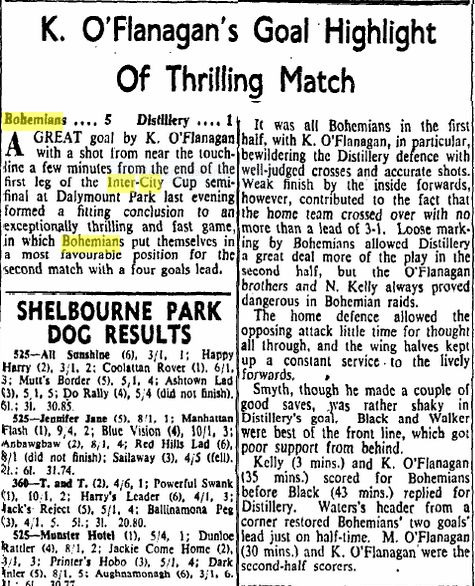
The first round game saw them drawn against fellow amateurs Cliftonville in Solitude on the 28th of April, with a return leg in Dalymount a week later. A 3-2 victory in Belfast with two penalties from full-back Frank Glennon and a Pat Waters goal gave Bohs too commanding a lead for the return leg, which ended as a 1-1 draw. The following round would see them matched with Glentoran; competition winners the previous year, Glentoran had been beaten on corners in the previous round by Limerick and only qualified as the best loser, their luck was out again as the tie finished 3-3 on aggregate so Bohs advanced as winners on corners 10-9 and thanks to an excellent performance by Collins in goal. Victory over Glentoran meant a meeting with Distillery, now based in Lisburn but then firmly ensconced in Grosvenor Park, West Belfast. Bohs would comfortably beat Distillery 8-3 on aggregate, a dynamic 5-1 victory in Dalymount was capped by a stunning strike from Kevin O’Flanagan, who beat the opposing keeper with a shot from out on his own touchline. The Irish Independent correspondent was moved to describe it as “the greatest goal seen in Dublin for years” and very topically likened the speed of the shot to that “of a V2 rocket”. O’Flanagan had the Distillery defence bewildered, and Bohs could have won by an even greater margin, as he finished with two goals. His brother Mick at centre-forward got one, while Noel Kelly and Waters got the other two. Despite going 2-0 down early on in the second leg in Belfast, the Gypsies rallied, and goals from Mattie Burns, Kevin O’Flanagan and Noel Kelly ensured there was no chance of an unlikely comeback.

Semi final

The other semi-final between Belfast Celtic and Linfield was also a high scoring affair, finishing 7-5 on aggregate to Celtic. As a two legged semi-final the first leg was held in Belfast before both sides travelled to Dalymount Park for the second game. With the tie balanced at 2-2 from the first leg, the Linfield goalkeeper and captain Tommy Breen (once of Manchester United and a seasoned international) elected to kick off defending the tramway end of the famous old ground. Due to heavy rain, Breen and his defence were ankle deep in water at that end of the ground which had cut up much worse than the opposite school end. 7 of the 8 goals scored on the day went into the tramway goal and Linfield were out. Breen’s former team, Belfast Celtic, were through to the final and were eager to make up for their defeat to Glentoran the previous year. Celtic had beaten not only Linfield, but Shamrock Rovers and Shelbourne en route to the final. The first leg was to be played in Belfast on May 30th with the return leg in Dalymount on June 2nd. VE day had taken place on May 8th and the laws and censorship brought in during the “Emergency” were lifted shortly afterwards. For the first time in six long years, football fans both North and South could genuinely look forward to the first real cup final in “peacetime”.

It is worth a brief diversion from our narrative to outline the merits of the Belfast Celtic side. Although the club has not existed in any real sense since the end of the 1940’s, they were at the time unquestionably one of the biggest sides on the island of Ireland. By the time the club was dissolved in 1949 they had won 14 league titles, second only to Linfield who by that stage had 19 to their credit. Former players included Mickey Hamill later of Manchester United and Manchester City, former President of the FAI and Government minister Oscar Traynor, Paddy O’Connell who would also play for Man Utd and later managed Real Betis and FC Barcelona, and Louis Bookman, the Lithuanian-born Irish international who became the first Jewish player to play professionally in Britain. Their coach at the time was Elisha Scott, a former player with Belfast Celtic and also Liverpool’s longest serving player ever. Scott was considered with some justification to have been one of the greatest keepers Ireland has ever produced and won ten league titles and six Irish Cups as Belfast Celtic manager. Their starting XI at the time of the Inter-City cup final was also on par with any of their previous sides. They would win the first official Irish League title after the war in 1947-48, and the team that Bohs faced included the likes of midfielder Charlie Tully, who would later join Glasgow Celtic and once famously scored against England direct from a corner in an international, attacker Jimmy McAlinden (an FAI and IFA international) an FA Cup winner with Portsmouth, and fellow international centre half Jackie Vernon who spent much of his career at West Brom.

In the case of Bohs, it would be a last hurrah of sorts. After the end of the Inter-City final, several of the winning side left for pastures new, including young goalkeeper Jimmy Collins, Frank Glennon and Noel Kelly, who would all switch to Shamrock Rovers. They would be joined a year later by their coach Jimmy Dunne, the former record breaking striker and soft-spoken coach, returning to Rovers after patching up his differences with the Cunninghams. Kevin O’Flanagan, a medical doctor was offered a job as a GP in Ruislip, London where he would spend his free time playing for Arsenal at football and London Irish in Rugby. While Bohs would make another FAI Cup final in 1947 (which they would lose after a replay to Cork United) the Inter-City cup would be the last trophy that Bohs would win apart from a pair of Leinster Senior Cups until the Cup final victory over Sligo Rovers in 1970. Bohemians’ insistence on remaining strictly amateur had served them well, as they won Leagues and Cups in the 1920s and 30s, but by the 40s, key players were being picked off by other clubs offering a few pound a week. While Bohemians continued to find and recruit excellent young players, they struggled to keep them for any length of time, the few exceptions being those whose day jobs allowed them the freedom to play without care for additional wages.

The two-legged final would be a close and often controversial affair. In the first leg there was nothing to separate the teams, not even corners as the sides finished level with two goals apiece, six corners each and both sides down to ten men. Kevin O’Flanagan for Bohs and Douglas for Celtic were the men sent off after coming to blows after Douglas kicked the ball out to touch when O’Flanagan was about to take a free. Bohs had taken a two goal lead thanks to an own goal and a finish by Smith, but the free scoring Bohs full-back Glennon ended up getting a roasting from Celtic outside left Paddy Bonnar, who grabbed two second half goals to tie the game. The return leg was no less controversial. Bohs named an unchanged side for the second leg (almost identical to the one which had lost to Shamrock Rovers just over a month before apart from Smith coming in for Frank Morris).

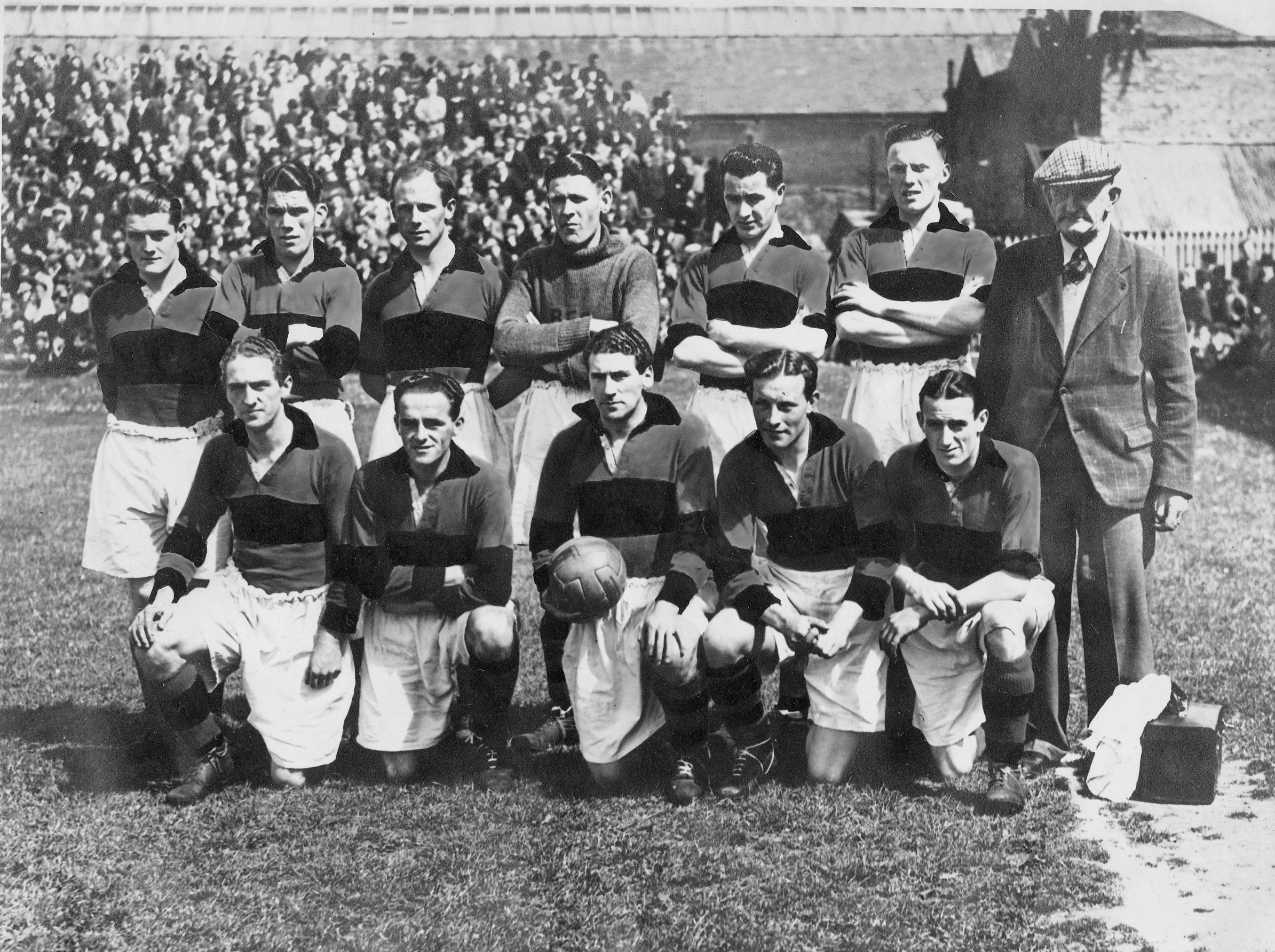
Bohemian FC Inter City Cup winning side

The Bohs side read: Standing – Ossie Nash, Paddy Waters, Billy Richardson, Jimmy Collins, Frank Glennon, Peter Molloy, Charlie Harris (Trainer). Front – Mick O’Flanagan, Noel Kelly, Kevin O’Flanagan (Captain), Matty Burns, Bobby Smith.

Belfast Celtic had suffered some injuries in the first leg with Peter O’Connor and Charlie Currie coming into attack for Johnny Campbell and Tommy Byrne. The second leg remained tight with few opportunities, Jimmy Collins in the Bohs goal being called into action in the first half to deal with chances from both Tully and Bonnar, but it was in the 67th minute that things became more heated when a cross came in from Smith which was trapped by Kevin O’Flanagan and passed into his younger brother Mick who when controlling the ball had a “Thierry Henry moment” and appeared to handle it before firing past Celtic keeper Hughie Kelly. This started furious protests from the Celtic players and led to an altercation between Captains Kevin O’Flanagan and Jimmy McAlinden who both had their names taken by the referee. Despite the Celtic players’ protests, the goal stood. Celtic’s disjointed attack, with the enforced changes since the first leg, had struggled to get past the Bohs defence, with Richardson and Glennon coming in for particular praise. Bohs successfully defended their lead, and after a season of disappointment, were All Ireland champions. It was particularly sweet for the star player Kevin O’Flanagan, who despite his sending off in the first leg, had been key in Bohs’ advancement to the final in much the same way that he had been key during the FAI Cup run scoring three goals by the time they reached that final. By setting up the goal for his brother Mick he had managed to make amends for his below par display in the earlier final versus Shamrock Rovers. Despite being a qualified GP the “Flying Doctor” had failed to diagnose himself with a bout of flu and upon returning home after the defeat to Rovers took his temperature and found that he had played a cup final with a 103 degree temperature!

Final article 1st leg2

It would be the last major trophy that Bohs would win for some time and the Inter-City cup was in some ways was the farewell of the Corinthian era of Bohemians and of Irish football as they signed off as Champions of North and South. Belfast Celtic, meanwhile, would remove themselves from League football only four years later, a mixture of sectarian violence, financial troubles and mismanagement forcing them out of senior football. While the Celtic board believed the withdrawal would only be a temporary measure it would transpire that their successful tour of North America, where they played to packed stadiums and famously defeated the Scottish national team, would in fact be their good-bye to the world of football. Guesting at centre forward for that touring side was none other than Bohs’ Mick O’Flanagan, his “hand of Mick” moment forgotten as he starred for Belfast Celtic as they slipped into history.

*special thanks to Martin Flynn and the Belfast Celtic Society for their assistance with some research for this article.

The Flying Doctor & the free-scoring Publican – the famous O’Flanagan brothers

Along Marlborough Street, opposite the Department of Education and a 100 yards or so from the Pro-Cathedral, stands the aptly-named Confession Box pub, a small intimate venue where one could air your concerns over a pint that once belonged to former Bohemians and Ireland centre-forward Mick O’Flanagan.

The pub has its own sporting legacy quite apart from its former proprietor, it was there in 1960 that the Soccer Writers’ Association of Ireland was formed, and it was there that Mick O’Flanagan received the phone call that would make him an Irish International.

It was, as O’Flanagan recalled, around two o’clock in the afternoon of 30th September 1946 when a call came to the pub from Tommy Hutchinson, the Bohemians member of the FAI selection committee which chose the Irish International team.

Ireland were due to play England at 5:30 that afternoon, a historic meeting between the two nations as this was a first time the English national side had agreed to play an FAI selected team since the split with the IFA in 1921.

After decades of being ignored and ostracised by the English FA the FAI had finally secured a fixture against a formidable English side in Dalymount Park. In the minds of the FAI committee of 1946 this was the biggest game in its relatively short history. There was only one problem, their centre-forward, West Brom’s Davy Walsh had pulled out through injury.

This was the purpose of Hutchinson’s call to Mick O’Flanagan, the 24 year old Bohemian striker was being asked to line out against the inventors of the beautiful game at the last minute.

As O’Flanagan remembered:

“I went home to Terenure for a bite to eat, had a short rest and then headed off to Dalymount. It was not really sufficient notice as only the previous evening I had brought a party of English journalists to Templeogue tennis club and I hadn’t got home until nearly two in the morning.”

Despite a laughable lack of preparation, the Irish side put it up to their illustrious opponents who had hammered an IFA selection 7-2 just days earlier. It was only a Tom Finney winner eight minutes from time that sealed victory for the English.

Henry Rose in the Daily Express was moved to write:

“If ever a team deserved to win Eire did. They out-played, out-fought, out-tackled, out-starred generally the cream of English talent, reduced the brilliant English team of Saturday to an ordinary looking side that never got on top of the job.”

Not only did Mick O’Flanagan line out against the likes of Finney, Billy Wright, Tommy Lawton and Raich Carter, he did so alongside his older brother, and fellow Bohemian, Kevin (pictured).

Brothers Kevin and Mick O’Flanagan are unique in world sport as not only did they play international football for their country, they both were capped by Ireland at Rugby, making them the only pair of brothers in the world to play for their nation in both codes.

Mick was capped against Scotland in 1948 as part of the last Irish Grand Slam winning side until 2009, while Kevin had been capped a year previous to that against Australia. This unique achievement is one that isn’t likely to be repeated anytime soon.

Despite this singular accomplishment the sporting careers of the brothers could have been even more illustrious had it not been for the outbreak of World War 2. Both were lining out for Bohemians when hostilities commenced in 1939, Mick a 17-year-old just beginning his career, his older brother Kevin at 20 had been a first-teamer for four years, had already captained Bohemians and had seven Irish caps and three goals to his name as well as being selected to play for Northern Ireland.

While the League of Ireland would continue during the war years, international football would cease for Ireland until 1946. Similarly, Olympic competition would cease which would rob Kevin the chance of competing in the Olympiads of 1940 and 1944. Kevin, at the time was a medical student in UCD, was Irish sprint champion at 60 and 100 yards as well as being national long jump champion.

He had even been a promising GAA footballer, lining out for the Dublin minor panel alongside Johnny Carey (Carey and O’Flanagan would both make their international debuts as teenagers against Norway in 1937) before being dropped because of his involvement with the “Garrison game”.

Young Michael would also miss out, his best goal scoring season would be 1940-41 where he finished as the League’s top scorer with 19 goals for Bohs. Had war not been raging across Europe he might rightly have expected to have more than his solitary international cap.

The brothers remained committed to the amateur ethos of the club which explains the duration of their stays at Bohemians. Mick as a publican in the city centre and Kevin as a medical student and later a Doctor weren’t likely to be swayed by the offer of a couple of extra quid a week from a rival club.

Indeed Kevin took his commitment to the Corinthian ideal to the extreme. Upon qualifying as a doctor in 1945 he had been offered a position as a GP in Ruislip, London. Despite this move he kept up and even increased his sporting activities, he signed on with Arsenal as an amateur while also lining out as a Rugby player for London Irish, when Arsenal invited him to submit his expense claims, they were shocked that he asked for just 4p, the cost of his tube journey from Ruislip to Arsenal.

Bernard Joy, a team-mate of Kevin’s at Arsenal, and a fellow amateur, noted in his history of the club that the then secretary Bob Wall quipped that Kevin “did not want to know anything about tactics. I play football the way I feel it should be played’, he would say.”

Arsenal coach Tom Whittaker said that O’Flanagan could have been “one of the greatest players in football history” if only he could have gotten him to train properly. Despite only spending one full season with the Arsenal first team (for whom he scored three times) Kevin would make a big impression.

No lesser an authority than Brian Glanville described him thus:

“A fascinating, amateur, figure in those Arsenal teams between 1945 and 1947 was the powerfully athletic Irish outside right, the hugely popular Dr. Kevin O’Flanagan. Coming from Dublin to London to take up a general medical practice, he demonstrated pace, strength and a fearsome right foot. He attained the distinction of playing soccer for Ireland on a Saturday, rugby for them the following Sunday.”

Between them, the O’Flanagan brothers would spend almost 20 years as players for Bohemians, while their younger brother Charlie O’Flanagan, a winger, would also line out for the club in the 1946-47 season.

Kevin would return to the Dalymount in another role, that of the club’s Chief Medical Officer and despite his retirement as a player he would remain hugely busy as a sporting physician and sports administrator. He was a member of the International Olympic Committee for almost 20 years before being made an Honorary Lifetime member upon his retirement and was the Chief Medical Officer of numerous Irish Olympic teams throughout the 1960’s and 70’s.

Despite missing out as a competitor, “The Flying Doctor” would manage to make a huge contribution to the Olympics and to Irish Sport in general.

Although they spent almost twenty years service in the red and black of Bohs and scored almost two hundred goals  between them the honours list for the two brothers was relatively short. Both brothers combined to help Bohs win the Inter-City Cup in 1945 in somewhat controversial circumstances.

A year later after Kevin left for London, Mick scored an astonishing six goals in Bohs 11-0 victory over local rivals Grangegorman in the Leinster Senior Cup final, a record not likely to be broken any time soon by a Bohemian player in a cup final.

So much about the brothers’ careers is unique or exceptional, so in this our 125th year it’s worth remembering two of the greatest all-round sportsmen that Ireland has ever produced.

Originally posted on the official Bohemian FC website in August 2015

Ireland v Germany and the gathering storm of World War II

Jimmy Dunne stood on the pitch at the Weser Stadium, Bremen, May 1939, as the German anthem, complete with Deutschland über alles verses, echoed around the arena. The Swastika fluttered next to the Irish tricolour. Dunne was captaining Ireland that day and as a committed socialist, as a Republican who had been interned as a teenager, the fact that he has been told by his Association to give the Nazi salute grated deeply.

His teammate Joe O’Reilly recalled Dunne shouting to the rest of the side “Remember Aughrim, Remember 1916!” as they raised their arm. The packed stadium had heard a full two hour programme of stirring music and political speeches and were whipped into the appropriate delirious ferment. Further along the Irish team line, giving an awkward salute stood 20-year-old Dubliner, Johnny Carey of Manchester United.

Within months Carey had joined the British army and would be at combat against the Axis powers. As part of the Queen’s Royal Hussars he would see active duty in the Middle East and Italy. On his decision to enlist he stated that “a country that gives me my living is worth fighting for”. The match against Ireland was to be the last match that Germany would play before the outbreak of World War II less than four months later.

Ireland Germany 1

The Ireland team give an awkward fascist salute in Bremen.

So as Ireland prepare for their daunting challenge against the reigning World Champions in Gelsenkirchen let us remember this game that brought Ireland both praise and shame.

First it is important to note that the side that took on Ireland was not just a German team in the modern sense, as since the Anschluss of Austria the previous year that nations’ players were also called on to represent ” Greater Germany”. Among those in the German side that day was Wilhelm Hahnemann, born in Vienna he represented SK Admira a popular club in that city.

The FAI at the time were still in dispute with the IFA over the selection of players with both Associations selecting players from the whole island which in this case included Northerners like Sheffield Wednesday’s Willie Fallon born in Larne and Dundalk’s Mick Hoy from Tandragee lining out for the Free State.

The match in Bremen was to be the fourth that Ireland would play against German opposition in just four years. The Free State Association, still effectively ostracised by the Football Associations of the United Kingdom had to look to further shores in search of quality opposition, and this was regularly provided by the Germans.

In fact, given the massive political upheaval that took place throughout Europe during the 20s and 30s, it was not surprising that Ireland would find themselves competing against nations with far right and fascist governments. The Free State’s earliest games took place against Italy when they were under the rule of Mussolini, while the two games that preceded the game in Bremen were home and away fixtures against a talented Hungarian side; Hungary at the time was ruled by Miklós Horthy and his right-wing parliament which increasingly featured prominent anti-Semites.

When the Germans had last played against Ireland, in 1936 in Dalymount Park they had been well beaten. The Free State select running out comfortable 5-2 winners, with Oldham’s Tom Davis scoring a brace on his debut and Paddy Moore playing a starring role. On that occasion the Germany side had made the fascist salute and were joined by what can best be described as misguided members of the Irish sporting public (and perhaps some ex-patriot Germans?) who appear to have made the same gesture as a confused mark of respect to the visiting side.

By that stage there were already reports of the persecution taking place in Hitler’s regime but some felt that such reports were of dubious origin. Many Irish people remembered the fictional atrocities hyped by the British press that were attributed to German soldiers during the First World War and used as a recruiting tool in Ireland to get men to enlist, or indeed invented triumphs by Crown Forces during the Irish War of Independence. This was also the year of that grand Nazi propaganda exercise the Berlin Olympic Games; the view of the majority of the world seemed to be that sport should be wholly separate from politics. All the while Hitler wielded the global profile of the Games as a colossal example of Nazi soft power.

Theodor Lewald, a German protestant but one with well-known Jewish ancestry had been a key man in preparing Berlin for the Olympic Games. He had been head of the organising committee well before the Nazis cottoned on to the idea that the Games could be a great propaganda coup. When they decided to support the games with massive financial backing, Lewald’s Jewish ancestry became a useful defence to calls for boycotts of the games on the grounds of Germany’s discriminatory practices, even so he was eventually forced to step down from his role.

Avery Brundage, the head of the American delegation and later President of the International Olympic Committee (IOC), had strongly objected to any boycott stating that he had been “given positive assurance in writing … that there will be no discrimination against Jews. You can’t ask more than that and I think the guarantee will be fulfilled”.

Only Spain (then on the brink of Civil War) and the Soviet Union (who had never participated up to that point anyway) would boycott the Games. Ireland, due to complex wrangling over the border issue could not field a team at the 1936 games. In this context it is perhaps somewhat understandable that Ireland would be so happy to play Germany in 1936.

However, by 1939, with Europe on the brink of war, and Germany being slowly ostracised after its 1938 conquest of Austria and the Sudetenland it is more difficult to ignore the political dimensions of the decision to play Germany and offer the Nazi salute.

Commemorating victors at the 1936 Olympics. Theodor Lewald's name is shown on the central panel.

Plaque commemorating the 1936 Olympic games featuring the name of Dr. Theodor Lewald

In his official report to the FAI Council the General Secretary Joe Wickham noted:

In Bremen our flags were flown though, of course, well outnumbered by the Swastika. We also, as a compliment, gave the German salute to their Anthem, standing to attention for our own. We were informed this would be much appreciated by their public which it undoubtedly was.

The German Sports Minister [Reichssportführer Hans von Tschammer und Osten] at the Banquet paid special tribute to our playing the match as arranged despite what he described as untrue press reports regarding the position in Germany and their intentions.

The Football Association were not the only ones to view the stories of German abuses with a certain measure of scepticism. The Irish Government held certain doubts as well, inherently distrustful as they were of British media reports, they were also being fed misinformation and racially motivated lies by their man in Germany, Charles Bewley.

Born into the famous Bewley coffee family whose iconic Grafton Street café still trades today, Charles was raised as a Quaker. However as a young man he went against his illustrious family and converted to Catholicism and became involved in politics, standing unsuccessfully for Sinn Féin in 1918.

By 1933 he had been appointed as Irish envoy to Berlin where he became an outspoken admirer of National Socialism and Adolf Hitler. He regularly reported back to Taoiseach Éamon de Valera that Jews in Berlin were not under threat but instead libelled the Berlin Jewish community, accusing them of all manner of vices.

Bewley’s actions also meant that those German Jews seeking a visa to come to the Irish Free State in order to escape the Nazi regime were generally refused, with fewer than one hundred Jews being granted visas during his time in Germany. De Valera finally dismissed Bewley in August 1939 but by then it was too late for many to escape.

The actions of men like Bewley can go some way to explain the certain level of scepticism which some in Ireland viewed reports of Nazi outrages. Joe Wickham as noted above seemed more concerned with showing due courtesy to their German hosts and was happy to repeat the line about the “untrue press reports” at the following Council meeting.

There is perhaps a certain obsequious Irishness evident here. With few international games available for the Free State association, who were effectively boycotted in senior internationals by the “Home Nations”, matches against a significant team like German were important for the Irish side and also for the association’s finances. A small, still fledgling association like Wickham’s was too beholden to the German.

It is also worth remembering that England playing in Berlin only a year earlier had given a Nazi salute before the game, although this was apparently done under protest from the players, especially from Eddie Hapgood of Arsenal who was England captain at the time. The English players only agreed when the British Ambassador to Germany Sir Neville Henderson informed them that a refusal to perform the salute could be the “spark to set Europe alight”. Interestingly Aston Villa, touring in Germany at the same time, refused to give the salute after their game against a German XI. The English side had also given a fascist salute again just days prior to Ireland’s match in Bremen ahead of their own game in Milan against Mussolini’s Italy.

While England would go on to win their game 6-3 the game against Ireland would end as a one all draw. The Irish lined out with Southend’s George McKenzie in goal and a standard WM formation with a back line featuring William O’Neill, Mick Hoy (both Dundalk), Joe O’Reilly (St. James’s Gate), Matt O’Mahoney (Bristol Rovers), Ned Weir (Clyde) and a front five of Kevin O’Flanagan (Bohemians), Willie Fallon (Sheffield Wednesday), Jimmy Dunne (Shamrock Rovers), Johnny Carey (Manchester United) and Paddy Bradshaw of St. James’s Gate at centre forward.

The Germans apart from having the Austrian, Hahnemann in their ranks also featured world class players like their captain Paul Janes, rated as one of the world’s finest defenders, prolific goal-scorer Ernst Lehner was part of the forward line along with the man who would coach Germany to the 1974 World Cup, Helmut Schön. Organising things from the touchline was that legendary manager and creator of bon mots Sepp Herberger, who would eventually lead Germany to World Cup victory in 1954.

As described above over 35,000 people had crammed into the Weser Stadium from early on for the pre-match “entertainment” and had been suitably roused for the forthcoming match. While the German anthem and various martial airs had been blared out, the band present on the day had no sheet music for the Irish Anthem, according to journalist Peter Byrne, it was Joe O’Reilly who had once been a member of the Irish Army Band who stepped into the breach and sketched down the music for Amhrán na bhFiann from memory. The crowd was a then record attendance for the stadium and their enthusiasm seemed to have had the desired impact with Germany hitting the post through Hahnemann early on.

Ireland responded with some good play of their own as their “accurate passes and their head-work aroused the admiration of the crowd”, Dunne and Bradshaw were combining well and both forced good saves from keeper Hans Jakob. Disaster would strike though in the 34th minute, Jimmy Dunne, Irish captain and record goalscorer, was injured in a collision with defender Hans Rohde and had to be carried from the pitch. This misfortune was compounded only four minutes later when Helmut Schön scored the opening goal.

Ireland trailed one nil at the break and were forced to begin the second half with only ten men (still no substitutes in those days) and the Germans nearly grabbed a second goal through TuS Neuendorf forward Josef Gauchel. On the 55th minute Jimmy Dunne returned to the fray, going in at outside right meaning a move to centre forward for Kevin O’Flanagan, the 19-year-old was studying medicine in UCD and playing as an amateur for Bohemians, and was remembered as possessing one of the hardest shots in football , this move also allowed Paddy Bradshaw to withdraw to inside right.

The return of Dunne and the reshuffle in the forward line seemed to throw the Germans and the Irish improved in the volume and quality of their attacks, Carey came close to scoring before Bradshaw restored parity in the 60th minute with a powerful header from a Fallon cross. For the remaining half hour it was Jakob in the German goal who was the busier of the two keepers as the Irish pressed for the winner. The influential Kicker magazine stated “from a competitive point of view, there was no weak point in the Irish team, their only deficiency being a lack of precision in passing”.

A more than credible draw for the Irish in ominous circumstances, they were feted after their game by the German public, obviously impressed by the Irish play, and they were received by Nazi top brass at a banquet that night. The result would mark the best ever season of results in the short history of the Free State side and strange as it may seem they would probably have been looking forward to the following year’s fixtures.

Joe Wickham, flushed with the success of the Irish tour to Hungary and Germany was keen to organise fixtures for the coming seasons including matches against Spain, Italy and Romania. Of course war was to intervene and while the League of Ireland would continue the Free State would not play another international for seven years.

Young men like Carey and O’Flanagan would return for Ireland in the 1940s but the other nine men who took the field would never wear the green again. The greatest of these was Dunne, captain on the day and he had defied injury to finish the German game, his goalscoring record of 13 would stand for nearly 30 years. On the return journey to Ireland he was greeted in the port of Southampton and given a rousing salute from that city’s dockworkers, Dunne had played for Southampton for a year and his goals had saved them from relegation. Not something quickly forgotten by the working men of that town.

Because of those careers cut short, the ignominy of being required to make the salute, Johnny Carey’s desire to fight and the intermittently dangerous power of sport as propaganda do spare a thought for those men in Bremen when Martin O’Neill’s side line out in Gelsenkirchen.

Originally posted on backpagefootball.com in 2014