Something inside so strong – from Tull to Wright
By Fergus Dowd
‘Theirs is a land of hope and glory,Mine is the green field and the factory floor
Theirs are the skies all dark with bombers,And mine is the peace we knew
Between the wars… ‘ Billy Bragg
On the road outside stands the Cross of Sacrifice in front of the arched entrance of the Faubourg d’Amiens Cemetery, inside the rows of graves run for miles. Surnames etched on headstones from across the globe, men, some boys, who yearned for adventure but only found the travesty of war. On entering, you encounter the Arras Memorial panels and panels of names, thirty-four thousand seven hundred and eighty-five to be exact, souls who perished in no man’s land.
The memorial represents the names of those who died in the area between the spring of 1916 and the 7th of August 1918, with no known grave.
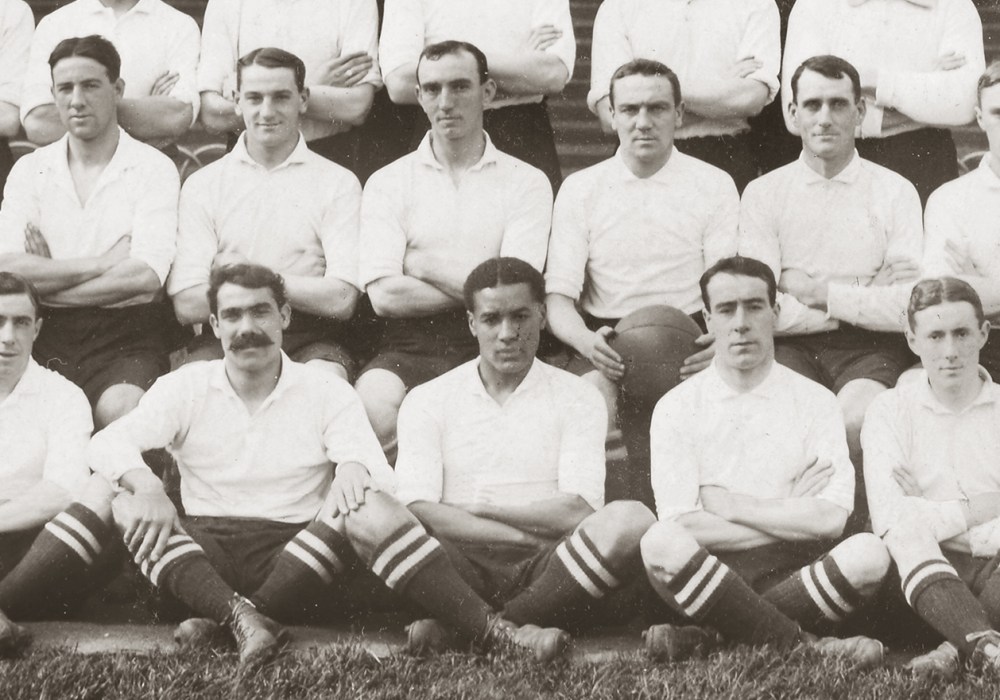
Inscribed on one of the panels is the name William Tull a Second Lieutenant of the Middlesex Regiment who had hung up his football boots to join the war effort. Part of a ‘Footballers Battallion’ which drew professional players from across different clubs, he fought on the Alpine Front between November 1917 and March 1918.
Tull arrived after the Battle of Caporetto, where the Austro-Hungarians and their German allies had fired chlorine-arsenic agent and diphosgene, forcing the Italian army into retreat. After leading 26 men on a night raid against an enemy position crossing the River Piave under heavy fire, the men under his command all returned unharmed. Tull was cited for his ‘Coolness and Gallantry’ by Major-General Sydney Lawford, whose son Peter was a Rat Pack member with Frank Sinatra. Tull had returned to the conflict after suffering ‘shell shock’ and became the first British-born black army officer and the first black man to lead white British troops into battle.
A man of firsts on the 1st of September 1909, Walter Tull became the first outfield, black, professional footballer when he wore the white of Tottenham Hotspur at Roker Park. It was Spurs first ever match in the topflight they would lose 3-1, but Tull would become a forefather for black footballers who followed in his footsteps. He had signed from Clapton F.C. as a robust and mobile inside forward and impressed enough to be taken on Tottenham’s 1909 tour of Argentina and Uruguay. The tour was the brainchild of Sir Fredrick Wall of the Football Association, it would see Everton and Spurs making a fourteen-thousand-mile trip. Wall would refuse war-time financial compensation to Anglo-Irish coach Jimmy Hogan for training MTK Budapest while interned as an enemy alien during World War I.
It was a nine-week adventure for Tull and his teammates involving three weeks of travel and twenty days of playing matches in South America; the two teams had successfully toured Astro-Hungary in 1905. Wall felt this tour would help promote the English game further afield. The Tottenham squad missed the boat on the Southampton quays, and a tugboat allowed them to catch it up in the Solent area; by the 6th of June 1909, Tull was lining out in Buenos Aires.
In an exhibition match watched on by ten thousand in the city, including the Argentine President José Figueroa Alcorta, Spurs and Everton drew 2-2.
A month earlier, on May Day, local workers had campaigned for human rights ‘Semana Roja’ as mass protests were called for against the backdrop of government-backed limitation of democratic liberties and repressive laws and regulations. As the workers began to march in the local square Plaza Lorea, the police opened fire, killing ten and injuring seventy. The tour yielded a profit of £300, which would promote football in the Argentine; Tull would enhance his reputation in South America as the local scribes wrote about the strength and skill of the inside forward of negro colour.
Following the loss to Sunderland, Tottenham faced champions Manchester United in their first-ever home game in the first division. Tull earned his side a penalty in a 2-2 draw – outside left George Wall scoring one of United’s goals his brother Tom would also perish like Tull in the Great War. On the 18th of September 1909, at Valley Parade, Tull became only the second black man to score a goal in the first division. The ground had been redeveloped by the renowned football architect Archibald Leitch following Bradford’s promotion.
However, across the land and the terraces of England, Tull would face weekly racism; it reached ahead at an away game at Bristol when the newspapers reported the barrage of hateful language and taunts the young man received upon his every touch. This affected Walter’s performances, and eventually, he would be dropped and ended up in the reserves in his first season playing sixteen games for Spurs second string.
Tull need not have worried the great innovator Herbert Chapman had his eye on the youngster, the man who would transform the red and white side of North London, introducing the world to Alex James and Cliff Bastin.
Chapman was then at Northampton Town. He was due to retire from football himself a Spurs player to become a mining engineer, but after teammate Walter Bull decided to turn down the advances of the cobblers to remain at White Hart Lane, Chapman stepped into the hot seat.
In 1901/02, Northampton was elected to the Southern League’s first division, joining Tottenham Hotspur and neighbours Kettering; for the first three seasons, the club finished mid-table. The team performances slumped, and by 1906/07 they had finished bottom of the league remaining in the league due to no automatic relegation.
Chapman arrived in the summer of 1907, and the club were crowned champions in 1908, the season before they had finished 8th, and Tottenham, who finished 7th, were elected to the old Football second division.
A rejuvenated Tull with Chapman’s unique management style found the net nine times that season from just twelve games played; this included a quartet in the thrashing of Bristol City 5-0. He would line out 110 times for Northampton before joining the war effort; his final game against Southampton ended in a 2-1 victory on the 18th of April 1914.
Walter Tull was born in the port town of Folkestone in 1888; and nearly a century earlier in nearby Portsmouth, two thousand black prisoners arrived on ships from the Caribbean most were imprisoned at Portchester Castle.
Tull’s father Daniel had landed in the UK from Barbados in 1876, making his way across the seas as a ship’s carpenter, under the sole direction of his master assisting in all-hands work required on the vessel. From a young age, Walter’s life was marked with tragedy. Aged seven, his mother died of breast cancer, two years later, his father passed away from heart disease. Walter and his siblings found themselves orphans, and eventually, an orphanage in Bethnal Green accepted the brothers.
On the 21st of March 1918 in Arras at 4:40 am, the German Spring offensive began six thousand six hundred guns fired 3.5 million explosive shells over five hours on British positions. In the firing line, that day was Walter Tull among the two hundred and fifty thousand casualties suffered by the combined British and French forces. Tull took his last breath in ‘No Man’s Land’ Private Tom Billingham, who had starred in nets for Leicester Fosse before the war, tried unsuccessfully to drag his body back to the trenches.
In 1984 three quarters of a century after Tull had toured South America, John Barnes, one of the most gifted wingers ever to grace the English game, found himself in Brazil. It was the 10th of June forty-three minutes had passed in the friendly game between England and Brazil fifty-sixty thousand one hundred and twenty-six souls were in the Maracana when Barnes chested the ball on the left-wing. Moving inside, he ghosted past Brazil’s right full-back, Leandro. He moved with menace into the opposition’s penalty box, swerving beyond the advances of Mozer and Ricardo Gomes before leaving keeper Roberto Costa sprawling and nonchantly slotting the ball into an empty net.
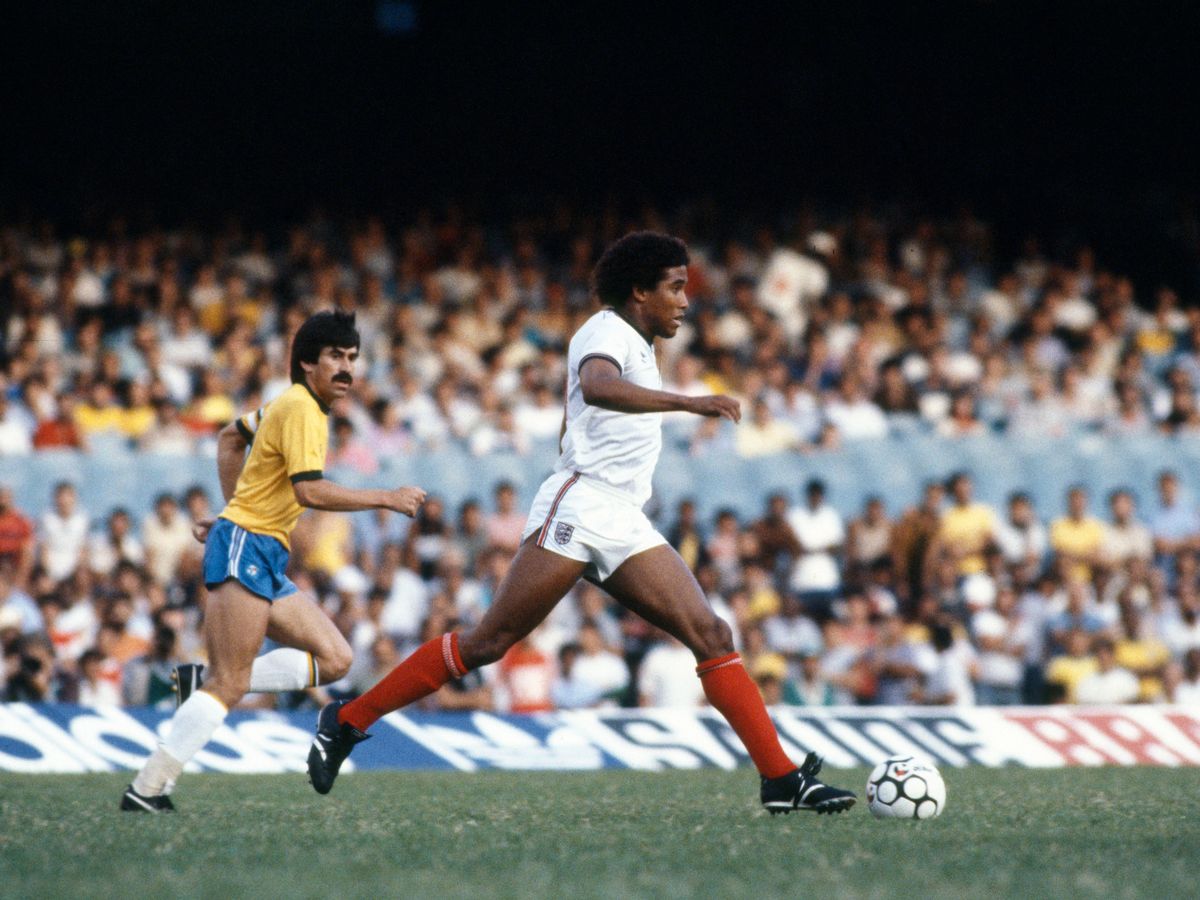
It was pure genius, for some though one of England’s greatest goals did not exist as miners fought the Iron Lady back home; the National Front had infiltrated the terraces of England. A few days after his ‘Barnstorming’ performance, a reference from the headlines on the back pages, Barnes and England headed for Montevideo and a game against Uruguay.’ On the journey, Barnes was confronted by the National Front group, being told, ‘England only won 1-0 as a N****s goal doesn’t count’ – Barnes had also set up the second goal for Portsmouth’s Mark Hateley, a header from a pinpoint cross from the Watford winger. Throughout the 1980s, Barnes, like all black footballers, would find himself being racially targeted at most football grounds in England; one-touch would be greeted with boos and monkey chants. Barnes would famously back flick a banana skin off the pitch at Goodison Park in 1988.
One man learning his trade in that period was Ian Wright reared on the Merritt Road in Southeast London. He, like Tull, would be a forward and one of Arsenal’s greatest – one hundred and eighty-five goals in just two hundred and eighty-eighth appearances the darling of the Northbank. The current Match of the Day pundit found himself dealing with daily abuse from his stepdad when the very programme came on the TV; Wright would be forced to stand in front of the wall and turn away from the TV so he could not watch the game he loved. A peek at the pictures coming from the TV by young Ian would mean being screamed at to remain in position.

In May 2020, Wright was racially abused online by a youth from Ireland. In the local courts, the crime went unpunished; a first offence and coming from a decent family were the order of the day. You wonder about the mentality of some in a country which across the continent were referred to ‘as the blacks of Europe’ and a nation who faced signs ‘no blacks, no dogs, no Irish’ upon setting foot in Britain. The first black footballer to represent the Republic of Ireland also came from Tottenham Hotspur in full-back Chris Hughton who made his debut in 1979 at Dalymount Park versus the USA.
As football gets ready for another European Championships tournament and modern-day black footballers, continue the fight against racism, not far from where Tull made his debut in the Northeast England line out.
We have come a long way from the days of Walter Tull, but as the boos reverberate around the Riverside Stadium as those England players take the knee, have we?
 A Bohemian Sporting Life