Freebooting around the rock of Gibraltar

Co-written with Michael Kielty

Given that Gibraltar are one of the newest members of UEFA you wouldn’t expect there to be much of a footballing history between the tiny British Overseas Territory and Ireland, but what if I told you there was a prominent footballer from Gibraltar playing in Dublin at the very dawn of organised football? That man was Gonzalo Canilla and he was a fixture on the Dublin sporting scene of the 1890s, lining out for both Bohemian F.C. and Freebooters F.C. as well as excelling on the cricket pitch.

Canilla was born in Gibraltar in 1876, he came from a pious Catholic family, with his uncle and namesake having been made Catholic bishop of Gibraltar in 1881. The younger Gonzalo was sent to England to further his education, where he attended the prestigious Catholic boarding school, Stonyhurst College in Lancashire, and this is where his connection with Irish football first emerges. Among his fellow classmates were many young men from prominent Dublin families, including Oliver St. John Gogarty and the Meldon brothers George and Philip.

Gogarty found his greatest fame as a writer but was also a talented athlete, he was a strong swimmer and was also a Leinster Senior Cup winner with Bohemians as an outside right, while Phillip Meldon, one of the founding members of Freebooters F.C, became an Irish international footballer.  Freebooters, one of Dublin’s earliest clubs, were based in Simmonscourt, near the present-day Aviva Stadium and were also founding members of the Leinster Football Association.

Canilla, played for both clubs after leaving Stonyhurst for further studies in the Royal College of Surgeons in Dublin. He even took his preparatory exams in Bell’s Academy on North Great George’s Street. Several students at Bell’s Academy had been among the founders of Bohemians in 1890.  It’s during this time that an 18 year old Canilla first appears for Bohemians as a full back against Athlone in January 1895. By then Canilla was also playing cricket for Phoenix Cricket Club. This was quite common at the time and many of his footballing teammates were also colleagues or opponents on the cricket pitch.  By 1897 there are reports of Canilla lining out for Freebooters and by the end of the following year he had formalised this by switching his registration to them, from Bohemians. The club, with Canilla in their side at full back finished in second place in the Leinster Senior League.

By 1899 however, having successfully completed his final examinations in the RCSI, Dr. Gonzalo Canilla departed Ireland for his native Gibraltar. Newspaper reports described him as someone “long and favourably associated with cricket and football” and that a “large crowd of sportsmen” gathered to see him off from Westland Row station to the strains of Auld Lang Syne.  In total Gonzala Canilla’s Irish sporting career lasted about four years which saw him play at the highest level in Dublin at the time.

Canilla married his wife Antonia in 1904 and they had at least two children. Gonzalo practiced medicine in England until 1916 then becoming the Rio Tinto mining company doctor in Huelva, Spain. He played competitive cricket in Spain and then recreational golf until his retirement, he passed away in 1955.

His grandson David Cluett was also a successful footballer, he won 69 caps as a goalkeeper for Malta, including an appearance in a 2-0 defeat to the Republic of Ireland in 1989 as well as winning numerous honours in the Maltese game, primarily for the Floriana club.

Cricket team 1901

Dr. Canilla is in the front row holding the cricket bat


With special thanks to the Canilla/Cluett family for their assistance. This piece featured in the Ireland v Gibraltar match programme (June 10th 2019) and has also been shared on Bohemians.ie 


My United States of first ever

Back in 2000 the then Enterprise Minister Mary Harney told a gathering of the American Bar Association that Ireland was “a lot closer to Boston than Berlin”. At the time that statement provoked plenty of debate and whatever your views its accuracy it held a certain truth in the very early days of the FAI. There was certainly a greater footballing closeness with the Americans than with our near neighbours in Britain. When the Football Association of Ireland formed out of the split from the Belfast-based IFA they entered a very inhospitable footballing climate. They were no longer part of the British Championship and their requests for fixtures with neighbouring Associations were rebuffed. Looking further afield international recognition came from FIFA in 1923 and the following summer the FAI sent an amateur international side to compete in the Paris Olympics in what was to be the nascent Association’s first foray into International football.

A victory over Bulgaria in the opening round, followed by a quarter final exit after extra time to the Dutch was a credible performance for a new and poorly funded side. But there was little on the horizon in terms of a home international. Here however enter the Americans; another side who had likewise been knocked out in the Olympic quarter finals would be heading Ireland’s way shortly after.

The USA had been knocked out by eventual winners Uruguay and had taken the opportunity to play a couple of friendly games before the long journey back across the Atlantic. After defeating Poland 3-2 in Warsaw on June 10th the Americans were swiftly on a boat to Cork and then by train to Dublin to play the Irish on June 14th 1924 in Dalymount Park.

It was a game of many firsts. It was a first home match for the FAI, indeed it was the first Irish international to be held in Dublin since 1913. It was one of the first football matches to feature the playing of Amhrán na bhFiann as the national anthem (an official decision had not been made on a post-Independence anthem and other songs such as Let Erin Remember had been used before), and it recorded the first hat-trick for the young Free State side as the Irish ran out 3-1 winners.

The side that had travelled to the Olympics had been all amateur but there were to be some changes ahead of the American game. St. James’s Gate’s Charlie Dowdall for one was unavailable. He had gone to visit relatives in England on his was back from Paris!

In goal Frank Collins joined the side. Collins has spent a season as a professional with Glasgow Celtic and had already been capped by the IFA but he was back working as a baker in Dublin in 1924 and playing for his employers Jacob’s in the League of Ireland. Another who was making a debut appearance was the hat-trick hero Ned Brooks of Bohemians, like Collins he had also been previously capped by the IFA.

The USA game was to be his only appearance for Ireland which means he has an enviable goals per game ratio. He started at centre-forward which meant that Paddy Duncan of St. James’s Gate was withdrawn into the midfield which seemed to have the desired affect against the Americans. The side in this first home international was captained by Brooks’ Bohemian team-mate Bertie Kerr.

Brooks ad

Ned Brooks featuring in an advertisement

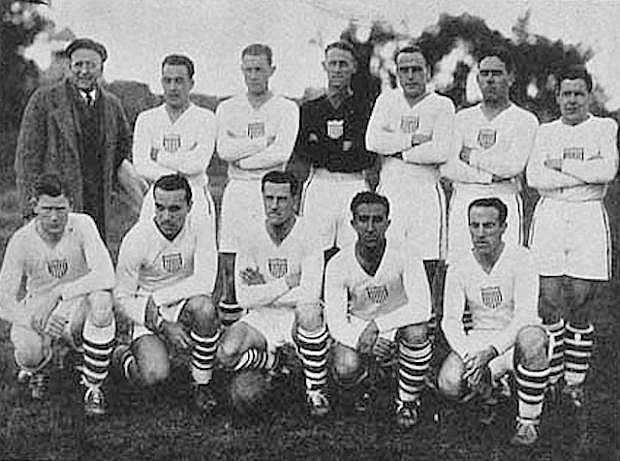
Most of the USA players were active in the American Soccer League (ASL), an early professional soccer league based mainly around the states of New York, New Jersey and Pennsylvania. Many of the participating clubs would have found similarities with the likes of Jacobs and James’s Gate as they too were works teams. The side’s star player on the day was their goalkeeper, Jimmy Douglas who would have a relatively long international career with the USA, featuring for them in the semi-final of the inaugural World Cup in 1930 (see banner pic). A goal from James Rhody of Harrison F.C. and that fine performance for Douglas in goal was as good as it got for the USA on the day.

Pathé newsreel footage of the game can be seen here.

There was also an Irish connection with the USA party, their Association President Peter J. Peel was in Dalymount Park in 1924 and it was sure to have been a familiar sight. Peel had been born in Dublin and moved to Chicago as a young man. He was a sporting all-rounder, prominent in the fields of golf and tennis in his home city. Such was his devotion to football that he was convinced that it would outstrip baseball in the competition for American sporting affections within five years. Peel obviously had the Irish gift of the gab matched with an American sense of indefatigable optimism though with the continued growth of the MLS who is to say that the predictions of a Dubliner some 94 years ago may yet come to pass?


This article first appeared in the June 2018 match programme for the Republic of Ireland v USA international friendly match.

Ernie Crawford he’s our friend

Regular attendees to Dalymount Park may have noticed a new flag appearing around Block F. It features a bare chested man with a Charlie Chaplin moustache and bears the legend Ernie Crawford – He’s our friend, he hates Rovers. But who, you may ask was Ernie Crawford?

Born in Belfast in November 1891 Ernie was perhaps best known for his endeavours on the Rugby pitch. He starred for Malone in Belfast and later Lansdowne Rugby Club and won 30 caps for Ireland, fifteen of them as Captain between 1920 and 1927. After retirement he was heavily involved in administration as President of Lansdowne Rugby Club between 1939 and 1941 and President of the IRFU in the 1957/58 season as well as being an Irish team selector between 1943 and 1951 and again between 1955-1957. His obituary in the Irish Times listed him as one of the greatest rugby full-backs of all time, he was honoured for his contribution to sport by the French government and even featured on a Tongan stamp celebrating rugby icons.

He was also a successful football player who turned out for Cliftonville, for Bohemians and on a number of occasions for Athlone Town. He was even a passable cricket player. Ernie was a chartered accountant by trade and moved to Dublin to take up the role of accountant at the Rathmines Urban Council in 1919, and this facilitated his joining Bohemians. Despite his greater reputation as a rugby player, Ernie, as a footballer for Bohs, was still considered talented enough to be part of the initial national squad selected by the FAIFS (now the FAI) for the 1924 Olympics in Paris. In all, six Bohemians were selected (Bertie Kerr, Jack McCarthy, Christy Robinson, John Thomas & Johnny Murray were the others and were trained by Bohs’ Charlie Harris), but when the squad had to be cut to only 16 players Ernie was dropped, though he chose to accompany the squad to France as a reserve. The fact that he was born in Belfast may have led to him being cut due to the tension that existed with the FAIFS and the IFA over player selection. However, even as a travelling supporter, he caused some controversy. He was stopped by customs officials en route to Paris and had to explain the presence of a revolver in his possessions. Ernie’s reply was merely that he brought the gun for his “piece of mind”. Not that this was Ernie’s first experience with firearms.

Crawford collage

Ernie in military uniform, appearing on a Tongan postage stamp and in rugby kit

Ernie had served and been injured during the First World War. That he could captain the Irish Rugby Team and be selected for the Olympics is even more impressive when you consider that during the Great War Ernie was shot in the wrist at Arras, France in 1917 causing him to be invalided from the Army and to lose the power in three of his fingers. He had enlisted in the 6th Inniskilling Dragoons in October 1914 and was commissioned and later posted to the London Regiment (Royal Fusiliers), becoming a Lieutenant in August 1917. After his injury he finished his war service on the staff of the Ministry of Munitions. He was a recipient of both the British War medal and Victory Medal.

Ernie later returned to Belfast where he became City Treasurer in 1933. It was in Belfast in 1943 that Ernie encountered Bohs again, as he was chosen to present the Gypsies with the Condor Cup after their victory over Linfield in the annual challenge match.

One of the reasons that his memory has lasted nearly a century with the Bohemians faithful and why a group of us decided to get a flag made up bearing his image centres around a minor cup tie. Ernie, due to his Rugby and also his professional commitments tended to not be a regular starter for Bohemians, his appearances tended to be because of the injury or suspension of other players or as part of reduced strength sides in smaller cup competitions.

As we all know however, when it comes to games against Rovers there are no “smaller ties”. After one particularly tough cup game against Shamrock Rovers an angry Crawford removed his jersey challenged Rovers star forward Bob Fullam to a fight in the middle of the pitch. It’s this moment that the image on the flag imagines!

Fullam himself was no shrinking violet, as well as being an accomplished footballer who was capped twice by Ireland he supplemented his income as a docker in Dublin Port. He finished the 1922 FAI Cup final amid a mass brawl after Rovers were beaten by St. James Gate. The fighting only ceased when the brother of the Gate’s Charlie Dowdall reportedly confronted Fullam with a pistol.

Ernie himself seemed to have been one of those “larger than life” characters, quite aside from bringing a gun to the Olympics and bare-chested on-pitch scraps he also fell foul of Rugby referees one of whom complained about Crawford’s back-chat and claimed that such was the roughness of his play “that the definition of a “tackle” should be sent in black and white to him”. On another occassion an English rugby opponent remembers Crawford treating him and his wife to dinner and giving them a lift back in his car which didn’t happen to have any working headlights. Ernie in an attempt to beat traffic tried to get between a tram and the pavement without much success, badly denting the side of his car and scratching up the paintwork of the tram car. The angry tram driver jumped from the vehicle but on recognising that the other driver was non other than Irish rugby captain Ernie Crawford he let the car pass unhindered, taking off more paint as he went.

In 1932 he became the first man from Britain or Ireland to be awarded the silver medal of honour by the French ministry of sport and physical education for his contributions to the world of sport. Apart from sport he was obviously professionally successful, being City Treasurer of Belfast until his retirement in 1954, he was also trained as a barrister and took an interest in economics. He died in 1959 and was survived by his wife and three children.

Ernie Crawford, he’s our friend.

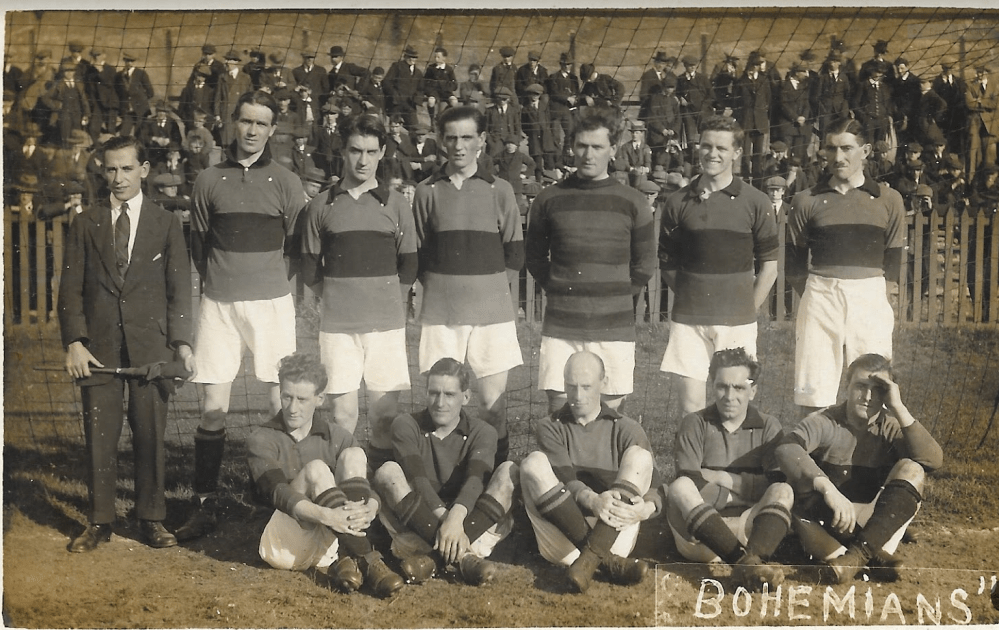
Ernie is pictured below on the back row, far right as part of the Bohemian FC squad of 1920-21.

Bohs 192021 EC

Useful resources on Ernie’s career include Paul Rouse’s History of Irish Sport, Tadhg Carey’s When we were Kings and David Needham’s Ireland’s first real World Cup and the Dictionary of Irish biography.

Celtic connections

They came across the narrow channel from the Antrim coast in the north-east of Ireland to the island of Iona in a wicker currach leaving behind conflict and bringing their religion to the neighbouring land. It was the year 563AD and their leader was Columba, a man now venerated as a Saint whose patronages include the lands of Ireland and Scotland and with him he rather appropriately brought twelve followers.

He certainly wasn’t the first Irish man to make this crossing. The Dál Riata kingdom of north Antrim had been expanding into western Scotland since the early 5th Century, even before that in the 3rd Century the Picts who lived north of Hadrian’s Wall had sought help from their Irish neighbours in their campaigns against Roman imperial might. Back then the Romans had referred to the tribes of northern Britain as the Caledonians, they called their Irish allies the Scotti.

In time Iona, where Columba landed became a great centre of learning and religious devotion and a prestigious Abbey was founded there. From Iona, the Picts were gradually converted to Christianity as were the Anglo-Saxons of Northumbria. In the centuries to come the name of the Scotti would become the name of the Gaelic speaking land north of the River Forth; Scotland – the land of the Gaels. Iona remained a focal point for centuries, it was a burial place for Scottish Kings who traced their power and authority back to the sacred island.

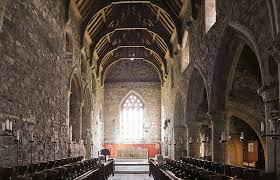
Iona monastery

The medieval Abbey church on Iona

But if the Irish gave Scotland its very name and the beginnings of the Christian faith then the Scots can lay some claim to giving Ireland football. In 1878, so the story goes, John McAlery, a Belfast businessman was on his honeymoon in Scotland and went to watch a game of Association Football. The views of Mrs. McAlery on this matter are not recorded. Greatly enamoured with the game the sporty Mr. McAlery arranged for an exhibition game to take place later that year in the Ulster Cricket Grounds in Belfast between Scottish sides Queens Park and Caledonians with Queen’s Park running out 3-2 winners.

A year later he formed Cliftonville Association Football Club in his home city and they advertised for new players as a club playing under the “Scottish Association Rules”. By the end of 1880 McAlery, along with  representatives from six other clubs had formed the Irish Football Association (IFA). Cliftonville F.C. exist to this day, while the IFA remains the 4th oldest Football Association in the world. While football had existed in Ireland before John McAlery it was he who set about putting in place a proper organisation and structure around the game. Had John taken his honeymoon somewhere other than Scotland then the history of football in Ireland may have been very different. Sadly the McAlery honeymoon story is definitely apochryphal but this hasn’t stopped it persisting. What is undeniable is that McAlery, and Scottish Clubs were at the forefront of the instigation of organised football in Ireland.

The game had grown quickly in the north east of Ireland and began in time to gain popularity in Dublin as well with the formation of clubs like Bohemian F.C. (1890) and Shelbourne F.C. (1895). A league was duly formed as well as cup competitions. But despite the good works of John McAlery and other early pioneers of the game Ireland’s early record in international competition makes for some harrowing reading. The international highlight in the early years was a 1-1 draw with Wales in 1883 sandwiched between a 7-0 loss to England and a 5-0 loss to Scotland. It would be 1914 before the Irish would win the annual Home Nations Championship outright, defeating Wales and England before facing Scotland knowing that if they avoided defeat they would triumph. Despite the match being held in Belfast Scotland remained the favourites, the Irish papers noting especially that the Scots were the more physically imposing side. However, in a torrential downpour a weakened Irish side managed to secure a draw and with it their first outright victory in the Home Nations Championship. They hadn’t beaten the Scots but they had won the day.

It was to be the last victory as a united Ireland though, not long after the end of the First World War the Football Association of Ireland (FAI) was formed as a breakaway association from the IFA. The FAI eventually secured recognition from FIFA and, grudgingly, from the Home Nations as the Association representing the 26 counties that would become the Republic of Ireland. What they could not secure however was favour from the Home Nations who refused all fixture invitations from the nascent organisation. Eventually over two decades later England agreed to a friendly in 1946, Wales waited until 1960 before playing the Republic. Scotland refused all invitations and only played the Republic when drawn against them in a qualifier in 1961. Despite their breakaway from the IFA the FAI remained in awe of the Home Nations and valued games against them more than any other, they fervently craved not only the money that these games would bring but also some sense of acceptance from their neighbours. Naturally this made the cold shoulder that they received all the more painful.

This desperation for acceptance can be encapsulated in a single game. In 1939 Ireland were due to play the Hungarians, who had been runners up to Italy in the 1938 World Cup and had played against Ireland twice before in the recent past. On both occasions the matches took place in Dalymount Park in Dublin. However on this occasion the match took place in the smaller Mardyke grounds of University College Cork and home to League of Ireland side Cork F.C.

So why were the World Cup runners up being asked to play in a University sports ground rather than at the larger capacity Dalymount? Well because there was a bigger game taking place in Dalymount just two days earlier on St. Patrick’s Day 1939, when the League of Ireland representative side were taking on their Scottish league counterparts.

Even a game against a Scottish League XI was viewed as a huge mark of acceptance from their Scottish peers. While the game in the Mardyke would attract 18,000 spectators, a respectable return, over 35,000 would pack into Dalymount Park to see the stars of the Scottish League. At the time commentators were moved to describe the match against the Scottish League as “the most attractive and far reaching fixture that had been secured and staged by the South since they set out to fend for themselves” before adding that “for 20 years various and futile efforts have been made to gain recognition and equal status with the big countries at home. Equality is admitted by the visit of the Scottish League”. For the FAI a game against any Scottish team was a game against giants.

Giants, funnily enough, feature prominently in Celtic mythology. Fionn MacCumhaill is arguably Ireland’s most famous character from myth, famed for his size and for his prodigious strength. He is credited with having created the Isle of Mann by scooping out the land of Loch Neagh and hurling it into the Irish Sea. However even a man of this power was no match for the Scottish giant Benandonner. In myth Fionn learns that Benandonner is coming for him in combat from Scotland and Fionn does the only sensible thing, he runs to his wife for help. Benandonner is so huge that Fionn fears that even he won’t stand a chance in a fight so he does what any man would do, he has his wife dress him up as a giant baby and put him sleeping in a cradle in front of his fire. When Benandonner arrives demanding to know where Fionn is, Fionn’s wife Oona tells him that he is out but will be back shortly. She introduces the “baby” as her and Fionn’s infant son. Seeing the size of the baby and not wanting to meet the enormous child’s father Benandonner flees back to Scotland, on his way he destroys the bridge that links Scotland and Ireland behind him. Folklore tells that Antrim’s Giant’s Causway was a left as the remnants of this destroyed bridge.

For the FAI the Scots remained giants. Like Benandonner they could not be beaten by force but only by cunning. In 1963 a 1-0  victory by Ireland over Scotland in a friendly was greeted with elation by the Irish football public as one of its greatest ever  despite the narrow nature of the win.

While the awe in which the Scottish national team were held has faded significantly over the intervening decades the affection and devotion to one of her clubs remains as strong as ever. Writing as a Dubliner it sometimes seems impossible to avoid the prevalence of Celtic jerseys in my home city. In many ways this is understandable, while the island of Ireland might be grateful to John McAlery for bringing Scottish footballers to Ireland, the Irish in turn had a significant impact in creating the footballing landscape of Scotland. Beginning with the foundation of Hibernian F.C. in 1875 and continuing with the foundation of clubs like Dundee Harp, Dundee United and Celtic the Irish immigrant community and their descendants helped to create some of the most significant football clubs in Scotland.

This came about largely because of a period of mass migration of Irish people to Scotland from the 1820’s onward. Scotland’s industrial towns provided jobs, while Irish counties like Down, Antrim, Sligo and Donegal provided willing seasonable labour for Scottish factories, shipyards and farmers and this mass influx across the Irish Sea gathered apace after the Potato Famine began to grip Ireland in 1845. The parentage rule as introduced by FIFA has meant that the Irish national team have continually benefited from this immigrant connection even at the recent Euros two members of the Irish squad were Scottish born players; Aiden McGeady and James McCarthy.

Domestically clubs like Hibs and Celtic would emerge from these immigrant communities, often forming a charitable focal point at the centre of new Irish communities. While Hibs still prominently wear green and white and their current logo includes an Irish harp as a nod to their foundation (though it was removed from the crest for a period after the 1950s) they seem to be less defined by an Irish identity. Celtic however are for many the Irish club. This does have the tendency to cause some confusion for those fans of clubs actually based in Ireland.

Celtic’s Irish credentials are indeed impeccable. Founded in 1888 by Andrew Kerins an Irish Marist brother from Co. Sligo, (better known as Brother Walfrid), the club was created to support the poverty stricken Irish community in Glasgow. When Celtic Park was being opened in 1892 it was the Irish Nationalist and Land reform agitator Michael Davitt who laid the first sod,  the turf brought over from the “auld sod”, Co. Donegal. Davitt would be made an honorary patron of Celtic,  a position he also enjoyed in the Gaelic Athletic Association (GAA) who in 1905 would issue a ban on any member either participating in or even watching ‘foreign’ games.

“Foreign Games” meant anything that could be construed to be English, or indeed Scottish and as such obviously included Association Football which may have put the ageing Davitt in an awkward situation. The club have also had many prominent Irish players and managers associated with them throughout their long history; men such as Neil Lennon, Seán Fallon, Martin O’Neill and Packie Bonner, while even the likes of Roy and Robbie Keane have had brief Celtic cameos during their careers. In terms of ownership Irish businessman Dermot Desmond is the club’s largest individual shareholder. The early successes of Celtic helped prove that imitation was the sincerest form of flattery as in 1891 a group of Belfast sports enthusiasts from the Falls Road area formed Belfast Celtic F.C. Their early Chairman James Keenan noting that they chose their name “after our Glasgow friends, and that our aim should be to imitate them in their style of play, win the Irish Cup, and follow their example, especially in the cause of Charity.”

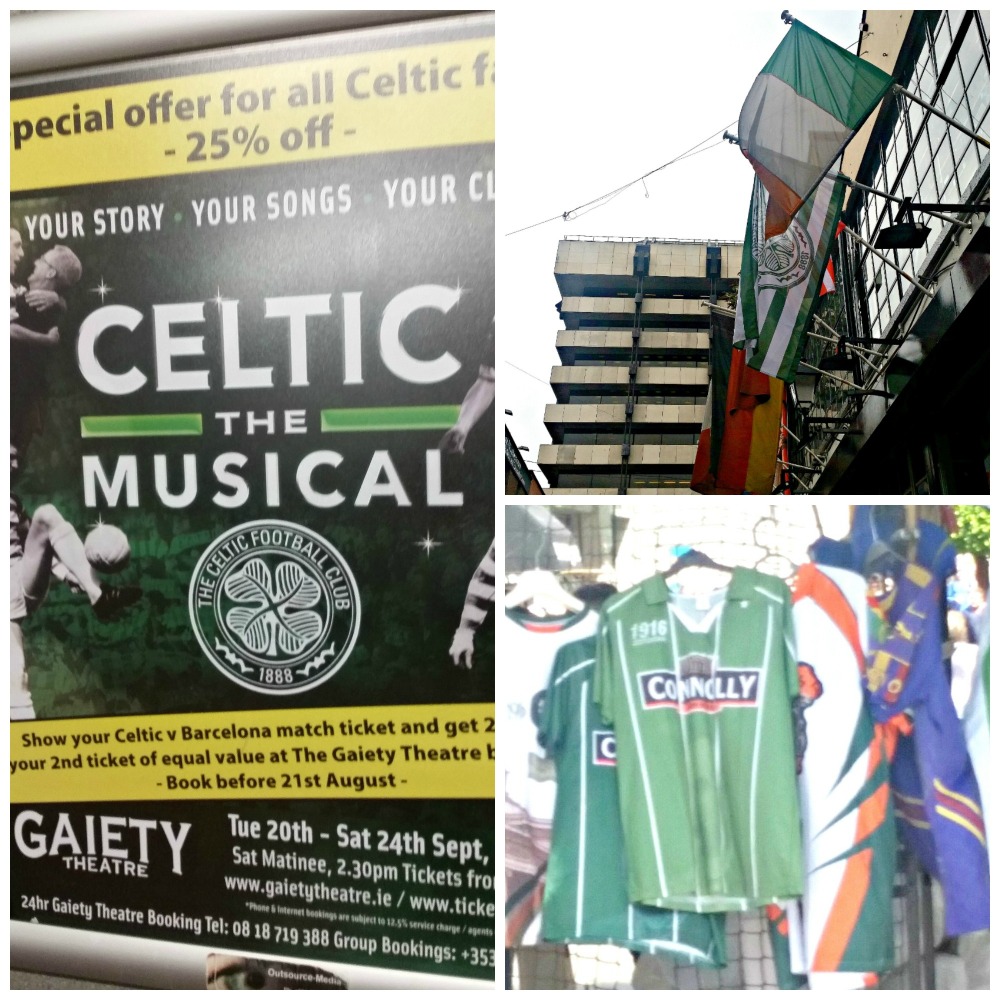
While all of this provides a strong basis for the popularity of the club in Ireland the other major aspect is of course that Celtic have been successful, from being the first British winners of the European Cup in 1967 to their 47 Scottish League titles theirs is a level of dominance, at least at domestic level, that is rarely seen. While as recently as the 2002-03 season Celtic reached the final of the UEFA Cup the fortunes of the club and the Scottish League in general have struggled recently when it has come to progress at European level. Despite this, support remains strong for the club in Ireland and their presence ubiquitous. Celtic flags and banners fly from Dublin city pubs while a musical treatment of Celtic’s history plays at present in one of the city’s most prominent theatres. In the commemorations to mark the centenary of the 1916 Rising the imagery of Celtic has been invoked as somewhat apocryphally one can purchase a “replica” Celtic jersey emblazoned with the name “Connolly” where once a Magners cider logo appeared. A reference to the Scottish born labour activist James Connolly who was among the leaders of the Rising; son of Irish immigrants he was born in the Cowgate area of Edinburgh and was a passionate Hibernian fan.

Celtic collage

“Celtic the Musical” in Dublin’s Gaiety Theatre, an Irish tricolour next to a Celtic Flag at a restaurant in Temple Bar, a “replica” Celtic jersey featuring the name of executed 1916 leader James Connolly.

The stories of Fionn and Benandonner, the competing giants of Ireland and Scotland remain prominent stories in Irish folklore however they enjoyed a new lease of life in the 18th Century when Scottish poet James Macpherson compiled and re-framed the ancient myths into a book of poetry. The publication of his work was a literary sensation at the time but also caused debate and controversy as Irish historians felt their literature and history were being appropriated. The truth is that as we’ve seen with the historic patterns of movement and the shared culture between the two islands; from 6th Century monks to the Ulster plantations and the Famine migrations of the mid 19th Century, the two nations share far more similarities than some political groups and indeed football fans would care to admit. It was from Scotland that the original Irish football organisers took their inspiration but even by that stage the Irish in Scotland were already creating clubs that would help to dominate the Scottish football landscape. In a confused and confusing identity relationship it becomes hard to separate the interwoven strands of our social and sporting DNA. Where the Irish ends and the Scottish begins.

This article originally appeared in the Football Pink issue 14, they’re a great publication and well worth a subscription.

Ireland at Euro 1964: First time to the last 8

Dublin hosting the European Championships, what once was the sort of thing speculated about during the excess of the Celtic Tiger years, usually as part of some sort of All-Ireland, pan-Celtic bid, will come to pass in 2020. The Irish Capital has been chosen as one of 13 “host cities” for a 60th anniversary celebration tournament. We will of course have to qualify if there is to be any chance of seeing an Irish team in action on home soil.

However the idea of hosting all tournament matches in the same one or two countries is relatively recent. When the first Euros were held in 1960 in France only the semi-finals, finals and 3rd/4th playoff were played in the host country while only in 1980 did the tournament grow to eight teams. The qualifying was somewhat more straight-forward in those days as UEFA was a much smaller place. The Soviet Union had a single team, the Czech Republic and Slovakia had not separated and Yugoslavia hadn’t splintered into its constituent parts.

In 1964, during the second ever tournament, Ireland even got as far as the quarter-finals which were two-legged affairs, home and away. These quarter-final games took place in March and April of 1964 before the semi-finals and finals took place in the host country of Spain in the middle of June.

Ireland had had an inauspicious start during the first Euros in 1960. With 17 nations entering and a straight knock-out style of qualification without a group format, one pair of nations would have to play a preliminary round to even up the numbers. Ireland were drawn with Czechoslovakia and despite a promising start in the home leg with Ireland winning 2-0 they were eventually eliminated 4-2 on aggregate by an improving Czech side that would make it all the way to the World Cup final only two years later.

Four years later in 1964 there was thankfully no preliminary round for the Irish but the qualifying format continued as a straight knock-out competition. Round one pitched Ireland against Iceland with Ireland drawn at home first with the game starting well with Newcastle’s Liam Touhy getting Ireland off the mark after just 11 minutes and while Ríkharður Jónsson equalised for Iceland Amby Fogarty of Sunderland restored Ireland’s lead before half time. In the second half Noel Cantwell extended Ireland’s lead to 4-1 with two goals before Jónsson grabbed a consolation before the final whistle. Cantwell usually lined out at full back for his club Manchester United but was often employed as a centre forward for Ireland. Tall and well-built Cantwell made a good target man and also had a strong shot, he was Ireland’s usual penalty taker and scored an impressive 14 goals in 36 appearances, a record for Ireland that wasn’t broken until the heyday of Don Givens in the 1970s.

iceland v ireland

Ireland v Iceland with Noel Cantwell on the programme cover

A weakened Irish team made the journey to Reykvanik for the return leg, the side were without Giles in midfield and Tony Dunne in defence and had to settle for a 1-1 draw, Tuohy again on the scoresheet. This 5-3 aggregate victory set up a meeting with Austria in the second round.

Now Austria have never been Ireland’s easiest opponents, David Alaba’s fantastic strike in qualifying for Brazil 2014 will be fresh in the memories of Irish fans. Many of us will also remember the pair of 3-1 losses late in Jack Charlton’s tenure, including Ireland’s infamous pre-match preparation of a visit to Harry Ramsden’s fish and chip restaurant the day before the home game. Back in 1963 our record was not much healthier, it read played 4, won 1, lost 3, including a 6-0 shellacking way back in 1952. However, things would be different this time round.

Ireland were drawn away in the opening leg and were not at full strength, and there was significant trepidation ahead of the trip to Vienna with certain newspapers suggesting that a weakened Irish side would need a miracle to get a result and that the focus should be one of damaged limitation and preserving national pride. Ireland were without Cantwell and Tony Dunne who were not released by Manchester United and there would be three débutantes for the game, Bohemians’ right back Willie Browne (until Joey Lapira the last amateur capped by Ireland), Ray Brady of QPR in the centre of defence alongside Charlie Hurley and Ronnie Whelan Snr of St. Patrick’s Athletic at inside forward. The conditions however suited Ireland with the game being played in a downpour and Ray Brady in particular impressing. Well, impressing the Irish fans at least, the Austrians were not pleased with what they viewed as Brady’s rough play. His combative style also upset the Austrian players, so much so that he was kicked by one of the Austrian forwards who was luckily quick enough to escape retaliation from a furious Brady before the referee intervened to calm things down. Apart from Brady an inspired performance by Alan Kelly Snr. in goal denied the Austrians on numerous occasions and they were unable to force a goal and the game ended 0-0.

The controversy didn’t end with the away leg, while Ireland would be ultimately successful against Austria in Dalymount Park the game very nearly could have been called off. There are plenty of examples from Ireland’s football history of unjust decisions going against us in games and stories of hotels serving dodgy food or rowdy fans creating so much noise that the Irish players couldn’t sleep before a game. This time however it was the Irish fans who were the ones doing the intimidating. Over the course of the game, which Ireland won 3-2 there were no less than four pitch invasions! The old Phibsboro ground was packed with over 40,000 people, including a number who clambered up the floodlight pylons to get a better view so its not too surprising that there might have been some incursions onto the field.  The most controversial was the pitch invasion just before the final whistle. Ireland had been just awarded a penalty when a Joe Haverty cross was handled in box in the 89th minute. The crowd spilled onto the pitch yet again and had to be herded back by Gardaí and stewards just as had happened earlier when they encroached on the pitch at half time and also to celebrate the second Irish goal.

ireland-1963-crop

Ireland team v Austria

Duly intimidated by the boisterous Irish crowd the Austrian keeper Gernot Fraydl dived the wrong way and Noel Cantwell’s second goal sealed a famous victory for the Irish. They were through to the quarter-finals of the European Championships. It had not been a pretty game, Ireland had effectively played much of the match with only ten men after Blackburn’s Mick McGrath was kicked in the head early in the first half, McGrath had to get seven stitches in his scalp and although he togged back out for the second half he was pretty much a passenger for the rest of the game, stuck out ineffectively on the right wing. The Irish too, knew how to dish it out and the Irish Times correspondent described their tackling as “verging on the unorthodox”. The Austrians were furious after the game and their Coach Karl Decker threatened to appeal to UEFA to overthrow the result and force a replay due to the pitch invasions. The result stood however, and despite the intimidating atmosphere Ireland had played well with Millwall’s diminutive winger Joe Haverty coming in for special praise, Brady and Hurley had performed well in defence with the result that Alan Kelly in the Ireland goal was not unduly tested apart from Austria’s two strikes. While the central Europeans were perhaps the better footballing side the weather had been against them in the first leg and the Irish had out-competed them in the return fixture. Next up for the Irish were the Spaniards in the last 8.

The Spaniards were hosts of the ’64 semi-finals and finals with games split between Camp Nou in Barcelona and the Bernabeu stadium in Madrid. In 1960 despite boasting some scintillating talents and numerous stars from the all-conquering Real Madrid side the Spaniards had essentially withdrawn from the inaugural European Championships (or nations cup as it was then known)  when they had been drawn away to the USSR. Just two days before the game was to be played the Spanish team withdrew and when a furious Alfredo Di Stefano confronted the President of the Spanish Football Federation, Alfonso de la Fuente Chaos as to why they were not travelling to Moscow he was told, “Orders from above,”. Franco himself had intervened. The Soviets, who had militarily backed the Republican side against Franco in the Spanish Civil War would see their side progress. They would eventually become the tournaments inaugural winners, beating Yugoslavia after extra time in the final. It had been a disaster for the reputation of Spanish football and even for Franco himself, they would have to make amends in ’64.

The first leg of the quarter final would take place on 11th March 1964 in the Sanchez Pizjuan stadium, home of Sevilla. The Spanish national team had used this stadium as a home base many time before and since due to the undoubted passion and volume of the local Andalusian crowd. Things did not start well for Ireland, due to the FA Cup sixth round tie between Manchester Utd and Sunderland going to a second replay which was to take place two days before the Spanish game United refused to allow Tony Dunne and Noel Cantwell to travel. It also meant that Charlie Hurley who had been at the heart of the Sunderland defence would have to play his third game in five days.

It would be Hurley’s tired legs that would give away the first goal, he played a square ball which was intercepted by the pacey Real Madrid forward Amancio who easily converted past Kelly in the Irish goal. Josep Maria Fusté of Barcelona then added a second only a few minutes later. Ireland did try to get back in the game, a clever chipped pass from Giles sent Andy McEvoy away and the Blackburn striker converted his chance in the 22nd minute to get his first for Ireland. McEvoy was in the best form of his career at the time, he would finish that season as the 2nd top scorer in England’s top flight just behind Jimmy Greaves, however he had been crowbarred into previous Irish XI’s as a half back.

Amancio.jpg

Amancio of Spain & Real Madrid

The game belonged to Amancio, the Real Madrid right-winger was running rings around the Irish defence which included the exhausted Hurley and debut cap Theo Foley of Northampton Town. He grabbed his second of the evening on the half-hour mark before setting up Zaragoza striker Marcelino for Spain’s fourth on 33 minutes. Marcelino would add a second goal just before the final whistle, a shot deflecting off Tommy Traynor and past Kelly into the Irish goal. The game finished 5-1. The home leg in Dalymount could only be a formality, Ireland were out.

Despite the crushing defeat 40,000 Irish fans turned up in Dalymount the following month perhaps in some mad, deluded hope that a stronger Ireland side with home advantage might make a miraculous comeback. Tony Dunne and Cantwell were made available by Manchester United, there were recalls for Willie Browne of Bohemians and Johnny Fullam of Shamrock Rovers to add steel to the team, and best of all Spain were without the services of Amancio who had caused the Irish defence such difficulty in Seville. It was not to be though, Pedro Zaballa, the Barcelona winger in for Amancio scored two goals in what would be his only senior cap for Spain to secure them passage to the semi-finals. While the Irish had been committed and work hard throughout it says much that the stand-out player was once again Alan Kelly in goal.

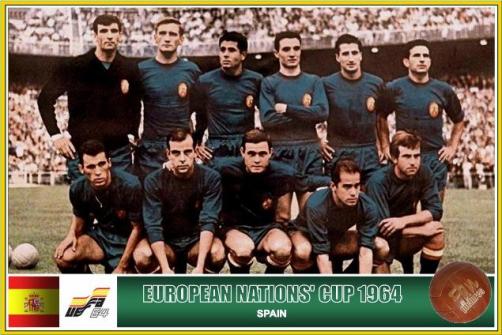
Spain 64

The victorious Spain side of 1964

Spain would go on to win the tournament on home soil, defeating the USSR side that they had refused to play four years earlier in the final. The final score was 2-1 with the winner scored by Marcelino, the same striker who had put two past Ireland in Seville. Amancio would end up coming third in the voting for that year’s Ballon D’Or award, his international captain Luis Suarez came second. And Franco had his win against an arch-enemy. Upon their return the USSR coach Konstantin Beskov and team director Andrei Starostin, were summoned to a meeting at the Soviet Football Federation after a furious Nikita Khrushchev had watched the game on TV and seen pictures of a smiling Franco beamed around the Soviet Union. They were both fired from their posts.

As for Ireland they would meet Spain again the following year in qualifying for the 1966 World cup, losing out in a controversial play-off leg in Paris. For the next European Championships qualifying groups had been introduced but the Irish team that had promised so much was now in decline. Players like Joe Havery, Amby Fogarty, Noel Cantwell and Charlie Hurley who had all been so influential were in their 30’s and coming toward the end of their careers. Ireland were also severely restricted compared to other nations, as we’ve seen there were no guarantees that key players would be released by British clubs, the team manager Johnny Carey was little more than a glorified trainer with little power except to give a pep talk to his hastily gathered players before the game. The Irish team was still selected by an FAI committee and it wasn’t until 1969 that this changed with the appointment of Mick Meagan as manager. It wouldn’t be until 1988 that the Republic of Ireland would have a side that would reach the last eight of the European Championships again.


This first appeared on backpagefootball.com in June 2016


I am the Lord Thy God. Thou shalt have no other Gods before me – From Messi to Messiah


The Spanish Conquistadors brought much to South and Central America; a lust for conquest, cannon and Spanish steel, deadly European diseases and indeed Christianity. But there were things that they found in New Spain that were new to these violent colonisers as well. Just picture the scene; a scorching hot day in the glorious Aztec capital of Tenochtitlán, surrounded on all sides by lakes and swamps it is the site of the modern metropolis of Mexico City. In a formal cordoned off rectangular space beneath tiers of grey stone steps populated by the masses of the city, ordered by social rank, a group of men compete fiercely in a ball game. The two teams face off, the purpose of the game is to get the hard, heavy, solid rubber ball through a circular hoop or goal at either end of the field. The players can’t handle the ball but propel it with amazing skill with their hips, knees and buttocks. This is sport but not as we know it today, instead it is part ritual, part religious rite.

Andreas Campomar in his encyclopaedic study, Golazo! on the history of football in Latin America emphasises the sheer importance of these sort of ball games not just to the Aztecs but to the Mayans and other pre-Colombian civilisations. For example thousands of rubber game balls were paid as tribute to kings, the myths of great societies featured stories of ferocious ball games played against gods and monsters, and most frighteningly of all there was a very real connection between these ball games and forms of religious human sacrifice. There are stories of losing sides in games being beheaded in ritual sacrifice in the civilisations of Veracruz. Stories of racks of human skulls being kept pitch-side displaying the chilling fate of previous competitors, and artworks showing fountains of arterial blood bursting forth from the neck of recently decapitated players. The Christian Spaniards saw these ancient ballgames as forms of witchcraft but the Mesoamerican people viewed them with much greater awe and significance, in many cases the ball itself seems to have had an almost spiritual quality, this circular orb flying through the air in games providing a metaphor for the orbit of the sun and the stars. Another view was that their ballgames were a form of proxy war, literally competitions of life or death or of communing with the divine.

ballcourt

An example of a Mesoamerican ballcourt

While the ancient games of the Mayans were part of religious ritual, those who codified the game of football; the British Victorians, also viewed their sport as having a religious element. Sports were part and parcel of the ethos of “muscular Christianity” that found favour in the public school system of 19th Century Britain. Health and wellbeing, exemplified by the gentlemanly virtues of team sports were seen as an absolute “moral good”, taking inspiration directly from the Bible, for example the passage in Corinthians which noted:

  1. What know ye not that your body is the temple of the Holy Ghost which is in you, which ye have of God, and ye are not your own?
  2. For ye are bought with a price: therefore glorify God in your body, and in your spirit, which are God’s.

While the conquering Spaniards saw the ballgames and customs of Latin American as one of many vices to be expunged by colonialization and the introduction of Christianity the Victorians viewed the role of sport in muscular Christianity as a great virtue and to some measure as part and parcel in the manufacture of robust soldiers and sailors for the British military and hence the creation of the British Empire. The competitive nature of team sport, its focus on defence and attack in unison, and its obvious role in physical development helped form a generation of officers for the British military. To take the most critical viewpoint of this movement would be to say it formed a part of an outlook not dissimilar to the American concept of “Manifest Destiny” or the earlier notions of the “virtuous” Crusaders of the 11th , 12th and 13th Centuries, a “Born to rule” mentality.  The author James George Cotton Minchin when writing on the influence of the British Public School system was moved to speak of “the Englishman going through the world with rifle in one hand and Bible in the other” and added, “If asked what our muscular Christianity has done, we point to the British Empire.” George Orwell, himself a former Eton schoolboy was highly critical of what he saw as the recent and cultish growth in sport, he wrote the following after the tour of Dynamo Moscow to Britain in 1945 on the topic of “serious sport” and football in particular: “It is bound up with hatred, jealousy, boastfulness, disregard of all rules and sadistic pleasure in witnessing violence: in other words it is war minus the shooting.” Perhaps closer to the brutal games of Mesoamerica with their emphasis on sport as a proxy war than we might like to admit?

If the role of team sports like football had a part to play in the creation and spread of the British Empire and militarism, and the idea that this had a certain divine authority, then religious organisations were also keen to use football to promote the causes of their Churches and the social causes that they supported. The more appealing side to the notion of “muscular Christianity” would be that these muscular Christians had a duty to protect the weaker and more downtrodden in society.

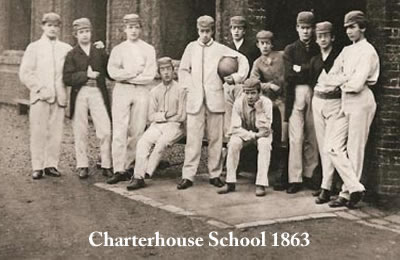
charterhouse-school-1863

Students at Charterhouse Public school 1863. Past pupils formed Old Carthusians FC who won the FA Cup in 1881

During the age of industrial upheaval towards the end of the 19th Century and into the 20th Century many saw sport as a way to support the working classes who faced terrible living conditions, poor sanitation and were excluded from many areas of society. As Peter Lupson notes in his book Thank God for Football many of the most historic clubs that make up the top divisions in England today were founded as part of Church groups, whether it was Aston Villa, Tottenham Hotspur, Bolton Wanderers or Everton, whose Goodison Park stadium has a church between its famous Gwladys Street End and Goodison Road stand. Manchester City were formed out of St. Mark’s West Gorton FC, founded by the public school educated clergyman Arthur Connell and his proselytising daughter Anna. Concerned about the violence and alcohol abuse that were rampant in the West Gorton area of Manchester, St. Mark’s was established as a way to get the men of the area to focus their energies elsewhere, first in cricket and then later in football. There were many such links with church groups and sports clubs and often with a specific connection to the temperance movement of the late 19th and early 20th century.

From the ancient ballgames of Central America and their religious, ritualistic significance, to the Victorian use of football and other team sports to create a notion of the muscular Christian (whether as soldier and imperialist or as a social and sporting evangelists for the disadvantaged in society) we can see how religion and sports were crucially interlinked, however the point would come when football would move beyond religious links. With the rise of Communism in the early part of the 20th Century there was a move, nominally at least, towards atheistic societies. As Karl Marx famously said:

Religion is the sigh of the oppressed creature, the heart of a heartless world, and the soul of soulless conditions. It is the opium of the people. The abolition of religion as the illusory happiness of the people is the demand for their real happiness”

In some ways the early view of football in Communist nations was not dissimilar, there was an opinion that football was a distraction from the issues that should have been of greater concern to the disenfranchised working classes. That football was another “opiate” just like religion to use the phraseology of Marx and de Sade. We can turn again to George Orwell on this matter and take a quote from his seminal piece of dystopian fiction 1984 in which he described the future of the working classes as; “Heavy physical work, the care of home and children, petty quarrels with neighbour, films, football, beer and above all gambling filled up the horizon of their minds. To keep them in control was not difficult” [my emphasis]

It was not long however before Communist nations realised the propaganda value of sport. Rather than acting as a distraction to the masses why could football not work as the perfect exemplar of the successful Communist state? An example not of individual dominance but of cooperation, planning, teamwork and self-sacrifice for the greater good. One high profile clash between a supposedly atheist Communist state, Yugoslavia and the Republic of Ireland took place in 1955 in Dublin. Much of the controversy surrounded the Croatian Cardinal Aloysius Stepinac who had been imprisoned by Josip Tito’s government, ostensibly on the basis that he had collaborated with the fascist Ustaše group during World War 2, however critics of Tito’s regime claimed that Stepinac’s trial and imprisonment was a show trial brought about because the Cardinal had been critical of the new Communist post-war regime in Yugoslavia. Although Stepinac was released in 1951 it was viewed that Yugoslavia, and Tito in particular were actively persecuting the Catholic Church.

It should be noted that the Ireland of the 1950’s was not necessarily a bastion of freedom either. The modest economic growth and modernisation that would take place under Sean Lemass’ tenure as Taoiseach (Irish Prime Minister) were still some years in the future and Ireland of 1955 was an impoverished nation with a high rate of unemployment and mass emigration. The social and intellectual sphere was limited, in literature alone despite there being a glut of talented writers emerging in Ireland at the time many fell afoul of draconian censorships laws (such as Brendan Behan, Liam O’Flaherty and later Edna O’Brien) which meant their works were banned from publication never mind the works of non-Irish writers (Balzac, Huxley, Salinger et al). Furthermore the Irish Constitution of 1937 protected freedom of all religions but made special mention of the Catholic Church:

The State recognises the special position of the Holy Catholic Apostolic and Roman Church as the guardian of the Faith professed by the great majority of the citizens. – Article 44.1.2 of the Irish Constitution (1937)

It was no surprise that the “special position” of the Catholic Church was recognised in the Constitution as Fr. John Charles McQuaid was one of the key advisors on the creation of the document to his old schoolmate, Taoiseach Eamon de Valera. This same Fr. McQuaid would within three years of the Constitution being ratified become Archbishop of Dublin. It was in his role as Archbishop of Dublin that McQuaid helped scupper a modest 1951 proposal from Health Minister Dr. Noel Browne to provide free health care to Mothers and children. He stated that the “Mother & Child scheme” was against the moral teaching of the Catholic Church which led to Browne’s resignation from Government.

It was against this background that in 1952 McQuaid persuaded the FAI to cancel a proposed match with Yugoslavia, however the football association decided to arrange another game against the Yugoslav’s three years later. McQuaid called for a boycott of the game and urged the FAI to cancel the match but the Association persisted with the fixture scheduled for Dublin’s Dalymount Park on Wednesday 19th October 1955. McQuaid’s view was in contrast to the recent instructions of Pope Pius XII who recommended against the Church or politics taking any stance on sporting events.

This game was never likely to pass without controversy. It was alleged by FAI board member Peadar Halpin that he had agreed to the arrangement of the fixture against the Yugoslavs on the advice that Archbishop McQuaid had been consulted and given his approval. Upon learning that the Archbishop was opposed to the game he still backed the match to proceed but only because to do otherwise would cost the FAI a significant chunk of cash. The call for a boycott of the game had other consequences, the FAI could not secure a band to play the anthems on the day after the Irish Army No. 1 band withdrew so they resorted to playing a recording of both nations’ anthems over a record player in the stadium.  The regular trainer for the Irish national side, Dick Hearns of Dublin club Shelbourne also withdrew his services from the team and had to be replaced by Shamrock Rovers trainer Billy Lord. It was ensured by de Valera that President Sean T. O’Kelly (notionally at least the First Citizen of the State) would not attend the game in an official function, nor would de Valera himself or any of his senior Ministers. The voice of football at the time on RTE radio, Philip Greene also made himself unavailable to cover the game. It was suggested that this was in part a direct response to a call from Archbishop McQuaid not to cover the match and lead to the infamous headline “Reds turn Greene Yellow”. The lone political representative of note in the ground that day was Oscar Traynor TD who was also President of the FAI and a noted former footballer with Belfast Celtic. He received a rapturous welcome.

Despite the various organs of the theoretically separate Church and State boycotting the match a decent crowd of 22,000 turned out. Although larger attendances of around 35,000 were recorded at other home matches around this time it is worth noting that the Yugoslavia game was a midweek friendly played in wet and overcast conditions. The FAI were at pains to point out that no tickets were returned on foot of the Bishopric denunciation and it is striking that in a country so under the influence of the Catholic Church that 22,000 football fans ignored the condemnations and calls for boycott of one of the most powerful men in Ireland. In doing so they had to pass a cordon of irate, anti-Communist, placard-carrying Legion of Mary members. Not only were there fans in the ground but newspaper reports state that they gave the Yugoslavs a warm reception and a rousing ovation at the end of the game. The Yugoslavs had put on a fine attacking display and run out easy 4-1 winners against the Irish, a display that had obviously impressed the home crowd.

Shamrock Rovers young forward Liam Touhy who made his debut that day summed up the opinion of the players when he said their only concern about playing Communist Yugoslavia was that the game might be called off and the players might miss out on a cap. Tuohy was also quoted as saying that many of the Yugoslavs blessed themselves upon entering the pitch and that “there were nearly more Catholics on their side than there were on ours”. The Yugoslavs for their part were bemused at the involvement of the Catholic Church having not encountered previous calls for the boycott of matches. North of the border in Belfast, Unionist politicians cited the interference of the Archbishop as another example of the dangers of having Dublin involved with any of the affairs of Northern Ireland due to the strength of influence of the Catholic Church in the Republic.

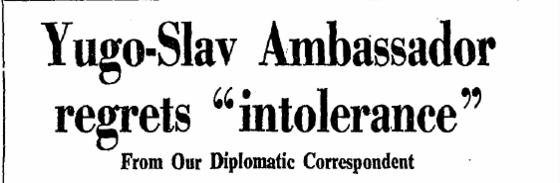
yugoslav headline

Headline from The Irish Times the day before the match – October 1955

It would be decades before the scale of the abuses of power perpetuated by the Catholic Church in Ireland would emerge; in the culture of silence that existed the simple act of attending a football match after the Church had called for a boycott was a powerful statement, against the influence of the Church but also in support of the beautiful game. This wasn’t sport in service to religious ritual as in Central America, or sport in the service of Christianity as in Victorian Britain but sport as a form of protest against religious power and hypocrisy. Perhaps the next evolutionary step would be football as religion and footballers as icons or even messianic figures?

Such comparisons between football and religion are as obvious as they are simplistic, the stadium as Cathedral, the chants of fans as psalms or hymns, even collective footballing passion and hysteria could be seen as having religious counterparts whether that is spiritual possession or speaking in tongues. There is also a devotional and messianic aspect, a form of footballer worship, many players have engendered a certain cult around themselves, developed followings convinced of their significance but even of their divinity? The most extreme example is probably that of Diego Maradona, a man who has inspired his own devoted Church and following, the Iglesia Maradoniana. While El Diego is not averse to religious comparisons himself, the Hand of God being the most obvious example, the creation of a religion complete with prayers, ceremonies, works of devotional art and even its own calendar; (we’re in the year 55, the calendar starts in 1960 the year of Maradona’s birth), is another step entirely! While many feel uncomfortable with this worship of a hugely talented but highly flawed human being, some viewing it as blasphemy, others are happy to pass on their Maradona related creed to succeeding generations, to their sons (many named Diego) and their daughters. The “religion” unsurprisingly borrows heavily from the Christian faith and Roman Catholicism in particular, there is an “Our Diego” prayer modelled on the Our Father and there are Ten Commandments to live by. Such syncretism with Judeo-Christian faiths can create further searches for parallels between Maradona’s life and that of Jesus Christ. Would Claudio Caniggia be the apostle John, the favoured disciple? Or could Diego’s infant grandson, the son of Man City star Sergio Aguero, be a “Second Coming” of the divine? While the Iglesia Maradoniana is an extreme example of the footballer as saviour or messianic figure the form of secular devotion and religious comparisons drawn with football are plain to see. That’s without even mentioning ex-footballers who might think themselves as saviours. The ex- Coventry and Hereford United goalkeeper David Icke infamously declared at a 1991 press conference that he was “Son of the Godhead”.

Football; from the ancient ball games of Central America which were part of religious ritual to the 19th Century role of religious organisations in the early growth and development of the game as social good, the interaction between the game and religion has developed over time. While religious institutions helped to create circumstances for the growth of football they were not necessarily prepared for rejection by the newly popularised game, even in good Catholic Ireland football could become a rare form of resistance against dominant religious interference. Today, at a great remove from the Corinthian, public school, class-orientated view of “muscular Christianity” one would imagine that Thomas Hughes or any of the other propagators of that phrase would struggle to recognise the highly commodified, modern professional game. They would certainly balk at the idea that professional footballers would be idealised, and dare we say worshipped as secular idols well beyond the confines of their mega-stadiums and into the homes of their acolytes around the world. While not every footballer will have his own Church or followers like Diego Maradona, for an increasing number of people the ritual of following their football team is the closest they will come to a religious experience. Now altogether

Our Diego, who is on the pitches,
Hallowed be thy left hand….

This article first appeared in issue 10 of The Football Pink  with some original artwork from Kevin McGivern the new issue 11 is out now which also features one of my articles.

Euro 88 Scotland v Ireland & how Lawro got the bandwagon rolling

We’re only a playoff away from our third ever European Championships so here’s a bit of nostalgia ahead of the Bosnia game going all they way back to another qualifying group with Scotland.

When thinking of the Scottish national team and its relationship to that of the Republic of Ireland the match that jumps out most is not our most recent encounter, a narrow victory in the little loved Nations Cup.

Some may be old enough to remember the famous 1-0 in Dalymount Park way back in 1963, but the Scottish match that most Irish fans think of probably didn’t even feature Ireland. It was that win in Sofia when Gary Mackay scored the only goal of his short international career, a goal which meant that the Bulgarians, who had needed only a draw and were favourites to qualify stayed at home in the glorious summer of 1988.

Instead it was Ireland, in their maiden campaign under Jack Charlton who were off to West Germany for their first major international tournament.

 That tournament, arguably featured the strongest even Irish squad and would go a long way in broadening the appeal of soccer in Ireland, it would help to galvanise the travelling support that would make Irish fans famous throughout the world and it gave us moments of joy (Houghton putting the ball in the English net, Ronnie Whelan’s amazing shinned volley) and despair (Wim Kieft’s looping header off a Ronald Koeman shot to send Ireland home). It would give us Joxer goes to Stuttgart, and raise our national sporting expectations.

According to some it would even help to kick start the nation’s economy?

And yet the qualifying campaign was more than just Mackay’s unexpected winner, Ireland had topped a tough group having only lost once during qualifying. After draws in their opening two games, away to Belgium and home to Scotland the Irish needed a win to properly kick start their drive for the Euros.

They got that win in the intimidating atmosphere of Hampden Park and the goal would be scored by a man who little realised that his career at the highest level would be over within a year. It would also mark the first occasion that a Republic of Ireland team would defeat a Scottish side on their home turf and can perhaps be seen as a changing of the guard in terms of the hierarchies of the two Celtic nations?

As mentioned Euro 88 qualifying was Jack Charlton’s first major outing as Ireland manager. Eoin Hand had departed early in 1986 after a disappointing World Cup campaign which saw Ireland finish fourth in a five team group behind Denmark, USSR and Switzerland.

The exciting talents of the Danish Dynamite side that would light up the World Cup in Mexico were especially evident against Ireland as they recorded a 3-0 win in Copenhagen before winning 4-1 in the last qualifying game in Lansdowne Road. Preben Elkjær, then starring for Verona in Serie A proving particularly lethal against Hand’s side.

While Charlton managed to restore some faith in Irish camp early on by gaining victories over Iceland and Czechoslovakia in Reykjavik, in the process winning Ireland’s first piece of silverware he had also managed to alienate Arsenal’s classy centre half Dave O’Leary.

He did, however, give a first cap to O’Leary’s young teammate Niall Quinn, as well as unearthing two “granny –rule” players of considerable quality after Oxford United defender Dave Langan put Charlton on to the Irish connections of his teammates John Aldridge and Ray Houghton. This would become a player acquisition route much favoured by Charlton.

While the squad may have gained some confidence from their friendly tournament win in Iceland they still faced a daunting qualifying group which included Belgium (semi-finalists in Mexico 86) an emerging Bulgaria side featuring the talents of a young Hristo Stoichkov, Scotland and Luxembourg.

Ireland’s opening home draws with Belgium (2-2) and Scotland (0-0) meant that the significant task of defeating the Scots in Hampden grew in importance. Playing away from home suited Charlton’s teams to a certain extent, set up as they were for high-pressure, counter attacking football.

It could sometimes be less effective when playing at home when there was a greater onus to take the game to the opponent but it worked in crucial away fixtures like those in Glasgow.

Ireland took on Scotland in Hampden on the 18th February 1987 and would line-up in a standard 4-4-2 formation. A huge Irish contingent travelled to Glasgow for the game (topical) and this became a sign of things to come for the Irish team in terms of vociferous travelling support. In goal was Packie Bonner who was establishing himself as Charlton’s No. 1 having previously played second fiddle to Seamus McDonagh and on occasion Gerry Peyton.

Sport, Football, European Championship Qualifier, Dublin, 15th October 1986, Republic of Ireland 0 v Scotland 0, Republic of Ireland's Liam Brady moves away from Scotland's Roy Aitken  (Photo by Bob Thomas/Getty Images)

Sport, Football, European Championship Qualifier, Dublin, 15th October 1986, Republic of Ireland 0 v Scotland 0, Republic of Ireland’s Liam Brady moves away from Scotland’s Roy Aitken (Photo by Bob Thomas/Getty Images)

The back four consisted of Mick McCarthy, Kevin Moran, Ronnie Whelan and Paul McGrath, with Whelan and McGrath unusually operating in the full back positions after both Dave Langan and Jim Beglin had suffered serious injuries. Midfield saw Liam Brady (then coming to the end of his Italian sojourn with Ascoli) partner Mark Lawrenson who was positioned in front of the back four allowing Brady space to roam forward.

The pair were flanked by Ray Houghton and Spurs’ Tony Galvin. Up front Frank Stapleton was partnered by John Aldridge who enjoyed a fairly thankless task in Charlton’s system as the prime exponent of his pressing game, harassing the opposing defence high up the pitch the force errors in their build-up play.

The strength of the Scottish XI is evidenced by the fact that the trailing Scots were able to introduce Celtic legends Paul McStay and Roy Aitken as substitutes to compliment the talents of Hansen, Strachan, McClair and McCoist.

The role of Lawrenson in the team was key. He was starting in a defensive midfield role partially because of the competition in defence but mainly due to the gap left in the Irish team by the ultimately career ending injury to his Liverpool teammate Jim Beglin forcing Whelan into the left back slot.

Ever versatile Lawrenson had played in central defence alongside Hansen for much of his time at Liverpool but had also featured in midfield and at full back, especially from the 1986 onward as Gary Gillespie began to establish himself alongside Hansen in the heart of the Red’s defence.

Lawrenson had had injury problems of his own over the last year after damaging his Achilles in a game against Wimbledon meaning he would only feature in three of the Euro 88 qualifiers. However it is worth noting that Lawrenson started in the crucial victories against Scotland and Bulgaria as well as the 2-2 draw with Belgium.

The Bulgaria game would be his last competitive match for Ireland. Having never properly recovered from that earlier Achilles injury he did further damage during a Liverpool game versus Arsenal in early 1988 and by the age of 30 his top level playing career was effectively over.

As was the chance of being part of the Irish squad for the Euros. A combination of injury and suspension would also rob Ireland of the services of the veteran Brady, an ever-present throughout qualifying. He was another who had played at the very highest level who would never get the opportunity to compete at an international tournament.

Lawrenson’s winner against Scotland also showed how the Irish had changed under Charlton. The Irish had usually been cast as the victims, the injured parties in international games as more savvy nations took advantage, or at least that was the comforting narrative.

In the opening game against Belgium Frank Stapleton’s cuteness had won Ireland a late penalty that Brady converted. Early on against Scotland it was Stapleton again who won Ireland a crucial set piece, towering above two Scottish defenders in a challenge for a high ball he won a free while managing to leave Dundee United’s Maurice Malpas sprawled on the deck.

The keen-witted Lawrenson called to John Aldridge to take the free quickly as he rushed past Richard Gough to fire the ball into Jim Leighton’s net before the Scottish defence had time to regroup and with Malpas still lying prone on the field. Lawrenson had struck early, with only seven minutes on the clock but Big Jack’s “Put em under pressure” approach was paying off, the Scots were stifled by the constant pressing and tight marking of the Irish.

It was a famous victory that helped kick-start the Irish qualifying campaign and gathered momentum behind Charlton.

Ireland entered their final group game eight months later at home to Bulgaria and the same eleven that had taken on Scotland did not disappoint, securing a fine 2-0 victory thanks to goal-scoring defenders Moran and McGrath and leaving the Boys in Green with a slim but mathematical chance of qualification.

And so it was that with qualifying over for the Irish that RTE screened the game between Scotland and Bulgaria, in Sofia a city that had brought so much disappointed and controversy to the Irish national team in the past. It was in Sofia that Jimmy Holmes had his leg broken in a vicious tackle, it was in Sofia that questionable hometown decisions were given and where Liam Brady had been given his marching orders only the month before.

Few expected a Scottish victory, least of all Jack Charlton who recorded the game and went out fishing instead. It was only later when watching the game on tape and he started to get phone calls of congratulations that he realised that Ireland had qualified.

The Green Bandwagon had begun to roll and Joxer was off to Stuttgart.

Originally published in 2014 for backpagefootball.com 

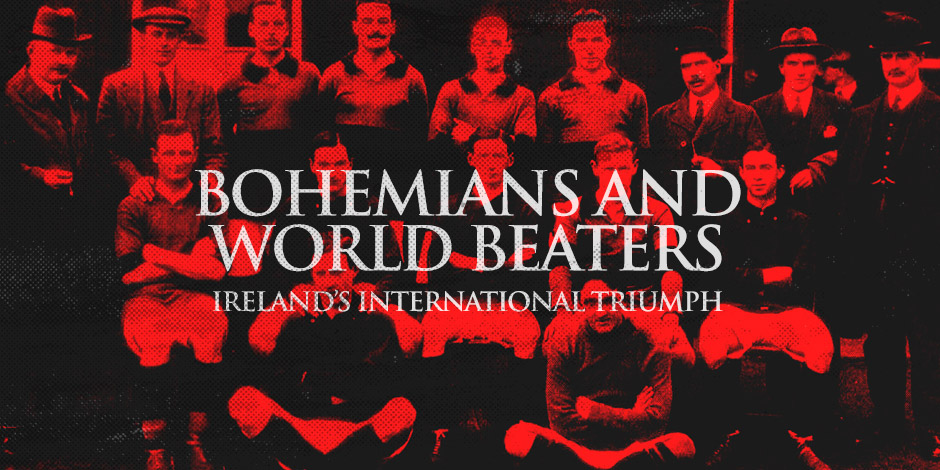
Bohemians and world beaters: Ireland’s international triumph

The split between the footballing associations of the FAI and the IFA has had many consequences for football on our island, many hours have been whiled away with “what if” scenarios with barflies imagining an Irish side of the 60’s featuring the likes of John Giles and George Best. Another less discussed consequence of the split between the two associations was for many the loss of any sense of identity with the all Ireland side that had competed from the 1880’s through to 1921. Any connection with the history of this 32 county team has for most football fans in the Republic, (and indeed some in the North) been severed and there is little sense of identification with the players and their achievements pre -1921.

I for one think that this is a great pity, it ignores the history of the sport and the rich and interesting personal stories of those involved. It also means modern fans in the Republic often feel little pride or connection to the victory by a truly representative Irish team in the Home Nations Championship of 1914. At the time the Home Nations Championship was viewed, in the British Isles at least, as the foremost International football competition in the world with the winners rating themselves as the best international side in the world. While this is obviously an isolated and arrogant viewpoint it is reasonable to say that the winners could legitimately claim to be among the very best international sides in the world.

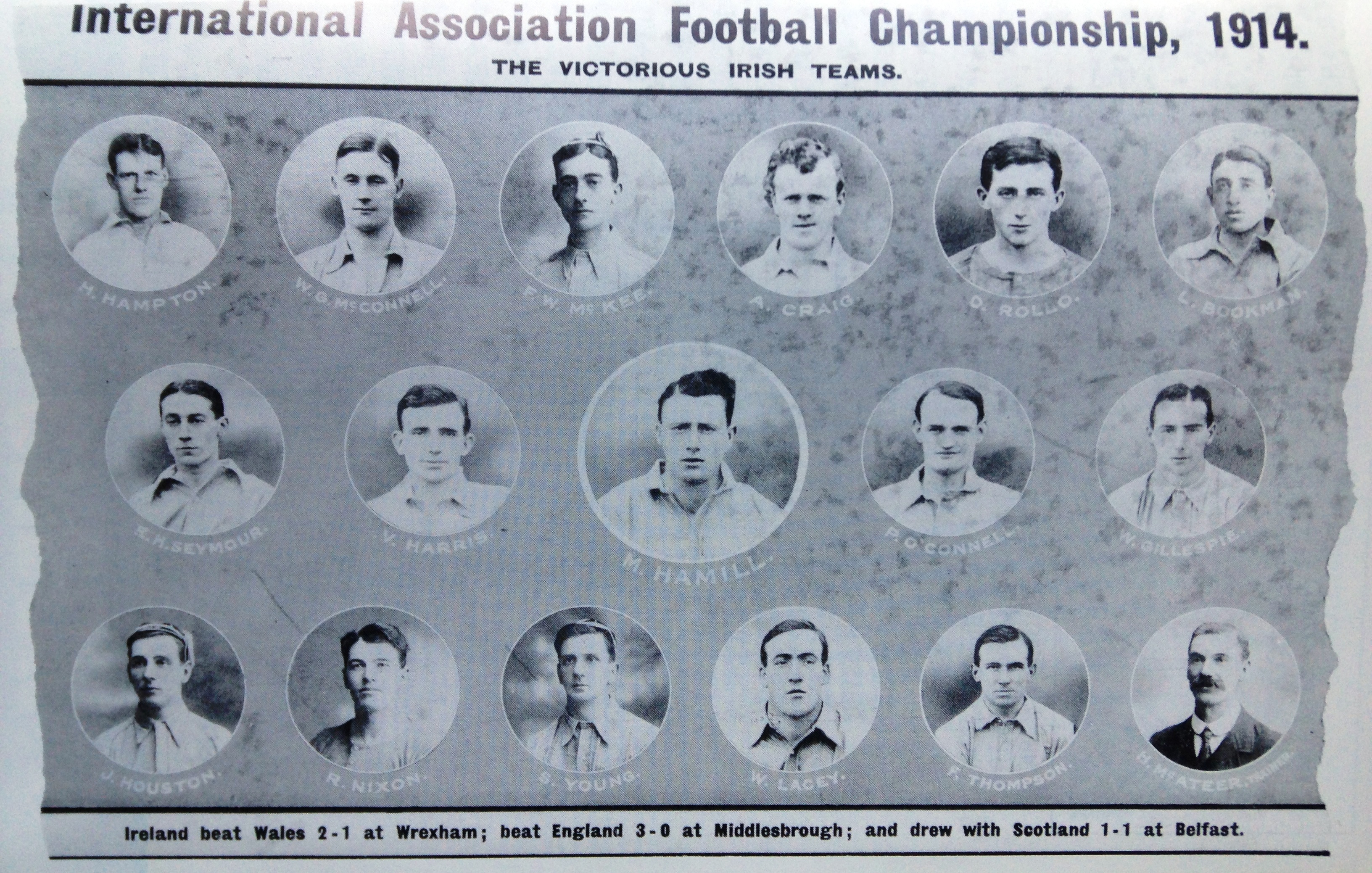
The side that triumphed in 1914 was a young, impressive and truly representative team. While in previous years there had been a great deal of tension and legitimate criticism about Belfast based players being favoured ahead of Leinster based players, the squad for the 1914 Championship was a truly all island affair. It featured players from the footballing hotbeds of Dublin and Belfast but also players born in the likes of Wexford (Billy Lacey), Galway (Alex Craig) and even Lithuania in the case of Louis Bookman who was born in what was then part of the Russian Empire. Bookman’s  family fled to Dublin when he was a boy to escape the persution of Jews then taking place, he began his footballing career for Belfast Celtic before moving to England with Bradford City, in course becoming the first Jewish professional  footballer in Britain. Bookman was playing for Bradford when he was called up in 1914 but the squad was a mix of players who were plying their trade in both Ireland and Britain, it also included two players from Bohemians, William McConnell and Ted Seymour.

1914_ireland_british_champions

1914 Home Nations Champions

Both players were of course amateurs in keeping with the traditions in place at Bohs which meant that they were in a minority even by 1914 as most of the major teams in Ireland had already embraced professionalism by that time. The two main exceptions being Bohemians and Cliftonville. Seymour was an outside-right for Bohemians and one of the stand-out forwards for the Gypsies at the time, the son of an RIC officer who lived in the nearby Phoenix Park he won his first amateur cap for Ireland by 1912 scoring in a 3-2 victory against England, the same year he would win the Leinster Senior Cup with Bohemians. His lone senior cap would come in Ireland’s opening match of the Home Nations Championship, an away fixture against Wales which Ireland won 2-1 when he was called up as a replacement for Everton’s injured winger John Houston. Sheffield United forward Billy Gillespie got both goals in that game but Seymour obviously impressed over the course of the match as he was quickly signed up by Cardiff City on the strength of his performance.

Amateur team pic

The Irish amateur team which defeated England 3-2 in 1912. The side featured three Bohemian F.C. players; William McConnell, Ted Seymour and Dinny Hannon.

William McConnell had a somewhat more extensive career at International level. Regarded as one of the best full backs in Ireland McConnell was a strong and physically dominant defender for Bohemians and Ireland. A member of the Bohemians team that lost out in the 1911 Cup Final to Shelbourne he also won a pair of Leinster Senior Cups with Bohemians and represented the Irish League on three occasions. At International level McConnell won six senior caps and was only on the losing side once, in a 2-1 defeat to Scotland in 1913. McConnell made his debut in 1912 in a 3-2 win over Wales and was part of an historic victory in only his second cap as Ireland beat England for the first time ever. Billy Gillespie grabbed both goals in a 2-1 victory in Windsor Park as McConnell lined out alongside his Bohs team-mate Dinny Hannon. Despite that landmark victory the Irish side still finished bottom of the Home Nations Championship but things were to be much different the following year. McDonnell was an ever present in the successful Home Nations campaign starting every game at full back.

The Ireland side before the opening game against Wales

The Ireland side before the opening game against Wales

The campaign opened with the aforementioned 2-1 win away to Wales and was followed by another away fixture, this time against England in Middlesboro’s Ayresome Park. Proving that the previous victory against England was no flash in the pan the Irish trounced the English on home soil, two goals from the ever versatile Billy Lacey, then of Liverpool and a third from Billy Gillespie eased Ireland to victory over a stunned England. The Donegal born Gillespie would end the tournament as its top scorer with three goals and was arguably one of the greatest players in the world at this time. He would captain Sheffield United to victory in the 1925 FA Cup final and play on for them until he was more than 40, towards the end of his career his role at the heart of the Blades attack would be taken over by another Irishman, Jimmy Dunne who would later coach Bohemians in the 1940’s. At international level his 13 goals for Ireland/Northern Ireland would remain a record until it was eclipsed by David Healy in 2004.

However Gillespie would miss the final match that could guarantee Ireland the 1914 Championship, as Sheffield United had to replay an FA cup tie they refused to release Gillespie for the game against Scotland in Belfast’s Windsor Park. This would require a significant reshuffle on behalf of the Irish with Samuel Young of Linfield coming into the forward line and Billy Lacey taking over Gillespie’s role in the attack. McConnell continued as usual alongside Alex Craig (Greenock Morton) in a defence that had proven solid over the previous two games.

William

William “Bill” McConnell

The match would be the only home game for Ireland that year taking place in Windsor Park, but under far from ideal conditions. Not only was Gillespie unavailable but there was a downpour the day before the game which continued through to the game meaning that both sets of players were ankle deep in mud. The view of the press at the time was that this would suit a more physically imposing Scottish side. Worse was to come for the Irish as the conditions and the hard-fought nature of the game began to take their toll and injuries on the Irish side began to mount. Paddy O’Connell, then of Manchester United and later manager of Barcelona picked up a knock as did McConnell who had to leave the field of play. However the Bohs man wasn’t out of the action long as the Irish keeper Fred McKee of Cliftonville suffered a broken collar bone during the first half. McKee managed to struggle on until half time but once the second half commenced McConnell took to the field in his place in a sodden goalkeeper jersey that was supposedly “two sizes too small” . As substitutions were not in use at the time Ireland were down to ten men with Lacey dropping back from the forwards to take McConnell’s place at full back.

This was not the first time Ireland had found themselves in this situation, Lacey had been forced off in the Welsh game yet Ireland had triumphed and now he was in defence helping protect McConnell in goal. Forced into making a couple of saves early on McConnell seemed to be doing alright in his unfamiliar position but a mis-timed run forward  meant he gave possession to the onrushing Scottish forward Joe Donnachie who had a simple finish to give Scotland the lead. It seemed like all could be lost in the cruellest fashion. The team without its main goalscoring threat in Gillespie and down to ten men looked doomed but with just eight minutes remaining a fine pass from Patrick O’Connell sent Sam Young free and he blasted the ball home to send the crowd wild. Despite the terrible weather the huge crowd had been in full voice behind the Irish team and Windsor Park saw record gate receipts of £1,600 on the day. The supporters had gotten their moneys worth, the underdog team, shorn of their best player, having finished two of their three matches with only ten men were now outright Champions for the first time.

This victory was met with great joy and optimism on behalf of the footballing community throughout Ireland. Having defeated England in their last two outings and having won the Home Nations Championship outright there were high hopes that the team could push on from this achievement and defend their title the following year. Other matters were to intercede however.

While the outbreak of War did not bring about a halt to all football it did end international matches. Players were encouraged to set a good example to other young men and enlist. Football clubs in all parts of the country faced tough times losing both players and fans to the trenches of France and Belgium while the league would split for the course of the war creating regional leagues focusing on Dublin and Belfast.

By the time peace was restored to Europe several of the squad had passed their prime and although players like Lacey and Gillespie were still top performers for their clubs in England the split between the Irish football associations which led to the formation of what we know today as the FAI meant that the potential of a united Irish XI would never be realised.

For those players with a Bohemians connection their careers were varied. Ted Seymour’s stay in the Welsh capital was brief and included works in a Welsh munitions factory to support the War effort, he left Cardiff City in 1915 and returned to Ireland with Glentoran for whom he lined out for much of the War years. Despite twice winning the Irish Cup (once with Glentoran and later with Linfield) Seymour was never again selected to represent Ireland.

McConnell also transferred to Britain, signing for Bradford Park Avenue who were then in enjoying their best ever league season, finishing 9th in the Football League in 1914/15, McConnell would have a limited role however, making only 4 league appearances. He would spend a brief sojourn in Belfast with Linfield before returning to Bohemians in 1916 where he played a handful of games. This was not to be the end of his sporting career however, he found significant success as an amateur golfer being successful enough to triumph in the 1925 and 1929 West of Ireland Amateur Championships. Some Pathé newsreel footage even survives of McConnell playing a round at a new golf course in Dun Laoghaire.

Though the war would disrupt the career of Billy Lacey he would still go on to have considerable success in the 1920s as a player for Liverpool, winning back to back titles. Lacey would return to Ireland to finish his playing career at Shelbourne and then as player-coach of Cork Bohemians. It was in 1930 during this spell in Cork that he would win his final cap for Ireland at the age of 41, he remains to this date the oldest player ever capped by the FAI. With his playing career finally over Lacey brought his considerable experience to the Bohemians of the Dublin variety. During his five years at Dalymount Park (between 1933 and 1938) Lacey would lead Bohs to two league titles and an FAI Cup as well as a host of other minor honours. During this stint Lacey would also provide his coaching talents to the Irish national side.

While the split remains as wide as ever between the FAI and the IFA and relations between the associations have been strained over players like James McClean and Darron Gibson electing to play for the Republic, it is worth remembering a time when a truly all-Ireland team triumphed against the odds and the role that key figures in the history of Bohemians would play in that victory.

If you are interested in further reading on the subject I’d suggest David Owen’s article in The Blizzard Issue 8. Neil Garnham’s “Association Football and Society in pre-partition Ireland” and also Cormac Moore’s “The Irish Soccer Split”. Finally a special thanks to Stephen Burke of Bohemian F.C. for providing additional information on the career of Bill McConnell. For more on Louis Bookman and his fascinating life try “Does your Rabbi know you’re here?” by Anthony Clavane.

Ireland v Germany and the gathering storm of World War II

Jimmy Dunne stood on the pitch at the Weser Stadium, Bremen, May 1939, as the German anthem, complete with Deutschland über alles verses, echoed around the arena. The Swastika fluttered next to the Irish tricolour. Dunne was captaining Ireland that day and as a committed socialist, as a Republican who had been interned as a teenager, the fact that he has been told by his Association to give the Nazi salute grated deeply.

His teammate Joe O’Reilly recalled Dunne shouting to the rest of the side “Remember Aughrim, Remember 1916!” as they raised their arm. The packed stadium had heard a full two hour programme of stirring music and political speeches and were whipped into the appropriate delirious ferment. Further along the Irish team line, giving an awkward salute stood 20-year-old Dubliner, Johnny Carey of Manchester United.

Within months Carey had joined the British army and would be at combat against the Axis powers. As part of the Queen’s Royal Hussars he would see active duty in the Middle East and Italy. On his decision to enlist he stated that “a country that gives me my living is worth fighting for”. The match against Ireland was to be the last match that Germany would play before the outbreak of World War II less than four months later.

Ireland Germany 1

The Ireland team give an awkward fascist salute in Bremen.

So as Ireland prepare for their daunting challenge against the reigning World Champions in Gelsenkirchen let us remember this game that brought Ireland both praise and shame.

First it is important to note that the side that took on Ireland was not just a German team in the modern sense, as since the Anschluss of Austria the previous year that nations’ players were also called on to represent ” Greater Germany”. Among those in the German side that day was Wilhelm Hahnemann, born in Vienna he represented SK Admira a popular club in that city.

The FAI at the time were still in dispute with the IFA over the selection of players with both Associations selecting players from the whole island which in this case included Northerners like Sheffield Wednesday’s Willie Fallon born in Larne and Dundalk’s Mick Hoy from Tandragee lining out for the Free State.

The match in Bremen was to be the fourth that Ireland would play against German opposition in just four years. The Free State Association, still effectively ostracised by the Football Associations of the United Kingdom had to look to further shores in search of quality opposition, and this was regularly provided by the Germans.

In fact, given the massive political upheaval that took place throughout Europe during the 20s and 30s, it was not surprising that Ireland would find themselves competing against nations with far right and fascist governments. The Free State’s earliest games took place against Italy when they were under the rule of Mussolini, while the two games that preceded the game in Bremen were home and away fixtures against a talented Hungarian side; Hungary at the time was ruled by Miklós Horthy and his right-wing parliament which increasingly featured prominent anti-Semites.

When the Germans had last played against Ireland, in 1936 in Dalymount Park they had been well beaten. The Free State select running out comfortable 5-2 winners, with Oldham’s Tom Davis scoring a brace on his debut and Paddy Moore playing a starring role. On that occasion the Germany side had made the fascist salute and were joined by what can best be described as misguided members of the Irish sporting public (and perhaps some ex-patriot Germans?) who appear to have made the same gesture as a confused mark of respect to the visiting side.

By that stage there were already reports of the persecution taking place in Hitler’s regime but some felt that such reports were of dubious origin. Many Irish people remembered the fictional atrocities hyped by the British press that were attributed to German soldiers during the First World War and used as a recruiting tool in Ireland to get men to enlist, or indeed invented triumphs by Crown Forces during the Irish War of Independence. This was also the year of that grand Nazi propaganda exercise the Berlin Olympic Games; the view of the majority of the world seemed to be that sport should be wholly separate from politics. All the while Hitler wielded the global profile of the Games as a colossal example of Nazi soft power.

Theodor Lewald, a German protestant but one with well-known Jewish ancestry had been a key man in preparing Berlin for the Olympic Games. He had been head of the organising committee well before the Nazis cottoned on to the idea that the Games could be a great propaganda coup. When they decided to support the games with massive financial backing, Lewald’s Jewish ancestry became a useful defence to calls for boycotts of the games on the grounds of Germany’s discriminatory practices, even so he was eventually forced to step down from his role.

Avery Brundage, the head of the American delegation and later President of the International Olympic Committee (IOC), had strongly objected to any boycott stating that he had been “given positive assurance in writing … that there will be no discrimination against Jews. You can’t ask more than that and I think the guarantee will be fulfilled”.

Only Spain (then on the brink of Civil War) and the Soviet Union (who had never participated up to that point anyway) would boycott the Games. Ireland, due to complex wrangling over the border issue could not field a team at the 1936 games. In this context it is perhaps somewhat understandable that Ireland would be so happy to play Germany in 1936.

However, by 1939, with Europe on the brink of war, and Germany being slowly ostracised after its 1938 conquest of Austria and the Sudetenland it is more difficult to ignore the political dimensions of the decision to play Germany and offer the Nazi salute.

Commemorating victors at the 1936 Olympics. Theodor Lewald's name is shown on the central panel.

Plaque commemorating the 1936 Olympic games featuring the name of Dr. Theodor Lewald

In his official report to the FAI Council the General Secretary Joe Wickham noted:

In Bremen our flags were flown though, of course, well outnumbered by the Swastika. We also, as a compliment, gave the German salute to their Anthem, standing to attention for our own. We were informed this would be much appreciated by their public which it undoubtedly was.

The German Sports Minister [Reichssportführer Hans von Tschammer und Osten] at the Banquet paid special tribute to our playing the match as arranged despite what he described as untrue press reports regarding the position in Germany and their intentions.

The Football Association were not the only ones to view the stories of German abuses with a certain measure of scepticism. The Irish Government held certain doubts as well, inherently distrustful as they were of British media reports, they were also being fed misinformation and racially motivated lies by their man in Germany, Charles Bewley.

Born into the famous Bewley coffee family whose iconic Grafton Street café still trades today, Charles was raised as a Quaker. However as a young man he went against his illustrious family and converted to Catholicism and became involved in politics, standing unsuccessfully for Sinn Féin in 1918.

By 1933 he had been appointed as Irish envoy to Berlin where he became an outspoken admirer of National Socialism and Adolf Hitler. He regularly reported back to Taoiseach Éamon de Valera that Jews in Berlin were not under threat but instead libelled the Berlin Jewish community, accusing them of all manner of vices.

Bewley’s actions also meant that those German Jews seeking a visa to come to the Irish Free State in order to escape the Nazi regime were generally refused, with fewer than one hundred Jews being granted visas during his time in Germany. De Valera finally dismissed Bewley in August 1939 but by then it was too late for many to escape.

The actions of men like Bewley can go some way to explain the certain level of scepticism which some in Ireland viewed reports of Nazi outrages. Joe Wickham as noted above seemed more concerned with showing due courtesy to their German hosts and was happy to repeat the line about the “untrue press reports” at the following Council meeting.

There is perhaps a certain obsequious Irishness evident here. With few international games available for the Free State association, who were effectively boycotted in senior internationals by the “Home Nations”, matches against a significant team like German were important for the Irish side and also for the association’s finances. A small, still fledgling association like Wickham’s was too beholden to the German.

It is also worth remembering that England playing in Berlin only a year earlier had given a Nazi salute before the game, although this was apparently done under protest from the players, especially from Eddie Hapgood of Arsenal who was England captain at the time. The English players only agreed when the British Ambassador to Germany Sir Neville Henderson informed them that a refusal to perform the salute could be the “spark to set Europe alight”. Interestingly Aston Villa, touring in Germany at the same time, refused to give the salute after their game against a German XI. The English side had also given a fascist salute again just days prior to Ireland’s match in Bremen ahead of their own game in Milan against Mussolini’s Italy.

While England would go on to win their game 6-3 the game against Ireland would end as a one all draw. The Irish lined out with Southend’s George McKenzie in goal and a standard WM formation with a back line featuring William O’Neill, Mick Hoy (both Dundalk), Joe O’Reilly (St. James’s Gate), Matt O’Mahoney (Bristol Rovers), Ned Weir (Clyde) and a front five of Kevin O’Flanagan (Bohemians), Willie Fallon (Sheffield Wednesday), Jimmy Dunne (Shamrock Rovers), Johnny Carey (Manchester United) and Paddy Bradshaw of St. James’s Gate at centre forward.

The Germans apart from having the Austrian, Hahnemann in their ranks also featured world class players like their captain Paul Janes, rated as one of the world’s finest defenders, prolific goal-scorer Ernst Lehner was part of the forward line along with the man who would coach Germany to the 1974 World Cup, Helmut Schön. Organising things from the touchline was that legendary manager and creator of bon mots Sepp Herberger, who would eventually lead Germany to World Cup victory in 1954.

As described above over 35,000 people had crammed into the Weser Stadium from early on for the pre-match “entertainment” and had been suitably roused for the forthcoming match. While the German anthem and various martial airs had been blared out, the band present on the day had no sheet music for the Irish Anthem, according to journalist Peter Byrne, it was Joe O’Reilly who had once been a member of the Irish Army Band who stepped into the breach and sketched down the music for Amhrán na bhFiann from memory. The crowd was a then record attendance for the stadium and their enthusiasm seemed to have had the desired impact with Germany hitting the post through Hahnemann early on.

Ireland responded with some good play of their own as their “accurate passes and their head-work aroused the admiration of the crowd”, Dunne and Bradshaw were combining well and both forced good saves from keeper Hans Jakob. Disaster would strike though in the 34th minute, Jimmy Dunne, Irish captain and record goalscorer, was injured in a collision with defender Hans Rohde and had to be carried from the pitch. This misfortune was compounded only four minutes later when Helmut Schön scored the opening goal.

Ireland trailed one nil at the break and were forced to begin the second half with only ten men (still no substitutes in those days) and the Germans nearly grabbed a second goal through TuS Neuendorf forward Josef Gauchel. On the 55th minute Jimmy Dunne returned to the fray, going in at outside right meaning a move to centre forward for Kevin O’Flanagan, the 19-year-old was studying medicine in UCD and playing as an amateur for Bohemians, and was remembered as possessing one of the hardest shots in football , this move also allowed Paddy Bradshaw to withdraw to inside right.

The return of Dunne and the reshuffle in the forward line seemed to throw the Germans and the Irish improved in the volume and quality of their attacks, Carey came close to scoring before Bradshaw restored parity in the 60th minute with a powerful header from a Fallon cross. For the remaining half hour it was Jakob in the German goal who was the busier of the two keepers as the Irish pressed for the winner. The influential Kicker magazine stated “from a competitive point of view, there was no weak point in the Irish team, their only deficiency being a lack of precision in passing”.

A more than credible draw for the Irish in ominous circumstances, they were feted after their game by the German public, obviously impressed by the Irish play, and they were received by Nazi top brass at a banquet that night. The result would mark the best ever season of results in the short history of the Free State side and strange as it may seem they would probably have been looking forward to the following year’s fixtures.

Joe Wickham, flushed with the success of the Irish tour to Hungary and Germany was keen to organise fixtures for the coming seasons including matches against Spain, Italy and Romania. Of course war was to intervene and while the League of Ireland would continue the Free State would not play another international for seven years.

Young men like Carey and O’Flanagan would return for Ireland in the 1940s but the other nine men who took the field would never wear the green again. The greatest of these was Dunne, captain on the day and he had defied injury to finish the German game, his goalscoring record of 13 would stand for nearly 30 years. On the return journey to Ireland he was greeted in the port of Southampton and given a rousing salute from that city’s dockworkers, Dunne had played for Southampton for a year and his goals had saved them from relegation. Not something quickly forgotten by the working men of that town.

Because of those careers cut short, the ignominy of being required to make the salute, Johnny Carey’s desire to fight and the intermittently dangerous power of sport as propaganda do spare a thought for those men in Bremen when Martin O’Neill’s side line out in Gelsenkirchen.

Originally posted on backpagefootball.com in 2014

Jack Grealish and knowing your true self

Jack Reynolds’ second cap as an Irish International came in the spring of 1890 against England. It was the occasion of Reynolds only goal in the “St. Patrick’s blue” of Ireland, the Distillery winger grabbing what couldn’t even be called a consolation in a 9-1 drubbing at the Ulster Cricket Ground where the diminutive Everton striker Fred Geary grabbed a hat-trick for the three lions.

So far nothing too unusual, Ireland were the whipping boys of the early Home Nations Championship finishing bottom in six of the first seven competitions. What is unusual about Reynolds is that he would end up winning three Home Nation Championships. For England.

Jack Reynolds (born 1869) an Irish and English international

Jack Reynolds circa 1890

Reynolds had been born in Blackburn in 1869 but moved to Ireland at a young age and grew up in Country Antrim. He signed for Blackburn Rovers at the age of 15 before a spell in the Army saw him return on duty to Ireland where he ended up playing for both Distillery and Ulster F.C. during which time he won five caps for the Irish National team.

It was only upon his return to England with West Brom that Reynolds discovered he had actually been born in England. It was during his time in the midlands with West Brom and Aston Villa that he would win his eight caps for the England national team.

It is tempting to draw parallels between Reynolds and another Jack, young Jack Grealish. Both talented wingers, both Aston Villa players, in fact there may even have been a bit of overlap between Reynolds, whose Villa career ended in 1897 and Grealish’s great grandfather Billy Garraty who joined Villa that same year. But one thing that they won’t have in common it seems is lining out for both Ireland and England.

Grealish has stuck to his guns on his international future, stating earlier this year that he would make a decision come September, Martin O’Neill tried to force the issue by calling him into the squad for the upcoming friendly against England and qualifier against Scotland.

In theory Grealish could have played against England in the friendly and still switched his allegiance to them thereafter, but as things stand it appears that young Jack won’t reveal his hand until September at the earliest.

Much comment has been passed about the apparent rebuttal to O’Neill by Grealish. It prompted former football and rugby captains Kenny Cunningham and Brian O’Driscoll spoke on air about the issue, which was neatly summarised by Dan McDonnell in a recent Irish Independent article.

Rather than debate the pros and cons of a 19 year olds decision (there is plenty already written on the subject) what would perhaps be better to examine is why there is so much fuss about a player who a year ago was lining out on loan at Notts County in League One. A clue to all this hubbub can perhaps be seen in a closer examination of O’Neill’s current squad.

O’Neill has been criticised for not trying out enough new players and sticking with the same ageing group that he inherited from Giovanni Trapattoni. Some new players such as Cyrus Christie and David McGoldrick were blooded in the friendly against the USA, and the uncapped in the current squad include Harry Arter of Bournemouth, Alan Judge of Brentford and Adam Rooney of Aberdeen.

Arter, Judge and Rooney all have certain similarities, they are all in around the same age, 26, 25 and 27 respectively. All have represented Ireland at under age level at some stage. And all three have won their first call-up on the back of impressive seasons, not in the Premier League but in the Championship and in Rooney’s case the SPL.

All three have taken a circuitous route to the Irish International squad, loan moves, dropping down divisions, (including in Arter’s case a spell at non-league Woking) before settling into regular football at their current clubs.

They have all been selected on form rather than reputation; Judge’s trickery helping Brentford to the play-offs, Rooney has scored 27 goals in all competitions this season propelling Aberdeen to second in the SPL, while Arter has been one of the best midfielders in the Championship this year and will join the ranks of Irish internationals in the Premier League next season. This perhaps hints at a career trajectory not dissimilar to an established current international like Jonathan Walters.

Grealish pic

William Garraty & great-great grandson Jack Grealish, both of Aston Villa

It is players like this who are more emblematic of Ireland’s footballing future than Premier League starlet than Grealish.

It’s hard to think of the last time in recent years that an Irish teenager has broken through at Premier League level, the last time that a number of such players came through was the emergence of the likes of Damien Duff, Shay Given, John O’Shea, Richard Dunne and Robbie Keane at the turn of the millennium, most of whom had come through the successful Irish youth sides of Brian Kerr.

I’ve banged on about this before but we are not producing elite level players in any consistent manner.

This paucity of top level talent means that we have a tendency to latch onto talents like Grealish and heap the future of Irish football onto his narrow shoulders rather than looking at our technical deficiencies and the reasons that many of our more technically gifted players are being produced through the coaching and youth development systems of other national associations.

If Grealish makes his decision in September and indicates that he’ll line out for Ireland then our national team will be the stronger for it and any prevarication or seeming reluctance will surely be forgotten, much as it was with former internationals like Clinton Morrison or Jason McAteer.

If he chooses to represent England then rather than letting their ire pour out against a 19-year-old footballer on Twitter, Irish fans might look closer to home at our own coaching structures and player development paths rather than the decision of a young man to represent the nation of his birth.

At a recent Italia 90 nostalgia evening arranged as part of the One City One Book event to celebrate Roddy Doyle’s Barrytown trilogy in Lansdowne Road, the RTE panel of Dunphy, Giles and the late Bill O’Herlihy was reconvened with Paul McGrath and Charlie O’Leary also in attendance. Giles and Dunphy were still trenchant in their criticism of Jack Charlton, his style of football, his lack of professionalism and so on.

And despite the general light-hearted air of the event Dunphy pursued a darker thread of discussion, veering off on a tangent where he discussed the current state of the game.

He decried the death of the street footballer, what an Argentine fan might call a pibe, and stated that football was “dead in Ireland”, Scotland, England and so on, that the quality of player was not being produced by these nations anymore. He referenced the abundance of quality in the squads of the Charlton and Hand eras, how many of these players were regulars at top English clubs.

Dunphy only sees decline but seems to fail to appreciate that the English Premier League is now truly global, it is global in its reach, fans, media influence and the manner in which it sources its players in a way it never did in the past even when Britain was a centre of global empire. The favoured role of the Irish footballer in Britain with our shared language, cultural similarities, intertwined history and geographical proximity count for far less now.

The Premier League is a brutal, unforgiving meritocracy, it doesn’t care where you’re from (even though racism and xenophobia certainly still exist) it cares that you win. As the Premier League has casted its net wider in search of playing talent this has led to young Irish players facing far greater competition.

While we may not be producing Duffs and Keanes in abundance today maybe we haven’t gotten thatmuch worse? Certainly not to the point that football is “dying” as Dunphy maintains, perhaps it’s just that a league that many in Ireland view as our own has gotten more competitive and other nations, once viewed as minnows during Dunphy’s playing career have improved immeasurably. As others have caught up so our access to the elite levels has diminished.

In the past a successful or at least improving Irish side was able to secure the services from top flight clubs of “granny rule” players like John Aldridge, Ray Houghton and Andy Townsend, or though astute scouting recruit players like Mark Lawrenson long before he was a star for Liverpool.

Many of these players were recruited through personal connections, Aldridge and Houghton being recommended by Dave Langan while Preston North End legend Alan Kelly Sr. spotted a teenage Lawrenson and alerted the Irish manager at the time John Giles long before he would have come to the notice of an England manager.

While these recruitment methods still work today the football landscape of the 70s and 80s was not one where agents are as ubiquitous as now, where salaries weren’t as inflated or where people used social media to lambast players for every decision. Modern external pressures and opinions, as well as player empowerment and FIFA eligibility changes mean that things are less straightforward today.

The ancient Greeks had a saying, often quoted by Socrates, which simply said “know thyself”. One interpretation being that before seeking to gain greater knowledge or expertise or before commenting on the actions of others one should first know your own being and nature.

Before we lambast Jack Grealish for not rushing into a decision perhaps Irish fans should consider the Football Association, structure, facilities and challenges that influence the development of football in Ireland and look to why we have not produced another three or four players of Grealish’s profile to replenish our ageing squad.

Jack Grealish’s predecessor Jack Reynolds thought he knew himself, raised and educated in County Antrim where he also played his football, he lined out for Ireland and like a character from Greek tragedy did not realise his error until it was too late.

Let’s allow Jack Grealish the time to get to “know himself”, trying to define who and what you are and what you will represent indelibly is hard enough for any of us, never mind a 19-year-old caught in the public gaze.

First published in May 2015 for backpagefootball.com