The history of Talbot Street

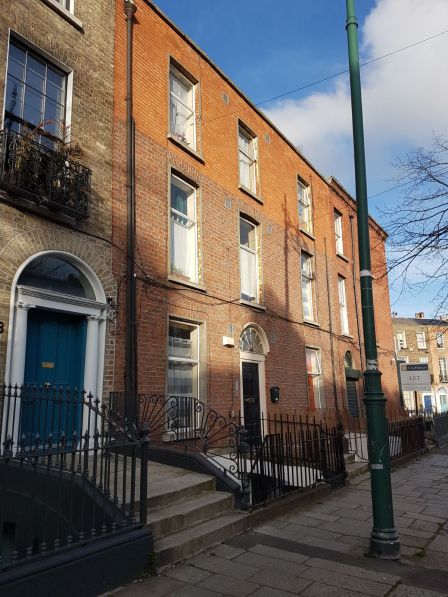
As part of a new work-related project I’m involved in around the Talbot Street area (stay tuned for more on this later) I’ve decided to look at the history of the Street and its surrounds. The street we know today as Talbot Street emerged in the early 19th Century and it reflected the style and design of that time. The Wide Street Commission was doing important work redesigning the centre of Dublin, it was shifting the city’s axis eastward and creating the broad boulevards that we know today like Dame Street, Westmoreland Street and D’Olier Street.

The Chief commissioner of the Commission was a man named John Beresford who was brother-in-law to Luke Gardiner whose family owned huge tracts of land in the North of city. These lands, known as the Gardiner Estate, included the area we know today as Talbot Street and the wider Gardiner family gave their name to many of the streets we know in the area today, such as Gardiner Street, Mountjoy Square, and Montgomery Street (now Foley Street), which infamously became known as the “Monto” red light district during the 19th and early 20th centuries.

Talbot Map

One of the earliest developers in the area was Henry Moore, the Earl of Drogheda, who in the late 17th Century developed the upper end of what we know today as O’Connell Street, as well as Henry Street and North Earl Street, modestly deciding to name all the streets after himself. The earliest incarnation of Talbot Street was known as North Cope Street and had such lovely attractions as the Cow Pock Institution, which opened in 1804 to treat sufferers of Cow Pox. A fairly horrible contagious disease that could be transmitted from livestock to humans!

The more modern Talbot Street appears on William Duncan’s map from 1821 and the area sees some rapid development over the next few decades. In 1846 Connolly Train station (then known simply as Amiens Street station) opened its doors. It was constructed for the Drogheda and Dublin Railway Company and was the first of the four major Dublin Railway stations to be built. The commanding central tower of the station can be seen the length of Talbot Street as far down as O’Connell Street. This was followed with the prominent railway bridge that cuts across Talbot Street in 1891. The area became, over time, even more of a transport hub when the Busáras station opened on Store Street in 1953 and then in 2004 the Luas Red line started to run with stops on Lower Abbey Street, Store Street and at Connolly Station. The area is now arguably the most well connected area for transport in the country which explains one of the reasons that it is so popular with visitors with a proliferation of hotels and backpacker hostels in the district such as the Ripley Court, Isaac’s hostel and The Celtic Lodge.

Molloys

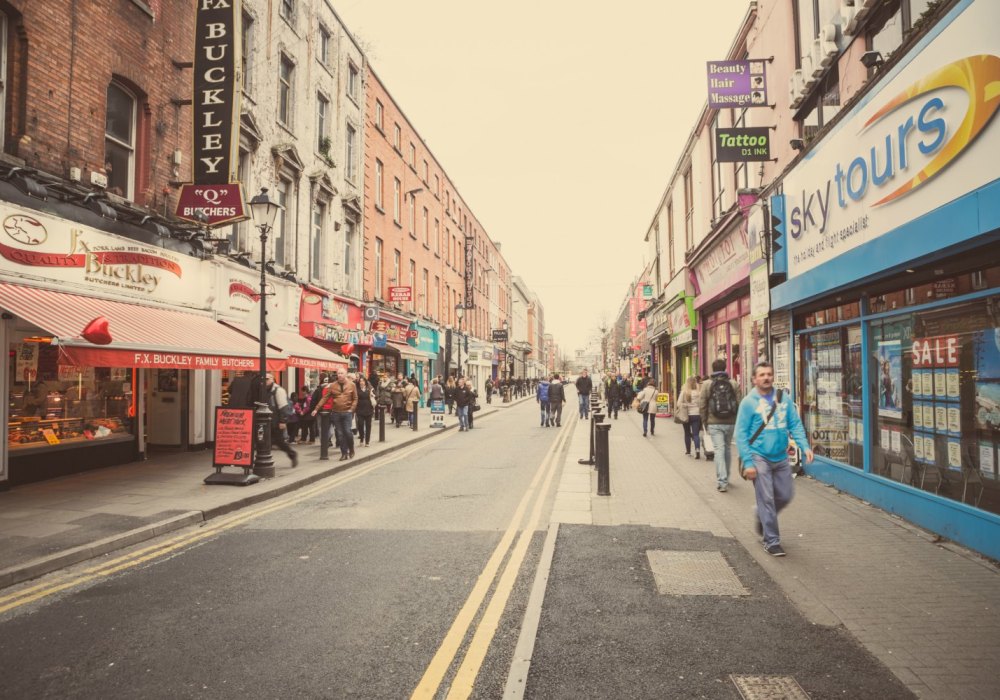
While the area is well known as a key historic shopping area, with famous traditional Dublin names like Guiney’s, FX Buckley Butchers, O’Neill’s Shoes and many more, it is also home to quality restaurants like 101 Talbot and Le Bon Crubeen. While around the corner is the world-renowned Abbey Theatre. The Abbey was the first state-subsidized theatre in the English-speaking world and played a central role in the cultural revival of the early 20th Century and many key moments in the early decades of the State. Beyond the other boundary of Talbot Street on Marlborough Street lies St. Mary’s Pro Cathedral. Across the road from this bishropic seat are the fine, impressive grounds of the Department of Education which was originally the site of the first stone-built mansion in Dublin, Tyrone House, which still stands there to this day. The Richard Cassells’s designed building was purchased by the state in 1835 and is now home to the Model School and the Scoil Caoimhín Gaelscoil. All of this shows the often overlooked architectural gems that are dotted around the Talbot Street area. Sure did you know that there was even a Welsh language Church on the street?!

FXB

During its history the street has been associated with a number of dramatic and tragic events from the death of Sean Tracey in a gun battle in front of what is now the Wooden Whisk cafe. Sean was one of the men who fired what could be viewed as the first shots of the War of Independence during the Solohedbeg ambush in Tipperary, 1918. At the time the Wooden Whisk was a shop that provided uniforms for the Volunteers. The street also witnessed one of the darkest days of the Troubles in 1974 as it was targeted as part of a coordinated bombing attack on the city. But the area has always bounced back, today Talbot Street is a link between the main transport hubs like Connolly Station, the IFSC and docklands and with areas further west like Henry Street and Capel Street while still retaining an appeal all its own. Of late we’ve profiled all the different places to dine in the area while several new companies have opened offices in the area bringing an influx of new workers and an extra vibrancy to the area.

Originally posted to DublinTown in March 2016

The pubs of 1916 and beyond

During the long history of various Irish independence movements the Dublin Pub has always been a focal point for public meetings, clandestine gatherings and developing networks. Michael Collins’ knowledge of Dublin pubs and network of helpful publicans is legendary. Several famous bars in the city even still bear the scars of bullet and shell from the days of the Rising. Below is a short list of Dublin pubs with connections to the independence movement.


Davy Byrne’s

Davy-Byrnes

Situated just off Grafton Street this pub is famously associated with Joyce’s famous character Leopold Bloom who drops in for a bite of lunch but during the War of Independence and Civil War the premises was visited regularly by Michael Collins and Arthur Griffith. Davy Byrne’s nationalist sympathies were evident, permitting as he did the upstairs room to be used for meetings of the Irish Republican Brotherhood (IRB) and the outlawed Provisional Cabinet of the State, of which Collins was Minister for Finance. On one occasion, an officious barman clearing the premises at closing called: “Time, gentlemen please,” to which one customer replied, “Time be damned! The Government is sitting upstairs.”


The Duke

The-Duke

The Duke has a long association with Home Rule and Republican politics. As far back as the 19th Century when Charles Stewart Parnell, the leader of the Home Rule party tended to spend his Dublin sojourns in a hotel on nearby Dawson Street. Many of his Parnellite followers used to meet and socialise in the tavern then run by the Kennedy brothers at 9 Duke Street. From 1900 onward, and just next door to the pub the famous Dive Oyster Bar operated and in 1904 it was taken over by the Kiernan family of Granard, Co. Longford. Their daughter Kitty would famously become the fiancé of Michael Collins and the pub would become one of Collins’ many safe houses in the city.


The Grand Central Bar

The-Grand-Central

Although its only been a licensed premises since 2003 when the former branch of AIB became the latest addition to the Louis Fitzgerald Group, this fine and impressive building dates all the way back to the early 19th Century and was very much in the middle of the action in Easter 1916. The building at no. 10 Sackville Street (now O’Connell Street) was owned by Alderman William McCarthy, a Unionist politician on Dublin City Council, and during Easter week 1916 the building was heavily damaged by the many shells fired by the Royal Navy gunboat the Helga II into the Sackville Street and Abbey Street vicinity. After the Rising the building was so thoroughly repaired that by the following year Aldreman McCarthy was in a position to sell no. 10 and 11 to the Munster and Leinster bank which would later become part of AIB.


The Old Stand

The-Old-Stand

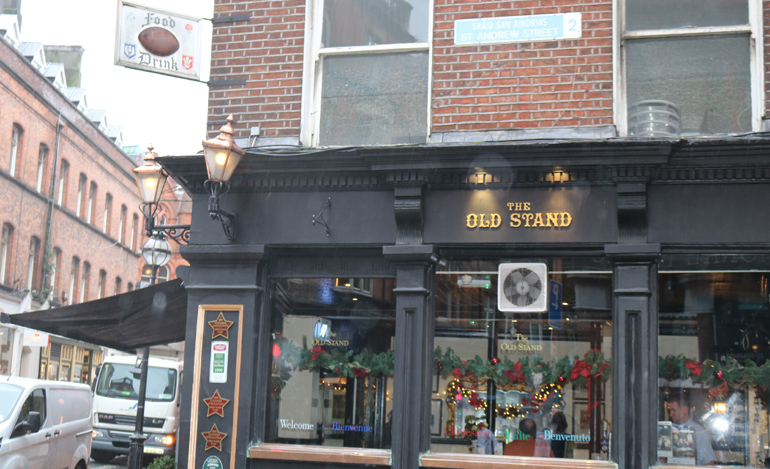
During the War of Independence, the premises was frequently visited by Michael Collins, who had an office nearby at 3, St Andrew Street (now the Trocadero Restaurant). From time to time, Collins held informal meetings of the outlawed I.R.B. (Irish Republican Brotherhood) in the premises and in true Collins tradition, he was less conspicuous while in the midst of the public. A handsome commemorative plaque and a portrait of “the Big Fella” hang in the pub to remind modern customers of these clandestine meetings.


The Swan

The-Swan-Bar

The Swan pub on Aungier Street, then owned by Tipperary man John Maher was occupied during Easter 1916 as it sat close to the Jacob’s biscuit factory (now part of the National Archives) which was captured by the rebels under the command of Thomas MacDonagh. Numbered among the ranks of the Volunteers was Peadar Kearney who would later write the words for the Irish national anthem. One of the last garrisons to surrender when the rebels were making their escape and Michael Molloy, a Volunteer stated

“Orders were also given that we were to burrow through from Jacob’s to a public house at the corner facing Aungier Street. We had two masons in our party and the burrowing was made easy. Strict instructions were given that no Volunteer was to take any drink from the public house. And although I am not a drinking man myself I must say that this order was strictly obeyed”

The pockmarks of artillery fire were still visible for many years on the walls of the premises.


The Oval

The-Oval-Bar

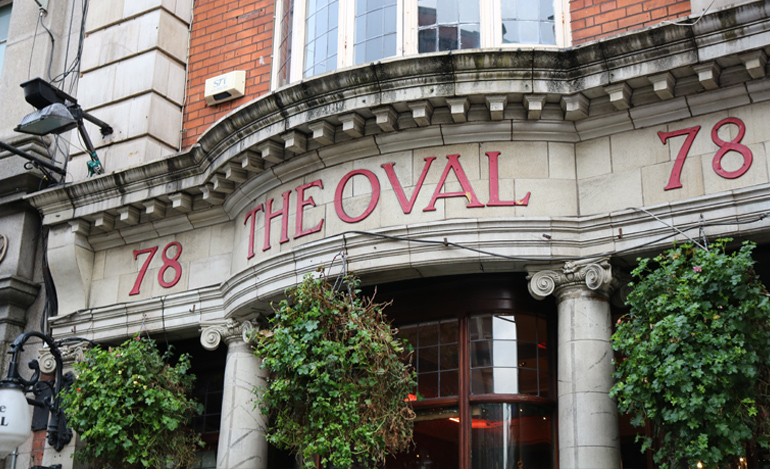
In the years leading up to 1916 this pub found favour with more that the members of the fourth estate from the nearby Irish Independent offices. Uniformed members of the Irish Citizen Army and the Irish Volunteers frequently dropped in to The Oval after manoeuvres while waiting for trams. A busy pub in a busy city centre was the perfect meeting place for members of the I.R.B., who blended in with a swelling clientèle.

Easter Monday, April 24th seemed a day like any other at The Oval until the Irish Volunteers captured the nearby GPO and proclaimed the Irish Republic. The week that followed would bring chaos, devastation, death and destruction both to the city of Dublin and to The Oval. By Wednesday the HMS Helga II had sailed up the Liffey and commenced shelling Liberty Hall and the GPO. At precisely 10am on Thursday April 27th the fate of The Oval was sealed. New trajectories were set on the Helga and the GPO and surrounding buildings were all hit. Fires blazed in Sackville Street and Abbey Street. Before long an inferno had engulfed the city centre. The Oval and surrounding buildings were destroyed. Abbey Street and Sackville Street smouldered for days as ruin and rubble scattered the pavements.

The pub’s owner John Egan set about rebuilding the pub and it was able to re-open its doors for business in 1922. It is this pub that customers see when they visit today but a brass plaque at the entrance commemorates the pubs historic destruction.


The Confession Box

Confession-Box

The reason for the name of the pub dates back all the way to the Irish War of Independence (1919-1921). During that conflict the last know excommunications from the Catholic Church in Ireland took place and were directed against the men involved in the ongoing rebellion. At the forefront of issuing these excommunications was Bishop Daniel Cohalan of Cork and it was rumoured that many of those who were excommunicated, including that famous Corkonian Michael Collins, would drop into what was then the “Maid of Erin” pub and would receive Communion and Confession from sympathetic priests from the nearby Pro-Cathedral. Thus the pub earned the nickname of “The Confession Box”.


The International Bar

The-International-Bar

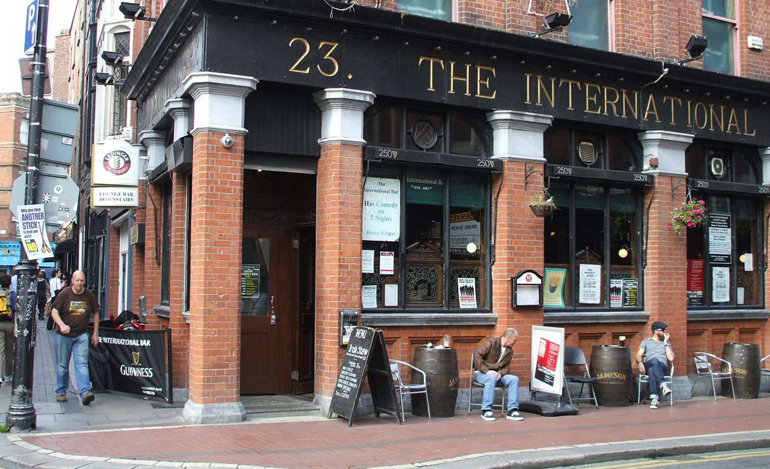
The International was another of Michael Collins’ many haunts and has played host to many authors, musicians and artists over the years. It has also been in the possession of the O’Donohoe family since way back in the 1880’s! I’ve left this to the last on the list as it has a very modern connection with 1916 in that the International, at the corner of Wicklow Street and Andrew Street is the meeting point for the hugely popular 1916 Rebellion Walking tours which run seven days a week.

Originally published for DublinTown in January 2016


Football, revolutionaries and my great-grandfather – 1916 and all that

We’ve only begun the year of commemorations and there has already been a great deal written about the various organisations, groupings and competing actors around the dramatic events of Easter 1916.  In much of nationalist history there is a huge role played by sport in the recruitment and training of the Volunteers, this is something often celebrated by the GAA and is born testament to in the naming of stadiums and club teams around the county.

This involvement with the nationalist cause was not limited only to the sphere of Gaelic games. Despite its occasional portrayal as a “Garrison Game” many individuals who were actively involved with football clubs also became key players in the struggle for independence. Among them were family members of my own.

In doing some family tree research I’ve started looking into the history and background of some of the relatives on my Da’s side of the family, people I was vaguely aware of but who by and large had died before I was born. This trail has brought me to a few individuals, my great-grandfather Thomas Kieran (occasionally spelled Kiernan) his sister Brigid and her husband , my great-uncle, Peadar Halpin.

At this point I must state that I do indeed have some non-Dublin blood in my veins, not much mind, but both Thomas and Peadar were from Co. Louth. Peadar would come to prominence due to his association with Dundalk FC and the FAI. He was a founder member of the club and spent decades on the management committee of Dundalk FC and was also club President. He also served as Chairman of the FAI’s international affairs committee and President of the League of Ireland and also Chairman of the FAI Council.

Football in Dundalk, in a somewhat disorganised fashion could be found as far back as the late 19th Century and some of the impetus given to the game in the early 20th Century can be traced back to a Dundalk architect named Vincent J. O’Connell. He had played for scratch teams in the town in his youth and had been a member of Bohemian FC between 1902 and 1907 during a sojourn in Dublin. Upon his return north he set about working with others to bring some structure to the playing of the association game in the town.  The club we know today as Dundalk FC began life as Dundalk GNR, the GNR standing for Great Northern Railway, and they spent a number of years in junior football before being elected to the League of Ireland in the 1926-27 season. The campaign for election to the league as well as the eventual re-branding of the club to Dundalk FC was apparently the result of the machinations of a group of local football enthusiasts comprised of Peadar Halpin, Paddy McCarthy, Jack Logan, Paddy Markey and Gerry Hannon. According to a report in the Irish Times the decision to change the club’s colours from black and amber to white and black was made by one Barney O’Hanlon-Kennedy who promised his silver watch as a raffle prize for a fundraiser for the club. As he was the one putting forward the funds he was given the honour of selecting the team’s colours.

That Dundalk should be so connected with the railway shouldn’t be that surprising, then as now, Dundalk was a major station between Dublin and Belfast, even if the creation of the border did cause disruption. My great-grandfather Thomas Kieran (born in 1889, son of Patrick and Annie Kieran) was a worker for the railway, at the time of the 1911 census when he was 22 years old and residing in the family home of 14 Vincent Avenue in Dundalk (five minutes from the train station). He was listed as being an “engine fitter”, while his father Patrick was a carpenter for the railway as well. Later reports show that Patrick was also involved with the union (the Irish Vehicle builders and Woodworkers Union) and was among the workers representatives when a strike was threatened in 1932. The census also reveals that of the family of five both Thomas and his sister Brigid spoke Irish.

Vincent Avenue

House in Vincent Avenue today, they were build c.1880

Republican roots, what the records say…

When searching through the Bureau of Military history records I came across a number of references to the Kieran family. One referred to the family as a “Volunteer family….railway people”. This came from the witness statement of Muriel MacSwiney, the wife of future TD and Lord Mayor of Cork, Terence MacSwiney who stayed with the Kieran family during one of Terence’s frequent bouts of imprisonment. This is confirmed by the witness statement of another local Volunteer James McGuill who referred directly to Brigid saying that Muriel MacSwiney “stayed in Dundalk with Miss Kieran now Mrs. Peadar Halpin.”

78-1926-08-15-Muriel-MacSwiney-1920

Muriel MacSwiney

On a slight digression Muriel MacSwiney was a fascinating woman, born Muriel Murphy, her family owned the Midleton Distillery and they were firmly against her marriage to Terence MacSwiney and even tried to get the Bishop of Cork to intervene to delay it. As a footnote that will become relevant later, the best man at their wedding was Richard Mulcahy the future Chief of Staff of the IRA, Minister for Defence during the Civil War and later still, leader of Fine Gael. Terence was in and out of various gaols during the course of his short marriage with Muriel, he would be dead by 1920 at the age of just 41, wasting away on hunger strike in Brixton Jail. The impact his death had on the wider world is probably comparable to that of Bobby Sands six decades later. MacSwiney was viewed by many as a martyr in a fight against Imperialism and was cited as an influence by  Mahatma Gandhi as well as India’s first Prime Minister Jawaharlal Nehru.

Apart from providing lodgings for Muriel MacSwiney it’s worth looking at what else the Halpins and Kieran’s were up to at this turbulent time. Thomas Kieran is mentioned again the the Bureau of Military History. In the witness statement of Patrick McHugh, Operational Commander and Lieutenant of the Irish Volunteers in Dundalk during Easter week 1916 listed Thomas Kieran among those “who served Easter Sunday 23rd April 1916, remained with company that day and, volunteered to return home when uncertainty of position was explained to them. Some returning Sunday night, others Monday morning or as Stated.”  Interestingly Thomas is already listed as living in Dublin by this stage while most of those mentioned were still living in Dundalk. Peter Kieran (a possible relation?) another Dundalk based Volunteer declared in his witness statement that Thomas Kieran was among a group of Volunteers who had arranged to meet on the night of Thursday 20th April with plans to make their way to Dublin to join the rest of the Volunteers in the Rising. They had elaborate plans to get there via motor boat but were warned that the Royal Navy had vessels patrolling the area.

The plans for the Thursday journey to Dublin was called off and the group met again on Friday and Saturday night, however word came that the Rising was off, probably a reference to Eoin MacNeill’s order cancelling the Rising, which obviously had a significant impact on the numbers of those who arrived in Dublin. Peter Kieran went on to state that about the second week in May arrests were made in the town by the RIC. The family version of the story that I’ve been told was that Thomas was one of those arrested while cycling his bike with a rifle on his back and that he was later interned!

Peter Kieran in his statement also noted that “Those who served 23rd, 24th and 25th April 1916 and became disconnected, were ordered home on account of age, infirmity or as stated. [included] Peter Halpenny or Halpin [of] Byrnes Row Dundalk”  Although it is hard to be absolutely certain this Peter Halpin could well be our Peadar Halpin, he was listed as Peter on the earlier census return. There is also a record of a P. Halpin from Byrne’s Row who was arrested a couple of weeks after the Rising and sent to Stafford Detention Barracks in England on 8 May 1916. There are other references in other sources to a P. Halpin of Byrne’s/Burn’s Row being arrested and sent to Stafford.

In searching the medal rolls for this issued the 1917-21 Service Medal both Peadar and Brigid appear. Both were issued the medal, Brigid in 1943 and Peadar in 1951. Her deposition states that Brigid was a member of Cumann na mBan from before the Rising. She was involved in dispatch work, fundraising for the purchase of arms, did election work for local candidates and visited republican prisoners. Peadar in his deposition states he was a member of “A” company of the 4th Northern Division of the IRA and that his involvement also predated the Rising, going back to 1915. It doesn’t however, detail individual operations of which he was part.

Patrick McHugh (who we encountered above) managed to escape arrest although he was interrogated by RIC men just after the Rising. He then moved up to Dublin to stay with his sister on Iona Road for a short time until he “got in touch with friends Tom Kieran and his wife [the granny Kiernan], who had a room in Mountjoy Street.” It seems that Thomas Kieran had moved to Dublin sometime between 1911 and 1916. I know he ended up working in the CIE engineering works in Inchicore for many more years. He obviously met Jane Brennan (2 years his junior) when he moved to Dublin, she had been living on Dominick Street Upper at the time.

Blessington St1

The house at 27 Blessington Street, just off Mountjoy Street, where the Kierans lived.

Peadar was born in 1895 and grew up in Stockwell Lane, Drogheda. He trained as a cooper, (the trade of his father John) before moving to Dundalk to work in the Macardle Moore Brewery where he later became the foreman cooper. It is interesting to note that his wife Brigid was 12 years his senior. He came from something of a Republican family and a street (Halpin Terrace) in Drogheda bears the family name. This street has something of a tragic history to it as it was named after Peadar’s younger brother Thomas, who was killed there by the Black and Tans in February 1921. At the time Thomas was an Alderman of the local Corporation representing the Sinn Féin party. Thomas Halpin, along with another man, John Moran were abducted from their homes and brought to the local West Gate barracks where they were brutally beaten. They were then dragged to a third man`s home, that of a Thomas Grogan whose house was also raided but fortunately Grogan had been tipped off and had made his escape before the Tans arrival. It was at this spot that Thomas Halpin and John Moran were murdered, their bloodied bodies being discovered there the following morning. Each year the local Council commemorates this event and a monument now stands at the site of the men’s murder.

IRA memorial

Commemorations for Alderman Thomas Halpin & Captain John Moran in 2014


Footballing connections; all roads lead to Bohs

Thomas, is something of a family name, Peader’s brother Thomas was tragically killed and Peadar would name a son of his as Thomas, perhaps in tribute to his murdered sibling. Thomas Kieran would also have a son named Thomas and there is an interesting football overlap as both of these men named Thomas would have a part to play in the history of Bohemian FC.

Peadar’s son Tom lined out for Dundalk in the early 40s before moving to Bohemians in 1947. He featured prominently in Bohs run to that season’s FAI Cup Final where he was part of a team that defeated Drumcondra FC, Shelbourne in the semi-final (where Halpin scored a penalty) and took on a highly talented Cork United side in the final. Cork United had been the dominant team of the 1940s and had already won five league titles by the time they took on Bohemians in front of over 20,000 fans at Dalymount Park on April 20th 1947. The Leesiders were the strong favourites. Bohs were at an added disadvantage as two of their key, experienced defenders (Snell and Richardson) were out injured. Halpin was playing at right half and spent most of his time trying to counteract the attacking threat of Cork’s forward line which included Irish internationals like Tommy Moroney and Owen Madden.

Bohs 1947

The Bohemian team from the 1947 final

Bohs were already 2-0 down before 30 minutes were on the clock but Mick O’Flanagan managed to pull one back before Halpin scored a penalty after Frank Morris was fouled in the box. The game finished 2-2 and went to a replay four days later. In a howling gale and lashing rain Bohs lost out in the replay in front of barely 5,500 people with the Munstermen winning 2-0.

Tom Kieran’s connection with Bohemians was a very long one, a referee for decades, including at League of Ireland level in the 1960s. The uncle Tom was a member of Bohemians since 1969 and was Vice-President of the club from 1985 to 2000 and was later made an Honorary Vice-President for life. Tom’s daughter Susan and her husband Dominic are of course still very familiar faces down at Dalymount to this day.

the uncle Tom

The uncle Tom as photographed for an Evening Herald profile in Dalymount Park

There are further remarkable connections with the Halpin family and with Dundalk and Bohemians as Thomas Halpin’s grandson; Peter was the Commercial Manager at both Dundalk FC and Bohemian FC as well as having a spell with Belfast club Glentoran.

Despite these many connections with the beautiful game the strongest and most influential roles in Irish football were undoubtedly held by Peadar Halpin. He was on the committee of Dundalk FC since at least 1926 and had two spells as Club Chairman from 1928-1941 and 1951-1965 and in 1966 he was appointed Club President, a position he was re-elected to in 1973. He also held a number of roles for the FAI, he was Chairman from 1956-1958 and had many years previous experience on various FAI committees and had made an unsuccessful attempt at arranging UEFA mediation to help resolve the long-running schism between the FAI and the IFA. At the age of 70 he was elected as President of the League of Ireland, it was a role he hadn’t been expecting to fill but after the Dundalk rep Joe McGrath became ill Peadar was the only member of the Dundalk committee with sufficient experience to take on the role. While the FAI and League of Ireland have (with good reason) been seen as conservative and at times backward there were a number of advances that took place during his tenure. It was the Dundalk committee that suggested the introduction of the B division which would eventually lead to the creation of the First Division as well as overseeing the admittance of new clubs to the League of Ireland. On a local level he was crucially involved with the development of Dundalk FC as a force within the League of Ireland, at present they are the second most successful side in Irish club football with 11 League titles and 10 FAI Cups. He claimed that of the many successful years that Dundalk enjoyed his favourite was 1942 when Dundalk beat Cork United 3-1 in the FAI Cup final and Shamrock Rovers 1-0 in the Inter City Cup.

Dundalkimage

Mattie Clarke in action for Dundalk in the 1950s as featured in the Irish Times

A potential politician?

Despite this extremely long connection with Dundalk FC the earliest reference to his involvement was in 1926. Prior to that we know that he was working as a foreman cooper in the Macardle Moore Brewery but in March 1923 his name appears in a debate in Dáil Éireann when his local TD Cathal O’Shannon raised a question on his behalf with the then Minister for Defence, General Richard Mulcahy. This is the same Richard Mulcahy who had performed best man duties at the wedding of Terence MacSwiney and Muriel Murphy who the Halpin’s would later shelter. It is testament to the divisiveness of the Civil War that such former allies could be so opposed.

O’Shannon had been elected TD for Louth-Meath in 1922 as a member of the Labour Party and was a supporter of the Treaty of 1921 which had officially led to the partition of Ireland. Mulcahy as Minster for Defence was a highly controversial figure for some as it was he who gave the order for 77 executions during the Civil War. The content of O’Shannon’s query was a request for an update on the status of Peadar Halpin and the likelihood of his release from Newbridge Barracks where he had been held since August 1922. Mulcahy replied that “Mr. Halpin was arrested for aiding and abetting Irregulars during the time of their occupation of Dundalk. It is not considered advisable to release him at present”, he further added that Peadar was not to be allowed send or receive letters.

As for what “aiding and abetting the Irregulars” referred to, the most likely answer given the fact that Peadar was arrested in August 1922 in Dundalk was that he was involved in assisting the anti-Treaty IRA (or “Irregulars”) in their attack on Dundalk on August 16th 1922. During this attack, led by future Tánaiste Frank Aiken, the anti- Treaty forces captured the town, freed over 200 prisoners held in the barracks and also took over 400 rifles. Rather than try to hold their position the town was re-taken the following day by Free State forces. In all the attack on Dundalk cost the lives of six Free State soldiers and one officer as well as the lives of two of the “Irregulars”. It is not clear what assistance Peadar provided during this time but it was obviously significant enough to warrant him being held in gaol for months without charge.

Family recollections of Jane Kieran née Brennan, the wife of Thomas Kieran are fairly clear on her views on Mulcahy and Cumann na nGaedheal, she put it bluntly and succinctly, saying “they cut the old age pension and they shot them in pairs”. It was not to be the last connection between Peadar and Cathal O’Shannon or Frank Aiken for that matter as the below excerpt shows.

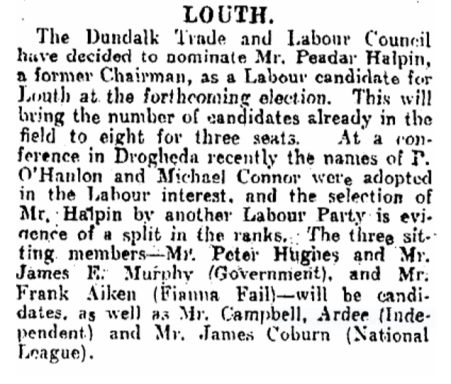
Peadar Labour snip

From the Irish Times April 29th 1927


Cathal O’Shannon stood in the new Meath constituency in the first general election of 1927 and in his absence as the Labour candidate it was proposed that Peadar should run. Among his competition would have been the man he likely assisted during the Civil War, Frank Aiken. However as is the cross that left-wing politics must bear, there was a split, those who proposed Peadar as a candidate were not successful in securing his nomination and Thomas O’Hanlon and Michael Connor ran, unsuccessfully, for the Labour Party. As another of my many side notes, Cathal O’Shannon was unsuccessful in gaining election in 1927 however he later became the first Secretary of the Congress of Irish Unions in 1945, the last president of this Congress was one Terence Farrell, head of the Irish Bookbinders and Allied Trades Union. His nephew Gerard, after whom I’m named, married Nancy Kieran which brings together the Farrell and Kieran clans. Their eldest son was my Da, Leo and as many in the family will know he played for Bohs in the early 60s.

Anyone who has read this blog regularly will know that I often try to look at life and history through the prism of football. Of particular interest is the role that “soccer men” played in the Rising and subsequent War of Independence and Civil War. This is probably the most personal post as I’ve tried to do the same with my own family and their involvement with the nationalist movement. There are many stories that I would love to include but haven’t but would appreciate any feedback or additional information from family members. I hope that this could be the first in a series of posts that might be of interest or maybe just a first draft of something more extensive, there were certainly enough stories told at uncle Joe’s funeral to fill a book, but I hope this might be a start.


With a special thanks to Jim Murphy, Dundalk FC historian for his assistance with some of the research for this piece.

Alexander McDonnell Chess champion and slavery apologist

recent article on sports website balls.ie highlighted the claims by Michael Cusack, one of the founding members of the GAA, that Chess was in fact a game that was Irish in origin. Cusack claimed chess should be “played because it was Irish and National, and especially because it was the principal instrument of culture among the most glorious people that ever lived in Ireland – the Fenians of ancient Erin.” The article focuses on some fascinating research carried out by UCD’s Paul Rouse in his latest book ‘Sport and Ireland: A History’ and the article further mentions that to date our only Grandmaster is the Russian born, Irish resident Alexander Baburin.

Despite this lack of high level achievement  there is a long history of chess in Ireland, though perhaps quite different from the one suggested by Michael Cusack. Chess, or the game from which it originated, has variously been traced to China, Persia or most commonly India, with the game we know today moving westward into Europe and then northward through Italy and Spain. The Prague-born Wilhelm Steinitz has been recognised as the first official Chess “World Champion” in 1886, while the international governing body for chess, FIDE was founded in France in 1924. However in the years before Steinitz’s triumph there were a number of unofficial world champions, and one of the first, and most brief of these champions was an Irishman, the Belfast-born Alexander McDonnell.

McDonnell was born in Belfast in 1798, his father, also named Alexander was a noted surgeon in Belfast. It was said that he attended the the execution of Henry Joy McCracken, one of the leaders of the 1798 rebellion. While his uncle Dr. James McDonnell was the founder of the Belfast Fever Hospital, which exists today as the Royal Victoria Hospital. James was also father to a son named Alexander, but we will return to him in another post.

Alexander, the future chess star, trained and worked as a merchant in the West Indies in the early part of the 19th Century, and this is where the story takes a decidedly dark turn. Reports suggest that Alexander went out to the West Indies at the age of 17 and ended up in the colony of Demerara-Essequibo, now part of modern day Guyana, and worked as a merchant dealing mainly with the export crops of the area, sugar and coffee. McDonnell was obviously well thought of by the merchants and plantation owners of the area because in 1820 he returned to London to act on their behalf as secretary of the Committee of West Indian Merchants. This role was to primarily represent the interests of the British colonists in the West Indies and to liaise with persons of importance and members of Parliament, what we might recognise today as a PR and lobbying role. This was a crucial time for those with financial interests in the West Indies, as there was a growing abolitionist movement in Britain, and the plantations of the West Indies were almost totally operated by slave labour. By 1807 the British Empire had outlawed Slave trading, which ceased the long established practice of the Atlantic slave trade, the forcible capture and relocation of people from west Africa to the Americas for work in the hugely profitable plantations. Slavery itself though remained legal. Those enslaved people already in the possession of plantation owners remained their chattels, as did any children born into slavery.

McDonnell doc

McDonnell’s cruel attempt to justify the conditions of slavery in Demerara.

In 1823 the Anti-slavery society, which sought to abolish slavery completely and which lobbied extensively for this cause, was founded in Britain. 1823 was also the year that Demerara became the focus of international attention, after a slave revolt was ruthlessly put down by the local colonists and their armed forces. While initial public sentiment in Britain was with the plantation owners, this soon changed when details of the conditions for the enslaved people emerged. Central to the revolt seems to have been the actions of an abolitionist preacher named John Smith who wished to provide religious instruction to the enslaved people and who also told them of the abolitionist movement. Smith was arrested and charged with promoting discontent and dissatisfaction among the enslaved people of the plantations. He was duly convicted and sentenced to death but died of “consumption” before the sentence could be carried out. The death of the white Parson Smith caused uproar in Britain, far more than the death of over 200 black people during and after the revolt, and let to over 200 petitions being delivered to Parliament. Over 20 of the enslaved people who had been part of the largely peaceful uprising were executed and their bodies strung up on gibbets as a ghastly warning to any other slave who would dare to seek their freedom.

It was against this background of huge negative publicity, the creation of Parson John Smith as the so-called “Demerara Martyr” and the rise in prominence of abolitionists like William Wilberforce, that Alexander McDonnell wrote a book entitled “Considerations on Negro Slavery with authentic reports illustrative of the actual conditions of the Negroes in Demerara” . The book reads as a condescending apologia for the Demerara plantocracy. McDonnell seeks to the defend the indefensible conditions and practices of the planters, mainly by referring to replies he received from plantation managers to a series of letters he had sent. While he criticises the slave trade and the cruelty of kidnapping people from their native lands, he defends the present “patriarchal” conditions of slavery that existed in Demerara. His arguments against immediate abolition were threefold, though predominatly focused on the financial impact of such a decision. Firstly, he argued that the West Indian colonies were worth a great deal financially to the British Empire, but that this was predicated on the production of items like sugar through slave labour, and abolishing slave labour would make the colonies a drain on the Empire. Secondly, that plantation owners had a right to their property and should not be denied a living. He stated that even the most vociferous abolitionists would have a different view of slavery if its banning should lead to their own loss of income. And thirdly, that the slaves of Demerara could not be freed as they were not yet civilised enough to avoid slipping into complete idleness. To support this hypothesis he drew comparisons with the “keeping up with the Joneses” type of motivations that encouraged the English to strive towards greater security and wealth, comparing the dilligent and hard-working farmers and merchants of England with the feckless and idle farmers from the West of Ireland.

Guyana

Monument to the 1823 Demerara rebellion in modern day Guyana.

Ironically given his preoccupation with idleness, McDonnell’s job representing the interests of West Indies merchants supplied him with a good income and quite an amount of downtime in which he spent honing his skills at the game of chess. McDonnell was only in his early 20s when he was sent back to London in 1820, and by 1825 he was a chess pupil of William Lewis, the first man to ever have the term “Grandmaster” used about him. By 1832 (according to no less an authority than Charles Dickens), McDonnell and several others had joined the Westminster Chess Club, situated on the first floor of a coffee house at Covent Garden. One of the founders of the club was chess player and author George Walker. It was Walker, more than anyone, who helped to popularise chess in Britain at the time. Although not as great a player as the likes of William Lewis, his regular and readable articles on the game, and importantly cheap and accessible books on chess, help drum up interest in the pastime. His Westminster Club would be so successful that it would soon have over 200 members paying two guineas each in membership fees.

Chess clubs such as the Westminster gave McDonnell the opportunity to cement his reputation as the foremost player in Britain, replacing the man who taught him, William Lewis as the top British player of his day. And so, to the chess games that could briefly allow McDonnell a claim to being world chess champion. In 1834, the ever enterprising George Walker sought to arrange a series of games between McDonnell (judged the best player in Britain) and Louis-Charles Mahé de La Bourdonnais, the strongest player in France.

La Bourdonnais was an interesting character. Born on the Indian Ocean island of Reunion, part of the French empire just off the east coast of Africa, he squandered his fortune in a series of bad investments and turned to chess to provide him with a living. In the early 1820’s he had travelled to London and had defeated the foremost players that Britain had to offer, including William Lewis and John Cochrane. In 1834, some nine years after his last visit to England, La Bourdonnais returned at the invitation of George Walker to play Alexander McDonnell, now recognised as Britain’s finest chess player in the Westminster Chess club.

Louis-Charles-Mahe-de-La-Bourdonnais

La Bourdonnais as he appeared on a Cambodian stamp celebrating great chess champions.

Between June and October 1834 the pair would play a series of 6 matches, which eventually totalled 85 games for what was effectively the World Championship of Chess. The two men’s personal styles differed greatly; McDonnell was a quiet, taciturn individual who would spend hours over a single move, but despite this could be highly reckless in his play. He rarely spoke during play and would often be found afterwards in his rooms, pacing up and down furiously as he mentally replayed that day’s games. The fact that McDonnell was by this stage already suffering from Bright’s disease, a kidney ailment similar to nephritis which can also be accompanied by hypertension, probably didn’t assist his mood, and would eventually lead to his death aged just 37.

La Bourdonnais, on the other hand, was a far more garrulous and animated individual, swearing loudly when he lost and chatting affably and drinking when he was winning. It was said that McDonnell’s somewhat inscrutable demeanour during play, whether winning or losing, was quite off-putting for the Frenchman.

Off-putting as McDonnell’s personality may have been, it didn’t stop La Bourdonnais triumphing easily in the opening match, winning 16 games to McDonnell’s 5 with only 4 draws, which demonstrates the wild difference between theses early 19th Century games and modern competitive chess, where draws are far more common. In the second series of matches, there were to be no draws at all, with McDonnell winning 5 games to 4.

Chess board

The final positions of a game from match 4. McDonnell (white) and La Bourdonnais (Black).

As mentioned above, there would not be an officially recognised World Chess Champion for another 52 years after the McDonnell- La Bourdonnais games. It is at this short juncture, after victory in the second series of games, that McDonnell could claim to being the Chess World Champion, and therefore the only Irishman in history who could hope to lay claim to that title.

La Bourdonnais would win the next three series of games, but it was during the sixth set of matches, with McDonnell in the lead 5 games to 4, that the Frenchman left abruptly to return home. It seemed that La Bourdonnais’ poor financial choices were catching up with him again, and he had to leave urgently to deal with his various creditors. Overall, 85 games were played over the six matches, with the final standing at 45 games to La Bourdonnaise, 13 draws and 27 wins for McDonnell. It was the stated intention to reconvene the sixth match of the series, but within a year McDonnell would be dead. Five years later in 1840, La Bourdonnais would die in poverty having been forced to sell even his clothes to try and pay off his debts. George Walker, the man who had organised the 1834 matches undertook the cost of La Bourdonnais’ burial and arranged for him to be buried in Kensal Green cemetery in London, only a few metres from the grave of his old adversary McDonnell. Both graves have been lost now, but their headstones are recorded to have said simply:

Sacred to the Memory of
Alexander McDonnell
(Formerly of Belfast,)
Who died 14th September, 1835,
Aged 37 years.”

&

Louis Charles de la Bouronnais,
The celebrated Chess Player,
Died 13th December, 1840,
Aged 43 years.”

To an extent, both men’s fame outlived their short life span. For this they have William Greenwood Walker to thank. A Secretary of the Westminster Chess Club, Greenwood Walker had diligently recorded almost all of the 85 games played by McDonnell and La Bourdonnais. Accounts of these games were quickly published and were studied eagerly by chess players the world over. Cary Utterburg, who has written extensively on the matches, has said this on the massive impact Greenwood Walker’s records and publications had on the world of chess:

 “The recording and publication of game scores from a series of matches between masters was a first in chess history. The event irrevocably altered the game, giving birth to modern chess theory. Once based upon composed, abstract exercises, studied in isolation, theory now became concrete and measurable. Practice replaced contrivance, and tactics could be studied and honed in light of the avalanche of match records that followed.”

These games changed the history of the game and founded a new specified genre of writing focused on chess theory and tactics. In this sense, an Irish man was central to the notion that there should be such a thing as an international chess competition, that there could be a world chess champion, and that chess games could be recorded, published and studied by future generations of players. McDonnell’s role in all this was revolutionary, and this is to say nothing of the specific stylistic influence that his play had on generations of chess players to come.

However, it is also impossible to ignore McDonnell’s ignoble role in the far more momentous political movements around the abolition of the slavery. McDonnell had become wealthy off the back of the sugar and coffee trade of the Caribbean, and had returned to London to advocate and lobby on the behalf of plantation owners, men like Sir John Gladstone (father of the future Prime Minister William Gladstone) who had never set foot on their massive plantations, but who extracted great wealth from them. The pathetic arguments put forward by McDonnell in his book of 1825 defending the use of slave labour in the Caribbean were used again when he addressed both houses of Parliament on the issue of the “West India question” in 1830.

McDonnell’s wealth and comfortable job, built on the back of slave labour, allowed him to indulge his talent for chess and may have helped him make history in the game, but his efforts on behalf of the plantation owners could not stem the tides of history. The 1823 slave uprising in Demerara that McDonnell wrote about was followed by a number of other rebellions, most notably the Jamaican Slave revolt of Christmas 1831 in which as many as 60,000 people enslaved in Jamaica rebelled against the planter class.  As in Demerara, the reprisals by the plantation owners were brutal and as many as 500 enslaved people were killed, and over 300 further were executed after the end of the uprising.

While McDonnell was playing La Bourdonnais in 1834, the Slavery Abolition Act was being passed in Parliament. As for men like Sir John Gladstone, they could see the writing on the wall but made sure to use people like McDonnell to lobby intensively for massive compensation due to the loss of their “property”. In this McDonnell was successful, as an example Gladstone alone received almost £107,000 for the loss of slaves through the abolition bill. In modern day sums this equates to approximately £83 million. He would later re-staff his plantations with indentured servants from India who continued to endure terrible conditions.

Alexander McDonnell, a fine chess player, with a fair claim to being a World Champion, but someone who did his utmost on behalf of wealthy and unscrupulous plantation owners to impede the abolition of slavery within the British Empire.


You can read McDonnell’s address to Parliament here and a copy of his “Considerations of Negro slavery” here . 
 

The Flying Doctor & the free-scoring Publican – the famous O’Flanagan brothers

Along Marlborough Street, opposite the Department of Education and a 100 yards or so from the Pro-Cathedral, stands the aptly-named Confession Box pub, a small intimate venue where one could air your concerns over a pint that once belonged to former Bohemians and Ireland centre-forward Mick O’Flanagan.

The pub has its own sporting legacy quite apart from its former proprietor, it was there in 1960 that the Soccer Writers’ Association of Ireland was formed, and it was there that Mick O’Flanagan received the phone call that would make him an Irish International.

It was, as O’Flanagan recalled, around two o’clock in the afternoon of 30th September 1946 when a call came to the pub from Tommy Hutchinson, the Bohemians member of the FAI selection committee which chose the Irish International team.

Ireland were due to play England at 5:30 that afternoon, a historic meeting between the two nations as this was a first time the English national side had agreed to play an FAI selected team since the split with the IFA in 1921.

After decades of being ignored and ostracised by the English FA the FAI had finally secured a fixture against a formidable English side in Dalymount Park. In the minds of the FAI committee of 1946 this was the biggest game in its relatively short history. There was only one problem, their centre-forward, West Brom’s Davy Walsh had pulled out through injury.

This was the purpose of Hutchinson’s call to Mick O’Flanagan, the 24 year old Bohemian striker was being asked to line out against the inventors of the beautiful game at the last minute.

As O’Flanagan remembered:

“I went home to Terenure for a bite to eat, had a short rest and then headed off to Dalymount. It was not really sufficient notice as only the previous evening I had brought a party of English journalists to Templeogue tennis club and I hadn’t got home until nearly two in the morning.”

Despite a laughable lack of preparation, the Irish side put it up to their illustrious opponents who had hammered an IFA selection 7-2 just days earlier. It was only a Tom Finney winner eight minutes from time that sealed victory for the English.

Henry Rose in the Daily Express was moved to write:

“If ever a team deserved to win Eire did. They out-played, out-fought, out-tackled, out-starred generally the cream of English talent, reduced the brilliant English team of Saturday to an ordinary looking side that never got on top of the job.”

Not only did Mick O’Flanagan line out against the likes of Finney, Billy Wright, Tommy Lawton and Raich Carter, he did so alongside his older brother, and fellow Bohemian, Kevin (pictured).

Brothers Kevin and Mick O’Flanagan are unique in world sport as not only did they play international football for their country, they both were capped by Ireland at Rugby, making them the only pair of brothers in the world to play for their nation in both codes.

Mick was capped against Scotland in 1948 as part of the last Irish Grand Slam winning side until 2009, while Kevin had been capped a year previous to that against Australia. This unique achievement is one that isn’t likely to be repeated anytime soon.

Despite this singular accomplishment the sporting careers of the brothers could have been even more illustrious had it not been for the outbreak of World War 2. Both were lining out for Bohemians when hostilities commenced in 1939, Mick a 17-year-old just beginning his career, his older brother Kevin at 20 had been a first-teamer for four years, had already captained Bohemians and had seven Irish caps and three goals to his name as well as being selected to play for Northern Ireland.

While the League of Ireland would continue during the war years, international football would cease for Ireland until 1946. Similarly, Olympic competition would cease which would rob Kevin the chance of competing in the Olympiads of 1940 and 1944. Kevin, at the time was a medical student in UCD, was Irish sprint champion at 60 and 100 yards as well as being national long jump champion.

He had even been a promising GAA footballer, lining out for the Dublin minor panel alongside Johnny Carey (Carey and O’Flanagan would both make their international debuts as teenagers against Norway in 1937) before being dropped because of his involvement with the “Garrison game”.

Young Michael would also miss out, his best goal scoring season would be 1940-41 where he finished as the League’s top scorer with 19 goals for Bohs. Had war not been raging across Europe he might rightly have expected to have more than his solitary international cap.

The brothers remained committed to the amateur ethos of the club which explains the duration of their stays at Bohemians. Mick as a publican in the city centre and Kevin as a medical student and later a Doctor weren’t likely to be swayed by the offer of a couple of extra quid a week from a rival club.

Indeed Kevin took his commitment to the Corinthian ideal to the extreme. Upon qualifying as a doctor in 1945 he had been offered a position as a GP in Ruislip, London. Despite this move he kept up and even increased his sporting activities, he signed on with Arsenal as an amateur while also lining out as a Rugby player for London Irish, when Arsenal invited him to submit his expense claims, they were shocked that he asked for just 4p, the cost of his tube journey from Ruislip to Arsenal.

Bernard Joy, a team-mate of Kevin’s at Arsenal, and a fellow amateur, noted in his history of the club that the then secretary Bob Wall quipped that Kevin “did not want to know anything about tactics. I play football the way I feel it should be played’, he would say.”

Arsenal coach Tom Whittaker said that O’Flanagan could have been “one of the greatest players in football history” if only he could have gotten him to train properly. Despite only spending one full season with the Arsenal first team (for whom he scored three times) Kevin would make a big impression.

No lesser an authority than Brian Glanville described him thus:

“A fascinating, amateur, figure in those Arsenal teams between 1945 and 1947 was the powerfully athletic Irish outside right, the hugely popular Dr. Kevin O’Flanagan. Coming from Dublin to London to take up a general medical practice, he demonstrated pace, strength and a fearsome right foot. He attained the distinction of playing soccer for Ireland on a Saturday, rugby for them the following Sunday.”

Between them, the O’Flanagan brothers would spend almost 20 years as players for Bohemians, while their younger brother Charlie O’Flanagan, a winger, would also line out for the club in the 1946-47 season.

Kevin would return to the Dalymount in another role, that of the club’s Chief Medical Officer and despite his retirement as a player he would remain hugely busy as a sporting physician and sports administrator. He was a member of the International Olympic Committee for almost 20 years before being made an Honorary Lifetime member upon his retirement and was the Chief Medical Officer of numerous Irish Olympic teams throughout the 1960’s and 70’s.

Despite missing out as a competitor, “The Flying Doctor” would manage to make a huge contribution to the Olympics and to Irish Sport in general.

Although they spent almost twenty years service in the red and black of Bohs and scored almost two hundred goals  between them the honours list for the two brothers was relatively short. Both brothers combined to help Bohs win the Inter-City Cup in 1945 in somewhat controversial circumstances.

A year later after Kevin left for London, Mick scored an astonishing six goals in Bohs 11-0 victory over local rivals Grangegorman in the Leinster Senior Cup final, a record not likely to be broken any time soon by a Bohemian player in a cup final.

So much about the brothers’ careers is unique or exceptional, so in this our 125th year it’s worth remembering two of the greatest all-round sportsmen that Ireland has ever produced.

Originally posted on the official Bohemian FC website in August 2015

The fall and rise of UD Salamanca

You could say that the footballing history of most countries began with an Englishman. The national football story of many nations begins with an English engineer, sailor or student stepping off a boat or train with a ball under his arm and a poorly organised kick-about with friends and locals invariably follows.

For many years the Englishman remained the expert, the teacher, and even up to the 1950s the English trainer, manager, football missionary was highly influential. The lives and careers of men like James Richard Spensley, Jimmy Hogan, Vic Buckingham, Fred Pentland and George Raynor are testament to the formative role that these English footballing proselytisers had on the global game.

The role of the Irish is somewhat less obvious, though people like Paddy O’Connell, Jack Kirwan and Monaghan-born Anna Connell (who played a significant part in Manchester City’s foundation) have had some influence beyond our borders. However some of those that influenced the development of the game abroad remain unknown to us to this day, as is the case with the group of Irish students who helped introduce the game to the city of Salamanca and founded the predecessor of Spanish side UD Salamanca.

The first football club in the Spanish city of Salamanca (located about 200km west of Madrid) was founded by Irish students in 1907. This isn’t as strange as it might first seem, Ireland has a greater connection with Salamanca than simply the name of a Dublin tapas restaurant. Salamanca, as one of Spain’s oldest University cities was home to an Irish College, part of a series of educational institutions that were founded throughout Europe during the 16th Century.

These institutions became home to one of the first waves of the IrishUD Salamanca emigrant diaspora after the political turmoil of the times; (the Munster and Ulster plantations, the Nine Years War, the Confederate War and the Cromwellian conquest) drove many of the Gaelic Irish and Old English into the Catholic armies and seminaries of mainland Europe. Indeed many of these colleges still exist or perform some similar role today, the Irish College in Rome still trains Catholic clergy while the Irish College in Paris is now a Cultural centre for Irish students and artists. That Irish students were present in early 20th Century Spain to form the Salamanca Football Team which competed in the early editions of the Copa del Rey shouldn’t surprise us.
While we even know the café where the club was founded the names of the Irish students involved sadly remains unrecorded. Although the early team folded a new side was formed in 1923 as Unión Deportiva Salamanca, they were a yo-yo club for much of their existence but managed to spend 12 seasons in the top-flight and were Segunda division champions on three occasions. However there are to be no more seasons at Spanish football’s top table as the club ceased to exist in the Summer of 2013, the 90th year of their being.

The story of their demise is a familiar one, and one that is likely to be repeated again in the near future. Relegated from the Segunda at the end of the 2010-2011 season, struggling Salamanca’s debts rose. Following the drop to regionalised football, UD Salamanca’s financial problems worsened and by the time the club entered liquidation in June 2013 they owed €23 million to creditors. This raised the very real prospect that the city could have been without a football team for the first time in nearly a Century.

It is into this territory of uncertainty entered Juan José “Pepe” Hidalgo, a local businessman made wealthy through his Globalia company which deals in tourist flights and a chain of hotels. Only days after the liquidation of UD Salamanca a new club, Salamanca Athletic was formed and Argentine coach Gustavo Siviero, formerly in charge at Real Murcia was appointed to manage the fledgling side.

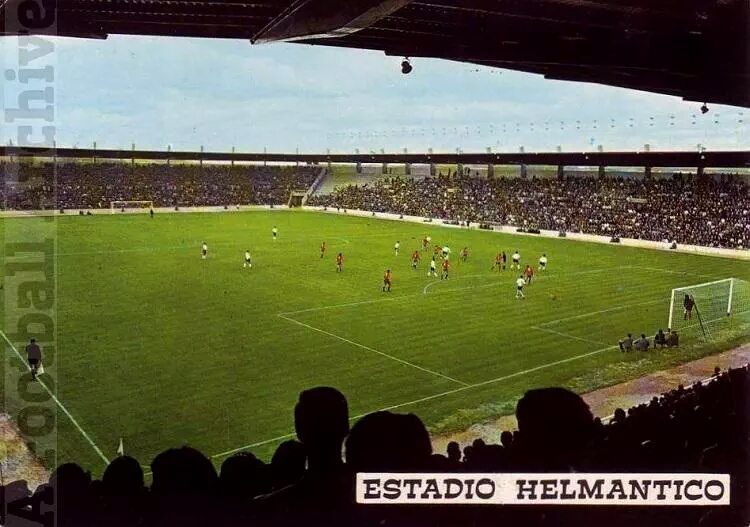
After much wrangling between the Spanish Football Federation and the local judiciary (the football federation initially blocked the new club taking UD Salamanca’s place in the Segunda B division,a decision that was subsequently overturned by the courts) the historic town of Salamanca looked like it would have a football team in place for the 2013-14 season, and looked likely play in UD Salamanca’s old home the Estadio el Helmántico

However this new club never played an official match and looks unlikely ever to do so. A second new club Unionistas de Salamanca CF emerged as a fan owned club made up of former UD Salamanca supporters. The include among their number a local hero in the form of Vincente del Bosque. In their first season secured promotion from the sixth tier of Spanish football into the Primera Regional for Castille and León.

In the chaotic and financially turbulent world it is pleasing that over a Century after some Irish students introduced football to the city, Salamanca will still have a team to support.

Originally posted on Backpagefootball.com in August 2013

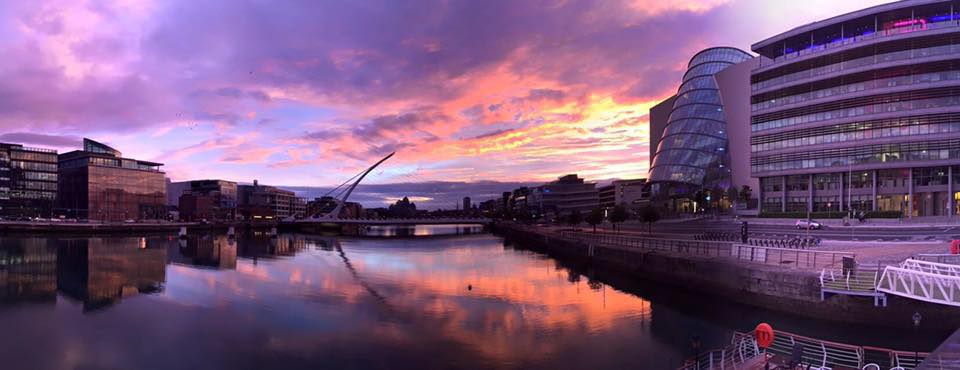
The Bridges of Dublin

Are you a northsider or a southsider? It’s a question asked a bit. A lot more than are you a Dubliner? You can blame Ross O’Carroll Kelly, Damo & Ivor or odd and even postcodes but it seems that we look on our own lovely Liffey as a barrier that divides us rather than the Life-giving River that is like the blood running through the veins of our vibrant city.

So rather than look at what separates us as Dubliners  why not look at what crosses such divides and brings us together. Our bridges of Dublin. Last year Dublin City Council launched their Bridges of Dublin website along with a small exhibition in the Civic Offices which prompted us here in DublinTown to spend a little time thinking about the bridges of our fair city.

After all doesn’t Baile Átha Cliath simply mean town of the hurdle fort, a reference back to the time when both our Viking and Gaelic ancestors were leppin’ across the Liffey at the site of the current Fr. Mathew Bridge? That’s the one that joins Church Street to Merchant’s Quay, and there has been a bridge of some variety there for over 1,000 years. It’s named after the priest who tried to rid Dublin of the daemon drink as a Temperance campaigner in the 19th Century.

Fr. Mathew was born in County Tipperary and he’s the only priest to have Dublin bridge named after him but not the only non-Dubliner. Jeremiah O’Donovan Rossa, the Fenian leader, was born in Cork and has a bridge named after him, at Winetavern Street (next to the Civic Offices) over to the Four Courts, while an earlier rebel leader Rory O’More (a Laois man) gives his name to the fetching blue bridge that links Watling Street and Ellis Street next to the Guinness brewery,  Sean Heuston (of Limerick) a Volunteer commander in 1916 is also commemorated at both Heuston bridge and nearby Heuston train station.

hinde

As you can see plenty of Rebels are recorded in the stones and struts that criss-cross our city although one of the British army’s most famous leaders was also once commemorated thus. The Duke of Wellington, a Dubliner by birth was once commemorated as you crossed from Liffey Street to Temple Bar, what we now know today as the iconic Ha’penny bridge.

Apart from Rebels and soldiers there are bridges that commemorate politicians and statesmen like Isaac Butt, and most grandly, Daniel O’Connell, his O’Connell Bridge leading into O’Connell Street. A unique bridge, visually appealing and beautifully crafted it is in fact wider than it is long by 5 metres. The building of O’Connell Bridge as well as a construction of the Custom House a few years earlier changed the shape of the city’s business and trade. Throngs of people moved between the widened streets of Sackville Street (now O’Connell Street) and Westmoreland Street which saw these areas become a new commercial hub in the city as the centre of shipping was moved further east into Dublin Bay, reshaping the city profoundly.

As the centuries progressed our city continued to grow, Eastward Dublin Port developed and later still the IFSC and Docklands areas began to emerge. To serve these new areas and connect our city, new bridges and new designs emerged to reflect a modern city, new names too. The city’s rich literary heritage was celebrated with bridges bearing the names of Sean O’Casey, James Joyce and Nobel Laureate Samuel Beckett. The style and use of the bridges had progressed, the Beckett Bridge reminiscent of the Irish harp straddling the river, while the pedestrian only O’Casey Bridge pivots in sections so as to accommodate boats sailing up the Liffey.

View of the Samuel Beckett bridge

The latest bridge to span the river is the Rosie Hackett Bridge, the first Liffey Bridge named after a woman it opened in 2014. The diminutive Rosie was a long-time member of the ITGWU and was also a member of James Connolly’s Irish Citizen Army during the 1916 Rising, it was Rosie who delivered the still wet proclamation of the Irish Republic to Connolly before it was read out by Padraic Pearse on the steps of the GPO. The Rosie Hackett Bridge also features tram tracks to accommodate the new Luas Cross City line which will begin crossing the river from Marlborough Street to Hawkins Street from 2017.

1901394_10152384220898618_712520739564754956_n

The Rosie Hackett bridge at night

So next time you cross the river try to think more of what connects us as a city, the wrought iron, steel and granite of its bridges, the names of men and women of Dublin and all Ireland who left a mark upon their city and the world. Forget about north side/Southside stereotypes, it’s time to build a bridge and get over it.

Originally posted to DublinTown in June 2015.

The story of Bruxelles- from star signs to rock stars

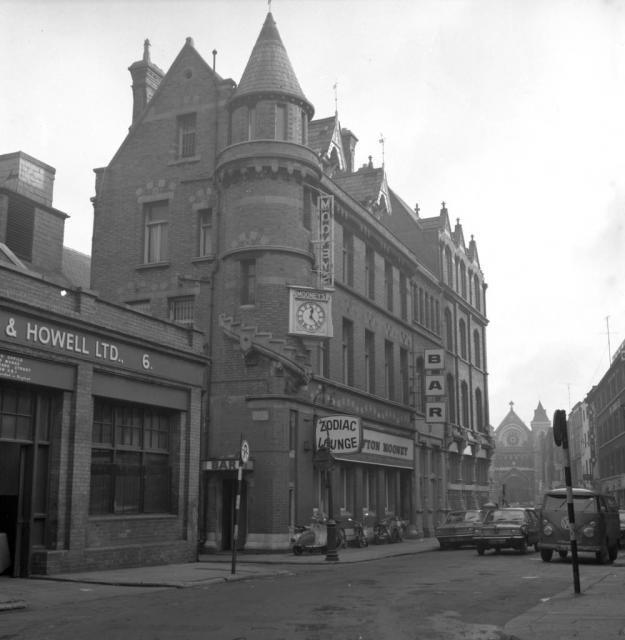
In the late 19th Century there was a revival of interest in those matters spiritual and supernatural. People of the 1880’s and 90’s rediscovered an interest in the forgotten pastime of astrology and this re-emergence of a fascination with astrology and horoscopes might explain the reason that the pub we know today as Bruxelles (more on that name shortly) was originally known as the Zodiac Lounge when it opened its doors for business way back in 1886.

Bruxelles-Bar-Zoodiac

The Zodiac Lounge was part of the famous Mooney’s pub group and was also known as the Grafton Mooney, much as the Parnell Heritage Pub on Parnell Street was known as the Parnell Mooney. The signs of the Zodiac that influenced the pub’s name are still clearly visible in Bruxelles to this day. Just look behind the main bar and you can still see the beautiful tiled mosaics of figures representing each of the star signs, these tiles are almost 130 years old and offer a connection back to the Victorian world of the Zodiac lounge.

Bruxelles-Bar-Zoodiac-2

Bruxelles-Bar-FlagsBut why is it called Bruxelles and why are all those flags hanging from the ceiling? And speaking of that, why are there no stars and stripes hanging there an American friend asks? Well, give me a minute and I’ll tell you. In the early 1970’s the bar came into the ownership of the Egan family who continue to run the pub to this day. The purchase of the pub happened to coincide with Ireland’s entry into the EU (or the EEC as it was then) and in the spirit of European harmony the pub was renamed Bruxelles after the Belgian capital. The flags that hang from the ceiling represent all the member nations of the EU so sorry to any visitors from across the Atlantic but that’s why you don’t see an American, or Canadian or Australian flag there.

Bruxelles-Bar-UndergroundWhile the 70’s brought big changes Bruxelles certainly hasn’t stood still in the intervening decades. The pub, and its famous basement bars became the hangout in Dublin for the emerging Rock scene and was famously frequented by Phil Lynott of Thin Lizzy fame. It’s for this reason that when a statue was erected to Philo, that Harry Street, right next to the pub he knew so well seemed the natural location for its location. The connection with the Lynott clan continues to this day. Philomena, Phil’s Ma in case you didn’t already know, continues to drop by the pub from time to time and has played a big part in its latest development.

The basement bars, so long beloved of rockers, metallers and indie kids have been completely refurbished and extended. The Zodiac Lounge and the Flanders Lounge as they’re dubbed in acknowledgment to the venue’s history look fantastic and the Flanders Lounge has been decked out with a huge amount of Phil Lynott and Thin Lizzy memorabilia kindly donated by Philomena. Phil has his own eponymous snug down the back of the bar and there is a new beer cellar that stretches right out under the flagstones of Grafton Street. It’s the perfect spot to try a pint of Bruxelles own bespoke lager!

The new basement bars are available for private hire and for live music and DJ nights. They’re also a treasure trove for any connoisseur of good beer or good rock music.

Originally poster to Dublintown.ie July 2015

Ireland versus England – The quest for footballing approval

Relationships can be tricky at the best of times. Even when they’re over feelings can remain, passions linger, doubts about whether breaking up was the right decision can cloud one’s judgement.

The unhealthiest of relationships can provoke these reactions and much as we like to think we’ve moved on and we’re being the bigger person we still crave attention; a reaction from our former partner.

Much of recent Irish history, and almost all of our football history has lived out this type of conflict with our spurned partners England. Identifying ourselves as our own strong, confident, distinct individual nation while also being constantly obsessed with either getting one over on the English (Euro 88!) or craving their attention and approval to give validation to our actions.

The footballing split between North and South, between IFA and FAI, was in many ways related back to our messy divorce with the English. Tensions between the footballing centres of Belfast and Dublin had been running high for some time but it was the refusal of a Glenavon side to travel to Dublin for an Irish Cup match against Shelbourne in 1921 due to the civil unrest in the city caused by the War of Independence that proved to be the final straw that triggered the schism.

The split in the associations meant that the FAI were out in the footballing cold as the other UK based associations continued to recognise the IFA as the only legitimate association for the island and refused to play matches involving FAI teams or to release British based players for international matches.

The FAI also lost out on participation in the prestigious home nation championship and a crucial source of revenue. Despite competing the 1924 Olympics it would be 1927 before the FAI would manage to arrange an international match when they lined out against Italy.

While the FAI were understandably put out by these developments and felt that the British associations were acting unfairly they still desperately craved their attention and approval. Britain was after all the home of football and was viewed as the pre-eminent soccer power at the time.

When a South American touring side visited Dublin in 1933 there was much excitement among the Irish media, Uruguay had won gold at the 1928 Olympics as well as the inaugural World Cup but journalists wondered whether South Americans were “capable of challenging English and Scottish supremacy at the game”.

For the Irish football public at the time the British associations were the be all and end all, although they were loath to admit it. Two games highlight this preoccupation more than most, if we look at the two home internationals that bookended World War II, the game against Hungary in March 1939 and the first ever international match against England in September 1946.

The Hungarians had been runners up to Italy in the 1938 World Cup and had played against Ireland twice before in recent years, on both occasions the matches took place in Dalymount Park. However on this occasion the match took place in the Mardyke, the grounds of University College Cork and home to League of Ireland side Cork F.C.

This was the first FAI organised international since the split that had been held outside of Dublin. So why were the World Cup runners up being asked to play in a University sports ground rather than at the larger capacity Dalymount? Well because there was a bigger game taking place in Dalymount just two days earlier on St. Patrick’s Day 1939, when the League of Ireland representative side were taking on their Scottish counterparts.

Even a game against a Scottish League XI was viewed as a huge mark of acceptance for a football association that was yet to reach its 20th birthday. While the game in the Mardyke would attract 18,000 spectators, a respectable return, over 35,000 would pack into Dalymount Park to see the stars of the Scottish League.

Newspaper advertisement for the match against the Scottish League

Sean Ryan, writing in his history of the FAI, noted that as the match against the Scottish League was played at the larger venue and achieved double the attendance to be further evidence of the “massive inferiority complex which Irish soccer had towards Britain”.

He also remarked that commentators at the time were moved to describe the match against the Scottish League as “the most attractive and far reaching fixture that had been secured and staged by the South since they set out to fend for themselves” before adding “for 20 years various and futile efforts have been made to gain recognition and equal status with the big countries at home. Equality is admitted by the visit of the Scottish League.”

This notion of the “big countries” is crucial, by 1939 Ireland had already played against the likes of Italy (world cup winners in 1934 and 1938), Hungary, Germany, Poland and France but it was the visit of the Scottish League that was viewed as delivering some notion of football “equality”.

The Scottish FA wouldn’t accept the offer of a match against the Republic of Ireland until they were drawn together in a qualifying group for the 1962 World Cup so whether this game was actually a sign of acceptance by the Scots, or “equal status” is far from proven.

For the record a competitive Scottish League (valued at staggering £60,000 at the time) side lost 2-1 to their League of Ireland opposition, Johnstone of Sligo Rovers and Paddy Bradshaw of St. James Gate getting the goals. Five of those who played against the Scots on St. Patricks Day; Mick Hoy (Dundalk), Kevin O’Flanagan (Bohemians), Jimmy Dunne (Shamrock Rovers), Joe O’Reilly and goalscorer Bradshaw (both St. James Gate) left Dalymount and headed straight to Cork for the game against Hungary two days later.

Perhaps not the best preparation but slightly better organisation than that arranged for Raith Rovers Tim O’Keefe who missed the match as the ferry to Larne was delayed by two hours.

O’Keefe’s absence meant that there were no Cork men in the XI for the Hungary match which may go some way to explaining the less than electric atmosphere in the ground in what WP Murphy of the Irish Independent described as “one of the most apathetic crowds I have ever seen at an International”. Bradshaw was on the score sheet again along with Manchester United’s Johnny Carey as the Irish gained a 2-2 draw against the Hungarians.

The Scottish League visit and the unexpected victory provided a fillip for Ireland and perhaps suggested some level of acceptance from the home nations, however a full international match had yet to take place. World War II would disrupt football fixtures for the next six years and it was 1946 before an Irish national team took to the field again in a pair of away games,  against Portugal (a 3-1 defeat) and Spain (a surprise 1-0 win).

The first home game would be in September against England, the English FA sending a letter a month earlier saying that they would play a game in Dublin two days after their fixture against Northern Ireland in Belfast. It was not an occasion that Official Ireland could pass up.

At an earlier international game against Poland in 1938 Irish President Douglas Hyde had been expelled by the GAA because of his presence at an Association Football match, in contravention of the infamous rule 27. This had provoked significant criticism of the GAA at the time in both the press and from government benches.

However, the arrival of England was too big a deal for the political elite of Ireland to miss out on. The game was seen as a sort of fence mending exercise with the English after the “Economic war” of the 1930’s and the verbal sparring of De Valera and Churchill during the war years.

De Valera hosted a pre-match reception for the teams and officials, President Sean T. O’Kelly was there for the pre-match introductions and Tánaiste Sean Lemass (alleged to have been a member of Michael Collins’ infamous Squad) was present in the stands for the match.

The English officials were even presented with a replica of the Ardagh Chalice as a memento of their visit. Clearly the Irish wanted to make a big impression on their illustrious visitors and had put a great deal of thought and effort into the reception and hospitality for their guests.

This did not however extend to the team selection, Shamrock Rovers’ Paddy Coad had to cancel his honeymoon to play against England while West Brom centre-forward Davy Walsh pulled out late with injury meaning a late call-up for Mick O’Flanagan of Bohemians as his replacement.

O’Flanagan ran a pub in Marlborough Street in Dublin City Centre and received a phone call there on the morning of the game from Tommy Hutchinson the Bohemian rep on the Irish team selection committee. He was told to get his boots and get to Dalymount Park for the game that evening.

As O’Flanagan recalled:

I went home to Terenure for a bite to eat, had a short rest and then headed off to Dalymount. It was not really sufficient notice as only the previous evening I had brought a party of English journalists to Templeogue tennis club and I hadn’t got home until nearly two in the morning.

It was only when his brother Kevin, then of Arsenal arrived to the stadium straight from the boat that he realised that he would be playing alongside his younger brother against England.

Despite this usual shambolic preparation the Irish team more than put it up to their English opponents. The English had easily defeated Northern Ireland by seven goals to two only two days earlier but were up against more formidable opposition in Dublin.

With eight minutes to go it was still nil all but a young Tom Finney, making only his second appearance for England managed to beat Tommy Breen in the Irish goal. Ireland had pushed their illustrious guests all the way, Everton’s Alex Stephenson had rattled the English crossbar while Kevin O’Flanagan had been agonisingly close with a header.

The Irish had also had to play much of the game with effectively ten men after Huddersfield Town’s Bill Hayes was injured early on and, in the days before substitutions was shunted out to the wing, forcing Johnny Carey into the centre half position.

The Irish Times’ PD MacWeeney was moved to describe the match as “the most exciting International football match ever played at Dalymount Park” while his English equivalents were no less effusive in their descriptions, Henry Rose in the Daily Express was moved to write “If ever a team deserved to win Eire did. They out-played, out-fought, out-tackled, out-starred generally the cream of English talent, reduced the brilliant English team of Saturday to an ordinary looking side that never got on top of the job”.

Though the game could be seen as another in a long line of famous Irish “moral victories” or “glorious failures”, it certainly had the desired effect for the FAI as the game was both a huge commercial success and also gained the craved for recognition from the English.

While Scotland, Wales and Northern Ireland would avoid matches against the Irish further games against the English were more forthcoming. Within three years the Irish had even beaten the English on home soil when they emerged as 2-0 winners in Goodison Park.

And next week we get to live it all over again. While we’d like to think that we are not as needy and requiring of validation from England as we were in 1946 the game on Sunday has still captured the public imagination more than any other friendly.

Some commentators, like The Guardian’s Barney Ronay have gone so far as to call the game “pointless and a mistake” , and there are concerns about a recurrence of the ever-popular “Fuck the IRA” chants from sections of the English travelling support while almost 2000 “supporters” will be barred from travelling to Dublin for the game for fear of a repeat of the violent scenes of 1995.

HOOLIGANS_3332587b

English hooligans in the Lansdowne Road riot of 1995

Aside from that there is also the slightly thorny issue of Jack Grealish’s international allegiances as a sidebar to the game. But still we look to this game against the English and see a guaranteed full house for an international friendly, not something that can always be counted on.

The English FA for their part, perhaps cognisant of the events of ’95 made sure to include a friendly against Ireland in Wembley as part of their 150th anniversary celebrations, along with friendlies against original international opponents Scotland and prestige matches against the likes of Germany and Brazil. Were we secretly pleased that they invited us to the party and have chosen to return the favour by coming to Dublin?

It’s 20 years since the debacle in Lansdowne Road and 30 years since Ireland have lost to England, whether that has lessened any Irish inferiority complex will be seen on Sunday.

Originally posted on backpagefootball.com June 2015