The Story of Stan Kobierski – From Dalymount Roar to Siberian Railtracks

by Fergus Dowd

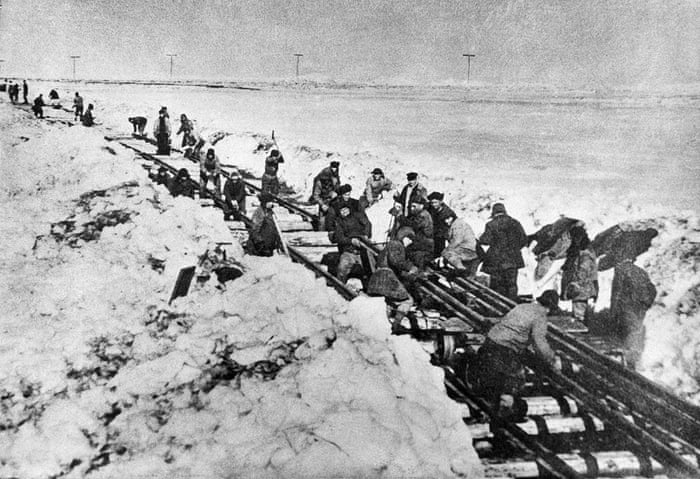
As the snow drifted up to his waist in the Siberian wilderness and the wind stung his face, the Gulag prisoner Stanislaus Kobierski dug, lay, and scraped. He would receive 200 grams of bread and a cup of water for his efforts while all around him bodies dropped dead; 300,000 would perish as temperatures plummeted to minus fifty.

The project was the Trans-Polar mainline, Joseph Stalin’s attempt to conquer the Arctic Circle.
An audacious scheme to link the eastern and western parts of Siberia by one thousand miles of railway track from the city of Inta via Salekhard to Igarka lying on the Yenisei River. The track that Kobierski lay had the acronym ZIS written into it – it stood for ‘Zavod Imeni Stalina’ factory – named after the Russian leader. Kobierski was part of the 501st labour camp which began work eastward towards Salekhard in 1947 under the supervision of Col. Vasily Barabanov, who would be decorated with the order of Lenin in 1952. All around the camp were watchtowers; any thoughts of escape would be met with the firing squad.
More than a decade earlier, Stanislaus Kobierski had landed in Balmoral Aerodrome on the outskirts of Dublin from Scotland; in his bag were his football boots. It was October 16th, 1936, and two days before Kobierski and his German teammates had given the Nazi salute to sixty thousand Scots at Ibrox stadium. The crowd cheered on seeing this unusual sight as ‘Deutschland Uber Alles’ was struck up as the Swastika flag fluttered in the wind alongside the Union Jack.

At half time a protest took place against the new wave German regime, two of the instigators were arrested and removed from the ground. The Scots ran out two-nil victors with Celtic’s Jimmy Delaney netting twice; Delaney would run out for Cork Athletic in the 1956 FAI Cup Final. Then aged 41, Delaney of Irish descent, who was reared in the Lanarkshire mining village of Cleland, would be denied the opportunity to obtain a unique collection of cup winners medals across the British Isles after winning the IFA Cup with Derry City in 1954, the Scottish Cup with Celtic in 1937 and the FA Cup with Manchester United in 1948.

As Kobierski and his colleagues disembarked from the plane which carried Nazi flags on the tailfin, President Eamon DeValera and Dublin’s Lord Mayor Alfie Byrne stepped forward to welcome the travelling party. The team stayed in the Gresham Hotel on O’Connell Street and were brought into town in a bus adorned with the ancient religious icon from the cultures of Eurasia. Like Ibrox before the playing of anthems, the Germans gave their infamous salute to the main stand at Dalymount Park as locals watched on.

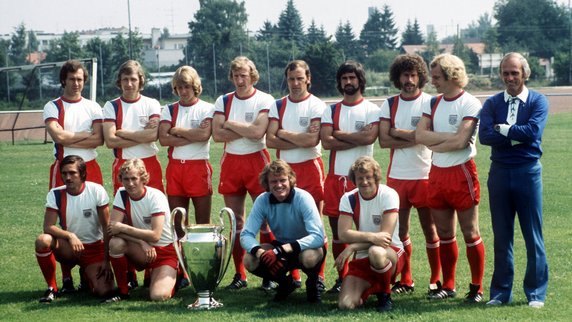
In the 26th minute Kobierski, at the home of Irish football, scored, equalising for the Germans after Dundalk’s Joey Donnelly had netted a minute earlier for the Irish. That same year Kobierski had won the Gauliga Niederrhein with Fortuna Dusseldorf. They would become the most successful German side, winning five championships throughout the reign of the Third Reich. The league was one of sixteen top-flight divisions introduced by the Nazi sports office in 1933, replacing the Bezirksligas and Oberligas as the highest level of play in German football competitions.

Fortuna would reach the national league finals losing out to F.C. Nurnberg two-one after extra time; Kobierski’s colleague on that day in Dalymount, Andreas Munkert would lift the title in Berlin. However, there would be no glory in Dublin for Munkert as he and his defensive partners were run ragged by Paddy Moore and Donnelly, as a marauding Irish team ran out 5-2 winners. One of Schalke’s greatest ever players, Fritz Szepan, scored the German’s second goal. He won six championships and a cup final medal for Die Knappen and was voted on the greatest Schalke team of the century when the club celebrated its 100th anniversary in 2004.

Szepan played for Germany in the second World Cup in 1934, hosted in Italy; Kobierski would score Germany’s first-ever championship goal against Belgium as the Germans would finish a respectable third in the competition.
Both would feature in the ‘Unified German’ side, which would also include some of the great Austrian players from the iconic Wunderteam after the Anschluss.

The Austrians played their last match as an independent nation on the 3rd of April 1938 at the Prater Stadium in Vienna against Germany; dubbed ‘the homecoming match’, the Austrian side ran out two-nil winners.
Their star forward, Matthias Sindelar, known as ‘The Mozart of Football’, scored one of the goals that day. Karl Sesta got the second an audacious lob, which led to Sindelar dancing in front of the VIP box in celebration, which housed Nazi leaders and their Austrian satraps.

Sindelar was found dead in his flat within a year, alongside his girlfriend Camilla Castagnola, both asphyxiated by a gas leak. In Austria, they still wonder about the mysterious circumstances of the deaths – suicide, an accident, or murder? On that autumnal day at Dalymount, the joyous Irish public invaded the pitch at the end, even cheering the Germans off the pitch, some raising their arms in the salute they had witnessed earlier.

In 1941 after over a decade with his hometown club, Kobierski, whose parents hailed from Poznan, was ordered to line out for the SS & German police club in Warsaw for exhibition games. On the 1st of September 1939, Germany had invaded Poland from the West, while seventeen days later, the Soviets invaded from the East; by October, Poland was defeated. Unlike their German counterparts, the Soviets allowed league football to be played primarily in the city of Lwow, the birthplace of football in Poland.

One of the teams in East Poland was Junak Drohobycz, a side who were actively involved in the Polish resistance movement; the players all in their twenties were also soldiers helping people escape to Hungary across the Carpathians. The team were known as ‘The White Couriers’ and ended up playing matches in Hungary and Yugoslavia during the war. One of the ‘Couriers’ was goalkeeper Stanislaw Gerula, who played for Leyton Orient of London in 1948. Gerula would spend two years at Brisbane Road before turning out for non-league Walthamstow Avenue playing in nets against Arsenal at Highbury in the London FA Challenge in 1952. That same year, Gerula helped Walthamstow win the FA Amateur Cup at Wembley; he was 38 years young. Twelve months later, Gerula rolled back the years against a Manchester United team who had won the championship in 1952 captained by Jackie Carey; in the fourth round of the FA Cup, the amateur side would draw 1-1 at Old Trafford as the ‘Courier’ performed heroics in goals.

In mid-1942, Kobierski and his team faced Huragan Wolomin in Legionowo; the Christmas of 1941 had seen the start of the underground Warsaw District of Association Football league. The Germans banned the league, and most games were played in the suburbs, such as Wolomin, Góra Kalwaria, Brwinow, and Piaseczno, as it was too dangerous to play games in the city. Alfred Nowakowski founded the league an ex-Legia Warsaw player; he would be awarded the Golden Cross of Merit in 1946, a Polish civil state decoration.

On the 1st of August 1944, the Polish Home Army initiated the Warsaw uprising, a non-Communist underground resistance movement to liberate the city from Germany. Forty-five thousand members fought alongside another 2,500 soldiers from the National Armed Forces and the Communist People’s Army against the military might of the Germans. Only a quarter of the partizans had access to weapons. Alongside this came the ‘Red Army’ appearing along the east bank of the Vistula River, Kobierski would eventually be captured and sent to Siberia.

The uprising would last for sixty-three days and be suppressed by the Germans in Oct 1944; with civilians deported to concentration and labour camps, the intensive fighting would reduce Warsaw to ruins. Stanislaus Kobierski would remain in Siberia until 1949 and, on his release, return to live out his days in West Germany, passing away in 1972.
Before he took his final breath, Kobierski witnessed his beloved Fortuna finishing third in the Bundesliga and qualifying for European competition for the first time in the club’s history. Football was all he knew, but it took him from hell and back.

Groundhopping – FC St. Pauli

I’m not one for New Year’s resolutions, I think most of the time they tend to be things we think we should do than things we really want to do. But I usually aim to visit one new place that I’ve never been to before within the follow twelve months, it’s something I know I want to do, and it is usually fairly achieveable.

It is also a good opportunity to catch a game or two, I wrote early in the summer about my trip to Essen and Cologne and I managed to squeeze in a trip to Hamburg just before the New Year, joined once again by Brendan, my German, football-obsessive mate.

With the German season having just finished for its winter break there wasn’t a chance to catch a game though I did want to visit the Millerntor, the stadium of FC St. Pauli, a club that may not boast an extensive trophy cabinet but one that has an international reputation as a “Kult” club and for situating progressivism at the forefront not only of its image but its day to day existence. Their stands bear slogans like “Kein Fussball den Faschisten” (No football for Fascists) and “Kein Mensch ist illegal” (No one is illegal). Their “skull and crossbones” logo has also become ubiqutious and can be spotted in the most unlikely of places. According to our guide, despite the relative size of the club St. Pauli are often in the top three or four clubs in Germany in terms of their revenue from merchandise.

St. Pauli is a quarter within the city of Hamburg, it sits close to the port on the river Elbe as well as the famous Reeperbahn home to the city’s red-light district and once home to The Beatles who performed in many of the clubs in the area. The ground is also situated right next to an enourmous, former Nazi bunker, now being turned into a luxury hotel.

The stadium is modest by some standards, the club can’t build beyond a capacity of 30,000 and they have avoided some of the soulless bowl type conventions with our tour guide noting with pride that they preferred the “English style” of four individual stands, close to the pitch. Three of the stands also feature a mix of seating and terracing with only one stand being an all-seater though they do also host a number of quite luxurious, customised corporate boxes.

Anyway here are some pics and I’d like to get back and try and catch a game here before the season ends and maybe do a double header with an Altona 93 game in the Regionalliga. And while it seems far fetched it still feels that it might be possible for League of Ireland clubs to steal a few more ideas from a club like St. Pauli and adapt them for an Irish context. Well here’s hoping.

This slideshow requires JavaScript.

Oh the Cologne – a football weekend on the Rhine

Last month I finally ceased procratinating and managed to get myself over to catch a Bundesliga game, it was something I’d been meaning to do for quite a while but for one reason or another never managed to get round to actually booking. The last time I’d been in Germany when there was a regular season game on, was way back in 2012, when I visited Berlin. There was quite the apetising fixture as Hertha Berlin has been relegated to the Bundesliga II and were going to face city rivals Union in a league game for the first time. However, the game was being played in Union’s Stadion An der Alten Försterei which at the time had a capacity below 20,000, no chance for a blow-in tourist to snap up a ticket so.

Certain things have to be considered when picking a game, avoiding the worst extremes of the German weather and potential sub-zero temperatures ruled out games in February and much of March, so we settled on getting a game in early May as the season drew to a close, it gave a better chance of getting some good weather and being able to enjoy a few beers outside before the kick-off.

I was lucky in having a good guide for German football in the shape of my friend Brendan. Son of an Irish mother and German father Brendan grew up in Hannover where he became a season ticket holder at Hannover 96 before he moved to Ireland a few years ago and I managed to indoctrinate him into becoming a Bohs fan.

The itinerary we eventually decided on was to fly direct to Cologne, get a game at Rot Weiss Essen in the Regionliga West on the Saturday, before getting a FC Koln game on the Sunday and flying home that Monday. A good efficient plan.

This plan wasn’t helped by my bringing the wrong passport with me and having to book in a later flight to Frankfurt, meaning I arrived in Cologne several hours after Brendan. But first things first – the bar, a nice unprepossessing, traditional local bar next to the apartment where we were staying in Ehrenfeld adorned with some FC Koln memerobilia, including a rather impressive portrait of the almost ubiquitus Hennes the goat.

To explain briefly, Hennes the goat is the mascot of FC Koln, although mascot seems too small a word, the club are nicknamed the Billy Goats on his account. He appears on the club crest, looming over the other famous image of the city; its Cathedral, and is held in the highest affection by Cologne fans. He’s named Hennes after the former player and manager Hennes Weisweiler, the goat was presented as a gift from a local circus in 1950 and the manager happily adopted him and named him after himself. The current Hennes is the eighth incarnation since then and we did indeed get to see Hennes VIII on our weekend.

One of the other striking things about Cologne is the beer, the local brew is a light lager called Kolsch, after the city, it is best drank on draft and is served in 200ml, test-tubelike glasses. The effect on someone more used to drinking by the pint is to lull you into a false sense of security where you convince yourself you’ve drank hardly anything when you’re well into double figures of the diminutive glasses. Usually the local bar runs a tab by marking a beermat to keep track on how many of these refreshing beverages you’ve had. They also tend to be pretty keenly priced, our local charged us a very reasonable €1.40 per glass. Drink til you make a profit lads.

Somewhat bleary-eyed we roused ourselves the following morning, the free-flowing Kolsch and welcoming locals had slightly dulled our senses but we had a game to get to in the nearby city of Essen. About an hour away on the train, wikipedia reliably informed me that Essen was Germany’s ninth largest city and we were off to catch their premier club Rot Weiss Essen in action.

This slideshow requires JavaScript.

Rot Weiss Essen’s (literally the Red and whites of Essen) greatest claim to fame is being the hometown club of Helmut Rahn, the man who scored the winning goal for West Germany in the 1954 World Cup final against Hungary. Rahn had been a star forward for Essen throughout the 50’s, helping them to a German Cup triumph in 1953 and the league title in 1955. This was in the years before the foundation of the national, professional Bundesliga was set up in 1963.

The club are a long way from those lofty heights, financial problems in the 1990’s and again within the last ten years see them playing in the Regionalliga West, effectively a vast, regionalised 4th tier of German football. They do however possess a very impressive stadium, the Stadion Essen replaced the much older Georg-Melches-Stadion in 2012 and this modern, four-sided ground boasts a capacity of just over 20,000.

The game that Saturday was against SC Wiedenbruck who were struggling against relegation. With the season drawing to an end Rot-Weiss Essen, who were comfortably mid-table had little to play for, and it showed. We took up our spaces in the main standing terrace behind the goal, a group of locals quickly – and fairly directly – advised us that we were in their spot and should move further back. While the terrace boasted a few thousand souls the other stands were sparsely occupied, I estimated the attendance at no more than 3,000.

The “ultras” group did make some noise throughout the game, with my limited German I could work out that they were big fans of their goal-scorer on the day Timo Brauer, and their main chant seeming to be singing the clubs name along to the tune of Mike Oldfield’s 1983 hit Moonlight Shadow. So imagine “carried way by a ROT-WEISS-ESSEN!

This wasn’t the most enthrawling of games; Weidenbruck took the lead through a wickedly deflected own-goal, Essen equalised but rarely threatened and Weidenbruck had the better of the play and ended up deserved 2-1 winners. We took the opportunities during the various lulls in play to hit the bars and enjoyed the really quite good quality local lagers and the odd wurst. Both teams did try to play football and were technically adept but played at a deadeningly slow pace and seemed to telegraph every pass, all of  which looked like they had already been agreed upon on the training ground the previous day. The few moments of pace and creativity tended to come from Weidenbruck and generally created some manner of attacking opportunity as a result but these forays were disappointingly rare. As for the overall standard, my limited knowledge would suggest that either of these sides would have struggled against a decent League of Ireland side. That said, perhaps Essen’s apathy was simply a result of it being a “nothing to play for” end of season game against an opponent motivated to avoid relegation?

With the game over we went to a couple of decent local bars in Essen with a group of Bochum fans we’d met. Bochum were playing away that weekend and the guys fancied catching a game. They were also in the first flushes of young adulthood and had a drinking stamina that Brendan and I have long since lost. We somewhat sensibly turned down their kind offer of a visit to a house party followed by a local club night and got the train back to Cologne.

WhatsApp Image 2019-06-22 at 9.17.17 PM (1)

Recuperating on the train back from Essen

We did get a second wind once we reached Cologne and did manage a few more Kolsch before ending up in a fairly uninspiring “club” but at least we got to plaster a few Bohs stickers around the place. Having survived our Saturday game and subsequent outings relatively unscathed (okay slightly in bits) we had to psyche ourselves up for the main event – FC Koln versus SSV Jahn Regensburg in Bundesliga 2.

WhatsApp Image 2019-06-22 at 9.20.31 PM (3)

Koln were the Champions in waiting and already guaranteed promotion back to the top flight after just a year in the second tier, Regensburg, a Bavarian club had done relatively well that season, but it had just been confirmed that their manager, Achim Beierlorzer had agreed to join Koln for the upcoming season back in the top division which added a little bit extra to the atmosphere for the loud and colourful travelling fans.

Incidentally Regensburg is the Bavarian town the club come from while the “Jahn” in their name refers to a Friedrich Ludwig Jahn, who was a 19th German nationalist who is seen as the father of the gymnastics movement. So there you go.

The Koln stadium is a relatively short tram journey from the city centre and both we and our hangovers got out there early to soak in a bit of the matchday atmosphere and also collect our tickets. The stadium is located in a huge swathe of green space on all sides and there was somewhat of a carnival atmosphere, plenty of food vendors, people having picnics, live music playing.

At the rear of the stadium are a number of well-kept public football pitches which were all well-occupied by groups of all ages and then further beyond the pitches stretched a large and picturesque public park where people were treated like adults and could have a beer and a barbeque without fear of censure. Imagine!

This slideshow requires JavaScript.

After trudging for what seemed like an eternity to collect our tickets from a small office operating from a not-so-nearby hotel we got ready to head onto the terrace. Fortified with some beer and pretzels we felt a bit better and were about to take our position as nominal Jahn Regensburg fans for the day, through this did mean hiding my snazzy new Hennes the goat pin badge.

This was clearly going to be much different from the Essen game, the Rhine Energie Stadium was pretty much full a good thirty minutes before kick-off and even getting a good vantage point among the away fans proved a challenge. With the game kicking off there was something of a carnival atmosphere in the ground, understandable since Koln were already promoted, but many of their fans were far from happy. From early in the game right through to after the final whistle there was an array of banners held aloft by huge numbers of the Koln faithful in the opposite terrace criticising the board and their running of the club. Promotion from the second tier was something that had to be achieved but the fans explicitly viewed it as a situation they never should have been in in the first place.

The game itself was no less lively with Regensburg racing into an early lead thanks to a 7th minute OG. They doubled their lead before on the stroke of half-time as Koln had a player sent off and only seconds later they conceded a penalty. While they finished the half a man short and 3-0 down, but by that stage things were only getting started. Koln mounted something of a comeback through the unlikely figure of German international Jonas Hector who was playing at left-back who managed to score two second-half goals either side of a Sargis Adamyan goal for Regensburg.

On 76 minutes a frantic, 10-man Koln seemed within touching distance of an unlikely draw when substitute Anthony Modeste grabbed a goal to bring the score back to 4-3 but as they continued to throw everything into attack in search of an equalizer, and I mean everything, Koln were caught on the break by Regensburg with the Koln goalkeeper Timo Horn caught up the pitch the visitors had an empty goal to shoot into as they scored their 5th and destroyed any slim chances there might have been for a Koln comeback.

Still it wasn’t all bad for Koln, despite their defeat in a hugely exciting, frenetic game they still had the won the Bundesliga II and got to raise the divisional trophy on the pitch after the game. There was also some cheering and celebration when news filtered through that results had conspired to make sure that Hamburg finish fourth and outside of the play-off places. Der Dino, never the most popular club to begin with, must be getting very used to the enthusiastic application of the German concept of schadenfreude over the last couple of seasons.

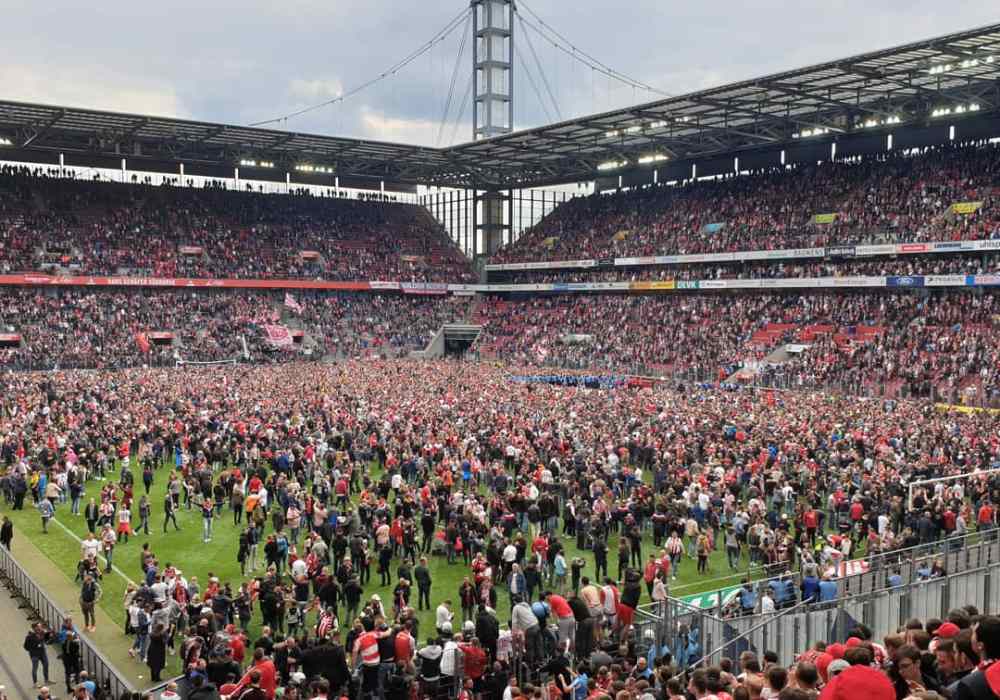
As the Koln players lifted their trophy the lines of stewards were quickly bypassed and first hundreds and then thousands of spectators began pouring onto the pitch. Located as we were in the away end, a significant number of riot police kept us penned in and well seperated. The Koln fans however began by taking apart the goal nets as souvenirs before eventually the goal-frame closest to us collapsed under the weight of supporters climbing on top of it.

This slideshow requires JavaScript.

We were eventually spewed back out into the stadium concourse and walked on towards the tram stop at the far side of the open green space that surrounds the stadium. No more than 15 minutes later we were back in Ehrenfeld and despite promising ourselves that we would do otherwise we ended up in a local bar after a quick dinner.

The Cologne locals throughout our short trip were friendly and engaging, and in this instance a request that we keep an eye on another customers dog led to a conversation about football (he coached a team playing in the regionalised 6th tier) and even the possibility of arranging a match against Bohemians.

So after years of procrastinating I got myself to a couple of games in Germany, plenty of colour, excitement and genuinly good people who love their sport, I’ll definitely be back.

WhatsApp Image 2019-06-22 at 9.17.18 PMWhatsApp Image 2019-06-22 at 9.17.17 PM (4)WhatsApp Image 2019-06-22 at 9.17.17 PM (2)

Playing football with a battleship

In February 1937 Seán Lester, the noted Irish diplomat became Deputy Secretary of the League of Nations, a forerunner organisation to the modern-day United Nations. As a result of his promotion he left his role as High Commissioner in the Free City of Danzig (modern day Gdansk in Poland) and moved to the Swiss city of Geneva where the League’s headquarters were based.

His time living in Danzig had been fraught, he had witnessed first hand the rise of Nazi Germany and clearly understood the threat it could pose to the independent port city of Danzig and to wider Europe in general. When speaking about his biography of Lester, his son in law Douglas Gageby described him as “the first western diplomat to receive the full force of Hitler’s hatred” due to his opposition to the Nazi regime. Lester spent the remainder of his time before and during the War trying to stop the League of Nations falling under the the control of the Axis powers. The efforts of this brave Irishman seem to have gone virtually unnoticed by Irish football’s governing body (and many others) however, just months before the outbreak of War the Irish national team played the German national side (which now included players from post-Anschluss Austria) in Bremen and performed a Nazi salute prior to the game in an infamous moment in Irish sport.

Perhaps less well-known is another game that took place in Dublin just two months after Lester’s departure from Gdansk. It was a match between Bohemian F.C. and the crew of the German battleship, Schleswig-Holstein. This was this same battleship that in September 1939 sailed to Gdansk under the pretext of a diplomatic engagement before firing the first shots of the Second World War, attacking the city that Lester had known so well, as German marines over-ran the once Free port city.

This is a brief account of the visit of the Battleship Schleswig-Holstein (pictured above) to the port of Dun Laoghaire in April 1937 and the huge popular reception they received from the Irish people. Among the film-screenings, dinners, tours and parties that were undertaken to welcome the ship to Dublin there was even time for that game of football.

The battleship itself was launched in 1906 as an early part of Kaiser Wilhelm II’s plan to develop and modernise the German navy and make the nation a world naval power. By the time of the ships’ completion the German navy had already seen further technological development as they had begun the roll out of the German dreadnought class of even larger battleships. However the Schleswig-Holstein still saw action during World War I, taking part in the Battle of Jutland where it was damaged and had three of its men killed after being struck by a British shell.

After the First World War the Schleswig-Holstein was one of the ships that the German navy sought to retain under the terms of their disarmament agreements and when Hitler came to power and began to redevelop the German military machine the Holstein became a training vessel for the many new German cadets recruited for a growing Navy. As part of one of these training missions the ship went on a seven month voyage into the Caribbean and south Atlantic calling at ports in Brazil, Venezuela, Costa Rica and Bermuda among others. Their stop at Dun Laoghaire was their first stop-off back in Europe before their return to the naval base at Wilhelmshaven. On board were 31 officers and 785 petty officers and crew which included over 170 naval cadets.

The Schleswig-Holstein arrived into Dun Laoghaire on the 9th April 1937. Due to heavy fog the ship was two hours late in arriving but was still greeted by a 21 gun salute from an artillery battery near Dun Laoghaire’s East Pier. The battleship returned the salute by blazing its cannon in reply and soon after hoisted the Irish tricolour from its mast-head where it fluttered next to the German standard emblazoned with the Nazi swastika at its centre. Several hundred people were gathered at the harbour to see the ship berth, including a sizable contingent from the German legation in Ireland, there to welcome their fellow countrymen. Among them was Erich Schroetter, the head German diplomat in Ireland. Schroetter later fell foul of the influential Dublin-based, Nazi Adolf Mahr and would be replaced within months of the ship’s visit by Eduard Hempel. Mahr, as well as being the Director of the National Museum of Ireland was also head of the Nazi party in Ireland. He was represented on Dun Laoghaire pier that day by his Dutch wife Maria.

This welcoming party was only the first in a cavalcade of social engagements for the ship’s officers and crew. On the afternoon of their landing a deputation from the Schleswig-Holstein, along with members of the German legation visited with the Irish Army Chief of Staff, Lieutenant General Michael Brennan and the Minister for Defence, Frank Aiken in Army Headquarters before stopping off at the Mansion House to drop in on the Lord Mayor of Dublin, Alfie Byrne. The Lord Mayor would pay a return visit to see the German battleship in Dun Laoghaire before the end of their stay and even Taoiseach Eamon De Valera took time out on the Saturday after the battleship’s arrival to meet it’s Captain Günther Krause along with the aforementioned Erich Schroetter.

During their brief stay the crew were not left short for entertainment. While members of the Dublin public were allowed to take tours around the battleship the German sailors quickly became a common sight in both Dun Laoghaire and Dublin City Centre. During the week of their visit they were invited to the Pavillion Theatre in Dun Laoghaire for a special showing of a German film production of the popular opera The Gipsy Princess. Afterwards there was a screening of an Irish tourism short, painfully entitled Top of the Morning. They visited Portobello Barracks (now Cathal Brugha Barracks) where they were introduced to the Irish Army’s own German officer, Friedrich Wilhelm “Fritz” Brase. “Fritz” was the head of music for the Irish Defence Forces and had also briefly been Chairman of the Nazi party in Ireland until advised to step down by his Irish military superiors, at which point he was replaced by Mahr.

Apart from their musical engagements there were excursions arranged for crew members to Dublin’s most prominent tourist attractions, many would still be on most tourists’ itinerary today, namely, St. Patrick’s Cathedral, Trinity College and the Guinness brewery.

Other excursions meant travelling slightly further from the city which allowed Adolf Mahr to indulge his passion for ancient Irish history. He lectured the visiting Germans on monastic Ireland at Glendalough and also provided guided tours to Newgrange and the historic ruins of Monasterboice. Several of the ship’s compliment even climbed the 168 steps up the column of that British naval hero Horatio Nelson to get a better view of O’Connell Street from the top of the pillar.

Somehow among this myriad of social engagements, tours, parties and public concerts by the ship’s band, a selection of the crew also got to squeeze in a football match against Bohemian F.C. in Dalymount Park. There was a good sized crowd in the ground for a Tuesday afternoon as Bohs fielded a fairly strong side against the visiting Germans. Some 120 of the German officers and sailors attended the game among thousands more local spectators. When one considers that contemporary reports stated that over 10,000 locals visited the battleship at berth in Dun Laoghaire it is no exaggeration to say that perhaps more than 20,000 Dubliners must have been to see the German’s either aboard ship or at another event such as the football match during the six days of their visit.

Despite the fact that Bohemians had a league fixture against Shamrock Rovers the following day they named a competitive side including some veterans and “B” team players. Among the starting XI were Irish internationals like Harry Cannon (who was a Captain in the Irish Army and who would work through “The Emergency”), Kevin O’Flanagan and Fred Horlacher (himself the Irish-born son of German immigrants).  Despite the pedigree of the Bohs side the German XI put on a good display and only lost by the odd goal in three. Their goal was scored by their midfielder Bischaf while a Barry Hooper goal and a header from Kevin O’Flanagan had given Bohs the victory. The match had been refereed by Johnny McMahon, a former Bohemian player and a member of An Garda Siochána.

After the game the Germans put on a display of “field ball” which by photographs and reports seems like an 11-a-side version of Olympic handball played with a full sized football. It was reported to be a sport favoured by the German armed forces as a way of keeping fit and developing muscle mass.

German sailors photo

Image and caption from The Irish Times

The teams on the day were as follows: Bohemian F.C. – Capt. Harry Cannon, Kevin Kerr, Jack McCarthy, Barry Hooper, Ivor Hooper, Fred Horlacher, Kevin O’Flanagan, Billy Dennis, Paddy Ennis, Tommy Fitzpatrick, Joe Mullen

Schleswig-Holstein XI: Haas, Gobel, Grosser, Bischaf, Lux, Kaiser, Nowack, Hinneberg, Brix, Gronert, Bucker

Four of that side (Kerr, Barry Hooper, O’Flanagan and Horlacher) would play against Rovers the following day and, perhaps not unexpectedly given the circumstances, lost 3-0.

The Germans left for their home port of Wilhemshaven on the Thursday after the game. Large crowds gathered to see off the German battleship from port and  “Deutschland uber alles” was played followed by the Irish national anthem, which were both greeted by cheers from the quayside. The previous afternoon Captain Krause had entertained several guests at a farewell lunch aboard ship. Along with members of the German legation in Ireland were Free State Government Ministers, Frank Aiken and Seán Murphy. The coverage of the battleship’s visit was overwhelmingly positive. Captain Krause praised the hospitality of the Irish and he and his crew seem to have been viewed as minor celebrities during their week in Dublin.

Captain Krause upon returning to Germany was replaced in command of the Schleswig Holstein by Captain Gustav Kleikamp, and Krause was soon rising up the naval command chain. Krause had always seem blessed with his timing, he had been a U-boat commander during the First World War and had twice been awarded the Iron Cross. During his period in command of the submarine UB-41 in 1917 he had sunk eight enemy ships but less than a month after his transfer the submarine was sunk by a mine with the loss of all hands. The Captain who had so charmed the Dublin public would end the Second World War as a Vice Admiral in the Kriegsmarine and survived the War unscathed, living to the grand old age of 93. He was well departed from the Schleswig-Holstein by the time its crew had to scuttle it in the waters of the Baltic sea in 1945 in order to stop it from falling into the hands of the advancing Soviet Armies.

This couldn’t save the ship from its ultimate ignominious fate however. Once a flagship of the German Navy, the Schleswig-Holstein that so impressed the crowds who had gathered to see her in Dun Laoghaire was raised by the Soviet Navy in 1946 and spent the next two decades off the coast of Estonia being used for Soviet target practice. What became of the eleven sailors who played a match in Dalymount, or their colleagues who climbed Nelson’s pillar to gain a bird’s eye view of Dublin we don’t yet know.

During their Dublin visit criticism of the sailors or of the violently repressive Nazi regime and military that they represented was non-existent in the press reports of the major papers. This is interesting to note as on the same pages that gave over considerable column inches to photos and articles about the German sailors there were also articles detailing the escalating tensions between Nazi Germany and other nations including the United States and the Vatican. The Irish people could not realistically claim complete ignorance of such matters. But such issues do not seem to have bothered the general public who flocked to see what by naval standards was already an old and somewhat obsolete battleship, or the newspapers (particularly The Irish Times and Irish Press) who lavished coverage on the German visitors.

Perhaps the only nod to any controversy or discomfort surrounding the emergence of the Nazi state was when one columnist in The Irish Times noted that whatever-

“views the citizens of Saorstát Eireann may have upon the political philosophy of contemporary Germany – and we do not think that there is much doubt on that score- they demonstrated in the clearest possible way that politics are not permitted to interfere with the cordial – even enthusiastic – reception of our German guests.”

The only other qualm that seems to be expressed in relation to the German visit was that O’Connell Street was a trifle too dirty and that the visiting sailors may have been unimpressed with the levels of litter in Dublin City Centre. There were however some protests a year later when two ships from the Fascist Italian navy docked in Dublin, although again on this occasion the visiting parties were offically treated as honoured guests and were shown hospitality by both Taoiseach Eamon De Valera and Lord Mayor Alfie Byrne.

By the close of August 1939, just two years after her Dublin visit, the Schleswig-Holstein sailed to Danzig under the pretext of a courtesy visit, but this one was very unlike the one she had enjoyed at Dun Laoghaire. On September 1st at 4.45am she began to shell the Polish garrison at Westerplatte with its 15cm cannon from near point-blank range as the shock troops hidden in her hold spilled forth to attack the Polish garrison.  World War II had begun.

As often is the case, thanks again must go to Bohemian F.C. historian Stephen Burke for his assistance in identification of several players involved for Bohs on the day of the match. For more on Adolf Mahr it’s worth checking out Gerry Mullins’ biography of him entitled “Dublin Nazi Number 1”.

Before they were famous: Bayern Munich

One of Pep Guardiola’s last acts as manager of Bayern Munich was to lift the DFB Pokal trophy, it had already been announced that he was on his way to England and Manchester City but the delight on Guardiola’s face showed that he hadn’t checked out just yet. He was enjoying the occasion; he was, after all, a serial winner relishing his last trophy as manager of one of world’s biggest clubs. The league title had been wrapped up nearly two weeks earlier when the Bayern players raised the famous “salad bowl” trophy. This made it Guardiola’s second double of his Bayern tenure and marked a record breaking fourth consecutive Bundesliga title. Despite this unprecedented success there were some who felt the club should have won more; for some, only reaching three consecutive Champions League semi-finals meant they had fallen short. Under previous coach Jupp Heynckes they had enjoyed even greater success winning a treble of League, Cup and the European Cup.

Such is the dominance of the very elite clubs in various European Leagues it can feel that the league winners have been as good as decided before we even reach September. Perhaps this season will bring some surprises but in Italy, Juventus are heavy favourites to once again retain their title. Likewise, Paris Saint Germain in France and Bayern Munich in Germany. However, while Bayern’s dominance might seem preordained it was not always thus.

Formed in 1900 Bayern had enjoyed “early” successes, winning a couple of regional titles in the 1920’s before winning the last National title (1931-32) before the German sport system was taken over by the Third Reich. This maiden title for the club was contested in a knock-out format between the top two sides from each of the regional leagues and at the time, football in Germany was still technically an amateur sport. It would be over 35 years before the Bavarians would win another league title.

When the first Bundesliga season began in the late summer of 1963 Bayern Munich were not even among its member clubs. A decision had been made the year earlier to do away with regional leagues and to institute a proper, professional, national league and the winners of the Oberliga Sud (Bayern’s regional league), were their city neighbours TSV 1860 München. Although Bayern finished third that year which should have been enough to qualify them for the new national Bundesliga, the German FA did not want two teams from the same city represented so 1860 progressed at their neighbours’ expense.

moore-tsv

TSV 1860 München had been founded as a sports club, not as their name suggests in 1860, but as a gymnastics club in 1848. Due to a political decree during tumultuous times they were disbanded but officially reformed in 1860 with their football division beginning a year before Bayern in 1899. The club enjoyed great popularity in their debut season in the Bundesliga, averaging a respectable average attendance of 34,000 at the Grünwalder Stadion which they shared with Bayern. In fact, they had been Bayern’s landlords there from 1925 until the Second World War when the stadium was bombed and badly damaged in 1944. During the debut Bundesliga season, they would win the German Cup final against Eintracht Frankfurt and went on to contest the following year’s Cup Winner’s Cup final, losing 2-0 to West Ham.

Far from being one of Europe’s leading clubs Bayern at this stage were not even the biggest club in their city. They were eventually promoted to the top flight for the 1965-66 season and managed to win the German Cup that year while finishing a very respectable 3rd place in a league that was eventually won by their city rivals 1860. That Cup win was Bayern’s first major trophy in almost a decade. In the final they defeated Meidericher SV by 4 goals to 2, the fourth was scored by one of the club’s precocious young talents, a twenty-year-old by the name of Franz Beckenbauer.

Beckenbauer was not the only young star making waves for this upwardly mobile Bayern team. The club’s shrewd President Wilhelm Neudecker, a wealthy construction magnate had begun investing in the side to turn them from a regional yo-yo club into one that could deliver success. In 1963 the Croatian Zlatko “Čik” Čajkovski, who had starred as a player for Partizan Belgrade and Yugoslavia in the 40’s and 50’s, was brought in to coach the then second tier side. This represented something of a coup as Čajkovski had coached FC Köln to the title in 1962 yet here he was taking a step down to coach a side that hadn’t yet made the Bundesliga. But Bayern had some exceptional young talent coming through; Beckenbauer had joined as a youth in 1959 having stormed out of the youth ranks of 1860 after a row broke out during the final of an under-14’s tournament. A teenage keeper named Sepp Maier had made his debut the year before Cajkovski’s arrival and then in 1964 President Neudecker presented his new coach with his latest young prospect, an 18-year-old called Gerd Muller. To begin with Cajkovski was unimpressed, dismissing the somewhat tubby 5’9” striker with the following statement to his club President: “I’m not putting that little elephant in among my string of thoroughbreds”. The little elephant, however, knew where the goal was.

bayern75

During the late 60’s and into the early 70’s Bayern either developed or signed from lower the leagues players of the calibre of Beckenbauer, Muller, Maier, Paul Breitner, Franz Roth, Uli Hoeneß and Hans-Georg Schwarzenbeck. Not only would all of these players win multiple leagues, cups and European Cups but they would also help the West Germans defeat the great Dutch team in the World Cup final of 1974. They had hardly cost Bayern a penny in transfer fees.

After the success of their debut Bundesliga season Bayern had the added distraction of a first European campaign to deal with due to participation in the Cup Winners Cup. They managed to out-do the previous efforts of their neighbours 1860 by going on and winning the competition defeating Rangers in a tight final after extra time. The winner came in the 109th minute from 21-year-old midfielder Franz Roth who would develop a habit of getting crucial goals in major finals.

By the end of the 60’s Bayern were truly in the ascendancy, there were coaching changes with Cajkovski departing for Hannover and being replaced by Branko Zebec, his former Partizan and Yugoslavia teammate. Zebec had coached Dinamo Zagreb to victory in the Inter City Fairs Cup in 1966-67 and introduced a more structured defensive approach with Bayern. During Cajkovski’s last season in charge the club had scored an impressive 68 goals in 34 games but had conceded the worryingly high number of 58. In Zebec’s first season they scored 61 (30 coming from Muller) but conceded a miserly 31. They finished eight points clear of Alemannia Aachen to comfortably win the league title. They followed this up with a 2-1 Cup win over Schalke (two more goals from Muller) to win the first double in Bundesliga history. Zebec also made Beckenbauer captain that season and the young midfielder began experimenting with his distinctive sweeper type role with which he would become synonymous.

A three in a row run of league titles at the beginning of the 70s showed how this young group was maturing, they added to their ranks bringing in a young, attacking full-back named Paul Breitner, and in attack Uli Hoeneß, who would help shape the club on and off the pitch for the next five decades. But Europe was a learning curve for the young side. In the 1972-73 season, they were well beaten 5-2 on aggregate by eventual winners Ajax at the Quarter final stage. The following year they were almost eliminated in the first round by Swedish champions Åtvidaberg before narrowly beating East German champions Dynamo Dresden in the next stage. They met Spanish champions Atletico Madrid in Brussels in the final, which was forced to a replay after a nervy 1-1 draw. In the replay, however, Bayern showed a devastating competitive edge, hounding the Spaniards in possession, counter-attacking at pace with a frightening directness, with Muller and Hoeneß scoring two each.

Back at home in the Bundesliga, Bayern’s great rivals of the 1970s, Borussia Mönchengladbach, were the dominant team as Bayern struggled domestically, the demands of Europe taking their toll. In 74-75 when Bayern defeated Leeds in a controversy filled final the Bavarians finished a disappointing 10th. But midfielder Rainer Zobel described how, despite struggling to beat average Bundesliga sides, Bayern could raise their game in Europe. Leeds fans still feel aggrieved when the final of 1975 is mentioned, often highlighting the stunning Peter Lorimer strike that was disallowed as evidence of their bad luck. What is seldom mentioned is that Bayern lost two players to injury caused by rough tackles from Leeds players, defender Björn Andersson after two minutes and Uli Hoeneß just before half-time. Watching the footage back, an aging Leeds side had no answer to the stylish build-up to Roth’s goal in the 71st minute or when, ten minutes later, Müller got goal-side of his marker and scored at the near post from six yards out.


Having defeated first the champions of Spain and then the champions of England in their consecutive finals, Bayern then faced St. Etienne, the champions of France, and one of the finest sides in the history of the French League. Hampden Park was the venue in 1976, but there was to be no repeat of the 1960 final goal-fest. St. Etienne were unlucky with Bethanay hitting the cross-bar and Santini hitting the famous “square posts” of the Hampden goals. Bayern however, while not dominant, displayed the sort of mental toughness and doggedness that have become synonymous with German teams. Muller had a goal ruled out for offside, before Beckenbauer squared for Roth to score in his second consecutive final.

The bulk of these successes were won by a core group of players who had come through the club ranks as youngsters, however the club were not averse to splashing the cash when necessary; Jupp Kapellmann was brought in for a German transfer record from FC Köln in 1973, the same year the club snapped up Swedish international Conny Torstensson after he impressed against Bayern in the early rounds of the European Cup. Parallels with a modern Bayern can be seen with a locally developed core of players (Lahm, Thomas Muller, Alaba, and even a returning Mats Hummels) complemented by the best talent bought in from Germany and further afield.

Nowadays, Bayern are based in the ultra-modern Allianz arena which was initially shared and co-owed with neighbours 1860. However, in 2006 Bayern’s one-time landlords were forced to sell their share of the stadium rights to deal with their financial problems. While construction magnate Wilhelm Neudecker is long gone the Bayern boardroom is now filled with former players and blue-chip commercial partners; alongside Executive board members like Karl Heinz Rumminigge sit Triple A corporate representatives from Adidas, Audi and Allianz which helps explain the club’s rude financial health. The massive financial clout of Bayern and their ability to cherry-pick the best of their opponent’s players has meant that it is sometimes hard to envision a Bundesliga that was not the domain of the Bavarians, but thanks to strong support from an ambitious club president, excellent scouting networks, improvements in coaching and a once in a lifetime group of players Bayern went from the Second Division to European powerhouse within the course of a decade.

This post originally appeared on the Football Pink

Ireland v Germany and the gathering storm of World War II

Jimmy Dunne stood on the pitch at the Weser Stadium, Bremen, May 1939, as the German anthem, complete with Deutschland über alles verses, echoed around the arena. The Swastika fluttered next to the Irish tricolour. Dunne was captaining Ireland that day and as a committed socialist, as a Republican who had been interned as a teenager, the fact that he has been told by his Association to give the Nazi salute grated deeply.

His teammate Joe O’Reilly recalled Dunne shouting to the rest of the side “Remember Aughrim, Remember 1916!” as they raised their arm. The packed stadium had heard a full two hour programme of stirring music and political speeches and were whipped into the appropriate delirious ferment. Further along the Irish team line, giving an awkward salute stood 20-year-old Dubliner, Johnny Carey of Manchester United.

Within months Carey had joined the British army and would be at combat against the Axis powers. As part of the Queen’s Royal Hussars he would see active duty in the Middle East and Italy. On his decision to enlist he stated that “a country that gives me my living is worth fighting for”. The match against Ireland was to be the last match that Germany would play before the outbreak of World War II less than four months later.

Ireland Germany 1

The Ireland team give an awkward fascist salute in Bremen.

So as Ireland prepare for their daunting challenge against the reigning World Champions in Gelsenkirchen let us remember this game that brought Ireland both praise and shame.

First it is important to note that the side that took on Ireland was not just a German team in the modern sense, as since the Anschluss of Austria the previous year that nations’ players were also called on to represent ” Greater Germany”. Among those in the German side that day was Wilhelm Hahnemann, born in Vienna he represented SK Admira a popular club in that city.

The FAI at the time were still in dispute with the IFA over the selection of players with both Associations selecting players from the whole island which in this case included Northerners like Sheffield Wednesday’s Willie Fallon born in Larne and Dundalk’s Mick Hoy from Tandragee lining out for the Free State.

The match in Bremen was to be the fourth that Ireland would play against German opposition in just four years. The Free State Association, still effectively ostracised by the Football Associations of the United Kingdom had to look to further shores in search of quality opposition, and this was regularly provided by the Germans.

In fact, given the massive political upheaval that took place throughout Europe during the 20s and 30s, it was not surprising that Ireland would find themselves competing against nations with far right and fascist governments. The Free State’s earliest games took place against Italy when they were under the rule of Mussolini, while the two games that preceded the game in Bremen were home and away fixtures against a talented Hungarian side; Hungary at the time was ruled by Miklós Horthy and his right-wing parliament which increasingly featured prominent anti-Semites.

When the Germans had last played against Ireland, in 1936 in Dalymount Park they had been well beaten. The Free State select running out comfortable 5-2 winners, with Oldham’s Tom Davis scoring a brace on his debut and Paddy Moore playing a starring role. On that occasion the Germany side had made the fascist salute and were joined by what can best be described as misguided members of the Irish sporting public (and perhaps some ex-patriot Germans?) who appear to have made the same gesture as a confused mark of respect to the visiting side.

By that stage there were already reports of the persecution taking place in Hitler’s regime but some felt that such reports were of dubious origin. Many Irish people remembered the fictional atrocities hyped by the British press that were attributed to German soldiers during the First World War and used as a recruiting tool in Ireland to get men to enlist, or indeed invented triumphs by Crown Forces during the Irish War of Independence. This was also the year of that grand Nazi propaganda exercise the Berlin Olympic Games; the view of the majority of the world seemed to be that sport should be wholly separate from politics. All the while Hitler wielded the global profile of the Games as a colossal example of Nazi soft power.

Theodor Lewald, a German protestant but one with well-known Jewish ancestry had been a key man in preparing Berlin for the Olympic Games. He had been head of the organising committee well before the Nazis cottoned on to the idea that the Games could be a great propaganda coup. When they decided to support the games with massive financial backing, Lewald’s Jewish ancestry became a useful defence to calls for boycotts of the games on the grounds of Germany’s discriminatory practices, even so he was eventually forced to step down from his role.

Avery Brundage, the head of the American delegation and later President of the International Olympic Committee (IOC), had strongly objected to any boycott stating that he had been “given positive assurance in writing … that there will be no discrimination against Jews. You can’t ask more than that and I think the guarantee will be fulfilled”.

Only Spain (then on the brink of Civil War) and the Soviet Union (who had never participated up to that point anyway) would boycott the Games. Ireland, due to complex wrangling over the border issue could not field a team at the 1936 games. In this context it is perhaps somewhat understandable that Ireland would be so happy to play Germany in 1936.

However, by 1939, with Europe on the brink of war, and Germany being slowly ostracised after its 1938 conquest of Austria and the Sudetenland it is more difficult to ignore the political dimensions of the decision to play Germany and offer the Nazi salute.

Commemorating victors at the 1936 Olympics. Theodor Lewald's name is shown on the central panel.

Plaque commemorating the 1936 Olympic games featuring the name of Dr. Theodor Lewald

In his official report to the FAI Council the General Secretary Joe Wickham noted:

In Bremen our flags were flown though, of course, well outnumbered by the Swastika. We also, as a compliment, gave the German salute to their Anthem, standing to attention for our own. We were informed this would be much appreciated by their public which it undoubtedly was.

The German Sports Minister [Reichssportführer Hans von Tschammer und Osten] at the Banquet paid special tribute to our playing the match as arranged despite what he described as untrue press reports regarding the position in Germany and their intentions.

The Football Association were not the only ones to view the stories of German abuses with a certain measure of scepticism. The Irish Government held certain doubts as well, inherently distrustful as they were of British media reports, they were also being fed misinformation and racially motivated lies by their man in Germany, Charles Bewley.

Born into the famous Bewley coffee family whose iconic Grafton Street café still trades today, Charles was raised as a Quaker. However as a young man he went against his illustrious family and converted to Catholicism and became involved in politics, standing unsuccessfully for Sinn Féin in 1918.

By 1933 he had been appointed as Irish envoy to Berlin where he became an outspoken admirer of National Socialism and Adolf Hitler. He regularly reported back to Taoiseach Éamon de Valera that Jews in Berlin were not under threat but instead libelled the Berlin Jewish community, accusing them of all manner of vices.

Bewley’s actions also meant that those German Jews seeking a visa to come to the Irish Free State in order to escape the Nazi regime were generally refused, with fewer than one hundred Jews being granted visas during his time in Germany. De Valera finally dismissed Bewley in August 1939 but by then it was too late for many to escape.

The actions of men like Bewley can go some way to explain the certain level of scepticism which some in Ireland viewed reports of Nazi outrages. Joe Wickham as noted above seemed more concerned with showing due courtesy to their German hosts and was happy to repeat the line about the “untrue press reports” at the following Council meeting.

There is perhaps a certain obsequious Irishness evident here. With few international games available for the Free State association, who were effectively boycotted in senior internationals by the “Home Nations”, matches against a significant team like German were important for the Irish side and also for the association’s finances. A small, still fledgling association like Wickham’s was too beholden to the German.

It is also worth remembering that England playing in Berlin only a year earlier had given a Nazi salute before the game, although this was apparently done under protest from the players, especially from Eddie Hapgood of Arsenal who was England captain at the time. The English players only agreed when the British Ambassador to Germany Sir Neville Henderson informed them that a refusal to perform the salute could be the “spark to set Europe alight”. Interestingly Aston Villa, touring in Germany at the same time, refused to give the salute after their game against a German XI. The English side had also given a fascist salute again just days prior to Ireland’s match in Bremen ahead of their own game in Milan against Mussolini’s Italy.

While England would go on to win their game 6-3 the game against Ireland would end as a one all draw. The Irish lined out with Southend’s George McKenzie in goal and a standard WM formation with a back line featuring William O’Neill, Mick Hoy (both Dundalk), Joe O’Reilly (St. James’s Gate), Matt O’Mahoney (Bristol Rovers), Ned Weir (Clyde) and a front five of Kevin O’Flanagan (Bohemians), Willie Fallon (Sheffield Wednesday), Jimmy Dunne (Shamrock Rovers), Johnny Carey (Manchester United) and Paddy Bradshaw of St. James’s Gate at centre forward.

The Germans apart from having the Austrian, Hahnemann in their ranks also featured world class players like their captain Paul Janes, rated as one of the world’s finest defenders, prolific goal-scorer Ernst Lehner was part of the forward line along with the man who would coach Germany to the 1974 World Cup, Helmut Schön. Organising things from the touchline was that legendary manager and creator of bon mots Sepp Herberger, who would eventually lead Germany to World Cup victory in 1954.

As described above over 35,000 people had crammed into the Weser Stadium from early on for the pre-match “entertainment” and had been suitably roused for the forthcoming match. While the German anthem and various martial airs had been blared out, the band present on the day had no sheet music for the Irish Anthem, according to journalist Peter Byrne, it was Joe O’Reilly who had once been a member of the Irish Army Band who stepped into the breach and sketched down the music for Amhrán na bhFiann from memory. The crowd was a then record attendance for the stadium and their enthusiasm seemed to have had the desired impact with Germany hitting the post through Hahnemann early on.

Ireland responded with some good play of their own as their “accurate passes and their head-work aroused the admiration of the crowd”, Dunne and Bradshaw were combining well and both forced good saves from keeper Hans Jakob. Disaster would strike though in the 34th minute, Jimmy Dunne, Irish captain and record goalscorer, was injured in a collision with defender Hans Rohde and had to be carried from the pitch. This misfortune was compounded only four minutes later when Helmut Schön scored the opening goal.

Ireland trailed one nil at the break and were forced to begin the second half with only ten men (still no substitutes in those days) and the Germans nearly grabbed a second goal through TuS Neuendorf forward Josef Gauchel. On the 55th minute Jimmy Dunne returned to the fray, going in at outside right meaning a move to centre forward for Kevin O’Flanagan, the 19-year-old was studying medicine in UCD and playing as an amateur for Bohemians, and was remembered as possessing one of the hardest shots in football , this move also allowed Paddy Bradshaw to withdraw to inside right.

The return of Dunne and the reshuffle in the forward line seemed to throw the Germans and the Irish improved in the volume and quality of their attacks, Carey came close to scoring before Bradshaw restored parity in the 60th minute with a powerful header from a Fallon cross. For the remaining half hour it was Jakob in the German goal who was the busier of the two keepers as the Irish pressed for the winner. The influential Kicker magazine stated “from a competitive point of view, there was no weak point in the Irish team, their only deficiency being a lack of precision in passing”.

A more than credible draw for the Irish in ominous circumstances, they were feted after their game by the German public, obviously impressed by the Irish play, and they were received by Nazi top brass at a banquet that night. The result would mark the best ever season of results in the short history of the Free State side and strange as it may seem they would probably have been looking forward to the following year’s fixtures.

Joe Wickham, flushed with the success of the Irish tour to Hungary and Germany was keen to organise fixtures for the coming seasons including matches against Spain, Italy and Romania. Of course war was to intervene and while the League of Ireland would continue the Free State would not play another international for seven years.

Young men like Carey and O’Flanagan would return for Ireland in the 1940s but the other nine men who took the field would never wear the green again. The greatest of these was Dunne, captain on the day and he had defied injury to finish the German game, his goalscoring record of 13 would stand for nearly 30 years. On the return journey to Ireland he was greeted in the port of Southampton and given a rousing salute from that city’s dockworkers, Dunne had played for Southampton for a year and his goals had saved them from relegation. Not something quickly forgotten by the working men of that town.

Because of those careers cut short, the ignominy of being required to make the salute, Johnny Carey’s desire to fight and the intermittently dangerous power of sport as propaganda do spare a thought for those men in Bremen when Martin O’Neill’s side line out in Gelsenkirchen.

Originally posted on backpagefootball.com in 2014