How the Belfast Boy became a Croppy Boy

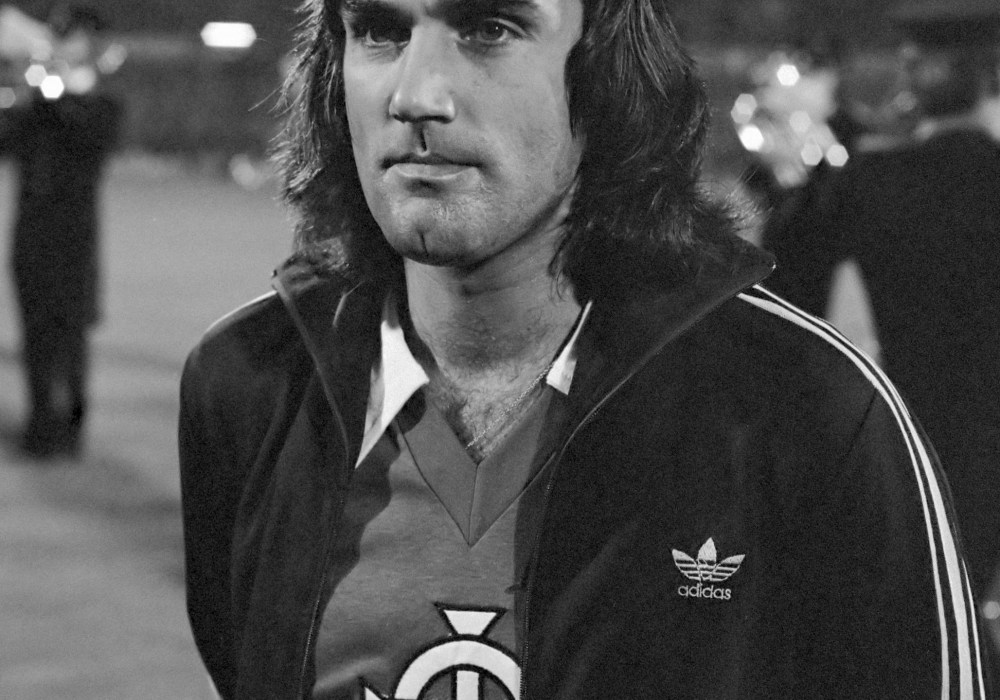
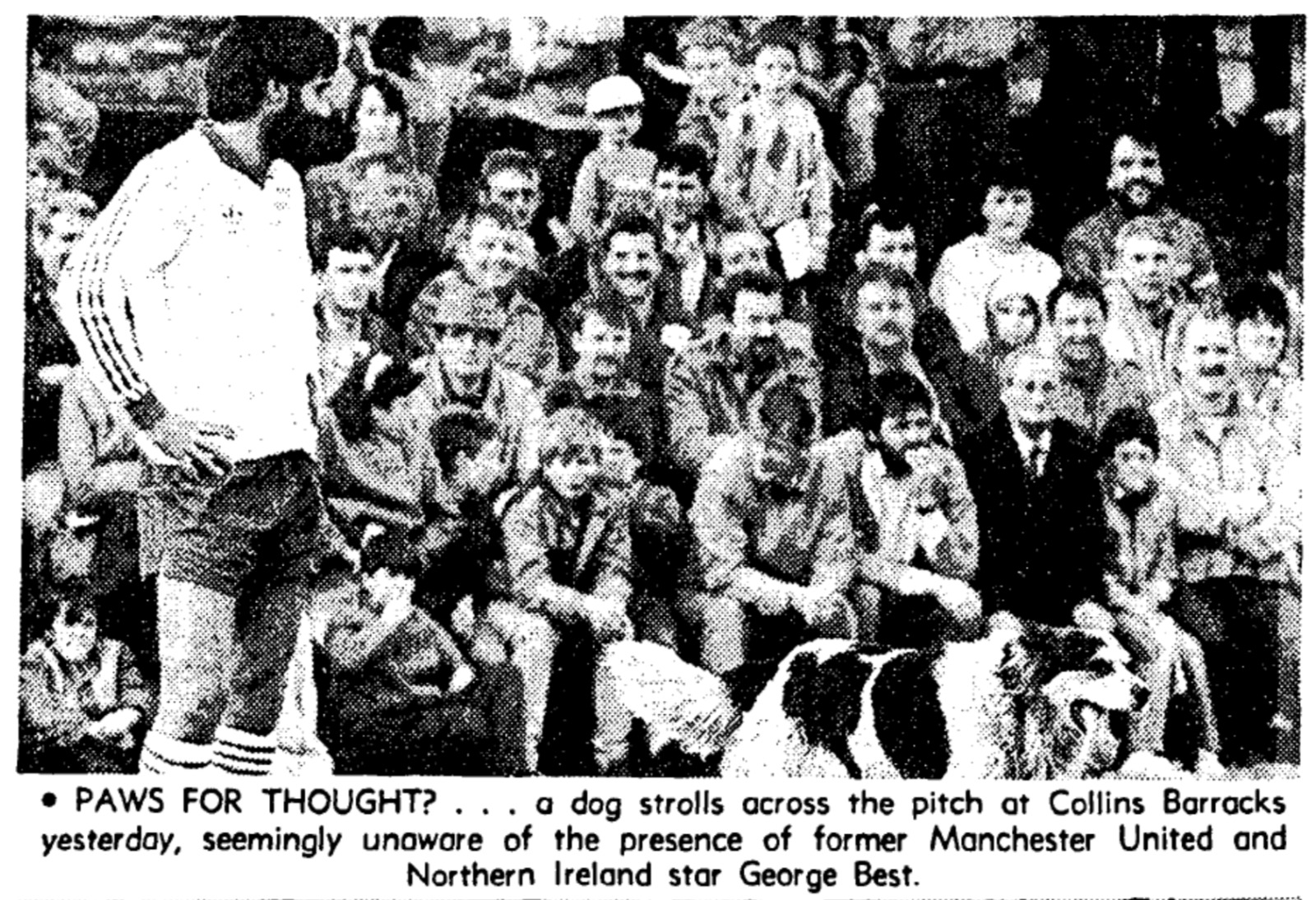
At a conservative estimate there were at least 1,500 people perched on temporary bleachers hoping to catch a glimpse of the fading brilliance of one of the greatest players that Ireland has ever produced. They were crammed into the exercise grounds of Collins Barracks, known simply as the esplanade, where the soldiers of the oldest continually functioning army barracks in Europe exercised and played football. At least that was the case at the time, today the area is better known to the Dublin public as the Croppies’ Acre park, a public space and monument to the dead of 1798, some of whom are reputedly buried beneath the park. However, in April 1986 thoughts were not of the dead of two centuries ago but on the left foot of a 40 year old George Best, playing along the banks of the Liffey to help raise money for an old friend.

While Best was long removed from the brilliance of his Manchester United prime, when he had terrorised defences throughout Europe and been named Footballer of the Year, he was still a box office draw. He had spent the intervening years playing his trade mostly in the North American Soccer League (NASL) while also having spells with the likes of Fulham, Hibernian, Bournemouth and even a three game spell with Cork Celtic in the League of Ireland. While this peripatetic existence meant that he had played in a variety of interesting and unusual surroundings the military exercise grounds of an army barracks flanked by city traffic must be among the more unusual sites that he plied his trade.

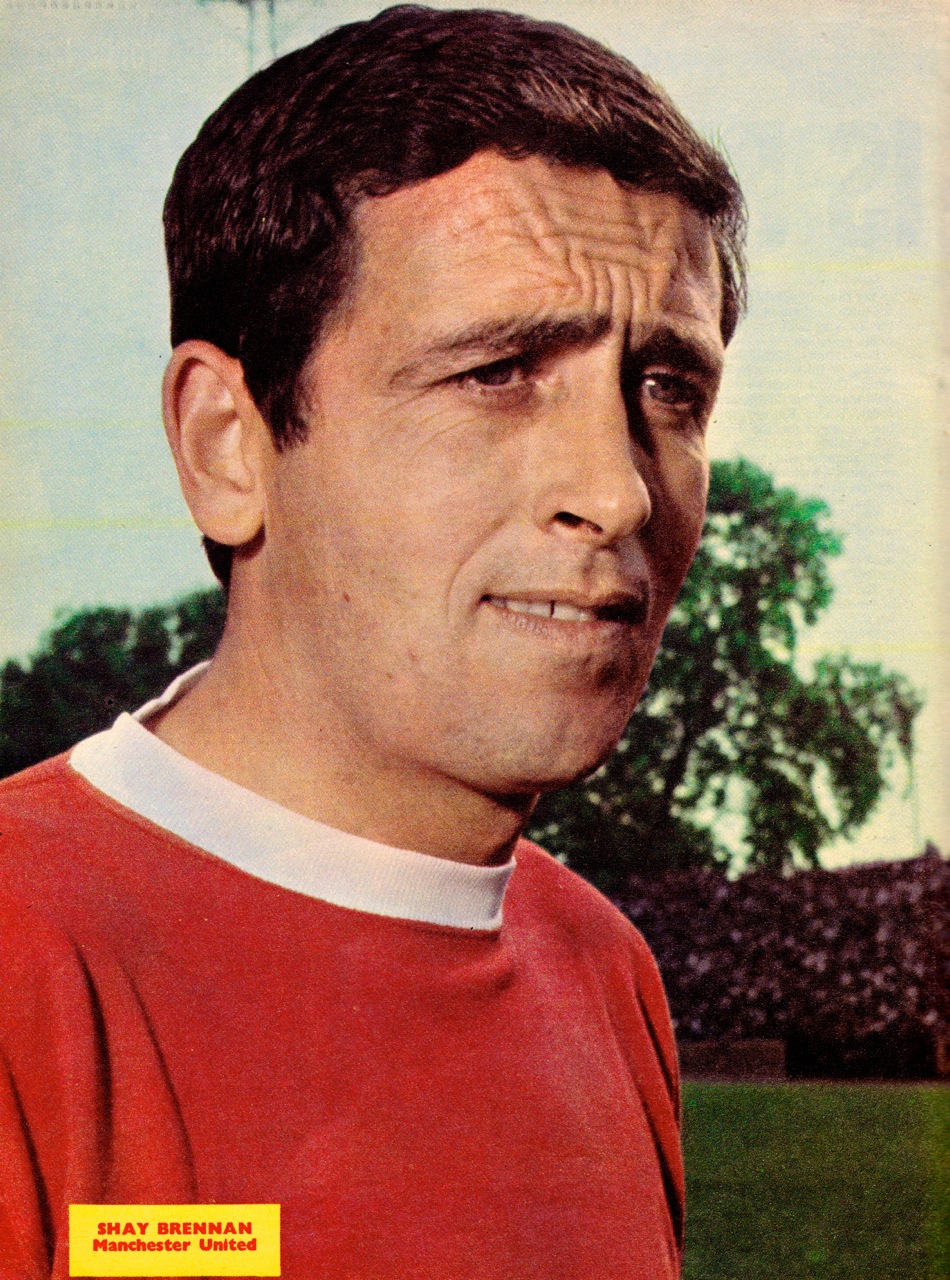
The reason for Best’s appearance was the annual Liam Tuohy XI v Collins Barracks celebrity XI match which was a benefit game for his former teammate Shay Brennan. While in Dublin it was announced that a Testimonial match had been confirmed in aid of Brennan between Manchester United and Shamrock Rovers with the game due to take place in August of that year. Brennan was the first English-born footballer to play for the Republic of Ireland and had been a teammate of Best’s as part of the great Manchester United side of the 1960s which had won two league titles and the 1968 European Cup. Brennan had later enjoyed success as player and manager of Waterford, leading them to two league titles and an FAI Cup win. Brennan, who was a close friend of Best, and was known as a man who enjoyed socialising and the occasional bet, had been advised by Busby to take a “pension” of £15 a week from Manchester United in lieu of a testimonial in 1970 as Busby feared he would waste a sudden windfall from a benefit match. In 1985 Brennan had suffered a heart attack which likely prompted the push to fundraise on his behalf.

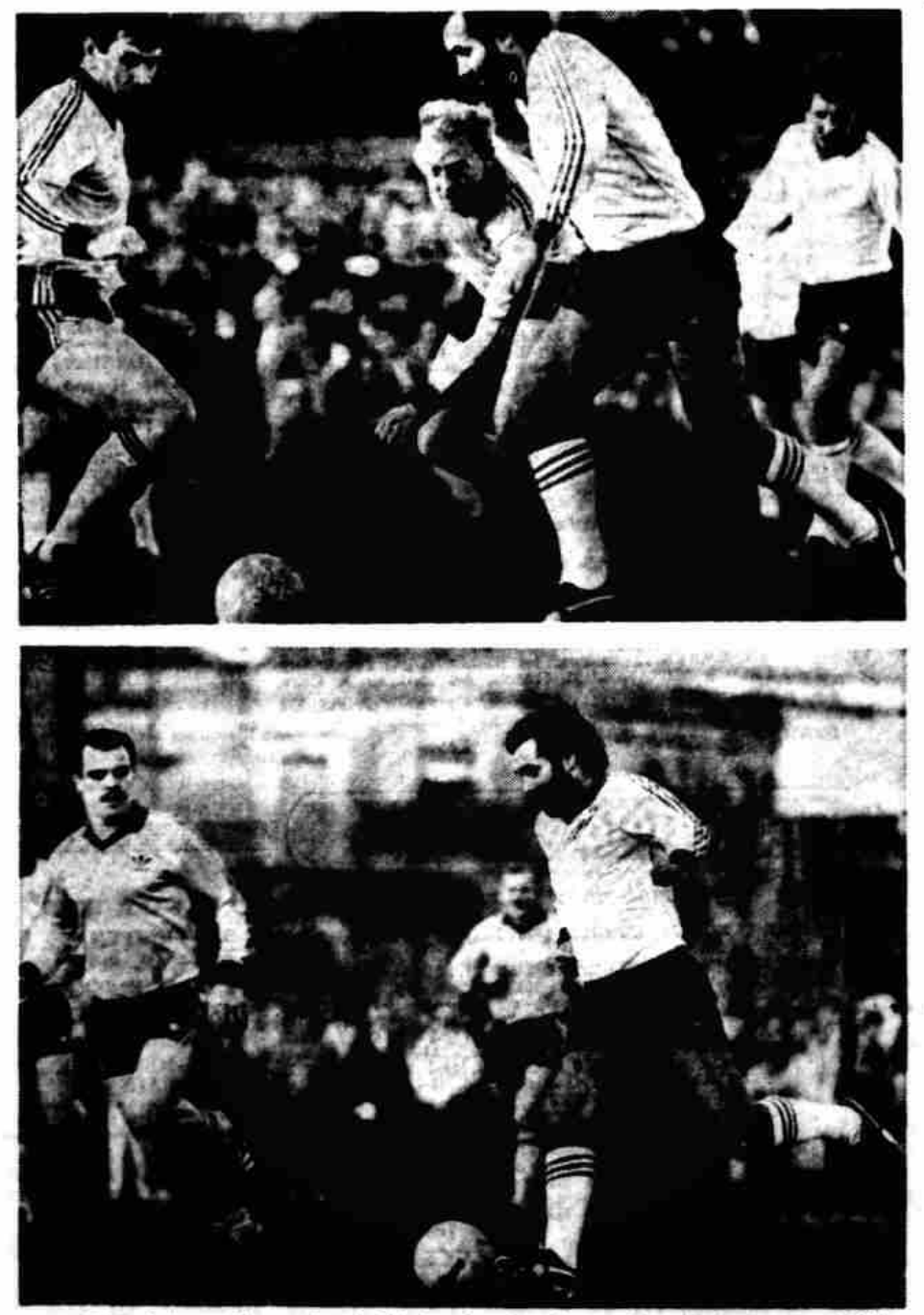
Best in action from the Irish Independent

In interviews in the lead up to the game at Collins Barracks, Best claimed he had been “on the wagon” for seven months, and that was staying fit by appearing in regular exhibition matches. Most of the reports and photos associated with the game commented on how relatively “trim and fit” Best appeared, though the Irish Independent described the Belfast man as being “fuller of figure”. Most were complimentary on his performance as well, describing some good touches, dribbles and demonstrations of the “full range of his famous skills”. Best was substituted in the game after 70 minutes as he had to get back to Manchester, which also meant that he had to forgo the after game reception and hospitality.

Best in the Evening Press with the crowds at Collins Barracks in the background

Best wasn’t the only prominent player involved, his former Manchester United teammate Pat Crerand was there on behalf of the club to announce the details of the forthcoming benefit match for Brennan and also featured in the match, alongside the likes of John Giles, Mick Leech, Eoin Hand, Mick Martin, Turlough O’Connor and Shamrock Rovers manager Jim McLaughlin. There were also stars from other codes including Dublin GAA goalkeeper John O’Leary, Roscommon footballer and Army Officer Dermot Earley and Rugby player Tony Ward. For the record the Collins Barracks XI won the game 2-1 with goals from Army Quarter Master Kevin Corcoran and Con Martin Jnr. cancelling out a strike from former Irish international Mick Leech.

While Best’s stay was brief he certainly made a splash, as well as the 1,500 or so who squeezed in to watch him by the banks of the Liffey there were the usual throngs of fans seeking autographs and photosgraphs at his hotel, while in interviews Best was his usual conversational, witty, acerbic self, he had been critical of the appointment of Jack Charlton to the Ireland manager’s job earlier in the year, and this continued to be a subject for humour and discussion while he was in Dublin.

Pat Crerand joked with Best that “Jack Charlton is waiting to meet you at the hotel”.

Best replied: “That’s good, I’m looking forward to introducing myself to Jack. I don’t think he ever saw me when we played. I’ll walk backwards so he can recognise me.”

Reported in the Evening Herald, 28th April 1986

Best would go on to say that he had questioned Jack’s appointment “on the grounds of his nationality and on his commitment to the game, that’s all”. Best and Crerand warming to their task also had some choice words on an array of other subjects, such as for the lack of quality in the British game, Brian Clough – “it’s sad when the biggest name in British football is Brian Clough and the media is prepared to pay him money to say ridiculous things” , as well as the treatment of meted out by the British press to sports “superstars” such as Lester Piggot, Alex Higgins or Ian Botham – “Who gives a damn what Ian Botham does off the pitch on tour, or how many beds he breaks doing it. I don’t.” stated Best.

Ian Botham in action in 1983

The much larger testimonial game for Shay “Bomber” Brennan was arranged for August 14th 1986, a pre-season friendly to be held in Milltown, which attracted a crowd of over 10,000. United travelled with a strong squad which included Irish internationals Kevin Moran, Paul McGrath and Frank Stapleton as well as seasoned internationals such as Jesper Olsen, Gordon Strachan and Mike Duxbury. Rovers saw the game as good practice for their upcoming European Cup tie with Celtic and impressed on the day, running out 2-0 winners with goals from Mick Bennett (loaned by Waterford for the match) and Liam O’Brien. United by their own account played poorly with one of the only stand-out players being substitute Joe Hanrahan who had been brought to Old Trafford a year earlier from UCD.

Liam O’Brien, who had won his first international cap earlier that year had obviously impressed United manager Ron Atkinson during the match as he made an offer for the young midfielder shortly afterwards for an initial fee of £50,000. However, O’Brien wouldn’t play under “Big Ron” who was sacked in November 1986 after a poor start to the season, He would have to wait until the arrival of Atkinson’s replacement, Alex Ferguson before he would make his first appearance in the red of United.

The cumulative crowds of around 12,000 across the two games no doubt helped Shay Brennan after his health setbacks. He would pass away in 2000 at the age of 63 while playing golf near Waterford. George Best who was experiencing his own health problems at the time was reported at being deeply upset at the passing of his good friend. Best himself would pass away just five years later. It is a testament to Brennan’s enduring popularity that the world of football was so quick to rally around him in his time of need, he was known for his easy-going nature and sense of humour, and was hugely popular in Manchester, where he had played over 350 games for Manchester United, and in his adoptive home of Waterford where he had helped deliver success but where he also enjoyed small-town life in Tramore and regular games of golf. After all it is not just anybody who could prompt George Best and Johnny Giles into playing a football match in a park on the banks of the Liffey.

Shay Brennan, Manchester United 1966

On being the Best

In a recent interview with journalist Andy Mitten the great Xavi Hernandez was asked if Lionel Messi was the “best ever”. Xavi is a true football anorak, he tends not to give glib answers, he’s been one of the greatest midfielders in arguably the greatest club and international sides ever, so his responses should be given a certain gravitas. He replied to Mitten that:

Yes [Messi is the best ever]. Pele and [Diego] Maradona both made a huge difference, but football has evolved. The players are better than they were, the game is better. Physically, tactically, technically and psychologically, football is better than ever. And Messi stands out as the best at the best time in the history of football.

pic_2015-03-08_OTRO_BARCELONA-RAYO_18.v1428485118

Succinctly put. It’s easy to see the logic of Xavi’s arguement, he even name-checks Pele and Maradona, those players who would traditionally vie for the title of the “best ever”. Messi does indeed play at a level, a pace and at a tactical evolve that would be alien to Pelé or even Maradona. If we had access to a time machine and dropped either of these two historical greats into the current Barcelona side then it is likely that we would see what Xavi is talking about. The frenetic pace of elite level football, the amount of ground that would have to be covered, the tactics and shape, the diet and conditioning, even the very rules of the game would be unfamiliar to the Pelé of 1970 or the Maradona of 1986, so of course the 2015 Messi would appear the better player.

To be clear there is a very strong argument that Lionel Messi is indeed the best player in the history of the game. His attacking versatility, his scarcely believable goal scoring rate, the collection of winners medals that he has accumulated through a glittering club career are all testament to this. The one mark in the debit column against Messi that is usually stated is that despite his amazing achievements with Barcelona he has yet to win a senior international tournament with Argentina while both Pele and Maradona were instrumental in winning the World Cup for Brazil and Argentina respectively.

For much of the global history of football the international game was considered the very highest standard of excellence and Pele and Maradona are rightly recognised for their success at this level. However in recent years with the growing dominance of elite European leagues, and an upper echelon of super-wealthy elite clubs within these leagues this has begun to change. It is now arguable that even the best sides at a World Cup would be overall inferior to the matchday squad of better Champions League sides. The expansion in player scouting to truly global proportions, as well as football’s growth in popularity and professionalism (there are now estimated to be more than 265 million active players worldwide according to FIFA) has meant that competitiveness for places and the breath of playing talent available to elite clubs is far beyond anything in the earlier history of the sport.

The hot-housing and accumulation of talent within clubs like Barcelona, Real Madrid and Bayern Munich, means that the elite levels of European club football are the ultimate proving grounds for individual footballing excellence. So surely Messi, having now won four Champions League titles, has achieved as much at such a high standard as any other player who could lay a claim to being the Best?

This would all point to fact that Xavi is right in his choice of Messi as the greatest ever player, that the pace of the modern game and its tactical advancement would mean that players of earlier generations would look like something from that Harry Enfield sketch of black and white era football buffoons. But I feel that this is somewhat unfair, the modern game has become obsessed with the 24 hour football news cycle and a couple of events have suggested that we find it difficult as modern football fans to appreciate footballing achievement if its historical context pre-dates the 1990’s.

Two recent events apart from the Xavi’s quote above have brought this into focus for me. Jamie Vardy’s consecutive goalscoring record and the tenth anniversary of George’s Best’s death. In Vardy’s case he has claimed a very significant landmark, he now has the record for most consecutive goals in the history of the Premier League with  goals in 11 consecutive games. That is to say a record since the rebrand of top flight English football in 1992. This is still a significant achievement, he’s done something that Ruud van Nistelrooy, Alan Shearer or Theirry Henry never managed, and of course we like to view history in bite size chunks, there is no harm in that. Prior to the Premier League there was often mention as I recall of “post-war” records because that’s just how we like to process the passing of time. Credit should be reserved for the likes of Sky Sports who have consistently highlighted that the overall record still belongs to Jimmy Dunne who scored 18 goals over 12 consecutive games in the 1931-32 season.

Little footage remains of Dunne and it’s only Vardy’s recent record breaking feats that have brought him back into the footballing consciousness. Even in Ireland where Dunne was our record goalscorer for 27 years (until this was broken by Noel Cantwell) few are really aware of his feats on a football pitch and Dunne is seldom ever mentioned in greatest Irish XI’s or such like.

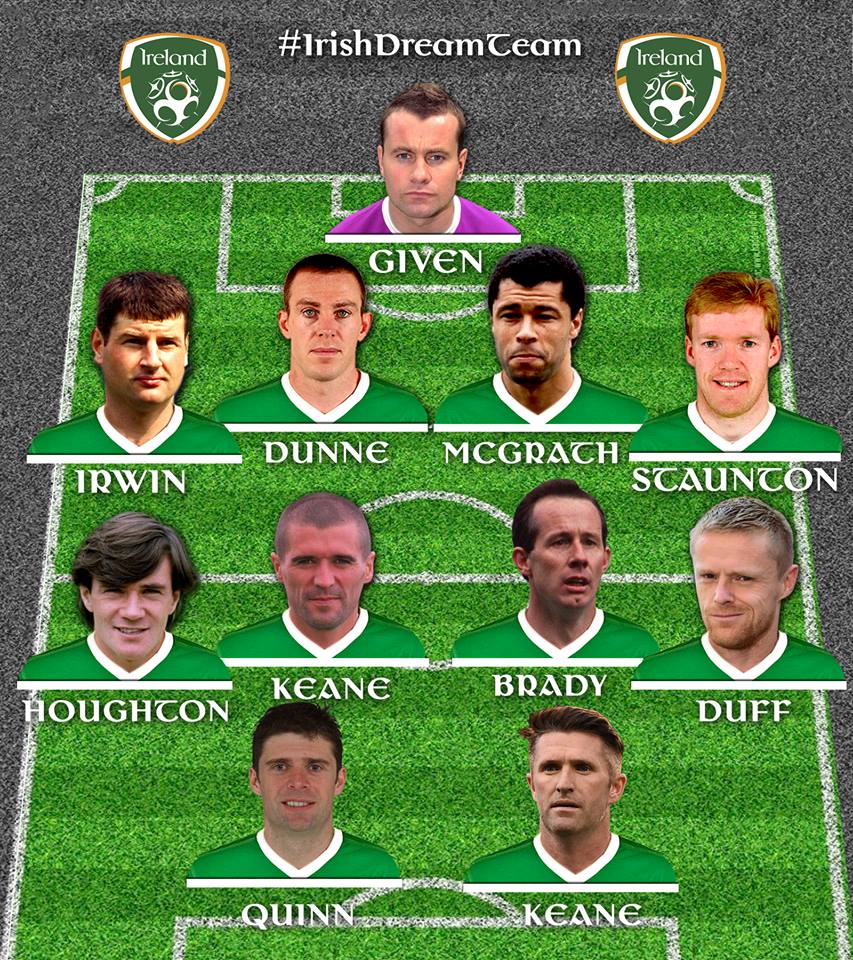
Such polls are always fickle, in fact a recent poll by the FAI to select the greatest Irish team in the last 50 years didn’t even include Johnny Giles! And it can’t be said that John lacks any media profile.

FAI XI

The best Irish team of the last 50 years as chosen by Irish football fans. No room for John Giles.

The other landmark in recent days was the tenth anniversary of the death of George Best. Manchester United fans were commemorated Best with banners and chants at Old Trafford and there were many comparisons drawn between the swashbuckling playing style of Best, Law and Charlton with the more prosaic football on offer from Louis van Gaal’s charges.

Best is often cited as the first of a new generation of footballers, one of the first “modern” players. Best made his first team debut in 1963, the year the first Beatles album came out, and the year that poet Philip Larkin claimed “Sexual intercourse began”. That’s the problem with the past, we can only view it in retrospect so of course it appears that Best’s life and career were always on a pre-destined course. So it seems to us he was always the handsome Belfast-boy who was destined to become the “fifth Beatle” , the supremely talented player who was doomed to live fast and burn out young.

But did it have to be that way? Returning to Xavi’s point about Lionel Messi being the best ever, does the comparison with Pelé and Maradona work the other way. Yes they might appear off the pace if they were magically transported into the modern game but then that could be said of any discipline; Jessie Owens would lose to Usain Bolt in a sprint,  in the arts the master practitioners of past would be out of their depth if thrown into a modern milieu, imagine asking Alfred Hitchcock or Cecil B. DeMille to direct a modern Hollywood blockbuster, on digital, with the current demands of a global film industry, they’d be overwhelmed but it doesn’t mean they are not great directors.

What if Best and Pelé were born later? What if Maradona had been born in 1990 not 1960? Players with their control, technique and vision would always thrive, they’d be better protected now from the darker arts of opposing defenders, and they could avail of the most modern training techniques, tactical instruction, diets and so on. Best was at the forefront of the tortuous birth of the modern celebrity sportsman, today Best would have been better understood, the level of public scrutiny to which he was suggested would now be commonplace and both player and his club better able to deal with these extremes. Similarly the excesses of his personal life are better understood, today there would be a far better chance of Best firstly being better protected from the rigours of celebrity and secondly to have better supports available if he did begin to develop a dependency on alcohol. While it might be cynical it is in the best interests of hyper-wealthy football clubs to protect their stars as best they can.

Similarly with Maradona or Pelé, the modern club structures would have meant that Maradona would have been unlikely to move from Barcelona to Napoli (while Napoli are top of Serie A at the time of writing they were struggling when Diego arrived in 1984) due to the wealth gap between even the top clubs in Serie A and the small elite band of hyper-wealthy sides. Perhaps he would never have fallen in with the Camorra, perhaps his drug habit, which had begun towards the end of his time at Barcelona would never have developed as it did. Pelé might likely have followed a similar route to current Brazilian international and fellow Santos alumni Neymar Jr. staying only in Brazil to his early 20s before a lucrative move to Europe.

The greatest players probably should only be judged on their individual eras as one of the greatest facets of football is that while it remains quite close to the original rules of the 1860’s that made it “the simplest game” it is also constantly changing, progressing and reacting. Football would be both instantly recognisable to a time traveller from the past and bewilderingly different.

Messi is unique in world football at present and has a strong claim to being one of the greatest players of all time but our standards for greatness change as time progresses. Just as it would be folly for a football fan in 30 years time to write off Messi’s achievements because of the victories of some as yet unborn player, so to is it our folly to underestimate the accomplishments of those who have gone before.


League of Ireland international XI

Sander Puri the Estonian international and Sligo Rovers player was called up a couple of weeks ago for the European Championship qualifiers against Lithuania and Slovenia. Manager Micky Adams would have been more used to international call-ups from his previous stints as manager of clubs like Leicester City but admitted it wasn’t something he was expecting upon relocation to the north-west of Ireland.

While not all that common foreign internationals who have played in our very own League or Ireland do have a long and storied history, so I set about creating a match day squad and first XI of players who had been capped by their countries who had also played League or Ireland. The only criteria were that they had been capped at some stage, whether before, during or after their Irish adventure and that they were capped by a nation that was not the Republic of Ireland.

The resulting squad is not exhaustive, it is certainly subjective and probably biased but I hope it makes for interesting reading. It contains three World Cup winners, one beaten world cup finalist, a European player of the year, an international World cup captain and a former team-mate of Pelé.

The first XI features players from seven different nations across Europe, Africa, North and Central America in a slightly unorthodox 3-4-3 formation. I’m sure I’ve made glaring omissions so feel free to make your suggestions below.

Goalkeeper

Gordon Banks

World Cup winner with England in 1966, Banks is often credited with making one of the greatest saves in history during the 1970 World Cup when he acrobatically changed direction to deny Pelé a headed goal when holders England met eventual winners Brazil.
Best remembered at club level for his service to Leicester and Stoke City (he won League Cups with both), he tragically lost the vision in one eye after a car accident in 1972. This led to an enforced retirement, which he broke to line out for the Fort Lauderdale Strikers in the NASL in 1977-78. It was around this time that he made his one appearance in the League of Ireland, guarding the net for St. Patrick’s Athletic in the 1-0 win over Shamrock Rovers in Richmond Park in 1977.

Defence

Avery John

Avery John was a high-profile part of a group of Caribbean players that graced the League of Ireland during the 90’s and early 2000’s. He just about edges out ex Galway United and Bray Wanderers man Wesley Charles (100 caps for St. Vincent & the Grenadines) for spot in defence due to the fact that he played in a World Cup.

Avery

Avery John not only featured in the 2006 World Cup for tournament debutants Trinidad & Tobago, he had the dubious distinction of being the first player in the tournament to be sent off, receiving two yellows in the opening game against Sweden. Trinidad survived, gaining a credible 0-0 draw, thanks in no small part to the expertise of their coach Leo Beenhakker who threw on another attacker shortly after John’s dismissal to keep the Swedes pegged back.

During his club career John played with merit for Bohemians (twice), Shelbourne and Longford Town in the League of Ireland. He spawned his own chant while at Bohs, the highly original “Avery, John, John, John” sung to the tune of “Feeling Hot Hot Hot” before moving to the MLS in 2004, first lining out for New England Revolution and later Miami FC and DC United where he retired in 2010.

Alvaro Ros Rodriguez (Alvarito)

One of more unusual members of the team; a two-time Spanish international who featured in away matches against Chile (win) and Argentina (loss), Alvarito spent the bulk of his career at Atletico Madrid winning two Spanish Cups (Copa del Generalisimo as it was during the Franco dictatorship) as well as the 1961-62 Cup Winners Cup against the competitions’ inaugural Champions Fiorentina.

Despite this success Alvarito was never a regular with Atletico, he suffered injuries including a severe leg-break and was mainly understudy to Spanish international Isacio Calleja. However he did start in the final of the 1959-60 Copa del Generalisimo, a famous 3-1 win over city rivals Real Madrid in a packed Santiago Bernabéu.

His experience of the League of Ireland, like many in our team, was short-lived. Upon leaving Atletico Madrid he spent a single season with Real Murcia before joining Shelbourne as a player-coach in 1965, making his debut in a 2-1 win for Shels over Dublin rivals Drumcondra. Some impressive performances followed but a combination of injury and difficulties with the language meant that his stay was brief. What followed after leaving Shels was over 20 years of coaching in the Spanish lower leagues, something that Shels can look on with a little bit of pride as they gave him his first coaching role in the game.

Bobby Smith

Bobby Smith won 18 caps for the United States national team over a seven-year international career and was an NASL All-Star. Born and raised in the town of Trenton, New Jersey, which would later give us NBA All-Star and global diplomat Denis Rodman, Smith began his career at the Philadelphia Atoms in the NASL, winning the Championship in his debut season of 1973.

As was often the case in the 70s players from both sides of the Atlantic would take advantage of the differing season schedules with European players going on loan to North American teams during the summer off-season, and in the case of Smith some American based players going in the opposite direction during the NASL off-season. Smith’s port of call was Dundalk where he was signed up on loan by the legendary Jim McLaughlin who was player-manager at the time. Also signed up was fellow American Dave D’Errico.

Smith would later join the star-studded New York Cosmos where his team-mates would include Pelé, Franz Beckenbauer, Giorgio Chinaglia and Playgirl centrefold Shep Messing. Further NASL Championships would follow before he was transferred to Seattle, followed by a return to Philadelphia (this time to Philadelphia Fury) where he played alongside Irish international John Dempsey. He continued with Philadelphia Fury when the team was sold, renamed and moved to Montreal finishing his career at Montreal Manic in 1981.

Midfield

George Best

In quite an attacking line-up the European Player of the Year for 1968 is included as an attacking right-winger in our League XI. The great George Best, capped 37 times by Northern Ireland, lined out for Cork Celtic in the 1975-76 season. This was only seven years after winning the European Cup and the previously mentioned player of the year award. Though not quite 30 he was already well on the downward spiral of his peripatetic footballing career.

Spells with the LA Aztecs amongst others in the NASL and two seasons with Fulham would follow, as would occasional reminders of his utter beguiling brilliance . League of Ireland fans only witnessed Best live on three occasions in matches against Drogheda United, Bohemians and Shelbourne, although he attracted sizeable crowds Best failed to score in any of his games and left spectators unimpressed.

Ed McIlvenney

When asked to name the moment in football history when England first realised that they were not the world’s greatest team, when they perhaps got their first inkling that those damn foreigners might know something about football after all, many will point to the 1953 destruction of the English national team by Hungary’s Magic Magyars in Wembley. Certainly the 6-3 humiliation had a seismic impact on English theories of footballing superiority.

Some Irish observers may suggest the 2-0 win by an Irish team over the English in Goodison Park, 1949 as another such a moment. A third such game was in England’s second match of the 1950 World Cup (the first time they had deigned to enter, having tended to ignore the pre-war tournaments) when the United States defeated England 1-0 thanks to a goal from Haitian student Joe Gaetjens.

What is often forgotten is that the captain of the American team that day was a Scotsman named Ed McIlvenney. McIlvenney was born in Greenock in Scotland in 1924 and in the late 1940s went to live with his sister in the States, having by that stage played some football for Wrexham, then in the Third Division North. After excelling for the Philadelphia Nationals he was called up to the United States national team for the World Cup.

His Philadelphia team-mate Walter Bahr was usually the captain of the USA national team, however as a Scotsman, McIlvenney was given the honour of captaining the side against the old enemy for what would become a famous upset. Impressed by his performances Matt Busby gave him a chance at Manchester United where he only made a couple of appearances before moving across the Irish sea to sign for Waterford in 1953.

He even had the privilege of being immortalised in a feature film by none other than Sheffield Wednesday icon John Harkes in 2005’s The Game of their Lives which also bizarrely features Bush lead signer Gavin Rossdale as Blackpool legend Stan Mortensen.

Bobby Charlton

Bobby Charlton, much like Ed McIlvenney was signed for Manchester United by Matt Busby, however their similarities in the red shirt of United end there. The second of our World Cup winners, Charlton remains United’s record goal scorer and certainly adds a goal threat to our midfield.

Also like McIlvenney , Charlton signed for Waterford, in this case in 1976 after his spell as Preston North End player-manager had ended in disaster, with the club being relegated in his first season. His number two at Preston was his old team-mate Nobby Stiles, who was married to Johnny Giles’ sister Kay so perhaps it was Nobby’s idea for Bobby to go to Waterford? More likely it was the diplomacy of Joe Delaney (John’s Da) who correctly saw the potential for Charlton to boost Waterford’s crowds.

Charlton’s career in Ireland was, like Best’s brief, but it was slightly more successful, 6,000 souls braved the snow to see him score against Finn Harps in his second game for the club, after impressing everyone during his debut, a 3-2 win over St. Patrick’s Athletic, in which Charlton won the penalty that opened the scoring. Charlton would play twice more but both games ended in defeat with Waterford going down 2-0 to Bohemians and losing 3-0 as Finn Harps gained their revenge in the Cup.

Joseph N’Do

Many of the players discussed in this article were veteran pros who, in the days before hyper-inflated salaries saw the League of Ireland as somewhere they could earn a few quid by playing a handful of games in the twilight of their careers. Then there are those who were international players from smaller nations for whom the League of Ireland offered professional football and even the potential for a mini-run in European competition. Then there’s Joey N’Do.

An African Cup of Nations winner with Cameroon in 2002 (the year before he signed for Pat’s) and a Coupe de France winner with Strasbourg of Ligue 1, N’Do’s presence seems gloriously incongruous, as though he had just stumbled upon the League of Ireland while looking for somewhere else, liked it and decided to stick around.

N’Do’s career has seen him win every honour in the Irish game as well as being voted player of the year in 2006. He has also managed to play for the four main Dublin clubs; St. Pat’s, Shelbourne, Bohemians and Shamrock Rovers (on loan) without incurring the bile and invective of supporters usually associated with moves to local rivals. During his more than ten years in the League he has played a multitude of roles from tricky, skilful winger to deep-lying forward, and in recent years with Sligo Rovers that of deep- lying play maker, his intelligence and reading of the game making up for any loss of pace. His talent is as self-evident as the warmth and joie de vivre which accompanies his game. The images of Joey dancing pitch-side with a trophy after another victory are ones that many of his fans will fondly remember.

Recently he auctioned off his African Cup of Nations medal, his most recent FAI Cup winner’s medal and his World Cup participation medal to raise money for his former team-mate Gary O’Neil who had just been diagnosed with cancer. Joey N’Do, one of the good guys of Irish football.

Forwards

William Ralph ‘Dixie’ Dean

He didn’t like being called Dixie, he much preferred Bill as a moniker. And for a time in the 20’s and 30’s he was the greatest centre forward in the world. Beginning his career at Tranmere, he was snapped up by Everton, the team he supported as a boy, at the age of 18. He would set a scoring record for the Toffees that stands to this day, along with a record for most goals in a season (60) which also remains intact. His international record reads 18 goals in 16 games for England.

To fully understand his celebrity in a pre-television age consider that Dean was an Evertonian beloved of Bill Shankly, that Babe Ruth asked to meet him after an Everton game and bemoaned how little English football players were paid for their talents. In one possibly apocryphal story a captured Italian soldier during World War 2 was said to have shouted at his English captors “Fuck your Winston Churchill, and fuck your Dixie Dean!”.

This is the same Bill ‘Dixie’ Dean who pitched up at Sligo Rovers in 1939 aged 32. Dean scored 10 goals in his seven-league games for Sligo starting with a goal on his debut against Shelbourne. He would score another against Shelbourne in that years Cup Final, however the game finished 1-1 and Dean was unable to repeat this feat in the replay, Sligo going down 1-0 to a William ‘Sacky’ Glen goal in front of almost 29,000 in Dalymount.

Infamously his runner-up medal went missing after the game only for it to reappear in a package sent from Ireland seven years later to Dean who, by then, was then running the Dublin Packet pub in Chester.

Uwe Seeler

Apart from Pele only two other men has played and scored in four World Cups, both are German, one is current Lazio striker Miroslav Klose the other is Uwe Seeler. The runner-up medal Seeler recieved in 1966 when he was 30 years of age was to be his best placed finish. He retired from international football in 1968 but was coaxed back into the national team by coach Helmut Schoen for the Mexico World Cup of 1970. It proved to be schrewd move as the veteran striker scored three goals, including a header against England in the quarter finals to bring the game to extra time. Inevitably Germany prevailed 3-2 with Seeler’s successor Gerd Muller grabbing the crucial winner.

During his career Seeler remained a one club man almost to the end, spending nearly 20 years as a first team player with his local side Hamburg, where both his father Erwin and brother Dieter also played. He remains their record goalscorer to this day with an astonishing 404 goals in 476 games.
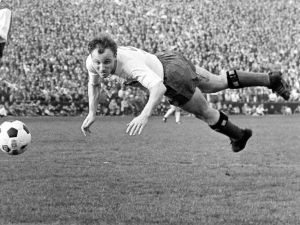
uwe

What endeared Seeler to the German public even more than his goals was his humble and friendly attitude, gaining the nickname ‘Uns Uwe’ or ‘Our Uwe’. He turned down Inter Milan coach Helenio Herrera when he came calling, offering a huge transfer fee and salary. For much of his career Seeler played in a regionalised, ‘amateur’ league system in Germany, whatever he earned from football in Germany would have been a paltry amount compared to the riches available in Italy. However he turned down Herrera and remained in Hamburg. In response the club looked after him with a relatively well-paid role as a regional sales rep for Adidas as some sort of compensation.

However, six years after retirement he, along with his former Hamburg teammate Franz Josef Konig lined out for a club other than Hamburg. That club was Cork Celtic. Seeler thought this game was a sponsored event for Adidas but would find out later that it was an actual league match against Dundalk in 1978. Needless to say Seeler scored both goals as part of Cork Celtic’s 2-1 victory.

Geoff Hurst

Aparently Geoff Hurst scored a hat-trick in a World Cup final, but we don’t really hear too much about that. Hurst is the final World Cup winner in our team but was considered a little bit of a wild card in 1966. Originally a defensive midfielder he benifitted from a move up front early in his West Ham career and then the goals began to flow.

He caught the eye of Alf Ramsey and was given a chance for England in a friendly against Germany in February of 1966, impressing in his role up front with Liverpool’s Roger Hunt as England won 1-0 thanks to a Nobby Stiles goal. Hurst got his chance in the World Cup proper due to an injury to Jimmy Greaves in the final group game against France. Hurst seized his opportunity, scoring against Argentina and impressing against Eusebio’s Portugal in the semi-final. He didn’t disappoint in the final either, even if one of his goals didn’t cross the line.

Hurst finished as the second highest scorer in West Ham’s history before moving on to Stoke and then West Brom. After his contract finished there a 34-year-old Hurst signed a one month deal with (once again) Cork Celtic in 1976. He managed three goals in three league games as well as featuring in cup games against Shamrock Rovers and Dundalk.

Team

Gordon Banks

Alvaro ‘Alvarito’ Ros Rodriguez, Avery John, Bobby Smith

George Best, Ed McIlvenney, Bobby Charlton, Joey Ndo

Dixie Dean, Uwe Seeler, Geoff Hurst

Subs: Ryan Thompson (gk), Bobby Tambling, Wesley Charles, Terry McDermott , Peter Lorimer, Mindaugas Kalonas, Jimmy Johnstone, Piotr Suski, Charles Livingstone Mbabazi

Manager: Raich Carter

Original article published on backpagefootball.com in January 2014