A cup to call our own – a new European trophy for smaller nations?

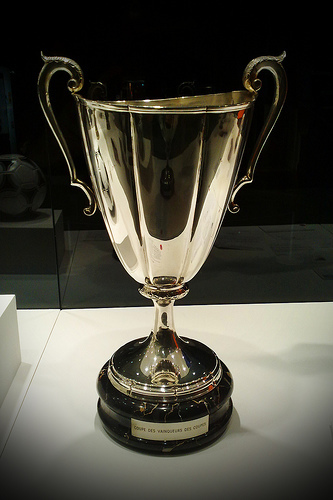
Remember when Magdeburg, Mechelen, Aberdeen and Dinamo Tbilisi were European champions? Those clubs from East Germany, Belgium, Scotland and Georgia respectively were all winners of the lamentably departed Cup Winners Cup, the UEFA competition that did what it said on the tin and provided a competition for well… Cup Winners.

The Cup Winners Cup, a straight knock out tournament for the victors of domestic knock out tournaments tended to throw up more unexpected champions than in other tournaments and had a greater representation from a broader geographical area. Before the greater consolidation of power and wealth into the hands of a group of superclubs in a handful of leagues the Cup Winners Cup was a chance to see teams from corners of Europe that one was not necessarily exposed to on a regular basis.

programme

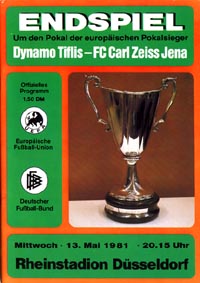
Match programme from the 1981 Cup Winner Cup Final

Since that 1998-99 season UEFA has ran the two main European club competitions of the Champions League and Europa League but as of 2018 that could change. In 2018 the television rights for the two main competitions comes to an end and there area early discussion about returning a 3rd European club competition but one focused mainly on smaller clubs who exit other European competitions early. This could provide a potential windfall for Irish clubs who miss out on the lucrative group stages of either competition and present a tantalising array of possible outcomes. European football beyond September could finally be a realistic expectation for Irish clubs.

Such move would be in keeping with the ethos of UEFA president Michel Platini who has extended the European Championships to 24 sides and made changes to qualifying for club tournaments to give greater representation to smaller nations. Quite what format the tournament would take should UEFA decide to proceed with its creation is still up in the air. As reported in the Guardian the Scottish FA’s Stewart Regan said that

“It’s a discussion around whether it’s a separate third competition exclusively for smaller countries who then relinquish their place in the Europa League and/or Champions League or whether it’s a competition that basically acts as a further safety net for those clubs that enter the Champions League or Europa League but are typically out by August and then [instead] they fall down into a third competition,”

Whether smaller nations would choose to give up on the possibility, albeit a slim one, of qualifying for the Champions League in order to compete in a lower tier competition is dubious but the option for a follow up competition for club sides from smaller nations to compete in beyond August and September could prove to be a welcome boost. Such a competition could generate revenue and interest for clubs and also give club sides from smaller nations the opportunity to test themselves in a competitive environment against sides from other jurisdictions.

Manuel Veth, writing on the subject for the Futbolgrad.com website highlighted the example of the Baltic League competition held between the major teams from the Baltic States or the Royal League held between sides from Denmark, Sweden and Norway as regionalised multi-league tournaments that have already been tried.

A regionalised competition based on a straight knock-out format could prove popular, especially if victory could guarantee something like automatic group phase qualification for either the Champions League or Europa League the following season.

However, significant potential drawbacks from such a hypothetical competition exist. In a regionalised format would their be sufficient interest in a competition between top sides in say the Republic of Ireland, Northern Ireland, Scotland and Wales? Especially if a larger team like Celtic secured qualification through to the Champions League and were not involved? Much would depend on the prize money available and the draw of other sides in the competition. Irish football fans on both sides of the border would have seen interest in Setanta Cup wane once there was significant reductions in the prize money. Such prize money would most likely have to come from TV rights deals and sponsorship and it remains to be seen whether there would be an appetite on behalf of broadcasters to covers games in what would effectively be a third tier competition.

Even moderate TV income would benefit smaller clubs in smaller nations. Perhaps it could be considered in the negotiations of TV rights deals in 2018 with preferred bidders for the Champions League being required to purchase a certain number of games from this new tournament? Similarly UEFA could create a solidarity fund from the massive TV and sponsorship revenues that the Champions League and Europa League enjoy and use such a fund to provide incentives and prize money for clubs from smaller nations competing?

uefa

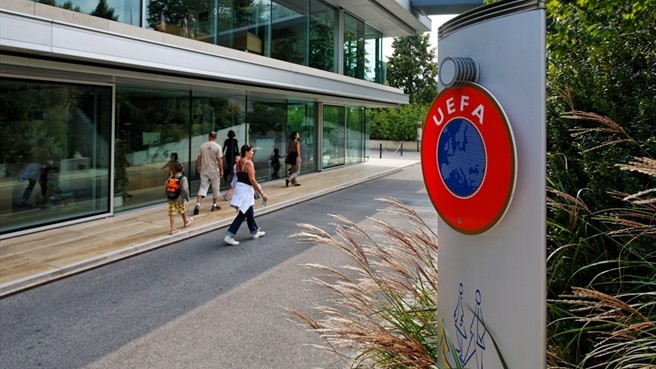
UEFA headquarters, Nyon

Despite the reforms brought in by Michel Platini and his administration to facilitate greater participation of small nations and their clubs there seems to be a growing gap between the hyper-wealth elite like Real Madrid, Barcelona, Bayern Munich, Chelsea and so on, the historic clubs from smaller and middling sized nations and clubs from more peripheral nations. Whether we like it or not, Ireland in this context is a peripheral nation. There has long been a hope among League of Ireland fans that an Irish side could “do a Rosenburg” and secure regular qualification for the group phases of major competitions but despite Shamrock Rovers making the Europa League group stages those days don’t appear to be on the immediate horizon.

In the absence of regular group stage qualification could a third tournament give us our European fix?

Originally posted on backpagefootball.com 

The fall and rise of UD Salamanca

You could say that the footballing history of most countries began with an Englishman. The national football story of many nations begins with an English engineer, sailor or student stepping off a boat or train with a ball under his arm and a poorly organised kick-about with friends and locals invariably follows.

For many years the Englishman remained the expert, the teacher, and even up to the 1950s the English trainer, manager, football missionary was highly influential. The lives and careers of men like James Richard Spensley, Jimmy Hogan, Vic Buckingham, Fred Pentland and George Raynor are testament to the formative role that these English footballing proselytisers had on the global game.

The role of the Irish is somewhat less obvious, though people like Paddy O’Connell, Jack Kirwan and Monaghan-born Anna Connell (who played a significant part in Manchester City’s foundation) have had some influence beyond our borders. However some of those that influenced the development of the game abroad remain unknown to us to this day, as is the case with the group of Irish students who helped introduce the game to the city of Salamanca and founded the predecessor of Spanish side UD Salamanca.

The first football club in the Spanish city of Salamanca (located about 200km west of Madrid) was founded by Irish students in 1907. This isn’t as strange as it might first seem, Ireland has a greater connection with Salamanca than simply the name of a Dublin tapas restaurant. Salamanca, as one of Spain’s oldest University cities was home to an Irish College, part of a series of educational institutions that were founded throughout Europe during the 16th Century.

These institutions became home to one of the first waves of the IrishUD Salamanca emigrant diaspora after the political turmoil of the times; (the Munster and Ulster plantations, the Nine Years War, the Confederate War and the Cromwellian conquest) drove many of the Gaelic Irish and Old English into the Catholic armies and seminaries of mainland Europe. Indeed many of these colleges still exist or perform some similar role today, the Irish College in Rome still trains Catholic clergy while the Irish College in Paris is now a Cultural centre for Irish students and artists. That Irish students were present in early 20th Century Spain to form the Salamanca Football Team which competed in the early editions of the Copa del Rey shouldn’t surprise us.

While we even know the café where the club was founded the names of the Irish students involved sadly remains unrecorded. Although the early team folded a new side was formed in 1923 as Unión Deportiva Salamanca, they were a yo-yo club for much of their existence but managed to spend 12 seasons in the top-flight and were Segunda division champions on three occasions. However there are to be no more seasons at Spanish football’s top table as the club ceased to exist in the Summer of 2013, the 90th year of their being.

The story of their demise is a familiar one, and one that is likely to be repeated again in the near future. Relegated from the Segunda at the end of the 2010-2011 season, struggling Salamanca’s debts rose. Following the drop to regionalised football, UD Salamanca’s financial problems worsened and by the time the club entered liquidation in June 2013 they owed €23 million to creditors. This raised the very real prospect that the city could have been without a football team for the first time in nearly a Century.

It is into this territory of uncertainty entered Juan José “Pepe” Hidalgo, a local businessman made wealthy through his Globalia company which deals in tourist flights and a chain of hotels. Only days after the liquidation of UD Salamanca a new club, Salamanca Athletic was formed and Argentine coach Gustavo Siviero, formerly in charge at Real Murcia was appointed to manage the fledgling side.

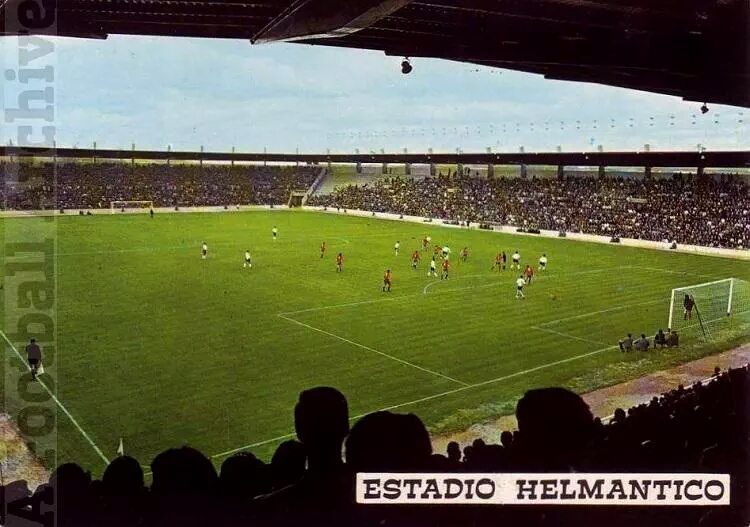
After much wrangling between the Spanish Football Federation and the local judiciary (the football federation initially blocked the new club taking UD Salamanca’s place in the Segunda B division,a decision that was subsequently overturned by the courts) the historic town of Salamanca looked like it would have a football team in place for the 2013-14 season, and looked likely play in UD Salamanca’s old home the Estadio el Helmántico

However this new club never played an official match and looks unlikely ever to do so. A second new club Unionistas de Salamanca CF emerged as a fan owned club made up of former UD Salamanca supporters. The include among their number a local hero in the form of Vincente del Bosque. In their first season secured promotion from the sixth tier of Spanish football into the Primera Regional for Castille and León.

In the chaotic and financially turbulent world it is pleasing that over a Century after some Irish students introduced football to the city, Salamanca will still have a team to support.

Originally posted on Backpagefootball.com in August 2013

Defending the indefensible – the Millionaire Footballer: a retort

It’s hard to have sympathy for the modern day Premier League footballer. Brash, cosseted, occasionally removed from both the average football fan and indeed reality, and of course overpaid.

In a recent article for the Football Pink, Harry Dunford made a cogent argument that modern footballers are absolutely overpaid and that the notion that any top level footballer should automatically be a millionaire and are worth such inflated salaries is a myth. As he noted “In the Premier League alone, where the average wage is around £30,000 per week, how many players really put in a performance week in week out that demands that salary?”

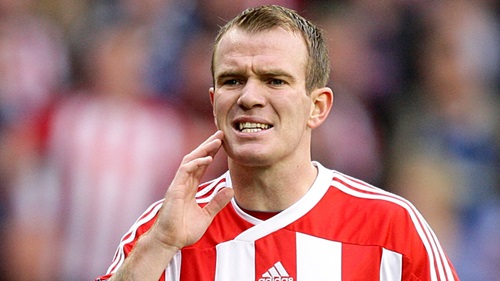
He goes on to add that “This is of course scandalous, a player such as Glenn Whelan, for example, shouldn’t be paid £50,000 per week just because the state of football says the top talent are paid £100,000.” He’s not alone in holding this viewpoint. In fact, Irish football pundit Eamon Dunphy was moved to comment on Glenn Whelan’s earning prowess, sneering of Whelan that “He drives two Ferraris; I think he’s a very lucky lad to have 50 caps for Ireland,” Dunphy would later climb down on his pronouncements after Glenn Whelan went on to challenge Dunphy’s remaks by comparing his career to that of the former Millwall man saying:

I have played 50 times for my country, played at the European Championship finals, played in the Premier League for a long time, played in Europe for two clubs, played in an FA Cup final.

And in fairness to Whelan he has a point, he’s played over 200 games at Premier League level and played in Europe. He’s maintained a first team place under a number of disparate managers when many more overtly talented players have failed to hold down a starting place in the Stoke first XI yet, doesn’t it still seem strange that such an unglamorous footballer should own a Ferrari? Surely such cars are the preserve of continental superstars and not just a midfield workhorse in the Potteries.

btsky

Yet if BT and Sky are willing to pay £5.1billion to secure Premier League TV rights then who should share in this wealth? Harry suggests in his piece, not unreasonably that we all collectively drank the Sky TV Kool-Aid and have been “conned into paying for television subscriptions” which in turn funds the bloated salaries of average footballers. While we could collectively cancel Sky TV subscriptions this, however, ignores a crucial point, that while a British (or indeed Irish) Premier League fan may become turned off from “The best league in the world TM” football is now a truly globalised game, the overseas TV rights for the Premier League have now risen to almost £3billion. For every disillusioned fan in Manchester or Birmingham there are a legion of willing subscribers in other countries.

The viewership of the Premier League (and to a growing but still lesser extent La Liga, Bundesliga and other major leagues) is now global and so is the breadth of sporting talent that the Premier League can call upon – so are these players worth their wages? While Glenn Whelan may not be a marquee name he’s remained playing at a consistent level for a number of years in one of the most viciously competitive sporting meritocracies on the planet. Harry states that “players much further down the talent spectrum within the Premier League are still paid ridiculous amounts of money in relation to their talent” which put me in mind of Nick Hornby’s musings about the hapless Arsenal player Gus Caesar: “To get where he did, Gus Caesar clearly had more talent than nearly everyone of his generation… and it still wasn’t quite enough”. Gus Caesar turned out for Arsenal in the 80s when the majority of the players in the English top flight were British with a few Irish and the odd Dane or Dutchman thrown in. Today, because of the massive scouting networks pioneered in part by the likes of Arsenal and the huge wealth available to Premier League clubs, the talent net can be cast ever wider. Gus Caesar never had to compete against the best talent scouted in Africa, South American and Asia, not to mention all of continental Europe to get an Arsenal squad place, nor were Arsenal at the time richer than the likes of Juventus and AC Milan as they are now. But Glenn Whelan does have to compete in this modern reality, Stoke are signing players from Barcelona for God’s sake. There is an argument that even getting a squad place in a Premier League side has never been as difficult or competitive.

When one thinks of a league so financially dominant one might think of Serie A in the 80s and 90s, yet even that league’s great era didn’t dominate as extensively. There was still greater wage parity between leagues at the time, for example the stars of Brazil’s great 1982 side, Zico, Socrates and Falcao did end up playing in Italy but as mature players who made a decision to leave their domestic game. Today such talent would have been snatched up after a season or two in the Brasileirao. The same is true of European league hierarchies; today a team like Newcastle United, who finished in fifteenth place last year, can snap up a player like Georginio Wijnaldum from PSV. That’s former European Cup winners PSV, Dutch champions who had the opportunity to play Champions League football this year but were out-muscled by a club that in recent years have more experience flirting with relegation than the Champions League. Thus, if even non-elite teams can afford to compile such an array of talent then shouldn’t the players should be recompensed accordingly?

The other main point is that if the players are not to be paid the “millionaire wages”, then where does or should the billions generated by TV deals and sponsorship go?

Should Roman Abramovich just start adding to his art collection? Should Real Madrid, rather than pay huge salaries to Ronaldo, Benzema, Ramos and Co. plan to build more theme parks in Abu Dhabi? Simply put, as football becomes more global in appeal and the elite clubs and leagues become better at generating revenue, then where does this money end up? From a personal point of view I would rather it would go to the athletes on the field who do the most to popularise the game rather than into the pockets of directors, shareholders or oligarchs. Football has always been a game of the masses and in particular the working classes which is where the majority of players still come from. For young boys and men growing up in areas of disadvantage, football offers the chance (albeit a very slim one) of reward and financial security. In a classist society where further education can still seem to be the preserve of the elite, professional football seems one of the only routes of class mobility, one of the only opportunities available to have both the esteem of a community and financial wealth.

hills

When English football had a maximum wage up to 1961 it did not result in great investments or improvements elsewhere in football. The stadium disasters of the 1980’s at Valley Parade and Hillsborough both bear witness to a legacy of massive underinvestment in stadiums in those previous decades, club chairman certainly never gave any great thought to fan comfort or safety when they were paying their players £20 a week but still getting tens of thousands through the turnstiles.

In his piece Harry makes the point that while players like Messi and Ronaldo through their exceptional talent may be somewhat more justified in their massive salaries, but that this raises the bar so that other, lesser players expect far more commensurately. To go back again to the pre-1961 era just look at the example of Fulham’s entertainer chairman Tommy Trinder who publicly proclaimed that star player Johnny Haynes was worth £100 per week. Never adverse to some free publicity, when the maximum wage was abolished, Trinder duly gave Haynes a contract worth £100 a week. However, when teammates like Maurice Cook and Alan Mullery looked for improved deals they were told they could leave the club if they weren’t happy with the contracts that were a fraction of what Haynes would earn. Lest we forget football is a team sport, while stars like Messi gain the plaudits he doesn’t win trophies alone and it would hardly be fair if he earned several multiples of the salary of say Jordi Alba or Ivan Rakitic.

Perhaps the focus should be less on the well paid, mostly working class young men of football, but on how, despite their massive increase in revenue English football clubs in particular have failed to reduce ticket prices, or to improve pay for other workers at their clubs, perhaps issues like these are the more worthy targets of fan frustration. From my point of view, as a football supporter in a country with a much smaller league where many players are part-time and even the very few well paid professionals would not earn more than €2,000 per week, my concern is the ever-growing, cavernous wealth disparity between leagues. I read an article recently that referred to Anderlecht as “minnows” and had a friend’s brother ask me who Club Brugge were when they played Manchester United recently. I would never have traditionally viewed these clubs (who have competed in and indeed won trophies at high levels in Europe) as “minnows”. That is to say nothing of the likes of PSV and Ajax having the cream of their talent picked off by middling teams from wealthier leagues. In the last Forbes football rich list, West Ham and Newcastle were both in the top 20 richest clubs in the world but previous European Cup winners like Benfica or FC Porto weren’t anywhere to be seen.

For me that small minority of well-paid players who play in that small minority of super wealthy leagues deserve to share in the wealth that their endeavour creates. Their position in the game can still be tenuous with injury, capricious managers and the sheer level of unending competition from players around the world who want to take their place. Achieving a fairness and balance in the game is about a lot more than how much Glenn Whelan gets paid.

Originally poster on the Football Pink – August 2015

Ray Keogh – A forgotten pioneer in Irish football

It was on a still, sunny November afternoon last year on the approach to the Aviva Stadium (Lansdowne Road as was) that I spotted Paul McGrath. Paul was, like the rest of the crowd, on his way to the FAI Cup final between Derry City and his former club, St. Patrick’s Athletic. He is of course no stranger to the old ground; he strode its turf with gazelle-like grace over the course of his 12 year international career, and it was his performances in a green shirt that have ensured his status as a sporting legend in Ireland.  Despite his much publicised personal problems, or perhaps because of them, Paul is not only respected by the Irish public, but genuinely loved. It is that hint of vulnerability that was so at odds with his commanding, assured performances, that has struck such a chord with football fans.

He was my footballing hero growing up, my early childhood helpfully coinciding with an unprecedented level of success for the Irish national team. Paul was of course a key part of that success, a national talisman, and a rock during the nations’ first tournament involvement; Euro 88, Italia 90, where the team reached the quarter-finals, and USA 94. For many, the opening game in World Cup 94 was Paul’s defining moment in a green shirt, when an ageing McGrath, dodgy knees, painkilling injection in his shoulder, dominated an Italian attack featuring Giuseppe Signori and Roberto Baggio. If the World Cups were the peak of his career, then his presence at Lansdowne Road last November was a reminder of his more humble beginnings as a professional footballer.

Despite playing only a single season for St. Pat’s (1981-82), Paul remains a legend at the club based in the South Dublin suburb of Inchicore. It was pleasing to see by his attendance at the final that Paul hadn’t forgotten his roots. Such was his popularity with the Pat’s faithful that Paul became known as “The Black Pearl of Inchicore”, a reference to Benfica legend Eusebio. Paul was the first player to be given that moniker by the Pat’s fans, but not the last, as both Curtis Fleming (later of Middlesboro and Crystal Palace) and Paul Osam were sometimes given the “Black Pearl” sobriquet.

Though perhaps the most prominent person of colour to play for the national team, Paul was not the first. The first mixed race player to don the green jersey in a senior international was Spurs’ Chris Hughton back in 1979, six years before Paul’s debut. Like Paul he would also feature in Euro 88 and World Cup 90. As for the first player of colour in the League of Ireland? Well we have to go back a little further…

In fact we’ll have to go back to May 1961, back to the FAI Cup final, this time held in Dalymount Park, and as in 2014 St. Patrick’s Athletic are one of the teams in action. Pat’s would win the final in 2014, as they would also triumph in 1961 though in the intervening 53 years, the Saints would contest seven cup finals and lose them all. One other thing that the finals of 2014 and 1961 had in common was that my father was in attendance at both. We sat together in the south stand in 2014, but back in 1961 he was in Dalymount Park as a member of Drumcondra F.C.’s under-18 team watching their senior counterparts lose 2-1 to St. Pats. As an outside-right he would have been paying special attention to the senior player in his position, a 21 year old full of skill and trickery named Ray Keogh.

Ray, as far as any League of Ireland historian or statistician can confirm was the first black player in the League of Ireland. British football has, in recent years started to pay attention to the contribution made by players of colour in the early years of football’s development. Men like Andrew Watson, Walter Tull and Arthur Wharton have begun to have their input to the game recognised, and there is a growing understanding that the early decades of British football were not as white and homogenous as once portrayed. However in Ireland there has been little discussion on similar subjects. In the absence of any earlier players being mentioned I’d like to talk a little about Ray’s career in the League of Ireland.

Ray was raised in a white family in the Dublin suburb of Milltown in the 1940s. The area was in close proximity to Glenmalure Park, the then home of Shamrock Rovers, one of the country’s biggest clubs. Ray joined them as a teenager after playing schoolboy football with Castleville and the famous Home Farm club, and made appearances for the Rovers’ reserve side in 1958 before making his first team debut a year later. Some reports incorrectly stated that Ray was part of the Rovers team in 1957 that took on Busby Babes era Manchester United early in their tragic European Cup campaign, mistaking a 17 year old Ray for the similarly named Shay Keogh. Despite his talent and versatility, primarily as an outside right (though he played in a variety of positions), first team opportunities at Rovers were limited for Ray. They had been League Champions in the 56-57 and 58-59 seasons, and their forward line was full of Irish internationals such as Paddy Ambrose, Liam Tuohy, Tommy Hamilton, “Maxie” McCann and experienced player-manager Paddy Coad.

A move was needed and initially it was a trip north-west to Longford Town in the 59-60 season. Longford were a “B” division side at the time playing against reserve sides of the likes of Shamrock Rovers and other smaller and regional sides. His stay with Longford was brief, however, as he moved back to the top-flight of Irish football and to Drumcondra F.C. Based in the north Dublin suburb of the same name, “Drums” had been Shamrock Rovers’ great rivals throughout the 50’s. The club had been home to players of the highest quality such as Alan Kelly Sr. (a Preston North End legend with a stand named after him at Deepdale) as well as League of Ireland stars like Jimmy Morrissey and Christy “Bunny” Fullam.

drums-pic-circa-1957

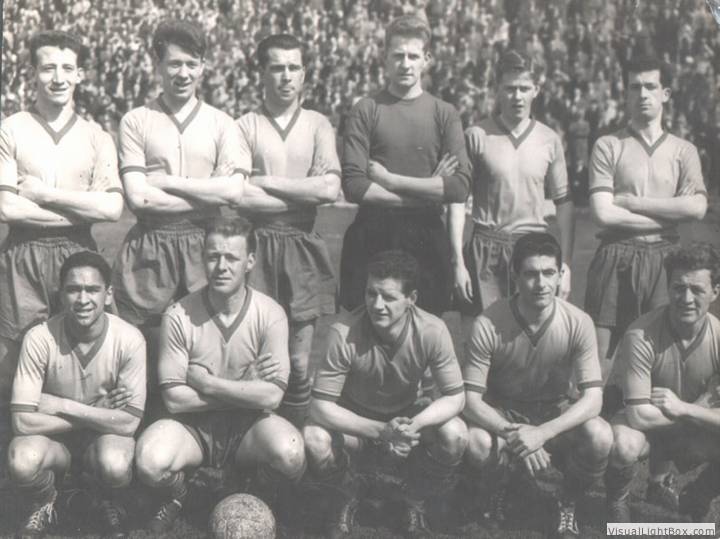
Drumcondra FC before the 1961 FAI Cup final. Ray Keogh is bottom left. (source http://drumcondrafc.com/)

While Drums lost out in that 1961 final, they qualified for the European Cup as League Champions for 1960-61, which was Ray’s first full season with the side. Ray would feature in the European Cup defeat at the hands of German champions FC Nurnberg in the first round, but would fare better the following year in the Inter-Cities Fairs Cup, when Drumcondra made football history by becoming the first Irish side to win a European game on aggregate, defeating Danish side Odense 6-5 over two legs, with Ray playing both games. They were drawn against Bayern Munich in the following round.  Ray didn’t feature in the heavy 6-0 defeat in Munich, however he did return to the starting line-up for the home leg and helped restore some pride as Drums beat Bayern 1-0.

He would also win representative honours representing the League of Ireland selection on a number of occasions. Inter-league games were usually against British and occasionally mainland European league sides, and were considered to be highly prestigious at the time. The fact that Ray, on several occasions, was judged to be among the best players in the league and worthy of selection is testament to his ability. He made his debut in 1961 against a Scottish XI in a 1-1 draw and would make several appearances for the league before a move to his next club, Ards based in the County Down town of Newtownards in Northern Ireland.

The Northern Irish league was traditionally dominated by the bigger Belfast sides like Linfield and Glentoran, though Ards had enjoyed a league title success in the 1957-58 season. Though signed by Johnny Neilson the manager for the majority of Ray’s stay north of the border was George Eastham Sr., a former Bolton Wanderers player and father to Arsenal and Newcastle star George Eastham Jr. The town of Newtownards was overwhelmingly Protestant and it must have been somewhat daunting for a black, Catholic Dubliner venturing over the border in 1964. Although the horrific violence of “the Troubles” was still a few years off it was still a time of tension in Northern Ireland. The IRA’s ill-fated border campaign, which led to the use of internment on both sides of the border had only ended two years previously, while the beginnings of the Civil Rights Movement would soon be heard in the city of Derry. Ray would spend two seasons with Ards with the team itself struggling at the lower end of the Irish League table as well as brief unhappy spell with Portadown.

His next move would take him to the other end of the island, moving almost 700km south to Cork, where he would spend a season lining out for Cork Hibernians before moving again after the arrival of former Irish international Amby Fogarty as player-manager. This move was to Drogheda F.C. During his time with Drogheda, Ray worked with some notable managers, first former Middlesboro player Arthur Fitzsimons who had previously coached the Libyan national team, and later, player-manager Mick Meagan; the tireless former Everton defender who combined these roles with his position as manager of Republic of Ireland national team. Meagan would bring in other experienced players such as Ronnie Whelan Sr. to add to the emerging young stars at the club such as Mick Fairclough. Despite the talent at the Lourdes Stadium, the best that Drogheda would achieve during Ray’s stay would be a 5th place league finish in 1967-68. They would make it to the Cup final of 1970-71, but by that stage Ray had moved on to pastures new.

By then on the wrong side of 30, Ray would drop out of senior football and move into coaching, first with Tullamore Town where as player-manager he would win the Intermediate Cup and the League of Ireland “B” division, and then on to Parkvilla F.C. based in Navan. Despite the drop down from senior football ranks, Ray, as both player and manager would still encounter players of real quality. In the FAI Cup they would come close to a giant-killing, forcing a replay against Shamrock Rovers. While Parkvilla’s title rivals Pegasus featured a young defender, one Kevin Moran, who would go on to make his name at Manchester United. Another rival side were Dalkey United who featured a young full back by the name of Paul McGrath. Dalkey is a well-healed south-Dublin coastal town that also happened to be home to one of the orphanages where Paul grew up. It is tempting to see Parkvilla versus Dalkey United, an unglamorous amateur tie probably watched by a couple of dozen spectators, as somehow significant: Ray, a trailblazer in his own way but now in his late 30s, encountering an 18 year Paul McGrath at a point before his career took off. Two black Dubliners who would help to change the perception of what the traditional, homogenous view of what it means to be Irish at a time when to be Irish seemed to be synonymous with words like white and Catholic, denying the pluralism (albeit stifled and hidden) that has always existed in Irish society.

So what sort of player was Ray and how was he treated by spectators of the day? From talking to those who watched him and who played alongside him, his main attributes were his passing ability and dribbling, fast without being lightning quick he was also excellent on set-pieces. Newspaper reports are full of descriptions of him humiliating fullbacks, constantly beating his man and delivering excellent crosses. While usually employed as an old-fashioned, chalk-on-your-boots right winger, Ray was versatile playing across all of the old front five positions, his awareness and passing ability assisting his role as an inside forward, reports referring to him as a “delightful ball player”. He also played centre forward with some success, no small feat for a man described as “diminutive” even by the standards of the day and he also played as a sweeper during his later years as a player-manager. The fact that he was black didn’t seem to cause much comment either, a few early reports noted the talents of the young “coloured” player and while at Longford he was referred to as “Nigerian forward Ray Keogh”. He did attract some bizarre and offensive nicknames such as “Darky” Keogh and the more esoteric “Blessed Martin” after Saint Martin de Porres, the 16th Century Peruvian monk who was the mixed-race son of a Spanish nobleman and a freed Panamanian slave.

RK pic2

Ray’s senior playing career coincided with the golden age of the League of Ireland, the 50’s and 60’s were an era of big crowds, bigger clubs often having gates of over 20,000 while cup finals could see over 40,000 in attendance. The League was also able to keep more of the better quality Irish players in the country. The maximum wage remained in place in England until 1961, and even after the limit was lifted it was still often more financially beneficial for a player to stay in Ireland than to go to England. Domestic players were truly local heroes, especially at clubs like Shamrock Rovers and Drumcondra, who enjoyed a great popular sporting rivalry through the 50s and 60s. Ray got to play in front of big crowds, win league titles, compete in cup finals, play in Europe against the likes of Bayern Munich, and represent his league in prestigious games. He was a local icon but because of the era he played in, the strange role that domestic football played in Irish society at the time, and the lack of surviving TV footage, Ray is mainly remembered these days by groups of ageing Drumcondra fans who hold on to memories of a club that disappeared from senior league football back in 1972.

When the Irish national team enjoyed its own golden age, reaching its peak at Italia 90, players like Chris Hughton and Paul McGrath were household names. The constant replaying of the penalty shoot-out against Romania, Kevin Sheedy’s equaliser against England and the pain of Bonner’s parry and Schillaci’s finish means that the players of that era are never likely to be forgotten. Nor will the way that Jack Charlton’s side helped that process of redefining Irishness. That men from Dublin, Cork and Donegal could line up alongside men from Glasgow, London and Manchester, be they black or white, Catholic or Protestant and still represent Ireland and the green jersey with pride had a profound effect on how we viewed our nation and diaspora. And in a small way we should remember the contribution of a man named Ray Keogh to that process.

Tullamore 1971

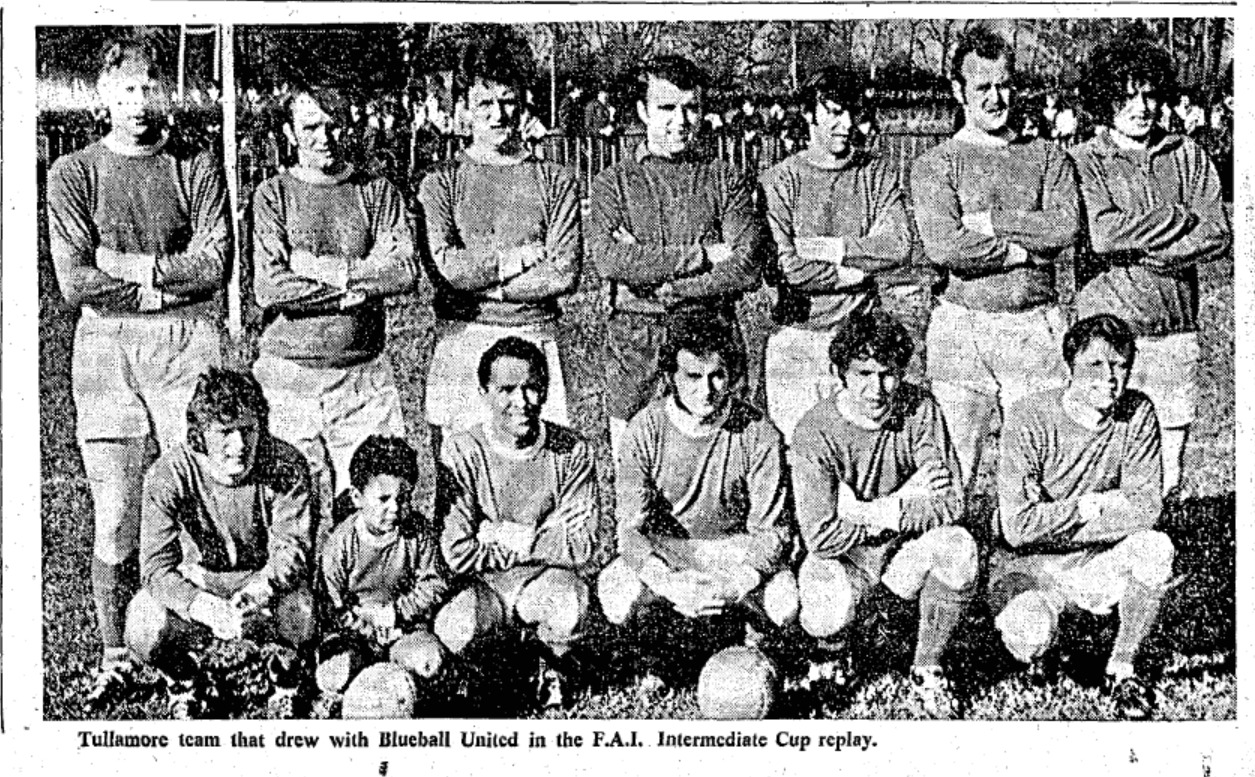
Tullamore FC in 1971 – the author’s father Leo Farrell (ball at his feet) is pictured to the right of Ray Keogh

This article was first published in edition 8 of The Football Pink magazine. They do good work so do check them out. If any readers out there have more information on Ray or his career please get in touch.

Jack Grealish and knowing your true self

Jack Reynolds’ second cap as an Irish International came in the spring of 1890 against England. It was the occasion of Reynolds only goal in the “St. Patrick’s blue” of Ireland, the Distillery winger grabbing what couldn’t even be called a consolation in a 9-1 drubbing at the Ulster Cricket Ground where the diminutive Everton striker Fred Geary grabbed a hat-trick for the three lions.

So far nothing too unusual, Ireland were the whipping boys of the early Home Nations Championship finishing bottom in six of the first seven competitions. What is unusual about Reynolds is that he would end up winning three Home Nation Championships. For England.

Jack Reynolds (born 1869) an Irish and English international

Jack Reynolds circa 1890

Reynolds had been born in Blackburn in 1869 but moved to Ireland at a young age and grew up in Country Antrim. He signed for Blackburn Rovers at the age of 15 before a spell in the Army saw him return on duty to Ireland where he ended up playing for both Distillery and Ulster F.C. during which time he won five caps for the Irish National team.

It was only upon his return to England with West Brom that Reynolds discovered he had actually been born in England. It was during his time in the midlands with West Brom and Aston Villa that he would win his eight caps for the England national team.

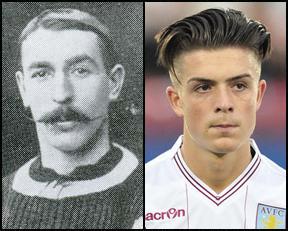
It is tempting to draw parallels between Reynolds and another Jack, young Jack Grealish. Both talented wingers, both Aston Villa players, in fact there may even have been a bit of overlap between Reynolds, whose Villa career ended in 1897 and Grealish’s great grandfather Billy Garraty who joined Villa that same year. But one thing that they won’t have in common it seems is lining out for both Ireland and England.

Grealish has stuck to his guns on his international future, stating earlier this year that he would make a decision come September, Martin O’Neill tried to force the issue by calling him into the squad for the upcoming friendly against England and qualifier against Scotland.

In theory Grealish could have played against England in the friendly and still switched his allegiance to them thereafter, but as things stand it appears that young Jack won’t reveal his hand until September at the earliest.

Much comment has been passed about the apparent rebuttal to O’Neill by Grealish. It prompted former football and rugby captains Kenny Cunningham and Brian O’Driscoll spoke on air about the issue, which was neatly summarised by Dan McDonnell in a recent Irish Independent article.

Rather than debate the pros and cons of a 19 year olds decision (there is plenty already written on the subject) what would perhaps be better to examine is why there is so much fuss about a player who a year ago was lining out on loan at Notts County in League One. A clue to all this hubbub can perhaps be seen in a closer examination of O’Neill’s current squad.

O’Neill has been criticised for not trying out enough new players and sticking with the same ageing group that he inherited from Giovanni Trapattoni. Some new players such as Cyrus Christie and David McGoldrick were blooded in the friendly against the USA, and the uncapped in the current squad include Harry Arter of Bournemouth, Alan Judge of Brentford and Adam Rooney of Aberdeen.

Arter, Judge and Rooney all have certain similarities, they are all in around the same age, 26, 25 and 27 respectively. All have represented Ireland at under age level at some stage. And all three have won their first call-up on the back of impressive seasons, not in the Premier League but in the Championship and in Rooney’s case the SPL.

All three have taken a circuitous route to the Irish International squad, loan moves, dropping down divisions, (including in Arter’s case a spell at non-league Woking) before settling into regular football at their current clubs.

They have all been selected on form rather than reputation; Judge’s trickery helping Brentford to the play-offs, Rooney has scored 27 goals in all competitions this season propelling Aberdeen to second in the SPL, while Arter has been one of the best midfielders in the Championship this year and will join the ranks of Irish internationals in the Premier League next season. This perhaps hints at a career trajectory not dissimilar to an established current international like Jonathan Walters.

Grealish pic

William Garraty & great-great grandson Jack Grealish, both of Aston Villa

It is players like this who are more emblematic of Ireland’s footballing future than Premier League starlet than Grealish.

It’s hard to think of the last time in recent years that an Irish teenager has broken through at Premier League level, the last time that a number of such players came through was the emergence of the likes of Damien Duff, Shay Given, John O’Shea, Richard Dunne and Robbie Keane at the turn of the millennium, most of whom had come through the successful Irish youth sides of Brian Kerr.

I’ve banged on about this before but we are not producing elite level players in any consistent manner.

This paucity of top level talent means that we have a tendency to latch onto talents like Grealish and heap the future of Irish football onto his narrow shoulders rather than looking at our technical deficiencies and the reasons that many of our more technically gifted players are being produced through the coaching and youth development systems of other national associations.

If Grealish makes his decision in September and indicates that he’ll line out for Ireland then our national team will be the stronger for it and any prevarication or seeming reluctance will surely be forgotten, much as it was with former internationals like Clinton Morrison or Jason McAteer.

If he chooses to represent England then rather than letting their ire pour out against a 19-year-old footballer on Twitter, Irish fans might look closer to home at our own coaching structures and player development paths rather than the decision of a young man to represent the nation of his birth.

At a recent Italia 90 nostalgia evening arranged as part of the One City One Book event to celebrate Roddy Doyle’s Barrytown trilogy in Lansdowne Road, the RTE panel of Dunphy, Giles and the late Bill O’Herlihy was reconvened with Paul McGrath and Charlie O’Leary also in attendance. Giles and Dunphy were still trenchant in their criticism of Jack Charlton, his style of football, his lack of professionalism and so on.

And despite the general light-hearted air of the event Dunphy pursued a darker thread of discussion, veering off on a tangent where he discussed the current state of the game.

He decried the death of the street footballer, what an Argentine fan might call a pibe, and stated that football was “dead in Ireland”, Scotland, England and so on, that the quality of player was not being produced by these nations anymore. He referenced the abundance of quality in the squads of the Charlton and Hand eras, how many of these players were regulars at top English clubs.

Dunphy only sees decline but seems to fail to appreciate that the English Premier League is now truly global, it is global in its reach, fans, media influence and the manner in which it sources its players in a way it never did in the past even when Britain was a centre of global empire. The favoured role of the Irish footballer in Britain with our shared language, cultural similarities, intertwined history and geographical proximity count for far less now.

The Premier League is a brutal, unforgiving meritocracy, it doesn’t care where you’re from (even though racism and xenophobia certainly still exist) it cares that you win. As the Premier League has casted its net wider in search of playing talent this has led to young Irish players facing far greater competition.

While we may not be producing Duffs and Keanes in abundance today maybe we haven’t gotten thatmuch worse? Certainly not to the point that football is “dying” as Dunphy maintains, perhaps it’s just that a league that many in Ireland view as our own has gotten more competitive and other nations, once viewed as minnows during Dunphy’s playing career have improved immeasurably. As others have caught up so our access to the elite levels has diminished.

In the past a successful or at least improving Irish side was able to secure the services from top flight clubs of “granny rule” players like John Aldridge, Ray Houghton and Andy Townsend, or though astute scouting recruit players like Mark Lawrenson long before he was a star for Liverpool.

Many of these players were recruited through personal connections, Aldridge and Houghton being recommended by Dave Langan while Preston North End legend Alan Kelly Sr. spotted a teenage Lawrenson and alerted the Irish manager at the time John Giles long before he would have come to the notice of an England manager.

While these recruitment methods still work today the football landscape of the 70s and 80s was not one where agents are as ubiquitous as now, where salaries weren’t as inflated or where people used social media to lambast players for every decision. Modern external pressures and opinions, as well as player empowerment and FIFA eligibility changes mean that things are less straightforward today.

The ancient Greeks had a saying, often quoted by Socrates, which simply said “know thyself”. One interpretation being that before seeking to gain greater knowledge or expertise or before commenting on the actions of others one should first know your own being and nature.

Before we lambast Jack Grealish for not rushing into a decision perhaps Irish fans should consider the Football Association, structure, facilities and challenges that influence the development of football in Ireland and look to why we have not produced another three or four players of Grealish’s profile to replenish our ageing squad.

Jack Grealish’s predecessor Jack Reynolds thought he knew himself, raised and educated in County Antrim where he also played his football, he lined out for Ireland and like a character from Greek tragedy did not realise his error until it was too late.

Let’s allow Jack Grealish the time to get to “know himself”, trying to define who and what you are and what you will represent indelibly is hard enough for any of us, never mind a 19-year-old caught in the public gaze.

First published in May 2015 for backpagefootball.com 

Ireland versus England – The quest for footballing approval

Relationships can be tricky at the best of times. Even when they’re over feelings can remain, passions linger, doubts about whether breaking up was the right decision can cloud one’s judgement.

The unhealthiest of relationships can provoke these reactions and much as we like to think we’ve moved on and we’re being the bigger person we still crave attention; a reaction from our former partner.

Much of recent Irish history, and almost all of our football history has lived out this type of conflict with our spurned partners England. Identifying ourselves as our own strong, confident, distinct individual nation while also being constantly obsessed with either getting one over on the English (Euro 88!) or craving their attention and approval to give validation to our actions.

The footballing split between North and South, between IFA and FAI, was in many ways related back to our messy divorce with the English. Tensions between the footballing centres of Belfast and Dublin had been running high for some time but it was the refusal of a Glenavon side to travel to Dublin for an Irish Cup match against Shelbourne in 1921 due to the civil unrest in the city caused by the War of Independence that proved to be the final straw that triggered the schism.

The split in the associations meant that the FAI were out in the footballing cold as the other UK based associations continued to recognise the IFA as the only legitimate association for the island and refused to play matches involving FAI teams or to release British based players for international matches.

The FAI also lost out on participation in the prestigious home nation championship and a crucial source of revenue. Despite competing the 1924 Olympics it would be 1927 before the FAI would manage to arrange an international match when they lined out against Italy.

While the FAI were understandably put out by these developments and felt that the British associations were acting unfairly they still desperately craved their attention and approval. Britain was after all the home of football and was viewed as the pre-eminent soccer power at the time.

When a South American touring side visited Dublin in 1933 there was much excitement among the Irish media, Uruguay had won gold at the 1928 Olympics as well as the inaugural World Cup but journalists wondered whether South Americans were “capable of challenging English and Scottish supremacy at the game”.

For the Irish football public at the time the British associations were the be all and end all, although they were loath to admit it. Two games highlight this preoccupation more than most, if we look at the two home internationals that bookended World War II, the game against Hungary in March 1939 and the first ever international match against England in September 1946.

The Hungarians had been runners up to Italy in the 1938 World Cup and had played against Ireland twice before in recent years, on both occasions the matches took place in Dalymount Park. However on this occasion the match took place in the Mardyke, the grounds of University College Cork and home to League of Ireland side Cork F.C.

This was the first FAI organised international since the split that had been held outside of Dublin. So why were the World Cup runners up being asked to play in a University sports ground rather than at the larger capacity Dalymount? Well because there was a bigger game taking place in Dalymount just two days earlier on St. Patrick’s Day 1939, when the League of Ireland representative side were taking on their Scottish counterparts.

Even a game against a Scottish League XI was viewed as a huge mark of acceptance for a football association that was yet to reach its 20th birthday. While the game in the Mardyke would attract 18,000 spectators, a respectable return, over 35,000 would pack into Dalymount Park to see the stars of the Scottish League.

Newspaper advertisement for the match against the Scottish League

Sean Ryan, writing in his history of the FAI, noted that as the match against the Scottish League was played at the larger venue and achieved double the attendance to be further evidence of the “massive inferiority complex which Irish soccer had towards Britain”.

He also remarked that commentators at the time were moved to describe the match against the Scottish League as “the most attractive and far reaching fixture that had been secured and staged by the South since they set out to fend for themselves” before adding “for 20 years various and futile efforts have been made to gain recognition and equal status with the big countries at home. Equality is admitted by the visit of the Scottish League.”

This notion of the “big countries” is crucial, by 1939 Ireland had already played against the likes of Italy (world cup winners in 1934 and 1938), Hungary, Germany, Poland and France but it was the visit of the Scottish League that was viewed as delivering some notion of football “equality”.

The Scottish FA wouldn’t accept the offer of a match against the Republic of Ireland until they were drawn together in a qualifying group for the 1962 World Cup so whether this game was actually a sign of acceptance by the Scots, or “equal status” is far from proven.

For the record a competitive Scottish League (valued at staggering £60,000 at the time) side lost 2-1 to their League of Ireland opposition, Johnstone of Sligo Rovers and Paddy Bradshaw of St. James Gate getting the goals. Five of those who played against the Scots on St. Patricks Day; Mick Hoy (Dundalk), Kevin O’Flanagan (Bohemians), Jimmy Dunne (Shamrock Rovers), Joe O’Reilly and goalscorer Bradshaw (both St. James Gate) left Dalymount and headed straight to Cork for the game against Hungary two days later.

Perhaps not the best preparation but slightly better organisation than that arranged for Raith Rovers Tim O’Keefe who missed the match as the ferry to Larne was delayed by two hours.

O’Keefe’s absence meant that there were no Cork men in the XI for the Hungary match which may go some way to explaining the less than electric atmosphere in the ground in what WP Murphy of the Irish Independent described as “one of the most apathetic crowds I have ever seen at an International”. Bradshaw was on the score sheet again along with Manchester United’s Johnny Carey as the Irish gained a 2-2 draw against the Hungarians.

The Scottish League visit and the unexpected victory provided a fillip for Ireland and perhaps suggested some level of acceptance from the home nations, however a full international match had yet to take place. World War II would disrupt football fixtures for the next six years and it was 1946 before an Irish national team took to the field again in a pair of away games,  against Portugal (a 3-1 defeat) and Spain (a surprise 1-0 win).

The first home game would be in September against England, the English FA sending a letter a month earlier saying that they would play a game in Dublin two days after their fixture against Northern Ireland in Belfast. It was not an occasion that Official Ireland could pass up.

At an earlier international game against Poland in 1938 Irish President Douglas Hyde had been expelled by the GAA because of his presence at an Association Football match, in contravention of the infamous rule 27. This had provoked significant criticism of the GAA at the time in both the press and from government benches.

However, the arrival of England was too big a deal for the political elite of Ireland to miss out on. The game was seen as a sort of fence mending exercise with the English after the “Economic war” of the 1930’s and the verbal sparring of De Valera and Churchill during the war years.

De Valera hosted a pre-match reception for the teams and officials, President Sean T. O’Kelly was there for the pre-match introductions and Tánaiste Sean Lemass (alleged to have been a member of Michael Collins’ infamous Squad) was present in the stands for the match.

The English officials were even presented with a replica of the Ardagh Chalice as a memento of their visit. Clearly the Irish wanted to make a big impression on their illustrious visitors and had put a great deal of thought and effort into the reception and hospitality for their guests.

This did not however extend to the team selection, Shamrock Rovers’ Paddy Coad had to cancel his honeymoon to play against England while West Brom centre-forward Davy Walsh pulled out late with injury meaning a late call-up for Mick O’Flanagan of Bohemians as his replacement.

O’Flanagan ran a pub in Marlborough Street in Dublin City Centre and received a phone call there on the morning of the game from Tommy Hutchinson the Bohemian rep on the Irish team selection committee. He was told to get his boots and get to Dalymount Park for the game that evening.

As O’Flanagan recalled:

I went home to Terenure for a bite to eat, had a short rest and then headed off to Dalymount. It was not really sufficient notice as only the previous evening I had brought a party of English journalists to Templeogue tennis club and I hadn’t got home until nearly two in the morning.

It was only when his brother Kevin, then of Arsenal arrived to the stadium straight from the boat that he realised that he would be playing alongside his younger brother against England.

Despite this usual shambolic preparation the Irish team more than put it up to their English opponents. The English had easily defeated Northern Ireland by seven goals to two only two days earlier but were up against more formidable opposition in Dublin.

With eight minutes to go it was still nil all but a young Tom Finney, making only his second appearance for England managed to beat Tommy Breen in the Irish goal. Ireland had pushed their illustrious guests all the way, Everton’s Alex Stephenson had rattled the English crossbar while Kevin O’Flanagan had been agonisingly close with a header.

The Irish had also had to play much of the game with effectively ten men after Huddersfield Town’s Bill Hayes was injured early on and, in the days before substitutions was shunted out to the wing, forcing Johnny Carey into the centre half position.

The Irish Times’ PD MacWeeney was moved to describe the match as “the most exciting International football match ever played at Dalymount Park” while his English equivalents were no less effusive in their descriptions, Henry Rose in the Daily Express was moved to write “If ever a team deserved to win Eire did. They out-played, out-fought, out-tackled, out-starred generally the cream of English talent, reduced the brilliant English team of Saturday to an ordinary looking side that never got on top of the job”.

Though the game could be seen as another in a long line of famous Irish “moral victories” or “glorious failures”, it certainly had the desired effect for the FAI as the game was both a huge commercial success and also gained the craved for recognition from the English.

While Scotland, Wales and Northern Ireland would avoid matches against the Irish further games against the English were more forthcoming. Within three years the Irish had even beaten the English on home soil when they emerged as 2-0 winners in Goodison Park.

And next week we get to live it all over again. While we’d like to think that we are not as needy and requiring of validation from England as we were in 1946 the game on Sunday has still captured the public imagination more than any other friendly.

Some commentators, like The Guardian’s Barney Ronay have gone so far as to call the game “pointless and a mistake” , and there are concerns about a recurrence of the ever-popular “Fuck the IRA” chants from sections of the English travelling support while almost 2000 “supporters” will be barred from travelling to Dublin for the game for fear of a repeat of the violent scenes of 1995.

HOOLIGANS_3332587b

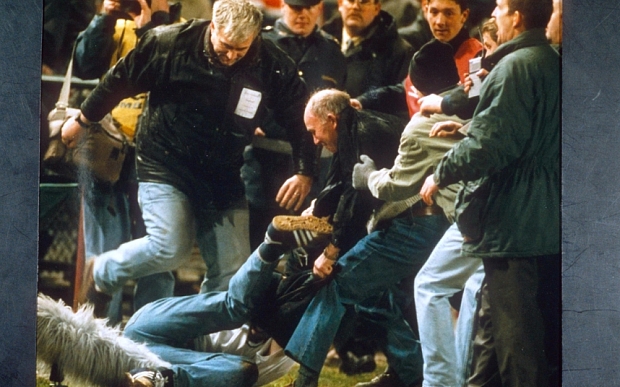
English hooligans in the Lansdowne Road riot of 1995

Aside from that there is also the slightly thorny issue of Jack Grealish’s international allegiances as a sidebar to the game. But still we look to this game against the English and see a guaranteed full house for an international friendly, not something that can always be counted on.

The English FA for their part, perhaps cognisant of the events of ’95 made sure to include a friendly against Ireland in Wembley as part of their 150th anniversary celebrations, along with friendlies against original international opponents Scotland and prestige matches against the likes of Germany and Brazil. Were we secretly pleased that they invited us to the party and have chosen to return the favour by coming to Dublin?

It’s 20 years since the debacle in Lansdowne Road and 30 years since Ireland have lost to England, whether that has lessened any Irish inferiority complex will be seen on Sunday.

Originally posted on backpagefootball.com June 2015

Ireland, Aimar and the promise of the 1997 World youth championship

A little over two weeks ago Pablo Aimar retired, a decision that attracted little comment in this part of the world. The former Valencia, Benfica and Argentina star had been trying to regain fitness at Buenos Aires giants River Plate, the club where he first made his name, but had been hampered by ongoing injury problems and had only made a single substitute appearance for Los Millonarios.

In his first spell there Diego Maradona was moved to declare that “Pablo is the only current footballer I’d pay to watch” and described Aimar as the “best player in Argentina over the last couple of years and is even more talented than Riquelme or Saviola”.

Screen Shot 2015-07-30 at 00.03.21

Only slightly taller than El Diego and blessed with a similar array of skills, it wasn’t long before Aimar was given the dreaded “next Maradona” tag ahead of his move to Spain with Valencia. With his slight frame, graceful balletic touch and outrageous trickery, it’s easy to see why a current Argentine star like Lionel Messi had idolised Aimar as a youngster, and claimed that he was one of the players he looked up to.

Aimar falls into the category of great Argentine players who have come to retirement having never won a senior international trophy, a gifted generation that saw the overlapping talents of Juan Sebastian Veron, Hernan Crespo, Juan Roman Riquelme, and many others who have left the game without a World Cup or Copa America to their names.

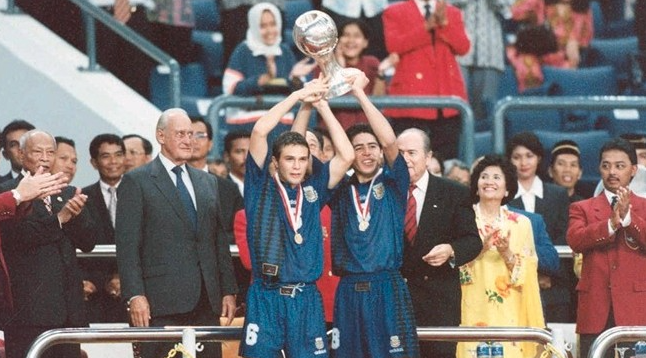
But 18 years ago it looked like things would be much different, because in Malaysia in the summer of 1997, Argentina had just won the FIFA World Youth Championships, a tournament I had watched with rapt attention, not just because of the talents of Pablo Aimar, but because the team they beat in the semi-finals, en route to ultimate victory, was Ireland.

1997 was a strange time to be an Irish football fan. As a teenage supporter I had grown up in an era of success and expectation based on the successful qualifying campaigns for Euro ’88 and the World Cups of 1990 and ’94. However the qualifiers for Euro 1996 had changed a great deal of that expectation into a climate of trepidation, and although results had been initially encouraging, things quickly went downhill with Ireland managing only a 0-0 draw away to Liechtenstein and then losing 3-1 to Austria in Dublin.

This meant that Ireland needed a playoff victory against a youthful Dutch side, full of Ajax players who had just won the Champions League, to progress to England. A two-nil defeat courtesy of a pair of Patrick Kluivert goals ensured the end of the Jack Charlton era, and for the first time in a decade, the Irish national team had to face into a period of uncertainty with their talismanic manager gone and a core group of players edging towards retirement.

But fast forward a year later and what appeared upon the horizon only Brian Kerr and Noel O’Reilly leading their bunch of impressive young players to Malaysia and the FIFA World Youth Championships. There was at least a hint of promise that the generation of McGrath, Moran, Houghton and Aldridge could and would be replaced by young players of quality.

The team that went to Malaysia could have been even stronger but for the fact that the new senior team manager Mick McCarthy chose to stop Ian Harte and David Connolly from travelling. Both players had made their senior debuts the year before and McCarthy wanted them to rest and focus on establishing themselves at their clubs ahead of the new season.

Similarly Everton’s young defender Richard Dunne was unavailable due to injury. The difference between 1997 and the footballing landscape today is noticeable; Connolly was about to move to Dutch giants Feyenoord, while Dunne and Harte were establishing themselves as teenagers in Premier League sides.

The Irish were in a tough group with Ghana, China and the USA with no match being decided by more than a single goal. Things didn’t get off to a great start with Ireland going down 2-1 to Ghana in the opening game although Trevor Molloy, then of Athlone Town got his first goal of the tournament. A 2-1 over the United States and a 1-1 draw with China followed, with Micky Cummins then of Middlesboro getting on the scoresheet in both games, enough to secure the second qualifying spot in the group.

Screen Shot 2015-07-30 at 00.02.37

Next up was the round of 16 match against Morocco who had also finished second in their group behind eventual finalists Uruguay. Ireland opened the scoring with a goal from Neale Fenn before Morocco equalised through a Niall Inman own goal. The game went to extra time before being eventually decided by a 97th minute Damien Duff strike to set up a quarter final meeting with Spain.

The Spanish have tended to be the European masters at the various underage level and their under 20 side contained the likes of David Albelda and Gerard Lopez, and while the Irish rode their luck in the game, they ultimately emerged victorious, that man Molloy on the scoresheet again scoring with a second half penalty, his third goal of the tournament.

This side had now progressed further than any other Irish side ever had in a tournament, to the semi-finals against Argentina. Prior to the Spanish game Kerr had rallied his young charges with that very thought:

Just think, you guys may never again get the chance to play against Argentina, even if you all go on to become senior internationals. The senior World Cup comes around only every four years so think of how many opportunities you will have to meet Argentina during your career.

Kerr’s rousing words had the desired effect against Spain and Ireland would now face a side containing the likes of Walter Samuel, Juan Roman Riquelme, Esteban Cambiasso, Diego Plancente and Pablo Aimar. The Argentines had already dispatched an English side containing the likes of Danny Murphy, Michael Owen, Jamie Carragher and Kieron Dyer, with goals from Riquelme and Aimar sending Ted Powell’s side home and next knocked out the free-scoring Brazilians who themselves had smashed ten past a hapless Belgian side in the round of 16.

In what was a tight game, a somewhat nervous and fatigued Irish side succumbed to a Bernardo Romeo strike early in the second half. Six games in 15 days in the heat and humidity of Malaysia had taken its toll, and while there was a late Irish rally and a missed chance by Glen Crowe in the closing minutes the Argentines were the deserved winners.

They would defeat Uruguay 2-1 in the final three days later, while Ireland, the last European side left in the tournament, would take the bronze medal, with goals from Dessie Baker and Damien Duff securing a 2-1 win over Ghana and revenge for their opening day defeat.

Watching this all unfold in an apartment in Gran Canaria I was convinced I was watching the future of Irish football in action, I indulged in those misguided games of what-iffery that occasionally fill newspaper column inches, trying to picture an Irish Senior XI in 5 years’ time. This is the type of thing that comes back to haunt you when you predict that Neil Mellor will help England’s win Euro 2008. But it seemed inconceivable at the time that players from that squad wouldn’t make the next step.

Screen Shot 2015-07-30 at 00.07.00

Damien Duff, the youngest player in the squad was a bona fide star and already looked the finished article, he even drew favourable comparisons from various media outlets with a certain Liam Brady. I was convinced that Derek O’Connor would provide competition for the No. 1 jersey with a youthful Shay Given, that Robbie Ryan could surely be the next Denis Irwin, Colin Hawkins would provide competition and physicality at centre half while the composed captain; Thomas Morgan would help protect the back four alongside Roy Keane in the senior team. And surely the top scorer, Trevor Molloy, released by Shamrock Rovers only six months earlier, was only weeks away from a move cross channel?

Of course things don’t work like that. Liam Tuohy’s side that got to the 1985 Youth Championships didn’t contain a single player who would win a senior cap and Kerr’s squad didn’t fare much better. Although Duff would win a century of caps for Ireland, the only other team member who would be capped at senior level was Glen Crowe, winning two caps during his first spell with Bohemians. The one other player to win a senior cap for Ireland from that tournament was Jon Macken, then part of the England squad, who would switch his allegiance to Ireland and won a single cap in 2004.

Perhaps these under-age tournaments are always disappointments when viewed retrospectively. Pablo Aimar, voted as one of the players of the tournament and dubbed as one of many new Maradona’s, has been viewed, for all his skill, flair and finesse as an example of unfulfilled potential. Despite two La Liga titles, a Portuguese League title and a UEFA Cup win, there is a sense that he could have achieved more.

While Duff won a hundred caps for Ireland, played at a World Cup and a European Championship and won two Premier League titles with Chelsea, could or should some of his team mates achieved similar success? Players like Fenn, Crowe, Morgan, Hawkins, Dessie Baker and Trevor Molloy had successful careers in the League of Ireland, Robbie Ryan and David Worrell had solid careers in England, but others, such as goalkeeper Derek O’Connor had drifted out of league football within a year.

Part of the joy of such tournaments is the glimpse they give of a potential that has yet to be fulfilled, the glimpse of infinite footballing possibilities, the moment watching the emergence of a small, slightly-built Argentine playmaker and knowing he may never be Maradona but suspecting that maybe, just maybe, he could be. It’s the joy of seeing an 18-year-old Damien Duff playing uninhibited street football and skinning full backs with chalk on his boots.

Just think of Burt Lancaster’s Moonlight Graham or Kevin Costner as Crash Davis in Bull Durham, minor league players who fleetingly tasted ‘success’ even if that success lasted just a single inning in the Majors. For all my naivety as a 15-year-old watching a group of young men, three and four years my senior,  there was that hope that they could populate our next great international side.

To finish on another film reference, I’m brought to mind of what Joey ‘the Lips’ Fagan says at the end of The Commitments when imagining a different future for the band, one of success and record contracts – “Where’s the romance in that?”.

Originally posted on backpagefooball.com in July 2015

A Springbok ran in Solitude – South Africa’s international debut

South Africa were there from the beginning of organised football in Africa, the game arrived from Britain in the late 19th Century and the national association first affiliated to FIFA in 1910.

As an early African member of FIFA in the 1950’s they agitated for greater representation for African football and in 1957, along with Egypt, Ethiopia and Sudan they were founders of CAF (Confederation of African Football) and were almost among the original participants in the African Cup of Nations, however it was at this point that the thorny issue of Apartheid intruded on proceedings.

As the Sudanese delegate Abdim Halim Mohammed recalled at the time, the South African delegate was:

A chap called Fred Fell, not an Afrikaner but British. We accepted him and accepted South Africa. He accepted we would host the first African Cup of Nations in Khartoum…Then we came to that “area”. He said the government had told him it is either a pure white team or a black team. We said we don’t accept that. We want black and white.

South Africa were understandably disqualified as a result of their intransigence on the issue of a mixed national team and it would be almost forty years before a South African side would compete in the Cup of Nations.

When they did enter the competitions it was as hosts in 1996, Nelson Mandela was President, and a multicultural South African team would emerge as Champions with Mark Williams grabbing both goals in the final against Tunisia.South Africa 1996

Since the 90s post-apartheid South Africa has competed in, and hosted a further Cup of Nations as well as the 2010 World Cup. However their long, controversial and turbulent international history began not in Cape Town or Johannesburg, or even on the continent of Africa, but on a trip to Ireland and in the cities of Dublin and Belfast.

Back in 1899 a football team from the Orange Free State had toured England, notable for the fact that it was an all-black team, while in 1906 a white side had toured South America and played in both Brazil and Argentina, however the Union of South Africa was only formally established in 1910 bringing together four previously separate British colonies.

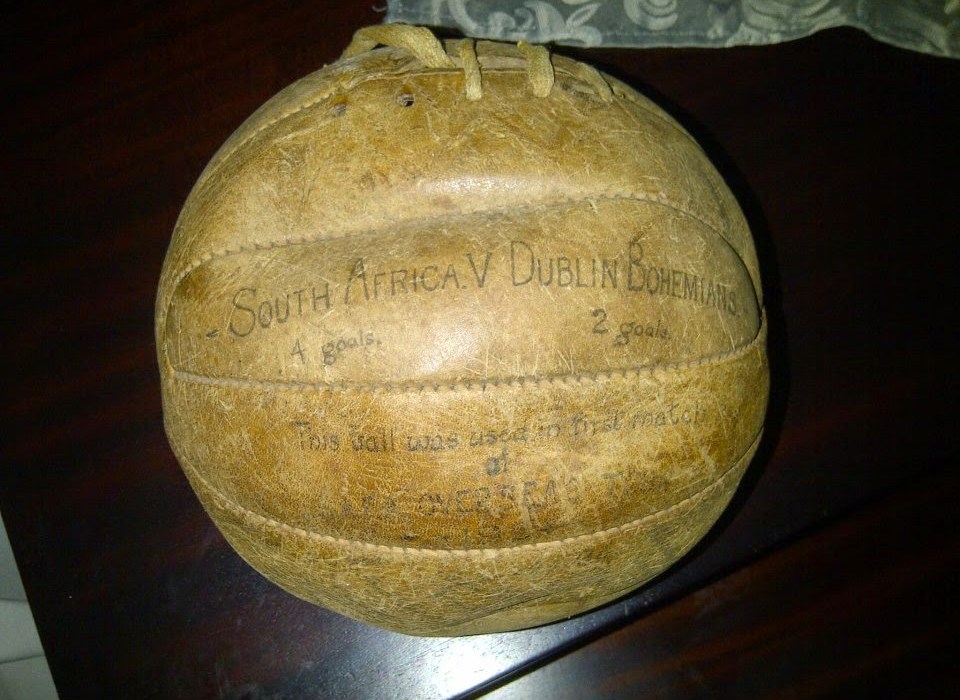
The new football team of this new nation would join FIFA but wouldn’t play a formal international until September 1924 when “The Springboks” came to Europe. Their first port of call for the all-white touring side was Dublin, and their first opponents Bohemian F.C.

By that stage the South African government had already brought in one of first pieces of Apartheid legislation, the 1913 Natives Land Act which limited the ownership of land in South Africa by the majority black population to just 8% of the total area of the country.

While the majority of apartheid legislation was introduced in the late 40s be Prime-minister DF Malan the preceding decades had seen the steady erosion of the rights of the black South African population. Despite these rulings the sporting relations between Britain (and Ireland) with South Africa were flourishing in 1924.

Not only was the football team visiting but in rugby, the British and Irish Lions were on tour in South Africa, while the South African Cricket team was just completing a summer tour of England.

The visiting football team would play three games in Ireland, the first on 30th August versus Bohemians before travelling north of the recently created border to take on the Irish National Team (the IFA selection which from this point on will be referred to as Northern Ireland) in Belfast and a North-West XI playing in Derry in September.

The split between the Belfast based IFA and the recently formed FAI of the Free State was still a sensitive issue, with both associations claiming exclusive use of the name “Ireland” while each association continued to select players from the whole of the island. As just one example of the complexity of this cross-border situation the Free State FAI Cup holders at the time of South Africa’s arrival were the Belfast based Alton United.

There were now two leagues and two national teams on the island of Ireland and although the FAI had sent a side to compete in the 1924 Olympics that summer the fledgling association had yet to play a FIFA recognised match. It was under these circumstances that South Africa; an amateur side at the time would take on not the Free State XI but the reigning League of Ireland champions (and fellow amateurs) Bohemians.

They would meet in Dalymount Park and the touring side would get off to a great start in front of a large Dublin crowd with the South Africans eventually running out 4-2 winners. Bohs were without the influential Bertie Kerr who was injured but did have players of quality such as Paddy O’Kane, Dave Roberts and Jack McCarthy in their side who would all go on to win full caps for Ireland. Incidentally Bohemians were captained by Billy Otto, who had been born in South Africa.

The South African goals would come from Eric Stuart of Western Province, Jim Green of Transvaal and a brace from a 20-year old-striker named Gordon Hodgson.

Hodgson, the son of English emigrants, had worked as a boiler maker in his native South Africa while also lining out for the Transvaal side. Like many of the touring South African side he was physically imposing, standing at six foot one and weighing over 13 stone.

Early reports of the South African tour suggest that their forwards were somewhat rough diamonds in terms of finishing, their good attacking play being undone by some poor marksmanship, Hodgson, however, would certainly prove to be a formidable goal-scorer.

The South African side would spend three months touring Ireland, England and the Netherlands and their teams’ performances, including wins over Chelsea, Aston Villa, Liverpool and Everton would generate significant interest in a number of the Springbok players and several would pursue professional careers in England.

Gordon Hodgson would join Liverpool and make the biggest impression, along with him goalkeeper Arthur Riley and Glasgow-born fullback Jimmy Gray would all join the Reds in 1925. Gray would make a single appearance before joining Exeter City where he played until 1936, while Riley would have to bide his time at Anfield as he would have to replace the legendary Elisha Scott in goal.

Scott was (and remains) Liverpool’s longest serving player and an Anfield hero and was also first choice keeper for Northern Ireland. It would be the 1928-29 season before Riley got any sort of extended run in the Liverpool team though he would eventually amass over 300 appearances for the club.

Hodgson would become a record breaker on the red half of Merseyside, becoming Liverpool’s record goal scorer, a title he would hold for three decades before the arrival of Roger Hunt in the 1960s. Initial interest in Hodgson was piqued when he scored a hat-trick in front of the Kop for South Africa against Liverpool during their tour, something guaranteed to catch the club’s attention.

He would score 233 league goals for Liverpool (including a still standing club record 17 hat-tricks) during his 11 years at Anfield, before, at the age of 32 he was signed by Aston Villa for £3,000. His spell at Villa would be short and he would move to Leeds United for £1,500 in 1937, eventually scoring an impressive 53 goals in 85 appearances for the Yorkshire club.

Gordon Hodgson of Liverpool, South Africa and later England

Gordon Hodgson of Liverpool, South Africa and later England

Hodgson still sits fourth on the all-time top flight scoring chart in English football, by his retirement he had 288 league goals, five above Alan Shearer, and only behind Jimmy Greaves, Steve Bloomer and his contemporary, and city rival Dixie Dean.

It is perhaps because of Dean that Hodgson is not more well know. Liverpool have had their fair share of prolific forwards but what separates Hodgson from the likes of Hunt, Keegan, Dalglish and Rush is that those later era strikers were all trophy winners.

Hodgson played for Liverpool during a trophy-less period, made all the worse by the fact that Everton would win two league titles and an FA Cup during Hodgson’s time there, with Dean being recognised as the greatest centre forward in the world and one of sports’ biggest names.

Despite the obvious scoring prowess of Hodgson he failed to find the net in his next game in Ireland after his brace against Bohemians. In fact contemporary reports mentioned his poor finishing in the game against Northern Ireland; the game that would go down in South African football history as their first international.

The match would take place in Solitude, the home ground of Belfast club Cliftonville in front of a crowd of 6,000, generating the princely sum of £254 in gate receipts on the 24th of September 1924. The South Africans had made some changes to their starting line-up since the match at Dalymount, in came Williams, Touhy, Jacobi and Murray. Out went Howell, Hicking, West and Walker. They had played four games in the London area in the intervening three weeks, their most recent match a 4-2 win over Second Division Chelsea with Hodgson grabbing two.

The Northern Irish didn’t field their strongest side for the game. There was no Elisha Scott to face his Liverpool successor, nor was their star forward, Sheffield United’s Billy Gillespie in their line-up. In fact as a cost saving measure the IFA chose to select only players from the Irish League to save on travelling costs.

This all-domestic XI did cause some confusion as to the status of the game both at the time and subsequently. Some reports, including the Irish Times, referred to the Irish side as an Irish League XI rather than a full national team and for many years the IFA did not list the match as a full international, recognising it only as an amateur match.

The South Africans would also play both the English and Welsh amateur sides on their trip but these would not count as full internationals.

However the game against Northern Ireland has been recognised as a full international since 2001. While the Irish side were all home based there were paid professionals among their ranks including Thomas “Tucker” Croft who had scored the winner against England only a year earlier.

They wore the St. Patrick’s blue jersey of the full International side rather than the green jerseys associated with the Irish amateur side and the match was advertised at the time as a full international by the IFA.

The Irish side took the lead early through Frank Rushe who got on the end of a free kick after ten minutes. Rushe was born in Bessbrook in County Armagh. At the time of the South Africa match, his only senior cap, he was playing for Distillery in the Irish League but had spent the previous season with Dublin side Shelbourne who had finished runners-up to Bohemians in the Free State league.

The South Africans would strike back though, just before half time David James Murray getting them back on level terms before Jim Green, who had also scored in Dalymount, grabbed the winner 15 minutes from time.

Irish football correspondents noted the improvement in play from the South Africans since the match in Dublin and the physical disparity between the well-built Springboks and the less robust Irishmen was commented upon by a number of columnists.

It was also noted that the margin of victory could have been greater for the South Africans if it had not been for their wasteful finishing, with particular mention for young Hodgson who seemed to be having a rare off day.

The South Africans would spend the next three months touring Britain and the Netherlands, including another full international, a 2-1 defeat to the Dutch national team in Amsterdam, though these would be the last games played for the national team by men like Hodgson and Riley.

As mentioned, Hodgson would even line-out three times for his new homeland, England. While he and Riley would have successful careers in England, making almost 800 league appearances between them.

It would be almost thirty years before a black South African would play professionally in Europe when Steve Mokone signed for Coventry in 1955 before playing in Holland, Italy and Spain. Two years after Mokone’s move to Coventry his fellow countryman David Julius would sign for Sporting Lisbon.

Due to the racist policies of apartheid South Africa and the various bans, suspensions and boycotts that resulted, neither man would ever play for the land of their birth, Julius would end up donning the red of Portugal rather than the green and gold of South Africa.

While Hodgson scored for England against Wales during the second of his three caps he at least had the opportunity to play for South Africa against Northern Ireland and the Netherlands. In many ways the tour of 1924 was a false dawn in international footballing terms for South Africa.

The ruling government’s refusal to allow mixed teams meant their expulsion from CAF, FIFA, the Cup of Nations and the World Cup. It was only in the mid-90s that the football isolation of the nation would properly end.

While the record books show that South Africa made its international debut in Belfast in 1924 perhaps that game should have an asterisk against it, and not because the IFA selection they faced included only domestic based players.

Despite the quality of players like Gordon Hodgson and Arthur Riley a truly representative South African XI wouldn’t make its international bow until the Bafana Bafana defeated Cameroon in Durban 68 years later.

Originally posted on backpagefootball.com