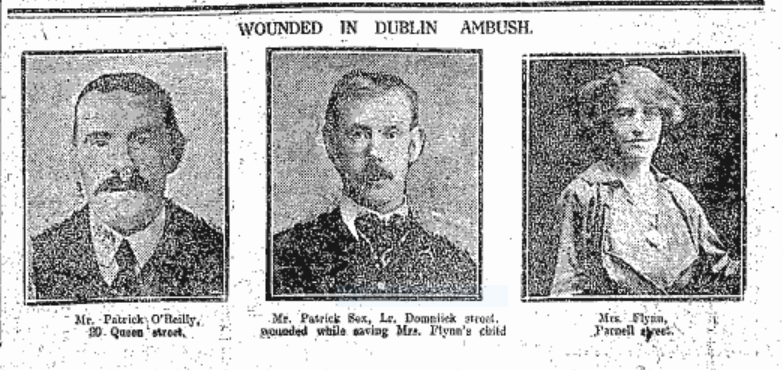
Patrick Sex from the Freemans Journal 1921

The Death of Sex

It started in somewhat unusual fashion, a Whatsapp chat with some fellow historians, a screenshot from the Irish Newspaper archive with the unusual headline “Replay for Sex Memorial Gold Medals”, which of course provoked a bit of schoolboy humour but also planted a seed of curiosity. From the short clipping I could see that it was a replayed football match between Bohemians and a Leinster football XI, the Bohemian teamsheet was shown and I could tell that this was a game from the early 1920s with several high profile players featuring, including future internationals like Joe Grace, Jack McCarthy, John Thomas and Johnny Murray as well as South African centre-half Billy Otto.

But who or what was “Sex” referring to? Memorial games or charity matches for sets of gold medals were not uncommon in the era but I could find nobody with the surname Sex as having been associated with Bohemian FC in their first thirty or so years, and as the opposition were a selection of other Leinster based players then there was no specific opponent club who might have been arranging a memorial. A quick look at the 1911 Census suggested a possible answer, as it displayed 22 people with the surname “Sex” living in Dublin.

Having ascertained that there indeed may be a “Sex” living in Dublin, deserving of a memorial game, but unsure of any footballing connections I started searching the Irish newspaper archives for the early 1920s and quickly discovered a likely candidate for the “Sex Memorial Gold medal match”, namely Patrick Sex of Dominick Street in Dublin’s north inner city with the memorial match and replay taking place for him in May 1921.

Patrick Sex was born in Dublin in 1880 and by the time of his marriage to Mary Kenna – a dressmaker living in Mary’s Abbey off Capel Street – in September 1901, he was living in Coles Lane, a busy market street off Henry Street and working as a butcher. Coles Lane, which now leads into the Ilac Centre but once ran all the way to Parnell Street, was full of stalls and shops selling everything from clothing to meat, fish and vegetables and formed part of a warren of streets and lanes feeding off the busy shopping areas of Henry Street and Moore Street. The area was a booming spot for a butcher to find work, it is likely that Patrick was raised and apprenticed in the trade as “butcher” is listed as his father James’s trade on Patrick’s marriage certificate.

Patrick and Mary, welcomed a son, James in August 1902 and they moved around the same small footprint of this section of north inner city Dublin in the coming years, with addresses on Jervis Street, Great Britain Street (now Parnell Street) and Dominick Street. It is on Dominick Street where we found the Sex family living in the 1911 Census, by which point they have five children, with one-year-old Esther being the youngest and Patrick was still working in the same trade, being listed as a Butcher’s Porter.

Moving forward ten years to 1921, the year of Patrick’s violent and untimely death, and the family had a total of ten children and were still living at 72 Dominick Street. Patrick was still working in the butchery trade in McInnally’s butchers at 63 Parnell Street, close to the junction with Moore Lane, roughly where the Leonardo (formerly Jury’s) hotel is today and would have been close to Devlin’s Pub, owned by Liam Devlin and a popular meeting spot for the IRA during the War of Independence.

Parnell Street as it appears on the Goad Insurance maps from 1895

By this stage in his life, as well as his place of work and large family we know that Patrick was active in the trade union movement, being Chairman of the No. 3 branch of the Irish Transport and General Workers’ Union (ITGWU), this branch featured many from the butchers’ trade and was known as the Victuallers’ Union. Living and working where he did, no doubt Patrick would have clear memories of the Lock-out in 1913 and the infamous baton charge by the Dublin Metropolitan Police on Sackville Street in August of that year when two workers were mortally wounded.
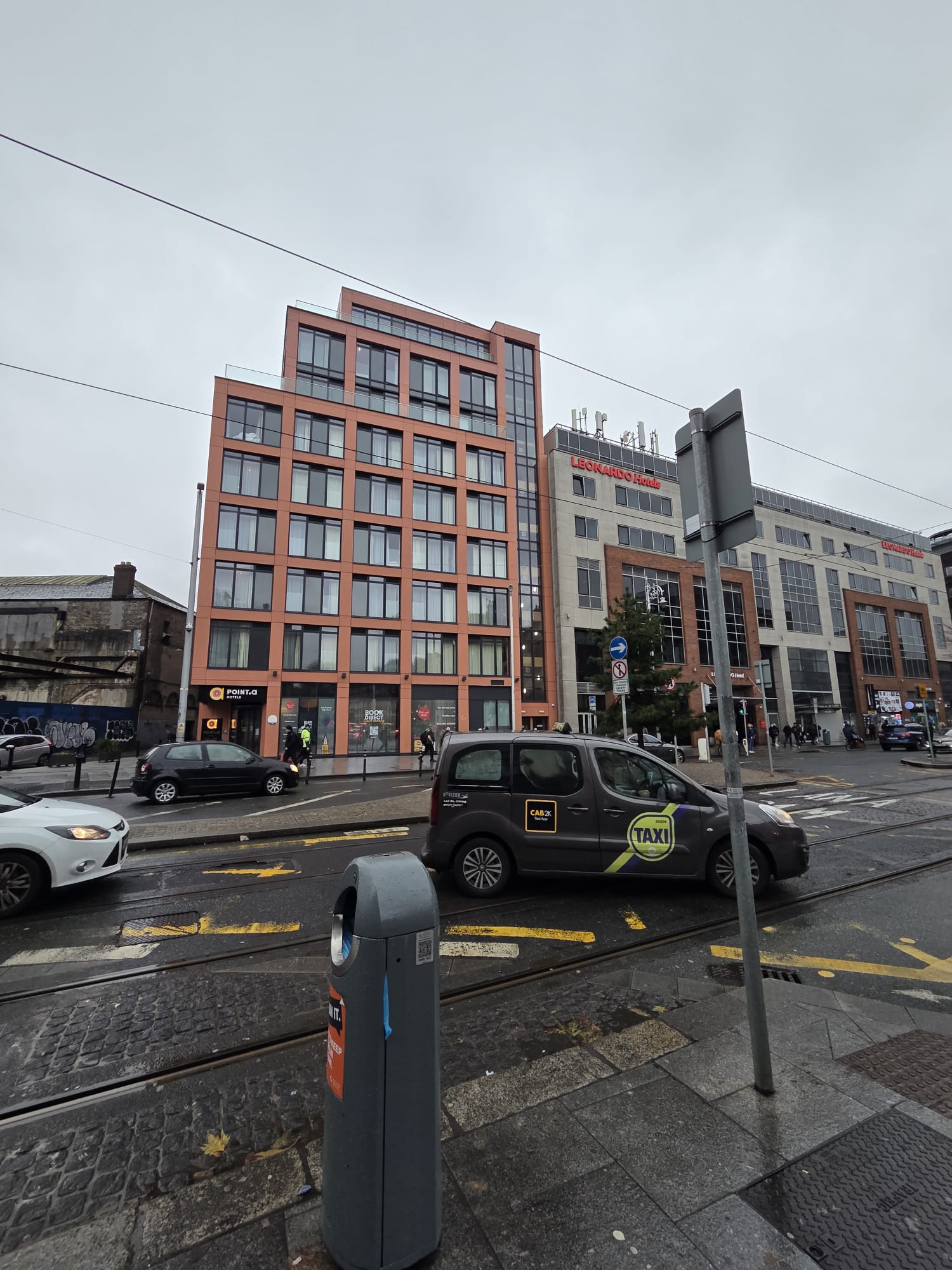
Parnell Street 2025
Parnell Street as it appears today – the Point A hotel is built on the site of the former Devlin’s Pub, McInnally’s butcher shop would have been within the footprint of the current Leonardo Hotel and Moore Street Mall

On March 26th 1921, Patrick Sex was, as usual, working at McInnally’s butcher’s shop on Parnell Street, it was owned by Hugh McInnally, originally from Scotland he had set up a number of butcher’s shops in Dublin and by the 1920s was entering his 70s and living in some comfort near Howth. The city and country more broadly were far less comfortable – more than two years into the violent period of the War of Independence, Dublin had seen the city placed under curfew in February 1920, there had been wide scale arrests, November 1920 had seen Bloody Sunday when fourteen people were killed in Croke Park by Crown Forces in reprisal for the wave of assassinations earlier that morning by the “Squad” and the Active Service Unit of the IRA. Croke Park was just a few minutes walk from Patrick’s home and place of work, he likely knew many who had attended the match, or perhaps some of those arrested in the wide scale arrests across the city by Crown Forces that followed. As mentioned, McInnally’s butcher’s was just doors away from an IRA safe house and meeting place in Devlin’s Pub, while Vaughan’s Hotel was just around the corner on Parnell Square.

This was the backdrop against which Patrick Sex and his family lived and worked in Dublin. On that fateful day of the 26th just before 3pm a lorry, carrying Crown Forces were attacked by members of “B” company of the 1st Dublin Brigade of the IRA as they journeyed up Parnell Street. The brigade report, taken from the Richard Mulcahy papers reads as follows;

“8 men… attacked a lorry containing 16 enemy at Parnell Street and Moore Street. 3 grenades exploded in lorry followed by revolver fire. Enemy casualties believed to be heavy. The lorry drove into O’Connell Street and was again attacked by a further squad of this coy. [company] numbering 18 men. They attacked another lorry at Findlater Place but were counter-attacked by lorry coming from the direction of Nelson’s Pillar. 3 of our grenades failed to explode so we retired. One of our men was slightly wounded”.

The Freeman’s Journal, reporting on the attacks a couple of days later goes into more detail on the impact of the grenade and gun attacks as they affected the public caught in the melee;

“the first bomb was thrown and exploded with a great crash in the channel opposite MacInally’s (sic) victualling establishment, 63 Parnell Street. The explosion was followed by a wild stampede of pedestrians.”

They continued: “The glass and woodwork of the houses from 63 to 66 Parnell Street were damaged by the flying fragments of the bombs. Mr. Patrick Sex, an assistant in the victualling establishment of Mr. MacInally was wounded in the hip and leg… and others in the shop had narrow escapes from the contents of the bomb, which in the words of Mr. O’Doherty ‘came through the shop like a shower of hail’.”

John O’Doherty the butcher in McInnally’s, mentioned above, would later given a statement to a subsequent court of inquiry at Jervis Street Hospital, stating that he heard “two explosions and three or four shots”, before adding that “several fragments of the bombs came into the shop, and Patrick Sex who was attending a customer at the time said ‘I am struck’ , I saw that he had a wound in his left thigh and hurried him off to hospital.”

Another of those to give testimony at the court of inquiry (inquests into deaths had been suspended during the War of Independence) was Charles Smith of the RAF, he was in one of the Crossley Tender lorries, with two other RAF men in the driver’s cab as it made its way up Parnell Street, when he recalled that a man armed with a revolver stepped into the street and shouted “Hands up” and “Stop” at which point “3 or 4 other civilians fired at us, the driver was immediately hit and collapsed in his seat. Several bombs were thrown at us, as far as I know three or four.”

The driver who was hit was Alfred Walter Browning, a nineteen year old RAF recruit from Islington. He was taken to the King George V Hospital (later St Bricin’s Military Hospital) at Arbour Hill where he died later that evening. The other passenger was David Hayden from the Shankill in Belfast, he was badly injured but survived. All three men were based at the airfield in Baldonnell which was in use then as a RAF base. There was another fatality related to the attack on the lorry at Findlater Place, just off O’Connell Street, when 15 year old Anne Seville was struck by a ricocheting fragment of a bullet as she watched the fighting below from her bedroom window. Despite an operation in an attempt to save her life she passed away two days later.

But what of Patrick Sex? His wound was deemed to be not particularly serious, he was brought to Jervis Street hospital and initially it seemed that everything would be alright. Patrick was seen by Dr. L.F. Wallace who also testified before the inquiry and he stated that there was a wound to Patrick’s left thigh, with no corresponding exit wound. Despite being admitted on the 26th March, Patrick was not thought in need of emergency surgery and was not operated on until April 4th when an “irregular piece of metal” about half an inch long was removed from his thigh. However, despite all seeming to have gone well Patrick contracted tetanus and his condition immediately worsened, he only survived until April 6th. His death notice read “cardiac failure following on tetanus caused by a wound from a fragment of a bomb”.

This left Mary, widowed with a family of ten children to support, and while it may not even have been known yet by Mary and Patrick, she was pregnant with their eleventh child, who would be born in November of that year and would be christened, Vincent Patrick by his mother.

Mary hired prominent solicitor John Scallan who had offices on Suffolk Street in the city centre to pursue a claim for compensation from the Corporation of Dublin and the Provisional Government in January, 1922. Scallan’s letters to the military inquiry requested information on the outcome of the inquiry and a list of any witnesses that they could call, the letter also incorrectly states that Patrick Sex was wounded by a bullet and not a bomb fragment. These claims were reported on in May, 1922 with it being stated in the Freeman’s Journal that a claim for £5,000 had been lodged by Mary Sex “in respect of the murder of her husband, Patrick Sex”. The article describes the compensation claims as those “alleged to have been committed by any of the several units of the British forces in Ireland”. While Patrick was an innocent bystander from the medical reports it would seem a bomb fragment from a grenade thrown by members of the Dublin Brigade, rather than a British bullet was the ultimate cause of his death. It was reported that by November 1922 over 10,000 claims for compensation had been made.

While Mary lodged that claim in January 1922, after the ceasing of hostilities and the signing of the Anglo-Irish treaty, she still had to provide for her large, and growing family. The tragic case of Patrick’s death had clearly struck a particular chord among the Dublin public, despite the amount of violence and death they had witnessed over the previous two years. Perhaps it was the fact that he left a widow and ten children, his role as a prominent trade union organiser, or perhaps it was also the fact that several newspapers, including Sport, The Freeman’s Journal and The Dublin Evening Telegraph had reported that Patrick had sustained his injuries while protecting others leant even greater emphasis to his harrowing story.

The mention that Patrick had protected others is hard to confirm but from piecing together accounts in various newspaper reports it seems that Patrick may have shielded a child who was in the shop from the blast, possibly the child of an Annie Flynn who was mentioned as also being injured by the grenade blast, (see header image) though this is not specifically mentioned by John O’Doherty, the one witness at the inquiry who had witnessed Patrick get hit by the bomb fragment.

Funeral of Patrick Sex on Marlborough Street
Clipping of Patrick Sex’s funeral from the Freeman’s Journal

Patrick’s funeral took place on the 11th of April in the Pro-Cathedral, just a couple of minutes walk from his place of work. There was a huge crowd in attendance, estimated by the Evening Herald as numbering as high as two thousand with the funeral described as “one of the largest witnessed in Dublin for a considerable period”. As well as family mourners there was a strong representation of Patrick’s trade union colleagues, they presented a large floral wreath in the shape of a celtic cross. His funeral cortege passed through a Parnell Street which shut all its shops in a sign of mourning and was then met by more of the ITGWU branch members at Cross Guns bridge where they took the coffin from the hearse and carried it to Glasnevin cemetery for burial.
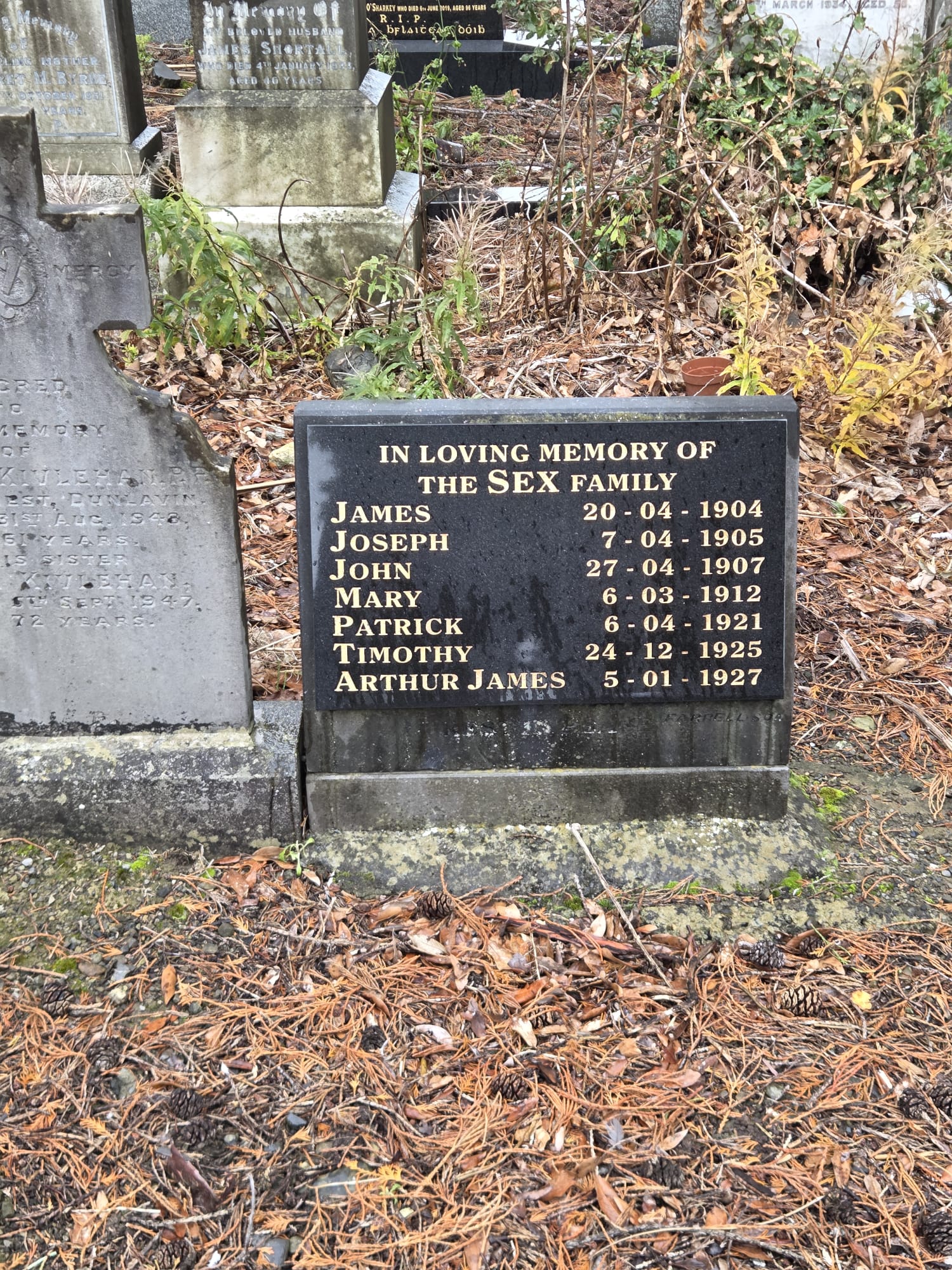
Grave of the Sex family
The grave of Patrick Sex in Glasnevin cemetery

The burial itself was somewhat unusual as the gravediggers at Glasnevin cemetery were on strike, which they would not break, even for a fellow union man, so Patrick’s grave was dug and closed by friends and family members. Gravediggers’ strikes were not uncommon at the time, they had taken place in 1916, 1919, and again in 1920. The one exception made by the gravediggers during their strike did take place a couple of days before Patrick’s burial, for the internment of Dublin’s Archbishop, William Walsh.
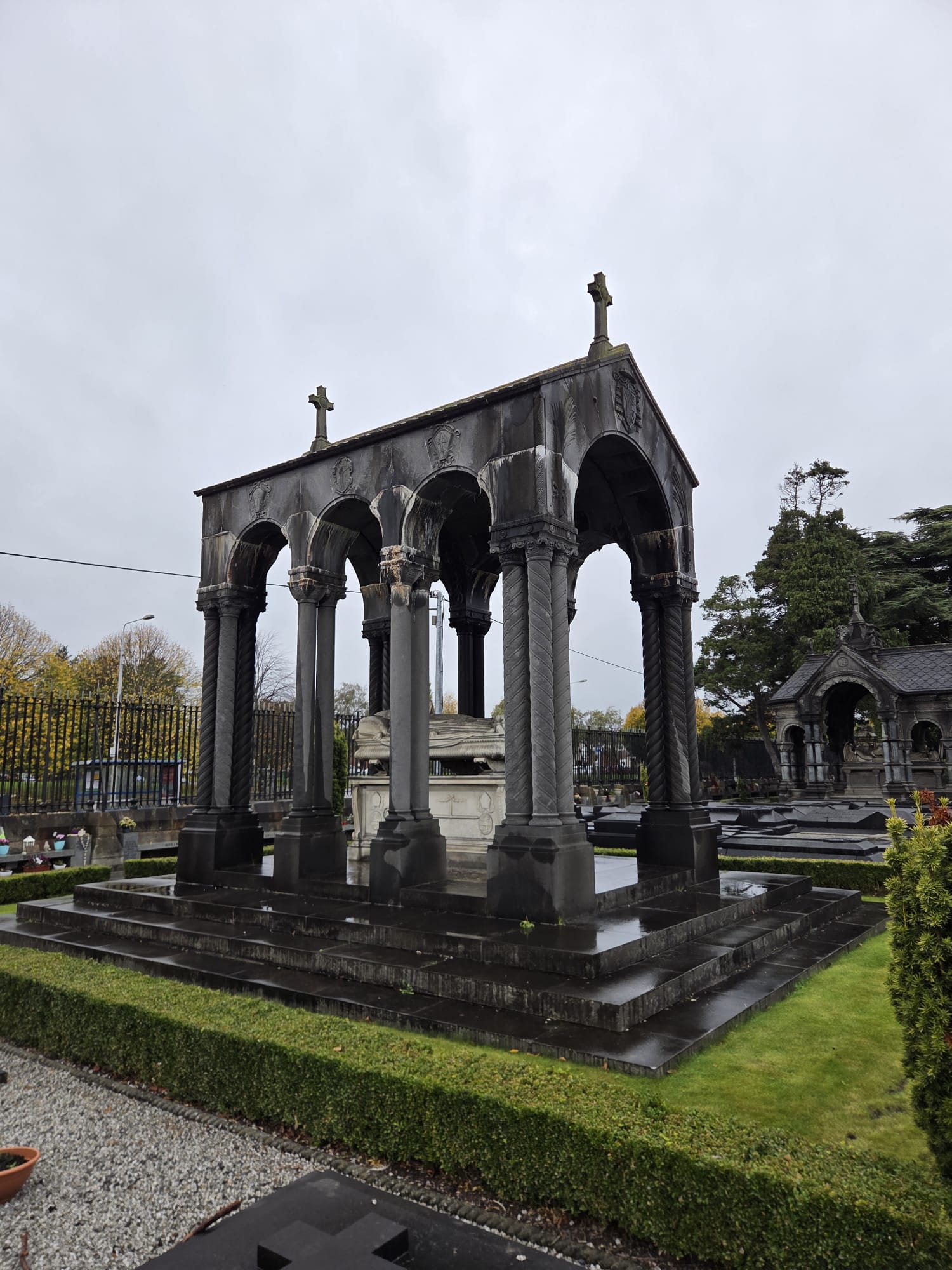
By contrast, the elaborate grave of Archbishop William Walsh

The outpouring of public support for the Sex family was evident not only in the strong turnout for Patrick’s funeral but also in the sporting world. A memorial committee had been established and a month after Patrick’s funeral there was to be an end-of season benefit match staged in Dalymount Park between Bohemians and a Best of Leinster XI, a set of high-quality gold medals were to be presented to the winning team while the proceeds from the game would go to help Mary Sex and her children.

The selection to face Bohemians in the charity match which included future Ireland internationals Alec Kirkland and Paddy Duncan – from the Evening Herald 16th May 1921

The game was played on the 18th May, 1921 and a crowd of around 4,000 was in attendance to witness an entertaining 2-2 draw. With no extra-time and no penalty shoot-outs a replay to decide the winner of the gold medals was set, which also guaranteed a second opportunity to fundraise for the Sex family. After some back and forth around a replay date, the 26th May was chosen and Dalymount Park was once again the venue, this time Bohemians were the victors, triumphing 1-0 over the best of Leinster selection, thanks to a goal by Billy Otto. It was said that the game was played “before a good attendance” and this hopefully translated into funds for Patrick’s family.

It had been suggested in a Dublin Evening Telegraph report that Laurence O’Neill, the Lord Mayor of Dublin might ceremonially kick off the game, but this did not happen due to his having to travel to the USA where O’Neill was working with the “White Cross” who were providing aid in Ireland during the War of Independence. It was suggested in O’Neill’s absence that W.T. Cosgrave, then an Alderman on Dublin City Council, might take over that role but it is not clear from reports whether this happened.

The same report stated that “this is the first time the Dublin footballers and supporters have come forward to do something the alleviate the sorrow of at least one household in these unsettled days” while also encouraging those who did not attend football matches to “rid themselves of all petty prejudices and bring all their friends and associates for the once to Dalymount”. Which would appear to be a not so subtle appeal to supporters of the GAA codes to ignore “the Ban” and attend a soccer match due to the good cause that it was supporting.

One final question that arises, considering the level and scale of violence witnessed over the previous two years, why was Patrick Sex the first victim of the violence in the War of Independence to receive a benefit match? While Patrick Sex may have been a football fan, though it is not specifically mentioned in any reports, he doesn’t seem to have been mentioned in any role in connection with any club or with the Leinster Football Association (LFA). As previously discussed the size of Patrick’s family, his role in the Trade Union movement, and being well known in the local area having worked for many years for McInnally’s butchers all contributed to the prominence given to his funeral, but he was sadly far from unique. Many people with large families, who were well known within their communities lost their lives during the War of Independence, so why a football benefit for Patrick if we can’t find any specific connection of Bohemians, the LFA or any other football club?

I would suggest the answer lies in the timing of Patrick’s death in April 1921, with the benefit match and its replay being held the following month. For context, long-standing issues within the Belfast-based Irish Football Association and its relationship with the LFA and its member clubs were coming to a head against the backdrop of internal bureaucratic strife and the ongoing violence of the War of Independence. In February 1921 there are been consternation among the IFA officials at the displaying of an Irish tricolour at an amateur international against France in Paris, those involved were arrested and there were charges within Dublin football and local media of bias on the part of the IFA. The IFA had also made the decision to not play that season’s Junior Cup and move Intermediate Cup matches which had been scheduled for Dublin to Belfast. The final straw arrived in March 1921 when the venue for a replay of the drawn Cup game between Glenavon and Shelbourne came to be decided. The original match had taken place in Belfast so custom would suggest that the replay should take place in Dublin. However, the IFA ruled that the replay should also take place in Belfast.

On June 1st, less than a week after the Sex memorial match replay, at the annual meeting of the LFA in Molesworth Hall in Dublin, an overwhelming majority of committee members voted to break away from the IFA. The LFA had been polling its member clubs on the subject since April before passing the motion at the beginning of June and by September of that year the Football Association of Ireland had been established, and surprisingly quickly a new League of Ireland cup and league competition had also been formed.

As Neal Garnham notes “by mid-May the LFA was effectively operating independently of the IFA”. Somewhat bizarrely the IFA held a Council meeting on June 7th, seemingly blissfully unaware that the LFA had voted to remove itself from IFA jurisdiction, among the items voted on and approved at the meeting was a motion by Bohemians to play a benefit match for Patrick Sex. It perhaps, shows the sporting and communications division between Belfast and Dublin, that the IFA were unaware that the LFA was no longer affiliated, or that two benefit matches for Patrick Sex had already been played. The organising of the game by Bohemians, the LFA and the role of the memorial committee which seems to have included prominent Republican politicians like Laurence O’Neill and W.T. Cosgrave, seems to suggest that the Patrick Sex memorial match was part of a larger, ongoing process of Dublin football moving away from Belfast control and taking charge of its own affairs, this coupled with the specific nature of Sex’s death and his background suggests why he, and not some other innocent victim was the first to receive such a benefit game.

With special thanks to Aaron Ó’Maonigh, Sam McGrath and Gerry Shannon for their help with elements of the research, and for Aaron for sending on the original “Sex memorial” clipping.
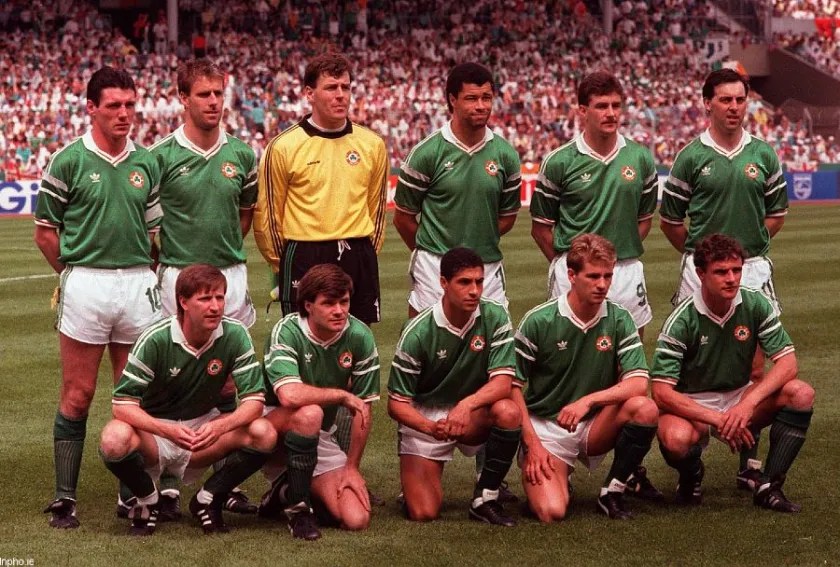
“There is no way anyone can win out here” – but nobody told Gary McKay


The reaction of Irish fans to being drawn in a group that included Bulgaria for the Euro ’88 qualifiers must have been one of dread. Twice in recent campaigns Ireland had been drawn against the Bulgarians, for the World Cup in 1978 and for the 1980 Euros – the games that followed had featured disallowed goals, brawls, red cards, a horrific injury to Ireland’s Jimmy Holmes and a crowd atmosphere in Sofia described as a “Cauldron of hate”.

This was a tough group for Jack Charlton’s opening qualifying campaign, Bulgaria, Belgium, Scotland and Luxembourg were the opposition with only the winner progressing. Bulgaria were a talented side to boot, having qualified for the 1986 World Cup level on points in their group with European Champions, France. And even though they didn’t make it out of a tough group featuring Italy and eventual winners Argentina there was plenty of skill and ability in their ranks.

When Ireland faced Bulgaria away in the first of the game on 1st April 1987 they were buoyed by a somewhat unexpected away win over Scotland that February thanks to a famous Mark Lawrenson goal. Ireland were unbeaten at this stage having drawn at home to Scotland and also drawn against Belgium in Brussels thanks to a late Liam Brady penalty.

Two of the main protagonists in Sofia that night were goalkeeper Boris Mikhailov and striker Nasko Sirakov, stars for Levski Sofia who had both returned from bans after their part in the infamous brawl that marred the 1985 Bulgarian Cup final against their great rivals CSKA Sofia. Mikhailov was impressive in the Bulgarian goal denying efforts from Stapleton, Brady and Ronnie Whelan while Sirakov was won the crucial penalty with just minutes remaining the second half. Latchezar Tanev scored the resulting spot kick to give Bulgaria a 2-1 win but there were significant protests from the Irish. Much of the commentary from Irish observers felt that Kevin Moran made contact with Sirakov outside the box and that it was a “soft penalty”, while there were similar shouts for a first half penalty for Ireland that fell on the deaf ears of Portuguese referee Carlos Silva Valente. It was Ireland though who were ultimately April fools and an angry Jack Charlton blustered to the Press “there is no way anyone can win out here” – though he remained proud of a performance he felt had warranted at least a draw, stating “anyone who thinks that Ireland have no chance of qualifying for the finals must be crackers after such a marvellous display”!

Ireland would meet Bulgaria again in October as the final game of qualifying. It perhaps says something for the lack of optimism among Irish fans that only 26,000 showed up to Lansdowne Road for the game, some twenty thousand less than for the home fixtures against Scotland or Belgium. Ireland turned in one of the best performances of the campaign, with goals coming from a pair of Manchester United defenders in the shape of Kevin Moran and Paul McGrath. The only downside was the dismissal of Liam Brady who received a second yellow for elbowing Ayan Sadakov in retaliation.

Brady was originally to face a four-match ban, and when Gary McKay’s unlikely winner in Sofia a month later guaranteed Irish qualification there was a concerted effort by the FAI to appeal the severity of the suspension. The four-match ban was eventually reduced to two after the FAI’s Des Casey gave a memorable speech, declaring “To Irish football, Liam Brady is what Michel Platini is to French football and what Diego Maradona is to Brazilian football”! Sadly, injury would prevent Brady from playing in the Euros but so much of that first European Championship qualification had hinged on Brady and indeed on results (both Irish and Scottish) against Bulgaria.

This originally appeared in the Ireland v Bulgaria match programme in March 2025

United Ireland v England and the token Welshman

In May 1951 as part of the Festival of Britain, the ten League of Ireland clubs ventured across the Irish Sea to join the festivities and take part in a series of exhibition matches against teams drawn from the Third Division (North) of the Football League. Of the opening round of fixtures involving the Irish sides only Bohemians would emerge with a victory, defeating Accrington Stanley (who are they?) 1-0, although the Bohs would lose their following two games against Oldham and Rochdale respectively.

This invitation was not limited to teams from the League of Ireland, Irish League sides also took part as well as teams from the Netherlands, Austria, Luxembourg, Belgium, Denmark and Yugoslavia. The Festival itself was held on the 100th anniversary of the Great Exhibition and was designed as a measure to showcase the best of British industry, art and design and perhaps most importantly to give a sense of hope and optimism to a nation still witness to the devastation of World War Two and still experiencing rationing, while hoping to rebuild. There was of course a footballing element and as well as the exhibition games played by visiting sides there were various other tournaments contested.

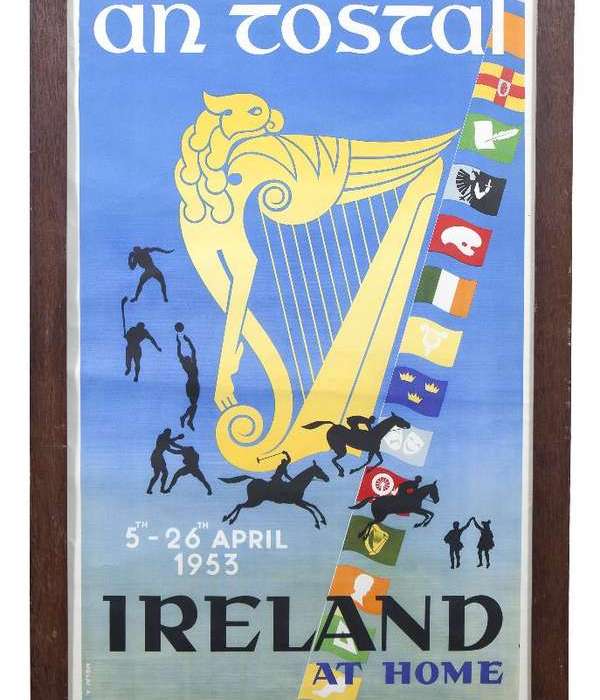
The Festival itself was hugely successful and it was estimated that as much as half the overall population of Britain visited a festival event during the summer of 1951. One man especially impressed was Juan Trippe, the Chairman of US Airline Pan Am who was apparently responsible for suggesting that Ireland might consider a similar festival event. Trippe and men like him were keen to increase trans-Atlantic passenger numbers on their airlines while the struggling Irish economy and Minister for Industry and Commerce, Seán Lemass were keen to elongate the short tourist season and increase visitor numbers. A plan was quickly put into action with An Tóstal (Ireland at home) being announced in 1952 with the aim of showcasing the country to foreign visitors, tapping into the dispora and beginning the tourist season earlier in Spring of 1953 rather than just in the traditional summer months. It was hoped that over 3,000 American tourists might visit for the festival as well as larger numbers travelling from Britain.

Tranmere v Dundalk match programme from the Festival of Britain, courtesy Gary Spain

Sport played a key role from the outset with cycling, athletics, rugby, hockey, greyhound racing, tennis, shooting, badminton, chess and even roller hockey tournaments and exhibitions being held. Association football was not to be found wanting, for the first year of An Tóstal in 1953 the FAI arranged an Irish XI to take on a visiting Celtic side in Dalymount. The FAI selection defeating their Glasgow visitors 3-2, while there was also an Inter-League game arranged against the Irish League a few days later. This was the first meeting of the representative league sides in three years and it was hoped the match might ease relations between the FAI and IFA which had been strained yet again during qualifying for the 1950 World Cup with the IFA trying to select players born outside the six counties. It was only the intervention of FIFA that finally ended the practice of players representing both “Irelands” that had persisted for over twenty years.

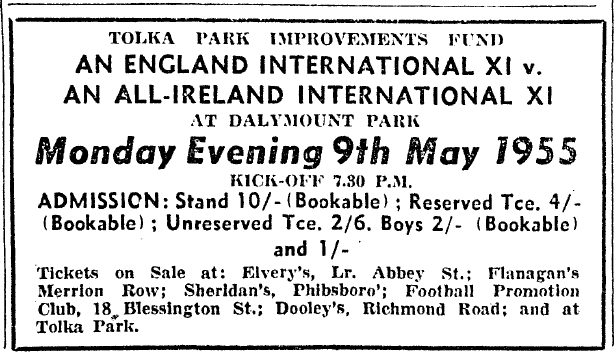
An Tóstal would return again in subsequent years and it was in 1955 that an intriguing fixture was announced featuring and “All Ireland” side who would take on and England XI. This match was the brainchild of Sam Prole, an FAI official and owner of Drumcondra FC, who had also previously had a long involvement with Dundalk FC. The game was to play the dual role of being a focal point for football during a busy end of season period and part of the An Tóstal events and it was also to act as a fundraising event for investment into Tolka Park, home of Drumcondra FC.

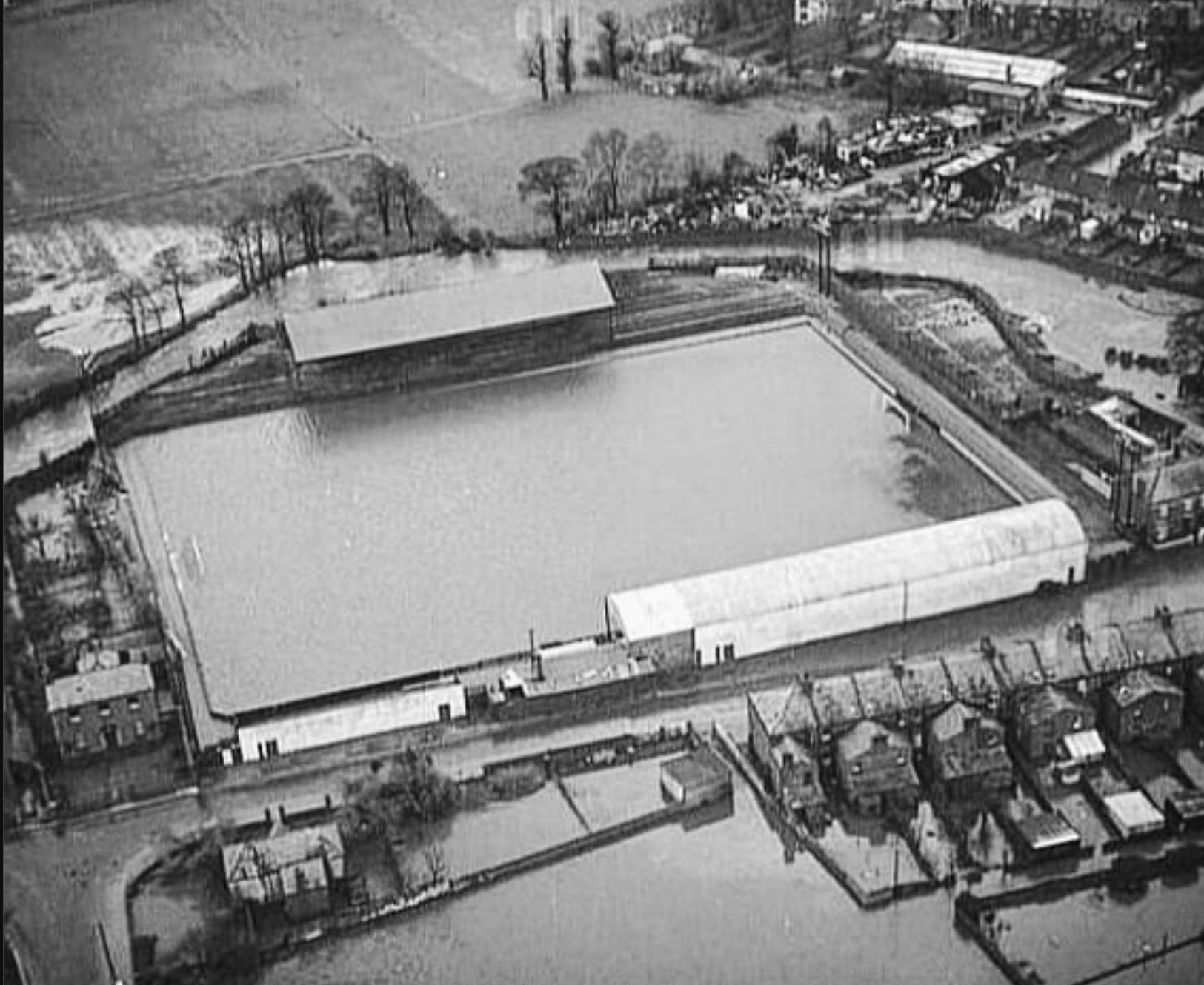
A flooded Tolka Park in 1954

The Prole family had taken over Tolka Park just a couple of years earlier and had seen almost immediate success with an FAI Cup win, they had also invested in the first set of permanent floodlights at a League of Ireland ground and had introduced other stadium innovations such as pitch side advertising boards as well as purchasing the house at the Ballybough end of the ground with a view to increasing stadium capacity. However, in 1954 Drumcondra and the North Strand suffered extreme flooding with the Tolka River bursting its banks and causing significant damage to the stadium. The Proles had ambitious plans for the club but also knew that an insurance settlement from the flood only covered a portion of the costs of repair and they need to generate additional revenue.

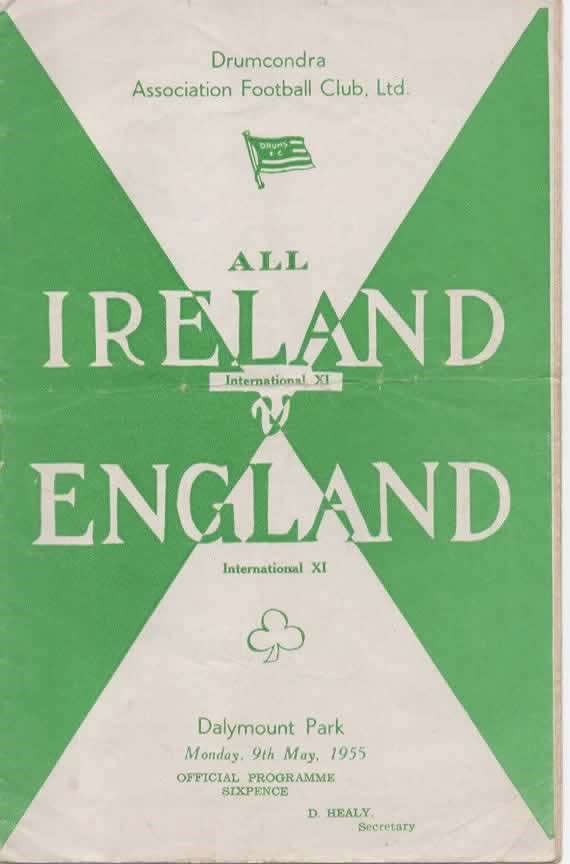
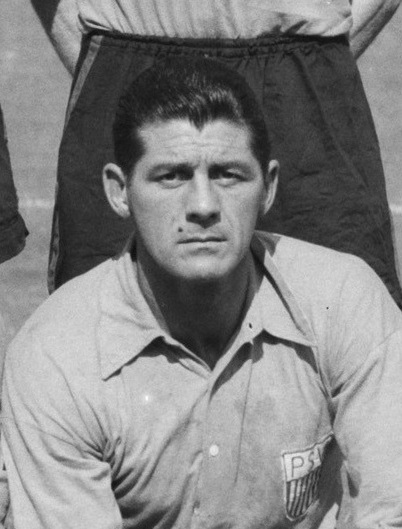
Dalymount Park, the largest football ground in the city, was chosen as the venue for this high-profile fundraising game and Prole went about putting together a pair of squads designed to appeal to the interests of the Dublin football public. The match programme for the game referred to the team as the “England International XI” and the “All Ireland International XI” however in various sections of the Press the teams were variously referred to as All Star XIs an “Old England XI” and also, trading on the name recognition of their star, the “Stanley Matthews Old England XI”. As the names suggest it was something of a veteran side brought over, the side being up of players the wrong side of thirty, while Matthews himself had just turned 40, though he was still a current English international. Nor were the England international side all English! In the side at centre-forward was Cardiff City’s Welsh international striker Trevor Ford.

The All-Ireland side was more mixed in ages, though several veterans still featured in the ranks, including one of the biggest draws Peter Doherty, the manager of Doncaster Rovers . Doherty had been a League winner with Manchester City before the War and a Cup winner with Derby County after it. He’d also been capped sixteen times by the IFA and was considered on of the greatest inside forwards of the 1930s and 40s. The advertising material in the run-up to the game focused on the presence of “Peter the Great” and “Stanley the Wizard” in the opposing sides.

Programme cover from 1955, courtesy of Gary Spain

As often happened with these games there were some last minute changes, the team named as travelling to Dalymount, and listed in the match programme was as follows; Ted Ditchburn, Alf Ramsey (both Tottenham Hotspur), Tom Garrett , Harry Johnston (both Blackpool), Neil Franklin (Hull City), Allenby Chilton (Grimsby Town), Stanley Matthews (Blackpool), Wilf Mannion (Hull City), Tommy Lawton (Arsenal), Jimmy Hagan (Sheffield United), Jack Rowley (Plymouth).

However, Mannion, Lawton and Hagan had to cry off for various reasons and at short notice they were replaced by Charlie Mitten of Fulham, Bobby Langton of Blackburn Rovers, a former England international. Replacing Lawton at centre forward was Trevor Ford of Cardiff City. As mentioned Ford was also the Welsh international centre-forward and as such this “England” side’s attack was led by a man from Swansea. While the side was on the older end of the age spectrum for professional footballers the entire XI apart from Mitten had been capped, and Ditchburn, Matthews and Ford were still current internationals.

Several of the Blackpool team who had won the FA Cup in 1953, famously dubbed the Matthews final, also appeared. Alf Ramsey, Spurs reliable full-back had won 32 caps for England but would find his greatest fame as a manager, first leading unfancied Ipswich to their only league title and then taking England to World Cup victory. The “England” side also featured several players who were somewhat infamous, both Mitten and Franklin were part of the “Bogota bandits” who left their club contracts in England and went to Colombia to play in the non-FIFA recognised league there due to the high wages on offer.

At the time the maximum wage which capped players salaries was still very much in force. Franklin, one of the greatest centre-halves of his generation never won another cap after his Colombian soujourn, while Mitten, who missed out on much of his early due to World War Two was never capped despite being a successful and popular winger for Manchester United and Fulham. A year after the game in Dalymount Trevor Ford would reveal in his autobiography that during his time at Sunderland he had been in receipt of under the counter payments to circumvent the maximum wage. He wasn subsequently suspended and announced his retirement, however changed his mind and moved to the Netherland where his ban could not be enforced and joined PSV Eindhoven.

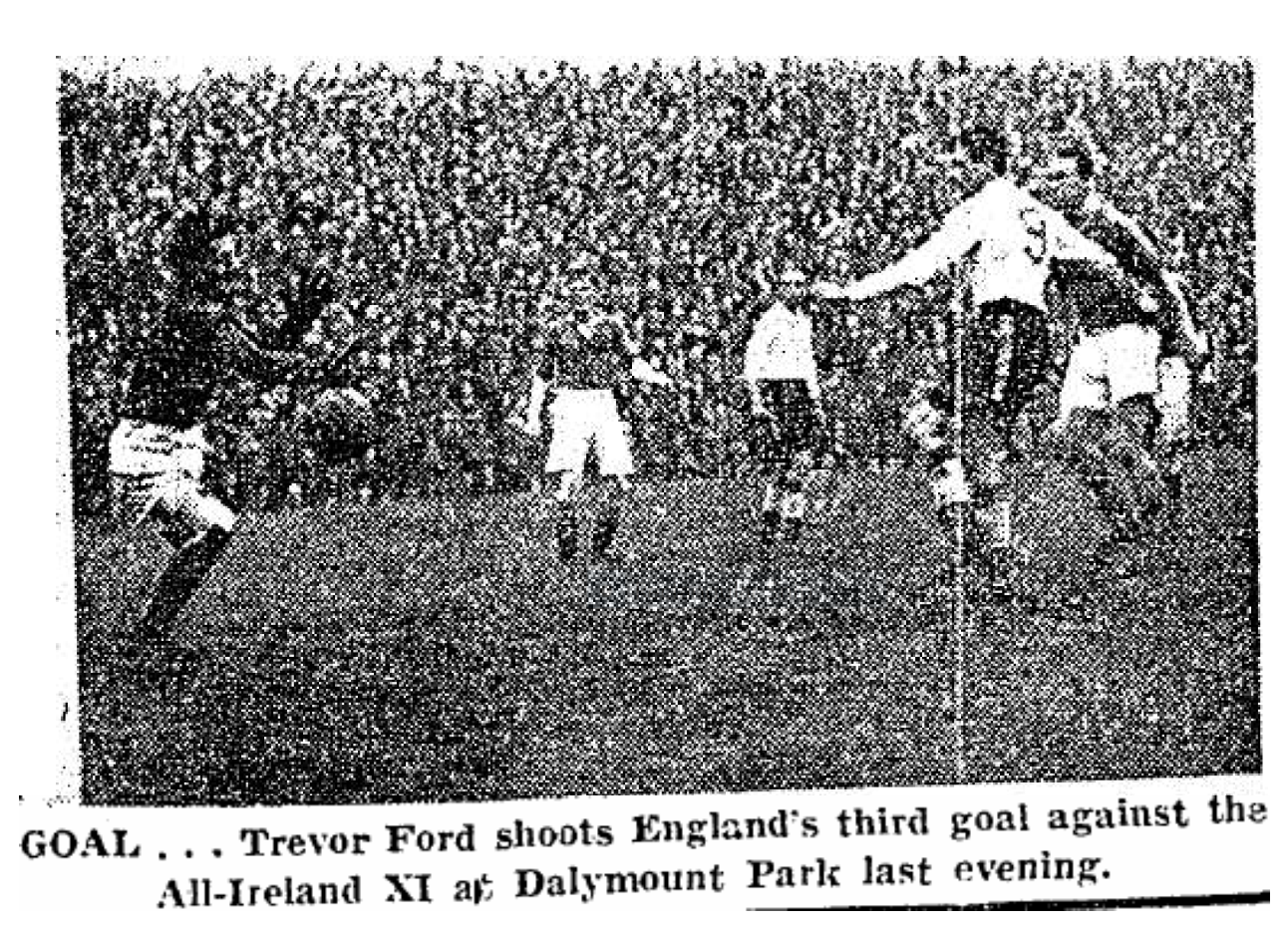
From the Irish Press, Trevor Ford scores for “England” in Dalymount Park.

In the Irish side there was a breakdown of six players born south of the border and five from the north, although like the English side there were late changes, Aston Villa’s Peter McPartland being unavailable he was replaced by his club and international teammate Norman Lockhart. The Irish stating XI read as Tommy Godwin (Bournemouth), Len Graham (Doncaster Rovers), Robin Lawlor (Fulham), Eddie Gannon (Shelbourne), Con Martin (Aston Villa), Des Glynn (Drumcondra), Johnny McKenna (Blackpool), Eddie McMorran (Doncaster Rovers) Shay Gibbons (St. Patrick’s Athletic), Peter Doherty (Doncaster Rovers), Norman Lockhart (Aston Villa).

Sam Prole obviously could rely on the services of his own players like Des Glynn, as well as former Drumcondra men like Con Martin and Robin Lawlor. As mentioned the connection with Doncaster Rovers through manager Peter Doherty, who was also manager of Northern Ireland likely helped secure the services of several other players.

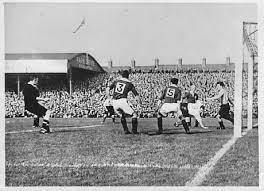
The match proved to be a success in terms of the turnout and entertainment value, 24,000 turned up in Dalymount Park on the 9th of May 1955 for a goal-fest. The main plaudits were rained on Stanley Matthews for his exhibition of wing play, but the entire “England” forward line drew praise from the media reports, Trevor Ford being referred to as the “Welsh wizard among the Saxons” while he scored twice for England. In defence Neil Franklin and keeper Ted Ditchburn were also complimented. Ditchburn was lauded as the best keeper in England despite the fact that he conceded five on the day, Tommy Godwin in the Irish goal came off on worse as the hosts lost 6-5.

There was also praise for several of the Irish performers, despite having hung up his boots two years earlier the technique of Peter Doherty was still remarked upon, however it was Doncaster’s Eddie McMorran who drew the most praise and scoring two of the Irish goals. The press raved about the game, the Evening Herald declaring, in terms of exhibition matches “one of the finest ever seen at Dalymount Park” and again praising Matthews who it described as “being in peak form”. The Irish Press was similarly effusive, leading with the headline “Exhibition Treat Thrills Crowd – Stars Give a Soccer Lesson”. The healthy gate who turned up to see the star names no doubt helped the Prole family in the repair and upgrading work being carried out a short distance away at Tolka Park.

Trevor Ford in 1959, source Wikipedia

This marked a busy time for Dalymount, as days later there was another large attendance for An Tóstal events, with 15,000 turning up for a fireworks display which climaxed with “glittering reproduction of the Tostal harp in fiery gold. Underneath were the words : ” Beannacht De libh.” The young crowd left delighted although there were complaints from residents who were unaware of the event and were frightened by the unexpected noise.

Bouyed by the success of the 1955 match Sam Prole set about organising another All-Ireland v England match for the following year, though this time without the fundraising for Tolka tagline. Once again there was a high-profile selection of English veteran stars recruited and once again there was a cross border make-up to the Irish side. Though for 1956 it was much more weighted to the north with ten of the starting eleven being IFA internationals with only Pat Johnston, a Dubliner then plying his trade for Grimsby Town, coming from south of the border.

Several faces from the previous year’s game returned, including Peter Doherty and his Doncaster Rovers contingent which now included a young goalkeeper named Harry Gregg who would find fame at Manchester United, both on the pitch, and off it as one of the heros of the Munich air disaster. Once again Aston Villa’s Peter McParland was slated to appear but had to cry off, with once again his clubmate Norman Lockhart replacing him. There was also the considerable draw of two stars of Glasgow Celtic, Charlie Tully and Bertie Peacock. Tully, especially was a crowd favourite known for his amazing ball control, on-field trickery and cheeky personality. Such was his popularity among the Celtic faithful there were descriptions of “Tullymania” and his fame spawned an entire trade in Tully products and souveniers.

There were also returning stars from the “England” side that had played in the first game in Dalymount such as Tom Garrett of Blackpool and the “Welsh wizard” Trevor Ford, both late call-ups after Joe Mercer and Stan Mortenson were forced to pull out. The full teams were as follows:

“All-Ireland” – Harry Gregg (Doncaster Rovers), William Cunningham (Leicester City), Len Graham (Doncaster Rovers), Eddie Crossan (Blackburn Rovers), Pat Johnston (Grimsby Town), Bertie Peacock (Celtic), Johnny McKenna (Blackpool), Charlie Tully (Celtic), Jimmy Walker (Doncaster Rovers), Peter Doherty (Doncaster Rovers), Norman Lockhart (Aston Villa)

“England” – Sam Bartram (York City), George Hardwick (Oldham Athletic), Bill Eckersley (Blackburn Rovers), George Eastham Snr. (Ards), Malcolm Barass (Bolton Wanderers), Tom Garrett (Blackpool), George Eastham Jnr (Ards), Ernie Taylor (Blackpool), Trevor Ford (Cardiff City), Jackie Sewell (Aston Villa), Jimmy Hagan (Sheffield United).

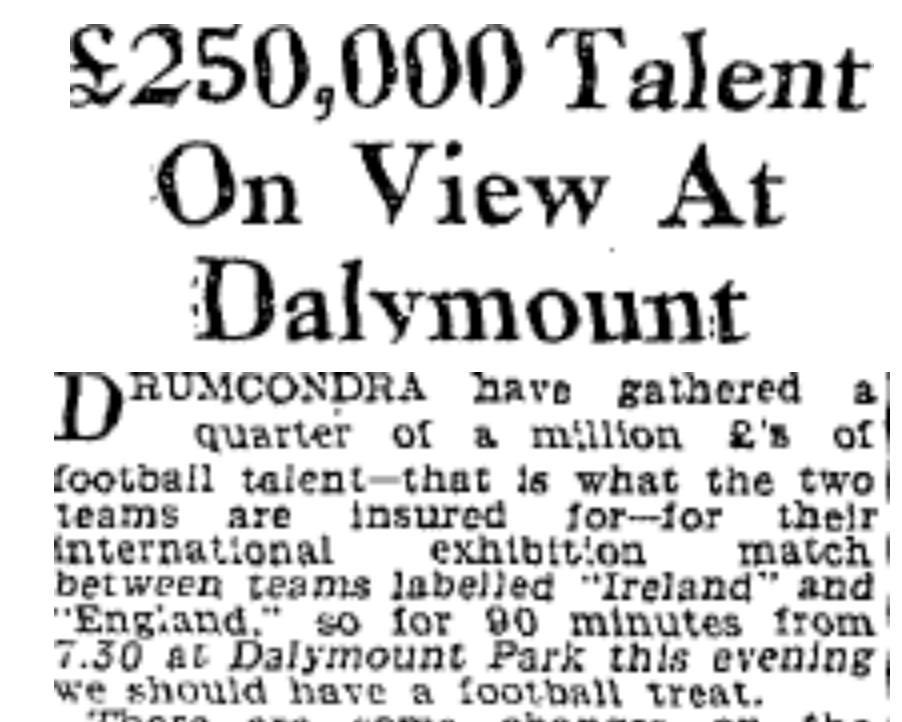
While there were well known veterans in the England team, Hagan was 38 and Sam Bartram, a Charlton legend and one of the most popular goalkeepers in football, was over 40 and had moved into management at York, were in the side there were also several younger players such as Johnny Wheeler and Ronnie Allen who were under the age of 30 and were due to feature but they both pulled out and were replaced by the father and son duo of George Eastham Senior and Junior. In the build up to the game much was made of the value of the team to be put on the pitch with the figure of £250,000 mentioned. In fact, in Jackie Sewell and Trevor Ford, there were two players who had broken the British transfer record over the past six years.

Irish Independent headline

It seems the crowd wasn’t as strong as the one from the previous year, attendance figures not being shared, but newspaper reports variously describing it as a “good” or “medium” crowd, it was also noted that the quality of the display was at a lower lever than the 1955 game, with this match having a more prounounced “end of season friendly” feel to it. The Irish Press called the game an “end of season frolic” while most reports did note the slower pace of the game and the lack of hard tackling, they were quick to praise the style and technique of the players on display. Once again the crowd were treated to a glut of goals, though the score wasn’t a close as the match a year earlier, Ireland lost 5-3 though reports state that this wasn’t a true reflection of the visitors superiority. Once again Trevor Ford was one of the stars while Villa’s Jackie Sewell also earned rave reviews. For the Irish side it was much more the Charlie Tully show, with him seeming to be the one player who was fully committed to the game, being described as a ball of energy and entertaining the crowd with his skills which prompted cries of “Give it to Charlie” from the terraces when Ireland were in possession.

Cover for the 1957 game, courtesy of Gary Spain

The younger George Eastham was also impressive for the English side, still only 19 Eastham had been a stand out player in the Irish League for Ards where his then 42 year old father was player-manager, before the year was out Eastham Jnr would sign for Newcastle United, and later his subsequent, protracted transfer to Arsenal, and court case would win significant change for players rights in English football, doing away with the old “retain and transfer” system clubs still held player’s registrations, even when the player in question was out of contract. He would enjoy a long and successful career and was a squad member of the England side which would win the World Cup in 1966.

Eastham Jnr. would open the scoring for England after Ireland took an unexpected lead through Walker, braces from Ford and Sewell rounded off the scoring for the English side, while the veteran Doherty with a penalty and Norman Lockhart scored Ireland’s other two goals. While the match was not as much of a success as the 55 game there was still praise for Sam Prole for taking the initiative to organise the game and for contributing on behalf of the footballing community to the Tóstal festival.

One possible reason for a smaller crowd in 1956 was not just the different line-ups, late withdrawals, or absence of Stanley Matthews, but also the sheer volume of other exhibition matches, often involving the same players, taking place at the time. Within days of the “All Ireland” v “England” game in May of 1956 there was an Irish youth international against West Germany, followed the next day by a combined Ireland – Wales XI against an England-Scotland XI, both taking place in Dalymount Park. Trevor Ford would feature for the Ireland/Wales side alongside Ivor Allchurch and local Cabra lad Liam Whelan, then making his name at Manchester United.

These games came just days after a Bohemian Select XI took on a side of Football League managers in an entertaining 3-3 draw in aid of the National Association for Cerebal Palsy. Among the Managers XI were players familiar to those who had attended the “All Ireland” games, such as Charlie Mitten, Trevor Ford (again), Peter Doherty (again!) as well as the likes of Bill Shankley and Raich Carter. There was perhaps a law of diminishing returns as despite the reports claiming the game was a highly entertaining spectacle and the associated good cause receiving the benefit, the crowd was descirbed as “disappointing”.

While the Shamrock Rovers XI match against Brazil in 1973, essentially a United Ireland side in all but name, is well known, and its 50th anniversary was marked last year in several quarters, these games in the 1950s are less well remembered. There are perhaps a number of reasons for this, for example, up until 1950 it was common practice for both the IFA and FAI to select players from either side of the borders and more than forty players were capped by both Associations. In this situation “All Ireland” representative sides were not all that uncommon, even if this did occasionally lead to tensions and even threats against players.

In the 1950s, Sam Prole, a key figure in the League of Ireland and the FAI was the driving force behind the matches, similar to the role played by Louis Kilcoyne in the 1973 game against Brazil, and similarly again there was the involvement of a national team manager, Peter Doherty in the 1950s and John Giles in the 1973 game. However, it seems that while the games in 1955 and 1956 used the title Ireland or All Ireland and the 1973 game was compelled to go under the Shamrock Rovers banner, the political situations were quite different. The 1973 game was played against the backdrop of one of the worst years of violence during the troubles, at the time the IFA were playing “home” matches in various grounds around England while a year earlier the 1972 Five nations rugby championship could not be completed as Scotland and Wales had refused to travel to Dublin, highlighting safety concerns.

There seemed to be a concerted effort by players involved in the 73 game to offer a counter narrative and most spoke of being in favour of a 32 county Irish international side. The games in 1955 and 56 lacked this political backdrop, the ill-fated IRA border campaign wouldn’t begin until the winter of 1956, and the stated aim seemed to be a novelty factor and curiousity element as can be seen with the other types of exhibition matches played at the time. There was no sense in any reportage that the games in 55 and 56 were trying to make a political point, they were fundraisers for Tolka Park initially, and a contribution by Irish football to fill a programme for the An Tóstal festival.

Though less than 20 years apart the football landscape was very different between 1955 and 1973. By 1973 European club competition was the norm, when it was only in its earliest phase in 1955 and lacked Irish or English participants. By 1973 colour TV had arrived and there was a massive increase in television set ownership in Ireland through the late 1960s. Where once stars of British football could only be seen in international or exhibition matches, or in snippets on newsreels, now they could be watched every Saturday night on Match of the Day.

While vestiges of An Tóstal live on today, it’s still celebrated in Drumshambo, Co. Leitrim for example, and we can credit it with the genesis of the likes of The Rose of Tralee, The Tidy Towns competition, the Cork Film Festival and Dublin Theatre Festival, one legacy it didn’t leave is a united, 32 county, Irish football team. Perhaps when Ireland is next on our uppers, and we have to reinvent a reason to convincea tourist diaspora to flock home to the old sod, we’ll hold some matches in Dalymount and unite the nation again?

With thanks to Gary Spain for sharing images of the match programmes for the 1955 and 1956 games.

Keep the green flag flying – 50 years on from defeating the Soviet Union

John Giles was enthusiastic that the aligning of Ireland’s European Championship qualifying fixtures with that of England, Scotland, Wales and Northern Ireland would have a beneficial effect on securing the release of players from their clubs for the upcoming match against Turkey. He made this point just after his Ireland side, playing in their first competitive game under his management had shocked European football by defeating the Soviet Union 3-0 on October 30th 1974.

Giles waxed lyrical about wanting the opportunity to work with the international team players on a weekly, even daily basis and hoped to have extra days for another opportunity for additional training ahead of the game against Turkey. Even things like the release of players and a day or two to work through set pieces wasn’t guaranteed in 1974.

The hero in that game, Don Givens, who celebrated his 25th cap with a hat-trick recalled being unable to get back to the team bus such were the crowds and didn’t know how to get to the team hotel in Booterstown so he hailed down a car in his muddy kit with a match ball under his arm. He was greeted with the inquiry as to whether he’d been “at the match?” by the driver.

Liam Brady, then an 18-year-old debutant remembered the flaking panelling in the Dalymount dressing room and the smell of liniment mixed with a waft of beer from the nearby club bar. The anxiety, and perhaps the odour meant that he recalled getting sick in the dressing room toilet prior to kick-off.

All of this perhaps sounds a far cry from modern international football but it was something of a dawning of a new era for Ireland. Giles had taken charge mere months earlier, had impressed in a series of friendlies, and was now player-manager leading the bid for Euro 76 qualification in a group featuring the Soviet Union, Switzerland and Turkey. Almost exactly 15 years earlier a teenaged Giles had scored on his debut in a victory over Sweden, now he was in charge on and off the pitch as Ireland took on the world’s largest nation featuring such stars as Oleg Blokhin who would win the Ballon D’Or just months later.

One of the Irish centre-backs that day, Terry Mancini, had praised Giles for his training techniques and the “tremendously professional atmosphere and attitude – as good as any team in the world”. As chance would have it, the Arsenal defender wouldn’t get to experience much more of the Ireland dressing room, a sending off for retaliating against Soviet defender Volodymyr Kaplychnyi saw his international career ended by a four-match ban.

During the game itself the 35,000 spectators were treated to scintillating, confident football by the Irish, with one commentator describing the interplay between Giles and Brady, master and student, as almost arrogant! It was claimed in reports that this was the game that brought Irish football in from the cold and gave Dalymount back its roar.

The crowd had just 23 minutes to wait for the first goal, a delightful ball in from Joe Kinnear, who excelled in marshalling Blokhin as well as joining the attack, which found the head of Givens who powered it home. Five quick passes cutting open the Soviets to give Ireland the lead. The second arrived on the half hour courtesy of the indefatigable Ray Treacy, who’s cross was flicked on by Steve Heighway to present Givens with a simple finish.

However, there was some concern two minutes later when Mancini and Kaplychnyi were sent off. Could Ireland’s 4-3-3 formation adapt to being down a centre half? Mick Martin, filled in ably, switching from midfield to defence, and Ireland managed to weather a Soviet storm in the first period of the second-half and any fears of a comeback were allayed on 70 minutes as Giles’s precise and quickly taken free found the Soviet defence asleep and Don Givens secured his hat-trick.

Through the late 60s and early 70s Irish fans had little reason to be cheerful, 50 years ago a new manager, and a shock result helped the Green army to find their voice and hope again.

This article originally appeared in the Ireland v Finland match programme in November 2024

Seán Byrne and a game of two hemispheres

In 1954 Dessie Byrne had the misfortune to head a ball a bit too firmly back to goalkeeper Jimmy Collins, his St. Pat’s teammate and brother-in-law, the resulting own-goal was enough to secure the cup for Drumcondra and create the beginnings of the lore around St. Patrick’s Athletic’s cup-curse. The hoodoo around the supposed curse was only dispelled in 2014 when Pats next lifted the trophy, although by then it had included another member of the Byrne family, Dessie’s son Seán, a versatile, tireless and hard-working midfielder or defender who also had an eye for goal. Seán was part of the Pats team that lost the 1974 final 3-1 to Finn Harps which saw the Donegal team claim the trophy for the first time.

Seán did do better than his Dad in that final, scoring Pat’s consolation goal, and he would taste cup success with his next side, Dundalk. Forming part of an impressive midfield which featured the likes of Barry Kehoe, Mick Lawlor and Leo Flanagan, Byrne would taste cup success twice as well as winning two league titles and impressing in Europe during his time at Oriel Park.

It was also during his spell at Oriel that a connection with New Zealand would first arise. In May of 1982 Dundalk manager Jim McLaughlin was tasked with selecting a League of Ireland squad for an end of season tour to New Zealand. The League of Ireland side was to provide the opposition for the New Zealand national team as part of five warm-up matches ahead of their first appearance at the World Cup that summer.

In preparation for facing Brazil, the Soviet Union and a strong Scottish side in Group six of World Cup 82, New Zealand would be up against Seán Byrne and his League of Ireland colleagues. With the season just ended the League of Ireland squad faced a trek of almost 20,000 km ahead of the first game in the town of Rotorua, landing just 48 hours before kick-off. The extent of the journey may have contributed to back-to-back 1-0 defeats on successive days in New Zealand before a 0-0 draw was achieved in Gisborne. The fourth match of the series of five took place in the city of Dunedin and would be the League of Ireland’s only win on the tour, a 2-1 victory thanks to goals from Seán Byrne and Athlone Town’s Denis Clarke.

An important connection was made on that tour, with Kevin Fallon the assistant manager of New Zealand, the Englishman had spent time in the League of Ireland with Sligo Rovers (he was part of the Sligo team which lost to Bohemians in the 1970 final) and he was impressed by Byrne’s performances. Back in an Ireland that was facing high unemployment, and a bleak economic outlook Seán Byrne was finding working life a struggle. A former coachbuilder for CIE and later a lorry driver, (gaining him the nickname Yorkie) Seán spent most of 1982 and 83 looking in vain for a job and getting by “with the dole and the few pound I made from playing football”. Fallon suggested that Byrne and his young family relocate to the city of Gisborne in New Zealand where he was managing the local team and could also arrange for work for Seán in the local shipbuilding industry.

Seán enjoyed almost immediate success with his new antipodean club side and eventually took out New Zealand citizenship, and with Fallon installed as national team coach from 1985 Seán was included in squads for the 1986 World Cup qualifying campaign, appearing in a victory over Taiwan and a defeat to Israel in what was ultimately an unsuccessful qualifying attempt. Byrne would eventually win five caps for his adopted homeland before moving again to Australia where he worked as player-coach for Morwell Pegasus close to the city of Melbourne.

In 2000 Seán was diagnosed with Motor Neurone disease which sadly claimed his life aged just 48 in 2003. A popular footballer on and off the pitch his passing was mourned in Dublin, Dundalk and is his adopted homes of New Zealand and Australia.

Originally published in 2023 as part of the Ireland v New Zealand match programme.

In conversation with Chris Lee – Free Event, May 25th

Coming up on Thursday May 25th I’ll be chatting with author Chris Lee from the Outside Write in the welcoming surroundings of The Saint Bar in Inchicore where we’ll be discussing the history and politicisation of football in Ireland.

Tickets are free but please register as spaces are limited. Free tickets are available through Eventbrite.

You can also have a listen to my podcast interview (link below) with Chris from late last year when he was on discussing his new book; Defiant : A history of football against Fascism.

A club for all seasons – 1929-30

Bohemians began with a pre-season tournament in August of 1929. While the club had played matches in England and Scotland in the past this was to be our first foray onto the Continent and things could not have gone better with Bohemians winning every game on the tour and securing the Aciéries d’Angleur Tournoi trophy after victories over the likes of Standard Liege and R.F.C. Tilleur. The invitational tournament ran for many years and would feature the likes of PSV Eindhoven and Bohemians Prague. Bohemians became only the second Irish side, after Glentoran in 1914, to win a European trophy, though it is worth noting that it would not be Bohemians’ last such title.

In the league it was a case of third time’s a charm as Bohemians won our third title in the 1929-30 season. It was a much-changed line-up from that of the all-conquering 1927-28 side, many of whom had moved to pastures new, although the likes of Jimmy White, Jimmy Bermingham, Johnny McMahon and goalkeeper Harry Cannon remained in the side. Cannon once again was a feature on the scorers list, hitting yet another penalty-kick that season. Added to these Bohs veterans were newer players like Stephen McCarthy who hit thirteen goals in the league that year, as well as a young Fred Horlacher (shown in cartoon form on the left) who continued to delivery on his exceptional promise. Further back in the midfield was the likes of Paddy O’Kane, yet another future Irish international.

Bohs only lost twice all season in the League, both away fixtures, while winning every single game at fortress Dalymount, they ultimately pipped defending champions Shelbourne to the title by a solitary point. Shels had a fine side that year, propelled by the goals of Johnny Ledwidge signed from LSL side Richmond Rovers, as well as former Bohemian inside forward Christy Robinson, they had to content themselves with victory in the League of Ireland Shield that year. There were no other changes to the make up of the League from the previous season and while Bohs finished top, Jacobs would finish bottom, winless all season, amassing only a meagre three points, despite featuring the talented Luke Kelly Snr. (father of the future Dubliners’ frontman) in midfield.

In the cup there was high drama as Shamrock Rovers won a controversial final 1-0 against Brideville thanks to a “Hand of God” moment from David “Babby” Byrne, the diminutive striker fisting the ball past Brideville’s Charlie O’Callaghan (in the Peter Shilton role) to secure Rovers second consecutive Cup triumph. Despite losing to Fordsons in the second round of the Cup, Bohemians did make history that year when forward Billy Cleary scored six goals in a 7-3 win over Bray Unknowns in a first round replay. Cleary’s record for most individual goals scored in a Cup tie remains intact to this day.

At international level Ireland’s sole match was a 3-1 win against Belgium in Brussels in May 1930, with Jimmy Dunne scoring twice. Among the starting eleven were Bohemians’ Fred Horlacher and Jack McCarthy who returned to Belgium after their successful, pre-season trip to Liege, also in the line-up was Billy Lacey who became Ireland’s oldest ever international, just four months short of his 41st birthday. Lacey would later become a successful coach at Bohemians in the 1930s.

Part of a series in the Bohemian FC match programmes. The 1928-29 season review can be found here.

Jesus back in a tracksuit – from Carey to Pauw

By Fergus Dowd

‘The pride and self-respect of our country as well as our players will be on show for millions in the pre-match ceremonies at Wembley Stadium on Saturday and it is important that we present ourselves in the best way possible, in terms of both dress and conduct, on every occasion during our stay in England.’

It was April 1957 as Jack Carey uttered those words to the FAI committee ahead of two World Cup preliminary games, home and away, against England the following month. The first Irishman to lift the FA Cup as captain of Manchester United, felt it was a simple request but he considered it essential that the powers that be purchase a set of tracksuits for those who would wear the green of Éire in London.

Today, sports manufacturers fall over themselves to provide football teams with clothing from polo shirts to the neck-warming ‘snood’, but it always wasn’t so. In the case of the FAI tracksuits were recycled on so many occasions they became undeniably shabby only six years before Carey’s words officials were forced to purchase a set in the course of a shopping expedition in downtown Helsinki ahead of a World Cup game in Finland. Unfortunately for the cash-strapped FAI these items of unexpected expenditure were impounded by customs and excise on the team’s return to Dublin, it took government intervention to release the tracksuits without charge. The cost for a set of tracksuits for the English adventure amounted to less than £50 but the word ‘tracksuit’ had left a bitter taste.

In 1946 Carey captained Éire against England at Dalymount Park after an interval of thirty-four years the English FA had agreed to send a team to Dublin. It included Wilf Mannion, Raich Carter, Tommy Lawton and Frank Swift in goals, names that rolled off the tongue easily, Stanley Matthews had also been selected but had to bow out through injury and was replaced by a young Tom Finney. Alongside Carey the Irish lineup included Cornelius (Con) Martin, Tommy Eglington, Alexander Stevenson, Billy Gorman and Bud Aherne.

Ireland v England 1946

Carey, Gorman and Aherne had lined up for the Irish FA in Belfast only two days previously against the same opposition with Mannion finding the net three times with the ‘Special Victory Ball’ supplied by The Athletic Stores of Wellington Place, Belfast as England ran out 7-2 winners. Wilf Mannion became the first debutant for England to score a hat-trick since George Mills in October 1937, only the eleventh player ever to achieve this feat.

Ahead of this meeting in Belfast the English FA had written to the Irish FA requesting an assurance that only players born in the North of Ireland would play, it was an era when men from the four corners of Ireland represented both entities on the football pitch. At the Liverpool Conference of 1923 the IFA was given international status and the Éire Association (FAI) dominion status. Under this agreement the IFA had the right to select any Irish-born player attached to an English or Scottish club and the Eire Association was only permitted to call upon Éire-born players.

Ireland team in Goodison Park 1949

In the press box in Dalymount Park the Fleet Street scribes who had taken the boat to Dublin reported:
“In Dublin, the first-ever meeting between the two nations was played in persistent drizzle and the difficult pitch made life awkward for the players. Throughout the match, the Republic put up a terrific fight and made the England team fight all the way to gain their eventual undeserved win. Indeed, had it not been for the fact that Frank Swift was in inspired form, then the visitors could have been well beaten. With only nine minutes remaining England stole victory with a fine goal. Langton gave Mannion a through pass down the left. The ‘Boro man cut in and unleashed an angled shot which Breen could only parry. The ball ran loose and Finney dashed in to slot it home. England had won by the skin of their teeth.”

Before William E. Webb of Glasgow had blown the whistle to get formalities underway, Dr W.F. Hooper, president of the FAI, handed to the chairman of the FA, Mr W. Brooke-Hurst, a silver cup – a replica of the Ardagh Chalice – to commemorate the first meeting with England in the Silver Jubilee year of the Éire Association.

However, three years later Éire would have their revenge in Goodison Park, Liverpool. Carey’s team, against all the odds, recorded a gratifying two-nil victory, becoming the first foreign team to beat England on their home patch. Nine of the Irish players were with Football League clubs and two from Shamrock Rovers but all of them were born in Ireland.

On the 8th of May 1957 Jackie Carey watched his team warm up at Wembley in tracksuits, Tommy Taylor one of those who would perish in the Munich air disaster would steal the show with a hat trick, and Duncan Edwards another who would die from his injuries from the disaster also lined out for England. Both sides had defeated Denmark and only seventeen days later in the return fixture, forty-seven thousand six hundred patrons watched Ireland warm up in tracksuits. Alf Ringstead son of a jockey from the Curragh would net after three minutes following a move between Billy Whelan and Arthur Fitzsimons led to Joe Haverty crossing for Ringstead, the Dalymount roar was heard as far as the Howth pier, “little Éire” looked destined for their first World Cup in Sweden. However, with the last attack of the game came the last dramatic moment, the Preston plumber Finney set off on a mazy dribble down the right and from the byline produced a perfect centre for John Atyeo to head home.

For some, it was artistry for others heartbreak, the legendary Irish football radio commentator Philip Green summed it up by stating: ‘The pained silence here at Dalymount Park can be heard all the way back to Nelson Pillar’. There would be no Éire tracksuits at the World Cup.

Sixty years after Carey demanded tracksuits for his players fourteen Irish international female footballers hosted an extraordinary press conference in Dublin’s Liberty Hall, it was described as “a last resort” in their treatment by the Football Association of Ireland. The core issues revolved around financial payments and representation of the players, with the FAI withdrawing the previous €30 per diem payment during international camps and failing to cover the earnings lost by members of the squad who were then part-time. Players had requested their Union (PFAI) represent them in negotiations with the FAI but the association outlined they would only negotiate with the payers directly through the help of an independent mediator, leading to the PFAI describing the treatment of the Irish women’s international team as ‘a fifth class citizen’ never mind second.

One of the most astonishing revelations which came from captain Emma Byrne was that “players were forced to change in and out of team kit in airport toilets before and after away trips as the tracksuits are also worn by underage teams” – the tracksuit was back on the agenda.

The conference hit home and by April 2021 equality was the name of the game as it was announced by the FAI players representing the Republic of Ireland’s senior men’s and women’s football teams were to receive equal match fees with immediate effect. “The historic three-way agreement between the men’s and women’s squads and the FAI was brokered by FAI CEO Jonathan Hill and Ciaran Medlar, advisor to the male and female international players, alongside captains Katie McCabe and Seamus Coleman,” outlined the FAI statement. The deal would see male players reducing their fees, with the FAI matching their contribution to ensure that the pay received by the senior women’s team would be aligned with that of their male counterparts.

Only two years earlier 56-year-old Vera Pauw had arrived to take over as manager of the Irish women’s football team, capped eighty-nine times for her native Holland, Pauw had pedigree taking the Netherlands all the way to the 2009 European Championships semi-finals and South Africa to the Olympics in 2016. Her love affair with the beautiful game began like so many playing football on the streets with her brothers in Amsterdam, by the age of thirteen she was playing for the ladies’ youth team of v.v. Brederodes in Utrecht.

The Netherlands had seen women first trying to play football professionally in the 1890s, Sparta Rotterdam even tried to form their own women’s football team in 1896, but the Royal Netherlands Football Association (KNVB) banned them from doing so. The Dutch Ladies Football Association was formed in the 1950s and a women’s football league was established in 1955, which was subsequently banned by the KNVB.

Women’s football was played regionally until the 1970s when UEFA declared that all members would have to invest in women’s football. So, in 1973, the KNVB established the Hoofdklasse. The Hoofdklasse was a playoff competition between six regional champions, with the winner of the group crowned champions of the Netherlands.

The popularity of women’s football rose during the 1990s and, in an effort to stop the best Dutch players from leaving to go to countries with professional leagues, the KNVB established the Eredivisie Vrouwen in 2007. The Eredivisie formally opened on August 29, 2007, with six clubs participating in its first season: ADO Den Haag, AZ, SC Heerenveen, FC Twente, FC Utrecht and Willem II. Only four months after the FAI’s equality pay deal Ellen Fokkema made Dutch football history when she became the first woman to play for a senior men’s team in a league match.

Pauw worked her magic on the Irish women’s team leading them to a World Cup playoff meeting with Scotland at Hampden Park, pre-match Katie McCabe the Ireland captain led her side out in green tracksuits for a stroll around the famous old stadium where Baxter, Law and McGrain had sent fans home with treasured memories. It was the 11th of October 2022 and two thousand and sixteen days since the press conference in Liberty Hall and the Irish women’s football team was on the threshold of history.
In the 71st minute Denise O’Sullivan from Knocknaheeny in Cork who started her career playing with the boys of Nufarm Athletic up until the age of eleven, controlled the ball with her right foot with space in midfield she got her head up to see her colleague Amber Barrett making a run through the centre, with a precision right footed pass O’Sullivan found Barrett. As a nation held its breath Barrett took the ball with her left foot leaving the whole of Scotland in her wake and with her right foot she cooly slotted the ball passed the Scottish goalkeeper.

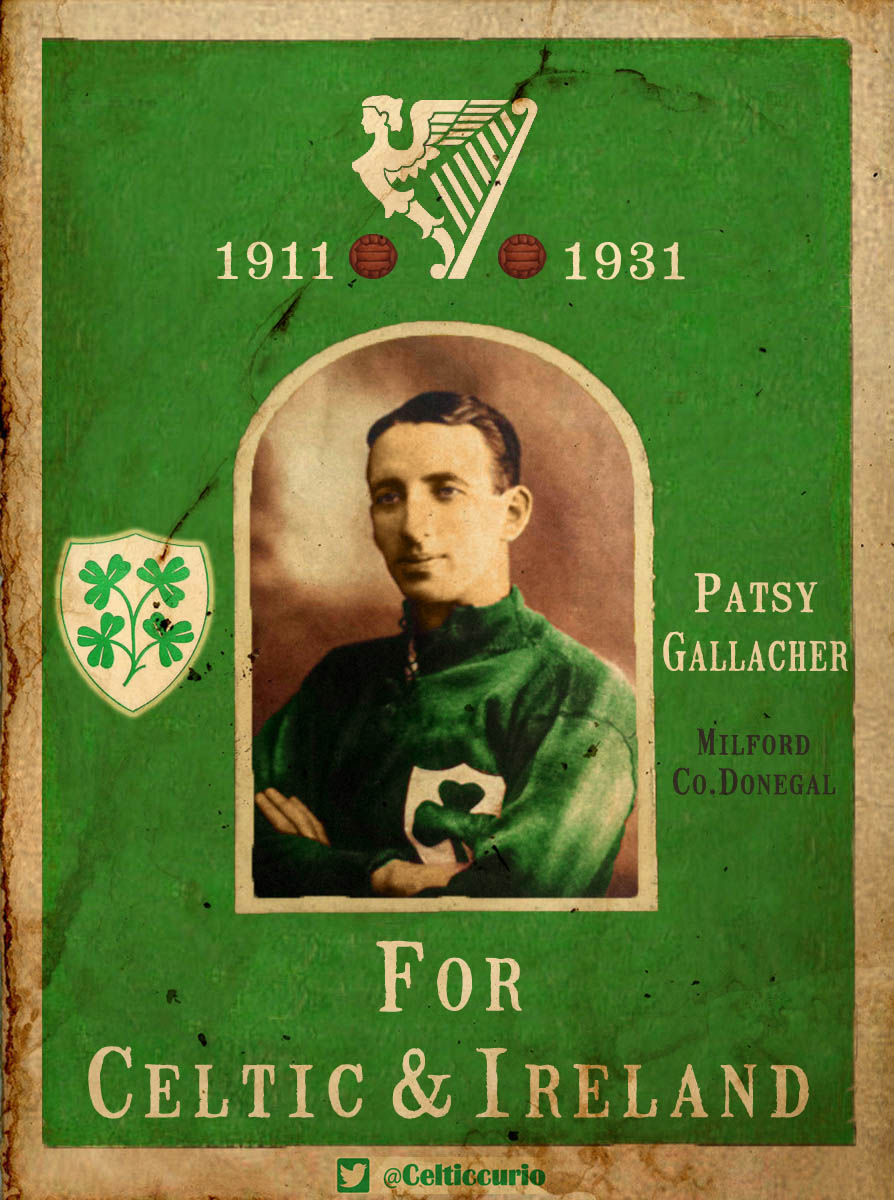
Patsy Gallagher

Amber Barrett celebrated on the same hallowed turf of Hampden Park where the ‘Mighty Atom’ Patsy Gallagher of Milford, Donegal fooled the best of defenders with his dribbling and feints winning four Scottish Cups and six league titles with Glasgow Celtic. Barrett hails from Milford, in 1891 the Poorhouse, which once stood on the outskirts of the town and saw its share of misery in the dark years of the Great Hunger, was where Patrick Gallagher was born his parents would soon leave the hills of Donegal for the shipyards of the Clyde.

In the darkness of the Glasgow night with the Hampden floodlights shining down on her, Amber Barrett kissed the black armband in memory of the ten victims of Creeslough, it was for them, it was for the community of Creeslough and the people of Donegal.

The Ireland women’s team would be part taking in their first World Cup, in her green Irish tracksuit pitchside Vera Pauw spoke to the press celebrating this historic moment with tears and mascara running down her face… Jack Carey would have been proud.

League of Ireland v Welsh League, 1924 – old friends, new relations

The split from the IFA and the formation of the FAI in 1921 was an acrimonious one, and the bad blood seeped beyond our own island as the English, Scottish and Welsh football associations roundly supported their colleagues in Belfast. This placed the nascent FAI in a difficult position, it had to look further afield for opponents leading to them joining FIFA, entering a team in the 1924 Olympics and inviting clubs from the Continent to visit Ireland. They knew however that the bigger draw for the sporting public were always going to be for teams from the British associations and if a full international match couldn’t be secured, then the next best thing would be an inter-league game. With an improvement in relations with the other associations after a conference in Liverpool in 1923, this was something that for the first time seemed achieveable.

In February 1924, almost three years since the split from the FAI, an inter-league match was scheduled against the Welsh League, with the match due to take place in Dalymount Park. This was the first time since the creation of the FAI that they would have any sort of representative game.
All that would be needed now was to select a team…

There was much discussion about the make-up of the team and not all Irish football supporters were happy. The newspaper letter pages at the time we’re deluged with criticisms and alternative XIs (they had to do something without Twitter) but ultimately side was picked by a Free State league selection committee and was made up of players from Bohemians, Shelbourne, Jacobs, St. James’s Gate and Shamrock Rovers. The Welsh, for their part selected four Cardiff players, three from Llanelli Town and one each from Swansea, Newport, Mid Rhondda and Pontypridd. Neither the League of Ireland team nor the Welsh side limited themselves to Irish or Welsh players only. For the Welsh League the likes of Cardiff’s English goalkeeper Herbert Kneeshaw or forward Jack Nock were selected. Similarly, the League of Ireland side featured English players, the Bohs’ forwards Harry Willitts and Dave Roberts were both born in England. Roberts had even had a brief career in the English league with the likes of Shrewsbury and Walsall.

It was quite an eclectic League of Ireland side, completing the Irish forward line alongside Willitts and Roberts were Hugh (Jimmy) Harvey, Jack (Kruger) Fagan and Christy Robinson. Harvey was a winger for Jacobs who, like Willitts had served in the British Army in World War I, he would later go on to have a career as a music hall performer and comedy actor. Robinson and Fagan, two of the younger players in the side, from Bohemians and Shamrock Rovers respectively, had both been involved with the IRA during the War of Independence.

The side was captained by Shelbourne’s Mick “Boxer” Foley (they loved a nickname back then) who was among the more experienced players on the side having been on the books of the now defunct Leeds City for almost ten years either side of the War. One player who was picked but who would have to be replaced late-on was Val Harris, at almost 40 Harris was back with Shelbourne after a distinguished career in England with Everton, however a late withdrawal saw his place taken by Bohs’ Johnny McIlroy. On the bench was Charlie Harris, the Bohemian FC trainer who also moonlighted as a trainer/physio for O’Toole’s GAC and occassionally the Dublin County GAA side, including on the infamous occassion of a match against Tipperary in Croke Park on Bloody Sunday 1920.

Teamsheet from the match programme.

The night before the game the Welsh delegation were treated to tea in Clery’s department store tearooms followed by a show across the river at the Theatre Royal.

The match itself was a success, a sizeable crowd of 15,000 generated gate receipts of £850, a record soon broken when Glasgow Celtic visited Dalymount to play the League selection later that month. The St. James Brass & Reed band provided entertainment and English referee T.G. Bryan (who would go on to referee the 1928 FA Cup final) was brought to Dublin specially for the match. The crowd were given the best possible start to proceedings when Ernie McKay of St. James’s Gate, and a worker in the GPO for his day job, open the scoring early on, McKay earned special praise for his performance in the game and was complimented for rising to the occasssion and showing leadership in midfield. For the Welsh side Jack Nock quickly equalised before Jimmy Jones of Cardiff put them in front.

Deep in the second half the Welsh did well to preserve their lead but with just 12 minutes to go Bohs striker Roberts who had been having a quiet game scored twice in quick succession to briefly give the Irish the lead. Jones however scored his second of the day which meant that this first ever representative game organised under the auspices of the FAI would end 3-3 and history was made.

Bios of the players involved:

Frank Collins: Collins had two spells with Jacobs, either side of a a short spell at Glasgow Celtic where he saw little first team action, he was restricted to just two first team appearances due to the primacy of regular Celtic custodian Charlie Shaw. While at Celtic he was capped by the IFA in a game against Scotland. He returned to Jacobs in 1922 and continued to play with them for a further ten years. The fact that Collins had played professionally in Scotland probably meant that he missed out on an appearance at the 1924 Olympics, however, he was capped by the FAI in a 3-0 win against the USA in Dalymount directly after the Olympics as well as the 1927 game against Italy.

Stephen Boyne: Boyne and his brother Eddie were both regulars for Jacobs around this time. They were from Bride Street and Stephen worked as a van driver for the Jacobs factory. He had received a significant ban in 1920 after altercations that took place during a game against Olympia.

Herbert (Bert) Kerr: Beginning as a a youth player with Drumcondra, Kerr later joined Bohemians when Drums disbanded during the First World War. Kerr represented Ireland at the 1924 Olympics and won three caps in total. He later became a club captain and a prominent member of the Bohemian FC management committee. A younger brother, Kevin Kerr, also later captained Bohemians. In 1920 he set up his own insurance and bloodstock agency. Bertie had a love of horses and Kerr and Company remain in business to this day. He purchased and sold on four horses that later won the Aintree Grand National as well as a Kentucky Derby winner. He passed away in 1973 aged 77.

Mick (Boxer) Foley: Born in Dublin in 1892 Foley made his name at Shelbourne from where he was purchased by Leeds City along with two of his teammates in 1910. Foley made more than 120 appearances over the next ten, war-interrupted years, for Leeds before the club dissolved in 1919 due to financial irregularities. Foley quickly re-signed for Shelbourne winning the IFA Cup on his return. His grandson Paul played in the League of Ireland and in Australia.

Johnny McIlroy: Another one of the veteran players in the team, McIlroy had made his name with Belfast Celtic, appearing in both the 1917 and 1918 IFA Cup finals. He featured for the Falls League XI in a friendly match against Bohemians in 1921 and was soon signed by the Dublin club for whom he would have great success, winning league titles in 1924 and 1928 as well as the 1928 FAI Cup.

Ernie McKay: The son of a Scottish soldier, McKay was born in Richmond Barracks in Templemore, Tipperary, now the Garda training college. McKay played for St. James’s Gate but did not work for Guinness, instead he spent decades working in the GPO on O’Connell Street, as a teenager he was working there as a telegram boy when the Easter Rising broke out. It was around this time that he first became involved with St. James’s Gate as a footballer. Like other members of this XI he also featured in the 1924 Olympics. McKay won the double with the Gate in the first season of the Laegue of Ireland and formed an imposing half-back line alongside Frank Heaney and Bob Carter. He later retired to Essex and was one of last surviving members of the team, passing away in his later 90s.

John (Kruger) Fagan: “Kruger” as he was known in tribute to one of the heroes of the Boer War, grew up around the Markets area of Dublin. During the 1916 Rising he assisted rebels in the Four Courts in getting to safety and arranging for a safe house. A diminutive forward at just 5’2″ Fagan became part of Shamrock Rovers famed “Four Fs” forward line alongside Bob Fullam, Billy “Juicy” Farrell and John Joe Flood. He was capped by Ireland in the 1926 game against Italy in Turin and made history when his son Fionan, who starred for Manchester City was also capped by Ireland, making them the first father and son to achieve this honour. A talented all round sportsman he won a Leinster title in handball and later worked as an assistant to the first Dáil librarian before moving to the Werburgh Street offices of the Department of social welfare.

Harry Willits: Harry Willits was born in Middlesborough in 1889 and already made a strong impression as a footballer in his teens, when he played for Middlesbrough Old Boys, Cambridge House and the famous South Bank club where a team-mate was later English international George Elliott. He moved to Ireland in 1908 to work in the Civil Service and began playing for Bohemians around this time.

He joined the British Army in late 1915 and was seriously wounded in the leg in 1916. Despite this he returned to football and was an intergral part of the Bohemian side that won the league in 1924. Even before his playing days with Bohemians finally ended, Willits became involved with the club’s Management Committee, also later the Selection Committee, and he served as Vice-President.

Dave Roberts: From the English midlands Roberts had spells at both Walsall and Shrewsbury before moving to Bohemians. He had also served briefly in the British army before his footballing career in Ireland. He was top scorer in the 1923-24 season as Bohs won the league, later moving onto Fordsons in Cork. Roberts had a wife and two children living in Birmingham at this time and in 1925 while playing in Cork he was sentenced to a month in prison for child neglect for failing to pay the Birmingham Guardians £172 for the care of the children. At the time Roberts claimed his salary was only £3 and ten shillings a week. Roberts continued with Fordsons until 1927.

Christy Robinson: Born around the markets area on Arran Street in 1902, Robinson was a skillful inside left and one of the stars of a Bohemian side which won the league in 1924 and a clean sweep of trophies in 1928. He also had spells at both Bendigo and Shelbourne. Prior to his involvement with football he had been an member of Na Fianna Éireann and later a member of the First Battalion of the Dublin Brigade during the War of Independence. During this time he was involved in the raid on Monk’s Bakery where Kevin Barry was captured. He would later name one of his son’s Kevin in his honour. He was a Captain in the Free State army until his departure from it in 1924. Robinson was another player who travelled to the 1924 Olympics and featured in a friendly match against Estonia directly after Ireland’s exit from that competition. His brother Jeremiah (Sam) would also play for Ireland and would have a successful club career alongside his brother at Bohemians before moving onto Dolphin. Christy Robinson passed away in 1954 in Dover, England. He is incorrectly listed as S. Robinson on the match programme pictured above.

Hugh James Harvey: Hugh James Harvey, was better known as Jimmy Harvey and was born in Dublin in 1897. He had been a physical instructor in the British Army during World War I and had played for Shelbourne on his return to Dublin, featuring in the 1923 FAI Cup final where Shels had surprisingly lost to Belfast side Alton United, Harvey had the unlucky distiction of being the first player to ever miss a penalty in a FAI Cup final in that game. Harvey was useful in several positions across the forward line but found a new lease of life after his sporting career. During his time as a Jacob’s player records list him as a labourer. However, his father (also Hugh) was a “Variety artist” and the younger Hugh, decided to follow his father into show businesses. He excelled as a comedian as part of a comedy troupe known as the “Happy Gang” who performed in many theatres around Dublin and was also an accomplished singer, dancer and actor.

A club for all seasons – 1924-25

For the 1924-25 season the League of Ireland remained a 10- team league, Midland Athletic – the railway works team withdrew from the league, as did Shelbourne United, who withdrew just after the season had started. The League however, took on a more nationally representative characteristic with two non-Dublin clubs joining. The wonderfully named Bray Unknowns, (though still playing just over the county border in Dublin before reverting to the Carlisle Grounds a few seasons later), and Fordsons of Cork City.

Fordsons had been beaten in the previous season’s Cup Final and were associated with the Ford Factory, but they may never have become a sporting power if it wasn’t for Harry Buckle being thrown in Belfast Lough. Buckle was an Ireland international (IFA) who had starred for Sunderland but was back in his native Belfast working for Harland and Wolff. As a Catholic he had been subjected to sectarian attacks and decided to swap the shipyards for the Ford Factory. While there he helped re-establish the Munster FA and drive forward Fordsons to become Cork’s first (but not last) league of Ireland side where they’d finish a credible fourth in their debut season. His son Bobby Buckle, and great-grandson Dave Barry would also enjoy soccer success on Leeside.

Harry Buckle

At the top of the League it was Bohs and Rovers battling it out for supremacy and despite only losing once during the 18-game season Bohemians had to settle for 2nd place in the table. Shamrock Rovers went through the league season undefeated, with their famous “Four F” forward line propelling them to victory with a +55 goal difference. Top scorer that year was Billy “Juicy” Farrell with 25 goals and the other “F”s being Bob Fullam (who we met in an earlier instalment) Jack “Kruger” Fagan and John Joe “Slasher” Flood. Footballers and fans of the 20s clearly enjoyed the use of nicknames! Bohs top scorer that year was Ned Brooks, who we met in the last article after he had scored a hat-trick against the USA on his Ireland debut.

In the Cup Rovers made it a double with Fullam and Flood scoring in a 2-1 win over Shelbourne in front of 23,000 in Dalymount Park on St. Patrick’s Day 1925. Both teams were still playing in their original homes around Ringsend so the cup final made for something of a super-local derby.

Just three days before the Cup final the LOI had played its second ever inter-league game, once again the Welsh League provided the opposition with Bohemians’ Dave Roberts getting the only goal for the league as they lost 2-1 to their Welsh counterparts.

Roberts was to have an eventful season the following season but most of it would be spent away from Dalymount.