Finn margins in World Cup qualifying 1950

The 1950 World Cup would enter popular memory for the wonder of the Maracanã, the vast and noisy crowds that turned up to follow their Brazilian heroes, and of course the shock result in the “final” which saw Uruguay win their second World Cup by defeating the hosts in what became known as the Maracanzo – A result which seemed to traumatise the Brazilian nation like few others.

It was also the first World Cup to be held in twelve years due to the savagery of the Second World War, and slowly a decimated Europe returned to the football fields and to World Cup qualifying groups. Most groups were two team affairs, simple home and away fixtures with the winner progressing, however Ireland were drawn in a group of three, alongside Sweden and Finland. It was to be Ireland’s first meeting with both nations.

The Swedes would have been strong favourites for the group, they had triumphed in the football tournament at the 1948 Olympics in London and featured stars like Nils Liedholm and Gunnar Gren who would find greater fame in Italy with AC Milan. The Finns, however, were something of an unknown quantity with Irish newspaper previews detailing the struggle faced by Finish football due to the harshness of the climate and the ongoing recovery from the ravages of the Second World War.

For the visit of Finland to Dublin in September of 1949, the Republic of Ireland opted for experimentation. Having been well-beaten by a strong Spanish side in a recent friendly, there was a more youthful look to the Irish team against Finland with several debutants, especially in the attack. A brand-new front five was named, with Johnny Gavin, Arthur Fitzsimons, Jim Higgins, Peter Desmond and Tommy O’Connor all listed to start. Higgins had enjoyed a blistering start to the season with Dundalk, scoring six times before August was out but had to cry off with an injury, his place being taken by Shelbourne’s Brendan Carroll.

It was to be a further changed front line as Carroll had to go off injured after 25 minutes and Paddy Daly being the only outfield player (the 12th man) available as his replacement. This prompted another reshuffle, with the ever-versatile Con Martin moving from centre-half to the centre forward role and Daly taking Martin’s place. Despite the disruption to the team there seemed to be no ill-effects on the pitch. Johnny Gavin opened proceedings with a goal direct from a corner, 21-year-old Gavin was just beginning to make his name at Norwich but he would go on to become the Norfolk club’s record goal-scorer, a distinction still held to this day.

Two more goals followed, Peter Desmond was fouled which drew a penalty and was dispatched by Con Martin before victory was sealed, this time Martin again proving his worth as a striker flicking in a header in the 68th minute from an Ireland corner. A relatively comfortable 3-0 win in front of 23,000 in Dalymount.

The return leg in October was to be a different affair, Finland’s football season was coming to a close and the harsher winter weather was already in force, Ireland were playing in a biting wind with temperatures hovering just above freezing. The FAI had spared no expense, paying over £1,000 to fly an Aer Lingus charter flight to Helsinki and despite the conditions the Irish team must have been optimistic, they had just beaten England in Goodison Park a month earlier and regular centre forward Davy Walsh was back in the starting XI.

Walsh looked to have scored early on but Dutch referee Jan Bronkhorst disallowed it for a supposed foul on the Finish keeper. Ireland did however take the lead through Everton’s Peter Farrell, slipped in by Drums’ Tim Coffey, Farrell beat his man before unleashing a fierce shot into the Finnish net on 65 minutes. Ireland remained in the lead until the last minute when Jorma Vaihela managed to bundle the ball, and a number of Irish players, into the net. The Irish team quickly protested to the referee that the Finns had fouled in the lead up to the equaliser but their laments fell on deaf ears.

Finland decided to withdraw from qualifying after the game and never faced Sweden in the group. Ireland knew they would have to beat the Swedes to force a play-off but these narrow hopes were dashed by a Calle Palmér hat-trick in Dalymount. The Swedes would go to Brazil where they would finish third behind Uruguay and the hosts while it would be another 40 years before Ireland would grace World football’s greatest stage.

This article originally featured in the match programme for Ireland v Finland in November 2024. Banner photo from the Irish Press showing Con Martin bearing down on Finnish keeper Thure Sarnola in the September 1949 game.

World Cup of Hockey- Toronto 2016

If your old enough you might remember a bit of a fad in the early to mid 90’s for Ice Hockey in Ireland, well when I say Ice Hockey I really mean roller hockey; kids on roller-blades in oversized Chicago Blackhawks jerseys skating around suburban cul-de-sacs with hockey sticks. There were a few possible explanations for this fad, the growth in popularity of inline skates, the Mighty Ducks film franchise, as well as hockey cropping up in the likes of Wayne’s World, even that brief moment when super-baggy Ice Hockey jerseys were fashionable for about a month in 1995. For me the hook was the Sega mega-drive and the video game classic that is NHL 94, all Hockey Organ music and 16-bit power play bliss. The game was so popular it even crops up in the Vince Vaughan/Jon Favreau comedy Swingerwhere Vaughan’s character notes the exceptional video game talent of Chicago’s Jeremy Roenick.

Following actual live, non-sega based American sport was a bit harder for an Irish kid in the 90’s. There was the time difference, there was trying to find NHL or the NBA on television. For basketball there was sporadic coverage on Channel 4 and I seem to remember Eurosport(?) showing the NCAA Basketball championships for a couple of years. Dial-up internet wasn’t exactly ready for live streaming of sports so anything else tended to be going around to friends houses where they had good Sky Sport packages to see the odd game.

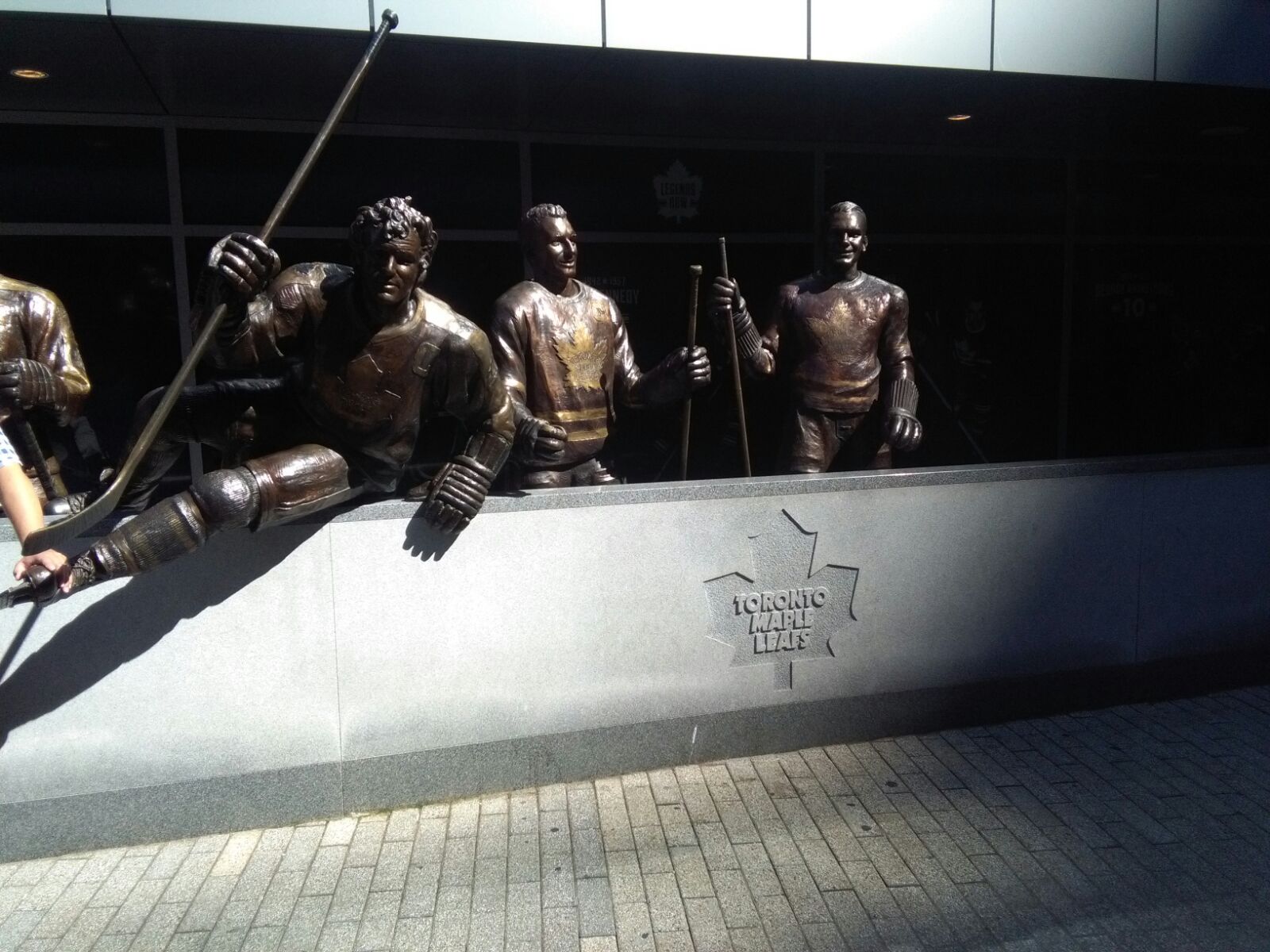
However I’d always kept a passing interest in the NHL and have been known to indulge in slightly boozy hockey conversations with Canadian tourists in some of Dublin’s finer hostelries. On that basis I had to try and catch a game on a recent trip to Toronto. It was mid September and most days were balmy mid 20’s so not exactly Ice Hockey weather and it was still a few weeks out from the start of the NHL season so no chance to see the Toronto Maple Leafs. The Maple Leafs are one of the “Original Six” founding members of the NHL and have 13 Stanley Cups to their name, though they haven’t won the title in the fifty years since the expansion of the League.

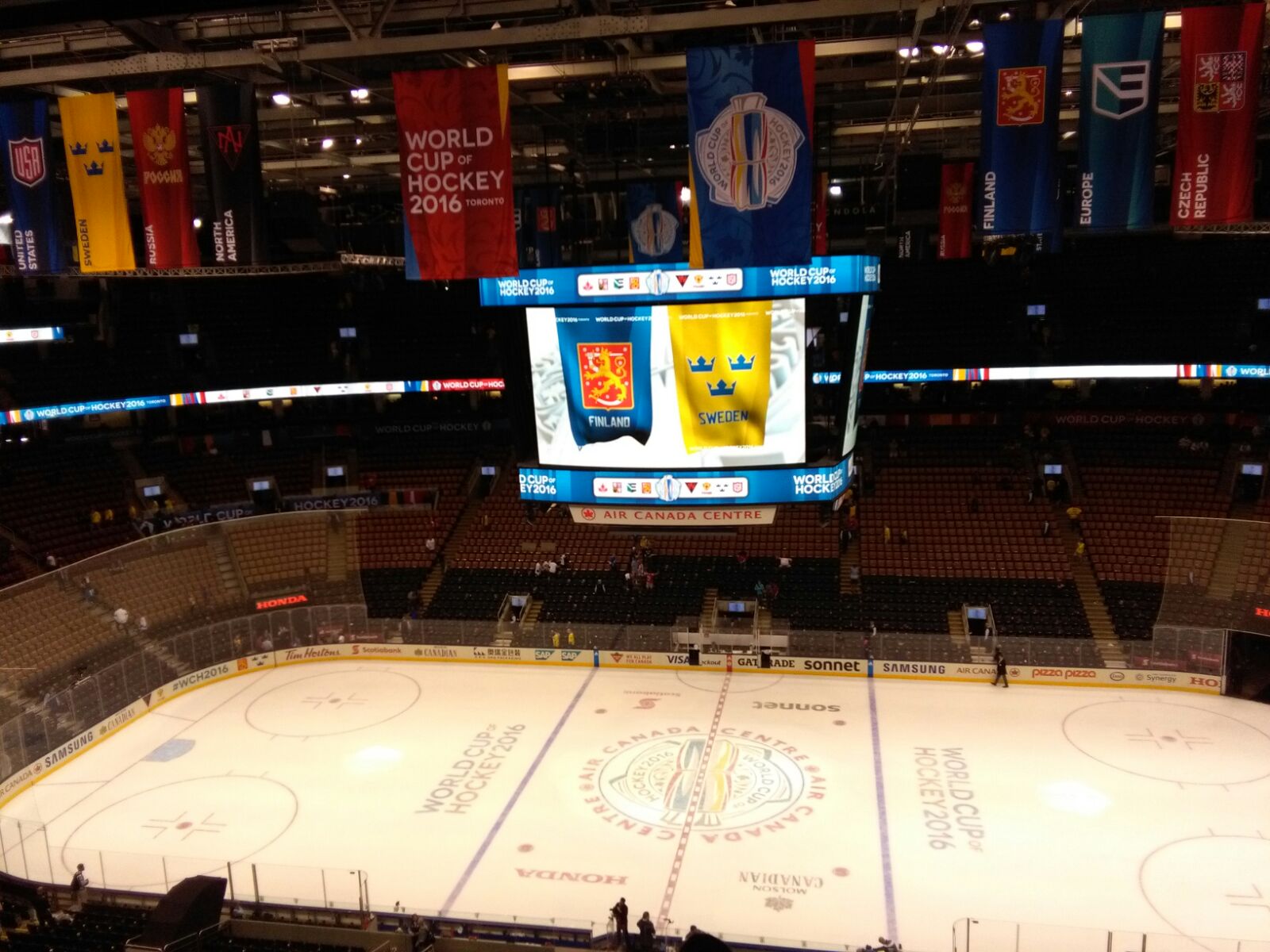
The Maple Leafs play their home games in the impressive indoor arena of the Air Canada Centre, located in downtown Toronto just behind Union Station. The arena also hosts Canada’s only existing NBA team, the Toronto Raptors. They can apparently change over from one sport to another in the space of just six hours. During my visit the Centre was also hosting the Ice Hockey World Cup, that’s the entire World Cup schedule, kind of like the idea for the Centenario in Montevideo for the first football World Cup in 1930.

a9f7051e-e55c-44e5-beb3-acdaffa6bf25

Toronto Maple Leafs hall of famers

The hockey World Cup isn’t really comparable with the current version of the FIFA World Cup however, it features only 8 sides for a starter, it occurs somewhat irregularly and features a couple of what you might term hybrid teams. This edition was the first World Cup held since 2004 and only the third ever overall. The World Cup itself was a successor to the invitational Canada Cup tournament that had been held from the 1970s onward. The idea is that in future the World Cup will be held regularly in four year cycles in the month of September. There are a few obvious advantages to this, the International Ice Hockey Federation’s (IIHF) annual World Championship tends to take place during the playoffs of the NHL season meaning that many top players are not released to take part. As the World Cup is organised by the NHL before their pre-season begins it will avoid this conflict and in theory ensure the best players can compete.

Those taking part in the tournament include International Hockey’s “Big Six” of the USA, Canada, Russia, Czech Republic, Sweden and Finland as well as “Europe” a team made up of the best of the rest European players from Austria, Denmark, France, Germany, Norway, Slovakia, Slovenia and Switzerland. The eighth side was North America, a Canada/USA selection of players aged 23 or under which also had the effect of making the individual Canadian and USA teams to be made up of players aged 24 and over.

57e3baec-e727-4427-b69b-e877c81fee5a

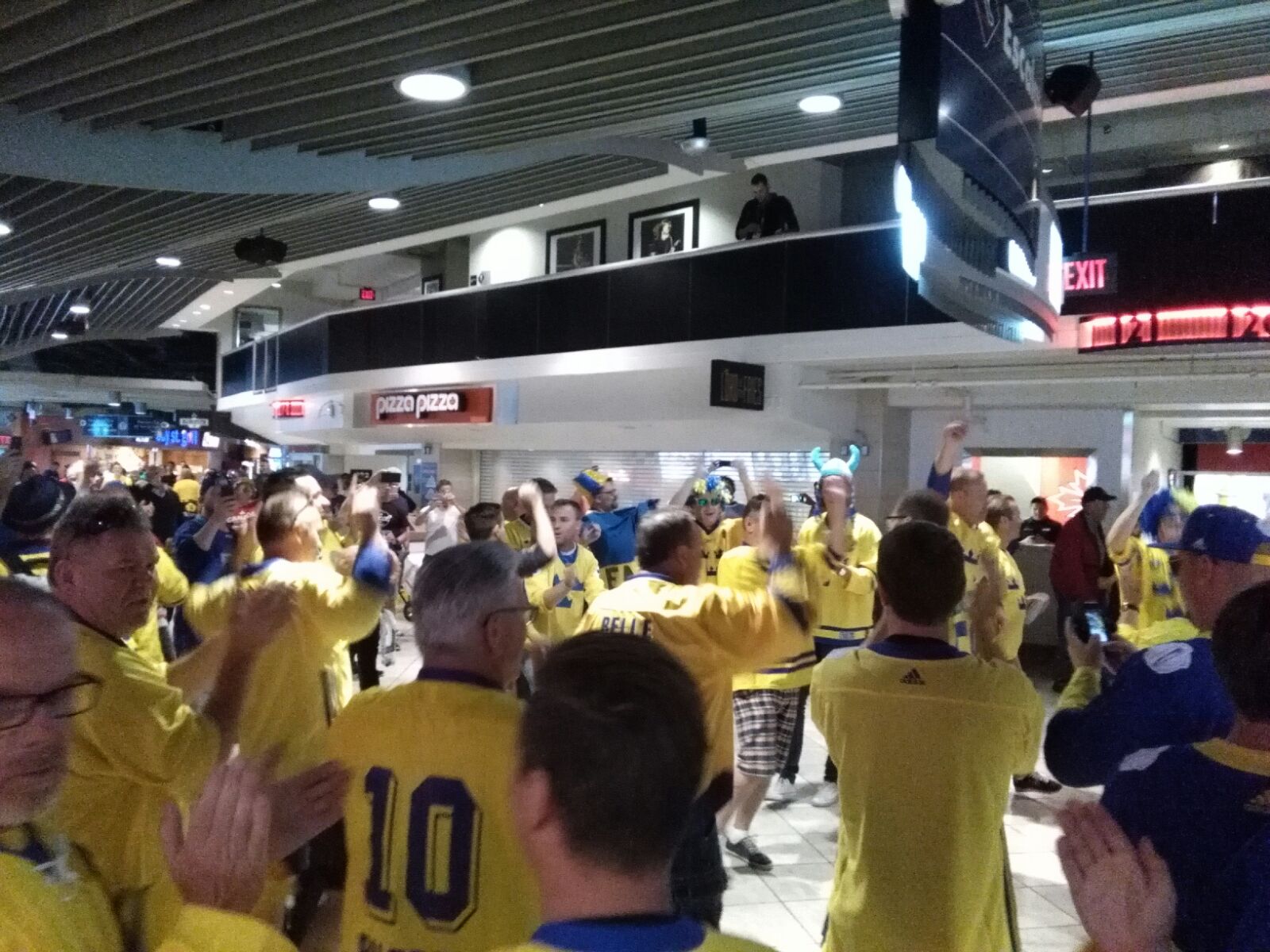
Swedish fans singing before the game

It was refreshing to be in a North American city and experience something close to the atmosphere you might find in a European city ahead of a big qualifying game in football, if not quite a full-on tournament atmosphere. There were plenty of yellow and blue clad Swedish fans along with reds of the Czech Republic and the blues of Finland populating the bars and patios of downtown Toronto and they were in full voice. Any game involving Canada, the USA or indeed the North America side were all sold out but we did manage to get tickets for the nosebleed seats for the Sweden v Finland game.

79a5f077-2f20-4adb-9887-3999b92ad328

The puck drop was set for 3pm and it felt we were swamped with Swedish fans. This being a modern 20,000 seat venue in North America there were plenty of places to grab merchandise and a drink. They do of course allow you to supersize that, you could get a 25oz beer which is a close to about two pints I think.

As I said the arena capacity is just under 20,000 so it was disappointing that the crowd was only around the 12,000 mark. I’d blame the pricing, we’d been cheapskates and got tickets for about $30 each and the seats all around us were full with a fair few locals in among the Swedes and Finns. However the more expensive seats, in the $100+ price range remained mostly empty.

bb7f0f92-4217-40df-9657-6158a9e81446

Team line-ups

Both squads (apart from a couple of Russian based players in Finland’s party) were comprised of NHL based players. The most prominent probably being the Swedish twin brothers Henrik and Daniel Sedin who both play for the Vancouver Canucks and for Finland it would probably be Minnesota Wild captain Mikko Koivu or goaltender Tuukka Rask.  The Finns started the brighter and seemed to play the better hockey in the first period but we weren’t to be provided with a goal. We were kept interested with another round of beers and some chanting from the predominantly Swedish crowd.

In the second period the Swedes came into the game a bit more with the Sedin brothers combining to set up Anton Strålman for the first goal. While Finland came back into the game and forced Sweden’s goal-tender, Henrik Lundqvist of the New York Rangers into a number good saves. The Finns continued to press for an equaliser in the final period, even committing Rask their goalie forward only to be caught out by a very late Swedish counter-attack with Loui Eriksson of the Vancouver Canucks scoring into the open goal. The win guaranteed the Swede’s progression from the group stages while Finland needed a miracle, something their crestfallen fans seemed well aware of.

319dfca6-cfb0-4281-a2fd-d906406ede16

Some disappointed Finland fans

Sweden would be knocked out the semi-final be the Europe selection, who would be defeated in the final by the heavy favourites Canada. It gives a Canada some what of a clean sweep as they are now World Champions, World Cup winners and Olympic Gold medallists and clearly the most dominant hockey team in the World. If the World Cup does gain some traction and some manages to become a regular fixture and not just a glorified warm-up to the NHL season then it could be the international competition with the highest player quality levels.

While not quite a global festival of sport it was still a chance to see some of the best players of the sport in international competition. Watching and reading the media coverage of the tournament there did seem a genuine pride and indeed novelty for the players taking part, many of whom had previously had scant opportunity to represent their nations.