
Thomas Blackstock and the outcasts – the story of the PFA
A guest post by Fergus Dowd
On the 8th of April 1907, Thomas Blackstock bid farewell to his wife and made his way to the Manchester suburb of Clayton. As the Scot walked through the streets of Manchester, he wondered if today would resurrect him back into the first team. That first team was Manchester United’s, and Tommy’s final destination was the stadium at Bank Street, known locally as the Bradford and Clayton athletic ground.
Blackstock had arrived in Manchester from the mining town of Cowdenbeath in June 1903; it was then a football club languishing in the second division which had recently survived a winding-up order.
Four months earlier, Newton Heath football club was grappling with severe debt; £2,700 to be exact was required to keep the club operating. Step forward several local businessmen led by John Henry Davies who would save the club from liquidation; Davies would become club president and Manchester United would be born.
Ernest Mangnall was installed as United boss, a man who believed in physical fitness over technique and skill.
He is the only man to date to have managed both Manchester clubs; Tommy was one of his first signings.
By season 1905/06, Blackstock was part of a United defence that only conceded 28 goals clinching the second division title. Funded by the monies from Brewery owner Davies, Mangnall went on a spending spree which saw the superstar of the day Billy Meredith arrive at Bank Street. Disappointingly for Tommy, another new arrival was Herbert Burgess from rivals Manchester City who would go on to manage AC Milan and would replace him in defence. This led to Tommy lining out for United reserves on that Spring day against St. Helens Recreation F.C. at Bank Street. Ten minutes had elapsed when Tommy with no one around him leaped up to head the ball; after connecting with the ball he collapsed and lay unconscious on the ground. Tommy was carried off the pitch and was brought to the sanctuary of the dressing rooms; sadly he was pronounced dead soon after.
In the inquest, to his death, the Manchester City coroner concluded Tommy Blackstock had ‘died of natural causes’ a possible fatal seizure after heading the ball. In the press comparisons were made with David ‘Soldier’ Wilson who had fought in the Boer War; Wilson had collapsed and died from heart failure playing for Leeds City a year earlier. Although as the United game was only ten minutes in heart failure seemed an unlikely cause of death. On April 11th, 1907 the town of Kirkcaldy came to a standstill as Tommy Blackstock was laid to rest, aged twenty-five, with family mixing with local officials and club representatives.
To compound the tragic loss for Blackstock’s family given the coroner’s report Manchester United withheld the insurance money due to his next-of-kin. This terrible treatment of Blackstock’s family and the upholding of the insurance money sparked his fellow teammates into action specifically Charlie Roberts, Billy Meredith, Sandy Turnball, and Oscar Linkson. Roberts had arrived in 1903 like Blackstock for the sum of £600 from Grimsby Town, he had previously come to the attention of the Football Association as rebelliously wearing his shorts above the knee.
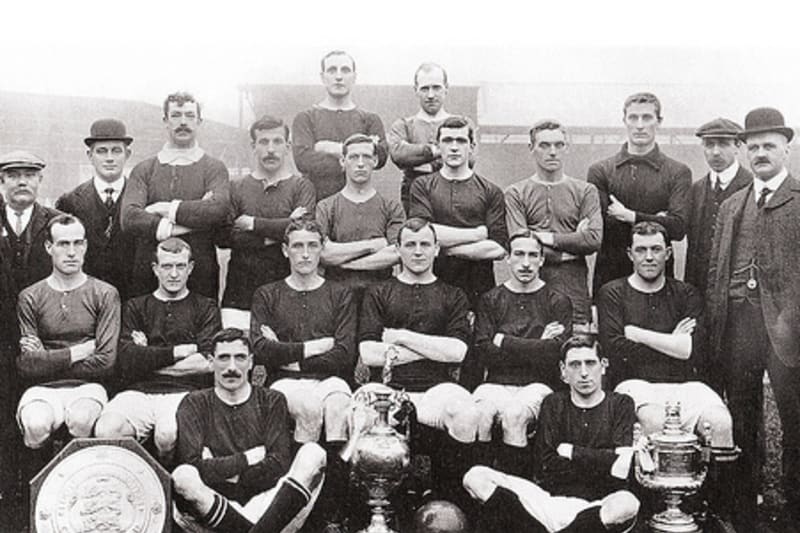
A centre half by trade Roberts would lead United to their first title in 1908 followed by FA Cup success in 1909 and another first division championship victory in 1911. However, eight months after Tommy Blackstock’s death Roberts and Meredith were sitting at the top table in a room in the Imperial Hotel, Manchester as the Association of Football Players’ and Trainers Union was formed. The groups aims the freedom of movement of players, an increase in the £4 maximum wage, and obtaining the same employment rights for footballers as other workers. At the annual general meeting of the football association in 1908, the union’s call for the maximum wage to be increased fell on deaf ears as £4 was reaffirmed. Although the possibility of a bonus system was raised whereby players could prosper from club profits. The AFPTU continued to negotiate with the Football Association, but by April 1909 things had drawn to a halt without any agreement.

In June of that year the FA announced that all footballers should resign from the AFPTU, they were given until July 1st otherwise their registrations as professionals would be cancelled. Most did except for the players at Manchester United who found themselves suspended by the club for their refusal to leave the union; the English media aptly named them ‘The Outcasts’. One of those who did resign but continued negotiations with the FA was Geordie Colin Veitch who played for Newcastle United captaining the Magpies to league success in 1905, 07, and ‘09 alongside the FA Cup in 1910. By August 1909 as Veitch was celebrating another league title and Roberts and Meredith were stubbornly refusing to budge from the union they had founded the FA relinquished on its position. In the city of Birmingham on the 31st of August word came through from a FA meeting that professional footballers would be allowed to be members of the AFPTU.

The Red’s first game of the season in 1909 at Bank Street was against Bradford City as the United team ran onto the pitch the crowd could see each team member wore an AFPTU armband. For those involved in the AFPTU most would never play for their country again, Roberts never represented England again due to his union activities even though he was described as a defender with exceptional ability and truly an inspirational captain. He also missed out on a testimonial at United which would have guaranteed a send-off of £500 a king’s ransom in those days. Roberts left United in 1913 for Oldham Athletic as the great war began a year later and football continued; he captained the Latics to second place in the first division as United struggled narrowly avoiding relegation in the final season of 1914/15. As the war across Europe continued football was cancelled, Roberts hung up his boots. He would still fight for the rights of footballers working as chair of the AFPTU and helping to get the maximum wage up to £9 and bonuses paid to players.
Sandy Turnball who had supported Roberts with his Union activities perished at the Battle of Arras in France; the war memorial at Gorse Hill not far from United’s modern-day stadium bears his name.
Billy Meredith, a coal-miner before he turned professional at eighteen would stay on at Manchester United until 1920, playing well into his forties. One of Roberts other comrades Oscar Linkson would leave United for the Emerald Isle in 1913 and play in an infamous Dublin derby between Shelbourne and Bohemians to the backdrop of the great Dublin lockout.
Today eight minutes from Bank Street is the PFA offices housed in the Bishopsgate area of Manchester; it seems apt that the union founded by Roberts and the Outcasts still flourishes as a pivotal organisation in the world of modern football.
 A Bohemian Sporting Life