
Alex Stevenson – solving a football mystery?
Sending a message home
In a soccer column in the pages of a regional newspaper there is a short, sad story, based on a message passed onto the author by a local man. In among the snippits about Waterford’s form going into their game with Finn Harps and the need for more referees in the junior leagues, there is a report of a frail, ill man in his seventies, feeling lonely in a hospital in Liverpool. It ends with the line “and now comes word that he would welcome hearing from old friends in a difficult time”. It was a sad situation for anyone to find themselves in, but when one considers the man in question was one of the greatest footballers of his era, beloved by crowds for his skill, trickery and cheekiness then it seems even more strange that he should find himself in that situation.
The man in question was Alex Stevenson. Mention of his plight appeared in the pages of a Waterford newspaper in November of 1984, the heart issues with which he was suffering sadly didn’t abate and by September 1985 Alex Stevenson had passed away in Liverpool aged 72. One of those who did reach out to him before he passed away, and perhaps recorded the last ever media interview with the Everton legend was Irish journalist Seán Ryan.

This last interview was published in the Irish Independent the day after Alex’s death under the headline “The football mystery that Alec Stevenson never solved”. While Stevenson spoke with Ryan about various aspects of his successful career the main point of concern from Stevenson was addressing speculation as to why he had to wait fourteen years between his first and second caps from the FAI. As one of the most feared and skilful inside-forwards in Britain, a league winner in both Scotland and England, surely there must have been some other reason for his non-selection? Was it down to the clubs he played for? Was it down to his religion?
I was accused of refusing to play for the FAI because I was a Protestant… but religion never came into it for me. The funny thing was I was never picked by the FAI until after the War but I got all the blame for it!
Alex Stevenson quoted to Seán Ryan in the Irish Independent – 3rd September 1985
We’ll explore the reasons why but first some more background on Alex’s life.
In Dublin’s fair city
Alexander Earnest Stevenson was born in Dublin’s Rotunda Hospital on the 12th of August 1912 as the fourth child of Alexander and Rosalina (often listed as Rosaline) who were living on Richmond Road at the time. While the family moved around quite a bit, with addresses at Cadogan Road, Fairfield Avenue, Northbrook Avenue they always remained close to that same North Strand-East Wall district. Both Alexander Stevenson and Rosalina Caprani were from the area and they didn’t move far from their respective families who had been neighbours on Leinster Avenue. They were married in North Strand Church in 1905 in a Church of Ireland service. The Stevenson and Caprani families were deeply connected, Alexander’s younger sister Robina later married Rosalina’s brother Henry in 1914.

Alexander Senior (our footballer’s father) was the son of yet another Alexander, a Scottish Presbyterian who had likely moved to Ireland in the late 1870s or early 1880s and took up work in Dublin’s extensive printing trade. Rosalina was the daughter of Joseph and Anna Caprani. Joseph was a Catholic, born in Como, northern Italy who likely arrived in Dublin in the early 1860s, while Anna (sometimes listed as Hannah) was originally from Cork and was a member of the Church of Ireland. Their children seemed to be baptised into either religion without any particular pattern, some sons and daughters were listed as Catholics, others, such as Rosalina were Church of Ireland. Based on the current FIFA eligibility criteria Alex Stevenson could have played for Ireland, Scotland – through his paternal grandfather, or Italy – through his maternal grandfather. It is an interesting idea, Stevenson the Irish Oriundo, playing for the Italian world cup winning teams of the 1930s, he certainly had the talent.
Joseph and many of the Caprani family were involved in the printing and compositing trade, another connection apart from geography which linked them with the Stevensons, scions of the family would achieve levels of fame and notoriety for various reasons; Joseph Desmond (J.D.) Caprani (1920-2015) was captain of the Irish Cricket team, while Vincent Caprani (b. 1934) is a poet, writer and historian who has also helped to mythologise figures from Ireland’s sporting past in his stories. Alexander and Rosalina raised their children in the Church of Ireland, Alexander having migrated from Presbyterianism. He would later become involved with local football, with the St. Barnabas club who were based out of the Church of St. Barnabas on Sheriff Street, as well as with the Leinster Football Association, serving on various committees.

As a teenager Alex began playing with St. Barnabas, alongside his older brother Henry, it didn’t take long for them to find success. While still just 17 Alex, along with Henry, helped St. Barnabas to victory in the 1930 Leinster Junior Cup final win over Seaview after two gruelling replays. Within a year Alex was being called up for an Irish Junior international against Scotland in Falkirk. A battling performance saw Ireland lose 3-2, with Stevenson one of the stand-out performers. There were plenty of clubs interested in his signature including Shamrock Rovers and Hearts, but Arthur Dixon, the shrewd player-manager of Dolphin had spotted Stevenson and secured his signature before the Junior international match was played. Alex’s starting wage was £3 a week with a £1 bonus for win but it meant he got to leave work as a docker and focus on his football full time.
Swimming with the big fish… and Dolphins
Alex was to spend just a year with Dolphin but it was to be an eventful one. Dolphin were one of the glamour clubs of Dublin in the 1930s, originally founded in Dolphin’s Barn, but by Alex’s time playing out of Harold’s Cross they had a reputation for good football and for bringing in quality players from Britain. Arthur Dixon, an English man who had spent most of his career in Scotland with St. Mirren, Rangers and Cowdenbeath was obviously brought in as player-manager to help with this recuitment. Aside from Alex, most of the Dolphin side were Scottish players, usually paid £5 a week rather than the £3 Alex was getting. There were a few other locals in the side however, including Larry Doyle, capped that season against Spain, and Jeremiah “Sam” Robinson, another international who had been part of the all-conquering Bohemians team of the 1927-28 season.
The diminutive Stevenson soon began demonstrating his skills surrounded by these more experienced pros. A lightweight inside-forward who would later draw comparison with the likes of Hughie Gallagher, Alex James and Patsy Gallagher, Alex possessed great ball-control, a range of passing, and bags of tricks. Also for a man only 5′ 5″ tall and weighing just 10 stone he possessed a deceptively powerful shot. In that one full season Stevenson helped Dolphin to a 3-0 victory over Shelbourne in the Leinster Senior Cup, while they also reached their first ever FAI Cup final. They lost a tight game 1-0 to Shamrock Rovers, with the mercurial Paddy Moore scoring the only goal of the match as Rovers extended their stranglehold over the cup.
Moore was from the same area around the North Strand as Alex and was only three years older, they likely would have known of each other growing up. Both men are emblematic of a certain type of Irish footballer – the small, skilful, flamboyant, “street footballer” of Dublin’s inner city. Perhaps the most recent comparable modern footballer in terms of size and style would be Wes Hoolahan, born some 70 years after Stevenson. Wes grew up in nearby Portland Row and would have honed his talents on the same streets as Moore and Stevenson.
Both Moore and Stevenson would line out for Ireland towards the end of that season, just weeks after the Cup final. Amsterdam was the destination and the Dutch national team were the opposition Paddy Moore had made a scoring debut for Ireland the previous year and would win his second cap, Alex would win his first and both played well in a 2-0 win for Ireland with Moore and Brideville’s Joe O’Reilly getting the goals in front of a crowd of 30,000.
Moore, O’Reilly and Jimmy Daly were all signed up by Aberdeen after their performances in that game, within weeks Alex Stevenson would be following them to Scotland.
An intrepid Ranger
In July of 1932 Arthur Dixon returned to Ibrox as a trainer to become part of Bill Struth’s backroom team. He had been part of a hugely successful Rangers side as a player in the 1920s, making over 300 appearances and winning six league titles with the Glasgow club, and he wasn’t returning to Ibrox empty-handed. A month after Dixon arrived back Alex Stevenson was signed on his recommendation. A fee of £250 was reported with Rangers also agreeing to play a game in Dublin against Dolphin with the proceeds being split.
To date he is the only player capped by the FAI at senior level to be signed by Rangers, a club whose Irish recruits had tended to come more from Belfast than from Dublin. It has long been alleged that Rangers, from the 1920s onwards had operated a policy of not signing Catholics, a policy, along with the strong Irish connections of their rivals Celtic that tended to make Rangers unpopular to many Irish football fans. Dixon when signing Stevenson would have known he was a Protestant due to his association with the St. Barnabas club and their connection to the Church of the same name. Among various theories suggested for the fact that Alex went so long before winning a second cap from the FAI was of an anti-Rangers bias because he had chosen to sign for the club.
Things started slowly at Rangers, there were suggestions that some thought him too lightweight for first team football, and he only made one league appearance for the first team in the season he signed. He did however, play in the match against Dolphin arranged as part of his transfer. This game was held in Dalymount in April 1933 and Rangers featured a strong starting XI including their stars Alan Morton, David Meiklejohn, goalie Jerry Dawson, and the Irish (IFA) international striker Sam English. It was English who scored twice in a 3-1 win for Rangers, though the scores were tied with less than ten minutes to go in the game.
The following season would prove more successful, in eleven matches at inside forward he scored seven goals and was described as having all “the craft that goes to make a star”, such was his success that interest soon developed from other clubs, especially Everton who were tracking him closely from the end of 1933. Initial reports on Stevenson had expressed concerns about his small physique but eventually these were dismissed as Stevenson continued to impress. While Everton were readying to make a move Stevenson was selected for all three of the Home Nations games by the IFA, the highpoint being a 2-1 win over Scotland, a game where he first lined out with his future Everton teammate Jackie Coulter.
Rangers meanwhile signed Scottish international Alexander Venters as a replacement for Stevenson as the latters move to Everton was being ironed out. It would take until the start of February 1934 for Alex’s move to Merseyside to be confirmed but the Toffees had finally gotten their man. After 18 months in Scotland his transfer fee had risen from the £250 plus a friendly paid by Rangers to the £2,750 paid by Everton. He had also done enough that season to secure himself a Scottish League winners medal before his move. Some later reports incorrectly stated that the fee was a whopping £37,000, however this would have meant that the Stevenson transfer would have broken the then world record by £14,000!
Mickey Mouse goes to Dixieland
Alex was joining an elite side, Everton were F.A. Cup holders when he joined and had been league Champions the season before that, expectation was high. They featured the great Ted Sagar in goal, one of the longest serving players in Everton history, the classy wing-half Cliff Britton who had helped inspire them to the Cup, Irish international Billy Cook who had won both the Scottish Cup and F.A. Cup and of course there was William Ralph “Dixie” Dean, or just Bill to his friends.
The 1933-34 season was to be a tough one for Dean, he spent most of the year ravaged by injury, only managing twelve league appearances and nine goals, his lowest return for a full season with Everton. Dean would return as the team’s top scorer the following year and he and Stevenson developed a strong rapport, Dean feeding off Stevenson’s clever passes and returning the favour as Dixie nodded down crosses for Alex to unleash one of his trademark, cannon-like strikes. One other player to join just weeks after Alex was Jackie Coulter, who had featured at outside left in the game against Scotland. They were to become the first of a number of great double-acts during Alex’s career.
While Alex was small and lightweight, Coulter was a somewhat more imposing physical specimen especially with his huge size 12 boots. He was dubbed the “Jazz winger” by the Goodison faithful and he and Stevenson developed an excellent almost telepathic understanding. It also endeared them to the crowds that both men were born entertainers, full of individual skill and trickery that was magnified by their play as a duo.

If Coulter was the “Jazz Winger” then Stevenson was dubbed “Mickey Mouse” because of his small stature. His Ireland teammate, the legendary Peter Doherty referred to Stevenson as the “Mighty Atom”, a sobriequet used for the another talented Irishman full of trickery from an earlier era, Celtic’s Patsy Gallagher. To many other Evertonians he was just “Stevie”.
Coulter and Stevenson combined in perhaps one of the most famous F.A. Cup ties in history, a fourth round replay against Sunderland in January 1935 witnessed by a crowd of 60,000 in Goodison Park. In a game full of incident the Irish left wing partnership of Coulter and Stevenson were on fire and with 16 mintues left to play two goals from Coulter and one from Stevenson gave Everton a 3-1 lead. Stevenson even provoked laughter from the crowd by trying to barge (the much larger) Sunderland keeper Jimmy Thorpe into his own net. Something still common in the rough and tumble English game at the time, (indeed tragically Jimmy Thorpe would die a year later after being kicked in the head during a game against Chelsea at Roker Park). With Alex this perhaps showed both his committment as well as his ability to play to the crowd. And while Stevenson “controlled the show, delighting the home crowd with his trickery and skill”, Sunderland began to rally, scoring two late goals to take the match to extra-time, Coulter got his hat-trick but Sunderland equalised again before two late goals from Albert Geldard sealed the victory for Everton.
In that first full season with the Toffees Stevenson played 41 games and scored 18 goals in all competitions. His signing was hailed as the bargain of the decade as he immediately cemented his place in the first team while making his name as one of the most skilful and entertaining inside forwards in British football. In the 1936-37 season as Everton were stuggling in the lower half of the table Alex had one of his best seasons, playing 44 games and scoring 21 goals, second only to Dean in the scoring charts. Everton were also a team in transition, the great Dixie Dean was slowing after years of injuries, from football and a motorcycle crash as a younger man. Tommy Lawton was brought in as his long term replacement. Jackie Coulter moved to Grimsby Town, a leg break while playing for Ireland against Wales took him out of the game for a year and sapped some of the magic from his game. T.G. Jones, an elegant and skilful centre half was signed from Wrexham and a young Joe Mercer was establishing himself in the team.
After some mediocre seasons by their recent standards, towards the end of the 30s Everton were ready to challenge for honours again, and Alex Stevenson had a new partner at left wing, Wally Boyes, signed from West Brom and even smaller than Stevenson at only 5′ 3″ , they formed a fantastic new partnership, while Tommy Lawton was now securely installed as Dean’s successor at centre forward. The 1938-39 season would be one of Everton’s best, they would finish as league champions, Lawton scoring 34 from 38 league games and Stevenson finishing with 11 goals, the third highest scorer in the side. His teammate Lawton was in no doubt of Stevenson’s talents, describing him as:
“A great player, greater to the player close to him than to the crowd perhaps… and is one of the finest footballers who have ever kicked a football on an English ground.”
Lawton on Stevenson
The title race was tightly balanced with Wolves pushing Everton all the way. Coming into the final stretch the Toffees faced three matches in just four days during April. In the first game Everton beat Sunderland 2-1 in a Good Friday fixture at Roker Park. There then followed a lengthy train journey to London, where Everton faced Chelsea the following day. Everton laboured and with twenty minutes remaining the scores were still goalless. Then Stevenson intervened with what Lawton dubbed the ‘miracle’ of Stamford Bridge – . Alex had scored the opener after a knockdown from Lawton, before Torrance Gillick secured the victory with a late second. Two days later Everton trounced Sunderland 6-2 in Goodison with Alex again on the scoresheet. The title was all but secured 5 days later after a draw with Preston North End. Recalling Stevenson’s goal against Chelsea his teammate Gordan Watson remembered it as “a great moment because Stevie had played so well all season, he was probably our most consistent player – and that’s saying something because we were a great side”. That title-winning season with Everton was perhaps Alex’s career highlight.

By this stage Stevenson has also established himself as first choice with the IFA selectors and by the mid-30s they possessed a formidable pair of supremely talented inside-forwards in the shape of Stevenson and Peter Doherty. By the time he had become a League champion with Everton, Alex had been awarded 14 caps by the IFA (who continued to select players born in the Irish Free State for a further decade) and had scored four goals.
Alex Stevenson was just 26 when he lifted the English league trophy, an established international and viewed by his peers and the public as one of the most skilful players in Britain. He must have felt confident that his best years were ahead of him. He had got married in 1937 and his with Ethel was pregnant by the beginning of the following season, a bright future on the horizon. However, with the 1939-40 season just three games old all football was suspended, the World was at War.

Wartime action
With football suspended and the footballers of Britain effectively out of work there were few options for the players. Many joined the armed forces and fought during World War II, others found employment in war industries like munitions factories, there was also a newly appealing option for footballers who wished to continue playing League football. The League of Ireland continued, uninterrupted as the Irish Free State adopted the policy of neutrality during the War. Internationals like Willie Fallon and Bill Hayes returned from England to play for the likes of Shamrock Rovers and Cork United respectively. The later months of 1939 were full of rumours about which star player was next going to turn up in Ireland – Jackie Carey? Peter Doherty? And even Alex Stevenson?
While Carey would make a couple of wartime appearances for Shamrock Rovers, he Doherty and Stevenson would all joined the armed forces, in Carey’s case it was the British Army while in the case of Doherty and Stevenson, it was the RAF. Stevenson, who had been linked with moves back to Ireland to either Shelbourne or Limerick signed up with the Royal Air Force in November of 1940. A journalist with the Evening Express was moved to remark;
“One of the finest inside-forwards football has seen in a decade goes to do his bit. I wish him the best of luck – and many more games with his beloved Everton.”
Evening Express – November 14th, 1940
And there were indeed plenty more games, despite his committments as a ground crew member of the RAF Stevenson still played plenty of football during the war years, some 206 games (and 91 goals) with Everton in the war time competitions, as well as guesting for the likes of Tranmere and Blackpool and lining out for various representative sides as part of matches within the armed forces. Like many footballers Alex lost some of the best years of his career to the War, while competition could be haphazard and the standard of opposition clearly wasn’t as high he still competed against many of his former adversaries in the wartime leagues and Everton performed well. Observers at the time stated that Alex played some of his best football during this period.
Towards the end of the War Alex ended up based in India for a short time and didn’t return to England until the end of 1945. League football didn’t return until the 1946-47, and though the 1945-46 season did feature a return of the FA Cup but league football was still regionalised.
Peacetime and the Greening of Goodison
As the 1946-47 season began Everton were in the unusual position of being defending Champions after a gap of seven seasons, they returned to the league with several of those who had been part of that title-winning team, however many of those players were now diminshed in their footballing capacities. Also several key men from the title-winning campaign had left the club – centre forward Tommy Lawton had moved to Chelsea, while Joe Mercer, then coming into his prime was was sold to Arsenal before the end of the season. Both of these moves were at least in part motivated by the prickly and divisive Everton manager Theo Kelly. Lawton, Mercer and Dean before them, had all fallen foul of Kelly with Dean describing him as “an autocrat and despot“.
Despite his nature Kelly had done a good job as manager in maitaining Everton’s finances and he had recruited new, young players to boost the squad. With Lawton’s departure more firepower was required and Jock Dodds, a prolific scorer for Blackpool before and during the War was recruited after a short spell with Shamrock Rovers. Also recruited from Rovers were Peter Farrell and Tommy Eglington, for a combined fee of £3,000. Eglington would displace Wally Boyes on the left wing and he and Stevenson would form an all-Dublin left-flank for the Toffees.
Everton finished a disappointing 10th that year while their city rivals Liverpool compounded matters by winning the title. The 34 year old Alex Stevenson remained one of the side’s better players that year, playing thirty games and scoring eight times and helping Eglington establish himself in the first team, in what was perhaps his third, and final, great Everton partnership – Coulter – Boyes – Eglington. Stevenson even introduced his young Dublin partner to the joys of golf on Bootle golf course.
There was also a call-up from the FAI. Alex Stevenson would win his second cap 14 years after his first – still a record – and the opposition couldn’t have been more significant. It would be the first time that England would play against Ireland since the split from the IFA in 1921.
Rangers? Sectarianism? – and the exclusion of Alex Stevenson
But why was Stevenson not selected for 14 years? Already an international by the time he left Dolphin he had won a League title with Rangers and one with Everton while establishing himself as one of the most skilful and entertaining forwards in Britain. We can certainly rule out a lack of talent on Stevenson’s behalf. He had also been capped 14 times by the IFA in the intervening period.
We also know from later interviews that it was nothing to do with Stevenson himself refusing a call-up, he had approached both Theo Kelly of Everton and Joe Wickham of the FAI to seek clarity on the issue.
“To clear up the mystery I remember approaching Theo Kelly who was Secretary-Manager of Everton and asked him if they would release me but he wouldn’t discuss the matter… in the 50’s I tried to clear the matter up by speaking to Joe Wickham but he never divulged anything. It’s still a puzzle to me.”
Stevenson interviewed by Seán Ryan in the Irish Independent 3rd September 1985
The answer lies in the, now-digitised, records of Everton Football Club. The minute books reveal that the FAI made regular and repeated attempts to call-up Stevenson to international squads throughout the 1930s but at each point were refused by the club’s management. As early as February 1934, just a month after joining Everton, the FAI requested his release for the World Cup qualifying match against Belgium. This was the famous 4-4 draw in Dalymount where Paddy Moore scored all of Ireland’s goals. It had been noted in the Everton minutes that:
“Irish Free State v Belgium. Application from the Irish Free State F.A. for release of A.E. Stevenson to play in this match on the 25th inst. was refused. Chairman reported that the Football League were not desirous of players to be release for this match.”
Everton minute books
A further request was made by the FAI for Stevenson’s release which was again rejected. If, as suggested above, the Football League had issued a notice to the effect that players should not be released then it is clear to see just the sort of challenges that the FAI faced to putting out their strongest international team. The Chairman of the Football League at this time was in fact an Irishman, John McKenna, born in Co. Monaghan in 1855 he had moved to Liverpool as a young man. In Liverpool he met John Houlding, and through him began an involvement with. first, Everton and later Liverpool F.C. that would later see him become, Secretary and then Chairman of Liverpool. In correspondence with Everton later in 1934 about the release of Stevenson for a match with Hungary, the FAI secretary Jack Ryder pointed out that FAI delegates had been assured personally by John McKenna that the Football League would not prevent players born in the Irish Free State (contrary to the message communicated to Everton, of which the FAI were no doubt unaware) from representing their country. These entreaties fell on deaf ears. Stevenson was not released and the true attitude of John McKenna and the Football League towards the release of players seemed to be against the release of players to the FAI.
The Belgium game was far from a one-off, applications had been made for Stevenson’s services by the FAI for matches throughout the decade. Release for games against the likes of Switzerland, Germany, Hungary and others were refused by Everton. This was not necessarily all that uncommon, as mentioned there was a general lack of support across many British clubs for the release of players to the FAI, Jimmy Dunne went six years between his first and second caps, this period coincided with the best football of his career with Sheffield United and Arsenal. He won the majority of his FAI caps when he was back in Dublin playing for Shamrock Rovers.
There was also the complicating factor that because the IFA continued to select players from the 26 counties the same players’ services could be requested for two different dates by two different Associations. In the 1930s and 40s there were not agreed international breaks and because the IFA continued to compete in the Home Nations Championship, which were held on dates agreed by the IFA, SFA, FAW and English FA, they were always likely to be the beneficiaries. Added to this mix was the personality of Theo Kelly the Everton Secretary-Manager, while his name might suggest an Irish connection Kelly’s father was from the Isle of Mann and his mother was from Cornwall. He also had a track record of complaining about losing players to international call-ups and even wartime charity matches!
While Theo Kelly would remain in charge of Everton until the early 50s the attitude towards the releasing of players for matches under the jurisdiction of the FAI changed after the War. Both Stevenson and Eglington were released for the game against England in 1946. By this stage the FAI were more than 25 years in existence and perhaps the fact that there were now several players in the squad who would want to play for their country changed the thinking of the Everton management? Another possible reason was an improvement in relations between the English FA and the Football League, with the FAI in 1946 after a conference meeting in Glasgow. Agreements were made at this conference regarding the regularisation of transfer of players between the leagues, the recognition of “retained players“, as well as the scheduling of representative games between the various leagues and the League of Ireland. By 1950 the issue about the same player being selected by both the FAI and IFA had also ceased after the FAI requested FIFA’s intervention.
Whatever the precise reasoning Alex Stevenson was to make up for some lost time, he would make six appearances in two years, starting with that game against England in Dalymount. The English fielded a strong side featuring Frank Swift in goal and the likes of Billy Wright, Neil Franklin, Raich Carter, Wilf Mannion, Tom Finney and Alex’s old teammate Tommy Lawton. Ultimately, the English would triumph, a Tom Finney goal scored eight minutes from time was enough to secure a win that many in the English press thought would come easily (England had beaten the IFA XI 7-2 just days earlier). However, the Irish had rattled them, and Alex Stevenson had rattled the crossbar with a rocket of a shot which almost put Ireland ahead in the second half. Summing up the match Henry Rose wrote the in the Daily Express that
“If ever a team deserved to win Eire did. They out-played, out-fought, out-tackled, out-starred generally the cream of English talent, reduced the brilliant English team of Saturday to an ordinary looking side that never got on top of the job.”
Aside from the England game perhaps the most noteworthy of Alex’s subsequent matches was a 3-2 victory over Spain in 1947 in front of over 40,000 fans in Dalymount. Alex, joined by Everton teammates Farrell and Eglington battled back from a 2-1 deficit and defeated Telmo Zarra and Co. thanks to a goal from Paddy Coad and a brace from West Brom striker Davy Walsh. Alex, by then 36 played his final match for Ireland was in December 1948, in a 1-0 defeat to Switzerland in Dalymount.
Goodison goodbyes
Although he still appeared regularly for Everton the number of games became less frequent, over his final two seasons Alex played thirty-seven times for Everton and chipped in with five goals. He had also begun his coaching career, taking on duties with the Everton reserve team. One of Alex’s last significant matches for Everton was also Goodison Park’s biggest, literally. It was the Merseyside derby which set a Goodison attendance record that will never be broken. On 18th September 1948, Alex Stevenson, captain for the day, led out Everton in front of 78,299 people, thousands more were locked outside. In a tight game Liverpool took the lead through Willie Fagan but Jock Dodds equalised for the Toffees with the game finishing 1-1.

Alex played his final Everton match on May 7th 1949, a 1-0 defeat away to Bolton on the final day of the season. His Everton career in numbers was 271 appearances and 90 goals in all competitions. If wartime matches are included this totals as 477 appearances 181 goals. The most he ever earned while at Everton was £9 a week, the maximum wage paid at the time within English football. While he had the opportunity to stay with the club in his coaching role Alex still wanted to play, and by the following year he became player-manager of nearby Bootle in the Lancashire Combination while also running a newsagents. As a parting gift to Everton he had scouted and recommended the club sign a 17 year old from Dublin’s Bulfin United named Jimmy O’Neill, he was the man who would ultimately succeed Ted Sagar in the Everton goal.
A Dublin homecoming
Despite relative success with Bootle, as well as helping develop players for top-level football, he left the job in August of 1952 and returned to Dublin a year later to take over the role of Irish national team coach. A role that probably sounds more impressive to modern ears. When Alex was awarded the role the Ireland squad and starting XI were still selected by FAI Committee and with many senior international players based in Britain Alex got to do very little actual coaching, and what coaching he did do seemed to be limited to series of evening lectures. It was a role he soon grew tired of. Only months into the job and he was looking for a way out, one which was presented to him via the offer of a two year contract to be player-manager of St. Patrick’s Athletic. The FAI didn’t stand in his way and by the start of February 1954 Alex was player-manager of St. Pats with a longer contract than the one offered by the FAI as well as a residence in Dublin provided by the club.
His impact at Pat’s was instantaneous, in one of his first games they demolished Dundalk 6-1 with Stevenson scoring twice, his left wing partner, an 18 year old named Joe Haverty was also on the scoresheet. The Irish Independent called it a victory “urged on by the skill and football brains of Alec Stevenson”. By the end of the season young Joe Haverty had been signed by Arsenal and while Pat’s finished towards the bottom of the table they had made the final of the FAI Cup after hard fought victories over Jacobs, Evergreen and in the semi-final, Cork Athletic. Stevenson did cause controversy however, when he dropped star striker Shay Gibbons for the final. According to Stevenson
“Shay had been playing but was not consistent. He had bags of speed and could hit the ball with his right foot but he wasn’t a great header and lacked heart so I left him out. I took a bit of stick over that. Even the chairman didn’t agree with my decision because Gibbons was a big favourite in Inchicore, but I did what I thought was right.”
Alex Stevenson on dropping Shay Gibbons for the 1954 Cup Final – from “The Official Book of the FAI Cup” by Seán Ryan
In the final and without Gibbons, Pat’s lost 1-0 to Drumcondra due to an own goal by centre half Dessie Byrne.
Despite that defeat this was a Pat’s team on the up for the 1954-55 season, and as with Haverty the focus was on bringing through younger players as well as developing those already at the club while adding one or two players in key positions. The signing of Tommy Dunne from Shamrock Rovers was something of a coup while Dinny Lowry became the first choice keeper, while Ronnie Whelan Snr. and Paddy “Ginger” O’Rourke came to prominence. Shay Gibbons had his best ever season for the club, scoring 28 goals to help St. Patrick’s Athletic to their second ever league title, perhaps making a point about his “consistency” as well. Twenty-eight goals in a league season remains a club record for St. Pat’s to this day. Stevenson himself continued to make occasional appearances as a player until at least 1955, at which point he would have been almost forty-three, some twenty-four years after his first league appearance for Dolphin. It also meant that Alex had now won leagues in Scotland, England and Ireland.
St. Pat’s repeated the trick the following year, Gibbons topped the League scoring charts with 21 goals and won a recall to the Irish team, while his teammate “Ginger” O’Rourke chipped in with 17. One disappointment was that the League of Ireland teams chose not to enter into the earliest editions of the European Cup which denied Alex the chance of leading out Pat’s for their European debut.
After this success in Inchicore it was some surprise that in the summer of 1958 that Alex was prized away by Waterford to become their new manager. There was some newspaper speculation as to personal differences between Stevenson and the St. Pat’s board but the exact cause of his departure seems unclear. However, their loss was Waterford’s gain, newspaper reports confirming that Stevenson would “have complete control of selection, signing of players, training and coaching programmes etc.” – very much a manager in the modern understanding of the term.
Just as during his time with Pat’s success was almost instantaneous; Waterford triumphed in the first major competition of the season, winning the League of Ireland Shield, as well as finishing third in the League, they even made their way to the FAI Cup final. There they faced Stevenson’s old club, St. Patrick’s Athletic, and despite taking the match to a replay Waterford would lose the rematch 2-1. As with the Cup final in 1954 Alex made a controversial decision that had reprecussions for the final, playing star player Alfie Hale in a League match just before the final. Hale suffered a serious knee ligament injury and was out for six months. Alfie as well as being the team’s star was also its penalty taker, with him unavailable his brother Richard (also known as “Dixie”) took over spot-kick duties and fired a penalty over the bar in the final.

Despite this initial success the following season was to be Stevenson’s last at Waterford and his last in football management at any significant level. Waterford finished the 1959-60 season with an average enough eighth place finish in the league and failed to replicate the initial season’s success in any other competitions. Key players like Peter Fitzgerald and Alfie Hale were leaving for new pastures as well, Fitzgerald joining Sparta Rotterdam and Hale joining Aston Villa. However, Stevenson was busy at work developing local coaching and scouting networks in Waterford to unearth the best young, local talent, he had a year left on his contract and must have been planning for the coming season. However, he was replaced in summer 1960 by the return of local hero Paddy Coad after his years of success with Shamrock Rovers. Coad and Stevenson had been international teammates and it was Coad who would eventually deliver a league title to the city on the Suir in 1966.
Later years
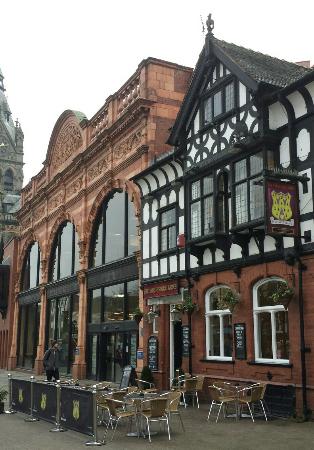
The Shropshire Arms – a pub in Chester was the next port of call. The footballer turned pub landlord is a well trodden path, Alex’s teammate Dixie Dean had run a pub in the same town some years earlier. But things didn’t go well.
“That was a mistake. My wife hated pub life and we separated. Later we were divorced. I stuck the pub for four years then got an assembly line at Vauxhall’s where I had charge of the firm’s football teams too.”
Alex Stevenson in The Liverpool Echo 15 January 1974
From the assembly line Alex turned his hand to labouring on construction sites (working on a block of flats was “the only time I got to look down on anyone”) and an eventual return to Bootle where he joined the local Council, laying flagstones, driving laundry vans and monitoring the canal banks for vandalism. In interviews the trademark wit that made him so popular with fans and teammates alike was still obvious, but there must have been some sadness, one of the great players of his generations spending his 60s looking for graffiti on canal bridges, with failed marriages behind him and living alone in small flat on Merton Road, Bootle. He wasn’t forgotten by Everton or its supporters however, He shared a table with Dixie Dean and Tommy Lawton at a dinner celebrating Everton’s league triumph in 1970, cracking up his former teammates with his jokes and stories. He was popular at Everton Supporter’s Club fuctions and a cabaret night was held in his honour in 1979 attended by Everton stars of a more recent vintage such as Brian Labone and Mike Lyons.
In 1984 Stevenson began suffering from heart trouble, he spent much of the next year of his life in hospital before passing away on the 2nd of September 1985. In the tributes to him that followed there were as many stories of his wit and humour as of his brilliance on the football field. His partnerships with Coulter and Boyes were often the subject of nostalgic reflection as was the Sunderland Cup match, the title winning season and the story of the day the diminutive Alex played centre forward against Arsenal and frustrated and taunted their towering centre half Leslie Compton so much with his skill and trickery that he provoked Compton into fouling him and giving away a penalty.
No less a figure than Brendan Behan, born a few years after Stevenson and only a few streets away, reminded Dublin’s inner-city Protestant community to “If you are a Protestant remember these are the people of Saint Barnabas’ parish homeland of your illustrious co-religionsits Sean O’Casey, Alex Stevenson who played for Barnabas soccer team and my friend, Ernie Smith who battled in the ring for Ireland in the Olympics.” Brendan’s brother Dominic recalled in his memoir “Teems of Times and Happy Returns” an Everton supporters club on Dublin’s Russell Street in the 1930s arranging trips to Liverpool to see Alex and Everton play. Though forgotten, or perhaps even misremembered today, Stevenson was one of Ireland’s greatest players. Every country has the mythology of its “street footballers” – Stevenson, from Dublin city, small, skinny, skilful, cheeky, a showman, seems to be the Platonic ideal of the Irish street footballer as espoused by the likes of Eamon Dunphy, born a generation later on the same street as Alex.
I’ll leave the closing words to an anonymous football fan in the letters pages and his description of Alex Stevenson. He said that “Everton without Stevenson… is just the same as Joe Louis without his punch.”


 A Bohemian Sporting Life