Jack O’Donnell – the Dolphin trawling the seas

As excuses go for missing training it was at least original. Being absent because you were caught in storms aboard a fishing trawler off the coast of Iceland and at any moment feared that you’d be washed overboard to a watery grave. This was the excuse offered by Jack O’Donnell, full-back for Blackpool FC in 1932, when they were still a top-flight side. It wasn’t to be O’Donnell’s first brush with authority, nor his last. This is the story of how a talented footballer went from being a League champion with Everton to making intermittent appearances for Dolphin FC and Reds United in the League of Ireland either side of a stint in prison.

O’Donnell was born in Gateshead in March 1897, the son of John and Grace O’Donnell. John was a labourer from Newcastle, though the O’Donnell surname does suggest an Irish lineage some way back in the family. By the age of 14 young Jack was already working as a driver in a coal mine. Like many young miners-cum-footballers in the north east of England he began playing with his local colliery team, Felling and then later with Gateshead St. Wilfrids, before being signed by Darlington in 1923. At the time Darlington were in the Third Division North, and were on the lookout for a stiker, however a series of injuries meant that O’Donnell was pressed into service on his debut as a left back, the position that he was to make his own over the coming two seasons.

In early 1925 Darlington were drawn against Cardiff City in the first round of the FA Cup. While Cardiff would ultimately prevail, and make it all the way to the final that year, Darlington did manage to take them to two replays with back-to-back 0-0 scorelines. O’Donnell was especially impressive in these games and drew the attention of Everton who signed him just weeks later in February 1925 for a fee of £2,700, huge money at the time for a defender, especially one playing in the Third Division and was at the time far and away the record fee ever received by Darlington.

One issue of note however, is that at the time of signing for the Toffees, O’Donnell was a month shy of his 28th birthday but the newspapers at the time of the transfer list him variously as 20 or 21 years of age. A journalistic mistake or a case of O’Donnell shaving a few years off his actual age? He certainly wouldn’t be the first or last footballer to attempt it if this was the case.

O’Donnell quickly made the Everton first team, although his versatility was occasionally to his detriment, twice in his early days he ended up going in goal to replace an injured goalkeeper as substitutions were not yet allowed. He also ended up featuring as an inside-left for the Toffees and while ‘Dixie’ Dean was clearly the first choice centre forward O’Donnell did contribute five goals in the 1925-26 season when pressed into the forward line. While he made 27 and 24 League appearances respectively in his first two, full seasons with Everton there is a sense that his adaptability stopped him from cementing his place in the team. That was to change for the 1927-28 season though, O’Donnell, along with Scottish winger Alec Troup, were the only two players to feature in all 44 games for Everton that season (42 League, 2 FA Cup) as Everton, propelled by the brilliance of ‘Dixie’ Dean who scored 60 League goals, won the League Championship.

O’Donnell at Everton

O’Donnell the ever-present, won plenty of praise that season, he was a physically tough player but with surprising technical skill, his bravery and fearlessnesss in the tackle also marked him out and there are numerous reports of last ditch tackles saving the day at Goodison Park and elsewhere.

It was also during that league winning season that Jack married Margaret Butcher, with the first of their two children, John, being born the following year. It seemed that everything was going well for Jack. For the following two seasons he was a first team regular for Everton and while they won the Charity Shield the following year there was a drop to 18th in a 22 team league. Worse was to follow the next season (1929-30) as Everton finished bottom and were relegated. In August of 1930, as Everton were facing into the prospect of a season in the Second Division there was a note at a club board meeting mentioning O’Donnell as “suffering from a disease of owing to his own misconduct” and being suspended for 14 days. He would never play for the Toffees again.

Rather than spend a full season in Division Two, especially having fallen from favour with the board, O’Donnell joined Blackpool in Division One for a fee of around £1,500 just after Christmas 1930, as the seaside club aimed to stave off a relegation battle of their own. Blackpool did manage to narrowly survive that season with O’Donnell installed at full-back and he even was named as team captain. O’Donnell and was a regular starter for the rest of the season as Blackpool finished 20th out of 22 teams, with only two sides relegated Blackpool survived by a single point as Leeds and Manchester United dropped into the second tier.

A cartoon of O’Donnell after his move to Blackpool

The following season was to be a similar experience for Blackpool, once again finishing 20th and avoiding the drop by a single point. Again, O’Donnell was a regular, playing 31 out of 42 League games, however there was significant drama for Jack off the pitch.

In November of 1931 O’Donnell was suspended by Blackpool for fourteen days for an unnamed “breach of discipline”, he had also been stripped of the club captaincy just weeks beforehand. When interviewed later in 1933 for the Topical Times O’Donnell gave a robust, if rambling, defence of himself. In an interview which featured allegations of club directors taking backhanders, O’Donnell alleges that his initial suspension at Blackpool resulted from false rumours being spread about him by “somebody with a nose for trouble-making and a character which didn’t have truth in his make up” who made the claim that O’Donnell was going out and getting drunk every night. O’Donnell denied this but said that these allegations had reached the ears of the Blackpool directors who called him for a meeting. O’Donnell recounts that he was “furious that they even listened to such tales” and that as a result he “said things he didn’t mean”. The outcome was another suspension by the club.

It is however, the way in which O’Donnell chose to spend his suspension that gained him most notoriety. Due to return to training in early December O’Donnell was a no-show at the day he was due back. His landlady, and his friends in the local club where he socialised didn’t know where he was but his landlady did mention that O’Donnell had previously expressed a desire to become a fisherman. A man answering to O’Donnell’s description and wearing a pair of plus fours was seen boarding the trawler Cremlyn in the port of Fleetwood in the company of the trawler’s cook.

Jack O’Donnell had indeed gone to sea! Speaking to the media later in December, after he’d returned to dry land he gave the somewhat implausible story that he had simply been talking to the ship’s cook who was a friend of his, had boarded the Cremlyn with no intention of sailing, but without realising the boat had pulled away from shore. O’Donnell was also quick to deny the allegations that he had claimed he was done with football and was planning on pursuing life as a fisherman.

This rather thin excuse is contradicted by O’Donnell himself in the 1933 Topical Times interview when he says that being suspended and having little to do, that he was invited to go sailing on the basis that it was to be a short trip and that he would be back in Blackpool in plenty of time ahead of the lifting of his suspension. However, these plans were waylaid by Poseidon when, off the coast of Iceland the Cremlyn “ran into one of the biggest storms ever seen in the North Atlantic” according to O’Donnell. He claimed that the lifeboat was washed away in the storm and he feared that “every minute would be out last.”

Jack O’Donnell is front page news over his fishing trawler exploits in 1931

O’Donnell did of course make it back to dry land, but unimpressed with his explanation the board of Blackpool, still fighting off relegation, gave him a further fourteen day suspension. On this occasion O’Donnell had the good sense to remain off the high seas. Jack’s aquatic adventures had further reprecussions for him off the football field, as the New Year turned to January 1932 he found himself served with a court order by his, now estranged, wife Margaret. While Jack was living in Blackpool, Margaret was still living in Gateshead with their son John. There had been a legal agreement in place since July of 1931 that Jack would pay £2 a week in maintenance to his wife, but that around the same time as the trawler incident these payments had ceased.

It was at this point that Margaret declared that she was “absolutely destitute” and had to “apply for relief”, meaning that she had to seek the limited form of social welfare available under the “poor laws” that existed at the time. Representatives of Blackpool FC pleaded with Margaret to cease proceedings in the case, promising a £4 postal order and £2 a week as long as he was employed at Blackpool and further stating that “Jack is making a big effort to make a man of himself and we are doing all possible to assist him.”

The case was adjourned for a week and when it was eventually heard in Gateshead a court order of £2 a week maintenance for his wife and son was made against Jack. Margaret mentioned a particular personal cruelty from Jack, despite being in Newcastle for three days for a cup game against Newcastle United (which was taken to a replay which Blackpool lost) in the week before the hearing, Jack made no effort to get in touch with his wife or three year old son.

O’Donnell finished out the season for Blackpool as they clung on to secure their top-flight status, but there was further drama during the summer as once again Jack went missing, this time in July during pre-season training. Blackpool quickly sought to have O’Donnell suspended by the FA, who duly obliged. With the new season on the horizon Jack O’Donnell found himself in an unevniable position, suspended from playing football but with Blackpool still holding his registration and hoping for some return in terms of a transfer fee for their errant star. The club denied that a transfer was forthcoming but there was still a protracted saga as Hartlepools United, then in the Third Division North, sought to sign O’Donnell. Hartlepools were managed by Jackie Carr, a former England centre half who had briefly played with O’Donnell at Blackpool towards the end of his own career. He clearly believed that his former teammate and powerful full back still had something to offer despite his many off the field issues and disappearing acts.

A prolonged transfer saga was finally brought to an end when Hartlepools paid a fee in the region of £500 for O’Donnell’s services. Blackpool placed certain conditions on the transfer and successfully requested the FA to lift the player’s suspension so that he could move to the County Durham club.

Jack was once again a regular, playing out the season with Hartlepools, and once again he was made club captain making 28 league appearances, scoring twice as they finished lower mid-table in Division Three. It was to be his only year with them as with the season coming to a close he was transfer listed in May 1933 and by August of that year Jack had joined Wigan in the Cheshire League where he was once again made club captain on his arrival.

This return to football wasn’t quite guaranteed as during the summer of 1933 Jack once again took to the seas, taking a job as a steward on an ocean liner sailing between Liverpool and Montreal. In the Topical Times interview he recalls playing football for a team made up of the ship’s crew, playing against barefoot teams in the Canary Islands and against American and Canadian sides, recounting the physicality of the game as played in America (which is saying something considering the physical nature of O’Donnell’s own game but also tallies with other descriptions of the extremely physcial nature of the game in the United States) as well as describing a sporting encounter with Everton legend of the teens and twenties, Sam Chedgzoy who had relocated to Canada.

Despite being installed as captain and some encouraging early performances at Wigan, Jack was once again in trouble with the club heirarchy after only a couple of months. By October 1933 he had pulled yet another of his “disappearing acts” and there was speculation on behalf of Wigan Athletic that his well-known wanderlust and love of deep-sea fishing had gotten the better of him and that he had once more gone to sea, which to some extent he had, bacause Jack was with the Dolphins. He had crossed the Irish sea to sign with League of Ireland side Dolphin, located in the south Dublin suburb of Dolphin’s Barn.

O’Donnell during his time at Dolphin FC

Dolphin FC had finished the previous season as FAI Cup runners-up and were under the tutelage of player-manager Jerry Kelly. The Scottish defender/midfielder had enjoyed a successful career in England winning a league title for Everton alongside Jack O’Donnell and it is likely that his former teammate was responsible for Jack’s trip to Dublin. While Jack had been suspended by Wigan, the fact that they were a non-league club and the somewhat fluid nature of transfers between British and Irish teams at the time meant that transfer rules were less hard and fast, however it still took a couple of weeks for clearance and paperwork to be finalised by Wigan to allow Jack make his League of Ireland debut for Dolphin.

O’Donnell impressed in his first game for Dolphin, a 3-0 win over Cork Bohemians on 26th November 1933, he was praised for his “powerful kicking and positional play” and got on the scoresheet with a penalty after a Cork handball. It is obvious that O’Donnell had impressed not only at the back but with his attacking play and a move to centre-forward, where he had previously played on occasion for Darlington and Everton, was planned for the next game against Shelbourne. This would allow a return to the defence of Dolphin’s international pairing of Larry Doyle and George Lennox. Of course, this wasn’t to be, Jack O’Donnell had pulled yet another one of his “disappearing acts” going missing for both the Shelbourne game and the subsequent match against Bohemians.

By the time O’Donnell returned in mid-December after dealing with unnamed “business” Dolphin had signed a new striker in the form of Jimmy Rorrison who had joined them from Distillery. Rorrison, something of a journeyman striker in the Scottish and English Leagues had impressed at Cork the previous season and took over the centre forward berth with O’Donnell continuing in his favoured role at left-back.

Dolphin cruised to an easy 4-1 victory in their next match with Bray Unknowns with O’Donnell scoring another penalty and his overall display being described as “polished and clever”. O’Donnell featured in a run of games for Dolphin over the Christmas period and into the New Year of 1934, scoring a third penalty in a 2-1 defeat to Shamrock Rovers in January. There was a return to form the following week in the opening round of the FAI Cup, as Dolphin were drawn in something of a local derby with fellow southsiders Jacobs. O’Donnell was installed as centre-forward in place of Rorrison who was released after only a month at the club. O’Donnell scored twice from open play as Dolphin swept to a facile 5-0 over the Biscuitmen which was followed by a victory over Queen’s Park (from the Pearse Street area of the city) after a replay in the second round. All of a sudden Dolphin were into the Cup semi-finals.

However, the cup run seems to have distracted from their league form and Dolphin slumped to a 2-0 defeat to bottom side Cork Bohemians with O’Donnell being utilised as an inside-left to little effect. This slump in form continued for Dolphin as they were beaten in a dull game 1-0 by St. James’s Gate in the Cup semi-final, Billy Kennedy scoring the decisive goal as Jack O’Donnell was returned to his more usual position of left-back. O’Donnell continued as a regular for the remainder of the season, and although Dolphin’s form was patchy he did win praise for his displays, mostly in the full back position although he did score his fourth, and final, league goal for Dolphin in March 1934 as a centre-forward in a resounding 3-0 win over Dundalk in the final game of the season.

Dolphin finished fifth that season and had made the semi-finals of the FAI Cup, however they had probably hoped for a little bit more having recruited heavily from outside the league, including the signing of O’Donnell. Dolphin had led the way in the League in the recruitment of cross-channel players and were known as one of the clubs in the League of Ireland who were prepared to pay higher wages to bring talent across the Irish Sea to Dublin. This also influenced their choice of coaches such as Arthur Dixon who would join the coaching team at Rangers and bring the young Dolphin star Alex Stevenson with him, and Dixon’s eventual replacement, Jerry Kelly who brought his former teammate O’Donnell to Dublin.

Reports stated that Jack had returned to Blackpool for the summer months, he was gone from Dolphin for their League of Ireland Shield campaign and missed the friendly match against Notts County arranged as part of Willie Fallon’s move from Dolphin to the Magpies. However, it wasn’t to be a relaxing summer on the beaches of Lancashire for Jack, in May 1934 he faced another summons from his wife Margaret for once again abandoning her and his family as Margaret had once more been forced to go to the “Public Assistance Committee” to makes ends meet. Jack was now a father of two, as a daughter, Kathleen had been born earlier that year. In her statement Margaret recounted that he had briefly returned to her after being suspended by Wigan and that later that year his “disappearing act” from Dolphin in November had seen him briefly return to his family in Gateshead. After finishing with Dolphin in March he seems to have ended up in Blackpool where he claimed he was looking for work on the town’s pleasure beaches. At the court hearing in Gateshead he was sentenced to a month’s imprisonment.

Upon Jack’s release at the end of June the court ordered that he pay 25 shillings a week in maintenance to his wife and growing family. Faced with this challenge it is unclear what Jack did for the remainder of his summer however he reappears in media reports in September with the news that he has signed for non-league side Clitheroe. Although 37 years of age by this stage, (if his clubs were even aware of his real age), it was to football that he returned yet again to make a living. As always with Jack it wasn’t plain sailing, having only played once for Clitheroe there was an objection to his registration from Dolphin, he remained their player and they claimed that he had been suspended by them and as such couldn’t turn out for another team. This would suggest that Jack’s return to Britain at the end of the previous League campaign wasn’t something that had been agreed with Dolphin.

Frustated in these attempts it seems Jack returned home to Tyneside, lining out for Wardley Welfare FC in his home town of Gateshead, and perhaps spending a bit more time with his family. His younger brother Bill, who had mirrored Jack’s career somewhat, joining Darlington and later Everton, without ever enjoying Jack’s success, was back playing his football in Gateshead as well, turning out for Gateshead FC in the Third Division North. Back in Dublin, Dolphin enjoyed one of their best ever seasons, winning the League title, the Dublin City Cup and finishing runners-up in the Shield without the suspended Jack O’Donnell. Ray Rogers finished as their top scorer, the former Bohemians man solving the centre-forward problem that had plagued them during Jack’s season with the club.

There was one final footballing adventure for Jack and it involved a return to the League of Ireland. With Dolphin beginning the following season as defending champions they once again came calling for the services of Jack O’Donnell, however his time with them was to be very brief. After just one game, a 4-3 defeat to Sligo Rovers he was released only to be signed a week later by another Dublin side, Reds United who were enjoying their sole League of Ireland season. As luck would have it his first, and only game, for Reds he came up against his old side Dolphin with the game ending in defeat for the League newcomers. Once again Jack was released after a single game.

Be the end of the 1930s, his playing days behind him, Jack was back in the North East of England, living with his family and working as a labourer in a timber yard. He made a few more brief appearances in the sports pages – in 1948 when he visited the Everton team ahead of a game against Newcastle in St. James’s Park, while in 1952 he was listed as turning out in a charity match in South Shields alongside a number of other, well-known, retired players. It must have been one of the last games he played as he passed away later that year.

With special thanks to Rob Sawyer of the Everton FC Heritage Society for his assistance, especially the Topical Times article and photos of Jack O’Donnell while at Everton.
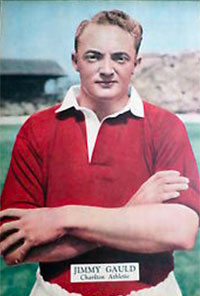
Jimmy Gauld: goal-poaching & match-fixing

When Dundalk dominated a couple of seasons ago there were many accolades thrown in the direction of the team and its players as they progressed to a historic double. Among the awards amassed was that of top scorer in the league for their prolific striker, Patrick Hoban who fell just one goal short of the 30 mark. A hugely impressive achievement. In fact the last time someone hit the 30 goal mark in the League of Ireland was way back in the 1954-55 season. That man’s name was Jimmy Gauld, and his thirty-goal haul for Waterford was only one dramatic chapter in a life full of intrigue and incident.

Gauld was born in Aberdeen in 1929 and although he lined out as a youth player for his hometown club he never made a first time appearance, instead he plied his trade in the Highland leagues before being signed by Waterford in time for the beginning of the 1954-55 season. The Blues obviously had been keeping an eye on the Scottish game as they also signed ‘keeper Tom Hanson from Greenock Morton on a trial.

Gauld joined an exciting Waterford side who were on the up and featured plenty of talented players in their ranks, including three of the Fitzgerald brothers, the Hale brothers George and “Dixie”, and Scottish-born, United States international, Ed McIlvenney who had been signed from Manchester United.

Stocky, tough and with an incredible burst of acceleration (Jimmy had been a useful sprinter in his youth) Gauld could play anywhere across the front five but tended to line out at inside right for Waterford. He made an immediate impression on the league, within a month of joining Waterford Gauld had been selected to represent the League of Ireland against the Football League in front of an estimated 35,000 spectators at Dalymount Park. The Football League were convincing winners on that day with a certain Don Revie netting a hat-trick, ably assisted by team-mates of the calibre of Stanley Matthews and Billy Wright.

Jimmy Gauld however would have more success on the domestic scene however, over the course of a thrilling season Waterford pushed St. Patrick’s Athletic close for the league title, Pats eventually winning the title race by three points. It was however, an amazing season of goals for runners-up Waterford. In a 22 game league campaign they scored 70 goals, and they broke the 100 mark in all competitions. Gauld got 30 in the league and an incredible 42 in all competitions to beat St. Pats centre-forward Shay Gibbons into 2nd place for the top scorer award. In particular he developed a fine understanding with Jack Fitzgerald and their partnership brought huge crowds to Kilcohan Park with their attacking style of play. Jimmy would also feature again for the League of Ireland XI, this time starring alongside four of his Waterford teammates in a 2-1 victory over the Irish League.

Gauld scores against St. Pats’ from the Irish Press – 28th March 1955

Jimmy Gauld’s scoring exploits didn’t go unnoticed across the water. Charlton Athletic who were enjoying a spell in the top-flight earmarked Jimmy Gauld as the man to replace their departing superstar striker Eddie Firmani who was on his way to Sampdoria. A fee of €4,000 was agreed with Waterford and Gauld enjoyed immediate success in the English First Division, scoring an impressive 17 goals in his first season with Charlton. His good form continued into the early weeks of the following season which prompted a big money move to Everton for over £10,000. Apparently Gauld was upset by dressing room criticism of his style of play from Charlton teammates who accused him of not doing enough in terms of his defensive duties. According to a number of accounts he was also a good friend of Everton captain Peter Farrell who had begun his football career with Shamrock Rovers.

Gauld only lasted a season at Everton, playing 26 games and scoring 8 goals but by the 1957-58 season illness and injury had seen him dropped from the Everton first team. This helped Plymouth Argyle manager Jack Rowley pull off something of a coup by getting him to sign for the club who were then in the Third Division. Gauld’s style of play, goal-scoring ability and searing pace quickly endeared him to the Home Park faithful and he helped the club to promotion to the Second Division, scoring 21 goals in that promotion season of 1958-59. Once again however, Jimmy and the club management had a failing out.

Perhaps enamoured by their star striker’s success and hoping to cash-in on a player who had just hit 30 goals, Plymouth made it known that they would entertain offers for Jimmy’s services. Gauld was upset by this treatment, as were his many fans of the Argyle. There were offers for him to move into a player-coach role at Gloucester City but Plymouth insisted on a significant four-figure transfer fee which the Southern League club couldn’t afford. Ultimately Jimmy’s next port of call was Swindon Town who signed him for a club record fee of £6,500.

Despite a respectable return of 14 goals from 40 games in his only season for Swindon it was around this time that rumours first started to swirl about Jimmy in relation to match fixing.  He was released at the end of the season after accusations that he helped to fix a match in April 1960 versus Port Vale, which Swindon lost 6-1. Four years later, he admitted that “Swindon were comfortably in the middle of the League, with nothing to win or lose, so it didn’t seem such a terrible thing to do”.

It turned out that Gauld was able to make good money convincing teammates to throw games while at Swindon which saw him rack up betting earnings of up to £1,000 per game. Huge money when the maximum wage in football was still in place and even the best players couldn’t earn more than £20 a week. Gauld and his colleagues in the Third Division would have been earning considerably less than even that modest amount.

Despite being released by Swindon there were still demands for Gauld’s services in 1960. The match-fixing side of his life hadn’t come to public prominence yet and there was interest in Jimmy from the likes of QPR, Peterborough and from Irish Champions Limerick who surely remembered his record-breaking season just five years earlier and wanted him to lead the line ahead of their first season in European football.

It wasn’t to be however, rather than return across the Irish Sea Jimmy went back to his home country of Scotland and signed for St. Johnstone. After a very brief spell north of the border he was back in the Football League with Mansfield Town in the old Fourth Division. Jimmy had a good start scoring three times in his first four games, but in the last of those games he broke his leg and despite attempted comebacks his career as a player was effectively ended aged just 31.

In 1964 a shock exposé by The People newspaper named Gauld as the ringleader in a bribery scandal which shook British football to its core. It showed that he was at the heart of a scam which had fixed up to three matches per week by utilising contacts from his years in the game, most of whom never knew each other nor who was in on the scam.

One of the most high profile matches that Gauld was involved in fixing was the meeting between Sheffield Wednesday and Ipswich Town which he arranged through his former Swindon teammate David Layne. Wednesday midfielder Tony Kay, who was capped by England and later moved to Everton, recalls Layne approaching him about the game saying;

‘What do you reckon today?’ I said, ‘Well, we’ve never won down here [Portman Road].’ He said: ‘Give me £50 and I’ll get you twice your money.’ I thought that was a good deal.

The story of my bet eventually came out after I was transferred to Everton. I was in a Liverpool nightclub one Saturday night [in 1964] and a friend said to me: ‘You’re all over the front page of the Sunday People about the Ipswich game. They’re saying you bet on the match and the bookmakers have been screaming because they lost £35,000 that week.’

Kay was ironically named Man of the Match in that 2-0 defeat to Ipswich. After the revelations became public he was doorstepped by Jimmy Gauld, who he claimed to never have met previously. Gauld fired a rapid barrage of questions at him about the game and match fixing before leaving his house. It turned out he had secretly been recording Kay and used those taped recordings in the subsequent trial. He also sold his story to the Sunday People newspaper for a reported fee of £7,000.

After pleading guilty Gauld served four years in jail and was fined £5,000 for his illegal activities which also saw nine other players imprisoned, including England internationals Peter Swan and Tony Kay. The judge stated at the hearing in January 1965 that,

“It is my duty to make it clear to all evil-minded people in all branches of sport that this is a serious crime. You are responsible for the ruin of players of distinction like Swan, Layne and Kay.”

After prison Jimmy Gauld did return to Ireland, living on Co. Mayo in the 1970’s, he worked as a driver and assistant to the wealthy industrialist Denis Ferranti who owned Massbrook House on the shores of Loch Conn. Locals remember him as a popular and sociable character, he was well-liked by the local youngsters due to his habit of giving them copies of Shoot magazine, a rare commodity in rural Mayo.  He later returned to London where he passed away in 2004. He remains the last player to score 30 goals in a League of Ireland season but this impressive statistic is lost obscured by his key role in organising one of the biggest betting scandals in British sporting history.

A special thank you to Frank Gibbons for information on Jimmy Gauld’s later life on Co. Mayo.

Alex Stevenson – solving a football mystery?

Sending a message home

In a soccer column in the pages of a regional newspaper there is a short, sad story, based on a message passed onto the author by a local man. In among the snippits about Waterford’s form going into their game with Finn Harps and the need for more referees in the junior leagues, there is a report of a frail, ill man in his seventies, feeling lonely in a hospital in Liverpool. It ends with the line “and now comes word that he would welcome hearing from old friends in a difficult time”. It was a sad situation for anyone to find themselves in, but when one considers the man in question was one of the greatest footballers of his era, beloved by crowds for his skill, trickery and cheekiness then it seems even more strange that he should find himself in that situation.

The man in question was Alex Stevenson. Mention of his plight appeared in the pages of a Waterford newspaper in November of 1984, the heart issues with which he was suffering sadly didn’t abate and by September 1985 Alex Stevenson had passed away in Liverpool aged 72. One of those who did reach out to him before he passed away, and perhaps recorded the last ever media interview with the Everton legend was Irish journalist Seán Ryan.

Irish Independent headline on 3rd September 1985 – the day after Alex Stevenson died

This last interview was published in the Irish Independent the day after Alex’s death under the headline “The football mystery that Alec Stevenson never solved”. While Stevenson spoke with Ryan about various aspects of his successful career the main point of concern from Stevenson was addressing speculation as to why he had to wait fourteen years between his first and second caps from the FAI. As one of the most feared and skilful inside-forwards in Britain, a league winner in both Scotland and England, surely there must have been some other reason for his non-selection? Was it down to the clubs he played for? Was it down to his religion?

I was accused of refusing to play for the FAI because I was a Protestant… but religion never came into it for me. The funny thing was I was never picked by the FAI until after the War but I got all the blame for it!

Alex Stevenson quoted to Seán Ryan in the Irish Independent – 3rd September 1985

We’ll explore the reasons why but first some more background on Alex’s life.

In Dublin’s fair city

Alexander Earnest Stevenson was born in Dublin’s Rotunda Hospital on the 12th of August 1912 as the fourth child of Alexander and Rosalina (often listed as Rosaline) who were living on Richmond Road at the time. While the family moved around quite a bit, with addresses at Cadogan Road, Fairfield Avenue, Northbrook Avenue they always remained close to that same North Strand-East Wall district. Both Alexander Stevenson and Rosalina Caprani were from the area and they didn’t move far from their respective families who had been neighbours on Leinster Avenue. They were married in North Strand Church in 1905 in a Church of Ireland service. The Stevenson and Caprani families were deeply connected, Alexander’s younger sister Robina later married Rosalina’s brother Henry in 1914.

“Palace View” Terrace, Richmond Road – where Alex Stevenson was born

Alexander Senior (our footballer’s father) was the son of yet another Alexander, a Scottish Presbyterian who had likely moved to Ireland in the late 1870s or early 1880s and took up work in Dublin’s extensive printing trade. Rosalina was the daughter of Joseph and Anna Caprani. Joseph was a Catholic, born in Como, northern Italy who likely arrived in Dublin in the early 1860s, while Anna (sometimes listed as Hannah) was originally from Cork and was a member of the Church of Ireland. Their children seemed to be baptised into either religion without any particular pattern, some sons and daughters were listed as Catholics, others, such as Rosalina were Church of Ireland. Based on the current FIFA eligibility criteria Alex Stevenson could have played for Ireland, Scotland – through his paternal grandfather, or Italy – through his maternal grandfather. It is an interesting idea, Stevenson the Irish Oriundo, playing for the Italian world cup winning teams of the 1930s, he certainly had the talent.

Joseph and many of the Caprani family were involved in the printing and compositing trade, another connection apart from geography which linked them with the Stevensons, scions of the family would achieve levels of fame and notoriety for various reasons; Joseph Desmond (J.D.) Caprani (1920-2015) was captain of the Irish Cricket team, while Vincent Caprani (b. 1934) is a poet, writer and historian who has also helped to mythologise figures from Ireland’s sporting past in his stories. Alexander and Rosalina raised their children in the Church of Ireland, Alexander having migrated from Presbyterianism. He would later become involved with local football, with the St. Barnabas club who were based out of the Church of St. Barnabas on Sheriff Street, as well as with the Leinster Football Association, serving on various committees.

St. Barnabas Church of Ireland – Sheriff Street, Dublin

As a teenager Alex began playing with St. Barnabas, alongside his older brother Henry, it didn’t take long for them to find success. While still just 17 Alex, along with Henry, helped St. Barnabas to victory in the 1930 Leinster Junior Cup final win over Seaview after two gruelling replays. Within a year Alex was being called up for an Irish Junior international against Scotland in Falkirk. A battling performance saw Ireland lose 3-2, with Stevenson one of the stand-out performers. There were plenty of clubs interested in his signature including Shamrock Rovers and Hearts, but Arthur Dixon, the shrewd player-manager of Dolphin had spotted Stevenson and secured his signature before the Junior international match was played. Alex’s starting wage was £3 a week with a £1 bonus for win but it meant he got to leave work as a docker and focus on his football full time.

Swimming with the big fish… and Dolphins

Alex was to spend just a year with Dolphin but it was to be an eventful one. Dolphin were one of the glamour clubs of Dublin in the 1930s, originally founded in Dolphin’s Barn, but by Alex’s time playing out of Harold’s Cross they had a reputation for good football and for bringing in quality players from Britain. Arthur Dixon, an English man who had spent most of his career in Scotland with St. Mirren, Rangers and Cowdenbeath was obviously brought in as player-manager to help with this recuitment. Aside from Alex, most of the Dolphin side were Scottish players, usually paid £5 a week rather than the £3 Alex was getting. There were a few other locals in the side however, including Larry Doyle, capped that season against Spain, and Jeremiah “Sam” Robinson, another international who had been part of the all-conquering Bohemians team of the 1927-28 season.

The diminutive Stevenson soon began demonstrating his skills surrounded by these more experienced pros. A lightweight inside-forward who would later draw comparison with the likes of Hughie Gallagher, Alex James and Patsy Gallagher, Alex possessed great ball-control, a range of passing, and bags of tricks. Also for a man only 5′ 5″ tall and weighing just 10 stone he possessed a deceptively powerful shot. In that one full season Stevenson helped Dolphin to a 3-0 victory over Shelbourne in the Leinster Senior Cup, while they also reached their first ever FAI Cup final. They lost a tight game 1-0 to Shamrock Rovers, with the mercurial Paddy Moore scoring the only goal of the match as Rovers extended their stranglehold over the cup.

Moore was from the same area around the North Strand as Alex and was only three years older, they likely would have known of each other growing up. Both men are emblematic of a certain type of Irish footballer – the small, skilful, flamboyant, “street footballer” of Dublin’s inner city. Perhaps the most recent comparable modern footballer in terms of size and style would be Wes Hoolahan, born some 70 years after Stevenson. Wes grew up in nearby Portland Row and would have honed his talents on the same streets as Moore and Stevenson.

Both Moore and Stevenson would line out for Ireland towards the end of that season, just weeks after the Cup final. Amsterdam was the destination and the Dutch national team were the opposition Paddy Moore had made a scoring debut for Ireland the previous year and would win his second cap, Alex would win his first and both played well in a 2-0 win for Ireland with Moore and Brideville’s Joe O’Reilly getting the goals in front of a crowd of 30,000.

Moore, O’Reilly and Jimmy Daly were all signed up by Aberdeen after their performances in that game, within weeks Alex Stevenson would be following them to Scotland.

An intrepid Ranger

In July of 1932 Arthur Dixon returned to Ibrox as a trainer to become part of Bill Struth’s backroom team. He had been part of a hugely successful Rangers side as a player in the 1920s, making over 300 appearances and winning six league titles with the Glasgow club, and he wasn’t returning to Ibrox empty-handed. A month after Dixon arrived back Alex Stevenson was signed on his recommendation. A fee of £250 was reported with Rangers also agreeing to play a game in Dublin against Dolphin with the proceeds being split.

To date he is the only player capped by the FAI at senior level to be signed by Rangers, a club whose Irish recruits had tended to come more from Belfast than from Dublin. It has long been alleged that Rangers, from the 1920s onwards had operated a policy of not signing Catholics, a policy, along with the strong Irish connections of their rivals Celtic that tended to make Rangers unpopular to many Irish football fans. Dixon when signing Stevenson would have known he was a Protestant due to his association with the St. Barnabas club and their connection to the Church of the same name. Among various theories suggested for the fact that Alex went so long before winning a second cap from the FAI was of an anti-Rangers bias because he had chosen to sign for the club.

Things started slowly at Rangers, there were suggestions that some thought him too lightweight for first team football, and he only made one league appearance for the first team in the season he signed. He did however, play in the match against Dolphin arranged as part of his transfer. This game was held in Dalymount in April 1933 and Rangers featured a strong starting XI including their stars Alan Morton, David Meiklejohn, goalie Jerry Dawson, and the Irish (IFA) international striker Sam English. It was English who scored twice in a 3-1 win for Rangers, though the scores were tied with less than ten minutes to go in the game.

The following season would prove more successful, in eleven matches at inside forward he scored seven goals and was described as having all “the craft that goes to make a star”, such was his success that interest soon developed from other clubs, especially Everton who were tracking him closely from the end of 1933. Initial reports on Stevenson had expressed concerns about his small physique but eventually these were dismissed as Stevenson continued to impress. While Everton were readying to make a move Stevenson was selected for all three of the Home Nations games by the IFA, the highpoint being a 2-1 win over Scotland, a game where he first lined out with his future Everton teammate Jackie Coulter.

Rangers meanwhile signed Scottish international Alexander Venters as a replacement for Stevenson as the latters move to Everton was being ironed out. It would take until the start of February 1934 for Alex’s move to Merseyside to be confirmed but the Toffees had finally gotten their man. After 18 months in Scotland his transfer fee had risen from the £250 plus a friendly paid by Rangers to the £2,750 paid by Everton. He had also done enough that season to secure himself a Scottish League winners medal before his move. Some later reports incorrectly stated that the fee was a whopping £37,000, however this would have meant that the Stevenson transfer would have broken the then world record by £14,000!

Mickey Mouse goes to Dixieland

Alex was joining an elite side, Everton were F.A. Cup holders when he joined and had been league Champions the season before that, expectation was high. They featured the great Ted Sagar in goal, one of the longest serving players in Everton history, the classy wing-half Cliff Britton who had helped inspire them to the Cup, Irish international Billy Cook who had won both the Scottish Cup and F.A. Cup and of course there was William Ralph “Dixie” Dean, or just Bill to his friends.

The 1933-34 season was to be a tough one for Dean, he spent most of the year ravaged by injury, only managing twelve league appearances and nine goals, his lowest return for a full season with Everton. Dean would return as the team’s top scorer the following year and he and Stevenson developed a strong rapport, Dean feeding off Stevenson’s clever passes and returning the favour as Dixie nodded down crosses for Alex to unleash one of his trademark, cannon-like strikes. One other player to join just weeks after Alex was Jackie Coulter, who had featured at outside left in the game against Scotland. They were to become the first of a number of great double-acts during Alex’s career.

While Alex was small and lightweight, Coulter was a somewhat more imposing physical specimen especially with his huge size 12 boots. He was dubbed the “Jazz winger” by the Goodison faithful and he and Stevenson developed an excellent almost telepathic understanding. It also endeared them to the crowds that both men were born entertainers, full of individual skill and trickery that was magnified by their play as a duo.

A cartoon featuring Coulter and Stevenson from the Liverpool Echo

If Coulter was the “Jazz Winger” then Stevenson was dubbed “Mickey Mouse” because of his small stature. His Ireland teammate, the legendary Peter Doherty referred to Stevenson as the “Mighty Atom”, a sobriequet used for the another talented Irishman full of trickery from an earlier era, Celtic’s Patsy Gallagher. To many other Evertonians he was just “Stevie”.

Coulter and Stevenson combined in perhaps one of the most famous F.A. Cup ties in history, a fourth round replay against Sunderland in January 1935 witnessed by a crowd of 60,000 in Goodison Park. In a game full of incident the Irish left wing partnership of Coulter and Stevenson were on fire and with 16 mintues left to play two goals from Coulter and one from Stevenson gave Everton a 3-1 lead. Stevenson even provoked laughter from the crowd by trying to barge (the much larger) Sunderland keeper Jimmy Thorpe into his own net. Something still common in the rough and tumble English game at the time, (indeed tragically Jimmy Thorpe would die a year later after being kicked in the head during a game against Chelsea at Roker Park). With Alex this perhaps showed both his committment as well as his ability to play to the crowd. And while Stevenson “controlled the show, delighting the home crowd with his trickery and skill”, Sunderland began to rally, scoring two late goals to take the match to extra-time, Coulter got his hat-trick but Sunderland equalised again before two late goals from Albert Geldard sealed the victory for Everton.

In that first full season with the Toffees Stevenson played 41 games and scored 18 goals in all competitions. His signing was hailed as the bargain of the decade as he immediately cemented his place in the first team while making his name as one of the most skilful and entertaining inside forwards in British football. In the 1936-37 season as Everton were stuggling in the lower half of the table Alex had one of his best seasons, playing 44 games and scoring 21 goals, second only to Dean in the scoring charts. Everton were also a team in transition, the great Dixie Dean was slowing after years of injuries, from football and a motorcycle crash as a younger man. Tommy Lawton was brought in as his long term replacement. Jackie Coulter moved to Grimsby Town, a leg break while playing for Ireland against Wales took him out of the game for a year and sapped some of the magic from his game. T.G. Jones, an elegant and skilful centre half was signed from Wrexham and a young Joe Mercer was establishing himself in the team.

After some mediocre seasons by their recent standards, towards the end of the 30s Everton were ready to challenge for honours again, and Alex Stevenson had a new partner at left wing, Wally Boyes, signed from West Brom and even smaller than Stevenson at only 5′ 3″ , they formed a fantastic new partnership, while Tommy Lawton was now securely installed as Dean’s successor at centre forward. The 1938-39 season would be one of Everton’s best, they would finish as league champions, Lawton scoring 34 from 38 league games and Stevenson finishing with 11 goals, the third highest scorer in the side. His teammate Lawton was in no doubt of Stevenson’s talents, describing him as:

“A great player, greater to the player close to him than to the crowd perhaps… and is one of the finest footballers who have ever kicked a football on an English ground.”

Lawton on Stevenson

The title race was tightly balanced with Wolves pushing Everton all the way. Coming into the final stretch the Toffees faced three matches in just four days during April. In the first game Everton beat Sunderland 2-1 in a Good Friday fixture at Roker Park. There then followed a lengthy train journey to London, where Everton faced Chelsea the following day. Everton laboured and with twenty minutes remaining the scores were still goalless. Then Stevenson intervened with what Lawton dubbed the ‘miracle’ of Stamford Bridge – . Alex had scored the opener after a knockdown from Lawton, before Torrance Gillick secured the victory with a late second. Two days later Everton trounced Sunderland 6-2 in Goodison with Alex again on the scoresheet. The title was all but secured 5 days later after a draw with Preston North End. Recalling Stevenson’s goal against Chelsea his teammate Gordan Watson remembered it as “a great moment because Stevie had played so well all season, he was probably our most consistent player – and that’s saying something because we were a great side”. That title-winning season with Everton was perhaps Alex’s career highlight.

Alex Stevenson wheels away after scoring against Arsenal (source @theleaguemag )

By this stage Stevenson has also established himself as first choice with the IFA selectors and by the mid-30s they possessed a formidable pair of supremely talented inside-forwards in the shape of Stevenson and Peter Doherty. By the time he had become a League champion with Everton, Alex had been awarded 14 caps by the IFA (who continued to select players born in the Irish Free State for a further decade) and had scored four goals.

Alex Stevenson was just 26 when he lifted the English league trophy, an established international and viewed by his peers and the public as one of the most skilful players in Britain. He must have felt confident that his best years were ahead of him. He had got married in 1937 and his with Ethel was pregnant by the beginning of the following season, a bright future on the horizon. However, with the 1939-40 season just three games old all football was suspended, the World was at War.

An Ireland XI (IFA) v Scotland 1938 featuring Stevenson and Coulter on the left of the attack.

Wartime action

With football suspended and the footballers of Britain effectively out of work there were few options for the players. Many joined the armed forces and fought during World War II, others found employment in war industries like munitions factories, there was also a newly appealing option for footballers who wished to continue playing League football. The League of Ireland continued, uninterrupted as the Irish Free State adopted the policy of neutrality during the War. Internationals like Willie Fallon and Bill Hayes returned from England to play for the likes of Shamrock Rovers and Cork United respectively. The later months of 1939 were full of rumours about which star player was next going to turn up in Ireland – Jackie Carey? Peter Doherty? And even Alex Stevenson?

While Carey would make a couple of wartime appearances for Shamrock Rovers, he Doherty and Stevenson would all joined the armed forces, in Carey’s case it was the British Army while in the case of Doherty and Stevenson, it was the RAF. Stevenson, who had been linked with moves back to Ireland to either Shelbourne or Limerick signed up with the Royal Air Force in November of 1940. A journalist with the Evening Express was moved to remark;

“One of the finest inside-forwards football has seen in a decade goes to do his bit. I wish him the best of luck – and many more games with his beloved Everton.”

Evening Express – November 14th, 1940

And there were indeed plenty more games, despite his committments as a ground crew member of the RAF Stevenson still played plenty of football during the war years, some 206 games (and 91 goals) with Everton in the war time competitions, as well as guesting for the likes of Tranmere and Blackpool and lining out for various representative sides as part of matches within the armed forces. Like many footballers Alex lost some of the best years of his career to the War, while competition could be haphazard and the standard of opposition clearly wasn’t as high he still competed against many of his former adversaries in the wartime leagues and Everton performed well. Observers at the time stated that Alex played some of his best football during this period.

Towards the end of the War Alex ended up based in India for a short time and didn’t return to England until the end of 1945. League football didn’t return until the 1946-47, and though the 1945-46 season did feature a return of the FA Cup but league football was still regionalised.

Peacetime and the Greening of Goodison

As the 1946-47 season began Everton were in the unusual position of being defending Champions after a gap of seven seasons, they returned to the league with several of those who had been part of that title-winning team, however many of those players were now diminshed in their footballing capacities. Also several key men from the title-winning campaign had left the club – centre forward Tommy Lawton had moved to Chelsea, while Joe Mercer, then coming into his prime was was sold to Arsenal before the end of the season. Both of these moves were at least in part motivated by the prickly and divisive Everton manager Theo Kelly. Lawton, Mercer and Dean before them, had all fallen foul of Kelly with Dean describing him as “an autocrat and despot“.

Despite his nature Kelly had done a good job as manager in maitaining Everton’s finances and he had recruited new, young players to boost the squad. With Lawton’s departure more firepower was required and Jock Dodds, a prolific scorer for Blackpool before and during the War was recruited after a short spell with Shamrock Rovers. Also recruited from Rovers were Peter Farrell and Tommy Eglington, for a combined fee of £3,000. Eglington would displace Wally Boyes on the left wing and he and Stevenson would form an all-Dublin left-flank for the Toffees.

Everton finished a disappointing 10th that year while their city rivals Liverpool compounded matters by winning the title. The 34 year old Alex Stevenson remained one of the side’s better players that year, playing thirty games and scoring eight times and helping Eglington establish himself in the first team, in what was perhaps his third, and final, great Everton partnership – Coulter – Boyes – Eglington. Stevenson even introduced his young Dublin partner to the joys of golf on Bootle golf course.

There was also a call-up from the FAI. Alex Stevenson would win his second cap 14 years after his first – still a record – and the opposition couldn’t have been more significant. It would be the first time that England would play against Ireland since the split from the IFA in 1921.

Rangers? Sectarianism? – and the exclusion of Alex Stevenson

But why was Stevenson not selected for 14 years? Already an international by the time he left Dolphin he had won a League title with Rangers and one with Everton while establishing himself as one of the most skilful and entertaining forwards in Britain. We can certainly rule out a lack of talent on Stevenson’s behalf. He had also been capped 14 times by the IFA in the intervening period.

We also know from later interviews that it was nothing to do with Stevenson himself refusing a call-up, he had approached both Theo Kelly of Everton and Joe Wickham of the FAI to seek clarity on the issue.

“To clear up the mystery I remember approaching Theo Kelly who was Secretary-Manager of Everton and asked him if they would release me but he wouldn’t discuss the matter… in the 50’s I tried to clear the matter up by speaking to Joe Wickham but he never divulged anything. It’s still a puzzle to me.”

Stevenson interviewed by Seán Ryan in the Irish Independent 3rd September 1985

The answer lies in the, now-digitised, records of Everton Football Club. The minute books reveal that the FAI made regular and repeated attempts to call-up Stevenson to international squads throughout the 1930s but at each point were refused by the club’s management. As early as February 1934, just a month after joining Everton, the FAI requested his release for the World Cup qualifying match against Belgium. This was the famous 4-4 draw in Dalymount where Paddy Moore scored all of Ireland’s goals. It had been noted in the Everton minutes that:

“Irish Free State v Belgium. Application from the Irish Free State F.A. for release of A.E. Stevenson to play in this match on the 25th inst. was refused. Chairman reported that the Football League were not desirous of players to be release for this match.”

Everton minute books

A further request was made by the FAI for Stevenson’s release which was again rejected. If, as suggested above, the Football League had issued a notice to the effect that players should not be released then it is clear to see just the sort of challenges that the FAI faced to putting out their strongest international team. The Chairman of the Football League at this time was in fact an Irishman, John McKenna, born in Co. Monaghan in 1855 he had moved to Liverpool as a young man. In Liverpool he met John Houlding, and through him began an involvement with. first, Everton and later Liverpool F.C. that would later see him become, Secretary and then Chairman of Liverpool. In correspondence with Everton later in 1934 about the release of Stevenson for a match with Hungary, the FAI secretary Jack Ryder pointed out that FAI delegates had been assured personally by John McKenna that the Football League would not prevent players born in the Irish Free State (contrary to the message communicated to Everton, of which the FAI were no doubt unaware) from representing their country. These entreaties fell on deaf ears. Stevenson was not released and the true attitude of John McKenna and the Football League towards the release of players seemed to be against the release of players to the FAI.

The Belgium game was far from a one-off, applications had been made for Stevenson’s services by the FAI for matches throughout the decade. Release for games against the likes of Switzerland, Germany, Hungary and others were refused by Everton. This was not necessarily all that uncommon, as mentioned there was a general lack of support across many British clubs for the release of players to the FAI, Jimmy Dunne went six years between his first and second caps, this period coincided with the best football of his career with Sheffield United and Arsenal. He won the majority of his FAI caps when he was back in Dublin playing for Shamrock Rovers.

There was also the complicating factor that because the IFA continued to select players from the 26 counties the same players’ services could be requested for two different dates by two different Associations. In the 1930s and 40s there were not agreed international breaks and because the IFA continued to compete in the Home Nations Championship, which were held on dates agreed by the IFA, SFA, FAW and English FA, they were always likely to be the beneficiaries. Added to this mix was the personality of Theo Kelly the Everton Secretary-Manager, while his name might suggest an Irish connection Kelly’s father was from the Isle of Mann and his mother was from Cornwall. He also had a track record of complaining about losing players to international call-ups and even wartime charity matches!

While Theo Kelly would remain in charge of Everton until the early 50s the attitude towards the releasing of players for matches under the jurisdiction of the FAI changed after the War. Both Stevenson and Eglington were released for the game against England in 1946. By this stage the FAI were more than 25 years in existence and perhaps the fact that there were now several players in the squad who would want to play for their country changed the thinking of the Everton management? Another possible reason was an improvement in relations between the English FA and the Football League, with the FAI in 1946 after a conference meeting in Glasgow. Agreements were made at this conference regarding the regularisation of transfer of players between the leagues, the recognition of “retained players“, as well as the scheduling of representative games between the various leagues and the League of Ireland. By 1950 the issue about the same player being selected by both the FAI and IFA had also ceased after the FAI requested FIFA’s intervention.

Whatever the precise reasoning Alex Stevenson was to make up for some lost time, he would make six appearances in two years, starting with that game against England in Dalymount. The English fielded a strong side featuring Frank Swift in goal and the likes of Billy Wright, Neil Franklin, Raich Carter, Wilf Mannion, Tom Finney and Alex’s old teammate Tommy Lawton. Ultimately, the English would triumph, a Tom Finney goal scored eight minutes from time was enough to secure a win that many in the English press thought would come easily (England had beaten the IFA XI 7-2 just days earlier). However, the Irish had rattled them, and Alex Stevenson had rattled the crossbar with a rocket of a shot which almost put Ireland ahead in the second half. Summing up the match Henry Rose wrote the in the Daily Express that

“If ever a team deserved to win Eire did. They out-played, out-fought, out-tackled, out-starred generally the cream of English talent, reduced the brilliant English team of Saturday to an ordinary looking side that never got on top of the job.”

Aside from the England game perhaps the most noteworthy of Alex’s subsequent matches was a 3-2 victory over Spain in 1947 in front of over 40,000 fans in Dalymount. Alex, joined by Everton teammates Farrell and Eglington battled back from a 2-1 deficit and defeated Telmo Zarra and Co. thanks to a goal from Paddy Coad and a brace from West Brom striker Davy Walsh. Alex, by then 36 played his final match for Ireland was in December 1948, in a 1-0 defeat to Switzerland in Dalymount.

Goodison goodbyes

Although he still appeared regularly for Everton the number of games became less frequent, over his final two seasons Alex played thirty-seven times for Everton and chipped in with five goals. He had also begun his coaching career, taking on duties with the Everton reserve team. One of Alex’s last significant matches for Everton was also Goodison Park’s biggest, literally. It was the Merseyside derby which set a Goodison attendance record that will never be broken. On 18th September 1948, Alex Stevenson, captain for the day, led out Everton in front of 78,299 people, thousands more were locked outside. In a tight game Liverpool took the lead through Willie Fagan but Jock Dodds equalised for the Toffees with the game finishing 1-1.

Alex (Everton, left) and Jack Balmer (Liverpool, right) lead out their teams at the record-breaking 1948 Merseyside Derby – Liverpool Echo

Alex played his final Everton match on May 7th 1949, a 1-0 defeat away to Bolton on the final day of the season. His Everton career in numbers was 271 appearances and 90 goals in all competitions. If wartime matches are included this totals as 477 appearances 181 goals. The most he ever earned while at Everton was £9 a week, the maximum wage paid at the time within English football. While he had the opportunity to stay with the club in his coaching role Alex still wanted to play, and by the following year he became player-manager of nearby Bootle in the Lancashire Combination while also running a newsagents. As a parting gift to Everton he had scouted and recommended the club sign a 17 year old from Dublin’s Bulfin United named Jimmy O’Neill, he was the man who would ultimately succeed Ted Sagar in the Everton goal.

A Dublin homecoming

Despite relative success with Bootle, as well as helping develop players for top-level football, he left the job in August of 1952 and returned to Dublin a year later to take over the role of Irish national team coach. A role that probably sounds more impressive to modern ears. When Alex was awarded the role the Ireland squad and starting XI were still selected by FAI Committee and with many senior international players based in Britain Alex got to do very little actual coaching, and what coaching he did do seemed to be limited to series of evening lectures. It was a role he soon grew tired of. Only months into the job and he was looking for a way out, one which was presented to him via the offer of a two year contract to be player-manager of St. Patrick’s Athletic. The FAI didn’t stand in his way and by the start of February 1954 Alex was player-manager of St. Pats with a longer contract than the one offered by the FAI as well as a residence in Dublin provided by the club.

His impact at Pat’s was instantaneous, in one of his first games they demolished Dundalk 6-1 with Stevenson scoring twice, his left wing partner, an 18 year old named Joe Haverty was also on the scoresheet. The Irish Independent called it a victory “urged on by the skill and football brains of Alec Stevenson”. By the end of the season young Joe Haverty had been signed by Arsenal and while Pat’s finished towards the bottom of the table they had made the final of the FAI Cup after hard fought victories over Jacobs, Evergreen and in the semi-final, Cork Athletic. Stevenson did cause controversy however, when he dropped star striker Shay Gibbons for the final. According to Stevenson

“Shay had been playing but was not consistent. He had bags of speed and could hit the ball with his right foot but he wasn’t a great header and lacked heart so I left him out. I took a bit of stick over that. Even the chairman didn’t agree with my decision because Gibbons was a big favourite in Inchicore, but I did what I thought was right.”

Alex Stevenson on dropping Shay Gibbons for the 1954 Cup Final – from “The Official Book of the FAI Cup” by Seán Ryan

In the final and without Gibbons, Pat’s lost 1-0 to Drumcondra due to an own goal by centre half Dessie Byrne.

Despite that defeat this was a Pat’s team on the up for the 1954-55 season, and as with Haverty the focus was on bringing through younger players as well as developing those already at the club while adding one or two players in key positions. The signing of Tommy Dunne from Shamrock Rovers was something of a coup while Dinny Lowry became the first choice keeper, while Ronnie Whelan Snr. and Paddy “Ginger” O’Rourke came to prominence. Shay Gibbons had his best ever season for the club, scoring 28 goals to help St. Patrick’s Athletic to their second ever league title, perhaps making a point about his “consistency” as well. Twenty-eight goals in a league season remains a club record for St. Pat’s to this day. Stevenson himself continued to make occasional appearances as a player until at least 1955, at which point he would have been almost forty-three, some twenty-four years after his first league appearance for Dolphin. It also meant that Alex had now won leagues in Scotland, England and Ireland.

St. Pat’s repeated the trick the following year, Gibbons topped the League scoring charts with 21 goals and won a recall to the Irish team, while his teammate “Ginger” O’Rourke chipped in with 17. One disappointment was that the League of Ireland teams chose not to enter into the earliest editions of the European Cup which denied Alex the chance of leading out Pat’s for their European debut.

After this success in Inchicore it was some surprise that in the summer of 1958 that Alex was prized away by Waterford to become their new manager. There was some newspaper speculation as to personal differences between Stevenson and the St. Pat’s board but the exact cause of his departure seems unclear. However, their loss was Waterford’s gain, newspaper reports confirming that Stevenson would “have complete control of selection, signing of players, training and coaching programmes etc.” – very much a manager in the modern understanding of the term.

Just as during his time with Pat’s success was almost instantaneous; Waterford triumphed in the first major competition of the season, winning the League of Ireland Shield, as well as finishing third in the League, they even made their way to the FAI Cup final. There they faced Stevenson’s old club, St. Patrick’s Athletic, and despite taking the match to a replay Waterford would lose the rematch 2-1. As with the Cup final in 1954 Alex made a controversial decision that had reprecussions for the final, playing star player Alfie Hale in a League match just before the final. Hale suffered a serious knee ligament injury and was out for six months. Alfie as well as being the team’s star was also its penalty taker, with him unavailable his brother Richard (also known as “Dixie”) took over spot-kick duties and fired a penalty over the bar in the final.

Headline in praise of Stevenson in the Waterford News and Star (1959)

Despite this initial success the following season was to be Stevenson’s last at Waterford and his last in football management at any significant level. Waterford finished the 1959-60 season with an average enough eighth place finish in the league and failed to replicate the initial season’s success in any other competitions. Key players like Peter Fitzgerald and Alfie Hale were leaving for new pastures as well, Fitzgerald joining Sparta Rotterdam and Hale joining Aston Villa. However, Stevenson was busy at work developing local coaching and scouting networks in Waterford to unearth the best young, local talent, he had a year left on his contract and must have been planning for the coming season. However, he was replaced in summer 1960 by the return of local hero Paddy Coad after his years of success with Shamrock Rovers. Coad and Stevenson had been international teammates and it was Coad who would eventually deliver a league title to the city on the Suir in 1966.

Later years

The Shropshire Arms – a pub in Chester was the next port of call. The footballer turned pub landlord is a well trodden path, Alex’s teammate Dixie Dean had run a pub in the same town some years earlier. But things didn’t go well.

“That was a mistake. My wife hated pub life and we separated. Later we were divorced. I stuck the pub for four years then got an assembly line at Vauxhall’s where I had charge of the firm’s football teams too.”

Alex Stevenson in The Liverpool Echo 15 January 1974
The Shropshire Arms, Chester (source Tripadvisor)

From the assembly line Alex turned his hand to labouring on construction sites (working on a block of flats was “the only time I got to look down on anyone”) and an eventual return to Bootle where he joined the local Council, laying flagstones, driving laundry vans and monitoring the canal banks for vandalism. In interviews the trademark wit that made him so popular with fans and teammates alike was still obvious, but there must have been some sadness, one of the great players of his generations spending his 60s looking for graffiti on canal bridges, with failed marriages behind him and living alone in small flat on Merton Road, Bootle. He wasn’t forgotten by Everton or its supporters however, He shared a table with Dixie Dean and Tommy Lawton at a dinner celebrating Everton’s league triumph in 1970, cracking up his former teammates with his jokes and stories. He was popular at Everton Supporter’s Club fuctions and a cabaret night was held in his honour in 1979 attended by Everton stars of a more recent vintage such as Brian Labone and Mike Lyons.

In 1984 Stevenson began suffering from heart trouble, he spent much of the next year of his life in hospital before passing away on the 2nd of September 1985. In the tributes to him that followed there were as many stories of his wit and humour as of his brilliance on the football field. His partnerships with Coulter and Boyes were often the subject of nostalgic reflection as was the Sunderland Cup match, the title winning season and the story of the day the diminutive Alex played centre forward against Arsenal and frustrated and taunted their towering centre half Leslie Compton so much with his skill and trickery that he provoked Compton into fouling him and giving away a penalty.

No less a figure than Brendan Behan, born a few years after Stevenson and only a few streets away, reminded Dublin’s inner-city Protestant community to “If you are a Protestant remember these are the people of Saint Barnabas’ parish homeland of your illustrious co-religionsits Sean O’Casey, Alex Stevenson who played for Barnabas soccer team and my friend, Ernie Smith who battled in the ring for Ireland in the Olympics.” Brendan’s brother Dominic recalled in his memoir “Teems of Times and Happy Returns” an Everton supporters club on Dublin’s Russell Street in the 1930s arranging trips to Liverpool to see Alex and Everton play. Though forgotten, or perhaps even misremembered today, Stevenson was one of Ireland’s greatest players. Every country has the mythology of its “street footballers” – Stevenson, from Dublin city, small, skinny, skilful, cheeky, a showman, seems to be the Platonic ideal of the Irish street footballer as espoused by the likes of Eamon Dunphy, born a generation later on the same street as Alex.

I’ll leave the closing words to an anonymous football fan in the letters pages and his description of Alex Stevenson. He said that “Everton without Stevenson… is just the same as Joe Louis without his punch.”

Dick Forshaw – Waterford pioneer and troubled soul

Waterford has had its share of visitors over the centuries, ever since the Vikings first set up shop there back in the 9th Century. The football team have been no different, whether it was former World Cup winner Bobby Charlton, Polish international Piotr Suski or the Coventry born duo of Johnny Matthews and Peter Thomas who would enjoy great success down on the south coast, all playing in the blue of the city at one stage or other.

In his recent, meticulously researched history of soccer in Munster, David Toms goes into some detail in the development of the sport in the southern province and he focuses especially on developments in urban centres like Cork, Limerick and Waterford. What Toms’ research shows is that the Waterford predilection for a British footballing import has a long history. In 1930, despite the city suffering significant unemployment levels as well as the economics effects of the Great Depression the city’s business community and local football supporters embarked on a significant fundraising venture. Their aim? To provide sufficient funds to have a competitive Waterford team in the League of Ireland.

To compete with the likes of Shelbourne, Bohemians, Dundalk and Shamrock Rovers it was felt that Waterford FC would need to invest in bringing in some quality professional imports to play along home grown stars like Alfie Hale Sr. and future Ireland international Tom Arrigan. Brought in as player-coach was former Brighton and Man City player Jack Doran who had been capped three times by Ireland and he used his connections in the game to recruit a number of players with experience of the English league.

In fact for Waterford’s opening fixture in league football seven out of their starting XI were players who had some experience of cross-channel football. That opening game was in front of 10,000 spectators in the Dundalk Athletic Grounds on August 24th 1930 where the fledgling Waterford site were defeated 7-3 by the home side. It was somewhat of an inauspicious start for the Munster side but their undoubted star on the day was an Englishman named Dick Forshaw who scored Waterford’s first goal in league football. Forshaw opened the scoring in the match against Dundalk and was unlucky not to grab a second as he struck the post late on in the second half. He’d grab two goals the following week in Waterford’s first home league fixture as they secured their first win of the season, a 3-2 victory over St. James’s Gate.

That Forshaw was such as instant success should not be that surprising, although he had just turned 35 before he made his Waterford debut he had until very recently been playing in the English second division for Wolves. Prior to that he had enjoyed an illustrious and record-making career with both Liverpool and Everton.

Born in the Lancashire town of Preston in 1895, Forshaw had joined the British army as a young man and spent some time during World War I stationed in the British colony of Ceylon (modern day Sri Lanka), at the time a fairly favourable posting as the area was spared the sort of brutality endured on the like of the Western Front. Upon returning to Britain he was signed by Liverpool manager George Patterson and made his debut for the Reds in September of 1919 with the Evening Telegraph describing him as a hockey and tennis enthusiast who was destined to “develop into a top-notcher”. Forshaw was a skillful right sided inside-forward, his early seasons for Liverpool weren’t prolific in goal scoring terms but he did tend to enjoy “purple patches”, for instance he grabbed a hat-trick against Derby County in his first season.

Dick’s progress in those early seasons was steady, he became a first team regular as Liverpool enjoyed consecutive fourth place finishes, it was however in the 1921-22 and 1922-23 seasons that Forshaw would really make his name. It was in these seasons that Liverpool would win back to back titles and Forshaw wouldn’t miss a single league game for those two years, chipping in with an impressive 36 goals from 84 matches, second only to centre forward Harry Chambers in the club’s goalscoring stakes. One of his team-mates in that Liverpool side was Wexford man Billy Lacey who he would encounter again as player-manager of Cork Bohemians during Forshaw’s sojourn with Waterford.

Although further titles would elude Liverpool for the next two decades Forshaw continued his good form including a knack of scoring hat-tricks against Manchester United. In fact he scored three against United at Anfield two seasons running in 1925 and 1926! In all he scored seven hat-tricks in his time at Anfield and also jointly holds the record (with John Aldridge) for scoring in the most consecutive games (9 in case you’re wondering) in one season.

It wasn’t just with Liverpool that Forshaw made history, he made history by leaving the club as well. Despite playing well during the 1926-27 season (he was on 14 league goals at the time of his departure) the club sold him for £3,750 to city rivals Everton in March of 1927. While this was a significant sum at the time (the transfer record was the £6,500 Sunderland paid for Bob Kelly) especially for a man that was nearly 32, it still came as somewhat of a shock to the Liverpool faithful and to Forshaw and his family. As was the style of the time this was something agreed by the Directors of the two clubs with no discussion with the player. His wife was said to have declared  “I have never been an Evertonian and I don’t know what I shall do about it.” By the time he left he had scored 123 goals in 288 games for the Reds in all competitions.

Success followed Forshaw to Goodison Park however and he made history by becoming the first, and so far only man, to win league titles with both Everton and Liverpool when he was part of the triumphant Everton side of 1927-28. Central to this achievement of course was “Dixie” Dean who would score his record breaking 60 league goals that season, he was helped in part by his forward partner Forshaw.

However by the start of the 1929 season Forshaw was on the move again, aged 34 he signed for a “substantial fee” to second division Wolves. He was only there a matter of months before he handed in a transfer request and began somewhat of a peripatetic existence, popping up at non-league sides like Hednesford Town and Rhyl Athletic (now simply Rhyl FC) for short spells. It was in this set of circumstances that John Doran was able to sign Forshaw for Waterford, only two years after he was playing alongside Dixie Dean and winning a Championship with Everton.

Dean of course, would also enjoy a spell in the League of Ireland in the 1930s, spending some time on the books of Sligo Rovers in 1939 and scoring a club record 5 goals against a hapless Waterford side, however by that stage Forshaw was long gone and his life after football was filled with more tragedy than joy.

Within a year of leaving Waterford Forshaw was up in court charged with defrauding an acquaintance of his, one Richard Green. In April 1932 Green had given Forshaw £100 to place a bet on a horse at Ascot, the horse won and Green of course expected to collect his winnings of over £2,000, however Forshaw was nowhere to be found. Not expecting the horse to win Forshaw had doctored betting slips to make it appear that he had placed the full wager when in fact he had only placed a couple of £2 bets and kept the remained of the stake money for himself.

Forshaw had acted, according to the judge, with “peculiar meanness”, and he gave little consideration to Forshaw’s justifications about needing the money. Now aged 36, Forshaw claimed that due to an accident he had been forced to give up on his playing career, he had tried his hand at other trades and at the time of his trial was living in Kilburn, London and running a Fish and Chip shop with his wife. This carried little weight and the unfortunate ex-footballer was sentenced to 12 months of hard labour for his offence.

His difficulties did not end here, within months of completing his sentence Forshaw was back in court, when in November 1933 and listing his livelihood as a salesman, he pleaded guilty to four counts of theft and was sentenced to a further 17 months of hard labour. The next few years would repeat this pattern, release from gaol before almost immediate re-arrest, mainly for offences like theft. In 1937, then he was in the dock on two counts of theft. Only hours after release from his previous sentence Forshaw had gone out drinking, he had stolen some silverware from a London hotel before drunkenly stealing two suitcases from Euston train station. At the trial the magistrate spoke to Forshaw, a married man, father of three who was now stuck in a cycle of crime and punishment, he said the following to Forshaw as he told him he was likely to face imprisonment with hard labour;

“I want you to take warning from this. Can’t you pull yourself up before it is too late?”
Forshaw  replied– “That’s what I want to do.”

Forshaw would pass away in 1963, in what was an era of dominance for his former clubs, Everton winning the league in 1962-63 and Liverpool bringing the title across Stanley Park the following year. Waterford too were improving, they finished second in the 1962-63 season with Mick Lynch taking up the role as the side’s main attacking threat. Lynch, who was a friend of Coventry City manager Jimmy Hill used that connection to bring over the likes of goalkeeper Peter Thomas and Johnny Matthews to Waterford where they would help (along with the likes of the returning Alfie Hale) bring unprecedented success to the south coast by the end of the decade.

Waterford Shield

Forshaw played a small part in helping to establish a league footfall foothold in the city, Waterford finished a credible 9th in their first season of League football and even picked up some silverware with a victory of the League of Ireland shield. Despite the hardship of his later life it’s worth remembering his small contribution to the growth of football in Ireland.

There is some great further reading available at the excellent http://playupliverpool.com/