FAI Cup catastrophe – a fatal accident between Dundalk and Distillery

The 1935 FAI Cup final remains the highest scoring final in the history of the competition, Bohemians triumphed in an entertaining, back and forth game 4-3 over Dundalk who were playing in their second final but were still searching for their first ever Cup triumph. On their way to the final Dundalk had defeated Shamrock Rovers in the opening round, Sligo Rovers in the semi-final and in between had to overcome Leinster Senior League side Distillery F.C.

Distillery took their name from Distillery Road just off the North Circular Road, close to Croke Park and home to the DWD whiskey distillery which would operate in the area until its closure in 1941. The club Distillery FC were considered one of the greatest Irish club teams never to play at League of Ireland level, winning the Leinster Senior Cup by a 4-1 margin against League of Ireland side Bray Unknowns on St. Stephen’s Day, 1941 in front of the crowd of over 3,000. The same year they won the Intermediate Cup, the Junior Cup and the Leinster Senior League. In fact, they were Leinster Senior League Champions on five occasions from the mid-1930s through to the early 1940s.

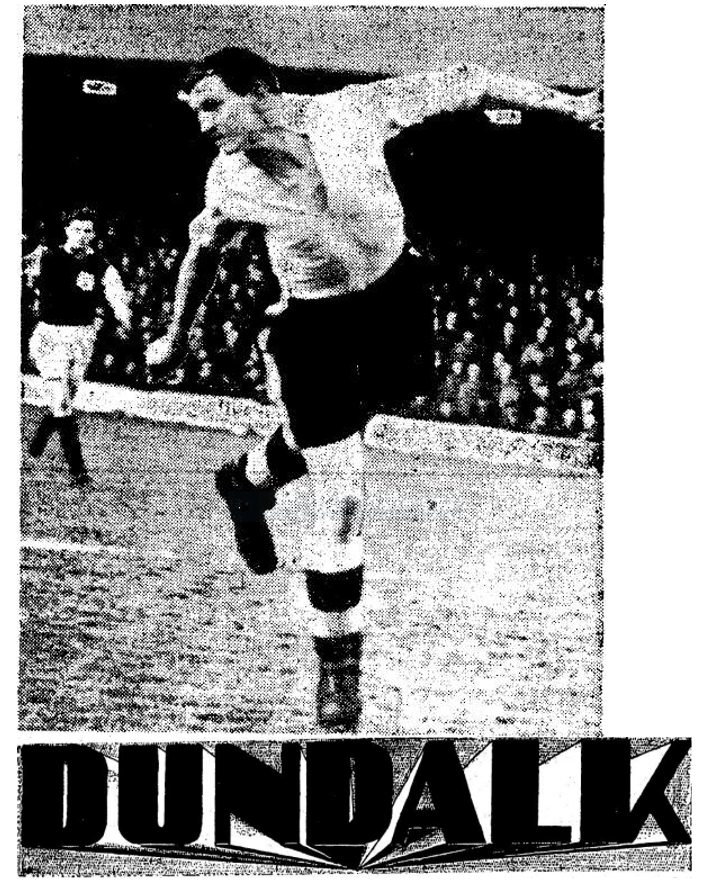
Photo from the Irish Press, December 1941

The Distillery side that was about to embark on this period of unprecedented success was drawn against another non-league side in the first round of the FAI Cup, facing off against Cork team, Butchers with the game listed for Dolphin Park on the southside of the river, despite the northside origins of Distillery. Despite the sides being from outside of the League of Ireland they did both have several players with League experience, Butchers featured several former players of Cork Bohemians while Distillery had a number of former Dolphin players among their ranks, such as forward Joe Ward who would move to Shamrock Rovers the following season and enjoy a successful career there. The club captain was Christy “Dickie” Giles who had played in the League of Ireland for Bohemians and Shelbourne but is probably best known to history as the father of John Giles.

On a cold January, Sunday afternoon Distillery were trailing 1-0 to Butchers but the Cork team suffered an injury to their right-back Brien who had to go off. With substitutions not allowed this meant that Butchers were down to ten men and Distillery began to work this to their advantage. An equaliser was finally found when the Butchers keeper, O’Connell who had been excellent to that point was decieved by a cross-cum-shot by Charles Recusin of Distillery and misjuding the flight of the ball conceded with the game ending 1-1 and a replay being arranged for the following Wednesday to be played at Turner’s Cross.

A short note on Charles Recusin who scored the equaliser for Distillery, he had previously been a player with Queen’s Park, a team based around Pearse Street and Pearse Square (formerly Queen’s Square/Park from where the team took their name), and had enjoyed success with them in the early 1930s as a winger and had been selected for an FAI Junior international against Scotland in 1933. Recusin was a member of Dublin’s small but vibrant Jewish community. His family were likely part of the significant emigration west from the Russian empire in the late 19th and early 20th century.

Charles Recusin, wearing his junior cup, in a team photo for Queen’s Park

For the replay there were changes to both sides, Brien who had been injured for Butchers was out, while Distillery were without Samuel Beattie at full-back and took the somewhat unusual step of replacing him with Molloy their usual centre-forward. Butchers, who had impressed in the initial game were favourites, especially with home advantage and a vocal, passionate crowd behind them. However, the match was a disappointing stalement, ending 0-0. The greatest excitement was at the final whistle, when the referee, a Mr. Dwyer from Dublin had to be escorted from the field by stewards and players from both sides after being surrounded by irate spectators.

A second replay was fixed for the following week in Tolka Park, crowd numbers suffered for this game as it clashed with another cup replay between Bohemians and Reds United just a kilometre away in Dalymount which proved a bigger draw. Beattie returned to the Distillery line-up and despite the closely contested games previously this proved to be a far easier test for the Dubliners who ran out comfortable 3-0 winners thanks to goals from Dorney, Redmond and Molloy. Distillery were solid in defence and according to the match reports could have scored four or five. After 270 minutes of football they were finally through the first round of the cup to what was effectively the quarter-final stage. Awaiting them would be League of Ireland side Dundalk.

Dundalk had been League of Ireland champions just two years earlier in the 1932-33 season and regularly included in their line-ups Irish internationals like Billy O’Neill and Joey Donnelly as well as players like “Jim Mills” and “Craig Gaughran”, a pair of Irish League players for Portadown, brought south of the border and playing under assumed names, Mills was really Jim Mailey and Gaughran was really Willy Craig. Shamrock Rovers had protested their loss to Dundalk the previous month on this point but had lost their appeal due to lack of evidence.

The match was played in Shelbourne Park on 9th February, 1935 on a pitch that was described as heavy. It seemed that the occasion had gotten to Distillery a bit, despite their win over Butchers and ongoing excellent performances in the Leinster Senior League they were perhaps overawed facing a side of the calibre of Dundalk? The Distillery tactics seemed set up to spoil and various reports mention the high number of frees given away and the “vigour” of the approach of the Distillery players who seemed more intent on stopping Dundalk from playing than anything else.

However, despite this approach it was Distillery who took the lead after mistakes from Tom Godwin and Jerry McCourt allowed Joe Ward to fire a powerful shot past Peter McMahon in the Dundalk goal to give them a first half lead. Dundalk did bounce back however and there was a good move by inside-left Jerry McCourt who beat Distilley full-back Sam Beattie and crossed for Billy O’Neill to score the equaliser. The game continued in a stop-start fashion with continuous niggling fouls. The Dundalk Democrat report mentioned that the referee at one point halted to game to converse with the two captains about the number of offences being committed. The same reporter said that the second half’s opening minutes produced the best of the football, and then about twenty minutes into the second half a ball was cleared from a corner by Power in the Distillery goal. McCourt and Beattie both clashed heads as they challenged for the ball and went down hurt.

The referee was George T. Davies of Bury, Lancashire, brought over for a high-profile cup game as was standard practice in the League of Ireland of the era, with British referees deemed to be of a higher standard and more impartial. Davies was an experienced ref who had taken charge of games at the highest level in English league football. He halted the game and both players were given a minute or two to get up and continue, no foul was deemed by the referee to have been committed and both men stated their willingness to play on.

The second half continued in much the same manner as the rest of the game but various reports said that as the game progressed Dundalk’s edge and superior fitness came to the fore. McCourt used his skill to good effect in attack before being fouled from behind by a Distillery player in the box to win a penalty, which was duly converted by Mailey/Mills to give Dundalk a 2-1 advantage which they maintained to the final whistle. It was the Lilywhites that were through to the semi-finals.

Again according to reports in the Dundalk Democrat there was some bad blood at the end of the game with Distillery players looking to confront their opponents after the game “invading the Dundalk dressing room”.

As for Sam Beattie he returned home to his family home at 7 North Gloucester Street (around modern day Sean McDermott Street and what is now Larkin College) where he lived with his parents and sisters, initially at least he seemed to be in good health. However, as the evening progressed he complained of head pain and a doctor was called. The doctor, according to the evidence provided by his sister Margaret, advised Sam to go to the hospital and called an ambulance was called but Sam refused to get in it. Later as he became delirious he was brought by ambulance and taken to Jervis Street hospital.

Giving testimony at the inquest the Jervis Street hospital House Surgeon, Dr. P.K. O’Brien stated that Beattie arrived to the hospital having lost consciousness, which he never regained and he passed away later that night. A post mortem examination found no skull fracture and proclaimed the cause of death as a cerebral haemorrhage.

The referee George Davies, Dundalk player (John) Jerry McCourt, Garda Sergeant Reidy (who seemed to have been at the match), and the Distillery trainer Joseph Walsh, who like Beattie also lived on Gloucester Street, all gave evidence at the inquest held in Jervis Street Hospital. All concurred that the clash of heads between McCourt and Beattie was accidental and that both players had agreed to play on the remaining 25 minutes of the game, McCourt stating he felt a bang on his forehead and fell to the ground and had had no grievance against Beattie and that he was shocked when he later learned that Beattie had died. Sgt. Reidy stated that he saw Sam Beattie directly after the game and that he definitely refused to go to the hospital. Davies said that there had been no foul play in the game which does seem a slight exaggeration when compared with the newspaper reports all of which highlighted the number of frees given in the game but the tact displayed in his testimony is understandable.

Jerry McCourt of Dundalk (pic from Dundalk’s Who’s Who)

Various parties present at the inquest, including a solicitor representing Dundalk FC and the FAI Secretary Jack Ryder all offered their sympathies to the Beattie family, and Beattie’s father, also named Samuel, stated that he was satisfied that the collision which had caused his son’s death had been purely accidental. The inquest jury added a rider, that in their view Jerry McCourt was in no way responsible for Sam Beattie’s death.

On February 13th, Sam’s funeral took place in Our Lady of Lourdes Church on Gloucester Street, before his remains were brought to Glasnevin cemetery. The funeral cortege had passed the Level Brothers soap powder works on Sheriff Street were Sam had worked as a labourer, the 300 mostly female staff had lined up outside in tribute to their former co-worker. The chief mourners were his parents Samuel and Margaret, and his four sisters, Eva and Margaret (both older) and his younger sisters Julia and Josie. Sam, the middle child and only boy in the family was only 27 when he died.

There was of course a significant representation from the world of Irish football, FAI Chairman Larry Sheridas was in attendance as was the Secretary of the League of Ireland Jim Brennan. Many of his Distillery team mates were there including Christy Giles and Charlie Recusin and club secretary John Blakely. There were also representatives from Bohemian FC, UCD AFC, Hospitals Trust FC, Reds United, Queens Park, and St. James’s Gate. Beattie’s former clubs, Shamrock Rovers, for whom he had played at reserve at Leinster Senior League level, and Dolphin for whom Sam had represented in both the Leinster Senior League and League of Ireland for a number of years and in a variety of positions were also well represented. Dundalk who had provided the opposition that fateful day were represented by players Henry Hurst, Gerry Godwin and Jerry McCourt. There had been a minutes silence the day after Sam’s death observed by the 17,000 football fans in Tolka Park to watch Drumcondra take on Dolphin in the cup, no doubt many of the Dolphin fans would have known him well.

McCourt would go on to enjoy an illustrious career with Dundalk, born in Portadown in 1905 as John Gerard McCourt, Gerry/Jerry as he was known joined the club in 1930 from Glenavon and would eventually become the club’s record goalscorer for a time before being eclipsed by Joey Donnelly. Dundalk FC historian Jim Murphy would profile McCourt as a “universal favourite, playing his heart out for the team, yet eminently fair and clean, a real gentleman of the game”. McCourt’s playing career was curtailed just two years after the clash with Distillery when he suffered a bad leg-break in a Cup game against Waterford. He continued to operate as a trainer for the club and it was in this role that he travelled with the Irish international team on its 1936 tour to Hungary, Germany and Luxembourg.

Signatures of the Irish and German players from a match played in Cologne in 1936. Jerry McCourt’s signature is fourth from the top on the rightphoto courtesy of the Behan family

Sadly for the Beattie family, and many others in the era, football could be a dangerous and even lethal game at the time. In 1924, Samuel O’Brien died after a touchline dispute in the Phoenix Park, in 1931, Gerard O’Sullivan, a worker for Dublin Corporation died in very similar circumstances to Sam Beattie, making just his third appearance for Bohemians he was involved in a clash of heads, went off the pitch and was apparently fine but later complained of head pain, and similar to Beattie was rushed to Jervis Street hospital where he later died. Over the same weekend as Beattie met his tragic fate two other footballers were hospitalised with injuries they received during matches being played in the Phoenix Park. Deaths from concussive head injuries, or limb amputations caused by bad breaks remained tragically common into the 1950s while the true extent of brain damage caused by heading footballs is still coming to be fully realised.

The inscription on Sam Beattie’s headstone in Glasnevin cemetery

With thanks to Sam McGrath of Come here to me for suggesting Sam Beattie to me as a possible person to research

A club for all seasons – 1926-27

There was change again in the 10-team League of Ireland as Pioneers raised a glass of squash and bid adieu after four seasons. This side, which began as a sporting branch of the Pioneer temperance movement are still around today playing in the Leinster Senior League. Pioneers place was awarded to Dundalk GNR – the GNR standing for Great Northern Railway and the team would have worn amber and black stripes rather than the more familiar white jerseys that we associate with Dundalk today. In that debut season Dundalk used no fewer than 47 different players, including many with experience in the Irish League, ultimately, they finished in 8th position.

The Dundalk team from that season

Bohemians battled it out with their Dublin rivals for the title, finishing 3rd behind defending champs Shelbourne in 2nd place and Shamrock Rovers who claimed their third title. Shorn of the goals of Billy “Juicy” Farrell, Rovers turned to the diminutive, young, striker David “Babby” Byrne who finished that season as joint top alongside Shelbourne’s Scottish striker Jock McMillan with 17 goals.

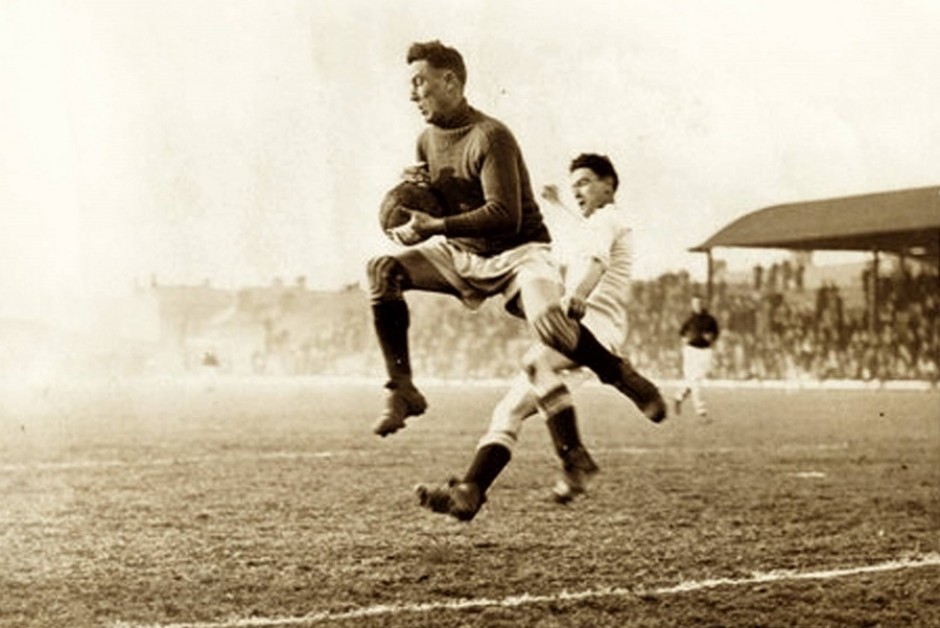
For Bohemians Dr. Jim O’Flaherty and Ernie Graham were the top marksmen but a young English forward, once of Port Vale, named Billy Dennis was also beginning to make his mark. One of the more unusual scorers for Bohs that season was goalkeeper Harry Cannon who scored his solitary goal from the penalty spot. Cannon tried the trick again on a short midseason tour undertaken by Bohs but missed in a game against London Caledonians, that match was quickly followed by another games against Tottenham Hotspur a few days later.

Harry Cannon in action

In the FAI Cup there was to be something of an upset as Leinster Senior League side Drumcondra FC, who had only been re-founded in 1924, defeated League of Ireland side Brideville in the final. Granted, Brideville had finished bottom of the league that year but they were still heavy favourites despite the fact the Drumcondra had already accounted for league sides Jacobs and Bohemians en route to the final.
The match went to a replay and with the scores tied at 0-0 after the second 90 minutes extra time was played, it was former Bohemians player Johnny Murray who final grabbed the late winner and insured that Drums could bring the trophy back to their Tolka Park home.

On the international front Ireland hosted the return fixture against Italy in Lansdowne Road, again the Irish were on the losing side, but did get on the scoresheet thanks to Bob Fullam, the score finishing 2-1 to Italy but not before Fullam had come close a second time with a free kick that was struck so hard that it knocked an Italian defender unconscious.

While Bohemians finished the season empty handed an impressive squad was being developed that was on the verge of greatness that would be fully realised the following season.

Read about the 1925-26 season here.

Building football at the halfway house – The story of Vincent O’Connell

Debate is raging at present as to whether the current Dundalk F.C. team are the greatest that has ever been produced in the history of the League of Ireland. There is plenty to recommend this Dundalk crop for that accolade; they’ve won three consecutive league titles, they won a double in 2015 and most notably they have had (by Irish standards) significant success in European competition. In terms of overall trophies Dundalk are second only to Shamrock Rovers in the medals table, having won 12 league titles and 10 FAI Cups. In this regard I’m sad to say that in recent seasons Dundalk have overtaken my own dear Bohemian F.C. in terms of League titles won despite Bohs having been 13 years longer in existence than even the earliest incarnation the Louth team.

However Bohemian F.C. as one of the earliest founded and most prominent clubs certainly played a role in the growth of football in Dundalk. For example it was a former Bohs player, Steve Wright who led Dundalk to their first league title way back in the 1930s. The

wrightstephen

Steve Wright – source Dundalkfcwhoswho.com

focus of this article however, is another former Bohs player who was one of the a number of men instrumental in helping to organise the sport of association football in that town and helped to found one of the first proper leagues there.

That this is the case shouldn’t be too surprising, in research for this piece I came across a Sunday Independent article from 1956 which declared of Dundalk that “Soccer stopped at the half-way house” as Dundalk occupied the geographic midpoint between the early footballing hot-beds of Belfast and Dublin, it seems only reasonable that Dublin would have some baring on the games development.

As well as its location there were plenty of other reasons for football to take root in the town. These included presence of a British Army barracks staffed with many active young men, many of whom would already have been familiar with the game, as well as the growth of the railway industry, specifically what became the works side of the Great Northern Railway (GNR) from which the present Dundalk F.C. developed. One of the biggest games in early Dundalk football history was the arrival of the Bohemian F.C. side to take on a local Dundalk AFC side in the Leinster Senior Cup on St. Stephen’s Day 1895. Bohs emerged as the victors from a 3-1 scoreline, however the Dundalk side had competed well and the significant crowd despite the particularly cold winter weather had shown that there certainly was an audience for the sport in the Louth town.

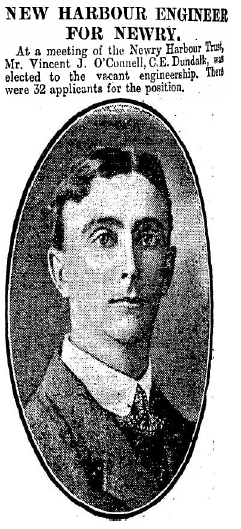
One of the Bohs men who had an influence in shaping the football landscape of Co. Louth was Vincent J. O’Connell. A local lad, Vincent was born in Dundalk in 1882 as fourth son of Henry O’Connell a grocer, of Dundalk, and his wife, Mary. Vincent was a good student and pursued a career as an architect which was what brought him to Dublin to study with the Hague & McNamara firm who were based on Dawson Street. He had been involved with various scratch teams in Dundalk around the turn of the 20th Century and also featured with a side named Dundalk Rovers F.C. who competed occasionally in the Leinster Senior Cup. Vincent would have been roughly 20 by the time he moved to Dublin to study with Hague & McNamara and continued to pursue his interest in the sport by joining Bohemian F.C. in 1902. There is mention of him lining out as a half-back for Bohs in a December 1903 match against the Dublin University club from Trinity College. The Bohs starting XI was described as “not at full strength” and they suffered a heavy 6-1 defeat. O’Connell remained a Bohemians member until 1907 by which stage he had returned to Dundalk and had set up his own architectural firm on Earl Street in the town.

Like many Bohemians of this area his talents weren’t limited just to football and he was also a well know cycling enthusiast. In the business world Vincent prospered and in 1909 he was appointed to the position of engineer at Newry Port, he even branched out by opening a new office in Newry by 1911. As an architect he designed the stores along the Albert Basin not too far away from the Showgrounds where Newry City AFC currently play. Despite these increasing work commitments his

vj-oconnell-pic

Vincent J. O’Connell in 1909

interest in football maintained and he was recorded as the Vice Captain of the St. Nicholas football team for the 1910-11. St. Nicholas had been training at the Dundalk polo grounds and had competed in local leagues and in the Leinster Junior Cup for a number of years by this stage, and by 1910 were a well established side on the local football scene.

Vincent continued this involvement with local football when he served on the board of the of the Dundalk and District league in the tumultuous year of season of 1920/21. The War of Independence was raging in Louth and in the sporting boardrooms the Leinster Football Association had formally decided to cede from the IFA. At the AGM of the Dundalk and District league the member clubs were encouraged to align their loyalties to the Leinster association, Vincent was at this stage the Dundalk and District League vice-president. Perhaps most surprising to note was that the league that season consisted of six teams, three of which were representatives sides drawn from British Army regiments in and around the town.

By 1926 the Dundalk GNR (Great Northern Railway) club had become a League of Ireland member and in 1930 they renamed to become the Dundalk F.C. we know today. In the 1932-33 season they became the first provincial side to take the title out of Dublin but they had done so at great financial cost to the club. Led by former Bohemians player Steve Wright as their trainer/manager Dundalk had taken advantage of the fact that the FAI were not recognising player registrations of clubs in Britain or Northern Ireland meaning that players could freely move to Ireland without Irish clubs having to buy out these registrations. Effectively free transfers.

Dundalk brought in a number of British pros, men like forward Jimmy Bullock who had lined out for Manchester United before moving across the Irish Sea or the veteran former Celtic star Joe Cassidy. These signings were won through the charm of Steve Wright and the bankbook of Dundalk F.C. and coupled with the beginnings of a generation of young local players such as Joey Donnelly had begun to bring success. There was a Cup final appearance in 1930/31 with a league title following in 1932/33. However a number of factors such as the professional wages paid to these new players, the unpopular entertainment tax levied on football matches by the Irish government, a loss of revenue due to the cancellation of previously popular cross-border matches with Northern clubs, and the continuing effects of the Great Depression meant that money was extremely tight and there was even some chance that the club might go under.

By the time all this was taking place Vincent O’Connell was busy operating his main business premises out of 15 Earl Street in Dundalk, one of his most recent projects had been the design of the new chapel for St. Mary’s College in 1933, a school that had been central in popularising the game of football in the town. Vincent had maintained his own interest in football long after his playing days were done. In January of 1934 he joined a fundraising committee to keep Dundalk F.C. going in their time of need and he personally was one of the largest financial donors, donating a guinea, a similar sum to that donated by Dundalk board members like Bob Prole and, my own great-uncle, Peadar Halpin. Through their fundraising efforts sufficient finances were raised to keep the club afloat.

Vincent maintained his interest in football and many other sports for the rest of his life, the 1956 article quoted above described him as the “prominent Dundalk architect whose enthusiasm for all forms of sport has left him with an invaluable store of memories.”  Less than a year after that interview Vincent passed away in July 1957, he was survived by his wife and three children. He had remained active as an architect into the 1950’s where he was joined by his son Daniel (trading as V.J. O’Connell & Son), and over the course of his more than 50 year career he worked on projects as diverse as monasteries, to hospitals and cinemas. However at his passing the various obituaries tended to spend as much time discussing his many sporting successes, especially his time at Bohemians and his early role in helping to develop the sport in his native Dundalk.


Football, revolutionaries and my great-grandfather – 1916 and all that

We’ve only begun the year of commemorations and there has already been a great deal written about the various organisations, groupings and competing actors around the dramatic events of Easter 1916.  In much of nationalist history there is a huge role played by sport in the recruitment and training of the Volunteers, this is something often celebrated by the GAA and is born testament to in the naming of stadiums and club teams around the county.

This involvement with the nationalist cause was not limited only to the sphere of Gaelic games. Despite its occasional portrayal as a “Garrison Game” many individuals who were actively involved with football clubs also became key players in the struggle for independence. Among them were family members of my own.

In doing some family tree research I’ve started looking into the history and background of some of the relatives on my Da’s side of the family, people I was vaguely aware of but who by and large had died before I was born. This trail has brought me to a few individuals, my great-grandfather Thomas Kieran (occasionally spelled Kiernan) his sister Brigid and her husband , my great-uncle, Peadar Halpin.

At this point I must state that I do indeed have some non-Dublin blood in my veins, not much mind, but both Thomas and Peadar were from Co. Louth. Peadar would come to prominence due to his association with Dundalk FC and the FAI. He was a founder member of the club and spent decades on the management committee of Dundalk FC and was also club President. He also served as Chairman of the FAI’s international affairs committee and President of the League of Ireland and also Chairman of the FAI Council.

Football in Dundalk, in a somewhat disorganised fashion could be found as far back as the late 19th Century and some of the impetus given to the game in the early 20th Century can be traced back to a Dundalk architect named Vincent J. O’Connell. He had played for scratch teams in the town in his youth and had been a member of Bohemian FC between 1902 and 1907 during a sojourn in Dublin. Upon his return north he set about working with others to bring some structure to the playing of the association game in the town.  The club we know today as Dundalk FC began life as Dundalk GNR, the GNR standing for Great Northern Railway, and they spent a number of years in junior football before being elected to the League of Ireland in the 1926-27 season. The campaign for election to the league as well as the eventual re-branding of the club to Dundalk FC was apparently the result of the machinations of a group of local football enthusiasts comprised of Peadar Halpin, Paddy McCarthy, Jack Logan, Paddy Markey and Gerry Hannon. According to a report in the Irish Times the decision to change the club’s colours from black and amber to white and black was made by one Barney O’Hanlon-Kennedy who promised his silver watch as a raffle prize for a fundraiser for the club. As he was the one putting forward the funds he was given the honour of selecting the team’s colours.

That Dundalk should be so connected with the railway shouldn’t be that surprising, then as now, Dundalk was a major station between Dublin and Belfast, even if the creation of the border did cause disruption. My great-grandfather Thomas Kieran (born in 1889, son of Patrick and Annie Kieran) was a worker for the railway, at the time of the 1911 census when he was 22 years old and residing in the family home of 14 Vincent Avenue in Dundalk (five minutes from the train station). He was listed as being an “engine fitter”, while his father Patrick was a carpenter for the railway as well. Later reports show that Patrick was also involved with the union (the Irish Vehicle builders and Woodworkers Union) and was among the workers representatives when a strike was threatened in 1932. The census also reveals that of the family of five both Thomas and his sister Brigid spoke Irish.

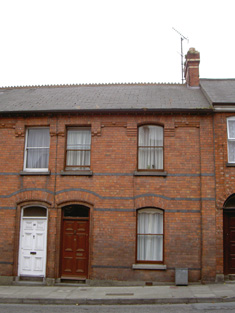
Vincent Avenue

House in Vincent Avenue today, they were build c.1880

Republican roots, what the records say…

When searching through the Bureau of Military history records I came across a number of references to the Kieran family. One referred to the family as a “Volunteer family….railway people”. This came from the witness statement of Muriel MacSwiney, the wife of future TD and Lord Mayor of Cork, Terence MacSwiney who stayed with the Kieran family during one of Terence’s frequent bouts of imprisonment. This is confirmed by the witness statement of another local Volunteer James McGuill who referred directly to Brigid saying that Muriel MacSwiney “stayed in Dundalk with Miss Kieran now Mrs. Peadar Halpin.”

78-1926-08-15-Muriel-MacSwiney-1920

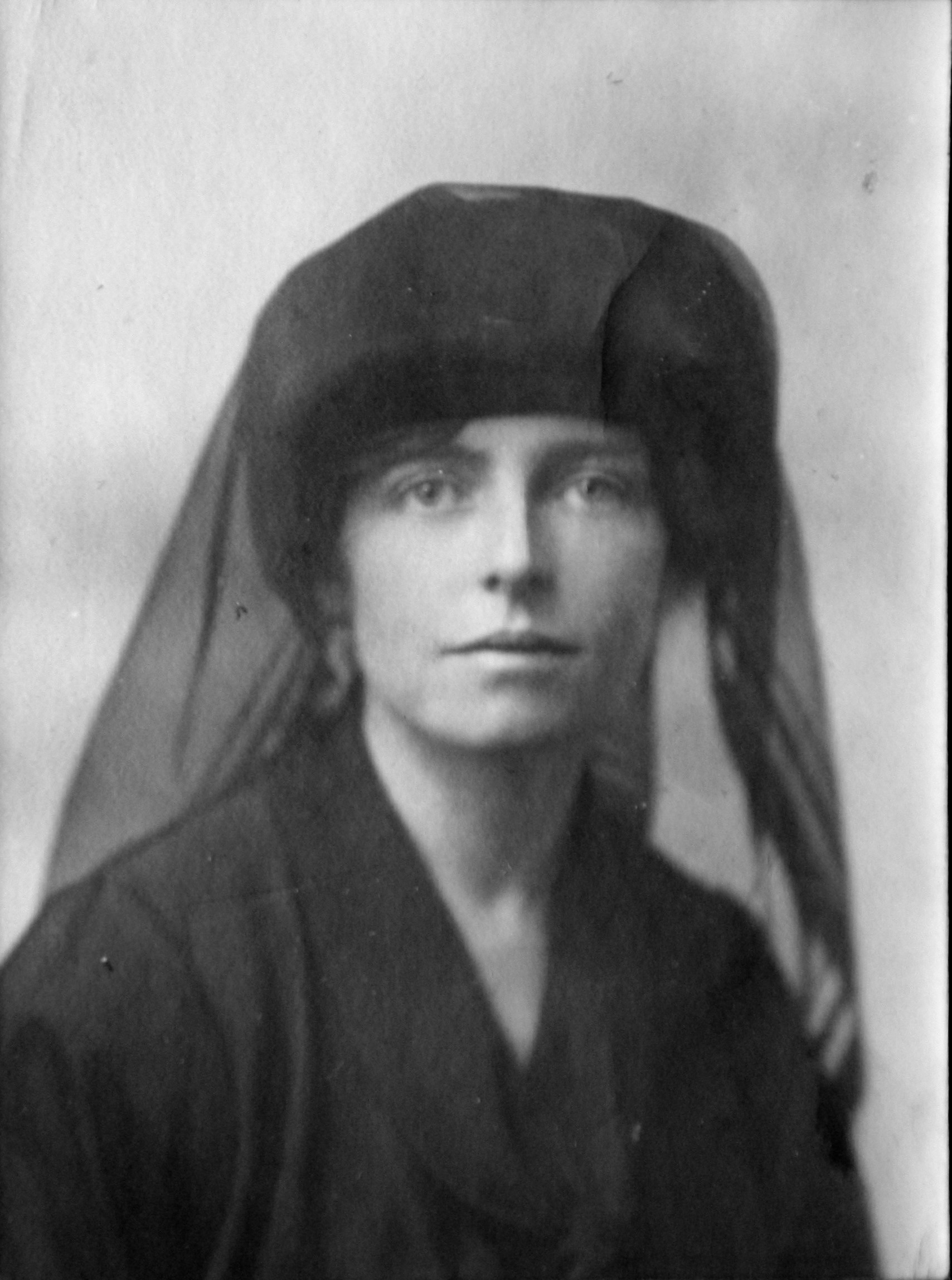
Muriel MacSwiney

On a slight digression Muriel MacSwiney was a fascinating woman, born Muriel Murphy, her family owned the Midleton Distillery and they were firmly against her marriage to Terence MacSwiney and even tried to get the Bishop of Cork to intervene to delay it. As a footnote that will become relevant later, the best man at their wedding was Richard Mulcahy the future Chief of Staff of the IRA, Minister for Defence during the Civil War and later still, leader of Fine Gael. Terence was in and out of various gaols during the course of his short marriage with Muriel, he would be dead by 1920 at the age of just 41, wasting away on hunger strike in Brixton Jail. The impact his death had on the wider world is probably comparable to that of Bobby Sands six decades later. MacSwiney was viewed by many as a martyr in a fight against Imperialism and was cited as an influence by  Mahatma Gandhi as well as India’s first Prime Minister Jawaharlal Nehru.

Apart from providing lodgings for Muriel MacSwiney it’s worth looking at what else the Halpins and Kieran’s were up to at this turbulent time. Thomas Kieran is mentioned again the the Bureau of Military History. In the witness statement of Patrick McHugh, Operational Commander and Lieutenant of the Irish Volunteers in Dundalk during Easter week 1916 listed Thomas Kieran among those “who served Easter Sunday 23rd April 1916, remained with company that day and, volunteered to return home when uncertainty of position was explained to them. Some returning Sunday night, others Monday morning or as Stated.”  Interestingly Thomas is already listed as living in Dublin by this stage while most of those mentioned were still living in Dundalk. Peter Kieran (a possible relation?) another Dundalk based Volunteer declared in his witness statement that Thomas Kieran was among a group of Volunteers who had arranged to meet on the night of Thursday 20th April with plans to make their way to Dublin to join the rest of the Volunteers in the Rising. They had elaborate plans to get there via motor boat but were warned that the Royal Navy had vessels patrolling the area.

The plans for the Thursday journey to Dublin was called off and the group met again on Friday and Saturday night, however word came that the Rising was off, probably a reference to Eoin MacNeill’s order cancelling the Rising, which obviously had a significant impact on the numbers of those who arrived in Dublin. Peter Kieran went on to state that about the second week in May arrests were made in the town by the RIC. The family version of the story that I’ve been told was that Thomas was one of those arrested while cycling his bike with a rifle on his back and that he was later interned!

Peter Kieran in his statement also noted that “Those who served 23rd, 24th and 25th April 1916 and became disconnected, were ordered home on account of age, infirmity or as stated. [included] Peter Halpenny or Halpin [of] Byrnes Row Dundalk”  Although it is hard to be absolutely certain this Peter Halpin could well be our Peadar Halpin, he was listed as Peter on the earlier census return. There is also a record of a P. Halpin from Byrne’s Row who was arrested a couple of weeks after the Rising and sent to Stafford Detention Barracks in England on 8 May 1916. There are other references in other sources to a P. Halpin of Byrne’s/Burn’s Row being arrested and sent to Stafford.

In searching the medal rolls for this issued the 1917-21 Service Medal both Peadar and Brigid appear. Both were issued the medal, Brigid in 1943 and Peadar in 1951. Her deposition states that Brigid was a member of Cumann na mBan from before the Rising. She was involved in dispatch work, fundraising for the purchase of arms, did election work for local candidates and visited republican prisoners. Peadar in his deposition states he was a member of “A” company of the 4th Northern Division of the IRA and that his involvement also predated the Rising, going back to 1915. It doesn’t however, detail individual operations of which he was part.

Patrick McHugh (who we encountered above) managed to escape arrest although he was interrogated by RIC men just after the Rising. He then moved up to Dublin to stay with his sister on Iona Road for a short time until he “got in touch with friends Tom Kieran and his wife [the granny Kiernan], who had a room in Mountjoy Street.” It seems that Thomas Kieran had moved to Dublin sometime between 1911 and 1916. I know he ended up working in the CIE engineering works in Inchicore for many more years. He obviously met Jane Brennan (2 years his junior) when he moved to Dublin, she had been living on Dominick Street Upper at the time.

Blessington St1

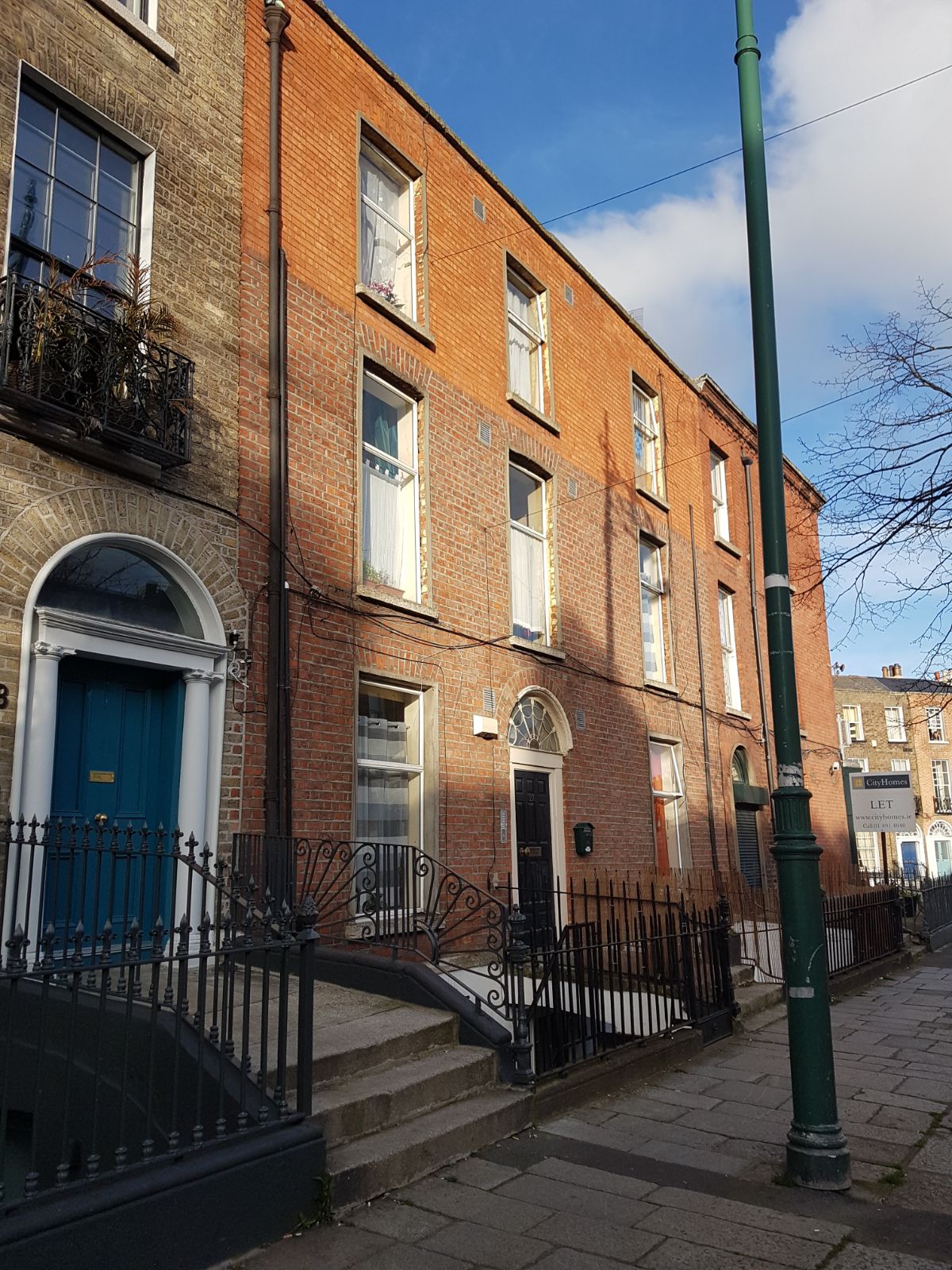
The house at 27 Blessington Street, just off Mountjoy Street, where the Kierans lived.

Peadar was born in 1895 and grew up in Stockwell Lane, Drogheda. He trained as a cooper, (the trade of his father John) before moving to Dundalk to work in the Macardle Moore Brewery where he later became the foreman cooper. It is interesting to note that his wife Brigid was 12 years his senior. He came from something of a Republican family and a street (Halpin Terrace) in Drogheda bears the family name. This street has something of a tragic history to it as it was named after Peadar’s younger brother Thomas, who was killed there by the Black and Tans in February 1921. At the time Thomas was an Alderman of the local Corporation representing the Sinn Féin party. Thomas Halpin, along with another man, John Moran were abducted from their homes and brought to the local West Gate barracks where they were brutally beaten. They were then dragged to a third man`s home, that of a Thomas Grogan whose house was also raided but fortunately Grogan had been tipped off and had made his escape before the Tans arrival. It was at this spot that Thomas Halpin and John Moran were murdered, their bloodied bodies being discovered there the following morning. Each year the local Council commemorates this event and a monument now stands at the site of the men’s murder.

IRA memorial

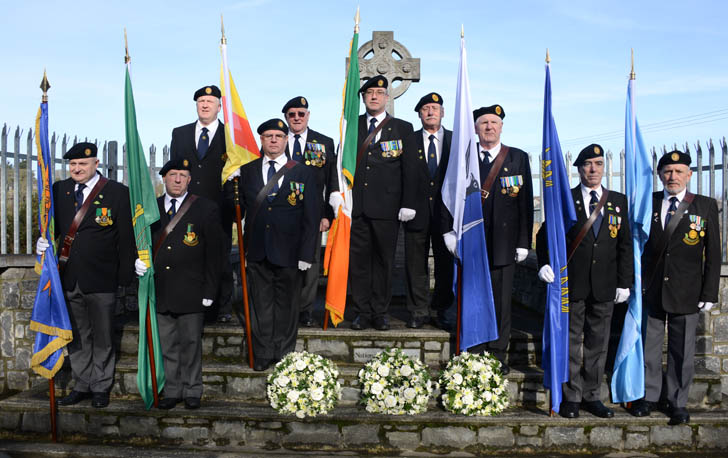
Commemorations for Alderman Thomas Halpin & Captain John Moran in 2014


Footballing connections; all roads lead to Bohs

Thomas, is something of a family name, Peader’s brother Thomas was tragically killed and Peadar would name a son of his as Thomas, perhaps in tribute to his murdered sibling. Thomas Kieran would also have a son named Thomas and there is an interesting football overlap as both of these men named Thomas would have a part to play in the history of Bohemian FC.

Peadar’s son Tom lined out for Dundalk in the early 40s before moving to Bohemians in 1947. He featured prominently in Bohs run to that season’s FAI Cup Final where he was part of a team that defeated Drumcondra FC, Shelbourne in the semi-final (where Halpin scored a penalty) and took on a highly talented Cork United side in the final. Cork United had been the dominant team of the 1940s and had already won five league titles by the time they took on Bohemians in front of over 20,000 fans at Dalymount Park on April 20th 1947. The Leesiders were the strong favourites. Bohs were at an added disadvantage as two of their key, experienced defenders (Snell and Richardson) were out injured. Halpin was playing at right half and spent most of his time trying to counteract the attacking threat of Cork’s forward line which included Irish internationals like Tommy Moroney and Owen Madden.

Bohs 1947

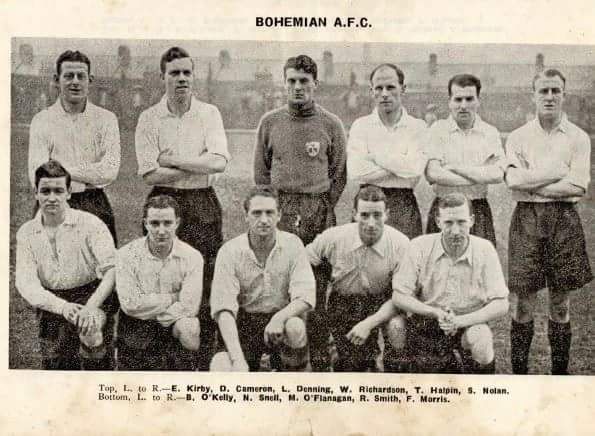
The Bohemian team from the 1947 final

Bohs were already 2-0 down before 30 minutes were on the clock but Mick O’Flanagan managed to pull one back before Halpin scored a penalty after Frank Morris was fouled in the box. The game finished 2-2 and went to a replay four days later. In a howling gale and lashing rain Bohs lost out in the replay in front of barely 5,500 people with the Munstermen winning 2-0.

Tom Kieran’s connection with Bohemians was a very long one, a referee for decades, including at League of Ireland level in the 1960s. The uncle Tom was a member of Bohemians since 1969 and was Vice-President of the club from 1985 to 2000 and was later made an Honorary Vice-President for life. Tom’s daughter Susan and her husband Dominic are of course still very familiar faces down at Dalymount to this day.

the uncle Tom

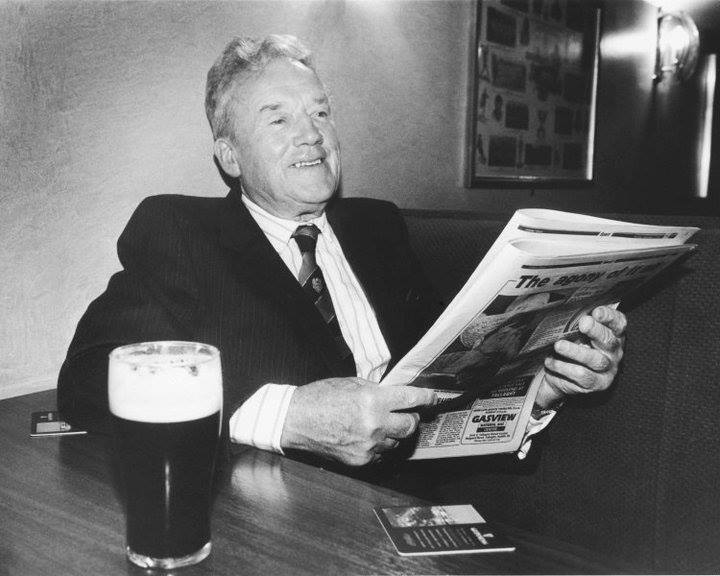
The uncle Tom as photographed for an Evening Herald profile in Dalymount Park

There are further remarkable connections with the Halpin family and with Dundalk and Bohemians as Thomas Halpin’s grandson; Peter was the Commercial Manager at both Dundalk FC and Bohemian FC as well as having a spell with Belfast club Glentoran.

Despite these many connections with the beautiful game the strongest and most influential roles in Irish football were undoubtedly held by Peadar Halpin. He was on the committee of Dundalk FC since at least 1926 and had two spells as Club Chairman from 1928-1941 and 1951-1965 and in 1966 he was appointed Club President, a position he was re-elected to in 1973. He also held a number of roles for the FAI, he was Chairman from 1956-1958 and had many years previous experience on various FAI committees and had made an unsuccessful attempt at arranging UEFA mediation to help resolve the long-running schism between the FAI and the IFA. At the age of 70 he was elected as President of the League of Ireland, it was a role he hadn’t been expecting to fill but after the Dundalk rep Joe McGrath became ill Peadar was the only member of the Dundalk committee with sufficient experience to take on the role. While the FAI and League of Ireland have (with good reason) been seen as conservative and at times backward there were a number of advances that took place during his tenure. It was the Dundalk committee that suggested the introduction of the B division which would eventually lead to the creation of the First Division as well as overseeing the admittance of new clubs to the League of Ireland. On a local level he was crucially involved with the development of Dundalk FC as a force within the League of Ireland, at present they are the second most successful side in Irish club football with 11 League titles and 10 FAI Cups. He claimed that of the many successful years that Dundalk enjoyed his favourite was 1942 when Dundalk beat Cork United 3-1 in the FAI Cup final and Shamrock Rovers 1-0 in the Inter City Cup.

Dundalkimage

Mattie Clarke in action for Dundalk in the 1950s as featured in the Irish Times

A potential politician?

Despite this extremely long connection with Dundalk FC the earliest reference to his involvement was in 1926. Prior to that we know that he was working as a foreman cooper in the Macardle Moore Brewery but in March 1923 his name appears in a debate in Dáil Éireann when his local TD Cathal O’Shannon raised a question on his behalf with the then Minister for Defence, General Richard Mulcahy. This is the same Richard Mulcahy who had performed best man duties at the wedding of Terence MacSwiney and Muriel Murphy who the Halpin’s would later shelter. It is testament to the divisiveness of the Civil War that such former allies could be so opposed.

O’Shannon had been elected TD for Louth-Meath in 1922 as a member of the Labour Party and was a supporter of the Treaty of 1921 which had officially led to the partition of Ireland. Mulcahy as Minster for Defence was a highly controversial figure for some as it was he who gave the order for 77 executions during the Civil War. The content of O’Shannon’s query was a request for an update on the status of Peadar Halpin and the likelihood of his release from Newbridge Barracks where he had been held since August 1922. Mulcahy replied that “Mr. Halpin was arrested for aiding and abetting Irregulars during the time of their occupation of Dundalk. It is not considered advisable to release him at present”, he further added that Peadar was not to be allowed send or receive letters.

As for what “aiding and abetting the Irregulars” referred to, the most likely answer given the fact that Peadar was arrested in August 1922 in Dundalk was that he was involved in assisting the anti-Treaty IRA (or “Irregulars”) in their attack on Dundalk on August 16th 1922. During this attack, led by future Tánaiste Frank Aiken, the anti- Treaty forces captured the town, freed over 200 prisoners held in the barracks and also took over 400 rifles. Rather than try to hold their position the town was re-taken the following day by Free State forces. In all the attack on Dundalk cost the lives of six Free State soldiers and one officer as well as the lives of two of the “Irregulars”. It is not clear what assistance Peadar provided during this time but it was obviously significant enough to warrant him being held in gaol for months without charge.

Family recollections of Jane Kieran née Brennan, the wife of Thomas Kieran are fairly clear on her views on Mulcahy and Cumann na nGaedheal, she put it bluntly and succinctly, saying “they cut the old age pension and they shot them in pairs”. It was not to be the last connection between Peadar and Cathal O’Shannon or Frank Aiken for that matter as the below excerpt shows.

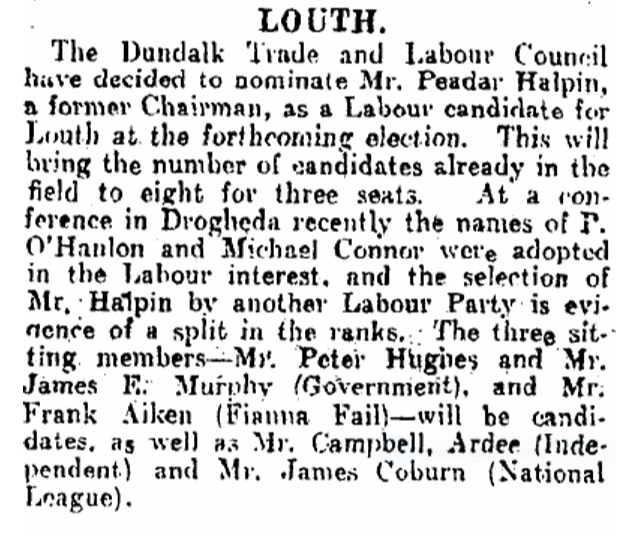
Peadar Labour snip

From the Irish Times April 29th 1927


Cathal O’Shannon stood in the new Meath constituency in the first general election of 1927 and in his absence as the Labour candidate it was proposed that Peadar should run. Among his competition would have been the man he likely assisted during the Civil War, Frank Aiken. However as is the cross that left-wing politics must bear, there was a split, those who proposed Peadar as a candidate were not successful in securing his nomination and Thomas O’Hanlon and Michael Connor ran, unsuccessfully, for the Labour Party. As another of my many side notes, Cathal O’Shannon was unsuccessful in gaining election in 1927 however he later became the first Secretary of the Congress of Irish Unions in 1945, the last president of this Congress was one Terence Farrell, head of the Irish Bookbinders and Allied Trades Union. His nephew Gerard, after whom I’m named, married Nancy Kieran which brings together the Farrell and Kieran clans. Their eldest son was my Da, Leo and as many in the family will know he played for Bohs in the early 60s.

Anyone who has read this blog regularly will know that I often try to look at life and history through the prism of football. Of particular interest is the role that “soccer men” played in the Rising and subsequent War of Independence and Civil War. This is probably the most personal post as I’ve tried to do the same with my own family and their involvement with the nationalist movement. There are many stories that I would love to include but haven’t but would appreciate any feedback or additional information from family members. I hope that this could be the first in a series of posts that might be of interest or maybe just a first draft of something more extensive, there were certainly enough stories told at uncle Joe’s funeral to fill a book, but I hope this might be a start.


With a special thanks to Jim Murphy, Dundalk FC historian for his assistance with some of the research for this piece.