The whistle of Langenus

In the summer of 2018 as the elated French champions cavorted and the Croatian players lay prone and disconsolate a group of men in fluorescent light-blue jerseys went to the podium to collect their medals, they were referee Néstor Pitana and his team of officials. This was surely the sporting pinnacle for Pitana, who had celebrated his 43rd birthday just a month before and had begun his career refereeing in the Argentine second tier back in 2006.

But Néstor Pitana is but the latest link in a chain that stretches back almost 90 years to John Langenus, the Belgian official who had refereed the chaotic first World Cup final in 1930, as well as games in the 1934 and ’38 tournaments and the 1928 Olympics. Such was Langenus’s international reputation that he was in high demand for club games outside of his native Belgium, and it is here that the Irish connection appears, because just three months before he refereed in the Amsterdam Olympics of 1928 and two years before the World Cup final, he was in Dalymount Park for the Free State Cup Final between Bohemians and Drumcondra.

Bohs won that Cup final 2-1 in front of a crowd of over 25,000 on St. Patrick’s Day, 1928 to secure a clean sweep of all four domestic competitions that season. Their goals came from Jimmy White and Billy Dennis which cancelled out John Keogh’s opener for Drums. Match reports record that the Bohs were deserved winners with Drumcondra offering little in attack after their opening goal. Of the referee’s role The Irish Times noted that “while feelings ran high at intervals, the referee, Mr. Langenus of Belgium, handled the game splendidly and that nothing unseemly occurred to mar the enjoyment of the huge crowd”.

Langenus was something of a Pierluigi Collina of his day, well-known, popular and well-respected throughout the sporting world as well as being visually arresting, as a tall figure with slicked back hair who took to the field in a shirt, tie, jacket and a pair of plus-fours. It was this reputation that led him to Dalymount Park in 1928. Then as now there were constant debates about the quality of referees and plenty of criticism was aimed at the men in the middle during the early years of the League of Ireland. This meant that for high profile games such as Cup finals the FAI had established the practice of bringing in referees from outside of Ireland.

Usually this meant an English referee, Ireland still looked to England as a bastion of the game and it made sense to use an English speaking referee. For example, in 1927  J.T. Howcroft from Bolton had taken charge of his second FAI Cup Final. A prominent English referee, Howcroft had also officiated the 1920 FA Cup final between Aston Villa and Huddersfield. However, John Langenus had two things in his favour, he was a fluent English-speaker and in addition to his native Flemish he also spoke French, German, Spanish and Italian. The second reason that it should not be such a surprise that he refereed the Cup Final was that a year earlier he had been in Lansdowne Road to referee the Ireland v Italy international which Italy had won 2-1 thanks to two goals from Juventus striker Federico Munerati.

At a banquet following that Ireland match held in the Hibernian Hotel on Dawson Street where John Langenus and his wife were guests, the Honourary Secretary of the Association John S. Murphy toasted Langenus and described him as “one of the best referees they had ever seen in Dublin”. This surely helped with his appointment to the following year’s Cup final.

The paths of the Irish national team and John Langenus would cross on several further occasions, he took charge of Irish matches against Spain, the Netherlands, Hungary, Switzerland and finally against Czechoslovakia in 1938. Langenus himself had many happy memories of his trips to Dublin. He committed some of these to record in one of his memoirs Whistling through the world printed in 1942.

In his book he recalls witnessing the St. Patrick’s day parade on the morning of the FAI Cup Final,  as well as his chats with Lord Mayor of Dublin Alfie Byrne, and his visits to the main tourist attractions; Dublin Zoo, the Botanic Gardens and St. Michan’s Church where he saw the famous preserved bodies in the church crypt. But his main memories are of Irish social culture, and Irish drink! John Langenus took a particular interest in Irish whiskey and would go directly to the distilleries to buy 90 and 100 year old bottles that wouldn’t usually be found on general sale, these he would keep as special gifts for friends (and perhaps a couple for his own collection). He was lucky on one occasion that he managed to bluff his was through English customs checks with two bottles of vintage whiskey in his suitcase.

Similarly he remembered the good humour of the after-match banquets, once again his beloved Irish whiskey makes an appearance though he mentioned that the only way he could tell his Irish hosts were getting a little drunk was that they tended to sing more. In winning or losing he recalls the good mood of his hosts remained the same.

Not all of Langenus’s sporting engagements were to be as enjoyable. His most famous role, that of World Cup Final referee was as far from the relaxed surroundings of a Dublin banquet as was possible. As the great Brian Glanville wrote of Langenus during that final match in Montevideo’s Estadio Centenario “The prospects of dealing with twenty-two players, each of whom was capable of disputing any and every decision, to say nothing of the nearly 100,000 spectators who, once they had paid their money, felt entitled to behave as they pleased, would have daunted men of lesser experience and courage than Langenus”.

Doubtless that Langenus was experienced and courageous but he was also pragmatic, he would no doubt have heard the chants and songs thousands of passionate Argentine fans as they streamed from their ferries across the River Plate and into the stadium hours before kick-off, he would have heard their Uruguayan counterparts fanatically chanting their own calls to arms, including the ominous “Victory or death!”. Who’s death exactly? In such cases often it’s the referee in the firing line and Langenus had sought assurances from the Montevideo police that a swift, armed escort, direct to their ship should be arranged right after the match for him and his team of officials should this be required.

Although the match was intense and undoubtedly passionate Langenus escaped the ire of either set of supporters, in fact he was involved in solving the biggest point of conflict even before kick-off. With both sides insisting that a football manufactured in their own country be used, Solomon-like, Langenus agreed that a ball from Argentina would be used in the first half and a ball from Uruguay in the second.

On that day, as Uruguay celebrated victory in the maiden World Cup, in front of their own home fans, John Langenus must have realised he had reached the apex of his refereeing career. He would return again to officiate in the next two World Cups, signing off his last World Cup match officiating the 3rd place play-off in 1938 which saw Brazil claim bronze, defeating Sweden 4-2.  While he continued to referee international games for another year the outbreak of World War Two effectively ended his career as an international referee though he continued to referee matches in the Belgian League throughout the War until finally the league was suspended for the 1944-45 season. By that stage Langenus was 53 years of age.

According to one source, as a teenager he had played youth football for AS Anversoise but was already a referee in the Belgian top flight since at least 1912, refereeing his first international match in 1923 aged just 31. Throughout his career he was a committed amateur. He worked as a public servant in his home city of Antwerp for his whole working life and was also an occasional sports journalist. While on international duty only his expenses were paid and he refused any fees to referee games though often in such instances medals, cut glass, watches or decorative cups were given as mementos. He also had the perk of  being able to bring back the likes of whiskey from Ireland or cigars from Spain. His positively Corinthian idealism is evident even just by looking at him with august bearing and almost formal attire.

His talent for writing was something that he put to good use in his retirement, writing a memoirs and two other football related books. He passed away in his native Belgium in 1952 aged 60.

With thanks to the people behind @WC1930blogger and @RefereeingBooks for their assistance.
Ray Keogh – a pioneer in Irish football (Podcast)

Recordings of my talk on the life and career of Ray Keogh from January 2020. This talk took place in Drumcondra Library and I would like to thank Conor Curran and Emma Kelly for their assistance in organising everything on the night.

Also discussed are topics like the demise of Drumcondra FC as a league club, as well as the career of other players of colour in the League of Ireland and the Irish League. Also heard at the end of the talk is Ray’s former Drumcondra teammate Alf Girvin who shares some of his memories of Ray and Drums.

Some photos included below are provided by Ray’s family as well as some images from the evening of the talk.

This slideshow requires JavaScript.

The Hungarian Revolution?

At the beginning of the 1950’s the Hungarian international side were the great ascendant football team of the era, it was a period that would deliver them an Olympic Gold medal in 1952 and see them become runners-up in the 1954 World Cup in somewhat controversial circumstances as the West German national team pulled off on of the all-time sporting shocks.

Hungary’s international exploits were at somewhat of a remove from the League of Ireland where a Englishman, Welshman or Scotsman was usually as exotic as things got in terms of playing personnel, however the huge political changes that took place in post- War Hungary ended up having an unexpected, tangential impact on the League of Ireland as within ten years or each other two men, apparently Hungarian internationals, were lining up for League of Ireland clubs like Limerick City, Sligo Rovers and Drumcondra.

The first of these two was Siegfried Dobrowitsch who arrived in Ireland in 1949 via France after leaving his Hungarian homeland in 1947. Siegfried or “Dobro” and many of his Irish team-mates nicknamed him had left Hungary as the Hungarian Communist party were growing in power, becoming the dominant party in the short-lived Second Hungarian Republic before, in 1949, declaring Hungary a single party Communist state; the People’s Republic of Hungary.

Dobrowitsch claimed that he had heard about Sligo Rovers as part of a recruitment advertisement for new players brought to his attention by his French wife, not that far fetched when you consider only ten years earlier the club had persuaded an ageing “Dixie” Dean to sign up for a short stint in the north west. In fact the Sligo Champion newspaper went as far to lead with the headline announcing his signing with “First Dean, Now Dobrowitsch”.

Dobro image 2

Siegfried Dobrowitsch

In various reports it was stated that Dobrowitsch had been capped either five, or six times by the Hungarian national team and there was much comment about this being something of a coup for Sligo Rovers who were anxious to get him into their starting XI. However, Siegfried’s first game was delayed several times as Rovers had to seek international clearance for him to make his debut, there seemed to have been long, drawn-out correspondence with the French Football Association as Dobrowitsch had  most recently been plying his trade for Strasbourg.

More information on Siegfried’s early life has come to light through the research of his daughter Alda Cornish, who recently visited Ireland and met with representatives of Sligo Rovers. In a piece in the Sligo Weekender where she filled in some scant details of her father’s early years, noting that “he was born in a part of what was Hungary and we understand he lost both of his parents by the age of seven. He was put in a Jesuit Boys Home, but it was a very cruel place where he grew up. The next thing I could find was he was playing football and working as an electrician. He ended up in France around 1947 and played with Strasbourg, where he met his first wife.”

Newspaper reports at the time state that Dobrowitsch was born in a part of Yugoslavia that had come under Hungarian control and that his multi-lingual French wife acted as his interpreter. In an interview published in February 1949 in the Irish Independent, presumably with his wife acting as translator Siegfried got to explain something of his personal story. Born around 1920 he claimed to have won six international caps for Hungary between 1938 and 1942, after which point he was drafted into the Hungarian army to fight for the Axis powers during the Second World War.

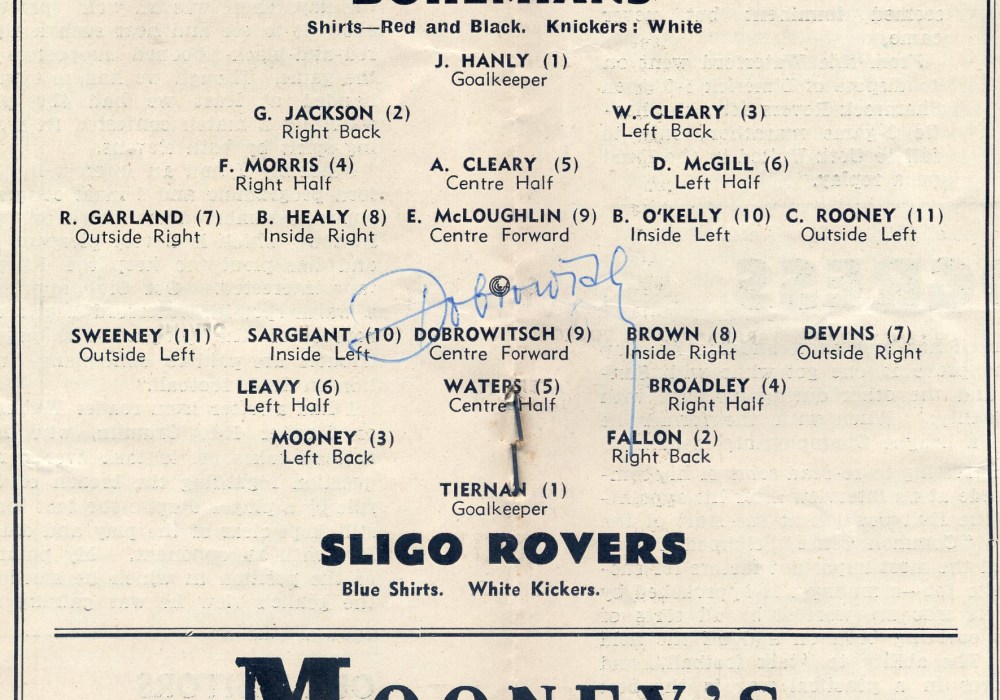
After his army discharge in 1946 he returned to his farm before it was seized by the government the following year, fleeing across the country he was assisted in crossing into Austria and from there into France, where he met his wife and eventually relocated to Dublin, commuting to Sligo with the club’s other Dublin-based players and using Dalymount Park as a personal training ground. He was even in the stands at Dalymount, awaiting his international clearance when Sligo met Bohemians in early March 1949, going so far to sign a match programme for a star-struck fan, obviously impressed by the presence of a supposed Hungarian international. (You can see his signature in the header image of this article).

His international clearance eventually arrived and on March 27th, over a month after his signing was initially publicised Siegfried Dobrowitsch made his debut for Sligo Rovers in a 1-1 draw with Limerick in the Showgrounds. While the reports describe a tight game where Dobrowitsch, the starting centre-forward had to survive on scraps, he did manage to score Sligo’s only goal of the game, a well dispatched, powerful penalty kick early in the second half.

Despite a good start there was misfortune only a couple of weeks later when Dobrowitsch was involved in a car crash on his way from Dublin to a match in Sligo. Travelling up for a match against a Sligo local league selection, Dobrowitsch, along with goalkeeper Fred Kiernan and winger Stephen Leavey crashed into another vehicle. While luckily nobody was seriously injured Siegfried did suffer a dislocated shoulder and missed a number of games as a result.

Perhaps as a result of his injury, work commitments in Dublin, or merely through inconsistent form Dobrowitch’s stay in Sligo was relatively short-lived, by November of 1949 he had been released by Sligo despite boasting a relatively successful strike rate and had been signed by Drumcondra in Dublin.

Things started relatively well for Siegfried at Drums, scoring twice on his debut against Shelbourne in a Shield game which Drumcondra won 4-1. Despite this initial success only a year later Seigfried had dropped out of senior football and was lining out for Larkhill in the AUL.

When interviewed many years later Dobrowitsch’s former teammate Pa Daly recalled playing alongside him. While he was referred to as “Dobro” when in Sligo the Drumcondra players had instead dubbed him “drop-a-stritch”, and in Daly’s opinion Dobrowitsch had never been a Hungarian international as they had been led to believe. While he praised Siegfreid for his dedication to training, recalling the exasperated Drums groundsman Peter Penrose calling in Dobrowitsch from training with the words “come on in or the pubs will be closed!” he was of the opinion that his claims to have been a Hungarian international were exaggerated.  Any research in relation to the matches that Siegfried Dobrowitsch claimed to have played in for Hungary show no similar names on the historic teamsheets. Ultimately Siegfried would leave Ireland around 1956 bound for Zimbabwe where he spent much of the remainder of his life before he passed away in 1994.

More recently, research by Hungarian sports writer Gergely Marosi has suggested that these details may actually refer to the life and career of Andor Dobrovics, who seemed to be from the town of Rákosszentmihály and played for his locaL club, RAFC who were a lower tier club. He played as a midfielder and occasionally a forward before he moved to top-flight side Elektromos for a short stay. Dobrovics never played for the first team, mostly lining out for their reserve side.

While the story of Seigfried Dobrowitsch may seem unusual he was just the first supposed Hungarian international footballer to play in the League of Ireland in the 1950s. The second was Laszlo Lipot who enjoyed a brief spell at Limerick after arriving in Ireland as a refugee around the time that Seigfried Dobrowitsch was leaving Ireland.  Lipot, who lined out at right half for a short time with Limerick in 1956-57 had ended up as one of a small group of refugees taken in by Ireland after the Hungarian Revolution of 1956 was crushed by the state authorities with the backing of the Soviet Union.

What had begun as a series of protests in Budapest in October 1956, mostly from students, journalists and writers seeking reform of the system of government, and a move away from the influence of Moscow quickly turned violent,  the Hungarian government sought military support from the Soviet Union which was speedily dispatched. The revolutionaries stood little chance against the might of the Soviet military. The newly installed Hungarian government quickly carried out mass-arrests numbering in the tens of thousands, it was estimated that upwards of 200,000 refugees fled Hungary in the aftermath of the failed revolution and among their number was Laszlo Lipot.

Of the thousands who fled Hungary more than 300 refugees found themselves in the far from glamourous surroundings of the Knockalisheen army camp just outside of Limerick City on the far side of the Clare border. While the refugees were broadly welcomed by the local people life in the army camp was tough and there was even a threatened hunger strike by some of the refugees at the conditions they endured.

Laszlo Lipot is first mentioned in December of 1956, less than two months after the Hungarian Uprising had been suppressed. In the December 8th edition of the Limerick Leader there is a cryptic reference to Lipot under the pseudonym “Janos” who is described as a Hungarian international right back who had only recently represented the national team against Czechoslovakia and had been an international teammate of no less a luminary than Ferenc Puskás. It states that “Janos” has been training with Limerick and had impressed the team management and was hopeful of making his first team debut in the near future. He did make his debut shortly afterwards, in a game against Shelbourne, which ended in a heavy 6-1 defeat, though match reports say that Lipot/Janos was one of the better Limerick players on the pitch. He was unable to add to this single start as his playing registration still lay with the Hungarian FA.

Newspaper reports named his club as “Tata” which according to Hungarian football expert Gergely Marosi was a reference to Hungarian club Tatai Vörös Meteor SK who have since merged into umbrella club Tatai AC. This would mean however, that he certainly was never an international as his club would have been in the third tier at the time. The closest he would have ever come to this standard was playing for his county in inter-region exhibition matches so the talk of an “international” seems to be another tall tale.

Back in Limerick it would be August 1957 before he would get to play another game for the Shannonsiders when the issues with his playing registration were finally resolved, and he was able to line out for Limerick under his own name of Lazslo Lipot. His Limerick career was shortlived however as by the end of the summer of 1957 most of the few hundred Hungarians who had been living in the Knockalisheen camp had left the country, many left to start new lives in Canada and the United States while Laszlo and his wife took the shorter journey to England in September of 1957. His Limerick playing career had amounted to a single league game against Shelbourne in the 1956-57 season and a handful of Shield games in August and September of 1957.

What exactly became of Laszlo after he left Ireland is something that I’ve been unable to find out, there is a death notice for a Laszlo Lipot in the town of Caerphilly in South Wales from 2004. This Laszlo had been born in 1931 and would be the correct age, perhaps he was the same man who once graced the Markets Field?

The cases of Seigfried Dobrowitsch and Laszlo Lipot are striking in their similarity, both were refugees from the post-War turmoil that engulfed Hungary, in Dobrowitsch’s case as an orphaned former soldier he claimed to have fled after the loss of his farm to the new emerging Communist rulers in the late 1940’s, for Laszlo it was the violent events of the 1956 Uprising that led him to leave his homeland. Whether he had been directly involved and feared reprisal or simply wanted to escape a harsher regime after the direct military intervention of the Soviet Union that spurred him to leave we simply don’t know.

We do know however, that both men had some talent for football, and in the days before Youtube highlights videos and professional scouting software both men were able to embellish their playing careers, adding international caps that almost certainly never existed to their playing CVs. While neither player had the longest or most successful League of Ireland career they are examples of a subgroup rarely mentioned in Irish football or indeed, Irish society, namely political and economic migrants who came to Ireland to make a better life. While we might think this is a recent phenomenon the stories of Siegfried and Laszlo shows that is dates back decades. It also shows that we perhaps haven’t learned from the mistakes of the past, while several of Laszlo’s fellow refugees in Knockalisheen did remain in Ireland and built new lives the majority left after less than a year in Ireland, often after protests and threatened hunger strikes about the poor quality of their accommodation. Today Knockalisheen is used as a Direct Provision Centre.

With both men there are many unanswered questions about their lives and careers, especially back in their native Hungary, if any readers have any further information I’d hope they would get in touch so that I can better separate the truth for the stories told about them.

Programme image provided by Stephen Burke. If you enjoyed this article you may also find this piece on the life, career and tragic death of Hungarian international Sandor Szucs of interest.

The lost clubs – Drumcondra F.C.

DrumsAs a young lad the sporting geography of the city was always fairly fixed and familiar to me. You saw Bohs and maybe the odd Cup final at Dalymount. You saw Ireland in Lansdowne Road, the Dubs in the freezing expanse of Parnell Park in the league, and if things were going well, in Croke Park in the sun. Morton Stadium in Santry was an annual pilgrimage for the National Athletics championships and as for Tolka Park, well that was Shels’ home, and to the unquestioning mind of a child it was always thus.

But of course it wasn’t always so. Shelbourne were once of Ringsend and took their name from the Shelbourne Road next to the pub where they were founded. While they had spent seasons playing at Tolka in the past they only took over the lease of the ground in 1989. Tolka had originally been the home of Drumcondra F.C. a team that developed rapidly, whose success burned intensely, and who formed arguably one of Irish football’s most storied rivalries at the peak of the league’s popularity. And then almost as quick as their ascent, they disappeared from League of Ireland football.

The area around Drumcondra has always been fertile ground for sporting endeavour. As Dublin city grew beyond the traditional inner city district in the 19th Century the local and wider city population were also availing of greater freedom from the stresses of their work-life. Changes to the working week meant people finally had some proper leisure time, they had access to a growing rail network meaning that they could travel the country more easily. All this lead to the creation of many different local and national clubs and organisations, not surprisingly many focused around sporting activities.

In 1864 Alderman Maurice Butterly leased 21 acres near Jones Road, Drumcondra which for the next couple of decades would be known as the City and Suburban Sports Grounds and which could be hired out by a variety of sports clubs. In the early 1890’s these grounds were briefly the home of Bohemian F.C. they also were a venue for GAA matches. In fact the GAA liked the area so much that by 1907 they’d bought the lands and renamed them after their organisation’s patron Archbishop Thomas Croke.

As Drumcondra developed eastwards as a bustling suburb it should be no surprise that this sporting development continued as you crossed the river Tolka. By 1924 a group of enthusiastic locals including Tom Johnston, Christy Purcell, George Ollis, Paddy Dunne, Tom Cribben and Andy Quinn had founded Drumcondra F.C. and the club were quick to make progress. Even in their early years as a Leinster Senior League side Drums attracted prominent players, including former Bohemians stars Johnny Murray and Joe Grace. In 1926, despite still plying his trade for a lower league side Grace won his only Irish international cap against Italy in Turin. He remains to this day the only Leinster Senior League player to be capped by Ireland.

A year later, while still playing at Leinster Senior League level Drums began lifting serious silverware. They were winners of the inagural Intermediate Cup, then referred to as the Qualifying Cup as it qualified them for the 1st round proper of the FAI Cup. There followed wins over Jacob’s and Bohemians which saw the Drums through to the final where they faced Brideville. A 1-1 draw in the first game forced a replay, held in Shelbourne Park and an extra time winner from Johnny Murray secured the first of five FAI Cup wins for Drumcondra.

Drums got another cup final the following year, losing 2-1 to Bohemians before finally being accepted as a League of Ireland side a year later and shortly afterwards they moved away from their amateur ethos to paying players. It was later into the 1940’s before Drums began to emerge as a real force in the League of Ireland. These sides were built around a core of some exceptional footballers like Kit Lawlor, Benny “Rosie” Henderson and the young and ever versatile Con Martin. The final years of the decade also the emergence of their prolific centre forward Dessie Glynn. By the end of the 40’s Drumcondra had won two more FAI Cups (1942-43 and 1945-46) as well as their first two league titles (1947-48 and 1948-49).

It was perhaps this success that attracted new owners to the club. Father and son William and Walter Hunter had run the club up until the early 1950’s but they were soon to be replaced by another father and son team, that of Sam and Roy Prole. A younger son Robert Prole also became a club director while still a schoolboy and would later feature as a player for the club.

The Proles had a long involvement with Dundalk F.C. having made their money through the Great Northern Railway which had its works and a main station in Dundalk. In progressive moves they improved Tolka Park, levelling the pitch, adding roofs to stands, introducing pitch-side advertising boards and in 1953 Tolka became the first stadium to introduce floodlights when Drums played an exhibition game against St. Mirren in March of that year. The Proles also placed a major focus on developing young players and among the early managers that they appointed was Billy Behan. He was Manchester United’s eyes in Ireland, helping discover a plethora of great young talents from Liam Whelan to Paul McGrath. Perhaps the words of George Orwell may have stuck in the minds of Drumds fans of the time, If There Is Hope It Lies In The Proles. 

With Tolka Park now being developed into one of the better club grounds in the League there was plenty of drama on the pitch to keep supporters entertained. The 1950’s and into the early 1960’s in some ways signified a high watermark in the popularity of the League of Ireland. In an often grey and economically deprived Ireland the game offered a cheap and enjoyable spectacle and a stylish Drumcondra side were at the forefront. To this day recollections of their decade long rivalry with Shamrock Rovers has a misty-eyed effect on Irish football fans of a certain vintage and it’s not hard to understand why.

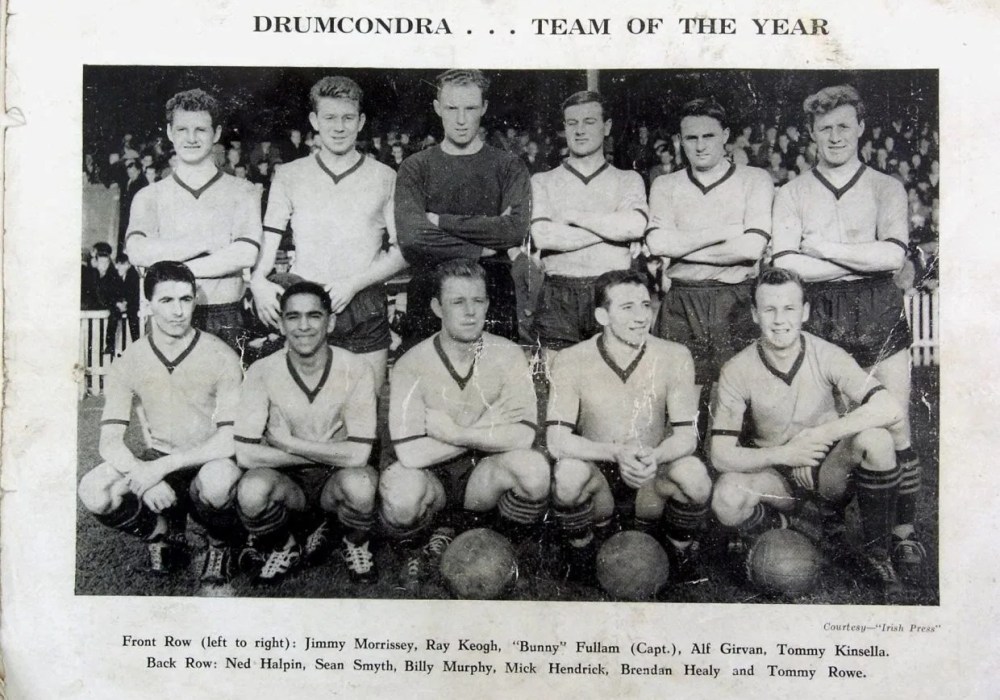
With little access to the English game apart from occasional touring sides and newsreel footage the League of Ireland was amplified in its sporting significance. It helped that there was a strict wage cap in England up to 1963 so many talented Irish players had less financial incentive to cross the Irish sea. Drums managed to develop and keep many of their talented players for longer than many League of Ireland sides could do today. During the 50’s they could call on Irish International Alan Kelly Senior in goal, “Bunny” Fullam in defence and an array of other young talents like Ray Keogh, Jimmy Morrissey, Stan Pownall and Tommy Rowe while club legend Kit Lawlor would return after a spell in England with Doncaster Rovers.

In just over ten years Drums picked up another two titles (1957-58 and 1960-61 while finishing runners up on a  number of occasions) and two more FAI Cups and by this stage European competition had begun. Here again Drums were quick in making progress. In only their third season in Europe (1962-63) they became the first League of Ireland side to win a tie over two legs when they defeated an Odense city XI  6-5 in the Inter-city Fairs Cup. Jimmy Morrissey and Billy Dixon were prominent among the goals which secured Drums a tie with Bayern Munich.

Bayern weren’t yet established as the behemoths of European football that they are today but they were still an impressive side, many of whom would go on to win titles and cups with the Baverians. Drums lost 6-0 in the first leg in snowy Munich, German international Willi Giesemann as well as Bayern’s 3rd highest scorer of all time, Rainer Ohlhauser among those getting on the score-sheet. Drumcondra did manage to save some face in the return leg when the beat Bayern in Tolka Park 1-0 thanks to another goal from Billy Dixon.

The Drums had something of a habit of facing German sides, in their five seasons in European football they faced three other German sides as well as facing Atlético Madrid in that famous sides first ever appearance in European football. While never again progressing beyond the opening rounds as they had done against Odense there were other credible individual results such as a 1-0 home win against East German champions Vorwärts Berlin.

There would be one final, major trophy for Drums, a league title in the 1964-65 season but it was to be somewhat of a twilight victory. Within five years they would be bottom of the league and a couple of years after that, Drums as we would know them, were gone. After back to back last place finishes Sam Prole agreed to sell up, in a strange turn of events, Drums, a professional side were taken over and replaced by the amateur Home Farm side. A hybrid team name of Home Farm-Drumcondra lost its Drumcondra suffix after a single season and after 45 years of league football Drumcondra F.C. were gone.

It had been an eventful existence, five league titles and five FAI Cups had the Drums name etched against them. There were famous European nights under lights and the club had always tended to punch above their weight, whether as a Leinster Senior League side lifting the cup, or in their famous rivalry of the 50’s and 60’s with Rovers that lit up the league, or even going to toe to toe with some European heavyweights.

A Leinster Senior League club under the name Drumcondra F.C. reformed about ten years ago, wearing the traditional yellow and blue. They’re even based across the street facing their former home at Tolka Park. The memory of the glories of the Drums still lives on, preserved in the name Drumcondra F.C. that adorn a modest the clubhouse on Richmond Road, back where it all began. Up the Drums! 


This piece first appeared on the SSE Airtricity League website and can be found here.


Stanley Matthews at Drums – A Ballon D’Or winner at Drumcondra F.C.

Fagan’s pub of Drumcondra is well known to many sports fans in the city of Dublin; in business since 1907 its close proximity to both Croke Park and Tolka Park means that it is regularly frequented by supporters of the both Dubs, Shelbourne F.C. and their various opponents. The walls of the pub bear witness to this, with many photographs and pennants of various sports teams but one that caught my eye on a recent visit were a collection of match programmes from Tolka Park’s former residents Drumcondra F.C.

Fagans

Fagan’s pub in Drumcondra, a short walk from Tolka Park

Surrounded by advertisements for tobacco, bingo halls and pubs are the starting XI’s for both Drumcondra and their visitors Glentoran of Belfast. To the left of the line-ups is a nice little action photo of former Bohemians player Amby Fogarty who had joined Glentoran from the Dalymount club in 1955. A date for the game didn’t appear on the programme page but a little research showed it had taken place on Wednesday October 24th 1956.

A few of the names on that Drumcondra side were familiar to me by reputation, in goal was Alan Kelly Sr.  who became a legend at Preston North End and won almost 50 caps for Ireland. Also in the side was Christopher “Bunny” Fullam, another former Bohs player who also tasted success with Shelbourne, as well as other Drums legends like Tommy Rowe, later a league winner and manager with Dundalk.

Drums v Glentoran

Drumcondra v Glentoran match programme inlay

One name I wasn’t sure of was the number 7, Matthews at outside right. A little more research revealed it to be none other than the wing wizard himself, Stanley Matthews. At the time of the game Matthews was 41 years old but was still an England international and had just enjoyed the best league season of his career, with Blackpool finishing as runners up to the Busby Babes of Manchester United. In fact less than two months after lining out for Drums Matthews would be named as the inaugural winner of the Ballon D’Or, defeating competition from Alfredo Di Stefano and Raymond Kopa to be named as the best player in Europe.

While another Ballon D’Or winner, George Best would later play a handful of games for Cork Celtic in his peripatetic later career, this was seven years after he had won Europe’s greatest individual honour and was sadly just another interlude on the downward spiral or his stellar career. Similarly an ageing Bobby Charlton, recently released from coaching duties at Preston North End, played a handful of games for Waterford in 1976 some ten years after his Ballon D’Or’ win. Despite Matthews advanced years for a footballer he was still in the elongated prime of his career. He would win his second Football Writers Player of the Year award in 1963 and played his final top flight game for Stoke City in 1965 at the age of 50.

Matthews was obviously the main draw for the game and provided much of the entertainment, “beating players with ease” and delivering “delightful passes”. Drums ran out 3-2 winners against Glentoran with a hat-trick coming from Drums other winger on the night, Dermot Cross. Glentoran’s goals came from brothers Dara and Cyril Nolan, both former Drumcondra players, with Cyril’s coming from the penalty spot. One other player of note for Glentoran was their thrice beaten keeper Eamonn McMahon, he had kept goal for Armagh in the All – Ireland Footfall final against Kerry in 1953. His talent in the Gaelic code attracted the attention of Glasgow Celtic with whom he had a brief spell before returning to Ireland to play for Glentoran.

A league of Ireland side with a future European footballer of the year playing for them might seem a bit odd nowadays (even for a friendly) but the game against Glentoran was in fact the third time Matthews had lined out for Drumcondra, having appeared for them twice in the late 40s in a pair of benefit matches played in Dalymount Park.

The first was in 1946 when he played in a benefit match for Drums’ Scottish trainer Jock McCosh (surely the most Scottish name since Hamish MacBeth).  The second game came a year later when he appeared in a match for Drums’ player Paddy Daly.

This first game to feature Matthews (for Drums trainer Mr. McCosh) was appropriately against Scottish opposition in the form of Greenock Morton. Drums were on an upward swing having just won the FAI cup for the third time in their history. However Greenock (who would narrowly lose the Scottish Cup final in a replay to Rangers later that year) were far too strong for Drums, riding out comfortable 6-0 winners. Matthews had chartered a private plane to get him to Dublin for the game but had a limited impact. His performance started well and he linked up nicely with both Kit and Jimmy Lawlor while keeping the opposing fully busy with his crossing and dribbling skills. However, he had not fully recovered from a recent injury and his impact waned as the match progressed with reports on the match describing him as “not at his best”.

If Matthews wasn’t at his best in the ’46 game it didn’t have an impact on the interest in the next game where he featured. The report of the Daly benefit match from April 1947 described Dalymount as almost full (at a time when attendances were on occasion reported around the 40,000 mark) and described Matthews himself as “the outstanding and most attractive players of his generation”.

Drums Matthews3

Irish Times headline from the 1956 match against Glentoran

This match was between a Drumcondra XI and a Distillery selection and there were plenty of other well-known players in attendance apart from Matthews. These included such popular names as Peter Farrell and Tommy Eglinton of Everton, both Irish internationals. Con Martin of Leeds United was also due to line out in goal for Drums but had to pull out at late notice due to injury. The Drumcondra selection ran out 1-0 winners in a poor game in which the Distillery tactics were described as “crude”.  As far as his personal performance Matthews stood apart among the standard front five although he wasn’t supported sufficiently and didn’t manage to get on the ball as much as expected. He obviously did enough to impress the reporters present with his talent when he did get on the ball being described as “well above the ordinary” and he was praised for his “excellent ball control and accurate passing”.

While it might seem strange that one of the world’s most famous players lined out on three occasions for a now defunct League of Ireland side it was far from uncommon at the time, especially for someone like Matthews. Having begun his career in 1932, and despite its longevity he was well into his 40’s by the time the maximum wage was abolished in England. Ever aware of the precariousness of a footballer’s existence Matthews had in his early years lived off his win bonuses and saved his regular salary, he developed sideline business ventures including running a guesthouse, signing an early boot deal and of course appearing as a guest player for what could be lucrative match fees for the time. Based for much of his later life in Blackpool, (even after a playing return to Stoke City) it was only short journey to Dublin and Drumcondra F.C.

One of Matthews final Irish involvements came a year after his last match for Drums. He lined out in a World Cup qualifier for England against the Republic of Ireland in Wembley. The English ran out 5-1 winners, with Manchester United’s centre forward Tommy Taylor grabbing a hat-trick. Taylor was born the year that Matthews had made his debut for Stoke. This was to be the second last of his 54 caps, his final one coming a week later in a 4-1 against Denmark. This final match meant that he was the oldest player ever to represent England, and despite having played in 3 of the four qualifying games Matthews was not selected for the England squad that travelled to Sweden for the 1958 World Cup.

Having played in many a benefit match Matthews had a testimonial of his own in 1965 when he finally hung up his boots professionally. The opposition was a star-studded World XI taking on a “Stan’s XI” who lined out in red and white, the colours of his beloved Stoke. The World XI won out 6-4 and Matthews was carried off the pitch by two of his opponents on the night Lev Yashin and Ferenc Puskas. Among the opposition that night were Raymond Kopa and Alfredo di Stefano, the two mean who had beaten to win the first Ballon D’Or nine years before.


The remarkable life of Bohs captain William H. Otto

The 1923-24 season was to signal the first of Bohemian Football Club’s 11 League of Ireland title wins. That maiden title was captured in the penultimate game of the season, a 2-1 victory over St. James’s Gate in Dalymount. The goals that day came from English-born centre forward Dave Roberts and Dubliner Christy Robinson at inside-left. Between them they would score 32 of the Bohs’ 56 goals that season, with Roberts finishing as the League’s top marksman with 20. But while strikers tend to get the glory this maiden victory was of course a team effort. A number of those league winning Bohs players were selected for the Irish squad that travelled to the 1924 Olympics. Men like full-back Bertie Kerr, Paddy O’Kane, Jack McCarthy, Ned Brooks and Johnny Murray would win caps for Ireland and are still remembered for their contributions for the club. However, one man who was central to those achievements but leaves less of a trace is William Henry Otto, the versatile Bohemians half-back, better known as Billy, who captained the team.

Finding Billy

Anyone who has ever trawled through Irish newspaper archives or through any number of online census returns or genealogy sites will appreciate the difficulty in trying to track down a relative from the distant past. Particularly if that relative has a rather common surname, without having the specifics to hand working out if that John O’Sullivan or that Mary Byrne is your ancestor can be a thankless task. It is for some of these reasons that researching someone with the surname Otto in 1920’s Ireland is that bit more intriguing. However detail on the life of Billy Otto of Bohemian Football Club initially proved illusive and as his story developed it brought me on quite an unexpected journey.

What we know about Billy Otto begins with his birth in December of 1898, son of another William Henry Otto, in Robben Island just off Cape Town, South Africa. Robben Island is most famous for being the island where Nelson Mandela was imprisoned for 18 years from the 1960’s to 1980’s. However in 1898 it was a leper colony. William Henry Otto Snr. was a pharmacist which explains his presence on the island, though it was hardly the ideal place for a new born baby as part of the growing family. Billy being the 2nd born of a large family of 10 children.

In 1915, before he had even reached his 17th birthday young Billy had volunteered to join the 1st South African Infantry Regiment and was off to fight in World War I under the command of Brigadier General Henry Lukin. The Regiment was part of the South African Overseas Expeditionary Force which was a volunteer military organisation that fought on the British side against the Central Powers during the war. Billy’s regiment was colloquially known as the “Cape Regiment” as this was the area that provided the bulk of their manpower.

Early on the regiment fought along with the British in North Africa and Billy was involved in the Action of Agagia in Egypt in February 1916 as part of what was known as the Senussi campaign. The Senussi were a religious sect based in Libya and Egypt who had been encouraged by Ottoman Turkey to attack the British. The engagement at Agagia led to the capture of one of the Senussi leaders.

But by May 1916 the 1st South African Infantry had left Africa and had been transferred to Europe and the Western Front and where they were joined into the 9th Scottish Division. They would take part in some of the many epic and bloody engagements of the Battle of the Somme at Longueval and at Delville Wood. Brigadier-General Henry Lukin and his South African troops were ordered to take and hold Delville Wood at all costs. The battle was for a tiny and ultimately insignificant sliver of land as part of the huge Somme offensive and began on 15th July of 1916. By the 18th of July Billy had been injured in a massive German counter-offensive, the Germans shelled the small section of the Wood for seven and a half hours and over the course of day, in an area less than one square mile, 20,000 shells fell. One account described the trees of the woodland being turned to matchsticks by the end of the bombardment.

The South African soldiers would continue to be shelled and sniped at from three sides until the July 20th when suffering from hunger, thirst and exhaustion they were led out of the wood. The Battle of Deville Wood would be the most costly action that the South African forces on the Western Front would endure, of the 3,153 men from the brigade who entered the wood, only 780 were present at the roll call after their relief.

Delville_Wood_South_African_National_Memorial_(September_2010)_2

Deville Wood South African National Memorial (source wikipedia)

The injured Billy would ultimately be sent to England to recuperate and it is likely that from here he got the idea to travel to Ireland. What prompted this we simply don’t yet know.

What we do know is that Billy appears first as a sportsman for Bohemians in 1920, and featured regularly from 1921 as Bohemians competed in the first season of the newly formed Free State League. Billy usually played in a half-back (midfield) position in the team though did he feature in a number of other roles and proved an occasional goal-getter.

In April 1923 he features in the Bohemian XI that take on touring French side CAP Gallia in Dalymount, in what was the first visit by a continental side to Ireland since the split with the IFA. In late December 1923 Otto captained the Bohs side that travelled to Belfast to take on Linfield. Bohs won the game 4-2 in one of the first matches played against northern opposition since the split. He was then part of a selection under the Shelbourne banner (a composite side made up from several clubs) that took on members of the 1924 Olympic football team in a warm up game prior to their departure for Paris. Here he featured against his regular midfield teammates John Thomas and Johnny Murray.

Other prominent games were to follow in 1924, rather appropriately for Billy Bohemians took on the South African national team as the debut game on their European Tour.  Billy once again captained Bohs as the South Africans ran out 4-2 winners. Tantalisingly the Pathé news cameras were at the ground that day and recorded some of the footage of the game and the teams posing before the match. As captain it is Billy we see receiving a piece of South African art from his opposite number. Tall, slim and dark-haired Billy would have been around 26 years of age when this footage was shot.

Billy was Bohemian captain for the 1923-24 season, a time of progress for the club as they were crowned League champions and Shield winners that year with the club also finishing as League runners-up the following year, he would also become a member of the club committee. He continued as a regular team member through to the first half of 1927 when he disappears from the match reports of the club. We know that during his time in Dublin he more than likely worked for the the revenue service as we know he lined out for them as a footballer in the Civil Service League around the same time that he was on the books of Bohemians. This wasn’t too unusual as a number of Billy’s other team-mates would have also been civil servants (i.e. Harry Willitts) at what was then still a strictly amateur club.

Billy sets sail

While Billy Otto might have been finishing up at Bohemians he was about to begin another chapter of his life. On the 24th November 1927 he boarded the steamship Bendigo (shown above) on the London docks bound for a return to Cape Town, South Africa. Billy was by this stage 29 years of age and listed his residence as the Irish Free State, more specifically at 28 Hollybank Road in Drumcondra. On the ship’s passenger list the stated country of his future residence was South Africa and his profession was recorded as bloodstock. There is a possible Bohemian connection here as one of Billy’s former teammates, Bertie Kerr was already by this stage and established bloodstock agent who would go on to purchase and sell four Aintree Grand National winners.

Billy and Bertie were known to be good friends outside of football. Is it possible that the Kerr family may have introduced Otto to the business? Perhaps, although there is strong evidence that there may have been a familial connection. Billy’s brother Johnny was a champion jockey in South Africa and later worked as a steward at the Jockey club.

28-hollybank-road

28 Hollybank Road as it appears today. In the 1920s it was home to Bohs captain Billy Otto

In his personal life it must have been during his time living in Drumcondra that Billy was to meet his future wife Christine. Born Christina Quigley in Dalkey on 8th December 1900 to a Policeman; Thomas, and a housewife, Maryanne, by the 1911 census Christine was living on St. Patrick’s Road in Drumcondra. She is not listed as a passenger on Billy’s 1927 voyage and they did not marry in Ireland. However, we know that they did indeed get married and had three sons, tying the knot in December 1929 in St. Mary’s Cathedral in Cape Town. Records show that she had travelled to South Africa via Mozambique aboard the SS Grantully Castle just one month earlier. Christine Otto (nee Quigley) did make return visits to Ireland later in her life. She came back to Dublin via Southampton for a visit in 1950, the stated destination for her visit was  to 25 Hollybank Road.

Billy departs

In March 1958 a small obituary in the Irish Times noted the passing on the 13th of that month of William H (Billy) Otto at his residence of Wingfield on the Algarkirk Road, Seapoint, Cape Town. “Beloved husband of Chriss (Quigley) late of Drumcondra, Dublin. Deeply mourned by his three sons and members of the Bohemian Football Club”. Billy’s passing occured within a week of the deaths of two other team-mates, Ned Brooks and Jack McCarthy, from that same championship winning team. Christine remained in South Africa though she is listed as returning again to Ireland in 1960, two years after Billy’s death. The address that she was to stay at for an intended 12 months was, on this occasion, in Foxrock, Dublin.

Billy had lived out his days in his native Cape Town, he and Chriss had three sons, another William Henry, Brian Barry and Terrence John. Whatever about his interest in bloodstock and horse racing Billy also had other business interests running an off-licence (locally known as “bottle stores”) up to the time of his death in 1958. In just 60 years he had led quite the life and defied the odds in many ways. Born in a leper colony, as a teenager he had survived the horrors of the Somme to go on and become one of the first prominent South African born footballers in Europe. He captained his club to a League title and faced off against the national team of his home nation in one of their earliest games. He built a life, friendships and family across two continents and I hope I’ve done a small part in restoring him to the consciousness of the Bohemian fraternity.

With thanks to Simon O’Gorman and Stephen Burke for their assistance and input and a special thank you to Maryanne and all of the Otto/Calitz family for sharing information about their late grandfather.

Ray Keogh – A forgotten pioneer in Irish football

It was on a still, sunny November afternoon last year on the approach to the Aviva Stadium (Lansdowne Road as was) that I spotted Paul McGrath. Paul was, like the rest of the crowd, on his way to the FAI Cup final between Derry City and his former club, St. Patrick’s Athletic. He is of course no stranger to the old ground; he strode its turf with gazelle-like grace over the course of his 12 year international career, and it was his performances in a green shirt that have ensured his status as a sporting legend in Ireland.  Despite his much publicised personal problems, or perhaps because of them, Paul is not only respected by the Irish public, but genuinely loved. It is that hint of vulnerability that was so at odds with his commanding, assured performances, that has struck such a chord with football fans.

He was my footballing hero growing up, my early childhood helpfully coinciding with an unprecedented level of success for the Irish national team. Paul was of course a key part of that success, a national talisman, and a rock during the nations’ first tournament involvement; Euro 88, Italia 90, where the team reached the quarter-finals, and USA 94. For many, the opening game in World Cup 94 was Paul’s defining moment in a green shirt, when an ageing McGrath, dodgy knees, painkilling injection in his shoulder, dominated an Italian attack featuring Giuseppe Signori and Roberto Baggio. If the World Cups were the peak of his career, then his presence at Lansdowne Road last November was a reminder of his more humble beginnings as a professional footballer.

Despite playing only a single season for St. Pat’s (1981-82), Paul remains a legend at the club based in the South Dublin suburb of Inchicore. It was pleasing to see by his attendance at the final that Paul hadn’t forgotten his roots. Such was his popularity with the Pat’s faithful that Paul became known as “The Black Pearl of Inchicore”, a reference to Benfica legend Eusebio. Paul was the first player to be given that moniker by the Pat’s fans, but not the last, as both Curtis Fleming (later of Middlesboro and Crystal Palace) and Paul Osam were sometimes given the “Black Pearl” sobriquet.

Though perhaps the most prominent person of colour to play for the national team, Paul was not the first. The first mixed race player to don the green jersey in a senior international was Spurs’ Chris Hughton back in 1979, six years before Paul’s debut. Like Paul he would also feature in Euro 88 and World Cup 90. As for the first player of colour in the League of Ireland? Well we have to go back a little further…

In fact we’ll have to go back to May 1961, back to the FAI Cup final, this time held in Dalymount Park, and as in 2014 St. Patrick’s Athletic are one of the teams in action. Pat’s would win the final in 2014, as they would also triumph in 1961 though in the intervening 53 years, the Saints would contest seven cup finals and lose them all. One other thing that the finals of 2014 and 1961 had in common was that my father was in attendance at both. We sat together in the south stand in 2014, but back in 1961 he was in Dalymount Park as a member of Drumcondra F.C.’s under-18 team watching their senior counterparts lose 2-1 to St. Pats. As an outside-right he would have been paying special attention to the senior player in his position, a 21 year old full of skill and trickery named Ray Keogh.

Ray, as far as any League of Ireland historian or statistician can confirm was the first black player in the League of Ireland. British football has, in recent years started to pay attention to the contribution made by players of colour in the early years of football’s development. Men like Andrew Watson, Walter Tull and Arthur Wharton have begun to have their input to the game recognised, and there is a growing understanding that the early decades of British football were not as white and homogenous as once portrayed. However in Ireland there has been little discussion on similar subjects. In the absence of any earlier players being mentioned I’d like to talk a little about Ray’s career in the League of Ireland.

Ray was raised in a white family in the Dublin suburb of Milltown in the 1940s. The area was in close proximity to Glenmalure Park, the then home of Shamrock Rovers, one of the country’s biggest clubs. Ray joined them as a teenager after playing schoolboy football with Castleville and the famous Home Farm club, and made appearances for the Rovers’ reserve side in 1958 before making his first team debut a year later. Some reports incorrectly stated that Ray was part of the Rovers team in 1957 that took on Busby Babes era Manchester United early in their tragic European Cup campaign, mistaking a 17 year old Ray for the similarly named Shay Keogh. Despite his talent and versatility, primarily as an outside right (though he played in a variety of positions), first team opportunities at Rovers were limited for Ray. They had been League Champions in the 56-57 and 58-59 seasons, and their forward line was full of Irish internationals such as Paddy Ambrose, Liam Tuohy, Tommy Hamilton, “Maxie” McCann and experienced player-manager Paddy Coad.

A move was needed and initially it was a trip north-west to Longford Town in the 59-60 season. Longford were a “B” division side at the time playing against reserve sides of the likes of Shamrock Rovers and other smaller and regional sides. His stay with Longford was brief, however, as he moved back to the top-flight of Irish football and to Drumcondra F.C. Based in the north Dublin suburb of the same name, “Drums” had been Shamrock Rovers’ great rivals throughout the 50’s. The club had been home to players of the highest quality such as Alan Kelly Sr. (a Preston North End legend with a stand named after him at Deepdale) as well as League of Ireland stars like Jimmy Morrissey and Christy “Bunny” Fullam.

drums-pic-circa-1957

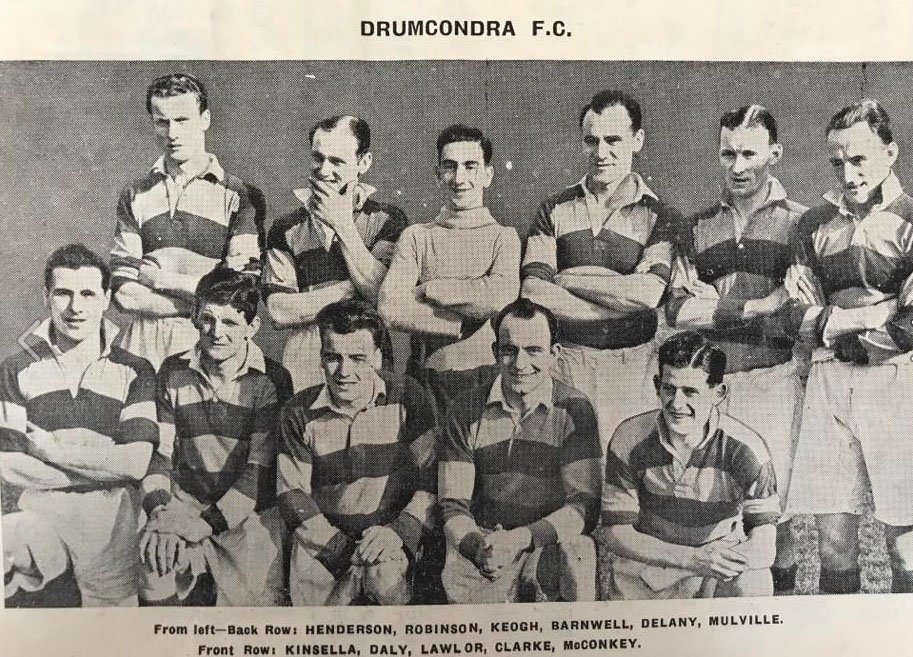
Drumcondra FC before the 1961 FAI Cup final. Ray Keogh is bottom left. (source http://drumcondrafc.com/)

While Drums lost out in that 1961 final, they qualified for the European Cup as League Champions for 1960-61, which was Ray’s first full season with the side. Ray would feature in the European Cup defeat at the hands of German champions FC Nurnberg in the first round, but would fare better the following year in the Inter-Cities Fairs Cup, when Drumcondra made football history by becoming the first Irish side to win a European game on aggregate, defeating Danish side Odense 6-5 over two legs, with Ray playing both games. They were drawn against Bayern Munich in the following round.  Ray didn’t feature in the heavy 6-0 defeat in Munich, however he did return to the starting line-up for the home leg and helped restore some pride as Drums beat Bayern 1-0.

He would also win representative honours representing the League of Ireland selection on a number of occasions. Inter-league games were usually against British and occasionally mainland European league sides, and were considered to be highly prestigious at the time. The fact that Ray, on several occasions, was judged to be among the best players in the league and worthy of selection is testament to his ability. He made his debut in 1961 against a Scottish XI in a 1-1 draw and would make several appearances for the league before a move to his next club, Ards based in the County Down town of Newtownards in Northern Ireland.

The Northern Irish league was traditionally dominated by the bigger Belfast sides like Linfield and Glentoran, though Ards had enjoyed a league title success in the 1957-58 season. Though signed by Johnny Neilson the manager for the majority of Ray’s stay north of the border was George Eastham Sr., a former Bolton Wanderers player and father to Arsenal and Newcastle star George Eastham Jr. The town of Newtownards was overwhelmingly Protestant and it must have been somewhat daunting for a black, Catholic Dubliner venturing over the border in 1964. Although the horrific violence of “the Troubles” was still a few years off it was still a time of tension in Northern Ireland. The IRA’s ill-fated border campaign, which led to the use of internment on both sides of the border had only ended two years previously, while the beginnings of the Civil Rights Movement would soon be heard in the city of Derry. Ray would spend two seasons with Ards with the team itself struggling at the lower end of the Irish League table as well as brief unhappy spell with Portadown.

His next move would take him to the other end of the island, moving almost 700km south to Cork, where he would spend a season lining out for Cork Hibernians before moving again after the arrival of former Irish international Amby Fogarty as player-manager. This move was to Drogheda F.C. During his time with Drogheda, Ray worked with some notable managers, first former Middlesboro player Arthur Fitzsimons who had previously coached the Libyan national team, and later, player-manager Mick Meagan; the tireless former Everton defender who combined these roles with his position as manager of Republic of Ireland national team. Meagan would bring in other experienced players such as Ronnie Whelan Sr. to add to the emerging young stars at the club such as Mick Fairclough. Despite the talent at the Lourdes Stadium, the best that Drogheda would achieve during Ray’s stay would be a 5th place league finish in 1967-68. They would make it to the Cup final of 1970-71, but by that stage Ray had moved on to pastures new.

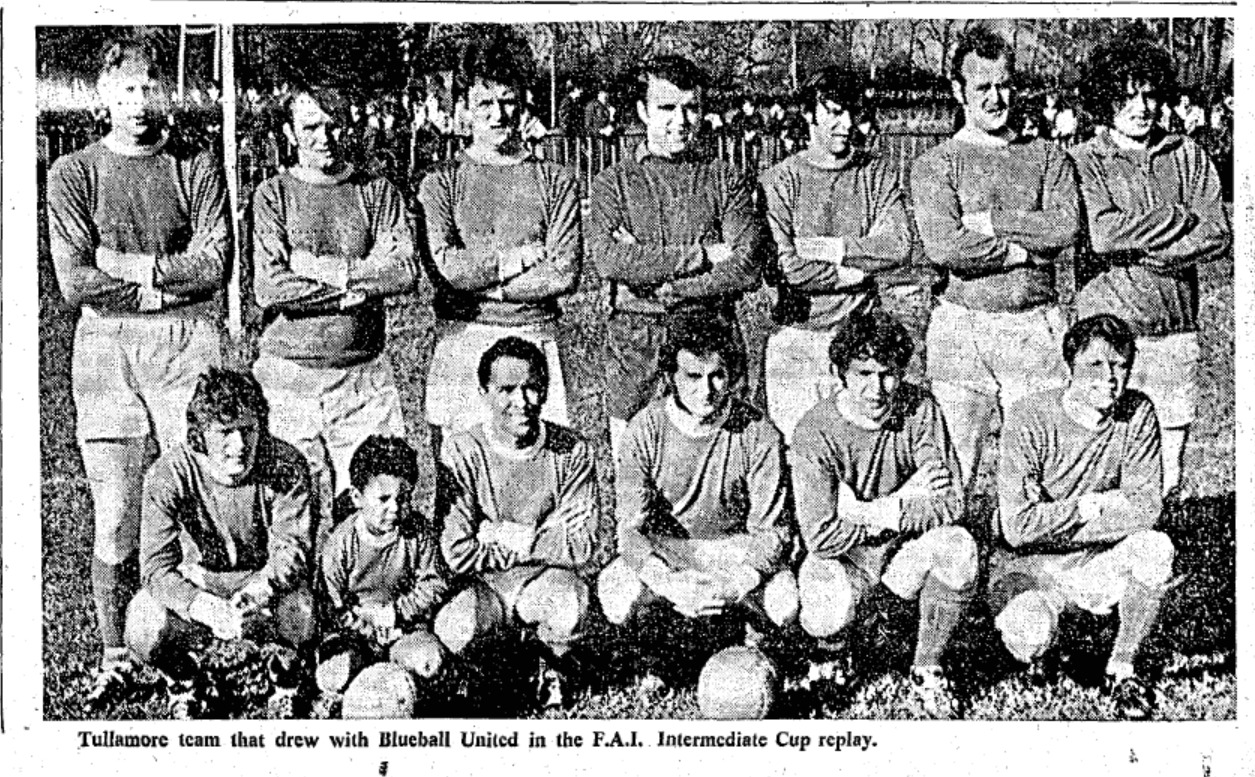
By then on the wrong side of 30, Ray would drop out of senior football and move into coaching, first with Tullamore Town where as player-manager he would win the Intermediate Cup and the League of Ireland “B” division, and then on to Parkvilla F.C. based in Navan. Despite the drop down from senior football ranks, Ray, as both player and manager would still encounter players of real quality. In the FAI Cup they would come close to a giant-killing, forcing a replay against Shamrock Rovers. While Parkvilla’s title rivals Pegasus featured a young defender, one Kevin Moran, who would go on to make his name at Manchester United. Another rival side were Dalkey United who featured a young full back by the name of Paul McGrath. Dalkey is a well-healed south-Dublin coastal town that also happened to be home to one of the orphanages where Paul grew up. It is tempting to see Parkvilla versus Dalkey United, an unglamorous amateur tie probably watched by a couple of dozen spectators, as somehow significant: Ray, a trailblazer in his own way but now in his late 30s, encountering an 18 year Paul McGrath at a point before his career took off. Two black Dubliners who would help to change the perception of what the traditional, homogenous view of what it means to be Irish at a time when to be Irish seemed to be synonymous with words like white and Catholic, denying the pluralism (albeit stifled and hidden) that has always existed in Irish society.

So what sort of player was Ray and how was he treated by spectators of the day? From talking to those who watched him and who played alongside him, his main attributes were his passing ability and dribbling, fast without being lightning quick he was also excellent on set-pieces. Newspaper reports are full of descriptions of him humiliating fullbacks, constantly beating his man and delivering excellent crosses. While usually employed as an old-fashioned, chalk-on-your-boots right winger, Ray was versatile playing across all of the old front five positions, his awareness and passing ability assisting his role as an inside forward, reports referring to him as a “delightful ball player”. He also played centre forward with some success, no small feat for a man described as “diminutive” even by the standards of the day and he also played as a sweeper during his later years as a player-manager. The fact that he was black didn’t seem to cause much comment either, a few early reports noted the talents of the young “coloured” player and while at Longford he was referred to as “Nigerian forward Ray Keogh”. He did attract some bizarre and offensive nicknames such as “Darky” Keogh and the more esoteric “Blessed Martin” after Saint Martin de Porres, the 16th Century Peruvian monk who was the mixed-race son of a Spanish nobleman and a freed Panamanian slave.

RK pic2

Ray’s senior playing career coincided with the golden age of the League of Ireland, the 50’s and 60’s were an era of big crowds, bigger clubs often having gates of over 20,000 while cup finals could see over 40,000 in attendance. The League was also able to keep more of the better quality Irish players in the country. The maximum wage remained in place in England until 1961, and even after the limit was lifted it was still often more financially beneficial for a player to stay in Ireland than to go to England. Domestic players were truly local heroes, especially at clubs like Shamrock Rovers and Drumcondra, who enjoyed a great popular sporting rivalry through the 50s and 60s. Ray got to play in front of big crowds, win league titles, compete in cup finals, play in Europe against the likes of Bayern Munich, and represent his league in prestigious games. He was a local icon but because of the era he played in, the strange role that domestic football played in Irish society at the time, and the lack of surviving TV footage, Ray is mainly remembered these days by groups of ageing Drumcondra fans who hold on to memories of a club that disappeared from senior league football back in 1972.

When the Irish national team enjoyed its own golden age, reaching its peak at Italia 90, players like Chris Hughton and Paul McGrath were household names. The constant replaying of the penalty shoot-out against Romania, Kevin Sheedy’s equaliser against England and the pain of Bonner’s parry and Schillaci’s finish means that the players of that era are never likely to be forgotten. Nor will the way that Jack Charlton’s side helped that process of redefining Irishness. That men from Dublin, Cork and Donegal could line up alongside men from Glasgow, London and Manchester, be they black or white, Catholic or Protestant and still represent Ireland and the green jersey with pride had a profound effect on how we viewed our nation and diaspora. And in a small way we should remember the contribution of a man named Ray Keogh to that process.

This article was first published in edition 8 of The Football Pink magazine. They do good work so do check them out. If any readers out there have more information on Ray or his career please get in touch.