The 1925-26 season was a last exit for Brooklyn as the southside club withdrew from the league, being replaced by another Dublin side, Brideville FC who were the original League of Ireland side to compete out of Richmond Park in Inchicore.
Shamrock Rovers were defending champions but there was stiff competition expected from other quarters, mainly from the Fordsons team who started the season strongly and had added Bohemians striker Dave Roberts to their ranks, as well as from Shelbourne for whom John Simpson and Fran Watters provided the bulk of the attacking talent.
Despite all the striking talent in the league in the goalscoring stakes it was once again Billy “Juicy” Farrell of Shamrock Rovers who topped the scoring charts with 24 league goals. An all-round sportsman, Farrell excelled at hockey, cricket, Gaelic football and even billiards. However, the 25-26 season would be the last one in which he would play regularly, a broken leg after a serious motorbike accident in May 1926 prematurely curtailing one of the most promising careers in the League.
For Bohemians their top scorer was the South African, Billy Otto, pressed into service more often as a centre forward after the departure of Roberts, with the likes of Dr. Jim O’Flaherty (another in a long line of Bohemian doctors), Jimmy Bermingham, and Joe Stynes (a prominent Republican during the Civil War and former Dublin county footballer) all chipping in through the season. Between the posts the Irish Army Officer, Harry Cannon had made the goalkeeper spot his own.
As mentioned Fordsons had a particularly good start to the season but it was Bohemians who became the first side to win against them in Cork, securing an impressive 2-0 win. However, this win and the two points that came with it were overturned and awarded to the Cork team after a protest that veteran Bohs player Harry Willits had been listed on a team sheet for the game as “Henry” Willits. The league committee awarding Fordsons the victory due to the mis-spelling of the name of one of the league’s best known and longest serving players.
Despite that dubious victory Fordsons would only finish 3rd in the league, Shelbourne capturing the title for the first time in their history with Simpson and Watters scoring 33 goals between them to propel them to victory. In the Cup however it was to be Fordsons year, they defeated Shamrock Rovers 3-2 in the final in front of a record crowd of 25,000 in Dalymount.
Key to their victory was their goalkeeper Billy O’Hagan, the Donegal born former IFA international saved a penalty from Bob Fullam with the scores tied at 2-2 to inspire his team onwards, and with five minutes to go Paddy Barry scored the winner to bring the cup to Leeside for the first time. Harry Buckle, (who we met in the last issue) made history by becoming the oldest player at 44 years old, to win the cup, a record that still stands to this day.
In terms of trophies Bohemians had to be content with the Leinster Senior Cup which they won 2-1 in a replayed final against Shelbourne, Dr. Jim O’Flaherty grabbing both the goals in the game played on April 19th as one of the final matches of the football season.
A month earlier the League had secured its first inter-league victory, defeating the Irish League 3-1 in a comfortable victory in Dalymount in the first ever meeting between representative teams from the island’s two leagues.
And just a week after that history was made as an Irish international side under the auspices of the FAI took to the field in Turin to face Italy. Despite a 3-0 reverse it was an important first step in world football for the national side, among the starting XI that day were Bohemians Harry Cannon in goal and Jack McCarthy in the defence.
The split from the IFA and the formation of the FAI in 1921 was an acrimonious one, and the bad blood seeped beyond our own island as the English, Scottish and Welsh football associations roundly supported their colleagues in Belfast. This placed the nascent FAI in a difficult position, it had to look further afield for opponents leading to them joining FIFA, entering a team in the 1924 Olympics and inviting clubs from the Continent to visit Ireland. They knew however that the bigger draw for the sporting public were always going to be for teams from the British associations and if a full international match couldn’t be secured, then the next best thing would be an inter-league game. With an improvement in relations with the other associations after a conference in Liverpool in 1923, this was something that for the first time seemed achieveable.
In February 1924, almost three years since the split from the FAI, an inter-league match was scheduled against the Welsh League, with the match due to take place in Dalymount Park. This was the first time since the creation of the FAI that they would have any sort of representative game. All that would be needed now was to select a team…
There was much discussion about the make-up of the team and not all Irish football supporters were happy. The newspaper letter pages at the time we’re deluged with criticisms and alternative XIs (they had to do something without Twitter) but ultimately side was picked by a Free State league selection committee and was made up of players from Bohemians, Shelbourne, Jacobs, St. James’s Gate and Shamrock Rovers. The Welsh, for their part selected four Cardiff players, three from Llanelli Town and one each from Swansea, Newport, Mid Rhondda and Pontypridd. Neither the League of Ireland team nor the Welsh side limited themselves to Irish or Welsh players only. For the Welsh League the likes of Cardiff’s English goalkeeper Herbert Kneeshaw or forward Jack Nock were selected. Similarly, the League of Ireland side featured English players, the Bohs’ forwards Harry Willitts and Dave Roberts were both born in England. Roberts had even had a brief career in the English league with the likes of Shrewsbury and Walsall.
It was quite an eclectic League of Ireland side, completing the Irish forward line alongside Willitts and Roberts were Hugh (Jimmy) Harvey, Jack (Kruger) Fagan and Christy Robinson. Harvey was a winger for Jacobs who, like Willitts had served in the British Army in World War I, he would later go on to have a career as a music hall performer and comedy actor. Robinson and Fagan, two of the younger players in the side, from Bohemians and Shamrock Rovers respectively, had both been involved with the IRA during the War of Independence.
The side was captained by Shelbourne’s Mick “Boxer” Foley (they loved a nickname back then) who was among the more experienced players on the side having been on the books of the now defunct Leeds City for almost ten years either side of the War. One player who was picked but who would have to be replaced late-on was Val Harris, at almost 40 Harris was back with Shelbourne after a distinguished career in England with Everton, however a late withdrawal saw his place taken by Bohs’ Johnny McIlroy. On the bench was Charlie Harris, the Bohemian FC trainer who also moonlighted as a trainer/physio for O’Toole’s GAC and occassionally the Dublin County GAA side, including on the infamous occassion of a match against Tipperary in Croke Park on Bloody Sunday 1920.
Teamsheet from the match programme.
The night before the game the Welsh delegation were treated to tea in Clery’s department store tearooms followed by a show across the river at the Theatre Royal.
The match itself was a success, a sizeable crowd of 15,000 generated gate receipts of £850, a record soon broken when Glasgow Celtic visited Dalymount to play the League selection later that month. The St. James Brass & Reed band provided entertainment and English referee T.G. Bryan (who would go on to referee the 1928 FA Cup final) was brought to Dublin specially for the match. The crowd were given the best possible start to proceedings when Ernie McKay of St. James’s Gate, and a worker in the GPO for his day job, open the scoring early on, McKay earned special praise for his performance in the game and was complimented for rising to the occasssion and showing leadership in midfield. For the Welsh side Jack Nock quickly equalised before Jimmy Jones of Cardiff put them in front.
Deep in the second half the Welsh did well to preserve their lead but with just 12 minutes to go Bohs striker Roberts who had been having a quiet game scored twice in quick succession to briefly give the Irish the lead. Jones however scored his second of the day which meant that this first ever representative game organised under the auspices of the FAI would end 3-3 and history was made.
Bios of the players involved:
Frank Collins: Collins had two spells with Jacobs, either side of a a short spell at Glasgow Celtic where he saw little first team action, he was restricted to just two first team appearances due to the primacy of regular Celtic custodian Charlie Shaw. While at Celtic he was capped by the IFA in a game against Scotland. He returned to Jacobs in 1922 and continued to play with them for a further ten years. The fact that Collins had played professionally in Scotland probably meant that he missed out on an appearance at the 1924 Olympics, however, he was capped by the FAI in a 3-0 win against the USA in Dalymount directly after the Olympics as well as the 1927 game against Italy.
Stephen Boyne: Boyne and his brother Eddie were both regulars for Jacobs around this time. They were from Bride Street and Stephen worked as a van driver for the Jacobs factory. He had received a significant ban in 1920 after altercations that took place during a game against Olympia.
Herbert (Bert) Kerr: Beginning as a a youth player with Drumcondra, Kerr later joined Bohemians when Drums disbanded during the First World War. Kerr represented Ireland at the 1924 Olympics and won three caps in total. He later became a club captain and a prominent member of the Bohemian FC management committee. A younger brother, Kevin Kerr, also later captained Bohemians. In 1920 he set up his own insurance and bloodstock agency. Bertie had a love of horses and Kerr and Company remain in business to this day. He purchased and sold on four horses that later won the Aintree Grand National as well as a Kentucky Derby winner. He passed away in 1973 aged 77.
Mick (Boxer) Foley: Born in Dublin in 1892 Foley made his name at Shelbourne from where he was purchased by Leeds City along with two of his teammates in 1910. Foley made more than 120 appearances over the next ten, war-interrupted years, for Leeds before the club dissolved in 1919 due to financial irregularities. Foley quickly re-signed for Shelbourne winning the IFA Cup on his return. His grandson Paul played in the League of Ireland and in Australia.
Johnny McIlroy: Another one of the veteran players in the team, McIlroy had made his name with Belfast Celtic, appearing in both the 1917 and 1918 IFA Cup finals. He featured for the Falls League XI in a friendly match against Bohemians in 1921 and was soon signed by the Dublin club for whom he would have great success, winning league titles in 1924 and 1928 as well as the 1928 FAI Cup.
Ernie McKay: The son of a Scottish soldier, McKay was born in Richmond Barracks in Templemore, Tipperary, now the Garda training college. McKay played for St. James’s Gate but did not work for Guinness, instead he spent decades working in the GPO on O’Connell Street, as a teenager he was working there as a telegram boy when the Easter Rising broke out. It was around this time that he first became involved with St. James’s Gate as a footballer. Like other members of this XI he also featured in the 1924 Olympics. McKay won the double with the Gate in the first season of the Laegue of Ireland and formed an imposing half-back line alongside Frank Heaney and Bob Carter. He later retired to Essex and was one of last surviving members of the team, passing away in his later 90s.
John (Kruger) Fagan: “Kruger” as he was known in tribute to one of the heroes of the Boer War, grew up around the Markets area of Dublin. During the 1916 Rising he assisted rebels in the Four Courts in getting to safety and arranging for a safe house. A diminutive forward at just 5’2″ Fagan became part of Shamrock Rovers famed “Four Fs” forward line alongside Bob Fullam, Billy “Juicy” Farrell and John Joe Flood. He was capped by Ireland in the 1926 game against Italy in Turin and made history when his son Fionan, who starred for Manchester City was also capped by Ireland, making them the first father and son to achieve this honour. A talented all round sportsman he won a Leinster title in handball and later worked as an assistant to the first Dáil librarian before moving to the Werburgh Street offices of the Department of social welfare.
Harry Willits: Harry Willits was born in Middlesborough in 1889 and already made a strong impression as a footballer in his teens, when he played for Middlesbrough Old Boys, Cambridge House and the famous South Bank club where a team-mate was later English international George Elliott. He moved to Ireland in 1908 to work in the Civil Service and began playing for Bohemians around this time.
He joined the British Army in late 1915 and was seriously wounded in the leg in 1916. Despite this he returned to football and was an intergral part of the Bohemian side that won the league in 1924. Even before his playing days with Bohemians finally ended, Willits became involved with the club’s Management Committee, also later the Selection Committee, and he served as Vice-President.
Dave Roberts: From the English midlands Roberts had spells at both Walsall and Shrewsbury before moving to Bohemians. He had also served briefly in the British army before his footballing career in Ireland. He was top scorer in the 1923-24 season as Bohs won the league, later moving onto Fordsons in Cork. Roberts had a wife and two children living in Birmingham at this time and in 1925 while playing in Cork he was sentenced to a month in prison for child neglect for failing to pay the Birmingham Guardians £172 for the care of the children. At the time Roberts claimed his salary was only £3 and ten shillings a week. Roberts continued with Fordsons until 1927.
Christy Robinson: Born around the markets area on Arran Street in 1902, Robinson was a skillful inside left and one of the stars of a Bohemian side which won the league in 1924 and a clean sweep of trophies in 1928. He also had spells at both Bendigo and Shelbourne. Prior to his involvement with football he had been an member of Na Fianna Éireann and later a member of the First Battalion of the Dublin Brigade during the War of Independence. During this time he was involved in the raid on Monk’s Bakery where Kevin Barry was captured. He would later name one of his son’s Kevin in his honour. He was a Captain in the Free State army until his departure from it in 1924. Robinson was another player who travelled to the 1924 Olympics and featured in a friendly match against Estonia directly after Ireland’s exit from that competition. His brother Jeremiah (Sam) would also play for Ireland and would have a successful club career alongside his brother at Bohemians before moving onto Dolphin. Christy Robinson passed away in 1954 in Dover, England. He is incorrectly listed as S. Robinson on the match programme pictured above.
Hugh James Harvey: Hugh James Harvey, was better known as Jimmy Harvey and was born in Dublin in 1897. He had been a physical instructor in the British Army during World War I and had played for Shelbourne on his return to Dublin, featuring in the 1923 FAI Cup final where Shels had surprisingly lost to Belfast side Alton United, Harvey had the unlucky distiction of being the first player to ever miss a penalty in a FAI Cup final in that game. Harvey was useful in several positions across the forward line but found a new lease of life after his sporting career. During his time as a Jacob’s player records list him as a labourer. However, his father (also Hugh) was a “Variety artist” and the younger Hugh, decided to follow his father into show businesses. He excelled as a comedian as part of a comedy troupe known as the “Happy Gang” who performed in many theatres around Dublin and was also an accomplished singer, dancer and actor.
The 1970s saw Bohs first forays into European competition. The decision taken in 1969 to abandon the strict amateur ethos of the club, observed since its foundation in 1890 paid immediate dividends with victory in the 1970 FAI Cup and secured entry to the 1970-71 European Cup Winners Cup. Given the club’s name it was somehow appropriate that our first opposition should come from what is now the Czech Republic. Over the course of the decade Bohs would qualify for European competition eight times, and would see the club enjoy its first victories. The focus of these articles are the dramatic campaigns of 1977-78 in the UEFA Cup and the 1978-79 European Cup.
The 1976-77 League season had seen Bohs finish second, a point behind Sligo Rovers who won just their second ever title. It was a young, talented Bohs side, packed with players who would go on to have successful international careers, and some who had already been capped by their country. That second-place finish secured qualification for the following season’s UEFA Cup, now rebranded as the Europa League. European football in the 1970s was quite a different place from today, the splintering of the USSR and Yugoslavia into their constituent parts was still decades away and nations like the Faroe Islands or Andorra were not yet represented in European competition. With a smaller number of nations there was no qualifying round and no group stages, qualifying meant entry into a straight knock-out, first round tie and a potential draw against a European heavyweight.
There was the dilemma here for Irish clubs, whether to hope for a smaller, more obscure team, and a better opportunity to progress, or the desire for a big name in the draw and a potential bumper home gate. It’s worth noting that in this era Europe was generally a drain on club resources, prize money was not nearly as significant to an Irish club as it is today and getting drawn against a little-known side from Eastern Europe could end up being hugely costly to a club’s finances. The biggest draws for an Irish club, then as now, were British clubs, well known to the Irish public and almost guaranteed to draw a big crowd even if the chances for progression were slim.
It was against this backdrop that Bohemians were drawn against Newcastle United in the opening round of the 1977-78 UEFA Cup, with the first leg being a home-tie in Dalymount. From a Bohs point of view this had the potential to be a lucrative tie, Newcastle had finished fifth in the First Division the previous year and would be well known to a Dublin audience, while the away trip to Newcastle could be done at relatively low cost. Billy Young, the long-serving Bohs manager during this period recalled that the club made all their travel arrangements through a travel agent named “Mrs. Chisholm” and while she couldn’t always arrange the most direct route, she always arranged the cheapest! For Bohs away trip this would entail a flight to Leeds, and after some delays, a coach to Newcastle.
The Bohs squad for those games against Newcastle was one of the strongest of the decade, in goal was Mick Smyth, the veteran of the team at 37, he was hugely experienced and successful, having starred for Drumcondra and Shamrock Rovers before joining Bohs, he’d also been capped for Ireland against Poland back in 1968. In front of Smyth were the likes of full-back Eamonn Gregg, who would win eight international caps during his time as a Bohs player, and later manage the club, Tommy Kelly, another vastly experienced player who still holds the club record for most appearances for Bohemians, on the left of defence was Fran O’Brien, a pacey, attacking player from a footballing family, he would win three caps for Ireland and ended up spending the majority of his career playing professionally in the United States. These were supported by the likes of the imposing Joe Burke, and classy defender/midfielder John McCormack, inevitably nicknamed “The Count”.
The Bohs midfield set up might strike current fans as familiar, there was a focus on using the flanks as avenues of attack, helped by the fact that in the shape of Gerry Ryan and Pat Byrne they had two of the best wide men in the League. Both players would win numerous caps for Ireland, Ryan would later star for Derby County and Brighton while Byrne enjoyed spells with the likes of Hearts and Leicester City, but is probably best known for his time with Shamrock Rovers (boo!). Up front was the peerless Turlough O’Connor, another Irish international, he would set goalscoring records for Bohs not broken until the time of Glen Crowe, and would finish the 1977-78 season as the league’s top goalscorer. Turlough would later succeed his erstwhile teammate Eamonn Gregg as Bohs manager in 1993.
The Bohs team of 1977-78
This group was ably assisted by players of the quality of Padraic O’Connor (brother of Turlough), Tony Dixon, Eddie Byrne, Niall Shelly and Austin Brady. As mentioned, the side was coached by Billy Young, a stalwart player for Bohs during the club’s amateur era in the 1960s. Young would take the managerial reigns at Dalymount in 1973 and stayed in charge through to 1989!
To ensure a bumper crowd for the Newcastle match the Bohemians committee decided to reduce the standard entry fee for the game, the Irish Independent reporter Noel Dunne went so far as to say that Bohs were offering the cheapest football in Europe with fees ranging from £2 for a stand ticket down to 50p for a spot on the terraces. The pulling power of an English team and cheap tickets had the desired effect and Dalymount welcomed almost 25,000 spectators for the home leg. Bohs were able to field an almost full strength side apart from Joe Burke who missed out having scalded his foot in a workplace accident (not something that the opposition side would likely have had to deal with). The Bohs XI were Mick Smyth, Eamonn Gregg, Fran O’Brien, Tommy Kelly, John McCormack, Padraic O’Connor, Pat Byrne, Niall Shelly, Turlough O’Connor, Eddie Byrne and Gerry Ryan.
Ryan especially was a thorn in the side of Newcastle, going close early on with a long-range shot, and helping create the best chances for the game for Bohemians thanks to his excellent link-up play with Pat Byrne and Turlough O’Connor. While Bohs had enjoyed some decent opportunities in the first half Mick Smyth was called into action to make crucial saves from Micky Burns and it took a last-ditch Eamonn Gregg clearance to deny Irving Nattrass. However, the performance was about to become of secondary importance in proceedings. With the sides still at 0-0 at the break, trouble began to flare when the Newcastle players returned to the pitch for the second half.
Newcastle squad photo taken from the game’s match programme
With Newcastle keeper Mike Mahoney taking up his position in goal in front of the school end of the ground there was a barrage of missiles and he was struck in the head by a beer can and play was suspended so that Mahoney could receive treatment. But that was just the beginning. Trouble began to flare between Bohs supporters in the tramway end and Newcastle fans in the main stand, chants, provocation and missiles flew back and forth. The Newcastle Chronicle reporter John Gibson claimed that the spark had been the unfurling of a Union Flag by some Newcastle fans which was met with anti-British chanting by the home fans, followed by fans hurling more than insults. With only fourteen minutes of the second half played the referee withdrew the players to the relative safety of the dressing rooms. In the interim additional Gardaí had arrived at the ground and there were baton charges to restore order. Post-match reports stated that a Garda and several others were injured and that five arrests were made at the game.
After some semblance of order had been restored the players returned to the pitch to complete the game with the crowd of almost 25,000 in what was described as a somewhat “unreal” atmosphere. The reports of the actual football, and conversations with both Billy Young and Tommy Kelly who were involved in the game, as Bohs manager and player respectively, recall a competitive game full of good football. Kelly remarked on the quality of player that Newcastle had, like Alan Kennedy who would achieve fame as a European Cup winner with Liverpool, Northern Irish international David Craig, and his Scottish namesake Tommy Craig. Indeed, Bohs had a great opportunity to win the game with twelve minutes remaining only for Mahoney (now patched up) saving after an excellent Bohs move put Turlough through on goal.
As was often the case with League of Ireland sides in Europe a decent home result and performance wasn’t enough to get Bohs through the tie. A flight to Leeds and a delay in getting the coach to Newcastle meant that the Bohs side arrived late in the Evening before the away leg, not ideal preparation. The coach had also stopped to collect the Derby County manager Tommy Docherty who had also attended the game in Dalymount. Docherty was a larger than life character, and hugely popular within the game, he had won the FA Cup a year earlier with Manchester United but had been sacked after beginning a relationship with Mary Brown, the wife of club physio Laurie Brown. Docherty was keen on signing two of Bohemians’ outstanding players, left-back Fran O’Brien and winger Gerry Ryan. Both players were in demand and indeed Newcastle had made offers for both players around this time.
Aware that there was competition for the players’ signatures Docherty was adding a personal touch. He was well-known to the Bohs committee, during his time with Manchester United he had signed the likes of Gerry Daly, Mick Martin and Ashley Grimes from the club, and was keen to make some key additions now that he found himself managing at the Baseball Ground. After the home leg in Dalymount, he had asked Billy Young if he could buy the players a drink, Young agreed and Docherty proceeded to order bottles of champagne for the Bohs players, before catching a private flight back to Derby.
The away leg was to be a let-down for Bohs, though Tommy Kelly remarked that the squad travelled with a certain level of confidence, feeling unlucky not to have won the first leg, the Magpies were a different prospect on home turf. They also welcomed back Alan Gowling to the starting eleven and he and Tommy Craig proved the match-winners, both scoring a brace to hand the Geordies a 4-0 win on aggregate. Within two days of the away leg newspapers were announcing that Derby County had signed Gerry Ryan and Fran O’Brien for a combined fee of £75,000 (£40,000 for Ryan and £35,000 for O’Brien), and that the players would merely be flying back to Dublin to collect belongings before moving to their new club. Speaking to Fran O’Brien he claimed the fact that Derby was close to Nottingham, home to his brother Ray who was playing for Notts County, influenced his preference in choosing Derby over the Magpies.
However, a supposed issue with O’Brien’s medical halted the move though what the issue was wasn’t made clear to O’Brien or Bohemians. Whatever the concerns from the Derby medical, Fran O’Brien would enjoy a long and successful career. He joined the Philadelphia Fury in the NASL a year later and played alongside the likes of Alan Ball, John Giles and Peter Osgood, he also became the first player to be capped for Ireland while playing in the United States.
Ryan would only spend a year at Derby before falling out with Docherty and moving to Brighton for a fee of £80,000, double what Bohs had been paid for his services a year earlier. He was to become a fan favourite at Brighton and joined a significant contingent of Irish internationals there including Tony Grealish, Michael Robinson and Mark Lawrenson. He was kept out of the starting XI for the 1983 FA Cup Final by fellow Dubliner and future Shels player Gary Howlett. Ryan would go on to win eighteen caps for Ireland before an injury aged 29 effectively ended his career.
Gerry Ryan during his time with Brighton showing off the souvenirs collected during his international career.
In the UEFA Cup Newcastle would lose their next tie 5-2 on aggregate to Corsican side Bastia, a masterclass by Dutchman Johnny Rep in St. James Park where he scored twice in a 3-1 sealed the Magpies fate in the competition. A week later their manager Richard Dinnis, a man promoted from his role as coach to manager at the insistence of a sizeable proportion of the Newcastle squad, was sacked. The former Wolves manager Bill McGarry was eventually appointed in his place but he couldn’t save Newcastle from finishing second bottom and being relegated. Dinnis would later end up as coach with Philadelphia Fury where he would manage Fran O’Brien, the player he had just previously tried to sign from Bohemians.
As for Bohemians, the season couldn’t have finished more differently to their Geordie opponents, they would finish top of the sixteen team League of Ireland, pipping Finn Harps to the title and seeing Turlough O’Connor as the League’s top goalscorer. Victory also secured entry to the following season’s European Cup, however the crowd trouble at the Newcastle game cast a long shadow and would have consequences for the club.
Tommy Kelly had described the trouble are less violent than that which had accompanied the game against Rangers in 1975, and Billy Young also said that the Bohs’ predicament could have been worse were it not for the intervention of Paddy Daly who had been looking after the UEFA observer at the game. Sensing the tension in the air at the game he ensured that the UEFA official left for the club hospitality before half time and delayed him returning for the second half, meaning that he missed some of the worse incidents of trouble. However, such was the scale of the disturbances action was going to have to be taken.
The Minister for Justice, Gerry Collins TD had demanded an inquiry into the game. The findings were heavily critical of Bohemian Football Club, saying the club hadn’t employed “sufficient Gardaí” while An Garda Síochána stated that Dalymount was no longer suitable for matches of this type, that the “roof of the St. Peter’s Road stand is in danger of collapse” and that “wire around the pitch is cut in several places, and missiles are easily available on waste ground within the stadium”. UEFA were not much kinder in their appraisal; they criticised the supporters “dangerous and violent behaviour” making specific reference to the injury to Mahoney, the Newcastle goalkeeper.
It is worth contextualising the violence at the match, this was not an issue unique to Bohemians, or indeed to Ireland, at the same disciplinary meeting where Bohemians were sanctioned, fines and suspensions were also issued to Manchester City over issues arising from the behaviour of their fans and players. Hooliganism was an issue across European football, and tensions between teams from the League of Ireland and those from Britain and indeed the Irish League also took place amid the backdrop of horrific violence in the North, this was perhaps most famously encapsulated during the 1979-80 European Cup tie between Dundalk and Linfield and indeed by the return to Dalymount of Glasgow Rangers in 1984.
The punishment handed down by UEFA was that the ties for the forthcoming European Cup campaign would have to be played away from Dalymount. The club’s “home” matches would have to take place at a minimum distance of 150 kilometres from Dublin.
Despite this ban the “home” legs for the 1978-79 European Cup would bring a qualified level of success for Bohemians, as we’ll see from part two…
With special thanks to Billy Young, Tommy Kelly and Fran O’Brien for sharing their memories of the era.
Sean O’Casey’s Juno and the Paycock debuted on the Abbey Theatre stage in 1924 with the focus of the drama set in the city of Dublin after the outbreak of the Civil War just a couple of years earlier in 1922. The “Paycock” of the title, the feckless Captain Jack Doyle, became identified by the malapropism which he exclaimed repeatedly through the play, “the whole world is in a terrible state o’ chassis”. And indeed it was. If we take it that Captain Jack meant by “chassis” that the world was in a state of chaos and change then certainly his final drunken quip was accurate. Maybe he’d been at the first ever Free State cup final a few months earlier?
By the dawn of 1922 the truce in bloody War of Independence was’t yet six months old, the Anglo-Irish Treaty had only been signed in December of 1921 which allowed for the creation of a 26 county Free State by the end of 1922. But before that would happen 1922 would also witness the beginnings of the Irish Civil War. A state of chassis indeed.
In the middle of this chaos the Football Association of Ireland had been formed after a split from the Belfast-based IFA and a brand new league and cup competition were begun before the Irish Free State had even officially come into being. While that first season can be viewed as a success from a footballing perspective, it was not to be without incident or drama. Befittingly, it was the cup final that witnessed some of the most dramatic scenes.
The first season of the league had kicked off in September 1921, it only featured eight teams in total and all of them were from Dublin. Of those eight only two are still involved in League of Ireland football today, Shelbourne and Bohemians. The cup however, was slightly more diverse, featuring the likes of Athlone Town, who would join the league the following season, as well as West Ham. The West Ham from Belfast that is.
West Ham were a team in the Falls and District League in Belfast. When the split from the IFA occurred these clubs chose to affiliate with the FAI and in West Ham’s case their new cup competition. This wasn’t to be the only occasion that something like this happened, the following season the cup winners were Alton United, previously a junior club in Belfast they shocked Shelbourne in the final with a 1-0 win. The relative success of junior clubs from Belfast was likely to have drawn some condescending looks from the IFA in relation to the standard of football south of the border. But it should be noted that at the time due to the political turmoil in Belfast one the foremost clubs on the island; Belfast Celtic had withdrawn from the league and many of their players were active for sides in the FAI affiliated Falls and District league.
This would change when by the end of 1923 the FAI was admitted to FIFA. One of the conditions of acceptance being that only clubs from the 26-county Free State could be members of the Association. This meant an end to the involvement of northern clubs until Derry City joined the league in 1985. West Ham were not to have much of a cup run. Their highlight was holding Shelbourne to a scoreless draw before they were knocked out in a replay.
While the West Ham versus Shelbourne game may have been tight there were a few hammerings in the early rounds of the cup. In the opening round Dublin United beat their league rivals Frankfort 8-1. While Dublin United would drift out of football over the following few years Frankfort, from the Raheny area of Dublin are still active locally, playing their matches in St. Anne’s Park.
Despite their convincing win in the opening round Dublin United were dumped out in the following tie by Shamrock Rovers, then a Leinster Senior League side. Rovers had already had a long cup campaign before the met Dublin United. Not being a league club they had to negotiate a number of qualifying rounds which had their own fair share of drama. A comfortable win over UCD was followed by a trip to Tipp to take on Tipperary Wanderers. Despite the recent prominence of Shane Long we don’t often think of Tipperary as a soccer stronghold but the local side were good enough to beat Rovers 1-0. The men from Ringsend however, made a formal protest because of the poor quality of the pitch that they were forced to play on. A ruling was made that the match had to be replayed and this time Rovers emerged victorious.
Further victories followed over St. James’s Gates “B” side and Shelbourne United (a club who also had their origins in Ringsend but not to be confused with Shelbourne F.C.) which meant that Rovers were through to the first round proper of the cup against Free State league side Olympia. A 3-1 win there and the 5-1 hammering of Dublin United saw them drawn in the semi-finals against Bohemians.
Bohs being the more well established side went into the games as favourites. They enjoyed home advantage as both semi-finals were to be played in Dalymount Park, they’d finished a close second to St. James’s Gate in the inaugural league season and they’d demolished Athlone Town 7-1 in the previous round. But it was Rovers who emerged victorious thanks to a lone strike by John Joe Flood. The result was somewhat of a shock, accounts at the time describe Bohs enjoying the better of the play but failing to take their chances, ultimately the more direct, physical approach taken by Rovers paid dividends.
The scorer of the winning goal, John Joe Flood was one of the team’s early stars. A Ringsend local, he was the son of John Flood, a bottle blower at the nearby glass bottle works. He had previously played for Shelbourne but was very much a Shamrock Rovers man. He even spent some of his youth living on Shamrock Terrace, the road that gave Rovers their name. In all he had four spells at the club, while also trying his luck on two occasions in England, a short spell with Leeds United and later sojourn at Crystal Palace.
He was known as tough and pacey inside forward and was occasionally referred to by the nickname “Slasher” which makes him sound like a fairly formidable opponent. In Rovers’ colours he’d end up collecting four League of Ireland medals and six cup winners medals and later became part of the famous “Four F’s” forward line along with Billy “Juicy” Farrell, Jack “Kruger” Fagan and Bob Fullam. He would also be capped five times by Ireland, scoring four goals, including a hat-trick in a 4-0 victory over Belgium.
Victory over Bohs had secured Rovers’ place in the final, due to take place on St. Patrick’s Day 1922 but they would have to wait a while before the identity of their opponents was confirmed. The other semi-final had gone to a replay, St. James’s Gate versus Shelbourne had finished scoreless in their first meeting and there was a gap of more than two weeks before the game was replayed. The victors on that day were St. James’s Gate and they were confirmed as the side to face Rovers in the final on St. Patrick’s Day.
St. James’s Gate at the time were based around grounds in Dolphin’s Barn that were rented by the Guinness brewery which gave them their name. Guinness were known for the paternalistic attitude they took towards their workers and a job at the brewery offered a level of security and benefits that were not often found in other workplaces around Dublin. The James’s Gate players were nominally amateurs, five players from the team would be part of the amateur squad that competed for Ireland in the football tournament at the 1924 Olympics, but even by the time of the Cup final there were a quota of non-Guinness players allowed play for the team.
Some of those who weren’t Guinness employees included Ernie MacKay, the son of a Scottish soldier, Ernie worked for at the GPO for decades while also remaining involved with James’s Gate as a player and administrator well into the 1940’s. His team-mate at inside-left was Charlie Dowdall who had worked for Guinness briefly but spent most of his career working at the Inchicore railway works. Still they would have had access to the superior sporting facilities of the Guinness workers, pitches, gymnasiums and medical experts. Such was the prestige of the club at the time that many star players who did work at the brewery were excused from more taxing work to make sure they were fit and healthy for upcoming matches.
This approach had brought impressive results. In the 1919-20 season St. James’s Gate had won the Leinster Senior Cup, the Leinster Senior League, the Metropolitan Cup and the Irish Intermediate Cup. By the time the cup final rolled around on St. Patrick’s Day 1922 the Gate had already become the inaugural Free State league champions and Leinster Senior Cup winners, an FAI Cup win would seal a treble.
The Gate were favourites, despite the fact that they were technically viewed as an amateur “works” team whereas Rovers (still a Leinster Senior League side) were paying players between 20-30 shillings a game. The Gate possessed the league’s top scorer, Jack Kelly in their ranks, and while Rovers had a certain reputation for toughness and aggression (especially men like Bob Fullam, Dinny Doyle and William “Sacky” Glen) St. James’s were no push-overs in this regard.
Their midfield half-back line of Frank Heaney, Ernie MacKay and Bob Carter were tough, tall, physically imposing men. Heaney, a veteran at this stage, had won amateur caps for the IFA, while MacKay, Dowdall and the versatile Paddy “Dirty” Duncan would also all represent Ireland at the 1924 Olympics. They were certainly a side with pedigree.
What was described as a “fine holiday crowd” numbering up to 15,000 were in attendance in Dalymount Park that St. Patrick’s Day for the final. Despite the fact that the Gate midfield was physically bigger the Rovers half-backs were dominant in the opening half, but their forward-line, though “aggressive” missed a succession of chances and five minutes before the break Jack Kelly rose highest to power home a header from a Johnny Gargan corner kick to give St. James’s Gate a half-time lead.
Ten minutes into the second half Rovers restored parity, Paddy Coleman, the Gate keeper failing to clear a ball from an in-swinging corner meant an easy finish for the Rovers winger Charlie Campbell. Rovers rallied and had some good chances before the end of the game but their earlier slack finishing persisted and they failed to make their pressure count. The Irish Times used the standard parlance (then, as now) referring to the match as a “typical cup tie”, it was hard fought, but they complained that much of the play was “crude”. A replay was set of the 8th of April and there was even greater drama to come.
The crowd wasn’t quite as sizable for the replayed game, perhaps due to the fact that the Irish Rugby team were playing France that same day in Lansdowne Road and enjoying a rare will over Les Blues. The 10,000 or so who were there in Dalymount Park were in full voice, and the Gate’s Charlie Dowdall later described the atmosphere as “electric”, and remembered the “intense fanaticism between the supporters” before ominously noting that “those were the troubled days, and there were a few guns lying around in supporters’ pockets, though it all ended happily”. As we’ll see later at least one supporters’ gun didn’t end up staying in his pocket!
As the game kicked off with Rovers captain Bob Fullam winning the toss and deciding to play into the wind in the opening half, this didn’t seem to hamper Rovers who had the better of the play and created most of the chances, however, as in the previous game, they couldn’t make possession and territorial advantage count. Rovers errant finishing would cost them as a minute before the interval Johnny Gargan nicked the ball from Joe “Buller” Byrne (later a groundsman at Milltown) and squared for Jack Kelly who beat Bill Nagle in the Rovers goal with a fierce, low strike. Despite Rovers continuing to have the better of the play in the second half it would remain the only goal of the game as Paddy Coleman put in a display described as “miraculous” between the sticks for the James’s Gate.
The final whistle was met with a pitch invasion from some of the Rovers support who headed straight for the James’s Gate players. They were soon joined by several of the Rovers players. Two tough teams had obviously gotten under each others skin and Dowdall and Fullam in particular had been having something of a running battle throughout the match.
As the St. James’s Gate players made for the dressing rooms at pace they were chased from the pitch by the invading fans and three Rovers players. Bob Fullam, allegedly joined by Dinny Doyle and John Joe Flood, pursued the Gate players inside where Fullam advanced on the object of his ire, Charlie Dowdall. It all seemed set to kick-off when Jack Dowdall, Charlie’s younger brother and an IRA volunteer stepped forward and produced a pistol. Fullam and his Rovers teammates were outnumbered, and now out-gunned and they sensibly beat a retreat from the changing rooms. Fullam, along with Doyle and Flood ended up receiving bans from the FAI for their part in the disturbances.
Fullam wouldn’t be banned for long and ended up scoring 27 times in the league for Rovers the following year. Most with his howitzer-like left foot. While his first cup final may have ended is defeat he would retire from the game with four winners medals to his credit, to go with the four league titles he’d collected. So central did he become to Rovers success that the popular refrain among their support whenever the team were lacking inspiration on the pitch was “Give it to Bob”, a phrase that entered widespread use through Dublin in the subsequent decades.
Fullam also has an important footnote in Irish international football history. After the 1924 Olympics few international matches were forthcoming and the FAI had to wait until 1926 to secure a full international fixture, in this case a game against Italy in Turin with a return game in Dublin also agreed. Fullam and Frank Brady of Fordsons were the only players to play in both of those early games. The Italians ran out comfortable 3-0 winners in Turin but performed better in Lansdowne Road the following year with Ireland taking the lead through a powerful strike from none other than Bob Fullam. It was counted as the first goal in International football for a FAI national team. Indeed he nearly grabbed a second shortly after from a free-kick, the power of which meant that Mario Zanelli, the Italian full-back was stretchered off after he blocked the fierce shot with his head. Despite the performance that was to be Fullam’s last cap for Ireland, he was by then into his 30’s and Rovers were to be the main focus of his footballing exploits.
That inaugural season of Free State football belonged to St. James’s Gate who finished with three trophies, while Paddy Duncan, Charlie Dowdall and Ernie MacKay would all go on to represent the nascent international team in the following years. Despite the chaos of the cup final replay over 25,000 spectators had paid in to watch the two games, bringing in gate receipts of over £1,000 which were crucial to the FAI’s finances in those early days.
Less than a week after the replay anti-treaty IRA volunteers, led by Rory O’Connor occupied the Four Courts in Dublin city. Tensions mounted and in the early hours of June 28th the Free State army began shelling the Four Courts from their positions south of the Liffey. The Civil War had begun, the nation was convulsed by almost a year of violence that would leave thousands dead. By the time a cessation to the violence arrived in May 1923, amid the turmoil, lawlessness and death somehow an entire football league season and cup competition had been played out. Circumstances that seem so utterly bizarre and unreal today. Shamrock Rovers, newly elected to the Free State league had won it at their first attempt. With Bob Fullam, returned from his ban, as top scorer. In the cup Alton United enjoyed their brief moment in the sun by winning the cup, a Belfast side triumphing in the Free State blue ribbon competition. A tragic, dramatic, scarcely believable, terrible state o’ chassis indeed.
Boxing is Ireland’s most successful Olympic Sport and Dublin has produced fighters of international renown and witnessed world title fights but the city has also had a somewhat ambivalent relationship with the sport, happy to cheer on successes but often young fighters had to venture beyond our city for recognition. For more than sixty years Dalymount Park was an important venue for both amateur and professional bouts attracting big name fighters while also giving a platform for up-and-coming Irish boxers.
Dalymount Park was staging boxing matches since at least 1920 when the Irish Amateur Boxing Association (IABA) hosted an All-Ireland boxing competition there. Tickets ranged in cost from 2 shillings up to 5 shillings for ringside seats. The tournament was a great success though the closing bouts were hampered somewhat by an unseasonal July downpour which made it difficult for fighters to keep their balance on the slippery canvas.
Contests continued to be held in Dalymount through the 1920s as Bohemian Football Club made gradual improvements to the stadium. In 1928 an Irish Amateur boxing team faced off against their Danish counterparts in an international exhibition tournament ahead of the Olympics. By 1932 after some further improvements to Dalymount by renowned architect Archibald Leitch, the stadium was to hold one of its biggest ever fights, an exhibition match by the “Ambling Alp”, Primo Carnera. The giant Italian was one of the biggest names in Boxing and was just a year away from becoming heavyweight champion of the world when he defeated Jack Sharkey in Madison Square Garden in 1933. Carnera was the headline name on a bill that included various weight divisions and fighters from all over Britain and Ireland. The 6’6”, 20 stone Carnera fought exhibition bouts against English heavyweights Bert Ikin and Cyril Woods and entertained a crowd reported to be almost 20,000. The Irish Independent called him as “light as a bantam” on his feet, and the rest of the Irish media were similarly impressed with Carnera’s boxing skills and amiable personality. Carnera, it was explained was learning his English from “the talkies” and had enjoyed the trip to Ireland apart from the crossing of the Irish Sea, berths aboard ship were not suited to a man of his size and he had found it very difficult to get to sleep. Carnera would ultimately lose his title to Max Baer in 1934, this fight features prominently in the Jim Braddock biopic The Cinderella Man which starred Russell Crowe.
Primo Carnera
The 1930s was a busy decade for boxing in Dalymount, there were more of the amateur international contests against the likes of England and Italy’s finest fighters, while more big-name professionals were brought there to fight after the success of Carnera’s visit. Boxing Hall-of-famer Freddie Miller fought the Welsh Champion Stan Jehu in Dalymount in 1935. Miller was the National Boxing Association (NBA) World featherweight titleholder at the time and had embarked on an extensive tour of Europe defending his title against all-comers. Three thousand spectators, including Government minister Frank Aiken and American Ambassador Alvin Owsley, watched Miller stop Jehu after four rounds. The same year Dalymount hosted Irish professional title fights which saw George Kelly become Irish lightweight title holder and Mossy Condon win the welterweight title.
Freddie Miller
The Irish Press writing about the bouts in Dalymount praised promoter Gerald Egan for his excellent promotional work and for arranging attractive bouts and headliners, declaring that “Professional boxing, dead as the proverbial doornail for so many years in Dublin, is sitting up and taking nourishment again – and this time it’s the right kind of nourishment”.
George Kelly, a Dubliner who had competed in the 1928 Olympics as an amateur, became a star attraction for the Dublin boxing public. Seven thousand people paid to see his title defence against Eddie Dunne in Dalymount, and there were scenes approaching pandemonium as Dunne, born in Skerries but raised in New York and fighting only his second fight outside of the United States, floored Kelly in the sixth round. The crowd yelled that Dunne had felled Kelly with a low blow as the defending champion squirmed in agony on the canvas. The crowd then stormed the ring and it took the intervention of An Garda Siochána before the final fight of the bill could proceed.
The outbreak of the Second World War created obvious difficulties in arranging international fights and bringing over top class professional boxers to Dublin. It also meant that it was more difficult for an impressive generation of young Irish fighters to hone their skills against elite level opponents. Despite this there were a number of high-profile matches. Chris “Con” Cole became the Irish heavyweight champion in Dalymount Park in 1942 when he defeated Jim Cully, flooring him seven times during the course of the fight. “Tiny” Cully was one of the tallest fighters in boxing history, conservatively measured at 7’2” he would enjoy a short, and ultimately unsuccessful boxing career, he found his greatest popularity during his couple of fights in the United States after appearing three times in Dalymount. Cully also seems to have enjoyed some popularity as a wrestler after he hung up his gloves. There is some great footage of the Dalymount fight here.
The following year would see one of the biggest fights in Dalymount history, but also one of its most disappointing. Cole was the opponent for the return of the “Gorgeous Gael” – Jack Doyle, almost four years after his last fight in London against Eddie Phillips. Doyle was a larger-than-life character, standing 6’5” he was a boxer, singer, actor, racehorse owner (he had a disagreement with former Bohs captain, and bloodstock agent Bert Kerr over a horse which ended up in a court case) and socialite. Doyle claimed that in terms of boxing he was the next Jack Dempsey and in singing he was the next John McCormack, he married the movie star Movita Casteneda in Westland Row church in Dublin in 1939 and stopped traffic in the city as the locals craned their necks to see a man who had packed out theatres with his singing and brought 90,000 to White City for his fight with Jack Petersen.
Jack Doyle
Sadly, by the time his fight in Dalymount rolled around Doyle was a shadow of himself. He was descending into alcoholism and had become a caricature of himself, reportedly heavily indulging in liberal amounts of brandy before previous bouts. For his fight with Cole he had “Cyclone” Billy Warren as his cornerman, a veteran black, American (or possible Australian) boxer, Warren had claimed to have fought Jack Johnson in his prime. Whatever the truth of this Warren had ended up in Dublin in 1909 and had later become Irish heavyweight champion. But all of his experience couldn’t help Jack Doyle. His fight against Cole was over within a round, Doyle managed only two and half minutes of “boxing” which he mostly spent clinging to the ropes as Cole pummelled him. The referee stepped in to stop the fight as it seemed that Doyle was unable to defend himself. What many Dubliners (and the media) had hyped up to be the “fight of the century” was finished and almost 20,000 disappointed fight fans left Dalymount in shock.
Jack Doyle bill at Dalymount
It is perhaps testament to the appeal of Doyle that even after his defeat to Cole thousands returned to Dalymount only two months later when Doyle once again topped the bill, this time they witnessed three rounds of boxing with Doyle emerging victorious over Cork heavyweight Butcher Howell. It was to be Doyle’s last professional fight, though he would later appear as a wrestler in Tolka Park. Doyle later ended up in penury, holding down work as a nightclub bouncer. His wife Movita, tired of his womanising and violent abuse, left him, she later married Marlon Brando. Jack Doyle, arguably the most famous Irishman in the world at one stage died in 1978.
While Doyle’s career might have come to an end in Dalymount others were only approaching their zenith. The Dublin sporting public became enthralled by the developing sporting rivalry between John “Spike” McCormack and Jimmy Ingle. Both fighters were familiar to each other from the amateur ranks. Ingle had gone on to win gold at the European Amateur Championships which were held in Dublin in 1939 while Spike had enlisted in the British Army early in the War. After being invalided out Spike went pro in 1942, as did Ingle. Spike making his Dalymount debut a year later. In 1944 both fighters would face off in Dalymount Park for their first meeting as professionals and would renew a long-standing sporting rivalry from their amateur days. Spike would win that fiercely contested bout on points but the great spectacle created a demand to see the pair in action again.
Spike McCormack v Jimmy Ingle advertisement
As Ciarán Murray notes, the “men would fight each other a further four times in the space of three years, twice for the Irish middleweight title. Spike would win both of these fights, before fighting to a draw in a bout in Dalymount in June 1945, and Spike losing to Ingle in May 1947 in Tolka Park”. That drawn fight in June of 1945 would etch itself into the city’s sporting memory. Writing almost forty-five years later the Bohemian F.C. board member and club historian Phil Howlin would recall;
“there was a 15 round, middleweight contest between two really good fighters from Dublin, John (Spike) McCormack and Jimmy Ingle. 15 rounds of one of the fiercest fights we had ever to witness, they virtually threw everything short of the kitchen sink at each other. It ended in a draw to the rapturous applause of a big crowd. Faith had been restored in Professional Boxing in a big way.”
Spike McCormack, as well as being a boxer, British Army commando and Dock labourer also worked for Des Kelly carpets for many years. He and Ingle remained good friends outside the ring. The Ingle name would become synonymous with boxing, a younger brother, John Ingle also fought in Dalymount on the same bill as his brother in 1945. He later became Irish lightweight champion. Perhaps the most famous Ingle was Brendan, another younger brother in a family of sixteen children. While he boxed as a middleweight in the 1960s and 70s he became much better known as the man who trained four world champions including Prince Naseem Hamed.
With the end of the Second World War there was also an opportunity to bring in more fighters from outside of Ireland – in 1946 Jimmy Ingle fought French boxer Robert Charron while on the same bill the light heavyweight Pat O’Connor defeated Ben Valentine, a fighter from Fiji who would later spend time as a bodyguard for screen idol Mae West during her tour of Britain.
The biggest draw in those post war years was undoubtedly the arrival of Lee Savold – the “Battling Bartender” of St. Paul, Minnesota, in 1949. Savold was already a household name for any boxing fan, and a year later he would defeat Bruce Woodcock in White City to claim the European Boxing Union’s version of the World Heavyweight title. His final fights in 1951 and 1952 were to be less successful, losing to the great Joe Louis before bowing out against a 28 year old from Brockton, Massachusetts named Rocky Marciano.
During his exhibition fight in Dalymount, Savold took on Irish heavyweight champion Gerry McDermott for four rounds as well as two rounds with Canadian champ Don Mogard. Newspaper reports describe how Savold “toyed with them like a good-natured bear”. Though the crowds were there to see an exhibition by Savold the fight of the night was lightweight contest between Paddy Dowdall and the Canadian, Jewish fighter Solly Cantor which ended in a draw.
Lee Savold
The days of world-famous names gracing Dalymount became less frequent in subsequent years but there were still occasional big draws for the fistic arts. Perhaps the most famous was in 1981 when Charlie Nash defended his European lightweight boxing title at the Phibsborough venue. Nash was from Derry and had represented Ireland at the 1972 Olympics but was knocked out of the competition in a quarterfinal by the eventual winner, Jan Szczpanski of Poland. That he had fought at all is testament to his character as the Games came just months after his brother Willie, was shot dead, and his father, Alex, was shot and wounded during the Bloody Sunday massacre. The horrible task of identifying his 19-year old brother’s body fell to Charlie. As he later told the Derry Journal; “Had there been no Olympic Games that year, I would’ve probably ended up in the IRA.”
Nash had hoped that the successful defence of his European title in Dalymount against Giuseppe Gibilisco might propel him to another shot at the World lightweight title, but it was not to be, Gibilisco made Nash endure six punishing rounds before the brave Derryman was knocked out. Such was the concern for Nash’s health that he recalled “I had to be rushed by ambulance to hospital. I can remember the sirens blasting as it sped through the streets of Dublin. They had to examine me and I had a concussion. I was expected to beat Gibilisco but he was a strong featherweight. It was outdoors in Dalymount Park and it was a cold, cold night for me.”
Charlie Nash at Free Derry corner
While Charlie Nash might have been coming towards the end of his career another young fighter made his professional debut on the undercard that night, 20-year-old Barry McGuigan defeated Selvin Bell by TKO in two rounds, little did we know the heights that his career would reach.
It’s important to remember that while Dalymount is synonymous with football that for many years a variety of sports were played there, everything from tennis, to croquet, Rugby league to skittle bowling, and a significant part of that history is caught up with boxing. It has been some time since a fight of note has been hosted at the ground. Roddy Collins was apparently involved in trying to secure Dalymount as a venue for a proposed fight between his brother Stephen and Roy Jones Jnr. and an honorable mention should go to Dave Scully and all who raised money back in 2013 for Bohemians during the Dalymount Fight Night. Perhaps with a redeveloped stadium Dalymount may once again witness the exponents of the sweet science do battle.
As the snow drifted up to his waist in the Siberian wilderness and the wind stung his face, the Gulag prisoner Stanislaus Kobierski dug, lay, and scraped. He would receive 200 grams of bread and a cup of water for his efforts while all around him bodies dropped dead; 300,000 would perish as temperatures plummeted to minus fifty.
The project was the Trans-Polar mainline, Joseph Stalin’s attempt to conquer the Arctic Circle. An audacious scheme to link the eastern and western parts of Siberia by one thousand miles of railway track from the city of Inta via Salekhard to Igarka lying on the Yenisei River. The track that Kobierski lay had the acronym ZIS written into it – it stood for ‘Zavod Imeni Stalina’ factory – named after the Russian leader. Kobierski was part of the 501st labour camp which began work eastward towards Salekhard in 1947 under the supervision of Col. Vasily Barabanov, who would be decorated with the order of Lenin in 1952. All around the camp were watchtowers; any thoughts of escape would be met with the firing squad.
More than a decade earlier, Stanislaus Kobierski had landed in Balmoral Aerodrome on the outskirts of Dublin from Scotland; in his bag were his football boots. It was October 16th, 1936, and two days before Kobierski and his German teammates had given the Nazi salute to sixty thousand Scots at Ibrox stadium. The crowd cheered on seeing this unusual sight as ‘Deutschland Uber Alles’ was struck up as the Swastika flag fluttered in the wind alongside the Union Jack.
At half time a protest took place against the new wave German regime, two of the instigators were arrested and removed from the ground. The Scots ran out two-nil victors with Celtic’s Jimmy Delaney netting twice; Delaney would run out for Cork Athletic in the 1956 FAI Cup Final. Then aged 41, Delaney of Irish descent, who was reared in the Lanarkshire mining village of Cleland, would be denied the opportunity to obtain a unique collection of cup winners medals across the British Isles after winning the IFA Cup with Derry City in 1954, the Scottish Cup with Celtic in 1937 and the FA Cup with Manchester United in 1948.
As Kobierski and his colleagues disembarked from the plane which carried Nazi flags on the tailfin, President Eamon DeValera and Dublin’s Lord Mayor Alfie Byrne stepped forward to welcome the travelling party. The team stayed in the Gresham Hotel on O’Connell Street and were brought into town in a bus adorned with the ancient religious icon from the cultures of Eurasia. Like Ibrox before the playing of anthems, the Germans gave their infamous salute to the main stand at Dalymount Park as locals watched on.
In the 26th minute Kobierski, at the home of Irish football, scored, equalising for the Germans after Dundalk’s Joey Donnelly had netted a minute earlier for the Irish. That same year Kobierski had won the Gauliga Niederrhein with Fortuna Dusseldorf. They would become the most successful German side, winning five championships throughout the reign of the Third Reich. The league was one of sixteen top-flight divisions introduced by the Nazi sports office in 1933, replacing the Bezirksligas and Oberligas as the highest level of play in German football competitions.
Fortuna would reach the national league finals losing out to F.C. Nurnberg two-one after extra time; Kobierski’s colleague on that day in Dalymount, Andreas Munkert would lift the title in Berlin. However, there would be no glory in Dublin for Munkert as he and his defensive partners were run ragged by Paddy Moore and Donnelly, as a marauding Irish team ran out 5-2 winners. One of Schalke’s greatest ever players, Fritz Szepan, scored the German’s second goal. He won six championships and a cup final medal for Die Knappen and was voted on the greatest Schalke team of the century when the club celebrated its 100th anniversary in 2004.
Szepan played for Germany in the second World Cup in 1934, hosted in Italy; Kobierski would score Germany’s first-ever championship goal against Belgium as the Germans would finish a respectable third in the competition. Both would feature in the ‘Unified German’ side, which would also include some of the great Austrian players from the iconic Wunderteam after the Anschluss.
The Austrians played their last match as an independent nation on the 3rd of April 1938 at the Prater Stadium in Vienna against Germany; dubbed ‘the homecoming match’, the Austrian side ran out two-nil winners. Their star forward, Matthias Sindelar, known as ‘The Mozart of Football’, scored one of the goals that day. Karl Sesta got the second an audacious lob, which led to Sindelar dancing in front of the VIP box in celebration, which housed Nazi leaders and their Austrian satraps.
Sindelar was found dead in his flat within a year, alongside his girlfriend Camilla Castagnola, both asphyxiated by a gas leak. In Austria, they still wonder about the mysterious circumstances of the deaths – suicide, an accident, or murder? On that autumnal day at Dalymount, the joyous Irish public invaded the pitch at the end, even cheering the Germans off the pitch, some raising their arms in the salute they had witnessed earlier.
In 1941 after over a decade with his hometown club, Kobierski, whose parents hailed from Poznan, was ordered to line out for the SS & German police club in Warsaw for exhibition games. On the 1st of September 1939, Germany had invaded Poland from the West, while seventeen days later, the Soviets invaded from the East; by October, Poland was defeated. Unlike their German counterparts, the Soviets allowed league football to be played primarily in the city of Lwow, the birthplace of football in Poland.
One of the teams in East Poland was Junak Drohobycz, a side who were actively involved in the Polish resistance movement; the players all in their twenties were also soldiers helping people escape to Hungary across the Carpathians. The team were known as ‘The White Couriers’ and ended up playing matches in Hungary and Yugoslavia during the war. One of the ‘Couriers’ was goalkeeper Stanislaw Gerula, who played for Leyton Orient of London in 1948. Gerula would spend two years at Brisbane Road before turning out for non-league Walthamstow Avenue playing in nets against Arsenal at Highbury in the London FA Challenge in 1952. That same year, Gerula helped Walthamstow win the FA Amateur Cup at Wembley; he was 38 years young. Twelve months later, Gerula rolled back the years against a Manchester United team who had won the championship in 1952 captained by Jackie Carey; in the fourth round of the FA Cup, the amateur side would draw 1-1 at Old Trafford as the ‘Courier’ performed heroics in goals.
In mid-1942, Kobierski and his team faced Huragan Wolomin in Legionowo; the Christmas of 1941 had seen the start of the underground Warsaw District of Association Football league. The Germans banned the league, and most games were played in the suburbs, such as Wolomin, Góra Kalwaria, Brwinow, and Piaseczno, as it was too dangerous to play games in the city. Alfred Nowakowski founded the league an ex-Legia Warsaw player; he would be awarded the Golden Cross of Merit in 1946, a Polish civil state decoration.
On the 1st of August 1944, the Polish Home Army initiated the Warsaw uprising, a non-Communist underground resistance movement to liberate the city from Germany. Forty-five thousand members fought alongside another 2,500 soldiers from the National Armed Forces and the Communist People’s Army against the military might of the Germans. Only a quarter of the partizans had access to weapons. Alongside this came the ‘Red Army’ appearing along the east bank of the Vistula River, Kobierski would eventually be captured and sent to Siberia.
The uprising would last for sixty-three days and be suppressed by the Germans in Oct 1944; with civilians deported to concentration and labour camps, the intensive fighting would reduce Warsaw to ruins. Stanislaus Kobierski would remain in Siberia until 1949 and, on his release, return to live out his days in West Germany, passing away in 1972. Before he took his final breath, Kobierski witnessed his beloved Fortuna finishing third in the Bundesliga and qualifying for European competition for the first time in the club’s history. Football was all he knew, but it took him from hell and back.
The following is a condensed version of the talk given in the Jackie Jameson bar on December 7th 2019
After a gap of eight years the 2020 season will see Bohemian FC return to European competition, given the club’s name and its history it could be argued that this is merely a return to its rightful position as for more than a century the Bohemian Football Club has looked beyond the borders of Ireland for challenge and opposition.
Bohemian internationalism really dates back to the development of Dalymount Park as the club’s permanent home. This base allowed them to invite the cream of British talent to Dublin to try their luck against the Bohemians, in those early years Preston North End, Aston Villa, Celtic and Sheffield United were among the early visitors. In 1908 Bohemians played Queens Park in Glasgow on New Year’s Day in an annual fixture which was the world’s most prestigious amateur club match usually contested against English side Corinthians. With them being unavailable to travel Bohemians were asked in their place and contested the game in front of over 20,000 spectators in Hampden Park.
After the split from the IFA the footballing landscape for clubs based in the new Free State was very different, the emerging FAI sought membership to FIFA and clubs like Bohemians also began to look to the Continent. In 1923 the first Continental side to play in Ireland since the split from the IFA arrived to take on Bohemians and an FAI XI, they were Gallia Club of Paris who played out a draw with Bohs.
From further afield came the South African national team, embarking on a tour of Britain and Ireland, the first opponents on this tour were Bohs in Dalymount Park and the unusual situation arose as two South African captains faced off against each other. Because the captain of Bohs for that 1924 season was Billy Otto, born on Robben Island he had left South Africa as a teenager to fight in World War I before ending up working in Dublin as a civil servant. A talented and versatile footballer he captained Bohemians to the League title before moving back to South Africa with his Irish wife in 1927.
By 1929 Bohemians were embarking on their first European tour themselves, competing in the Aciéries D’Angleur – an annual invitational tournament held around Liege in Belgium. Bohs played four games in all, including friendlies, winning every one and emerging victorious in a tournament which also featured Union Saint Gilloise, Standard Liege and RFC Tilleur. During this visit to Belgium the club also performed diplomatic functions on behalf of the Irish State such as flying the tricolor (at the first game the club had been mistakenly introduced under a Union Jack) and laying a wreath at the tomb of the unknown soldier.
Further continental success would follow three years later in the 1932 Tournois de Pentecôte held in Paris in the Stade Buffalo ahead of the first full professional season of the French League. Bohemians triumphed again by beating Cercle Athlétique de Paris (aka CA Paris/Gallia who we encountered earlier) and Club Français and winning the tournament and securing a second European trophy in three years. These were no mean achievements as both sides featured a number of French internationals who had competed in the 1930 World Cup and who had scored a stunning victory over England only a year earlier.
A year after the trip to France, Dalymount Park welcomed the first ever South American touring side to visit Britain or Ireland. This was the combined selection from Peru and Chile – the “Combinado del Pacifico” who also visited Scotland, England, the Netherlands, Czechoslovakia, Germany, France, Italy and Spain
There was significant interest and media attention paid to the game, with an official reception by the Lord Mayor of Dublin etc. The success of Uruguay in recent Olympic games (1924 & 28) and at the 1930 World Cup had sparked interest in South American football and despite the talent within the squad, including several future Copa America champions Bohs were able to hold out for a more than credible 1-1 with the touring side.
Bohs didn’t even taste defeat on European soil until April 1st 1934 when they were made to look the fools, losing the opening match of another European tournament against Dutch side Go Ahead in Amsterdam. The tournament also featured Cercle Bruges and Ajax. While the Gypsies bounced back and defeated Cercle Bruges 4-1 and secured a draw against ADO Den Haag there was sadly to be no match against that emerging force of Dutch football, Ajax.
While it would be the 1970-71 before Bohs would enter an official UEFA competition let nobody tell you that we don’t have a long history in Europe.
This piece first appeared in the Bohemian FC v Fehérvár match programme in August 2020.
I love a good Western and among many great practitioners of that ultimate piece of cinematic Americana was John Ford, born John Feeney in Maine to two Irish-speaking immigrants. Ford was a man who knew how to mythologise himself and he did plenty of myth-making in his movies as well. For better or ill his film The Quiet Man has probably influenced the American view of rural Irish life to this day. While, his westerns are far from historical documents of frontier life for European settlers in the American west, rather they are among the founding myths of American exceptionalism.
Of course Ford knew this, in one of my favourite of his films, The man who shot Liberty Valance a world-weary newspaper man utters the immortal line “When the legend becomes fact, print the legend”. Ford ackowledges that very Irish trait of preferring the entertaining story to the truth. And so it is with football, there are plenty of myths that grow legs, that persist to the present day despite constantly being debunked. I mentioned the old chestnut of Germany wearing a green away kit as a “thank you” gesture to Ireland in a recent post, but in this piece I’m going to address the notion that Bohemian Football Club bought the iconic Dalymount pylon-style floodlights second-hand from Arsenal, and that these same lights once adorned Highbury Stadium.
The origins of the myth
There are several fairly authoritative accounts, including one on the club’s own website, that perpetuate the story that the lights were either sold or gifted by Arsenal to Bohemians. I had in the past shared this story on social media myself before doing a bit of digging on the subject. This myth seems to have arisen from the fact that Arsenal played Bohemian F.C. in an inaugural match for the new lights in March 1962.
Cover of the match programme featuring the newly installed floodlights.
This simple inaugural match has somehow morphed into a story that Arsenal sold the lights to Bohemians. There are a few ways to dispel this myth so lets begin with the idea that these were the floodlights that once adorned Highbury.
The Highbury dilemma
Arsenal began playing matches under floodlights from 1951, at which time league matches under lights were not even permitted by the F.A. They did however play a number of high profile friendly matches including one against Glasgow Rangers. While the glorious old ground of Highbury has since been turned into modern apartments large sections of the stadium received listed status and still exist.
Anyone who ever visited the stadium will likely attest to its architectural beauty, it was however, also known for the compact nature of its dimensions, including an infamously narrow pitch, well exploited by managers like George Graham. Simply put Highbury didn’t have the space for large pylon towers like those that stand in Dalymount today. In the photo below you can see Highbury Stadium from that 1951 game against Rangers. This is verified both here and also here on the official Arsenal website.
From this early photo it is clear that there are no floodlight pylons, all the lights are roof mounted. It is worth noting that this photo is from a mere 11 years before the lights were supposedly “sold” by Arsenal to Bohemians, which would mean that any floodlight pylons would have to have been installed after 1951, survived less than ten years, and then been removed and replaced by another roof mounted lighting system.
From later photos it’s clear that there were no pylons at Highbury and indeed very little space in such a tight stadium for the location of large pylon tower lights. The two photos below are from circa 1960 (roof mounted floodlights again) and secondly from the last season that Arsenal played at Highbury in 2006. As before, roof-mounted lights.
Highbury in 2006
The only connection between Highbury and Dalymount is that they are both tight grounds located in residential areas and that portions of both stadiums shared a stadium architect in the early decades of the 20th century, namely Archibald Leitch.
The story of the lights
The insertion of the Arsenal Football Club and Highbury Stadium into the history of Dalymount is really by accident. Bohemians had organised a fundraising subcommittee to look at the cost and feasibility of installing floodlights at least as early as 1959. It also quickly became clear that once the lights were ordered that some form of inagugural game would prove popular.
To be clear, the Dalymount Park floodlights were not the first set of lights used in Dublin. Stadium lighting was temporarily installed in Croke Park for the Tailteann games of 1924, while Ruaidhrí Croke has written recently about the first games under lights in Tolka Park back in 1953 when it was home to Drumcondra F.C.
However, Dalymount Park was the de facto home ground of the Irish national team and the lack of floodlights meant that international games had to have earlier kick-offs, even when scheduled for mid-week which had an obvious impact on crowd numbers.
Taking inspriation from another national football stadium a preferred design and supplier emerged after from a visit to Hampden Park in Glasgow who installed their own floodlights in 1961. In a report in the DublinEvening Mail from November 14th 1961 it was reported that the contract had been signed with “a Scottish firm” for the lights and that these would take approximately three months to manufacture, transport and install. The firm in question was Miller and Stables of Edinburgh who, apart from Hampden, had also provided floodlights (or drenchlights as they dubbed them) for Windsor Park, Celtic Park, Easter Road and many others.
Original lighting console from Dalymount plyons showing the name of the manufacturer, Miller & Stables (pic Graham Hopkins)
Earlier in January 1961 an edition of the Irish Times confirmed that the FAI had accepted the recommendations of their own Finance Committee in guaranteeing major matches for Dalymount Park for at least the next ten years in order to assist with Bohemian F.C. in funding the purchase of new floodlights. Even by that stage the lights had been costed at £17,000 including import duty and transportation costs. This figure rose slightly when the lights were installed early in 1962 and were reported as costing £18,000 or even £20,000 according to one report.
The floodlights themselves are 125 feet high and originally featured three banks of ten lights on each pylon and a special transformer station had to be constructed to meet with the power supply demands. With the new lights it meant that mid-week games could be played in the evenings, for internationals this should mean bigger crowds and with Bohemians getting approximately 15% of the gate from international games this meant greater revenue for the club.
Despite the expected future return on investment this was still a huge outlay for the amateur club. Initial notices suggested that the lights would be in place by September 1961, which was then extended to October and ultimately until February of 1962. In the words of Club Secretary Andy Kettle, as quoted by Ryan Clarke in his recent series on Dalymount, it also meant that Bohs could “invite many top clubs to Dublin from time to time”.
The first of which ended up being Arsenal, though they weren’t first choice. But before these glamour matches could be played Kettle had to deal with some level of internal dissent from Bohs members about the level of expenditure and even had to engage in a little bit of what might be termed “crowdfunding” in the modern parlance. Kettle elaborated in the Dublin Evening Mail that the club had “approached their bankers, the Munster and Leinster Bank, their members, players, traders, FAI and League of Ireland for financial assistance”, before adding “Bohs are keeping open their fund and will only be to happy to receive any further contributions. No matter how small…”
The Arsenal Game
As Andy Kettle had hoped the installation of floodlights would help Bohemians raise additional funds by playing friendly games against some of the “many top clubs” that could be invited to Dublin. But the question remained which team should receive the honour of being first? There were suggestions from media commentators that Shamrock Rovers should be invited although the preferred option emerged as a game between a League of Ireland selection against a British based Irish XI. However, as this would require multiple clubs across England and Scotland to release players it quickly because clear that this was unfeasible.
Among the other clubs sounded out by Bohemians to fulfil this fixture were Sunderland and Leeds United, as well as Manchester United and Blackburn Rovers (both of whom declined due to FA Cup committements). Attention was then turned to Arsenal, Celtic or Wolverhampton Wanderers with Arsenal finally being chosen from that shortlist of three.
From this is it clear that Arsenal, despite being a famous First Division side were realistically a fifth or sixth choice on behalf of the Bohemians’ committee for the role of opponents for this inaugural game. Arsenal were ultimately chosen and played in Dalymount on at least their third occasion (the previous two being in 1948 and 1950) and fielded a strong team including Welsh international goalkeeper Jack Kelsey, George Eastham, and future Cork Hibernians player-manager Dave Bacuzzi. The Bohemian XI featured players like Tommy Hamilton from Shamrock Rovers, Eric Barber and Tommy Carroll from Shelbourne as well as Ronnie Whelan Sr. and Willie Peyton from St. Patrick’s Athletic.
Arsenal would ultimately win an exciting game, played in poor weather, 8-3. However, throughout all the media coverage during the build-up to the game and afterward there was no mention of any Arsenal or Highbury connection with the lights other than their being chosen as the opposition.
Maybe it is a little bit of an inferiority issue with Irish football fans that we’d rather believe that we bought the most iconic set of floodlights of any stadium in the country, second-hand from a big English club rather than believe that an amateur club, working in partnership with the League, the FAI and ordinary fans and players managed to successfully fundraise a huge amount of money for a major infrastructural project.
For me that’s a bigger story than any mythic historical connection with a defunct football stadium in London. But as they say “When the legend becomes fact, print the legend” I’d rather it be shine your own light rather than bathe in reflected glory.
An introduction to just some of the Bohemian F.C. members who swapped the playing fields of Ireland for the killing fields of Europe.
Fred Morrow was only 17 when he took to the pitch for Bohemians at the curtain raiser at their great rivals’ new home, Shelbourne Park. The Bohs v Shels games were known then as the Dublin derby and as with many derbies, passions were inflamed. But this game’s atmosphere was even more heightened and it wasn’t just to do with the 6,000 spectators packed into the ground. Even in just getting to the ground Morrow and his teammates had seen over one hundred Dublin Tramway workers picketing the game.
The 1913 Dublin lock-out was only a few days old and Jim Larkin had declared that there were players selected for the game who were “scabs”: Jack Millar of Bohemians and Jack Lowry of Shelbourne were the names identified during the strike. The striking tramway workers subjected the players and supporters to (in the words of the Irish Times) “coarse insults” and had even tried to storm the gates of the new stadium. Foreshadowing the events of the next day, there were some violent altercations with the officers of the Dublin Metropolitan Police, with 16 arrests made and over 50 people suffering injuries.
This can’t have affected the teenaged Morrow too badly as he scored Bohs’ goal in a one all draw that day. Although less than 5’5” in height, the youngster was shaping up to be quite a prolific centre forward. Fred had started his career early, lining out for his local side Tritonville FC based in Sandymount, and while with the club he had won a Junior cap for Ireland, scoring in a 3-0 victory over Scotland in front of over 8,000 spectators in Belfast. The following season he’d been persuaded north of the river to Dalymount, and he was to enjoy a successful season including scoring a hat-trick in an unexpected 3-1 victory over title holders Linfield.
The Shelbourne side that Bohs faced that day included in their ranks a new signing of their own, Oscar Linkson, who had just been signed from Manchester United. Linkson had made almost 60 appearances for United and had been at the club when they won the FA Cup in 1909 and the League in 1911. Quite the coup, then, for Shels. Oscar moved to Dublin with his 17 year old wife Olive and his son Eric, who would be joined by a baby sister just months later. He faced Fred Morrow that day as part of the Shels defence.
Within a year of this game, War would be declared. Both Fred Morrow and Oscar Linkson volunteered to serve in the British Army, Oscar with the famous “Football Battalion” of the Middlesex Regiment alongside a whole host of star players which included the Irish international John Doran. Neither Fred nor Oscar would return, by the end of 1917 both were dead on the fields of France.
The Memorial plaque or “Death penny” issued to Fred Morrow’s family
The events that the players had witnessed leading up to that Bohs v Shels game had far-reaching consequences, with the violence in the adjoining Ringsend streets at the game growing worse over the following day, culminating with violent clashes between the Dublin Metropolitan Police and striking workers on Sackville Street (now O’Connell Street). Hundreds were wounded amid baton charges and three striking workers were killed. The dramatic events convinced Union leaders James Connolly, James Larkin and Jack White that the workers needed to be protected, and that an Irish Citizen Army needed to be formed for this purpose. Ireland’s decade of lead had begun.
A year earlier in 1912, in response to the passing of the third Home Rule bill, and the possibility that Home Rule would finally become a reality in Ireland, hundreds of thousands of Irish Unionists signed what was known as the Ulster Covenant, where allegiance was pledged to the King of England. They stated that Home Rule would be resisted by “all means necessary”. This included the very real possibility of armed resistance, as demonstrated by the Ulster Volunteers (formed in 1912) importing thousands of rifles into the port of Larne from Germany in April 1914. In response, the Irish Volunteers, supporters of Home Rule formed in order to guarantee the passage of Home Rule bill, also imported German arms into Howth in July 1914; just days before the outbreak of the First World War. This mini arms-race in Ireland mirrored the greater stockpiling of armour and weaponry by the great European powers in the lead-up to the First World War; the whole Continent was in the grip of militarism. Violence seemed, to many people, to be unavoidable.
Clashes on Sackville Street during the 1913 lock-out
Over 200,000 Irish men fought in the First World War. To put this in perspective, the total male population of Ireland at the 1911 Census was just over 2.1 million. Those who fought did so for many reasons. Some, including many members of the Irish Volunteers, heeded John Redmond, the leader of the Irish Parliamentary Party who called on Irishmen to go and fight to help secure Home Rule, as a gesture of fidelity to Britain, in support of Catholic Belgium and in defence of smaller nations.
Redmond asked Irish men to prove “on the field of battle that gallantry and courage which has distinguished our race” in a war that he said was fought “in defence of the highest principles of religion and morality”.
Some men went in search of adventure, unaware then of the horrors that awaited them. Many Dublin men joined up as a way to financially support their families, the city at the time had a population of 304,000, with roughly 63% described as “working class”, the majority of whom lived in tenement houses, almost half with no more than one room per family. The army might offer death but least it offered a steady income.
What we also know is that many Bohemians joined up. Some like Harry Willits or Harold Sloan may have simply joined out of a sense of duty, that this was the “right thing to do”. Most joined in what was known as a “short service attestation”, meaning that they were only joining for the duration of the war, which many mistakenly assumed would be over quickly. In one edition of the Dublin based weekly paper Sport, it was estimated that Bohemians lost forty members to War service, among the highest of any club in the whole country, although we know that there was also significant enlistment from other Dublin clubs such as Shelbourne and Shamrock Rovers, while the loss of players to military service was cited as one of the reasons for the withdrawal from football of the original Drumcondra F.C.
Bohemian F.C. Roll of Honour – Evening Herald, September 1915 source @Cork1914to1924
Some like Harry Willits did return to resume their football career. Several did not return at all. Corporal Fred Morrow, who we met earlier as Bohs centre-forward, was a member of the Royal Field Artillery in France when he died of his wounds in October 1917. His mother had to write formally asking for the death certificate that the armed forces had neglected to send so that she could receive the insurance money for his funeral.
Private Frank Larkin was only 22 when he died just before Christmas 1915. He had been a Bohs player before the war. At this time, due the growing popularity of both the club and football generally in Dublin, Bohs often fielded several teams. Frank featured for the C and D teams, but like many Bohemians, was a fine all-rounder. He played cricket for Sandymount and rowed for the Commercial Rowing Club. He and two of his colleagues from the South Irish Horse were killed by a shell on December 22nd in Armentieres, Belgium. His will left a grand total of £5 14 shillings and 2p to his two married sisters.
Thomas Johnson as pictured at Royal Lytham & St. Anne’s Golf Club in his later years
Thomas Johnson, a young Doctor from Palmerstown was just 23 when the War broke out. He had won an amateur international cap for Ireland and was a star of the Bohs forward line, usually playing at outside right. He was a hugely popular player who the Evening Herald described as “always likely to do something sensational”. He was another fine sporting all-rounder with a talent for both cricket and golf. Johnson became a Lieutenant in the 5th Connaught Rangers during the War and later brought his professional talents to the Royal Army Medical Corps. He was awarded the Military Cross for his actions at Gallipoli. He received numerous citations for bravery, for example at the Battle of Lone Pine during the Gallipoli campaign the Battalion history notes “Second-Lieutenant T.W.G. Johnson behaved with great gallantry in holding an advanced trench during one of the counter-attacks. Twice he bound up men’s wounds under heavy fire, thereby saving their lives”.
While his medical skills were a great asset in saving lives Johnson also was a fierce soldier during the most brutal and heavy fighting. He was awarded the Military Cross specifically for his actions around the attack on the infamous Battle of Hill 60 where so many Irishmen perished. The battalion history states that on August 21st 1915
“Lieutenant T.W.G. Johnson went out to the charge, with rifle and bayonet, and killed six Turks. He shot two more and narrowly missed killing another one. Later, although wounded severely, he reported to the commanding officer, and showed exactly where the remaining men of his company were still holding their own, in a small trench on “Hill 60.”
It was by this means that these men eventually were carefully withdrawn, after keeping the Turks at bay for some hours.” . Hill 60 of course was for many years the name by which Dubliners knew the terrace at the Clonliffe Road end of Croke Park, it was only in the 1930’s that it became known as Hill 16 and later the apocryphal story emerged that the terrace had been built from the ruins of O’Connell Street after the Easter Rising.
Herbert Charles Crozier – back row far left. Harold Sloan – front row third from the right
Other Bohemians suffered serious wounds but managed to make it through to the armistice. One of the most prominent of these was Herbert Charles “Tod” Crozier. He had joined Bohemians as a 17 year old and took part in the victorious Leinster Senior Cup final of 1899. In 1900 he appeared for Bohs on the losing side in an all-amateur Irish Cup Final, which was won 2-1 by Cliftonville. Crozier was described as one of the most “brilliant half-backs playing association football in Ireland” and he formed a formidable and famous midfield trio of Crozier-Fulton-Caldwell who were still revered for their brilliance decades after their retirement. “Tod” had a long association with Bohemians and was also a prominent member of Wanderers Rugby Club. He grew up on Montpellier Hill, close to the North Circular Road and not far from Dalymount.
Major H.C. Crozier
His Scottish-born father was a veterinary surgeon but “Tod” became a career military man with the 1st battalion of the Royal Dublin Fusiliers. In 1908 he was awarded the Bronze Star by the Royal Humane Society while serving in Sudan for trying to save the drowning Lieutenant Cooper from the River Nile. It was noted that he behaved with great bravery despite knowing of the “dangerous under-current and that crocodiles were present”. He was a Captain at the beginning of the War and was part of the Mediterranean Expedition Force that travelled to Gallipoli. It was here that he was wounded, and as a result of his actions was awarded the Military Cross, and later, after a promotion to the rank of Major, the Military Star. Despite the wounds he received at Gallipoli he returned to Montpelier Hill in Dublin and continued to attend football and rugby games. He was still enough of a well-known figure that he was the first person quoted in a newspaper report about Bohs progression to the 1935 FAI Cup Final. He lived to the age of 80, passing away in 1961 and was buried in Mount Jerome Cemetery.
One man who returned from the War and then joined Bohemian F.C. was the legendary Ernie Crawford. Born in Belfast in 1891 Ernie was perhaps best known for his endeavours on the Rugby pitch. He starred for Malone in Belfast and later Lansdowne Rugby Club and won 30 caps for Ireland, fifteen of them as Captain. He would later be named President of the IRFU. His obituary in the Irish Times listed him as one of the greatest rugby full-backs of all time, he was honoured for his contribution to sport by the French government and even featured on a Tongan stamp celebrating rugby icons.
Ernie Crawford in uniform, on a Tongan stamp and as an Irish Rugby international
He was, however, a successful football player who turned out for Cliftonville and for Bohemians. Ernie, a chartered accountant by trade, moved to Dublin to take up the role of accountant at the Rathmines Urban Council in 1919, and this facilitated his joining Bohemians. Despite his greater reputation as a rugby player, Ernie, as a footballer for Bohs, was still considered talented enough to be part of the initial national squad selected by the FAIFS (now the FAI) for the 1924 Olympics. In all, six Bohemians were selected (Bertie Kerr, Jack McCarthy, Christy Robinson, John Thomas & Johnny Murray were the others and were trained by Bohs’ Charlie Harris), but when the squad had to be cut to only 16 players Ernie was dropped, though he chose to accompany the squad to France as a reserve. The fact that he was born in Belfast may have led to him being cut due to the tension that existed with the FAIFS and the IFA over player selection.
That he could captain the Irish Rugby Team and be selected for the Olympics is even more impressive when you consider that during the Great War Ernie was shot in the wrist causing him to be invalided from the Army and to lose the power in three of his fingers. He had enlisted in the 6th Inniskilling Dragoons in October 1914 and was commissioned and later posted to the London Regiment (Royal Fusiliers), becoming a Lieutenant in August 1917. He was a recipient of the British War and Victory Medals. Ernie later returned to Belfast where he became City Treasurer. It was in Belfast in 1943 that Ernie encountered Bohs again, as he was chosen to present the Gypsies with the Condor Cup after their victory over Linfield in the annual challenge match. He passed away in January 1959.
So who were these men who went to war? From looking through the various records available (very much an ongoing task) it is clear to see that they were of a variety of different backgrounds. Most were from Dublin, though some like Sidney Kingston Gore (born in Wales) were only in Dublin due to Military placement. Some like Harry Willitts came to Dublin as a young man, others like Crozier and Morrow were children to parents from Scotland, Belfast or elsewhere. They were of various religious beliefs with Catholics, Church of Ireland and Presbyterians among their number.
By the outbreak of the War Bohemian F.C. was not yet 25 years old, some of those who had helped to found the club as young men were still very much involved. The employment backgrounds of the men who enlisted seem to have connections back to those early days when young medical students, those attending a civil service college as well as some young men from the Royal Hibernian military school in the Phoenix Park helped found the club. There were a number who are listed as volunteering for the “Pals” battalion of the Royal Dublin Fusiliers, in this case more than likely the 7th battalion. This battalion was made up of white collar workers and many civil servants, they were sometimes referred to as the “Toffs among the toughs”.
The 7th Battalion also featured a large number of Trinity College graduates, as well as many Rugby players encouraged to join by President of the Irish Rugby Football Union, F.H. Browning, a number of those who joined would end up dead on the beaches of Gallipoli. Browning later died after encountering the Volunteers on return from maneuvers at Mount Street Bridge during Easter 1916. The medical profession is clearly represented by men such as Thomas Johnson and J.F. Whelan. There were also characters like Alfred Smith and Tod Crozier who were career military men.
We know that like many Bohemians they were great sporting all-rounders, many being talented Rugby players, rowers, tennis players and cricketers in addition to their talents on the football field. In most cases they were young; Fred Morrow was still a teenager when he joined up, Frank Larkin only 21. Even the prematurely bald Harry Willitts looked much older than his 25 years.
Those who did return from the trenches came back to an Ireland that was changed utterly. The events of the Easter Rising, the growth in Republican Nationalist sentiment and the gathering forces that would soon unleash the War of Independence meant that those who returned may well have felt out of step with the Dublin of 1918-19. Those mentioned above are only a small selection of the Bohemians who took part in the First World War, there are many more stories; of Ned Brooks the prolific centre forward posted to Belfast who ended up guesting for Linfield, of Jocelyn Rowe the half-back who had also played for Manchester United who was injured in combat. There are many others forgotten to history. Those men described above often only appear in the records because of their death or serious injury, many more passed without comment. For men like Harry Willits and Tod Crozier, they could return to familiar surroundings of Dalymount Park whether as a player or just as a spectator. Some of those who returned, like Ernie Crawford, were yet to begin their Bohemian adventure. Among this latter group was a dapper Major of the Dublin Fusiliers named Emmet Dalton. He was a man who had won a Military Cross for his bravery in France and trained British soldiers to be snipers in Palestine. On his return to Ireland, he would join Bohemians as a player along with his younger brother Charlie. Both men would also join the IRA. They would play a central role in the War of Independence and the Civil War though they weren’t the only Bohemian brothers with this distinction as I’ll outline in my next piece.
A partial list of Bohemian F.C.members who served in World War I
Captain H.C. Crozier (wounded, recipient of the Military Cross) 1st Royal Dublin Fusiliers. Later promoted to Major.
Lt-Colonel Joseph Francis Whelan Royal Army Medical Corps, recipient of the Distinguished Service Order for his actions in Mesopotamia (Bohemian player, committee member and club vice-president). Later awarded and O.B.E. as well as an Honorary Master of Science degree by the National University.
Surgeon Major George F. Sheehan, Royal Army Medical Corps. Awarded the D.S.O.
Lieutenant Sidney Kingston Gore, 1st Battalion Royal West Kent Regiment (killed in action). He died after being shot in the head on 28th October 1914 near Neuve Chapelle he was a talented centre-forward who was particularly strong with the ball at his feet.
Sgt-Major Jocelyn Rowe, 1st Battalion, East Surreys (wounded in action). Rowe was born in Nottingham and had briefly played for Manchester United. A report in the Irish Independent of 30th March 1916 stated that Rowe had been wounded an astounding 83 times but was still hopeful of playing football again.
Company Sgt-Major Alfred J Smith, Army Service Corps, (amatuer Irish international, wounded in action)
Private Joseph Irons, on guard duty at the Viceregal Lodge during Easter 1916 he later served duty in the Dardanelles campaign. Irons was born in England and was considered one of the best full-backs in Irish football, he worked on the staff of the Viceregal Lodge (now Áras an Uachtaráin) before being called up to the army from the reserve on the outbreak of War.
Lieutenant P.A. Conmee, Royal Navy (a former Rugby player and a goalkeeper for Bohemians)
Sgt-Major B.W. Wilson Inniskilling Dragoons
Lieutenant JRM Wilson, Bedfords (brother of above)
Reverend John Curtis, Royal Army Chaplains’ Department
Lieutenant Thomas William Gerald Johnson, 5th Connaught Rangers and later Royal Army Medical Corps (wounded in action, awarded the Military Cross for his actions in taking the infamous “Hill 60” during the battle for Gallipoli). Also an Irish amateur international player.
Private Frank Kelly, Army Service Corps
Lieutenant Ernie Crawford, Inniskilling Dragoons and Royal Fusiliers
Corporal F. Barry, Black Watch
Second lieutenant Charlie Webb, King’s Royal Rifle Corps. He was captured in March 1918 near Nesle in Northern France and saw out the war from a Prisoner of War camp near Mainz. Webb was an Irish international forward who was born into a military family in the Curragh Camp, Co. Kildare. He played for Bohemians between 1908-09 but is most associated with Brighton & Hove Albion where as a player he scored the winning goal in the 1910 Charity Shield Final. He later became Brighton’s longest serving manager, beginning in 1919 and continuing until 1947, a span that covered over 1,200 matches.
Private James Nesbitt, Black Watch (killed in action 16/07/15) the son of W. H. and Jeannie Nesbitt, of 54, North Strand Road, Dublin. James was a Customs and Excise Officer at Bantry, Co. Cork, at the outbreak of war. Although badly injured he directed medical attention to other wounded men. He walked back to the field hospital but died soon afterwards. Nesbitt was also a member of the Irish Parliamentary Party who sat on Blackrock Urban Council. He was known as the “Battalion Bard” as he amused the other troops by writing and singing “topical songs”. Nesbitt mostly played for the Bohs C and D teams.
Sergeant Harrison McCloy, Tank Corps. (Killed in action) McCloy was born 12th December 1883 in Belfast. He continued a common tradition of being a footballer for Clinftonville before joining Bohemians. He was a player for Bohemians from 1902 to 1905 including appearing for the first team in the Irish League. He later moved into an administrative role and was a club Vice President for Bohemians from the 1905-06 season through to 1911-12, He was also mentioned as having been Honorary Secretary of the Irish League in 1911. He had been part of the Young Citizens Volunteers before transferring to the Tank Corps serving as a Quartermaster Sergeant during World War I. His main role was supervision and security of tanks used in battle pre or post engagement. He was killed in Belgium by enemy shellfire on the 21st August 1917 whilst engaged in such duties. He was 33 years old. Buried in the White House Cemetery St-Jean-Les-Ypres. His gratuity was left to four of his siblings.
Corporal Fred Morrow, Royal Field Artillery (formerly of Tritonville F.C. Bohemian F.C. and Shelbourne), killed in action 1917.
Private Angus Auchincloss from Clontarf joined the Army Cycling Corps in 1915 and transferred to the Royal Irish Rifles in 1916. He was discharged in 1919 and died in Eastbourne, England in 1975 at the age of 81.
Lieutenant Harold Sloan, Royal Garrison Artillery killed in action January 1917.
Major Emmet Dalton, Royal Dublin Fusiliers. On returning to Dublin Dalton became IRA Head of Intelligence during the War of Independence and later a Major-General in the Free State Army.
Lieutenant Robert Tighe, 5th Battalion Royal Dublin Fusiliers
Private G.R. McConnell, Black Watch (wounded)
Trooper Francis Larkin, South Irish Horse (killed in action)
Major Fred Chestnutt-Chesney, 6th Lancashire Fusiliers (former goalkeeper for Bohemians and for Trinity College’s football team). Later a Church of Ireland Reverend. Wounded in combat by a gun shot to his left leg.
Private J.S. Millar, Black Watch
John C. Hehir, the star goalkeeper for Bohemians until January 1915. He was also capped by Ireland in 1910. Hehir played rugby for London-Irish and also won a Dublin Senior Club championship medal with the Keatings GAA club in 1903. He left Bohs to take up an “important role” with the War Office in London
Lieutenant William James Dawson, Royal Flying Corps. Injured in 1917 he returned to action but died in 1918. He was also a member of the Neptune Rowing Club and the Boys Brigade.
Private F.P. Gosling, Black Watch and later the Machine Gun Corps
Lieutenant L.A. Herbert, Veterinary Corps
Private Bobby Parker, Royal Scots Fusiliers. Parker was the English First Divisions top goalscorer in the 1914-15 season as he helped Everton to the League title. However, after league football was suspended Parker enlisted and was wounded in early 1918. Despite attempts to continue his playing career the bullet lodged in his back essentially meant his time as a player was over at the age of 32 after a brief spell with Nottingham Forest. Parker moved into coaching and in 1927 was appointed coach of Bohemian FC, a position he held until 1933. He led Bohemians to a clean sweep of every major trophy in the 1927-28 season.
Private William Woodman, 7th Battalion Royal Dublin Fusiliers and his brother Private Albert Woodman, Royal Engineers. After the war Albert returned to his job at the General Post Office, working there until his retirement. During World War II, he worked as a censor and redactor. He bought a home on Rathlin Road, in Glasnevin. Albert passed away in 1969, at the age of 78. For more on the Woodman family see here.
Private Stephen Wright served with the Leicestershire Regiment and the Royal Army Medical Corps during World War I. Born in Leicester he had two spells with Bohemians, before the outreak of the war, and again in the 1919-20 season. He would also appear for Bolton Wanderers, Norwich City and Brighton and Hove Albion. He returned to Ireland as a coach after breaking his leg while at Brighton, taking up a role at Dundalk in 1930 and leading the Louth club to their first ever league title in the 1932-33 season.
Private F. W. Taylor
Corporal H. Thompson, Royal Engineers
Trooper Griffith Mathews, North Irish Horse
Part of a series of posts on the history of Bohemian F.C from 1913-1923. Read about Bohs during Easter 1916 here or about the life and career of Harry Willits here.
When Harry Willits finished his first season as Bohemian captain in spring 1916 he had other major responsibilities on his mind. He had joined the Royal Dublin Fusiliers in late 1915 “for the duration of the war” and soon he would be sent to the western front in France during the Battle of the Somme.
He had followed his friends and several Bohemian colleagues in signing up for the army. His choice was the Commercial Battalion of the Dublin Fusiliers, established to cater for young men of the “commercial class” and farmers.
Willits was not the military type, according to his daughter Audrey, still living in the family home aged 93. But English-born and a civil servant, he moved in circles where enlisting for military service would have been regarded as a matter of duty.
He was promoted to corporal in February 1916, three months after enlisting. According to military records he became a sergeant in July 1916, though he was already identified in a June 1916 report of a cricket match between King’s Hospital and 10th Dublin Fusiliers as “Sgt Willetts”, bowled out for a duck.
He had a short period – three months – of active military service, yet he lived all his days with the consequences of it. In October or November 1916 he was wounded in the thigh, and he spent several months in hospital in southern England before returning to Dublin, and to Bohemians. His injury was serious enough for amputation to have been considered.
He missed all of the football season, 1916-17, as he recovered from his injury. The mark of the wound remained visible and the strain of playing in a weakened condition took its toll on his health in later life.
Harry Willits was born in Middlesborough in 1889 and already made a strong impression as a footballer in his teens, when he played for Middlesbrough Old Boys, Cambridge House and the famous South Bank club where a team-mate was later English international George Elliott.
Willits’s father was headmaster of Middlesborough High School when Harry and George were pupils there. But it was apparently in order to get away from his over-bearing father that Harry sat the civil service examinations and then, when he was admitted to the service, chose to take up a post in Dublin. He worked in the Post Office stores and later, over several decades, in the Registry of Deeds.
He joined Bohemians just after the club had captured the Irish Cup for the first time in 1908. He was a regular first-team player over the following years in the forward line, at inside-left or outside-left, alongside internationals Harold Sloan and Johnny McDonnell.
In spring 1916 he played football and cricket for the Dublin Fusiliers as well as captaining Bohemians. When he resumed service with Bohemians in late 1917, he was profiled in the Dublin weekly newspaper, Sport, as The Darling of Dalymount. The writer claimed there were many who came to Dalymount specifically to see Willits play.
A feature on Harry in a 1917 edition of Sport
Tall and prematurely balding, he was a striking figure. He was best-known as a skilful passer and crosser of the ball, but also contributed goals, including some from the penalty spot. Willits and Johnny West were a potent partnership at inside- and outside-left. (West was also a popular baritone singer, who performed at summer evening ‘promenades’ in Dalymount during the war years.)
Willits lived for a time near the Botanic Gardens with his mother, who had moved to Dublin following the death of Willits’s father. In 1919, however, Harry married Annie ‘Cis’ Wilson and with her inheritance they bought a house in Lindsay Road that remains in the family nearly a century later. The furniture includes a large dining-room sideboard that was a wedding gift to Harry and Cis from Bohemians, and a mark of the high esteem in which the club held him.
Willits was Bohemian captain again in 1920-21, when he was reported to have had a “new lease of life” as a footballer. Now in his thirties, he was prominent also in the Bohemian team that won their first League of Ireland title in 1923, and was selected with four other Bohemians for the new league in their first representative match against their Welsh counterparts in 1924. Willits played for club and league alongside Christy Robinson, who had a very different military record as a member of the IRA during the War of Independence.
Harry stars in the first ever inter-league game against the Welsh League
Some newspaper correspondents suggested that, but for his English birth, Willits might have been selected for Ireland. From 1925 onwards, he was playing with Bohemians’ second team and scored in a 4-0 win over Dublin University (Trinity College) in 1929, when he was 40. He featured in a short Bohemian’newsreel’ of 1930 as a “model Bohemian” who was “still going strong” and “a sportsman to the core”. Nearly fifty years old, in April 1938, he lined out for an Old Bohs team in a charity match in Dalymount against an Old Rovers side.
Even before his playing days with Bohemians finally ended, Willits became involved with the club’s Management Committee, also later the Selection Committee, and he served as Vice-President.
From the 1920s Harry Willits was a keen and competitive tennis player, being club champion in Drumcondra Tennis Club several times over the period 1923-33. He served also as club president and vice-president.
A man of routines, he always had two books on loan – one fiction, one non-fiction – from the Phibsborough Library. He dressed formally, in suit, tie and hat, and walked from his home to the Registry of Deeds in King’s Inns, responding to the frequent greetings of Bohemian fans in the streets. He practised calligraphy and did charcoal drawings.
His daughter Audrey and son Alec were both kicking footballs with their father in the family’s Glasnevin garden from early days. Alec played briefly for Bohemians first and second teams in the 1940s, but could not live up to what was expected of him as his father’s son. He later played for the Nomads.
Audrey applied her kicking skills to keeping goal for Pembroke Wanderers hockey teams for many years, appearing also for Leinster provincial teams and serving many years in the club’s committees.
From 1937, as Audrey recalls, Harry Willits developed asthma due to the strain of living with a war wound and this had a serious impact on his quality of life, also taking a financial toll. Harry had to reduce his work to half-time, which also meant half-pay, and Audrey remembers that the family often struggled to get by.
Despite this, Willits continued his involvement with Bohemians, as club officer and selector, and even – up to the age of 60 – as a coach. He was actively associated with Bohemians in one capacity or another for over forty years. He died in April 1960, aged 70, and is buried with his wife in Mount Jerome Cemetery.
This post originally appeared on the official Bohemian F.C. website in May 2016. Co-written and researched with Brian Trench as part of an ongoing series on Bohemians players from the First World War to the end of the Irish Civil War


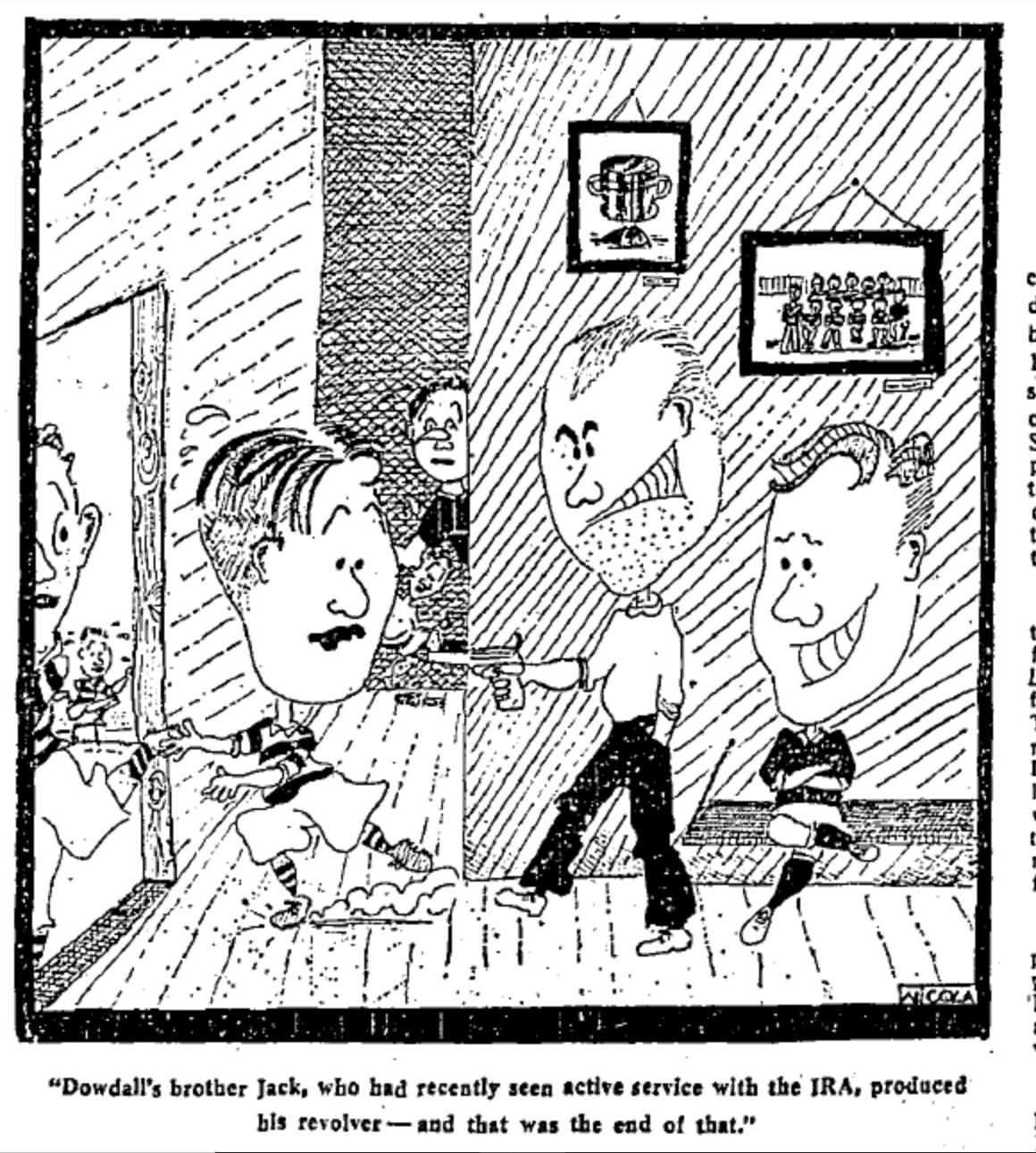


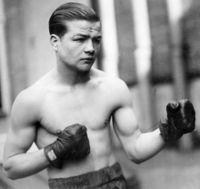


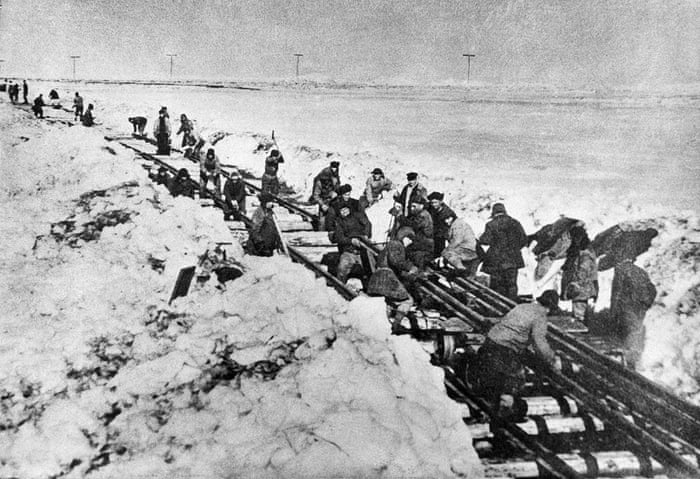


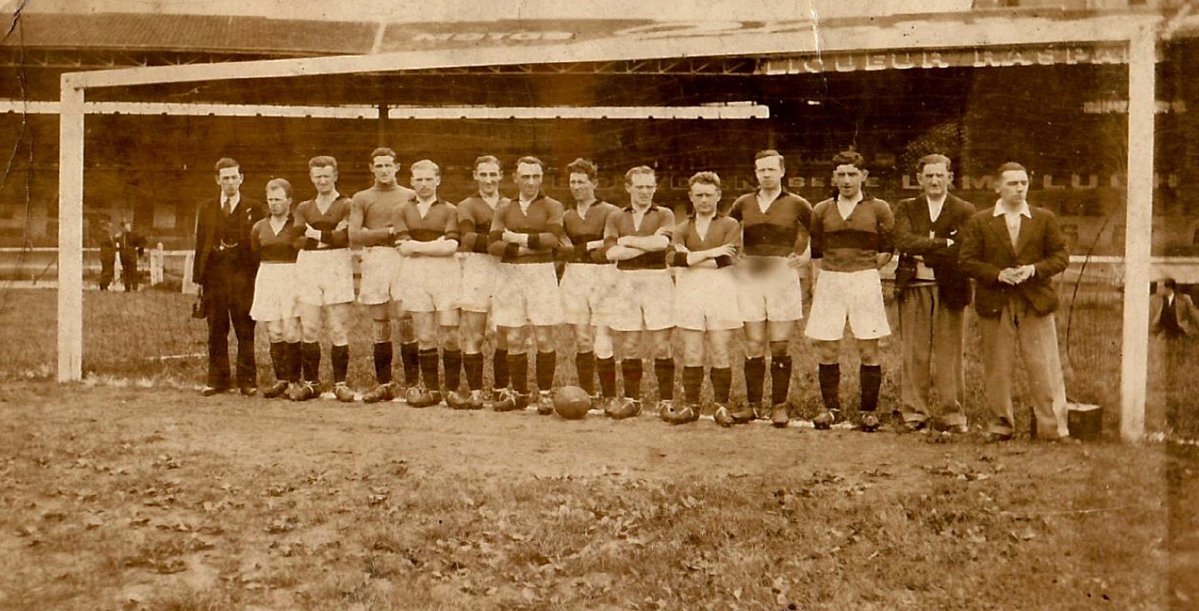


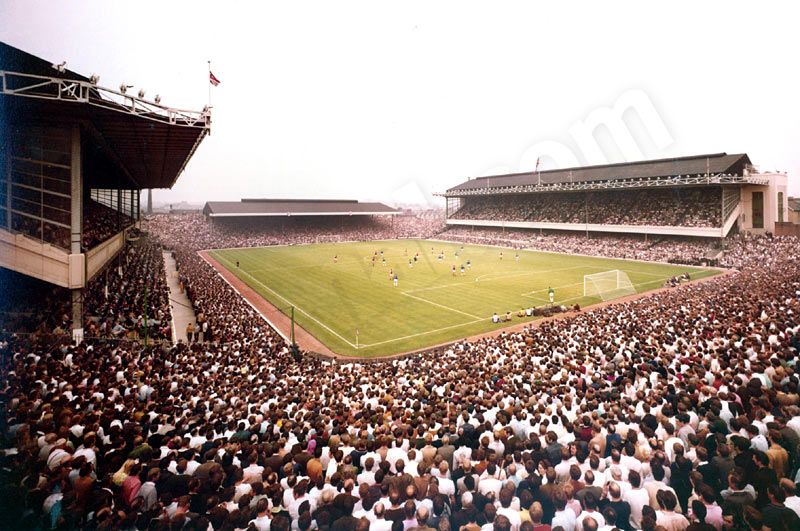

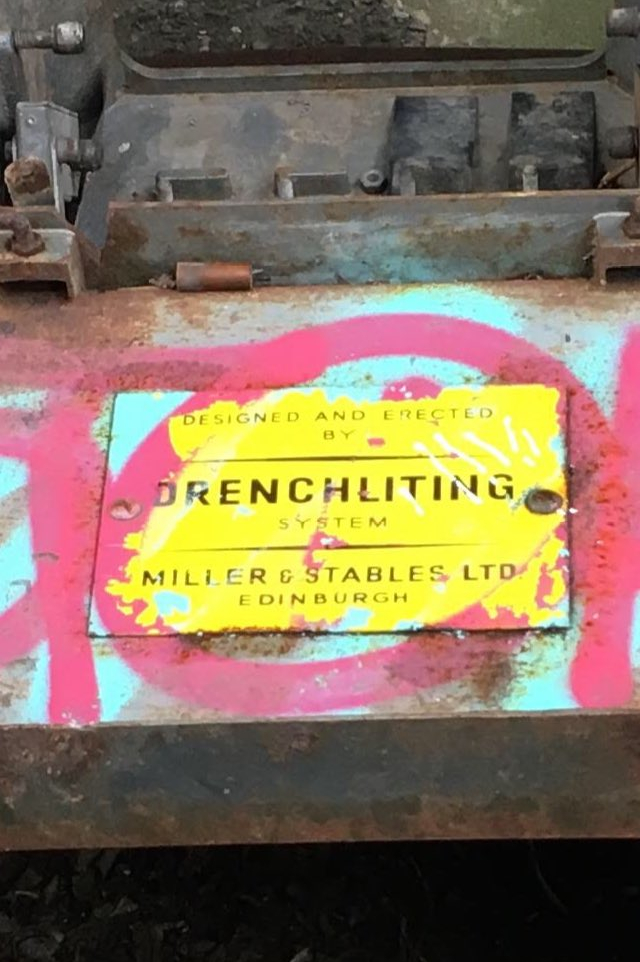


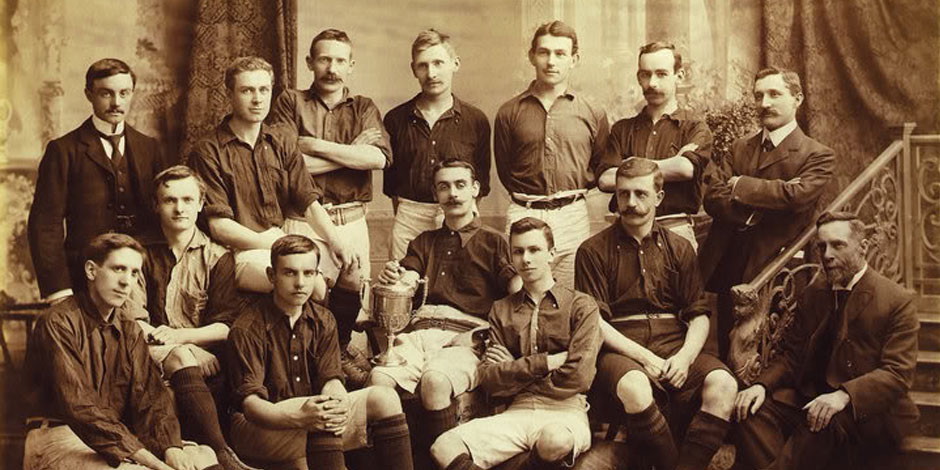
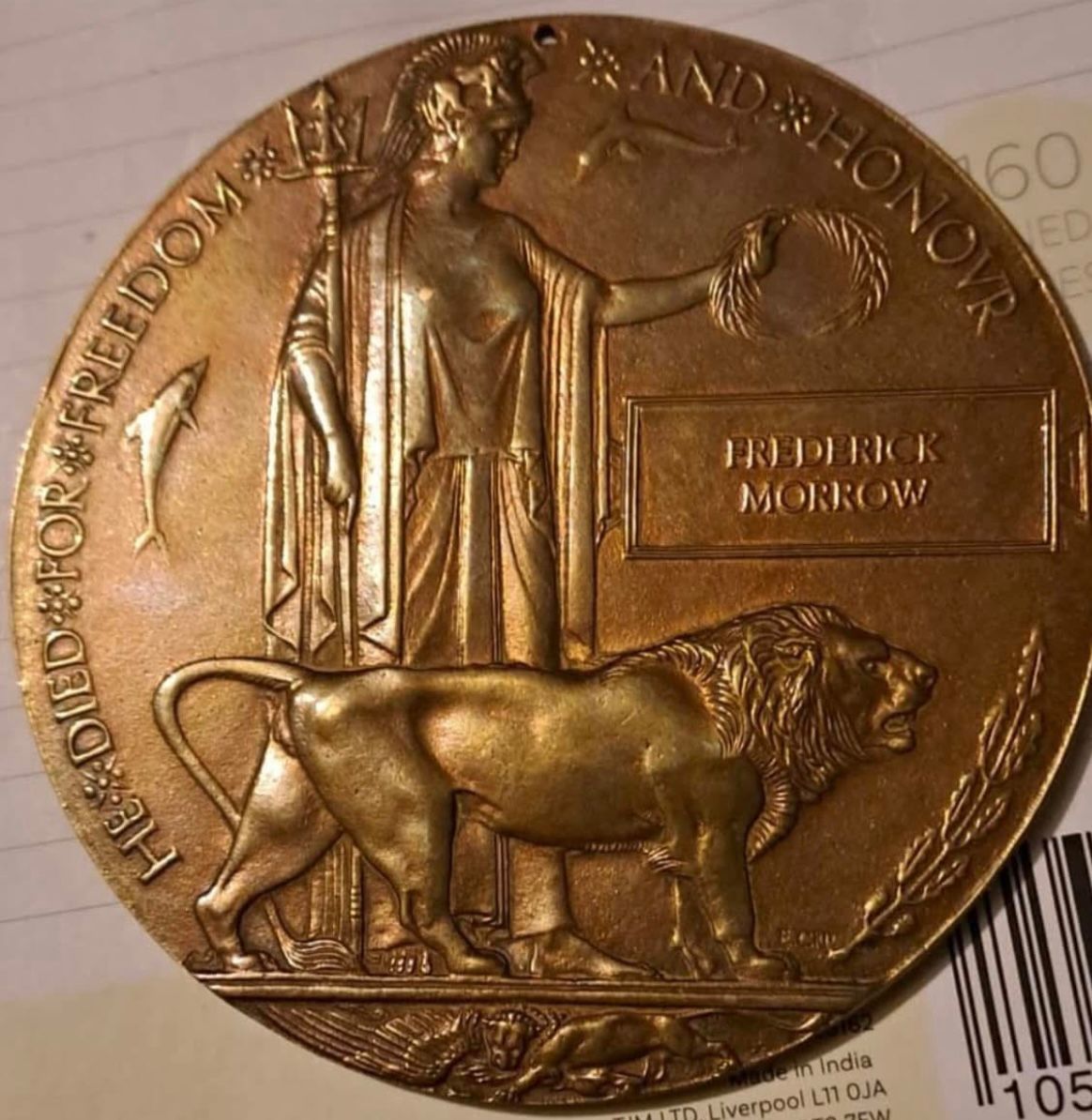

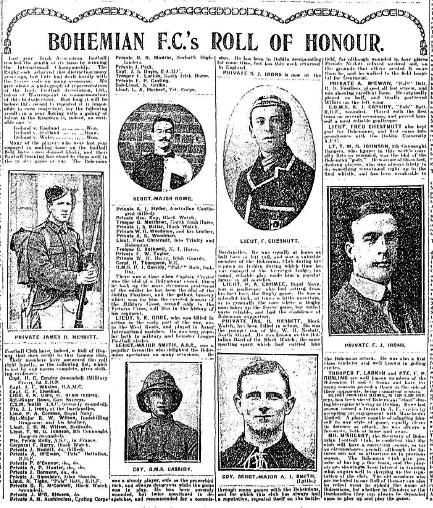




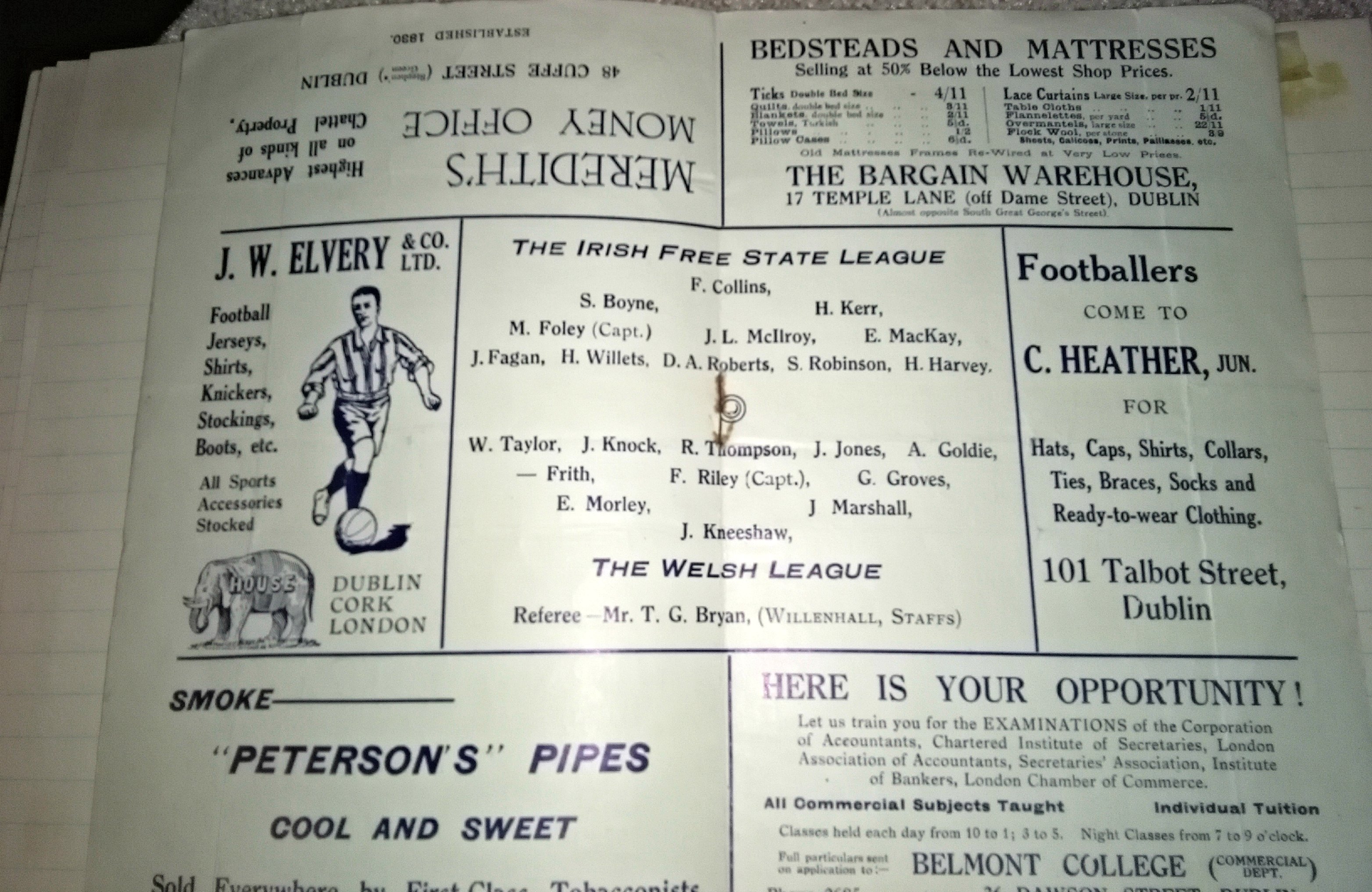
 A Bohemian Sporting Life