Finn margins in World Cup qualifying 1950

The 1950 World Cup would enter popular memory for the wonder of the Maracanã, the vast and noisy crowds that turned up to follow their Brazilian heroes, and of course the shock result in the “final” which saw Uruguay win their second World Cup by defeating the hosts in what became known as the Maracanzo – A result which seemed to traumatise the Brazilian nation like few others.

It was also the first World Cup to be held in twelve years due to the savagery of the Second World War, and slowly a decimated Europe returned to the football fields and to World Cup qualifying groups. Most groups were two team affairs, simple home and away fixtures with the winner progressing, however Ireland were drawn in a group of three, alongside Sweden and Finland. It was to be Ireland’s first meeting with both nations.

The Swedes would have been strong favourites for the group, they had triumphed in the football tournament at the 1948 Olympics in London and featured stars like Nils Liedholm and Gunnar Gren who would find greater fame in Italy with AC Milan. The Finns, however, were something of an unknown quantity with Irish newspaper previews detailing the struggle faced by Finish football due to the harshness of the climate and the ongoing recovery from the ravages of the Second World War.

For the visit of Finland to Dublin in September of 1949, the Republic of Ireland opted for experimentation. Having been well-beaten by a strong Spanish side in a recent friendly, there was a more youthful look to the Irish team against Finland with several debutants, especially in the attack. A brand-new front five was named, with Johnny Gavin, Arthur Fitzsimons, Jim Higgins, Peter Desmond and Tommy O’Connor all listed to start. Higgins had enjoyed a blistering start to the season with Dundalk, scoring six times before August was out but had to cry off with an injury, his place being taken by Shelbourne’s Brendan Carroll.

It was to be a further changed front line as Carroll had to go off injured after 25 minutes and Paddy Daly being the only outfield player (the 12th man) available as his replacement. This prompted another reshuffle, with the ever-versatile Con Martin moving from centre-half to the centre forward role and Daly taking Martin’s place. Despite the disruption to the team there seemed to be no ill-effects on the pitch. Johnny Gavin opened proceedings with a goal direct from a corner, 21-year-old Gavin was just beginning to make his name at Norwich but he would go on to become the Norfolk club’s record goal-scorer, a distinction still held to this day.

Two more goals followed, Peter Desmond was fouled which drew a penalty and was dispatched by Con Martin before victory was sealed, this time Martin again proving his worth as a striker flicking in a header in the 68th minute from an Ireland corner. A relatively comfortable 3-0 win in front of 23,000 in Dalymount.

The return leg in October was to be a different affair, Finland’s football season was coming to a close and the harsher winter weather was already in force, Ireland were playing in a biting wind with temperatures hovering just above freezing. The FAI had spared no expense, paying over £1,000 to fly an Aer Lingus charter flight to Helsinki and despite the conditions the Irish team must have been optimistic, they had just beaten England in Goodison Park a month earlier and regular centre forward Davy Walsh was back in the starting XI.

Walsh looked to have scored early on but Dutch referee Jan Bronkhorst disallowed it for a supposed foul on the Finish keeper. Ireland did however take the lead through Everton’s Peter Farrell, slipped in by Drums’ Tim Coffey, Farrell beat his man before unleashing a fierce shot into the Finnish net on 65 minutes. Ireland remained in the lead until the last minute when Jorma Vaihela managed to bundle the ball, and a number of Irish players, into the net. The Irish team quickly protested to the referee that the Finns had fouled in the lead up to the equaliser but their laments fell on deaf ears.

Finland decided to withdraw from qualifying after the game and never faced Sweden in the group. Ireland knew they would have to beat the Swedes to force a play-off but these narrow hopes were dashed by a Calle Palmér hat-trick in Dalymount. The Swedes would go to Brazil where they would finish third behind Uruguay and the hosts while it would be another 40 years before Ireland would grace World football’s greatest stage.

This article originally featured in the match programme for Ireland v Finland in November 2024. Banner photo from the Irish Press showing Con Martin bearing down on Finnish keeper Thure Sarnola in the September 1949 game.

Shedding some light on Dalymount – the true story of the Bohs floodlights

I love a good Western and among many great practitioners of that ultimate piece of cinematic Americana was John Ford, born John Feeney in Maine to two Irish-speaking immigrants. Ford was a man who knew how to mythologise himself and he did plenty of myth-making in his movies as well. For better or ill his film The Quiet Man has probably influenced the American view of rural Irish life to this day. While, his westerns are far from historical documents of frontier life for European settlers in the American west, rather they are among the founding myths of American exceptionalism.

Of course Ford knew this, in one of my favourite of his films, The man who shot Liberty Valance a world-weary newspaper man utters the immortal line “When the legend becomes fact, print the legend”. Ford ackowledges that very Irish trait of preferring the entertaining story to the truth. And so it is with football, there are plenty of myths that grow legs, that persist to the present day despite constantly being debunked. I mentioned the old chestnut of Germany wearing a green away kit as a “thank you” gesture to Ireland in a recent post, but in this piece I’m going to address the notion that Bohemian Football Club bought the iconic Dalymount pylon-style floodlights second-hand from Arsenal, and that these same lights once adorned Highbury Stadium.

The origins of the myth

There are several fairly authoritative accounts, including one on the club’s own website, that perpetuate the story that the lights were either sold or gifted by Arsenal to Bohemians. I had in the past shared this story on social media myself before doing a bit of digging on the subject. This myth seems to have arisen from the fact that Arsenal played Bohemian F.C. in an inaugural match for the new lights in March 1962.

Floodlight Arsenal cover

Cover of the match programme featuring the newly installed floodlights.

This simple inaugural match has somehow morphed into a story that Arsenal sold the lights to Bohemians. There are a few ways to dispel this myth so lets begin with the idea that these were the floodlights that once adorned Highbury.

The Highbury dilemma

Arsenal began playing matches under floodlights from 1951, at which time league matches under lights were not even permitted by the F.A. They did however play a number of high profile friendly matches including one against Glasgow Rangers. While the glorious old ground of Highbury has since been turned into modern apartments large sections of the stadium received listed status and still exist.

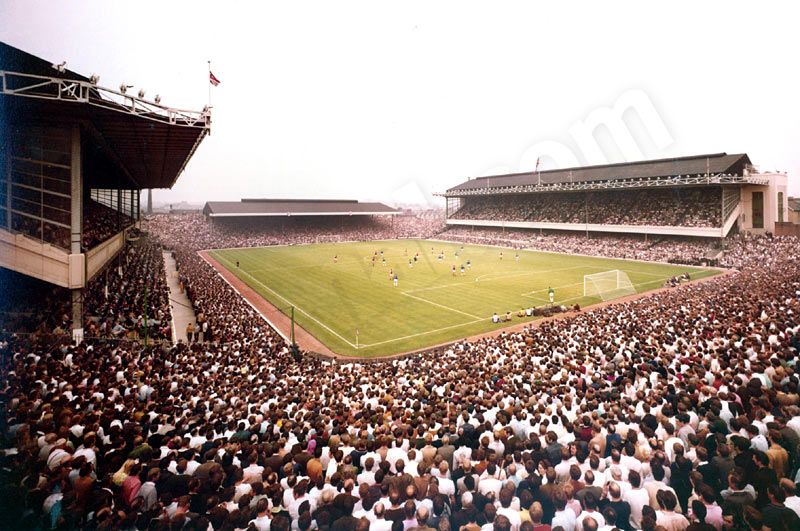
Anyone who ever visited the stadium will likely attest to its architectural beauty, it was however, also known for the compact nature of its dimensions, including an infamously narrow pitch, well exploited by managers like George Graham. Simply put Highbury didn’t have the space for large pylon towers like those that stand in Dalymount today. In the photo below you can see Highbury Stadium from that 1951 game against Rangers. This is verified both here and also here on the official Arsenal website.

Highbury

From this early photo it is clear that there are no floodlight pylons, all the lights are roof mounted. It is worth noting that this photo is from a mere 11 years before the lights were supposedly “sold” by Arsenal to Bohemians, which would mean that any floodlight pylons would have to have been installed after 1951, survived less than ten years, and then been removed and replaced by another roof mounted lighting system.

From later photos it’s clear that there were no pylons at Highbury and indeed very little space in such a tight stadium for the location of large pylon tower lights. The two photos below are from circa 1960 (roof mounted floodlights again) and secondly from the last season that Arsenal played at Highbury in 2006. As before, roof-mounted lights.

Highbury2

Highbury3

Highbury in 2006

The only connection between Highbury and Dalymount is that they are both tight grounds located in residential areas and that portions of both stadiums shared a stadium architect in the early decades of the 20th century, namely Archibald Leitch.

The story of the lights

The insertion of the Arsenal Football Club and Highbury Stadium into the history of Dalymount is really by accident. Bohemians had organised a fundraising subcommittee to look at the cost and feasibility of installing floodlights at least as early as 1959. It also quickly became clear that once the lights were ordered that some form of inagugural game would prove popular.

To be clear, the Dalymount Park floodlights were not the first set of lights used in Dublin. Stadium lighting was temporarily installed in Croke Park for the Tailteann games of 1924, while Ruaidhrí Croke has written recently about the first games under lights in Tolka Park back in 1953 when it was home to Drumcondra F.C.

However, Dalymount Park was the de facto home ground of the Irish national team and the lack of floodlights meant that international games had to have earlier kick-offs, even when scheduled for mid-week which had an obvious impact on crowd numbers.

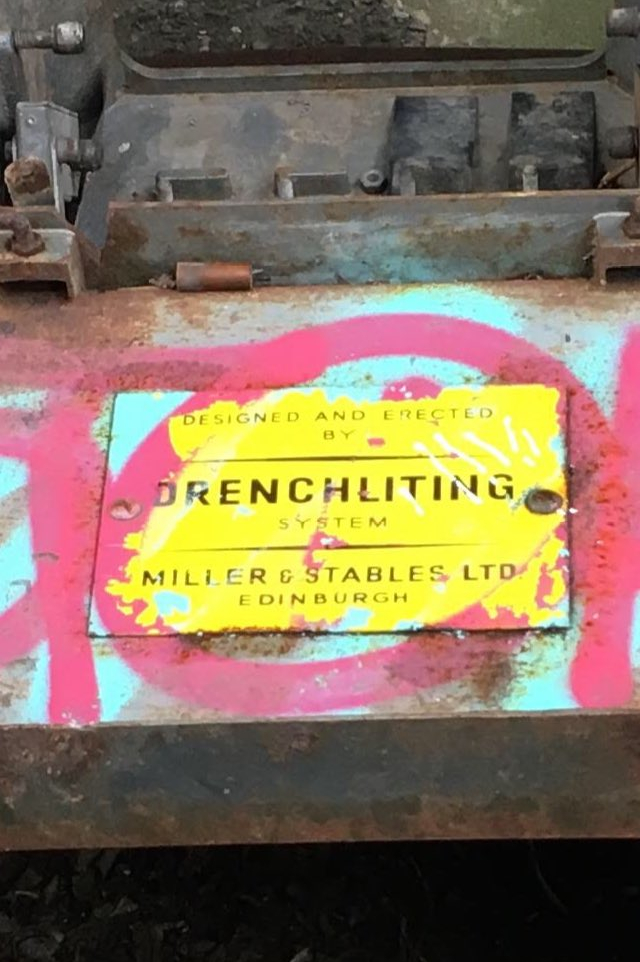
Taking inspriation from another national football stadium a preferred design and supplier emerged after from a visit to Hampden Park in Glasgow who installed their own floodlights in 1961. In a report in the Dublin Evening Mail from November 14th 1961 it was reported that the contract had been signed with “a Scottish firm” for the lights and that these would take approximately three months to manufacture, transport and install. The firm in question was Miller and Stables of Edinburgh who, apart from Hampden, had also provided floodlights (or drenchlights as they dubbed them) for Windsor Park, Celtic Park, Easter Road and many others.

Drenchlighting

Original lighting console from Dalymount plyons showing the name of the manufacturer, Miller & Stables (pic Graham Hopkins)

Earlier in January 1961 an edition of the Irish Times confirmed that the FAI had accepted the recommendations of their own Finance Committee in guaranteeing major matches for Dalymount Park for at least the next ten years in order to assist with Bohemian F.C. in funding the purchase of new floodlights. Even by that stage the lights had been costed at £17,000 including import duty and transportation costs. This figure rose slightly when the lights were installed early in 1962 and were reported as costing £18,000 or even £20,000 according to one report.

The floodlights themselves are 125 feet high and originally featured three banks of ten lights on each pylon and a special transformer station had to be constructed to meet with the power supply demands. With the new lights it meant that mid-week games could be played in the evenings, for internationals this should mean bigger crowds and with Bohemians getting approximately 15% of the gate from international games this meant greater revenue for the club.

DpvWxqfWwAM--Ju

Despite the expected future return on investment this was still a huge outlay for the amateur club. Initial notices suggested that the lights would be in place by September 1961, which was then extended to October and ultimately until February of 1962. In the words of Club Secretary Andy Kettle, as quoted by Ryan Clarke in his recent series on Dalymount, it also meant that Bohs could “invite many top clubs to Dublin from time to time”.

The first of which ended up being Arsenal, though they weren’t first choice. But before these glamour matches could be played Kettle had to deal with some level of internal dissent from Bohs members about the level of expenditure and even had to engage in a little bit of what might be termed “crowdfunding” in the modern parlance. Kettle elaborated in the Dublin Evening Mail that the club had “approached their bankers, the Munster and Leinster Bank, their members, players, traders, FAI and League of Ireland for financial assistance”, before adding “Bohs are keeping open their fund and will only be to happy to receive any further contributions. No matter how small…”

The Arsenal Game

As Andy Kettle had hoped the installation of floodlights would help Bohemians raise additional funds by playing friendly games against some of the “many top clubs” that could be invited to Dublin. But the question remained which team should receive the honour of being first? There were suggestions from media commentators that Shamrock Rovers should be invited although the preferred option emerged as a game between a League of Ireland selection against a British based Irish XI. However, as this would require multiple clubs across England and Scotland to release players it quickly because clear that this was unfeasible.

Among the other clubs sounded out by Bohemians to fulfil this fixture were Sunderland and Leeds United, as well as Manchester United and Blackburn Rovers (both of whom declined due to FA Cup committements). Attention was then turned to Arsenal, Celtic or Wolverhampton Wanderers with Arsenal finally being chosen from that shortlist of three.

From this is it clear that Arsenal, despite being a famous First Division side were realistically a fifth or sixth choice on behalf of the Bohemians’ committee for the role of opponents for this inaugural game. Arsenal were ultimately chosen and played in Dalymount on at least their third occasion (the previous two being in 1948 and 1950) and fielded a strong team including Welsh international goalkeeper Jack Kelsey, George Eastham, and future Cork Hibernians player-manager Dave Bacuzzi. The Bohemian XI featured players like Tommy Hamilton from Shamrock Rovers, Eric Barber and Tommy Carroll from Shelbourne as well as Ronnie Whelan Sr. and Willie Peyton from St. Patrick’s Athletic.

Arsenal would ultimately win an exciting game, played in poor weather, 8-3. However, throughout all the media coverage during the build-up to the game and afterward there was no mention of any Arsenal or Highbury connection with the lights other than their being chosen as the opposition.

Maybe it is a little bit of an inferiority issue with Irish football fans that we’d rather believe that we bought the most iconic set of floodlights of any stadium in the country, second-hand from a big English club rather than believe that an amateur club, working in partnership with the League, the FAI and ordinary fans and players managed to successfully fundraise a huge amount of money for a major infrastructural project.

For me that’s a bigger story than any mythic historical connection with a defunct football stadium in London. But as they say “When the legend becomes fact, print the legend” I’d rather it be shine your own light rather than bathe in reflected glory.

Dalyer

My United States of first ever

Back in 2000 the then Enterprise Minister Mary Harney told a gathering of the American Bar Association that Ireland was “a lot closer to Boston than Berlin”. At the time that statement provoked plenty of debate and whatever your views its accuracy it held a certain truth in the very early days of the FAI. There was certainly a greater footballing closeness with the Americans than with our near neighbours in Britain. When the Football Association of Ireland formed out of the split from the Belfast-based IFA they entered a very inhospitable footballing climate. They were no longer part of the British Championship and their requests for fixtures with neighbouring Associations were rebuffed. Looking further afield international recognition came from FIFA in 1923 and the following summer the FAI sent an amateur international side to compete in the Paris Olympics in what was to be the nascent Association’s first foray into International football.

A victory over Bulgaria in the opening round, followed by a quarter final exit after extra time to the Dutch was a credible performance for a new and poorly funded side. But there was little on the horizon in terms of a home international. Here however enter the Americans; another side who had likewise been knocked out in the Olympic quarter finals would be heading Ireland’s way shortly after.

The USA had been knocked out by eventual winners Uruguay and had taken the opportunity to play a couple of friendly games before the long journey back across the Atlantic. After defeating Poland 3-2 in Warsaw on June 10th the Americans were swiftly on a boat to Cork and then by train to Dublin to play the Irish on June 14th 1924 in Dalymount Park.

It was a game of many firsts. It was a first home match for the FAI, indeed it was the first Irish international to be held in Dublin since 1913. It was one of the first football matches to feature the playing of Amhrán na bhFiann as the national anthem (an official decision had not been made on a post-Independence anthem and other songs such as Let Erin Remember had been used before), and it recorded the first hat-trick for the young Free State side as the Irish ran out 3-1 winners.

The side that had travelled to the Olympics had been all amateur but there were to be some changes ahead of the American game. St. James’s Gate’s Charlie Dowdall for one was unavailable. He had gone to visit relatives in England on his was back from Paris!

In goal Frank Collins joined the side. Collins has spent a season as a professional with Glasgow Celtic and had already been capped by the IFA but he was back working as a baker in Dublin in 1924 and playing for his employers Jacob’s in the League of Ireland. Another who was making a debut appearance was the hat-trick hero Ned Brooks of Bohemians, like Collins he had also been previously capped by the IFA.

The USA game was to be his only appearance for Ireland which means he has an enviable goals per game ratio. He started at centre-forward which meant that Paddy Duncan of St. James’s Gate was withdrawn into the midfield which seemed to have the desired affect against the Americans. The side in this first home international was captained by Brooks’ Bohemian team-mate Bertie Kerr.

Brooks ad

Ned Brooks featuring in an advertisement

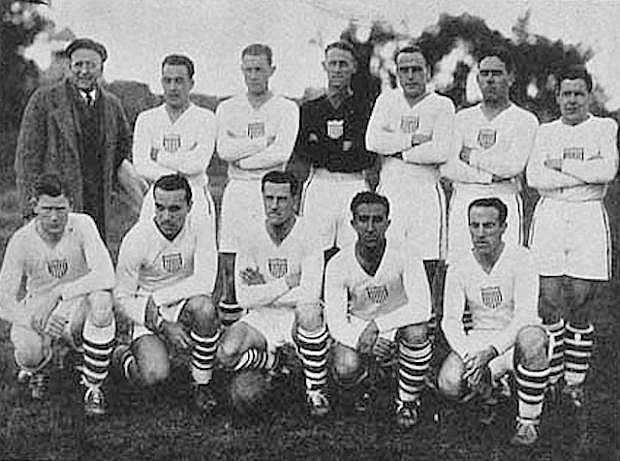
Most of the USA players were active in the American Soccer League (ASL), an early professional soccer league based mainly around the states of New York, New Jersey and Pennsylvania. Many of the participating clubs would have found similarities with the likes of Jacobs and James’s Gate as they too were works teams. The side’s star player on the day was their goalkeeper, Jimmy Douglas who would have a relatively long international career with the USA, featuring for them in the semi-final of the inaugural World Cup in 1930 (see banner pic). A goal from James Rhody of Harrison F.C. and that fine performance for Douglas in goal was as good as it got for the USA on the day.

Pathé newsreel footage of the game can be seen here.

There was also an Irish connection with the USA party, their Association President Peter J. Peel was in Dalymount Park in 1924 and it was sure to have been a familiar sight. Peel had been born in Dublin and moved to Chicago as a young man. He was a sporting all-rounder, prominent in the fields of golf and tennis in his home city. Such was his devotion to football that he was convinced that it would outstrip baseball in the competition for American sporting affections within five years. Peel obviously had the Irish gift of the gab matched with an American sense of indefatigable optimism though with the continued growth of the MLS who is to say that the predictions of a Dubliner some 94 years ago may yet come to pass?


This article first appeared in the June 2018 match programme for the Republic of Ireland v USA international friendly match.

Stanley Matthews at Drums – A Ballon D’Or winner at Drumcondra F.C.

Fagan’s pub of Drumcondra is well known to many sports fans in the city of Dublin; in business since 1907 its close proximity to both Croke Park and Tolka Park means that it is regularly frequented by supporters of the both Dubs, Shelbourne F.C. and their various opponents. The walls of the pub bear witness to this, with many photographs and pennants of various sports teams but one that caught my eye on a recent visit were a collection of match programmes from Tolka Park’s former residents Drumcondra F.C.

Fagans

Fagan’s pub in Drumcondra, a short walk from Tolka Park

Surrounded by advertisements for tobacco, bingo halls and pubs are the starting XI’s for both Drumcondra and their visitors Glentoran of Belfast. To the left of the line-ups is a nice little action photo of former Bohemians player Amby Fogarty who had joined Glentoran from the Dalymount club in 1955. A date for the game didn’t appear on the programme page but a little research showed it had taken place on Wednesday October 24th 1956.

A few of the names on that Drumcondra side were familiar to me by reputation, in goal was Alan Kelly Sr.  who became a legend at Preston North End and won almost 50 caps for Ireland. Also in the side was Christopher “Bunny” Fullam, another former Bohs player who also tasted success with Shelbourne, as well as other Drums legends like Tommy Rowe, later a league winner and manager with Dundalk.

Drums v Glentoran

Drumcondra v Glentoran match programme inlay

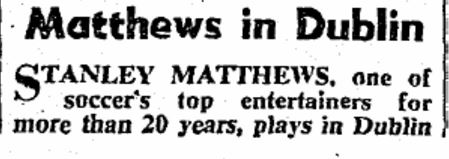
One name I wasn’t sure of was the number 7, Matthews at outside right. A little more research revealed it to be none other than the wing wizard himself, Stanley Matthews. At the time of the game Matthews was 41 years old but was still an England international and had just enjoyed the best league season of his career, with Blackpool finishing as runners up to the Busby Babes of Manchester United. In fact less than two months after lining out for Drums Matthews would be named as the inaugural winner of the Ballon D’Or, defeating competition from Alfredo Di Stefano and Raymond Kopa to be named as the best player in Europe.

While another Ballon D’Or winner, George Best would later play a handful of games for Cork Celtic in his peripatetic later career, this was seven years after he had won Europe’s greatest individual honour and was sadly just another interlude on the downward spiral or his stellar career. Similarly an ageing Bobby Charlton, recently released from coaching duties at Preston North End, played a handful of games for Waterford in 1976 some ten years after his Ballon D’Or’ win. Despite Matthews advanced years for a footballer he was still in the elongated prime of his career. He would win his second Football Writers Player of the Year award in 1963 and played his final top flight game for Stoke City in 1965 at the age of 50.

Matthews was obviously the main draw for the game and provided much of the entertainment, “beating players with ease” and delivering “delightful passes”. Drums ran out 3-2 winners against Glentoran with a hat-trick coming from Drums other winger on the night, Dermot Cross. Glentoran’s goals came from brothers Dara and Cyril Nolan, both former Drumcondra players, with Cyril’s coming from the penalty spot. One other player of note for Glentoran was their thrice beaten keeper Eamonn McMahon, he had kept goal for Armagh in the All – Ireland Footfall final against Kerry in 1953. His talent in the Gaelic code attracted the attention of Glasgow Celtic with whom he had a brief spell before returning to Ireland to play for Glentoran.

A league of Ireland side with a future European footballer of the year playing for them might seem a bit odd nowadays (even for a friendly) but the game against Glentoran was in fact the third time Matthews had lined out for Drumcondra, having appeared for them twice in the late 40s in a pair of benefit matches played in Dalymount Park.

The first was in 1946 when he played in a benefit match for Drums’ Scottish trainer Jock McCosh (surely the most Scottish name since Hamish MacBeth).  The second game came a year later when he appeared in a match for Drums’ player Paddy Daly.

This first game to feature Matthews (for Drums trainer Mr. McCosh) was appropriately against Scottish opposition in the form of Greenock Morton. Drums were on an upward swing having just won the FAI cup for the third time in their history. However Greenock (who would narrowly lose the Scottish Cup final in a replay to Rangers later that year) were far too strong for Drums, riding out comfortable 6-0 winners. Matthews had chartered a private plane to get him to Dublin for the game but had a limited impact. His performance started well and he linked up nicely with both Kit and Jimmy Lawlor while keeping the opposing fully busy with his crossing and dribbling skills. However, he had not fully recovered from a recent injury and his impact waned as the match progressed with reports on the match describing him as “not at his best”.

If Matthews wasn’t at his best in the ’46 game it didn’t have an impact on the interest in the next game where he featured. The report of the Daly benefit match from April 1947 described Dalymount as almost full (at a time when attendances were on occasion reported around the 40,000 mark) and described Matthews himself as “the outstanding and most attractive players of his generation”.

Drums Matthews3

Irish Times headline from the 1956 match against Glentoran

This match was between a Drumcondra XI and a Distillery selection and there were plenty of other well-known players in attendance apart from Matthews. These included such popular names as Peter Farrell and Tommy Eglinton of Everton, both Irish internationals. Con Martin of Leeds United was also due to line out in goal for Drums but had to pull out at late notice due to injury. The Drumcondra selection ran out 1-0 winners in a poor game in which the Distillery tactics were described as “crude”.  As far as his personal performance Matthews stood apart among the standard front five although he wasn’t supported sufficiently and didn’t manage to get on the ball as much as expected. He obviously did enough to impress the reporters present with his talent when he did get on the ball being described as “well above the ordinary” and he was praised for his “excellent ball control and accurate passing”.

While it might seem strange that one of the world’s most famous players lined out on three occasions for a now defunct League of Ireland side it was far from uncommon at the time, especially for someone like Matthews. Having begun his career in 1932, and despite its longevity he was well into his 40’s by the time the maximum wage was abolished in England. Ever aware of the precariousness of a footballer’s existence Matthews had in his early years lived off his win bonuses and saved his regular salary, he developed sideline business ventures including running a guesthouse, signing an early boot deal and of course appearing as a guest player for what could be lucrative match fees for the time. Based for much of his later life in Blackpool, (even after a playing return to Stoke City) it was only short journey to Dublin and Drumcondra F.C.

One of Matthews final Irish involvements came a year after his last match for Drums. He lined out in a World Cup qualifier for England against the Republic of Ireland in Wembley. The English ran out 5-1 winners, with Manchester United’s centre forward Tommy Taylor grabbing a hat-trick. Taylor was born the year that Matthews had made his debut for Stoke. This was to be the second last of his 54 caps, his final one coming a week later in a 4-1 against Denmark. This final match meant that he was the oldest player ever to represent England, and despite having played in 3 of the four qualifying games Matthews was not selected for the England squad that travelled to Sweden for the 1958 World Cup.

Having played in many a benefit match Matthews had a testimonial of his own in 1965 when he finally hung up his boots professionally. The opposition was a star-studded World XI taking on a “Stan’s XI” who lined out in red and white, the colours of his beloved Stoke. The World XI won out 6-4 and Matthews was carried off the pitch by two of his opponents on the night Lev Yashin and Ferenc Puskas. Among the opposition that night were Raymond Kopa and Alfredo di Stefano, the two mean who had beaten to win the first Ballon D’Or nine years before.


The 1945 Inter-City Cup: War, Goals, Controversy and death by corner kicks

As you go for a pint in the members bar you may on occasion glance upward and notice the Bohemian F.C. honours list spelt out handsomely in gilt on a dark red background. It makes for impressive reading and is testament to the proud history of our club. Right in the middle of the bar, between the list of League Titles and FAI Cups is a sign that reads “Setanta Cup Champions 2010”. The Setanta Cup is, at the time of writing, our most recent honour. Few of us will forget Anto Murphy’s goal versus Pats in Tallaght Stadium, and it added a little extra relish that Bohs had managed to win a trophy in the enemy’s back- yard so to speak. It is worth noting, however, that though the Setanta Cup is the latest All Ireland soccer competition, it was by no means the first, nor was it the first such competition where Bohemians emerged victorious. To learn about this other, much earlier victory we must go back 70 years, to a time when the most violent conflict in human history still raged, to the first cross border competition since partition; the Inter-City Cup.

The Inter-City Cup, or to give it its full title, the Dublin and Belfast Inter-City Cup was conceived as a way to provide much needed income during the turbulent years of the Second World War. When the First World War had broken out in 1914, the general and oft-repeated assumption was that the war would be over by Christmas, so the sporting calendar continued on much as it had done in peace time. Bohemians and Shelbourne, the only two clubs from outside the six counties, continued to play in an pre-partition league season into 1914-15, but the growing realisation that the war was going to drag out meant that the Football League in Britain was suspended, while the Irish League was reduced to a “Belfast and District League” of only six teams with no room for Bohs and Shels. Many players, especially in Britain came in for heavy criticism for playing on into 1915. Some viewed it as a dereliction of patriotic duty that fit and healthy young men should stay at home and be paid to play football rather than volunteer to fight at the front. This led to the formations of “Football battalions” where prominent footballers were used as promotional tools for enlistment. Some football fans joining up were encouraged by the fact that they would have the chance of serving with their sporting idols.

When the Second World War broke out, the mistakes of the past were avoided. The league season was suspended immediately in Britain while Northern Ireland completed the 1939-40 season (Belfast Celtic won their 13th title) before suspending the Irish League and playing on with a diminished Northern District League. The League of Ireland, being in a neutral country, continued on as usual during the War years. It would prove to be a particularly successful era for Cork United, who would win five titles between 1939 and 1946.

However, gone from the fixture calendar were lucrative games against touring British sides. The lack of income was obviously a significant concern for the clubs north of the border, robbed as they were of regular gates and a full league programme which ultimately led to the creation of the Inter-City Cup. The tournament would run for eight seasons between 1941-42 and 1948-49, and despite the name, did include clubs from outside of Dublin such as Limerick, Cork United, Dundalk and Derry City. While matches were spread around various grounds in Belfast, all games south of the border were to take place in Dalymount. Another interesting feature of the tournament was the significance of corners. If two sides were tied on aggregate in the final, the side who had won the most corners were deemed to be the winner. Bohs learned this to their cost during the 1942-43 competition when they lost the final on corners to Shamrock Rovers having drawn 2-2!

Despite that setback Bohs, would eventually triumph in the competition. The 1944-45 season would be one of highs and lows for Bohemians, but it did at least end in some silverware. Bohs’ league form during the War years was poor; a third place finish in 1940-41 being the sides’ best placing and the 44-45 season would see Bohs finish bottom of the eight team league but would also see them reach two cup finals. An epic, three game semi-final win over Team of the decade, Cork United, would get Bohs into an FAI Cup final against Shamrock Rovers, where in front of the biggest ever Cup Final crowd of almost 45,000 they would lose out to a Podge Gregg winner. Gregg, a native of Ringsend had just returned to Dublin after a spell with Glentoran where he had won the Inter-City cup the previous year.

Bottom of the league, having lost a final to Shamrock Rovers, its fairly obvious that Bohs’ season needed a pick-me-up, and the Inter-City Cup could provide it. So as not to clash too much with regular games, the Inter-City competition was held around April and May each season when most games were coming to an end.  In that particular year, Bohs lost the FAI Cup final to Rovers on the 22nd of April, but less than a week later were in action in round one of the Inter-City.

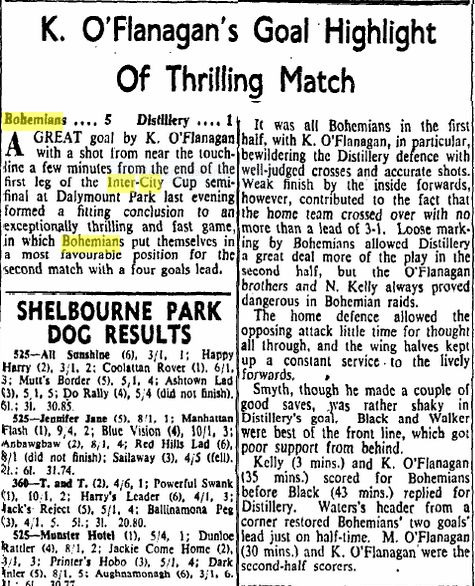
The first round game saw them drawn against fellow amateurs Cliftonville in Solitude on the 28th of April, with a return leg in Dalymount a week later. A 3-2 victory in Belfast with two penalties from full-back Frank Glennon and a Pat Waters goal gave Bohs too commanding a lead for the return leg, which ended as a 1-1 draw. The following round would see them matched with Glentoran; competition winners the previous year, Glentoran had been beaten on corners in the previous round by Limerick and only qualified as the best loser, their luck was out again as the tie finished 3-3 on aggregate so Bohs advanced as winners on corners 10-9 and thanks to an excellent performance by Collins in goal. Victory over Glentoran meant a meeting with Distillery, now based in Lisburn but then firmly ensconced in Grosvenor Park, West Belfast. Bohs would comfortably beat Distillery 8-3 on aggregate, a dynamic 5-1 victory in Dalymount was capped by a stunning strike from Kevin O’Flanagan, who beat the opposing keeper with a shot from out on his own touchline. The Irish Independent correspondent was moved to describe it as “the greatest goal seen in Dublin for years” and very topically likened the speed of the shot to that “of a V2 rocket”. O’Flanagan had the Distillery defence bewildered, and Bohs could have won by an even greater margin, as he finished with two goals. His brother Mick at centre-forward got one, while Noel Kelly and Waters got the other two. Despite going 2-0 down early on in the second leg in Belfast, the Gypsies rallied, and goals from Mattie Burns, Kevin O’Flanagan and Noel Kelly ensured there was no chance of an unlikely comeback.

Semi final

The other semi-final between Belfast Celtic and Linfield was also a high scoring affair, finishing 7-5 on aggregate to Celtic. As a two legged semi-final the first leg was held in Belfast before both sides travelled to Dalymount Park for the second game. With the tie balanced at 2-2 from the first leg, the Linfield goalkeeper and captain Tommy Breen (once of Manchester United and a seasoned international) elected to kick off defending the tramway end of the famous old ground. Due to heavy rain, Breen and his defence were ankle deep in water at that end of the ground which had cut up much worse than the opposite school end. 7 of the 8 goals scored on the day went into the tramway goal and Linfield were out. Breen’s former team, Belfast Celtic, were through to the final and were eager to make up for their defeat to Glentoran the previous year. Celtic had beaten not only Linfield, but Shamrock Rovers and Shelbourne en route to the final. The first leg was to be played in Belfast on May 30th with the return leg in Dalymount on June 2nd. VE day had taken place on May 8th and the laws and censorship brought in during the “Emergency” were lifted shortly afterwards. For the first time in six long years, football fans both North and South could genuinely look forward to the first real cup final in “peacetime”.

It is worth a brief diversion from our narrative to outline the merits of the Belfast Celtic side. Although the club has not existed in any real sense since the end of the 1940’s, they were at the time unquestionably one of the biggest sides on the island of Ireland. By the time the club was dissolved in 1949 they had won 14 league titles, second only to Linfield who by that stage had 19 to their credit. Former players included Mickey Hamill later of Manchester United and Manchester City, former President of the FAI and Government minister Oscar Traynor, Paddy O’Connell who would also play for Man Utd and later managed Real Betis and FC Barcelona, and Louis Bookman, the Lithuanian-born Irish international who became the first Jewish player to play professionally in Britain. Their coach at the time was Elisha Scott, a former player with Belfast Celtic and also Liverpool’s longest serving player ever. Scott was considered with some justification to have been one of the greatest keepers Ireland has ever produced and won ten league titles and six Irish Cups as Belfast Celtic manager. Their starting XI at the time of the Inter-City cup final was also on par with any of their previous sides. They would win the first official Irish League title after the war in 1947-48, and the team that Bohs faced included the likes of midfielder Charlie Tully, who would later join Glasgow Celtic and once famously scored against England direct from a corner in an international, attacker Jimmy McAlinden (an FAI and IFA international) an FA Cup winner with Portsmouth, and fellow international centre half Jackie Vernon who spent much of his career at West Brom.

In the case of Bohs, it would be a last hurrah of sorts. After the end of the Inter-City final, several of the winning side left for pastures new, including young goalkeeper Jimmy Collins, Frank Glennon and Noel Kelly, who would all switch to Shamrock Rovers. They would be joined a year later by their coach Jimmy Dunne, the former record breaking striker and soft-spoken coach, returning to Rovers after patching up his differences with the Cunninghams. Kevin O’Flanagan, a medical doctor was offered a job as a GP in Ruislip, London where he would spend his free time playing for Arsenal at football and London Irish in Rugby. While Bohs would make another FAI Cup final in 1947 (which they would lose after a replay to Cork United) the Inter-City cup would be the last trophy that Bohs would win apart from a pair of Leinster Senior Cups until the Cup final victory over Sligo Rovers in 1970. Bohemians’ insistence on remaining strictly amateur had served them well, as they won Leagues and Cups in the 1920s and 30s, but by the 40s, key players were being picked off by other clubs offering a few pound a week. While Bohemians continued to find and recruit excellent young players, they struggled to keep them for any length of time, the few exceptions being those whose day jobs allowed them the freedom to play without care for additional wages.

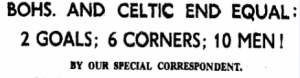
The two-legged final would be a close and often controversial affair. In the first leg there was nothing to separate the teams, not even corners as the sides finished level with two goals apiece, six corners each and both sides down to ten men. Kevin O’Flanagan for Bohs and Douglas for Celtic were the men sent off after coming to blows after Douglas kicked the ball out to touch when O’Flanagan was about to take a free. Bohs had taken a two goal lead thanks to an own goal and a finish by Smith, but the free scoring Bohs full-back Glennon ended up getting a roasting from Celtic outside left Paddy Bonnar, who grabbed two second half goals to tie the game. The return leg was no less controversial. Bohs named an unchanged side for the second leg (almost identical to the one which had lost to Shamrock Rovers just over a month before apart from Smith coming in for Frank Morris).
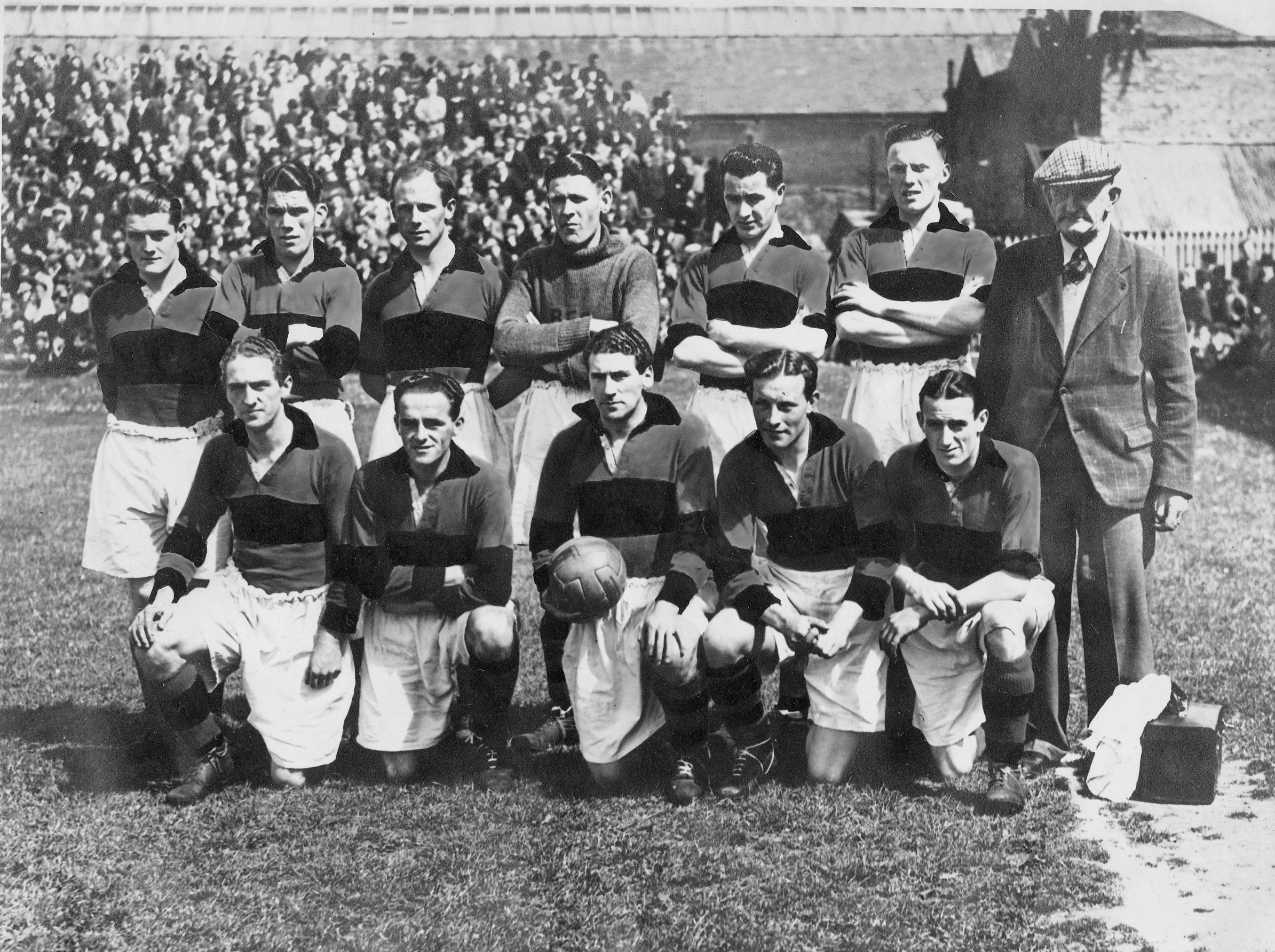
Bohemian FC Inter City Cup winning side

The Bohs side read: Standing – Ossie Nash, Paddy Waters, Billy Richardson, Jimmy Collins, Frank Glennon, Peter Molloy, Charlie Harris (Trainer). Front – Mick O’Flanagan, Noel Kelly, Kevin O’Flanagan (Captain), Matty Burns, Bobby Smith.

Belfast Celtic had suffered some injuries in the first leg with Peter O’Connor and Charlie Currie coming into attack for Johnny Campbell and Tommy Byrne. The second leg remained tight with few opportunities, Jimmy Collins in the Bohs goal being called into action in the first half to deal with chances from both Tully and Bonnar, but it was in the 67th minute that things became more heated when a cross came in from Smith which was trapped by Kevin O’Flanagan and passed into his younger brother Mick who when controlling the ball had a “Thierry Henry moment” and appeared to handle it before firing past Celtic keeper Hughie Kelly. This started furious protests from the Celtic players and led to an altercation between Captains Kevin O’Flanagan and Jimmy McAlinden who both had their names taken by the referee. Despite the Celtic players’ protests, the goal stood. Celtic’s disjointed attack, with the enforced changes since the first leg, had struggled to get past the Bohs defence, with Richardson and Glennon coming in for particular praise. Bohs successfully defended their lead, and after a season of disappointment, were All Ireland champions. It was particularly sweet for the star player Kevin O’Flanagan, who despite his sending off in the first leg, had been key in Bohs’ advancement to the final in much the same way that he had been key during the FAI Cup run scoring three goals by the time they reached that final. By setting up the goal for his brother Mick he had managed to make amends for his below par display in the earlier final versus Shamrock Rovers. Despite being a qualified GP the “Flying Doctor” had failed to diagnose himself with a bout of flu and upon returning home after the defeat to Rovers took his temperature and found that he had played a cup final with a 103 degree temperature!
Final article 1st leg2

It would be the last major trophy that Bohs would win for some time and the Inter-City cup was in some ways was the farewell of the Corinthian era of Bohemians and of Irish football as they signed off as Champions of North and South. Belfast Celtic, meanwhile, would remove themselves from League football only four years later, a mixture of sectarian violence, financial troubles and mismanagement forcing them out of senior football. While the Celtic board believed the withdrawal would only be a temporary measure it would transpire that their successful tour of North America, where they played to packed stadiums and famously defeated the Scottish national team, would in fact be their good-bye to the world of football. Guesting at centre forward for that touring side was none other than Bohs’ Mick O’Flanagan, his “hand of Mick” moment forgotten as he starred for Belfast Celtic as they slipped into history.

*special thanks to Martin Flynn and the Belfast Celtic Society for their assistance with some research for this article.