United Ireland v England and the token Welshman

In May 1951 as part of the Festival of Britain, the ten League of Ireland clubs ventured across the Irish Sea to join the festivities and take part in a series of exhibition matches against teams drawn from the Third Division (North) of the Football League. Of the opening round of fixtures involving the Irish sides only Bohemians would emerge with a victory, defeating Accrington Stanley (who are they?) 1-0, although the Bohs would lose their following two games against Oldham and Rochdale respectively.

This invitation was not limited to teams from the League of Ireland, Irish League sides also took part as well as teams from the Netherlands, Austria, Luxembourg, Belgium, Denmark and Yugoslavia. The Festival itself was held on the 100th anniversary of the Great Exhibition and was designed as a measure to showcase the best of British industry, art and design and perhaps most importantly to give a sense of hope and optimism to a nation still witness to the devastation of World War Two and still experiencing rationing, while hoping to rebuild. There was of course a footballing element and as well as the exhibition games played by visiting sides there were various other tournaments contested.

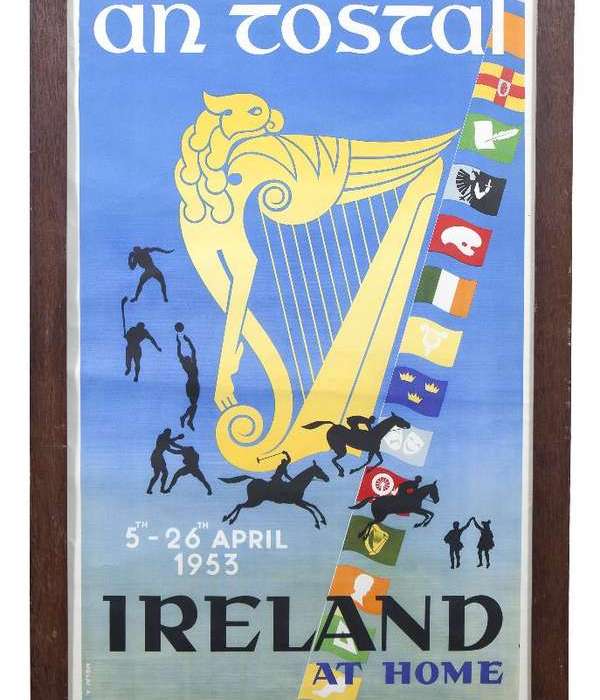
The Festival itself was hugely successful and it was estimated that as much as half the overall population of Britain visited a festival event during the summer of 1951. One man especially impressed was Juan Trippe, the Chairman of US Airline Pan Am who was apparently responsible for suggesting that Ireland might consider a similar festival event. Trippe and men like him were keen to increase trans-Atlantic passenger numbers on their airlines while the struggling Irish economy and Minister for Industry and Commerce, Seán Lemass were keen to elongate the short tourist season and increase visitor numbers. A plan was quickly put into action with An Tóstal (Ireland at home) being announced in 1952 with the aim of showcasing the country to foreign visitors, tapping into the dispora and beginning the tourist season earlier in Spring of 1953 rather than just in the traditional summer months. It was hoped that over 3,000 American tourists might visit for the festival as well as larger numbers travelling from Britain.

Tranmere v Dundalk match programme from the Festival of Britain, courtesy Gary Spain

Sport played a key role from the outset with cycling, athletics, rugby, hockey, greyhound racing, tennis, shooting, badminton, chess and even roller hockey tournaments and exhibitions being held. Association football was not to be found wanting, for the first year of An Tóstal in 1953 the FAI arranged an Irish XI to take on a visiting Celtic side in Dalymount. The FAI selection defeating their Glasgow visitors 3-2, while there was also an Inter-League game arranged against the Irish League a few days later. This was the first meeting of the representative league sides in three years and it was hoped the match might ease relations between the FAI and IFA which had been strained yet again during qualifying for the 1950 World Cup with the IFA trying to select players born outside the six counties. It was only the intervention of FIFA that finally ended the practice of players representing both “Irelands” that had persisted for over twenty years.

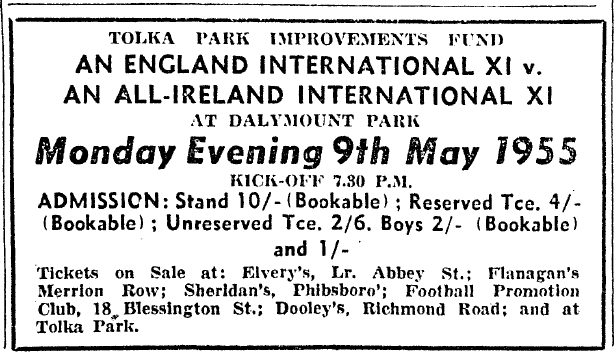
An Tóstal would return again in subsequent years and it was in 1955 that an intriguing fixture was announced featuring and “All Ireland” side who would take on and England XI. This match was the brainchild of Sam Prole, an FAI official and owner of Drumcondra FC, who had also previously had a long involvement with Dundalk FC. The game was to play the dual role of being a focal point for football during a busy end of season period and part of the An Tóstal events and it was also to act as a fundraising event for investment into Tolka Park, home of Drumcondra FC.

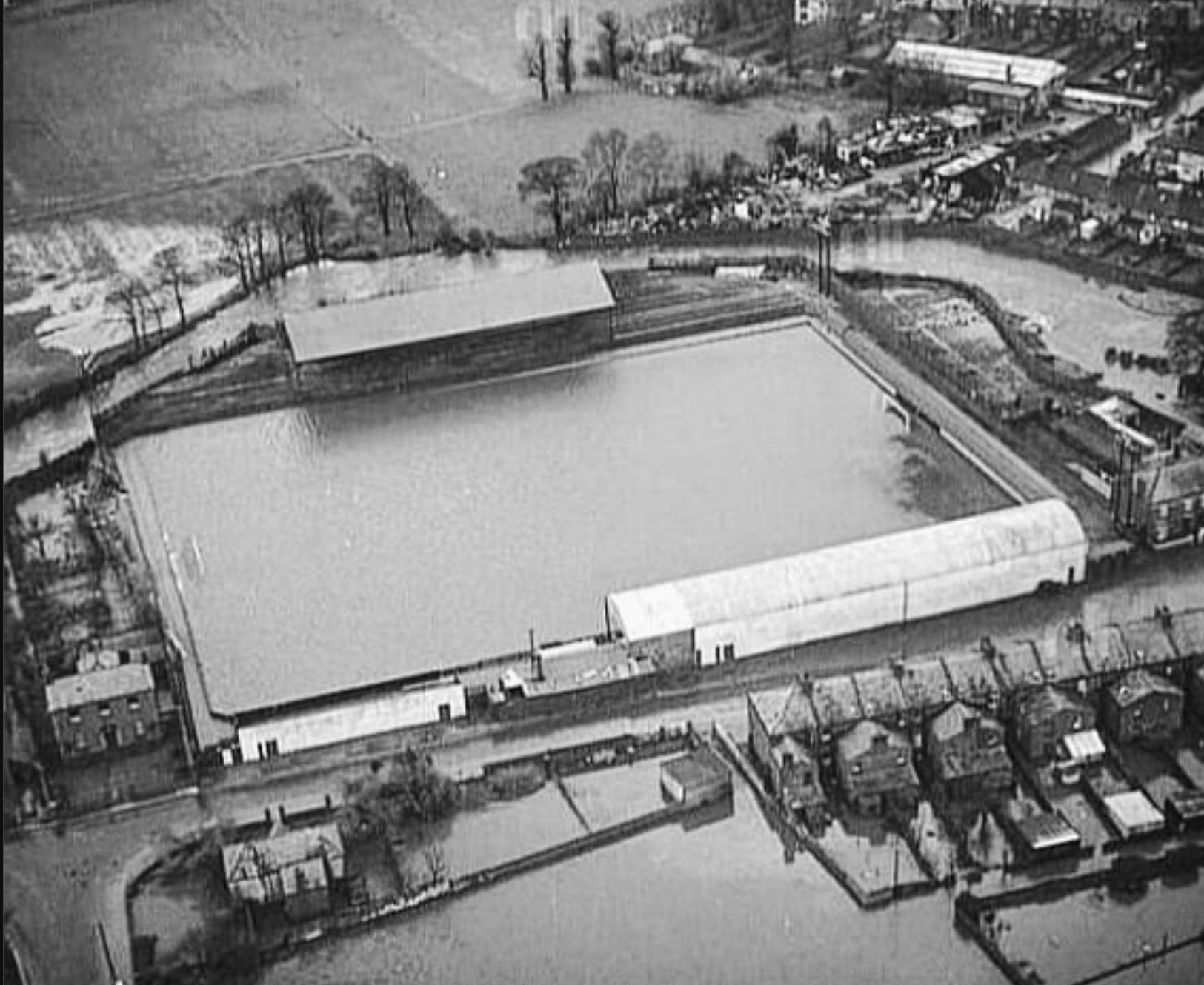
A flooded Tolka Park in 1954

The Prole family had taken over Tolka Park just a couple of years earlier and had seen almost immediate success with an FAI Cup win, they had also invested in the first set of permanent floodlights at a League of Ireland ground and had introduced other stadium innovations such as pitch side advertising boards as well as purchasing the house at the Ballybough end of the ground with a view to increasing stadium capacity. However, in 1954 Drumcondra and the North Strand suffered extreme flooding with the Tolka River bursting its banks and causing significant damage to the stadium. The Proles had ambitious plans for the club but also knew that an insurance settlement from the flood only covered a portion of the costs of repair and they need to generate additional revenue.

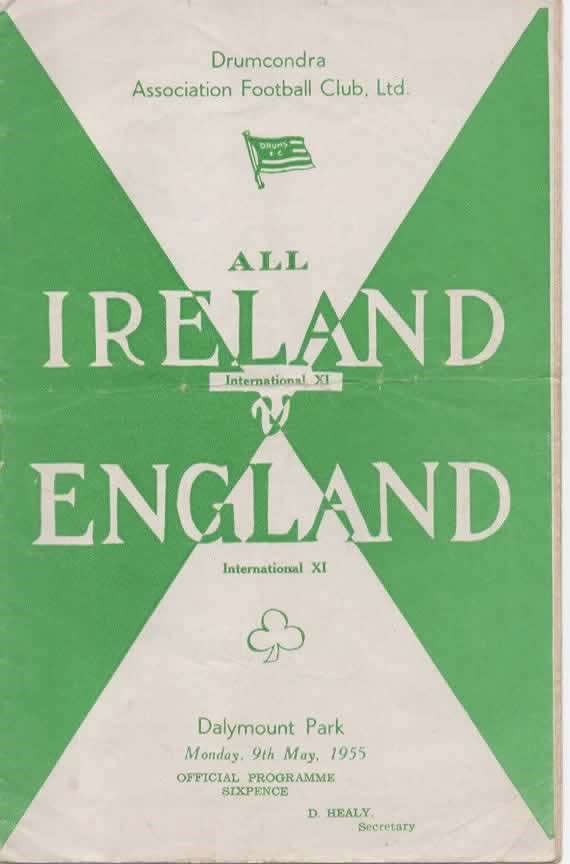
Dalymount Park, the largest football ground in the city, was chosen as the venue for this high-profile fundraising game and Prole went about putting together a pair of squads designed to appeal to the interests of the Dublin football public. The match programme for the game referred to the team as the “England International XI” and the “All Ireland International XI” however in various sections of the Press the teams were variously referred to as All Star XIs an “Old England XI” and also, trading on the name recognition of their star, the “Stanley Matthews Old England XI”. As the names suggest it was something of a veteran side brought over, the side being up of players the wrong side of thirty, while Matthews himself had just turned 40, though he was still a current English international. Nor were the England international side all English! In the side at centre-forward was Cardiff City’s Welsh international striker Trevor Ford.

The All-Ireland side was more mixed in ages, though several veterans still featured in the ranks, including one of the biggest draws Peter Doherty, the manager of Doncaster Rovers . Doherty had been a League winner with Manchester City before the War and a Cup winner with Derby County after it. He’d also been capped sixteen times by the IFA and was considered on of the greatest inside forwards of the 1930s and 40s. The advertising material in the run-up to the game focused on the presence of “Peter the Great” and “Stanley the Wizard” in the opposing sides.

Programme cover from 1955, courtesy of Gary Spain

As often happened with these games there were some last minute changes, the team named as travelling to Dalymount, and listed in the match programme was as follows; Ted Ditchburn, Alf Ramsey (both Tottenham Hotspur), Tom Garrett , Harry Johnston (both Blackpool), Neil Franklin (Hull City), Allenby Chilton (Grimsby Town), Stanley Matthews (Blackpool), Wilf Mannion (Hull City), Tommy Lawton (Arsenal), Jimmy Hagan (Sheffield United), Jack Rowley (Plymouth).

However, Mannion, Lawton and Hagan had to cry off for various reasons and at short notice they were replaced by Charlie Mitten of Fulham, Bobby Langton of Blackburn Rovers, a former England international. Replacing Lawton at centre forward was Trevor Ford of Cardiff City. As mentioned Ford was also the Welsh international centre-forward and as such this “England” side’s attack was led by a man from Swansea. While the side was on the older end of the age spectrum for professional footballers the entire XI apart from Mitten had been capped, and Ditchburn, Matthews and Ford were still current internationals.

Several of the Blackpool team who had won the FA Cup in 1953, famously dubbed the Matthews final, also appeared. Alf Ramsey, Spurs reliable full-back had won 32 caps for England but would find his greatest fame as a manager, first leading unfancied Ipswich to their only league title and then taking England to World Cup victory. The “England” side also featured several players who were somewhat infamous, both Mitten and Franklin were part of the “Bogota bandits” who left their club contracts in England and went to Colombia to play in the non-FIFA recognised league there due to the high wages on offer.

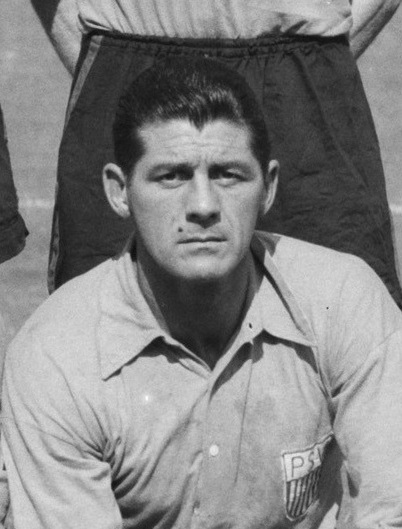
At the time the maximum wage which capped players salaries was still very much in force. Franklin, one of the greatest centre-halves of his generation never won another cap after his Colombian soujourn, while Mitten, who missed out on much of his early due to World War Two was never capped despite being a successful and popular winger for Manchester United and Fulham. A year after the game in Dalymount Trevor Ford would reveal in his autobiography that during his time at Sunderland he had been in receipt of under the counter payments to circumvent the maximum wage. He wasn subsequently suspended and announced his retirement, however changed his mind and moved to the Netherland where his ban could not be enforced and joined PSV Eindhoven.

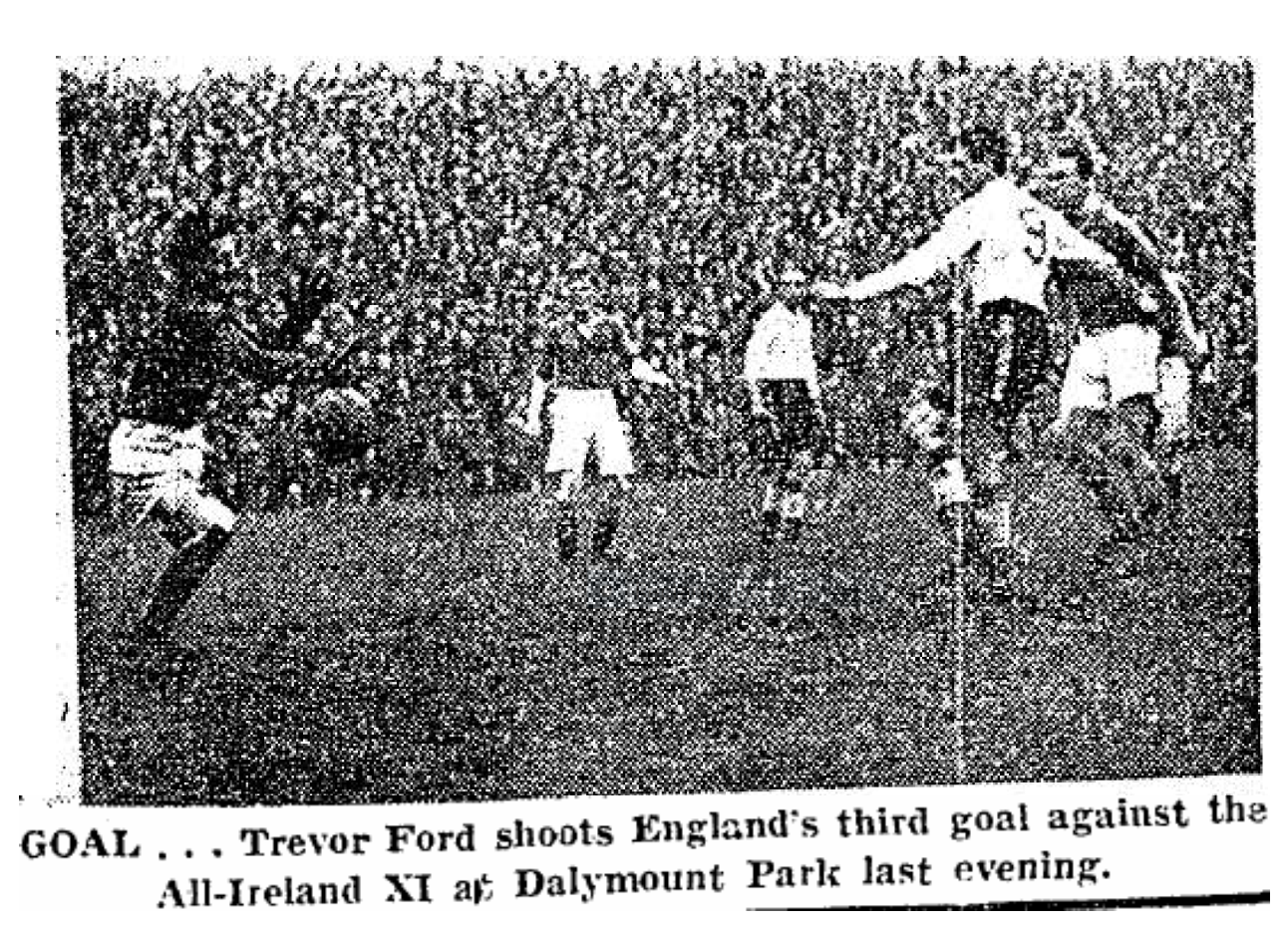
From the Irish Press, Trevor Ford scores for “England” in Dalymount Park.

In the Irish side there was a breakdown of six players born south of the border and five from the north, although like the English side there were late changes, Aston Villa’s Peter McPartland being unavailable he was replaced by his club and international teammate Norman Lockhart. The Irish stating XI read as Tommy Godwin (Bournemouth), Len Graham (Doncaster Rovers), Robin Lawlor (Fulham), Eddie Gannon (Shelbourne), Con Martin (Aston Villa), Des Glynn (Drumcondra), Johnny McKenna (Blackpool), Eddie McMorran (Doncaster Rovers) Shay Gibbons (St. Patrick’s Athletic), Peter Doherty (Doncaster Rovers), Norman Lockhart (Aston Villa).

Sam Prole obviously could rely on the services of his own players like Des Glynn, as well as former Drumcondra men like Con Martin and Robin Lawlor. As mentioned the connection with Doncaster Rovers through manager Peter Doherty, who was also manager of Northern Ireland likely helped secure the services of several other players.

The match proved to be a success in terms of the turnout and entertainment value, 24,000 turned up in Dalymount Park on the 9th of May 1955 for a goal-fest. The main plaudits were rained on Stanley Matthews for his exhibition of wing play, but the entire “England” forward line drew praise from the media reports, Trevor Ford being referred to as the “Welsh wizard among the Saxons” while he scored twice for England. In defence Neil Franklin and keeper Ted Ditchburn were also complimented. Ditchburn was lauded as the best keeper in England despite the fact that he conceded five on the day, Tommy Godwin in the Irish goal came off on worse as the hosts lost 6-5.

There was also praise for several of the Irish performers, despite having hung up his boots two years earlier the technique of Peter Doherty was still remarked upon, however it was Doncaster’s Eddie McMorran who drew the most praise and scoring two of the Irish goals. The press raved about the game, the Evening Herald declaring, in terms of exhibition matches “one of the finest ever seen at Dalymount Park” and again praising Matthews who it described as “being in peak form”. The Irish Press was similarly effusive, leading with the headline “Exhibition Treat Thrills Crowd – Stars Give a Soccer Lesson”. The healthy gate who turned up to see the star names no doubt helped the Prole family in the repair and upgrading work being carried out a short distance away at Tolka Park.

Trevor Ford in 1959, source Wikipedia

This marked a busy time for Dalymount, as days later there was another large attendance for An Tóstal events, with 15,000 turning up for a fireworks display which climaxed with “glittering reproduction of the Tostal harp in fiery gold. Underneath were the words : ” Beannacht De libh.” The young crowd left delighted although there were complaints from residents who were unaware of the event and were frightened by the unexpected noise.

Bouyed by the success of the 1955 match Sam Prole set about organising another All-Ireland v England match for the following year, though this time without the fundraising for Tolka tagline. Once again there was a high-profile selection of English veteran stars recruited and once again there was a cross border make-up to the Irish side. Though for 1956 it was much more weighted to the north with ten of the starting eleven being IFA internationals with only Pat Johnston, a Dubliner then plying his trade for Grimsby Town, coming from south of the border.

Several faces from the previous year’s game returned, including Peter Doherty and his Doncaster Rovers contingent which now included a young goalkeeper named Harry Gregg who would find fame at Manchester United, both on the pitch, and off it as one of the heros of the Munich air disaster. Once again Aston Villa’s Peter McParland was slated to appear but had to cry off, with once again his clubmate Norman Lockhart replacing him. There was also the considerable draw of two stars of Glasgow Celtic, Charlie Tully and Bertie Peacock. Tully, especially was a crowd favourite known for his amazing ball control, on-field trickery and cheeky personality. Such was his popularity among the Celtic faithful there were descriptions of “Tullymania” and his fame spawned an entire trade in Tully products and souveniers.

There were also returning stars from the “England” side that had played in the first game in Dalymount such as Tom Garrett of Blackpool and the “Welsh wizard” Trevor Ford, both late call-ups after Joe Mercer and Stan Mortenson were forced to pull out. The full teams were as follows:

“All-Ireland” – Harry Gregg (Doncaster Rovers), William Cunningham (Leicester City), Len Graham (Doncaster Rovers), Eddie Crossan (Blackburn Rovers), Pat Johnston (Grimsby Town), Bertie Peacock (Celtic), Johnny McKenna (Blackpool), Charlie Tully (Celtic), Jimmy Walker (Doncaster Rovers), Peter Doherty (Doncaster Rovers), Norman Lockhart (Aston Villa)

“England” – Sam Bartram (York City), George Hardwick (Oldham Athletic), Bill Eckersley (Blackburn Rovers), George Eastham Snr. (Ards), Malcolm Barass (Bolton Wanderers), Tom Garrett (Blackpool), George Eastham Jnr (Ards), Ernie Taylor (Blackpool), Trevor Ford (Cardiff City), Jackie Sewell (Aston Villa), Jimmy Hagan (Sheffield United).

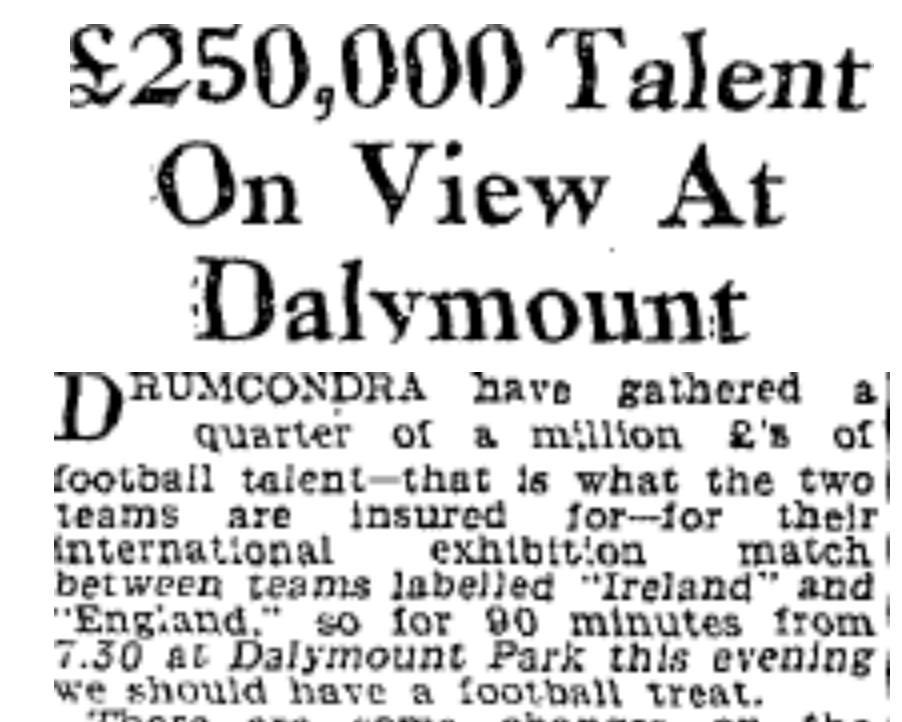
While there were well known veterans in the England team, Hagan was 38 and Sam Bartram, a Charlton legend and one of the most popular goalkeepers in football, was over 40 and had moved into management at York, were in the side there were also several younger players such as Johnny Wheeler and Ronnie Allen who were under the age of 30 and were due to feature but they both pulled out and were replaced by the father and son duo of George Eastham Senior and Junior. In the build up to the game much was made of the value of the team to be put on the pitch with the figure of £250,000 mentioned. In fact, in Jackie Sewell and Trevor Ford, there were two players who had broken the British transfer record over the past six years.

Irish Independent headline

It seems the crowd wasn’t as strong as the one from the previous year, attendance figures not being shared, but newspaper reports variously describing it as a “good” or “medium” crowd, it was also noted that the quality of the display was at a lower lever than the 1955 game, with this match having a more prounounced “end of season friendly” feel to it. The Irish Press called the game an “end of season frolic” while most reports did note the slower pace of the game and the lack of hard tackling, they were quick to praise the style and technique of the players on display. Once again the crowd were treated to a glut of goals, though the score wasn’t a close as the match a year earlier, Ireland lost 5-3 though reports state that this wasn’t a true reflection of the visitors superiority. Once again Trevor Ford was one of the stars while Villa’s Jackie Sewell also earned rave reviews. For the Irish side it was much more the Charlie Tully show, with him seeming to be the one player who was fully committed to the game, being described as a ball of energy and entertaining the crowd with his skills which prompted cries of “Give it to Charlie” from the terraces when Ireland were in possession.

Cover for the 1957 game, courtesy of Gary Spain

The younger George Eastham was also impressive for the English side, still only 19 Eastham had been a stand out player in the Irish League for Ards where his then 42 year old father was player-manager, before the year was out Eastham Jnr would sign for Newcastle United, and later his subsequent, protracted transfer to Arsenal, and court case would win significant change for players rights in English football, doing away with the old “retain and transfer” system clubs still held player’s registrations, even when the player in question was out of contract. He would enjoy a long and successful career and was a squad member of the England side which would win the World Cup in 1966.

Eastham Jnr. would open the scoring for England after Ireland took an unexpected lead through Walker, braces from Ford and Sewell rounded off the scoring for the English side, while the veteran Doherty with a penalty and Norman Lockhart scored Ireland’s other two goals. While the match was not as much of a success as the 55 game there was still praise for Sam Prole for taking the initiative to organise the game and for contributing on behalf of the footballing community to the Tóstal festival.

One possible reason for a smaller crowd in 1956 was not just the different line-ups, late withdrawals, or absence of Stanley Matthews, but also the sheer volume of other exhibition matches, often involving the same players, taking place at the time. Within days of the “All Ireland” v “England” game in May of 1956 there was an Irish youth international against West Germany, followed the next day by a combined Ireland – Wales XI against an England-Scotland XI, both taking place in Dalymount Park. Trevor Ford would feature for the Ireland/Wales side alongside Ivor Allchurch and local Cabra lad Liam Whelan, then making his name at Manchester United.

These games came just days after a Bohemian Select XI took on a side of Football League managers in an entertaining 3-3 draw in aid of the National Association for Cerebal Palsy. Among the Managers XI were players familiar to those who had attended the “All Ireland” games, such as Charlie Mitten, Trevor Ford (again), Peter Doherty (again!) as well as the likes of Bill Shankley and Raich Carter. There was perhaps a law of diminishing returns as despite the reports claiming the game was a highly entertaining spectacle and the associated good cause receiving the benefit, the crowd was descirbed as “disappointing”.

While the Shamrock Rovers XI match against Brazil in 1973, essentially a United Ireland side in all but name, is well known, and its 50th anniversary was marked last year in several quarters, these games in the 1950s are less well remembered. There are perhaps a number of reasons for this, for example, up until 1950 it was common practice for both the IFA and FAI to select players from either side of the borders and more than forty players were capped by both Associations. In this situation “All Ireland” representative sides were not all that uncommon, even if this did occasionally lead to tensions and even threats against players.

In the 1950s, Sam Prole, a key figure in the League of Ireland and the FAI was the driving force behind the matches, similar to the role played by Louis Kilcoyne in the 1973 game against Brazil, and similarly again there was the involvement of a national team manager, Peter Doherty in the 1950s and John Giles in the 1973 game. However, it seems that while the games in 1955 and 1956 used the title Ireland or All Ireland and the 1973 game was compelled to go under the Shamrock Rovers banner, the political situations were quite different. The 1973 game was played against the backdrop of one of the worst years of violence during the troubles, at the time the IFA were playing “home” matches in various grounds around England while a year earlier the 1972 Five nations rugby championship could not be completed as Scotland and Wales had refused to travel to Dublin, highlighting safety concerns.

There seemed to be a concerted effort by players involved in the 73 game to offer a counter narrative and most spoke of being in favour of a 32 county Irish international side. The games in 1955 and 56 lacked this political backdrop, the ill-fated IRA border campaign wouldn’t begin until the winter of 1956, and the stated aim seemed to be a novelty factor and curiousity element as can be seen with the other types of exhibition matches played at the time. There was no sense in any reportage that the games in 55 and 56 were trying to make a political point, they were fundraisers for Tolka Park initially, and a contribution by Irish football to fill a programme for the An Tóstal festival.

Though less than 20 years apart the football landscape was very different between 1955 and 1973. By 1973 European club competition was the norm, when it was only in its earliest phase in 1955 and lacked Irish or English participants. By 1973 colour TV had arrived and there was a massive increase in television set ownership in Ireland through the late 1960s. Where once stars of British football could only be seen in international or exhibition matches, or in snippets on newsreels, now they could be watched every Saturday night on Match of the Day.

While vestiges of An Tóstal live on today, it’s still celebrated in Drumshambo, Co. Leitrim for example, and we can credit it with the genesis of the likes of The Rose of Tralee, The Tidy Towns competition, the Cork Film Festival and Dublin Theatre Festival, one legacy it didn’t leave is a united, 32 county, Irish football team. Perhaps when Ireland is next on our uppers, and we have to reinvent a reason to convincea tourist diaspora to flock home to the old sod, we’ll hold some matches in Dalymount and unite the nation again?

With thanks to Gary Spain for sharing images of the match programmes for the 1955 and 1956 games.

Keep the green flag flying – 50 years on from defeating the Soviet Union

John Giles was enthusiastic that the aligning of Ireland’s European Championship qualifying fixtures with that of England, Scotland, Wales and Northern Ireland would have a beneficial effect on securing the release of players from their clubs for the upcoming match against Turkey. He made this point just after his Ireland side, playing in their first competitive game under his management had shocked European football by defeating the Soviet Union 3-0 on October 30th 1974.

Giles waxed lyrical about wanting the opportunity to work with the international team players on a weekly, even daily basis and hoped to have extra days for another opportunity for additional training ahead of the game against Turkey. Even things like the release of players and a day or two to work through set pieces wasn’t guaranteed in 1974.

The hero in that game, Don Givens, who celebrated his 25th cap with a hat-trick recalled being unable to get back to the team bus such were the crowds and didn’t know how to get to the team hotel in Booterstown so he hailed down a car in his muddy kit with a match ball under his arm. He was greeted with the inquiry as to whether he’d been “at the match?” by the driver.

Liam Brady, then an 18-year-old debutant remembered the flaking panelling in the Dalymount dressing room and the smell of liniment mixed with a waft of beer from the nearby club bar. The anxiety, and perhaps the odour meant that he recalled getting sick in the dressing room toilet prior to kick-off.

All of this perhaps sounds a far cry from modern international football but it was something of a dawning of a new era for Ireland. Giles had taken charge mere months earlier, had impressed in a series of friendlies, and was now player-manager leading the bid for Euro 76 qualification in a group featuring the Soviet Union, Switzerland and Turkey. Almost exactly 15 years earlier a teenaged Giles had scored on his debut in a victory over Sweden, now he was in charge on and off the pitch as Ireland took on the world’s largest nation featuring such stars as Oleg Blokhin who would win the Ballon D’Or just months later.

One of the Irish centre-backs that day, Terry Mancini, had praised Giles for his training techniques and the “tremendously professional atmosphere and attitude – as good as any team in the world”. As chance would have it, the Arsenal defender wouldn’t get to experience much more of the Ireland dressing room, a sending off for retaliating against Soviet defender Volodymyr Kaplychnyi saw his international career ended by a four-match ban.

During the game itself the 35,000 spectators were treated to scintillating, confident football by the Irish, with one commentator describing the interplay between Giles and Brady, master and student, as almost arrogant! It was claimed in reports that this was the game that brought Irish football in from the cold and gave Dalymount back its roar.

The crowd had just 23 minutes to wait for the first goal, a delightful ball in from Joe Kinnear, who excelled in marshalling Blokhin as well as joining the attack, which found the head of Givens who powered it home. Five quick passes cutting open the Soviets to give Ireland the lead. The second arrived on the half hour courtesy of the indefatigable Ray Treacy, who’s cross was flicked on by Steve Heighway to present Givens with a simple finish.

However, there was some concern two minutes later when Mancini and Kaplychnyi were sent off. Could Ireland’s 4-3-3 formation adapt to being down a centre half? Mick Martin, filled in ably, switching from midfield to defence, and Ireland managed to weather a Soviet storm in the first period of the second-half and any fears of a comeback were allayed on 70 minutes as Giles’s precise and quickly taken free found the Soviet defence asleep and Don Givens secured his hat-trick.

Through the late 60s and early 70s Irish fans had little reason to be cheerful, 50 years ago a new manager, and a shock result helped the Green army to find their voice and hope again.

This article originally appeared in the Ireland v Finland match programme in November 2024

Bert Pratt’s Bohemian story

A mildly amusing or unusual name is often the thing that stops me when looking through old Bohs teamsheets. Many names are familiar and repeated, numerous brothers playing for the club from its earliest days, the Blayneys, the Sheehans, the Murrays, the Hoopers. Some more or less common names, but there are fewer Pratts in Dublin, especially at the turn of the 20th Century so the name stuck.

The more I searched the more the name began appearing. H. Pratt regularly getting among the goals. H short for Herbert, Bert to his friends. Born in the small town of Woodstock in Oxfordshire in 1878 to parents Mary and Henry Pratt, Bert was one of a large family of eight. His upbringing seems to have been comfortable, his father running a hotel and mentioned as having served a term as Mayor of Woodstock. His father’s profession necessitated a move to the relatively nearby, midlands town of Worcester where his father ran a busy hotel next to the main railway station.

The younger Bert learned his trade in the emerging profession of electrical engineering, and there is reference to him briefly attending Oxford University, but he also seems to have maintained an interest in football, being listed as being on the books (as an amateur) of Wolverhampton Wanderers as a teenager. We can only speculate but it seems that perhaps it was his profession rather than a sporting transfer that brought the young Bert to Dublin. Bohemians were a strictly amateur side when Bert signed for them during the 1898-99 season at which point he would have been roughly 19 or 20 years of age. He appears on the 1901 Census, living as a boarder in a house at 99 South Circular Road with the Rudd family, an older couple in their 60s. Also present in the house was a Reginald Timmins, who like Bert was English born and was also an electrical engineer. All the residents of the house were members of the Anglican Church, apart from the one servant, Mary Lynch who was a Roman Catholic.

By this stage Bert was already a well known player, in fact he was probably regarded as one of the best forwards in Ireland. A big man for his day, at around six foot and strongly built, the main adjective used to describe Pratt’s play is “clever”, it’s a word used again and again from very early in his Bohemian career. He mostly played at inside-right but also featured as a centre-forward and even in a more deep-lying midfield role. He was variously described as “the most dashing and brilliant inside man in the country”, and the “finest forward in Dublin”.

And Bert’s career was indeed successful, in the 97 games in which he featured for the Bohemians he had an excellent strike rate of 70 goals, including scores in some hugely important matches. By the end of his sojourn in Ireland he was considered among the best forwards on the island. It was also a time of huge change and maturation for the Bohemian Football Club. By the time of Pratt’s arrival the Leinster Senior League and Leinster Senior Cup had been established and while with Bohemians Pratt would win both as the Gypsies demonstated their superiority as the strongest team in Dublin.

During his time in Dublin, Bohemians would become the first team from the capital to join the Belfast dominated Irish League, in 1902. Pratt was also part of the Bohemian teams that twice reached the Irish Cup final, in 1900, where Bohemians were narrowly defeated 2-1 by Cliftonville and again in 1903 as Bohemians lost 3-1 to Distillery in the first ever final played in Dalymount Park. Despite finishing on the losing side in that game it was Bert who had been the star in the semi-final rout of Derry Celtic and it was he who got Bohs’ consolation goal just before the whistle in the final.

In 1901 Bert Pratt had been among that famous first eleven Bohemians who lined out in the inaugural match at Dalymount Park against Shelbourne. When he joined the club were playing their games in the grounds of Whitehall Lodge on the Finglas road (roughly opposite the modern main entrance of Glasnevin cemetery) but within a matter of years not only had the club secured its new grounds but this new stadium was already hosting cup finals.

All told, during his Bohemian career Bert won three Leinster Senior League titles, three Leinster Senior Cups, finished runner-up twice in the Irish Cup and also featured in Bohemians first ever Irish League seasons. He was also selected by the Irish League to represent them in the prestigious inter-league games against the Scottish League and the English League as well as being part of the first Bohemian team to welcome a British side to Dalymount when Bohs hosted Preston North End in their new home in 1901.

By 1900 Bert had already featured for Leinster in the regular inter-provincial challenge matches against Ulster and in 1902 was selected for the first time by the Irish League to face the English League in front of a 10,000 crowd in Solitude, Belfast. The Irish League performed commendably and were only defeated 3-2 by a late goal from Steve Bloomer, the star forward of Derby County and probably the best centre-forward in the world at that time. Bert was selected again the following year when he was picked for the visit of the Scottish League to Grosvenor Park, where in front of an even larger crowd Bert Pratt scored the only goal of the game to record only the third ever victory by an Irish League side in a representative game.

After these successes the sports pages wistfully remarked that due to his English birth it was a great pity that Bert could not represent Ireland at full international level as he was clearly considered one of the best players in the country. In fact, Bert was moving around a bit, even while on the books of Bohemians. In 1902 he was apparently spending part of his time in Lancashire and got mired in a minor transfer saga when he signed for Blackburn Rovers after his impressive performance against the English League. However, his registration (in English football at least) was still held by Wolves from his time with them as a teenager. While it seems that this was eventually sorted out Bert’s stay at Blackburn was brief. There was reported interest from both Preston North End and Manchester United but Bert quickly found himself back at Dalymount.

The 1903-04 season was to be Bert’s last in Dublin, despite all his success there was nearly a tragic coda to his time in Ireland as he was struck down with a serious bout of pneumonia in January of 1904. Luckily, considering the strong medical connections with Bohemian Football Club, his medical team-mates, the various Doctors Blayney were able to nurse him back to health. It is around this time that Bert moved more permanently to England, relocating to Liverpool and staying in the shadow of Anfield. By September of that year he would be signing for Liverpool as an amateur. Despite playing some pre-season games his short spell with the Reds was limited to eleven appearances for the Liverpool reserve side who were then playing in the Lancashire Combination.

During this time Bert also made the newspapers for a non-sporting reason, while attending the Theatre Royal in Birmingham in December 1904, along with his brother Robert the two were reported to the police for some drunken and unruly behaviour in the Theatre bar and for refusing to leave when requested. Things turned heated, when upon the arrival of the police, Bert’s brother Robert became violent. The whole affair ended up in court and both men were lucky to escape with a fine, Robert who seemed to be the more aggressive of the two facing a 60 shilling fine or face a month in prison while Bert got off more lightly, having to only pay 40 shillings.

By the time of the theatre incident Bert had thrown in his lot with Old Xaverians, an amateur side in Liverpool who were enjoying some success at the time. In 1902 they had been one of the first English amateur sides to tour Europe and did this again in 1908 with Bert as team captain on a visit to Belgium. Bert enjoyed great success at this level, he received further representative honours, representing Lancashire amateur sides in games against similar teams from Leicestershire and London. He did however make one more appearance for Bohemians, having the honour of captaining a Bohemian side in 1905 when they hosted Aston Villa at Dalymount.

The combined Bohemian and Aston Villa teams. Bert is seated in the front row in the darker jersey with the ball at his feet.

Bert would have been just 30 years old when he was captaining Old Xaverians on the tour to Belgium in 1908. He had graudally moved back in his playing role, from the forward line to a centre-half, or pivot role, effectively a central midfielder in the modern parlance. Old Xaverians were prospering at their level, winning regional amateur cups and being toasted by the Lord Mayor. However, less than a year later they were stunned when Bert was to pass away suddenly in September 1909 at the age of just 31.

There were glowing tributes paid in Ireland and England, The Irish Times calling him “one of the most popular players in the Irish metropolis” while the Liverpool Daily Post called him a “splendid exponent of the game”. There was a large funeral and Bert was buried in Kirkdale Cemetery in Liverpool, his sizeable family were joined by many from the local football scene including the Liverpool manager, Tom Watson as one of the mourners. Incidentally, the photo from the top of this article is from an In Memoriam section of a joint Liverpool-Everton match programme from 1909 expressing sympathy at Bert’s passing.

While perhaps forgotten in the mists of time Herbert Pratt was a crucial player in the early years of the Bohemian Football Club, a star forward, a fan favourite and a prolific goalscorer as the club became a dominant force in the city and moved up to challenge at the highest level in Ireland by joining the Irish League while also being part of the first Bohs side to make Dalymount their home.

With thanks to Rob Sawyer, Stephen Burke, Jonny Stokkeland and Kjell Hanssen for their assistance in the research for this article.

A club for all seasons – 1929-30

Bohemians began with a pre-season tournament in August of 1929. While the club had played matches in England and Scotland in the past this was to be our first foray onto the Continent and things could not have gone better with Bohemians winning every game on the tour and securing the Aciéries d’Angleur Tournoi trophy after victories over the likes of Standard Liege and R.F.C. Tilleur. The invitational tournament ran for many years and would feature the likes of PSV Eindhoven and Bohemians Prague. Bohemians became only the second Irish side, after Glentoran in 1914, to win a European trophy, though it is worth noting that it would not be Bohemians’ last such title.

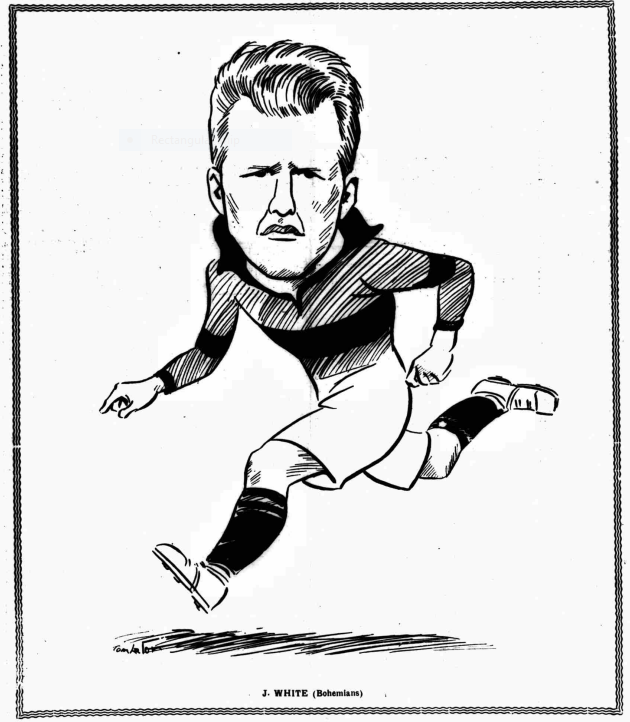
In the league it was a case of third time’s a charm as Bohemians won our third title in the 1929-30 season. It was a much-changed line-up from that of the all-conquering 1927-28 side, many of whom had moved to pastures new, although the likes of Jimmy White, Jimmy Bermingham, Johnny McMahon and goalkeeper Harry Cannon remained in the side. Cannon once again was a feature on the scorers list, hitting yet another penalty-kick that season. Added to these Bohs veterans were newer players like Stephen McCarthy who hit thirteen goals in the league that year, as well as a young Fred Horlacher (shown in cartoon form on the left) who continued to delivery on his exceptional promise. Further back in the midfield was the likes of Paddy O’Kane, yet another future Irish international.

Bohs only lost twice all season in the League, both away fixtures, while winning every single game at fortress Dalymount, they ultimately pipped defending champions Shelbourne to the title by a solitary point. Shels had a fine side that year, propelled by the goals of Johnny Ledwidge signed from LSL side Richmond Rovers, as well as former Bohemian inside forward Christy Robinson, they had to content themselves with victory in the League of Ireland Shield that year. There were no other changes to the make up of the League from the previous season and while Bohs finished top, Jacobs would finish bottom, winless all season, amassing only a meagre three points, despite featuring the talented Luke Kelly Snr. (father of the future Dubliners’ frontman) in midfield.

In the cup there was high drama as Shamrock Rovers won a controversial final 1-0 against Brideville thanks to a “Hand of God” moment from David “Babby” Byrne, the diminutive striker fisting the ball past Brideville’s Charlie O’Callaghan (in the Peter Shilton role) to secure Rovers second consecutive Cup triumph. Despite losing to Fordsons in the second round of the Cup, Bohemians did make history that year when forward Billy Cleary scored six goals in a 7-3 win over Bray Unknowns in a first round replay. Cleary’s record for most individual goals scored in a Cup tie remains intact to this day.

At international level Ireland’s sole match was a 3-1 win against Belgium in Brussels in May 1930, with Jimmy Dunne scoring twice. Among the starting eleven were Bohemians’ Fred Horlacher and Jack McCarthy who returned to Belgium after their successful, pre-season trip to Liege, also in the line-up was Billy Lacey who became Ireland’s oldest ever international, just four months short of his 41st birthday. Lacey would later become a successful coach at Bohemians in the 1930s.

Part of a series in the Bohemian FC match programmes. The 1928-29 season review can be found here.

A club for all seasons – 1928-29

Bohemians entered the new season as champions and were fancied to retain their crown after their clean-sweep the previous year. The league remained at 10 teams with Athlone Town, who had finished bottom and been on the end of a number of drubbings failing to be re-elected to the League and their place being taken by Drumcondra who had been Cup winners in 1927 and beaten finalists a year later.

It was one of the tightest title races ever with a ding-dong battle between Shelbourne and Bohs for the Championship, despite only losing once and drawing twice in the League campaign Shelbourne pipped Bohs to the title by a single point. David “Babby” Byrne and Jock McMillan supplying the goals while Shels had also added Bob Thomas, a star of the all-conquering Bohs the previous season to their midfield where he’d play alongside his brother Paddy.

For Bohemians Billy Dennis was once more top scorer but getting in among the goals was a young inside-left named Fred Horlacher who made his debut that season and would go on to become one of the greatest players in the club’s history. The son of a Mormon, German, pork-butcher Freddie Horlacher would play in numerous positions for Bohs as well as making several appearances for Ireland in a career that would see him become one of the club’s highest ever goalscorers.

Top scorer in the League overall however, was Eddie Carroll (left), a former Northern Ireland international who had spent the previous seasons playing in Scotland for Aberdeen and Dundee United, Carroll was in his first of three spells with Dundalk.

There was further disappointment in the Cup for Bohemians, despite knocking out St. James’s Gate, Jacobs and Drumcondra on the way to the final, we were ultimately defeated in a replay by Shamrock Rovers as they won their first of five consecutive Cup titles. The initial final had been played at Dalymount and ended in a 0-0 draw, however the replay was moved to Shelbourne Park and Rovers would triumph on the southside 3-0, with two goals from John Joe Flood and one from veteran forward Bob Fullam.

Bohemians would get a modicum of revenge when they defeated Shamrock Rovers 2-0 in a test match to settle the winner of the League of Ireland Shield later that season. Although Bohs were comfortable winners in that game with Jimmy White grabbing both goals it was Rovers teenage forward Paddy Moore who caught the eye of a Cardiff City scout who signed up the prodigious talent the following month.

At Inter-league level the LOI had mixed fortunes, beating the Welsh League 4-3 in Dublin, with Johnny McMahon and Peter Kavanagh of Bohs getting three of the goals, but then losing to the Irish League 2-1 later the same season. At international level Ireland only played one game, a resounding 4-0 victory over Belgium in April 1929 front of 30,000 fans in Dalymount. John Joe Flood scored a hat-trick with Babby Byrne getting the other goal. Jimmy Bermingham was the sole Bohemian in the starting XI for Ireland that day. Just four months later Bermingham and his Bohs teammates would be part of a visit to Belgium that would see them enjoy further success.

Jimmy White who scored the decisive goals to secure the Shield for Bohemians.

For the 1927-28 season click here.

The League of Ireland: An Historical and Contemporary Assessment – conference on Saturday January 14th

This Saturday (January 14th) Dalymount Park, specifically the Member’s Bar, will host a League of Ireland football history conference to mark the publiction by Routledge of it’s new academic collection The League of Ireland: An Historical and Contemporary Assessment which is edited by Conor Curran.

I have a paper included which looks at several case studies highlighting the complex patterns of migration of players into the League of Ireland over the last century. The conference is free to attend and you might even get a cup of tea and a sandwich.

Conference schedule

  • 9.30-10 am: Conor Curran (Trinity College Dublin) – Introductory Comments
  • 10-10.30 am: Julien Clenet (University College Dublin) – Association football in Dublin in the late Nineteenth Century: an Overview
  • 10.30-11 am: Cormac Moore (Dublin City Council Resident Historian) – The Formation of the Football Association of Ireland
  • 11.00-11.30 am: Aaron Ó Maonaigh (Independent Scholar) – ‘In the Ráth Camp, rugby or soccer would not have been tolerated by the prisoners’: Irish Civil War attitudes to sport, 1922–23.
  • 11.30-12 pm: Conor Heffernan (Ulster University) and Joseph Taylor (University College Dublin) – A League is Born: The League of Ireland’s Inaugural Season, 1921–1922
  • 12-12.30 pm: Conor Curran (Trinity College Dublin) – The cross-border movement of Republic of Ireland-born footballers to Northern Ireland clubs, 1922–2000
  • 12.30-1.30 pm Lunch
  • 1.30-2 pm: Gerry Farrell (Independent Scholar) – One-way traffic? – 100 years of soldiers, mercenaries, refugees and other footballing migrants in the League of Ireland, 1920 -2020
  • 2-2.30 pm: Tom Hunt (Independent Scholar) – Ireland’s Footballers at the 1924 and 1948 Olympic Games: Compromised by the Politics of Sport
  • 2.30-3 pm: Michael Kielty (Dublin Business School): Peter J. Peel: The Soccer King
  • 3-3.30 pm: Ken McCue (De Montfort University) – Who’s SARI now: Social enterprise and the use of the medium of sport to further human rights in society
  • 3.30-4 pm: Helena Byrne (Independent Scholar) – Breaking new ground: The formation of women’s football governing bodies in 1970s Ireland
  • 4-4.15pm Closing Comments
  • Papers will be for the duration of twenty minutes, with ten minutes afterwards for questions.

You can attend for free by registering through eventbrite.

Stuck in the middle – foreign referees in the League of Ireland

Controversy about refereeing decisions and the appointment of referees is nothing new in football. In the League of Ireland especially perceived biases, supposed club alliances, city of origin, and indeed refereeing ability all play into the arguements fans make about the unsuitability of a referee to take charge of a game. Of course their club of choice is uniquely victimised by Ireland’s officials while their rivals of course recieve favoured status – “sure doesn’t the ref support X team” or “doesn’t his young lad play for their under 15s” etc. etc.

This was a topic hotly discussed in the early days of the League of Ireland, with occassionally dramatic and even violent results and a pattern began whereby officiating Cup Finals and other high profile games became almost the exclusive preserve of referees from outside of Ireland. Bringing in referees (mostly from England) did help with tackling percieved bias that a referee might have held for or against any club and in many cases those taking charge were well known and respected in the game, even including men who had refereed World Cup and European Cup finals.

The first three FAI Cup finals were all refereed by Irish officials but by 1925 things had changed. Jack Howcroft of Bolton was brought in to take charge of the final due to be held on St. Patrick’s Day, 1925 in Dalymount Park. There was initial resistance to this from domestic referees, including the calling of strike action in the run-up to the Cup Final. Howcroft refused to break the strike but a Cup final without a referee was averted after the Evening Herald journalist William Stanbridge, who wrote under the sporting byline of “Nat” arranged a meeting between the disputing parties. Ultimately the referees association capitulated and recognised the FAI’s authority in appointing the referee for any competition and Howcroft was able to take his place as the man in the middle for the final between Shamrock Rovers and Shelbourne.

Howcroft was an experienced referee who had already taken charge of the 1920 FA Cup Final between Aston Villa and Huddersfield Town as well as 18 international matches by the time he made the journey to Dublin. He’d also taken charge of a match between Glentoran and Belfast Celtic some years earlier when he was greeted upon arrival by “a salute of umpteen revolvers” being fired in the air. Despite that experience Howcroft had no qualms about taking charge of the FAI Cup Final.

There was a record final crowd that day in Dalymount as attendance numbers breached 20,000 for the first time, and those present witnessed Shamrock Rovers 2-1 victory over their Ringsend rivals Shelbourne. Howcroft was well received and the crowd were in good spirits , despite, or perhaps because, the Government had just begun the practice of closing the pubs for St. Patrick’s Day. It wasn’t to be Howcroft’s last appearance at an FAI Cup final. Despite the fact that the FA, since 1902 had maintained the practice that a referee was to only be given the honour of refereeing a Cup final once, the FAI took a different approach and were happy to appoint referees to take charge of a final on multiple occasions.

Howcroft would return in 1927, while a year later his place in the middle was taken by Belgian referee John Langenus. Two years after taking charge of that Cup final clash between Bohemians and Drumcondra, Langenus was refereeing the first World Cup Final in Mondevideo. I’ve written about Langenus and his fascinating footballing journey, including his visits to Ireland elsewhere.

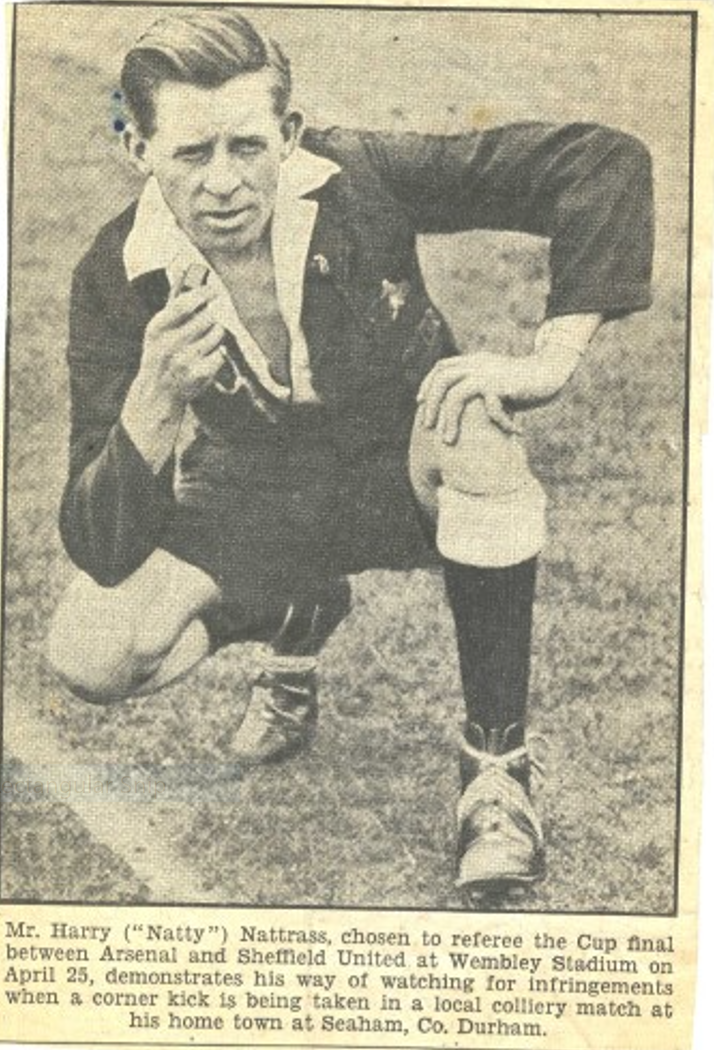
Harry Nattrass – image provided by Dr. Alexander Jackson

Non- Irish referees took charge of every subsequent final between 1925 and 1940 apart from the 1937 final which was refereed by John Baylor from Cork. Baylor was chosen ahead of English referee Isaac Caswell but this decision did not prove popular with everyone as finalists St. James’s Gate lodged a formal protest at his selection.

Harry Nattrass, from County Durham took change of the 1940 FAI Cup final between Shamrock Rovers and Sligo Rovers in front of a then record 38,000 supporters, Nattrass had refereed the FA Cup final just four years earlier, however despite his willingness to brave a crossing of the Irish Sea to take charge of the final in Dalymount the remaining finals during the War years would be the domain of Irish referees only. The escalation in the conflict and the danger to shipping from the German Kriegsmarine was obviously a major contributing factor, however, it is worth nothing that even after the War had ended it was 1950 before another non-Irish referee took charge of a Cup Final.

The 1950 final was in itself slightly unusual as it was the first final to go to a second replay. For the first two finals W.H.E. Evans of Liverpool took charge of the first two games between Transport and the favourites Cork Athletic, however he was replaced for the second replay by his fellow countryman Tom Seymour. Transport shocked Irish football by winning their first, and only Cup, and Tom Seymour would return the following year when Cork Athletic once again reach the final and eventually won on the replay 1-0 against Shelbourne.

The 1950s remained a decade when the FAI looked to England to provide referees for prominent games. This wasn’t confined to FAI Cup finals but also happened in semi-finals, prominent League of Ireland games, Shield games, Leinster Senior Cup games and more.

View of Dalymount Park for the 1950 FAI Cup Final (Irish Press)

This was not always popular with all members of the public. In 1932 two English referees, shortly after arriving in Dublin, were “requested” not to officiate two games involving Shelbourne over two consecutive weeks. First, Tom Crew of Leicester was visited ahead of a Shels games against Cork and the following week Tommy Thompson from Lemington was visited before a game against Drumcondra. Both referees did take charge of each of the games although Thompson did alert the Free State League committee. The League condemned these visits to referees and committee member Basil Mainey of Shamrock Rovers stated that the “attempts at intimidation were made by irresponsible persons.” The Gardaí, League and the FAI were reported to be investigating the matter by the Irish Press. Mainey did comment further, making a somewhat awkward justification for the use of English officials while also giving an idea of the rates of pay being offered in the early 1930s. He said;

“No one should get the idea that we employ English referees for the love of them or their country. It costs us four of five guineas every time and a local man would only cost about one guinea.”

The League committee stated at the time that with bigger games in the League of Ireland regularly attracting over 20,000 spectators that it was “desirable” that a “stranger acted as referee”, again returning to the idea that an English referee would be seen as impartial and unbiased. Not that there weren’t moments of friction, three years before those visits were paid to referees Crew and Thompson there was a spat between referee Albert Fogg and Dundalk FC over an article he had written in the English sporting press describing a league match he had refereed between Dundalk and Drumcondra. Fogg had described the Dundalk crowd as the “wild Irish” and a complaint was made by PJ Casey on behalf of Dundalk FC. Incidentally, Irish referee JJ Kelly wrote to the FAI in support of Fogg and complained that the Dundalk supporters were “the mostly cowardly lot of blackguards that ever attended a football game”.

Fogg was well used to taking charge of games in Ireland, he had refereed the 1926 FAI Cup final and was another man afforded the dual honour of taking charge of Cup Finals in both England and Ireland when he refereed the 1935 FA Cup final. As with Fogg, Langenus and Howcroft the majority of referees who came to Ireland were quite high profile, many refereed international matches and important league games and Cup Finals in England, and in the case of Langenus even the World Cup final. Among the other well-known refs who came to Ireland during this period from the 1920s through to the early 1960s were men like Albert Prince-Cox a former football manager, player and referee, boxer, and boxing promoter who had also designed Bristol Rovers distinctive blue and white quartered kit.

Perhaps the most well-known figure in this period would be Arthur Ellis. Ellis was in charge of the 1953 FAI Cup Final and its replay and also the 1955 FAI Cup Final. By that stage he had already been a linesman in the Maracanã for the 1950 World Cup final, and would referee at both the 1954 and 1958 tournaments. A year after refereeing Shamrock Rovers victory over Drumcondra in 1955, Ellis was entrusted with refereeing the first ever European Cup final, a classic game which was won in thrilling fashion 4-3 as Real Madrid defeated French side Stade de Reims. One of Ellis’s assistants in that European Cup final was Thomas H. Cooper who would referee another Shamrock Rovers v Drumcondra final in 1957, this time the Drums prevailed. Ellis himself became better known to a later generation as a media personality, being the referee in the TV gameshow It’s a Knockout.

As you can see from several examples above the FAI did not follow the English tradition of a referee only getting to take charge of a Cup Final once, Howcroft, Seymour, and Ellis all refereed two FAI Cup finals, although the record for a foreign referee is three, which is held by Isaac Caswell from Blackburn. Caswell was a Labour Councillor and was also very involved in organising (and delivering) Church services for sportsmen. He was the man in the middle for the 1932, 1934 and 1936 FAI Cup finals. It could have perhaps even been more were it not for the fact that Argentina were experiencing a similar situation to the League of Ireland and wanted British referees to take charge of league games there while also instructing and education local referees.

Jack Howcroft (right)

Caswell journeyed to Argentina in late 1937 and stayed until 1940, refereeing matches and training local officials. Caswell seems to have been popular in Argentina and like Ireland was seen as an impartial adjudicator although as with games in Ireland there were still moments of conflict. In 1938 there were reports that Caswell had been assualted during one game, although broadly speaking it was seen that his time there was a success. So much so that in the late 1940s there was a request for more British officials to take charge of fixtures in Argentina. Eight men departed for Argentina in 1948 with allowances made for their wives and children to travel with them

This group weren’t always as popular as Caswell had been and similar to the 1925 incident with James Howcroft there was a threatened strike by the Argentine match officials in 1950 while there were still some tumultuous scenes on occasion, with referee John Meade and his officials having to barricade themselves inside a dressing room during a game between Huracán and Velez Sarsfield.

In both Ireland and Argentina the use of referees from outside of their own Associations gradually came to an end. The last Englishman to referee an FAI Cup final was D.A. Corbett who took charge of Shamrock Rovers v Cork Celtic and the subsequent replay in 1964. Since that time the FAI Cup has been the preserve of Irish referees, however for a span of almost forty years British referees (and one Belgian) took charge of 26 FAI Cup finals as well as innumerable semi-finals, finals of other Cup competitions and prominent League and Shield games. Many of these referees had a reasonably high profile, took charge of international matches and tournaments, European club ties and English top flight games and FA Cup Finals, and while not always welcomed they were broadly viewed as neutral parties, freeing games of any sense of bias and bringing their expertise in the laws of the game to bear.

A special thank you to Dr. Alexander Jackson of the National Football Museum in Manchester for his assistance.

Jesus back in a tracksuit – from Carey to Pauw

By Fergus Dowd

‘The pride and self-respect of our country as well as our players will be on show for millions in the pre-match ceremonies at Wembley Stadium on Saturday and it is important that we present ourselves in the best way possible, in terms of both dress and conduct, on every occasion during our stay in England.’

It was April 1957 as Jack Carey uttered those words to the FAI committee ahead of two World Cup preliminary games, home and away, against England the following month. The first Irishman to lift the FA Cup as captain of Manchester United, felt it was a simple request but he considered it essential that the powers that be purchase a set of tracksuits for those who would wear the green of Éire in London.

Today, sports manufacturers fall over themselves to provide football teams with clothing from polo shirts to the neck-warming ‘snood’, but it always wasn’t so. In the case of the FAI tracksuits were recycled on so many occasions they became undeniably shabby only six years before Carey’s words officials were forced to purchase a set in the course of a shopping expedition in downtown Helsinki ahead of a World Cup game in Finland. Unfortunately for the cash-strapped FAI these items of unexpected expenditure were impounded by customs and excise on the team’s return to Dublin, it took government intervention to release the tracksuits without charge. The cost for a set of tracksuits for the English adventure amounted to less than £50 but the word ‘tracksuit’ had left a bitter taste.

In 1946 Carey captained Éire against England at Dalymount Park after an interval of thirty-four years the English FA had agreed to send a team to Dublin. It included Wilf Mannion, Raich Carter, Tommy Lawton and Frank Swift in goals, names that rolled off the tongue easily, Stanley Matthews had also been selected but had to bow out through injury and was replaced by a young Tom Finney. Alongside Carey the Irish lineup included Cornelius (Con) Martin, Tommy Eglington, Alexander Stevenson, Billy Gorman and Bud Aherne.

Ireland v England 1946

Carey, Gorman and Aherne had lined up for the Irish FA in Belfast only two days previously against the same opposition with Mannion finding the net three times with the ‘Special Victory Ball’ supplied by The Athletic Stores of Wellington Place, Belfast as England ran out 7-2 winners. Wilf Mannion became the first debutant for England to score a hat-trick since George Mills in October 1937, only the eleventh player ever to achieve this feat.

Ahead of this meeting in Belfast the English FA had written to the Irish FA requesting an assurance that only players born in the North of Ireland would play, it was an era when men from the four corners of Ireland represented both entities on the football pitch. At the Liverpool Conference of 1923 the IFA was given international status and the Éire Association (FAI) dominion status. Under this agreement the IFA had the right to select any Irish-born player attached to an English or Scottish club and the Eire Association was only permitted to call upon Éire-born players.

Ireland team in Goodison Park 1949

In the press box in Dalymount Park the Fleet Street scribes who had taken the boat to Dublin reported:
“In Dublin, the first-ever meeting between the two nations was played in persistent drizzle and the difficult pitch made life awkward for the players. Throughout the match, the Republic put up a terrific fight and made the England team fight all the way to gain their eventual undeserved win. Indeed, had it not been for the fact that Frank Swift was in inspired form, then the visitors could have been well beaten. With only nine minutes remaining England stole victory with a fine goal. Langton gave Mannion a through pass down the left. The ‘Boro man cut in and unleashed an angled shot which Breen could only parry. The ball ran loose and Finney dashed in to slot it home. England had won by the skin of their teeth.”

Before William E. Webb of Glasgow had blown the whistle to get formalities underway, Dr W.F. Hooper, president of the FAI, handed to the chairman of the FA, Mr W. Brooke-Hurst, a silver cup – a replica of the Ardagh Chalice – to commemorate the first meeting with England in the Silver Jubilee year of the Éire Association.

However, three years later Éire would have their revenge in Goodison Park, Liverpool. Carey’s team, against all the odds, recorded a gratifying two-nil victory, becoming the first foreign team to beat England on their home patch. Nine of the Irish players were with Football League clubs and two from Shamrock Rovers but all of them were born in Ireland.

On the 8th of May 1957 Jackie Carey watched his team warm up at Wembley in tracksuits, Tommy Taylor one of those who would perish in the Munich air disaster would steal the show with a hat trick, and Duncan Edwards another who would die from his injuries from the disaster also lined out for England. Both sides had defeated Denmark and only seventeen days later in the return fixture, forty-seven thousand six hundred patrons watched Ireland warm up in tracksuits. Alf Ringstead son of a jockey from the Curragh would net after three minutes following a move between Billy Whelan and Arthur Fitzsimons led to Joe Haverty crossing for Ringstead, the Dalymount roar was heard as far as the Howth pier, “little Éire” looked destined for their first World Cup in Sweden. However, with the last attack of the game came the last dramatic moment, the Preston plumber Finney set off on a mazy dribble down the right and from the byline produced a perfect centre for John Atyeo to head home.

For some, it was artistry for others heartbreak, the legendary Irish football radio commentator Philip Green summed it up by stating: ‘The pained silence here at Dalymount Park can be heard all the way back to Nelson Pillar’. There would be no Éire tracksuits at the World Cup.

Sixty years after Carey demanded tracksuits for his players fourteen Irish international female footballers hosted an extraordinary press conference in Dublin’s Liberty Hall, it was described as “a last resort” in their treatment by the Football Association of Ireland. The core issues revolved around financial payments and representation of the players, with the FAI withdrawing the previous €30 per diem payment during international camps and failing to cover the earnings lost by members of the squad who were then part-time. Players had requested their Union (PFAI) represent them in negotiations with the FAI but the association outlined they would only negotiate with the payers directly through the help of an independent mediator, leading to the PFAI describing the treatment of the Irish women’s international team as ‘a fifth class citizen’ never mind second.

One of the most astonishing revelations which came from captain Emma Byrne was that “players were forced to change in and out of team kit in airport toilets before and after away trips as the tracksuits are also worn by underage teams” – the tracksuit was back on the agenda.

The conference hit home and by April 2021 equality was the name of the game as it was announced by the FAI players representing the Republic of Ireland’s senior men’s and women’s football teams were to receive equal match fees with immediate effect. “The historic three-way agreement between the men’s and women’s squads and the FAI was brokered by FAI CEO Jonathan Hill and Ciaran Medlar, advisor to the male and female international players, alongside captains Katie McCabe and Seamus Coleman,” outlined the FAI statement. The deal would see male players reducing their fees, with the FAI matching their contribution to ensure that the pay received by the senior women’s team would be aligned with that of their male counterparts.

Only two years earlier 56-year-old Vera Pauw had arrived to take over as manager of the Irish women’s football team, capped eighty-nine times for her native Holland, Pauw had pedigree taking the Netherlands all the way to the 2009 European Championships semi-finals and South Africa to the Olympics in 2016. Her love affair with the beautiful game began like so many playing football on the streets with her brothers in Amsterdam, by the age of thirteen she was playing for the ladies’ youth team of v.v. Brederodes in Utrecht.

The Netherlands had seen women first trying to play football professionally in the 1890s, Sparta Rotterdam even tried to form their own women’s football team in 1896, but the Royal Netherlands Football Association (KNVB) banned them from doing so. The Dutch Ladies Football Association was formed in the 1950s and a women’s football league was established in 1955, which was subsequently banned by the KNVB.

Women’s football was played regionally until the 1970s when UEFA declared that all members would have to invest in women’s football. So, in 1973, the KNVB established the Hoofdklasse. The Hoofdklasse was a playoff competition between six regional champions, with the winner of the group crowned champions of the Netherlands.

The popularity of women’s football rose during the 1990s and, in an effort to stop the best Dutch players from leaving to go to countries with professional leagues, the KNVB established the Eredivisie Vrouwen in 2007. The Eredivisie formally opened on August 29, 2007, with six clubs participating in its first season: ADO Den Haag, AZ, SC Heerenveen, FC Twente, FC Utrecht and Willem II. Only four months after the FAI’s equality pay deal Ellen Fokkema made Dutch football history when she became the first woman to play for a senior men’s team in a league match.

Pauw worked her magic on the Irish women’s team leading them to a World Cup playoff meeting with Scotland at Hampden Park, pre-match Katie McCabe the Ireland captain led her side out in green tracksuits for a stroll around the famous old stadium where Baxter, Law and McGrain had sent fans home with treasured memories. It was the 11th of October 2022 and two thousand and sixteen days since the press conference in Liberty Hall and the Irish women’s football team was on the threshold of history.
In the 71st minute Denise O’Sullivan from Knocknaheeny in Cork who started her career playing with the boys of Nufarm Athletic up until the age of eleven, controlled the ball with her right foot with space in midfield she got her head up to see her colleague Amber Barrett making a run through the centre, with a precision right footed pass O’Sullivan found Barrett. As a nation held its breath Barrett took the ball with her left foot leaving the whole of Scotland in her wake and with her right foot she cooly slotted the ball passed the Scottish goalkeeper.

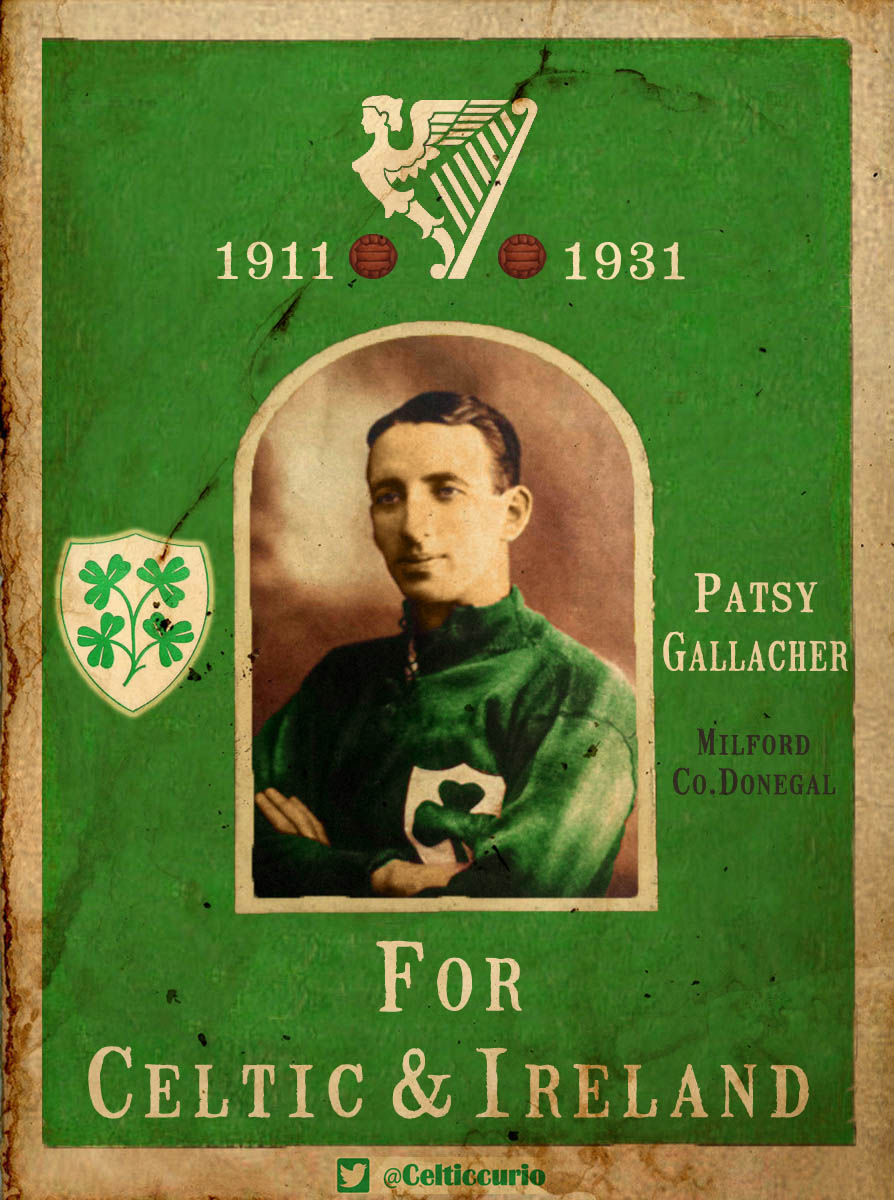
Patsy Gallagher

Amber Barrett celebrated on the same hallowed turf of Hampden Park where the ‘Mighty Atom’ Patsy Gallagher of Milford, Donegal fooled the best of defenders with his dribbling and feints winning four Scottish Cups and six league titles with Glasgow Celtic. Barrett hails from Milford, in 1891 the Poorhouse, which once stood on the outskirts of the town and saw its share of misery in the dark years of the Great Hunger, was where Patrick Gallagher was born his parents would soon leave the hills of Donegal for the shipyards of the Clyde.

In the darkness of the Glasgow night with the Hampden floodlights shining down on her, Amber Barrett kissed the black armband in memory of the ten victims of Creeslough, it was for them, it was for the community of Creeslough and the people of Donegal.

The Ireland women’s team would be part taking in their first World Cup, in her green Irish tracksuit pitchside Vera Pauw spoke to the press celebrating this historic moment with tears and mascara running down her face… Jack Carey would have been proud.

A club for all seasons – 1927-28

Go stand in the members bar and look at the pitch side wall and you’ll see that a huge, framed photograph dominates the wall. It shows 25 men with four trophies seated in front of the old main stand of Dalymount. Of those 25 only twelve are the footballers of Bohemian FC, the remaining gentlemen are committee members as well as the coaching team of Bobby Parker and trainer Charlie Harris. Parker was a Scottish centre forward who went to War as the English First division’s top scorer and returned with a bullet in his back, while Harris had been a top athlete in his youth who also trained the O’Toole’s Gaelic Club and the Dublin County team on occasion.

The all-conquering Bohemian FC team

This is not only one of the greatest Bohemian teams of all time but arguably one of the greatest League of Ireland sides in history. This was a side that swept all before them, winning the League, FAI Cup, Shield and Leinster Senior Cup. Seven of that squad had, or would be, capped by Ireland while Johnny McMahon from Derry was selected by the IFA. Others, like the English born Harry Willits and Billy Dennis were selected to represent the League of Ireland on numerous occasions.

The record for that season for all competitions reads – played 36, won 29, drew 5, lost 2 – Goals for 108, goals against 35. While the team photo does show only 12 players several more were utilised during that remarkable season, however it is true to say that the team starting XI was fairly fixed and six players played in all 36 matches while goalkeeper Harry Cannon played in 35.

Among those players to feature in all 36 games were the Robinson brothers, Christy, at inside forward, and Sam at right back. Both men had been actively involved in the War of Independence, Christy being involved in the raid on Monk’s Bakery when Kevin Barry was captured, while Sam (real name Jeremiah) had been a late addition to Michael Collins’ “Squad”.

Sam almost missed the FAI Cup final when some dressing room hijinks saw a bucket of scalding water tipper over his leg after yet another victory. However, the attentions of Dr. Willie Hooper ensured that Robinson was fit and read for the final against Drumcondra. Despite Drums taking the lead Bohs never panicked and goals from Jimmy White and Billy Dennis secured the victory.

Dennis scored 26 goals in all competitions that season although with only 12 in the league he was some way behind Charlie Heineman, Fordsons’ English centre forward who topped the league scoring charts with 24 goals. In the Shield, which only consisted of eight games, Bohs won seven, only drawing once, while in the Leinster Senior Cup Shelbourne were dispatched 4-1 in a replayed final.

Ireland’s only international that season was in Liège against Belgium, where an Irish side featuring Bohemians Harry Cannon, Jack McCarthy as captain, Sam Robinson and Jimmy White won 4-2 with White grabbing two second half goals for Ireland. Little did they know but many of those players would be returning to Belgium the following year to enjoy more success.

A club for all seasons – 1925-26

The 1925-26 season was a last exit for Brooklyn as the southside club withdrew from the league, being replaced by another Dublin side, Brideville FC who were the original League of Ireland side to compete out of Richmond Park in Inchicore.

Shamrock Rovers were defending champions but there was stiff competition expected from other quarters, mainly from the Fordsons team who started the season strongly and had added Bohemians striker Dave Roberts to their ranks, as well as from Shelbourne for whom John Simpson and Fran Watters provided the bulk of the attacking talent.

Despite all the striking talent in the league in the goalscoring stakes it was once again Billy “Juicy” Farrell of Shamrock Rovers who topped the scoring charts with 24 league goals. An all-round sportsman, Farrell excelled at hockey, cricket, Gaelic football and even billiards. However, the 25-26 season would be the last one in which he would play regularly, a broken leg after a serious motorbike accident in May 1926 prematurely curtailing one of the most promising careers in the League.

For Bohemians their top scorer was the South African, Billy Otto, pressed into service more often as a centre forward after the departure of Roberts, with the likes of Dr. Jim O’Flaherty (another in a long line of Bohemian doctors), Jimmy Bermingham, and Joe Stynes (a prominent Republican during the Civil War and former Dublin county footballer) all chipping in through the season. Between the posts the Irish Army Officer, Harry Cannon had made the goalkeeper spot his own.

As mentioned Fordsons had a particularly good start to the season but it was Bohemians who became the first side to win against them in Cork, securing an impressive 2-0 win. However, this win and the two points that came with it were overturned and awarded to the Cork team after a protest that veteran Bohs player Harry Willits had been listed on a team sheet for the game as “Henry” Willits. The league committee awarding Fordsons the victory due to the mis-spelling of the name of one of the league’s best known and longest serving players.

Despite that dubious victory Fordsons would only finish 3rd in the league, Shelbourne capturing the title for the first time in their history with Simpson and Watters scoring 33 goals between them to propel them to victory. In the Cup however it was to be Fordsons year, they defeated Shamrock Rovers 3-2 in the final in front of a record crowd of 25,000 in Dalymount.

Key to their victory was their goalkeeper Billy O’Hagan, the Donegal born former IFA international saved a penalty from Bob Fullam with the scores tied at 2-2 to inspire his team onwards, and with five minutes to go Paddy Barry scored the winner to bring the cup to Leeside for the first time. Harry Buckle, (who we met in the last issue) made history by becoming the oldest player at 44 years old, to win the cup, a record that still stands to this day.

In terms of trophies Bohemians had to be content with the Leinster Senior Cup which they won 2-1 in a replayed final against Shelbourne, Dr. Jim O’Flaherty grabbing both the goals in the game played on April 19th as one of the final matches of the football season.

A month earlier the League had secured its first inter-league victory, defeating the Irish League 3-1 in a comfortable victory in Dalymount in the first ever meeting between representative teams from the island’s two leagues.

And just a week after that history was made as an Irish international side under the auspices of the FAI took to the field in Turin to face Italy. Despite a 3-0 reverse it was an important first step in world football for the national side, among the starting XI that day were Bohemians Harry Cannon in goal and Jack McCarthy in the defence.

Ireland team v Italy 1926