Devlin’s of Parnell Street

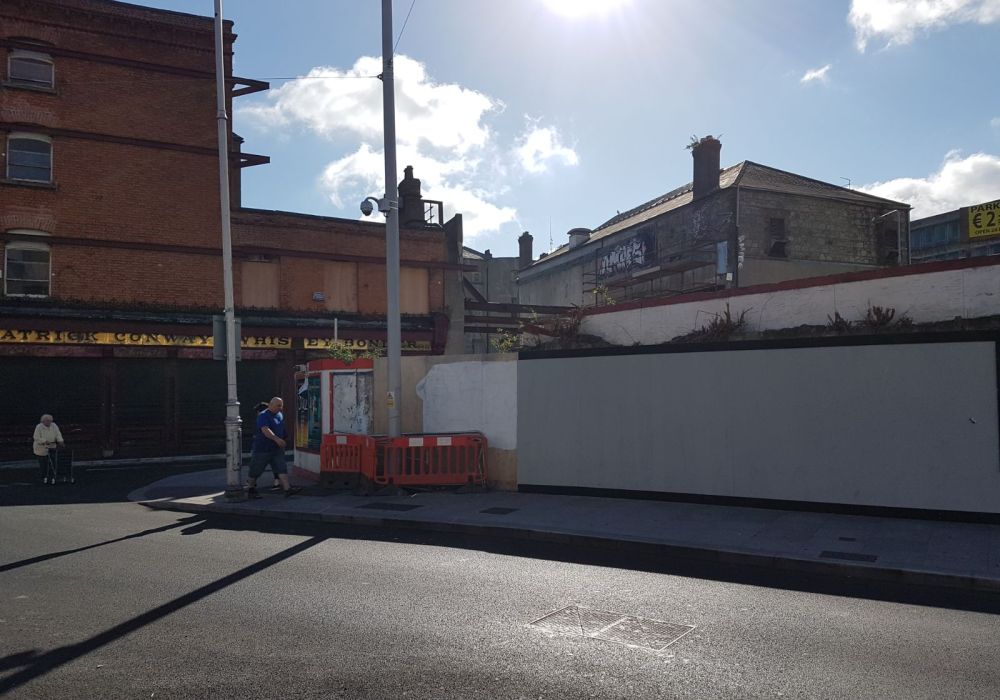
Walk down Parnell Street towards the Rotunda hospital and you’ll pass the junction with O’Connell Street, followed by the Parnell Heritage Pub (formerly the Parnell Mooney) and then at the corner you’ll reach Conway’s Pub which is closed at present. Opposite Conway’s across the junction with Moore Lane is a hoarded off site.  Wooden panels and advertising boards hide an empty space fronting out onto Parnell Street. Behind that is a small surface car-park and next door is the Jury’s Inn hotel.

It’s a fairly featureless site, but one with a certain weight of history associated with it. This site, 68 Parnell Street was formerly home to Devlin’s pub and hotel. A building of huge significance during the War of Independence and the subsequent Civil War.

The building itself was once a four-storey structure with a bar at ground floor level and rooms to hire on the floors above. It was bought by Liam Devlin and his family in 1920.

Devlin's Parnell Street

Devlin’s as it appeared in the Irish Times in 1924. Conway’s pub is visible to the left.

In his Bureau of Military history witness statement Frank Thornton, the Deputy Assistant Director of Intelligence to Michael Collins spoke about how Liam Devlin had taken over the licenced premises in mid-1920 and began running it with his wife. Devlin was originally from Derry but had moved to Greenock in Scotland and had become involved with the Irish Volunteer movement while based there. He moved to Dublin around 1918 and took over the running of what became Devlin’s pub in 1920 along with his young family. Liam Devlin’s son Denis Devlin (born 1908) would later gain a certain literary fame as a poet while also working for as an Irish diplomat in Italy during the 1950’s.

Through his existing connections with the Gaelic League and the IRB Liam Devlin came to be introduced to Michael Collins and quickly offered Collins and his Intelligence staff the use of his premises as a safe-house and meeting place.

Collins used a number of city centre premises as offices and meeting places during the time of the War of Independence, many in the Parnell Street and Square area such as Vaughan’s Hotel and Jim Kirwan’s. Information would be sent to him in these locations, and he would also use them to meet new recruits and make plans for upcoming operations. Devlin’s soon became a sort of unofficial HQ for Collins and his men.

Again as Frank Thornton’s witness statement noted;

We used Devlin’s extensively and every night Mick, [Collins],  Gearóid O’Sullivan, Liam Tobin, Dermot O’Hegarty, Piaras Beaslaí, Frank Thornton, Tom Cullen and Joe O’Reilly met there, the events of the day were discussed and plans were made for the following day. Any particular Column leader or Brigade Officer arriving in town was generally instructed to report to Devlin’s.

Eamon “Ned” Broy, the infamous double agent who was nominally a “G-man” intelligence officer with the Dublin Metropolitan Police but was in fact feeding information to Collins also remembered Devlin’s well. He remarked that it was known by the men as the “No 1 joint” at the time. It was to Devlin’s pub that Broy went to meet Collins after he had been released from prison. Many expected Broy to be killed and were delighted to see him safe and well, Collins celebrated his release in a somewhat unusual manner, Broy remembers Collins marking their reunion “by demanding a wrestling bout with me”.

The benefits of a welcoming city centre location were obvious but the hospitality of the Devlin family was an added bonus, while the premises’ status as a pub provided a good cover. As Thornton noted:

Mrs. Devlin acted in the capacity of a very generous hostess. Visitors from the country never left without getting a meal and in quite a large number of instances a bed for the night. It can be readily understood that a headquarters of this kind in the heart of the city was valuable to the movement generally and particularly to the Intelligence end of things, for, being a public house, no notice was taken of people continually going in and out.

This helps show the role of Devlin’s in the War of Independence and it was of clear importance and use to Collins personally, however it also had a significant role at the end of the Civil War. After the cessation of hostilities between the pro and anti Treaty forces in May of 1923 a general election was held in August of that year which elected the new Cumann na nGaedheal government led by W.T. Cosgrave. One immediate issue facing the government was how to demobilise a national army that had grown to a great size during the Civil War but was no longer needed in peacetime.

A hardcore of army officers, many of whom had been members of the Dublin Guard such as Liam Tobin, feared for their own positions under this demobilisation and some viewed themselves as being unfairly treated in relation to some former British Army officers who had joined the pro-Treaty forces during the Civil War. On the 7th March 1924 an ultimatum was sent to Cosgrave signed by Tobin and Colonel Charles Dalton demanding an end of the demobilisation.

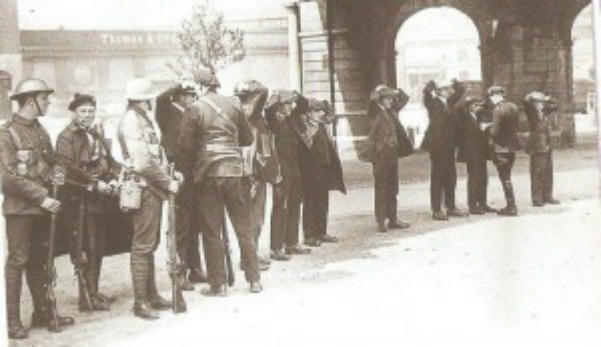
This was understandably viewed as a mutinous act from a section of the armed forces. Immediately afterwards a number of recruits refused to parade and arrest warrants were issued for Tobin and Dalton. By the 18th of March a group of roughly 40 armed men, including Dalton and Tobin decamped to Devlin’s to plan their next move and in response Kevin O’Higgins, the Minster for Justice who had token over the de facto leadership of a government divided by the issue sent lorry loads of loyal Army troops straight to Parnell Street. Two Cumann na nGaedheal TDs, Joseph McGrath and Daniel McCarthy attempted to negotiate with the surrounded mutineers to deescalate the situation. Tobin and Dalton, knowing Devlin’s well from their days there with Collins escaped along the building roofs and ultimately any threat of a wide scale army mutiny or even a coup d’état soon disappeared. The 1924 mutiny resulted in Richard Mulcahy resigning from his role as Defence Minister as well as nine TD’s resigning their seats from the Cumann na nGaedheal government.

More importantly it demonstrated that after almost a decade of death and violence, and only months after the end of a bloody Civil War, that it was elected government, and not the military that held the power in Ireland. It may be argued that the gun began to leave Irish politics after a period of intense militarisation on a spring night on Parnell Street outside a long demolished pub.

August 2019 update

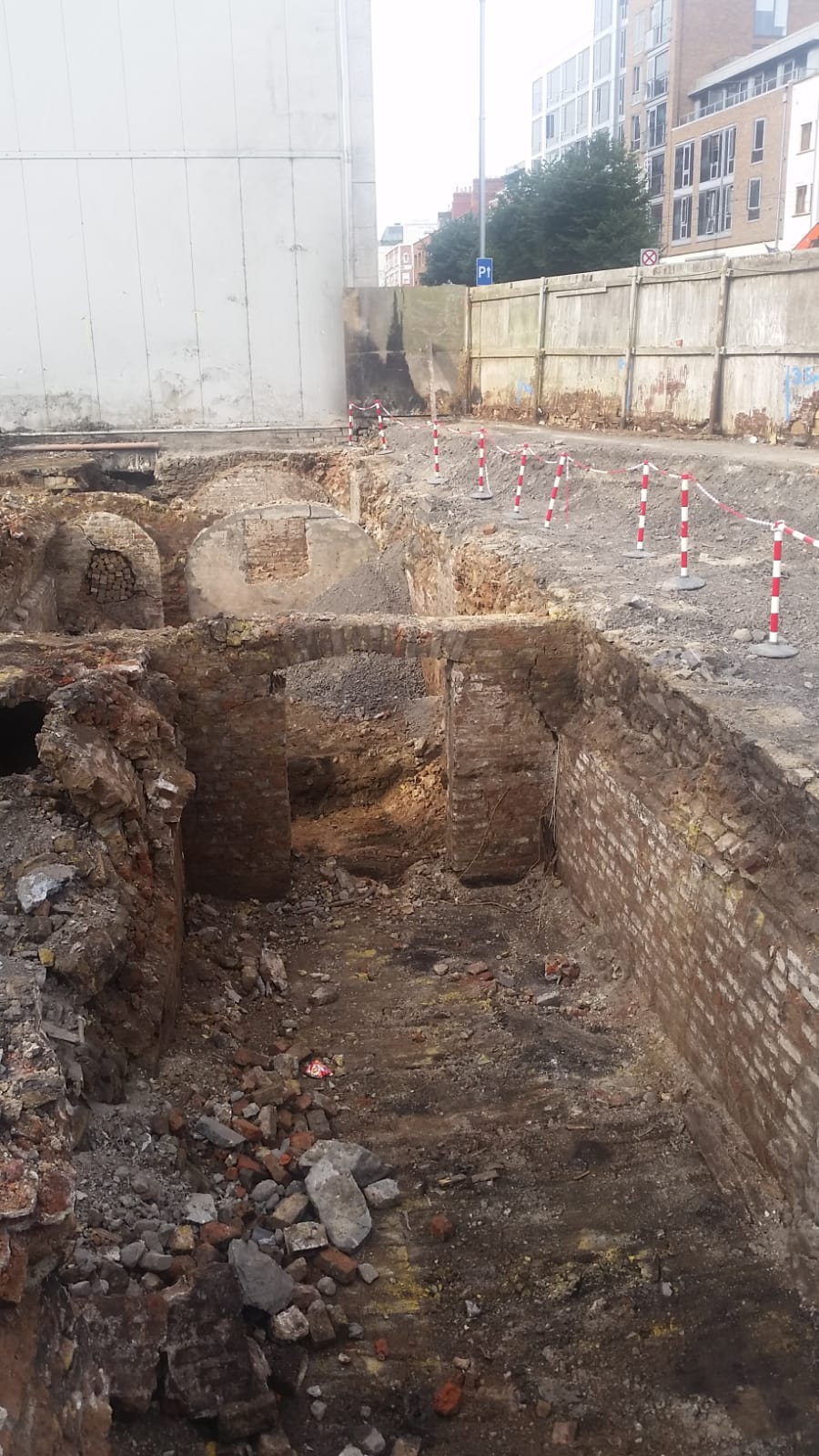
The Devlin’s site is currently being cleared and excavated in preparation for the construction of a new hotel. Below are a couple of photos taken on 29th August 2019 which show the cellars of what presumably would have been Devlin’s pub.

Devlins1Devlins2

April 2024 update

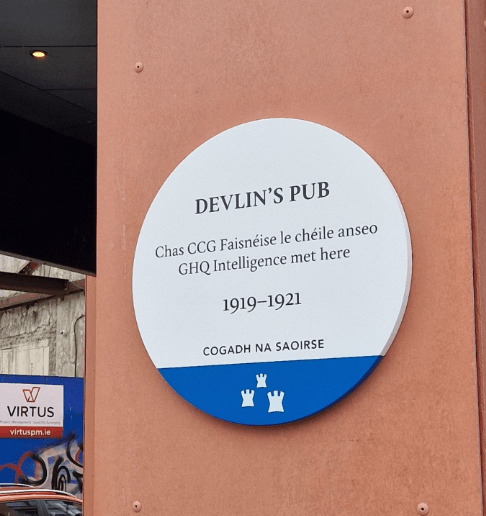
100 years on from the Army mutiny the site of Devlin’s Pub is now the Point A hotel which is currently being expanded. a plaque was unveiled here on 5th April, 2024 by the Lord Mayor of Dublin Daithí De Róiste.

Devlins

Bohemians and brothers in arms – The Robinsons

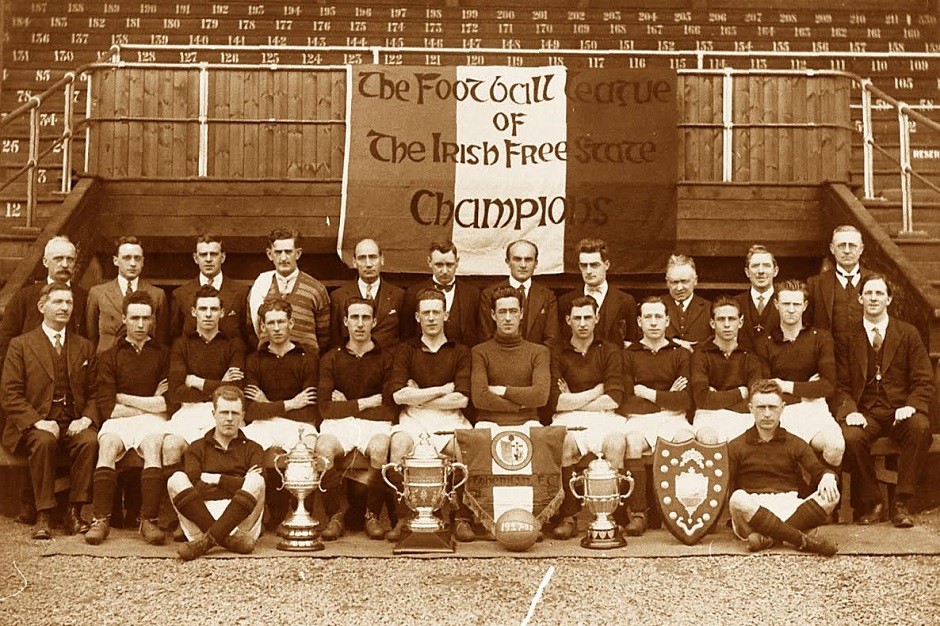
The great Bohemians team of the 1927-28 season is one that has rightly gone down in the annals as one of the finest sides in Irish football history; simply put they won everything there was to win, the League, the FAI cup, the Shield and the Leinster Senior Cup. An achievement all the more impressive when you remember that Bohs were strictly amateur at the time. Such was the confidence and camaraderie in the team that season that Jeremiah “Sam” Robinson, the tall, well-built and versatile half-back or full back, said that the Bohs players of that season never doubted that they would win the game, the only question was by how much. Sam was joined in that successful team by his older brother Christy, smaller and lighter than Sam, he was a tricky, skillful inside-left whose 12 goals had been crucial when Bohs won the league in 1923-24. He also holds the honour of scoring Bohemians first ever goal in the FAI Cup when he netted the first in a 7-1 win over Athlone Town in 1922.

For these achievements alone the brothers are significant and worthy of discussion, however by the time the Robinson brothers had joined Bohemians, as still young men, they had already led an extraordinary life. Both brothers had been active in the IRA in Dublin and Sam had even become a member of the Active Service Unit and later joined Michael Collins’ infamous “Squad ”.

Both brothers played in the Cup Final of 1928 when Bohemians defeated Drumcondra 2-1, although it was touch and go for Sam. Incidentally the reason Sam was known as Sam, and not by his given name Jeremiah was because of the fondness as a boy for using “Zam-buk” soaps and ointments for his legs, something he may have needed in getting ready for the Cup final. During some dressing room hijinks celebrating yet another victory Sam had his leg badly scalded by a bucket of hot water. The damage was so bad that it looked like he would miss the game until the intervention of Bohemians own Dr. Willie Hooper who bound up Sam’s leg (like a turkey cock as he later remarked) and tended to him regularly as they prepared for the final. The squad were worried that the Sam might not make the game but he was declared fit enough to play. Bohs won the match in front of 25,000 at Dalymount, Billy Dennis and Jimmy White getting the goals.

Bohemians have a long tradition of brothers playing in the same team. The aforementioned Willie Hooper and his brother Richard both captained Bohs in the early 1900’s while Sam and Christy had the distinction of becoming the first brothers to play for Ireland after the FAI had split with the Belfast-based IFA. Christy was part of the Irish Olympic squad that went to Paris in 1924 and defeated Bulgaria before being knocked out by the Netherlands in the next round. In all, six Bohemians were selected (Bertie Kerr, Jack McCarthy, Ernie Crawford, John Thomas & Johnny Murray were the others and were trained by Bohs’ Charlie Harris) The Irish team also played two friendlies after being knocked out of the tournament, Christy played and scored for Ireland in the game against Estonia as Ireland won 3-1 and would also represent the League of Ireland XI in their first ever representative fixture, against the Welsh League that same year. Sam won two senior caps, in 1928 and 1931 with a victory over Belgium and with a draw against Spain respectively.

Sam would eventually move on and play professionally for a period, he joined Dolphin F.C. based in the Dolphin’s Barn area of the city in 1930 and won his second Irish cap while there. He was also part of their team which contested the 1932 FAI Cup final, losing out to Shamrock Rovers in a tight game, while also guesting on a number of occasions for Belfast Celtic.

Christy and “Sam” were born in the Dublin’s north inner city on East Arran Street in 1902 and 1904 respectively, their home was close to the markets where their mother Lizzie worked as a fish dealer. Lizzie’s earnings had to support the family; the two boys and daughter Mary, when their father Charles died in 1905.

Sam Rob5

From left to right Christy, Lizzy and Sam Robinson

In 1916 as youngsters of 15 and 12 they would presumably have witnessed first-hand the fighting around the Four Courts just yards from their home and the family would likely have known some of the victims of the infamous North King Street massacre when British Army soldiers shot dead unarmed men and boys. Whatever the reason we know that by 1919 Sam, then aged only 15 had joined the IRA. He was a friend of Vinny Byrne who would also form part of the “Squad” and it was Byrne who brought him along to be inducted. At the time Sam lied about his age and claimed to be 17. The family story was that Michael Collins, on seeing young Sam told the boy that he wasn’t running a nursery and he should go home, however Sam insisted that he wished to join and both Byrne and Paddy Daly (one of Collins’ senior officers) vouched for the young man. It was to begin a long association between Sam and the armed forces.

Christy, also joined the IRA and took part in a number of notable actions, the most prominent probably being the raid on a British Army party at Monk’s bakery on Church Street in September 1920. This was the operation in which Kevin Barry was captured. Christy Robinson was one of the section commanders within H company of the 1st Battalion, Dublin brigade of the IRA during the raid when they encountered a much larger British army force than expected. Kevin Barry found that his new-fangled automatic pistol was jamming and hid under a lorry hoping to escape the attentions of the British forces. After heavy gunfire which left three British soldiers dead, H company withdrew but were unaware that Kevin was still hidden under the lorry on the side of the street. The unfortunate teenager was spotted by the British forces, arrested, and later became the first Republican prisoner to be executed since the Easter Rising over four years earlier.

Kevin Barry had attended the prestigious Belvedere secondary school and had been a promising rugby player. He had graduated and was studying medicine, in fact he intended to go sit an exam only hours after the raid on Monk’s bakery and was not a full time soldier. Christy would later christen his son, Kevin in honour of his executed comrade. Christy later joined the Free State Army and rose to the rank of Captain before leaving in 1924. After his football career Christy would move to England, first to London and later to Dover, where he would pass away in 1954.

Most of the members of the Dublin Brigade were men who took part in operations when they could but had to hold down jobs in order to support themselves and their families. Christy Robinson fell into this category. The IRA however saw the need for a full time force of both soldiers and intelligence staff. This led to the creation of the Active Service Unit (ASU); full time soldiers who were expected to make themselves available as operations required them, they were paid a good wage for the time. Sam Robinson would eventually join this select group of full time soldiers; a role he would continue after Independence.

The Robinson family had been victims during this period of bloodshed, two of the brothers’ cousins met violent ends just weeks apart in 1920. William Robinson, a former British soldier and a goalkeeper for the Jacobs football team was shot dead on Capel Street, just yards from his home in October 1920 by men identifying themselves as “Republican Police”. Another cousin, also named William, but better known as Perry Robinson was one of the youngest victims of the Bloody Sunday shootings in Croke Park. Aged just 11 years old Perry was shot in the shoulder and chest as he was perched in a tree watching Dublin take on Tipperary. The trainer of the Dublin side that day was none other than Bohs’ own Charlie Harris who would accompany Christy Robinson to the Paris Olympics just four years later.

112012_2337_BLOODYSUNDA2

The Dublin Football team on Bloody Sunday- Bohemians trainer Charlie Harris is at the back row, far right.

The Robinson family history tells that Sam was out that morning that would be remembered for all time as “Bloody Sunday”, in the company of his friend Vinny Byrne. Their destination on that fateful day was 28 Upper Mount Street, their targets British Lieutenants Aimes and Bennett. This was a late change to the plans due to a recent piece of intelligence received by one of Collins’ intelligence officers, Charlie Dalton who was also at the time also a member of Bohemians. Byrne and fellow Squad member Tom Ennis led the party. Although not named in these accounts Sam always claimed that he was out with Byrne and his group that day when Aimes and Bennett were shot dead in their beds, Byrne’s own witness statement mentioned that there were a party of about ten men involved and that the operation did not go as smoothly as hoped. The sound of shooting aroused the attention of other British military personnel in the area and the men keeping an eye on the entrance to Mount Street came under fire. Most of the party fled to the river and rather than risk crossing any of the city bridges back to the north side where they could be intercepted. They crossed by a ferry and disappeared into the maze of streets and safe-houses of the north inner city.

Not long after the events of Bloody Sunday Sam became a full time member of the “Squad” when it was reinforced in May of 1921. Within weeks they would be pressed into service in one of the largest operations ever undertaken, the attack on the Custom House, one of the centres of British administration, local Government and home to a huge amount of records.

Sam Robinson Custom House

Sam being arrested at the Custom House, he is fourth from the right with his hands on his head.

This was going to be a huge job and a symbolic attack at one of the nerve-centres of British rule in Ireland, up to 120 men of the 2nd Dublin Brigade along with members of the Squad and the Active Service Unit took part.  They were poorly equipped, armed only with revolvers and a limited supply of ammunition, they did however have plenty of petrol and bales of cloth which was used to destroy the records and ultimately the building itself which burned for five days straight. The raiding party soon drew the attention of a brigade of Auxiliaries. Unable to stay in the burning building, surrounded by the British forces and very quickly running out of ammunition the Republican forces knew they were in serious difficulty. Most of the men surrendered but some made a run for it, a few escaped, but others like Sean Doyle were killed as they tried to get away. Among the more than 70 IRA men captured was Sam Robinson, although he was not to be in captivity long. Within two months a truce had been called and the Treaty negotiations had begun and Sam was released by Christmas of 1921.

Upon his release Sam became part of the new Free State Army, by the 1922 Army census he was listed as a Lieutenant and he was heavily involved during the Civil War, seeing action in areas of some of the heaviest fighting around Cork, Kerry and later Sligo. He was in the Imperial Hotel in Cork City along with other serving officers to have breakfast with Michael Collins the day he was shot. Despite Collins’ initial scepticism about this teenager who had lied about his age to join the IRA he had trusted and promoted Sam. In turn Sam, like many other officers became a great admirer and loyal follower of the “Big Man” and was devastated to learn of his death at Béal na Bláth. In another freak Bohemians connection, the man who tended to Collins as he died was General Emmet Dalton, a former Bohemian F.C. player and later President of the Club.

Sam was promoted to the rank of Captain in February of 1923 and remained in the Army throughout the horrific violence of the Civil War but left, somewhat disillusioned, in 1924. There was concern among members of the Free State army about plans to significantly decrease the size of the army in peacetime and there was also a feeling among some soldiers that ex-British army officers were being favoured for advancement within the Free State forces. Such was the seriousness of this issue that Charlie Dalton (the ex-Bohs player we encountered above, and brother of Emmet Dalton) and General Liam Tobin were accused of attempting an Army Mutiny due to their opposition to the proposed demobilisation.

Sam Rob army pic

Sam in his Irish Army uniform

The army’s loss was Bohemians gain however and the civilian Sam Robinson joined his brother at the club and helped build towards the eventual dominance of the 1927-28 season. It was not to be Sam’s last involvement with the Army however, upon the declaration of the national state of Emergency during World War II Sam re-enlisted and was made a Captain of C Company of the 14th Battalion, his years of experience no-doubt appreciated by younger troops. He stayed in the Army until the end of the War before returned to the trade he had developed as a plasterer. In fact he started his own plastering company, Robinson & Son near Church Street in Dublin.

Things went well for Sam’s business for a while and he was a generous man always making sure that old Army or footballing colleagues were helped out with a job if they fell on hard times. Among those employed at one stage by Sam was his former Bohs team-mate John Thomas. However, in 1957 perhaps because of his generosity, Robinson & Son went out of business, Sam’s auditor incidentally at the time was a young man by the name of Charles J Haughey! While this was a setback Sam used it as an opportunity to travel, his trade took him to Canada, Malta, Britain and even Rhodesia (now Zimbabwe) before he returned to Ireland. Fate would have it that one of his final jobs as a plasterer was on the Phibsboro shopping centre, overlooking the pitch at Dalymount that had been so familiar to him.

Sam’s connection with Bohemians continued long after his playing days ended. His nephew Charlie Byrne began his career for Bohemians in the 1940’s , while his son Johnny Robinson enjoyed a successful League of Ireland career with Drumcondra and Dundalk.  Sam remained a Bohemian member until the day he died in 1985.

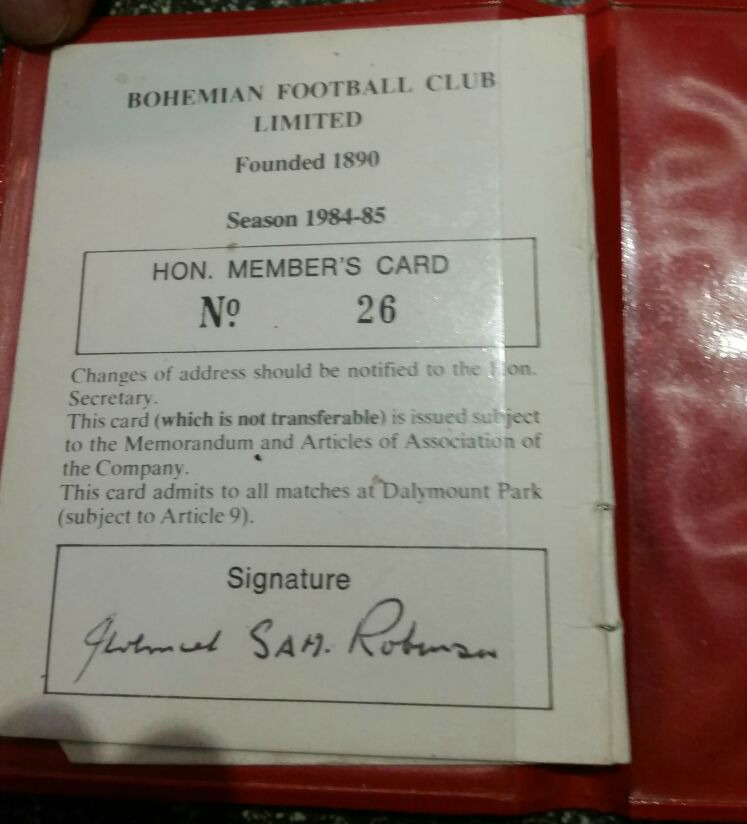
Member card2

The Bohemian membership card of Jeremiah “Sam” Robinson

With special thanks to Eamon Robinson, Frank Robinson and Kevin Robinson for their assistance and sharing their family research and photos.

Football, revolutionaries and my great-grandfather – 1916 and all that

We’ve only begun the year of commemorations and there has already been a great deal written about the various organisations, groupings and competing actors around the dramatic events of Easter 1916.  In much of nationalist history there is a huge role played by sport in the recruitment and training of the Volunteers, this is something often celebrated by the GAA and is born testament to in the naming of stadiums and club teams around the county.

This involvement with the nationalist cause was not limited only to the sphere of Gaelic games. Despite its occasional portrayal as a “Garrison Game” many individuals who were actively involved with football clubs also became key players in the struggle for independence. Among them were family members of my own.

In doing some family tree research I’ve started looking into the history and background of some of the relatives on my Da’s side of the family, people I was vaguely aware of but who by and large had died before I was born. This trail has brought me to a few individuals, my great-grandfather Thomas Kieran (occasionally spelled Kiernan) his sister Brigid and her husband , my great-uncle, Peadar Halpin.

At this point I must state that I do indeed have some non-Dublin blood in my veins, not much mind, but both Thomas and Peadar were from Co. Louth. Peadar would come to prominence due to his association with Dundalk FC and the FAI. He was a founder member of the club and spent decades on the management committee of Dundalk FC and was also club President. He also served as Chairman of the FAI’s international affairs committee and President of the League of Ireland and also Chairman of the FAI Council.

Football in Dundalk, in a somewhat disorganised fashion could be found as far back as the late 19th Century and some of the impetus given to the game in the early 20th Century can be traced back to a Dundalk architect named Vincent J. O’Connell. He had played for scratch teams in the town in his youth and had been a member of Bohemian FC between 1902 and 1907 during a sojourn in Dublin. Upon his return north he set about working with others to bring some structure to the playing of the association game in the town.  The club we know today as Dundalk FC began life as Dundalk GNR, the GNR standing for Great Northern Railway, and they spent a number of years in junior football before being elected to the League of Ireland in the 1926-27 season. The campaign for election to the league as well as the eventual re-branding of the club to Dundalk FC was apparently the result of the machinations of a group of local football enthusiasts comprised of Peadar Halpin, Paddy McCarthy, Jack Logan, Paddy Markey and Gerry Hannon. According to a report in the Irish Times the decision to change the club’s colours from black and amber to white and black was made by one Barney O’Hanlon-Kennedy who promised his silver watch as a raffle prize for a fundraiser for the club. As he was the one putting forward the funds he was given the honour of selecting the team’s colours.

That Dundalk should be so connected with the railway shouldn’t be that surprising, then as now, Dundalk was a major station between Dublin and Belfast, even if the creation of the border did cause disruption. My great-grandfather Thomas Kieran (born in 1889, son of Patrick and Annie Kieran) was a worker for the railway, at the time of the 1911 census when he was 22 years old and residing in the family home of 14 Vincent Avenue in Dundalk (five minutes from the train station). He was listed as being an “engine fitter”, while his father Patrick was a carpenter for the railway as well. Later reports show that Patrick was also involved with the union (the Irish Vehicle builders and Woodworkers Union) and was among the workers representatives when a strike was threatened in 1932. The census also reveals that of the family of five both Thomas and his sister Brigid spoke Irish.

Vincent Avenue

House in Vincent Avenue today, they were build c.1880

Republican roots, what the records say…

When searching through the Bureau of Military history records I came across a number of references to the Kieran family. One referred to the family as a “Volunteer family….railway people”. This came from the witness statement of Muriel MacSwiney, the wife of future TD and Lord Mayor of Cork, Terence MacSwiney who stayed with the Kieran family during one of Terence’s frequent bouts of imprisonment. This is confirmed by the witness statement of another local Volunteer James McGuill who referred directly to Brigid saying that Muriel MacSwiney “stayed in Dundalk with Miss Kieran now Mrs. Peadar Halpin.”

78-1926-08-15-Muriel-MacSwiney-1920

Muriel MacSwiney

On a slight digression Muriel MacSwiney was a fascinating woman, born Muriel Murphy, her family owned the Midleton Distillery and they were firmly against her marriage to Terence MacSwiney and even tried to get the Bishop of Cork to intervene to delay it. As a footnote that will become relevant later, the best man at their wedding was Richard Mulcahy the future Chief of Staff of the IRA, Minister for Defence during the Civil War and later still, leader of Fine Gael. Terence was in and out of various gaols during the course of his short marriage with Muriel, he would be dead by 1920 at the age of just 41, wasting away on hunger strike in Brixton Jail. The impact his death had on the wider world is probably comparable to that of Bobby Sands six decades later. MacSwiney was viewed by many as a martyr in a fight against Imperialism and was cited as an influence by  Mahatma Gandhi as well as India’s first Prime Minister Jawaharlal Nehru.

Apart from providing lodgings for Muriel MacSwiney it’s worth looking at what else the Halpins and Kieran’s were up to at this turbulent time. Thomas Kieran is mentioned again the the Bureau of Military History. In the witness statement of Patrick McHugh, Operational Commander and Lieutenant of the Irish Volunteers in Dundalk during Easter week 1916 listed Thomas Kieran among those “who served Easter Sunday 23rd April 1916, remained with company that day and, volunteered to return home when uncertainty of position was explained to them. Some returning Sunday night, others Monday morning or as Stated.”  Interestingly Thomas is already listed as living in Dublin by this stage while most of those mentioned were still living in Dundalk. Peter Kieran (a possible relation?) another Dundalk based Volunteer declared in his witness statement that Thomas Kieran was among a group of Volunteers who had arranged to meet on the night of Thursday 20th April with plans to make their way to Dublin to join the rest of the Volunteers in the Rising. They had elaborate plans to get there via motor boat but were warned that the Royal Navy had vessels patrolling the area.

The plans for the Thursday journey to Dublin was called off and the group met again on Friday and Saturday night, however word came that the Rising was off, probably a reference to Eoin MacNeill’s order cancelling the Rising, which obviously had a significant impact on the numbers of those who arrived in Dublin. Peter Kieran went on to state that about the second week in May arrests were made in the town by the RIC. The family version of the story that I’ve been told was that Thomas was one of those arrested while cycling his bike with a rifle on his back and that he was later interned!

Peter Kieran in his statement also noted that “Those who served 23rd, 24th and 25th April 1916 and became disconnected, were ordered home on account of age, infirmity or as stated. [included] Peter Halpenny or Halpin [of] Byrnes Row Dundalk”  Although it is hard to be absolutely certain this Peter Halpin could well be our Peadar Halpin, he was listed as Peter on the earlier census return. There is also a record of a P. Halpin from Byrne’s Row who was arrested a couple of weeks after the Rising and sent to Stafford Detention Barracks in England on 8 May 1916. There are other references in other sources to a P. Halpin of Byrne’s/Burn’s Row being arrested and sent to Stafford.

In searching the medal rolls for this issued the 1917-21 Service Medal both Peadar and Brigid appear. Both were issued the medal, Brigid in 1943 and Peadar in 1951. Her deposition states that Brigid was a member of Cumann na mBan from before the Rising. She was involved in dispatch work, fundraising for the purchase of arms, did election work for local candidates and visited republican prisoners. Peadar in his deposition states he was a member of “A” company of the 4th Northern Division of the IRA and that his involvement also predated the Rising, going back to 1915. It doesn’t however, detail individual operations of which he was part.

Patrick McHugh (who we encountered above) managed to escape arrest although he was interrogated by RIC men just after the Rising. He then moved up to Dublin to stay with his sister on Iona Road for a short time until he “got in touch with friends Tom Kieran and his wife [the granny Kiernan], who had a room in Mountjoy Street.” It seems that Thomas Kieran had moved to Dublin sometime between 1911 and 1916. I know he ended up working in the CIE engineering works in Inchicore for many more years. He obviously met Jane Brennan (2 years his junior) when he moved to Dublin, she had been living on Dominick Street Upper at the time.
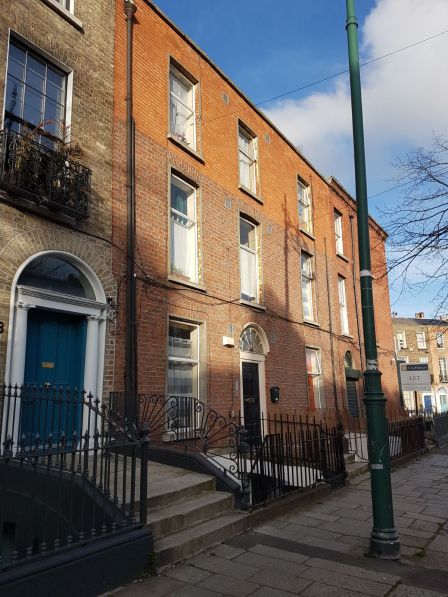
Blessington St1

The house at 27 Blessington Street, just off Mountjoy Street, where the Kierans lived.

Peadar was born in 1895 and grew up in Stockwell Lane, Drogheda. He trained as a cooper, (the trade of his father John) before moving to Dundalk to work in the Macardle Moore Brewery where he later became the foreman cooper. It is interesting to note that his wife Brigid was 12 years his senior. He came from something of a Republican family and a street (Halpin Terrace) in Drogheda bears the family name. This street has something of a tragic history to it as it was named after Peadar’s younger brother Thomas, who was killed there by the Black and Tans in February 1921. At the time Thomas was an Alderman of the local Corporation representing the Sinn Féin party. Thomas Halpin, along with another man, John Moran were abducted from their homes and brought to the local West Gate barracks where they were brutally beaten. They were then dragged to a third man`s home, that of a Thomas Grogan whose house was also raided but fortunately Grogan had been tipped off and had made his escape before the Tans arrival. It was at this spot that Thomas Halpin and John Moran were murdered, their bloodied bodies being discovered there the following morning. Each year the local Council commemorates this event and a monument now stands at the site of the men’s murder.

IRA memorial

Commemorations for Alderman Thomas Halpin & Captain John Moran in 2014


Footballing connections; all roads lead to Bohs

Thomas, is something of a family name, Peader’s brother Thomas was tragically killed and Peadar would name a son of his as Thomas, perhaps in tribute to his murdered sibling. Thomas Kieran would also have a son named Thomas and there is an interesting football overlap as both of these men named Thomas would have a part to play in the history of Bohemian FC.

Peadar’s son Tom lined out for Dundalk in the early 40s before moving to Bohemians in 1947. He featured prominently in Bohs run to that season’s FAI Cup Final where he was part of a team that defeated Drumcondra FC, Shelbourne in the semi-final (where Halpin scored a penalty) and took on a highly talented Cork United side in the final. Cork United had been the dominant team of the 1940s and had already won five league titles by the time they took on Bohemians in front of over 20,000 fans at Dalymount Park on April 20th 1947. The Leesiders were the strong favourites. Bohs were at an added disadvantage as two of their key, experienced defenders (Snell and Richardson) were out injured. Halpin was playing at right half and spent most of his time trying to counteract the attacking threat of Cork’s forward line which included Irish internationals like Tommy Moroney and Owen Madden.

Bohs 1947

The Bohemian team from the 1947 final

Bohs were already 2-0 down before 30 minutes were on the clock but Mick O’Flanagan managed to pull one back before Halpin scored a penalty after Frank Morris was fouled in the box. The game finished 2-2 and went to a replay four days later. In a howling gale and lashing rain Bohs lost out in the replay in front of barely 5,500 people with the Munstermen winning 2-0.

Tom Kieran’s connection with Bohemians was a very long one, a referee for decades, including at League of Ireland level in the 1960s. The uncle Tom was a member of Bohemians since 1969 and was Vice-President of the club from 1985 to 2000 and was later made an Honorary Vice-President for life. Tom’s daughter Susan and her husband Dominic are of course still very familiar faces down at Dalymount to this day.

the uncle Tom

The uncle Tom as photographed for an Evening Herald profile in Dalymount Park

There are further remarkable connections with the Halpin family and with Dundalk and Bohemians as Thomas Halpin’s grandson; Peter was the Commercial Manager at both Dundalk FC and Bohemian FC as well as having a spell with Belfast club Glentoran.

Despite these many connections with the beautiful game the strongest and most influential roles in Irish football were undoubtedly held by Peadar Halpin. He was on the committee of Dundalk FC since at least 1926 and had two spells as Club Chairman from 1928-1941 and 1951-1965 and in 1966 he was appointed Club President, a position he was re-elected to in 1973. He also held a number of roles for the FAI, he was Chairman from 1956-1958 and had many years previous experience on various FAI committees and had made an unsuccessful attempt at arranging UEFA mediation to help resolve the long-running schism between the FAI and the IFA. At the age of 70 he was elected as President of the League of Ireland, it was a role he hadn’t been expecting to fill but after the Dundalk rep Joe McGrath became ill Peadar was the only member of the Dundalk committee with sufficient experience to take on the role. While the FAI and League of Ireland have (with good reason) been seen as conservative and at times backward there were a number of advances that took place during his tenure. It was the Dundalk committee that suggested the introduction of the B division which would eventually lead to the creation of the First Division as well as overseeing the admittance of new clubs to the League of Ireland. On a local level he was crucially involved with the development of Dundalk FC as a force within the League of Ireland, at present they are the second most successful side in Irish club football with 11 League titles and 10 FAI Cups. He claimed that of the many successful years that Dundalk enjoyed his favourite was 1942 when Dundalk beat Cork United 3-1 in the FAI Cup final and Shamrock Rovers 1-0 in the Inter City Cup.

Dundalkimage

Mattie Clarke in action for Dundalk in the 1950s as featured in the Irish Times

A potential politician?

Despite this extremely long connection with Dundalk FC the earliest reference to his involvement was in 1926. Prior to that we know that he was working as a foreman cooper in the Macardle Moore Brewery but in March 1923 his name appears in a debate in Dáil Éireann when his local TD Cathal O’Shannon raised a question on his behalf with the then Minister for Defence, General Richard Mulcahy. This is the same Richard Mulcahy who had performed best man duties at the wedding of Terence MacSwiney and Muriel Murphy who the Halpin’s would later shelter. It is testament to the divisiveness of the Civil War that such former allies could be so opposed.

O’Shannon had been elected TD for Louth-Meath in 1922 as a member of the Labour Party and was a supporter of the Treaty of 1921 which had officially led to the partition of Ireland. Mulcahy as Minster for Defence was a highly controversial figure for some as it was he who gave the order for 77 executions during the Civil War. The content of O’Shannon’s query was a request for an update on the status of Peadar Halpin and the likelihood of his release from Newbridge Barracks where he had been held since August 1922. Mulcahy replied that “Mr. Halpin was arrested for aiding and abetting Irregulars during the time of their occupation of Dundalk. It is not considered advisable to release him at present”, he further added that Peadar was not to be allowed send or receive letters.

As for what “aiding and abetting the Irregulars” referred to, the most likely answer given the fact that Peadar was arrested in August 1922 in Dundalk was that he was involved in assisting the anti-Treaty IRA (or “Irregulars”) in their attack on Dundalk on August 16th 1922. During this attack, led by future Tánaiste Frank Aiken, the anti- Treaty forces captured the town, freed over 200 prisoners held in the barracks and also took over 400 rifles. Rather than try to hold their position the town was re-taken the following day by Free State forces. In all the attack on Dundalk cost the lives of six Free State soldiers and one officer as well as the lives of two of the “Irregulars”. It is not clear what assistance Peadar provided during this time but it was obviously significant enough to warrant him being held in gaol for months without charge.

Family recollections of Jane Kieran née Brennan, the wife of Thomas Kieran are fairly clear on her views on Mulcahy and Cumann na nGaedheal, she put it bluntly and succinctly, saying “they cut the old age pension and they shot them in pairs”. It was not to be the last connection between Peadar and Cathal O’Shannon or Frank Aiken for that matter as the below excerpt shows.
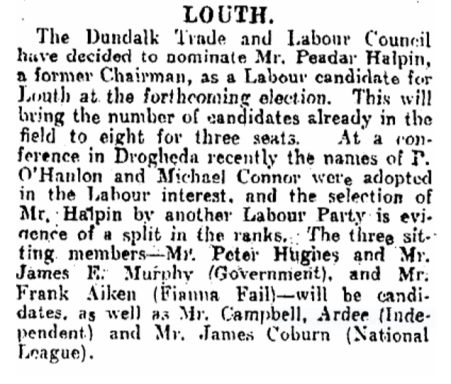
Peadar Labour snip

From the Irish Times April 29th 1927


Cathal O’Shannon stood in the new Meath constituency in the first general election of 1927 and in his absence as the Labour candidate it was proposed that Peadar should run. Among his competition would have been the man he likely assisted during the Civil War, Frank Aiken. However as is the cross that left-wing politics must bear, there was a split, those who proposed Peadar as a candidate were not successful in securing his nomination and Thomas O’Hanlon and Michael Connor ran, unsuccessfully, for the Labour Party. As another of my many side notes, Cathal O’Shannon was unsuccessful in gaining election in 1927 however he later became the first Secretary of the Congress of Irish Unions in 1945, the last president of this Congress was one Terence Farrell, head of the Irish Bookbinders and Allied Trades Union. His nephew Gerard, after whom I’m named, married Nancy Kieran which brings together the Farrell and Kieran clans. Their eldest son was my Da, Leo and as many in the family will know he played for Bohs in the early 60s.

Anyone who has read this blog regularly will know that I often try to look at life and history through the prism of football. Of particular interest is the role that “soccer men” played in the Rising and subsequent War of Independence and Civil War. This is probably the most personal post as I’ve tried to do the same with my own family and their involvement with the nationalist movement. There are many stories that I would love to include but haven’t but would appreciate any feedback or additional information from family members. I hope that this could be the first in a series of posts that might be of interest or maybe just a first draft of something more extensive, there were certainly enough stories told at uncle Joe’s funeral to fill a book, but I hope this might be a start.


With a special thanks to Jim Murphy, Dundalk FC historian for his assistance with some of the research for this piece.