Jimmy Delaney – Cup King

Name a footballer who has won a cup winners medal in three different countries across three separate decades? Quite the pub quiz brain teaser but if you answered – Jimmy Delaney award yourself 5 points.
Delaney the scintillating and pacey Scottish international winger, won a Scottish Cup with Celtic in 1937, the FA Cup with Manchester United in 1948 and the IFA Cup with Derry City in a twice replayed final against Glentoran in 1954. Delaney came within 12 minutes of winning a fourth cup medal, in 1956 with Cork Athletic, but fate, and Paddy Coad intervened.

With Cork leading 2-0 with 12 minutes to go (Delaney then aged 41 had put Cork ahead after 34 minutes) a tactical change by Shamrock Rovers player-manager Paddy Coad helped get them a late lifeline through Tommy Hamilton and two more goals followed between then and the final whistle to deliver the cup to Rovers. The Cork players, including their veteran player-coach Delaney were left in a state shock. Such had been their confidence one of the Cork directors had left Dalymount early to buy bottles of champagne!
Delaney had his own theories as to why Cork Athletic lost the cup – mainly around the team diet. As quoted by Seán Ryan he stated that “Soup, spuds, cabbage, meat was their usual diet while I had a poached egg or something light. They ate too much but they were a grand bunch.”

Despite that down-note at the end of his career Delaney, born in Cleland near Motherwell to Patrick and Bridget in an area populated mostly by generations of Irish immigrants, enjoyed great success on the biggest stages. Signed by the legendary Celtic manager Willie Maley, Jimmy made his Celtic debut as a 19-year-old as part of a squad that included the likes of Celtic’s record goalscorer Jimmy McGrory.
Delaney was a key component of a Celtic revival in the late 1930s winning two league titles and the aforementioned Scottish Cup, while thrilling crowds with his skill, pace and workrate down the touchline. A severe injury to his arm in 1939 would put him out of the game for a time but would also have likely have exempted him from military service as the Second World War broke out soon after. He did however, work in the mining industry to support the war effort while continuing to line out for Celtic in war time games.

After the hardship of War the opportunity to join fellow Scot Matt Busby at Old Trafford proved too good even for a die-hard Celt like Jimmy to resist and in 1946 he joined Manchester United and became an integral part of Busby’s first great post war team. He played an important role in the 1948 Cup Final as Manchester United, captained by Irishman Johnny Carey, defeated Blackpool. Jimmy set up the opening goal for Jack Rowley with one of his pinpoint crosses.

Just after his move to United he enjoyed one of his finest moments in a Scotland shirt, when in April 1946 he scored the only goal as Scotland defeated England in a post-war “Victory International” in front of a crowd of over 130,000 in Hampden Park. He finished his War-interrupted international career with 15 caps and six goals for Scotland, often playing in front of record-breaking crowds. He was posthumously inducted into the Scottish Football Hall of Fame in 2009

After finishing up at United aged 38 further spells with Aberdeen and Falkirk were followed by Jimmy’s Irish adventure in Derry and Cork. Football also continued in his family, his grandson was Celtic centre back John Kennedy whose career was curtailed by injury but who has since successful moved into coaching with Celtic FC.

This piece first appeared in the 2022 Ireland v Scotland match programme.

From Love Street to Gartcosh in the year of ’86

By Fergus Dowd

In the bowels of the Celtic Park dressing room Daniel Fergus McGrain pinched the skin on his arm and inserted the needle in at a 45-degree angle, leaving the syringe in place for the prescribed five seconds.
Outside the Jungle swayed to the sounds of ‘Off to Dublin in the Green’ and ‘Roamin in the Gloamin’ as the Glasgow Old Firm prepared to welcome in 1986.

Sadly, there were no cameras to capture the atmosphere a dispute between television companies and the Scottish Football League resulted in no coverage of football in Scotland between September 1985 and March 1986. At the same time down south, English football also faced a TV blackout while then prime minister Margaret Thatcher proposed the demonising and draconian football ID scheme making it an imprisonable offence to attempt to attend a game without requisite identification.

Among the throngs that January day at Celtic Park was one Frank Bradley, he witnessed thirty-six-year-old McGrain, a diabetic, roll back the years in a man of the match performance as the Celts won out two to nil. Joe’s forefathers had left Co. Donegal and settled in Coatbridge nine miles from Glasgow, close by was the Gartcosh steelworks where his father and many relations had worked – the steelworks would put food on the table for many families in surrounding villages such as Glenboig, Muirhead and Moodiesburn.
With its origins in the Woodneuk Iron Works, which was established in 1865, Gartcosh was eventually turned into a cold reduction strip mill in 1962 by the time Joe’s father joined the payroll. Mr. Bradley and his colleagues would form the steel into flexible sheets that would be shaped into finished products such as automobile components or kitchen sinks.

As Britain joined the European Union in 1973 opening up foreign competiton and the oil crisis plundered economies worldwide, the steel industry contracted. In 1979 as Mrs Thatcher was preaching St. Francis of Assisi on the steps of No. 10 thousands of Scottish steelworkers were wondering how they would support their families as employment in the industry detoriated from a high of twenty-five thousand plus to eighteen thousand a twenty-five per cent decline.

As Danny McGrain continued to tame Rangers main threat Davie Cooper filling in at left-back to accommodate Paul McStay’s brother Willie who played on the right for the New Year’s 1986 fixture – Tommy Brennan and colleagues were planning to march from Gartcosh to the House of Commons in London. They would leave on January 3rd in the snow performing relays to make London in ten days ahead of a House of Commons debate on the steel industry in Scotland; on the first night as they landed in Peebles the tempearture was minus 20.

The workers would successfully achieve their goal, however, on arrival at Downing Street they were greeted by Margaret Thatcher’s staff outlining the so-called Iron Lady was too busy to meet them.
Brennan would lead the men on the road for another mile as they handed their petition signed by twenty thousand Scots into the Queen’s aides at Buckingham Palace. Gartcosh the size of three football pitches would never open again and Ravenscraig steel works where Brennan worked would fold within six years.
Within twelve months of the march Hibs fans The Proclaimers would stand in Elstree Studios, London and sing about a ‘Letter from America’ and on the cover of the single for the world to see was Gartcosh.

For McGrain Scottish bigotry reared its head in stopping him joining his boyhood heroes Rangers his surname leading the local Ibrox scout to believe like Frank Bradley he was of Irish Catholic stock.
The McGrain’s lived in Finnieston an area made famous by the giant cantilever crane, which was like a beast in the skies, its primary purpose to lift tanks and steam locomotives onto ships for export.
Built of granite Daniel Fergus McGrain signed for Celtic in May 1967 twelve days before Jock Stein led eleven Glaswegians to immortality in Lisbon.

He would become part of the Quality Street gang of Dalglish, Hay, Connelly and Macari, his tough tackling and versatility would make him one of Scotlands greatest ever full backs. In those early years after making his bow at Tannadice against Dundee United in a League Cup fixture McGrain would have instant success as Celtic won the league in 1971 and 1972 – a fractured skull that season would put a slight dent in his progress. By 1974 as Celtic were on the cusp of winning nine league titles in a row, he was diagnosed with diabetes which for many can hinder their life never mind a sporting career.
The bearded one from Finnieston worked around his condition becoming a role model for others.

One of his finest hours came in 1979, as Margaret Thatcher was getting used to her new surroundings, McGrain was leading Celtic to a last day championship victory against the blue half of Glasgow. It was a Monday night, the 21st of May, again there were no cameras as a technician’s dispute meant the game would not be televised, a Celtic win would mean the league title. In an atmosphere you could cut with a knife Danny McGrain wore the captain’s armband in the same arm that he would inject to save him from disease and death.

Alex MacDonald silenced the Celtic faithful after nine minutes putting his name on the scoresheet, an instumental cog in Rangers Cup Winners Cup success of 1972 – by 1986 he would be manager of Heart of Midlothian and come within seven minutes of leading the Edinburgh side to a league title.
Ginger haired Johnny Doyle would seek retributon on MacDonald seeing red before half time, only two years later Celtic’s second son of Viewpark would be gone killed in an accident while rewiring his loft at home.

As the Celtic faithful sipped on their half time bovril the championship seemed destined for Ibrox, however, rallied by McGrain the ten men in green and white had other ideas. With an hour and six minutes on the clock Roy Aitken equalised and within another eight minutes bedlam ensued across two thirds of Parkhead as George McCluskey put McGrain’s men in the lead.

In a see-saw tie Bobby Russell equalised for Rangers sending twenty-five thousand blues into delirium believing again the domestic league trophy was headed across the city to Govan. Alas, with five minutes to play a McCluskey cross was cut out by the 6ft 4inch frame of Peter McCloy sadly for the Gers keeper he succeeded in only touching the ball onto the head of Colin Jackson who directed the ball into his own net – cue pandemonium around Celtic Park.

In the dying embers of the game midfielder Murdo McLeod scored the greatest Old Firm goal ever witnessed in the East End of Glasgow as he found the postage stamp of the Rangers goal with a strike sent from the heavens. As the Celtic faithful celebrated another title Daniel Fergus McGrain led his charges on a lap of honour around the famous hallowed turf as Rangers players lay all around him.

The New Years fixture of 1986 was a much straight forward affair for McGrain and Celtic and as Frank Bradley left the stadium for home his thoughts were of his neighbours, friends, and the imminent death of Lanarkshire’s most famous industry. It had only been nine months since Thatcher and her policies had crushed ‘the Enemy Within’ – mining communties across Britain with hundreds of years history were wiped out.

Within four months as Gartcosh lay empty, Alex MacDonald now manager of Hearts had created a team at Tynescastle that was on the cusp of the championship; moulded around Sandy Clark, Gary Mackay, and John Robertson. On the 3rd of May 1986 exactly sixteen weeks since Tommy Brennan had left for London Heart of Midlothian went to Dens Park while Celtic made the short trip to St. Mirren’s Love Street on the final day of the season – the TV cameras were back in situ. The mathematics were straightforward Hearts had to avoid defeat while Celtic needed a Dundee win and they needed to beat the budgies by 3 goals or more.

The men from Parkhead netted five times with Maurice Johnston, who would cross the religious divide of Glasgow, scoring one of Celtic’s greatest ever goals, while at Dens Park step forward Celtic fan Albert Kidd in the final seven minutes netting twice to break Jambo hearts.

St Mirren versus Celtic 3rd May 1986 Love Street Paisley football Celtic win league championship title on last day of season fans celebrate after invading pitch

In in his Lime green strip in the post match celebrations McGrain holds a bottle of champagne pouring it into the mouth of teammate Roy Aitken – McGrain had captured his ninth individual league title medal, it would be his last. Within one year nearly twenty years after he had walked through the doors of Celtic Park Danny McGrain was handed a free transfer; there was talk of a coaching role, but nothing materialised, it would be a decade before he would return.

In an interview thirty years after the march Tommy Brennan said about Britain’s first female prime minister:
‘So, for Mrs Thatcher I will say she brought the salmon back to the Clyde. By shutting the industries on either side of the river she cleaned it up. There you are.’
Where once Frank Bradley’s father and his relations earned their shillings today Gartcosh steel mill has been replaced by the police’s Scottish Crime Campus at a cost of £82million.

Thirty-two years after Love Street nearly to the day Daniel Fergus McGrain was found slumped in the driving seat of his car by police after going into hypoglycaemic shock – he survived – Celtic’s greatest number two still defying the odds.

From Jarrow to Carter and McGrory – In a Time of Hunger

By Fergus Dowd

As the dark clouds hovered above, they carried the coffin passed the shrubbery towards the church door as inside the old mixed with the young. It was Friday September 20th, 2003, and the town of Jarrow was saying a ‘farewell’ to Cornelius Whalen the last of the Jarrow Marchers, aged 93.

Whalen was one of two hundred men to walk from the town’s cobbled streets to London in October 1936 to lobby those in Westminster for work – at the time of industrial decline and poverty there was eighty percent unemployment in the town. Palmer’s shipyard was established in 1851 and was the biggest employer in the area, it built its first carrier within one year of opening and within five years it had turned its attentions to the lucrative market of warships. The founder of the shipyard Sir Charles Palmer, a Liberal Democrat MP from 1874 to 1885, had little interest in the conditions which his workers’ lived in.

Local MP Ellen Wilkinson who marched with Whalen and his comrades quotes a local scribe from the time: “There is a prevailing blackness about the neighbourhood. The houses are black, the ships are black, the sky is black, and if you go there for an hour or two, reader, you will be black”. Following the Great Depression, the National Unemployed Workers Movement began organising what the British Press coined ‘Hunger Marches’ across Britain, the 25-day Jarrow Crusade would arrive in London a week before the Sixth Hunger March. On the 4th of November 1936 Ellen Wilkinson presented the Jarrow petition to the House of Commons, it had been carried in an oak box with gold lettering, signed by 11,000 locals.
As a brief discussion followed in parliament about the Crusade, the marchers returned by train to a hero’s welcome in the Northeast; sadly, it would take the savagery of war to refuel employment in the town.

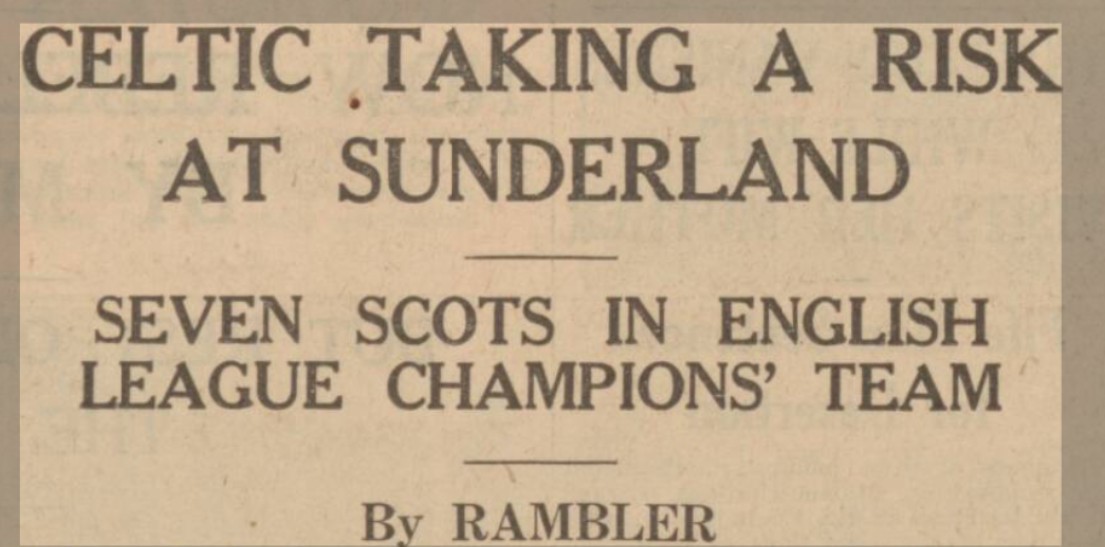
That September 1936 as Con Whalen was practicing walking along the hills of Northumberland the locals were bemoaning admission prices for a Sunderland v Celtic match at Roker Park; dubbed ‘The Unofficial Championship of Britain’. ‘Supporters from both districts will find it an expensive afternoon’s entertainment, with nothing being at stake.’ A fan wrote in his letter to the local press editor.
Horatio ‘Raich’ Stratton Carter at the tender age of twenty-three had led his hometown club Sunderland to the Championship title that April of 1936, midlanders Derby County finished runners up eight points in arrears.

A confident inside forward is how his fellow English teammate Stanley Matthews saw him: “Bewilderingly clever, constructive, lethal in front of goal, yet unselfish.” Like many from Jarrow, Carter would also join the war effort in 1939 becoming a pilot in the RAF stationed in Loughborough. Carter was considered a terrific competitor in school and presented with a gold watch, on leaving, for outstanding performances in football and cricket. George Medley a local scout had promised Carter a trial with Leicester City on reaching age seventeen, following a game with Sunderland a trial was arranged.

On a heavy pitch a couple of days after Christmas Day 1931, Carter was deemed too small for professional football by then Leicester manager Willie Orr; Orr had led Celtic to a league and cup double in 1906/07.
Carter was offered amateur terms initially by Sunderland and would become an electrician earning 45p a week; he would eventually go part time earning £3 a week training two nights a week with the Wearsiders.

Within five years the one they said was ‘too small’ would be joint top scorer for Sunderland that championship winning season and carry the trophy around Roker Park.
A few months after the Celtic match Carter would receive a benefit cheque of £650 for five years of service at Sunderland, despite a long career at the club and leading the club to the FA Cup in 1937, he would never receive another benefit.

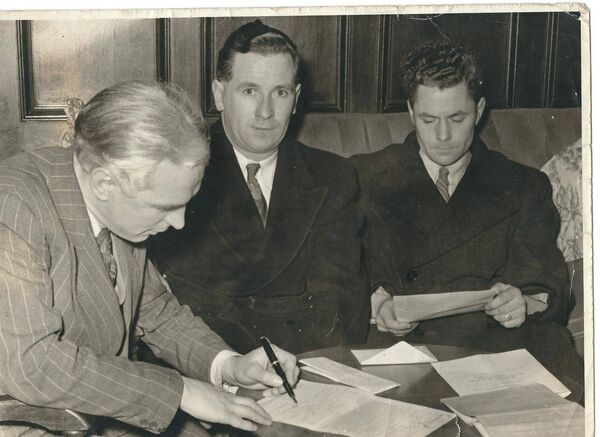
By 1953 in the twilight of his career Carter found himself in southern Ireland lining out for Cork Athletic; it was said he was paid £50 per match plus £20 expenses, this enabled him to fly from Hull to the Emerald Isle for matches. Carter had become manager of Hull City but a rift with Chairman Harold Needler led to his departure in January of that year, he left football to run a sweet shop. However, within one month Cork Athletic Secretary Donie Forde and director Dan Fitzgibbon had performed a miracle tempting Carter to Leeside.

Raich Carter signing for Cork

It proved an inspirational signing, after making his league debut versus Waterford, Carter and Cork would face Drumcondra. The Dublin club would make an objection regarding Raich’s residency in Éire, he had landed only two weeks previously, his match fee was earned as he scored the victorious goal at Tolka Park. Raich Carter would go on to win an FAI Cup winners medal with Athletic that season and play for a League of Ireland XI versus an England league select.

Glasgow Celtic arrived in Sunderland in the autumn of 1936 after winning the Scottish Championship a few months earlier, Aberdeen and Rangers finished tied for second place five points a drift.
In that winnig team was the ‘human torpedo’ Jimmy McGrory who was coming towards the end of his career, by December 1937 he would take the hot seat at Kilmarnock. McGrory was born in Garngad in North Glasgow a place commonly known as ‘Little Ireland’ given the ethnic idenities of many of the habitants. The atmosphere in the area was corroded with incessant smoke and fumes from the Tharsis Sulphur & Copper Works and the Milburn Chemical Works; in 1904 as wee Jimmy was taking his first breath on this earth the Provan Gas works was opened by Glasgow Corporation. It did nothing to improve the environment and only added to the breathing problems and illness for those in Garngad.

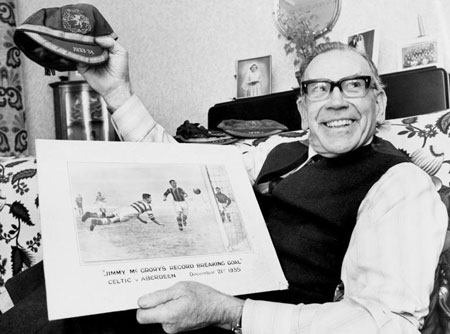
In 1921 then Celtic manager Willie Maley signed James Edward McGrory as an inside right from junior side St. Roch it would take him two years to make his debut against Third Lanark in January 1923; he had been loaned to Clydebank intially. Jimmy would be top scorer for the hoops twelve seasons in a row, and the season of 1935/36 would see him top of the European charts after netting fifty times; he was also European top scorer nearly a decade earlier scoring forty-nine times. In 1928 the Arsenal of North London offered £10,000 to make him the highest paid player in Britain. A true Celt Jimmy refused to leave Parkhead; the Celtic board hoping his departure would boost the clubs accounts were furious at his decision. So, much so they secretly paid him less wages than his fellow teammates for the rest of his career. Jimmy to the delight of the Sunderland defence was omitted from the Celtic team that Autumnal day. After notching up 472 goals in 445 league & cup appearances McGrory would retire a year after the Jarrow Crusade. Like Carter he would go on to be a manager leading to Celtic to a 7-1 victory over Rangers, a British record in a domestic cup final – ‘Hampden in the Sun’ they call it!!

Jimmy McGrory in later life

On September 16th, 1936, seventeen thousand paid in at Roker Park to watch Sunderland take on Glasgow Celtic, that same day in a sign of things to come Antonio de Oliveria Salazar’s right-wing dictatorship in Portugal unveiled the Portugeuse Legion a paramiltary state organisation setup to ‘defend the spiritual heritage of Portugal”. In goal for Sunderland that day was Johnny Mapson, he replaced Jimmy Thorpe. Thorpe was netminder for Sunderland from 1930 to 1936, on his one hundred and twenty third appearance against Chelsea in February 1936 he was kicked in the head and chest but played on.
After arriving back home Thorpe collapsed and four days later in hospital, he took his last breath.

His widow was presented with his 1935/36 championship medal and the FA rules changed stopping players kicking the ball out of goalkeepers’ arms. Mapson would concede only one goal, on the hour mark to Malky MacDonald who like McGrory had started life at St. Roch’s.

Raich Carter had opened the scoring for the Black Cats on the twentieth minute and referee Harry Nattrass who had officiated the FA Cup final of 1936 drew the afternoon’s proceedings to an end.
As the Jarrow marchers arrived in the Yorkshire town of Wakefield a month later on the 14th of October, Nattrass was refereeing at Hampden Park as the Nazi emblem flew alongside the St. Andrew’s Cross.
The teams would meet again a fortnight later at Parkhead, the green and white would win out three to two this time, thirteen thousand would witness McGrory netting twice.

Today in England there are no hunger marches, although you will find foodbanks at most league grounds on a Saturday; In Sunderland Raich Carter is eulogised in written word and art, while the name McGrory rolls off the tongue easily around Parkhead.
In Jarrow there is a statue dedicated to those who walked to London and if you care to have a pint in one of the locals, an Old Cornelius should be ordered in honour of a great man.

Celtic connections

They came across the narrow channel from the Antrim coast in the north-east of Ireland to the island of Iona in a wicker currach leaving behind conflict and bringing their religion to the neighbouring land. It was the year 563AD and their leader was Columba, a man now venerated as a Saint whose patronages include the lands of Ireland and Scotland and with him he rather appropriately brought twelve followers.

He certainly wasn’t the first Irish man to make this crossing. The Dál Riata kingdom of north Antrim had been expanding into western Scotland since the early 5th Century, even before that in the 3rd Century the Picts who lived north of Hadrian’s Wall had sought help from their Irish neighbours in their campaigns against Roman imperial might. Back then the Romans had referred to the tribes of northern Britain as the Caledonians, they called their Irish allies the Scotti.

In time Iona, where Columba landed became a great centre of learning and religious devotion and a prestigious Abbey was founded there. From Iona, the Picts were gradually converted to Christianity as were the Anglo-Saxons of Northumbria. In the centuries to come the name of the Scotti would become the name of the Gaelic speaking land north of the River Forth; Scotland – the land of the Gaels. Iona remained a focal point for centuries, it was a burial place for Scottish Kings who traced their power and authority back to the sacred island.

Iona monastery

The medieval Abbey church on Iona

But if the Irish gave Scotland its very name and the beginnings of the Christian faith then the Scots can lay some claim to giving Ireland football. In 1878, so the story goes, John McAlery, a Belfast businessman was on his honeymoon in Scotland and went to watch a game of Association Football. The views of Mrs. McAlery on this matter are not recorded. Greatly enamoured with the game the sporty Mr. McAlery arranged for an exhibition game to take place later that year in the Ulster Cricket Grounds in Belfast between Scottish sides Queens Park and Caledonians with Queen’s Park running out 3-2 winners.

A year later he formed Cliftonville Association Football Club in his home city and they advertised for new players as a club playing under the “Scottish Association Rules”. By the end of 1880 McAlery, along with  representatives from six other clubs had formed the Irish Football Association (IFA). Cliftonville F.C. exist to this day, while the IFA remains the 4th oldest Football Association in the world. While football had existed in Ireland before John McAlery it was he who set about putting in place a proper organisation and structure around the game. Had John taken his honeymoon somewhere other than Scotland then the history of football in Ireland may have been very different. Sadly the McAlery honeymoon story is definitely apochryphal but this hasn’t stopped it persisting. What is undeniable is that McAlery, and Scottish Clubs were at the forefront of the instigation of organised football in Ireland.

The game had grown quickly in the north east of Ireland and began in time to gain popularity in Dublin as well with the formation of clubs like Bohemian F.C. (1890) and Shelbourne F.C. (1895). A league was duly formed as well as cup competitions. But despite the good works of John McAlery and other early pioneers of the game Ireland’s early record in international competition makes for some harrowing reading. The international highlight in the early years was a 1-1 draw with Wales in 1883 sandwiched between a 7-0 loss to England and a 5-0 loss to Scotland. It would be 1914 before the Irish would win the annual Home Nations Championship outright, defeating Wales and England before facing Scotland knowing that if they avoided defeat they would triumph. Despite the match being held in Belfast Scotland remained the favourites, the Irish papers noting especially that the Scots were the more physically imposing side. However, in a torrential downpour a weakened Irish side managed to secure a draw and with it their first outright victory in the Home Nations Championship. They hadn’t beaten the Scots but they had won the day.

It was to be the last victory as a united Ireland though, not long after the end of the First World War the Football Association of Ireland (FAI) was formed as a breakaway association from the IFA. The FAI eventually secured recognition from FIFA and, grudgingly, from the Home Nations as the Association representing the 26 counties that would become the Republic of Ireland. What they could not secure however was favour from the Home Nations who refused all fixture invitations from the nascent organisation. Eventually over two decades later England agreed to a friendly in 1946, Wales waited until 1960 before playing the Republic. Scotland refused all invitations and only played the Republic when drawn against them in a qualifier in 1961. Despite their breakaway from the IFA the FAI remained in awe of the Home Nations and valued games against them more than any other, they fervently craved not only the money that these games would bring but also some sense of acceptance from their neighbours. Naturally this made the cold shoulder that they received all the more painful.

This desperation for acceptance can be encapsulated in a single game. In 1939 Ireland were due to play the Hungarians, who had been runners up to Italy in the 1938 World Cup and had played against Ireland twice before in the recent past. On both occasions the matches took place in Dalymount Park in Dublin. However on this occasion the match took place in the smaller Mardyke grounds of University College Cork and home to League of Ireland side Cork F.C.

So why were the World Cup runners up being asked to play in a University sports ground rather than at the larger capacity Dalymount? Well because there was a bigger game taking place in Dalymount just two days earlier on St. Patrick’s Day 1939, when the League of Ireland representative side were taking on their Scottish league counterparts.

Even a game against a Scottish League XI was viewed as a huge mark of acceptance from their Scottish peers. While the game in the Mardyke would attract 18,000 spectators, a respectable return, over 35,000 would pack into Dalymount Park to see the stars of the Scottish League. At the time commentators were moved to describe the match against the Scottish League as “the most attractive and far reaching fixture that had been secured and staged by the South since they set out to fend for themselves” before adding that “for 20 years various and futile efforts have been made to gain recognition and equal status with the big countries at home. Equality is admitted by the visit of the Scottish League”. For the FAI a game against any Scottish team was a game against giants.

Giants, funnily enough, feature prominently in Celtic mythology. Fionn MacCumhaill is arguably Ireland’s most famous character from myth, famed for his size and for his prodigious strength. He is credited with having created the Isle of Mann by scooping out the land of Loch Neagh and hurling it into the Irish Sea. However even a man of this power was no match for the Scottish giant Benandonner. In myth Fionn learns that Benandonner is coming for him in combat from Scotland and Fionn does the only sensible thing, he runs to his wife for help. Benandonner is so huge that Fionn fears that even he won’t stand a chance in a fight so he does what any man would do, he has his wife dress him up as a giant baby and put him sleeping in a cradle in front of his fire. When Benandonner arrives demanding to know where Fionn is, Fionn’s wife Oona tells him that he is out but will be back shortly. She introduces the “baby” as her and Fionn’s infant son. Seeing the size of the baby and not wanting to meet the enormous child’s father Benandonner flees back to Scotland, on his way he destroys the bridge that links Scotland and Ireland behind him. Folklore tells that Antrim’s Giant’s Causway was a left as the remnants of this destroyed bridge.

For the FAI the Scots remained giants. Like Benandonner they could not be beaten by force but only by cunning. In 1963 a 1-0  victory by Ireland over Scotland in a friendly was greeted with elation by the Irish football public as one of its greatest ever  despite the narrow nature of the win.

While the awe in which the Scottish national team were held has faded significantly over the intervening decades the affection and devotion to one of her clubs remains as strong as ever. Writing as a Dubliner it sometimes seems impossible to avoid the prevalence of Celtic jerseys in my home city. In many ways this is understandable, while the island of Ireland might be grateful to John McAlery for bringing Scottish footballers to Ireland, the Irish in turn had a significant impact in creating the footballing landscape of Scotland. Beginning with the foundation of Hibernian F.C. in 1875 and continuing with the foundation of clubs like Dundee Harp, Dundee United and Celtic the Irish immigrant community and their descendants helped to create some of the most significant football clubs in Scotland.

This came about largely because of a period of mass migration of Irish people to Scotland from the 1820’s onward. Scotland’s industrial towns provided jobs, while Irish counties like Down, Antrim, Sligo and Donegal provided willing seasonable labour for Scottish factories, shipyards and farmers and this mass influx across the Irish Sea gathered apace after the Potato Famine began to grip Ireland in 1845. The parentage rule as introduced by FIFA has meant that the Irish national team have continually benefited from this immigrant connection even at the recent Euros two members of the Irish squad were Scottish born players; Aiden McGeady and James McCarthy.

Domestically clubs like Hibs and Celtic would emerge from these immigrant communities, often forming a charitable focal point at the centre of new Irish communities. While Hibs still prominently wear green and white and their current logo includes an Irish harp as a nod to their foundation (though it was removed from the crest for a period after the 1950s) they seem to be less defined by an Irish identity. Celtic however are for many the Irish club. This does have the tendency to cause some confusion for those fans of clubs actually based in Ireland.

Celtic’s Irish credentials are indeed impeccable. Founded in 1888 by Andrew Kerins an Irish Marist brother from Co. Sligo, (better known as Brother Walfrid), the club was created to support the poverty stricken Irish community in Glasgow. When Celtic Park was being opened in 1892 it was the Irish Nationalist and Land reform agitator Michael Davitt who laid the first sod,  the turf brought over from the “auld sod”, Co. Donegal. Davitt would be made an honorary patron of Celtic,  a position he also enjoyed in the Gaelic Athletic Association (GAA) who in 1905 would issue a ban on any member either participating in or even watching ‘foreign’ games.

“Foreign Games” meant anything that could be construed to be English, or indeed Scottish and as such obviously included Association Football which may have put the ageing Davitt in an awkward situation. The club have also had many prominent Irish players and managers associated with them throughout their long history; men such as Neil Lennon, Seán Fallon, Martin O’Neill and Packie Bonner, while even the likes of Roy and Robbie Keane have had brief Celtic cameos during their careers. In terms of ownership Irish businessman Dermot Desmond is the club’s largest individual shareholder. The early successes of Celtic helped prove that imitation was the sincerest form of flattery as in 1891 a group of Belfast sports enthusiasts from the Falls Road area formed Belfast Celtic F.C. Their early Chairman James Keenan noting that they chose their name “after our Glasgow friends, and that our aim should be to imitate them in their style of play, win the Irish Cup, and follow their example, especially in the cause of Charity.”

While all of this provides a strong basis for the popularity of the club in Ireland the other major aspect is of course that Celtic have been successful, from being the first British winners of the European Cup in 1967 to their 47 Scottish League titles theirs is a level of dominance, at least at domestic level, that is rarely seen. While as recently as the 2002-03 season Celtic reached the final of the UEFA Cup the fortunes of the club and the Scottish League in general have struggled recently when it has come to progress at European level. Despite this, support remains strong for the club in Ireland and their presence ubiquitous. Celtic flags and banners fly from Dublin city pubs while a musical treatment of Celtic’s history plays at present in one of the city’s most prominent theatres. In the commemorations to mark the centenary of the 1916 Rising the imagery of Celtic has been invoked as somewhat apocryphally one can purchase a “replica” Celtic jersey emblazoned with the name “Connolly” where once a Magners cider logo appeared. A reference to the Scottish born labour activist James Connolly who was among the leaders of the Rising; son of Irish immigrants he was born in the Cowgate area of Edinburgh and was a passionate Hibernian fan.

Celtic collage

“Celtic the Musical” in Dublin’s Gaiety Theatre, an Irish tricolour next to a Celtic Flag at a restaurant in Temple Bar, a “replica” Celtic jersey featuring the name of executed 1916 leader James Connolly.

The stories of Fionn and Benandonner, the competing giants of Ireland and Scotland remain prominent stories in Irish folklore however they enjoyed a new lease of life in the 18th Century when Scottish poet James Macpherson compiled and re-framed the ancient myths into a book of poetry. The publication of his work was a literary sensation at the time but also caused debate and controversy as Irish historians felt their literature and history were being appropriated. The truth is that as we’ve seen with the historic patterns of movement and the shared culture between the two islands; from 6th Century monks to the Ulster plantations and the Famine migrations of the mid 19th Century, the two nations share far more similarities than some political groups and indeed football fans would care to admit. It was from Scotland that the original Irish football organisers took their inspiration but even by that stage the Irish in Scotland were already creating clubs that would help to dominate the Scottish football landscape. In a confused and confusing identity relationship it becomes hard to separate the interwoven strands of our social and sporting DNA. Where the Irish ends and the Scottish begins.

This article originally appeared in the Football Pink issue 14, they’re a great publication and well worth a subscription.