Groundhopping – FC St. Pauli

I’m not one for New Year’s resolutions, I think most of the time they tend to be things we think we should do than things we really want to do. But I usually aim to visit one new place that I’ve never been to before within the follow twelve months, it’s something I know I want to do, and it is usually fairly achieveable.

It is also a good opportunity to catch a game or two, I wrote early in the summer about my trip to Essen and Cologne and I managed to squeeze in a trip to Hamburg just before the New Year, joined once again by Brendan, my German, football-obsessive mate.

With the German season having just finished for its winter break there wasn’t a chance to catch a game though I did want to visit the Millerntor, the stadium of FC St. Pauli, a club that may not boast an extensive trophy cabinet but one that has an international reputation as a “Kult” club and for situating progressivism at the forefront not only of its image but its day to day existence. Their stands bear slogans like “Kein Fussball den Faschisten” (No football for Fascists) and “Kein Mensch ist illegal” (No one is illegal). Their “skull and crossbones” logo has also become ubiqutious and can be spotted in the most unlikely of places. According to our guide, despite the relative size of the club St. Pauli are often in the top three or four clubs in Germany in terms of their revenue from merchandise.

St. Pauli is a quarter within the city of Hamburg, it sits close to the port on the river Elbe as well as the famous Reeperbahn home to the city’s red-light district and once home to The Beatles who performed in many of the clubs in the area. The ground is also situated right next to an enourmous, former Nazi bunker, now being turned into a luxury hotel.

The stadium is modest by some standards, the club can’t build beyond a capacity of 30,000 and they have avoided some of the soulless bowl type conventions with our tour guide noting with pride that they preferred the “English style” of four individual stands, close to the pitch. Three of the stands also feature a mix of seating and terracing with only one stand being an all-seater though they do also host a number of quite luxurious, customised corporate boxes.

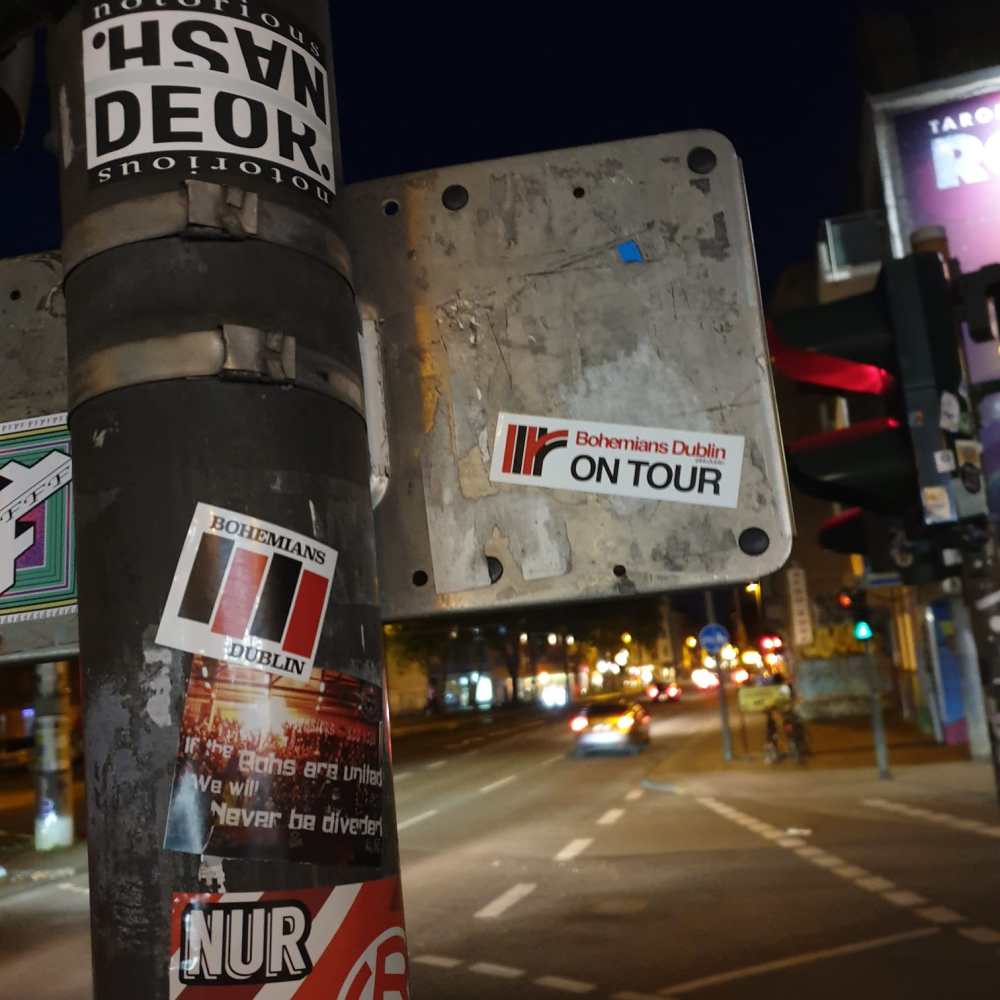
Anyway here are some pics and I’d like to get back and try and catch a game here before the season ends and maybe do a double header with an Altona 93 game in the Regionalliga. And while it seems far fetched it still feels that it might be possible for League of Ireland clubs to steal a few more ideas from a club like St. Pauli and adapt them for an Irish context. Well here’s hoping.

This slideshow requires JavaScript.

Three fates of the German League

In February 1956 the League of Ireland XI played an inter-league match against a team from the Oberliga Hessen, a German selection from the state of Hesse, home to cities like Frankfurt and Offenbach. Adorning the cover of the match programme is a photograph of a three-figured statue with a vaguely religious air and surrounding the statue are rows of men in suits and still others in uniform, all solemn onlookers. This photo seems incongruous with its subject matter, that of a simple football match. But perhaps it tells us something more about Ireland, Germany and the two country’s relationship in the 1950s.

Saint Stephen’s Green – Saturday 28th January, 1956

It was just over ten years after the end of the Second World War and on a cold January morning a crowd had gathered at the Leeson Street corner of St. Stephen’s Green park. Among their number was the 35 year old Minister for External Affairs, Liam Cosgrave, a future Taoiseach and opposite him stood the German Minister to Ireland Dr. Hermann Katzenberger, a man who had once presided over the upper house of the German parliament.

Katzenberger looked every inch the stereotypical German gentleman, with his rounded spectacles framing a bushy Edwardian era moustache. The left sleeve of his suit jacket hung empty, tucked into a pocket, the result of an arm amputated when he was barely out of boyhood and serving in the trenches of the First World War. As a conservative Catholic he was a member of the Zentrum (Centre) party of the late 1920s and early 1930s but had fallen foul of Franz von Papen who sought to move the party further to the right and ultimately assisted in bringing Adolf Hitler to power in 1933. When the Nazis came to power they viewed Katzenberger as “politically unreliable” and saw to it that he was removed from any position of influence during their murderous reign.

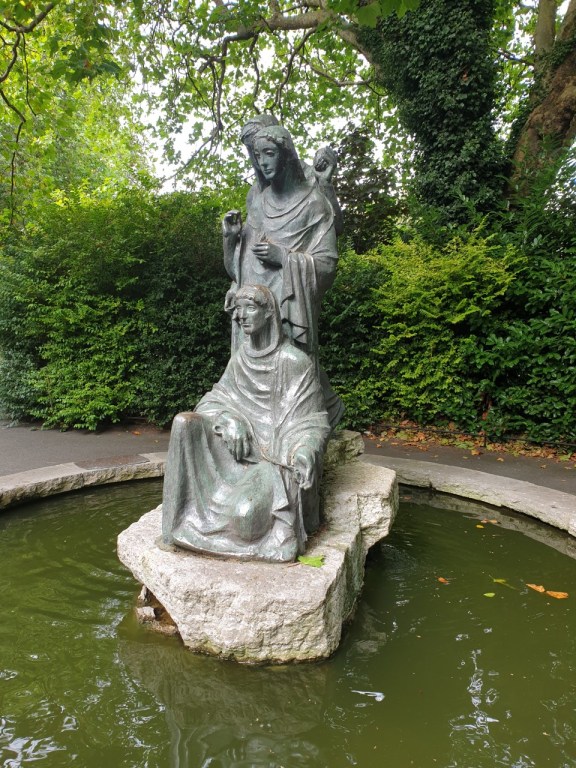
But Katzenberger prevailed, after the War he was involved in setting up the Christian Democratic Union of Germany (CDU) which became the most successful political party in the country. As a man with a passion for writing and journalism he was also involved in founding the Neue Zeit, the newspaper of the CDU, but that was years earlier – Here he was on a winter’s morning in Ireland, just months away from his final professional posting, with his retirement on the horizon. He stood before a statue of three female figures, the Three Fates of Norse mythology; Urd (past), Verdandi (present) and Skuld (future), they who control the destinies of Gods and men.

This theme is laid bare in the bronze plaque that the men must unveil in front of the waiting dignitaries and press corps, written in English, Irish and German it states “This fountain, designed by the sculptor Josef Wackerle, is the gift of the people of the German Federal Republic to mark their gratitude for Ireland’s help after the war of 1939-45. The bronze group portrays the three legendary fates spinning and measuring the thread of man’s destiny.”

Stephen's Green plaque three fates

Bronze commemorative plaque at the Three Fates monument

Absent from the gathering was Dr. Kathleen Lynn, who had passed away some four months earlier, the vice-chair of the Save the German children campaign which had helped give safe and secure homes to almost 500 German children in the years immediately after the war. Lynn had spent some of her early education in Germany in the late 19th century, like Katzenberger, and like Cosgrave’s father – W.T. she had seen violence first hand, had seen what a bullet or grenade could do to a body. During the 1916 Rising she had been Chief Medical Officer for the Irish Citizens Army, stationed at City Hall. As she moved away from politics she had devoted her life to helping children, through her work in founding St. Ultan’s children’s hospital and later through her wholehearted support for offering respite for children in post-war Germany.

Statue2

The Three Fates statue in St. Stephen’s Green (photo Gerard Farrell 2019)

It was these actions that were primarily in the mind of the sculptor when the words “Ireland’s help after the war” were cast in bronze. When Katzenberger arrived in Ireland in 1951 to present his credentials to Sean T. O’Kelly as German minister, the generosity of Irish families in offering to host German children, (some of them orphans, most of them merely suffering the poverty of a vanquished, rubble-strewn nation), was foremost in his comments. For O’Kelly’s part he referenced with pleasure the role that German scholars had played in studying and documenting the Irish language and folklore, and cited this as a particular tie connecting the two nations. The Irish President would later be awarded the Order of Merit of the Federal Republic of Germany. When the award was created in 1951 its stated aim was to acknowledge achievements that served the rebuilding of the country in the fields of political, socio-economic and intellectual activity, and is intended to mean an award of all those whose work contributes to the peaceful rise of the Federal Republic of Germany.

So much for the political and diplomatic context, now on to football. While the February 1956 game was not organised to coincide with the unveiling of the “Three Fates” statue in Stephen’s Green an explicit connection between the fraternal relations enjoyed between the two nations was made by the use of the cover photograph on the match programme.

This can been seen as part of an ongoing football and political relationship between the two nations stretching back at least to the 1930s. I’ve written extensively elsewhere on this blog (here and here for starters) about Irish football connections with Germany during Nazi rule and the problems that this raises. The post- war relationship is one that I haven’t covered as much until now.

1956 cover

Cover of the 1956 programme showing the unveiling of the “Three Fates” statue

There is a popular footballing myth that the West German National team wore a green away jersey for many years out of a sense of gratitude to Ireland because the Irish were the first country to play them after the war. This of course is not true, the German national team did indeed play Ireland in October 1951 (Ireland won 3-2 thanks to a goal by Drumcondra striker Dessie Glynn) but the Germans had already played Switzerland, Austria and Turkey during the previous year and a half. The more prosaic origin for the green away kit was that green and white are the colours of the German FA’s (DFB) badge, with the colours symbolising the green and white of the football pitch.

That the myth persisted does demonstrate the sense of a sporting connection between the two nations however, Ireland were the last country to play Germany before the outbreak of the war, at a time when the abuses of the Nazi regime were almost impossible to ignore (though ignore it the FAI did), and between 1951 and 1960 Ireland played West Germany five times in international friendlies, more than any other nation over that period.

From a League of Ireland point of view, more than six months before the international sides would meet in that October 1951 match a League of Ireland XI had faced off against the first visiting Hessenliga selection in a game that took place in Dalymount Park on St. Patrick’s Day of that year. The Hesse selection was only picked from two German clubs on that occasion, Kickers Offenbach and FSV Frankfurt, however this selection was sufficient to run riot over the hapless League of Ireland players, trouncing the Irish 7-0 in front of 24,000 spectators in Dalymount.

A further game against the Hessenliga was played in 1954, this time a well-taken, chipped finish from Drums’ Rosie Henderson gave the League of Ireland a measure of revenge for their humiliation three years earlier. There followed a double-header of away matches (in Frankfurt and Kassel) in 1955 with the Hessenliga winning both.

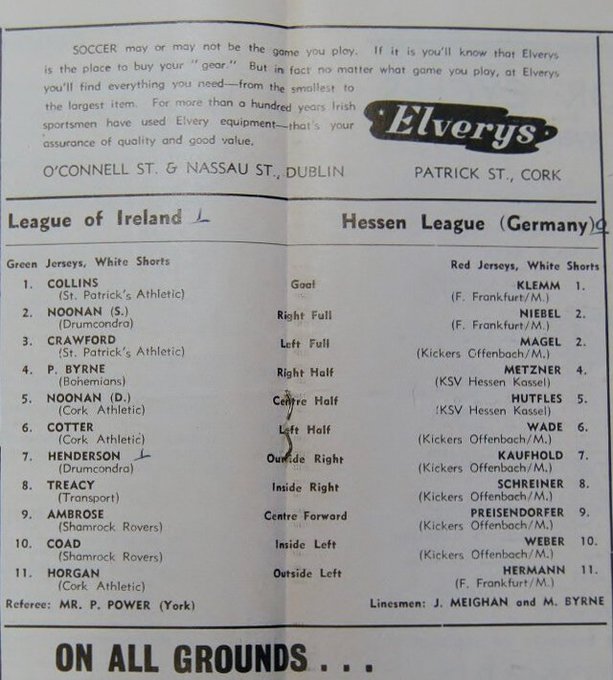
1954 lineups

Starting teams fromt the 1954 game

There was a return to success for the League of Ireland XI in 1956. A strong Irish selection ran out confortable 4-1 winners after the Hessenliga had taken an early lead. This was a strong selection from the Hessenliga with at least two full German internationals; Gerhard Kaufhold, who made his debut against England two years earlier and Richard Herrmann who had been part of West Germany’s World Cup winning squad in 1954, in the starting XI.

Apart from internationals there was good quality throughout the side, centre half Adolf Bechtold was a club legend at Eintracht Frankfurt where he was a league winner and club captain who also featured in the European Cup. At centre forward was Helmut Preisendörfer, a prolific striker for Kickers Offenbach he had been called up by West German coach Sepp Herberger to the national team but never won a full cap.

1956 team

Starting line-ups from the 1956 fixture

The Hessen League actually took the lead through a Kraus goal in the first half. He was unlucky not to double their advantage as his powerful header hit the bar a few minutes later, however, before half-time the League of Ireland took the lead through Waterford’s Jack Fitzgerald who scored two in quick succession. Early in the second half Shamrock Rovers’ Liam Touhy made it 3-1 before Fitzgerald secured his hat-trick 15 minutes from time. Despite the comprehensive nature of the victory in front of the bumper crowd of 23,000 there was some controversy.

Many reports in the following days were critical of the performance of Ignatius Larkin the referee in the game, criticising an undue leniency towards the League of Ireland side, particularly an apparently obvious foul by Shay Gibbons in the build up to Fitzgerald’s second goal. Despite the suggestion of hometown bias it seems clear from the match reports that the League of Ireland were the deserved victors on this occasion. This was probably one of the strongest sides available at the time with Liam Tuohy, Eddie Gannon, Tommy Hamilton, Shay Gibbons, Gerry Mackey, Dinny Lowry and Ronnie Nolan all being present or future Irish internationals.

There would be one further game against a Hesse selection in 1960, this yielded yet another victory for a League of Ireland inspired by the brilliance of Alfie Hale securing a 5-2 scoreline but by the early 1960s changes were afoot in German football which led to a major restructuring of the league, by the start of the 1963-64 season a truly national top division, the Bundesliga was formed, eventually the regional leagues would give way to a national competition across the highest divisions in German football.

Why particularly the Hesse league was always represented poses an interesting question. Perhaps this was because of the German FA are based in the Hessen city of Frankfurt? Early reports ahead of the first game in 1951 suggest that the arranging of that match was quite a haphazard affair based on informal discussions after the arranging of a series of amateur boxing contests between German and Irish fighters. It seems that the idea might even have been something pushed by a couple of intrepid German sports journalists. Initially it seemed that a game set for St. Patrick’s Day would be unlikely. Even as late as February Kurt Schaffner of the DFB suggested such a game wasn’t expected to take place as it was in the middle of the footballing season, however, just a month later the first Hessen League XI made their appearance at Dalymount Park.

This snapshot of time gives an interesting insight into Hiberno-German relations, like the statues of the Three Fates they showed the past, present and future of a German nation and their football culture. From the past, the deeply dubious sporting relationship cultivated between the FAI and the DFB during Nazi rule, to a post-war present where a vanquished Germany tried to rebuild literally and figuratively and sought to rekindle associations with Ireland. This was done in a sporting sense through the numerous friendly games between the Leagues and the national teams, but also away from sport through the fostering of German children by Irish families, redevelopment of trade connections, and through cultural and artistics ties, whether through gifts like public art or through German support for the study and research of the Irish language and culture. These connections are at least tacitly acknowledge by the match programme from 1956.

It might seem strange for Ireland to have been in a relatively more influential position than Germany but that is to underestimate the scale of post war destruction. Of course as we know now the scale and pace of German rebuilding was rapid, both in economic terms, with the Wirtschaftswunder economic miracle as it became known, and in footballing terms with the triumph in the 1954 World Cup, but in the immediate post-war years these successes were far from obvious or preordained. The third fate, that of the future, was perhaps echoed in the “Miracle of Bern” victory in 1954 and in the creation of the Bundesliga, or even with West Germany’s role in the Treaty of Rome and laying the foundations for the modern European Union.

With special thanks to Kevin Haney for providing the images of the match programmes shown above and sparking my interest in researching these games. You can follow Kevin on Twitter at @29Palmateer – he regularly shares excellent football history content.

Oh the Cologne – a football weekend on the Rhine

Last month I finally ceased procratinating and managed to get myself over to catch a Bundesliga game, it was something I’d been meaning to do for quite a while but for one reason or another never managed to get round to actually booking. The last time I’d been in Germany when there was a regular season game on, was way back in 2012, when I visited Berlin. There was quite the apetising fixture as Hertha Berlin has been relegated to the Bundesliga II and were going to face city rivals Union in a league game for the first time. However, the game was being played in Union’s Stadion An der Alten Försterei which at the time had a capacity below 20,000, no chance for a blow-in tourist to snap up a ticket so.

Certain things have to be considered when picking a game, avoiding the worst extremes of the German weather and potential sub-zero temperatures ruled out games in February and much of March, so we settled on getting a game in early May as the season drew to a close, it gave a better chance of getting some good weather and being able to enjoy a few beers outside before the kick-off.

I was lucky in having a good guide for German football in the shape of my friend Brendan. Son of an Irish mother and German father Brendan grew up in Hannover where he became a season ticket holder at Hannover 96 before he moved to Ireland a few years ago and I managed to indoctrinate him into becoming a Bohs fan.

The itinerary we eventually decided on was to fly direct to Cologne, get a game at Rot Weiss Essen in the Regionliga West on the Saturday, before getting a FC Koln game on the Sunday and flying home that Monday. A good efficient plan.

This plan wasn’t helped by my bringing the wrong passport with me and having to book in a later flight to Frankfurt, meaning I arrived in Cologne several hours after Brendan. But first things first – the bar, a nice unprepossessing, traditional local bar next to the apartment where we were staying in Ehrenfeld adorned with some FC Koln memerobilia, including a rather impressive portrait of the almost ubiquitus Hennes the goat.

To explain briefly, Hennes the goat is the mascot of FC Koln, although mascot seems too small a word, the club are nicknamed the Billy Goats on his account. He appears on the club crest, looming over the other famous image of the city; its Cathedral, and is held in the highest affection by Cologne fans. He’s named Hennes after the former player and manager Hennes Weisweiler, the goat was presented as a gift from a local circus in 1950 and the manager happily adopted him and named him after himself. The current Hennes is the eighth incarnation since then and we did indeed get to see Hennes VIII on our weekend.

One of the other striking things about Cologne is the beer, the local brew is a light lager called Kolsch, after the city, it is best drank on draft and is served in 200ml, test-tubelike glasses. The effect on someone more used to drinking by the pint is to lull you into a false sense of security where you convince yourself you’ve drank hardly anything when you’re well into double figures of the diminutive glasses. Usually the local bar runs a tab by marking a beermat to keep track on how many of these refreshing beverages you’ve had. They also tend to be pretty keenly priced, our local charged us a very reasonable €1.40 per glass. Drink til you make a profit lads.

Somewhat bleary-eyed we roused ourselves the following morning, the free-flowing Kolsch and welcoming locals had slightly dulled our senses but we had a game to get to in the nearby city of Essen. About an hour away on the train, wikipedia reliably informed me that Essen was Germany’s ninth largest city and we were off to catch their premier club Rot Weiss Essen in action.

This slideshow requires JavaScript.

Rot Weiss Essen’s (literally the Red and whites of Essen) greatest claim to fame is being the hometown club of Helmut Rahn, the man who scored the winning goal for West Germany in the 1954 World Cup final against Hungary. Rahn had been a star forward for Essen throughout the 50’s, helping them to a German Cup triumph in 1953 and the league title in 1955. This was in the years before the foundation of the national, professional Bundesliga was set up in 1963.

The club are a long way from those lofty heights, financial problems in the 1990’s and again within the last ten years see them playing in the Regionalliga West, effectively a vast, regionalised 4th tier of German football. They do however possess a very impressive stadium, the Stadion Essen replaced the much older Georg-Melches-Stadion in 2012 and this modern, four-sided ground boasts a capacity of just over 20,000.

The game that Saturday was against SC Wiedenbruck who were struggling against relegation. With the season drawing to an end Rot-Weiss Essen, who were comfortably mid-table had little to play for, and it showed. We took up our spaces in the main standing terrace behind the goal, a group of locals quickly – and fairly directly – advised us that we were in their spot and should move further back. While the terrace boasted a few thousand souls the other stands were sparsely occupied, I estimated the attendance at no more than 3,000.

The “ultras” group did make some noise throughout the game, with my limited German I could work out that they were big fans of their goal-scorer on the day Timo Brauer, and their main chant seeming to be singing the clubs name along to the tune of Mike Oldfield’s 1983 hit Moonlight Shadow. So imagine “carried way by a ROT-WEISS-ESSEN!

This wasn’t the most enthrawling of games; Weidenbruck took the lead through a wickedly deflected own-goal, Essen equalised but rarely threatened and Weidenbruck had the better of the play and ended up deserved 2-1 winners. We took the opportunities during the various lulls in play to hit the bars and enjoyed the really quite good quality local lagers and the odd wurst. Both teams did try to play football and were technically adept but played at a deadeningly slow pace and seemed to telegraph every pass, all of  which looked like they had already been agreed upon on the training ground the previous day. The few moments of pace and creativity tended to come from Weidenbruck and generally created some manner of attacking opportunity as a result but these forays were disappointingly rare. As for the overall standard, my limited knowledge would suggest that either of these sides would have struggled against a decent League of Ireland side. That said, perhaps Essen’s apathy was simply a result of it being a “nothing to play for” end of season game against an opponent motivated to avoid relegation?

With the game over we went to a couple of decent local bars in Essen with a group of Bochum fans we’d met. Bochum were playing away that weekend and the guys fancied catching a game. They were also in the first flushes of young adulthood and had a drinking stamina that Brendan and I have long since lost. We somewhat sensibly turned down their kind offer of a visit to a house party followed by a local club night and got the train back to Cologne.

WhatsApp Image 2019-06-22 at 9.17.17 PM (1)

Recuperating on the train back from Essen

We did get a second wind once we reached Cologne and did manage a few more Kolsch before ending up in a fairly uninspiring “club” but at least we got to plaster a few Bohs stickers around the place. Having survived our Saturday game and subsequent outings relatively unscathed (okay slightly in bits) we had to psyche ourselves up for the main event – FC Koln versus SSV Jahn Regensburg in Bundesliga 2.
WhatsApp Image 2019-06-22 at 9.20.31 PM (3)

Koln were the Champions in waiting and already guaranteed promotion back to the top flight after just a year in the second tier, Regensburg, a Bavarian club had done relatively well that season, but it had just been confirmed that their manager, Achim Beierlorzer had agreed to join Koln for the upcoming season back in the top division which added a little bit extra to the atmosphere for the loud and colourful travelling fans.

Incidentally Regensburg is the Bavarian town the club come from while the “Jahn” in their name refers to a Friedrich Ludwig Jahn, who was a 19th German nationalist who is seen as the father of the gymnastics movement. So there you go.

The Koln stadium is a relatively short tram journey from the city centre and both we and our hangovers got out there early to soak in a bit of the matchday atmosphere and also collect our tickets. The stadium is located in a huge swathe of green space on all sides and there was somewhat of a carnival atmosphere, plenty of food vendors, people having picnics, live music playing.

At the rear of the stadium are a number of well-kept public football pitches which were all well-occupied by groups of all ages and then further beyond the pitches stretched a large and picturesque public park where people were treated like adults and could have a beer and a barbeque without fear of censure. Imagine!

This slideshow requires JavaScript.

After trudging for what seemed like an eternity to collect our tickets from a small office operating from a not-so-nearby hotel we got ready to head onto the terrace. Fortified with some beer and pretzels we felt a bit better and were about to take our position as nominal Jahn Regensburg fans for the day, through this did mean hiding my snazzy new Hennes the goat pin badge.

This was clearly going to be much different from the Essen game, the Rhine Energie Stadium was pretty much full a good thirty minutes before kick-off and even getting a good vantage point among the away fans proved a challenge. With the game kicking off there was something of a carnival atmosphere in the ground, understandable since Koln were already promoted, but many of their fans were far from happy. From early in the game right through to after the final whistle there was an array of banners held aloft by huge numbers of the Koln faithful in the opposite terrace criticising the board and their running of the club. Promotion from the second tier was something that had to be achieved but the fans explicitly viewed it as a situation they never should have been in in the first place.

The game itself was no less lively with Regensburg racing into an early lead thanks to a 7th minute OG. They doubled their lead before on the stroke of half-time as Koln had a player sent off and only seconds later they conceded a penalty. While they finished the half a man short and 3-0 down, but by that stage things were only getting started. Koln mounted something of a comeback through the unlikely figure of German international Jonas Hector who was playing at left-back who managed to score two second-half goals either side of a Sargis Adamyan goal for Regensburg.

On 76 minutes a frantic, 10-man Koln seemed within touching distance of an unlikely draw when substitute Anthony Modeste grabbed a goal to bring the score back to 4-3 but as they continued to throw everything into attack in search of an equalizer, and I mean everything, Koln were caught on the break by Regensburg with the Koln goalkeeper Timo Horn caught up the pitch the visitors had an empty goal to shoot into as they scored their 5th and destroyed any slim chances there might have been for a Koln comeback.

Still it wasn’t all bad for Koln, despite their defeat in a hugely exciting, frenetic game they still had the won the Bundesliga II and got to raise the divisional trophy on the pitch after the game. There was also some cheering and celebration when news filtered through that results had conspired to make sure that Hamburg finish fourth and outside of the play-off places. Der Dino, never the most popular club to begin with, must be getting very used to the enthusiastic application of the German concept of schadenfreude over the last couple of seasons.

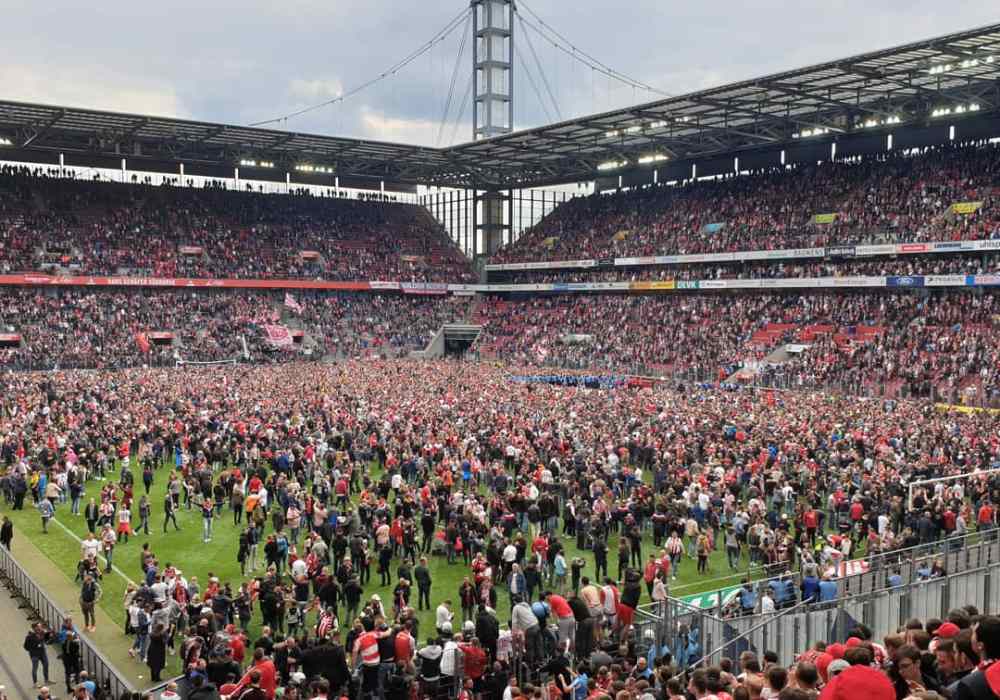
As the Koln players lifted their trophy the lines of stewards were quickly bypassed and first hundreds and then thousands of spectators began pouring onto the pitch. Located as we were in the away end, a significant number of riot police kept us penned in and well seperated. The Koln fans however began by taking apart the goal nets as souvenirs before eventually the goal-frame closest to us collapsed under the weight of supporters climbing on top of it.

This slideshow requires JavaScript.

We were eventually spewed back out into the stadium concourse and walked on towards the tram stop at the far side of the open green space that surrounds the stadium. No more than 15 minutes later we were back in Ehrenfeld and despite promising ourselves that we would do otherwise we ended up in a local bar after a quick dinner.

The Cologne locals throughout our short trip were friendly and engaging, and in this instance a request that we keep an eye on another customers dog led to a conversation about football (he coached a team playing in the regionalised 6th tier) and even the possibility of arranging a match against Bohemians.

So after years of procrastinating I got myself to a couple of games in Germany, plenty of colour, excitement and genuinly good people who love their sport, I’ll definitely be back.

WhatsApp Image 2019-06-22 at 9.17.18 PMWhatsApp Image 2019-06-22 at 9.17.17 PM (4)WhatsApp Image 2019-06-22 at 9.17.17 PM (2)

Before they were famous: Bayern Munich

One of Pep Guardiola’s last acts as manager of Bayern Munich was to lift the DFB Pokal trophy, it had already been announced that he was on his way to England and Manchester City but the delight on Guardiola’s face showed that he hadn’t checked out just yet. He was enjoying the occasion; he was, after all, a serial winner relishing his last trophy as manager of one of world’s biggest clubs. The league title had been wrapped up nearly two weeks earlier when the Bayern players raised the famous “salad bowl” trophy. This made it Guardiola’s second double of his Bayern tenure and marked a record breaking fourth consecutive Bundesliga title. Despite this unprecedented success there were some who felt the club should have won more; for some, only reaching three consecutive Champions League semi-finals meant they had fallen short. Under previous coach Jupp Heynckes they had enjoyed even greater success winning a treble of League, Cup and the European Cup.

Such is the dominance of the very elite clubs in various European Leagues it can feel that the league winners have been as good as decided before we even reach September. Perhaps this season will bring some surprises but in Italy, Juventus are heavy favourites to once again retain their title. Likewise, Paris Saint Germain in France and Bayern Munich in Germany. However, while Bayern’s dominance might seem preordained it was not always thus.

Formed in 1900 Bayern had enjoyed “early” successes, winning a couple of regional titles in the 1920’s before winning the last National title (1931-32) before the German sport system was taken over by the Third Reich. This maiden title for the club was contested in a knock-out format between the top two sides from each of the regional leagues and at the time, football in Germany was still technically an amateur sport. It would be over 35 years before the Bavarians would win another league title.

When the first Bundesliga season began in the late summer of 1963 Bayern Munich were not even among its member clubs. A decision had been made the year earlier to do away with regional leagues and to institute a proper, professional, national league and the winners of the Oberliga Sud (Bayern’s regional league), were their city neighbours TSV 1860 München. Although Bayern finished third that year which should have been enough to qualify them for the new national Bundesliga, the German FA did not want two teams from the same city represented so 1860 progressed at their neighbours’ expense.

moore-tsv

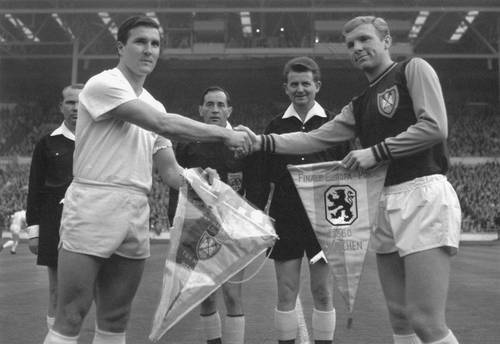
TSV 1860 München had been founded as a sports club, not as their name suggests in 1860, but as a gymnastics club in 1848. Due to a political decree during tumultuous times they were disbanded but officially reformed in 1860 with their football division beginning a year before Bayern in 1899. The club enjoyed great popularity in their debut season in the Bundesliga, averaging a respectable average attendance of 34,000 at the Grünwalder Stadion which they shared with Bayern. In fact, they had been Bayern’s landlords there from 1925 until the Second World War when the stadium was bombed and badly damaged in 1944. During the debut Bundesliga season, they would win the German Cup final against Eintracht Frankfurt and went on to contest the following year’s Cup Winner’s Cup final, losing 2-0 to West Ham.

Far from being one of Europe’s leading clubs Bayern at this stage were not even the biggest club in their city. They were eventually promoted to the top flight for the 1965-66 season and managed to win the German Cup that year while finishing a very respectable 3rd place in a league that was eventually won by their city rivals 1860. That Cup win was Bayern’s first major trophy in almost a decade. In the final they defeated Meidericher SV by 4 goals to 2, the fourth was scored by one of the club’s precocious young talents, a twenty-year-old by the name of Franz Beckenbauer.

Beckenbauer was not the only young star making waves for this upwardly mobile Bayern team. The club’s shrewd President Wilhelm Neudecker, a wealthy construction magnate had begun investing in the side to turn them from a regional yo-yo club into one that could deliver success. In 1963 the Croatian Zlatko “Čik” Čajkovski, who had starred as a player for Partizan Belgrade and Yugoslavia in the 40’s and 50’s, was brought in to coach the then second tier side. This represented something of a coup as Čajkovski had coached FC Köln to the title in 1962 yet here he was taking a step down to coach a side that hadn’t yet made the Bundesliga. But Bayern had some exceptional young talent coming through; Beckenbauer had joined as a youth in 1959 having stormed out of the youth ranks of 1860 after a row broke out during the final of an under-14’s tournament. A teenage keeper named Sepp Maier had made his debut the year before Cajkovski’s arrival and then in 1964 President Neudecker presented his new coach with his latest young prospect, an 18-year-old called Gerd Muller. To begin with Cajkovski was unimpressed, dismissing the somewhat tubby 5’9” striker with the following statement to his club President: “I’m not putting that little elephant in among my string of thoroughbreds”. The little elephant, however, knew where the goal was.

bayern75

During the late 60’s and into the early 70’s Bayern either developed or signed from lower the leagues players of the calibre of Beckenbauer, Muller, Maier, Paul Breitner, Franz Roth, Uli Hoeneß and Hans-Georg Schwarzenbeck. Not only would all of these players win multiple leagues, cups and European Cups but they would also help the West Germans defeat the great Dutch team in the World Cup final of 1974. They had hardly cost Bayern a penny in transfer fees.

After the success of their debut Bundesliga season Bayern had the added distraction of a first European campaign to deal with due to participation in the Cup Winners Cup. They managed to out-do the previous efforts of their neighbours 1860 by going on and winning the competition defeating Rangers in a tight final after extra time. The winner came in the 109th minute from 21-year-old midfielder Franz Roth who would develop a habit of getting crucial goals in major finals.

By the end of the 60’s Bayern were truly in the ascendancy, there were coaching changes with Cajkovski departing for Hannover and being replaced by Branko Zebec, his former Partizan and Yugoslavia teammate. Zebec had coached Dinamo Zagreb to victory in the Inter City Fairs Cup in 1966-67 and introduced a more structured defensive approach with Bayern. During Cajkovski’s last season in charge the club had scored an impressive 68 goals in 34 games but had conceded the worryingly high number of 58. In Zebec’s first season they scored 61 (30 coming from Muller) but conceded a miserly 31. They finished eight points clear of Alemannia Aachen to comfortably win the league title. They followed this up with a 2-1 Cup win over Schalke (two more goals from Muller) to win the first double in Bundesliga history. Zebec also made Beckenbauer captain that season and the young midfielder began experimenting with his distinctive sweeper type role with which he would become synonymous.

A three in a row run of league titles at the beginning of the 70s showed how this young group was maturing, they added to their ranks bringing in a young, attacking full-back named Paul Breitner, and in attack Uli Hoeneß, who would help shape the club on and off the pitch for the next five decades. But Europe was a learning curve for the young side. In the 1972-73 season, they were well beaten 5-2 on aggregate by eventual winners Ajax at the Quarter final stage. The following year they were almost eliminated in the first round by Swedish champions Åtvidaberg before narrowly beating East German champions Dynamo Dresden in the next stage. They met Spanish champions Atletico Madrid in Brussels in the final, which was forced to a replay after a nervy 1-1 draw. In the replay, however, Bayern showed a devastating competitive edge, hounding the Spaniards in possession, counter-attacking at pace with a frightening directness, with Muller and Hoeneß scoring two each.

Back at home in the Bundesliga, Bayern’s great rivals of the 1970s, Borussia Mönchengladbach, were the dominant team as Bayern struggled domestically, the demands of Europe taking their toll. In 74-75 when Bayern defeated Leeds in a controversy filled final the Bavarians finished a disappointing 10th. But midfielder Rainer Zobel described how, despite struggling to beat average Bundesliga sides, Bayern could raise their game in Europe. Leeds fans still feel aggrieved when the final of 1975 is mentioned, often highlighting the stunning Peter Lorimer strike that was disallowed as evidence of their bad luck. What is seldom mentioned is that Bayern lost two players to injury caused by rough tackles from Leeds players, defender Björn Andersson after two minutes and Uli Hoeneß just before half-time. Watching the footage back, an aging Leeds side had no answer to the stylish build-up to Roth’s goal in the 71st minute or when, ten minutes later, Müller got goal-side of his marker and scored at the near post from six yards out.


Having defeated first the champions of Spain and then the champions of England in their consecutive finals, Bayern then faced St. Etienne, the champions of France, and one of the finest sides in the history of the French League. Hampden Park was the venue in 1976, but there was to be no repeat of the 1960 final goal-fest. St. Etienne were unlucky with Bethanay hitting the cross-bar and Santini hitting the famous “square posts” of the Hampden goals. Bayern however, while not dominant, displayed the sort of mental toughness and doggedness that have become synonymous with German teams. Muller had a goal ruled out for offside, before Beckenbauer squared for Roth to score in his second consecutive final.

The bulk of these successes were won by a core group of players who had come through the club ranks as youngsters, however the club were not averse to splashing the cash when necessary; Jupp Kapellmann was brought in for a German transfer record from FC Köln in 1973, the same year the club snapped up Swedish international Conny Torstensson after he impressed against Bayern in the early rounds of the European Cup. Parallels with a modern Bayern can be seen with a locally developed core of players (Lahm, Thomas Muller, Alaba, and even a returning Mats Hummels) complemented by the best talent bought in from Germany and further afield.

Nowadays, Bayern are based in the ultra-modern Allianz arena which was initially shared and co-owed with neighbours 1860. However, in 2006 Bayern’s one-time landlords were forced to sell their share of the stadium rights to deal with their financial problems. While construction magnate Wilhelm Neudecker is long gone the Bayern boardroom is now filled with former players and blue-chip commercial partners; alongside Executive board members like Karl Heinz Rumminigge sit Triple A corporate representatives from Adidas, Audi and Allianz which helps explain the club’s rude financial health. The massive financial clout of Bayern and their ability to cherry-pick the best of their opponent’s players has meant that it is sometimes hard to envision a Bundesliga that was not the domain of the Bavarians, but thanks to strong support from an ambitious club president, excellent scouting networks, improvements in coaching and a once in a lifetime group of players Bayern went from the Second Division to European powerhouse within the course of a decade.

This post originally appeared on the Football Pink