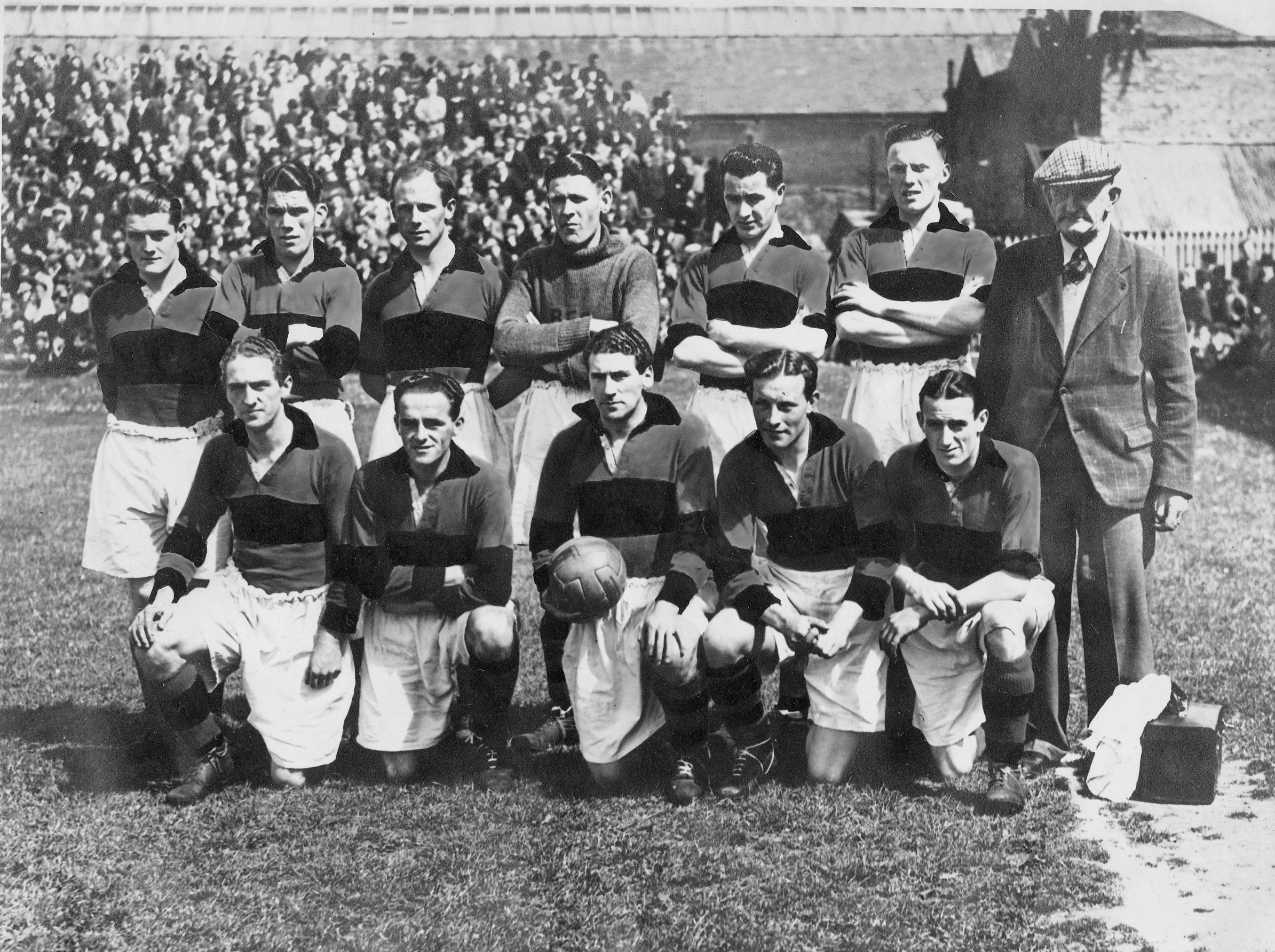
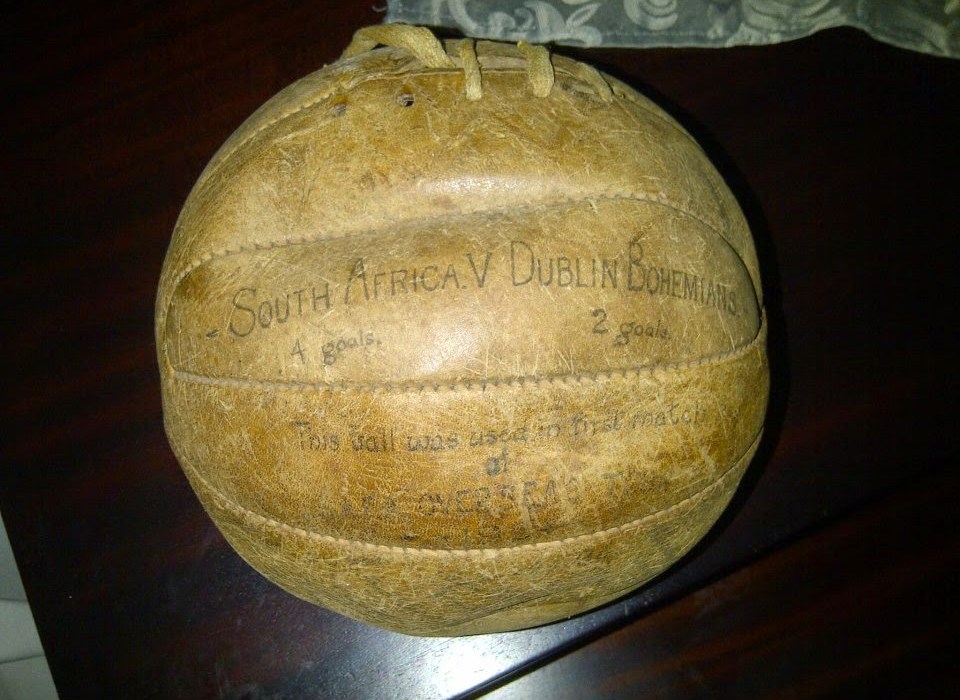
Bohemians during Easter 1916

In April 1916 Bohemians were coming to the end of a season disrupted by war, but in which they were rewarded yet again with the Leinster Senior Cup, their fifteenth win in twenty years. It took two attempts to secure the trophy from old rivals, Shelbourne. The first was on St Patrick’s Day, a scoreless draw watched by 6,000 spectators, the second on 1st April.
No Dublin clubs took part in the Irish League that season due to the war and several Bohemian players had enlisted with the army. But the club insisted that football should continue and they managed to maintain Dalymount Park as a playing pitch when some rugby and cricket grounds were taken over for relief works.

Half-back Josh Rowe was with the East Surrey Regiment and was wounded many times. At the end of March he was reported to be returning to duty after convalescence and, it was said, “he hopes to play football again”. Full-back J.J. Doyle had joined the Officer Training Corps in early 1916 but got leave to play for Bohemians in the Irish Cup semi-final, which Bohemians lost to Glentoran in Belfast.

Also involved in that cup campaign was outside-left Harry Willits, who was team captain in 1915-16. An English-born civil servant, he played during 1916 both for the Royal Dublin Fusiliers’ regimental team and for Bohemians. By the start of the next season, however, he was at the war front with the Dublin Fusiliers and in November 1916 was reported as wounded. He survived and was back with Bohemians in 1917-18. Bohemians’ squad in 1916, coached by the everlasting Charlie Harris, included two internationals, Billy McConnell and Johnny McDonnell, whose 1915 Irish shirt hangs today in the JJ Bar at Dalymount Park. Others included regular goal-scorers Ned Brooks and Dinny Hannon, and defender Bert Kerr, who had joined in 1915 and was to have a notable career with Bohemians, including as team captain. He also had a remarkable career as a pioneer in the Irish bloodstock industry.

On Easter Monday 1916, a Bohemian team travelled to Athlone to play an end-of-season friendly, as they had done for several years. So friendly was it that McDonnell and Hannon played for Athlone, in a team that included several army officers. (Hannon later won the Free State Cup with Athlone Town.) Neither team can have been aware of what was happening in Dublin as they played their game in bad weather (3-2 for Bohemians) and were later entertained at the Imperial Hotel and at a dance at the Commercial Quadrille Class. “The Bohemians expressed themselves highly pleased with their visit,” the Westmeath Independent reported. However, the trip was to end less pleasantly for the Bohemian team. Due to the Rising, train services were disrupted from Mullingar, and they had to arrange car transport back to the capital.

Their late return was reported in the Irish Times among the repercussions of the Rising: “Some of the [Bohemian team] members who lived on the south side of the city had to stay in Phibsborough for the [Wednesday] night and, after walking via Islandbridge, Kilmainham, Goldenbridge, Rialto, Crumlin and Dolphin’s Barn, these did not get home until Friday (April 28), at 1.30 p.m.”

While the Bohemian party were concerned about getting back to the city from Athlone the rebels were worried about the arrival of British Army reinforcements from the same location. Many of the sites occupied by the rebels were chosen for their ability to delay the troops coming into the city, most notably the engagement with the Sherwood Foresters at Mount Street bridge.

Bohs 1916 pic3

In Phibsborough members of B Company of the Dublin Brigade built barricades on the railway bridges on the Cabra Road and North Circular Road close to St. Peter’s Church. They even went as far as to try and blow up both bridges with gelignite.
While B Company was able to hold off a number of attacks from small arms and machine gun-fire, the arrival of artillery onto the Cabra Road (outside what is now the Deaf Village) and the use of shrapnel-loaded shells raining down on the bridges just yards from Dalymount Park and as far down as Doyle’s Corner meant that the Volunteers could not hold their positions. A number of civilians were killed by over-shooting shells, while 15-year-old Fianna Éireann scout Sean Healy was shot dead outside his Phibsborough home.
The rebels eventually abandoned their positions hoping to link up with Thomas Ashe in Finglas but by the time they got there he and his men had already left for Meath and the Battle of Ashbourne. Many of B Company found their way back into the city and some joined the garrison in the GPO and then Moore Street.

While there is no record of Bohemians fighting with the 1916 rebels, some Bohemians did work in the British administration during that period. Highest-placed of these was founder member Andrew P. Magill. He was an 18-year-old clerk in the Land Commission when he attended the club’s first meeting, and later a clerk in the office of the Chief Secretary for Ireland. He rose to become private secretary to Chief Secretary Augustine Birrell, who resigned in May 1916 after failing to predict or take preventative action to stop the Rising. Magill later worked in the post-partition civil service of Northern Ireland.
While Magill was serving the Chief Secretary, fellow-Bohemian Joe Irons, an army reserve who was called up when World War 1 broke out, was posted to the Vice-Regal Lodge in Phoenix Park, to what is now Áras an Úachtaráin, to protect the Viceroy.

This article was co-written and researched with Brian Trench for the Bohemian FC website where it appeared in March 2016. In later articles we will look further into the life and career of Harry Willits, report on other Bohemians who fought in World War 1, and tell the stories of some Bohemians who were IRA volunteers in the War of Independence.

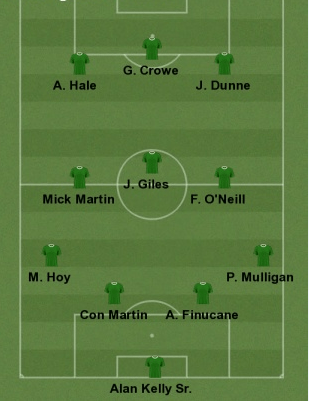
League of Ireland International XI

A good while back I did up a League of Ireland International XI elsewhere on this blog. It seemed to go down well and provoked a little bit of discussion. My previous version featured those players who had been capped by other nations and had featured in league football in Ireland, it included the likes of George Best, Bobby Charlton, Uwe Seeler and of course Avery John. That post deliberately excluded Irish internationals but I’d like to redress this by compiling my Irish International League of Ireland XI. My criteria are that all players included have to have been capped for Ireland while playing for a club in the League of Ireland. I’ve focused on players from the immediate years after the split with the IFA right up to the modern day. I’ve tried to represent various different eras basing much on pieces of research and reportage and the input of various older football fans. As always this is just a personal selection of players I like or that interest me so this will obviously reflect my own bias and interest but hopefully might create a bit of discussion, hence the sizeable bench! Anyway in goal I’ve gone for….


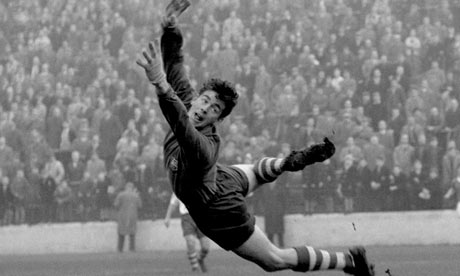
Goalkeeper – Alan Kelly Sr. (Drumcondra, 47 caps):  A man with a strong claim to be one Alan Kellyof Ireland’s greatest ever keepers and a founder of somewhat of an Irish goalkeeping dynasty. (Not the only one mind, hello to the Hendersons) Alan Kelly Sr. was a FAI Cup winner and a League champion with Drumcondra during their 1950’s heyday when he made his debut for the Republic of Ireland as they defeated World Champions Germany 3-0 in Dalymount Park. Before long a move to Preston North End beckoned and he spent 14 years as a player at Deepdale making a club record 513 appearances, including an impressive performance in the 1964 FA Cup final where the unfancied Preston were deafeated 3-2 by the West Ham of Bobby Moore and Geoff Hurst. Such was his importance at Preston that in 2001 a redeveloped stand was named after him. Kelly would later manager Preston and would assist John Giles during his managerial reign as well as being caretaker manager for Ireland during a 2-0 win over Switzerland.

Right-back – Paddy Mulligan (Shamrock Rovers, 50 caps, 1 goal): Paddy was already a four-time FAI cup winner and an Irish international by the time he left Shamrock Rovers to head to West London and the glamorous surroundings of one of Chelsea’s pre-Abramovich high-points. While at Chelsea he tasted European glory as Chelsea beat the Paddy Mulliganmight of Real Madrid 3-2 on aggregate in the Cup Winners Cup final before moving onto Crystal Palace and later West Bromwich Albion, managed at the time by his international team-mate Johnny Giles. While Paddy finished his career with a very respectable 50 caps he didn’t have the easiest start to his international career, he was a part-timer with Shamrock Rovers while also holding down a job with the Irish National Insurance Company when he was called up to the Irish squad in 1966, his employers weren’t too happy about his decision to travel with the squad to face Austria and Belgium and he was issued with an official warning by the company directors!


Centre Back – Al Finucane (Limerick, 11 caps): An elegant, ball playing centre-half Al Finucane  won all of his 11 international caps while on the books of his home-town club Limerick. However his time in the green of his country coincided with a dreadful run of results and his international record reads played 11, won 0, drew 1, lost 10. There was to far most success on the domestic front where he captained Limerick to two FAI Cups (1971 & 1982 when he was 39!) as well as lifting the famous old trophy with Waterford in 1980. Only the second player to achieve this after Johnny Fullam who captained both Shamrock Rovers and Bohemians to victory. Finucane’s longevity was astonishing and along the way he picked up a number of records in his 28 year League of Ireland career including the record number of appearances by any player in the league and also becoming the oldest player ever to play in a UEFA competition. At the age of 43 years 261 days he lined out for Waterford United against Bordeaux in the Cup Winners Cup, breaking a record previously held by Dino Zoff. His final game was at the age of 45 for Newcastlewest.

Al finucane

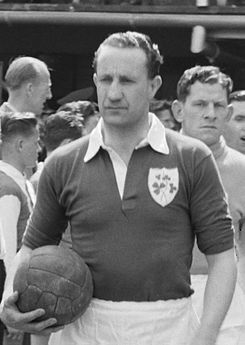
 Centre Back – Con Martin (Drumcondra, 30 caps, 6 goals): Con Martin made his first two international appearances as a Drumcondra player and in somewhat unexpected circumstances as a goalkeeper. His first appearance came as a substitute away to Portugal. Con_Martin_(1956)With Ireland trailing 3-0, thanks in no small part to the prolific Sporting striker Fernando Peyroteo, the Irish keeper Ned Courtney is forced to go off injured. Courtney kept goal for Cork United and was an officer in the Irish Army, he had also won a Munster title in Gaelic Football with Cork. Brought on in his place was Con Martin, who at the time was in the Irish Air Corps and had also won a provincial GAA football title, with Dublin in 1941, he kept a clean sheet for the remainder of the game and started in goal in the next match, a 1-0 victory over Spain. Martin was a hugely versatile player, he lined out as a centre half for Drumcondra he played almost an entire season in goal later in his career for Aston Villa and also regularly played as a half back or at inside forward. He was a regular penalty taker for Ireland and it was Con Martin who opened the scoring in the ground-breaking 2-0 win over England at Goodison Park.

Left Back – Mick Hoy (Dundalk, 6 caps): While the selection of the likes of James McClean and Marc Wilson has generated some ire with those in the IFA they are certainly not the first men born north of the border to play for an FAI selection. Mick was born in Tandragee, Co. Armagh and began his career at Glenavon before moving south to Dundalk in 1937 the same year he made his international debut in a 3-2 defeat to Nroway. He started that game alongside his fellow Dundalk team-mate Joey Donnelly. Mick won five further caps and his debut was to be the only game where he finished on the losing side. His final match for Ireland was the 1-1 draw away to Germany in 1939, the nation’s final international fixture before the outbreak of War.

Midfield – John Giles (Shamrock Rovers, 59 caps, 5 goals): To celebrate its 50th anniversary in 2004 UEFA asked each of its member associations to select their greatest player of the preceding 50 years. The FAI selected Johnny Giles. While there will always beJohn Giles
differences of opinion regarding the selection of any one player over another there would be a general consensus that Giles was worthy of the accolade. He was a FA Cup winner with Man Utd in 1963 before moving to Leeds where he won two league titles, another FA Cup, a League Cup and two Inter-City Fairs Cups and played in the final of the 1975 European Cup where Leeds finished runners-up to Bayern Munich. Only two years after playing in that final Giles was lining out as player-manager for Shamrock Rovers in the League of Ireland where he was attempting to make Rovers not only a force in Ireland but also in Europe with the introduction of a full-time, professional ethos, the “Milltown project” as it was dubbed by some. While this approach did yield an FAI Cup in 1978 it yielded little else in terms of silverware. During this time however Giles was a very busy man. As well as being player-manager at Rovers he was also the national team player-manager and also spent a summer in 1978 playing in the NASL for Philadelphia Fury! During this time he continued to add to his caps total, his final game coming in 1979 at the age of 38.

Midfield – Frank O’Neill (Shamrock Rovers, 20 caps, 1 goal): Frank O’Neill is the most capped League of Ireland player in history with a total of 20 to his name. All of these came during his time at Shamrock Rovers.Frank O'Neill Despite treading the well-worn path going from Home Farm schoolboy to England, joining Arsenal aged just 18 it was as one the classiest players in Rovers’ “Cup Kings” sides that he made his name. After only two league appearances for the Gunners, O’Neill, then aged 21 joined Rovers on their Summer 1961 tour of North American where they took part in the grandly titled Bill Cox International Soccer League against the likes of Dukla Prague, Red Star Belgrade and Monaco. O’Neill impressed grabbing six goals in seven games after which he was signed for £3,000. O’Neill would make over 300 appearances for Rovers, winning a league title as well as six consectutive FAI Cups, mostly playing on the right wing. His international career coincided with a downturn in the national team’s fortunes though there were highlights including the scoring of his only international goal against Turkey in a 2-1 victory.

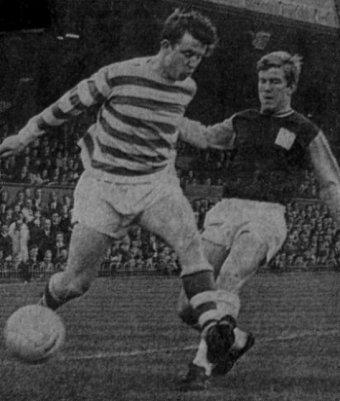
Midfield – Mick Martin (Bohemian FC, 51 caps, 4 goals): The second member of the prolific Martin football family in our team, Mick, son of Con began his career at Dalymount Park with Bohemians. His early international career didn’t get off to a great start as he was selected by new manager Liam Touhy for his début in a 6-0 defeat to Austria. The Irish Mick Martinteam that day was comprised of League of Ireland players as the match had been scheduled just a day after a full English league fixture programme. He also made a number of appearances at the Brazil Independence Cup while still of Bohs player, scoring in a 3-2 win over Ecuador. Better was to come for Martin, he got to mark Pelé as part of a Bohs/Drumcondra select that took on Santos and shortly afterwards secured a move to Manchester United and later joining Johnny Giles at West Brom. In his club career he is probably most associated with Newcastle United, who he joined for £100,000 in 1978. He was hugely popular with the St. James’s Park faithful who dubbed him “Zico” and he got to play alongside the likes of Kevin Keegan and a young Chris Waddle during his time there.

Forward – Jimmy Dunne (Shamrock Rovers, 15 caps, 13 goals): Jimmy Dunne began and ended his playing career at Shamrock Rovers. In his first spell at the club the Ringsend native didn’t manage to get much playing time due to the dominance of Rovers’ “Four Fs” forward line of “Juicy” Farrell, Jack “Kruger” Fagan, Bob Fullam and John Joe Flood though when he did get a look in he usually scored. JIMMYDUNNE A move to New Brighton (a now defunct club on Merseyside) in the old Third Division North followed, as did the goals. He joined First Division Sheffield United in 1926 though he had to bide his time before getting a prolonged run in the first team. However he exploded into life in the 1929-30 season scoring 42 goals in 43 games and winning his first cap for Ireland (he scored twice in a 3-1 win over Belgium) that year as well. Dunne however wouldn’t be released by United for further fixtures (though he was allowed to play 7 times for the IFA selection) during his prolific scoring exploits over the next few years and he wouldn’t win a second cap until 1936 when he was playing for Arsenal by which stage he had fallen down the pecking order at Highbury due to the arrival of Ted Drake. A season at Southampton followed before Jimmy or “Snowy” as he was known to some returned to Dublin and to Shamrock Rovers in 1937 at the age of 32. It was while on the books of Rovers that Dunne would win nine of his 15 caps and score five of his international goals. Dunne still has by far the best scoring ratio for Ireland of any player who has scored 10+ goals at 0.87 goals per game and one wonders what his stats would have been like had he been made available to play for Ireland during his peak years at Sheffield United.

Forward – Glen Crowe (Bohemian FC, 2 caps): The best striker that I’ve personally Glen Crowewitnessed in the League of Ireland and the most recent player to feature on this list. Crowe during the years of his peak was unplayable for opposing defences, he had strength, aerial ability and a cracking shot. He’s Bohs record league goalscorer, FAI Cup scorer and European scorer and was the League’s top scorer three years running. He’s also won 5 league titles (4 with Bohs, 1 with Shels) and two FAI Cups. At international level he featured against Greece under care-taker manager Don Givens and then again early in the reign of Brian Kerr in a cameo appearance against Norway.


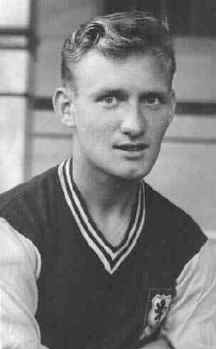
Forward – Alfie Hale (Waterford, 14 caps, 2 goals): The Hale’s are one of the great football families in Waterford, a Alfieplace that has given us plenty of them, including the Coads, the Fitzgeralds and the Hunts. Alfie’s father (Alfie Snr.) had been part of the first Waterford side to compete at League of Ireland level and at one stage formed an entire half back line for the club along with his brothers Tom and John in the 1930’s. Alfie Jnr. was born in 1939 and began his career with his hometown club before a somewhat peripatetic existence brought him to Aston Villa, where he would win his first international cap against Austria, and later to Doncaster Rovers where he would spend the majority of his stay in Britain. After seven years away Hale returned to Waterford where he was joined by Johnny Matthews and a little later by keeper Peter Thomas as part of a team that would dominate the League of Ireland, bringing five titles to the south coast between 1967 and 1973. Alfie’s final game for Ireland was as a Waterford United player in 1973 at the age of 34 when he came on to replace Don Givens in a 1-0 victory over a Polish side that had just finished ahead of England in World Cup qualifying.

XI


Subs: Peter Thomas (Waterford) Tommy McConville (Dundalk & Waterford) Johnny Fullam (Shamrock Rovers) Willie Browne (Bohemians) Shay Brennan (Waterford), Peter Farrell (Shamrock Rovers), Tommy Eglinton (Shamrock Rovers) Joe O’Reilly (Brideville, St. James Gate) Paddy Coad (Shamrock Rovers) Paddy Moore (Shamrock Rovers) Pat Byrne (Shamrock Rovers) Paddy Bradshaw (St. James Gate) Jason Byrne (Shelbourne)

*a note on the layout, I’ve listed players’ Irish clubs when they received their international caps only but have listed their total number of caps won at all of their clubs.


Bohemians and world beaters: Ireland’s international triumph

The split between the footballing associations of the FAI and the IFA has had many consequences for football on our island, many hours have been whiled away with “what if” scenarios with barflies imagining an Irish side of the 60’s featuring the likes of John Giles and George Best. Another less discussed consequence of the split between the two associations was for many the loss of any sense of identity with the all Ireland side that had competed from the 1880’s through to 1921. Any connection with the history of this 32 county team has for most football fans in the Republic, (and indeed some in the North) been severed and there is little sense of identification with the players and their achievements pre -1921.

I for one think that this is a great pity, it ignores the history of the sport and the rich and interesting personal stories of those involved. It also means modern fans in the Republic often feel little pride or connection to the victory by a truly representative Irish team in the Home Nations Championship of 1914. At the time the Home Nations Championship was viewed, in the British Isles at least, as the foremost International football competition in the world with the winners rating themselves as the best international side in the world. While this is obviously an isolated and arrogant viewpoint it is reasonable to say that the winners could legitimately claim to be among the very best international sides in the world.

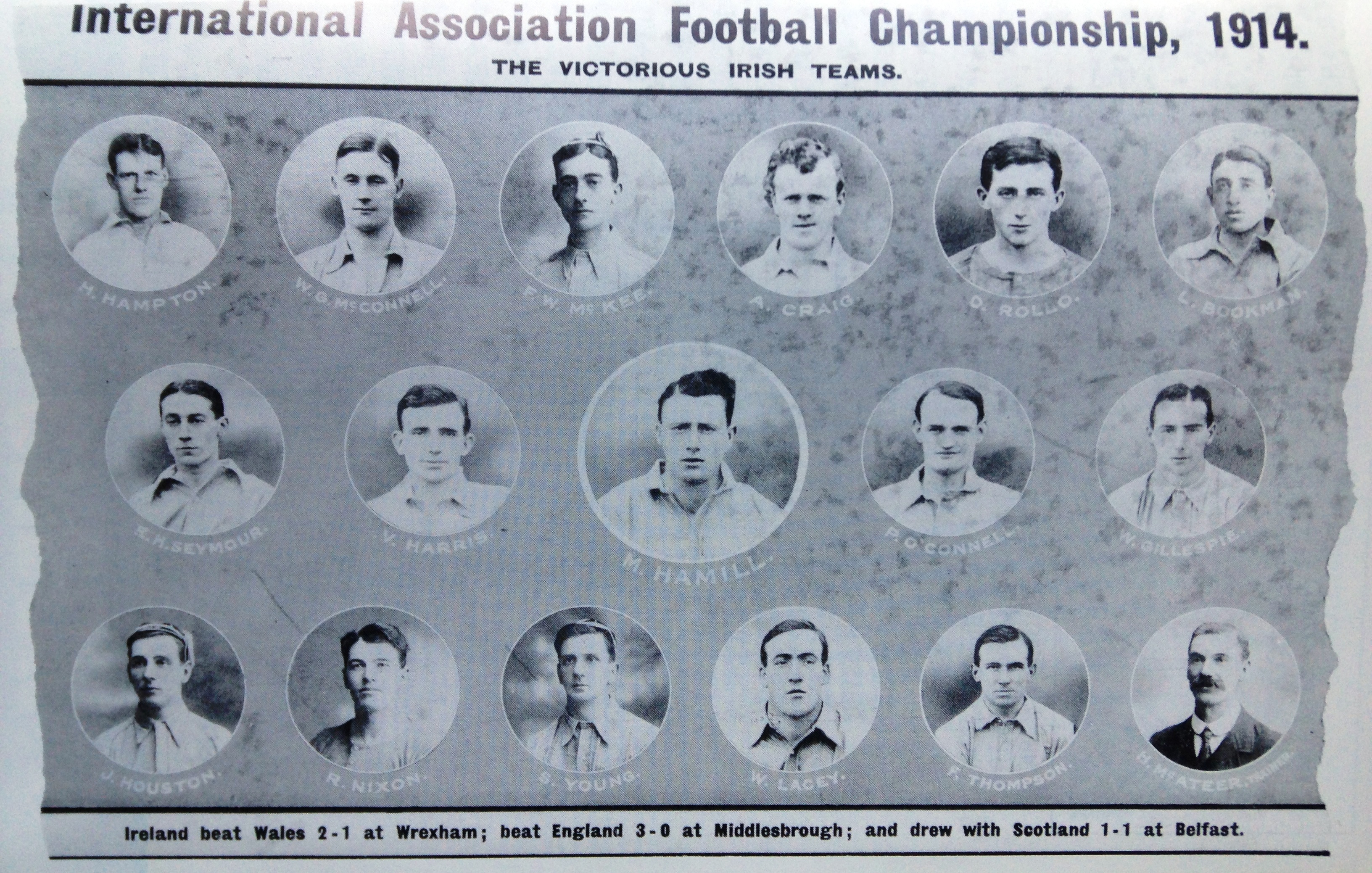
The side that triumphed in 1914 was a young, impressive and truly representative team. While in previous years there had been a great deal of tension and legitimate criticism about Belfast based players being favoured ahead of Leinster based players, the squad for the 1914 Championship was a truly all island affair. It featured players from the footballing hotbeds of Dublin and Belfast but also players born in the likes of Wexford (Billy Lacey), Galway (Alex Craig) and even Lithuania in the case of Louis Bookman who was born in what was then part of the Russian Empire. Bookman’s  family fled to Dublin when he was a boy to escape the persution of Jews then taking place, he began his footballing career for Belfast Celtic before moving to England with Bradford City, in course becoming the first Jewish professional  footballer in Britain. Bookman was playing for Bradford when he was called up in 1914 but the squad was a mix of players who were plying their trade in both Ireland and Britain, it also included two players from Bohemians, William McConnell and Ted Seymour.

1914_ireland_british_champions

1914 Home Nations Champions

Both players were of course amateurs in keeping with the traditions in place at Bohs which meant that they were in a minority even by 1914 as most of the major teams in Ireland had already embraced professionalism by that time. The two main exceptions being Bohemians and Cliftonville. Seymour was an outside-right for Bohemians and one of the stand-out forwards for the Gypsies at the time, the son of an RIC officer who lived in the nearby Phoenix Park he won his first amateur cap for Ireland by 1912 scoring in a 3-2 victory against England, the same year he would win the Leinster Senior Cup with Bohemians. His lone senior cap would come in Ireland’s opening match of the Home Nations Championship, an away fixture against Wales which Ireland won 2-1 when he was called up as a replacement for Everton’s injured winger John Houston. Sheffield United forward Billy Gillespie got both goals in that game but Seymour obviously impressed over the course of the match as he was quickly signed up by Cardiff City on the strength of his performance.

Amateur team pic

The Irish amateur team which defeated England 3-2 in 1912. The side featured three Bohemian F.C. players; William McConnell, Ted Seymour and Dinny Hannon.

William McConnell had a somewhat more extensive career at International level. Regarded as one of the best full backs in Ireland McConnell was a strong and physically dominant defender for Bohemians and Ireland. A member of the Bohemians team that lost out in the 1911 Cup Final to Shelbourne he also won a pair of Leinster Senior Cups with Bohemians and represented the Irish League on three occasions. At International level McConnell won six senior caps and was only on the losing side once, in a 2-1 defeat to Scotland in 1913. McConnell made his debut in 1912 in a 3-2 win over Wales and was part of an historic victory in only his second cap as Ireland beat England for the first time ever. Billy Gillespie grabbed both goals in a 2-1 victory in Windsor Park as McConnell lined out alongside his Bohs team-mate Dinny Hannon. Despite that landmark victory the Irish side still finished bottom of the Home Nations Championship but things were to be much different the following year. McDonnell was an ever present in the successful Home Nations campaign starting every game at full back.

The Ireland side before the opening game against Wales

The Ireland side before the opening game against Wales

The campaign opened with the aforementioned 2-1 win away to Wales and was followed by another away fixture, this time against England in Middlesboro’s Ayresome Park. Proving that the previous victory against England was no flash in the pan the Irish trounced the English on home soil, two goals from the ever versatile Billy Lacey, then of Liverpool and a third from Billy Gillespie eased Ireland to victory over a stunned England. The Donegal born Gillespie would end the tournament as its top scorer with three goals and was arguably one of the greatest players in the world at this time. He would captain Sheffield United to victory in the 1925 FA Cup final and play on for them until he was more than 40, towards the end of his career his role at the heart of the Blades attack would be taken over by another Irishman, Jimmy Dunne who would later coach Bohemians in the 1940’s. At international level his 13 goals for Ireland/Northern Ireland would remain a record until it was eclipsed by David Healy in 2004.

However Gillespie would miss the final match that could guarantee Ireland the 1914 Championship, as Sheffield United had to replay an FA cup tie they refused to release Gillespie for the game against Scotland in Belfast’s Windsor Park. This would require a significant reshuffle on behalf of the Irish with Samuel Young of Linfield coming into the forward line and Billy Lacey taking over Gillespie’s role in the attack. McConnell continued as usual alongside Alex Craig (Greenock Morton) in a defence that had proven solid over the previous two games.

William

William “Bill” McConnell

The match would be the only home game for Ireland that year taking place in Windsor Park, but under far from ideal conditions. Not only was Gillespie unavailable but there was a downpour the day before the game which continued through to the game meaning that both sets of players were ankle deep in mud. The view of the press at the time was that this would suit a more physically imposing Scottish side. Worse was to come for the Irish as the conditions and the hard-fought nature of the game began to take their toll and injuries on the Irish side began to mount. Paddy O’Connell, then of Manchester United and later manager of Barcelona picked up a knock as did McConnell who had to leave the field of play. However the Bohs man wasn’t out of the action long as the Irish keeper Fred McKee of Cliftonville suffered a broken collar bone during the first half. McKee managed to struggle on until half time but once the second half commenced McConnell took to the field in his place in a sodden goalkeeper jersey that was supposedly “two sizes too small” . As substitutions were not in use at the time Ireland were down to ten men with Lacey dropping back from the forwards to take McConnell’s place at full back.

This was not the first time Ireland had found themselves in this situation, Lacey had been forced off in the Welsh game yet Ireland had triumphed and now he was in defence helping protect McConnell in goal. Forced into making a couple of saves early on McConnell seemed to be doing alright in his unfamiliar position but a mis-timed run forward  meant he gave possession to the onrushing Scottish forward Joe Donnachie who had a simple finish to give Scotland the lead. It seemed like all could be lost in the cruellest fashion. The team without its main goalscoring threat in Gillespie and down to ten men looked doomed but with just eight minutes remaining a fine pass from Patrick O’Connell sent Sam Young free and he blasted the ball home to send the crowd wild. Despite the terrible weather the huge crowd had been in full voice behind the Irish team and Windsor Park saw record gate receipts of £1,600 on the day. The supporters had gotten their moneys worth, the underdog team, shorn of their best player, having finished two of their three matches with only ten men were now outright Champions for the first time.

This victory was met with great joy and optimism on behalf of the footballing community throughout Ireland. Having defeated England in their last two outings and having won the Home Nations Championship outright there were high hopes that the team could push on from this achievement and defend their title the following year. Other matters were to intercede however.

While the outbreak of War did not bring about a halt to all football it did end international matches. Players were encouraged to set a good example to other young men and enlist. Football clubs in all parts of the country faced tough times losing both players and fans to the trenches of France and Belgium while the league would split for the course of the war creating regional leagues focusing on Dublin and Belfast.

By the time peace was restored to Europe several of the squad had passed their prime and although players like Lacey and Gillespie were still top performers for their clubs in England the split between the Irish football associations which led to the formation of what we know today as the FAI meant that the potential of a united Irish XI would never be realised.

For those players with a Bohemians connection their careers were varied. Ted Seymour’s stay in the Welsh capital was brief and included works in a Welsh munitions factory to support the War effort, he left Cardiff City in 1915 and returned to Ireland with Glentoran for whom he lined out for much of the War years. Despite twice winning the Irish Cup (once with Glentoran and later with Linfield) Seymour was never again selected to represent Ireland.

McConnell also transferred to Britain, signing for Bradford Park Avenue who were then in enjoying their best ever league season, finishing 9th in the Football League in 1914/15, McConnell would have a limited role however, making only 4 league appearances. He would spend a brief sojourn in Belfast with Linfield before returning to Bohemians in 1916 where he played a handful of games. This was not to be the end of his sporting career however, he found significant success as an amateur golfer being successful enough to triumph in the 1925 and 1929 West of Ireland Amateur Championships. Some Pathé newsreel footage even survives of McConnell playing a round at a new golf course in Dun Laoghaire.

Though the war would disrupt the career of Billy Lacey he would still go on to have considerable success in the 1920s as a player for Liverpool, winning back to back titles. Lacey would return to Ireland to finish his playing career at Shelbourne and then as player-coach of Cork Bohemians. It was in 1930 during this spell in Cork that he would win his final cap for Ireland at the age of 41, he remains to this date the oldest player ever capped by the FAI. With his playing career finally over Lacey brought his considerable experience to the Bohemians of the Dublin variety. During his five years at Dalymount Park (between 1933 and 1938) Lacey would lead Bohs to two league titles and an FAI Cup as well as a host of other minor honours. During this stint Lacey would also provide his coaching talents to the Irish national side.

While the split remains as wide as ever between the FAI and the IFA and relations between the associations have been strained over players like James McClean and Darron Gibson electing to play for the Republic, it is worth remembering a time when a truly all-Ireland team triumphed against the odds and the role that key figures in the history of Bohemians would play in that victory.

If you are interested in further reading on the subject I’d suggest David Owen’s article in The Blizzard Issue 8. Neil Garnham’s “Association Football and Society in pre-partition Ireland” and also Cormac Moore’s “The Irish Soccer Split”. Finally a special thanks to Stephen Burke of Bohemian F.C. for providing additional information on the career of Bill McConnell. For more on Louis Bookman and his fascinating life try “Does your Rabbi know you’re here?” by Anthony Clavane.

The 1945 Inter-City Cup: War, Goals, Controversy and death by corner kicks

As you go for a pint in the members bar you may on occasion glance upward and notice the Bohemian F.C. honours list spelt out handsomely in gilt on a dark red background. It makes for impressive reading and is testament to the proud history of our club. Right in the middle of the bar, between the list of League Titles and FAI Cups is a sign that reads “Setanta Cup Champions 2010”. The Setanta Cup is, at the time of writing, our most recent honour. Few of us will forget Anto Murphy’s goal versus Pats in Tallaght Stadium, and it added a little extra relish that Bohs had managed to win a trophy in the enemy’s back- yard so to speak. It is worth noting, however, that though the Setanta Cup is the latest All Ireland soccer competition, it was by no means the first, nor was it the first such competition where Bohemians emerged victorious. To learn about this other, much earlier victory we must go back 70 years, to a time when the most violent conflict in human history still raged, to the first cross border competition since partition; the Inter-City Cup.

The Inter-City Cup, or to give it its full title, the Dublin and Belfast Inter-City Cup was conceived as a way to provide much needed income during the turbulent years of the Second World War. When the First World War had broken out in 1914, the general and oft-repeated assumption was that the war would be over by Christmas, so the sporting calendar continued on much as it had done in peace time. Bohemians and Shelbourne, the only two clubs from outside the six counties, continued to play in an pre-partition league season into 1914-15, but the growing realisation that the war was going to drag out meant that the Football League in Britain was suspended, while the Irish League was reduced to a “Belfast and District League” of only six teams with no room for Bohs and Shels. Many players, especially in Britain came in for heavy criticism for playing on into 1915. Some viewed it as a dereliction of patriotic duty that fit and healthy young men should stay at home and be paid to play football rather than volunteer to fight at the front. This led to the formations of “Football battalions” where prominent footballers were used as promotional tools for enlistment. Some football fans joining up were encouraged by the fact that they would have the chance of serving with their sporting idols.

When the Second World War broke out, the mistakes of the past were avoided. The league season was suspended immediately in Britain while Northern Ireland completed the 1939-40 season (Belfast Celtic won their 13th title) before suspending the Irish League and playing on with a diminished Northern District League. The League of Ireland, being in a neutral country, continued on as usual during the War years. It would prove to be a particularly successful era for Cork United, who would win five titles between 1939 and 1946.

However, gone from the fixture calendar were lucrative games against touring British sides. The lack of income was obviously a significant concern for the clubs north of the border, robbed as they were of regular gates and a full league programme which ultimately led to the creation of the Inter-City Cup. The tournament would run for eight seasons between 1941-42 and 1948-49, and despite the name, did include clubs from outside of Dublin such as Limerick, Cork United, Dundalk and Derry City. While matches were spread around various grounds in Belfast, all games south of the border were to take place in Dalymount. Another interesting feature of the tournament was the significance of corners. If two sides were tied on aggregate in the final, the side who had won the most corners were deemed to be the winner. Bohs learned this to their cost during the 1942-43 competition when they lost the final on corners to Shamrock Rovers having drawn 2-2!

Despite that setback Bohs, would eventually triumph in the competition. The 1944-45 season would be one of highs and lows for Bohemians, but it did at least end in some silverware. Bohs’ league form during the War years was poor; a third place finish in 1940-41 being the sides’ best placing and the 44-45 season would see Bohs finish bottom of the eight team league but would also see them reach two cup finals. An epic, three game semi-final win over Team of the decade, Cork United, would get Bohs into an FAI Cup final against Shamrock Rovers, where in front of the biggest ever Cup Final crowd of almost 45,000 they would lose out to a Podge Gregg winner. Gregg, a native of Ringsend had just returned to Dublin after a spell with Glentoran where he had won the Inter-City cup the previous year.

Bottom of the league, having lost a final to Shamrock Rovers, its fairly obvious that Bohs’ season needed a pick-me-up, and the Inter-City Cup could provide it. So as not to clash too much with regular games, the Inter-City competition was held around April and May each season when most games were coming to an end.  In that particular year, Bohs lost the FAI Cup final to Rovers on the 22nd of April, but less than a week later were in action in round one of the Inter-City.

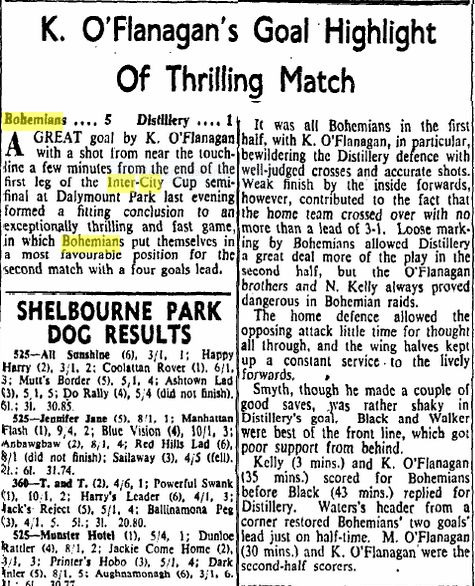
The first round game saw them drawn against fellow amateurs Cliftonville in Solitude on the 28th of April, with a return leg in Dalymount a week later. A 3-2 victory in Belfast with two penalties from full-back Frank Glennon and a Pat Waters goal gave Bohs too commanding a lead for the return leg, which ended as a 1-1 draw. The following round would see them matched with Glentoran; competition winners the previous year, Glentoran had been beaten on corners in the previous round by Limerick and only qualified as the best loser, their luck was out again as the tie finished 3-3 on aggregate so Bohs advanced as winners on corners 10-9 and thanks to an excellent performance by Collins in goal. Victory over Glentoran meant a meeting with Distillery, now based in Lisburn but then firmly ensconced in Grosvenor Park, West Belfast. Bohs would comfortably beat Distillery 8-3 on aggregate, a dynamic 5-1 victory in Dalymount was capped by a stunning strike from Kevin O’Flanagan, who beat the opposing keeper with a shot from out on his own touchline. The Irish Independent correspondent was moved to describe it as “the greatest goal seen in Dublin for years” and very topically likened the speed of the shot to that “of a V2 rocket”. O’Flanagan had the Distillery defence bewildered, and Bohs could have won by an even greater margin, as he finished with two goals. His brother Mick at centre-forward got one, while Noel Kelly and Waters got the other two. Despite going 2-0 down early on in the second leg in Belfast, the Gypsies rallied, and goals from Mattie Burns, Kevin O’Flanagan and Noel Kelly ensured there was no chance of an unlikely comeback.

Semi final

The other semi-final between Belfast Celtic and Linfield was also a high scoring affair, finishing 7-5 on aggregate to Celtic. As a two legged semi-final the first leg was held in Belfast before both sides travelled to Dalymount Park for the second game. With the tie balanced at 2-2 from the first leg, the Linfield goalkeeper and captain Tommy Breen (once of Manchester United and a seasoned international) elected to kick off defending the tramway end of the famous old ground. Due to heavy rain, Breen and his defence were ankle deep in water at that end of the ground which had cut up much worse than the opposite school end. 7 of the 8 goals scored on the day went into the tramway goal and Linfield were out. Breen’s former team, Belfast Celtic, were through to the final and were eager to make up for their defeat to Glentoran the previous year. Celtic had beaten not only Linfield, but Shamrock Rovers and Shelbourne en route to the final. The first leg was to be played in Belfast on May 30th with the return leg in Dalymount on June 2nd. VE day had taken place on May 8th and the laws and censorship brought in during the “Emergency” were lifted shortly afterwards. For the first time in six long years, football fans both North and South could genuinely look forward to the first real cup final in “peacetime”.

It is worth a brief diversion from our narrative to outline the merits of the Belfast Celtic side. Although the club has not existed in any real sense since the end of the 1940’s, they were at the time unquestionably one of the biggest sides on the island of Ireland. By the time the club was dissolved in 1949 they had won 14 league titles, second only to Linfield who by that stage had 19 to their credit. Former players included Mickey Hamill later of Manchester United and Manchester City, former President of the FAI and Government minister Oscar Traynor, Paddy O’Connell who would also play for Man Utd and later managed Real Betis and FC Barcelona, and Louis Bookman, the Lithuanian-born Irish international who became the first Jewish player to play professionally in Britain. Their coach at the time was Elisha Scott, a former player with Belfast Celtic and also Liverpool’s longest serving player ever. Scott was considered with some justification to have been one of the greatest keepers Ireland has ever produced and won ten league titles and six Irish Cups as Belfast Celtic manager. Their starting XI at the time of the Inter-City cup final was also on par with any of their previous sides. They would win the first official Irish League title after the war in 1947-48, and the team that Bohs faced included the likes of midfielder Charlie Tully, who would later join Glasgow Celtic and once famously scored against England direct from a corner in an international, attacker Jimmy McAlinden (an FAI and IFA international) an FA Cup winner with Portsmouth, and fellow international centre half Jackie Vernon who spent much of his career at West Brom.

In the case of Bohs, it would be a last hurrah of sorts. After the end of the Inter-City final, several of the winning side left for pastures new, including young goalkeeper Jimmy Collins, Frank Glennon and Noel Kelly, who would all switch to Shamrock Rovers. They would be joined a year later by their coach Jimmy Dunne, the former record breaking striker and soft-spoken coach, returning to Rovers after patching up his differences with the Cunninghams. Kevin O’Flanagan, a medical doctor was offered a job as a GP in Ruislip, London where he would spend his free time playing for Arsenal at football and London Irish in Rugby. While Bohs would make another FAI Cup final in 1947 (which they would lose after a replay to Cork United) the Inter-City cup would be the last trophy that Bohs would win apart from a pair of Leinster Senior Cups until the Cup final victory over Sligo Rovers in 1970. Bohemians’ insistence on remaining strictly amateur had served them well, as they won Leagues and Cups in the 1920s and 30s, but by the 40s, key players were being picked off by other clubs offering a few pound a week. While Bohemians continued to find and recruit excellent young players, they struggled to keep them for any length of time, the few exceptions being those whose day jobs allowed them the freedom to play without care for additional wages.

The two-legged final would be a close and often controversial affair. In the first leg there was nothing to separate the teams, not even corners as the sides finished level with two goals apiece, six corners each and both sides down to ten men. Kevin O’Flanagan for Bohs and Douglas for Celtic were the men sent off after coming to blows after Douglas kicked the ball out to touch when O’Flanagan was about to take a free. Bohs had taken a two goal lead thanks to an own goal and a finish by Smith, but the free scoring Bohs full-back Glennon ended up getting a roasting from Celtic outside left Paddy Bonnar, who grabbed two second half goals to tie the game. The return leg was no less controversial. Bohs named an unchanged side for the second leg (almost identical to the one which had lost to Shamrock Rovers just over a month before apart from Smith coming in for Frank Morris).

Bohemian FC Inter City Cup winning side

The Bohs side read: Standing – Ossie Nash, Paddy Waters, Billy Richardson, Jimmy Collins, Frank Glennon, Peter Molloy, Charlie Harris (Trainer). Front – Mick O’Flanagan, Noel Kelly, Kevin O’Flanagan (Captain), Matty Burns, Bobby Smith.

Belfast Celtic had suffered some injuries in the first leg with Peter O’Connor and Charlie Currie coming into attack for Johnny Campbell and Tommy Byrne. The second leg remained tight with few opportunities, Jimmy Collins in the Bohs goal being called into action in the first half to deal with chances from both Tully and Bonnar, but it was in the 67th minute that things became more heated when a cross came in from Smith which was trapped by Kevin O’Flanagan and passed into his younger brother Mick who when controlling the ball had a “Thierry Henry moment” and appeared to handle it before firing past Celtic keeper Hughie Kelly. This started furious protests from the Celtic players and led to an altercation between Captains Kevin O’Flanagan and Jimmy McAlinden who both had their names taken by the referee. Despite the Celtic players’ protests, the goal stood. Celtic’s disjointed attack, with the enforced changes since the first leg, had struggled to get past the Bohs defence, with Richardson and Glennon coming in for particular praise. Bohs successfully defended their lead, and after a season of disappointment, were All Ireland champions. It was particularly sweet for the star player Kevin O’Flanagan, who despite his sending off in the first leg, had been key in Bohs’ advancement to the final in much the same way that he had been key during the FAI Cup run scoring three goals by the time they reached that final. By setting up the goal for his brother Mick he had managed to make amends for his below par display in the earlier final versus Shamrock Rovers. Despite being a qualified GP the “Flying Doctor” had failed to diagnose himself with a bout of flu and upon returning home after the defeat to Rovers took his temperature and found that he had played a cup final with a 103 degree temperature!

Final article 1st leg2

It would be the last major trophy that Bohs would win for some time and the Inter-City cup was in some ways was the farewell of the Corinthian era of Bohemians and of Irish football as they signed off as Champions of North and South. Belfast Celtic, meanwhile, would remove themselves from League football only four years later, a mixture of sectarian violence, financial troubles and mismanagement forcing them out of senior football. While the Celtic board believed the withdrawal would only be a temporary measure it would transpire that their successful tour of North America, where they played to packed stadiums and famously defeated the Scottish national team, would in fact be their good-bye to the world of football. Guesting at centre forward for that touring side was none other than Bohs’ Mick O’Flanagan, his “hand of Mick” moment forgotten as he starred for Belfast Celtic as they slipped into history.

*special thanks to Martin Flynn and the Belfast Celtic Society for their assistance with some research for this article.

The Flying Doctor & the free-scoring Publican – the famous O’Flanagan brothers

Along Marlborough Street, opposite the Department of Education and a 100 yards or so from the Pro-Cathedral, stands the aptly-named Confession Box pub, a small intimate venue where one could air your concerns over a pint that once belonged to former Bohemians and Ireland centre-forward Mick O’Flanagan.

The pub has its own sporting legacy quite apart from its former proprietor, it was there in 1960 that the Soccer Writers’ Association of Ireland was formed, and it was there that Mick O’Flanagan received the phone call that would make him an Irish International.

It was, as O’Flanagan recalled, around two o’clock in the afternoon of 30th September 1946 when a call came to the pub from Tommy Hutchinson, the Bohemians member of the FAI selection committee which chose the Irish International team.

Ireland were due to play England at 5:30 that afternoon, a historic meeting between the two nations as this was a first time the English national side had agreed to play an FAI selected team since the split with the IFA in 1921.

After decades of being ignored and ostracised by the English FA the FAI had finally secured a fixture against a formidable English side in Dalymount Park. In the minds of the FAI committee of 1946 this was the biggest game in its relatively short history. There was only one problem, their centre-forward, West Brom’s Davy Walsh had pulled out through injury.

This was the purpose of Hutchinson’s call to Mick O’Flanagan, the 24 year old Bohemian striker was being asked to line out against the inventors of the beautiful game at the last minute.

As O’Flanagan remembered:

“I went home to Terenure for a bite to eat, had a short rest and then headed off to Dalymount. It was not really sufficient notice as only the previous evening I had brought a party of English journalists to Templeogue tennis club and I hadn’t got home until nearly two in the morning.”

Despite a laughable lack of preparation, the Irish side put it up to their illustrious opponents who had hammered an IFA selection 7-2 just days earlier. It was only a Tom Finney winner eight minutes from time that sealed victory for the English.

Henry Rose in the Daily Express was moved to write:

“If ever a team deserved to win Eire did. They out-played, out-fought, out-tackled, out-starred generally the cream of English talent, reduced the brilliant English team of Saturday to an ordinary looking side that never got on top of the job.”

Not only did Mick O’Flanagan line out against the likes of Finney, Billy Wright, Tommy Lawton and Raich Carter, he did so alongside his older brother, and fellow Bohemian, Kevin (pictured).

Brothers Kevin and Mick O’Flanagan are unique in world sport as not only did they play international football for their country, they both were capped by Ireland at Rugby, making them the only pair of brothers in the world to play for their nation in both codes.

Mick was capped against Scotland in 1948 as part of the last Irish Grand Slam winning side until 2009, while Kevin had been capped a year previous to that against Australia. This unique achievement is one that isn’t likely to be repeated anytime soon.

Despite this singular accomplishment the sporting careers of the brothers could have been even more illustrious had it not been for the outbreak of World War 2. Both were lining out for Bohemians when hostilities commenced in 1939, Mick a 17-year-old just beginning his career, his older brother Kevin at 20 had been a first-teamer for four years, had already captained Bohemians and had seven Irish caps and three goals to his name as well as being selected to play for Northern Ireland.

While the League of Ireland would continue during the war years, international football would cease for Ireland until 1946. Similarly, Olympic competition would cease which would rob Kevin the chance of competing in the Olympiads of 1940 and 1944. Kevin, at the time was a medical student in UCD, was Irish sprint champion at 60 and 100 yards as well as being national long jump champion.

He had even been a promising GAA footballer, lining out for the Dublin minor panel alongside Johnny Carey (Carey and O’Flanagan would both make their international debuts as teenagers against Norway in 1937) before being dropped because of his involvement with the “Garrison game”.

Young Michael would also miss out, his best goal scoring season would be 1940-41 where he finished as the League’s top scorer with 19 goals for Bohs. Had war not been raging across Europe he might rightly have expected to have more than his solitary international cap.

The brothers remained committed to the amateur ethos of the club which explains the duration of their stays at Bohemians. Mick as a publican in the city centre and Kevin as a medical student and later a Doctor weren’t likely to be swayed by the offer of a couple of extra quid a week from a rival club.

Indeed Kevin took his commitment to the Corinthian ideal to the extreme. Upon qualifying as a doctor in 1945 he had been offered a position as a GP in Ruislip, London. Despite this move he kept up and even increased his sporting activities, he signed on with Arsenal as an amateur while also lining out as a Rugby player for London Irish, when Arsenal invited him to submit his expense claims, they were shocked that he asked for just 4p, the cost of his tube journey from Ruislip to Arsenal.

Bernard Joy, a team-mate of Kevin’s at Arsenal, and a fellow amateur, noted in his history of the club that the then secretary Bob Wall quipped that Kevin “did not want to know anything about tactics. I play football the way I feel it should be played’, he would say.”

Arsenal coach Tom Whittaker said that O’Flanagan could have been “one of the greatest players in football history” if only he could have gotten him to train properly. Despite only spending one full season with the Arsenal first team (for whom he scored three times) Kevin would make a big impression.

No lesser an authority than Brian Glanville described him thus:

“A fascinating, amateur, figure in those Arsenal teams between 1945 and 1947 was the powerfully athletic Irish outside right, the hugely popular Dr. Kevin O’Flanagan. Coming from Dublin to London to take up a general medical practice, he demonstrated pace, strength and a fearsome right foot. He attained the distinction of playing soccer for Ireland on a Saturday, rugby for them the following Sunday.”

Between them, the O’Flanagan brothers would spend almost 20 years as players for Bohemians, while their younger brother Charlie O’Flanagan, a winger, would also line out for the club in the 1946-47 season.

Kevin would return to the Dalymount in another role, that of the club’s Chief Medical Officer and despite his retirement as a player he would remain hugely busy as a sporting physician and sports administrator. He was a member of the International Olympic Committee for almost 20 years before being made an Honorary Lifetime member upon his retirement and was the Chief Medical Officer of numerous Irish Olympic teams throughout the 1960’s and 70’s.

Despite missing out as a competitor, “The Flying Doctor” would manage to make a huge contribution to the Olympics and to Irish Sport in general.

Although they spent almost twenty years service in the red and black of Bohs and scored almost two hundred goals  between them the honours list for the two brothers was relatively short. Both brothers combined to help Bohs win the Inter-City Cup in 1945 in somewhat controversial circumstances.

A year later after Kevin left for London, Mick scored an astonishing six goals in Bohs 11-0 victory over local rivals Grangegorman in the Leinster Senior Cup final, a record not likely to be broken any time soon by a Bohemian player in a cup final.

So much about the brothers’ careers is unique or exceptional, so in this our 125th year it’s worth remembering two of the greatest all-round sportsmen that Ireland has ever produced.

Originally posted on the official Bohemian FC website in August 2015

From the Andes to Dalymount Park – Bohemians v The Peru/Chile XI

Last year’s World Cup in Brazil conjured up images in the imagination of the European football fan of head-tennis on Copacabana beach, the voluminous bowl of the Maracana, the glorious canary yellow jerseys of the Seleção. The ideas and notions we hold about South American football help create comforting stereotypes of the Brazilian jogo bonito, Argentinians being fabulously unpredictable in their dribbling and their temperament, all spinning in that interior mental carousel of sun-drenched blues, whites and yellows blanched in the Mexican heat of 1970 or 86, Carlos Alberto’s fourth against Italy, Maradona’s hand of god.

These idealised, mythologised notions of South American football that tend to dwell the minds of British and Irish fans did not begin, however, with the World Cup of 1970 but long before, initial interest being piqued by the exceptional displays of the great Uruguayan sides of the 1920s and ’30s. The first chance, however, that British and Irish fans got to see of South American footballers in the flesh was way back in 1933. It was the first time that a South American side had ever visited Ireland or Britain – they came from the land of the Andes and the Pacific. This is an attempt at their story, and the story of the team they would encounter on an October afternoon on the north side of Dublin City.

The side that was to visit Ireland was a select squad made up, not of Brazilians, Argentinians or Uruguayans but of players from the Peruvian and Chilean leagues. With the squad being dominated by players from the Lima based Universitario side, with reinforcements from Alianza Lima (the Peruvian champions at the time), Atlético Chalaco also of Peru, and Chilean side Colo-Colo. The team went by a number of names such as the Combinado del Pacífico and the less evocative Peru-Chile XI.

Colo-Colo were among the first sides who had embarked on a European tour a few years earlier in 1927 which was funded by the Chilean Department of Education as part a diplomatic and educational exercise that saw them take on Spanish sides, Atletico Madrid, Real Union and Barcelona. The tour would end in tragedy as Colo-Colo’s star player and club founder David Arellano died from peritonitis brought on by a rough challenge he received during a game. With this in mind it is perhaps understandable that only three Colo-Colo players would travel as part of the Combinado side. Much like Colo-Colo had done in 1927 the Combinado would also journey to Spain, however their first port of call for a game on this side of the Atlantic was Dublin and Dalymount Park, and their rivals would be Bohemian Football Club.

Bohemians were at the time strictly amateur and would remain so for another 40 years. The Combinado were titular amateurs back in South America but were provided with “tips”, sinecures and other payments (for example a teenage Lolo Fernández’s first contract was worth 120 soles a month, approximately €450 by modern values), they were however officially paid to take part in their European tour, and paid with good reason. Although teams like Colo-Colo, Nacional, Boca Juniors and others had previously toured Europe, the Combinado’s itinerary was truly immense by comparison with any earlier visiting side.

Their journey began in Panama with a win over local side Colón, then a trip to the idyllic Caribbean island of Curaçao and a comfortable 7-0 win in September of 1933 before departing for Europe, where, in total they would play games in Ireland, Scotland, England, the Netherlands, Czechoslovakia, Germany, France, Italy and Spain with the players finally returning home in the Spring of 1934. The results of the Combinado were mixed to say the least, there were victories over the likes of OGC Nice, Sparta Rotterdam and a selection of smaller Spanish sides and credible draws with Slavia Prague, Saint Etienne, Italy’s Pro Vercelli and West Ham.

There were however defeats to the likes of Celtic, Newcastle United, Bayern Munich and a 10-1 drubbing at the hands of a Madrid XI. In fairness to the Combinado this defeat in Madrid wasn’t helped by the fact that on the same day, half the squad, under the name “Chile-Peru” were losing 4-1 to Barcelona in their Les Corts stadium, while the remainder, playing under the title “All Pacific” were playing a combined Madrid side in the Chamartín arena. This was a Madrid side that featured the legendary keeper Ricardo Zamora of Real Madrid, while Atletico Madrid’s Julio Antonio Elícegui grabbed a hat-trick against the unfortunate South Americans.

Although the touring sides’ fortunes varied there is no doubt that there were players of genuine quality in their ranks. In goal was Alianza Lima’s Juan Humberto Valdivieso, the Peruvian national team goalkeeper at the 1930 World Cup, 1936 Olympics and 1939 Copa America. Nicknamed “El Mago” (the magician) he was renowned for his speciality at saving penalties, while during a game for Alianza after star forward Villanueva went off injured, Valdivieso took his place in the attack and proceeded to score seven goals in an 8-1 victory over Sporting Union.

Contemporary reports would describe him as one of best goalkeepers in all of South America and Valdivieso’s exceptionalism would continue through the generations; his son Luis is the current Peruvian Finance Minister while his grandson, a swimmer also named Juan Valdivieso followed in his grandfathers’ footsteps and competed at a Summer Olympics in both 2000 and 2004, something the grand old goalkeeper lived long enough to witness. Valdivieso’s Alianza club-mate on the tour was Alejandro Villanueva, who was nicknamed “Manguera” (Fire-hose) in recognition of his many outrageous moves on the pitch, indeed so well-known was he for his bicycle kicks that he was apocryphally attributed with the creation of that move. Rather than “Fire-hose” The Irish Independent preferred to give him the sobriquet of the “Peruvian Dixie Dean”. A veteran of two Copa Americas, one World Cup and the 1936 Olympics, Villanueva did not enjoy his erstwhile team-mates longevity, dying of tuberculosis in 1944 at the age of just 35. In testament to his enduring popularity and scoring exploits Alianza rechristened their stadium in 2000 as the Estadio Alejandro Villanueva almost 60 years after his death.


The Bohemians line-up from a 1932 trip to France

Although Alianza were represented by these two stars the majority of the squad as mentioned were from Universitario, to date Peru’s most successful club, winning 26 league titles and coming runners-up in the Copa Libertadores in 1972. Brightest among their firmament of stars was the young striker Teodoro “Lolo” Fernández. The famous Chilean sports journalist Renato González Moraga would praise the completeness of his game calling it as both “functional and beautiful” and describing Fernández as capable of striking a ball with ferocious power with both feet, being dangerous in the air, and capable of hitting precise long range passes to split open defences. History would know him as Universitario’s record goalscorer, a distinction he held for the Peruvian national team (with 24 goals) for over 30 years until his record was beaten by the current holder Teófilo Cubillas.

He would be the star player six years after his Dublin visit when he inspired Peru to their maiden victory in the Copa America in 1939; “Lolo” would end the tournament with the best player award and as the top scorer with 7 goals. Like Villanueva he was honoured by his club who played their home games in the Teodoro Lolo Fernández stadium from the 1950s all the way up to 2000. Although at the time of his visit to Dublin, The Irish Press’ correspondent, going under the bye-line of “Socaro” merely described the young striker as “a newcomer to big matches” but a “player of great promise”. He would be joined on the tour by his older brother and fellow Peru international Arturo.

Many of the touring players were young men like Lolo Fernández, players in their early 20s who were only developing the reputations that would later bring them fame. There were, however a handful of more seasoned players, nine of the squad including Valdivieso, Villanueva and Arturo Fernández had been part of Peru’s 1930 World Cup squad, as had midfielder Plácido Galindo who had the dubious distinction of being the first player ever sent off in a World Cup finals. Several of the younger members of the squad would form the core of the Peruvian team that would journey to Berlin to compete in the 1936 Olympics, while the Fernández brothers, Valdivieso and midfielder Carlos Tovar would be part of the Peru squad that would lift the Copa America in 1939.

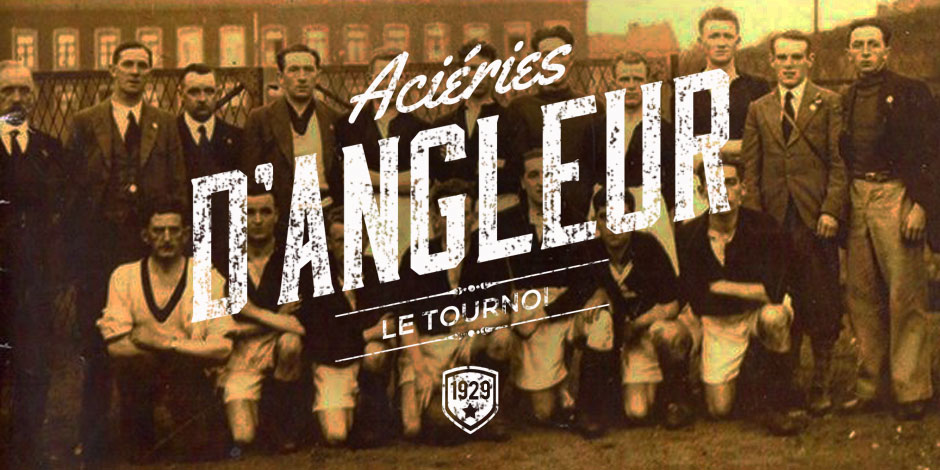
Despite the obvious talents available to the Combinado and the interest created by this exotic side Bohemians were certainly not to be underestimated as opponents. The Bohs were in the middle of one of their most dominant eras, twice champions in the late 20′s the 1933-34 season would yield yet another league title under the shrewd tutelage of Bill Lacey, a versatile former player of both Everton and Liverpool. Lacey had won two league titles with Liverpool in the 20′s and had been part of the pre-partition Irish side that had won the Home Nations Championship in 1914. After his playing days he moved into coaching at Bohemians and also coached the National team of the Irish Free State on a number of occasions throughout the 30s, including a 5-2 victory over Germans in 1936. Bohs had also had some success on European tours of their own; they had won the Acieries d’Angluer tournament in Belgium which included the likes of Standard Liege in 1929, while also playing regular challenge matches in Dublin which included a draw with French side Stade Francais a matter of months before the visit of the Combinado.

Bohemians also included in their ranks a number of Irish internationals such as Fred Horlacher, Jack McCarthy, goalkeeper Harry Cannon and others such as Paddy O’Kane, Billy Jordan and Plev Ellis who would receive their debut caps within the following couple of years. Horlacher, the son of a German immigrant, Pork-butcher, bore some comparisons with his Peruvian counterpart Villanueva. Like Villanueva he was an exciting, versatile attacker, he was also a talented all-round sportsman, representing Ireland at Olympic level in Water Polo and was a fine amateur tennis player and golfer.

Sadly also like Villanueva he would pass away prematurely, dying a year before the Peruvian in 1943 only a month after finishing his career with Bohemians. A reminder that life in 1930s and 40s, even away from combat could be still be brutally short even for the fit, young sportsmen. Another member of the Bohemian side who had won representative honours was Johnny McMahon, born in Derry he was defender who also had an eye for goal, and was the last Bohemian player to be capped by the IFA when he was selected for a game against Scotland in Glasgow earlier in 1933. A league winner with Bohs in 1927-28 and 1929-30 the game against the Combinado would be one of his last for Bohemians after injuring his knee in that same match.

The game itself took place on Sunday October 1st 1933 in front of a full house of over 30,000 at Dalymount Park. The build-up to the game had seen the press tout the Combinado as clear favourites; with The Irish Times noting ominously that “It would be too much to expect Bohemians to overcome them”. Most contemporary reports at the time had been much taken with Uruguay’s earlier footballing successes in the 1924 and 28 Olympics, as well as their World Cup win in 1930 and the image of the skillful and exciting South American footballer was gaining a foothold in the popular imagination.

An example of this attitude can be seen in The Irish Times in one of its previews of the game. It would highlight the significance of the encounter and go as far as to call the match:

The principal event in Free State [now Republic of Ireland] football during the first half of the season…[and that] The South American Republics have taken to Association football as a duck takes to water, and their game now is obviously of a very high standard, since Uruguay has come through very strong opposition to win the last two Olympic tournaments.

This is the first visit of a South American team to the British Isles, and intense interest centres on it, since Spain and Austria have shown themselves capable of challenging English and Scottish supremacy at the game. The visitors are setting out to demonstrate that football in South America is of as high a standard as it is anywhere else.

Our friend “Socaro” in The Irish Press indulged himself so far as to say that the match was “of world-wide interest”, a most uncommon situation for a football match taking place in Dublin at the time. He further stated that the travelling side “must at least consider that they can teach us a thing or two of the art of football”. It’s clear from the reports that the match had created quite a stir, with the main papers devoting significant column space to previews of the match, including pen-pics of all 21 South American players who would make up the Combinado squad, with special mention of Valdivieso, Villanueva and Chilean international Eduardo Schneeberger, of whom much was expected.

The sole negative note in the coverage of the South American’s visit was The Irish Independent’s decision to reprint a cartoon caricature of the Alianza player Villanueva; the black striker is depicted with all the stylized grotesquery one might associate with 1930′s representations of people of colour. To further enforce the significance of their visit the South American party were afforded a Civic welcome from the Lord Mayor of Dublin, while it was noted that “Many public men, including Foreign Consuls have intimated their intention of being present” at the game. A band had been booked to play as a warm-up act for an hour before kick-off and “in order to follow the game with greater interest an official programme” was to be put on sale.

The teams lined out as follows: Bohemian F.C: Harry. Cannon (gk), Aloysius Morris, Jack. McCarthy, Paddy O’Kane, Johnny McMahon, Fred Horlacher, Plev Ellis, William Dennis, Ray Rogers, Billy Jordan, John O’Dempsey
Peru-Chile: Juan Valdivieso (gk Alianza Lima), Alfonso Saldarriaga, Antonio Maquilón (both Atlético Chalaco) Alberto Denegri, Vicente Arce, Eduardo Astengo (all Universitario) Roberto Luco (Colo-Colo), Lolo Fernández (Universitario) Alejandro Villanueva (Alianza Lima) Carlos Tovar (Universitario), Eduardo Schneeberger (Colo-Colo).

The media had predicted a convincing win for the Combinado and it was the South Americans who duly struck first after “twenty five minutes of even play Denegri sent Luco away”, the pace of the Chilean getting beyond the Bohemian defence and though his shot was blocked it fell into the path of 20 year old Carlos Tovar who had an easy finish. Their lead, however would only last ten minutes, Bohemians’ Plev Ellis upon receiving the ball, cut inside his man and was able to fire in a cross, Valdivieso who would pull off a string of miraculous saves throughout the game missed the ball which fell kindly for Billy Jordan who tapped it into the empty net.

In the second half Bohemians attacked strongly but were somewhat hamstrung by the serious injury to defender Johnny McMahon about twenty minutes from time. This injury, which as stated would ultimately cause the premature end of McMahon’s career, forced a reshuffle, with Ellis moving back to right-half and Paddy O’Kane going in at centre-half. In a time before substitutions McMahon was compelled to hobble about out on the wing for the remainder of the game. As Bohs attacked more Valdivieso was forced into a number of saves and Eduardo Astengo had to clear from the goal-line on one occasion, though great praise was also reserved for the efforts of Harry Cannon in the Bohemian goal. Nevertheless, in the closing minutes the Combinado were presented with a chance to win the match but Villanueva shot wide from 6 yards out with only Cannon to beat.

The “interesting and exciting” game would finish 1-1 and Bohemians could reflect positively on their result in front of the bumper crowd who had just gained their first glimpse of South American footballers in the flesh.
Villanueva of all those on show provoked most comment, as a centre forward he was described as a “different conception of that position from British players. Instead of waiting well up the field for the ball to come to him he chases it all over the field”, he is several times described dropping deep and “feeding the wings with skill and precision”. Such descriptions would put one in mind of the type of role, variously described in the modern game as a deep-lying forward or False nine but being executed decades before the likes of Hungary’s Nándor Hidegkuti or even Man City’s Don Revie would popularise the position.

Pathé newsreel footage of the game can be found here.

Villanueva’s performance was somewhat representative of the teams’ style of play; while the reporters watching the game could not fathom his roaming about the pitch similarly they struggled to describe the style of play of the South Americans in general. “Socaro” noticed that they preferred to use their toe when playing as opposed to their instep and that though the Combinado were “adepts in controlling the ball…and with a fine sense of positional play [they]…failed badly in the matter of scoring goals” and that the “fine movements” and build-up play were wasted by their seeming reluctance or inability to finish off such pretty moves. The Irish Times correspondent concurred to an extent stating “they have speed and control the ball well, but… the forwards had not sufficient fire and dash near goal”. Bohemians for their part seemed to have set themselves up to play a counter-attacking game, sitting deep and trying to break quickly on the counter early on, while attacking with more confidence in the second half. “Socaro” despaired of this tactic which he dubbed disparagingly the “Wait and See” approach and went on to bemoan the “little or no charging” in the game.

This view of Peruvians as being a tad too elaborate in their play was not solely the view of the Irish media but one with more common currency. Uruguayan writer and journalist Andreas Campomar described how the sociologist Aldo Panfichi referred to the footballing neurosis of Peru as being the “history of near misses” with Peru producing great players and displays but being undone by individual overindulgence or by refereeing or bureaucratic interference.

In either case the Peruvian public could console itself that the team had played well, deserved to win but had been undone by others. In other words, the moral victory that so many Bohemians fans will be familiar with. Perhaps the most famous example of this neurosis in Peruvian footballing history would occur just three years after the match with Bohemians and featured many of the same players.
The Peruvians went into the 1936 Berlin Olympics with high hopes for victory, which were enhanced after they comfortably dispatched Finland 7-3 in the opening match, Fernández getting 5 of the goals.

In the following game versus Austria, Peru would go two goals down before rallying and drawing level to take the game to extra time. Although the Peruvians had the ball in the back of the net five times in the course of extra time the Norwegian referee only awarded two of them. But for Peru that seemed to be enough. They left the field believing themselves to be 4-2 winners. Austria however protested, arguing that the game had been unlawfully interrupted after spectators had come onto the field during extra time to celebrate one of the Peruvian goals; one such spectator was even reputed to have carried a pistol onto the field of play. The Austrians further alleged that one of the spectators had kicked one of their players and that these events caused a “decrease of the fighting energies of the team”. A rematch, which was due to be played behind the closed doors, was ordered but the Peruvians refused to turn up which resulted in a walkover victory for Austria.
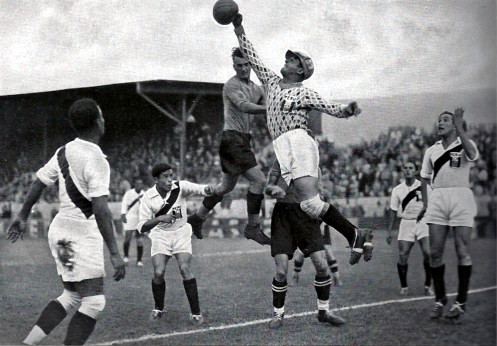
 

Peru_v_Austria_1936_Valdivieso

Juan Valdivieso in action for Peru against Austria in the 1936 Olympic Games

The whole Peruvian Olympic team withdrew from the Games in protest, Colombia did likewise as a gesture of fraternity with their neighbours while other Central and South American nations expressed their solidarity with the Andean Republic. Austria would end up going through to the final but would only collect the silver as they were defeated 2-1 by Italy. Back in Lima the German consulate had its windows smashed while the general population of Peru convinced themselves (with no supporting evidence) that Nazi Germany, sympathetic to Austria had rigged the Olympics to deny Peru the gold medal that was destined to be theirs.

That the touring South Americans should have chosen Dublin as the venue of their first game in Europe might seem a mite strange to modern readers there are a number of reasons as to why this might not be as unusual as it first appears. There was a strong appetite from both Ireland and Peru to test themselves in International competition. Mountainous Peru on the shores of the Pacific was far more geographically isolated that than Brazil or the nations of the River Plate. Apart from the Chileans football in neighbouring states like Columbia and Bolivia was still developing, and despite the tragedy of David Arellano’s death the tour to Spain by Colo-Colo had help put football in this part South American on map.

It was obvious that competitive games against European opposition could provide Peru and Chile with quality opposition as well as boosting the image of the nations abroad. This was similarly the case for the Irish Free State. As The Irish Times noted at the time the “Free State football season suffers from a lack of representative matches, which makes it difficult to assess the true value of the play seen here” which showed how the nascent Free State association faced the same type of challenges as their South American counterparts.

There was of course the still raw topic of the 1921 split of the Dublin-based Football Association of the Irish Free State (which would later become the FAI) from the Belfast based IFA, credibility on a global stage was something that the fledgling organisation craved and was something that the touring South Americans could offer. As well as being the home of Bohemians, Dalymount Park was also home to the Irish Free State’s national team and staging the first game of the tour in Dublin was quite a coup for both Bohemians and for FAI General Secretary Jack Ryder.

It is also worthy to note that sports fans of 1930s Dublin were as big a bunch of event junkies as their modern counterparts. A glamorous touring side in a gala friendly could put bums on seats, over 30,000 of them in Dalymount Park; an attractive venue, and at the time one of the best stadiums in Ireland which had recently been upgraded by the famous stadium architect Archibald Leitch. Such were the crowds in attendance that surviving newsreel footage shows some hardy souls standing on the roof of Dalymount’s main stand to gain a better view. The gate receipts for the Dublin game were a very healthy £900 compared to the £250 taken in Belfast when Glentoran F.C. hosted the Combinado the following day.

Finally there was also an odd Irish connection with the Combinado that may have secured Dublin as the first venue for a game in Europe. The tour organiser/manager was one Jack Gubbins (or John Alejandro Gubbins Pastor) to give him his full name, a Peruvian businessman who along with Colo-Colo president Waldo Sanhueza helped to organise and finance the venture. Mr. Gubbins could trace his family back to Woodstown, County Limerick where his ancestor Joseph Gubbins had settled after arriving in Ireland as a Captain in Oliver Cromwell’s New Model Army. Generations later it was from Limerick that Jack’s father had departed for Peru where the Gubbins family thrived upon their arrival, being especially successful in the rubber industry. An uncle of Jack’s; a John Russell Gubbins had been a director of the Peruvian Amazon Company, rubber manufacturers who had been castigated in the early part of the 20th Century by none other than Sir Roger Casement due to their barbarous practices towards the native Putumayo Indians who worked for the company.

As Casement commented about the Indians plight:

Whole families … were imprisoned-fathers, mothers, and children, and many cases were reported of parents dying thus, either from starvation or from wounds caused by flogging, while their offspring were attached alongside of them to watch in misery themselves the dying agonies of their parents.

Jack was not the only Gubbins to turn up in Ireland either, his brother Reginald (or Reynaldo) also arrived in Dublin, announcing himself as a candidate in Peru’s upcoming Presidential elections. Reginald was a close ally of Augusto Leguia, the recently deposed President. Leguia, (who had once appeared on the cover of Time magazine) was a businessman with experience in the Insurance industry, he had sought to revolutionise Peru’s outdated industrial sector, and set about ambitious infrastructural plans for drainage and health care.

His second term as President came though a Coup d’état and this term would take on a far more dictatorial style, with Leguia oppressing dissenting voices within the political opposition. With the onset of the Great depression and falling demands for Peruvian goods and raw materials his government was overthrown. Leguia’s eventual successor, Luis Sanchez Cerro had been assassinated only months before the Combinado’s departure for Dublin and Reginald Gubbins saw himself as the man to lead the country back to prosperity. He was not to be successful in his campaign however, and Óscar Benavides would become Peruvian president. Sometime later Gubbins’ company would be blacklisted for selling cotton to Nazi Germany in contravention of orders to refrain from trade with Axis powers during the Second World War, a blacklist from which the U.S. House of Representatives would later absolve the company. Such were the colourful Hiberno-Peruvian Gubbins family who surrounded the Combinado tour.

Ireland at the time was not without its own political worries and was wound up with its own paranoia about possible coups. There had been genuine, though unfounded fears earlier in the year that the Cumann na nGaedheal political party would refuse to relinquish power to the incumbent Fianna Fáil party of Éamon DeValera who had triumphed in the recent elections. While only a month before the Bohemian – Combinado game a planned march by the right-wing, quasi-fascist Blueshirts group, led by former Civil War General and Police Commissioner Eoin O’Duffy, had been banned over fears that any such march was intended to as a ploy to overthrow the government in a similar fashion to Mussolini’s infamous March on Rome.

By the end of 1933 the Blueshirts would be banned completely and by 1936 O’Duffy would be leading 700 members of an Irish Brigade to fight for Franco in the Spanish Civil War. It was against this backdrop of national tension and Europe’s gathering storm clouds that this game would take place. Yet despite the proximity of these events, the civil disturbances in Peru or Ireland seem to have had little effect on the sportsmen of the Bohemians or the Combinado. Bohemians would be champions that season and again in 1935-36 while developing numerous players for the National side. Peru would go to the Berlin Olympics and experience joy, sorrow and bitter regret before players like Valdivieso and Lolo Fernández would write their names in their nation’s football history as victors in the 1939 Copa America and enduring icons for their clubs.

Original version published on the official Bohemian FC website in 2014. Special thanks to Simon Alcock for the bespoke artwork.

Bohemians in Europe – The Aciéries D’Angleur trophy 1929

When you look through the history of Bohemian Football Club and you get down as far as the honours section there is, thankfully much to peruse – league titles, cups of various names and hues, some major, some minor, some now defunct.

One that sticks out though, its obscure French title jarring somewhat alongside lists of Leinster Senior Cup victories, is the Aciéries d’Angleur triumph of 1929. Many supporters may imagine this to be some sort of pre-Hanot era version of a European trophy, to be classified with the likes of the Mitropa Cup or Latin Cup which existed before the emergence of the European Cup in the 1950s. Unlike those other competitions, however, there is precious little information immediately available about the Aciéries d’Angleur, so for the benefit of the Bohs faithful, I offer this short account.

The Aciéries d’Angleur was a trophy contested by teams in and around Liege and Brussels, the term ‘Aciéries d’Angleur’ referred to the steel mills (aciéries) of the Angleur region around Liege, an area that had become heavily industrialised from the early 19th century onwards. Bohemians were invited to participate as a guest team in a competition involving , Standard Liege and Royal Tilleur FC but also played matches against a Royal Flemish XI and Charleroi Sporting Club as part of a wider tour of Belgium.

At the time, the national team of the Irish Free State was in its nascent phase. There had been an acrimonious spilt from the Belfast-based Irish Football Association (IFA), and the Football Association of the Irish Free State (FAIFS) had sought recognition from FIFA in order to compete on the international stage.

They knew that this recognition was unlikely to come from the “Home Nation” associations of the UK, whose official line was to recognise the IFA as football’s governing body for the whole island. Though the FAIFS had split from the IFA in 1921 and had been recognised by FIFA in 1923, it would not be until 1924 that a team would take to the pitch under the Free State banner when they competed in that year’s Olympic Games. It would be a further two years before a full international match would take place, this time against Italy in Turin. The Italians would then send a strong side for a return fixture in Dublin, playing in Lansdowne Road in 1927.

The two fixtures against the Italians both ended in defeat – the next international games were against Belgium and were both somewhat more successful. The first game, in February 1928, took place in Liege, with the Free State XI gaining a win with a very credible 4-2 victory in a game that featured Bohs’ Jack McCarthy as captain, Jimmy White grabbing two goals, Jeremiah (Sam) Robinson on the wing and Harry Cannon in goal. The return fixture was held in Dalymount Park a year later with the Irish running out 4-0 winners, thanks in no small part to a hat-trick by John Joe Flood of Shamrock Rovers in a game that also featured Bohs winger Jimmy Bermingham on the right.

Some IFA observers north of the border saw this Free State side as a rump team, playing these early fixtures against other “Catholic” nations and excluded from the Home Nations championship which they viewed, somewhat arrogantly, as the true competitive measure of an international side. However, returning to Bohs, with the Belgian national team having twice played against Ireland, once in Dalymount, it should not perhaps seem so strange that Bohemians – Irish champions in the 1927-28 season – should be invited to compete for the Aciéries d’Angleur trophy.

The tournament was held as a pre-season competition before the beginning of the 1929-30 season, a campaign that would see Bohs again crowned as league champions as they reclaimed their title from rivals Shelbourne. It was contested by teams from the region around Liege and often featured a foreign invitee, the famous amateur English club Dulwich Hamlet had previously taken part, as had PSV Eindhoven.

The fixtures took place in August 1929, with the first match being against Charleroi on August 15th. A crowd of 15,000 was estimated to have attended, with the Bohemians players given a “splendid reception” on what was described as a day “too warm indeed, for football”. Although it was noted by Irish diplomat PJ O’Byrne (a Papal Count from his time as Irish Envoy to Rome) that the Bohemian party were warmly welcomed by the British Consul in Charleroi, there was an incident which caused a bit of a stir.

As Count O’Byrne noted:

“Proceedings were marred somewhat – from our point of view – by the heralding of the Bohemian team on the field under the colours of the Union Jack, which, apparently, was the cause of some manifestation by a section of the crowd, probably British ex-Service Men.”

If the Union Flag incident affected the Bohs players, it didn’t show in their performance, as they ran out 2-1 winners, with goals from a pair of Bills – Bill Cleary and the English-born Bill Dennis. The matches came thick and fast, with another game the following day (Friday 16th) against Royal Flemish select in Brussels with Bohemians winning 1-0 according to a report in the Irish Times.

There is very little information about this game or about who made up the Royal Flemish side but later that same day the Bohemian Football Club party met with Count O’Byrne and arranged to lay a wreath at the tomb of the Unknown Soldier to honour the Irish dead of the First World War. The Free State international side had performed this same ritual the year before with some diplomatic assistance from the impressively named Count Gerald Edward O’Kelly de Gallagh et Tycooly, who had since relocated to Paris.

This simple ceremony, the laying of a wreath, which was a large floral harp in the Saorstát colours, was preceded by a short speech from Joe Wickham, secretary of Bohemians (and later to be General Secretary of the FAI). The diplomatic Free State flag was given to the team for the rest of the tour, so that it could be displayed in the stadium on match days and avoid any further incidents like the one in Charleroi. The wreath-laying ceremony had added significance for Bohemians, as the club had, according to one source, lost up to 40 playing members to the military during the Great War. One such Bohemian who would not return was the club’s early star forward Harold Sloan, who was killed in action on the Western Front in 1917.

On Saturday 17th the third game of the tour took place against Royal Tilleur FC. Royal Tilleur were a moderate side from Liege who had been relegated from the Belgian top flight the previous season. The club went through several mergers, and now exists as part of RFC de Liege, a club most famous for its refusal to release Jean Marc Bosman once his contract had expired and allow him to join French team Dunkerque. Again Bohemians ran out 1-0 winners, and once again Cleary was on the scoresheet.

The final game of the competition was against Standard Liege, to win what the Irish Independent referred to as the Royal Angleur Cup. The match was hard-fought, with the sides level at half-time at one apiece, Bermingham getting the first strike for Bohs. The Gypsies got on top in the second half, finishing as 3-2 winners, with Bill Dennis and Johnny McMahon getting the crucial goals. From there it was swiftly off to Ostend to catch the boat to London, and then back to Dublin to finish preparations for the new season.

Just over two weeks after the return of the triumphant Bohemian side, there was a meeting of the FAIFS Council. At this meeting, PJ Casey of Dundalk FC paid tribute to Bohs on account of their successes in Belgium. The Association agreed to officially record these achievements, and this motion was supported by “various members” of the Council. It was further agreed at this meeting that the Association should endeavour to arrange another match against Belgium (and others against Holland, Germany, Sweden, Italy and Spain).

The game with Belgium was duly arranged for May 1930, and heralded another victory for the Irish, this time a 3-1 win in a game that featured the final international appearance of Bohemians defender Jack McCarthy (then 32), and the debut of 20-year-old forward Fred Horlacher, who was beginning his journey to becoming a club legend.

We often think of European club football as being insular in the years before the European Cup, especially in Ireland of the 1920s and 30s, where the association game was restricted to the hotbeds of Dublin and Cork, separated from the major clubs in the Belfast area, and effectively ostracised by the “Home Nations”.

The Aciéries d’Angleur however, showed that a team like Bohemians, true to their name, were more connected to mainland Europe than one might expect. The journey to Belgium was in its own small way an important step to identify the Free State, its Football Association, and clubs as separate and distinct entities, capable of competing in the international arena.

The issues around the Free State flag and the visit to the grave of the Unknown Soldier show that Bohemian Football Club, in a minor way, did its part to acknowledge the past (such as the contribution of Irish soldiers during the Great War) and herald the future of a small nation in flying the flag of the Free State. It is not far-fetched to assume that many of those attending the matches in Belgium would never have seen the Irish tricolour flown before, or perhaps even been aware of the emergence of this new state.

This was not to be the last engagement between Bohemians and teams from other nations. It is noteworthy that throughout the 1920s and 30s, long before official UEFA club competitions, Bohemians were competing against sides from all over the world. Although the Free State national teams’ victories over Belgium show that Belgian sides were perhaps not world beaters, it is worth remembering that they had been Olympic Champions on home soil in 1920, and players from that victorious side were still featuring against the Irish in 1928.

Bohemians, as a completely amateur side, also had to undertake a boat journey to Belgium via Britain, and play games on consecutive dates in blistering August weather against the local sides and in front of partisan crowds. Their victory is still worthy of respect from the Bohemian faithful to this day, even if the tournament may seem obscure and archaic to modern fans.

Many will already know about Bohs’ historical victories in Europe against Rangers, Aberdeen, Kaiserslautern or BATE Borisov, though some may not be familiar with these earlier games in Belgium or indeed against sides from as far afield as South America, but then that’s a story for another day.

Originally posted on the official Bohemian FC website in 2014 and with special thanks to Simon Alcock for the imagery.

A Springbok ran in Solitude – South Africa’s international debut

South Africa were there from the beginning of organised football in Africa, the game arrived from Britain in the late 19th Century and the national association first affiliated to FIFA in 1910.

As an early African member of FIFA in the 1950’s they agitated for greater representation for African football and in 1957, along with Egypt, Ethiopia and Sudan they were founders of CAF (Confederation of African Football) and were almost among the original participants in the African Cup of Nations, however it was at this point that the thorny issue of Apartheid intruded on proceedings.

As the Sudanese delegate Abdim Halim Mohammed recalled at the time, the South African delegate was:

A chap called Fred Fell, not an Afrikaner but British. We accepted him and accepted South Africa. He accepted we would host the first African Cup of Nations in Khartoum…Then we came to that “area”. He said the government had told him it is either a pure white team or a black team. We said we don’t accept that. We want black and white.

South Africa were understandably disqualified as a result of their intransigence on the issue of a mixed national team and it would be almost forty years before a South African side would compete in the Cup of Nations.

When they did enter the competitions it was as hosts in 1996, Nelson Mandela was President, and a multicultural South African team would emerge as Champions with Mark Williams grabbing both goals in the final against Tunisia.South Africa 1996

Since the 90s post-apartheid South Africa has competed in, and hosted a further Cup of Nations as well as the 2010 World Cup. However their long, controversial and turbulent international history began not in Cape Town or Johannesburg, or even on the continent of Africa, but on a trip to Ireland and in the cities of Dublin and Belfast.

Back in 1899 a football team from the Orange Free State had toured England, notable for the fact that it was an all-black team, while in 1906 a white side had toured South America and played in both Brazil and Argentina, however the Union of South Africa was only formally established in 1910 bringing together four previously separate British colonies.

The new football team of this new nation would join FIFA but wouldn’t play a formal international until September 1924 when “The Springboks” came to Europe. Their first port of call for the all-white touring side was Dublin, and their first opponents Bohemian F.C.

By that stage the South African government had already brought in one of first pieces of Apartheid legislation, the 1913 Natives Land Act which limited the ownership of land in South Africa by the majority black population to just 8% of the total area of the country.

While the majority of apartheid legislation was introduced in the late 40s be Prime-minister DF Malan the preceding decades had seen the steady erosion of the rights of the black South African population. Despite these rulings the sporting relations between Britain (and Ireland) with South Africa were flourishing in 1924.

Not only was the football team visiting but in rugby, the British and Irish Lions were on tour in South Africa, while the South African Cricket team was just completing a summer tour of England.

The visiting football team would play three games in Ireland, the first on 30th August versus Bohemians before travelling north of the recently created border to take on the Irish National Team (the IFA selection which from this point on will be referred to as Northern Ireland) in Belfast and a North-West XI playing in Derry in September.

The split between the Belfast based IFA and the recently formed FAI of the Free State was still a sensitive issue, with both associations claiming exclusive use of the name “Ireland” while each association continued to select players from the whole of the island. As just one example of the complexity of this cross-border situation the Free State FAI Cup holders at the time of South Africa’s arrival were the Belfast based Alton United.

There were now two leagues and two national teams on the island of Ireland and although the FAI had sent a side to compete in the 1924 Olympics that summer the fledgling association had yet to play a FIFA recognised match. It was under these circumstances that South Africa; an amateur side at the time would take on not the Free State XI but the reigning League of Ireland champions (and fellow amateurs) Bohemians.

They would meet in Dalymount Park and the touring side would get off to a great start in front of a large Dublin crowd with the South Africans eventually running out 4-2 winners. Bohs were without the influential Bertie Kerr who was injured but did have players of quality such as Paddy O’Kane, Dave Roberts and Jack McCarthy in their side who would all go on to win full caps for Ireland. Incidentally Bohemians were captained by Billy Otto, who had been born in South Africa.

The South African goals would come from Eric Stuart of Western Province, Jim Green of Transvaal and a brace from a 20-year old-striker named Gordon Hodgson.

Hodgson, the son of English emigrants, had worked as a boiler maker in his native South Africa while also lining out for the Transvaal side. Like many of the touring South African side he was physically imposing, standing at six foot one and weighing over 13 stone.

Early reports of the South African tour suggest that their forwards were somewhat rough diamonds in terms of finishing, their good attacking play being undone by some poor marksmanship, Hodgson, however, would certainly prove to be a formidable goal-scorer.

The South African side would spend three months touring Ireland, England and the Netherlands and their teams’ performances, including wins over Chelsea, Aston Villa, Liverpool and Everton would generate significant interest in a number of the Springbok players and several would pursue professional careers in England.

Gordon Hodgson would join Liverpool and make the biggest impression, along with him goalkeeper Arthur Riley and Glasgow-born fullback Jimmy Gray would all join the Reds in 1925. Gray would make a single appearance before joining Exeter City where he played until 1936, while Riley would have to bide his time at Anfield as he would have to replace the legendary Elisha Scott in goal.

Scott was (and remains) Liverpool’s longest serving player and an Anfield hero and was also first choice keeper for Northern Ireland. It would be the 1928-29 season before Riley got any sort of extended run in the Liverpool team though he would eventually amass over 300 appearances for the club.

Hodgson would become a record breaker on the red half of Merseyside, becoming Liverpool’s record goal scorer, a title he would hold for three decades before the arrival of Roger Hunt in the 1960s. Initial interest in Hodgson was piqued when he scored a hat-trick in front of the Kop for South Africa against Liverpool during their tour, something guaranteed to catch the club’s attention.

He would score 233 league goals for Liverpool (including a still standing club record 17 hat-tricks) during his 11 years at Anfield, before, at the age of 32 he was signed by Aston Villa for £3,000. His spell at Villa would be short and he would move to Leeds United for £1,500 in 1937, eventually scoring an impressive 53 goals in 85 appearances for the Yorkshire club.

Gordon Hodgson of Liverpool, South Africa and later England

Gordon Hodgson of Liverpool, South Africa and later England

Hodgson still sits fourth on the all-time top flight scoring chart in English football, by his retirement he had 288 league goals, five above Alan Shearer, and only behind Jimmy Greaves, Steve Bloomer and his contemporary, and city rival Dixie Dean.

It is perhaps because of Dean that Hodgson is not more well know. Liverpool have had their fair share of prolific forwards but what separates Hodgson from the likes of Hunt, Keegan, Dalglish and Rush is that those later era strikers were all trophy winners.

Hodgson played for Liverpool during a trophy-less period, made all the worse by the fact that Everton would win two league titles and an FA Cup during Hodgson’s time there, with Dean being recognised as the greatest centre forward in the world and one of sports’ biggest names.

Despite the obvious scoring prowess of Hodgson he failed to find the net in his next game in Ireland after his brace against Bohemians. In fact contemporary reports mentioned his poor finishing in the game against Northern Ireland; the game that would go down in South African football history as their first international.

The match would take place in Solitude, the home ground of Belfast club Cliftonville in front of a crowd of 6,000, generating the princely sum of £254 in gate receipts on the 24th of September 1924. The South Africans had made some changes to their starting line-up since the match at Dalymount, in came Williams, Touhy, Jacobi and Murray. Out went Howell, Hicking, West and Walker. They had played four games in the London area in the intervening three weeks, their most recent match a 4-2 win over Second Division Chelsea with Hodgson grabbing two.

The Northern Irish didn’t field their strongest side for the game. There was no Elisha Scott to face his Liverpool successor, nor was their star forward, Sheffield United’s Billy Gillespie in their line-up. In fact as a cost saving measure the IFA chose to select only players from the Irish League to save on travelling costs.

This all-domestic XI did cause some confusion as to the status of the game both at the time and subsequently. Some reports, including the Irish Times, referred to the Irish side as an Irish League XI rather than a full national team and for many years the IFA did not list the match as a full international, recognising it only as an amateur match.

The South Africans would also play both the English and Welsh amateur sides on their trip but these would not count as full internationals.

However the game against Northern Ireland has been recognised as a full international since 2001. While the Irish side were all home based there were paid professionals among their ranks including Thomas “Tucker” Croft who had scored the winner against England only a year earlier.

They wore the St. Patrick’s blue jersey of the full International side rather than the green jerseys associated with the Irish amateur side and the match was advertised at the time as a full international by the IFA.

The Irish side took the lead early through Frank Rushe who got on the end of a free kick after ten minutes. Rushe was born in Bessbrook in County Armagh. At the time of the South Africa match, his only senior cap, he was playing for Distillery in the Irish League but had spent the previous season with Dublin side Shelbourne who had finished runners-up to Bohemians in the Free State league.

The South Africans would strike back though, just before half time David James Murray getting them back on level terms before Jim Green, who had also scored in Dalymount, grabbed the winner 15 minutes from time.

Irish football correspondents noted the improvement in play from the South Africans since the match in Dublin and the physical disparity between the well-built Springboks and the less robust Irishmen was commented upon by a number of columnists.

It was also noted that the margin of victory could have been greater for the South Africans if it had not been for their wasteful finishing, with particular mention for young Hodgson who seemed to be having a rare off day.

The South Africans would spend the next three months touring Britain and the Netherlands, including another full international, a 2-1 defeat to the Dutch national team in Amsterdam, though these would be the last games played for the national team by men like Hodgson and Riley.

As mentioned, Hodgson would even line-out three times for his new homeland, England. While he and Riley would have successful careers in England, making almost 800 league appearances between them.

It would be almost thirty years before a black South African would play professionally in Europe when Steve Mokone signed for Coventry in 1955 before playing in Holland, Italy and Spain. Two years after Mokone’s move to Coventry his fellow countryman David Julius would sign for Sporting Lisbon.

Due to the racist policies of apartheid South Africa and the various bans, suspensions and boycotts that resulted, neither man would ever play for the land of their birth, Julius would end up donning the red of Portugal rather than the green and gold of South Africa.

While Hodgson scored for England against Wales during the second of his three caps he at least had the opportunity to play for South Africa against Northern Ireland and the Netherlands. In many ways the tour of 1924 was a false dawn in international footballing terms for South Africa.

The ruling government’s refusal to allow mixed teams meant their expulsion from CAF, FIFA, the Cup of Nations and the World Cup. It was only in the mid-90s that the football isolation of the nation would properly end.

While the record books show that South Africa made its international debut in Belfast in 1924 perhaps that game should have an asterisk against it, and not because the IFA selection they faced included only domestic based players.

Despite the quality of players like Gordon Hodgson and Arthur Riley a truly representative South African XI wouldn’t make its international bow until the Bafana Bafana defeated Cameroon in Durban 68 years later.

Originally posted on backpagefootball.com

Blogging beginnings

I’ve been writing bits and pieces about football in general and Bohemian F.C. in particular for a number of years now. I always avoided trying to start my own blog preferring to write pieces for other websites who were either in the process of establishing themselves or were already well established. They already had readers and an audience and I’ve never felt comfortable chasing that and, well it seemed like a much easier way to get stuff read.

The reason I’ve started this blog now is that I wanted to have all the various articles I’ve written in the one place and maybe have a space to put up bits and pieces that are of even more of a minority interest than usual.

What you’ll find is a good bit of Bohs stuff, some general football musings and even a few other bits I’ve done on Dublin history. So please feel free to share, comment or complain.