Bohs in Europe

The following is a condensed version of the talk given in the Jackie Jameson bar on December 7th 2019

After a gap of eight years the 2020 season will see Bohemian FC return to European competition, given the club’s name and its history it could be argued that this is merely a return to its rightful position as for more than a century the Bohemian Football Club has looked beyond the borders of Ireland for challenge and opposition.

Bohemian internationalism really dates back to the development of Dalymount Park as the club’s permanent home. This base allowed them to invite the cream of British talent to Dublin to try their luck against the Bohemians, in those early years Preston North End, Aston Villa, Celtic and Sheffield United were among the early visitors. In 1908 Bohemians played Queens Park in Glasgow on New Year’s Day in an annual fixture which was the world’s most prestigious amateur club match usually contested against English side Corinthians. With them being unavailable to travel Bohemians were asked in their place and contested the game in front of over 20,000 spectators in Hampden Park.

After the split from the IFA the footballing landscape for clubs based in the new Free State was very different, the emerging FAI sought membership to FIFA and clubs like Bohemians also began to look to the Continent. In 1923 the first Continental side to play in Ireland since the split from the IFA arrived to take on Bohemians and an FAI XI, they were Gallia Club of Paris who played out a draw with Bohs.

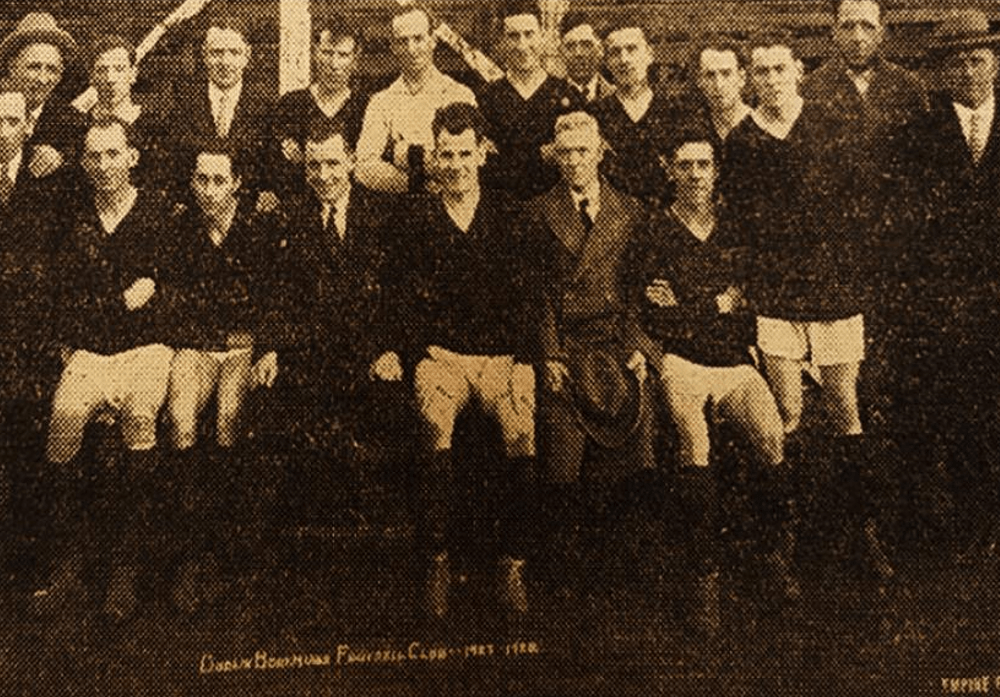
From further afield came the South African national team, embarking on a tour of Britain and Ireland, the first opponents on this tour were Bohs in Dalymount Park and the unusual situation arose as two South African captains faced off against each other. Because the captain of Bohs for that 1924 season was Billy Otto, born on Robben Island he had left South Africa as a teenager to fight in World War I before ending up working in Dublin as a civil servant. A talented and versatile footballer he captained Bohemians to the League title before moving back to South Africa with his Irish wife in 1927.

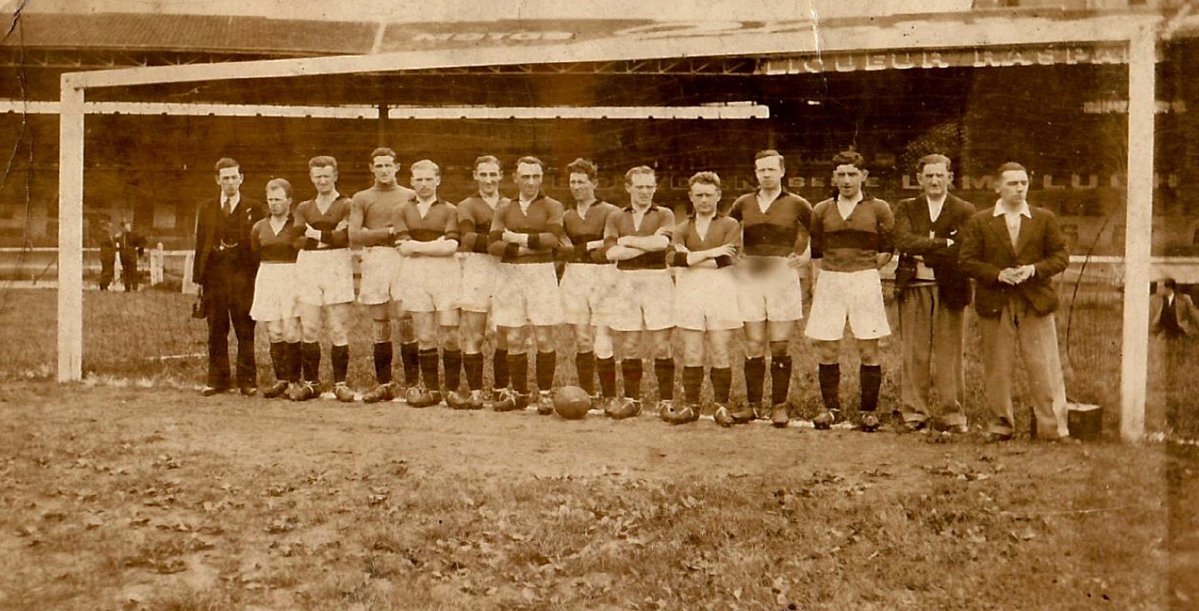
By 1929 Bohemians were embarking on their first European tour themselves, competing in the Aciéries D’Angleur – an annual invitational tournament held around Liege in Belgium. Bohs played four games in all, including friendlies, winning every one and emerging victorious in a tournament which also featured Union Saint Gilloise, Standard Liege and RFC Tilleur. During this visit to Belgium the club also performed diplomatic functions on behalf of the Irish State such as flying the tricolor (at the first game the club had been mistakenly introduced under a Union Jack) and laying a wreath at the tomb of the unknown soldier.

DZOKSKYWkAAFNxP

Further continental success would follow three years later in the 1932 Tournois de Pentecôte held in Paris in the Stade Buffalo ahead of the first full professional season of the French League. Bohemians triumphed again by beating Cercle Athlétique de Paris (aka CA Paris/Gallia who we encountered earlier) and Club Français and winning the tournament and securing a second European trophy in three years. These were no mean achievements as both sides featured a number of French internationals who had competed in the 1930 World Cup and who had scored a stunning victory over England only a year earlier.

A year after the trip to France, Dalymount Park welcomed the first ever South American touring side to visit Britain or Ireland. This was the combined selection from Peru and Chile – the “Combinado del Pacifico” who also visited Scotland, England, the Netherlands, Czechoslovakia, Germany, France, Italy and Spain

There was significant interest and media attention paid to the game, with an official reception by the Lord Mayor of Dublin etc. The success of Uruguay in recent Olympic games (1924 & 28) and at the 1930 World Cup had sparked interest in South American football and despite the talent within the squad, including several future Copa America champions Bohs were able to hold out for a more than credible 1-1 with the touring side.

Bohs didn’t even taste defeat on European soil until April 1st 1934 when they were made to look the fools, losing the opening match of another European tournament against Dutch side Go Ahead in Amsterdam. The tournament also featured Cercle Bruges and Ajax. While the Gypsies bounced back and defeated Cercle Bruges 4-1 and secured a draw against ADO Den Haag there was sadly to be no match against that emerging force of Dutch football, Ajax.

While it would be the 1970-71 before Bohs would enter an official UEFA competition let nobody tell you that we don’t have a long history in Europe.

This piece first appeared in the Bohemian FC v Fehérvár match programme in August 2020.

Bohemians in America (Podcast)

A podcast recorded with sports researcher Michael Kielty – a lively discussing which covers early patterns of emigration by Irish footballers, the emergence of  the New York Bohemians in the 1920s, as well as the stories of unique characters like Billy Synott and Joe Stynes.


This slideshow requires JavaScript.

Bohs in Europe – the early years (podcast)

A recording of the talk I gave on Bohs in Europe – the early years in Liberty Hall in December 2019, now available on all the main podcast platforms for you to listen to below. Also enclosed is a slideshow of photographs relating to the games and personalities that are mentioned. With thanks to Dubin City Council Libraries, Bohemian F.C. and Simon in Con Artist events.


This slideshow requires JavaScript.

Bohs in the time of influenza

We’re all stuck at home, talking a good game about catching up on our reading or perhaps finally completing that DIY project, more likely if you’re anything like me you’re mindlessly scrolling on your phone, or binge-watching lurid TV series on Netflix. Things are obviously a lot different if you are a frontline worker, in one of our hospitals, a member of our emergency services or working in essential retail businesses. The stress is very real. But this is not unique or unprecedented. This too shall pass.

Just over 100 years ago Ireland faced a not dissimilar epidemic. While the Spanish Flu was something of the misnomer, it was very real, and very deadly. Conservative estimates place the Irish death toll from the virus at over 20,000 from Summer 1918 to Spring 1919. Consider also that this came towards the end of the First World War which claimed the lives of perhaps 50,000 Irish people and saw a country in a state of turmoil on the topics of nationhood, conscription, poverty and on the brink of a violent War of Independence. We can perhaps sympathise with their plight.

Unlike today however, the people of Dublin in 1918 and 1919 had football. Despite schools closing, and many businesses shutting due to illness and self-quarantine measures, football continued in something akin to its usual patterns. To set the scene; at the end of the 1914-15 season due to rising costs, loss of players and supporters to the war-effort and the general disruption brought by the War, the Irish League split into regional competitions for the rest of the War. Bohemians and Shelbourne, the two Dublin sides in an eight-team league dominated by the main Belfast clubs, returned to the Leinster Senior League, and this in effect was our main league for the War and its immediate aftermath. The main Irish Cup competition still ran on an all-Ireland basis, though the early round draws were regionalised, while other trophies such as the Leinster Senior Cup were major priorities.

If anything, the years 1918 and 1919 brought almost a return to normality for Bohemians, the club had lost dozens of players to the War and many more in terms of supporters. At a conservative estimate some 50,000 Dubliners ended up in the battlefields of the First World War and perhaps 8,000 of them never made it home. This impacted not just Bohemians but every football club in Ireland. The Leinster Football Association (LFA) saw a reduction in affiliated clubs which declined by 50% during wartime and by 1919 the LFA had to go cap in hand seeking a grant or loan from the IFA to try and keep the Association afloat. A major concern for Bohemians (and many other clubs) was getting players released from their regiments in order to play for the team. In several games Bohs were hamstrung because of missing key players due to the refusal of the British armed forces to release players for matches, even after the armistice.

Willits army updated

A clipping from Sport showing Bohemian FC player Harry Willitts in army uniform in 1917

Despite all this upheaval there were still notes of optimism to be found, Bohemians won the Leinster Senior League – the highest level played by clubs outside of Belfast, in the 1917-18 season and came second to Shelbourne the following year. It should be noted that Bohs, despite the loss of numbers due to the War, were still fielding at least two teams at the time, with a Bohemian “B” side competing at Leinster Senior League Division Two against the like of St. James Gate and Glasnevin F.C.

The influenza epidemic first noticeably hit Ireland in early summer of 1918 as the football season was ending, but arguably had its peak in Dublin in October and November 1918, as well as continuing into the Spring of 1919. There were perhaps three different peaks of the epidemic. One theory for the surge in cases in November 1918 was that people congregated en masse to celebrate the end of the War and inadvertently helped spread the virus. Unlike most of the Covid-19 cases at present the “Spanish flu” (thus described because neutral Spain reported the first cases, it had been rife in the trenches of France and Belgium months earlier) seemed to affect younger, healthier people, with many in their 20s and 30s dying and leaving young families without parents.

One report in The Irish Times on November 16th 1918 noted that between September 28th and November 9th some 756 people had died of the influenza virus in Dublin City alone. Two days later Shelbourne beat Bohs in the league in front of what was described as “a record crowd of the season”. It was a good time for Shels at this point, they seemed to have the upper hand over their main Dublin rivals, the famous Bohemians, in both 1918 and 1919 they knocked Bohs out of the first round of the Irish Cup. In February 1919 they won their Cup match in Dalymount (at another resurgent point for the flu epidemic) in front of a crowd of over 8,000, which was described as a record attendance in Dublin since the outbreak of War.

Indeed, not happy with just the usual run of fixtures Bohs decided to host an alternative Cup final on 29th March 1919. On the same day that Linfield were playing Glentoran in the first of three finals (two drawn games followed by an eventual Linfield victory on the 7th of April) Bohs agreed to host beaten semi-finalists Belfast Celtic in front of a bumper crowd in Dalymount. The Bohs would triumph 2-1 on the day.

thumbnail_Belfast Celtic 1918

Belfast Celtic teams of the era

While the Dublin public were waylaid from all sides by death, whether from War, revolution or disease, somehow football continued, in the case of Bohemians the club saw suffering and death in the war, former players like Fred Morrow, Harold Sloan, Francis Larkin and others had died in action and many more were seriously injured. But during the Spanish Flu epidemic, partially spread by the return of so many soldiers from the front in 1918, while some quarantine measures and closures of businesses and schools did take place football continued as usual.


This article originally appeared in the Bohemian F.C. lockdown match programme which you can read in its entirety here.

Early football players of colour in the League of Ireland

As some readers may be aware I’ve had the opportunity to write a number of articles on the life and career of former Drumcondra footballer Ray Keogh. Indeed recently I was lucky enough to be asked by Dublin City Council libraries to give a talk on the subject, which you can listen to here.

Ray’s life and career were filled with plenty of drama and highlights which would have been worth recording no matter his background, but the fact that initially I thought that Ray may have been the first person of colour to play in the League of Ireland meant that I felt that his story really needed to be recorded and told while he was still with us. Sadly Ray died in August 2019 but I was lucky enough to meet him before he passed away, I was also fortunate enough to speak with members of his family, former teammates and others who remembered him from his playing days.

In the course of this research I learned that although Ray was one of the first people of colour to play football in the League, he was not the very first. This short article will give a little bit of background on some of the other players who featured, albeit often fleetingly, in Irish football in the years before Ray made his debut. Ray played that first senior game for Shamrock Rovers in 1959 but there was at least one other player who appeared for a League club before then.

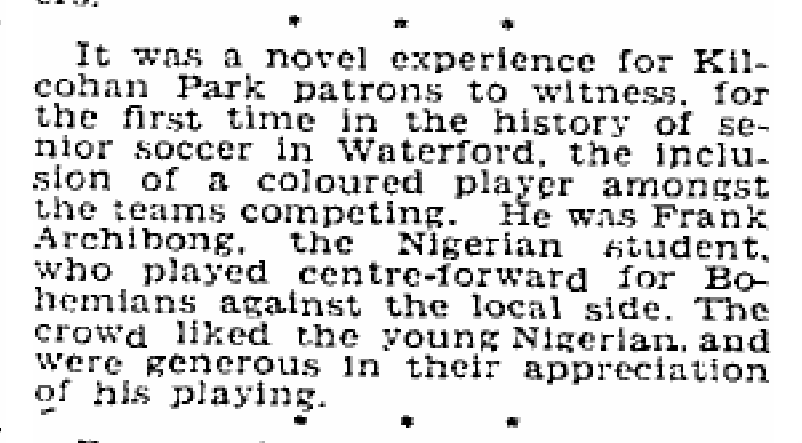
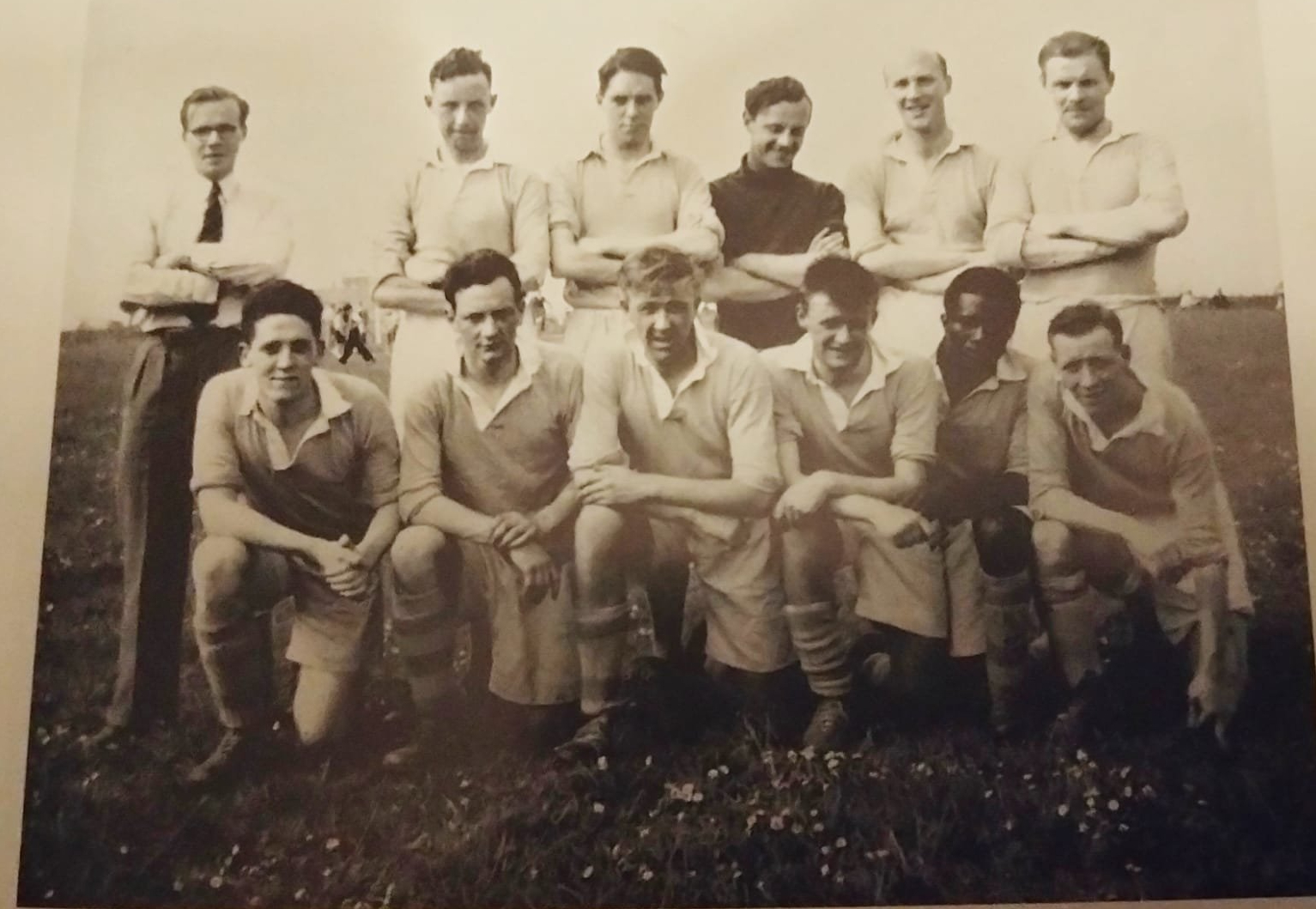
One early black player who was brought to my attention by Bohemian FC historian Stephen Burke was Francis Archibong, who had a brief career with Bohs more than ten years before Ray made his debut for Rovers. Francis Archibong was born in Nigeria and came to Dublin in the late 1940s to study English in University College Dublin. During his spell studying in Dublin he lived on Coulson Avenue in Rathgar but found time to line out for the Bohemians on a number of occasions during the 1948-49 season.

In total Francis Archibong’s Bohs career amounted to four games; two for the Bohemian “B” team in the Leinster Senior League and two for the first team in the League of Ireland Shield, a competition played ahead of the commencement of the main league season. Bohs lost all four matches in these competitions:- to Shamrock Rovers “B”, Jacobs, Waterford and Sligo Rovers respectively, with Francis playing as centre-forward in these games but failing to find the net in any of the contests.

I’ve made the assumption that Archibong may also have lined out for UCD AFC who were not a league side at the time but I’ve yet to find any definite evidence of this. Though there are newspaper reports of his Shield appearances for Bohemians against Waterford and Sligo which mention the novelty of a black African footballer appearing in the game, most reports are not particularly complimentary about his performances, or that of the Bohs side as a whole. The Munster Express was perhaps the most generous in their appraisal of Archibong’s performances who noted the warm welcome afforded to him by the Waterford crowd.

Archibong snippet

Munster Express 15th October 1948

While Francis’s Bohs career was short he did feature alongside players of note such as Brendan O’Kelly who would represent Ireland in football at the 1948 Olympics and Frank Morris. He also played against the likes of Ireland internationals Fred Kiernan and Sean Fallon who were lining out for Sligo. And if his football career didn’t perhaps live up to hopes then his professional life saw huge success.

He graduated with a degree in English from UCD in 1950, his thesis was entitled A history of the criticism of King Lear from Condell to Coleridge. Francis returned to Nigeria in October 1950 on board a plane packed with European missionaries, thereafter he devoted his career to educating young people in his home country. Francis Archibong ended up working for the Nigerian Ministry of Education and was involved in large scale literacy projects in the 1960s and even represented Nigeria at meetings of UNESCO.

Apart from Francis Archibong there were a number of subsequent people of colour with UCD connections who appeared in Irish football in the years after Francis’s brief sporting career.

UCD tended to be a Leinster Senior League side who also featured in the FAI Cup early

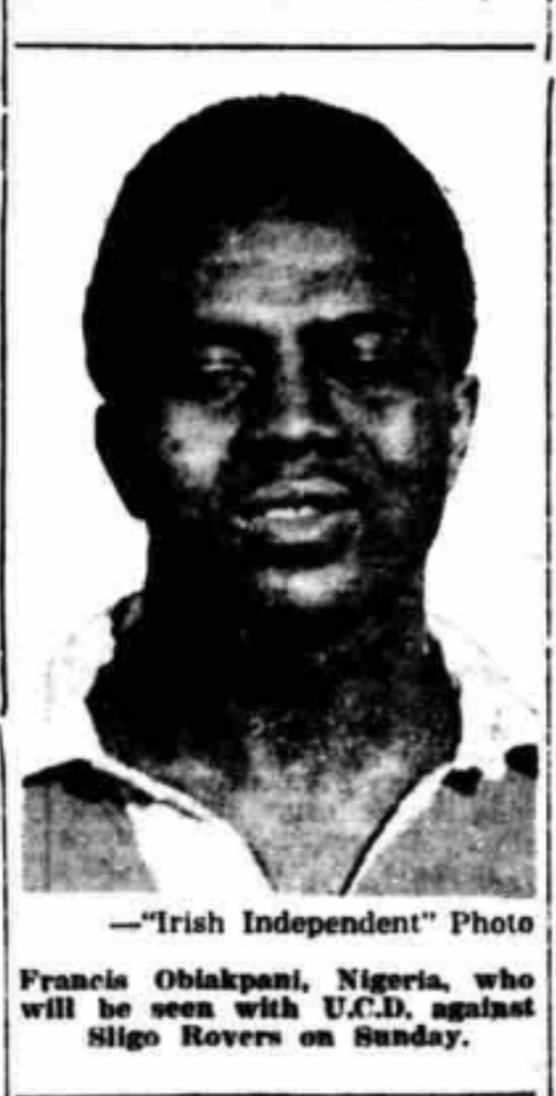
Pic of Obakpani

Francis Obiakpani

rounds, it would be 1979 before UCD AFC would be elected to the League of Ireland. UCD generally had a small number of foreign students at this time, including several from West Africa. A few years after Francis Archibong had graduated the UCD football team featured two Nigerian players in a Metropolitan Cup semi-final against Jacobs in 1956; they were Frank Obiakpani and Fidelis Ezemenari. They lost that game 3-1 with Ezemenari getting the consolation goal.

By that time Obiakpani was a medical student who had just graduated, he had been starring for the UCD side since 1953 and had helped the college to triumph in the Collingwood Cup.  While Ezemenari was studying Zoology. It was mentioned in one report that the two young men had known each other before their arrival in Ireland.

Among their teammates for UCD was a talented attacker named Brian Lenihan (see photo below) who won an amateur international cap for Ireland and who would later become Minister for Finance and run for office as President of Ireland, also on the side was Willie Browne, an accountancy student who would later win three caps for Ireland and captain Bohemian Football Club.

Lenihan UCD

Back in 1953 Obiakpani had faced off for UCD against a friend who was playing for UCC, listed as A. Ezenwa who was described as a talented centre-half who had played football with Obiakpani back in Nigeria, he was also a useful athlete away from the football pitch, excelling in the Long Jump. While in Cork he was studying Science. That UCC side were captained by Tommy Healy who was a star player for League of Ireland side Cork Athletic. Writer Cian Manning has written previously for Póg mo Goal about Francis/Frank Obiakpani and what happened to him after his graduation, he has suggested that Obiakpani may have been killed during the Biafran War in 1967.

I would love to know more about these players, while they did not feature at League of Ireland level they were playing at a high standard and alongside present and future League of Ireland stars. However, the information I’ve been able to find still leaves unanswered questions, even down to simple details like the first name of players like Ezenwa.

If you know more I’d love to hear from you.

Shedding some light on Dalymount – the true story of the Bohs floodlights

I love a good Western and among many great practitioners of that ultimate piece of cinematic Americana was John Ford, born John Feeney in Maine to two Irish-speaking immigrants. Ford was a man who knew how to mythologise himself and he did plenty of myth-making in his movies as well. For better or ill his film The Quiet Man has probably influenced the American view of rural Irish life to this day. While, his westerns are far from historical documents of frontier life for European settlers in the American west, rather they are among the founding myths of American exceptionalism.

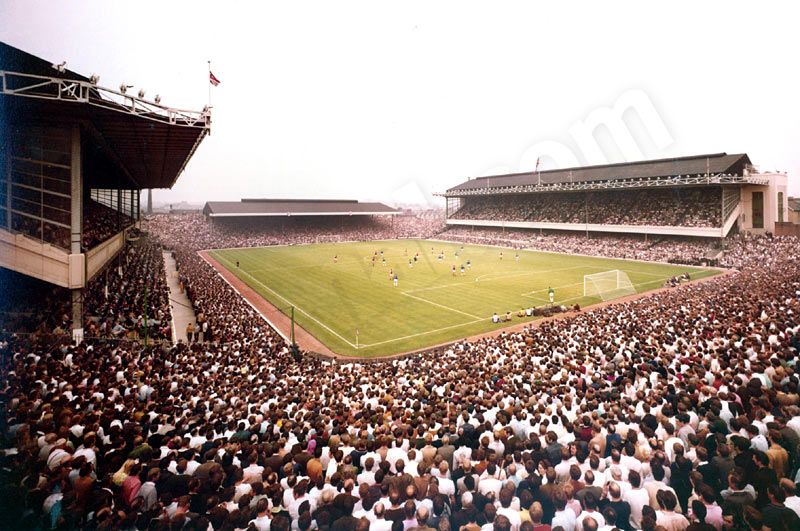
Of course Ford knew this, in one of my favourite of his films, The man who shot Liberty Valance a world-weary newspaper man utters the immortal line “When the legend becomes fact, print the legend”. Ford ackowledges that very Irish trait of preferring the entertaining story to the truth. And so it is with football, there are plenty of myths that grow legs, that persist to the present day despite constantly being debunked. I mentioned the old chestnut of Germany wearing a green away kit as a “thank you” gesture to Ireland in a recent post, but in this piece I’m going to address the notion that Bohemian Football Club bought the iconic Dalymount pylon-style floodlights second-hand from Arsenal, and that these same lights once adorned Highbury Stadium.

The origins of the myth

There are several fairly authoritative accounts, including one on the club’s own website, that perpetuate the story that the lights were either sold or gifted by Arsenal to Bohemians. I had in the past shared this story on social media myself before doing a bit of digging on the subject. This myth seems to have arisen from the fact that Arsenal played Bohemian F.C. in an inaugural match for the new lights in March 1962.

Floodlight Arsenal cover

Cover of the match programme featuring the newly installed floodlights.

This simple inaugural match has somehow morphed into a story that Arsenal sold the lights to Bohemians. There are a few ways to dispel this myth so lets begin with the idea that these were the floodlights that once adorned Highbury.

The Highbury dilemma

Arsenal began playing matches under floodlights from 1951, at which time league matches under lights were not even permitted by the F.A. They did however play a number of high profile friendly matches including one against Glasgow Rangers. While the glorious old ground of Highbury has since been turned into modern apartments large sections of the stadium received listed status and still exist.

Anyone who ever visited the stadium will likely attest to its architectural beauty, it was however, also known for the compact nature of its dimensions, including an infamously narrow pitch, well exploited by managers like George Graham. Simply put Highbury didn’t have the space for large pylon towers like those that stand in Dalymount today. In the photo below you can see Highbury Stadium from that 1951 game against Rangers. This is verified both here and also here on the official Arsenal website.

Highbury

From this early photo it is clear that there are no floodlight pylons, all the lights are roof mounted. It is worth noting that this photo is from a mere 11 years before the lights were supposedly “sold” by Arsenal to Bohemians, which would mean that any floodlight pylons would have to have been installed after 1951, survived less than ten years, and then been removed and replaced by another roof mounted lighting system.

From later photos it’s clear that there were no pylons at Highbury and indeed very little space in such a tight stadium for the location of large pylon tower lights. The two photos below are from circa 1960 (roof mounted floodlights again) and secondly from the last season that Arsenal played at Highbury in 2006. As before, roof-mounted lights.

Highbury2

Highbury3

Highbury in 2006

The only connection between Highbury and Dalymount is that they are both tight grounds located in residential areas and that portions of both stadiums shared a stadium architect in the early decades of the 20th century, namely Archibald Leitch.

The story of the lights

The insertion of the Arsenal Football Club and Highbury Stadium into the history of Dalymount is really by accident. Bohemians had organised a fundraising subcommittee to look at the cost and feasibility of installing floodlights at least as early as 1959. It also quickly became clear that once the lights were ordered that some form of inagugural game would prove popular.

To be clear, the Dalymount Park floodlights were not the first set of lights used in Dublin. Stadium lighting was temporarily installed in Croke Park for the Tailteann games of 1924, while Ruaidhrí Croke has written recently about the first games under lights in Tolka Park back in 1953 when it was home to Drumcondra F.C.

However, Dalymount Park was the de facto home ground of the Irish national team and the lack of floodlights meant that international games had to have earlier kick-offs, even when scheduled for mid-week which had an obvious impact on crowd numbers.

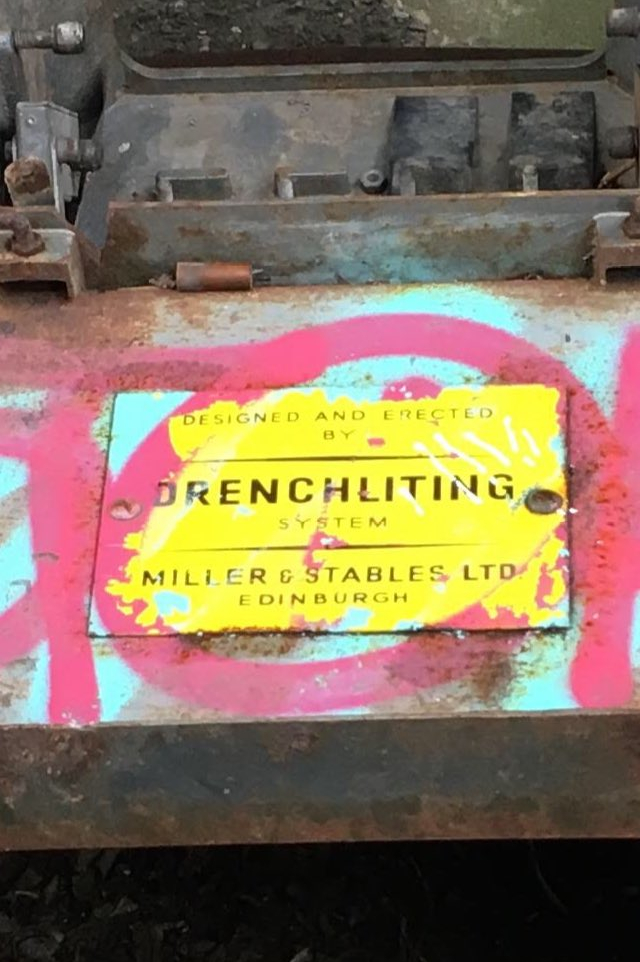
Taking inspriation from another national football stadium a preferred design and supplier emerged after from a visit to Hampden Park in Glasgow who installed their own floodlights in 1961. In a report in the Dublin Evening Mail from November 14th 1961 it was reported that the contract had been signed with “a Scottish firm” for the lights and that these would take approximately three months to manufacture, transport and install. The firm in question was Miller and Stables of Edinburgh who, apart from Hampden, had also provided floodlights (or drenchlights as they dubbed them) for Windsor Park, Celtic Park, Easter Road and many others.

Drenchlighting

Original lighting console from Dalymount plyons showing the name of the manufacturer, Miller & Stables (pic Graham Hopkins)

Earlier in January 1961 an edition of the Irish Times confirmed that the FAI had accepted the recommendations of their own Finance Committee in guaranteeing major matches for Dalymount Park for at least the next ten years in order to assist with Bohemian F.C. in funding the purchase of new floodlights. Even by that stage the lights had been costed at £17,000 including import duty and transportation costs. This figure rose slightly when the lights were installed early in 1962 and were reported as costing £18,000 or even £20,000 according to one report.

The floodlights themselves are 125 feet high and originally featured three banks of ten lights on each pylon and a special transformer station had to be constructed to meet with the power supply demands. With the new lights it meant that mid-week games could be played in the evenings, for internationals this should mean bigger crowds and with Bohemians getting approximately 15% of the gate from international games this meant greater revenue for the club.

DpvWxqfWwAM--Ju

Despite the expected future return on investment this was still a huge outlay for the amateur club. Initial notices suggested that the lights would be in place by September 1961, which was then extended to October and ultimately until February of 1962. In the words of Club Secretary Andy Kettle, as quoted by Ryan Clarke in his recent series on Dalymount, it also meant that Bohs could “invite many top clubs to Dublin from time to time”.

The first of which ended up being Arsenal, though they weren’t first choice. But before these glamour matches could be played Kettle had to deal with some level of internal dissent from Bohs members about the level of expenditure and even had to engage in a little bit of what might be termed “crowdfunding” in the modern parlance. Kettle elaborated in the Dublin Evening Mail that the club had “approached their bankers, the Munster and Leinster Bank, their members, players, traders, FAI and League of Ireland for financial assistance”, before adding “Bohs are keeping open their fund and will only be to happy to receive any further contributions. No matter how small…”

The Arsenal Game

As Andy Kettle had hoped the installation of floodlights would help Bohemians raise additional funds by playing friendly games against some of the “many top clubs” that could be invited to Dublin. But the question remained which team should receive the honour of being first? There were suggestions from media commentators that Shamrock Rovers should be invited although the preferred option emerged as a game between a League of Ireland selection against a British based Irish XI. However, as this would require multiple clubs across England and Scotland to release players it quickly because clear that this was unfeasible.

Among the other clubs sounded out by Bohemians to fulfil this fixture were Sunderland and Leeds United, as well as Manchester United and Blackburn Rovers (both of whom declined due to FA Cup committements). Attention was then turned to Arsenal, Celtic or Wolverhampton Wanderers with Arsenal finally being chosen from that shortlist of three.

From this is it clear that Arsenal, despite being a famous First Division side were realistically a fifth or sixth choice on behalf of the Bohemians’ committee for the role of opponents for this inaugural game. Arsenal were ultimately chosen and played in Dalymount on at least their third occasion (the previous two being in 1948 and 1950) and fielded a strong team including Welsh international goalkeeper Jack Kelsey, George Eastham, and future Cork Hibernians player-manager Dave Bacuzzi. The Bohemian XI featured players like Tommy Hamilton from Shamrock Rovers, Eric Barber and Tommy Carroll from Shelbourne as well as Ronnie Whelan Sr. and Willie Peyton from St. Patrick’s Athletic.

Arsenal would ultimately win an exciting game, played in poor weather, 8-3. However, throughout all the media coverage during the build-up to the game and afterward there was no mention of any Arsenal or Highbury connection with the lights other than their being chosen as the opposition.

Maybe it is a little bit of an inferiority issue with Irish football fans that we’d rather believe that we bought the most iconic set of floodlights of any stadium in the country, second-hand from a big English club rather than believe that an amateur club, working in partnership with the League, the FAI and ordinary fans and players managed to successfully fundraise a huge amount of money for a major infrastructural project.

For me that’s a bigger story than any mythic historical connection with a defunct football stadium in London. But as they say “When the legend becomes fact, print the legend” I’d rather it be shine your own light rather than bathe in reflected glory.

Dalyer

Freebooting around the rock of Gibraltar

Co-written with Michael Kielty

Given that Gibraltar are one of the newest members of UEFA you wouldn’t expect there to be much of a footballing history between the tiny British Overseas Territory and Ireland, but what if I told you there was a prominent footballer from Gibraltar playing in Dublin at the very dawn of organised football? That man was Gonzalo Canilla and he was a fixture on the Dublin sporting scene of the 1890s, lining out for both Bohemian F.C. and Freebooters F.C. as well as excelling on the cricket pitch.

Canilla was born in Gibraltar in 1876, he came from a pious Catholic family, with his uncle and namesake having been made Catholic bishop of Gibraltar in 1881. The younger Gonzalo was sent to England to further his education, where he attended the prestigious Catholic boarding school, Stonyhurst College in Lancashire, and this is where his connection with Irish football first emerges. Among his fellow classmates were many young men from prominent Dublin families, including Oliver St. John Gogarty and the Meldon brothers George and Philip.

Gogarty found his greatest fame as a writer but was also a talented athlete, he was a strong swimmer and was also a Leinster Senior Cup winner with Bohemians as an outside right, while Phillip Meldon, one of the founding members of Freebooters F.C, became an Irish international footballer.  Freebooters, one of Dublin’s earliest clubs, were based in Simmonscourt, near the present-day Aviva Stadium and were also founding members of the Leinster Football Association.

Canilla, played for both clubs after leaving Stonyhurst for further studies in the Royal College of Surgeons in Dublin. He even took his preparatory exams in Bell’s Academy on North Great George’s Street. Several students at Bell’s Academy had been among the founders of Bohemians in 1890.  It’s during this time that an 18 year old Canilla first appears for Bohemians as a full back against Athlone in January 1895. By then Canilla was also playing cricket for Phoenix Cricket Club. This was quite common at the time and many of his footballing teammates were also colleagues or opponents on the cricket pitch.  By 1897 there are reports of Canilla lining out for Freebooters and by the end of the following year he had formalised this by switching his registration to them, from Bohemians. The club, with Canilla in their side at full back finished in second place in the Leinster Senior League.

By 1899 however, having successfully completed his final examinations in the RCSI, Dr. Gonzalo Canilla departed Ireland for his native Gibraltar. Newspaper reports described him as someone “long and favourably associated with cricket and football” and that a “large crowd of sportsmen” gathered to see him off from Westland Row station to the strains of Auld Lang Syne.  In total Gonzala Canilla’s Irish sporting career lasted about four years which saw him play at the highest level in Dublin at the time.

Canilla married his wife Antonia in 1904 and they had at least two children. Gonzalo practiced medicine in England until 1916 then becoming the Rio Tinto mining company doctor in Huelva, Spain. He played competitive cricket in Spain and then recreational golf until his retirement, he passed away in 1955.

His grandson David Cluett was also a successful footballer, he won 69 caps as a goalkeeper for Malta, including an appearance in a 2-0 defeat to the Republic of Ireland in 1989 as well as winning numerous honours in the Maltese game, primarily for the Floriana club.

Cricket team 1901

Dr. Canilla is in the front row holding the cricket bat


With special thanks to the Canilla/Cluett family for their assistance. This piece featured in the Ireland v Gibraltar match programme (June 10th 2019) and has also been shared on Bohemians.ie 


From Dalymount to New York

Co-written with Michael Kielty

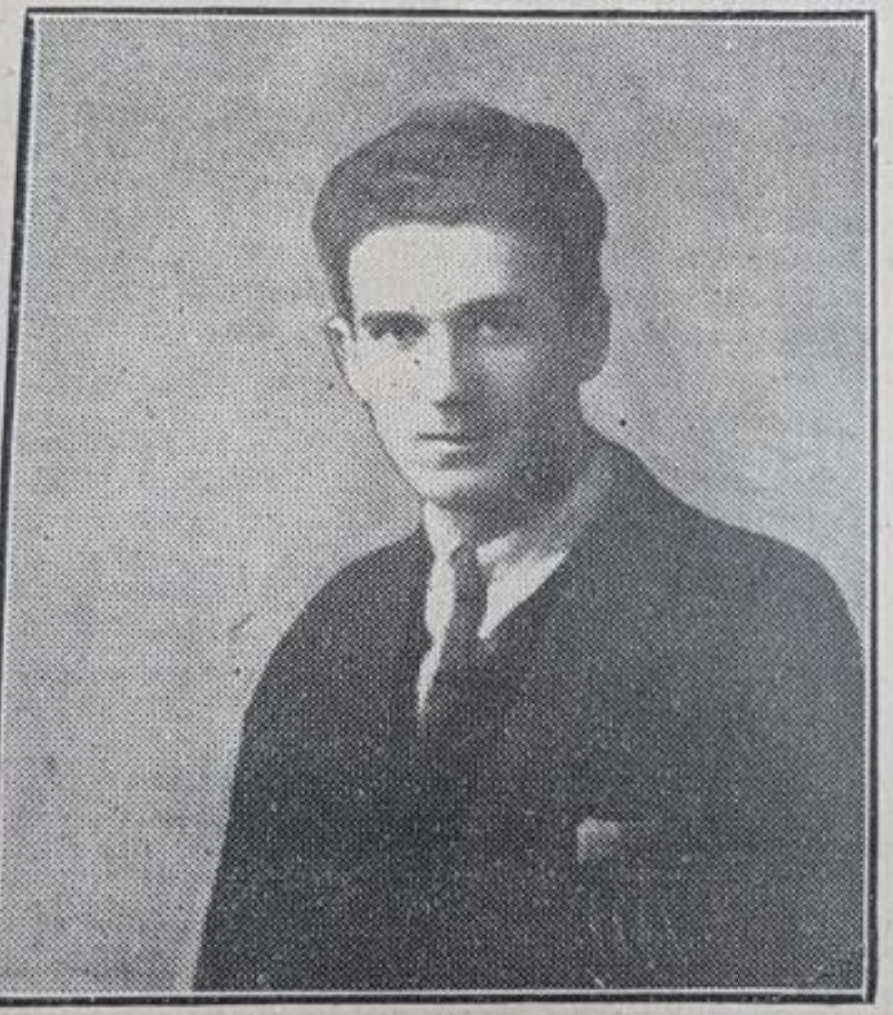
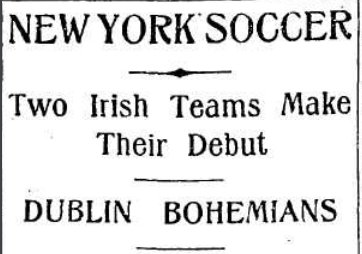
Certain things are hard to ignore, just as a ringing phone demands to be answered, the revelation that Bohemian FC had a sister club playing in New York in the 1920’s was something that I couldn’t put to one side after reading about it. I discovered an article entitled “New York Bohemian FC, USA” in a copy of the “Football Sports Weekly” newspaper from 1927 when carrying out some other research and being honest, it raised more questions than answers; Who were these men? How did they end up in America? What happened to the club? Were they even any good?

The original article mentioned some basics. Where the team played; the New York Oval with a stated capacity of 60,000, it mentioned that through fundraising the team had raised $1,000 and also listed the various players who had joined the club and in some cases short notes about their earlier playing careers. Most were ex-Bohs men but clubs like Seaview, Bendigo and Glentoran also featured. But first, it is probably worth providing a little historical background.

Irish immigration to the United States in the 1920’s was no new phenomenon. It is estimated that as many as 4.5 million Irish arrived in America between 1820 and 1930. Between 1820 and 1860 alone, the Irish constituted over one third of all immigrants to the United States. While emigration slowed down in the 1920’s there were still significant numbers travelling across the Atlantic, leaving an Ireland that was economically depressed and still in the early stages of rebuilding after the War of Independence and the division of the Civil War.

The Bohemian players did not travel as professional players to the States, although plenty of footballers from Ireland would do this, rather they were clerks, actors, labourers and tradesmen in search of a better life who happened to be talented amateur footballers who sought to recreate their beloved Dublin club in New York City. The correspondence back to Dublin makes this clear. Letters were sent to Bohs’ trainer Charlie Harris and were later published in the Evening Herald. These letters came from Billy Cahill and Godfrey O’Rourke, ex players for Bohemians in Dublin but if their names don’t seem familiar it shouldn’t be taken as much of a surprise. Cahill and O’Rourke were mostly players for Bohemian’s “B” side, plying their trade in the Leinster Senior League, still that didn’t stop Cahill from perhaps exaggerating his prowess, with one report in America noting that he was top scorer in Ireland 3 years in a row!

Their letters do give some insight into their motives and ambitions. They mention that the new club had approximately 80 members and wore the traditional red and black of Bohemians. They had grand plans to rename the Oval where they played as “Dalymount Park”, and arrange a visit to play in Dublin which never materialised. O’Rourke did mention that one crucial ingredient was missing from their Bohemian vista, that was the absence of “The Hut”, then, as now, a favoured watering hole of the Bohemian faithful. As this was the United States in the 1920’s the prohibition laws made getting post-match refreshments that bit more difficult.

There were some more senior Bohemians as part of this ex-pat group, such as goalkeeper Freddie Mason who had played first team football for Bohemians and had even featured against a touring South African national team in Dalymount, half back Ernie Gillespie also had first team experience for Bohemians and among the forwards was Joe Stynes who had scored 11 goals for the Dublin Bohemians in the 1925-26 season.

Joe Stynes pic

Joe Stynes in his Bohs days

Stynes had come to soccer later in life, born in Newbridge, Co. Kildare he became well-known as a Gaelic Footballer, winning the 1923 All-Ireland final with Dublin. He was also an active participant in the War of Independence and the Civil War. After being captured by the Free State Army he was imprisoned in the Curragh Camp which is where he took up the Association game in the cramped confines of “Tintown” as the camp was known. While there he played with a teenage Jimmy Dunne who would later win a league title with Arsenal, become Ireland’s record goalscorer and also manage Bohemians. Such was his fondness for his new sport that Stynes defied bans from the GAA to line out for Shelbourne and then later with Bohemians. He moved to the United States in 1926 and worked for Cartier Jewellers but also appeared for the New York Bohemians and other soccer teams such as “Dublin United”.

The fortunes of the New York Bohemians were mixed, they played in the highly competitive New York amateur leagues and there was plenty of interest from the media about the club. For a practice session ahead of a game against top local side Galicia F.C. over 1,000 fans turned up to see the two Bohemian practice XI’s put through their paces. However, if one were to summarise their success of the NY Bohs on the pitch one could best describe them as solidly mid-table. While they possessed in their ranks some stars who would even play professionally in the States there were many players of a lower standard.

dh98cqrx4aa6isp (2)

Incidentally, Galicia played Bohemians as a warm up for a match against a prominent touring side from Europe; Real Madrid! The New York Bohemians continued on until at least 1929 in the New York leagues and several of their players, such as Stynes had longer careers for other clubs in and around the Eastern coast of the United States.

Indeed Dinny Doyle, the former Shamrock Rovers player recalled bumping into actor, musician and former Bohs man Bob O’Brien in the following circumstances “When only a short time in America, Dinny was playing a game in Boston when he was amazed to hear as he himself put it ‘come on Bohs’ and at half-time out trotted Bob O‘Brien, the old Bohemian player.”

While relatively short-lived and only moderately successful the New York Bohemians experiment demonstrates that the draw of home and of club is such a strong influence that over 90 years ago, men who travelled 3,000 miles from home tried to rebuild Dalymount in the borough of Queens.

A version of this article featured in the Bohemian F.C. match programme for the game against Finn Harps on 15th February 2019.

It could happen to a Bishop – John Curtis in faith and football

A Bohemian history of the 20th Century: An examination as to whether it is possible to write about the key events of the last century through reference only to those people who played for Bohemian Football Club of Dublin. A difficult task but the more I read and research, perhaps not an impossible one. Thus far there are Bohemian connections to the 1916 Rising, the War of Independence and the Civil War in Irish history, and in a wider context there were the global conflicts of World War I and II which I have mentioned in previous posts. But how about Chinese missionaries and the rise of the Maoist interpretation of Communism? Well to tell that story we have to go back to Dublin in 1880.

John Curtis was born in 1880, as the eldest son of Thomas Hewson Curtis and Margaret Curtis. Thomas was a clerk and later a manager in the corn exchange near to Christchurch Cathedral but as a youngster John lived with his family on Montpellier Hill its steep incline rising to the North Circular Road gate of the Phoenix Park where Bohemian F.C. would be founded in 1890 by a group of men only a few years senior to young John. By that time the growing Curtis family had moved the short distance to Blackhall Street, residing in a house next to the Law Society buildings at Blackhall Place which were then occupied by the King’s Hospital school. Eventually the family moved to Hollybrook Road in Clontarf as Thomas’ career continued to progress. The young John was educated not in King’s Hospital but at Benson’s Grammar School in Rathmines which was founded by Rev. Charles William Benson on the lower Rathmines Road, the school also educated the likes of George Russell (AE) and members of the Bewley family.  John then graduated to study in Trinity College Dublin.

It was around this time that a teenage John Curtis first made an appearance for Bohemians. He appears in the first team in the 1897-98 season. He played most of his games for the club at inside-left, and in that first season his partner at outside-left was none other than Oliver St. John Gogarty. The pair starred together as Bohemians won the 1897-98 Leinster Senior Cup final, defeating Shelbourne 3-1 while also progressing to the semi-finals of the Irish Cup.

The following season showed a similar pattern, another Leinster Senior Cup win and another lost Irish Cup semi-final (this time to Linfield) for the Bohs and John Curtis. Though not yet 20 Curtis was already a star player, in the 18 games he played that season he scored an astonishing 21 goals. Bohemians wouldn’t join the Irish league until the 1902-03 season so Cup competitions such as the Leinster Senior Cup and the Irish Cup, as well as the Leinster Senior League, would have taken precedent at the time and Bohemians were clearly the strongest side outside of Ulster at that juncture.

The 1899-1900 season saw further progress in the Irish Cup, this time Bohs got all the way to the final. John Curtis was instrumental in getting them there, scoring a vital equalising goal in the semi-final against Belfast Celtic before Herbert Pratt scored the winner in a match played in the Jones Road sports ground, now better known as Croke Park. John lined out against Cliftonville in the final in Grosvenor Park in Belfast in front of 5,500 spectators. Alas it didn’t turn out to be a first cup win for Bohemians.

Bohs had made it to the cup final once before in 1895 when they were hammered 10-1  by Linfield, but the 1900 final was to be a much closer affair with Bohs being defeated 2-1 with George Sheehan getting the goal for the Dublin side. The newspaper reports described a tight game with Bohs deemed to have been highly unlucky to lose, indeed many observers thought that Cliftonville’s second goal was a clear offside. Matters weren’t helped by four Bohemian players picking up knocks during the course of the match.

On a personal note for John Curtis it seemed that just a week prior to the Irish Cup final  he might be honoured with an international cap. A first ever international game was to be staged in Dublin’s Lansdowne Road and Andrew Gara, the Roscommon born, Preston North End forward was earmarked for a spot in the Irish attack, however just days before the game Gara was injured and the Irish Independent reported that his place was to be awarded to John Curtis. This didn’t come to pass however, the sole Dubliner in the line-up was John’s team-mate George Sheehan who was given the honour of captaining Ireland in a 2-0 defeat to England. The closest John would come to an international cap would be representing Leinster in an inter-provincial game that season against an Ulster selection.

While John Curtis would continue to line out for Bohemians his appearances were reduced in number over the coming years, he had sporting commitments with Trinity College as well, representing them in as a footballer in the Irish Cup while also enjoying games of Rugby.
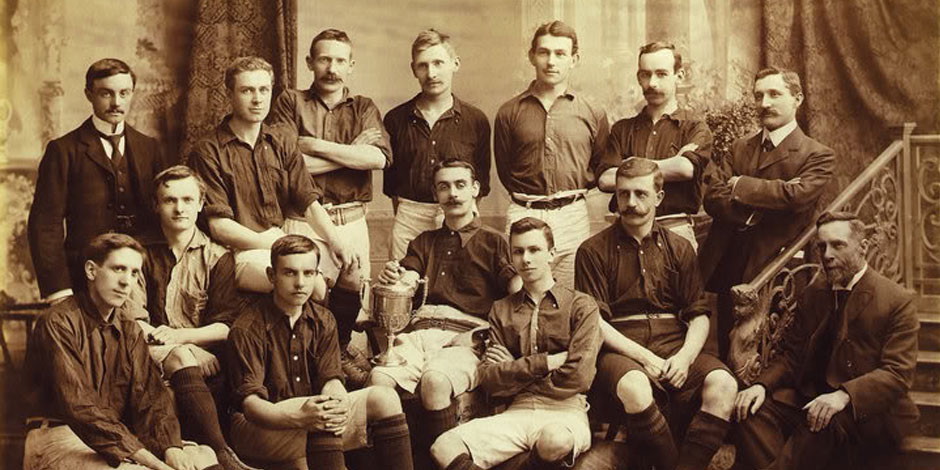
Bohs with Sloan Crozier

John Curtis is the big bloke with the moustache and his arms folded in the back row.

He features in a team photo from the 1902 Leinster Senior Cup winning photo but lined out for the club less frequently, he did appear in a couple of prestigious friendly matches in the early years of the century however, when Bohemians were keen to invite the cream of British football to their new home in Dalymount Park. John played against Celtic in 1901 and against Bolton Wanderers the following year.

By 1903 John had finished his studies in Trinity College and was ordained as a Reverend, his first parish being that of Leeson Park in Ballsbridge. By this stage his two younger brothers Edward (Ned) and Harry were both playing for Bohemians, though with less distinction than their older brother.

While his footballing life might have been coming to somewhat of an early close the even more remarkable parts of John Curtis’ story were only beginning. After only three years in his Dublin parish John Curtis was setting sail for missionary work in China and embarking on a whole new chapter in his life.

John was bound for the Chinese province of Fujian on the southwest coast of the country. The first Protestant missionaries had only begun working in China in 1807 and among the early missionaries was another Irishman, William Armstrong Russell who arrived in China in the 1840’s. Despite these earlier arrivals John’s journey was still very much a leap into the unknown and certainly a long way from leafy south- Dublin parish work.

John arrived in Fujian in 1906 and later, while working there met fellow missionary Eda Stanley Bryan-Brown, she had been born the daughter of a clergyman in Australia, and in 1914 they were married. In 1916, – perhaps out of a sense of duty? – John returned to Europe in the midst of War, this meant separation from his wife and his missionary work. Curtis joined the British Army Chaplains and shared the dangers of the combat troops in trenches and on battlefields. He spent time in Greece and also would have ministered to members of the Royal Dublin Fusiliers during his service. As one journalist who knew him well observed of his character “one cannot picture him holding back from that cataclysm”. Indeed despite his obvious religious devotion most descriptions of John Curtis focus strongly on his energy and fearlessness, whether on the sports ground, or the battlefield or in his missionary work.

Luckily John survived the War and in 1919 received the Victory medal, however he swiftly returned to his work in China. Since arriving in China in 1906 John had witnessed crowning of the child emperor Puyi in 1908 as well as his forced abdication, the end of Imperial rule, and the founding of the Republic of China just a few years later. His post-war return witnessed further upheaval. In 1927 John and his missionaries would no doubt have been aware of the first major engagements of the Chinese Civil War between the Kuomintang (or KMT, the major political party of the Republic) and the Red Army of the Chinese Communist Party. There was a major battle for control of the city Nanchang in the neighbouring province of Jiangxi which ultimately saw the Communist forces flee in defeat, many of their surviving troops marched hundreds of miles to take refuge in Fujian, the province where John and his family were living.

By this stage John and Eda had become parents to a son, John Guy Curtis in 1919, Arthur Bryan Curtis in 1924 and followed by a sister, Joan. It was a restless time to have a new family but there was further change for John as in 1929 he became Bishop of Zhejiang, replacing his fellow Dubliner Herbert Moloney. This meant that John and Eda moved to the beautiful city of Hangzhou, referred to by some at the time as the “Venice of the east” due to its location on the Grand Canal of China and sections of the Yangtze river delta. By this stage Eda had brought the children to England in 1927 to live with one of her brothers though both parents visited every year up until the outbreak of the Second World War. In their young lives the children had witnessed a great deal of violence. Joan recalled as a four year old hearing “soldier and their cannon” from the Missionary school. On another occasion in 1922 Eda and her two young children were obliged to undertake a long journey up river, during the course of which her oldest son John  by then only three years old at the time developed laryngeal diphtheria. When it looked like he might succumb to his illness she was forced to perform a tracheotomy, her only instruments being a pen-knife and some hair-pins. It was perhaps not surprising that the calm of rural England would seem a better place for the children to grow up.

Drama and upheaval followed the Curtis family to this new setting of Hangzhou  and as Christmas 1937 approached so too did the forces of Imperial Japan. The Second Sino-Japanese war had broken out that summer and on Christmas day 90,000 Japanese troops entered Hangzhou after fierce fighting. A week earlier the Japanese had advised all foreign consuls to evacuate any of their citizens from the area due to the danger of the fighting, in all there were only 31 foreigners in Hangzhou in 1937 and John Curtis was the only Irishman.

Journalist and Church of Ireland priest, Patrick Comerford notes that “living conditions deteriorated in the city, Curtis constantly visited the hospitals, medical camps and refugees, his overcoat pockets bulging with bottles of milk for the children. On what he called his ‘milk rounds,’ he also shepherded large numbers of frightened women and children to the safety of the refugee camps.”

He continued to administer to his Church’s followers throughout his vast diocese despite the restrictions caused by the Japanese invasion, and the subsequent outbreak of World War II.  By September 1942 more than nine months after the Japanese attack at Pearl Harbour many missionaries were called in for questioning. John Curtis was arrested in November and taken to the Haipong Road Camp in Shanghai and then held in Stanley Internment Camp, Hong Kong. Comerford writes that on one occasion, “the Japanese threatened to shoot him if he continued to criticise their treatment of his fellow prisoners, but it was said that in internment he was a great asset to the morale of the camp.”

The Curtis’s would remain in prison of war camps for the remainder of the War, it was in such a camp that they would learn of the death of their oldest son John, in January 1943. John, whose life Eda had saved as a toddler, was only 23 when he died in a flying accident while on service as an RAF pilot. When finally released from the camp at the end of the war both John and Eda were in their 60’s and had suffered cruelly during their captivity. Eda had continued her medical work, helping other prisoners inside the  camp and her thoughts were about returning to Hangzhou to continue her work at the mission hospital, which they managed to do with support from the Red Cross. After the war more missionaries did come out to China from Ireland and Britain however their work was made increasingly difficult under the rule of Chairman Mao Zedong. Eventually in 1950 John and Eda left China for the last time and returned to England.

John became a vicar in the small village of Wilden, north east of Stourport-on-Severn in Worcestershire before he eventually retired to Leamington in 1957 at the age of 77. Although struggling with arthritis it was noted that he remained in good spirits when in conversation with his old friends, and he kept in contact with his many old acquaintances and was eager for news from Dublin, indeed he had continued to visit Dublin regularly even while working in China. John was highly thought of as a  missionary and often during his returns to Dublin he was asked to speak about his work and travels. And despite the passing of time his reputation as one of the best Irish footballers of his generation lived on for decades as well.

John passed away suddenly in 1962 and Eda died just 18 months later. They had truly lived full, dramatic and difficult lives. Their daughter Joan got married and ended up living in Sligo while their surviving son Arthur Bryan Curtis, who had studied at Oxford and also served in World War II ended up emigrating to Rhodesia (now Zimbabwe) to become a school headmaster.

The sporting connection begun with John Curtis all those years ago for Bohemians continued with his son. John had been a handy Rugby player in his Trinity days and Arthur Bryan also excelled with the oval ball, playing for Oxford University and London Irish. In 1950 he won three Irish international caps as a flanker. Arthur’s son David also represented Ireland at Rugby, winning 13 caps and appearing as a centre during the 1991 Rugby World Cup, David was also a useful cricket player and represented Oxford University in that sport. Continuing a family tradition David’s sons Angus and Graham are currently playing Rugby with Ulster and Angus has already been capped for Ireland  at under-20 level.

But however exceptional the sporting careers of the younger Curtis men might be it cannot match the drama of their ancestor, the famous Bohemian John Curtis, or his wife the fearless Doctor, Eda Stanley Curtis.

Many thanks to Stephen Burke for providing information on John Curtis’s playing career. Also for more on Irish missionaries in China check out Patrick Comerford’s blog.