Bohemians entered the new season as champions and were fancied to retain their crown after their clean-sweep the previous year. The league remained at 10 teams with Athlone Town, who had finished bottom and been on the end of a number of drubbings failing to be re-elected to the League and their place being taken by Drumcondra who had been Cup winners in 1927 and beaten finalists a year later.
It was one of the tightest title races ever with a ding-dong battle between Shelbourne and Bohs for the Championship, despite only losing once and drawing twice in the League campaign Shelbourne pipped Bohs to the title by a single point. David “Babby” Byrne and Jock McMillan supplying the goals while Shels had also added Bob Thomas, a star of the all-conquering Bohs the previous season to their midfield where he’d play alongside his brother Paddy.
For Bohemians Billy Dennis was once more top scorer but getting in among the goals was a young inside-left named Fred Horlacher who made his debut that season and would go on to become one of the greatest players in the club’s history. The son of a Mormon, German, pork-butcher Freddie Horlacher would play in numerous positions for Bohs as well as making several appearances for Ireland in a career that would see him become one of the club’s highest ever goalscorers.
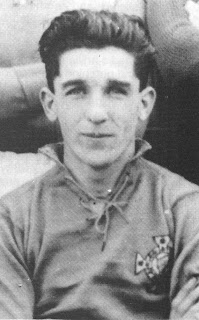
Top scorer in the League overall however, was Eddie Carroll (left), a former Northern Ireland international who had spent the previous seasons playing in Scotland for Aberdeen and Dundee United, Carroll was in his first of three spells with Dundalk.
There was further disappointment in the Cup for Bohemians, despite knocking out St. James’s Gate, Jacobs and Drumcondra on the way to the final, we were ultimately defeated in a replay by Shamrock Rovers as they won their first of five consecutive Cup titles. The initial final had been played at Dalymount and ended in a 0-0 draw, however the replay was moved to Shelbourne Park and Rovers would triumph on the southside 3-0, with two goals from John Joe Flood and one from veteran forward Bob Fullam.
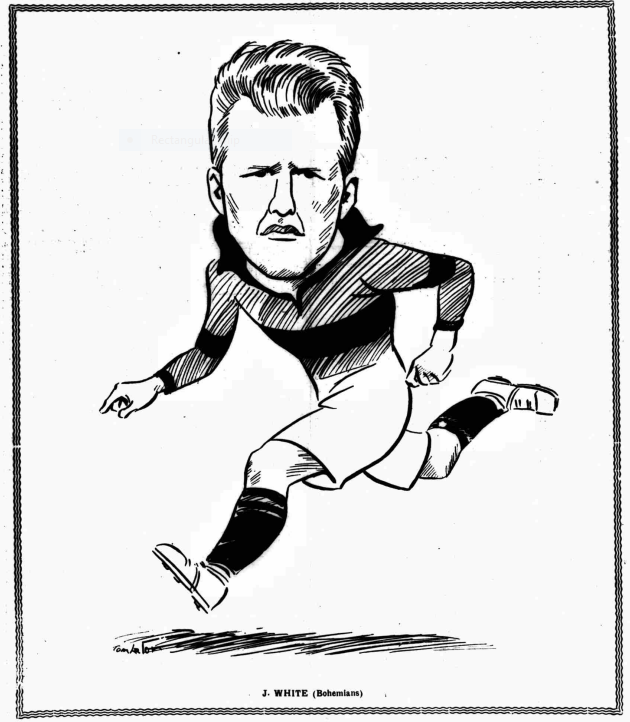
Bohemians would get a modicum of revenge when they defeated Shamrock Rovers 2-0 in a test match to settle the winner of the League of Ireland Shield later that season. Although Bohs were comfortable winners in that game with Jimmy White grabbing both goals it was Rovers teenage forward Paddy Moore who caught the eye of a Cardiff City scout who signed up the prodigious talent the following month.
At Inter-league level the LOI had mixed fortunes, beating the Welsh League 4-3 in Dublin, with Johnny McMahon and Peter Kavanagh of Bohs getting three of the goals, but then losing to the Irish League 2-1 later the same season. At international level Ireland only played one game, a resounding 4-0 victory over Belgium in April 1929 front of 30,000 fans in Dalymount. John Joe Flood scored a hat-trick with Babby Byrne getting the other goal. Jimmy Bermingham was the sole Bohemian in the starting XI for Ireland that day. Just four months later Bermingham and his Bohs teammates would be part of a visit to Belgium that would see them enjoy further success.
Jimmy White who scored the decisive goals to secure the Shield for Bohemians.
This Saturday (January 14th) Dalymount Park, specifically the Member’s Bar, will host a League of Ireland football history conference to mark the publiction by Routledge of it’s new academic collection The League of Ireland: An Historical and Contemporary Assessment which is edited by Conor Curran.
I have a paper included which looks at several case studies highlighting the complex patterns of migration of players into the League of Ireland over the last century. The conference is free to attend and you might even get a cup of tea and a sandwich.
Conference schedule
9.30-10 am: Conor Curran (Trinity College Dublin) – Introductory Comments
10-10.30 am: Julien Clenet (University College Dublin) – Association football in Dublin in the late Nineteenth Century: an Overview
10.30-11 am: Cormac Moore (Dublin City Council Resident Historian) – The Formation of the Football Association of Ireland
11.00-11.30 am: Aaron Ó Maonaigh (Independent Scholar) – ‘In the Ráth Camp, rugby or soccer would not have been tolerated by the prisoners’: Irish Civil War attitudes to sport, 1922–23.
11.30-12 pm: Conor Heffernan (Ulster University) and Joseph Taylor (University College Dublin) – A League is Born: The League of Ireland’s Inaugural Season, 1921–1922
12-12.30 pm: Conor Curran (Trinity College Dublin) – The cross-border movement of Republic of Ireland-born footballers to Northern Ireland clubs, 1922–2000
12.30-1.30 pm Lunch
1.30-2 pm: Gerry Farrell (Independent Scholar) – One-way traffic? – 100 years of soldiers, mercenaries, refugees and other footballing migrants in the League of Ireland, 1920 -2020
2-2.30 pm: Tom Hunt (Independent Scholar) – Ireland’s Footballers at the 1924 and 1948 Olympic Games: Compromised by the Politics of Sport
2.30-3 pm: Michael Kielty (Dublin Business School): Peter J. Peel: The Soccer King
3-3.30 pm: Ken McCue (De Montfort University) – Who’s SARI now: Social enterprise and the use of the medium of sport to further human rights in society
3.30-4 pm: Helena Byrne (Independent Scholar) – Breaking new ground: The formation of women’s football governing bodies in 1970s Ireland
4-4.15pm Closing Comments
Papers will be for the duration of twenty minutes, with ten minutes afterwards for questions.
You can attend for free by registering through eventbrite.
Go stand in the members bar and look at the pitch side wall and you’ll see that a huge, framed photograph dominates the wall. It shows 25 men with four trophies seated in front of the old main stand of Dalymount. Of those 25 only twelve are the footballers of Bohemian FC, the remaining gentlemen are committee members as well as the coaching team of Bobby Parker and trainer Charlie Harris. Parker was a Scottish centre forward who went to War as the English First division’s top scorer and returned with a bullet in his back, while Harris had been a top athlete in his youth who also trained the O’Toole’s Gaelic Club and the Dublin County team on occasion.
The all-conquering Bohemian FC team
This is not only one of the greatest Bohemian teams of all time but arguably one of the greatest League of Ireland sides in history. This was a side that swept all before them, winning the League, FAI Cup, Shield and Leinster Senior Cup. Seven of that squad had, or would be, capped by Ireland while Johnny McMahon from Derry was selected by the IFA. Others, like the English born Harry Willits and Billy Dennis were selected to represent the League of Ireland on numerous occasions.
The record for that season for all competitions reads – played 36, won 29, drew 5, lost 2 – Goals for 108, goals against 35. While the team photo does show only 12 players several more were utilised during that remarkable season, however it is true to say that the team starting XI was fairly fixed and six players played in all 36 matches while goalkeeper Harry Cannon played in 35.
Among those players to feature in all 36 games were the Robinson brothers, Christy, at inside forward, and Sam at right back. Both men had been actively involved in the War of Independence, Christy being involved in the raid on Monk’s Bakery when Kevin Barry was captured, while Sam (real name Jeremiah) had been a late addition to Michael Collins’ “Squad”.
Sam almost missed the FAI Cup final when some dressing room hijinks saw a bucket of scalding water tipper over his leg after yet another victory. However, the attentions of Dr. Willie Hooper ensured that Robinson was fit and read for the final against Drumcondra. Despite Drums taking the lead Bohs never panicked and goals from Jimmy White and Billy Dennis secured the victory.
Dennis scored 26 goals in all competitions that season although with only 12 in the league he was some way behind Charlie Heineman, Fordsons’ English centre forward who topped the league scoring charts with 24 goals. In the Shield, which only consisted of eight games, Bohs won seven, only drawing once, while in the Leinster Senior Cup Shelbourne were dispatched 4-1 in a replayed final.
Ireland’s only international that season was in Liège against Belgium, where an Irish side featuring Bohemians Harry Cannon, Jack McCarthy as captain, Sam Robinson and Jimmy White won 4-2 with White grabbing two second half goals for Ireland. Little did they know but many of those players would be returning to Belgium the following year to enjoy more success.
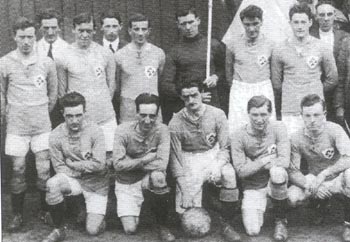
There was change again in the 10-team League of Ireland as Pioneers raised a glass of squash and bid adieu after four seasons. This side, which began as a sporting branch of the Pioneer temperance movement are still around today playing in the Leinster Senior League. Pioneers place was awarded to Dundalk GNR – the GNR standing for Great Northern Railway and the team would have worn amber and black stripes rather than the more familiar white jerseys that we associate with Dundalk today. In that debut season Dundalk used no fewer than 47 different players, including many with experience in the Irish League, ultimately, they finished in 8th position.
The Dundalk team from that season
Bohemians battled it out with their Dublin rivals for the title, finishing 3rd behind defending champs Shelbourne in 2nd place and Shamrock Rovers who claimed their third title. Shorn of the goals of Billy “Juicy” Farrell, Rovers turned to the diminutive, young, striker David “Babby” Byrne who finished that season as joint top alongside Shelbourne’s Scottish striker Jock McMillan with 17 goals.
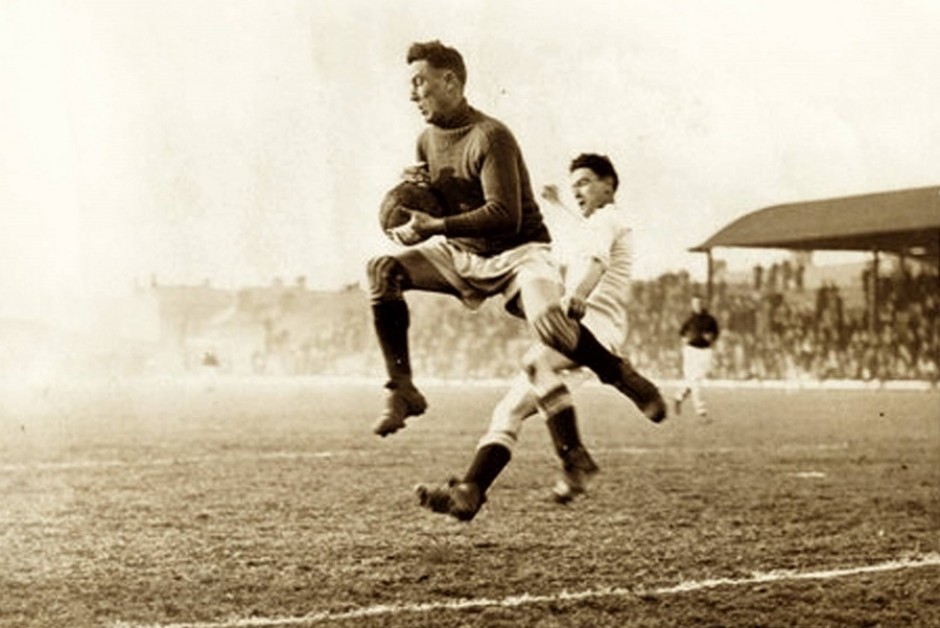
For Bohemians Dr. Jim O’Flaherty and Ernie Graham were the top marksmen but a young English forward, once of Port Vale, named Billy Dennis was also beginning to make his mark. One of the more unusual scorers for Bohs that season was goalkeeper Harry Cannon who scored his solitary goal from the penalty spot. Cannon tried the trick again on a short midseason tour undertaken by Bohs but missed in a game against London Caledonians, that match was quickly followed by another games against Tottenham Hotspur a few days later.
Harry Cannon in action
In the FAI Cup there was to be something of an upset as Leinster Senior League side Drumcondra FC, who had only been re-founded in 1924, defeated League of Ireland side Brideville in the final. Granted, Brideville had finished bottom of the league that year but they were still heavy favourites despite the fact the Drumcondra had already accounted for league sides Jacobs and Bohemians en route to the final. The match went to a replay and with the scores tied at 0-0 after the second 90 minutes extra time was played, it was former Bohemians player Johnny Murray who final grabbed the late winner and insured that Drums could bring the trophy back to their Tolka Park home.
On the international front Ireland hosted the return fixture against Italy in Lansdowne Road, again the Irish were on the losing side, but did get on the scoresheet thanks to Bob Fullam, the score finishing 2-1 to Italy but not before Fullam had come close a second time with a free kick that was struck so hard that it knocked an Italian defender unconscious.
While Bohemians finished the season empty handed an impressive squad was being developed that was on the verge of greatness that would be fully realised the following season.
The 1925-26 season was a last exit for Brooklyn as the southside club withdrew from the league, being replaced by another Dublin side, Brideville FC who were the original League of Ireland side to compete out of Richmond Park in Inchicore.
Shamrock Rovers were defending champions but there was stiff competition expected from other quarters, mainly from the Fordsons team who started the season strongly and had added Bohemians striker Dave Roberts to their ranks, as well as from Shelbourne for whom John Simpson and Fran Watters provided the bulk of the attacking talent.
Despite all the striking talent in the league in the goalscoring stakes it was once again Billy “Juicy” Farrell of Shamrock Rovers who topped the scoring charts with 24 league goals. An all-round sportsman, Farrell excelled at hockey, cricket, Gaelic football and even billiards. However, the 25-26 season would be the last one in which he would play regularly, a broken leg after a serious motorbike accident in May 1926 prematurely curtailing one of the most promising careers in the League.
For Bohemians their top scorer was the South African, Billy Otto, pressed into service more often as a centre forward after the departure of Roberts, with the likes of Dr. Jim O’Flaherty (another in a long line of Bohemian doctors), Jimmy Bermingham, and Joe Stynes (a prominent Republican during the Civil War and former Dublin county footballer) all chipping in through the season. Between the posts the Irish Army Officer, Harry Cannon had made the goalkeeper spot his own.
As mentioned Fordsons had a particularly good start to the season but it was Bohemians who became the first side to win against them in Cork, securing an impressive 2-0 win. However, this win and the two points that came with it were overturned and awarded to the Cork team after a protest that veteran Bohs player Harry Willits had been listed on a team sheet for the game as “Henry” Willits. The league committee awarding Fordsons the victory due to the mis-spelling of the name of one of the league’s best known and longest serving players.
Despite that dubious victory Fordsons would only finish 3rd in the league, Shelbourne capturing the title for the first time in their history with Simpson and Watters scoring 33 goals between them to propel them to victory. In the Cup however it was to be Fordsons year, they defeated Shamrock Rovers 3-2 in the final in front of a record crowd of 25,000 in Dalymount.
Key to their victory was their goalkeeper Billy O’Hagan, the Donegal born former IFA international saved a penalty from Bob Fullam with the scores tied at 2-2 to inspire his team onwards, and with five minutes to go Paddy Barry scored the winner to bring the cup to Leeside for the first time. Harry Buckle, (who we met in the last issue) made history by becoming the oldest player at 44 years old, to win the cup, a record that still stands to this day.
In terms of trophies Bohemians had to be content with the Leinster Senior Cup which they won 2-1 in a replayed final against Shelbourne, Dr. Jim O’Flaherty grabbing both the goals in the game played on April 19th as one of the final matches of the football season.
A month earlier the League had secured its first inter-league victory, defeating the Irish League 3-1 in a comfortable victory in Dalymount in the first ever meeting between representative teams from the island’s two leagues.
And just a week after that history was made as an Irish international side under the auspices of the FAI took to the field in Turin to face Italy. Despite a 3-0 reverse it was an important first step in world football for the national side, among the starting XI that day were Bohemians Harry Cannon in goal and Jack McCarthy in the defence.
For the 1924-25 season the League of Ireland remained a 10- team league, Midland Athletic – the railway works team withdrew from the league, as did Shelbourne United, who withdrew just after the season had started. The League however, took on a more nationally representative characteristic with two non-Dublin clubs joining. The wonderfully named Bray Unknowns, (though still playing just over the county border in Dublin before reverting to the Carlisle Grounds a few seasons later), and Fordsons of Cork City.
Fordsons had been beaten in the previous season’s Cup Final and were associated with the Ford Factory, but they may never have become a sporting power if it wasn’t for Harry Buckle being thrown in Belfast Lough. Buckle was an Ireland international (IFA) who had starred for Sunderland but was back in his native Belfast working for Harland and Wolff. As a Catholic he had been subjected to sectarian attacks and decided to swap the shipyards for the Ford Factory. While there he helped re-establish the Munster FA and drive forward Fordsons to become Cork’s first (but not last) league of Ireland side where they’d finish a credible fourth in their debut season. His son Bobby Buckle, and great-grandson Dave Barry would also enjoy soccer success on Leeside.
Harry Buckle
At the top of the League it was Bohs and Rovers battling it out for supremacy and despite only losing once during the 18-game season Bohemians had to settle for 2nd place in the table. Shamrock Rovers went through the league season undefeated, with their famous “Four F” forward line propelling them to victory with a +55 goal difference. Top scorer that year was Billy “Juicy” Farrell with 25 goals and the other “F”s being Bob Fullam (who we met in an earlier instalment) Jack “Kruger” Fagan and John Joe “Slasher” Flood. Footballers and fans of the 20s clearly enjoyed the use of nicknames! Bohs top scorer that year was Ned Brooks, who we met in the last article after he had scored a hat-trick against the USA on his Ireland debut.
In the Cup Rovers made it a double with Fullam and Flood scoring in a 2-1 win over Shelbourne in front of 23,000 in Dalymount Park on St. Patrick’s Day 1925. Both teams were still playing in their original homes around Ringsend so the cup final made for something of a super-local derby.
Just three days before the Cup final the LOI had played its second ever inter-league game, once again the Welsh League provided the opposition with Bohemians’ Dave Roberts getting the only goal for the league as they lost 2-1 to their Welsh counterparts.
Roberts was to have an eventful season the following season but most of it would be spent away from Dalymount.
Second and third place finishes saw Bohs begin the first years of the League of Ireland as nearly men, despite being one of the most well-established sides in the new league. The third season however, would finally deliver some major silverware to Dalymount in the form of the clubs first League title as well as winning the League of Ireland Shield.
Joining an experienced group were some newcomers; adding firepower to the Bohs’ forward line was Englishman Dave Roberts who had previously played for Walsall and Shrewsbury Town. Roberts would finish the league season as its top scorer with 20 goals, followed by his teammate, the skilful inside forward Christy Robinson with 12. There were goals throughout the Bohs side that year with Mick O’Kane registering eight, and another recent arrival Billy Otto getting five from midfield.
Otto, the captain for that title winning season, had been born on Robben Island just off Cape Town and had ended up in Ireland via the trenches of the Somme and later a Civil Service job in Dublin. He led Bohs to victory as they would finish four points clear of their nearest rivals Shelbourne, clinching the league title by beating St. James’s Gate with a game to spare.
Dublin United, Olympia and Rathmines United had all exited the league that season, with only Brooklyn (named after Brooklyn Terrace off the South Circular Road) joining what was now a 10-team league. In the Cup it was Athlone Town who triumphed in the St. Patrick’s Day final, they defeated Cork side Fordsons 1-0 with a goal coming from their veteran forward Dinny Hannon who had been a part of the Bohemian side who had won the Irish Cup way back in 1908. Athlone had knocked Bohs out in the semi-final that year and amazingly won the cup without conceding a goal in the entire competition.
At international level February 1924 saw the first League of Ireland XI play an inter-league match, an exciting 3-3 draw with the Welsh League at Dalymount, the LOI side featured five Bohemians that day; Bertie Kerr, Johnny McIlroy, Christy Robinson, Harry Willits and Dave Roberts who scored two of the League’s three that day. Of those players Robinson and Kerr would be selected to represent Ireland in football at the 1924 Olympics along with their fellow Bohemians Jack McCarthy, Johnny Murray, John Thomas and Ernie Crawford. Ireland opened the tournament with a 1-0 victory over Bulgaria thanks to a Paddy Duncan goal before exiting at the quarter final stage to the Netherlands who won 2-1 after extra time.
Ireland v USA in Dalymount, 1924
Further international games were arranged by the FAI including a 3-1 win over Estonia in a friendly in Paris directly after elimination at the Olympics as well as a first home international, another 3-1, this time over the United States in Dalymount in June 1924. The star of the show was hat-trick hero Ned Brooks of Bohemians who had helped the club to success in the League of Ireland Shield a few months earlier.
With Bohs having finished the debut League of Ireland season in 2nd place we were hoping to go one better the following year and secure the club’s first ever league title. The challenge would be all the greater as the league had swelled from an initial eight teams to twelve, which included the first non-Dublin side in the form of Athlone Town.
Also added to the league were Midland Athletic (associated with the Midland Great Western Railway company), Pioneers, Shelbourne United (no relation to the other Shelbourne, but you see how this can be confusing), Shamrock Rovers, and finally Rathmines Athletic. The Rathmines side were a late addition, initially UCD were going to enter a side but pulled out just before the beginning of the season, allowing Rathmines the chance to play their one and only season of LOI football. It was an inglorious season for the Southsiders as they finished bottom of the table, pulling out of the league even before they’d played their final fixture against Dublin United.
At the other end of the table, it was a three-way fight for supremacy between Bohemians, Shelbourne and newcomers Shamrock Rovers. While Bohs were table toppers at the halfway point, and ran up some spectacular scorelines, including a 7-0 win over Pioneers and an 8-0 drubbing of Olympia, costly defeats to the likes of Shelbourne and Midland Athletic at crucial points in the season meant Bohs had to settle for 3rd place.
The title went to Shamrock Rovers in their debut LOI season, fired to victory by the goals of Bob Fullam, banned at the start of the season for his part in the previous season’s Cup final fracas, Fullam scored 27 times as Rovers lifted the league title.
In the Cup there was a huge surprise win when Alton United, a Belfast team affiliated to the Dublin based FAI, defeated heavy favourites Shelbourne in the final with former Belfast Celtic forward Andy McSherry grabbing the winning goal.
Alton United
Two weeks later Bohemians played their first match against Continental opposition, drawing 1-1 with French side Club Athletic Paris Gallia, who became the first European team to visit Dublin since the split from the IFA. While it was a season that ultimately ended without a trophy Bohs were putting together a talented squad which now included South African midfielder Billy Otto, the talented and tricky inside forward Christy Robinson and a new striker from England named Dave Roberts allied to a core of experienced players such as Harry Willets, Johnny Murray and Johnny McIllroy, they’d have reason to be optimistic.
I’ve begun writing a series for each Bohemian FC match programme giving a short history of the key events in Irish Football season by season, beginning with the first League of Ireland season in 1921-22. I’ll be adding them to the blog for anyone who cares to read them. Part one begins below.Thanks to Alan Bird for the suggestionto write it in the first place.
In the first of a new series, we look at the major points of interest during a League of Ireland season from the past, and for the first in the series we’re going way back to the first ever season in the League, the 1921-22 season.
That first season is a bit of a misnomer the entire fixture list of 14 games (featuring just eight, Dublin-based, league sides playing each other twice) was completed in the three months between September and December 1921. Bohemians and Shelbourne, as the two sides from outside of Ulster who had competed in the Irish League against the giants of Belfast football, started among the favourites for the title. Bohs v YMCA game was the inaugural league fixture to kick off, in what was described as a “poorly filled” Dalymount, those who did turn out though witness a masterclass from Bohemians. It was Bohs’ striker Frank Haine who had the honour of scoring the first ever LOI goal, getting the opener in a 5-0 win. However, league honours ultimately fell to St. James’s Gate, the brewers pipping Bohs to the title by two points.
Frank Haine of Bohemians
It shouldn’t have come as that much of a surprise though, as the Gate had won both the Leinster Senior Cup and Irish Intermediate Cup just a season earlier. Several of that successful James’s Gate side would go on to represent Ireland but it would be the Paris Olympics in 1924 before they’d have the chance to pull on the green jersey. Among the Gate players from that season were Charlie Dowdall, like Ernie McKay and Paddy “Dirty” Duncan who joined five Bohemians in the squad. It was Duncan who would get the first goal in an international competition for the Irish Free State, grabbing the only score in a 1-0 Olympic victory over Bulgaria.
Joe O’Reilly and Charlie Dowdall with the Cup years later
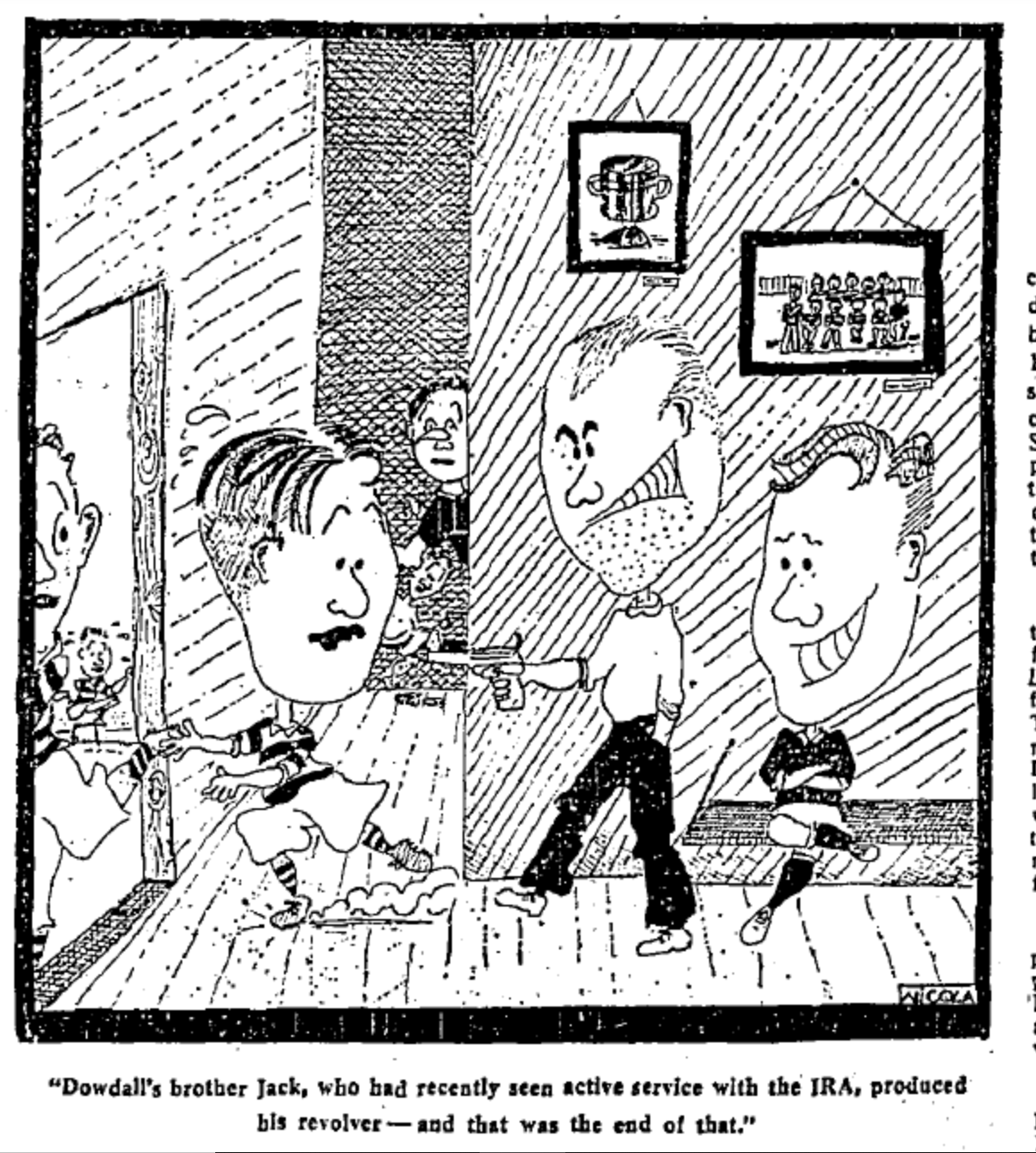
Of course, the political tumult in the country was never far removed from football, Bohemians began the season playing a pair of friendlies in Dublin and Belfast to help raise funds for the workers locked out of the Belfast shipyards, expelled because of their religion or their politics. The season then ended with pistols drawn in a Dalymount dressing room at a Cup final replay. St. James’s Gate won the double beating Shamrock Rovers (the of the Leinster Senior League) after an ill-tempered game which ended with infuriated Rovers players storming the Gate’s dressing room.
Bob Fullam of Rovers advanced on Charlie Dowdall when Charlie’s younger brother (and an IRA volunteer) Jack stepped forward and produced a pistol. Fullam and his Rovers teammates were outnumbered, and now out-gunned and they sensibly beat a retreat from the James’s Gate changing rooms!
Newspaper cartoon depicting the dressing room scene after the Cup final.
Did you know that Karl Marx played football with the KGB in East Germany?
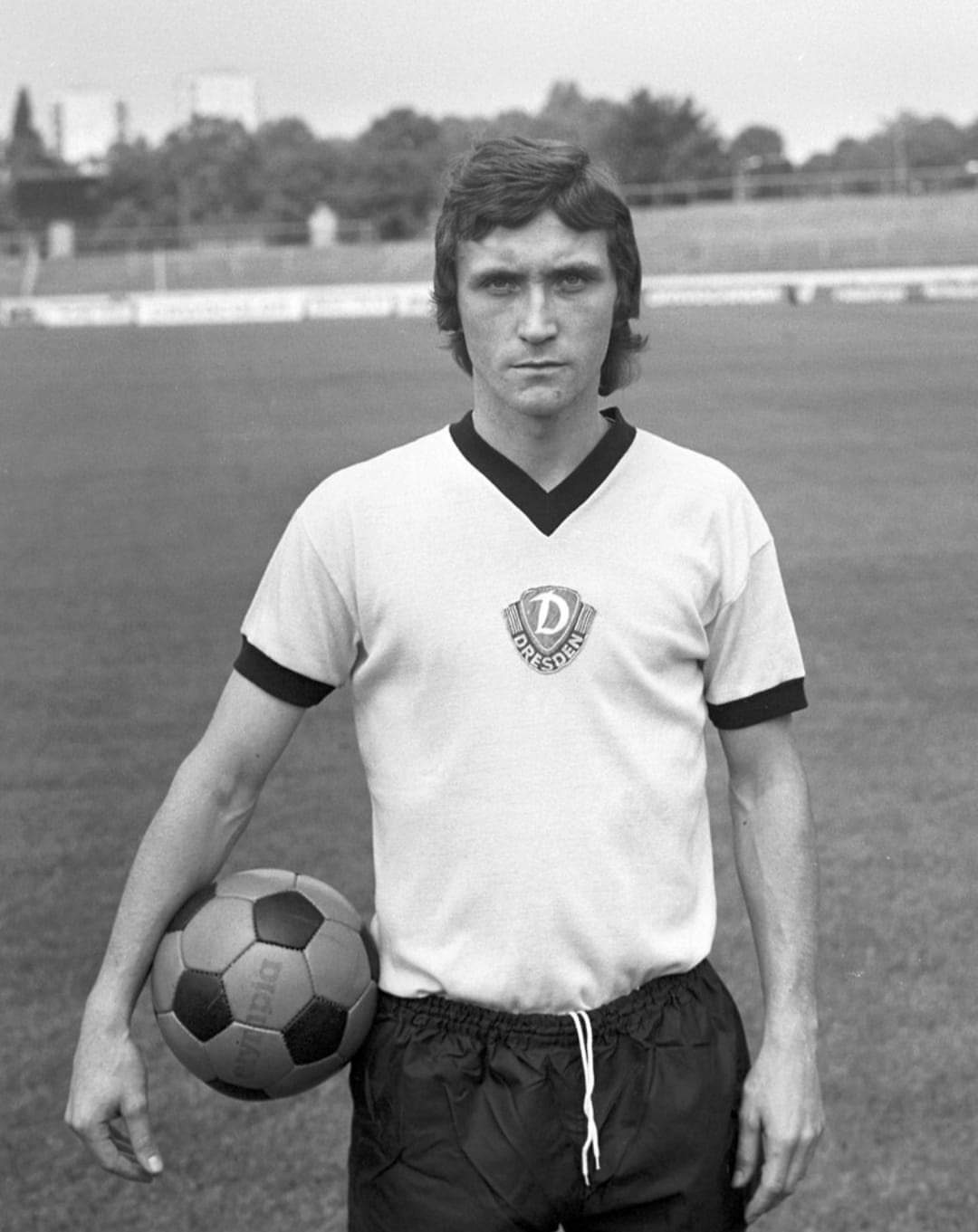
Bit of a trick question obviously but there is a grain of truth in it. As Bohemian Football Club progressed to the last 16 of the European Cup they were drawn against Dynamo Dresden, champions of East Germany and the dominant team there throughout the decade. It was a daunting mission, as we’ll see the Dresden side were packed with internationals and had reached the quarter finals of both the UEFA Cup and European Cup within the previous three years. Being drawn against Dynamo Dresden also meant another trip behind the “Iron Curtain”, something Bohs were getting familiar with having faced Eastern bloc sides in the past such as Polish Cup winners Śląsk Wrocław three years earlier. As well as a trip to face Gottwaldov in Czechoslovakia in the club’s first ever European tie.
But returning to Karl Marx, this was the moniker given by RTÉ commentator Philip Greene when watching one of Bohs’ young stars in action. It helped that Terry Eviston player on the left-wing, and that he was fairly hirsute in those days with a mop of curly hair and a beard, not unlike the famed German political-philosopher. As for the KGB? Well, that was a joking reference to a social group of the Bohs squad who palled around together, the K-G-B stood for (Tommy) Kelly, (Eamonn) Gregg, (Joe) Burke, the defensive backbone of the successful Bohs side of the 1970s.
But before the KGB could grab a couple of German lagers there were still some issues facing Bohemians that needed to be resolved. Having defeated Omonia Nicosia on away goals in the previous round Bohs now faced a difficult and expensive journey to Dresden, coupled with the fact the UEFA ban on using Dalymount for the home leg was still in place. The “home” game against Omonia Nicosia had taken place in Flower Lodge in Cork City and the Bohemians directors had been busy in the meantime trying to gain permission from UEFA to host the home leg closer to Dublin. They appealed against the diktat that the game must be played 150km from Dublin and successfully reduced the distance required as part of their ban to 80km.
According to the press reports the game in Flower Lodge, which attracted a crowd of roughly 4,500 had according to the club, cost Bohs £5,000 and hopeful of a successful appeal the club had already reached an agreement with Dundalk for the use of Oriel Park for the upcoming second round, first leg fixture against Dynamo Dresden. Luckily for the club, less than two weeks before the game their appeal was granted by UEFA President Artemio Franchi. Bohs were going to Oriel Park to face Dynamo Dresden and manager Billy Young encouraged the Bohs faithful, as well as the local Dundalk population to come out in force to support Bohemians.
At the forefront of the mind for Young, and the Bohemians’ Directors was the issue of finance. As mentioned, the previous tie in Cork had ended up costing the club £5,000 and this, coupled with the costs of getting to Dresden was eating into the profits made from the previous year’s league win, bumper gate against Newcastle and sale of winger Gerry Ryan. There costs weren’t insignificant, it is worth noting that the £5,000 quoted for arranging the home tie in Flower Lodge was more than the annual salary for someone on the average industrial wage at the time. Now, thankfully with a home venue secured and the distance to travel for the home games reduced Bohs could actually focus on the task at hand, trying to defeat Dynamo Dresden.
As for Dynamo Dresden they had a similar result to Bohemians, losing away, but winning at home to Partizan Belgrade, but with the scores from both legs finishing at 2-0 a penalty shoot-out was required to separate the teams. Ilija Zavišić missed the decisive penalty for Partizan while Udo Schmuck proved he wasn’t that type of Schmuck by scoring his spot kick for Dresden. It appeared that Dynamo weren’t taking Bohs lightly, in the week before the game they sent two club officials to scout on Bohs as they played Shelbourne in Tolka Park and were even planning on taping the game to analyse it. The Irish Press reported that this would have cost the German club in the region of £1,000 and of course the Dresden officials were referred to as “spying” on Bohemians. For his part Billy Young had been in contact with Liverpool’s Bob Paisley. Liverpool had knocked Dresden out of Europe the previous season 6-3 on aggregate, winning at Anfield but losing in Dresden. Paisley noted how strong they were at home as well as commentating on Dresden’s pace, intense fitness and good technical ability.
In the opening game in Oriel Park Bohs lined out as follows: Mick Smyth, Eamonn Gregg, Austin Brady, Tommy Kelly, Joe Burke, Padraig O’Connor, Gino Lawless, John McCormack, Turlough O’Connor, Paddy Joyce and Terry Eviston. The first half was fairly even as Dynamo seemed to be somewhat nervous, but as the second half progressed the East Germans began to push forward a bit more, winning a series of corners without ever really threatening Mick Smyth’s goal and being restricted to speculative long-range efforts. The media reports gave special praise to the solidity of the back four of Gregg, Burke, McCormack and Brady.
Next up was the daunting task of the away leg. That Bohs had failed to score and hadn’t looked particularly likely to threaten, coupled with the fact that Dresden were expected to be much tougher at home meant that most commentators had understandably written off Bohs chances of progressing. The squad flew out to Dresden with a stopover in Schipol. The over-riding first impression of Dresden in October was one of greyness, modern brutalist buildings alongside memorials to the Second World War seem to be particularly striking, all those spoken to for this piece mentioned the ruins of the Dresden Frauenkirche – an 18th Century Church destroyed in the infamous incendiary bombing of the city by Allied forces in 1945 that had killed as many as 25,000 people and utterly destroyed the city. The ruins of the Church had been left as a memento to these events before eventually being reconstructed after German unification.
Match programme vs Dynamo Dresden
As for the squad’s accommodation they were billeted in a set of holiday chalets outside of the city, usually a spot for families to flock to during the summer they were deserted as winter approached. Crucially they were also somewhat remote and secure and were under constant armed guard. The Bohs party were assured that this was for their protection. The squad also had official plainclothes chaperones to assist them, and keep an eye on them during their stay. Despite these efforts Terry Eviston recalls a leather jacket-clad character who approached the squad with promises to get them products of their choice in return for dollars or other western currency.
The armed guard and various official chaperones who were there to “protect” the team were by all accounts friendly enough though with limited command of English, and according to Billy Young graciously allowed the squad a bit of time to explore the city unsupervised in exchange for a bottle of Jameson whiskey. In fact the players seem to have had plenty of freedom with Tommy Kelly, Joe Burke and Eamonn Gregg (the KGB) managing to nip out for a pint and a bite to eat a couple of days before the game to a local restaurant, only to have to hide themselves behind a curtain in an alcove in the back when Billy Young and journalist Noel Dunne walked in!
What was highly impressive though to the Bohs players and management were the facilities available to Dynamo Dresden. While the club were nominally amateurs, Dynamo being a nationwide sports club for the East German police, meant that all the players were technically policemen or working in the wider police organisation, they were for all intents and purposes professionals, in receipt of better pay, better housing, cars as well as the opportunities for international travel that came with being part of one of the states elite Fußballclubs. A designation afforded only to the elite football teams in East German.
The team played out of the 33,000 capacity Dynamo Stadion, a huge open bowl which had four iconic floodlight pylons towering above it at an angle. The stadium had medical facilities on-site as well as gyms and dormitories nearby. A far call from Dalymount despite the nominal “amateur” status of Dynamo’s players.
This wasn’t the first time that Bohs had played against German opposition in Europe, though of the Western variety, the early part of the decade had seen Bohemians face FC Köln and Hamburger SV in consecutive seasons in the UEFA Cup. As with Dresden the players were blown away by the facilities available to the German clubs, though in this case the Köln and Hamburg players were overt professional outfits.
Tommy Kelly recalled a post match meal after being knocked out of the UEFA Cup by Hamburg, opposite Tommy was the Hamburg captain and German international Georg Volkert, with little English most of the conversation was carried out through a younger Hamburg player who asked Kelly and his Bohemian teammates how much they earned. Kelly recalled that his wages at Bohs were roughly £20 a week at the time, not unusual at a club were most of the players had day jobs. Deciding to inflate the figure he replied to Volkert that he earned £50 a week, when translated this drew surprise from Volkert who reportedly stated with a Naomi Campbell flourish, that he wouldn’t get out of bed for £50 a week. For context it’s worth noting that three years later Hamburg would break the German transfer record to sign Kevin Keegan, offering him a better salary than he was earning at Liverpool.
Dresden were of a similar standard as those sides, six of the gold-medal winning East German squad at the 1976 Monteal Olympics were provided by Dynamo Dresden. They defeated strong (nominally amateur) sides like the Soviet Union and Poland in the semi-final and final respectively. Dresden’s star sweeper Hans-Jürgen “Dixie” Dörner was routinely described as the “Beckenbauer of the East” and eight of the side that faced Bohemians were internationals.
The differences in the home and away legs was stark. During the first half Bohs had been solid in defence as Dynamo, cheered on by a capacity crowd who had begun flooding in hours before kick-off, had begun to exert greater and greater pressure. Bohs had been ably assisted by the oldest man on the pitch, goalkeeper Mick Smyth who had been pressed into service early and produced some remarkable saves. However, the valiant rear-guard action was finally breached by 19 year old Andreas Trautmann in the 29th minute after a goalmouth scramble. Dixie Dörner made it 2-0 with a shot from just inside the box just before half-time and it seems that Bohs knew their race was run by that stage.
In the second half Dynamo ran riot with a goal from Schmuck, a second from Trautmann, and two penalties scored first by Dieter Reidel and then by Peter Kotte. The Irish Press ran with the questionable headline of “Dresden, left in rubble after a bombing raid in 1945 saw another blitz last night when Bohemians were ripped apart”. While the wording may have lack sensitivity Bohs were indeed ripped apart in the second half, as can been seen even by the short clips of footage available. Dynamo Dresden can be seen moving with speed, purpose and precision as they head towards goal.
Billy Young was philosophical after the result, pointing out how well the team had done until conceding the first goal and praising the “blistering pace” of Dynamo Dresden, describing them as “undoubtedly the best side we have ever met in European competition”. Speaking to Billy recently that is a view he still holds to this day with one exception, that of Jim McClean’s Dundee United who so impressed the Dalymount faithful when they played in Dublin in 1985. Eamonn Gregg, who had just won his third international cap a week earlier described Dresden as “better than a lot of international teams I have seen. They always seem to have two or three players in space looking for the ball”.
Dresden in 1978 – photo courtesy of Terry Eviston
All that remained was the traditional post match dinner, held in one of the fine buildings of Dresden’s old town, rebuilt after the devastation of the war, there the players were introduced to the pleasure of quail egg soup while the club were presented with painting as a memento. Young left with the quote that he felt that Bohs had “learned a lot from the game which will help us at home in the championship”. Bohs would ultimately finish second that year, just two points behind Dundalk. This was of course the main benefit of Europe, exposure to good quality sides and new tactics and approaches as well as an excuse for a trip away and some team bonding. At the season’s close the costs of Europe were clear, the lack of proper “home” games and the cost of travel had reduced the club’s financial surplus from almost £45,000 to just under £17,000 a year later. The second place finish that year did however, secure a sixth consecutive season of European football which was ended after a 2-0 aggregate defeat to Sporting Lisbon in the first round despite and impressive scoreless draw in Portugal. Bohs wouldn’t return to European competition until the infamous games against Rangers in the 1984-85 UEFA Cup.
As for Dresden, perhaps they didn’t realise it but their decade of dominance was coming to an end. Their star striker Hans-Jürgen “Hansi” Kreische, who had played in the 1974 World Cup, had retired at the end of the previous season, he had been blacklisted by the national team because of a bet he had made about who would win the 1974 World Cup. The problem was less the bet (for five bottles of whiskey) but who he had made it with; Hans Apel, the new West German finance minister. Further fallings out with coaches and club officials at Dresden hastened his retirement aged just 30.
Apart from the loss of Kreische there was the small matter of Erich Mielke, head of the Stasi. As Dynamo were a police club they fell to an extent under his personal remit. In the 1950s Mielke had wholesale relocated the successful Dynamo Dresden squad to Berlin to play for Dynamo Berlin. Predictably Dynamo Dresden, shorn of their title-winning players were relegated and had to spend years in the wilderness until they were promoted back in 1962. Their further development and success in the 1970s did not please Mielke who wanted a successful club in Berlin, which he eventually got. From 1978-79 Dynamo Berlin would win ten straight league titles amid much controversy and accusations corruption, intimidating referees and preferential treatment of the club from the capital as Dynamo Berlin found success, but also hated outside their small, devoted fanbase.
Two other players involved in the games against Bohemians had careers cut short or diminished due to political decisions, midfield Gerd Weber and striker Peter Kotte, the man who had scored the sixth and final goal against Bohemians. As Alan McDougall writes, in 1981, while waiting to travel with the East German national team to South America, Weber, Kotte and another Dresden player Matthias Müller were arrested on suspicion of Republikflucht, i.e. attempting to defect from East Germany.
Weber, a gold medal winner in Montreal, was also a Stasi informant, who sent in over 70 reports on his teammates during his time as a player. This was not uncommon and there are estimates that up to a quarter of the players and coaches of top club sides in East Germany had been recruited as Stasi informers, however Weber had apparently used a recent UEFA Cup game against FC Twente to discuss a possible defection and move to FC Köln. Kotte and Müller were accused of knowing about this plan and failing to inform the authorities.
Gerd Weber
Weber was sentenced to almost two years in prison, serving nine months, was expelled from Dynamo and from his police job, and had any other privileges that he had accrued due to his position as a well known footballer removed, and was barred from football for life. Kotte and Müller would only spend a few days in jail but they were barred from playing football in the top two division for life.
While Dynamo Dresden would win two more East German titles in 1988-89 and 1989-90 and even make the semi-finals of the 1988-89 UEFA Cup, the reunification of Germany was not kind to them or to any of the Eastern clubs. After early seasons in the Bundesliga, huge debts saw the club relegated to the regionalised third tier, even dropping down a level further for a time in the early 2000s. At the time of writing the club are top of the third division, hoping to be promoted back to the second tier.