The Dawning of the cup

Sean O’Casey’s Juno and the Paycock debuted on the Abbey Theatre stage in 1924 with the focus of the drama set in the city of Dublin after the outbreak of the Civil War just a couple of years earlier in 1922. The “Paycock” of the title, the feckless Captain Jack Doyle, became identified by the malapropism which he exclaimed repeatedly through the play, “the whole world is in a terrible state o’ chassis”. And indeed it was. If we take it that Captain Jack meant by “chassis” that the world was in a state of chaos and change then certainly his final drunken quip was accurate. Maybe he’d been at the first ever Free State cup final a few months earlier?

By the dawn of 1922 the truce in bloody War of Independence was’t yet six months old, the Anglo-Irish Treaty had only been signed in December of 1921 which allowed for the creation of a 26 county Free State by the end of 1922. But before that would happen 1922 would also witness the beginnings of the Irish Civil War. A state of chassis indeed.

In the middle of this chaos the Football Association of Ireland had been formed after a split from the Belfast-based IFA and a brand new league and cup competition were begun before the Irish Free State had even officially come into being. While that first season can be viewed as a success from a footballing perspective, it was not to be without incident or drama. Befittingly, it was the cup final that witnessed some of the most dramatic scenes.

The first season of the league had kicked off in September 1921, it only featured eight teams in total and all of them were from Dublin. Of those eight only two are still involved in League of Ireland football today, Shelbourne and Bohemians. The cup however, was slightly more diverse, featuring the likes of Athlone Town, who would join the league the following season, as well as West Ham. The West Ham from Belfast that is.

West Ham were a team in the Falls and District League in Belfast. When the split from the IFA occurred these clubs chose to affiliate with the FAI and in West Ham’s case their new cup competition. This wasn’t to be the only occasion that something like this happened, the following season the cup winners were Alton United, previously a junior club in Belfast they shocked Shelbourne in the final with a 1-0 win. The relative success of junior clubs from Belfast was likely to have drawn some condescending looks from the IFA in relation to the standard of football south of the border. But it should be noted that at the time due to the political turmoil in Belfast one the foremost clubs on the island; Belfast Celtic had withdrawn from the league and many of their players were active for sides in the FAI affiliated Falls and District league.

This would change when by the end of 1923 the FAI was admitted to FIFA. One of the conditions of acceptance being that only clubs from the 26-county Free State could be members of the Association. This meant an end to the involvement of northern clubs until Derry City joined the league in 1985. West Ham were not to have much of a cup run. Their highlight was holding Shelbourne to a scoreless draw before they were knocked out in a replay.

While the West Ham versus Shelbourne game may have been tight there were a few hammerings in the early rounds of the cup. In the opening round Dublin United beat their league rivals Frankfort 8-1. While Dublin United would drift out of football over the following few years Frankfort, from the Raheny area of Dublin are still active locally, playing their matches in St. Anne’s Park.

Despite their convincing win in the opening round Dublin United were dumped out in the following tie by Shamrock Rovers, then a Leinster Senior League side. Rovers had already had a long cup campaign before the met Dublin United. Not being a league club they had to negotiate a number of qualifying rounds which had their own fair share of drama. A comfortable win over UCD was followed by a trip to Tipp to take on Tipperary Wanderers. Despite the recent prominence of Shane Long we don’t often think of Tipperary as a soccer stronghold but the local side were good enough to beat Rovers 1-0. The men from Ringsend however, made a formal protest because of the poor quality of the pitch that they were forced to play on. A ruling was made that the match had to be replayed and this time Rovers emerged victorious.

Further victories followed over St. James’s Gates “B” side and Shelbourne United (a club who also had their origins in Ringsend but not to be confused with Shelbourne F.C.) which meant that Rovers were through to the first round proper of the cup against Free State league side Olympia. A 3-1 win there and the 5-1 hammering of Dublin United saw them drawn in the semi-finals against Bohemians.

Bohs being the more well established side went into the games as favourites. They enjoyed home advantage as both semi-finals were to be played in Dalymount Park, they’d finished a close second to St. James’s Gate in the inaugural league season and they’d demolished Athlone Town 7-1 in the previous round. But it was Rovers who emerged victorious thanks to a lone strike by John Joe Flood. The result was somewhat of a shock, accounts at the time describe Bohs enjoying the better of the play but failing to take their chances, ultimately the more direct, physical approach taken by Rovers paid dividends.

The scorer of the winning goal, John Joe Flood was one of the team’s early stars. A Ringsend local, he was the son of John Flood, a bottle blower at the nearby glass bottle works. He had previously played for Shelbourne but was very much a Shamrock Rovers man. He even spent some of his youth living on Shamrock Terrace, the road that gave Rovers their name. In all he had four spells at the club, while also trying his luck on two occasions in England, a short spell with Leeds United and later sojourn at Crystal Palace.

He was known as tough and pacey inside forward and was occasionally referred to by the nickname “Slasher” which makes him sound like a fairly formidable opponent. In Rovers’ colours he’d end up collecting four League of Ireland medals and six cup winners medals and later became part of the famous “Four F’s” forward line along with Billy “Juicy” Farrell, Jack “Kruger” Fagan and Bob Fullam. He would also be capped five times by Ireland, scoring four goals, including a hat-trick in a 4-0 victory over Belgium.

Victory over Bohs had secured Rovers’ place in the final, due to take place on St. Patrick’s Day 1922 but they would have to wait a while before the identity of their opponents was confirmed. The other semi-final had gone to a replay, St. James’s Gate versus Shelbourne had finished scoreless in their first meeting and there was a gap of more than two weeks before the game was replayed. The victors on that day were St. James’s Gate and they were confirmed as the side to face Rovers in the final on St. Patrick’s Day.

St. James’s Gate at the time were based around grounds in Dolphin’s Barn that were rented by the Guinness brewery which gave them their name.  Guinness were known for the paternalistic attitude they took towards their workers and a job at the brewery offered a level of security and benefits that were not often found in other workplaces around Dublin. The James’s Gate players were nominally amateurs, five players from the team would be part of the amateur squad that competed for Ireland in the football tournament at the 1924 Olympics, but even by the time of the Cup final there were a quota of non-Guinness players allowed play for the team.

Some of those who weren’t Guinness employees included Ernie MacKay, the son of a Scottish soldier, Ernie worked for at the GPO for decades while also remaining involved with James’s Gate as a player and administrator well into the 1940’s. His team-mate at inside-left was Charlie Dowdall who had worked for Guinness briefly but spent most of his career working at the Inchicore railway works. Still they would have had access to the superior sporting facilities of the Guinness workers, pitches, gymnasiums and medical experts. Such was the prestige of the club at the time that many star players who did work at the brewery were excused from more taxing work to make sure they were fit and healthy for upcoming matches.

This approach had brought impressive results. In the 1919-20 season St. James’s Gate had won the Leinster Senior Cup, the Leinster Senior League, the Metropolitan Cup and the Irish Intermediate Cup. By the time the cup final rolled around on St. Patrick’s Day 1922 the Gate had already become the inaugural Free State league champions and Leinster Senior Cup winners, an FAI Cup win would seal a treble.

The Gate were favourites, despite the fact that they were technically viewed as an amateur “works” team whereas Rovers (still a Leinster Senior League side) were paying players between 20-30 shillings a game. The Gate possessed the league’s top scorer, Jack Kelly in their ranks, and while Rovers had a certain reputation for toughness and aggression (especially men like Bob Fullam, Dinny Doyle and William “Sacky” Glen) St. James’s were no push-overs in this regard.

Their midfield half-back line of Frank Heaney, Ernie MacKay and Bob Carter were tough, tall, physically imposing men. Heaney, a veteran at this stage, had won amateur caps for the IFA, while MacKay, Dowdall and the versatile Paddy “Dirty” Duncan would also all represent Ireland at the 1924 Olympics. They were certainly a side with pedigree.

What was described as a “fine holiday crowd” numbering up to 15,000 were in attendance in Dalymount Park that St. Patrick’s Day for the final. Despite the fact that the Gate midfield was physically bigger the Rovers half-backs were dominant in the opening half, but their forward-line, though “aggressive” missed a succession of chances and five minutes before the break Jack Kelly rose highest to power home a header from a Johnny Gargan corner kick to give St. James’s Gate a half-time lead.

Ten minutes into the second half Rovers restored parity, Paddy Coleman, the Gate keeper failing to clear a ball from an in-swinging corner meant an easy finish for the Rovers winger Charlie Campbell. Rovers rallied and had some good chances before the end of the game but their earlier slack finishing persisted and they failed to make their pressure count. The Irish Times used the standard parlance (then, as now) referring to the match as a “typical cup tie”, it was hard fought, but they complained that much of the play was “crude”.  A replay was set of the 8th of April and there was even greater drama to come.

The crowd wasn’t quite as sizable for the replayed game, perhaps due to the fact that the Irish Rugby team were playing France that same day in Lansdowne Road and enjoying a rare will over Les Blues. The 10,000 or so who were there in Dalymount Park were in full voice, and the Gate’s Charlie Dowdall later described the atmosphere as “electric”, and remembered the “intense fanaticism between the supporters” before ominously noting that “those were the troubled days, and there were a few guns lying around in supporters’ pockets, though it all ended happily”. As we’ll see later at least one supporters’ gun didn’t end up staying in his pocket!

As the game kicked off with Rovers captain Bob Fullam winning the toss and deciding to play into the wind in the opening half, this didn’t seem to hamper Rovers who had the better of the play and created most of the chances, however, as in the previous game, they couldn’t make possession and territorial advantage count. Rovers errant finishing would cost them as a minute before the interval Johnny Gargan nicked the ball from Joe “Buller” Byrne (later a groundsman at Milltown) and squared for Jack Kelly who beat Bill Nagle in the Rovers goal with a fierce, low strike. Despite Rovers continuing to have the better of the play in the second half it would remain the only goal of the game as Paddy Coleman put in a display described as “miraculous” between the sticks for the James’s Gate.

The final whistle was met with a pitch invasion from some of the Rovers support who headed straight for the James’s Gate players. They were soon joined by several of the Rovers players. Two tough teams had obviously gotten under each others skin and Dowdall and Fullam in particular had been having something of a running battle throughout the match.

As the St. James’s Gate players made for the dressing rooms at pace they were chased from the pitch by the invading fans and three Rovers players. Bob Fullam, allegedly joined by Dinny Doyle and John Joe Flood, pursued the Gate players inside where Fullam advanced on the object of his ire, Charlie Dowdall. It all seemed set to kick-off when Jack Dowdall, Charlie’s younger brother and an IRA volunteer stepped forward and produced a pistol. Fullam and his Rovers teammates were outnumbered, and now out-gunned and they sensibly beat a retreat from the changing rooms. Fullam, along with Doyle and Flood ended up receiving  bans from the FAI for their part in the disturbances.
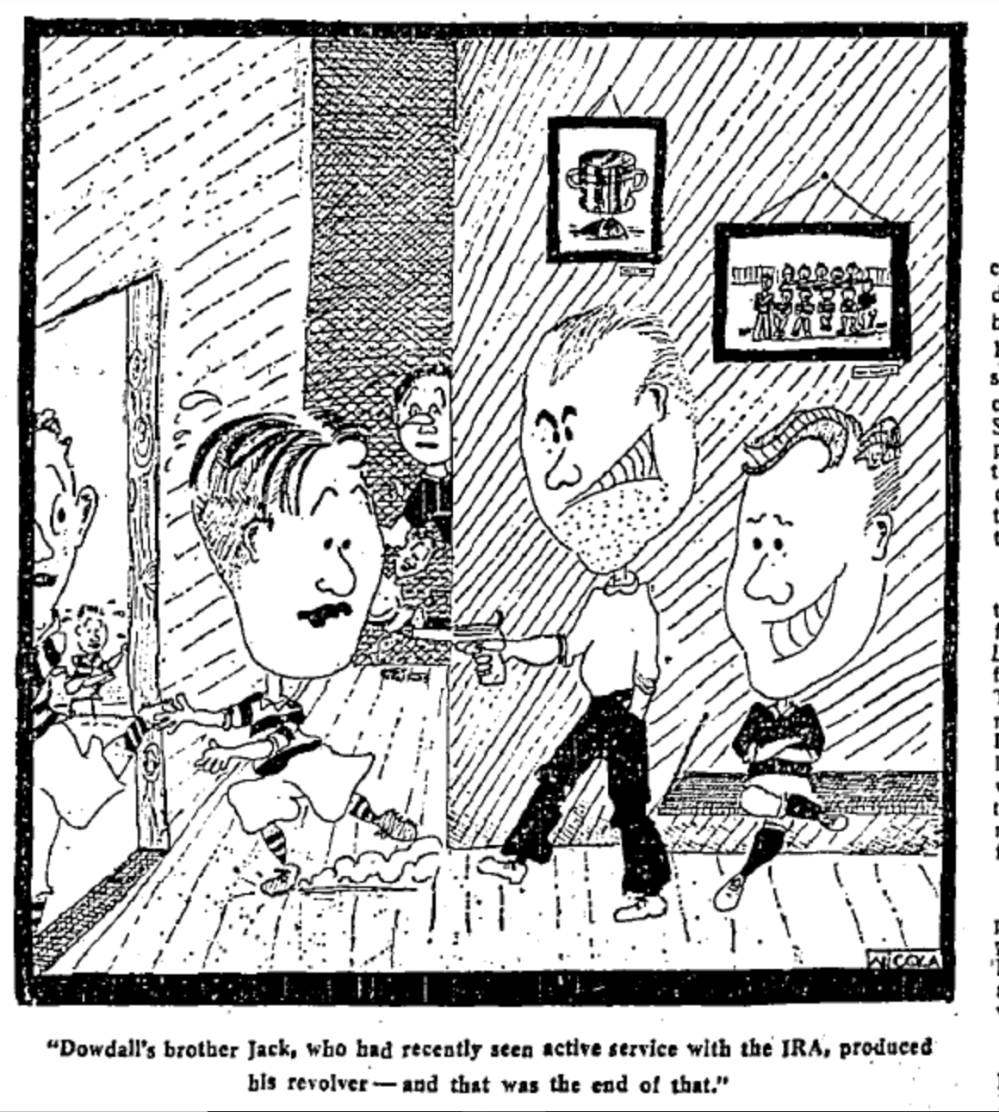
Dowdall brother cartoon

Fullam wouldn’t be banned for long and ended up scoring 27 times in the league for Rovers the following year. Most with his howitzer-like left foot. While his first cup final may have ended is defeat he would retire from the game with four winners medals to his credit, to go with the four league titles he’d collected. So central did he become to Rovers success that the popular refrain among their support whenever the team were lacking inspiration on the pitch was “Give it to Bob”, a phrase that entered widespread use through Dublin in the subsequent decades.

Fullam also has an important footnote in Irish international football history. After the 1924 Olympics few international matches were forthcoming and the FAI had to wait until 1926 to secure a full international fixture, in this case a game against Italy in Turin with a return game in Dublin also agreed. Fullam and Frank Brady of Fordsons were the only players to play in both of those early games. The Italians ran out comfortable 3-0 winners in Turin but performed better in Lansdowne Road the following year with Ireland taking the lead through a powerful strike from none other than Bob Fullam. It was counted as the first goal in International football for a FAI national team. Indeed he nearly grabbed a second shortly after from a free-kick, the power of which meant that Mario Zanelli, the Italian full-back was stretchered off after he blocked the fierce shot with his head. Despite the performance that was to be Fullam’s last cap for Ireland, he was by then into his 30’s and Rovers were to be the main focus of his footballing exploits.

That inaugural season of Free State football belonged to St. James’s Gate who finished with three trophies, while Paddy Duncan, Charlie Dowdall and Ernie MacKay would all go on to represent the nascent international team in the following years. Despite the chaos of the cup final replay over 25,000 spectators had paid in to watch the two games, bringing in gate receipts of over £1,000 which were crucial to the FAI’s finances in those early days.

Less than a week after the replay anti-treaty IRA volunteers, led by Rory O’Connor occupied the Four Courts in Dublin city. Tensions mounted and in the early hours of June 28th the Free State army began shelling the Four Courts from their positions south of the Liffey. The Civil War had begun, the nation was convulsed by almost a year of violence that would leave thousands dead. By the time a cessation to the violence arrived in May 1923, amid the turmoil, lawlessness and death somehow an entire football league season and cup competition had been played out. Circumstances that seem so utterly bizarre and unreal today. Shamrock Rovers, newly elected to the Free State league had won it at their first attempt. With Bob Fullam, returned from his ban, as top scorer. In the cup Alton United enjoyed their brief moment in the sun by winning the cup, a Belfast side triumphing in the Free State blue ribbon competition. A tragic, dramatic, scarcely believable, terrible state o’ chassis indeed.

The Philadelphia Story

Irish emigration to the United States is not a new phenomenon, Annie Moore from County Cork became the first immigrant to pass through Ellis Island, New York in 1892 but by that stage there had already been millions of Irish immigrants who had set up home throughout the USA. It is estimated that as many as 4.5 million Irish arrived in America between 1820 and 1930. Between 1820 and 1860 alone, the Irish constituted over one third of all immigrants to the United States.

With this number of Irish immigrants it should not be surprising that there are many Irish names to be found within the early years of US football history, names like Cahill, Peel, Farrell and Cunningham who were either Irish-born or the children and grandchildren of emigrants. Even the club names bear witness to this with plenty of Hibernians and Shamrocks being used as suffixes back into the 1890s. There was even mention of a team called the Philadelphia Irish Nationalists back as far as the 1870s.

However by the 1920s something different was happening: along the Eastern seaboard a professional soccer league was emerging, the ASL (American Soccer League), which began its inaugural season in 1921-22 featuring clubs from in and around New York, New Jersey,  Massachusetts and Pennsylvania, areas with strong concentrations of Irish immigrants. The debut season was won by the Philadelphia Field Club who were mostly made up of players formerly of the Bethlehem Steel Football Club. However, after this early success Philadelphia soccer took something of a nose-dive, with the club struggling towards the bottom of the league in subsequent years.

At this point, Irish interest re-emerges in the form of Irish-born, Brooklyn based businessman Fred Maginnis, who took over the struggling Philadelphia Field Club and boldly rebranded them as Philadelphia Celtic ahead of the 1927-28 season of the ASL. The change of name was not just a nod to his homeland; Maginnis had intended to bring across the cream of Irish footballing talent to join his squad. His hope, apparently, was that the significant Irish community in and around the city would come out in big numbers to support this Irish branded football team.

Maginnis got rid of most of the previous year’s squad, though he did keep former Irish League players Billy Pitt, once of Newry Town, and Hugh Reid, a promising defender who had previously been on the books of Glentoran. Both Pitt and Reid had been highly rated during their Irish League careers. Pitt, was a Belfast-born wing-half who had been part of the first Newry Town squad to compete in the Irish League, and he and young Reid had been selected for an Irish League XI for an inter-league game against a League of Ireland XI in 1926.

Billy Pitt proved to be especially useful for Maginnis in recruiting new players for the Philadelphia Celtic directly from Ireland. Pitt’s footballing connections, and Maginnis’ promises of free passage to America and $55 a week in wages, turned a lot of heads and players of varying talents made the journey. Of the more prominent figures convinced to journey across the Atlantic were Ards players Jimmy McAuley and Eddie Maguire, as well as the much-travelled forward Arnold Keenan, who had featured for Fordsons in the Free State League, Glentoran in the Irish League, and for Crystal Palace in England. Others who travelled from the League of Ireland included Michael Maguire, an inside-right, and Paul O’Brien, an outside-left who had played for Brideville, and Larry Kilroy, an inside-right from Bray Unknowns. Also included was Shelbourne player William Burns, who broke an FAI suspension from football to go and play in the United States.

Perhaps the two most famous players who travelled were Free State internationals Denis “Dinny” Doyle and Bob Fullam of Shamrock Rovers, who were joined by fellow Rovers team-mate Alfie Hale (father of the Waterford footballing legend of the same name). By the time of their journey they were both Irish internationals, having represented the Irish Free State in two games against Italy. While Doyle only featured in the home fixture against the Italians, Fullam played in both Turin and Dublin games and got on the score sheet in the home match.

Fullam was one of the best known figures in the League of Ireland. A talented inside forward, he had a rocket-like left-foot and had already been central to Shamrock Rovers’ three league titles and an FAI Cup win. Such was his importance to the team that the popular terrace cry of “Give it to Bob” became common among Rovers fans any time their team were on the back foot.

Fullam had played outside of Ireland before, lining out for a short time for Leeds United but the trip to Philadelphia was a bigger jump into the unknown. Billy Pitt would have faced Fullam in that inter-league match in 1926, and he would certainly been aware of him by reputation when he approached him about the trip to America. It was Fullam in turn who convinced Dinny Doyle to travel. Some newspaper reports suggested that Fullam and co travelled in August 1927, ostensibly as part of a touring Irish exhibition side to the United States, though this seems to have something of a cover story for their true intentions.

What was clear however, was that the Philadelphia Celtic, although rapidly assembled, could certainly hold their own in the professional ranks of the American Soccer League. Although they lost their opening game, they followed this up with a draw and then two victories over the impressive Fall River Marksmen and the Boston team. All was not well in the camp however, as the Boston result was overturned because Philadelphia had made an improper substitution. The lack of any proper coach or manager no doubt was partly to blame, as well as the mounting financial problems.

The ethnic marketing of an Irish Philadelphia side was not creating as big a stir in the city of Brotherly Love as Fred Maginnis might have hoped: even games against strong sides like Boston and Fall River were only drawing crowds of 2,000 – 3,000. Results were very unlikely to improve, as quite quickly the players realised that the riches they had been promised weren’t materialising. Whether Maginnis’s strategy had been to use money raised from expected big gates to pay the squad’s wages, or whether he was just a poor businessman without a Plan B isn’t clear, however, the Irish players quickly realised that the $55 a week they’d be promised wasn’t going to turn up, nor even a fraction of it.

There had been problems with payments from the beginning, and the ASL had come in and taken over the running of the team on an interim basis while they told Maginnis to find a buyer to take over the club. Maginnis, however, didn’t seem to be trying very hard. The Philadelphia franchise being deliberately over-valued put off potential investors, however, Maginnis did seem keen to strike a deal to sell the majority of the club’s playing staff to the Fall River Marksmen club. The league objected to this, and there were even discussions about whether the players could move. Eight of the players had work permits sponsored by Philadelphia Celtic (describing their profession as artists) which would then have to be endorsed by the new club that they would join.

It all came to a head before the end of October 1927 after only 10 games for Celtic, when the League Commissioner Bill Cunningham announced that Philadelphia Celtic had folded and that as far as they were concerned the players who had remained were free agents who could move to a club of their choosing. Some of the Irish contingent decided that they’d had enough; they’d struggled financially due to Maginnis’s mismanagement and by November William Burns and Paul O’Brien had already returned to Ireland. Bob Fullam had a short sojourn with the wonderfully named Detroit Holley Carburettor FC before eventually returning to Shamrock Rovers ahead of the 1928-29 season. Others like Kilroy, McGuire and Alfie Hale would return to Ireland after a matter of months. Billy Pitt, who had helped recruit many of the players for this Philadelphia experiment, would stay a few years longer, playing first for Fall River and later the New Bedford Whalers, Bethlehem Steel and the Pawtucket Rangers. He eventually returned to the Irish League in 1931 where he signed for Glentoran, after some disagreement regarding his transfer from his former club Newry Town. Pitt had left Newry for the States without a transfer being paid and personally faced a significant fine of £50 for breach of contract, it was only after Glentoran agreed to pay this fine that the transfer was sanctioned.

Fullam’s erstwhile team-mate Dinny Doyle had, however, taken to American living and to the ASL. After initially being frustrated in his attempts to sign the Philadelphia players, Sam Mark, owner of the Fall River Marksmen, was successful in signing not only Doyle and Pitt but also Arnold Keenan and Jimmy McAuley. Doyle would go on to be a league Champion with Fall River the following season, as they became one of the most dominant American soccer teams of that era. Dinny Doyle made his life in North America, passing away in his home in Canada in the late 1980s. He was the last surviving member of that first Shamrock Rovers side to win the league title.

The idea of importing an Irish soccer team wholesale into a professional American league was a novel one, it played to the ethnic target marketing that was common in American soccer at the time, but it was ultimately doomed to failure due to the unscrupulous behaviour of an Irish-American businessman trying to get one over on footballers eager for a better life.

While the Philadelphia Celtic quickly failed and many of their players returned to their careers in Ireland, it was not to be the last time that an Irish side was parachuted into an American soccer league…

The research of Steve Holroyd and Michael Kielty has been especially useful in preparing this article.

Ernie Crawford he’s our friend

Regular attendees to Dalymount Park may have noticed a new flag appearing around Block F. It features a bare chested man with a Charlie Chaplin moustache and bears the legend Ernie Crawford – He’s our friend, he hates Rovers. But who, you may ask was Ernie Crawford?

Born in Belfast in November 1891 Ernie was perhaps best known for his endeavours on the Rugby pitch. He starred for Malone in Belfast and later Lansdowne Rugby Club and won 30 caps for Ireland, fifteen of them as Captain between 1920 and 1927. After retirement he was heavily involved in administration as President of Lansdowne Rugby Club between 1939 and 1941 and President of the IRFU in the 1957/58 season as well as being an Irish team selector between 1943 and 1951 and again between 1955-1957. His obituary in the Irish Times listed him as one of the greatest rugby full-backs of all time, he was honoured for his contribution to sport by the French government and even featured on a Tongan stamp celebrating rugby icons.

He was also a successful football player who turned out for Cliftonville, for Bohemians and on a number of occasions for Athlone Town. He was even a passable cricket player. Ernie was a chartered accountant by trade and moved to Dublin to take up the role of accountant at the Rathmines Urban Council in 1919, and this facilitated his joining Bohemians. Despite his greater reputation as a rugby player, Ernie, as a footballer for Bohs, was still considered talented enough to be part of the initial national squad selected by the FAIFS (now the FAI) for the 1924 Olympics in Paris. In all, six Bohemians were selected (Bertie Kerr, Jack McCarthy, Christy Robinson, John Thomas & Johnny Murray were the others and were trained by Bohs’ Charlie Harris), but when the squad had to be cut to only 16 players Ernie was dropped, though he chose to accompany the squad to France as a reserve. The fact that he was born in Belfast may have led to him being cut due to the tension that existed with the FAIFS and the IFA over player selection. However, even as a travelling supporter, he caused some controversy. He was stopped by customs officials en route to Paris and had to explain the presence of a revolver in his possessions. Ernie’s reply was merely that he brought the gun for his “piece of mind”. Not that this was Ernie’s first experience with firearms.

Crawford collage

Ernie in military uniform, appearing on a Tongan postage stamp and in rugby kit

Ernie had served and been injured during the First World War. That he could captain the Irish Rugby Team and be selected for the Olympics is even more impressive when you consider that during the Great War Ernie was shot in the wrist at Arras, France in 1917 causing him to be invalided from the Army and to lose the power in three of his fingers. He had enlisted in the 6th Inniskilling Dragoons in October 1914 and was commissioned and later posted to the London Regiment (Royal Fusiliers), becoming a Lieutenant in August 1917. After his injury he finished his war service on the staff of the Ministry of Munitions. He was a recipient of both the British War medal and Victory Medal.

Ernie later returned to Belfast where he became City Treasurer in 1933. It was in Belfast in 1943 that Ernie encountered Bohs again, as he was chosen to present the Gypsies with the Condor Cup after their victory over Linfield in the annual challenge match.

One of the reasons that his memory has lasted nearly a century with the Bohemians faithful and why a group of us decided to get a flag made up bearing his image centres around a minor cup tie. Ernie, due to his Rugby and also his professional commitments tended to not be a regular starter for Bohemians, his appearances tended to be because of the injury or suspension of other players or as part of reduced strength sides in smaller cup competitions.

As we all know however, when it comes to games against Rovers there are no “smaller ties”. After one particularly tough cup game against Shamrock Rovers an angry Crawford removed his jersey challenged Rovers star forward Bob Fullam to a fight in the middle of the pitch. It’s this moment that the image on the flag imagines!

Fullam himself was no shrinking violet, as well as being an accomplished footballer who was capped twice by Ireland he supplemented his income as a docker in Dublin Port. He finished the 1922 FAI Cup final amid a mass brawl after Rovers were beaten by St. James Gate. The fighting only ceased when the brother of the Gate’s Charlie Dowdall reportedly confronted Fullam with a pistol.

Ernie himself seemed to have been one of those “larger than life” characters, quite aside from bringing a gun to the Olympics and bare-chested on-pitch scraps he also fell foul of Rugby referees one of whom complained about Crawford’s back-chat and claimed that such was the roughness of his play “that the definition of a “tackle” should be sent in black and white to him”. On another occassion an English rugby opponent remembers Crawford treating him and his wife to dinner and giving them a lift back in his car which didn’t happen to have any working headlights. Ernie in an attempt to beat traffic tried to get between a tram and the pavement without much success, badly denting the side of his car and scratching up the paintwork of the tram car. The angry tram driver jumped from the vehicle but on recognising that the other driver was non other than Irish rugby captain Ernie Crawford he let the car pass unhindered, taking off more paint as he went.

In 1932 he became the first man from Britain or Ireland to be awarded the silver medal of honour by the French ministry of sport and physical education for his contributions to the world of sport. Apart from sport he was obviously professionally successful, being City Treasurer of Belfast until his retirement in 1954, he was also trained as a barrister and took an interest in economics. He died in 1959 and was survived by his wife and three children.

Ernie Crawford, he’s our friend.

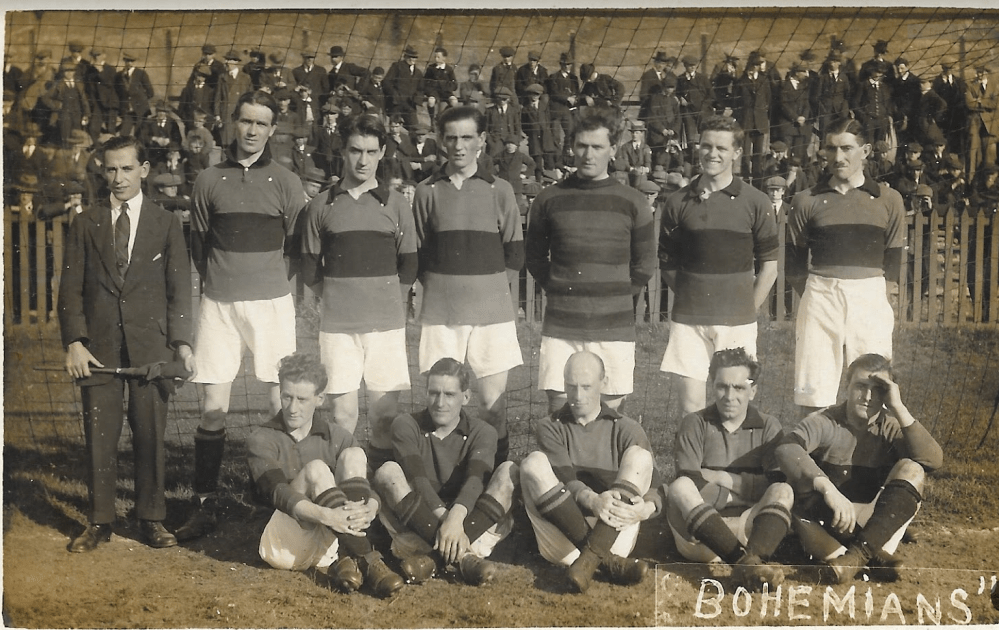
Ernie is pictured below on the back row, far right as part of the Bohemian FC squad of 1920-21.

Bohs 192021 EC

Useful resources on Ernie’s career include Paul Rouse’s History of Irish Sport, Tadhg Carey’s When we were Kings and David Needham’s Ireland’s first real World Cup and the Dictionary of Irish biography.