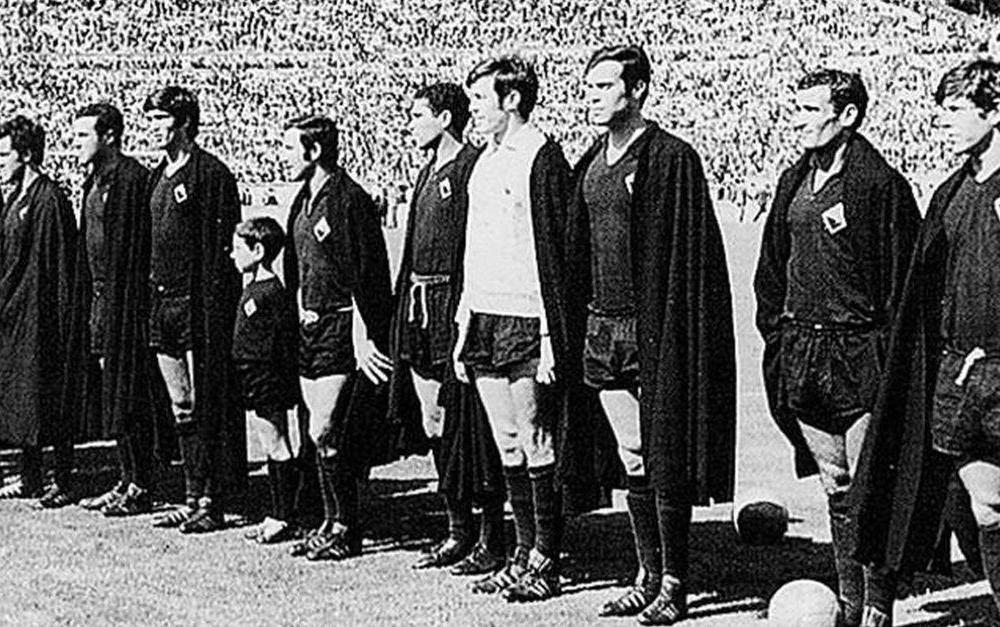
Football for a cause – the 1969 Portuguese Cup final
In August of 1968 the Portuguese dictator, António de Oliveira Salazar fell in the bath. He was 79 years old and had been Portugal’s political leader for thirty-six years by that stage. After his fall the dictator’s health continued to worsen and he slipped into a coma and with his imminent death expected, Marcelo Caetano was proclaimed his successor of the Estado Novo, the so-called conservative and autocratic, New State. When Salazar unexpectedly awoke from his coma, and lived for a further two years, none of his Ministers or advisors had the heart to tell him that he was no longer in charge and he continued to believe he was “ruling” Portugal from the comfort of his personal residence.
If the declining political health of Portugal was evident in the commensurate decline of its political leaders, then it was also becoming surprisingly evident on the football pitches. The 1960s had been an era of huge progress for Portuguese football, Benfica had won back-to-back European Cups at the beginning of the decade and the national team had finished third in the 1966 World Cup. Despite a lack of interest from Salazar in football the regime wouldn’t fail to capitalise on the success of their star sides, Football became one of the defining “Three Fs” of Portuguese culture, the others being Fado, the traditional music of Portugal, and Fatima, the religious shine dedicated to the Virgin Mary and central to Salazar’s conservative, Catholic ideology.
These emerging tensions between the state and football came into sharp focus less then a year after Salazar’s incapacitation and it happened in the most pronounced of ways, at the Portuguese Cup final. Held in the Estádio Nacional in Lisbon, where Celtic had won their European Cup in 1967, the Taça de Portugal final pitted the might of Benfica, complete with Eusébio and captained by Mário Coluna against Académica de Coimbra.
Académica de Coimbra were the university team of the city of Coimbra, an ancient and beautiful city that has housed a prestigious university since the 14th Century. Their football team, while not often challenging the big three of Benfica, Sporting and Porto still were able to recruit many talented young players who were also looking to further their educations. In fact, the Benfica midfielder Toni, who played in that final had begun his career with Académica.
The students of Coimbra, in both the college campuses and the football dressing rooms were becoming ever more radicalised, tiring of a dictatorship that stretched back decades before their birth and inspired by the student protests of 1968 that had erupted across European universities, including in Coimbra, and showing solidarity with the youth of Portugal who resented being sent in their thousands to fight brutal colonial wars in Angola and Mozambique. They decided that their Cup run and the final would be a chance for protest.
While Académica usually wore all black, with a dramatic flourish, in their semi-final win over Sporting they wore white with a black armband as a sign of mourning for the state of the country. With the final they had even more in mind, they wore long, black graduation robes as they walked onto the pitch, the pace of their gate much slower to give the impression of a funeral cortege in protest. The Benfica players, through Toni, were aware of this planned entrance and similarly walked out slowly.
The regime, nervous after prolonged student protests at Coimbra University and aware of the armband stunt in the semi-final, decided not to cover the game on TV, but could not drown out the tens of thousands of student supporters chanting against the regime on the radio broadcast of the match. The cheers were deafening as Académica took an early lead through Manuel António. They defended that lead for over 80 minutes before a goalkeeping error allowed António Simões to equalise and bring the game into extra-time. The students who had competed so bravely for so long began to wilt in the June heat and with 109 minutes on the clock Eusébio headed home the winner.
Académica had planned to bring the cup into the crowd and celebrate with the people had they won, tiredness and the quality of the opposition denied them of this, but the Benfica players still celebrated with their opponents on the pitch, understanding the significance of their actions.
The story of the Académica team lives on in the documentary film Futebol de Causas (Football for a cause) by Ricardo Martins who also provided the image for this article, while it also features in the book The Defiant: A History of Football Against Fascism by Chris Lee, I am indebted to them for their research on this game.
An original version of this article featured in the November 2025 match programme for Ireland v Portugal.
 A Bohemian Sporting Life