The life and career of Jimmy Dunne

The football highlights don’t do justice to the man but let’s recount them anyway. One of only three players in the history of the English top-flight to score 30+ league goals across three consecutive seasons, the most recent is Alan Shearer. The record for the longest scoring streak in English league football; scoring in 12 consecutive games, a league Champion with Arsenal, a League of Ireland and FAI Cup winner, national team record goal-scorer for 28 years. Not a bad football CV – it belongs to Jimmy Dunne.

But there is so much more to Dunne than  90-year-old scoring records. He was born on Cambridge Street in Ringsend in 1905 the son of Thomas and Catherine Dunne. Thomas was a bottle blower in the nearby glass bottle works. The Dunne family’s life was far from easy, of the eight children born to Catherine only four survived, with Jimmy being the youngest.

A further blow to the family occurred with the death of Thomas from tuberculosis when Jimmy was just two years of age. To make ends meet the newly widowed Catherine took in lodgers to their small, two-room tenement home, while Jimmy’s older brother Michael was working at the glass bottle works by the age of 14. Local stories record that Jimmy himself got a job for a local bakery as a delivery boy, bringing fresh bread, and occasionally secret IRA communications, on his bicycle around the city.

As a teenager his Republican sympathies continued, and along with his brother Christy he took the anti-Treaty side in the Civil War, eventually being interned in both Portlaoise and the Tintown camp in the Curragh after being arrested during the “Bridges Job” of August 1922 when anti-Treaty forces sabotaged various roads and bridges throughout Dublin. The association game proved popular in the internment camps and playing with rag-balls in tight confines no doubt honed Dunne’s touch and control. Upon his release in 1923 he played briefly for junior club Parkview before he joined Shamrock Rovers and made his debut for Rovers “B” against Pioneers in the Leinster Senior League in December of that year. While he was a Shield winner with Rovers an extended run in the first team was limited by the dominance and scoring prowess of Billy “Juicy” Farrell at centre forward.

Frustrated at the lack of opportunities Jimmy joined New Brighton (on Merseyside not to be confused with Brighton on the South Coast) in the old English Third Division North for the 1925-26 season.

His time on Merseyside was brief however, he made an impressive start to his career, scoring on his debut against Rochdale and registering six goals in eight league games as well as scoring in the cup, this quickly brought him to the attention of Sheffield United’s secretary John Nicholson who signed him for a fee reported between £750 – £800. Apparently this swift turnaround for Dunne, who had gone from Leinster Senior League to the top of the English football pyramid in less than year, was completely unexpected and the modest Dunne had to be persuaded that his future lay in the First Division.
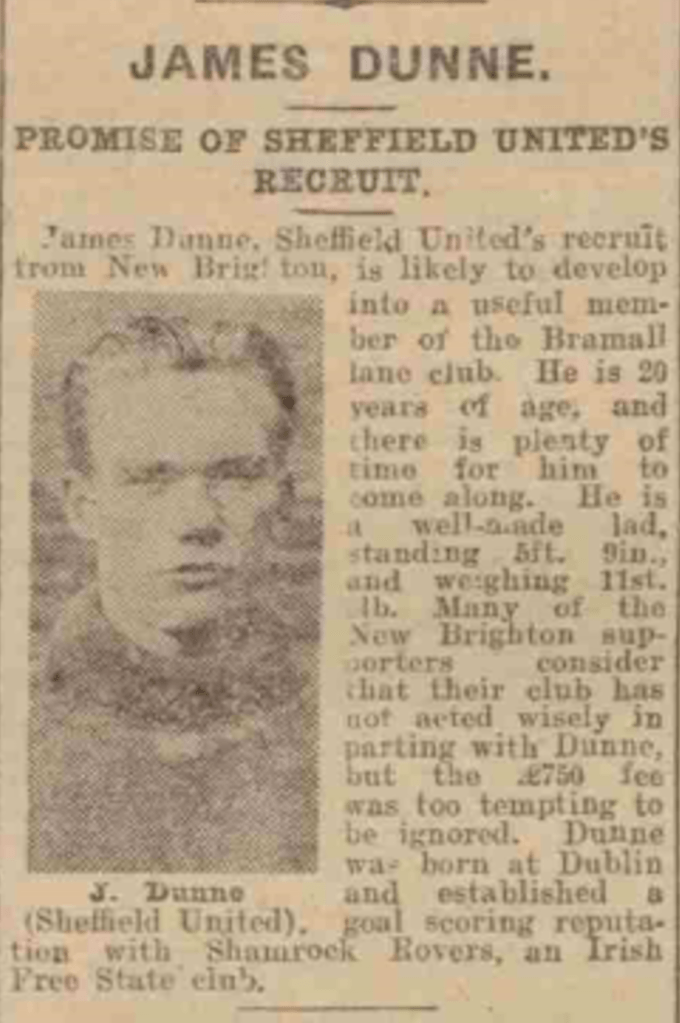
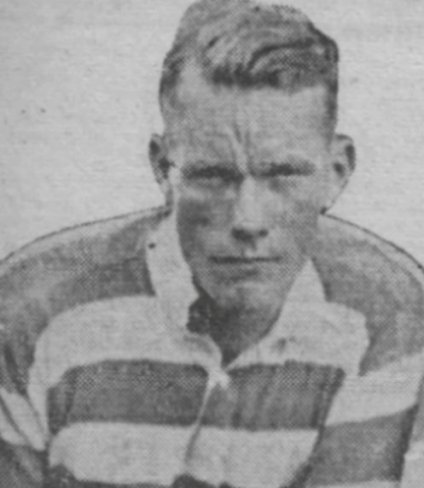
A young Jimmy Dunne after signing for Sheffield United – 1926

As before with “Juicy” Farrell the path to first team football was initially blocked, this time in the form of Harry Johnson. Dunne spent much of the next three seasons in the reserves, making only occasional appearances and at one stage was on the verge of being transfer listed. However, the 1929-30 season would be his breakthrough year, scoring 36 in 39 league games to keep Sheffield United clear of relegation by the old method of goal ratio. Dunne’s amazing run continued with the 1930-31 season being his best ever 41 goals in 41 league games (a record for an Irish player in the English top-flight) and 50 in all competitions. The following seasons brought more goals, significant improvements in United’s league positions and interest from other clubs, especially from Arsenal and their legendary manager Herbert Chapman.

Sheffield United rebuffed an initial approach of £10,000 as they wanted a record £12,000 for Dunne, however Chapman played the waiting game, and with the 1933-34 season underway United found themselves in financial trouble. Chapman boarded an early train and had Dunne signed up for a reduced fee of just over £8,000. Dunne went right into the team and helped Arsenal to the League title, though the manager who signed him, died suddenly in January 1934. Soon after Ted Drake arrived from Southampton, and it would be the goals of Drake, not Dunne that would propel the Gunners to the title again the following season. Drake’s excellent form effectively ended Dunne’s Arsenal career, and belatedly Jimmy Dunne would end up as Drake’s replacement by signing for a struggling Southampton for the 1936-37 season. He would be the club’s top scorer that season and helped them avoid relegation to the third tier.

Dunne, from the numerous reports and descriptions of him as a player, and the very limited footage of him in action, appears as a complete centre forward, he had a good touch and ball control, no doubt honed as a teenager during times of confinement, he was strong and robust, quick off the mark and could shoot with power with either foot. He was versatile enough to drop deeper and play in the more creative role as an inside forward, however, all sources describe his greatest asset as his heading ability. Despite his height being listed as 5’10” the blonde head of Dunne struck fear into defences across Europe. He once scored a hat-trick of headers in a game for Sheffield United against Portsmouth and the innovative coach Jimmy Hogan (himself the son of Irish immigrants) chose Dunne as the player to demonstrate the skill of heading in an instructional coaching film that he made in the 1930s. In an interesting article with Dunne in the Sunday Pictorial while at Arsenal he even mentions having watched the famously skillful and scheming Austrian centre-forward Matthias Sindelar play, nothing the effectiveness of his “withdrawn striker” or “false 9” role as we would know it today. This demonstated Dunne’s keen eye for positioning and tactical possibilities.

While Dunne could have stayed an extra season at The Dell he chose to return home to Dublin and Shamrock Rovers as a player-coach. Though now into his 30s Dunne’s passion was undimmed and helped Rovers to back to back league titles as well as victory in the 1940 FAI Cup. Despite his advancing years these would be his most productive days in the Green of Ireland, in fact, Dunne won 14 of the 15 caps awarded to him by FAI after the age of 30. While Sheffield United released Dunne for seven IFA games during his time with them they very rarely released him for any FAI squads, this was mainly due to the fact that IFA matches coincided with the English national team game while FAI games had to work to other schedules that made English club reluctant to release players. Despite this Dunne amassed 15 caps and scored a record 13 goals which stood until broken by Noel Cantwell in 1967.
jimmydunne

One incident of note was that Dunne was released to the IFA by Sheffield United for a game against Scotland in Ibrox. The goalkeeper Tom Farquharson, born in Dublin, withdrew from the squad and wrote to the IFA stating that he only recognised the FAI as the representative Association for Ireland. Dublin-born Harry Duggan followed suit and there was some expectation that Dunne, another Dubliner would do likewise. Without any guidance from the FAI about whether he should play or not Dunne travelled to Scotland.  However, Dunne received a letter, sent to Ibrox from Belfast which called him a “traitor to his country” and threatened him with death for playing for an IFA selection. Dunne started the game and duly scored in a 3-1 defeat to the Scots.

If fixtures had been different or UEFA dictats that today require clubs to release players for internationals had existed magine what he could have achieved had he worn the jersey for Ireland in his goalscoring prime with Sheffield United? Perhaps he could have made the difference in qualifying for the 1934 World Cup? Dunne continued playing into the 1940s, although the War had put an end to his international career. His final game for Ireland being a controversial match against Germany in Bremen in May 1939. Dunne was injured in the game but returned to the pitch and had a huge influence as Ireland drew 1-1.

His playing career finished in slightly acrimonious fashion, when aged 37 he was pressured into not playing in a FAI Cup semi-final by the owners of Shamrock Rovers. Dunne, hung up his boots and left the club to take the reins as coach across the city at Bohemians in 1942. Dunne would improve the fortunes of the Gypsies and led them to victory in the Inter-City Cup in 1945, before eventually rifts were healed with Shamrock Rovers and he returned to them as coach in 1947. Dunne was now a full-time coach with Rovers and gave up his job with boiler manufacturers Babcock and Wilcox.

The Irish football world was plunged into mourning in November 1949 when Jimmy Dunne passed away suddenly. His day had been a usual one, and he even spent time watching the Swedish national team train in Dublin ahead of their match with Ireland. Dunne was keen to talk football with their English coach George Raynor before he passed away suddenly after returning to his home on the Tritonville Road and suffered a heart attack.

It is no exaggeration to say that his footballing legacy endured, whether at Rovers in the form of the likes of Paddy Coad who succeeded him, or with his own family with his sons Jimmy Jnr. and Tommy becoming footballers, as well as his nephews, another Tommy Dunne and Christy Doyle.

While almost always referenced as being quiet apart from occasionally accompanying teammates in a sing-song on his button-accordian, mild-mannered, and gentlemanly in demeanour Dunne, in his playing style was robust and fearless. It is worth remembering he had been part of a revolutionary movement in his youth, he was the man who roared “Remember Aughrim, Remember 1916!” to psyche up his teammates before that match in Bremen against Nazi Germany in 1939 and who left his beloved Rovers because of interference from the Cunningham family, he even defied death threats to play for the IFA selection against Scotland in 1931, he was certainly a man who knew his own mind and could stand up for himself. He should also be remembered as one of the greatest strikers this island has ever produced.

The cover of a match programme from a Jimmy Dunne memorial game in 1952 featuring the two teams that Dunne had coached (courtesy Ruairí Devlin)

Shedding some light on Dalymount – the true story of the Bohs floodlights

I love a good Western and among many great practitioners of that ultimate piece of cinematic Americana was John Ford, born John Feeney in Maine to two Irish-speaking immigrants. Ford was a man who knew how to mythologise himself and he did plenty of myth-making in his movies as well. For better or ill his film The Quiet Man has probably influenced the American view of rural Irish life to this day. While, his westerns are far from historical documents of frontier life for European settlers in the American west, rather they are among the founding myths of American exceptionalism.

Of course Ford knew this, in one of my favourite of his films, The man who shot Liberty Valance a world-weary newspaper man utters the immortal line “When the legend becomes fact, print the legend”. Ford ackowledges that very Irish trait of preferring the entertaining story to the truth. And so it is with football, there are plenty of myths that grow legs, that persist to the present day despite constantly being debunked. I mentioned the old chestnut of Germany wearing a green away kit as a “thank you” gesture to Ireland in a recent post, but in this piece I’m going to address the notion that Bohemian Football Club bought the iconic Dalymount pylon-style floodlights second-hand from Arsenal, and that these same lights once adorned Highbury Stadium.

The origins of the myth

There are several fairly authoritative accounts, including one on the club’s own website, that perpetuate the story that the lights were either sold or gifted by Arsenal to Bohemians. I had in the past shared this story on social media myself before doing a bit of digging on the subject. This myth seems to have arisen from the fact that Arsenal played Bohemian F.C. in an inaugural match for the new lights in March 1962.

Floodlight Arsenal cover

Cover of the match programme featuring the newly installed floodlights.

This simple inaugural match has somehow morphed into a story that Arsenal sold the lights to Bohemians. There are a few ways to dispel this myth so lets begin with the idea that these were the floodlights that once adorned Highbury.

The Highbury dilemma

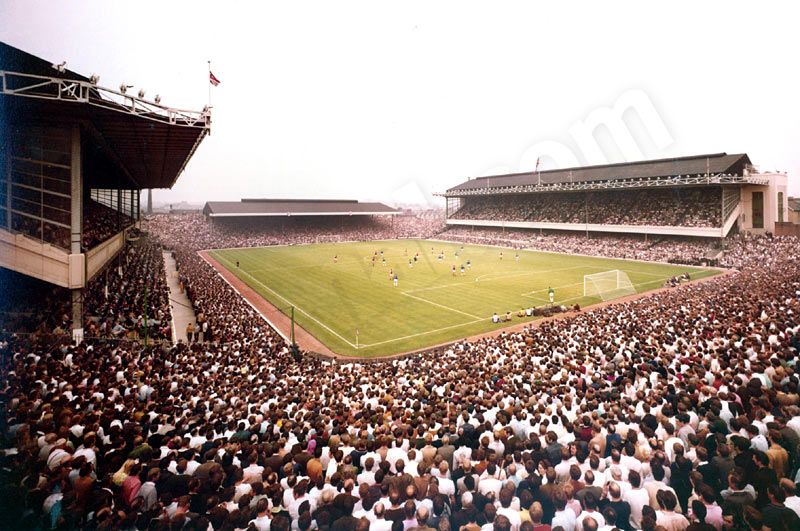
Arsenal began playing matches under floodlights from 1951, at which time league matches under lights were not even permitted by the F.A. They did however play a number of high profile friendly matches including one against Glasgow Rangers. While the glorious old ground of Highbury has since been turned into modern apartments large sections of the stadium received listed status and still exist.

Anyone who ever visited the stadium will likely attest to its architectural beauty, it was however, also known for the compact nature of its dimensions, including an infamously narrow pitch, well exploited by managers like George Graham. Simply put Highbury didn’t have the space for large pylon towers like those that stand in Dalymount today. In the photo below you can see Highbury Stadium from that 1951 game against Rangers. This is verified both here and also here on the official Arsenal website.

Highbury

From this early photo it is clear that there are no floodlight pylons, all the lights are roof mounted. It is worth noting that this photo is from a mere 11 years before the lights were supposedly “sold” by Arsenal to Bohemians, which would mean that any floodlight pylons would have to have been installed after 1951, survived less than ten years, and then been removed and replaced by another roof mounted lighting system.

From later photos it’s clear that there were no pylons at Highbury and indeed very little space in such a tight stadium for the location of large pylon tower lights. The two photos below are from circa 1960 (roof mounted floodlights again) and secondly from the last season that Arsenal played at Highbury in 2006. As before, roof-mounted lights.

Highbury2

Highbury3

Highbury in 2006

The only connection between Highbury and Dalymount is that they are both tight grounds located in residential areas and that portions of both stadiums shared a stadium architect in the early decades of the 20th century, namely Archibald Leitch.

The story of the lights

The insertion of the Arsenal Football Club and Highbury Stadium into the history of Dalymount is really by accident. Bohemians had organised a fundraising subcommittee to look at the cost and feasibility of installing floodlights at least as early as 1959. It also quickly became clear that once the lights were ordered that some form of inagugural game would prove popular.

To be clear, the Dalymount Park floodlights were not the first set of lights used in Dublin. Stadium lighting was temporarily installed in Croke Park for the Tailteann games of 1924, while Ruaidhrí Croke has written recently about the first games under lights in Tolka Park back in 1953 when it was home to Drumcondra F.C.

However, Dalymount Park was the de facto home ground of the Irish national team and the lack of floodlights meant that international games had to have earlier kick-offs, even when scheduled for mid-week which had an obvious impact on crowd numbers.

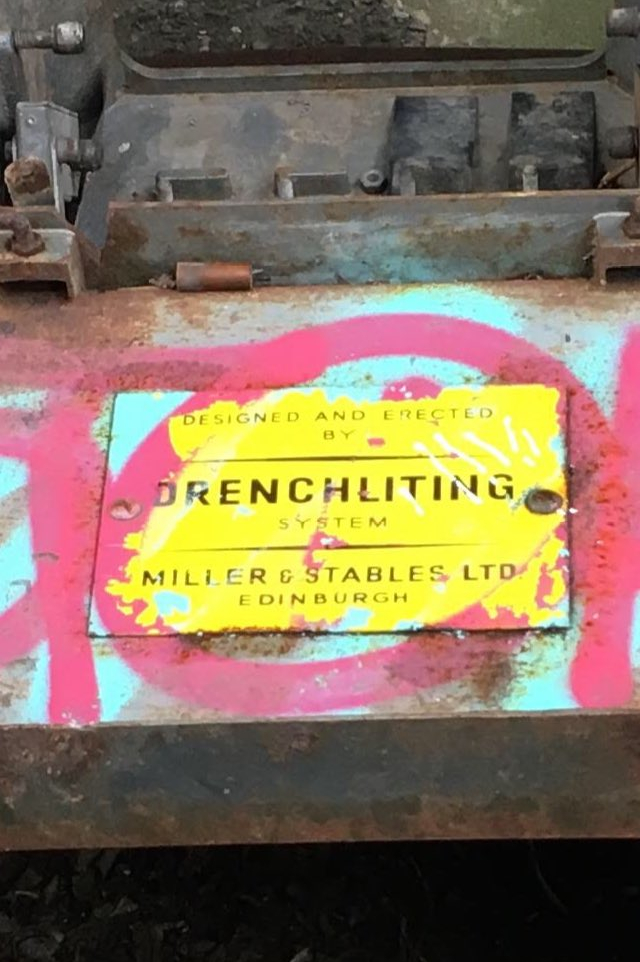
Taking inspriation from another national football stadium a preferred design and supplier emerged after from a visit to Hampden Park in Glasgow who installed their own floodlights in 1961. In a report in the Dublin Evening Mail from November 14th 1961 it was reported that the contract had been signed with “a Scottish firm” for the lights and that these would take approximately three months to manufacture, transport and install. The firm in question was Miller and Stables of Edinburgh who, apart from Hampden, had also provided floodlights (or drenchlights as they dubbed them) for Windsor Park, Celtic Park, Easter Road and many others.

Drenchlighting

Original lighting console from Dalymount plyons showing the name of the manufacturer, Miller & Stables (pic Graham Hopkins)

Earlier in January 1961 an edition of the Irish Times confirmed that the FAI had accepted the recommendations of their own Finance Committee in guaranteeing major matches for Dalymount Park for at least the next ten years in order to assist with Bohemian F.C. in funding the purchase of new floodlights. Even by that stage the lights had been costed at £17,000 including import duty and transportation costs. This figure rose slightly when the lights were installed early in 1962 and were reported as costing £18,000 or even £20,000 according to one report.

The floodlights themselves are 125 feet high and originally featured three banks of ten lights on each pylon and a special transformer station had to be constructed to meet with the power supply demands. With the new lights it meant that mid-week games could be played in the evenings, for internationals this should mean bigger crowds and with Bohemians getting approximately 15% of the gate from international games this meant greater revenue for the club.

DpvWxqfWwAM--Ju

Despite the expected future return on investment this was still a huge outlay for the amateur club. Initial notices suggested that the lights would be in place by September 1961, which was then extended to October and ultimately until February of 1962. In the words of Club Secretary Andy Kettle, as quoted by Ryan Clarke in his recent series on Dalymount, it also meant that Bohs could “invite many top clubs to Dublin from time to time”.

The first of which ended up being Arsenal, though they weren’t first choice. But before these glamour matches could be played Kettle had to deal with some level of internal dissent from Bohs members about the level of expenditure and even had to engage in a little bit of what might be termed “crowdfunding” in the modern parlance. Kettle elaborated in the Dublin Evening Mail that the club had “approached their bankers, the Munster and Leinster Bank, their members, players, traders, FAI and League of Ireland for financial assistance”, before adding “Bohs are keeping open their fund and will only be to happy to receive any further contributions. No matter how small…”

The Arsenal Game

As Andy Kettle had hoped the installation of floodlights would help Bohemians raise additional funds by playing friendly games against some of the “many top clubs” that could be invited to Dublin. But the question remained which team should receive the honour of being first? There were suggestions from media commentators that Shamrock Rovers should be invited although the preferred option emerged as a game between a League of Ireland selection against a British based Irish XI. However, as this would require multiple clubs across England and Scotland to release players it quickly because clear that this was unfeasible.

Among the other clubs sounded out by Bohemians to fulfil this fixture were Sunderland and Leeds United, as well as Manchester United and Blackburn Rovers (both of whom declined due to FA Cup committements). Attention was then turned to Arsenal, Celtic or Wolverhampton Wanderers with Arsenal finally being chosen from that shortlist of three.

From this is it clear that Arsenal, despite being a famous First Division side were realistically a fifth or sixth choice on behalf of the Bohemians’ committee for the role of opponents for this inaugural game. Arsenal were ultimately chosen and played in Dalymount on at least their third occasion (the previous two being in 1948 and 1950) and fielded a strong team including Welsh international goalkeeper Jack Kelsey, George Eastham, and future Cork Hibernians player-manager Dave Bacuzzi. The Bohemian XI featured players like Tommy Hamilton from Shamrock Rovers, Eric Barber and Tommy Carroll from Shelbourne as well as Ronnie Whelan Sr. and Willie Peyton from St. Patrick’s Athletic.

Arsenal would ultimately win an exciting game, played in poor weather, 8-3. However, throughout all the media coverage during the build-up to the game and afterward there was no mention of any Arsenal or Highbury connection with the lights other than their being chosen as the opposition.

Maybe it is a little bit of an inferiority issue with Irish football fans that we’d rather believe that we bought the most iconic set of floodlights of any stadium in the country, second-hand from a big English club rather than believe that an amateur club, working in partnership with the League, the FAI and ordinary fans and players managed to successfully fundraise a huge amount of money for a major infrastructural project.

For me that’s a bigger story than any mythic historical connection with a defunct football stadium in London. But as they say “When the legend becomes fact, print the legend” I’d rather it be shine your own light rather than bathe in reflected glory.

Dalyer

The Flying Doctor & the free-scoring Publican – the famous O’Flanagan brothers

Along Marlborough Street, opposite the Department of Education and a 100 yards or so from the Pro-Cathedral, stands the aptly-named Confession Box pub, a small intimate venue where one could air your concerns over a pint that once belonged to former Bohemians and Ireland centre-forward Mick O’Flanagan.

The pub has its own sporting legacy quite apart from its former proprietor, it was there in 1960 that the Soccer Writers’ Association of Ireland was formed, and it was there that Mick O’Flanagan received the phone call that would make him an Irish International.

It was, as O’Flanagan recalled, around two o’clock in the afternoon of 30th September 1946 when a call came to the pub from Tommy Hutchinson, the Bohemians member of the FAI selection committee which chose the Irish International team.

Ireland were due to play England at 5:30 that afternoon, a historic meeting between the two nations as this was a first time the English national side had agreed to play an FAI selected team since the split with the IFA in 1921.

After decades of being ignored and ostracised by the English FA the FAI had finally secured a fixture against a formidable English side in Dalymount Park. In the minds of the FAI committee of 1946 this was the biggest game in its relatively short history. There was only one problem, their centre-forward, West Brom’s Davy Walsh had pulled out through injury.

This was the purpose of Hutchinson’s call to Mick O’Flanagan, the 24 year old Bohemian striker was being asked to line out against the inventors of the beautiful game at the last minute.

As O’Flanagan remembered:

“I went home to Terenure for a bite to eat, had a short rest and then headed off to Dalymount. It was not really sufficient notice as only the previous evening I had brought a party of English journalists to Templeogue tennis club and I hadn’t got home until nearly two in the morning.”

Despite a laughable lack of preparation, the Irish side put it up to their illustrious opponents who had hammered an IFA selection 7-2 just days earlier. It was only a Tom Finney winner eight minutes from time that sealed victory for the English.

Henry Rose in the Daily Express was moved to write:

“If ever a team deserved to win Eire did. They out-played, out-fought, out-tackled, out-starred generally the cream of English talent, reduced the brilliant English team of Saturday to an ordinary looking side that never got on top of the job.”

Not only did Mick O’Flanagan line out against the likes of Finney, Billy Wright, Tommy Lawton and Raich Carter, he did so alongside his older brother, and fellow Bohemian, Kevin (pictured).

Brothers Kevin and Mick O’Flanagan are unique in world sport as not only did they play international football for their country, they both were capped by Ireland at Rugby, making them the only pair of brothers in the world to play for their nation in both codes.

Mick was capped against Scotland in 1948 as part of the last Irish Grand Slam winning side until 2009, while Kevin had been capped a year previous to that against Australia. This unique achievement is one that isn’t likely to be repeated anytime soon.

Despite this singular accomplishment the sporting careers of the brothers could have been even more illustrious had it not been for the outbreak of World War 2. Both were lining out for Bohemians when hostilities commenced in 1939, Mick a 17-year-old just beginning his career, his older brother Kevin at 20 had been a first-teamer for four years, had already captained Bohemians and had seven Irish caps and three goals to his name as well as being selected to play for Northern Ireland.

While the League of Ireland would continue during the war years, international football would cease for Ireland until 1946. Similarly, Olympic competition would cease which would rob Kevin the chance of competing in the Olympiads of 1940 and 1944. Kevin, at the time was a medical student in UCD, was Irish sprint champion at 60 and 100 yards as well as being national long jump champion.

He had even been a promising GAA footballer, lining out for the Dublin minor panel alongside Johnny Carey (Carey and O’Flanagan would both make their international debuts as teenagers against Norway in 1937) before being dropped because of his involvement with the “Garrison game”.

Young Michael would also miss out, his best goal scoring season would be 1940-41 where he finished as the League’s top scorer with 19 goals for Bohs. Had war not been raging across Europe he might rightly have expected to have more than his solitary international cap.

The brothers remained committed to the amateur ethos of the club which explains the duration of their stays at Bohemians. Mick as a publican in the city centre and Kevin as a medical student and later a Doctor weren’t likely to be swayed by the offer of a couple of extra quid a week from a rival club.

Indeed Kevin took his commitment to the Corinthian ideal to the extreme. Upon qualifying as a doctor in 1945 he had been offered a position as a GP in Ruislip, London. Despite this move he kept up and even increased his sporting activities, he signed on with Arsenal as an amateur while also lining out as a Rugby player for London Irish, when Arsenal invited him to submit his expense claims, they were shocked that he asked for just 4p, the cost of his tube journey from Ruislip to Arsenal.

Bernard Joy, a team-mate of Kevin’s at Arsenal, and a fellow amateur, noted in his history of the club that the then secretary Bob Wall quipped that Kevin “did not want to know anything about tactics. I play football the way I feel it should be played’, he would say.”

Arsenal coach Tom Whittaker said that O’Flanagan could have been “one of the greatest players in football history” if only he could have gotten him to train properly. Despite only spending one full season with the Arsenal first team (for whom he scored three times) Kevin would make a big impression.

No lesser an authority than Brian Glanville described him thus:

“A fascinating, amateur, figure in those Arsenal teams between 1945 and 1947 was the powerfully athletic Irish outside right, the hugely popular Dr. Kevin O’Flanagan. Coming from Dublin to London to take up a general medical practice, he demonstrated pace, strength and a fearsome right foot. He attained the distinction of playing soccer for Ireland on a Saturday, rugby for them the following Sunday.”

Between them, the O’Flanagan brothers would spend almost 20 years as players for Bohemians, while their younger brother Charlie O’Flanagan, a winger, would also line out for the club in the 1946-47 season.

Kevin would return to the Dalymount in another role, that of the club’s Chief Medical Officer and despite his retirement as a player he would remain hugely busy as a sporting physician and sports administrator. He was a member of the International Olympic Committee for almost 20 years before being made an Honorary Lifetime member upon his retirement and was the Chief Medical Officer of numerous Irish Olympic teams throughout the 1960’s and 70’s.

Despite missing out as a competitor, “The Flying Doctor” would manage to make a huge contribution to the Olympics and to Irish Sport in general.

Although they spent almost twenty years service in the red and black of Bohs and scored almost two hundred goals  between them the honours list for the two brothers was relatively short. Both brothers combined to help Bohs win the Inter-City Cup in 1945 in somewhat controversial circumstances.

A year later after Kevin left for London, Mick scored an astonishing six goals in Bohs 11-0 victory over local rivals Grangegorman in the Leinster Senior Cup final, a record not likely to be broken any time soon by a Bohemian player in a cup final.

So much about the brothers’ careers is unique or exceptional, so in this our 125th year it’s worth remembering two of the greatest all-round sportsmen that Ireland has ever produced.

Originally posted on the official Bohemian FC website in August 2015