Recorded live in the Joyce Tower museum during the Joycenight festival, your host Gerard Farrell chairs a discussion on the events that took place in the Sandycove Martelloe tower that fractured the friendship of James Joyce and Oliver St. John Gogarty, gave rise to Stately plump Buck Mulligan and what all this has to do with Bohemian Football Club.
With expert guests Des Gunning, Graham Hopkins and Brian Trench.
A mildly amusing or unusual name is often the thing that stops me when looking through old Bohs teamsheets. Many names are familiar and repeated, numerous brothers playing for the club from its earliest days, the Blayneys, the Sheehans, the Murrays, the Hoopers. Some more or less common names, but there are fewer Pratts in Dublin, especially at the turn of the 20th Century so the name stuck.
The more I searched the more the name began appearing. H. Pratt regularly getting among the goals. H short for Herbert, Bert to his friends. Born in the small town of Woodstock in Oxfordshire in 1878 to parents Mary and Henry Pratt, Bert was one of a large family of eight. His upbringing seems to have been comfortable, his father running a hotel and mentioned as having served a term as Mayor of Woodstock. His father’s profession necessitated a move to the relatively nearby, midlands town of Worcester where his father ran a busy hotel next to the main railway station.
The younger Bert learned his trade in the emerging profession of electrical engineering, and there is reference to him briefly attending Oxford University, but he also seems to have maintained an interest in football, being listed as being on the books (as an amateur) of Wolverhampton Wanderers as a teenager. We can only speculate but it seems that perhaps it was his profession rather than a sporting transfer that brought the young Bert to Dublin. Bohemians were a strictly amateur side when Bert signed for them during the 1898-99 season at which point he would have been roughly 19 or 20 years of age. He appears on the 1901 Census, living as a boarder in a house at 99 South Circular Road with the Rudd family, an older couple in their 60s. Also present in the house was a Reginald Timmins, who like Bert was English born and was also an electrical engineer. All the residents of the house were members of the Anglican Church, apart from the one servant, Mary Lynch who was a Roman Catholic.
By this stage Bert was already a well known player, in fact he was probably regarded as one of the best forwards in Ireland. A big man for his day, at around six foot and strongly built, the main adjective used to describe Pratt’s play is “clever”, it’s a word used again and again from very early in his Bohemian career. He mostly played at inside-right but also featured as a centre-forward and even in a more deep-lying midfield role. He was variously described as “the most dashing and brilliant inside man in the country”, and the “finest forward in Dublin”.
And Bert’s career was indeed successful, in the 97 games in which he featured for the Bohemians he had an excellent strike rate of 70 goals, including scores in some hugely important matches. By the end of his sojourn in Ireland he was considered among the best forwards on the island. It was also a time of huge change and maturation for the Bohemian Football Club. By the time of Pratt’s arrival the Leinster Senior League and Leinster Senior Cup had been established and while with Bohemians Pratt would win both as the Gypsies demonstated their superiority as the strongest team in Dublin.
During his time in Dublin, Bohemians would become the first team from the capital to join the Belfast dominated Irish League, in 1902. Pratt was also part of the Bohemian teams that twice reached the Irish Cup final, in 1900, where Bohemians were narrowly defeated 2-1 by Cliftonville and again in 1903 as Bohemians lost 3-1 to Distillery in the first ever final played in Dalymount Park. Despite finishing on the losing side in that game it was Bert who had been the star in the semi-final rout of Derry Celtic and it was he who got Bohs’ consolation goal just before the whistle in the final.
In 1901 Bert Pratt had been among that famous first eleven Bohemians who lined out in the inaugural match at Dalymount Park against Shelbourne. When he joined the club were playing their games in the grounds of Whitehall Lodge on the Finglas road (roughly opposite the modern main entrance of Glasnevin cemetery) but within a matter of years not only had the club secured its new grounds but this new stadium was already hosting cup finals.
All told, during his Bohemian career Bert won three Leinster Senior League titles, three Leinster Senior Cups, finished runner-up twice in the Irish Cup and also featured in Bohemians first ever Irish League seasons. He was also selected by the Irish League to represent them in the prestigious inter-league games against the Scottish League and the English League as well as being part of the first Bohemian team to welcome a British side to Dalymount when Bohs hosted Preston North End in their new home in 1901.
By 1900 Bert had already featured for Leinster in the regular inter-provincial challenge matches against Ulster and in 1902 was selected for the first time by the Irish League to face the English League in front of a 10,000 crowd in Solitude, Belfast. The Irish League performed commendably and were only defeated 3-2 by a late goal from Steve Bloomer, the star forward of Derby County and probably the best centre-forward in the world at that time. Bert was selected again the following year when he was picked for the visit of the Scottish League to Grosvenor Park, where in front of an even larger crowd Bert Pratt scored the only goal of the game to record only the third ever victory by an Irish League side in a representative game.
After these successes the sports pages wistfully remarked that due to his English birth it was a great pity that Bert could not represent Ireland at full international level as he was clearly considered one of the best players in the country. In fact, Bert was moving around a bit, even while on the books of Bohemians. In 1902 he was apparently spending part of his time in Lancashire and got mired in a minor transfer saga when he signed for Blackburn Rovers after his impressive performance against the English League. However, his registration (in English football at least) was still held by Wolves from his time with them as a teenager. While it seems that this was eventually sorted out Bert’s stay at Blackburn was brief. There was reported interest from both Preston North End and Manchester United but Bert quickly found himself back at Dalymount.
The 1903-04 season was to be Bert’s last in Dublin, despite all his success there was nearly a tragic coda to his time in Ireland as he was struck down with a serious bout of pneumonia in January of 1904. Luckily, considering the strong medical connections with Bohemian Football Club, his medical team-mates, the various Doctors Blayney were able to nurse him back to health. It is around this time that Bert moved more permanently to England, relocating to Liverpool and staying in the shadow of Anfield. By September of that year he would be signing for Liverpool as an amateur. Despite playing some pre-season games his short spell with the Reds was limited to eleven appearances for the Liverpool reserve side who were then playing in the Lancashire Combination.
During this time Bert also made the newspapers for a non-sporting reason, while attending the Theatre Royal in Birmingham in December 1904, along with his brother Robert the two were reported to the police for some drunken and unruly behaviour in the Theatre bar and for refusing to leave when requested. Things turned heated, when upon the arrival of the police, Bert’s brother Robert became violent. The whole affair ended up in court and both men were lucky to escape with a fine, Robert who seemed to be the more aggressive of the two facing a 60 shilling fine or face a month in prison while Bert got off more lightly, having to only pay 40 shillings.
By the time of the theatre incident Bert had thrown in his lot with Old Xaverians, an amateur side in Liverpool who were enjoying some success at the time. In 1902 they had been one of the first English amateur sides to tour Europe and did this again in 1908 with Bert as team captain on a visit to Belgium. Bert enjoyed great success at this level, he received further representative honours, representing Lancashire amateur sides in games against similar teams from Leicestershire and London. He did however make one more appearance for Bohemians, having the honour of captaining a Bohemian side in 1905 when they hosted Aston Villa at Dalymount.
The combined Bohemian and Aston Villa teams. Bert is seated in the front row in the darker jersey with the ball at his feet.
Bert would have been just 30 years old when he was captaining Old Xaverians on the tour to Belgium in 1908. He had graudally moved back in his playing role, from the forward line to a centre-half, or pivot role, effectively a central midfielder in the modern parlance. Old Xaverians were prospering at their level, winning regional amateur cups and being toasted by the Lord Mayor. However, less than a year later they were stunned when Bert was to pass away suddenly in September 1909 at the age of just 31.
There were glowing tributes paid in Ireland and England, The Irish Times calling him “one of the most popular players in the Irish metropolis” while the Liverpool Daily Post called him a “splendid exponent of the game”. There was a large funeral and Bert was buried in Kirkdale Cemetery in Liverpool, his sizeable family were joined by many from the local football scene including the Liverpool manager, Tom Watson as one of the mourners. Incidentally, the photo from the top of this article is from an In Memoriam section of a joint Liverpool-Everton match programme from 1909 expressing sympathy at Bert’s passing.
While perhaps forgotten in the mists of time Herbert Pratt was a crucial player in the early years of the Bohemian Football Club, a star forward, a fan favourite and a prolific goalscorer as the club became a dominant force in the city and moved up to challenge at the highest level in Ireland by joining the Irish League while also being part of the first Bohs side to make Dalymount their home.
With thanks to Rob Sawyer, Stephen Burke, Jonny Stokkeland and Kjell Hanssen for their assistance in the research for this article.
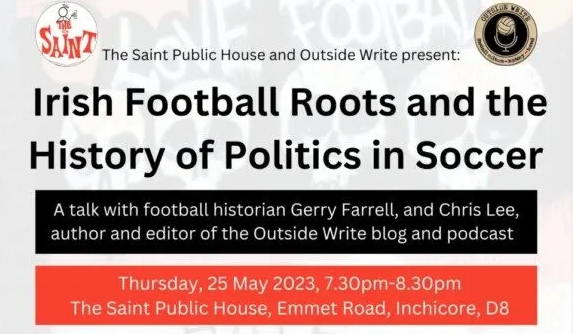
Coming up on Thursday May 25th I’ll be chatting with author Chris Lee from the Outside Write in the welcoming surroundings of The Saint Bar in Inchicore where we’ll be discussing the history and politicisation of football in Ireland.
Tickets are free but please register as spaces are limited. Free tickets are available through Eventbrite.
You can also have a listen to my podcast interview (link below) with Chris from late last year when he was on discussing his new book; Defiant : A history of football against Fascism.
As excuses go for missing training it was at least original. Being absent because you were caught in storms aboard a fishing trawler off the coast of Iceland and at any moment feared that you’d be washed overboard to a watery grave. This was the excuse offered by Jack O’Donnell, full-back for Blackpool FC in 1932, when they were still a top-flight side. It wasn’t to be O’Donnell’s first brush with authority, nor his last. This is the story of how a talented footballer went from being a League champion with Everton to making intermittent appearances for Dolphin FC and Reds United in the League of Ireland either side of a stint in prison.
O’Donnell was born in Gateshead in March 1897, the son of John and Grace O’Donnell. John was a labourer from Newcastle, though the O’Donnell surname does suggest an Irish lineage some way back in the family. By the age of 14 young Jack was already working as a driver in a coal mine. Like many young miners-cum-footballers in the north east of England he began playing with his local colliery team, Felling and then later with Gateshead St. Wilfrids, before being signed by Darlington in 1923. At the time Darlington were in the Third Division North, and were on the lookout for a stiker, however a series of injuries meant that O’Donnell was pressed into service on his debut as a left back, the position that he was to make his own over the coming two seasons.
In early 1925 Darlington were drawn against Cardiff City in the first round of the FA Cup. While Cardiff would ultimately prevail, and make it all the way to the final that year, Darlington did manage to take them to two replays with back-to-back 0-0 scorelines. O’Donnell was especially impressive in these games and drew the attention of Everton who signed him just weeks later in February 1925 for a fee of £2,700, huge money at the time for a defender, especially one playing in the Third Division and was at the time far and away the record fee ever received by Darlington.
One issue of note however, is that at the time of signing for the Toffees, O’Donnell was a month shy of his 28th birthday but the newspapers at the time of the transfer list him variously as 20 or 21 years of age. A journalistic mistake or a case of O’Donnell shaving a few years off his actual age? He certainly wouldn’t be the first or last footballer to attempt it if this was the case.
O’Donnell quickly made the Everton first team, although his versatility was occasionally to his detriment, twice in his early days he ended up going in goal to replace an injured goalkeeper as substitutions were not yet allowed. He also ended up featuring as an inside-left for the Toffees and while ‘Dixie’ Dean was clearly the first choice centre forward O’Donnell did contribute five goals in the 1925-26 season when pressed into the forward line. While he made 27 and 24 League appearances respectively in his first two, full seasons with Everton there is a sense that his adaptability stopped him from cementing his place in the team. That was to change for the 1927-28 season though, O’Donnell, along with Scottish winger Alec Troup, were the only two players to feature in all 44 games for Everton that season (42 League, 2 FA Cup) as Everton, propelled by the brilliance of ‘Dixie’ Dean who scored 60 League goals, won the League Championship.
O’Donnell at Everton
O’Donnell the ever-present, won plenty of praise that season, he was a physically tough player but with surprising technical skill, his bravery and fearlessnesss in the tackle also marked him out and there are numerous reports of last ditch tackles saving the day at Goodison Park and elsewhere.
It was also during that league winning season that Jack married Margaret Butcher, with the first of their two children, John, being born the following year. It seemed that everything was going well for Jack. For the following two seasons he was a first team regular for Everton and while they won the Charity Shield the following year there was a drop to 18th in a 22 team league. Worse was to follow the next season (1929-30) as Everton finished bottom and were relegated. In August of 1930, as Everton were facing into the prospect of a season in the Second Division there was a note at a club board meeting mentioning O’Donnell as “suffering from a disease of owing to his own misconduct” and being suspended for 14 days. He would never play for the Toffees again.
Rather than spend a full season in Division Two, especially having fallen from favour with the board, O’Donnell joined Blackpool in Division One for a fee of around £1,500 just after Christmas 1930, as the seaside club aimed to stave off a relegation battle of their own. Blackpool did manage to narrowly survive that season with O’Donnell installed at full-back and he even was named as team captain. O’Donnell and was a regular starter for the rest of the season as Blackpool finished 20th out of 22 teams, with only two sides relegated Blackpool survived by a single point as Leeds and Manchester United dropped into the second tier.
A cartoon of O’Donnell after his move to Blackpool
The following season was to be a similar experience for Blackpool, once again finishing 20th and avoiding the drop by a single point. Again, O’Donnell was a regular, playing 31 out of 42 League games, however there was significant drama for Jack off the pitch.
In November of 1931 O’Donnell was suspended by Blackpool for fourteen days for an unnamed “breach of discipline”, he had also been stripped of the club captaincy just weeks beforehand. When interviewed later in 1933 for the Topical Times O’Donnell gave a robust, if rambling, defence of himself. In an interview which featured allegations of club directors taking backhanders, O’Donnell alleges that his initial suspension at Blackpool resulted from false rumours being spread about him by “somebody with a nose for trouble-making and a character which didn’t have truth in his make up” who made the claim that O’Donnell was going out and getting drunk every night. O’Donnell denied this but said that these allegations had reached the ears of the Blackpool directors who called him for a meeting. O’Donnell recounts that he was “furious that they even listened to such tales” and that as a result he “said things he didn’t mean”. The outcome was another suspension by the club.
It is however, the way in which O’Donnell chose to spend his suspension that gained him most notoriety. Due to return to training in early December O’Donnell was a no-show at the day he was due back. His landlady, and his friends in the local club where he socialised didn’t know where he was but his landlady did mention that O’Donnell had previously expressed a desire to become a fisherman. A man answering to O’Donnell’s description and wearing a pair of plus fours was seen boarding the trawler Cremlyn in the port of Fleetwood in the company of the trawler’s cook.
Jack O’Donnell had indeed gone to sea! Speaking to the media later in December, after he’d returned to dry land he gave the somewhat implausible story that he had simply been talking to the ship’s cook who was a friend of his, had boarded the Cremlyn with no intention of sailing, but without realising the boat had pulled away from shore. O’Donnell was also quick to deny the allegations that he had claimed he was done with football and was planning on pursuing life as a fisherman.
This rather thin excuse is contradicted by O’Donnell himself in the 1933 Topical Times interview when he says that being suspended and having little to do, that he was invited to go sailing on the basis that it was to be a short trip and that he would be back in Blackpool in plenty of time ahead of the lifting of his suspension. However, these plans were waylaid by Poseidon when, off the coast of Iceland the Cremlyn “ran into one of the biggest storms ever seen in the North Atlantic” according to O’Donnell. He claimed that the lifeboat was washed away in the storm and he feared that “every minute would be out last.”
Jack O’Donnell is front page news over his fishing trawler exploits in 1931
O’Donnell did of course make it back to dry land, but unimpressed with his explanation the board of Blackpool, still fighting off relegation, gave him a further fourteen day suspension. On this occasion O’Donnell had the good sense to remain off the high seas. Jack’s aquatic adventures had further reprecussions for him off the football field, as the New Year turned to January 1932 he found himself served with a court order by his, now estranged, wife Margaret. While Jack was living in Blackpool, Margaret was still living in Gateshead with their son John. There had been a legal agreement in place since July of 1931 that Jack would pay £2 a week in maintenance to his wife, but that around the same time as the trawler incident these payments had ceased.
It was at this point that Margaret declared that she was “absolutely destitute” and had to “apply for relief”, meaning that she had to seek the limited form of social welfare available under the “poor laws” that existed at the time. Representatives of Blackpool FC pleaded with Margaret to cease proceedings in the case, promising a £4 postal order and £2 a week as long as he was employed at Blackpool and further stating that “Jack is making a big effort to make a man of himself and we are doing all possible to assist him.”
The case was adjourned for a week and when it was eventually heard in Gateshead a court order of £2 a week maintenance for his wife and son was made against Jack. Margaret mentioned a particular personal cruelty from Jack, despite being in Newcastle for three days for a cup game against Newcastle United (which was taken to a replay which Blackpool lost) in the week before the hearing, Jack made no effort to get in touch with his wife or three year old son.
O’Donnell finished out the season for Blackpool as they clung on to secure their top-flight status, but there was further drama during the summer as once again Jack went missing, this time in July during pre-season training. Blackpool quickly sought to have O’Donnell suspended by the FA, who duly obliged. With the new season on the horizon Jack O’Donnell found himself in an unevniable position, suspended from playing football but with Blackpool still holding his registration and hoping for some return in terms of a transfer fee for their errant star. The club denied that a transfer was forthcoming but there was still a protracted saga as Hartlepools United, then in the Third Division North, sought to sign O’Donnell. Hartlepools were managed by Jackie Carr, a former England centre half who had briefly played with O’Donnell at Blackpool towards the end of his own career. He clearly believed that his former teammate and powerful full back still had something to offer despite his many off the field issues and disappearing acts.
A prolonged transfer saga was finally brought to an end when Hartlepools paid a fee in the region of £500 for O’Donnell’s services. Blackpool placed certain conditions on the transfer and successfully requested the FA to lift the player’s suspension so that he could move to the County Durham club.
Jack was once again a regular, playing out the season with Hartlepools, and once again he was made club captain making 28 league appearances, scoring twice as they finished lower mid-table in Division Three. It was to be his only year with them as with the season coming to a close he was transfer listed in May 1933 and by August of that year Jack had joined Wigan in the Cheshire League where he was once again made club captain on his arrival.
This return to football wasn’t quite guaranteed as during the summer of 1933 Jack once again took to the seas, taking a job as a steward on an ocean liner sailing between Liverpool and Montreal. In the Topical Times interview he recalls playing football for a team made up of the ship’s crew, playing against barefoot teams in the Canary Islands and against American and Canadian sides, recounting the physicality of the game as played in America (which is saying something considering the physical nature of O’Donnell’s own game but also tallies with other descriptions of the extremely physcial nature of the game in the United States) as well as describing a sporting encounter with Everton legend of the teens and twenties, Sam Chedgzoy who had relocated to Canada.
Despite being installed as captain and some encouraging early performances at Wigan, Jack was once again in trouble with the club heirarchy after only a couple of months. By October 1933 he had pulled yet another of his “disappearing acts” and there was speculation on behalf of Wigan Athletic that his well-known wanderlust and love of deep-sea fishing had gotten the better of him and that he had once more gone to sea, which to some extent he had, bacause Jack was with the Dolphins. He had crossed the Irish sea to sign with League of Ireland side Dolphin, located in the south Dublin suburb of Dolphin’s Barn.
O’Donnell during his time at Dolphin FC
Dolphin FC had finished the previous season as FAI Cup runners-up and were under the tutelage of player-manager Jerry Kelly. The Scottish defender/midfielder had enjoyed a successful career in England winning a league title for Everton alongside Jack O’Donnell and it is likely that his former teammate was responsible for Jack’s trip to Dublin. While Jack had been suspended by Wigan, the fact that they were a non-league club and the somewhat fluid nature of transfers between British and Irish teams at the time meant that transfer rules were less hard and fast, however it still took a couple of weeks for clearance and paperwork to be finalised by Wigan to allow Jack make his League of Ireland debut for Dolphin.
O’Donnell impressed in his first game for Dolphin, a 3-0 win over Cork Bohemians on 26th November 1933, he was praised for his “powerful kicking and positional play” and got on the scoresheet with a penalty after a Cork handball. It is obvious that O’Donnell had impressed not only at the back but with his attacking play and a move to centre-forward, where he had previously played on occasion for Darlington and Everton, was planned for the next game against Shelbourne. This would allow a return to the defence of Dolphin’s international pairing of Larry Doyle and George Lennox. Of course, this wasn’t to be, Jack O’Donnell had pulled yet another one of his “disappearing acts” going missing for both the Shelbourne game and the subsequent match against Bohemians.
By the time O’Donnell returned in mid-December after dealing with unnamed “business” Dolphin had signed a new striker in the form of Jimmy Rorrison who had joined them from Distillery. Rorrison, something of a journeyman striker in the Scottish and English Leagues had impressed at Cork the previous season and took over the centre forward berth with O’Donnell continuing in his favoured role at left-back.
Dolphin cruised to an easy 4-1 victory in their next match with Bray Unknowns with O’Donnell scoring another penalty and his overall display being described as “polished and clever”. O’Donnell featured in a run of games for Dolphin over the Christmas period and into the New Year of 1934, scoring a third penalty in a 2-1 defeat to Shamrock Rovers in January. There was a return to form the following week in the opening round of the FAI Cup, as Dolphin were drawn in something of a local derby with fellow southsiders Jacobs. O’Donnell was installed as centre-forward in place of Rorrison who was released after only a month at the club. O’Donnell scored twice from open play as Dolphin swept to a facile 5-0 over the Biscuitmen which was followed by a victory over Queen’s Park (from the Pearse Street area of the city) after a replay in the second round. All of a sudden Dolphin were into the Cup semi-finals.
However, the cup run seems to have distracted from their league form and Dolphin slumped to a 2-0 defeat to bottom side Cork Bohemians with O’Donnell being utilised as an inside-left to little effect. This slump in form continued for Dolphin as they were beaten in a dull game 1-0 by St. James’s Gate in the Cup semi-final, Billy Kennedy scoring the decisive goal as Jack O’Donnell was returned to his more usual position of left-back. O’Donnell continued as a regular for the remainder of the season, and although Dolphin’s form was patchy he did win praise for his displays, mostly in the full back position although he did score his fourth, and final, league goal for Dolphin in March 1934 as a centre-forward in a resounding 3-0 win over Dundalk in the final game of the season.
Dolphin finished fifth that season and had made the semi-finals of the FAI Cup, however they had probably hoped for a little bit more having recruited heavily from outside the league, including the signing of O’Donnell. Dolphin had led the way in the League in the recruitment of cross-channel players and were known as one of the clubs in the League of Ireland who were prepared to pay higher wages to bring talent across the Irish Sea to Dublin. This also influenced their choice of coaches such as Arthur Dixon who would join the coaching team at Rangers and bring the young Dolphin star Alex Stevenson with him, and Dixon’s eventual replacement, Jerry Kelly who brought his former teammate O’Donnell to Dublin.
Reports stated that Jack had returned to Blackpool for the summer months, he was gone from Dolphin for their League of Ireland Shield campaign and missed the friendly match against Notts County arranged as part of Willie Fallon’s move from Dolphin to the Magpies. However, it wasn’t to be a relaxing summer on the beaches of Lancashire for Jack, in May 1934 he faced another summons from his wife Margaret for once again abandoning her and his family as Margaret had once more been forced to go to the “Public Assistance Committee” to makes ends meet. Jack was now a father of two, as a daughter, Kathleen had been born earlier that year. In her statement Margaret recounted that he had briefly returned to her after being suspended by Wigan and that later that year his “disappearing act” from Dolphin in November had seen him briefly return to his family in Gateshead. After finishing with Dolphin in March he seems to have ended up in Blackpool where he claimed he was looking for work on the town’s pleasure beaches. At the court hearing in Gateshead he was sentenced to a month’s imprisonment.
Upon Jack’s release at the end of June the court ordered that he pay 25 shillings a week in maintenance to his wife and growing family. Faced with this challenge it is unclear what Jack did for the remainder of his summer however he reappears in media reports in September with the news that he has signed for non-league side Clitheroe. Although 37 years of age by this stage, (if his clubs were even aware of his real age), it was to football that he returned yet again to make a living. As always with Jack it wasn’t plain sailing, having only played once for Clitheroe there was an objection to his registration from Dolphin, he remained their player and they claimed that he had been suspended by them and as such couldn’t turn out for another team. This would suggest that Jack’s return to Britain at the end of the previous League campaign wasn’t something that had been agreed with Dolphin.
Frustated in these attempts it seems Jack returned home to Tyneside, lining out for Wardley Welfare FC in his home town of Gateshead, and perhaps spending a bit more time with his family. His younger brother Bill, who had mirrored Jack’s career somewhat, joining Darlington and later Everton, without ever enjoying Jack’s success, was back playing his football in Gateshead as well, turning out for Gateshead FC in the Third Division North. Back in Dublin, Dolphin enjoyed one of their best ever seasons, winning the League title, the Dublin City Cup and finishing runners-up in the Shield without the suspended Jack O’Donnell. Ray Rogers finished as their top scorer, the former Bohemians man solving the centre-forward problem that had plagued them during Jack’s season with the club.
There was one final footballing adventure for Jack and it involved a return to the League of Ireland. With Dolphin beginning the following season as defending champions they once again came calling for the services of Jack O’Donnell, however his time with them was to be very brief. After just one game, a 4-3 defeat to Sligo Rovers he was released only to be signed a week later by another Dublin side, Reds United who were enjoying their sole League of Ireland season. As luck would have it his first, and only game, for Reds he came up against his old side Dolphin with the game ending in defeat for the League newcomers. Once again Jack was released after a single game.
Be the end of the 1930s, his playing days behind him, Jack was back in the North East of England, living with his family and working as a labourer in a timber yard. He made a few more brief appearances in the sports pages – in 1948 when he visited the Everton team ahead of a game against Newcastle in St. James’s Park, while in 1952 he was listed as turning out in a charity match in South Shields alongside a number of other, well-known, retired players. It must have been one of the last games he played as he passed away later that year.
With special thanks to Rob Sawyer of the Everton FC Heritage Society for his assistance, especially the Topical Times article and photos of Jack O’Donnell while at Everton.
I interviewed sports historian Conor Curran recently about his new book, Soccer and Society in Dublin, which you can find in all good bookshops and online here.
I’d recommend it to anyone with even a passing interest in Irish football. You can listed to my chat with Conor on the podcast via the link below.
Hundreds, maybe even thousands of the record crowd had flooded onto the pitch, reports said that there were six, maybe seven thousand packed into Showgrounds. The English referee, brought from Sheffield to the west coast of Ireland to take charge of a first round FAI Cup tie, had trouble restoring order. It was unclear to some why J.E. Bennison had blown his whistle in the first place, a penalty had been awarded for a foul on a Sligo Rovers player but thousands of heads straining for a view from amid the multitude weren’t sure exactly what had happened. Sligo were trailing 2-1 in the dying moments of the match to Shamrock Rovers, and already struggling in the League, the chance of a Cup run was all that was left of Sligo’s season. A last minute penalty, a lifeline, the dreams of Cup glory might live for another day.
But first, the decisive kick had to be taken. Bennison had made it clear that the penalty kick was to be the last kick of the match, miss and Sligo were out, score and a replay was secured. It took twelve minutes to clear the crowds that had swarmed onto the pitch, dozens still encroached on the playing surface but enough space had been cleared to allow a clear sight of the goal and Shamrock Rovers netminder Charlie O’Callaghan. A ring of players from both sides was formed around the man approaching the penalty spot, around them another ring of the “suddenly hushed spectators”, Albert Straka placed the ball on the spot, calmly ran up and dispatched the it into the corner of the net, Sligo Rovers would live to fight another day.
Three days later, thanks to goals from Paddy Coad and Liam Touhy, Shamrock Rovers won the replay 2-1 and would go on to lift the cup that year, defeating Drumcondra in the final. Despite this ultimate outcome the “Straka penalty” has entered Sligo Rovers history, it is included in a panel at the club’s outdoor museum at the Showgrounds and is still recalled in media pieces almost seventy years after the fact. But who was Albert Straka? Signed by Sligo Rovers in February 1955 as a player-coach with the club languishing at the bottom of the League, his time in the north-west was brief and he was released by the time the season had concluded at the end of April, his penalty in the Cup game and the chaos that surrounds it were probably his most lasting legacy from his short time in Ireland.
Straka, according to the limited biographical information furnished after his signing, was from Vienna, Austria, spoke very little English, was thirty-two years of age, 5’9″ tall, of stocky build and had previously played as a forward with well established Austrian clubs like Simmeringer SC, Admira Vienna and Floridsdorfer AC. It was further stated that Straka had once been a teammate of Austrian captain Ernst Ocwirk, probably Austria’s most famous footballer at the time and known to Irish soccer supporters having played in Dalymount Park in an international against Ireland two years earlier. Ocwirk has been at Floridsdorf as a young player before moving to Austia Vienna in 1947. Straka however, had listed his most recent club as FK Pottendorf, a club based fourteen miles south of Vienna.
Now, while the small town of Pottendorf is indeed south of Vienna, their football club was not as the Irish Independent stated, sitting fourth in the Austrian League, any team with Pottendorf in their name were playing in the amateur leagues in Austria. In fact, the Austrian football writer Richard Turkowitsch confirmed that SVg Pottendorf were a third division club at the time (Landesliga Niederösterreich to be precise), so at the time of his transfer Straka had been playing in a regional league. It is also interesting to note that while Austria had allowed professional football as early as 1924 in several newspaper reports it is noted that Albert Straka was a barber rathen than footballer by profession.
It is in more recent publications that Albert Straka is listed as having been an Austrian international, no such claim seems to have been made at the time, but it was stated that along with being a former teammate of Ernst Ocwirk and having played with prominent Austrian clubs, that he had also been on European tours with his clubs to nations such as France, Norway and Sweden. The statement that a small town amateur team like Pottendorf were fourth in the Austrian league sounds like it could have been a significant exagerration on behalf of Albert. I’ve written previously about how Sligo had signed Siegfried Dobrowitsch, a supposed Hungarian international in 1949, who was most likely a lower league Hungarian player who had never been anywhere close to the Hungarian national team. Both the signing of Dobrowitsch and Straka were organised through Alec McCabe.
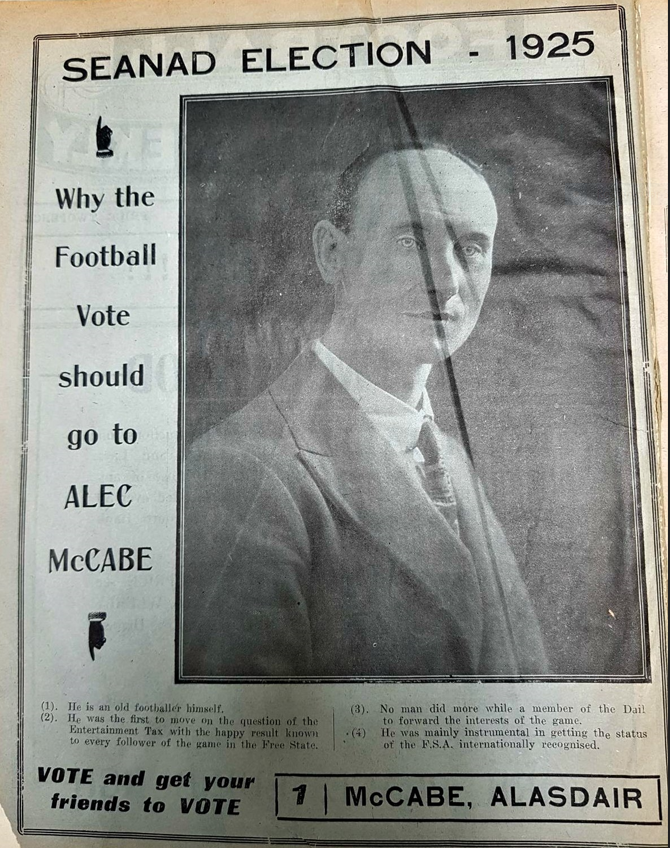
Alec McCabe election poster from ‘Football Sports Weekly’
McCabe is an interesting and controversial character in his own right. A Republican revolutionary, he was a member of the Irish Volunteers and later the IRB, he met with Seán McDermott, Patrick Pearse, Tom Clarke and James Connolly immediately prior to the Easter Rising of 1916 and tried unsuccessfully to ignite an uprising in County Sligo at the time to little effect. Interned in the Rath camp in Kildare during the War of Independence he was a TD in the fourth Dáil for Cumann na nGaedheal, resigning his seat after the failed Army Mutiny of 1924. McCabe, was a teacher by profession and a founder member of the Educational Building Society (EBS). As the 1930s progressed he became more involved with the Blueshirt movement and with the Irish Christian Front at the outreak of the Spanish Civil War. At a large public meeting in College Green in 1936 McCabe spoke to the crowd about the dangers posed by Communism and praised the efforts of Dictators in other European nations in fighting its spread, stating of the perceived Communist threat “thanks to Hitler, they [Communists] were crushed for all time in Germany, and, thanks to Mussolini, they had been checked in Italy. Thanks to Franco, they would never come to Ireland.“
McCabe was briefly interned in 1940–41 “because of his pro-German sympathies” however on release he returned to teaching and his work with the EBS, eventually becoming its full-time managing director, a position he held until 1970. His interests also clearly extended to sport, in his youth he was an accomplised Gaelic, soccer and rugby player and after hanging up his boots he remained very active in various roles with both Sligo Rovers and the FAI. In relation to Straka he was referred in the Sligo Champion as the key organiser of the signing and was described as Sligo’s “representative in Dublin” as due to his role with the EBS he was by then, permanently living in Ranelagh.
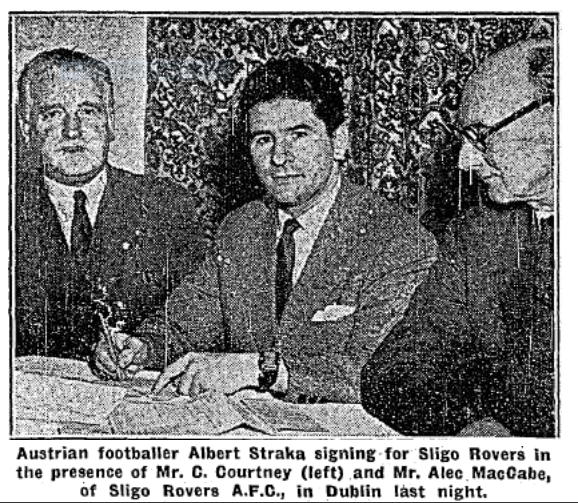
McCabe seems to have had several connections in Continental Europe, perhaps through various roles at the FAI. There are newspaper reports of him providing Irish journalists with hard to find European sports publications as well as the fact that he somehow found a network that allowed him to sign Straka and back in 1949 Siegfried Dobrowitsch, a former WWII soldier in the Hungarian army for the Axis powers who later claimed to have fled Hungary after the rise of Communism and found his way to Ireland via a spell in France. Speaking later in 1955 at the end of season AGM the Sligo Rovers secretary Charlie Courtney said that Straka had been “highly recommended” to Alec McCabe by an unnamed party, and that McCabe “at no small expense and inconvenience to himself obtained Straka’s services” which confirms that there was at least some sort of informal football network who viewed McCabe as someone likely to take a risk on a European player.
Straka put pen to paper just before the first round draw of the FAI Cup, Sligo were at the time bottom of the League and as mentioned were hoping for a Cup run, boosted by a high profile signing to give some meaning to their season and increase gate receipts at the Showgrounds. It was a path Sligo had travelled before, signing Dobrowitsch in 1949 and most famously signing ‘Dixie’ Dean in 1939 where he enjoyed a brief and prolific spell propelling Sligo all the way to the final of the FAI Cup while drawing massive crowds everywhere he played during his Irish sojourn.
This practice of course wasn’t just limited to Sligo Rovers, Cork Athletic had pulled off something of a coup in 1953 by bringing in a 39 year old Raich Carter. Carter, one of the standout creative attacking talents of the 30s and 40s who still possessed enough of his footballing gifts to make a major impression on the League of Ireland and help Cork Athletic to Cup victory over city rivals Evergreen United. The same week that Albert Straka signed for Sligo Rovers another veteran English forward was signed by Shelbourne, Frank Broome had been a star for Aston Villa and Derby County during the 30s and 40s and Shels hoped the former England international still had enough in his locker as he appraoched his 40th birthday to deliver some silverware for them. However in six games he failed to find the net for Shelbourne, and unlike Albert Straka he failed from the spot when presented with his best chance in a Cup match against Shamrock Rovers.
Despite his limitations in the English language Albert Straka was to be more than just a player for Sligo, he was also going to fulfil a coaching role, alongside his joint-coach and fellow player Jimmy Batton, a Scottish defender then lining out for the club. Straka made his debut on the 6th February, 1955 in a League game against a Waterford side who were chasing the League title. The presence of the new signing in the starting XI had the desired effect, at the turnstiles at least. Over 3,000 fans, a record attendance for the season to that point paid £230 in gate reciepts to see the Austrian make his debut. The Donegal Democrat reported that over 250 cars from Donegal and Derry made the journey south for the game, while other papers had reports of long journeys by bicycle or even on foot after early starts from all over County Sligo.
Sligo Champion headline
Waterford even though they were missing their star striker Jimmy Gauld through injury, proved too strong for Straka and Sligo, winning a poor game 2-1. The reviews of Straka were not very complimentary, while it seems from the reports that Straka was a danger from set pieces and that he could create good chances with his accurate crossing it was felt that he overall had a limited impact. In fairness most reports listed the various mitigating factors, that he had endured three days of travel to get to Sligo, that he had only just met his teammates who did not speak the same language as him, and that the League of Ireland played a more “robust” style of football than he might otherwise have been used to.
Straka himself, through an interpreter, told Seamus Devlin of the Irish Press that he wasn’t fully match-fit as the Austrian league had finished and he hadn’t played in five weeks, while he also complained of the heavy pitch at the Showgrounds. In the first half he seems to have picked up a minor injury and spent much of the second half relegated to the right-wing as a virtual passenger in the game.
The following match was to be more successful as Sligo surprised many pundits by defeating Shelbourne 3-1 in Tolka Park with Straka linking up especially well with his partner in attack Johnny Armstrong. Straka scored his first for the club, a penalty kick which he “clipped into the corner of the net like he did it every week” in what was to become something of a trademark for the Austrian. There were several mentions of displays of prodigious technique and creativity by Straka who clearly impressed those in attendance. Shelbourne, on something of a bad run of form were without Martin Colfer for most of the game and were effectively down to ten men after losing their star player to injury after half an hour. They also conspired to miss a first half penalty and it really seemed to be a day for them to forget at Tolka and things could have been even worse. Sligo were awarded a second penalty and with the game effectively won rather than let Straka take a second spot kick the opportunity was given to Armstrong who preferred power to accuracy and missed with his kick. The win lifted Sligo off the bottom and gave them a bit of belief that they could avoid having to apply for re-election to the league.
The following week Sligo were back in the Showgrounds hosting St. Patrick’s Athletic who would ultimately go on to be crowned League of Ireland champions that season. Clearly with their confidence bouyed by their result against Shelbourne there was an impressive performance by Sligo, especially in defence, with goalkeeper Tommy Oates and Jimmy Batton earning high praise. The game was tightly contested and Straka had his name taken by referee Michael Byrne after his reacted to a rough tackle by Tommy Dunne. Straka would have some measure of revenge later in the game. Johnny Armstrong made one of his bursting runs and was only denied a goal when one of the Pats defenders cleared ball from the goal-line with his hand. From the resulting penalty Straka “simply stroked the ball into the corner of the net” in what the Sligo Champion described as “one of the best penalty kicks ever taken in the Showgrounds”.
Despite the penalty award the Sligo fans clearly felt aggreived at the refereeing performance of Michael Byrne who was pelted with snowballs on the cold February evening as the match ended and he quickly made his way to the pavillion after St. Pats had snatched a late victory with Sligo down to ten men due to injury. Not content with snowballs some of the other Sligo fans “besieged” the St. Pat’s team bus as they tried to make their exit in the direction of Dublin. There would be more visitors from Dublin soon, the Cup game against Shamrock Rovers was on the horizon, three trains full of fans from Dublin were expected to add to a huge expected local attendance in the Showgrounds.
In the meantime there was the small matter of a trip to face Cork Athletic in the Mardyke. Straka was on the touchline in purely a coaching role, an injury from the ill-tempered St. Pat’s game (perhaps from the attentions of Tommy Dunne) ruling him out as Sligo slumped to a 4-1 defeat. In terms of his coaching the Sligo players were complimentary of Straka’s ideas, all of which had to be communicated via interpreters. Tommy Oates praised his techical ability as a passer and dead ball specialist and most of the players seemed to hve been shocked by the intensity of the phyiscal and fitness training introduced by Straka. However, the heavy defeat to Cork brought home the reality of their limitations.
Which brings us back to the “Straka penalty” and the chaotic game against Shamrock Rovers on March 6th, just over a month after Albert Straka had been first signed. Little did anyone know it at the time but that last minute penalty was to be his last goal for the club. In the replay in Milltown days later the newspaper reports were unforgiving of Straka’s performance as Sligo lost 2-1 with William P. Murphy in the Irish Independent referring to him as the “insignificant Straka” and singling him out as the weakest of the Sligo players on the day and bemoaning the absence of Victor Meldrum from the starting eleven.
Murphy got his wish the following week when Straka was dropped (who did the dropping of the player-coach?) and was replaced by Victor Meldrum (I don’t believe it!) for the visit of Transport. Meldrum didn’t disappoint, scoring twice in an easy 3-0 victory in the Showgrounds. Albert Straka wouldn’t feature again for Sligo Rovers. The next mention of Straka appeared in the Sligo Champion at the end of April to say that he was released from his position of player-coach and was in France and expected to sign for an unnamed French side.
Straka then disappears from the records, certainly in Ireland. In subsequent years his penalty taking ability, especially the spot kick against Shamrock Rovers after a pitch invasion became something ingrained in both the folklore of Sligo Rovers and the League of Ireland more broadly. The judgements made about Straka’s short time the League of Ireland from those who saw him play and those who played alongside him tend to focus on the positives, both Tommy Oates and Victor Meldrum praised his technical ability, which is also attested to by several references in match reports, even those that were not overly complimentary did tend to praise Straka’s skill, trickery and dead-ball mastery. There was an appreciation that as a coach, if nothing else, he significantly raised the fitness levels of his team-mates with his training methods. Where there was criticism, and indeed there was a signifiant amount, especially after the Cup replay, it was at least tempered by the acknowledgment that the League of Ireland differed greatly in its style of football than that more commonly found in Continental Europe.
Speaking years later to the Sligo Weekender in 2017, Paddy Gilmartin, who filled numerous roles for Sligo Rovers said of Straka “he came with a pedigree, he was a very good player and scored a few goals. His style was probably ahead of the League for that time.” This seemed to concur with the view of the Sligo committee back in 1955, returning to the summer AGM of 1955 after Straka had left the club, the club secretary summed up the signing as follows,
“He did not meet…with expectations and while he imparted much information to the team and kept them fighting fit he was just beaten by the type of football played in these islands. The signing of Straka was their second experiment with continental players and as it was felt they did not fit in with the type of game played here no useful purpose was to be gained in recruiting players from these countries.”
Sligo Rovers secretary Charlie Courtney
What became of Albert Straka after he left Sligo is unclear, perhaps he did indeed sign for a French club and his technical skills were more appreciated in a different style of football to the League of Ireland. Having consulted with a couple of Austrian football historians they have confirmed that the much later claims in Irish media that Straka was an Austrian international have no basis in fact. Similarly, the name Straka is not readily associated with any of the Austrian clubs from the 1940s and 50s mentioned in the early reports after his signing by Sligo. My own best guess is that Albert Straka was a decent amateur league player who like other players before and after “exaggerated” on their CV to embellish their footballing credibility and gain a contract. This is as last partly clear from the initial claims that a non-league club like Pottendorf were in fourth place in the Austrian league.
If anyone in Austria, Ireland, France or further afield has any more information on the enigmatic Albert Straka I’d love to hear from you.
Bohemians began with a pre-season tournament in August of 1929. While the club had played matches in England and Scotland in the past this was to be our first foray onto the Continent and things could not have gone better with Bohemians winning every game on the tour and securing the Aciéries d’Angleur Tournoi trophy after victories over the likes of Standard Liege and R.F.C. Tilleur. The invitational tournament ran for many years and would feature the likes of PSV Eindhoven and Bohemians Prague. Bohemians became only the second Irish side, after Glentoran in 1914, to win a European trophy, though it is worth noting that it would not be Bohemians’ last such title.
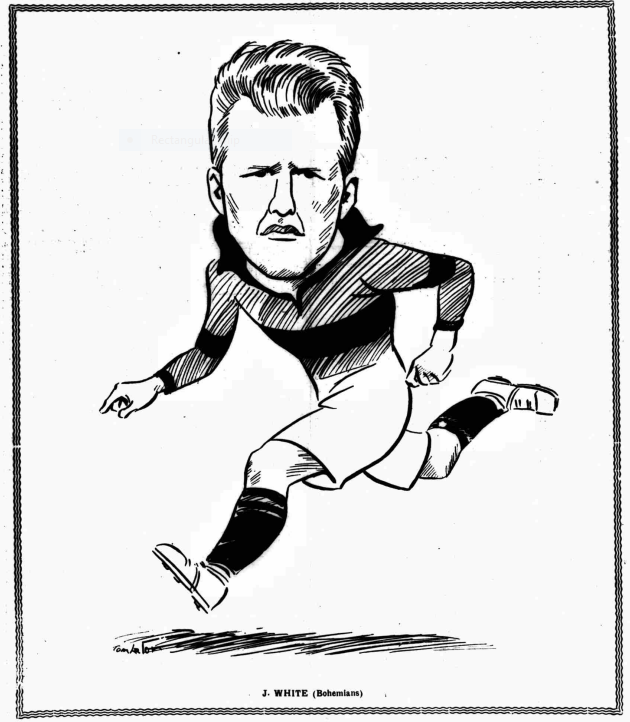
In the league it was a case of third time’s a charm as Bohemians won our third title in the 1929-30 season. It was a much-changed line-up from that of the all-conquering 1927-28 side, many of whom had moved to pastures new, although the likes of Jimmy White, Jimmy Bermingham, Johnny McMahon and goalkeeper Harry Cannon remained in the side. Cannon once again was a feature on the scorers list, hitting yet another penalty-kick that season. Added to these Bohs veterans were newer players like Stephen McCarthy who hit thirteen goals in the league that year, as well as a young Fred Horlacher (shown in cartoon form on the left) who continued to delivery on his exceptional promise. Further back in the midfield was the likes of Paddy O’Kane, yet another future Irish international.
Bohs only lost twice all season in the League, both away fixtures, while winning every single game at fortress Dalymount, they ultimately pipped defending champions Shelbourne to the title by a solitary point. Shels had a fine side that year, propelled by the goals of Johnny Ledwidge signed from LSL side Richmond Rovers, as well as former Bohemian inside forward Christy Robinson, they had to content themselves with victory in the League of Ireland Shield that year. There were no other changes to the make up of the League from the previous season and while Bohs finished top, Jacobs would finish bottom, winless all season, amassing only a meagre three points, despite featuring the talented Luke Kelly Snr. (father of the future Dubliners’ frontman) in midfield.
In the cup there was high drama as Shamrock Rovers won a controversial final 1-0 against Brideville thanks to a “Hand of God” moment from David “Babby” Byrne, the diminutive striker fisting the ball past Brideville’s Charlie O’Callaghan (in the Peter Shilton role) to secure Rovers second consecutive Cup triumph. Despite losing to Fordsons in the second round of the Cup, Bohemians did make history that year when forward Billy Cleary scored six goals in a 7-3 win over Bray Unknowns in a first round replay. Cleary’s record for most individual goals scored in a Cup tie remains intact to this day.
At international level Ireland’s sole match was a 3-1 win against Belgium in Brussels in May 1930, with Jimmy Dunne scoring twice. Among the starting eleven were Bohemians’ Fred Horlacher and Jack McCarthy who returned to Belgium after their successful, pre-season trip to Liege, also in the line-up was Billy Lacey who became Ireland’s oldest ever international, just four months short of his 41st birthday. Lacey would later become a successful coach at Bohemians in the 1930s.
Part of a series in the Bohemian FC match programmes.The 1928-29 season review can be found here.
Bohemians entered the new season as champions and were fancied to retain their crown after their clean-sweep the previous year. The league remained at 10 teams with Athlone Town, who had finished bottom and been on the end of a number of drubbings failing to be re-elected to the League and their place being taken by Drumcondra who had been Cup winners in 1927 and beaten finalists a year later.
It was one of the tightest title races ever with a ding-dong battle between Shelbourne and Bohs for the Championship, despite only losing once and drawing twice in the League campaign Shelbourne pipped Bohs to the title by a single point. David “Babby” Byrne and Jock McMillan supplying the goals while Shels had also added Bob Thomas, a star of the all-conquering Bohs the previous season to their midfield where he’d play alongside his brother Paddy.
For Bohemians Billy Dennis was once more top scorer but getting in among the goals was a young inside-left named Fred Horlacher who made his debut that season and would go on to become one of the greatest players in the club’s history. The son of a Mormon, German, pork-butcher Freddie Horlacher would play in numerous positions for Bohs as well as making several appearances for Ireland in a career that would see him become one of the club’s highest ever goalscorers.
Top scorer in the League overall however, was Eddie Carroll (left), a former Northern Ireland international who had spent the previous seasons playing in Scotland for Aberdeen and Dundee United, Carroll was in his first of three spells with Dundalk.
There was further disappointment in the Cup for Bohemians, despite knocking out St. James’s Gate, Jacobs and Drumcondra on the way to the final, we were ultimately defeated in a replay by Shamrock Rovers as they won their first of five consecutive Cup titles. The initial final had been played at Dalymount and ended in a 0-0 draw, however the replay was moved to Shelbourne Park and Rovers would triumph on the southside 3-0, with two goals from John Joe Flood and one from veteran forward Bob Fullam.
Bohemians would get a modicum of revenge when they defeated Shamrock Rovers 2-0 in a test match to settle the winner of the League of Ireland Shield later that season. Although Bohs were comfortable winners in that game with Jimmy White grabbing both goals it was Rovers teenage forward Paddy Moore who caught the eye of a Cardiff City scout who signed up the prodigious talent the following month.
At Inter-league level the LOI had mixed fortunes, beating the Welsh League 4-3 in Dublin, with Johnny McMahon and Peter Kavanagh of Bohs getting three of the goals, but then losing to the Irish League 2-1 later the same season. At international level Ireland only played one game, a resounding 4-0 victory over Belgium in April 1929 front of 30,000 fans in Dalymount. John Joe Flood scored a hat-trick with Babby Byrne getting the other goal. Jimmy Bermingham was the sole Bohemian in the starting XI for Ireland that day. Just four months later Bermingham and his Bohs teammates would be part of a visit to Belgium that would see them enjoy further success.
Jimmy White who scored the decisive goals to secure the Shield for Bohemians.
This Saturday (January 14th) Dalymount Park, specifically the Member’s Bar, will host a League of Ireland football history conference to mark the publiction by Routledge of it’s new academic collection The League of Ireland: An Historical and Contemporary Assessment which is edited by Conor Curran.
I have a paper included which looks at several case studies highlighting the complex patterns of migration of players into the League of Ireland over the last century. The conference is free to attend and you might even get a cup of tea and a sandwich.
Conference schedule
9.30-10 am: Conor Curran (Trinity College Dublin) – Introductory Comments
10-10.30 am: Julien Clenet (University College Dublin) – Association football in Dublin in the late Nineteenth Century: an Overview
10.30-11 am: Cormac Moore (Dublin City Council Resident Historian) – The Formation of the Football Association of Ireland
11.00-11.30 am: Aaron Ó Maonaigh (Independent Scholar) – ‘In the Ráth Camp, rugby or soccer would not have been tolerated by the prisoners’: Irish Civil War attitudes to sport, 1922–23.
11.30-12 pm: Conor Heffernan (Ulster University) and Joseph Taylor (University College Dublin) – A League is Born: The League of Ireland’s Inaugural Season, 1921–1922
12-12.30 pm: Conor Curran (Trinity College Dublin) – The cross-border movement of Republic of Ireland-born footballers to Northern Ireland clubs, 1922–2000
12.30-1.30 pm Lunch
1.30-2 pm: Gerry Farrell (Independent Scholar) – One-way traffic? – 100 years of soldiers, mercenaries, refugees and other footballing migrants in the League of Ireland, 1920 -2020
2-2.30 pm: Tom Hunt (Independent Scholar) – Ireland’s Footballers at the 1924 and 1948 Olympic Games: Compromised by the Politics of Sport
2.30-3 pm: Michael Kielty (Dublin Business School): Peter J. Peel: The Soccer King
3-3.30 pm: Ken McCue (De Montfort University) – Who’s SARI now: Social enterprise and the use of the medium of sport to further human rights in society
3.30-4 pm: Helena Byrne (Independent Scholar) – Breaking new ground: The formation of women’s football governing bodies in 1970s Ireland
4-4.15pm Closing Comments
Papers will be for the duration of twenty minutes, with ten minutes afterwards for questions.
You can attend for free by registering through eventbrite.
Ted Sagar was an Everton legend, a league and cup winning goalkeeper, an England international, and the holder of the record amount of league appearances for the club for some forty years until it was broken by the Toffees other legendary keeper, Neville Southall. It is quite the impressive CV. Sagar’s Everton career ultimately lasted for an amazing 24 years but as time comes for all of us, with Ted approaching his late 30s the Everton manager Cliff Britton was on the lookout for a replacement for his veteran custodian. His eventual long-term successor, a man who would make over 200 appearances in more than ten years at the club was discovered in the most unusual of places, the south Dublin suburbs playing for “Bulfin United under 17s, Division 2.”
This young man was Jimmy O’Neill, as well as over a decade of service with Everton he enjoyed a successful spell at Stoke City where he was hugely popular and would win 17 caps for the Republic of Ireland. At just 5’9″ and willowy thin he didn’t conform to the stereotypical physique of the goalkeeper. This is the story about how his journey from the schoolboy leagues of Dublin to the Everton first team in the course of just over a year was facilitated through an unusual source, a League of Ireland club official and Dublin shopkeeper who had also been a revolutionary from his teens, was imprisioned during the War of Independence and had remained an active member of the IRA during and well after, the Civil War. It is the story of Michael Douglas.
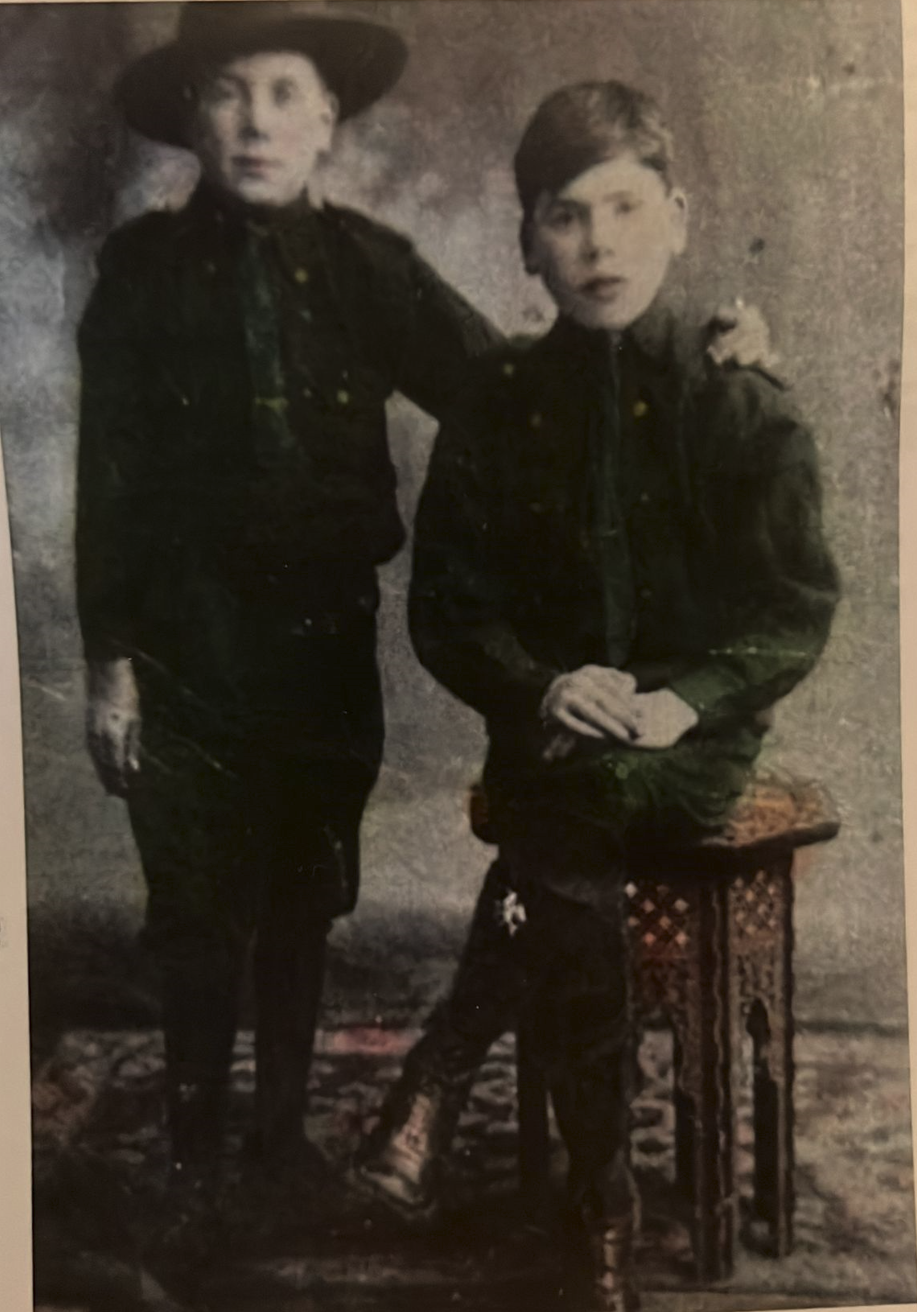
Michael Douglas was born in Dublin’s North Inner City in 1901, growing up on Stafford Street (now Wolfe Tone Street) and later on Granby Place, his parents, James and Lizzie were both born Dubliners, James beginning a family tradition of working for the City Council, his job being a paver. By 1917 young Michael was a member of Na Fianna Éireann, the Republican boy scout movement, where he was later joined by his younger brother Willie, both are pictured below. Also, by this stage the teenage Michael had followed his father into employment with the City Council.
By the end of 1917 Michael had become a fully fledged member of “G company” of the Dublin Brigade of the IRA, parading with them at the enormous public funeral of Thomas Ashe, a 1916 veteran who had died in Mountjoy prison after being force-fed while on hunger strike. Later during the War of Independence Michael continued to parade and provide guard duty at various functions while also being involved in well known raids including the one on Monk’s Bakery, North King Street which left three British soldiers dead but also resulted in the capture, and later execution of Kevin Barry. In another footballing connection with that incident, one of the other members of the Dublin Brigade involved was Christy Robinson who would later represent Bohemian FC and travel to the 1924 Olympics with Ireland.
By 20th November 1920 (a day before Bloody Sunday) Michael had been arrested as part of a wide crackdown by Crown Forces, he was found with Sinn Féin literature in the family home in Granby Place and was sent by steamer to Ballykinlar internment camp in Co. Down. Michael stated that the Crown Forces had not found any weapons in the raid but claimed that £29 (a considerable sum at the time) had been taken from his father’s house during the raid.
Ballykinlar was a former army base turned into an internment camp and which grew to bursting point by the end of 1920 as raids and arrests escalated in November and December of that year. There were upwards of 2,000 men interned from all across Ireland at its peak. Many were active in the Independence struggle, others were unlucky, not actively involved perhaps merely sympathetic to the Republican cause but arrested all the same as part of sweeps by Crown Forces.
While interned in Ballykinlar in July 1921, Michael’s sister Kate was injured in an altercation with Crown Forces around Dominick Street in the north inner city. On two occasions Crown Forces removed an Irish tricolour from the street where it had been strung between houses, on the first occasion a group of local women managed to wrestle the flag back and restring it across the street, however the Military patrol returned later that night to successfully remove the flag and Kate was injured by a revolver bullet as the local women harassed and jeered the soldiers from the street.
Michael requested leave to visit his injured sister, however as a truce was called shortly afterwards gradually the prisoners of Ballykinlar were released. It is around this time after his release that Michael seems to have taken a more keen interest in football and his own letters identifies the early 1920s as around the time he became involved with Shelbourne FC.
Michael’s interest in the national movement did not end after his release however, he remained actively involved, briefly being part of the group of anti-Treaty IRA who were occupying the Four Courts in 1922 just before the outbreak of the Civil War. Michael remained on the anti-Treaty side after the official outbreak of hostilities and was arrested by the Free State forces in November 1922, although he was released a month later. Michael remained inactive as the final months of the Civil War ground on although he did return to IRA activity in 1924 after the effective end of the Civil War and the issuing the of the “Dump arms order” in May 1923.
Perhaps the most significant incident in this period of his involvement was the bombing, in November 1928 of the equestrian statue of King William of Orange on College Green. It had been “first erected in 1701 to commemorate William’s victory over King James at the Battle of the Boyne in 1690″, the statue was always controversial, some felt that even Trinity College was being disrespected as Billy’s horse, White Sorrel, was positioned so its arse faced the University. Even by the end of the 18th Century the statue had been subjected to vandalism, and later in the 19th Century suffered from significant neglect and poor maintenance from an apathetic City Council.
King William’s statue on College Green (pic courtesy of Donal Fallon/Come Here to me)
On Armistice Day, 11th November 1928 in the early hours of the morning the statue was attacked yet again, it was blown up by the IRA. John Dorney explains the significance of the event as follows:
It was a part of a campaign by republicans, casting about for ways to remain relevant following their defeat in the 1922-23 Civil War, against Armistice Day in Dublin in which the Union flag was flown and ‘God Save the King’ sung by war veterans and unionists. On the same day, another bomb was placed at the statue of King George on Stephen’s Green. Rioting also took place between republicans and Poppy wearers in the city centre.
John Dorney, the Irish Story
Such was the damage to the statue that it was ultimately removed permanently by the City Council the following year. Among those responsible for the destruction of the statue was Michael Douglas, working under the supervision of former IRA Quartermaster and explosives expert Paddy Saunders. It is noted in the reports at the time that despite the blast taking place around 5am, with thankfully no injuries to anyone other than the leaden William, there were members of An Garda Síochána nearby who gave chase to those responsible for the bombing, they were chased up Trinity Street before a number of shots were fired at their pursuers. Interestingly in Michael’s military pension application the mention of Saunders (written as Sanders) is crossed out. Possibly because at the time of Michael’s application in the late 1930s Paddy Saunders had joined the ranks of An Garda Síochána himself!
By the 1930s Michael was married to Mary O’Neil and living in Little Ship Street with a growing family, right by the walls of Dublin Castle where he ran a small shop. He was also being referenced as a promintent member of Shelbourne Football Club, appearing in newspaper clippings representing the club at various functions, funerals etc. Moving forward a little later Michael is mentioned and photographed for the Shelbourne Golden Jubilee programme of 1945. Michael is mentioned as being a member of the Ways and Means committee of the club. The committee looked after matters such as the publication of the match programme, and the more social aspects of club life such as organising dances, events and fundraisers.
Douglas as part of the Shelbourne Ways and Means committee, 1945
It is perhaps in this context that Michael encountered Jimmy O’Neill, in a series of correspondence beginning in January 1949 he contacted Cliff Britton the Everton manager to recommend the young goalkeeper to him. Perhaps O’Neill was a relative through his wife and known to him that way? Or perhaps he had gotten to know young Jimmy through his work for Shelbourne? Either way he decided to approach the Everton manager, Britton who had been a star player for the Toffees in the era of ‘Dixie’ Dean and was also capped nine times by England. After enjoying some success with Burnley as a manager in the post war years Everton appointed him as manager in 1948. Everton also had a number of prominent Irish players at this time including Tommy Eglington and Peter Farrell and enjoyed quite a bit of support in Dublin at the time.
First contacting Britton on 25th January 1949, Douglas wrote, apparently with no prior connection with Britton, in order to
“recommend to you a boy who is playing goalkeeper for a schoolboys’ team and he is certainly playing great. I know of two League of Ireland Clubs who are interested in him but he is not inclined to sign for either of them. He has informed me that if he got the chance he would like a trip across.
He is 17 years, 3 months old: height – 5′ 9″: weight – 10st. 10lbs.I should like to mention that I am officially connected with a League of Ireland Club for the past 27 years and, for this reason, whether you are interested or not, I should like you and your Dublin representative (Scout) to treat this matter as strictly confidential.”
Letter from Michael Douglas to Cliff Britton
Reply to Michael Douglas from Cliff Britton
Britton replied within two days, asking for more detail on O’Neill and where he could have him watched. Douglas replied the following day, recommending that Everton have O’Neill watched in Bulfin United’s upcoming cup match against a strong Home Farm team before signing off wishing Everton success in their own Cup tie against Chelsea, a fourth round FA Cup match that Everton lost 2-0.
Everton duly had O’Neill scouted by no less a figure than former Goodison and Ireland great Alex Stevenson and in May 1949 Everton completed the signing of Jimmy O’Neill for the princely sum of £100 from Bulfin United. As for Michael he continued in conversation with Everton and recommended they scout Mortimer “Murty” Broderick, then plying his trade in the League of Ireland for Cork Athletic. He also had to chase Everton for a payment promised arising out the transfer of O’Neill. Eventually in October 1949, five months after signing Jimmy O’Neill, Everton paid Michael Douglas £5 for his part in recommending the club’s new goalkeeper.
Below you can see the fee of £100 paid for O’Neill (left) while on the right the £5 earmarked for Michael Douglas. Both taken from the excellent Everton Collection website
Everton never did sign Murty Broderick although they had played a friendly against Cork Athletic in 1949 and perhaps were not sufficiently impressed, Broderick would later join Sheffield United in 1950 and I can find no further contact or mention of Michael Douglas in club minute books after the signing of Jimmy O’Neill.
Writing an obituary for Jimmy O’Neill in 2007, The Independent’s Ivan Ponting described him as “the sort of goalkeeper that football fans love to watch. Whether plunging acrobatically to repel shots on his line or springing skywards to pluck crosses from the heads of rampaging centre-forwards, the slim, almost willowy Republic of Ireland international was a natural crowd-pleaser.”
He won 17 caps for Ireland playing in World Cup qualifiers and Ireland’s first ever games in European Championship qualification, a popular figure for both Everton and Stoke City but without the personal intervention of Michael Douglas he may never have reached those football pinacles. His almost 20 year professional football career owes a debt to the man who blew King Billy of his horse in College Green.
With a special thank you to the Fox and Carroll families for sharing Michael’s story and to Sam McGrath for assistance in the research of Michael Douglas’ and Paddy Saunders pension files.











 A Bohemian Sporting Life