Celtic connections

They came across the narrow channel from the Antrim coast in the north-east of Ireland to the island of Iona in a wicker currach leaving behind conflict and bringing their religion to the neighbouring land. It was the year 563AD and their leader was Columba, a man now venerated as a Saint whose patronages include the lands of Ireland and Scotland and with him he rather appropriately brought twelve followers.

He certainly wasn’t the first Irish man to make this crossing. The Dál Riata kingdom of north Antrim had been expanding into western Scotland since the early 5th Century, even before that in the 3rd Century the Picts who lived north of Hadrian’s Wall had sought help from their Irish neighbours in their campaigns against Roman imperial might. Back then the Romans had referred to the tribes of northern Britain as the Caledonians, they called their Irish allies the Scotti.

In time Iona, where Columba landed became a great centre of learning and religious devotion and a prestigious Abbey was founded there. From Iona, the Picts were gradually converted to Christianity as were the Anglo-Saxons of Northumbria. In the centuries to come the name of the Scotti would become the name of the Gaelic speaking land north of the River Forth; Scotland – the land of the Gaels. Iona remained a focal point for centuries, it was a burial place for Scottish Kings who traced their power and authority back to the sacred island.
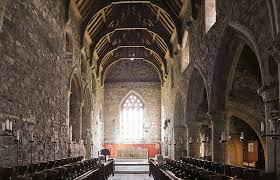
Iona monastery

The medieval Abbey church on Iona

But if the Irish gave Scotland its very name and the beginnings of the Christian faith then the Scots can lay some claim to giving Ireland football. In 1878, so the story goes, John McAlery, a Belfast businessman was on his honeymoon in Scotland and went to watch a game of Association Football. The views of Mrs. McAlery on this matter are not recorded. Greatly enamoured with the game the sporty Mr. McAlery arranged for an exhibition game to take place later that year in the Ulster Cricket Grounds in Belfast between Scottish sides Queens Park and Caledonians with Queen’s Park running out 3-2 winners.

A year later he formed Cliftonville Association Football Club in his home city and they advertised for new players as a club playing under the “Scottish Association Rules”. By the end of 1880 McAlery, along with  representatives from six other clubs had formed the Irish Football Association (IFA). Cliftonville F.C. exist to this day, while the IFA remains the 4th oldest Football Association in the world. While football had existed in Ireland before John McAlery it was he who set about putting in place a proper organisation and structure around the game. Had John taken his honeymoon somewhere other than Scotland then the history of football in Ireland may have been very different. Sadly the McAlery honeymoon story is definitely apochryphal but this hasn’t stopped it persisting. What is undeniable is that McAlery, and Scottish Clubs were at the forefront of the instigation of organised football in Ireland.

The game had grown quickly in the north east of Ireland and began in time to gain popularity in Dublin as well with the formation of clubs like Bohemian F.C. (1890) and Shelbourne F.C. (1895). A league was duly formed as well as cup competitions. But despite the good works of John McAlery and other early pioneers of the game Ireland’s early record in international competition makes for some harrowing reading. The international highlight in the early years was a 1-1 draw with Wales in 1883 sandwiched between a 7-0 loss to England and a 5-0 loss to Scotland. It would be 1914 before the Irish would win the annual Home Nations Championship outright, defeating Wales and England before facing Scotland knowing that if they avoided defeat they would triumph. Despite the match being held in Belfast Scotland remained the favourites, the Irish papers noting especially that the Scots were the more physically imposing side. However, in a torrential downpour a weakened Irish side managed to secure a draw and with it their first outright victory in the Home Nations Championship. They hadn’t beaten the Scots but they had won the day.

It was to be the last victory as a united Ireland though, not long after the end of the First World War the Football Association of Ireland (FAI) was formed as a breakaway association from the IFA. The FAI eventually secured recognition from FIFA and, grudgingly, from the Home Nations as the Association representing the 26 counties that would become the Republic of Ireland. What they could not secure however was favour from the Home Nations who refused all fixture invitations from the nascent organisation. Eventually over two decades later England agreed to a friendly in 1946, Wales waited until 1960 before playing the Republic. Scotland refused all invitations and only played the Republic when drawn against them in a qualifier in 1961. Despite their breakaway from the IFA the FAI remained in awe of the Home Nations and valued games against them more than any other, they fervently craved not only the money that these games would bring but also some sense of acceptance from their neighbours. Naturally this made the cold shoulder that they received all the more painful.

This desperation for acceptance can be encapsulated in a single game. In 1939 Ireland were due to play the Hungarians, who had been runners up to Italy in the 1938 World Cup and had played against Ireland twice before in the recent past. On both occasions the matches took place in Dalymount Park in Dublin. However on this occasion the match took place in the smaller Mardyke grounds of University College Cork and home to League of Ireland side Cork F.C.

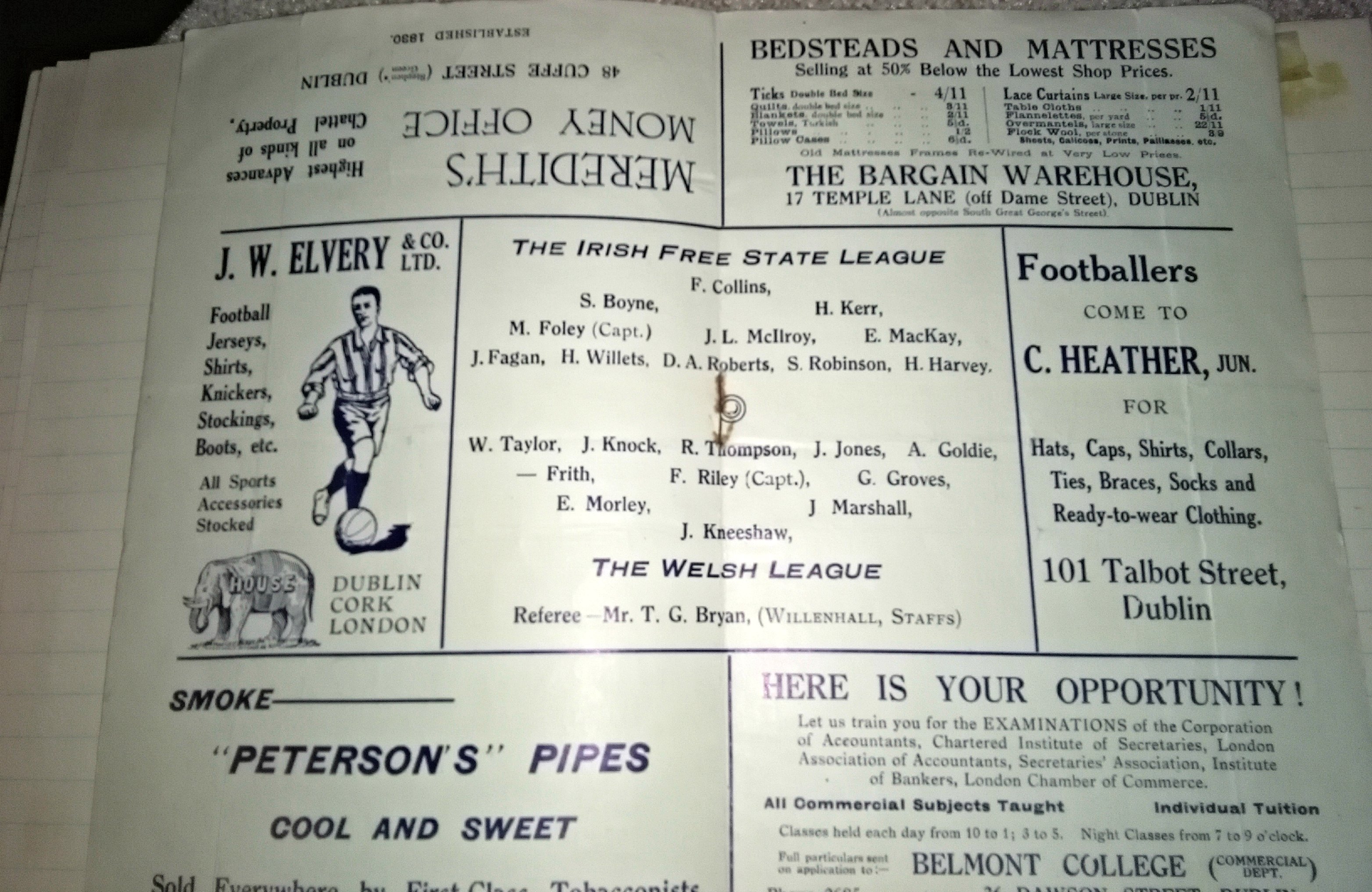
So why were the World Cup runners up being asked to play in a University sports ground rather than at the larger capacity Dalymount? Well because there was a bigger game taking place in Dalymount just two days earlier on St. Patrick’s Day 1939, when the League of Ireland representative side were taking on their Scottish league counterparts.

Even a game against a Scottish League XI was viewed as a huge mark of acceptance from their Scottish peers. While the game in the Mardyke would attract 18,000 spectators, a respectable return, over 35,000 would pack into Dalymount Park to see the stars of the Scottish League. At the time commentators were moved to describe the match against the Scottish League as “the most attractive and far reaching fixture that had been secured and staged by the South since they set out to fend for themselves” before adding that “for 20 years various and futile efforts have been made to gain recognition and equal status with the big countries at home. Equality is admitted by the visit of the Scottish League”. For the FAI a game against any Scottish team was a game against giants.

Giants, funnily enough, feature prominently in Celtic mythology. Fionn MacCumhaill is arguably Ireland’s most famous character from myth, famed for his size and for his prodigious strength. He is credited with having created the Isle of Mann by scooping out the land of Loch Neagh and hurling it into the Irish Sea. However even a man of this power was no match for the Scottish giant Benandonner. In myth Fionn learns that Benandonner is coming for him in combat from Scotland and Fionn does the only sensible thing, he runs to his wife for help. Benandonner is so huge that Fionn fears that even he won’t stand a chance in a fight so he does what any man would do, he has his wife dress him up as a giant baby and put him sleeping in a cradle in front of his fire. When Benandonner arrives demanding to know where Fionn is, Fionn’s wife Oona tells him that he is out but will be back shortly. She introduces the “baby” as her and Fionn’s infant son. Seeing the size of the baby and not wanting to meet the enormous child’s father Benandonner flees back to Scotland, on his way he destroys the bridge that links Scotland and Ireland behind him. Folklore tells that Antrim’s Giant’s Causway was a left as the remnants of this destroyed bridge.

For the FAI the Scots remained giants. Like Benandonner they could not be beaten by force but only by cunning. In 1963 a 1-0  victory by Ireland over Scotland in a friendly was greeted with elation by the Irish football public as one of its greatest ever  despite the narrow nature of the win.

While the awe in which the Scottish national team were held has faded significantly over the intervening decades the affection and devotion to one of her clubs remains as strong as ever. Writing as a Dubliner it sometimes seems impossible to avoid the prevalence of Celtic jerseys in my home city. In many ways this is understandable, while the island of Ireland might be grateful to John McAlery for bringing Scottish footballers to Ireland, the Irish in turn had a significant impact in creating the footballing landscape of Scotland. Beginning with the foundation of Hibernian F.C. in 1875 and continuing with the foundation of clubs like Dundee Harp, Dundee United and Celtic the Irish immigrant community and their descendants helped to create some of the most significant football clubs in Scotland.

This came about largely because of a period of mass migration of Irish people to Scotland from the 1820’s onward. Scotland’s industrial towns provided jobs, while Irish counties like Down, Antrim, Sligo and Donegal provided willing seasonable labour for Scottish factories, shipyards and farmers and this mass influx across the Irish Sea gathered apace after the Potato Famine began to grip Ireland in 1845. The parentage rule as introduced by FIFA has meant that the Irish national team have continually benefited from this immigrant connection even at the recent Euros two members of the Irish squad were Scottish born players; Aiden McGeady and James McCarthy.

Domestically clubs like Hibs and Celtic would emerge from these immigrant communities, often forming a charitable focal point at the centre of new Irish communities. While Hibs still prominently wear green and white and their current logo includes an Irish harp as a nod to their foundation (though it was removed from the crest for a period after the 1950s) they seem to be less defined by an Irish identity. Celtic however are for many the Irish club. This does have the tendency to cause some confusion for those fans of clubs actually based in Ireland.

Celtic’s Irish credentials are indeed impeccable. Founded in 1888 by Andrew Kerins an Irish Marist brother from Co. Sligo, (better known as Brother Walfrid), the club was created to support the poverty stricken Irish community in Glasgow. When Celtic Park was being opened in 1892 it was the Irish Nationalist and Land reform agitator Michael Davitt who laid the first sod,  the turf brought over from the “auld sod”, Co. Donegal. Davitt would be made an honorary patron of Celtic,  a position he also enjoyed in the Gaelic Athletic Association (GAA) who in 1905 would issue a ban on any member either participating in or even watching ‘foreign’ games.

“Foreign Games” meant anything that could be construed to be English, or indeed Scottish and as such obviously included Association Football which may have put the ageing Davitt in an awkward situation. The club have also had many prominent Irish players and managers associated with them throughout their long history; men such as Neil Lennon, Seán Fallon, Martin O’Neill and Packie Bonner, while even the likes of Roy and Robbie Keane have had brief Celtic cameos during their careers. In terms of ownership Irish businessman Dermot Desmond is the club’s largest individual shareholder. The early successes of Celtic helped prove that imitation was the sincerest form of flattery as in 1891 a group of Belfast sports enthusiasts from the Falls Road area formed Belfast Celtic F.C. Their early Chairman James Keenan noting that they chose their name “after our Glasgow friends, and that our aim should be to imitate them in their style of play, win the Irish Cup, and follow their example, especially in the cause of Charity.”

While all of this provides a strong basis for the popularity of the club in Ireland the other major aspect is of course that Celtic have been successful, from being the first British winners of the European Cup in 1967 to their 47 Scottish League titles theirs is a level of dominance, at least at domestic level, that is rarely seen. While as recently as the 2002-03 season Celtic reached the final of the UEFA Cup the fortunes of the club and the Scottish League in general have struggled recently when it has come to progress at European level. Despite this, support remains strong for the club in Ireland and their presence ubiquitous. Celtic flags and banners fly from Dublin city pubs while a musical treatment of Celtic’s history plays at present in one of the city’s most prominent theatres. In the commemorations to mark the centenary of the 1916 Rising the imagery of Celtic has been invoked as somewhat apocryphally one can purchase a “replica” Celtic jersey emblazoned with the name “Connolly” where once a Magners cider logo appeared. A reference to the Scottish born labour activist James Connolly who was among the leaders of the Rising; son of Irish immigrants he was born in the Cowgate area of Edinburgh and was a passionate Hibernian fan.
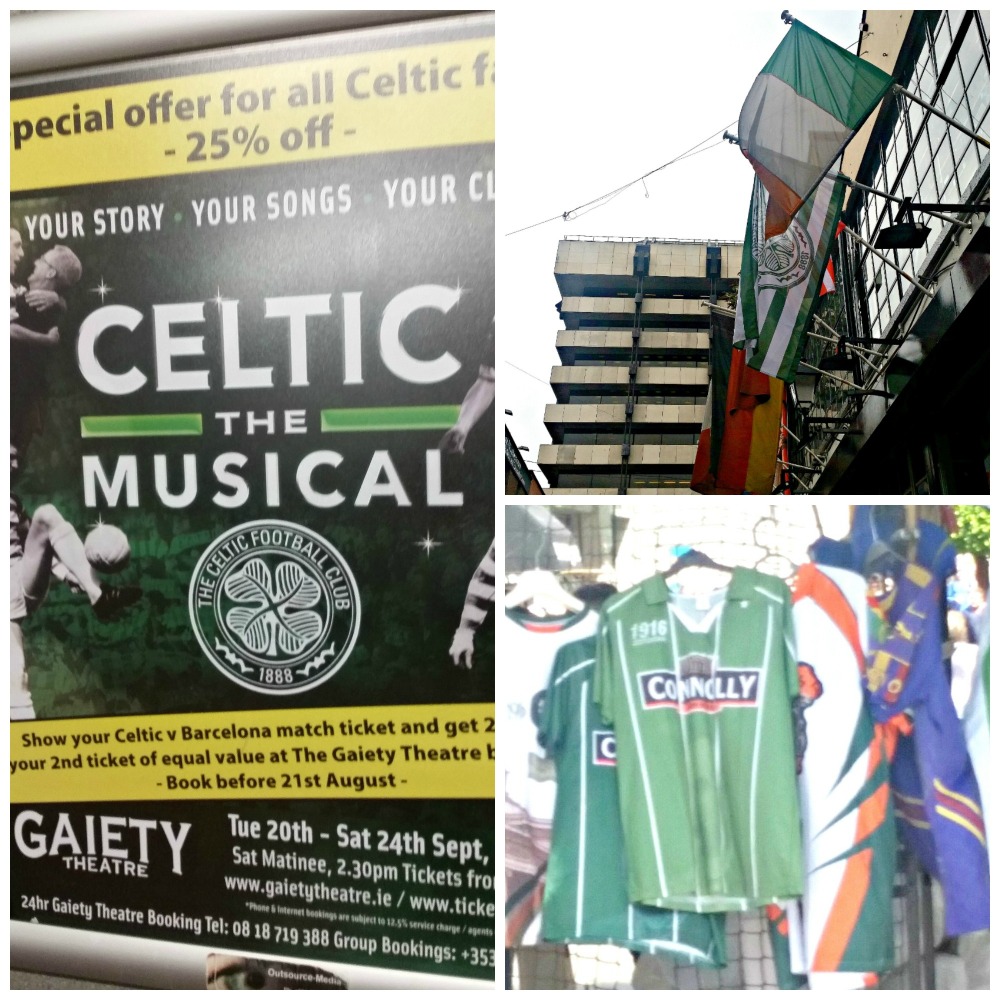
Celtic collage

“Celtic the Musical” in Dublin’s Gaiety Theatre, an Irish tricolour next to a Celtic Flag at a restaurant in Temple Bar, a “replica” Celtic jersey featuring the name of executed 1916 leader James Connolly.

The stories of Fionn and Benandonner, the competing giants of Ireland and Scotland remain prominent stories in Irish folklore however they enjoyed a new lease of life in the 18th Century when Scottish poet James Macpherson compiled and re-framed the ancient myths into a book of poetry. The publication of his work was a literary sensation at the time but also caused debate and controversy as Irish historians felt their literature and history were being appropriated. The truth is that as we’ve seen with the historic patterns of movement and the shared culture between the two islands; from 6th Century monks to the Ulster plantations and the Famine migrations of the mid 19th Century, the two nations share far more similarities than some political groups and indeed football fans would care to admit. It was from Scotland that the original Irish football organisers took their inspiration but even by that stage the Irish in Scotland were already creating clubs that would help to dominate the Scottish football landscape. In a confused and confusing identity relationship it becomes hard to separate the interwoven strands of our social and sporting DNA. Where the Irish ends and the Scottish begins.

This article originally appeared in the Football Pink issue 14, they’re a great publication and well worth a subscription.
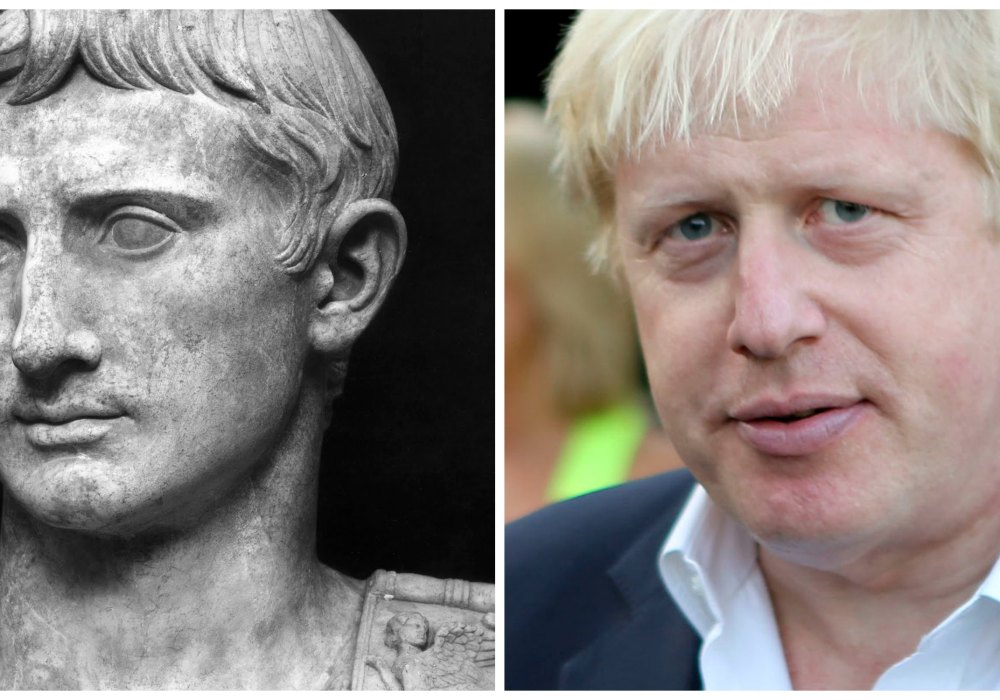
Boris – lessons from Ancient Rome

Memories of simpler times. Do you remember prior to his rise to prominence as London Mayor, later as an MP and one-time favourite for the Tory leadership Boris Johnson was best known for his frequent appearances on Have I Got News for you? In each programme, whether as host or guest Boris played the part of the bumbling, unintentionally amusing, Oxbridge-educated Toff to perfection.

These appearances were of course only part of Boris’s carefully cultivated media profile, there was also his editorship of the Spectator magazine, including the infamous publication of an article in 2004 which erroneously suggested that Liverpool supporters were partially to blame for the Hillsborough disaster . There was an appearance in Peter Andre: My Life, cameo in Eastenders as well as hosting the occasional documentary such as Boris Johnson and the Dream of Rome in 2006. That Boris should host a documentary about the Roman empire (and release a follow-up book) and use it to draw specific parallels with the modern EU should not be too surprising. After all he had studied  Classics, at Balliol College, Oxford where he was apparently deeply unhappy about receiving only a second class honours mark.

In his “Dream of Rome” documentary there are quiet a few moments when you can see the awe in which Boris holds various Emperors of Rome, this even strikes one of the experts, a Professor Carandini as Boris is seen to utter the following line:

Professor Carandini: “You would like to be an emperor, I can see it in your eyes.”

Boris Johnson: “I can see a worst fate.”

That Boris would be drawn to the personality cults that surrounded most Roman Emperors does not seem too surprising given recent events and his career to date, and given his knowledge of Roman history it caused me to ponder whether his turn away from Europe and his championing of the “Leave” side in the Brexit referendum was ever so slightly influenced by a reported episode in the life of Julius Caesar. When Caesar was sent to govern what it now south-Eastern Spain the writer Plutarch tells us that

he came to a little town in passing the Alps; and his friends, by way of mirth, took occasion to say, “Can there here be any disputes for offices, any contentions for precedency, or such envy and ambition as we see among the great?” To which Cæsar answered, with great seriousness, “I assure you I had rather be the first man here than the second man in Rome.”

So much of the discussion around Boris’s rationale for taking the “Leave” side when it would appear to fly in the face of all that he had stood for beforehand centres around his desire to be Prime minister and to replace his old school chum David Cameron. Whatever glory there lay for Boris in being Mayor of London, a media celebrity, and latterly an MP would seem to be insufficient, he would always be the second man in Rome.

It also strikes me that in the throws of uncomfortable victory after the referendum and his subsequent decision not to run for the vacant Prime ministerial post Boris may have recalled the life and reputation of the Roman Emperor Honorius. The same Emperor Honorius who succeeded Theodosius the Great but who by the end of his reign had witnessed the sacking of Rome by Alaric, King of the Visigoths and the continued decline of the western Roman Empire. Honorius retreated back to his palace in Ravenna, a city surrounded by impregnable marshland and offering relative security while the Roman city walls were breached for the first time in 800 years.

Honorius as Emperor is remembered primarily for being in the hotseat when Rome fell to the Goths, while many argue that the Roman Empire did not cease until the fall of Constantinople in 1453 the sacking of the city by Alaric remains a landmark date for the Roman Empire, and for some an end date. The only other item of note that tends to be remembered about Honorius is that he banned the wearing of trousers under punishment of exile.

Perhaps Boris Johnson thought about that when he withdrew from the running for the top job. Many man have dreamt of imitating Julius Caesar, few have wanted to be Flavius Honorius Augustus.

800px-Sack_of_Rome_by_the_Visigoths_on_24_August_410_by_JN_Sylvestre_1890

The Sack of Rome by the Barbarians in 410 by Joseph-Noel Sylvestre


Bohemians and brothers in arms – The Robinsons

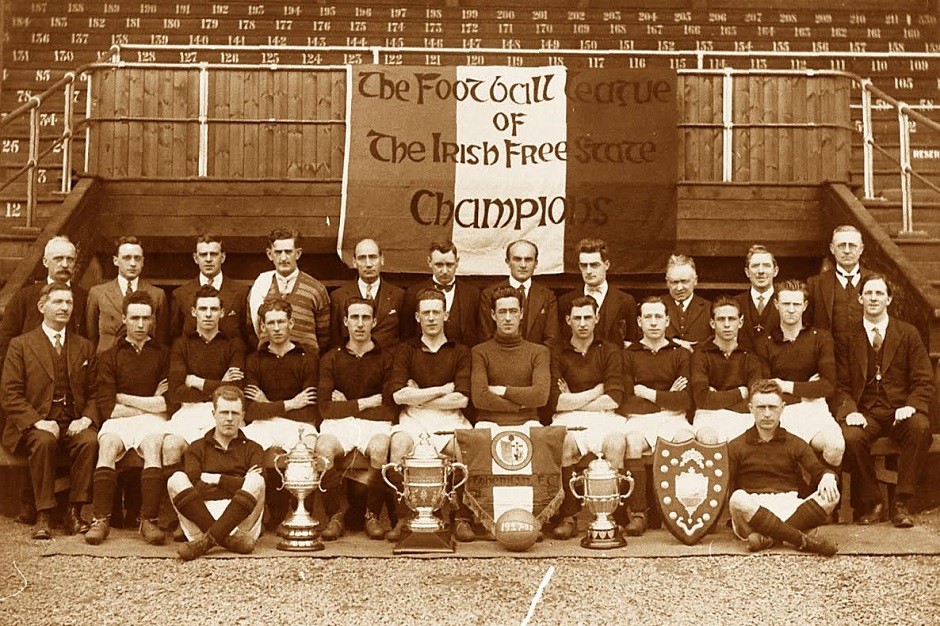
The great Bohemians team of the 1927-28 season is one that has rightly gone down in the annals as one of the finest sides in Irish football history; simply put they won everything there was to win, the League, the FAI cup, the Shield and the Leinster Senior Cup. An achievement all the more impressive when you remember that Bohs were strictly amateur at the time. Such was the confidence and camaraderie in the team that season that Jeremiah “Sam” Robinson, the tall, well-built and versatile half-back or full back, said that the Bohs players of that season never doubted that they would win the game, the only question was by how much. Sam was joined in that successful team by his older brother Christy, smaller and lighter than Sam, he was a tricky, skillful inside-left whose 12 goals had been crucial when Bohs won the league in 1923-24. He also holds the honour of scoring Bohemians first ever goal in the FAI Cup when he netted the first in a 7-1 win over Athlone Town in 1922.

For these achievements alone the brothers are significant and worthy of discussion, however by the time the Robinson brothers had joined Bohemians, as still young men, they had already led an extraordinary life. Both brothers had been active in the IRA in Dublin and Sam had even become a member of the Active Service Unit and later joined Michael Collins’ infamous “Squad ”.

Both brothers played in the Cup Final of 1928 when Bohemians defeated Drumcondra 2-1, although it was touch and go for Sam. Incidentally the reason Sam was known as Sam, and not by his given name Jeremiah was because of the fondness as a boy for using “Zam-buk” soaps and ointments for his legs, something he may have needed in getting ready for the Cup final. During some dressing room hijinks celebrating yet another victory Sam had his leg badly scalded by a bucket of hot water. The damage was so bad that it looked like he would miss the game until the intervention of Bohemians own Dr. Willie Hooper who bound up Sam’s leg (like a turkey cock as he later remarked) and tended to him regularly as they prepared for the final. The squad were worried that the Sam might not make the game but he was declared fit enough to play. Bohs won the match in front of 25,000 at Dalymount, Billy Dennis and Jimmy White getting the goals.

Bohemians have a long tradition of brothers playing in the same team. The aforementioned Willie Hooper and his brother Richard both captained Bohs in the early 1900’s while Sam and Christy had the distinction of becoming the first brothers to play for Ireland after the FAI had split with the Belfast-based IFA. Christy was part of the Irish Olympic squad that went to Paris in 1924 and defeated Bulgaria before being knocked out by the Netherlands in the next round. In all, six Bohemians were selected (Bertie Kerr, Jack McCarthy, Ernie Crawford, John Thomas & Johnny Murray were the others and were trained by Bohs’ Charlie Harris) The Irish team also played two friendlies after being knocked out of the tournament, Christy played and scored for Ireland in the game against Estonia as Ireland won 3-1 and would also represent the League of Ireland XI in their first ever representative fixture, against the Welsh League that same year. Sam won two senior caps, in 1928 and 1931 with a victory over Belgium and with a draw against Spain respectively.

Sam would eventually move on and play professionally for a period, he joined Dolphin F.C. based in the Dolphin’s Barn area of the city in 1930 and won his second Irish cap while there. He was also part of their team which contested the 1932 FAI Cup final, losing out to Shamrock Rovers in a tight game, while also guesting on a number of occasions for Belfast Celtic.

Christy and “Sam” were born in the Dublin’s north inner city on East Arran Street in 1902 and 1904 respectively, their home was close to the markets where their mother Lizzie worked as a fish dealer. Lizzie’s earnings had to support the family; the two boys and daughter Mary, when their father Charles died in 1905.

Sam Rob5

From left to right Christy, Lizzy and Sam Robinson

In 1916 as youngsters of 15 and 12 they would presumably have witnessed first-hand the fighting around the Four Courts just yards from their home and the family would likely have known some of the victims of the infamous North King Street massacre when British Army soldiers shot dead unarmed men and boys. Whatever the reason we know that by 1919 Sam, then aged only 15 had joined the IRA. He was a friend of Vinny Byrne who would also form part of the “Squad” and it was Byrne who brought him along to be inducted. At the time Sam lied about his age and claimed to be 17. The family story was that Michael Collins, on seeing young Sam told the boy that he wasn’t running a nursery and he should go home, however Sam insisted that he wished to join and both Byrne and Paddy Daly (one of Collins’ senior officers) vouched for the young man. It was to begin a long association between Sam and the armed forces.

Christy, also joined the IRA and took part in a number of notable actions, the most prominent probably being the raid on a British Army party at Monk’s bakery on Church Street in September 1920. This was the operation in which Kevin Barry was captured. Christy Robinson was one of the section commanders within H company of the 1st Battalion, Dublin brigade of the IRA during the raid when they encountered a much larger British army force than expected. Kevin Barry found that his new-fangled automatic pistol was jamming and hid under a lorry hoping to escape the attentions of the British forces. After heavy gunfire which left three British soldiers dead, H company withdrew but were unaware that Kevin was still hidden under the lorry on the side of the street. The unfortunate teenager was spotted by the British forces, arrested, and later became the first Republican prisoner to be executed since the Easter Rising over four years earlier.

Kevin Barry had attended the prestigious Belvedere secondary school and had been a promising rugby player. He had graduated and was studying medicine, in fact he intended to go sit an exam only hours after the raid on Monk’s bakery and was not a full time soldier. Christy would later christen his son, Kevin in honour of his executed comrade. Christy later joined the Free State Army and rose to the rank of Captain before leaving in 1924. After his football career Christy would move to England, first to London and later to Dover, where he would pass away in 1954.

Most of the members of the Dublin Brigade were men who took part in operations when they could but had to hold down jobs in order to support themselves and their families. Christy Robinson fell into this category. The IRA however saw the need for a full time force of both soldiers and intelligence staff. This led to the creation of the Active Service Unit (ASU); full time soldiers who were expected to make themselves available as operations required them, they were paid a good wage for the time. Sam Robinson would eventually join this select group of full time soldiers; a role he would continue after Independence.

The Robinson family had been victims during this period of bloodshed, two of the brothers’ cousins met violent ends just weeks apart in 1920. William Robinson, a former British soldier and a goalkeeper for the Jacobs football team was shot dead on Capel Street, just yards from his home in October 1920 by men identifying themselves as “Republican Police”. Another cousin, also named William, but better known as Perry Robinson was one of the youngest victims of the Bloody Sunday shootings in Croke Park. Aged just 11 years old Perry was shot in the shoulder and chest as he was perched in a tree watching Dublin take on Tipperary. The trainer of the Dublin side that day was none other than Bohs’ own Charlie Harris who would accompany Christy Robinson to the Paris Olympics just four years later.

112012_2337_BLOODYSUNDA2

The Dublin Football team on Bloody Sunday- Bohemians trainer Charlie Harris is at the back row, far right.

The Robinson family history tells that Sam was out that morning that would be remembered for all time as “Bloody Sunday”, in the company of his friend Vinny Byrne. Their destination on that fateful day was 28 Upper Mount Street, their targets British Lieutenants Aimes and Bennett. This was a late change to the plans due to a recent piece of intelligence received by one of Collins’ intelligence officers, Charlie Dalton who was also at the time also a member of Bohemians. Byrne and fellow Squad member Tom Ennis led the party. Although not named in these accounts Sam always claimed that he was out with Byrne and his group that day when Aimes and Bennett were shot dead in their beds, Byrne’s own witness statement mentioned that there were a party of about ten men involved and that the operation did not go as smoothly as hoped. The sound of shooting aroused the attention of other British military personnel in the area and the men keeping an eye on the entrance to Mount Street came under fire. Most of the party fled to the river and rather than risk crossing any of the city bridges back to the north side where they could be intercepted. They crossed by a ferry and disappeared into the maze of streets and safe-houses of the north inner city.

Not long after the events of Bloody Sunday Sam became a full time member of the “Squad” when it was reinforced in May of 1921. Within weeks they would be pressed into service in one of the largest operations ever undertaken, the attack on the Custom House, one of the centres of British administration, local Government and home to a huge amount of records.

Sam Robinson Custom House

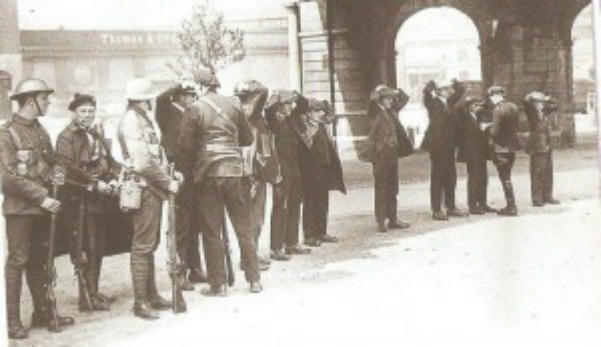
Sam being arrested at the Custom House, he is fourth from the right with his hands on his head.

This was going to be a huge job and a symbolic attack at one of the nerve-centres of British rule in Ireland, up to 120 men of the 2nd Dublin Brigade along with members of the Squad and the Active Service Unit took part.  They were poorly equipped, armed only with revolvers and a limited supply of ammunition, they did however have plenty of petrol and bales of cloth which was used to destroy the records and ultimately the building itself which burned for five days straight. The raiding party soon drew the attention of a brigade of Auxiliaries. Unable to stay in the burning building, surrounded by the British forces and very quickly running out of ammunition the Republican forces knew they were in serious difficulty. Most of the men surrendered but some made a run for it, a few escaped, but others like Sean Doyle were killed as they tried to get away. Among the more than 70 IRA men captured was Sam Robinson, although he was not to be in captivity long. Within two months a truce had been called and the Treaty negotiations had begun and Sam was released by Christmas of 1921.

Upon his release Sam became part of the new Free State Army, by the 1922 Army census he was listed as a Lieutenant and he was heavily involved during the Civil War, seeing action in areas of some of the heaviest fighting around Cork, Kerry and later Sligo. He was in the Imperial Hotel in Cork City along with other serving officers to have breakfast with Michael Collins the day he was shot. Despite Collins’ initial scepticism about this teenager who had lied about his age to join the IRA he had trusted and promoted Sam. In turn Sam, like many other officers became a great admirer and loyal follower of the “Big Man” and was devastated to learn of his death at Béal na Bláth. In another freak Bohemians connection, the man who tended to Collins as he died was General Emmet Dalton, a former Bohemian F.C. player and later President of the Club.

Sam was promoted to the rank of Captain in February of 1923 and remained in the Army throughout the horrific violence of the Civil War but left, somewhat disillusioned, in 1924. There was concern among members of the Free State army about plans to significantly decrease the size of the army in peacetime and there was also a feeling among some soldiers that ex-British army officers were being favoured for advancement within the Free State forces. Such was the seriousness of this issue that Charlie Dalton (the ex-Bohs player we encountered above, and brother of Emmet Dalton) and General Liam Tobin were accused of attempting an Army Mutiny due to their opposition to the proposed demobilisation.

Sam Rob army pic

Sam in his Irish Army uniform

The army’s loss was Bohemians gain however and the civilian Sam Robinson joined his brother at the club and helped build towards the eventual dominance of the 1927-28 season. It was not to be Sam’s last involvement with the Army however, upon the declaration of the national state of Emergency during World War II Sam re-enlisted and was made a Captain of C Company of the 14th Battalion, his years of experience no-doubt appreciated by younger troops. He stayed in the Army until the end of the War before returned to the trade he had developed as a plasterer. In fact he started his own plastering company, Robinson & Son near Church Street in Dublin.

Things went well for Sam’s business for a while and he was a generous man always making sure that old Army or footballing colleagues were helped out with a job if they fell on hard times. Among those employed at one stage by Sam was his former Bohs team-mate John Thomas. However, in 1957 perhaps because of his generosity, Robinson & Son went out of business, Sam’s auditor incidentally at the time was a young man by the name of Charles J Haughey! While this was a setback Sam used it as an opportunity to travel, his trade took him to Canada, Malta, Britain and even Rhodesia (now Zimbabwe) before he returned to Ireland. Fate would have it that one of his final jobs as a plasterer was on the Phibsboro shopping centre, overlooking the pitch at Dalymount that had been so familiar to him.

Sam’s connection with Bohemians continued long after his playing days ended. His nephew Charlie Byrne began his career for Bohemians in the 1940’s , while his son Johnny Robinson enjoyed a successful League of Ireland career with Drumcondra and Dundalk.  Sam remained a Bohemian member until the day he died in 1985.

Member card2

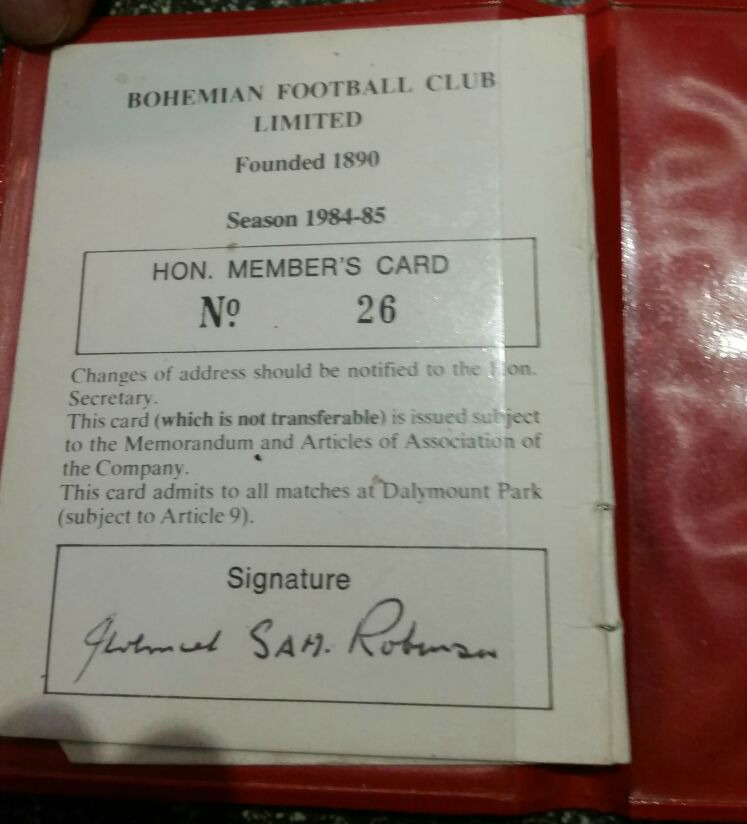
The Bohemian membership card of Jeremiah “Sam” Robinson

With special thanks to Eamon Robinson, Frank Robinson and Kevin Robinson for their assistance and sharing their family research and photos.

Bohemians of World War I

An introduction to just some of the Bohemian F.C. members who swapped the playing fields of Ireland for the killing fields of Europe.

Fred Morrow was only 17 when he took to the pitch for Bohemians at the curtain raiser at their great rivals’ new home, Shelbourne Park. The Bohs v Shels games were known then as the Dublin derby and as with many derbies, passions were inflamed. But this game’s atmosphere was even more heightened and it wasn’t just to do with the 6,000 spectators packed into the ground. Even in just getting to the ground Morrow and his teammates had seen over one hundred Dublin Tramway workers picketing the game.

The 1913 Dublin lock-out was only a few days old and Jim Larkin had declared that there were players selected for the game who were “scabs”: Jack Millar of Bohemians and Jack Lowry of Shelbourne were the names identified during the strike. The striking tramway workers subjected the players and supporters to (in the words of the Irish Times) “coarse insults” and had even tried to storm the gates of the new stadium. Foreshadowing the events of the next day, there were some violent altercations with the officers of the Dublin Metropolitan Police, with 16 arrests made and over 50 people suffering injuries.

This can’t have affected the teenaged Morrow too badly as he scored Bohs’ goal in a one all draw that day. Although less than 5’5” in height, the youngster was shaping up to be quite a prolific centre forward. Fred had started his career early, lining out for his local side Tritonville FC based in Sandymount, and while with the club he had won a Junior cap for Ireland, scoring in a 3-0 victory over Scotland in front of over 8,000 spectators in Belfast. The following season he’d been persuaded north of the river to Dalymount, and he was to enjoy a successful season including scoring a hat-trick in an unexpected 3-1 victory over title holders Linfield.

The Shelbourne side that Bohs faced that day included in their ranks a new signing of their own, Oscar Linkson, who had just been signed from Manchester United. Linkson had made almost 60 appearances for United and had been at the club when they won the FA Cup in 1909 and the League in 1911. Quite the coup, then, for Shels. Oscar moved to Dublin with his 17 year old wife Olive and his son Eric, who would be joined by a baby sister just months later. He faced Fred Morrow that day as part of the Shels defence.

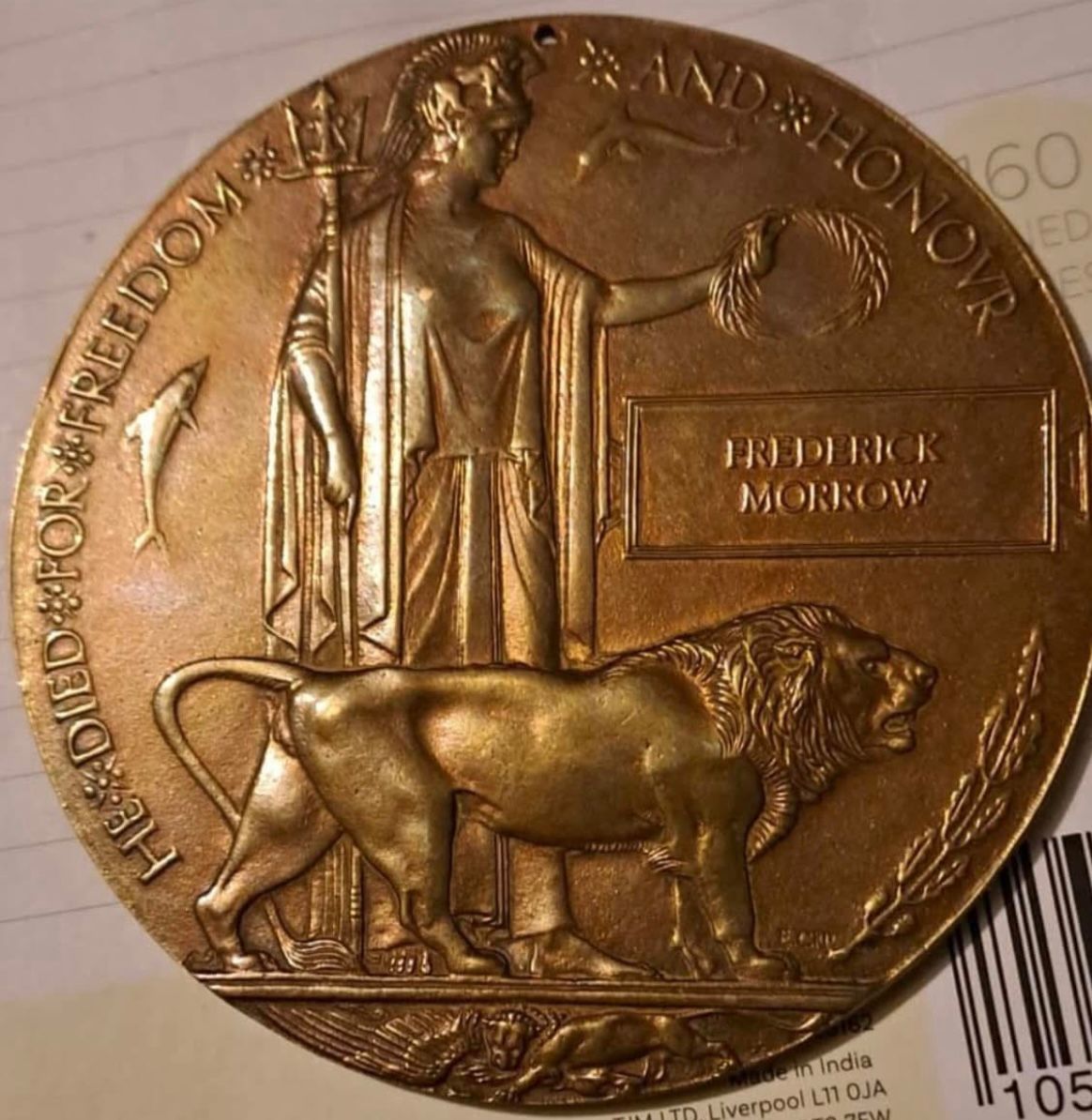
Within a year of this game, War would be declared. Both Fred Morrow and Oscar Linkson volunteered to serve in the British Army, Oscar with the famous “Football Battalion” of the Middlesex Regiment alongside a whole host of star players which included the Irish international John Doran. Neither Fred nor Oscar would return, by the end of 1917 both were dead on the fields of France.

Fred Morrow death penny
The Memorial plaque or “Death penny” issued to Fred Morrow’s family

The events that the players had witnessed leading up to that Bohs v Shels game had far-reaching consequences, with the violence in the adjoining Ringsend streets at the game growing worse over the following day, culminating with violent clashes between the Dublin Metropolitan Police and striking workers on Sackville Street (now O’Connell Street). Hundreds were wounded amid baton charges and three striking workers were killed. The dramatic events convinced Union leaders James Connolly, James Larkin and Jack White that the workers needed to be protected, and that an Irish Citizen Army needed to be formed for this purpose. Ireland’s decade of lead had begun.

A year earlier in 1912, in response to the passing of the third Home Rule bill, and the possibility that Home Rule would finally become a reality in Ireland, hundreds of thousands of Irish Unionists signed what was known as the Ulster Covenant, where allegiance was pledged to the King of England. They stated that Home Rule would be resisted by “all means necessary”. This included the very real possibility of armed resistance, as demonstrated by the Ulster Volunteers (formed in 1912) importing thousands of rifles into the port of Larne from Germany in April 1914. In response, the Irish Volunteers, supporters of Home Rule formed in order to guarantee the passage of Home Rule bill, also imported German arms into Howth in July 1914; just days before the outbreak of the First World War. This mini arms-race in Ireland mirrored the greater stockpiling of armour and weaponry by the great European powers in the lead-up to the First World War; the whole Continent was in the grip of militarism. Violence seemed, to many people, to be unavoidable.

O'Connell street 1913 again
Clashes on Sackville Street during the 1913 lock-out

Over 200,000 Irish men fought in the First World War. To put this in perspective, the total male population of Ireland at the 1911 Census was just over 2.1 million. Those who fought did so for many reasons. Some, including many members of the Irish Volunteers, heeded John Redmond, the leader of the Irish Parliamentary Party who called on Irishmen to go and fight to help secure Home Rule, as a gesture of fidelity to Britain, in support of Catholic Belgium and in defence of smaller nations.

Redmond asked Irish men to prove “on the field of battle that gallantry and courage which has distinguished our race” in a war that he said was fought “in defence of the highest principles of religion and morality”.

Some men went in search of adventure, unaware then of the horrors that awaited them. Many Dublin men joined up as a way to financially support their families, the city at the time had a population of 304,000, with roughly 63% described as “working class”, the majority of whom lived in tenement houses, almost half with no more than one room per family. The army might offer death but least it offered a steady income.

What we also know is that many Bohemians joined up. Some like Harry Willits or Harold Sloan may have simply joined out of a sense of duty, that this was the “right thing to do”. Most joined in what was known as a “short service attestation”, meaning that they were only joining for the duration of the war, which many mistakenly assumed would be over quickly. In one edition of the Dublin based weekly paper Sport, it was estimated that Bohemians lost forty members to War service, among the highest of any club in the whole country, although we know that there was also significant enlistment from other Dublin clubs such as Shelbourne and Shamrock Rovers, while the loss of players to military service was cited as one of the reasons for the withdrawal from football of the original Drumcondra F.C.

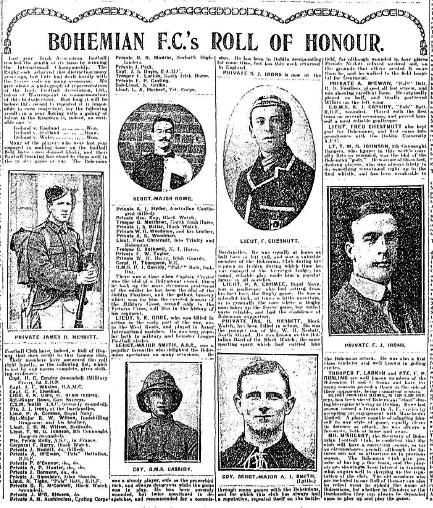
Roll of Honour
Bohemian F.C. Roll of Honour – Evening Herald, September 1915 source @Cork1914to1924

Some like Harry Willits did return to resume their football career. Several did not return at all. Corporal Fred Morrow, who we met earlier as Bohs centre-forward, was a member of the Royal Field Artillery in France when he died of his wounds in October 1917. His mother had to write formally asking for the death certificate that the armed forces had neglected to send so that she could receive the insurance money for his funeral.

Private Frank Larkin was only 22 when he died just before Christmas 1915. He had been a Bohs player before the war. At this time, due the growing popularity of both the club and football generally in Dublin, Bohs often fielded several teams. Frank featured for the C and D teams, but like many Bohemians, was a fine all-rounder. He played cricket for Sandymount and rowed for the Commercial Rowing Club. He and two of his colleagues from the South Irish Horse were killed by a shell on December 22nd in Armentieres, Belgium. His will left a grand total of £5 14 shillings and 2p to his two married sisters.

T.W.G. Johnson
Thomas Johnson as pictured at Royal Lytham & St. Anne’s Golf Club in his later years

Thomas Johnson, a young Doctor from Palmerstown was just 23 when the War broke out. He had won an amateur international cap for Ireland and was a star of the Bohs forward line, usually playing at outside right. He was a hugely popular player who the Evening Herald described as “always likely to do something sensational”. He was another fine sporting all-rounder with a talent for both cricket and golf. Johnson became a Lieutenant in the 5th Connaught Rangers during the War and later brought his professional talents to the Royal Army Medical Corps. He was awarded the Military Cross for his actions at Gallipoli. He received numerous citations for bravery, for example at the Battle of Lone Pine during the Gallipoli campaign the Battalion history notes “Second-Lieutenant T.W.G. Johnson behaved with great gallantry in holding an advanced trench during one of the counter-attacks. Twice he bound up men’s wounds under heavy fire, thereby saving their lives”.

While his medical skills were a great asset in saving lives Johnson also was a fierce soldier during the most brutal and heavy fighting. He was awarded the Military Cross specifically for his actions around the attack on the infamous Battle of Hill 60 where so many Irishmen perished. The battalion history states that on August 21st 1915

“Lieutenant T.W.G. Johnson went out to the charge, with rifle and bayonet, and killed six Turks. He shot two more and narrowly missed killing another one. Later, although wounded severely, he reported to the commanding officer, and showed exactly where the remaining men of his company were still holding their own, in a small trench on “Hill 60.”

It was by this means that these men eventually were carefully withdrawn, after keeping the Turks at bay for some hours.” . Hill 60 of course was for many years the name by which Dubliners knew the terrace at the Clonliffe Road end of Croke Park, it was only in the 1930’s that it became known as Hill 16 and later the apocryphal story emerged that the terrace had been built from the ruins of O’Connell Street after the Easter Rising.

Bohs with Sloan Crozier
Herbert Charles Crozier – back row far left. Harold Sloan – front row third from the right

Other Bohemians suffered serious wounds but managed to make it through to the armistice. One of the most prominent of these was Herbert Charles “Tod” Crozier. He had joined Bohemians as a 17 year old and took part in the victorious Leinster Senior Cup final of 1899. In 1900 he appeared for Bohs on the losing side in an all-amateur Irish Cup Final, which was won 2-1 by Cliftonville. Crozier was described as one of the most “brilliant half-backs playing association football in Ireland” and he formed a formidable and famous midfield trio of Crozier-Fulton-Caldwell who were still revered for their brilliance decades after their retirement. “Tod” had a long association with Bohemians and was also a prominent member of Wanderers Rugby Club. He grew up on Montpellier Hill, close to the North Circular Road and not far from Dalymount.

Herbert Crozier1
Major H.C. Crozier

His Scottish-born father was a veterinary surgeon but “Tod” became a career military man with the 1st battalion of the Royal Dublin Fusiliers. In 1908 he was awarded the Bronze Star by the Royal Humane Society while serving in Sudan for trying to save the drowning Lieutenant Cooper from the River Nile. It was noted that he behaved with great bravery despite knowing of the “dangerous under-current and that crocodiles were present”. He was a Captain at the beginning of the War and was part of the Mediterranean Expedition Force that travelled to Gallipoli. It was here that he was wounded, and as a result of his actions was awarded the Military Cross, and later, after a promotion to the rank of Major, the Military Star. Despite the wounds he received at Gallipoli he returned to Montpelier Hill in Dublin and continued to attend football and rugby games. He was still enough of a well-known figure that he was the first person quoted in a newspaper report about Bohs progression to the 1935 FAI Cup Final. He lived to the age of 80, passing away in 1961 and was buried in Mount Jerome Cemetery.

One man who returned from the War and then joined Bohemian F.C. was the legendary Ernie Crawford. Born in Belfast in 1891 Ernie was perhaps best known for his endeavours on the Rugby pitch. He starred for Malone in Belfast and later Lansdowne Rugby Club and won 30 caps for Ireland, fifteen of them as Captain. He would later be named President of the IRFU. His obituary in the Irish Times listed him as one of the greatest rugby full-backs of all time, he was honoured for his contribution to sport by the French government and even featured on a Tongan stamp celebrating rugby icons.

Crawford collage
Ernie Crawford in uniform, on a Tongan stamp and as an Irish Rugby international

He was, however, a successful football player who turned out for Cliftonville and for Bohemians. Ernie, a chartered accountant by trade, moved to Dublin to take up the role of accountant at the Rathmines Urban Council in 1919, and this facilitated his joining Bohemians. Despite his greater reputation as a rugby player, Ernie, as a footballer for Bohs, was still considered talented enough to be part of the initial national squad selected by the FAIFS (now the FAI) for the 1924 Olympics. In all, six Bohemians were selected (Bertie Kerr, Jack McCarthy, Christy Robinson, John Thomas & Johnny Murray were the others and were trained by Bohs’ Charlie Harris), but when the squad had to be cut to only 16 players Ernie was dropped, though he chose to accompany the squad to France as a reserve. The fact that he was born in Belfast may have led to him being cut due to the tension that existed with the FAIFS and the IFA over player selection.

That he could captain the Irish Rugby Team and be selected for the Olympics is even more impressive when you consider that during the Great War Ernie was shot in the wrist causing him to be invalided from the Army and to lose the power in three of his fingers. He had enlisted in the 6th Inniskilling Dragoons in October 1914 and was commissioned and later posted to the London Regiment (Royal Fusiliers), becoming a Lieutenant in August 1917. He was a recipient of the British War and Victory Medals. Ernie later returned to Belfast where he became City Treasurer. It was in Belfast in 1943 that Ernie encountered Bohs again, as he was chosen to present the Gypsies with the Condor Cup after their victory over Linfield in the annual challenge match. He passed away in January 1959.

So who were these men who went to war? From looking through the various records available (very much an ongoing task) it is clear to see that they were of a variety of different backgrounds. Most were from Dublin, though some like Sidney Kingston Gore (born in Wales) were only in Dublin due to Military placement. Some like Harry Willitts came to Dublin as a young man, others like Crozier and Morrow were children to parents from Scotland, Belfast or elsewhere. They were of various religious beliefs with Catholics, Church of Ireland and Presbyterians among their number.

By the outbreak of the War Bohemian F.C. was not yet 25 years old, some of those who had helped to found the club as young men were still very much involved. The employment backgrounds of the men who enlisted seem to have connections back to those early days when young medical students, those attending a civil service college as well as some young men from the Royal Hibernian military school in the Phoenix Park helped found the club. There were a number who are listed as volunteering for the “Pals” battalion of the Royal Dublin Fusiliers, in this case more than likely the 7th battalion. This battalion was made up of white collar workers and many civil servants, they were sometimes referred to as the “Toffs among the toughs”.

The 7th Battalion also featured a large number of Trinity College graduates, as well as many Rugby players encouraged to join by President of the Irish Rugby Football Union, F.H. Browning, a number of those who joined would end up dead on the beaches of Gallipoli. Browning later died after encountering the Volunteers on return from maneuvers at Mount Street Bridge during Easter 1916.  The medical profession is clearly represented by men such as Thomas Johnson and J.F. Whelan. There were also characters like Alfred Smith and Tod Crozier who were career military men.

We know that like many Bohemians they were great sporting all-rounders, many being talented Rugby players, rowers, tennis players and cricketers in addition to their talents on the football field. In most cases they were young; Fred Morrow was still a teenager when he joined up, Frank Larkin only 21. Even the prematurely bald Harry Willitts looked much older than his 25 years.

Those who did return from the trenches came back to an Ireland that was changed utterly. The events of the Easter Rising, the growth in Republican Nationalist sentiment and the gathering forces that would soon unleash the War of Independence meant that those who returned may well have felt out of step with the Dublin of 1918-19. Those mentioned above are only a small selection of the Bohemians who took part in the First World War, there are many more stories; of Ned Brooks the prolific centre forward posted to Belfast who ended up guesting for Linfield, of Jocelyn Rowe the half-back who had also played for Manchester United who was injured in combat. There are many others forgotten to history. Those men described above often only appear in the records because of their death or serious injury, many more passed without comment. For men like Harry Willits and Tod Crozier, they could return to familiar surroundings of Dalymount Park whether as a player or just as a spectator. Some of those who returned, like Ernie Crawford, were yet to begin their Bohemian adventure. Among this latter group was a dapper Major of the Dublin Fusiliers named Emmet Dalton. He was a man who had won a Military Cross for his bravery in France and trained British soldiers to be snipers in Palestine. On his return to Ireland, he would join Bohemians as a player along with his younger brother Charlie. Both men would also join the IRA. They would play a central role in the War of Independence and the Civil War though they weren’t the only Bohemian brothers with this distinction as I’ll outline in my next piece.

A partial list of Bohemian F.C.members who served in World War I

Captain H.C. Crozier (wounded, recipient of the Military Cross) 1st Royal Dublin Fusiliers. Later promoted to Major.

Lt-Colonel Joseph Francis Whelan Royal Army Medical Corps, recipient of the Distinguished Service Order for his actions in Mesopotamia (Bohemian player, committee member and club vice-president). Later awarded and O.B.E. as well as an Honorary Master of Science degree by the National University.

Surgeon Major George F. Sheehan, Royal Army Medical Corps. Awarded the D.S.O.

Lieutenant Sidney Kingston Gore, 1st Battalion Royal West Kent Regiment (killed in action). He died after being shot in the head on 28th October 1914 near Neuve Chapelle he was a talented centre-forward who was particularly strong with the ball at his feet.

Sgt-Major Jocelyn Rowe, 1st Battalion, East Surreys (wounded in action). Rowe was born in Nottingham and had briefly played for Manchester United. A report in the Irish Independent of 30th March 1916 stated that Rowe had been wounded an astounding 83 times but was still hopeful of playing football again.

Company Sgt-Major Alfred J Smith, Army Service Corps, (amatuer Irish international, wounded in action)

Private Joseph Irons, on guard duty at the Viceregal Lodge during Easter 1916 he later served duty in the Dardanelles campaign. Irons was born in England and was considered one of the best full-backs in Irish football, he worked on the staff of the Viceregal Lodge (now Áras an Uachtaráin) before being called up to the army from the reserve on the outbreak of War.

Lieutenant P.A. Conmee, Royal Navy (a former Rugby player and a goalkeeper for Bohemians)

Sgt-Major B.W. Wilson Inniskilling Dragoons

Lieutenant JRM Wilson, Bedfords (brother of above)

Reverend John Curtis, Royal Army Chaplains’ Department

Lieutenant Thomas William Gerald Johnson, 5th Connaught Rangers and later Royal Army Medical Corps (wounded in action, awarded the Military Cross for his actions in taking the infamous “Hill 60” during the battle for Gallipoli). Also an Irish amateur international player.

Private Frank Kelly, Army Service Corps

Lieutenant Ernie Crawford, Inniskilling Dragoons and Royal Fusiliers

Corporal F. Barry, Black Watch

Second lieutenant Charlie Webb, King’s Royal Rifle Corps. He was captured in March 1918 near Nesle in Northern France and saw out the war from a Prisoner of War camp near Mainz. Webb was an Irish international forward who was born into a military family in the Curragh Camp, Co. Kildare. He played for Bohemians between 1908-09 but is most associated with Brighton & Hove Albion where as a player he scored the winning goal in the 1910 Charity Shield Final. He later became Brighton’s longest serving manager, beginning in 1919 and continuing until 1947, a span that covered over 1,200 matches.

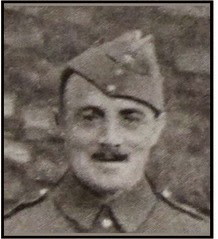
Private James Nesbitt, Black Watch (killed in action 16/07/15)  the son of W. H. and Jeannie Nesbitt, of 54, North Strand Road, Dublin. James was a Customs and Excise Officer at Bantry, Co. Cork, at the outbreak of war. Although badly injured he directed medical attention to other wounded men. He walked back to the field hospital but died soon afterwards. Nesbitt was also a member of the Irish Parliamentary Party who sat on Blackrock Urban Council. He was known as the “Battalion Bard” as he amused the other troops by writing and singing “topical songs”. Nesbitt mostly played for the Bohs C and D teams.

Private A. McEwan, Royal Dublin Fusiliers

Private P. O’Connor, Royal Dublin Fusiliers

Private A.P. Hunter, Royal Dublin Fusiliers

Private J. Donovan, Royal Dublin Fusiliers

Sergeant Harry Willitts, Royal Dublin Fusiliers

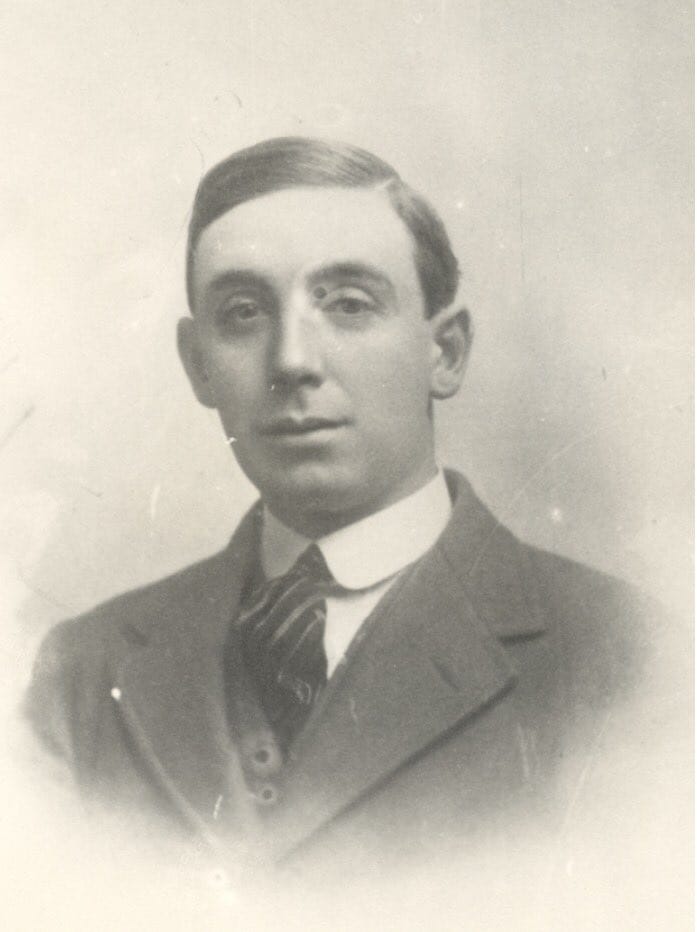
Sergeant Harrison McCloy, Tank Corps. (Killed in action) McCloy was born 12th December 1883 in Belfast. He continued a common tradition of being a footballer for Clinftonville before joining Bohemians. He was a player for Bohemians from 1902 to 1905 including appearing for the first team in the Irish League. He later moved into an administrative role and was a club Vice President for Bohemians from the 1905-06 season through to 1911-12, He was also mentioned as having been Honorary Secretary of the Irish League in 1911. He had been part of the Young Citizens Volunteers before transferring to the Tank Corps serving as a Quartermaster Sergeant during World War I. His main role was supervision and security of tanks used in battle pre or post engagement. He was killed in Belgium by enemy shellfire on the 21st August 1917 whilst engaged in such duties. He was 33 years old. Buried in the White House Cemetery St-Jean-Les-Ypres.  His gratuity was left to four of his siblings.

Harrison McCloy, who was killed aged 33

Corporal Fred Morrow, Royal Field Artillery (formerly of Tritonville F.C. Bohemian F.C. and Shelbourne), killed in action 1917.

Private Angus Auchincloss from Clontarf joined the Army Cycling Corps in 1915 and transferred to the Royal Irish Rifles in 1916. He was discharged in 1919 and died in Eastbourne, England in 1975 at the age of 81.

Lieutenant Harold Sloan, Royal Garrison Artillery killed in action January 1917.

Major Emmet Dalton, Royal Dublin Fusiliers. On returning to Dublin Dalton became IRA Head of Intelligence during the War of Independence and later a Major-General in the Free State Army.

Lieutenant Robert Tighe, 5th Battalion Royal Dublin Fusiliers

Private G.R. McConnell, Black Watch (wounded)

Trooper Francis Larkin, South Irish Horse (killed in action)

Major Fred Chestnutt-Chesney, 6th Lancashire Fusiliers (former goalkeeper for Bohemians and for Trinity College’s football team). Later a Church of Ireland Reverend. Wounded in combat by a gun shot to his left leg.

Private J.S. Millar, Black Watch

John C. Hehir, the star goalkeeper for Bohemians until January 1915. He was also capped by Ireland in 1910. Hehir played rugby for London-Irish and also won a Dublin Senior Club championship medal with the Keatings GAA club in 1903. He left Bohs to take up an “important role” with the War Office in London

Lieutenant William James Dawson, Royal Flying Corps. Injured in 1917 he returned to action but died in 1918. He was also a member of the Neptune Rowing Club and the Boys Brigade.

Captain J.S Doyle, Royal Army Medical Corps

William Henry (Billy) Otto, South African Infantry

Private F.P. Gosling, Black Watch and later the Machine Gun Corps

Lieutenant L.A. Herbert, Veterinary Corps

Private Bobby Parker, Royal Scots Fusiliers. Parker was the English First Divisions top goalscorer in the 1914-15 season as he helped Everton to the League title. However, after league football was suspended Parker enlisted and was wounded in early 1918. Despite attempts to continue his playing career the bullet lodged in his back essentially meant his time as a player was over at the age of 32 after a brief spell with Nottingham Forest. Parker moved into coaching and in 1927 was appointed coach of Bohemian FC, a position he held until 1933. He led Bohemians to a clean sweep of every major trophy in the 1927-28 season.

Private William Woodman, 7th Battalion Royal Dublin Fusiliers and his brother Private Albert Woodman, Royal Engineers. After the war Albert returned to his job at the General Post Office, working there until his retirement. During World War II, he worked as a censor and redactor. He bought a home on Rathlin Road, in Glasnevin. Albert passed away in 1969, at the age of 78. For more on the Woodman family see here.

Private Stephen Wright served with the Leicestershire Regiment and the Royal Army Medical Corps during World War I. Born in Leicester he had two spells with Bohemians, before the outreak of the war, and again in the 1919-20 season. He would also appear for Bolton Wanderers, Norwich City and Brighton and Hove Albion. He returned to Ireland as a coach after breaking his leg while at Brighton, taking up a role at Dundalk in 1930 and leading the Louth club to their first ever league title in the 1932-33 season.

Private F. W. Taylor

Corporal H. Thompson, Royal Engineers

Trooper Griffith Mathews, North Irish Horse

Part of a series of posts on the history of Bohemian F.C from 1913-1923. Read about Bohs during Easter 1916 here or about the life and career of Harry Willits here.

Following the money- wanting all the power, instead of just most of it

Follow the money. If you want to get to the heart of the matter always follow the money, in life as in football. As our beloved sport emerged and was codified in Victorian Britain there was a strong attempt to keep football strictly amateur, and by extension out of the reach of the vast bulk of ordinary people and the preserve mainly or a network of public-school Old Boys. This resistance was Canute-like and eventually by 1885, some twenty-two years after the foundation of the FA, professionalism was permitted in British football. Money had always been in the game but now it was openly, if grudgingly accepted.
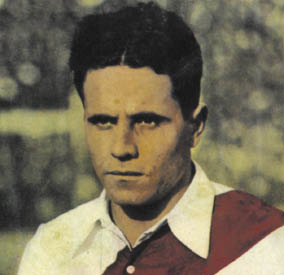
Even back then the sporting public were caught up in the drama of the transfer market, while many clutched their pearls and bemoaned the scandalous sums being paid to bring footballers to new clubs. By 1893 Willie Groves had become the first £100 player when he joined Aston Villa from near neighbours West Brom. Just twelve years later Alf Common became the first £1,000 player when he made the short journey from Sunderland to Middlesbrough. For the next three decades after Common’s move the transfer record would only be broken by English (and one Scottish) clubs. But the British dominance of the transfer record was smashed in 1932 as the world transfer record crossed the Atlantic to the Argentine capital of Buenos Aires. The buying club was River Plate and the player was Bernabé Ferreyra, signed from Tigre for £23,000, an amount that would stand unbroken for a record for seventeen years.

ferrerya

Bernabé Ferreyra – once the world’s most expensive player

Argentina had seen a breakaway professional league emerge in 1931 and River Plate immediately went out and paid 10,000 pesos for winger Carlos Peucelle and signed Ferreyra just a year later, this helped give rise to the clubs’ nickname of Los Millonarios. Although English clubs would take back the transfer record in the late 40s and kept it until 1951 this was to be the last era of British dominance or record breaking transfer fees, only in 1996 when Alan Shearer joined Newcastle from Blackburn would a British club again be a record breaker. For the rest of the last 64 years the transfer record has been held by either Italian on Spanish sides. The last five record fees have all been paid by Real Madrid, from Luis Figo in 2000 to Gareth Bale in 2013.

But of course merely to view the transfer market as a marker of wealth, and indeed power and influence is reductive. For one thing the Bosman ruling has changed the nature of transfer deals to some extent and it also ignores things like the money spent on wages, amounts earned through sponsorship, TV rights and prize money. However, according to Deloitte in their annual football rich list for this year, Real Madrid are once again the top club with a revenue of £439m. They are followed by Barcelona, Manchester United in 3rd and Paris Saint Germain in 4th, Bayern Munich in 5th and Manchester City in 6th. Juventus come in at tenth meaning there is one Italian side in the top category. However the most telling statistic is that overall of the top 30 clubs on the list 17 are in the Premier League.

This wealth created in the Premier League, primarily through super-lucrative television rights, currently trumps anything that can be matched financially by other leagues. Arrangements in Spain mean that clubs like Barcelona and Real Madrid get disproportionately larger shares of television revenue than other Spanish clubs, but the Premier League parity model has been suggested as one of the reasons that a club like Leicester have been able to mount their shock title challenge. While West Ham sit in 20th place on the rich list there is no place for the likes of Ajax, Benfica, FC Porto or many others. They are victims of geography and the rise of power or a super elite group of clubs forming out of the elite leagues. Some clubs like Manchester City and Paris Saint Germain have only been catapulted into these elite realms because of the massive recent investments of petro-wealth tycoons.

Yet despite these financial advantages there is always the search for more. Manchester United remain third on the rich list despite being very much in a period of transition. Real Madrid have sacked another coach and don’t look likely, at the time of writing, to be able to pip their great rivals Barcelona to the title. Their balance sheets are betrayed by their on-field performances. The present state of flux in the Premier League where it is conceivable that United, Chelsea and even possibly Arsenal could actually miss out on Champions League football, coupled with the natural nose for profit of other European football CEOs has led to talk of changes to the Champion’s League.

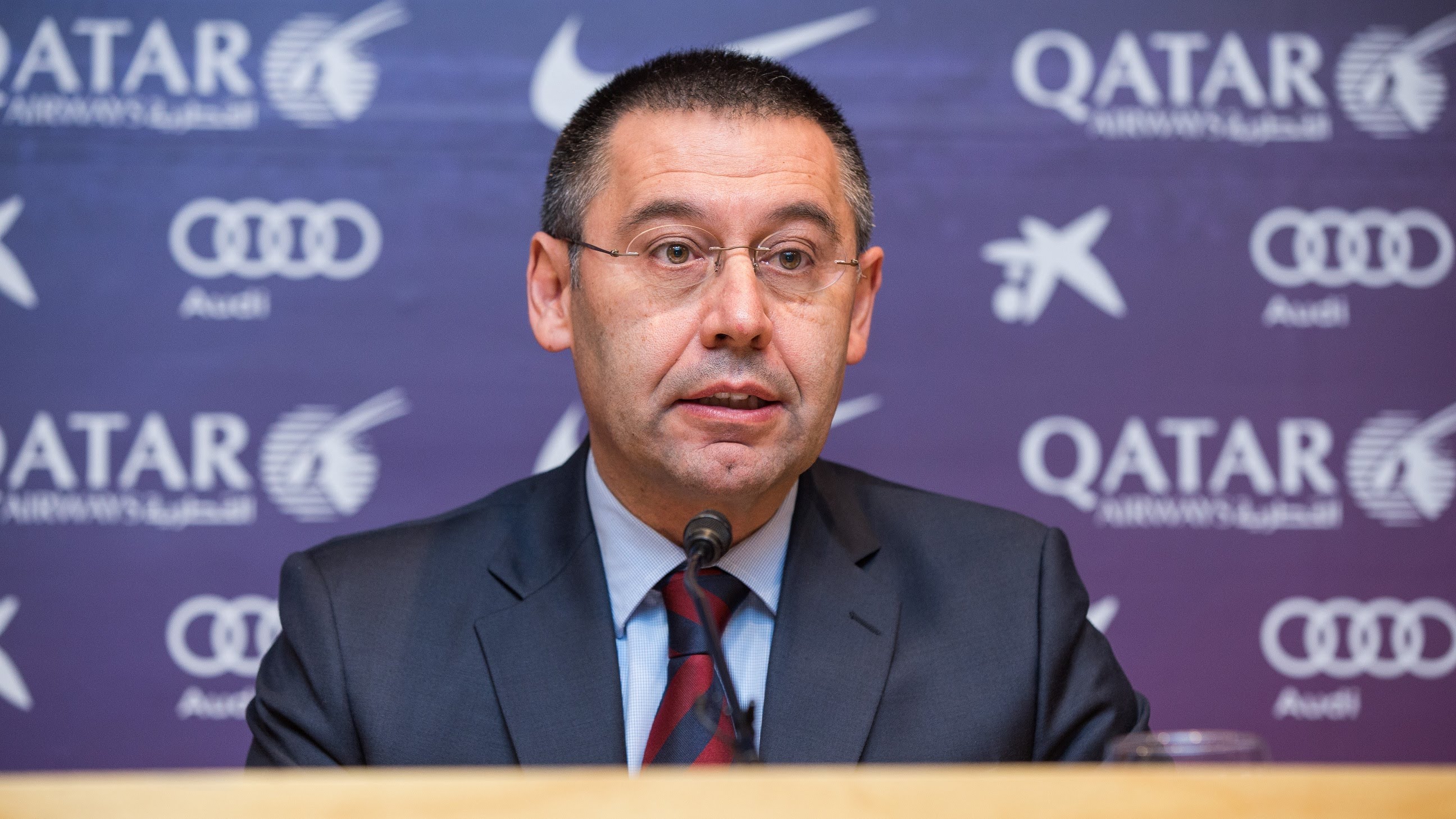
The Barcelona club president Josep Maria Bartomeu has already spoken about a type of fail-safe system that could reward under-performing big clubs who don’t progress to the Champions League, saying:
“Right now, we are lucky – because the important leagues, like the Premier League or the Spanish league or the Italian league – we have more clubs.
“But I’m sure that sometimes for the interest of football, why not give wildcards? Like in tennis – sometimes top players do not qualify and they get wildcards. Why not in football?”

Don’t you love the “important leagues” line? From a revenue point of view a match between Barcelona and an under-performing Manchester United has greater commercial incentives that a game against a more successful Leicester or indeed a Napoli who have gotten to the Champions League on merit. Such suggestions also undermine the whole basis of competitive sport. The notion that any team, on their day can beat any other team, and are thus rewarded accordingly are central to football’s appeal, history and excitement. We have reached a point that for World Cups the holders no longer automatically qualify, so why should say a Chelsea be rewarded to the tune of tens of millions for their gross mismanagement?

maxresdefault

Josep Maria Bartomeu of Barcelona

Should such suggestions be seen as a response to the moderate reforms brought in by Michel Platini which helped to ensure that club sides from smaller nations had a chance at more access to European competition? In recent years teams like APOEL Nicosia, Basel and this year Gent have made it through to the knockout stages of the Champions League on their own merit while supposed bigger names, and certainly wealthier teams have not progressed.

We might view Bartomeu’s comment in the context of the recent meetings of representative of the “Big Five” Premier League clubs (i.e. Man City, Man United, Arsenal, Chelsea and Liverpool) when they were forced to deny that the purpose for their talks was discussions of a breakaway European Super League. Interestingly this was some 25 years ago another “Big Five” met to form the break-away Premier League, they were Man United, Liverpool, Tottenham, Everton and Arsenal. It just goes to show what a Russian or Emerati oligarch can do for a club’s image.

While the current “Big Five” denied any talk of a break away they did start to talk about reform of the Champions League once the current agreements around structure and broadcasting run out in 2018. What this reform could mean has been described thus in a recent article in the Guardian and elsewhere as possibly including:
“…more knockout rounds before the revamped group phase. The top 16 seeds might enter the competition in the last 32, where they would not be able to draw each other. The established continental clubs believe this would allow them a better chance of avoiding lesser teams at the group stage, which in an eight-team format would mean 14 matches, played home and away. An example cited during discussions with UEFA came in 2008-09 when Real Madrid were drawn in a group that included Bate Borisov. The ties between the two sides attracted low viewing figures and there is a firm desire to avoid repeats in the future by having more high-profile games, generating a bigger income.”

Let’s just think about what that means. On the face that doesn’t sound too bad. More knock-out games just like the old European Cup? Seeded teams? Well top-flight teams don’t join the FA Cup until the third round, sounds fairly plausible. However in reality what it aims for is a fossilising of wealth and power in the hands of elite clubs and elite leagues. Whoever at this point in time has the wealth; the billionaire backers who are digging and gouging the earth for natural resources, or who are best at creating “global commercial partnerships” shall remain dominant. It is saying that even with all the advantages that wealth bestows that football is just too damn unpredictable for those in charge. Even Chelsea and Man United can fuck up and Leicester aren’t a big enough draw!
It’s worth thinking about this in the context of the recent passing of Johan Cruyff. The Netherlands only really began to embrace professionalism in the 1960s, but with the brilliance of a generation players like Cruyff and the vision and tactical ingenuity of managers like Rinus Michels Dutch clubs won four consecutive European Cups in the early 1970s. But that didn’t happen overnight, Ajax had been beaten finalists against AC Milan in 1969, before that they had destroyed Shankly’s Liverpool 7-3 in 1966 before being knocked out by Dukla Prague. They got game time against elite opponents, this gave players experience and allowed them to grow and develop and eventually become triple Champions. The plan outlined above effectively removes the number of games that teams from second tier nations get to play in the Champions League by putting in what is in effect an extra preliminary round.

Preliminary rounds already exist which significantly reduces the chances of a team from a smaller or secondary nation gaining access to the group stages, it would seem that Platini’s modest reforms are anathema to the conservative, insular forces of the elite clubs. This process would go against what has been shown to work successfully in International football. If one looks back to the reign of the last English head of FIFA, Sir Stanley Rous you can see how resistant he was to widening inclusion in the World Cup to teams from outside of Europe and South America. Primarily as a vote getting exercise his challenger Joao Havelange promised to open up the World Cup to more teams from Africa and Asia. Greater access to this level of competition has given nations experience to build upon and nowadays nations from throughout Africa, Asia and sides like Australia and New Zealand are less likely to be arrogantly assumed of being pushovers unworthy of entrance to competition. While there is a delicate balance to strike in making sure the best teams are represented for the World Cup to be truly be worthy of its name it needs participants from all over the globe.

The Champions League however has never been worthy of its name. If Mr. Bartomeu had his way this misnomer would be all the more inappropriate. What UEFA must decide is if it wants the Champions League to be a truly European affair, as a mechanism to grow the game in Europe and improve the level of participation and competition throughout the Continent. Or whether it simply wants a European Super League by another name. Just more of the same teams playing each other again and again with little possibility of change, calcifying an established order of the wealthy few for decades to come. It removes even the chance, the possibility of another Ajax-like success story.
Or… UEFA could have some guts. They could stand up to the biggest clubs and say that they already enjoy massive benefits from participation in the elite European club competition, that renegotiation of a deal will likely bring even greater prize money after 2018 and if they don’t like that then go and form a break-away Super League.
But… all players playing in the breakaway league would be removed from their domestic championships, all players playing for the breakaway clubs would be unable to take part in any UEFA/FIFA/CAF etc. tournaments or to play for their national team in any international fixture. Maybe the wealthiest clubs would relish the split with UEFA/FIFA, or maybe they would look at what having numerous governing and awarding bodies and a focus on pay-per view only policies has done to the sport of Boxing and balk at the idea. It could be the perfect opportunity for UEFA and FIFA to show some sort of commitment to fairness and inclusiveness after all the arrests, allegations and mountains of negative press. While the elite clubs and their participation in the Champions League is many ways the greatest advertisement (and revenue generator) that the governing bodies of European and World football could wish for, their power and wealth make them also their greatest threat, perhaps their only threat of a viable breakaway from FIFA hegemony. Such a breakaway however would be even more of a closed shop Plutocracy than what currently exists.

Perhaps the greatest test for the post-Blatter FIFA and post-Platini UEFA will be how they respond to the narrow commercial interests of a tiny number of hyper-wealthy clubs and whether they can take a view that sees that the Good of the Game can be distinguishable from the pursuit of ever-greater wealth. The elite clubs for their part seem prepared to follow a George W Bush era, corporate, “too big to fail” approach where their failures draw no consequence, while their triumphs, or indeed their mediocrity is subject to ever greater rewards. And the shape on football on this Continent will hang in the balance.

This article originally appeared in the Football Pink issue 11

Ireland at Euro 1964: First time to the last 8

Dublin hosting the European Championships, what once was the sort of thing speculated about during the excess of the Celtic Tiger years, usually as part of some sort of All-Ireland, pan-Celtic bid, will come to pass in 2020. The Irish Capital has been chosen as one of 13 “host cities” for a 60th anniversary celebration tournament. We will of course have to qualify if there is to be any chance of seeing an Irish team in action on home soil.

However the idea of hosting all tournament matches in the same one or two countries is relatively recent. When the first Euros were held in 1960 in France only the semi-finals, finals and 3rd/4th playoff were played in the host country while only in 1980 did the tournament grow to eight teams. The qualifying was somewhat more straight-forward in those days as UEFA was a much smaller place. The Soviet Union had a single team, the Czech Republic and Slovakia had not separated and Yugoslavia hadn’t splintered into its constituent parts.

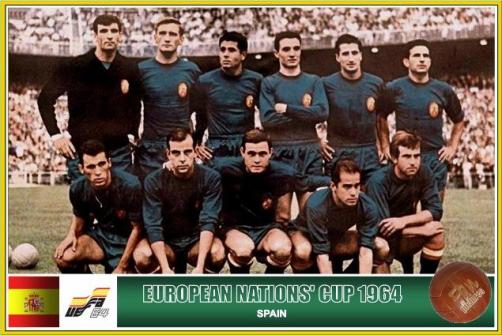
In 1964, during the second ever tournament, Ireland even got as far as the quarter-finals which were two-legged affairs, home and away. These quarter-final games took place in March and April of 1964 before the semi-finals and finals took place in the host country of Spain in the middle of June.

Ireland had had an inauspicious start during the first Euros in 1960. With 17 nations entering and a straight knock-out style of qualification without a group format, one pair of nations would have to play a preliminary round to even up the numbers. Ireland were drawn with Czechoslovakia and despite a promising start in the home leg with Ireland winning 2-0 they were eventually eliminated 4-2 on aggregate by an improving Czech side that would make it all the way to the World Cup final only two years later.

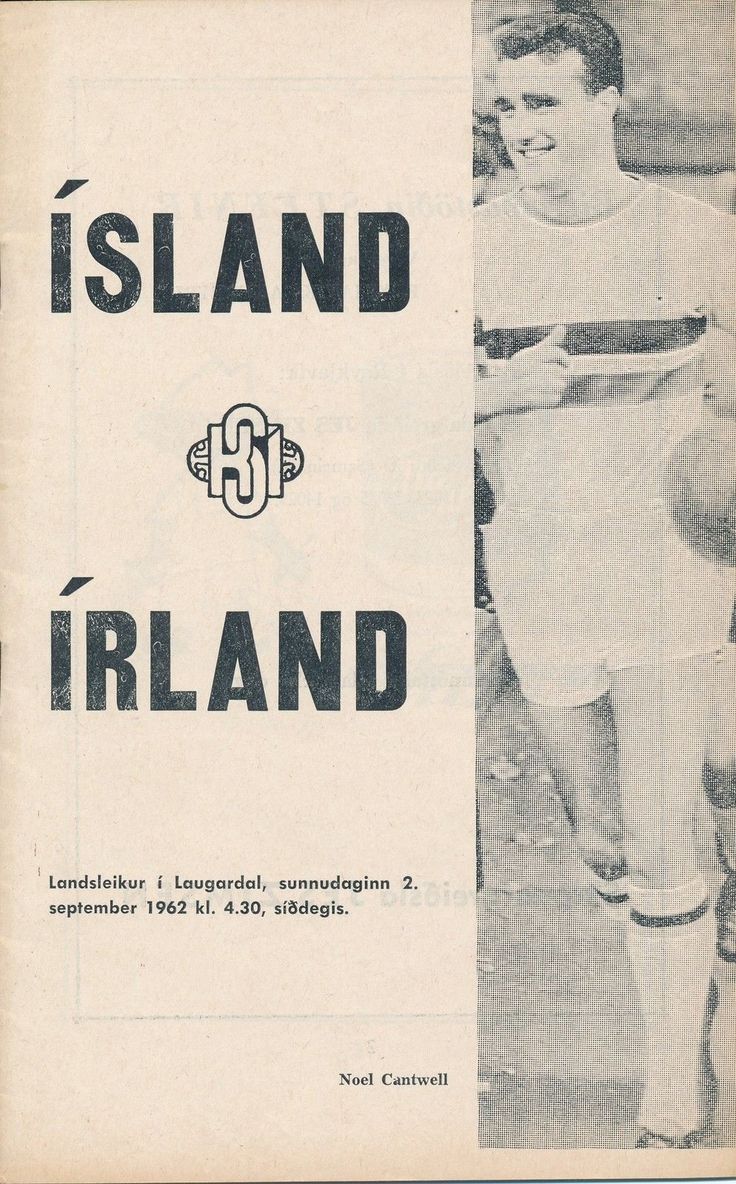
Four years later in 1964 there was thankfully no preliminary round for the Irish but the qualifying format continued as a straight knock-out competition. Round one pitched Ireland against Iceland with Ireland drawn at home first with the game starting well with Newcastle’s Liam Touhy getting Ireland off the mark after just 11 minutes and while Ríkharður Jónsson equalised for Iceland Amby Fogarty of Sunderland restored Ireland’s lead before half time. In the second half Noel Cantwell extended Ireland’s lead to 4-1 with two goals before Jónsson grabbed a consolation before the final whistle. Cantwell usually lined out at full back for his club Manchester United but was often employed as a centre forward for Ireland. Tall and well-built Cantwell made a good target man and also had a strong shot, he was Ireland’s usual penalty taker and scored an impressive 14 goals in 36 appearances, a record for Ireland that wasn’t broken until the heyday of Don Givens in the 1970s.

iceland v ireland

Ireland v Iceland with Noel Cantwell on the programme cover

A weakened Irish team made the journey to Reykvanik for the return leg, the side were without Giles in midfield and Tony Dunne in defence and had to settle for a 1-1 draw, Tuohy again on the scoresheet. This 5-3 aggregate victory set up a meeting with Austria in the second round.

Now Austria have never been Ireland’s easiest opponents, David Alaba’s fantastic strike in qualifying for Brazil 2014 will be fresh in the memories of Irish fans. Many of us will also remember the pair of 3-1 losses late in Jack Charlton’s tenure, including Ireland’s infamous pre-match preparation of a visit to Harry Ramsden’s fish and chip restaurant the day before the home game. Back in 1963 our record was not much healthier, it read played 4, won 1, lost 3, including a 6-0 shellacking way back in 1952. However, things would be different this time round.

Ireland were drawn away in the opening leg and were not at full strength, and there was significant trepidation ahead of the trip to Vienna with certain newspapers suggesting that a weakened Irish side would need a miracle to get a result and that the focus should be one of damaged limitation and preserving national pride. Ireland were without Cantwell and Tony Dunne who were not released by Manchester United and there would be three débutantes for the game, Bohemians’ right back Willie Browne (until Joey Lapira the last amateur capped by Ireland), Ray Brady of QPR in the centre of defence alongside Charlie Hurley and Ronnie Whelan Snr of St. Patrick’s Athletic at inside forward. The conditions however suited Ireland with the game being played in a downpour and Ray Brady in particular impressing. Well, impressing the Irish fans at least, the Austrians were not pleased with what they viewed as Brady’s rough play. His combative style also upset the Austrian players, so much so that he was kicked by one of the Austrian forwards who was luckily quick enough to escape retaliation from a furious Brady before the referee intervened to calm things down. Apart from Brady an inspired performance by Alan Kelly Snr. in goal denied the Austrians on numerous occasions and they were unable to force a goal and the game ended 0-0.

The controversy didn’t end with the away leg, while Ireland would be ultimately successful against Austria in Dalymount Park the game very nearly could have been called off. There are plenty of examples from Ireland’s football history of unjust decisions going against us in games and stories of hotels serving dodgy food or rowdy fans creating so much noise that the Irish players couldn’t sleep before a game. This time however it was the Irish fans who were the ones doing the intimidating. Over the course of the game, which Ireland won 3-2 there were no less than four pitch invasions! The old Phibsboro ground was packed with over 40,000 people, including a number who clambered up the floodlight pylons to get a better view so its not too surprising that there might have been some incursions onto the field.  The most controversial was the pitch invasion just before the final whistle. Ireland had been just awarded a penalty when a Joe Haverty cross was handled in box in the 89th minute. The crowd spilled onto the pitch yet again and had to be herded back by Gardaí and stewards just as had happened earlier when they encroached on the pitch at half time and also to celebrate the second Irish goal.

ireland-1963-crop

Ireland team v Austria

Duly intimidated by the boisterous Irish crowd the Austrian keeper Gernot Fraydl dived the wrong way and Noel Cantwell’s second goal sealed a famous victory for the Irish. They were through to the quarter-finals of the European Championships. It had not been a pretty game, Ireland had effectively played much of the match with only ten men after Blackburn’s Mick McGrath was kicked in the head early in the first half, McGrath had to get seven stitches in his scalp and although he togged back out for the second half he was pretty much a passenger for the rest of the game, stuck out ineffectively on the right wing. The Irish too, knew how to dish it out and the Irish Times correspondent described their tackling as “verging on the unorthodox”. The Austrians were furious after the game and their Coach Karl Decker threatened to appeal to UEFA to overthrow the result and force a replay due to the pitch invasions. The result stood however, and despite the intimidating atmosphere Ireland had played well with Millwall’s diminutive winger Joe Haverty coming in for special praise, Brady and Hurley had performed well in defence with the result that Alan Kelly in the Ireland goal was not unduly tested apart from Austria’s two strikes. While the central Europeans were perhaps the better footballing side the weather had been against them in the first leg and the Irish had out-competed them in the return fixture. Next up for the Irish were the Spaniards in the last 8.

The Spaniards were hosts of the ’64 semi-finals and finals with games split between Camp Nou in Barcelona and the Bernabeu stadium in Madrid. In 1960 despite boasting some scintillating talents and numerous stars from the all-conquering Real Madrid side the Spaniards had essentially withdrawn from the inaugural European Championships (or nations cup as it was then known)  when they had been drawn away to the USSR. Just two days before the game was to be played the Spanish team withdrew and when a furious Alfredo Di Stefano confronted the President of the Spanish Football Federation, Alfonso de la Fuente Chaos as to why they were not travelling to Moscow he was told, “Orders from above,”. Franco himself had intervened. The Soviets, who had militarily backed the Republican side against Franco in the Spanish Civil War would see their side progress. They would eventually become the tournaments inaugural winners, beating Yugoslavia after extra time in the final. It had been a disaster for the reputation of Spanish football and even for Franco himself, they would have to make amends in ’64.

The first leg of the quarter final would take place on 11th March 1964 in the Sanchez Pizjuan stadium, home of Sevilla. The Spanish national team had used this stadium as a home base many time before and since due to the undoubted passion and volume of the local Andalusian crowd. Things did not start well for Ireland, due to the FA Cup sixth round tie between Manchester Utd and Sunderland going to a second replay which was to take place two days before the Spanish game United refused to allow Tony Dunne and Noel Cantwell to travel. It also meant that Charlie Hurley who had been at the heart of the Sunderland defence would have to play his third game in five days.

It would be Hurley’s tired legs that would give away the first goal, he played a square ball which was intercepted by the pacey Real Madrid forward Amancio who easily converted past Kelly in the Irish goal. Josep Maria Fusté of Barcelona then added a second only a few minutes later. Ireland did try to get back in the game, a clever chipped pass from Giles sent Andy McEvoy away and the Blackburn striker converted his chance in the 22nd minute to get his first for Ireland. McEvoy was in the best form of his career at the time, he would finish that season as the 2nd top scorer in England’s top flight just behind Jimmy Greaves, however he had been crowbarred into previous Irish XI’s as a half back.

Amancio.jpg

Amancio of Spain & Real Madrid

The game belonged to Amancio, the Real Madrid right-winger was running rings around the Irish defence which included the exhausted Hurley and debut cap Theo Foley of Northampton Town. He grabbed his second of the evening on the half-hour mark before setting up Zaragoza striker Marcelino for Spain’s fourth on 33 minutes. Marcelino would add a second goal just before the final whistle, a shot deflecting off Tommy Traynor and past Kelly into the Irish goal. The game finished 5-1. The home leg in Dalymount could only be a formality, Ireland were out.

Despite the crushing defeat 40,000 Irish fans turned up in Dalymount the following month perhaps in some mad, deluded hope that a stronger Ireland side with home advantage might make a miraculous comeback. Tony Dunne and Cantwell were made available by Manchester United, there were recalls for Willie Browne of Bohemians and Johnny Fullam of Shamrock Rovers to add steel to the team, and best of all Spain were without the services of Amancio who had caused the Irish defence such difficulty in Seville. It was not to be though, Pedro Zaballa, the Barcelona winger in for Amancio scored two goals in what would be his only senior cap for Spain to secure them passage to the semi-finals. While the Irish had been committed and work hard throughout it says much that the stand-out player was once again Alan Kelly in goal.

Spain 64

The victorious Spain side of 1964

Spain would go on to win the tournament on home soil, defeating the USSR side that they had refused to play four years earlier in the final. The final score was 2-1 with the winner scored by Marcelino, the same striker who had put two past Ireland in Seville. Amancio would end up coming third in the voting for that year’s Ballon D’Or award, his international captain Luis Suarez came second. And Franco had his win against an arch-enemy. Upon their return the USSR coach Konstantin Beskov and team director Andrei Starostin, were summoned to a meeting at the Soviet Football Federation after a furious Nikita Khrushchev had watched the game on TV and seen pictures of a smiling Franco beamed around the Soviet Union. They were both fired from their posts.

As for Ireland they would meet Spain again the following year in qualifying for the 1966 World cup, losing out in a controversial play-off leg in Paris. For the next European Championships qualifying groups had been introduced but the Irish team that had promised so much was now in decline. Players like Joe Havery, Amby Fogarty, Noel Cantwell and Charlie Hurley who had all been so influential were in their 30’s and coming toward the end of their careers. Ireland were also severely restricted compared to other nations, as we’ve seen there were no guarantees that key players would be released by British clubs, the team manager Johnny Carey was little more than a glorified trainer with little power except to give a pep talk to his hastily gathered players before the game. The Irish team was still selected by an FAI committee and it wasn’t until 1969 that this changed with the appointment of Mick Meagan as manager. It wouldn’t be until 1988 that the Republic of Ireland would have a side that would reach the last eight of the European Championships again.


This first appeared on backpagefootball.com in June 2016


Harry Willits – the Darling of Dalymount

Co-written with Brian Trench

When Harry Willits finished his first season as Bohemian captain in spring 1916 he had other major responsibilities on his mind. He had joined the Royal Dublin Fusiliers in late 1915 “for the duration of the war” and soon he would be sent to the western front in France during the Battle of the Somme.

He had followed his friends and several Bohemian colleagues in signing up for the army. His choice was the Commercial Battalion of the Dublin Fusiliers, established to cater for young men of the “commercial class” and farmers.

Willits was not the military type, according to his daughter Audrey, still living in the family home aged 93. But English-born and a civil servant, he moved in circles where enlisting for military service would have been regarded as a matter of duty.

He was promoted to corporal in February 1916, three months after enlisting. According to military records he became a sergeant in July 1916, though he was already identified in a June 1916 report of a cricket match between King’s Hospital and 10th Dublin Fusiliers as “Sgt Willetts”, bowled out for a duck.

He had a short period – three months – of active military service, yet he lived all his days with the consequences of it. In October or November 1916 he was wounded in the thigh, and he spent several months in hospital in southern England before returning to Dublin, and to Bohemians. His injury was serious enough for amputation to have been considered.

He missed all of the football season, 1916-17, as he recovered from his injury. The mark of the wound remained visible and the strain of playing in a weakened condition took its toll on his health in later life.

Harry Willits was born in Middlesborough in 1889 and already made a strong impression as a footballer in his teens, when he played for Middlesbrough Old Boys, Cambridge House and the famous South Bank club where a team-mate was later English international George Elliott.

Willits’s father was headmaster of Middlesborough High School when Harry and George were pupils there. But it was apparently in order to get away from his over-bearing father that Harry sat the civil service examinations and then, when he was admitted to the service, chose to take up a post in Dublin. He worked in the Post Office stores and later, over several decades, in the Registry of Deeds.

He joined Bohemians just after the club had captured the Irish Cup for the first time in 1908. He was a regular first-team player over the following years in the forward line, at inside-left or outside-left, alongside internationals Harold Sloan and Johnny McDonnell.


In spring 1916 he played football and cricket for the Dublin Fusiliers as well as captaining Bohemians. When he resumed service with Bohemians in late 1917, he was profiled in the Dublin weekly newspaper, Sport, as The Darling of Dalymount. The writer claimed there were many who came to Dalymount specifically to see Willits play.

Willits army updated

A feature on Harry in a 1917 edition of Sport

Tall and prematurely balding, he was a striking figure. He was best-known as a skilful passer and crosser of the ball, but also contributed goals, including some from the penalty spot. Willits and Johnny West were a potent partnership at inside- and outside-left. (West was also a popular baritone singer, who performed at summer evening ‘promenades’ in Dalymount during the war years.)

Willits lived for a time near the Botanic Gardens with his mother, who had moved to Dublin following the death of Willits’s father. In 1919, however, Harry married Annie ‘Cis’ Wilson and with her inheritance they bought a house in Lindsay Road that remains in the family nearly a century later. The furniture includes a large dining-room sideboard that was a wedding gift to Harry and Cis from Bohemians, and a mark of the high esteem in which the club held him.

Willits was Bohemian captain again in 1920-21, when he was reported to have had a “new lease of life” as a footballer. Now in his thirties, he was prominent also in the Bohemian team that won their first League of Ireland title in 1923, and was selected with four other Bohemians for the new league in their first representative match against their Welsh counterparts in 1924. Willits played for club and league alongside Christy Robinson, who had a very different military record as a member of the IRA during the War of Independence.

Willits program final

Harry stars in the first ever inter-league game against the Welsh League

Some newspaper correspondents suggested that, but for his English birth, Willits might have been selected for Ireland. From 1925 onwards, he was playing with Bohemians’ second team and scored in a 4-0 win over Dublin University (Trinity College) in 1929, when he was 40. He featured in a short Bohemian’newsreel’ of 1930 as a “model Bohemian” who was “still going strong” and “a sportsman to the core”. Nearly fifty years old, in April 1938, he lined out for an Old Bohs team in a charity match in Dalymount against an Old Rovers side.

Even before his playing days with Bohemians finally ended, Willits became involved with the club’s Management Committee, also later the Selection Committee, and he served as Vice-President.

From the 1920s Harry Willits was a keen and competitive tennis player, being club champion in Drumcondra Tennis Club several times over the period 1923-33. He served also as club president and vice-president.

A man of routines, he always had two books on loan – one fiction, one non-fiction – from the Phibsborough Library. He dressed formally, in suit, tie and hat, and walked from his home to the Registry of Deeds in King’s Inns, responding to the frequent greetings of Bohemian fans in the streets. He practised calligraphy and did charcoal drawings.

His daughter Audrey and son Alec were both kicking footballs with their father in the family’s Glasnevin garden from early days. Alec played briefly for Bohemians first and second teams in the 1940s, but could not live up to what was expected of him as his father’s son. He later played for the Nomads.

Audrey applied her kicking skills to keeping goal for Pembroke Wanderers hockey teams for many years, appearing also for Leinster provincial teams and serving many years in the club’s committees.

From 1937, as Audrey recalls, Harry Willits developed asthma due to the strain of living with a war wound and this had a serious impact on his quality of life, also taking a financial toll. Harry had to reduce his work to half-time, which also meant half-pay, and Audrey remembers that the family often struggled to get by.

Despite this, Willits continued his involvement with Bohemians, as club officer and selector, and even – up to the age of 60 – as a coach. He was actively associated with Bohemians in one capacity or another for over forty years. He died in April 1960, aged 70, and is buried with his wife in Mount Jerome Cemetery.

This post originally appeared on the official Bohemian F.C. website in May 2016. Co-written and researched with Brian Trench as part of an ongoing series on Bohemians players from the First World War to the end of the Irish Civil War

A journey into non-league: Whyteleafe FC v Chatham Town

A couple of weeks ago a good friend of mine was running the London marathon for charity (it’s a very worth cause and you can donate here) and myself and my friend Andy decided to head over and do our bit to support him. Whenever I’m out of the country I try to catch a game while I’m away, or at the very least visit a local stadium or club museum. In England I’ve done the Premier League games before and on one of my last visits to London I caught a Championship game at the Valley between Charlton and Burnley where Charlie Austin scored a screamer. This time we went for something a bit further down the football pyramid, we wanted to check out a non-league game.

For the duration of our short stay we were based in Honor Oak. For those unacquainted with the southern extremities of Greater London that’s about midway between Peckham and Dulwich. For this reason our initial plan was to head to a Dulwich Hamlet game but as luck would have it the Hamlet were playing away so we needed another alternative.

d78b3cba-c2b4-449a-b302-b33e8d879512

View out to London from One Tree Hill in the middle of Honor Oak

In previous times we might have actually been forced to do some research, however thanks to the global interconnect-ability offered by Twitter Andy simply tweeted at one of the non-league twitter accounts and we were soon inundated with offers. One that caught our eyes offered us a warm welcome at a club near to where we were staying and the promise of some good beer in a rather unorthodox pub. We were sold, we were off to see Whyteleafe F.C. take on Chatham Town.

On a clear, chilly afternoon we set out at a leisurely pace and made our way out by train to Whytleleafe, a village in Surrey not far beyond Croydon. We were meeting Tim, our twitter contact and his mate Steve, in the Radius Arms for a pre-match pint before a classic 3pm Saturday kick-off. We arrived at the Radius ahead of a delayed Tim and could see why the “pub” is somewhat unorthodox, it’s housed in a converted “greasy-spoon” café and at most can seat about 20 people along its bar stools and tall benches. They do good beers and despite the somewhat early hour we went for two pints of ale followed by a couple of a very tasty local porters. Tim and his mate Steve had arrived by this stage, both local lads from the Croydon area. Tim somewhat surprisingly is a West Brom fan and a regular at the Hawthorns but attributes this to family connections to that part of the world. So far the pub and the warm welcome had been all that we’ve been promised so we’re looking forward to getting to the game.

The ground was within the Radius of the pub (sorry) and was located up a pleasant verdant pathway leading to a somewhat secluded entrance. Upon arriving in the car park what you first notice are the two modern full-size pitches. Directly ahead of us two schoolboy teams were in the middle of a game while to our right was the main pitch. Both surfaces were good quality 3G surfaces that are regularly hired out to local clubs and schools and would put a pitch like the one at Oriel Park to shame. We passed through the turnstiles, (£9 tickets, £2 a programme) which are an incongruous vivid red due to the fact that they were bought from Stoke City’s old Victoria Ground, most of pitch is shaded by high trees and at one end is the larger of the stands, built in 1999 for the club’s first round FA Cup match against Chester City, then a league side and to date the biggest gate in the club’s history.

It was the last game of the season and somewhat of a dead rubber, both Whyteleafe and the visitors, Chatham Town were safe in the Isthmian League Division One South but there was still a couple of hundred punters (later confirmed as 288) through the turnstiles.  Whyteleafe are celebrating their 70th anniversary this year, Chatham Town are considerably older having been formed way back in 1882. They also have somewhat of a giant-killing history having reached the quarter-finals of the FA Cup in the 1888-89 season, defeating Nottingham Forest along the way. Perhaps it was their Victorian era pedigree but Chatham started far quicker, their number 9, Luke Medley dominating proceedings from the get-go. Quick and powerful with a good touch Medley had Chatham 1-0 up after only three minutes. Whytleleafe were playing the better football, O’Leary at the back, Clayton and Lyle all looked good ball-players but Chatham had their game plan working; be combative and keeping looking to bring in the physique and pace of Medley up front.

It paid dividends again after 22 minutes, Medley getting in for his second although you were left with the feeling that the Whyteleafe keeper Adam Highsted could have done better, he looked ponderous in goal, unsure whether to try and close down Medley or hang back. Shawn Lyle got one back for Whyteleafe almost immediately and that was followed up by a goal from Sam Clayton only minutes later, we were back 2-2. But we went in at half-time with the hosts 4-2 down, Luke Medley completing his hat-trick from the penalty spot after 38 minutes before Austin Edwards scored for Chatham Town again just before the break. It was a clear penalty and it’s worth noting that although there were some tough calls including the penalty decision to be made the referee ran the game well and was a calm and authoritative presence on the pitch.

Now while the Radius had been a good spot for pints it hadn’t really been somewhere for food despite it’s status as a former café, this did however provide me with the opportunity for a personal footballing first. For you see, despite over 25 years of attending football matches I’ve never had a pie at a game. You don’t tend to find pies as a food option at League of Ireland games, burgers, chips, hot dogs (usually Denny jumbo sausages in buns) and even crepes a couple of times at Belfield but not pies. I went for a somewhat unappetising looking steak and kidney pie (the other option was a twix) and ordered a pint of ale in the clubhouse. The pie was actually surprisingly tasty and the pint was rather good too. The clubhouse atmosphere was jovial and welcoming despite the score, it had a well-stocked bar, some comfortable looking couches and a pool table, a set up that would be envied by a number of League of Ireland clubs I could name. It also had a fair amount of Crystal Palace memorabilia on the walls. Palace would be the main local club and Alan Pardew is probably Whyteleafe’s most prominent ex-player.

Having spent the first half leaning on the touch line railing we decided to move behind the goal for the second half. Almost immediately we got talking to two more senior gents who were Whyteleafe supporters and on hearing our accents introduced themselves as fellow Irishmen. One in particular professed his continuing interest in the League of Ireland despite being in England for over 40 years and started enquiring about Shamrock Rovers recent performances.

The second half was somewhat more subdued, apart from the six goals of the first we had one late-on to confirm Chatham Town’s victory and a penalty to Whyteleafe that was well dsaved. We moved back to the warmth of the clubhouse for a final pint and a discussion of Leicester’s chances in the last few games before catching our train back.

Having only previously experienced English football in the top two divisions I can see the growing appeal of non-league football, indeed it will strike a chord with many League of Ireland fans who will understand the draw of supporting a local team and know the warmth of supporting a club on a non-global scale. Although it is the eighth tier of English football was still of a decent standard with some nice touches of skill. And it still is in an overall pyramid and there is still that aspiration to progress and the ability to do so, just look at the progress of a club like Burton Albion from non-league to joining the Championship next year. There is always hope to dream. Whyteleafe are developing connections with bigger clubs up the football league and are apparently planning some big investments in their club with some committed local backer. We can only wish them all the best for the future.

Also a big thanks to Tim and Steve for their warm welcome and all those at Whyteleafe F.C. and at the Radius Arms.

College Football Classic – Ireland’s relationship with American Football

As many of you will know, this September 3rd Boston College and Georgia Tech will be taking to the Aviva Stadium to compete in the Aer Lingus College Football classic.

There are going to be over 20,000 American football fans crossing the Atlantic for the game and tickets for Irish fans go on sale from April 6th. American football has been growing in popularity here in Ireland in recent years, if you visit any Dublin pub late on Super Bowl Sunday you can see that but there is a longer history connecting Ireland with the Gridiron game. In this post we take at some of those connection…

The Beginnings

The first ever College Football match took place way back in 1869 between Princeton and Rutgers Universities. President of Princeton at the time was the Scottish philosopher James McCosh, his Belfast-born son Andrew James McCosh attended the University in the 1870s and was part of the Princeton College Football teams that were College Football national champions in 1874 and 1875. So even way back at the beginnings there was a bit of an Irish connection to College Football.

American Football Comes to Ireland

There are reports of an American football game taking place in Ravenhill, the home of Ulster Rugby back in 1942 when two teams of American armed forces personnel played each other in front of the reported crowd of 8,000 spectators. The first game to take place in Dublin happened in 1953. Again this was between two teams of American armed forces personnel who were still stationed in England after the end of the Second World War. The two teams were called the Burtonwood Bullets and the Wethersfield Raiders, with the bullets running out easy 27-0 victors on the day. The size of the crowd was estimated at 40,000 and this was one of the first occasions that sports other than those controlled by the GAA were played in Croke Park since it became the organisation’s home.

aer-lingus-college-football-classic-3

Seeing as it was the first time that the sport had been in the city the American embassy even organised lessons for the press about the rules of the sport and ran special screenings of football games in the embassy offices. The game was organised as a successful fundraiser for the Red Cross and was even attended by the President of the day Sean T. O’Kelly.

More Games for Dublin

Ireland_VIPs_take_part_in_the_opening_coin_toss.-286x190There was quiet a gap between the game of 1953 and other visiting teams coming to the city. The next big game featured one of this year’s competing teams, Boston College, taking on the Army team of West Point Academy in Lansdowne Road in 1988, the year of the Dublin Millennium. There have been four further games since then, including two of the classic encounters between Notre Dame v Navy (in 1996 and 2012) as well as most recent game which took place in Croke Park game 2014 between Penn State and UCF. Croke Park also hosted NFL sides the Pittsburgh Steelers and the Chicago Bears in a pre-season game back in 1997.
 

The League of Ireland Footballer Who Made a Career in the NFL

st-louis-cardinals-neil-o-donoghue-474-topps-1982-nfl-american-football-trading-card-72155-p-224x300Neil O’Donoghue grew up in Clondalkin, Dublin in the 60’s and 70’s and did what many young men did, he kicked a ball around the streets of his home town. At the age of just 18 he was good enough to make his debut for Shamrock Rovers in the 1971-72 season. On the back of his performances he won a soccer scholarship to Saint Bernard College in Alabama, however the school soon closed down it’s scholarship programme and Neil moved to Auburn College, also in Alabama where he started to play football of the American variety. During this time he won “All American” honours as a place kicker in 1976 (this means they were selected by media and as the best players, in a season, for each position) before being drafted into the NFL by the Buffalo Bills in 1977. His spell at the Bills was short-lived and he moved to the struggling Tampa Bay Buccaneers in 1978. After two years in Florida Neil moved to the St. Louis Cardinals (now the Arizona Cardinals) for the longest stay of his career. In 1984 he set a Cardinals record by scoring 117 points in a single season and he finished his NFL career the following season having played 110 matches and kicked 576 points. He remains the most recent Irishman to play in the NFL.
Irish Teams Taking Up The Game

In the early 1980s American Football began to get greater coverage in Ireland and interest 17-286x191from Irish people, and American ex-pats in playing the game began to develop. By 1986 such was the interest that the Irish American Football League had been established. The following year the first full season was played with 11 teams participating with the top two teams competing in the annual “Shamrock Bowl”. The league is an All-Ireland affair and the most successful side to date have been the Dublin Rebels who have won 7 titles.

Watching Football

As interest in American Football has grown in recent years so has the demand to see games, especially the Super Bowl each February. Plenty of venues around the city now show the game, and its famous half-time show live, for the recent 2016 edition (Super Bowl 50) some of our favourite places like the Living Room, Harry’s on the Green, the Woolshed, The Boar’s Head, Doyle’s, and Sam’s were all showing the game, often providing American themed food and entertainment.

This first appeared on DublinTown.ie in April 2016


Bohemians during Easter 1916

In April 1916 Bohemians were coming to the end of a season disrupted by war, but in which they were rewarded yet again with the Leinster Senior Cup, their fifteenth win in twenty years. It took two attempts to secure the trophy from old rivals, Shelbourne. The first was on St Patrick’s Day, a scoreless draw watched by 6,000 spectators, the second on 1st April.
No Dublin clubs took part in the Irish League that season due to the war and several Bohemian players had enlisted with the army. But the club insisted that football should continue and they managed to maintain Dalymount Park as a playing pitch when some rugby and cricket grounds were taken over for relief works.

Half-back Josh Rowe was with the East Surrey Regiment and was wounded many times. At the end of March he was reported to be returning to duty after convalescence and, it was said, “he hopes to play football again”. Full-back J.J. Doyle had joined the Officer Training Corps in early 1916 but got leave to play for Bohemians in the Irish Cup semi-final, which Bohemians lost to Glentoran in Belfast.

Also involved in that cup campaign was outside-left Harry Willits, who was team captain in 1915-16. An English-born civil servant, he played during 1916 both for the Royal Dublin Fusiliers’ regimental team and for Bohemians. By the start of the next season, however, he was at the war front with the Dublin Fusiliers and in November 1916 was reported as wounded. He survived and was back with Bohemians in 1917-18. Bohemians’ squad in 1916, coached by the everlasting Charlie Harris, included two internationals, Billy McConnell and Johnny McDonnell, whose 1915 Irish shirt hangs today in the JJ Bar at Dalymount Park. Others included regular goal-scorers Ned Brooks and Dinny Hannon, and defender Bert Kerr, who had joined in 1915 and was to have a notable career with Bohemians, including as team captain. He also had a remarkable career as a pioneer in the Irish bloodstock industry.

On Easter Monday 1916, a Bohemian team travelled to Athlone to play an end-of-season friendly, as they had done for several years. So friendly was it that McDonnell and Hannon played for Athlone, in a team that included several army officers. (Hannon later won the Free State Cup with Athlone Town.) Neither team can have been aware of what was happening in Dublin as they played their game in bad weather (3-2 for Bohemians) and were later entertained at the Imperial Hotel and at a dance at the Commercial Quadrille Class. “The Bohemians expressed themselves highly pleased with their visit,” the Westmeath Independent reported. However, the trip was to end less pleasantly for the Bohemian team. Due to the Rising, train services were disrupted from Mullingar, and they had to arrange car transport back to the capital.

Their late return was reported in the Irish Times among the repercussions of the Rising: “Some of the [Bohemian team] members who lived on the south side of the city had to stay in Phibsborough for the [Wednesday] night and, after walking via Islandbridge, Kilmainham, Goldenbridge, Rialto, Crumlin and Dolphin’s Barn, these did not get home until Friday (April 28), at 1.30 p.m.”

While the Bohemian party were concerned about getting back to the city from Athlone the rebels were worried about the arrival of British Army reinforcements from the same location. Many of the sites occupied by the rebels were chosen for their ability to delay the troops coming into the city, most notably the engagement with the Sherwood Foresters at Mount Street bridge.

Bohs 1916 pic3

In Phibsborough members of B Company of the Dublin Brigade built barricades on the railway bridges on the Cabra Road and North Circular Road close to St. Peter’s Church. They even went as far as to try and blow up both bridges with gelignite.
While B Company was able to hold off a number of attacks from small arms and machine gun-fire, the arrival of artillery onto the Cabra Road (outside what is now the Deaf Village) and the use of shrapnel-loaded shells raining down on the bridges just yards from Dalymount Park and as far down as Doyle’s Corner meant that the Volunteers could not hold their positions. A number of civilians were killed by over-shooting shells, while 15-year-old Fianna Éireann scout Sean Healy was shot dead outside his Phibsborough home.
The rebels eventually abandoned their positions hoping to link up with Thomas Ashe in Finglas but by the time they got there he and his men had already left for Meath and the Battle of Ashbourne. Many of B Company found their way back into the city and some joined the garrison in the GPO and then Moore Street.

While there is no record of Bohemians fighting with the 1916 rebels, some Bohemians did work in the British administration during that period. Highest-placed of these was founder member Andrew P. Magill. He was an 18-year-old clerk in the Land Commission when he attended the club’s first meeting, and later a clerk in the office of the Chief Secretary for Ireland. He rose to become private secretary to Chief Secretary Augustine Birrell, who resigned in May 1916 after failing to predict or take preventative action to stop the Rising. Magill later worked in the post-partition civil service of Northern Ireland.
While Magill was serving the Chief Secretary, fellow-Bohemian Joe Irons, an army reserve who was called up when World War 1 broke out, was posted to the Vice-Regal Lodge in Phoenix Park, to what is now Áras an Úachtaráin, to protect the Viceroy.

This article was co-written and researched with Brian Trench for the Bohemian FC website where it appeared in March 2016. In later articles we will look further into the life and career of Harry Willits, report on other Bohemians who fought in World War 1, and tell the stories of some Bohemians who were IRA volunteers in the War of Independence.