A few thoughts on Millennial bashing

To begin with, a quick admission of potential bias, depending on which definition you read I am either just about a Millennial or just outside of this supposed generational, cultural catchment, born as I was in the early 1980’s. I finished school and started University around the turn of the Millennium and I grew up with the rapid, progressive changes in technology through that time so for the purposes of this piece I’m considering myself an old Millennial.

The dominant view of this generation is a pejorative one which views us as weak. We are lacking in focus, painfully sensitive to criticism or indeed any disagreement to our world view, naively idealistic and basically existing in some phase of arrested development where we forever remain overgrown children who cannot face, understand or process the realities of daily life. This tends to be joyfully prodded home on social media through things like memes contrasting a generation that came of age in the 1940’s going off to fight a war and a current generation who are upset by even the slightest challenge to them and who must then flee to their “safe spaces”. In this context we must understand that safe spaces are “bad” and only exist to coddle adults who should just learn to “pull it together” and get on with things.  Let me know if I’ve covered all the bases here folks.

The idea of successive generations being weaker than their forebears is one that is as old as history. The Greek poet Hesiod, writing somewhere between 750-650 BC makes this clear in his works like the Theogony  and Works and Days; here the descent of the “Ages of Man” sees mankind descend from a near-immortal co-habitation with the gods, a life filled with leisure, to the gradual indignity of short lives full of toil and suffering. This is echoed the epic poems The Iliad and the Odyssey which are ascribed to Homer. In these works Nestor, an aged Greek King often lectures the younger characters about the glories of his past and compares sufferings of the current generation of Greek heroes like Odysseus, with those of his youth, often emphasising his own bravery and that of his deceased contemporaries.

This focus on a glorious past makes a certain sense in these Greek texts, they were written around the 8th Century BC when the authors and audiences would have seen the gargantuan ruins of the vanished Mycenaean civilisation which had collapsed around 1100 BC. These abandoned palaces and citadels were testament to a vanished age of heroes, their knowledge and technologies having been lost by the time of the composition of the heroic epics of Homer. Surely the ruins of such a civilisation were the works of greater men, those closer to the divine?

1024px-lions-gate-mycenae

The remains of the mighty Lion gate at the entrance to the citadel of Mycenae

This theme is not just confined to writings and myths of ancient Greece. The idea of the decline of mankind from a position of heroic, near godlike status appears in Irish mythology as well. Well known mythological figures like Fionn mac Cumhaill and Cú Chulainn possessed supernatural abilities in strength and cunning, in the case of Fionn this is passed down the generations to his son Oisín. In one of the many tales told around the world about the pursuit of the fountain of youth, Oisín is taken by his new wife Niamh a daughter of a god, to the island of Tír na nÓg. Oisín stays on the island for what he believes to be only three years but then returns to the mainland to find that 300 years have passed. Fionn is gone and the sites of the Fianna’s power are in ruin. The people who inhabit Ireland at this point are not of the heroic vintage of Oisín, they are seen as lesser specimens and Oisín has to stop to help them with the building of a road as they are too weak to move a boulder. When Oisín tries to help he falls from his enchanted horse and ages rapidly before dying.

The parallels appear again and again in different cultures, an idealised heroic past contrasting sharply with a fallen, degenerated present. This trend persisted. Across Western Europe the Roman empire may have retreated and eventually fallen but the immutable objects of their power and engineering genius remained, theatres, aqueducts, temples and villas dotted the landscape even centuries after the legions had left and in their vacuum contests for power, war and plagues later emerged. The knowledge and organisation of Roman rule moved eastwards and it was only during the middle centuries of the last Millennium that swathes of western European rediscovered the writing and learning of this Classical past. Only with this Renaissance could western Europe return to rediscover this connection with a near forgotten past.

In these instances we can see societies to some degree living in the shadow of earlier triumphs, inhabiting ruins whose creation they cannot fathom. In a way it made sense to view current or successive generations as somehow a decline of previous standards. As people and societies not evolving but degenerating. But this is a world away from modern experience.

Present generations can see technological progress before our eyes, we are more advanced and connected in these regards than any previous generation. In societal terms the last two centuries or so has seen progressive social movements that have helped lead to the abolition of chattel slavery and a spread of democratic government including the enfranchisement first of working class men and later women. The last half of the 20th century witnessed a growing independence movement among those nations that remained colonies of European powers. There was also the rise of a global civil rights movement that began to agitate against repressive regimes and legislation from places as diverse as South Africa, Northern Ireland and the United States.

The so-called Snowflake generation do not look back on the past cowed by the looming monuments of fallen empires that they are unable to recreate. They simply do not need or want to recreate them. We can see through our historical prism that we have moved on in many ways from our previous generations, we acknowledge and cherish the rights that previous generations fought to secure in the knowledge that there is a distance yet to travel, that there is further progress to be made, rights to be secured so that they may be bequeathed to the next generation.

In the United States the generation of men who went to fight in World War II were often referred to with the moniker of the “Greatest Generation”, they had survived the poverty and want of the 30’s and helped to defeat the scourge of fascism in the 40’s. In the process  they protected American interests and ensured that the United States emerged from the war as the pre-eminent western power.

Their generation assumed a gravitas that subsequent generations could not match, yet as the last members of this group disappear, it is their children and grandchildren who seek to objectify the Millennial generation as “Snowflakes”. This “baby-boomer” grouping enjoyed the peace that followed WW2, and the benefits that this brought. This is not to say that everything from 1946 onward was plain sailing but the scale of horror of the preceding decades was not to re-emerge.

In Ireland the most recent decades have seen a cessation of wide scale sectarian violence, a far greater social liberalisation than a post war generation could ever have imagined and rapid economic growth (at times far too rapid). It would be disingenuous for any Irish baby-boomer to say that the country is in worse shape now than when they were born in the 1940s/50s/60s. Can anyone really hark back to the days of Catholic Church dominance, subsistence farming, car bombs, and a beer and biscuits economy? It was not better back in the old days but nor is it perfect today.

For Millennials items like sky-rocketing rents, increased costs for education, lack of job security, the remaining anachronisms of an Irish theocracy, such as the 8th amendment, and the re-emergence of the far-right are legitimate issues of concern. But yet speaking out about something like the quality or security of your lodgings is seen being a needy Snowflake. Not as being a continuation of an Irish tradition that dates back to at least the land agitation of the 18th Century through to the housing protests against tenement conditions that continued well into the 1960’s in Dublin.

The ancient Greeks looked back into the murky mists of history through the ruins that dotted their landscape and invented the stories of great heroes. As Patrick Kavangh put it in his poem Epic

Till Homer’s ghost came whispering to my mind.
He said: I made the Iliad from such
A local row. Gods make their own importance.

Today it is baby-boomer Donald Trump who leads America, his rhetoric harking back to an idealised past that never existed. In his clumsy, repetitive speech he makes his heroes and myths. He invokes the past, the dead, and flanks his Oval Office desk with portraits of Thomas Jefferson and Andrew Jackson, harking back to an ideal of America that ignores slavery, the Civil War and the Trail of Tears. His rallying cry remains “Make America, Great Again”, which implies it is not great now, it can only become great again by going back, by undoing. The future of a nation rests on the nostalgia for a world that never existed among a dying generation. This is the Millennials’ inheritance.

In Britain likewise an exit from the EU voted for overwhelmingly by middle-aged and older Britons. When old securities vanish, when a minority can vote in Trump, when a gerontocratic block ensures that a majority of young Britons who want to be a part of the EU won’t have that opportunity then yes a Millennial generation will feel aggrieved.

Every human generation has been compared unfavourably to its predecessors, even when every measure of progress suggest that this is baseless and unjust. Millennials are in good company and have a growing means to express themselves. As the stakes get higher, as far-right forces gain prominence in more nations generation snowflake won’t be melting away. In the end I think future generations might even be thankful for that.

The main photo image is of the Mask of Agamemnon, a gold death mask of an unknown Greek discovered at Mycenae. It was named the mask of Agamemnon by Archaeologist Heinrich Schliemann.

World Cup of Hockey- Toronto 2016

If your old enough you might remember a bit of a fad in the early to mid 90’s for Ice Hockey in Ireland, well when I say Ice Hockey I really mean roller hockey; kids on roller-blades in oversized Chicago Blackhawks jerseys skating around suburban cul-de-sacs with hockey sticks. There were a few possible explanations for this fad, the growth in popularity of inline skates, the Mighty Ducks film franchise, as well as hockey cropping up in the likes of Wayne’s World, even that brief moment when super-baggy Ice Hockey jerseys were fashionable for about a month in 1995. For me the hook was the Sega mega-drive and the video game classic that is NHL 94, all Hockey Organ music and 16-bit power play bliss. The game was so popular it even crops up in the Vince Vaughan/Jon Favreau comedy Swingerwhere Vaughan’s character notes the exceptional video game talent of Chicago’s Jeremy Roenick.

Following actual live, non-sega based American sport was a bit harder for an Irish kid in the 90’s. There was the time difference, there was trying to find NHL or the NBA on television. For basketball there was sporadic coverage on Channel 4 and I seem to remember Eurosport(?) showing the NCAA Basketball championships for a couple of years. Dial-up internet wasn’t exactly ready for live streaming of sports so anything else tended to be going around to friends houses where they had good Sky Sport packages to see the odd game.

However I’d always kept a passing interest in the NHL and have been known to indulge in slightly boozy hockey conversations with Canadian tourists in some of Dublin’s finer hostelries. On that basis I had to try and catch a game on a recent trip to Toronto. It was mid September and most days were balmy mid 20’s so not exactly Ice Hockey weather and it was still a few weeks out from the start of the NHL season so no chance to see the Toronto Maple Leafs. The Maple Leafs are one of the “Original Six” founding members of the NHL and have 13 Stanley Cups to their name, though they haven’t won the title in the fifty years since the expansion of the League.

The Maple Leafs play their home games in the impressive indoor arena of the Air Canada Centre, located in downtown Toronto just behind Union Station. The arena also hosts Canada’s only existing NBA team, the Toronto Raptors. They can apparently change over from one sport to another in the space of just six hours. During my visit the Centre was also hosting the Ice Hockey World Cup, that’s the entire World Cup schedule, kind of like the idea for the Centenario in Montevideo for the first football World Cup in 1930.

a9f7051e-e55c-44e5-beb3-acdaffa6bf25

Toronto Maple Leafs hall of famers

The hockey World Cup isn’t really comparable with the current version of the FIFA World Cup however, it features only 8 sides for a starter, it occurs somewhat irregularly and features a couple of what you might term hybrid teams. This edition was the first World Cup held since 2004 and only the third ever overall. The World Cup itself was a successor to the invitational Canada Cup tournament that had been held from the 1970s onward. The idea is that in future the World Cup will be held regularly in four year cycles in the month of September. There are a few obvious advantages to this, the International Ice Hockey Federation’s (IIHF) annual World Championship tends to take place during the playoffs of the NHL season meaning that many top players are not released to take part. As the World Cup is organised by the NHL before their pre-season begins it will avoid this conflict and in theory ensure the best players can compete.

Those taking part in the tournament include International Hockey’s “Big Six” of the USA, Canada, Russia, Czech Republic, Sweden and Finland as well as “Europe” a team made up of the best of the rest European players from Austria, Denmark, France, Germany, Norway, Slovakia, Slovenia and Switzerland. The eighth side was North America, a Canada/USA selection of players aged 23 or under which also had the effect of making the individual Canadian and USA teams to be made up of players aged 24 and over.

57e3baec-e727-4427-b69b-e877c81fee5a

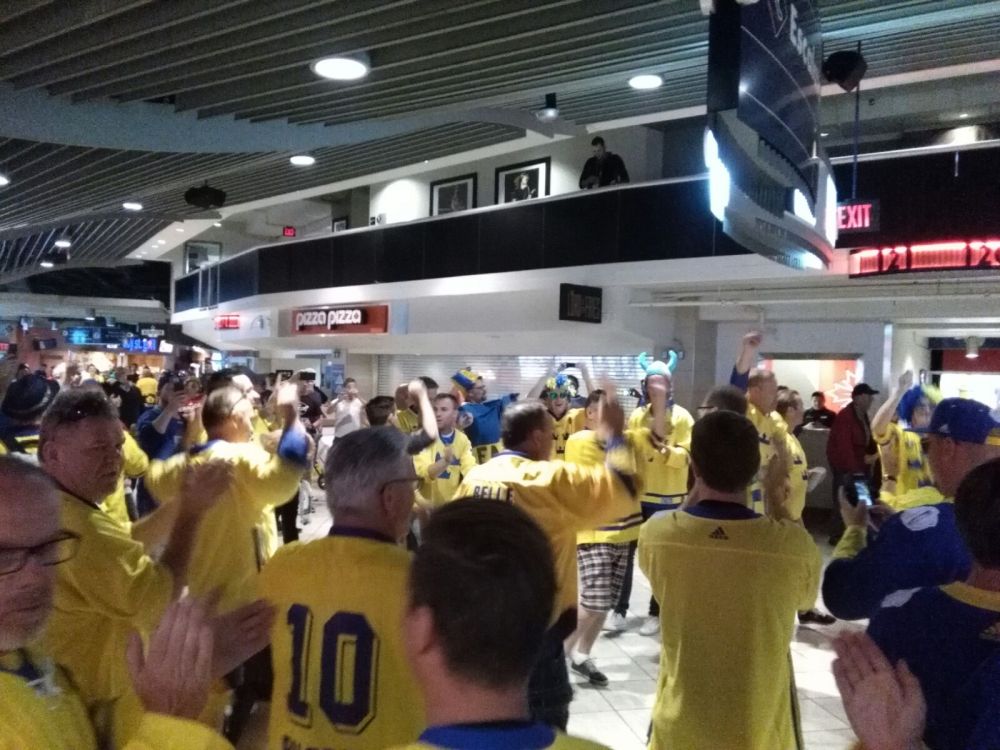
Swedish fans singing before the game

It was refreshing to be in a North American city and experience something close to the atmosphere you might find in a European city ahead of a big qualifying game in football, if not quite a full-on tournament atmosphere. There were plenty of yellow and blue clad Swedish fans along with reds of the Czech Republic and the blues of Finland populating the bars and patios of downtown Toronto and they were in full voice. Any game involving Canada, the USA or indeed the North America side were all sold out but we did manage to get tickets for the nosebleed seats for the Sweden v Finland game.

79a5f077-2f20-4adb-9887-3999b92ad328

The puck drop was set for 3pm and it felt we were swamped with Swedish fans. This being a modern 20,000 seat venue in North America there were plenty of places to grab merchandise and a drink. They do of course allow you to supersize that, you could get a 25oz beer which is a close to about two pints I think.

As I said the arena capacity is just under 20,000 so it was disappointing that the crowd was only around the 12,000 mark. I’d blame the pricing, we’d been cheapskates and got tickets for about $30 each and the seats all around us were full with a fair few locals in among the Swedes and Finns. However the more expensive seats, in the $100+ price range remained mostly empty.

bb7f0f92-4217-40df-9657-6158a9e81446

Team line-ups

Both squads (apart from a couple of Russian based players in Finland’s party) were comprised of NHL based players. The most prominent probably being the Swedish twin brothers Henrik and Daniel Sedin who both play for the Vancouver Canucks and for Finland it would probably be Minnesota Wild captain Mikko Koivu or goaltender Tuukka Rask.  The Finns started the brighter and seemed to play the better hockey in the first period but we weren’t to be provided with a goal. We were kept interested with another round of beers and some chanting from the predominantly Swedish crowd.

In the second period the Swedes came into the game a bit more with the Sedin brothers combining to set up Anton Strålman for the first goal. While Finland came back into the game and forced Sweden’s goal-tender, Henrik Lundqvist of the New York Rangers into a number good saves. The Finns continued to press for an equaliser in the final period, even committing Rask their goalie forward only to be caught out by a very late Swedish counter-attack with Loui Eriksson of the Vancouver Canucks scoring into the open goal. The win guaranteed the Swede’s progression from the group stages while Finland needed a miracle, something their crestfallen fans seemed well aware of.

319dfca6-cfb0-4281-a2fd-d906406ede16

Some disappointed Finland fans

Sweden would be knocked out the semi-final be the Europe selection, who would be defeated in the final by the heavy favourites Canada. It gives a Canada some what of a clean sweep as they are now World Champions, World Cup winners and Olympic Gold medallists and clearly the most dominant hockey team in the World. If the World Cup does gain some traction and some manages to become a regular fixture and not just a glorified warm-up to the NHL season then it could be the international competition with the highest player quality levels.

While not quite a global festival of sport it was still a chance to see some of the best players of the sport in international competition. Watching and reading the media coverage of the tournament there did seem a genuine pride and indeed novelty for the players taking part, many of whom had previously had scant opportunity to represent their nations.

Before they were famous: Bayern Munich

One of Pep Guardiola’s last acts as manager of Bayern Munich was to lift the DFB Pokal trophy, it had already been announced that he was on his way to England and Manchester City but the delight on Guardiola’s face showed that he hadn’t checked out just yet. He was enjoying the occasion; he was, after all, a serial winner relishing his last trophy as manager of one of world’s biggest clubs. The league title had been wrapped up nearly two weeks earlier when the Bayern players raised the famous “salad bowl” trophy. This made it Guardiola’s second double of his Bayern tenure and marked a record breaking fourth consecutive Bundesliga title. Despite this unprecedented success there were some who felt the club should have won more; for some, only reaching three consecutive Champions League semi-finals meant they had fallen short. Under previous coach Jupp Heynckes they had enjoyed even greater success winning a treble of League, Cup and the European Cup.

Such is the dominance of the very elite clubs in various European Leagues it can feel that the league winners have been as good as decided before we even reach September. Perhaps this season will bring some surprises but in Italy, Juventus are heavy favourites to once again retain their title. Likewise, Paris Saint Germain in France and Bayern Munich in Germany. However, while Bayern’s dominance might seem preordained it was not always thus.

Formed in 1900 Bayern had enjoyed “early” successes, winning a couple of regional titles in the 1920’s before winning the last National title (1931-32) before the German sport system was taken over by the Third Reich. This maiden title for the club was contested in a knock-out format between the top two sides from each of the regional leagues and at the time, football in Germany was still technically an amateur sport. It would be over 35 years before the Bavarians would win another league title.

When the first Bundesliga season began in the late summer of 1963 Bayern Munich were not even among its member clubs. A decision had been made the year earlier to do away with regional leagues and to institute a proper, professional, national league and the winners of the Oberliga Sud (Bayern’s regional league), were their city neighbours TSV 1860 München. Although Bayern finished third that year which should have been enough to qualify them for the new national Bundesliga, the German FA did not want two teams from the same city represented so 1860 progressed at their neighbours’ expense.

moore-tsv

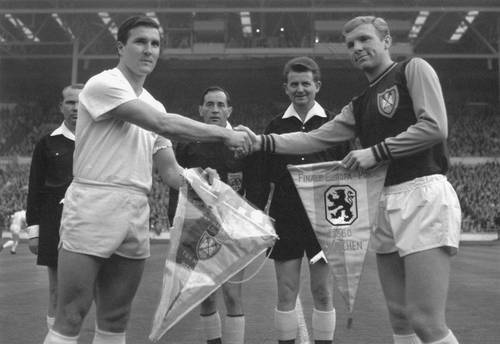
TSV 1860 München had been founded as a sports club, not as their name suggests in 1860, but as a gymnastics club in 1848. Due to a political decree during tumultuous times they were disbanded but officially reformed in 1860 with their football division beginning a year before Bayern in 1899. The club enjoyed great popularity in their debut season in the Bundesliga, averaging a respectable average attendance of 34,000 at the Grünwalder Stadion which they shared with Bayern. In fact, they had been Bayern’s landlords there from 1925 until the Second World War when the stadium was bombed and badly damaged in 1944. During the debut Bundesliga season, they would win the German Cup final against Eintracht Frankfurt and went on to contest the following year’s Cup Winner’s Cup final, losing 2-0 to West Ham.

Far from being one of Europe’s leading clubs Bayern at this stage were not even the biggest club in their city. They were eventually promoted to the top flight for the 1965-66 season and managed to win the German Cup that year while finishing a very respectable 3rd place in a league that was eventually won by their city rivals 1860. That Cup win was Bayern’s first major trophy in almost a decade. In the final they defeated Meidericher SV by 4 goals to 2, the fourth was scored by one of the club’s precocious young talents, a twenty-year-old by the name of Franz Beckenbauer.

Beckenbauer was not the only young star making waves for this upwardly mobile Bayern team. The club’s shrewd President Wilhelm Neudecker, a wealthy construction magnate had begun investing in the side to turn them from a regional yo-yo club into one that could deliver success. In 1963 the Croatian Zlatko “Čik” Čajkovski, who had starred as a player for Partizan Belgrade and Yugoslavia in the 40’s and 50’s, was brought in to coach the then second tier side. This represented something of a coup as Čajkovski had coached FC Köln to the title in 1962 yet here he was taking a step down to coach a side that hadn’t yet made the Bundesliga. But Bayern had some exceptional young talent coming through; Beckenbauer had joined as a youth in 1959 having stormed out of the youth ranks of 1860 after a row broke out during the final of an under-14’s tournament. A teenage keeper named Sepp Maier had made his debut the year before Cajkovski’s arrival and then in 1964 President Neudecker presented his new coach with his latest young prospect, an 18-year-old called Gerd Muller. To begin with Cajkovski was unimpressed, dismissing the somewhat tubby 5’9” striker with the following statement to his club President: “I’m not putting that little elephant in among my string of thoroughbreds”. The little elephant, however, knew where the goal was.

bayern75

During the late 60’s and into the early 70’s Bayern either developed or signed from lower the leagues players of the calibre of Beckenbauer, Muller, Maier, Paul Breitner, Franz Roth, Uli Hoeneß and Hans-Georg Schwarzenbeck. Not only would all of these players win multiple leagues, cups and European Cups but they would also help the West Germans defeat the great Dutch team in the World Cup final of 1974. They had hardly cost Bayern a penny in transfer fees.

After the success of their debut Bundesliga season Bayern had the added distraction of a first European campaign to deal with due to participation in the Cup Winners Cup. They managed to out-do the previous efforts of their neighbours 1860 by going on and winning the competition defeating Rangers in a tight final after extra time. The winner came in the 109th minute from 21-year-old midfielder Franz Roth who would develop a habit of getting crucial goals in major finals.

By the end of the 60’s Bayern were truly in the ascendancy, there were coaching changes with Cajkovski departing for Hannover and being replaced by Branko Zebec, his former Partizan and Yugoslavia teammate. Zebec had coached Dinamo Zagreb to victory in the Inter City Fairs Cup in 1966-67 and introduced a more structured defensive approach with Bayern. During Cajkovski’s last season in charge the club had scored an impressive 68 goals in 34 games but had conceded the worryingly high number of 58. In Zebec’s first season they scored 61 (30 coming from Muller) but conceded a miserly 31. They finished eight points clear of Alemannia Aachen to comfortably win the league title. They followed this up with a 2-1 Cup win over Schalke (two more goals from Muller) to win the first double in Bundesliga history. Zebec also made Beckenbauer captain that season and the young midfielder began experimenting with his distinctive sweeper type role with which he would become synonymous.

A three in a row run of league titles at the beginning of the 70s showed how this young group was maturing, they added to their ranks bringing in a young, attacking full-back named Paul Breitner, and in attack Uli Hoeneß, who would help shape the club on and off the pitch for the next five decades. But Europe was a learning curve for the young side. In the 1972-73 season, they were well beaten 5-2 on aggregate by eventual winners Ajax at the Quarter final stage. The following year they were almost eliminated in the first round by Swedish champions Åtvidaberg before narrowly beating East German champions Dynamo Dresden in the next stage. They met Spanish champions Atletico Madrid in Brussels in the final, which was forced to a replay after a nervy 1-1 draw. In the replay, however, Bayern showed a devastating competitive edge, hounding the Spaniards in possession, counter-attacking at pace with a frightening directness, with Muller and Hoeneß scoring two each.

Back at home in the Bundesliga, Bayern’s great rivals of the 1970s, Borussia Mönchengladbach, were the dominant team as Bayern struggled domestically, the demands of Europe taking their toll. In 74-75 when Bayern defeated Leeds in a controversy filled final the Bavarians finished a disappointing 10th. But midfielder Rainer Zobel described how, despite struggling to beat average Bundesliga sides, Bayern could raise their game in Europe. Leeds fans still feel aggrieved when the final of 1975 is mentioned, often highlighting the stunning Peter Lorimer strike that was disallowed as evidence of their bad luck. What is seldom mentioned is that Bayern lost two players to injury caused by rough tackles from Leeds players, defender Björn Andersson after two minutes and Uli Hoeneß just before half-time. Watching the footage back, an aging Leeds side had no answer to the stylish build-up to Roth’s goal in the 71st minute or when, ten minutes later, Müller got goal-side of his marker and scored at the near post from six yards out.


Having defeated first the champions of Spain and then the champions of England in their consecutive finals, Bayern then faced St. Etienne, the champions of France, and one of the finest sides in the history of the French League. Hampden Park was the venue in 1976, but there was to be no repeat of the 1960 final goal-fest. St. Etienne were unlucky with Bethanay hitting the cross-bar and Santini hitting the famous “square posts” of the Hampden goals. Bayern however, while not dominant, displayed the sort of mental toughness and doggedness that have become synonymous with German teams. Muller had a goal ruled out for offside, before Beckenbauer squared for Roth to score in his second consecutive final.

The bulk of these successes were won by a core group of players who had come through the club ranks as youngsters, however the club were not averse to splashing the cash when necessary; Jupp Kapellmann was brought in for a German transfer record from FC Köln in 1973, the same year the club snapped up Swedish international Conny Torstensson after he impressed against Bayern in the early rounds of the European Cup. Parallels with a modern Bayern can be seen with a locally developed core of players (Lahm, Thomas Muller, Alaba, and even a returning Mats Hummels) complemented by the best talent bought in from Germany and further afield.

Nowadays, Bayern are based in the ultra-modern Allianz arena which was initially shared and co-owed with neighbours 1860. However, in 2006 Bayern’s one-time landlords were forced to sell their share of the stadium rights to deal with their financial problems. While construction magnate Wilhelm Neudecker is long gone the Bayern boardroom is now filled with former players and blue-chip commercial partners; alongside Executive board members like Karl Heinz Rumminigge sit Triple A corporate representatives from Adidas, Audi and Allianz which helps explain the club’s rude financial health. The massive financial clout of Bayern and their ability to cherry-pick the best of their opponent’s players has meant that it is sometimes hard to envision a Bundesliga that was not the domain of the Bavarians, but thanks to strong support from an ambitious club president, excellent scouting networks, improvements in coaching and a once in a lifetime group of players Bayern went from the Second Division to European powerhouse within the course of a decade.

This post originally appeared on the Football Pink

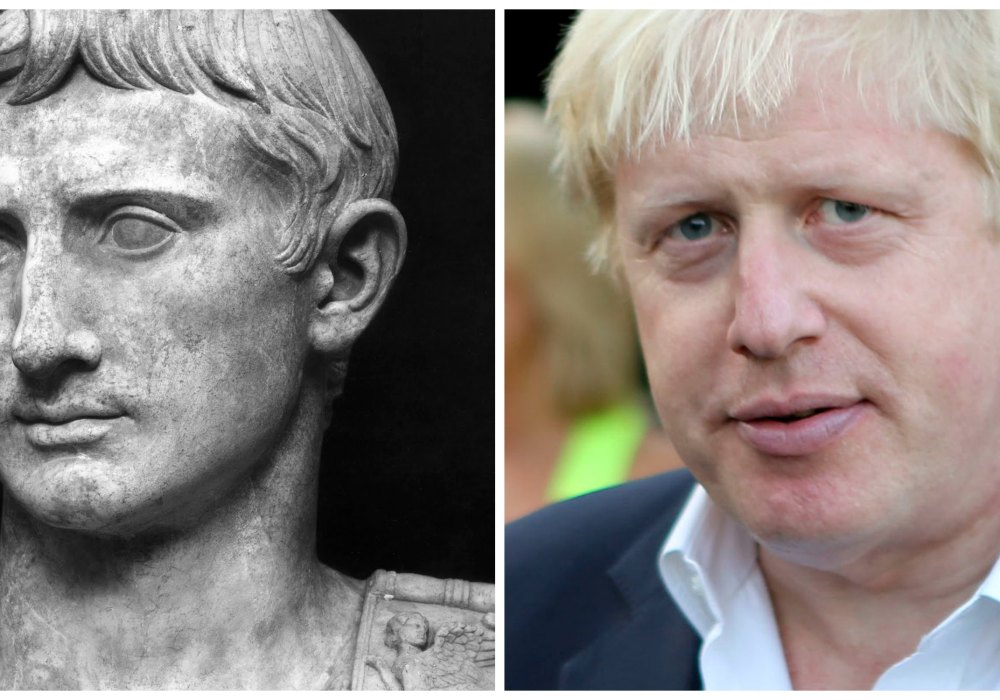
Boris – lessons from Ancient Rome

Memories of simpler times. Do you remember prior to his rise to prominence as London Mayor, later as an MP and one-time favourite for the Tory leadership Boris Johnson was best known for his frequent appearances on Have I Got News for you? In each programme, whether as host or guest Boris played the part of the bumbling, unintentionally amusing, Oxbridge-educated Toff to perfection.

These appearances were of course only part of Boris’s carefully cultivated media profile, there was also his editorship of the Spectator magazine, including the infamous publication of an article in 2004 which erroneously suggested that Liverpool supporters were partially to blame for the Hillsborough disaster . There was an appearance in Peter Andre: My Life, cameo in Eastenders as well as hosting the occasional documentary such as Boris Johnson and the Dream of Rome in 2006. That Boris should host a documentary about the Roman empire (and release a follow-up book) and use it to draw specific parallels with the modern EU should not be too surprising. After all he had studied  Classics, at Balliol College, Oxford where he was apparently deeply unhappy about receiving only a second class honours mark.

In his “Dream of Rome” documentary there are quiet a few moments when you can see the awe in which Boris holds various Emperors of Rome, this even strikes one of the experts, a Professor Carandini as Boris is seen to utter the following line:

Professor Carandini: “You would like to be an emperor, I can see it in your eyes.”

Boris Johnson: “I can see a worst fate.”

That Boris would be drawn to the personality cults that surrounded most Roman Emperors does not seem too surprising given recent events and his career to date, and given his knowledge of Roman history it caused me to ponder whether his turn away from Europe and his championing of the “Leave” side in the Brexit referendum was ever so slightly influenced by a reported episode in the life of Julius Caesar. When Caesar was sent to govern what it now south-Eastern Spain the writer Plutarch tells us that

he came to a little town in passing the Alps; and his friends, by way of mirth, took occasion to say, “Can there here be any disputes for offices, any contentions for precedency, or such envy and ambition as we see among the great?” To which Cæsar answered, with great seriousness, “I assure you I had rather be the first man here than the second man in Rome.”

So much of the discussion around Boris’s rationale for taking the “Leave” side when it would appear to fly in the face of all that he had stood for beforehand centres around his desire to be Prime minister and to replace his old school chum David Cameron. Whatever glory there lay for Boris in being Mayor of London, a media celebrity, and latterly an MP would seem to be insufficient, he would always be the second man in Rome.

It also strikes me that in the throws of uncomfortable victory after the referendum and his subsequent decision not to run for the vacant Prime ministerial post Boris may have recalled the life and reputation of the Roman Emperor Honorius. The same Emperor Honorius who succeeded Theodosius the Great but who by the end of his reign had witnessed the sacking of Rome by Alaric, King of the Visigoths and the continued decline of the western Roman Empire. Honorius retreated back to his palace in Ravenna, a city surrounded by impregnable marshland and offering relative security while the Roman city walls were breached for the first time in 800 years.

Honorius as Emperor is remembered primarily for being in the hotseat when Rome fell to the Goths, while many argue that the Roman Empire did not cease until the fall of Constantinople in 1453 the sacking of the city by Alaric remains a landmark date for the Roman Empire, and for some an end date. The only other item of note that tends to be remembered about Honorius is that he banned the wearing of trousers under punishment of exile.

Perhaps Boris Johnson thought about that when he withdrew from the running for the top job. Many man have dreamt of imitating Julius Caesar, few have wanted to be Flavius Honorius Augustus.

800px-Sack_of_Rome_by_the_Visigoths_on_24_August_410_by_JN_Sylvestre_1890

The Sack of Rome by the Barbarians in 410 by Joseph-Noel Sylvestre


College Football Classic – Ireland’s relationship with American Football

As many of you will know, this September 3rd Boston College and Georgia Tech will be taking to the Aviva Stadium to compete in the Aer Lingus College Football classic.

There are going to be over 20,000 American football fans crossing the Atlantic for the game and tickets for Irish fans go on sale from April 6th. American football has been growing in popularity here in Ireland in recent years, if you visit any Dublin pub late on Super Bowl Sunday you can see that but there is a longer history connecting Ireland with the Gridiron game. In this post we take at some of those connection…

The Beginnings

The first ever College Football match took place way back in 1869 between Princeton and Rutgers Universities. President of Princeton at the time was the Scottish philosopher James McCosh, his Belfast-born son Andrew James McCosh attended the University in the 1870s and was part of the Princeton College Football teams that were College Football national champions in 1874 and 1875. So even way back at the beginnings there was a bit of an Irish connection to College Football.

American Football Comes to Ireland

There are reports of an American football game taking place in Ravenhill, the home of Ulster Rugby back in 1942 when two teams of American armed forces personnel played each other in front of the reported crowd of 8,000 spectators. The first game to take place in Dublin happened in 1953. Again this was between two teams of American armed forces personnel who were still stationed in England after the end of the Second World War. The two teams were called the Burtonwood Bullets and the Wethersfield Raiders, with the bullets running out easy 27-0 victors on the day. The size of the crowd was estimated at 40,000 and this was one of the first occasions that sports other than those controlled by the GAA were played in Croke Park since it became the organisation’s home.

aer-lingus-college-football-classic-3

Seeing as it was the first time that the sport had been in the city the American embassy even organised lessons for the press about the rules of the sport and ran special screenings of football games in the embassy offices. The game was organised as a successful fundraiser for the Red Cross and was even attended by the President of the day Sean T. O’Kelly.

More Games for Dublin

Ireland_VIPs_take_part_in_the_opening_coin_toss.-286x190There was quiet a gap between the game of 1953 and other visiting teams coming to the city. The next big game featured one of this year’s competing teams, Boston College, taking on the Army team of West Point Academy in Lansdowne Road in 1988, the year of the Dublin Millennium. There have been four further games since then, including two of the classic encounters between Notre Dame v Navy (in 1996 and 2012) as well as most recent game which took place in Croke Park game 2014 between Penn State and UCF. Croke Park also hosted NFL sides the Pittsburgh Steelers and the Chicago Bears in a pre-season game back in 1997.


The League of Ireland Footballer Who Made a Career in the NFL

st-louis-cardinals-neil-o-donoghue-474-topps-1982-nfl-american-football-trading-card-72155-p-224x300Neil O’Donoghue grew up in Clondalkin, Dublin in the 60’s and 70’s and did what many young men did, he kicked a ball around the streets of his home town. At the age of just 18 he was good enough to make his debut for Shamrock Rovers in the 1971-72 season. On the back of his performances he won a soccer scholarship to Saint Bernard College in Alabama, however the school soon closed down it’s scholarship programme and Neil moved to Auburn College, also in Alabama where he started to play football of the American variety. During this time he won “All American” honours as a place kicker in 1976 (this means they were selected by media and as the best players, in a season, for each position) before being drafted into the NFL by the Buffalo Bills in 1977. His spell at the Bills was short-lived and he moved to the struggling Tampa Bay Buccaneers in 1978. After two years in Florida Neil moved to the St. Louis Cardinals (now the Arizona Cardinals) for the longest stay of his career. In 1984 he set a Cardinals record by scoring 117 points in a single season and he finished his NFL career the following season having played 110 matches and kicked 576 points. He remains the most recent Irishman to play in the NFL.

Irish Teams Taking Up The Game

In the early 1980s American Football began to get greater coverage in Ireland and interest 17-286x191from Irish people, and American ex-pats in playing the game began to develop. By 1986 such was the interest that the Irish American Football League had been established. The following year the first full season was played with 11 teams participating with the top two teams competing in the annual “Shamrock Bowl”. The league is an All-Ireland affair and the most successful side to date have been the Dublin Rebels who have won 7 titles.

Watching Football

As interest in American Football has grown in recent years so has the demand to see games, especially the Super Bowl each February. Plenty of venues around the city now show the game, and its famous half-time show live, for the recent 2016 edition (Super Bowl 50) some of our favourite places like the Living Room, Harry’s on the Green, the Woolshed, The Boar’s Head, Doyle’s, and Sam’s were all showing the game, often providing American themed food and entertainment.

This first appeared on DublinTown.ie in April 2016


Bohemians during Easter 1916

In April 1916 Bohemians were coming to the end of a season disrupted by war, but in which they were rewarded yet again with the Leinster Senior Cup, their fifteenth win in twenty years. It took two attempts to secure the trophy from old rivals, Shelbourne. The first was on St Patrick’s Day, a scoreless draw watched by 6,000 spectators, the second on 1st April.
No Dublin clubs took part in the Irish League that season due to the war and several Bohemian players had enlisted with the army. But the club insisted that football should continue and they managed to maintain Dalymount Park as a playing pitch when some rugby and cricket grounds were taken over for relief works.

Half-back Josh Rowe was with the East Surrey Regiment and was wounded many times. At the end of March he was reported to be returning to duty after convalescence and, it was said, “he hopes to play football again”. Full-back J.J. Doyle had joined the Officer Training Corps in early 1916 but got leave to play for Bohemians in the Irish Cup semi-final, which Bohemians lost to Glentoran in Belfast.

Also involved in that cup campaign was outside-left Harry Willits, who was team captain in 1915-16. An English-born civil servant, he played during 1916 both for the Royal Dublin Fusiliers’ regimental team and for Bohemians. By the start of the next season, however, he was at the war front with the Dublin Fusiliers and in November 1916 was reported as wounded. He survived and was back with Bohemians in 1917-18. Bohemians’ squad in 1916, coached by the everlasting Charlie Harris, included two internationals, Billy McConnell and Johnny McDonnell, whose 1915 Irish shirt hangs today in the JJ Bar at Dalymount Park. Others included regular goal-scorers Ned Brooks and Dinny Hannon, and defender Bert Kerr, who had joined in 1915 and was to have a notable career with Bohemians, including as team captain. He also had a remarkable career as a pioneer in the Irish bloodstock industry.

On Easter Monday 1916, a Bohemian team travelled to Athlone to play an end-of-season friendly, as they had done for several years. So friendly was it that McDonnell and Hannon played for Athlone, in a team that included several army officers. (Hannon later won the Free State Cup with Athlone Town.) Neither team can have been aware of what was happening in Dublin as they played their game in bad weather (3-2 for Bohemians) and were later entertained at the Imperial Hotel and at a dance at the Commercial Quadrille Class. “The Bohemians expressed themselves highly pleased with their visit,” the Westmeath Independent reported. However, the trip was to end less pleasantly for the Bohemian team. Due to the Rising, train services were disrupted from Mullingar, and they had to arrange car transport back to the capital.

Their late return was reported in the Irish Times among the repercussions of the Rising: “Some of the [Bohemian team] members who lived on the south side of the city had to stay in Phibsborough for the [Wednesday] night and, after walking via Islandbridge, Kilmainham, Goldenbridge, Rialto, Crumlin and Dolphin’s Barn, these did not get home until Friday (April 28), at 1.30 p.m.”

While the Bohemian party were concerned about getting back to the city from Athlone the rebels were worried about the arrival of British Army reinforcements from the same location. Many of the sites occupied by the rebels were chosen for their ability to delay the troops coming into the city, most notably the engagement with the Sherwood Foresters at Mount Street bridge.

Bohs 1916 pic3

In Phibsborough members of B Company of the Dublin Brigade built barricades on the railway bridges on the Cabra Road and North Circular Road close to St. Peter’s Church. They even went as far as to try and blow up both bridges with gelignite.
While B Company was able to hold off a number of attacks from small arms and machine gun-fire, the arrival of artillery onto the Cabra Road (outside what is now the Deaf Village) and the use of shrapnel-loaded shells raining down on the bridges just yards from Dalymount Park and as far down as Doyle’s Corner meant that the Volunteers could not hold their positions. A number of civilians were killed by over-shooting shells, while 15-year-old Fianna Éireann scout Sean Healy was shot dead outside his Phibsborough home.
The rebels eventually abandoned their positions hoping to link up with Thomas Ashe in Finglas but by the time they got there he and his men had already left for Meath and the Battle of Ashbourne. Many of B Company found their way back into the city and some joined the garrison in the GPO and then Moore Street.

While there is no record of Bohemians fighting with the 1916 rebels, some Bohemians did work in the British administration during that period. Highest-placed of these was founder member Andrew P. Magill. He was an 18-year-old clerk in the Land Commission when he attended the club’s first meeting, and later a clerk in the office of the Chief Secretary for Ireland. He rose to become private secretary to Chief Secretary Augustine Birrell, who resigned in May 1916 after failing to predict or take preventative action to stop the Rising. Magill later worked in the post-partition civil service of Northern Ireland.
While Magill was serving the Chief Secretary, fellow-Bohemian Joe Irons, an army reserve who was called up when World War 1 broke out, was posted to the Vice-Regal Lodge in Phoenix Park, to what is now Áras an Úachtaráin, to protect the Viceroy.

This article was co-written and researched with Brian Trench for the Bohemian FC website where it appeared in March 2016. In later articles we will look further into the life and career of Harry Willits, report on other Bohemians who fought in World War 1, and tell the stories of some Bohemians who were IRA volunteers in the War of Independence.

The history of Talbot Street

As part of a new work-related project I’m involved in around the Talbot Street area (stay tuned for more on this later) I’ve decided to look at the history of the Street and its surrounds. The street we know today as Talbot Street emerged in the early 19th Century and it reflected the style and design of that time. The Wide Street Commission was doing important work redesigning the centre of Dublin, it was shifting the city’s axis eastward and creating the broad boulevards that we know today like Dame Street, Westmoreland Street and D’Olier Street.

The Chief commissioner of the Commission was a man named John Beresford who was brother-in-law to Luke Gardiner whose family owned huge tracts of land in the North of city. These lands, known as the Gardiner Estate, included the area we know today as Talbot Street and the wider Gardiner family gave their name to many of the streets we know in the area today, such as Gardiner Street, Mountjoy Square, and Montgomery Street (now Foley Street), which infamously became known as the “Monto” red light district during the 19th and early 20th centuries.

Talbot Map

One of the earliest developers in the area was Henry Moore, the Earl of Drogheda, who in the late 17th Century developed the upper end of what we know today as O’Connell Street, as well as Henry Street and North Earl Street, modestly deciding to name all the streets after himself. The earliest incarnation of Talbot Street was known as North Cope Street and had such lovely attractions as the Cow Pock Institution, which opened in 1804 to treat sufferers of Cow Pox. A fairly horrible contagious disease that could be transmitted from livestock to humans!

The more modern Talbot Street appears on William Duncan’s map from 1821 and the area sees some rapid development over the next few decades. In 1846 Connolly Train station (then known simply as Amiens Street station) opened its doors. It was constructed for the Drogheda and Dublin Railway Company and was the first of the four major Dublin Railway stations to be built. The commanding central tower of the station can be seen the length of Talbot Street as far down as O’Connell Street. This was followed with the prominent railway bridge that cuts across Talbot Street in 1891. The area became, over time, even more of a transport hub when the Busáras station opened on Store Street in 1953 and then in 2004 the Luas Red line started to run with stops on Lower Abbey Street, Store Street and at Connolly Station. The area is now arguably the most well connected area for transport in the country which explains one of the reasons that it is so popular with visitors with a proliferation of hotels and backpacker hostels in the district such as the Ripley Court, Isaac’s hostel and The Celtic Lodge.

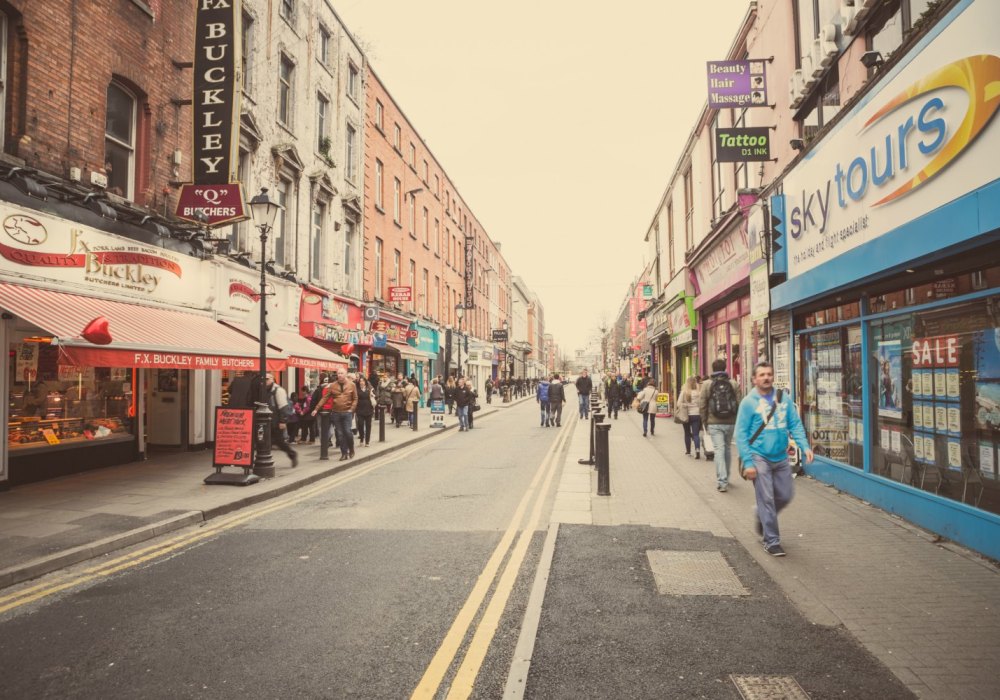
Molloys

While the area is well known as a key historic shopping area, with famous traditional Dublin names like Guiney’s, FX Buckley Butchers, O’Neill’s Shoes and many more, it is also home to quality restaurants like 101 Talbot and Le Bon Crubeen. While around the corner is the world-renowned Abbey Theatre. The Abbey was the first state-subsidized theatre in the English-speaking world and played a central role in the cultural revival of the early 20th Century and many key moments in the early decades of the State. Beyond the other boundary of Talbot Street on Marlborough Street lies St. Mary’s Pro Cathedral. Across the road from this bishropic seat are the fine, impressive grounds of the Department of Education which was originally the site of the first stone-built mansion in Dublin, Tyrone House, which still stands there to this day. The Richard Cassells’s designed building was purchased by the state in 1835 and is now home to the Model School and the Scoil Caoimhín Gaelscoil. All of this shows the often overlooked architectural gems that are dotted around the Talbot Street area. Sure did you know that there was even a Welsh language Church on the street?!

FXB

During its history the street has been associated with a number of dramatic and tragic events from the death of Sean Tracey in a gun battle in front of what is now the Wooden Whisk cafe. Sean was one of the men who fired what could be viewed as the first shots of the War of Independence during the Solohedbeg ambush in Tipperary, 1918. At the time the Wooden Whisk was a shop that provided uniforms for the Volunteers. The street also witnessed one of the darkest days of the Troubles in 1974 as it was targeted as part of a coordinated bombing attack on the city. But the area has always bounced back, today Talbot Street is a link between the main transport hubs like Connolly Station, the IFSC and docklands and with areas further west like Henry Street and Capel Street while still retaining an appeal all its own. Of late we’ve profiled all the different places to dine in the area while several new companies have opened offices in the area bringing an influx of new workers and an extra vibrancy to the area.

Originally posted to DublinTown in March 2016

The Liberty Hall 1916 Banners

You may have noticed over the last weekend if you were strolling down by the Liffey that the towering edifice of Liberty Hall has gotten a bit of a make-over.

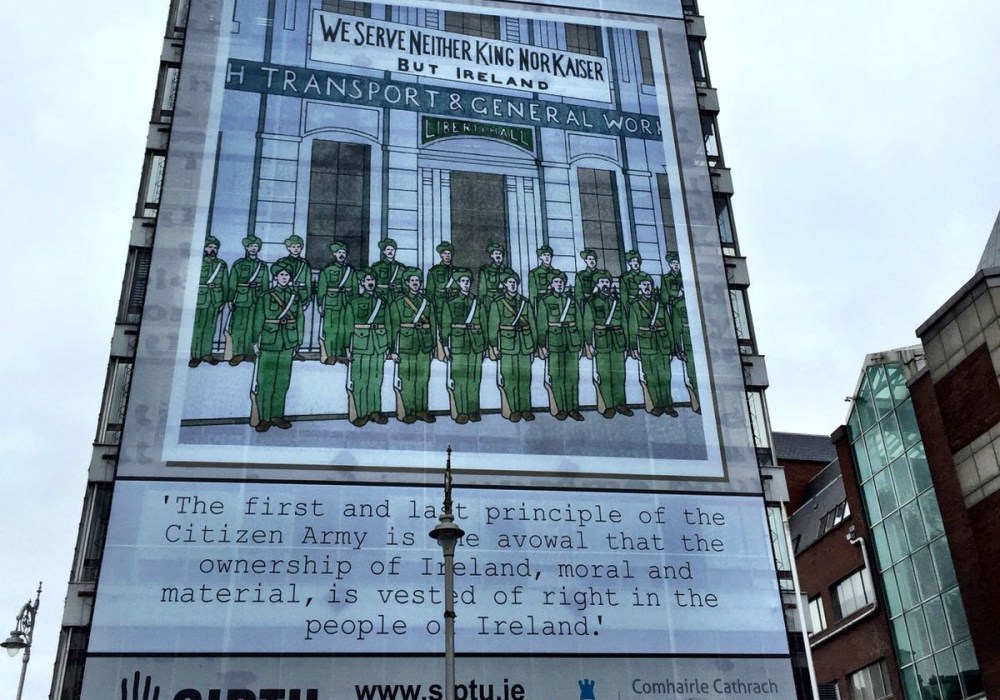
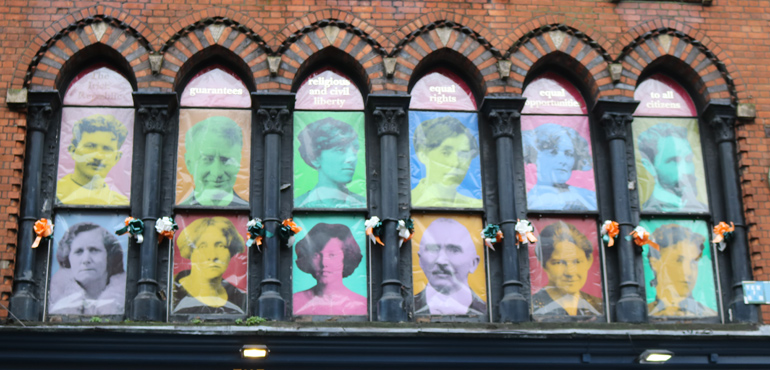
Draped over the different sides of the building are graphic representations of the build-up to the Rising, the action of the Rising itself and its aftermath. A number of the panels are based on the artwork of the renowned Irish artist Robert Ballagh and they have been erected by the SIPTU Trade Union.

Depicted on the various panels are images of the Citizen Army mustering at the old Liberty Hall ahead of the Rising, a depiction of the famous Starry Plough flag, a penal showing an injured James Connolly in the GPO and another of his execution in Kilmainham Gaol. Other images shown include the women of the ICA, a copy of the Proclamation of the Irish Republic and also the site of the Rebels imprisonment in Frongoch in North Wales.

A similar, visually impressive set of banners were displayed on the building to commemorate the 1913 Lock-out and it’s great to see such towering artistry in the city again for the 1916 Commemorations.

Originally published on DublinTown in March 2016


The pubs of 1916 and beyond

During the long history of various Irish independence movements the Dublin Pub has always been a focal point for public meetings, clandestine gatherings and developing networks. Michael Collins’ knowledge of Dublin pubs and network of helpful publicans is legendary. Several famous bars in the city even still bear the scars of bullet and shell from the days of the Rising. Below is a short list of Dublin pubs with connections to the independence movement.


Davy Byrne’s

Davy-Byrnes

Situated just off Grafton Street this pub is famously associated with Joyce’s famous character Leopold Bloom who drops in for a bite of lunch but during the War of Independence and Civil War the premises was visited regularly by Michael Collins and Arthur Griffith. Davy Byrne’s nationalist sympathies were evident, permitting as he did the upstairs room to be used for meetings of the Irish Republican Brotherhood (IRB) and the outlawed Provisional Cabinet of the State, of which Collins was Minister for Finance. On one occasion, an officious barman clearing the premises at closing called: “Time, gentlemen please,” to which one customer replied, “Time be damned! The Government is sitting upstairs.”


The Duke

The-Duke

The Duke has a long association with Home Rule and Republican politics. As far back as the 19th Century when Charles Stewart Parnell, the leader of the Home Rule party tended to spend his Dublin sojourns in a hotel on nearby Dawson Street. Many of his Parnellite followers used to meet and socialise in the tavern then run by the Kennedy brothers at 9 Duke Street. From 1900 onward, and just next door to the pub the famous Dive Oyster Bar operated and in 1904 it was taken over by the Kiernan family of Granard, Co. Longford. Their daughter Kitty would famously become the fiancé of Michael Collins and the pub would become one of Collins’ many safe houses in the city.


The Grand Central Bar

The-Grand-Central

Although its only been a licensed premises since 2003 when the former branch of AIB became the latest addition to the Louis Fitzgerald Group, this fine and impressive building dates all the way back to the early 19th Century and was very much in the middle of the action in Easter 1916. The building at no. 10 Sackville Street (now O’Connell Street) was owned by Alderman William McCarthy, a Unionist politician on Dublin City Council, and during Easter week 1916 the building was heavily damaged by the many shells fired by the Royal Navy gunboat the Helga II into the Sackville Street and Abbey Street vicinity. After the Rising the building was so thoroughly repaired that by the following year Aldreman McCarthy was in a position to sell no. 10 and 11 to the Munster and Leinster bank which would later become part of AIB.


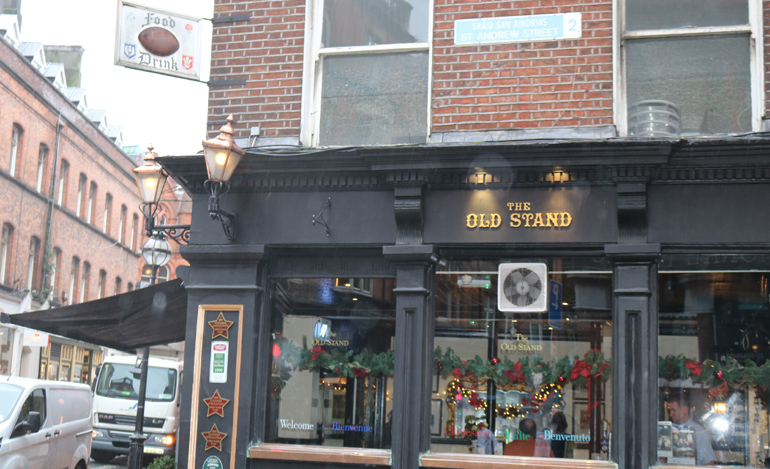
The Old Stand

The-Old-Stand

During the War of Independence, the premises was frequently visited by Michael Collins, who had an office nearby at 3, St Andrew Street (now the Trocadero Restaurant). From time to time, Collins held informal meetings of the outlawed I.R.B. (Irish Republican Brotherhood) in the premises and in true Collins tradition, he was less conspicuous while in the midst of the public. A handsome commemorative plaque and a portrait of “the Big Fella” hang in the pub to remind modern customers of these clandestine meetings.


The Swan

The-Swan-Bar

The Swan pub on Aungier Street, then owned by Tipperary man John Maher was occupied during Easter 1916 as it sat close to the Jacob’s biscuit factory (now part of the National Archives) which was captured by the rebels under the command of Thomas MacDonagh. Numbered among the ranks of the Volunteers was Peadar Kearney who would later write the words for the Irish national anthem. One of the last garrisons to surrender when the rebels were making their escape and Michael Molloy, a Volunteer stated

“Orders were also given that we were to burrow through from Jacob’s to a public house at the corner facing Aungier Street. We had two masons in our party and the burrowing was made easy. Strict instructions were given that no Volunteer was to take any drink from the public house. And although I am not a drinking man myself I must say that this order was strictly obeyed”

The pockmarks of artillery fire were still visible for many years on the walls of the premises.


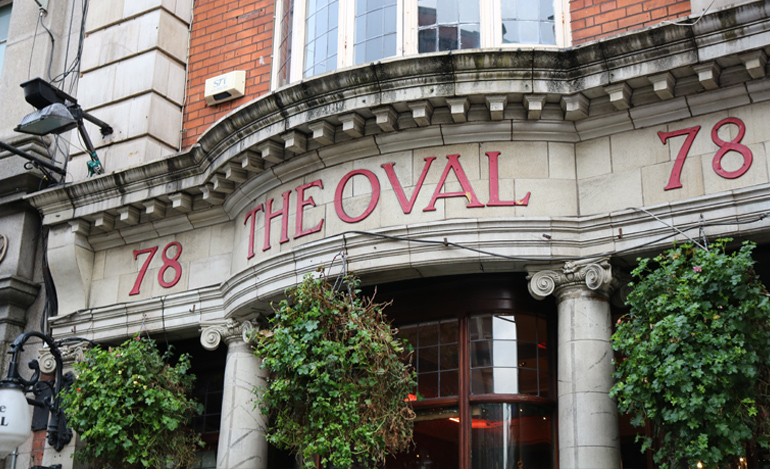
The Oval

The-Oval-Bar

In the years leading up to 1916 this pub found favour with more that the members of the fourth estate from the nearby Irish Independent offices. Uniformed members of the Irish Citizen Army and the Irish Volunteers frequently dropped in to The Oval after manoeuvres while waiting for trams. A busy pub in a busy city centre was the perfect meeting place for members of the I.R.B., who blended in with a swelling clientèle.

Easter Monday, April 24th seemed a day like any other at The Oval until the Irish Volunteers captured the nearby GPO and proclaimed the Irish Republic. The week that followed would bring chaos, devastation, death and destruction both to the city of Dublin and to The Oval. By Wednesday the HMS Helga II had sailed up the Liffey and commenced shelling Liberty Hall and the GPO. At precisely 10am on Thursday April 27th the fate of The Oval was sealed. New trajectories were set on the Helga and the GPO and surrounding buildings were all hit. Fires blazed in Sackville Street and Abbey Street. Before long an inferno had engulfed the city centre. The Oval and surrounding buildings were destroyed. Abbey Street and Sackville Street smouldered for days as ruin and rubble scattered the pavements.

The pub’s owner John Egan set about rebuilding the pub and it was able to re-open its doors for business in 1922. It is this pub that customers see when they visit today but a brass plaque at the entrance commemorates the pubs historic destruction.


The Confession Box

Confession-Box

The reason for the name of the pub dates back all the way to the Irish War of Independence (1919-1921). During that conflict the last know excommunications from the Catholic Church in Ireland took place and were directed against the men involved in the ongoing rebellion. At the forefront of issuing these excommunications was Bishop Daniel Cohalan of Cork and it was rumoured that many of those who were excommunicated, including that famous Corkonian Michael Collins, would drop into what was then the “Maid of Erin” pub and would receive Communion and Confession from sympathetic priests from the nearby Pro-Cathedral. Thus the pub earned the nickname of “The Confession Box”.


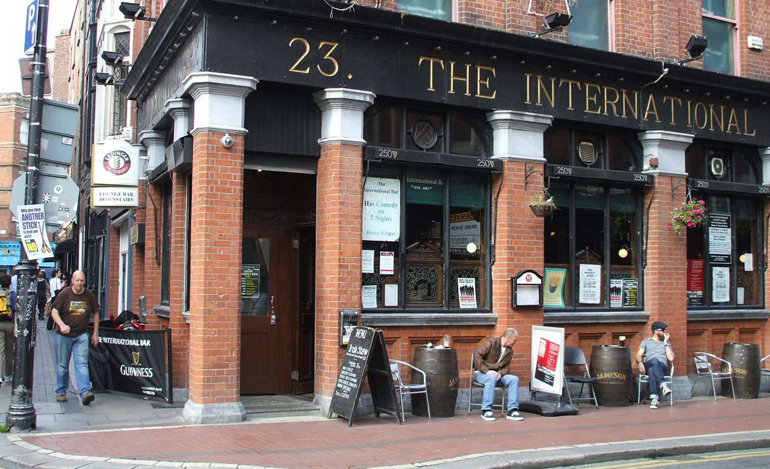
The International Bar

The-International-Bar

The International was another of Michael Collins’ many haunts and has played host to many authors, musicians and artists over the years. It has also been in the possession of the O’Donohoe family since way back in the 1880’s! I’ve left this to the last on the list as it has a very modern connection with 1916 in that the International, at the corner of Wicklow Street and Andrew Street is the meeting point for the hugely popular 1916 Rebellion Walking tours which run seven days a week.

Originally published for DublinTown in January 2016


Football, revolutionaries and my great-grandfather – 1916 and all that

We’ve only begun the year of commemorations and there has already been a great deal written about the various organisations, groupings and competing actors around the dramatic events of Easter 1916.  In much of nationalist history there is a huge role played by sport in the recruitment and training of the Volunteers, this is something often celebrated by the GAA and is born testament to in the naming of stadiums and club teams around the county.

This involvement with the nationalist cause was not limited only to the sphere of Gaelic games. Despite its occasional portrayal as a “Garrison Game” many individuals who were actively involved with football clubs also became key players in the struggle for independence. Among them were family members of my own.

In doing some family tree research I’ve started looking into the history and background of some of the relatives on my Da’s side of the family, people I was vaguely aware of but who by and large had died before I was born. This trail has brought me to a few individuals, my great-grandfather Thomas Kieran (occasionally spelled Kiernan) his sister Brigid and her husband , my great-uncle, Peadar Halpin.

At this point I must state that I do indeed have some non-Dublin blood in my veins, not much mind, but both Thomas and Peadar were from Co. Louth. Peadar would come to prominence due to his association with Dundalk FC and the FAI. He was a founder member of the club and spent decades on the management committee of Dundalk FC and was also club President. He also served as Chairman of the FAI’s international affairs committee and President of the League of Ireland and also Chairman of the FAI Council.

Football in Dundalk, in a somewhat disorganised fashion could be found as far back as the late 19th Century and some of the impetus given to the game in the early 20th Century can be traced back to a Dundalk architect named Vincent J. O’Connell. He had played for scratch teams in the town in his youth and had been a member of Bohemian FC between 1902 and 1907 during a sojourn in Dublin. Upon his return north he set about working with others to bring some structure to the playing of the association game in the town.  The club we know today as Dundalk FC began life as Dundalk GNR, the GNR standing for Great Northern Railway, and they spent a number of years in junior football before being elected to the League of Ireland in the 1926-27 season. The campaign for election to the league as well as the eventual re-branding of the club to Dundalk FC was apparently the result of the machinations of a group of local football enthusiasts comprised of Peadar Halpin, Paddy McCarthy, Jack Logan, Paddy Markey and Gerry Hannon. According to a report in the Irish Times the decision to change the club’s colours from black and amber to white and black was made by one Barney O’Hanlon-Kennedy who promised his silver watch as a raffle prize for a fundraiser for the club. As he was the one putting forward the funds he was given the honour of selecting the team’s colours.

That Dundalk should be so connected with the railway shouldn’t be that surprising, then as now, Dundalk was a major station between Dublin and Belfast, even if the creation of the border did cause disruption. My great-grandfather Thomas Kieran (born in 1889, son of Patrick and Annie Kieran) was a worker for the railway, at the time of the 1911 census when he was 22 years old and residing in the family home of 14 Vincent Avenue in Dundalk (five minutes from the train station). He was listed as being an “engine fitter”, while his father Patrick was a carpenter for the railway as well. Later reports show that Patrick was also involved with the union (the Irish Vehicle builders and Woodworkers Union) and was among the workers representatives when a strike was threatened in 1932. The census also reveals that of the family of five both Thomas and his sister Brigid spoke Irish.

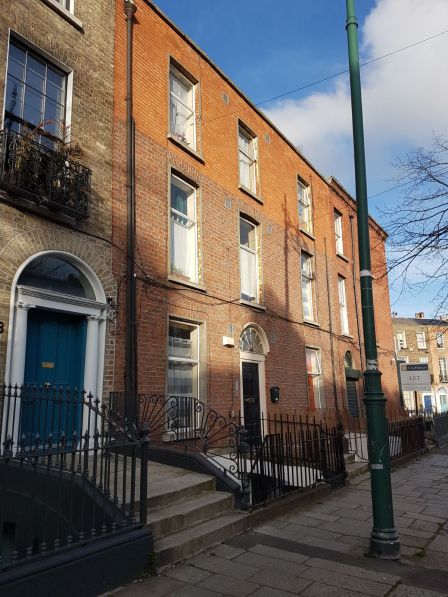
Vincent Avenue

House in Vincent Avenue today, they were build c.1880

Republican roots, what the records say…

When searching through the Bureau of Military history records I came across a number of references to the Kieran family. One referred to the family as a “Volunteer family….railway people”. This came from the witness statement of Muriel MacSwiney, the wife of future TD and Lord Mayor of Cork, Terence MacSwiney who stayed with the Kieran family during one of Terence’s frequent bouts of imprisonment. This is confirmed by the witness statement of another local Volunteer James McGuill who referred directly to Brigid saying that Muriel MacSwiney “stayed in Dundalk with Miss Kieran now Mrs. Peadar Halpin.”

78-1926-08-15-Muriel-MacSwiney-1920

Muriel MacSwiney

On a slight digression Muriel MacSwiney was a fascinating woman, born Muriel Murphy, her family owned the Midleton Distillery and they were firmly against her marriage to Terence MacSwiney and even tried to get the Bishop of Cork to intervene to delay it. As a footnote that will become relevant later, the best man at their wedding was Richard Mulcahy the future Chief of Staff of the IRA, Minister for Defence during the Civil War and later still, leader of Fine Gael. Terence was in and out of various gaols during the course of his short marriage with Muriel, he would be dead by 1920 at the age of just 41, wasting away on hunger strike in Brixton Jail. The impact his death had on the wider world is probably comparable to that of Bobby Sands six decades later. MacSwiney was viewed by many as a martyr in a fight against Imperialism and was cited as an influence by  Mahatma Gandhi as well as India’s first Prime Minister Jawaharlal Nehru.

Apart from providing lodgings for Muriel MacSwiney it’s worth looking at what else the Halpins and Kieran’s were up to at this turbulent time. Thomas Kieran is mentioned again the the Bureau of Military History. In the witness statement of Patrick McHugh, Operational Commander and Lieutenant of the Irish Volunteers in Dundalk during Easter week 1916 listed Thomas Kieran among those “who served Easter Sunday 23rd April 1916, remained with company that day and, volunteered to return home when uncertainty of position was explained to them. Some returning Sunday night, others Monday morning or as Stated.”  Interestingly Thomas is already listed as living in Dublin by this stage while most of those mentioned were still living in Dundalk. Peter Kieran (a possible relation?) another Dundalk based Volunteer declared in his witness statement that Thomas Kieran was among a group of Volunteers who had arranged to meet on the night of Thursday 20th April with plans to make their way to Dublin to join the rest of the Volunteers in the Rising. They had elaborate plans to get there via motor boat but were warned that the Royal Navy had vessels patrolling the area.

The plans for the Thursday journey to Dublin was called off and the group met again on Friday and Saturday night, however word came that the Rising was off, probably a reference to Eoin MacNeill’s order cancelling the Rising, which obviously had a significant impact on the numbers of those who arrived in Dublin. Peter Kieran went on to state that about the second week in May arrests were made in the town by the RIC. The family version of the story that I’ve been told was that Thomas was one of those arrested while cycling his bike with a rifle on his back and that he was later interned!

Peter Kieran in his statement also noted that “Those who served 23rd, 24th and 25th April 1916 and became disconnected, were ordered home on account of age, infirmity or as stated. [included] Peter Halpenny or Halpin [of] Byrnes Row Dundalk”  Although it is hard to be absolutely certain this Peter Halpin could well be our Peadar Halpin, he was listed as Peter on the earlier census return. There is also a record of a P. Halpin from Byrne’s Row who was arrested a couple of weeks after the Rising and sent to Stafford Detention Barracks in England on 8 May 1916. There are other references in other sources to a P. Halpin of Byrne’s/Burn’s Row being arrested and sent to Stafford.

In searching the medal rolls for this issued the 1917-21 Service Medal both Peadar and Brigid appear. Both were issued the medal, Brigid in 1943 and Peadar in 1951. Her deposition states that Brigid was a member of Cumann na mBan from before the Rising. She was involved in dispatch work, fundraising for the purchase of arms, did election work for local candidates and visited republican prisoners. Peadar in his deposition states he was a member of “A” company of the 4th Northern Division of the IRA and that his involvement also predated the Rising, going back to 1915. It doesn’t however, detail individual operations of which he was part.

Patrick McHugh (who we encountered above) managed to escape arrest although he was interrogated by RIC men just after the Rising. He then moved up to Dublin to stay with his sister on Iona Road for a short time until he “got in touch with friends Tom Kieran and his wife [the granny Kiernan], who had a room in Mountjoy Street.” It seems that Thomas Kieran had moved to Dublin sometime between 1911 and 1916. I know he ended up working in the CIE engineering works in Inchicore for many more years. He obviously met Jane Brennan (2 years his junior) when he moved to Dublin, she had been living on Dominick Street Upper at the time.

Blessington St1

The house at 27 Blessington Street, just off Mountjoy Street, where the Kierans lived.

Peadar was born in 1895 and grew up in Stockwell Lane, Drogheda. He trained as a cooper, (the trade of his father John) before moving to Dundalk to work in the Macardle Moore Brewery where he later became the foreman cooper. It is interesting to note that his wife Brigid was 12 years his senior. He came from something of a Republican family and a street (Halpin Terrace) in Drogheda bears the family name. This street has something of a tragic history to it as it was named after Peadar’s younger brother Thomas, who was killed there by the Black and Tans in February 1921. At the time Thomas was an Alderman of the local Corporation representing the Sinn Féin party. Thomas Halpin, along with another man, John Moran were abducted from their homes and brought to the local West Gate barracks where they were brutally beaten. They were then dragged to a third man`s home, that of a Thomas Grogan whose house was also raided but fortunately Grogan had been tipped off and had made his escape before the Tans arrival. It was at this spot that Thomas Halpin and John Moran were murdered, their bloodied bodies being discovered there the following morning. Each year the local Council commemorates this event and a monument now stands at the site of the men’s murder.

IRA memorial

Commemorations for Alderman Thomas Halpin & Captain John Moran in 2014


Footballing connections; all roads lead to Bohs

Thomas, is something of a family name, Peader’s brother Thomas was tragically killed and Peadar would name a son of his as Thomas, perhaps in tribute to his murdered sibling. Thomas Kieran would also have a son named Thomas and there is an interesting football overlap as both of these men named Thomas would have a part to play in the history of Bohemian FC.

Peadar’s son Tom lined out for Dundalk in the early 40s before moving to Bohemians in 1947. He featured prominently in Bohs run to that season’s FAI Cup Final where he was part of a team that defeated Drumcondra FC, Shelbourne in the semi-final (where Halpin scored a penalty) and took on a highly talented Cork United side in the final. Cork United had been the dominant team of the 1940s and had already won five league titles by the time they took on Bohemians in front of over 20,000 fans at Dalymount Park on April 20th 1947. The Leesiders were the strong favourites. Bohs were at an added disadvantage as two of their key, experienced defenders (Snell and Richardson) were out injured. Halpin was playing at right half and spent most of his time trying to counteract the attacking threat of Cork’s forward line which included Irish internationals like Tommy Moroney and Owen Madden.

Bohs 1947

The Bohemian team from the 1947 final

Bohs were already 2-0 down before 30 minutes were on the clock but Mick O’Flanagan managed to pull one back before Halpin scored a penalty after Frank Morris was fouled in the box. The game finished 2-2 and went to a replay four days later. In a howling gale and lashing rain Bohs lost out in the replay in front of barely 5,500 people with the Munstermen winning 2-0.

Tom Kieran’s connection with Bohemians was a very long one, a referee for decades, including at League of Ireland level in the 1960s. The uncle Tom was a member of Bohemians since 1969 and was Vice-President of the club from 1985 to 2000 and was later made an Honorary Vice-President for life. Tom’s daughter Susan and her husband Dominic are of course still very familiar faces down at Dalymount to this day.

the uncle Tom

The uncle Tom as photographed for an Evening Herald profile in Dalymount Park

There are further remarkable connections with the Halpin family and with Dundalk and Bohemians as Thomas Halpin’s grandson; Peter was the Commercial Manager at both Dundalk FC and Bohemian FC as well as having a spell with Belfast club Glentoran.

Despite these many connections with the beautiful game the strongest and most influential roles in Irish football were undoubtedly held by Peadar Halpin. He was on the committee of Dundalk FC since at least 1926 and had two spells as Club Chairman from 1928-1941 and 1951-1965 and in 1966 he was appointed Club President, a position he was re-elected to in 1973. He also held a number of roles for the FAI, he was Chairman from 1956-1958 and had many years previous experience on various FAI committees and had made an unsuccessful attempt at arranging UEFA mediation to help resolve the long-running schism between the FAI and the IFA. At the age of 70 he was elected as President of the League of Ireland, it was a role he hadn’t been expecting to fill but after the Dundalk rep Joe McGrath became ill Peadar was the only member of the Dundalk committee with sufficient experience to take on the role. While the FAI and League of Ireland have (with good reason) been seen as conservative and at times backward there were a number of advances that took place during his tenure. It was the Dundalk committee that suggested the introduction of the B division which would eventually lead to the creation of the First Division as well as overseeing the admittance of new clubs to the League of Ireland. On a local level he was crucially involved with the development of Dundalk FC as a force within the League of Ireland, at present they are the second most successful side in Irish club football with 11 League titles and 10 FAI Cups. He claimed that of the many successful years that Dundalk enjoyed his favourite was 1942 when Dundalk beat Cork United 3-1 in the FAI Cup final and Shamrock Rovers 1-0 in the Inter City Cup.

Dundalkimage

Mattie Clarke in action for Dundalk in the 1950s as featured in the Irish Times

A potential politician?

Despite this extremely long connection with Dundalk FC the earliest reference to his involvement was in 1926. Prior to that we know that he was working as a foreman cooper in the Macardle Moore Brewery but in March 1923 his name appears in a debate in Dáil Éireann when his local TD Cathal O’Shannon raised a question on his behalf with the then Minister for Defence, General Richard Mulcahy. This is the same Richard Mulcahy who had performed best man duties at the wedding of Terence MacSwiney and Muriel Murphy who the Halpin’s would later shelter. It is testament to the divisiveness of the Civil War that such former allies could be so opposed.

O’Shannon had been elected TD for Louth-Meath in 1922 as a member of the Labour Party and was a supporter of the Treaty of 1921 which had officially led to the partition of Ireland. Mulcahy as Minster for Defence was a highly controversial figure for some as it was he who gave the order for 77 executions during the Civil War. The content of O’Shannon’s query was a request for an update on the status of Peadar Halpin and the likelihood of his release from Newbridge Barracks where he had been held since August 1922. Mulcahy replied that “Mr. Halpin was arrested for aiding and abetting Irregulars during the time of their occupation of Dundalk. It is not considered advisable to release him at present”, he further added that Peadar was not to be allowed send or receive letters.

As for what “aiding and abetting the Irregulars” referred to, the most likely answer given the fact that Peadar was arrested in August 1922 in Dundalk was that he was involved in assisting the anti-Treaty IRA (or “Irregulars”) in their attack on Dundalk on August 16th 1922. During this attack, led by future Tánaiste Frank Aiken, the anti- Treaty forces captured the town, freed over 200 prisoners held in the barracks and also took over 400 rifles. Rather than try to hold their position the town was re-taken the following day by Free State forces. In all the attack on Dundalk cost the lives of six Free State soldiers and one officer as well as the lives of two of the “Irregulars”. It is not clear what assistance Peadar provided during this time but it was obviously significant enough to warrant him being held in gaol for months without charge.

Family recollections of Jane Kieran née Brennan, the wife of Thomas Kieran are fairly clear on her views on Mulcahy and Cumann na nGaedheal, she put it bluntly and succinctly, saying “they cut the old age pension and they shot them in pairs”. It was not to be the last connection between Peadar and Cathal O’Shannon or Frank Aiken for that matter as the below excerpt shows.

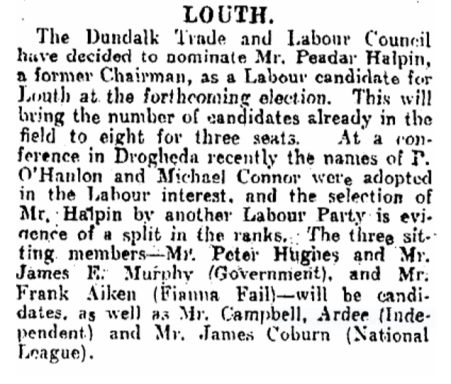
Peadar Labour snip

From the Irish Times April 29th 1927


Cathal O’Shannon stood in the new Meath constituency in the first general election of 1927 and in his absence as the Labour candidate it was proposed that Peadar should run. Among his competition would have been the man he likely assisted during the Civil War, Frank Aiken. However as is the cross that left-wing politics must bear, there was a split, those who proposed Peadar as a candidate were not successful in securing his nomination and Thomas O’Hanlon and Michael Connor ran, unsuccessfully, for the Labour Party. As another of my many side notes, Cathal O’Shannon was unsuccessful in gaining election in 1927 however he later became the first Secretary of the Congress of Irish Unions in 1945, the last president of this Congress was one Terence Farrell, head of the Irish Bookbinders and Allied Trades Union. His nephew Gerard, after whom I’m named, married Nancy Kieran which brings together the Farrell and Kieran clans. Their eldest son was my Da, Leo and as many in the family will know he played for Bohs in the early 60s.

Anyone who has read this blog regularly will know that I often try to look at life and history through the prism of football. Of particular interest is the role that “soccer men” played in the Rising and subsequent War of Independence and Civil War. This is probably the most personal post as I’ve tried to do the same with my own family and their involvement with the nationalist movement. There are many stories that I would love to include but haven’t but would appreciate any feedback or additional information from family members. I hope that this could be the first in a series of posts that might be of interest or maybe just a first draft of something more extensive, there were certainly enough stories told at uncle Joe’s funeral to fill a book, but I hope this might be a start.


With a special thanks to Jim Murphy, Dundalk FC historian for his assistance with some of the research for this piece.