Luke Kelly takes the biscuit

Raised on songs & stories Heroes of renown/ 
The passing tales & glories that once was DublinTown

The opening lines of “Dublin in the rare ould times” are a distillation of nostalgia at its purest for many Dubliners. The Pete St. John song found fame on the ballad circuit of the 1970’s and for my money the definitive version of the song will always be the Dubliners’ version with Luke Kelly on lead vocals. This song appeared on The Dubliners 1979 release “Together Again”, it marked the return to the band of Ronnie Drew and it would be the last album to feature Luke Kelly who would pass away less than 5 years later.

A rousing version of the song was performed in January of last year by Damien Dempsey accompanied by Kelly’s former bandmate John Sheahan on South King Street, a short walk from Grafton Street and Merrion Row and many venues that were home to performances by the Dubliners during the so-called “ballad boom”. This performance coincided with the 35th anniversary of Kelly’s death, aged just 43, but more positively it also announded the unveiling of a new bronze statue of the troubador and activist.

Statue

The unveiing of two pieces of public art celebrating the life and work of Luke Kelly provoked much fond reminiscence of him by friends and family, one area of his life that was discussed in detail was Luke’s love of football which was detailed in an excellent piece by David Sneyd in the Irish Mail on Sunday. The article had mentioned Kelly’s time as a schoolboy when he lined out for the famous Home Farm club, playing alongside future League of Ireland legend Billy Dixon.

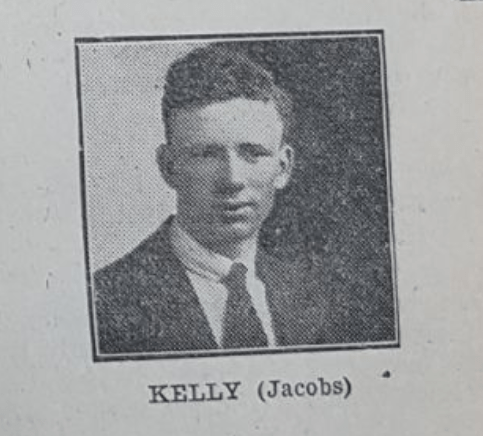
It also mentioned the playing career of his father, Luke Kelly Senior who played in the League of Ireland for Jacob’s F.C. In a piece for the “Lost Clubs” series on this website I focused on the history of Jacobs and in the course of my research had come across Luke Kelly Senior. A talented half-back or “pivot” in the Jacob’s teams of the late 1920’s.  Reports at the time describe him as a “tireless worker” , a “typical tackler and spoiler” and “most consistent”, though he was mentioned as being a shade on the small side. He was however, no brutal hatchet man, plenty of reports mention his range of passing and ability to switch the play and begin attacks.

The “pivot” role so commonly ascribed to him was one which had developed as part of the old 2-3-5 formation. The “centre-half” was not yet a central defender, but played in a more advanced role as an instigator of attacking play who could also drop back and assist in defensive areas. Hence he functioned as the “pivot” between defence and attack. This would change gradually over the 1920s, especially after Arsenal had success with withdrawing a centre-half into a more definsive position of a third defended, helping create what became known as the W-M formation.

Luke Senior was born on 1st September 1904 in Ryan’s Cottages on Marlborough Place in Dublin’s north inner-city. He was the son of Paddy and Christina Kelly who had been married nearby in Dublin’s Pro-Cathedral in 1898. Paddy Kelly had been born in Bealnamulla, Co. Roscommon just outside Athlone back in 1867, he in turn was the son of another Luke Kelly also from Bealnamulla. Luke Sr. married Julie Fleming in September of 1934 in St. Laurence O’Toole’s church which sits next to Sheriff Street, a part of the city to be forever associated with his son, Luke Kelly the singer who was born nearby in 1 Lattimore Cottages, Sheriff Street less than six years later.

Football was obviously deeply engrained in Luke Kelly Sr. from an early age, in an interview many years later when his son was at the height of his fame, he remembered playing football in Fairview Park when he and his pals spotted a brigade of the Scottish Borderers marching towards the city. Kelly recalled in the Irish Independent that he and his friends followed them all the way into the city, jeering at them and throwing stones.

What the young Kelly did not realise then was that the Scottish Borderers regiment had been called into the city centre on serious businesses. Earlier that day the Irish Volunteers had taken possession of a cache of weapons brough by boat into Howth harbour and which were en route to the city. The Dublin Metropolitan Police had been ordered to confront the Volunteers but many would have had sympathy with the Nationalist cause.

As prominent Irish Volunteer and IRB member Bulmer Hobson noted “A considerable number of the police did not move and disobeyed the order, while the remainder made a rush for the front Company of the Volunteers and a free fight ensued, in which clubbed rifles and batons were freely used. This fight lasted probably less than a minute, when the police withdrew to the footpath of their own accord and without orders.”

As a result the Borderers were sent to disarm the Volunteers, they also failed in this task and eventually a growing crowd stoned and jeered them as they marched back to Richmond Barracks along the Dublin quays. The troops opened fire on this taunting crowd on Bachelor’s Walk, killing three bystanders and injuring 37, including a 9 year old Luke Kelly as the youngest victim.

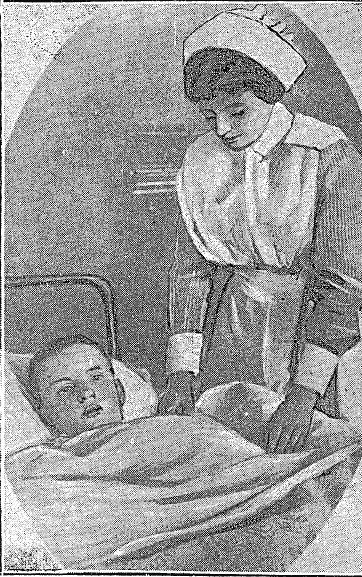
Kelly was shot in the back and a priest was called to administer to him as the staff in the nearby Jervis Hospital feared for his life. However Kelly was lucky and made a full recovery. A photo of him in his hospital bed even appeared in an edition of the Irish Independent a few days after the attack.
Indo hospital pic

Photo taken from the Irish Independent July 28th 1914: Luke Kelly, a little schoolboy, a victim of the Borderers fusilade, in a ward in Jervis Street hospital

Kelly joined the Jacobs factory as an employee at the age of 16 and continued working for them for 46 years, until his passing in 1966. During his time with Jacobs he was an accomplished athlete, he ultimately played seven seasons in the League of Ireland with Jacobs, and although at one stage he was linked with a move to Fordsons in Cork, he remained with the Biscuitmen as a player even after they dropped out of the League of Ireland and returned to the Leinster Senior League.

Though Jacobs struggled for much of Kelly’s time as a player there are numerous reports that mention Kelly as their stand-out individual performer. Such was the high regard in which he was held as a player he was also selected to play in a number of high profile friendly matches, such as a charity game in aid of St. Vincent de Paul at Christmas 1927 as well as being picked to play for Shelbourne as a guest in a benefit match against Linfield for their star player, the Irish international, Val Harris.

Jacobs were justifiably proud of the sporting achievements of their employees, apart from a football team they also constructed a swimming pool for employees, based on the example of a pool built by Heinz for their workers in Pittsburgh. Kelly was also an able swimmer, though it did get him into trouble on one occasion. In May 1932 Luke Kelly senior (then aged 27) was arrested by a Garda Burns and charged with attempted suicide by drowning in the River Liffey.

Kelly’s defence to this charge was that he had been out with friends for a drink on Sunday and after some significant alcohol consumption a bet was proposed as to whether Kelly could swim across the Liffey from Custom House Quay. As part of Kelly’s defence it was stated that he was an excellent swimmer as evidenced by the fact that although he was wearing a hat at the time it had remained dry throughout. The Judge at the hearing of the case let Kelly off on the condition that he took the pledge and kept the peace.

To return to the opening lines of this piece, the words of Pete St. John as sung by Luke Kelly, it always struck me that they apply equally well to how we hear about football and its players when we are young, father’s, olders siblings, relations and bar-room bores regaling youngsters about scarcely believeable feats of skill from years gone by. Luke Kelly Senior was a friend of John Giles’ father Dickie and one can imagine that both Luke and John heard many romanticised tales from their respective fathers about their exploits on and off the field.

Raised on songs & stories Heroes of renown/ 
The passing tales & glories…
The Lost Clubs – Reds United

The thing about close relationships is that after years of being together one partner builds up an intimate knowledge of the other, while this is usually beneficial, bringing closeness and trust it also means that you know how to push each others buttons, sometimes even going for the nuclear option in the heat of the moment. While these rash impulses can pass their impact can sometimes be felt for years. As in personal relationships so it was with Shelbourne and the football authorities in Dublin.

In 1921 the disregard shown to Shelbourne by the IFA in the scheduling of a cup match replay for Belfast rather than in Dublin as custom dictated was the final straw for the Leinster Football Association which split with the IFA and formed what we now know as the FAI. In this case the Dublin footballing authorities rallied behind Shelbourne and their sense of injustice at the treatment by the Belfast based IFA.

Shelbourne were trendsetters in the Irish game, they were one of the first clubs outside of Belfast to pay players professionally, they were the first Dublin side to win the Irish Cup, and after the split they backed the fledgling FAI and took part in the first season of the Free State League and contested one of the first finals of the FAI Cup. However by the 1930’s relations had soured. Shelbourne were accused of poaching players in early 1934 and were fined, Shels denied the charge and ignored the fine. Things continued to escalate and in March 1934 Shels went nuclear. They wrote to the FAI (the FAI of the Free State as it was then) and informed them that they were leaving and had applied to rejoin the IFA.

Shels further refused to fulfill their fixtures in the League of Ireland Shield competition, the FAI responded by fining the club £500 for failure to play the matches. The situation reached a head in June of 1934 when at a special meeting of the FAI Council, Shelbourne were suspended from football for 12 months and the members of the Shelbourne committee were “suspended from ever taking any part in the management of any club
or affiliated body in football, under the jurisdiction of the Football
Association of the Irish Free State”.

The departure of Shels & the emergence of Reds United

With Shelbourne removed from football for at least a year (they had been blocked from joining the IFA though whether that was ever really Shels intention is doubtful) and their place in the league was awarded to Waterford, returning to the league after a gap of a couple of seasons. However, in the Leinster Senior League another club appeared, they drew their support from the same Ringsend district as Shelbourne, the featured a number of former Shelbourne players and also like Shels, they wore red. They were Reds United.

Such was the prominence of the club that some 14,000 turned up at Shelbourne Park for one of their early games, to see Reds United of the Leinster Senior League take on Bohemians in the first round of the FAI Cup in January 1935. While the side was still quite raw they surprised many by securing a 3-3 draw and a replay against the far more seasoned Bohemians.

Although still a junior club the Reds featured a core of players with league experience and had a sizeable following as demonstrated by the crowd attending the Bohs cup game. Among those players who lined out for the club was John Joe Flood who was a Ringsend local. Flood was most associated as a talented forward for the successful Shamrock Rovers teams of the 1920’s but had also featured for Leeds United, Crystal Palace and Shelbourne. He had also been capped five times by Ireland scoring four goals, which included a hat-trick on his debut against Belgium. By the time he was lining out for Reds United Flood was already in his mid-30’s but he continued to be a threat at inside forward. Indeed, even later in his career while coaching TEK United John Joe made a brief comeback as a player at the age of 51!

Joining John Joe Flood on the team was his younger brother Patrick, who played in goal, as well as former Shamrock Rovers player Tommy “Nettler” Doyle who was the younger brother of Dinny Doyle, an Irish international who ended up playing for much of his career in the United States. Incidentally all of the Doyle family (as far back as Tommy’s grandfather) had the nickname “Nettler” apparently deriving from the fact that if you gave one of them a hard tackle you would get a stinging “Nettler” of a challenge in return. Doyle had also played for Shamrock Rovers and had done well at centre forward for them after the departure of the prolific Paddy Moore to Aberdeen. He mainly featured as a forward during his time at Reds United as well.

Also signed for Reds were Maurice Cummins and Paddy Lennon two prominent half-backs who both had lined out Cork F.C.  Cummins was also talented at lawn-bowling in his native Cork, he would later sign for St. James’s Gate and was part of their side that lifted the FAI Cup in the 1937-38 season. While there was a strong contingent of players from the greater Ringsend area the signing of Cummins and Lennon shows that the club were looking beyond the local, indeed two players were brought over from the Scottish Leagues.

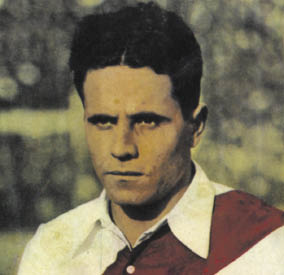
Jimmy TurnbullAlong with a winger named Wright who was signed from Alloa Athletic the Reds signed Willie Ouchterlonie who had enjoyed successful spells at Dundee United and Raith Rovers. Prior to joining the Reds he had been signed by Portadown F.C. but his spell up north didn’t last long before his unwieldy surname was troubling the Dublin press. He hit an impressive 20 goals for the Reds in his only season there, finishing as the club’s top scorer and third overall in the league behind Cork’s prolific Jimmy Turnbull (pictured right, scorer of a record breaking 37 league goals) and Ray Rogers of Dolphin on 23.

By the time Reds United were signing up players from Scotland they had already triumphed in their debut season in the Leinster Senior League, as a result they and Brideville were accepted into the League of Ireland for the 1935-36 season. This might have been different had Shelbourne been successful in their application to have their suspension lifted. A motion was put before the FAI Council in June of 1935 to try and resolve the dispute between the club and the Association but this was defeated. As a result it was to be another season in the wilderness for Shels but a chance for Reds United to mix with the best.

1935-36 was to be Reds United sole season as a League club although this short spell wasn’t down to a lack of success on the field, on the contrary the Reds finished fourth in a twelve team league and ahead of the likes of Shamrock Rovers, Dundalk and Waterford. This must have come as a surprise to Rovers who had the new club as a tenant at Glenmalure Park in Milltown and who featured a couple of their erstwhile players. The lease for Shelbourne Park was held by the still-banned Shelbourne so there was no chance to replicate the bumper crowd that had seen the cup game against Bohemians there the year before.  One other compromise was that for games against Rovers rather than play in Milltown these matches were moved to Dalymount Park instead. This saw a strange sort of Ringsend local derby being played out in Phibsboro on the north side of the city.

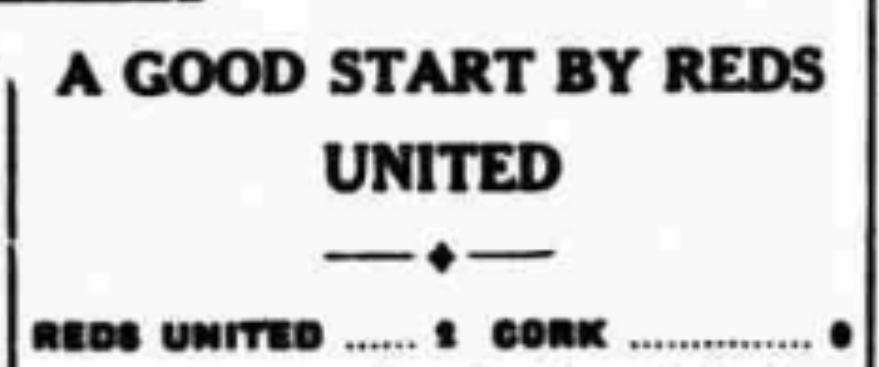
The Reds opened their league campaign with an impressive 2-0 victory over Cork with goals from Tommy Doyle and Ouchterlonie. There were several other highs to their singular league season, they did the double over their Ringsend rivals Shamrock Rovers as well as securing good wins over the likes of Drumcondra, Brideville and two wins, including a 5-0 demolition job, over Bray Unknowns. Several of their players shone during the season, along with the goals of Doyle, Oucherlonie and the veteran Flood there was talk that their Cork-born midfielder Cummins was in line for a national team call-up against the Netherlands due to his stand-out performances at left half-back.

The departure of Reds United and a Shelbourne return

Despite this impressive debut season there was to be no follow up. In June 1936 after the season had finished the league met to discuss the possible amalgamation of Reds United and Shelbourne. This didn’t seem to lead anywhere. Just a few weeks later Reds United resigned from the league, they had been unable to secure a stadium for the coming season after attempts to agree a lease on the Harold’s Cross stadium fell through.

With Reds United gone there were applications from Shelbourne and from Fearons F.C. (based in the Dublin suburb of Kimmage) for election to the league. Shels had been playing in the AUL during Reds United’s league season and in July 1936 a motion for re-admittance put forward by Shamrock Rovers was accepted unanimously at the FAI Council meeting. Similarly those Shelbourne committee members banned by the FAI were accepted back into the fold.  These representations from Shamrock Rovers were important to helping Shelbourne in successfully re-applying for a place in the league for the coming season while the unlucky Fearons club were told that their day had not yet come and that they should continue their good work with a view to being elected at a future date.

While Reds United were gone from the league they did continue life as a non-league side, they played out of Ballyfermot for a time and help develop the early careers of several prominent players. The club still had strong links with Shelbourne and the wider Ringsend area, even in the late 40’s club meetings of Reds United were taking place in the Shelbourne Sports Club off Pearse Street. A club who got their league opportunity because of a falling out between Shelbourne and the FAI may only have experienced that one league season but they continued developing footballers long after the original dispute was put to bed.

Podcast: Football in Pre-Partition Ireland — Outside Write

We talk to Dublin-based football historian Gerard Farrell about how association football took off in Ireland before partition in 1921 into what are now known as the Republic of Ireland and Northern Ireland. Gerard runs the blog A Bohemian Sporting Life, and provides a fascinating insight into how soccer competed for attention against the other […]

via Podcast: Football in Pre-Partition Ireland — Outside Write

Following the money- wanting all the power, instead of just most of it

Follow the money. If you want to get to the heart of the matter always follow the money, in life as in football. As our beloved sport emerged and was codified in Victorian Britain there was a strong attempt to keep football strictly amateur, and by extension out of the reach of the vast bulk of ordinary people and the preserve mainly or a network of public-school Old Boys. This resistance was Canute-like and eventually by 1885, some twenty-two years after the foundation of the FA, professionalism was permitted in British football. Money had always been in the game but now it was openly, if grudgingly accepted.
Even back then the sporting public were caught up in the drama of the transfer market, while many clutched their pearls and bemoaned the scandalous sums being paid to bring footballers to new clubs. By 1893 Willie Groves had become the first £100 player when he joined Aston Villa from near neighbours West Brom. Just twelve years later Alf Common became the first £1,000 player when he made the short journey from Sunderland to Middlesbrough. For the next three decades after Common’s move the transfer record would only be broken by English (and one Scottish) clubs. But the British dominance of the transfer record was smashed in 1932 as the world transfer record crossed the Atlantic to the Argentine capital of Buenos Aires. The buying club was River Plate and the player was Bernabé Ferreyra, signed from Tigre for £23,000, an amount that would stand unbroken for a record for seventeen years.

ferrerya

Bernabé Ferreyra – once the world’s most expensive player

Argentina had seen a breakaway professional league emerge in 1931 and River Plate immediately went out and paid 10,000 pesos for winger Carlos Peucelle and signed Ferreyra just a year later, this helped give rise to the clubs’ nickname of Los Millonarios. Although English clubs would take back the transfer record in the late 40s and kept it until 1951 this was to be the last era of British dominance or record breaking transfer fees, only in 1996 when Alan Shearer joined Newcastle from Blackburn would a British club again be a record breaker. For the rest of the last 64 years the transfer record has been held by either Italian on Spanish sides. The last five record fees have all been paid by Real Madrid, from Luis Figo in 2000 to Gareth Bale in 2013.

But of course merely to view the transfer market as a marker of wealth, and indeed power and influence is reductive. For one thing the Bosman ruling has changed the nature of transfer deals to some extent and it also ignores things like the money spent on wages, amounts earned through sponsorship, TV rights and prize money. However, according to Deloitte in their annual football rich list for this year, Real Madrid are once again the top club with a revenue of £439m. They are followed by Barcelona, Manchester United in 3rd and Paris Saint Germain in 4th, Bayern Munich in 5th and Manchester City in 6th. Juventus come in at tenth meaning there is one Italian side in the top category. However the most telling statistic is that overall of the top 30 clubs on the list 17 are in the Premier League.

This wealth created in the Premier League, primarily through super-lucrative television rights, currently trumps anything that can be matched financially by other leagues. Arrangements in Spain mean that clubs like Barcelona and Real Madrid get disproportionately larger shares of television revenue than other Spanish clubs, but the Premier League parity model has been suggested as one of the reasons that a club like Leicester have been able to mount their shock title challenge. While West Ham sit in 20th place on the rich list there is no place for the likes of Ajax, Benfica, FC Porto or many others. They are victims of geography and the rise of power or a super elite group of clubs forming out of the elite leagues. Some clubs like Manchester City and Paris Saint Germain have only been catapulted into these elite realms because of the massive recent investments of petro-wealth tycoons.

Yet despite these financial advantages there is always the search for more. Manchester United remain third on the rich list despite being very much in a period of transition. Real Madrid have sacked another coach and don’t look likely, at the time of writing, to be able to pip their great rivals Barcelona to the title. Their balance sheets are betrayed by their on-field performances. The present state of flux in the Premier League where it is conceivable that United, Chelsea and even possibly Arsenal could actually miss out on Champions League football, coupled with the natural nose for profit of other European football CEOs has led to talk of changes to the Champion’s League.

The Barcelona club president Josep Maria Bartomeu has already spoken about a type of fail-safe system that could reward under-performing big clubs who don’t progress to the Champions League, saying:
“Right now, we are lucky – because the important leagues, like the Premier League or the Spanish league or the Italian league – we have more clubs.
“But I’m sure that sometimes for the interest of football, why not give wildcards? Like in tennis – sometimes top players do not qualify and they get wildcards. Why not in football?”

Don’t you love the “important leagues” line? From a revenue point of view a match between Barcelona and an under-performing Manchester United has greater commercial incentives that a game against a more successful Leicester or indeed a Napoli who have gotten to the Champions League on merit. Such suggestions also undermine the whole basis of competitive sport. The notion that any team, on their day can beat any other team, and are thus rewarded accordingly are central to football’s appeal, history and excitement. We have reached a point that for World Cups the holders no longer automatically qualify, so why should say a Chelsea be rewarded to the tune of tens of millions for their gross mismanagement?

maxresdefault

Josep Maria Bartomeu of Barcelona

Should such suggestions be seen as a response to the moderate reforms brought in by Michel Platini which helped to ensure that club sides from smaller nations had a chance at more access to European competition? In recent years teams like APOEL Nicosia, Basel and this year Gent have made it through to the knockout stages of the Champions League on their own merit while supposed bigger names, and certainly wealthier teams have not progressed.

We might view Bartomeu’s comment in the context of the recent meetings of representative of the “Big Five” Premier League clubs (i.e. Man City, Man United, Arsenal, Chelsea and Liverpool) when they were forced to deny that the purpose for their talks was discussions of a breakaway European Super League. Interestingly this was some 25 years ago another “Big Five” met to form the break-away Premier League, they were Man United, Liverpool, Tottenham, Everton and Arsenal. It just goes to show what a Russian or Emerati oligarch can do for a club’s image.

While the current “Big Five” denied any talk of a break away they did start to talk about reform of the Champions League once the current agreements around structure and broadcasting run out in 2018. What this reform could mean has been described thus in a recent article in the Guardian and elsewhere as possibly including:
“…more knockout rounds before the revamped group phase. The top 16 seeds might enter the competition in the last 32, where they would not be able to draw each other. The established continental clubs believe this would allow them a better chance of avoiding lesser teams at the group stage, which in an eight-team format would mean 14 matches, played home and away. An example cited during discussions with UEFA came in 2008-09 when Real Madrid were drawn in a group that included Bate Borisov. The ties between the two sides attracted low viewing figures and there is a firm desire to avoid repeats in the future by having more high-profile games, generating a bigger income.”

Let’s just think about what that means. On the face that doesn’t sound too bad. More knock-out games just like the old European Cup? Seeded teams? Well top-flight teams don’t join the FA Cup until the third round, sounds fairly plausible. However in reality what it aims for is a fossilising of wealth and power in the hands of elite clubs and elite leagues. Whoever at this point in time has the wealth; the billionaire backers who are digging and gouging the earth for natural resources, or who are best at creating “global commercial partnerships” shall remain dominant. It is saying that even with all the advantages that wealth bestows that football is just too damn unpredictable for those in charge. Even Chelsea and Man United can fuck up and Leicester aren’t a big enough draw!
It’s worth thinking about this in the context of the recent passing of Johan Cruyff. The Netherlands only really began to embrace professionalism in the 1960s, but with the brilliance of a generation players like Cruyff and the vision and tactical ingenuity of managers like Rinus Michels Dutch clubs won four consecutive European Cups in the early 1970s. But that didn’t happen overnight, Ajax had been beaten finalists against AC Milan in 1969, before that they had destroyed Shankly’s Liverpool 7-3 in 1966 before being knocked out by Dukla Prague. They got game time against elite opponents, this gave players experience and allowed them to grow and develop and eventually become triple Champions. The plan outlined above effectively removes the number of games that teams from second tier nations get to play in the Champions League by putting in what is in effect an extra preliminary round.

Preliminary rounds already exist which significantly reduces the chances of a team from a smaller or secondary nation gaining access to the group stages, it would seem that Platini’s modest reforms are anathema to the conservative, insular forces of the elite clubs. This process would go against what has been shown to work successfully in International football. If one looks back to the reign of the last English head of FIFA, Sir Stanley Rous you can see how resistant he was to widening inclusion in the World Cup to teams from outside of Europe and South America. Primarily as a vote getting exercise his challenger Joao Havelange promised to open up the World Cup to more teams from Africa and Asia. Greater access to this level of competition has given nations experience to build upon and nowadays nations from throughout Africa, Asia and sides like Australia and New Zealand are less likely to be arrogantly assumed of being pushovers unworthy of entrance to competition. While there is a delicate balance to strike in making sure the best teams are represented for the World Cup to be truly be worthy of its name it needs participants from all over the globe.

The Champions League however has never been worthy of its name. If Mr. Bartomeu had his way this misnomer would be all the more inappropriate. What UEFA must decide is if it wants the Champions League to be a truly European affair, as a mechanism to grow the game in Europe and improve the level of participation and competition throughout the Continent. Or whether it simply wants a European Super League by another name. Just more of the same teams playing each other again and again with little possibility of change, calcifying an established order of the wealthy few for decades to come. It removes even the chance, the possibility of another Ajax-like success story.
Or… UEFA could have some guts. They could stand up to the biggest clubs and say that they already enjoy massive benefits from participation in the elite European club competition, that renegotiation of a deal will likely bring even greater prize money after 2018 and if they don’t like that then go and form a break-away Super League.
But… all players playing in the breakaway league would be removed from their domestic championships, all players playing for the breakaway clubs would be unable to take part in any UEFA/FIFA/CAF etc. tournaments or to play for their national team in any international fixture. Maybe the wealthiest clubs would relish the split with UEFA/FIFA, or maybe they would look at what having numerous governing and awarding bodies and a focus on pay-per view only policies has done to the sport of Boxing and balk at the idea. It could be the perfect opportunity for UEFA and FIFA to show some sort of commitment to fairness and inclusiveness after all the arrests, allegations and mountains of negative press. While the elite clubs and their participation in the Champions League is many ways the greatest advertisement (and revenue generator) that the governing bodies of European and World football could wish for, their power and wealth make them also their greatest threat, perhaps their only threat of a viable breakaway from FIFA hegemony. Such a breakaway however would be even more of a closed shop Plutocracy than what currently exists.

Perhaps the greatest test for the post-Blatter FIFA and post-Platini UEFA will be how they respond to the narrow commercial interests of a tiny number of hyper-wealthy clubs and whether they can take a view that sees that the Good of the Game can be distinguishable from the pursuit of ever-greater wealth. The elite clubs for their part seem prepared to follow a George W Bush era, corporate, “too big to fail” approach where their failures draw no consequence, while their triumphs, or indeed their mediocrity is subject to ever greater rewards. And the shape on football on this Continent will hang in the balance.

This article originally appeared in the Football Pink issue 11

A journey into non-league: Whyteleafe FC v Chatham Town

A couple of weeks ago a good friend of mine was running the London marathon for charity (it’s a very worth cause and you can donate here) and myself and my friend Andy decided to head over and do our bit to support him. Whenever I’m out of the country I try to catch a game while I’m away, or at the very least visit a local stadium or club museum. In England I’ve done the Premier League games before and on one of my last visits to London I caught a Championship game at the Valley between Charlton and Burnley where Charlie Austin scored a screamer. This time we went for something a bit further down the football pyramid, we wanted to check out a non-league game.

For the duration of our short stay we were based in Honor Oak. For those unacquainted with the southern extremities of Greater London that’s about midway between Peckham and Dulwich. For this reason our initial plan was to head to a Dulwich Hamlet game but as luck would have it the Hamlet were playing away so we needed another alternative.

d78b3cba-c2b4-449a-b302-b33e8d879512

View out to London from One Tree Hill in the middle of Honor Oak

In previous times we might have actually been forced to do some research, however thanks to the global interconnect-ability offered by Twitter Andy simply tweeted at one of the non-league twitter accounts and we were soon inundated with offers. One that caught our eyes offered us a warm welcome at a club near to where we were staying and the promise of some good beer in a rather unorthodox pub. We were sold, we were off to see Whyteleafe F.C. take on Chatham Town.

On a clear, chilly afternoon we set out at a leisurely pace and made our way out by train to Whytleleafe, a village in Surrey not far beyond Croydon. We were meeting Tim, our twitter contact and his mate Steve, in the Radius Arms for a pre-match pint before a classic 3pm Saturday kick-off. We arrived at the Radius ahead of a delayed Tim and could see why the “pub” is somewhat unorthodox, it’s housed in a converted “greasy-spoon” café and at most can seat about 20 people along its bar stools and tall benches. They do good beers and despite the somewhat early hour we went for two pints of ale followed by a couple of a very tasty local porters. Tim and his mate Steve had arrived by this stage, both local lads from the Croydon area. Tim somewhat surprisingly is a West Brom fan and a regular at the Hawthorns but attributes this to family connections to that part of the world. So far the pub and the warm welcome had been all that we’ve been promised so we’re looking forward to getting to the game.

The ground was within the Radius of the pub (sorry) and was located up a pleasant verdant pathway leading to a somewhat secluded entrance. Upon arriving in the car park what you first notice are the two modern full-size pitches. Directly ahead of us two schoolboy teams were in the middle of a game while to our right was the main pitch. Both surfaces were good quality 3G surfaces that are regularly hired out to local clubs and schools and would put a pitch like the one at Oriel Park to shame. We passed through the turnstiles, (£9 tickets, £2 a programme) which are an incongruous vivid red due to the fact that they were bought from Stoke City’s old Victoria Ground, most of pitch is shaded by high trees and at one end is the larger of the stands, built in 1999 for the club’s first round FA Cup match against Chester City, then a league side and to date the biggest gate in the club’s history.

It was the last game of the season and somewhat of a dead rubber, both Whyteleafe and the visitors, Chatham Town were safe in the Isthmian League Division One South but there was still a couple of hundred punters (later confirmed as 288) through the turnstiles.  Whyteleafe are celebrating their 70th anniversary this year, Chatham Town are considerably older having been formed way back in 1882. They also have somewhat of a giant-killing history having reached the quarter-finals of the FA Cup in the 1888-89 season, defeating Nottingham Forest along the way. Perhaps it was their Victorian era pedigree but Chatham started far quicker, their number 9, Luke Medley dominating proceedings from the get-go. Quick and powerful with a good touch Medley had Chatham 1-0 up after only three minutes. Whytleleafe were playing the better football, O’Leary at the back, Clayton and Lyle all looked good ball-players but Chatham had their game plan working; be combative and keeping looking to bring in the physique and pace of Medley up front.

It paid dividends again after 22 minutes, Medley getting in for his second although you were left with the feeling that the Whyteleafe keeper Adam Highsted could have done better, he looked ponderous in goal, unsure whether to try and close down Medley or hang back. Shawn Lyle got one back for Whyteleafe almost immediately and that was followed up by a goal from Sam Clayton only minutes later, we were back 2-2. But we went in at half-time with the hosts 4-2 down, Luke Medley completing his hat-trick from the penalty spot after 38 minutes before Austin Edwards scored for Chatham Town again just before the break. It was a clear penalty and it’s worth noting that although there were some tough calls including the penalty decision to be made the referee ran the game well and was a calm and authoritative presence on the pitch.

Now while the Radius had been a good spot for pints it hadn’t really been somewhere for food despite it’s status as a former café, this did however provide me with the opportunity for a personal footballing first. For you see, despite over 25 years of attending football matches I’ve never had a pie at a game. You don’t tend to find pies as a food option at League of Ireland games, burgers, chips, hot dogs (usually Denny jumbo sausages in buns) and even crepes a couple of times at Belfield but not pies. I went for a somewhat unappetising looking steak and kidney pie (the other option was a twix) and ordered a pint of ale in the clubhouse. The pie was actually surprisingly tasty and the pint was rather good too. The clubhouse atmosphere was jovial and welcoming despite the score, it had a well-stocked bar, some comfortable looking couches and a pool table, a set up that would be envied by a number of League of Ireland clubs I could name. It also had a fair amount of Crystal Palace memorabilia on the walls. Palace would be the main local club and Alan Pardew is probably Whyteleafe’s most prominent ex-player.

Having spent the first half leaning on the touch line railing we decided to move behind the goal for the second half. Almost immediately we got talking to two more senior gents who were Whyteleafe supporters and on hearing our accents introduced themselves as fellow Irishmen. One in particular professed his continuing interest in the League of Ireland despite being in England for over 40 years and started enquiring about Shamrock Rovers recent performances.

The second half was somewhat more subdued, apart from the six goals of the first we had one late-on to confirm Chatham Town’s victory and a penalty to Whyteleafe that was well dsaved. We moved back to the warmth of the clubhouse for a final pint and a discussion of Leicester’s chances in the last few games before catching our train back.

Having only previously experienced English football in the top two divisions I can see the growing appeal of non-league football, indeed it will strike a chord with many League of Ireland fans who will understand the draw of supporting a local team and know the warmth of supporting a club on a non-global scale. Although it is the eighth tier of English football was still of a decent standard with some nice touches of skill. And it still is in an overall pyramid and there is still that aspiration to progress and the ability to do so, just look at the progress of a club like Burton Albion from non-league to joining the Championship next year. There is always hope to dream. Whyteleafe are developing connections with bigger clubs up the football league and are apparently planning some big investments in their club with some committed local backer. We can only wish them all the best for the future.

Also a big thanks to Tim and Steve for their warm welcome and all those at Whyteleafe F.C. and at the Radius Arms.

The FAI’s Selection of “Granny Rulers” and Northerners: A Response to Eamonn Sweeney

A good reply to Eamonn Sweeney’s recent Independent article about the pursuit of granny-rule players.

Daniel Collins's avatarDaniel Collins

According to Eamonn Sweeney, writing for the Irish Independent on the 4th of October, “the way [Ireland have] used the granny rule is a prime example of sleeveenism, sharp practice and the search for a short-term advantage”. Sweeney makes a number of negative points, with which I take issue, both in relation to the FAI’s utilisation of the rule and in relation to specific, once-potential or assumed “granny rulers”. He begins:

There’s been something utterly demeaning about the way Martin O’Neill and the FAI have traipsed after [Jack] Grealish, trying to hurry him into accepting the green jersey like it was some piece of dodgy merchandise which might not pass muster on closer inspection.

In the end Grealish didn’t buy it and his refusal brought home just what a squalid mess our Find Another Irishman policy has become. Like many other tenuously qualified players we seek, Grealish would…

View original post 2,705 more words

Dalymount days: Identity crises in the home of Irish football 1914-1939

A fine piece from Ciaran Priestly on the role of Dalymount Park in the sporting and social landscape of Dublin and the country as a whole.

Ciaran Priestley's avatardear durty dublin

While speaking at a public event of the Blizzard football journal in Dublin, esteemed French football journalist Philippe Auclair remarked on the “schizophrenic” nature of the modern Irish football fan’s mentality. This analysis of the current state-of-play is entirely accurate. In truth, the most common popular expression of football supporter identity in Ireland is to wear a premier league shirt to the pub. Football’s mass-culture in Ireland grew out of a similar process.

Advocates of the League of Ireland were dismayed that the summer obsession with football during Italia ’90 did not lead to a bounce in attendance figures, despite virtually nothing being done to attract newly converted fans to their clubs. The decline of the League of Ireland continued throughout the nineties as the national team captured the nation’s imagination while elite English club football commercialised at an unprecedented rate. Ireland was a ripe football market which SKY TV…

View original post 3,398 more words