Don’t you remember? They called me Al

Quiz question – no phones, no Google – who is the oldest player ever to feature in a UEFA club competition?

Think about it… Champions League, oldest player… must be a keeper, Dino Zoff maybe? Someone from the Cup Winners Cup back in the day, lying about their age maybe?

Well the answer gets a little complicated, the records for the Champions League/European Cup show several players in their 40’s who featured in preliminary qualifying rounds, including Pasquale D’Orsi and former Roma midfielder Damiano Tommasi who both featured for teams from San Marino at 47 and 44 years old respectively. Sandwiched in between them is Northern Irish goalkeeper Mickey Keenan who lined out for Portadown FC against Belarus side Belshina Bobruisk back in 2002 aged 46.

In all these instances these players were on the losing side of a qualifying round game, however another Irishman played in UEFA competition proper, at the age of 43 years and 261 days, breaking a record held by Italian World Cup winner Dino Zoff. That man was Al Finucane and he set this milestone when he lined out against Bordeaux in the first round of the Cup Winners Cup in September 1986.

This was no mean Bordeaux side, they were in the middle of one of their most successful periods under the stewardship of future World Cup winning manager Aimé Jacquet. That same season they would win the French league and cup double to add to their French cup triumph from the previous year. Their squad included the likes of classy midfielder Jean Tigana and fellow French internationals René Girard, Patrick Battiston and the unfortunately named goalkeeper Dominique Dropsy. There was an international element to their line-ups as well with Croation twins Zoran and Zlatko Vujovic who were both Yugoslavia internationals at the time, they even had a German international, striker Uwe Reinders. A stern challenge for a Waterford side who were only in the Cup Winners Cup as losing finalists after Shamrock Rovers had won the league and cup double the previous season.

Not that Waterford were without international experience themselves. Al Finucane had won 11 Irish caps, granted the most recent of those had come some 15 years earlier, but there were also Noel Synott and Tony Macken, both veterans aged 35 and 36 respectively who had previously been capped by Ireland. There was a dash of youth in the Waterford side with a teenage Paul Cashin in midfield making a name for himself by nutmegging Jean Tigana during the home leg of the tie.

Finucane also had plenty of experience in European competition in addition to his international caps, during his long League of Ireland career which stretched back to his Limerick debut in 1960, Al had featured against the likes of Torino, CSKA Sofia, IFK Göteborg, Southampton, Dinamo Tbilisi and even scored a goal against Hibernians of Malta at the age of 37 as he helped Waterford through to the second round of the 1980-81 Cup Winners Cup.

Michael Alphonsus Finucane was born in Limerick in 1943 and by the age of 17 had made his League of Ireland debut for his local club against Shamrock Rovers in 1960. He would go on to make a record 634 appearances in the league across 27 seasons and win three FAI Cups. He began his career as an attacking, left footed midfielder but would spend most of his career as a classy, ball-playing defender.

He had the rare honour of captaining Ireland while still a League of Ireland player in a game against Austria in 1971. He also represented the League of Ireland XI on 16 occasions. He came from a family with a strong association with football, including with his uncle John Neilan who had played full back from Limerick in the 1950’s.

Finucane had two spells with both Limerick and Waterford before winding down his league career with another Limerick side, Newcastlewest during their short tenure in the League of Ireland first division. He was 45 when he finally left League of Ireland football, though he didn’t hang up his boots, he continued playing football regularly and also indulged his passion for golf.

But returning to that record breaking game with Bordeaux, as with many European nights for League of Ireland sides it was a story of bravery and determination before eventually succumbing to overwhelming odds. A competitive first leg tie in Kilcohan Park in Waterford saw Bordeaux take a two goal lead thanks to French internationals René Girard and Philippe Vercruysse before veteran defender Noel Synott got Waterford back in the game with a late goal. The away leg in front of a relatively small Bordeaux crowd of around 10,000 finished 4-0 to the French side but that tells only half the story. Waterford, and in particular young goalkeeper David Flavin, put on a fine display and striker Bernard Lacombe missed a number of chances, it was only in the 79th minute that Bordeaux broke the deadlock. A tiring Waterford defence, once breached, could stem the tide no longer. three more goals followed in last ten minutes.

That defeat remains the last time a Waterford side have competed in Europe. Finucane still holds that record more than 30 years later. At more than 43 and up against a top French side packed with internationals Waterford manager Alfie Hale, (a former team-mate of Finucane) kept faith with the veteran star, saying simply, “if he wasn’t playing well, he wouldn’t be in the side”. While Irish players don’t hold too many European records Al Finucane’s achievement as part of a remarkable career is one that League of Ireland fans can take pride in.

Bohs in Europe

The following is a condensed version of the talk given in the Jackie Jameson bar on December 7th 2019

After a gap of eight years the 2020 season will see Bohemian FC return to European competition, given the club’s name and its history it could be argued that this is merely a return to its rightful position as for more than a century the Bohemian Football Club has looked beyond the borders of Ireland for challenge and opposition.

Bohemian internationalism really dates back to the development of Dalymount Park as the club’s permanent home. This base allowed them to invite the cream of British talent to Dublin to try their luck against the Bohemians, in those early years Preston North End, Aston Villa, Celtic and Sheffield United were among the early visitors. In 1908 Bohemians played Queens Park in Glasgow on New Year’s Day in an annual fixture which was the world’s most prestigious amateur club match usually contested against English side Corinthians. With them being unavailable to travel Bohemians were asked in their place and contested the game in front of over 20,000 spectators in Hampden Park.

After the split from the IFA the footballing landscape for clubs based in the new Free State was very different, the emerging FAI sought membership to FIFA and clubs like Bohemians also began to look to the Continent. In 1923 the first Continental side to play in Ireland since the split from the IFA arrived to take on Bohemians and an FAI XI, they were Gallia Club of Paris who played out a draw with Bohs.

From further afield came the South African national team, embarking on a tour of Britain and Ireland, the first opponents on this tour were Bohs in Dalymount Park and the unusual situation arose as two South African captains faced off against each other. Because the captain of Bohs for that 1924 season was Billy Otto, born on Robben Island he had left South Africa as a teenager to fight in World War I before ending up working in Dublin as a civil servant. A talented and versatile footballer he captained Bohemians to the League title before moving back to South Africa with his Irish wife in 1927.

By 1929 Bohemians were embarking on their first European tour themselves, competing in the Aciéries D’Angleur – an annual invitational tournament held around Liege in Belgium. Bohs played four games in all, including friendlies, winning every one and emerging victorious in a tournament which also featured Union Saint Gilloise, Standard Liege and RFC Tilleur. During this visit to Belgium the club also performed diplomatic functions on behalf of the Irish State such as flying the tricolor (at the first game the club had been mistakenly introduced under a Union Jack) and laying a wreath at the tomb of the unknown soldier.

DZOKSKYWkAAFNxP

Further continental success would follow three years later in the 1932 Tournois de Pentecôte held in Paris in the Stade Buffalo ahead of the first full professional season of the French League. Bohemians triumphed again by beating Cercle Athlétique de Paris (aka CA Paris/Gallia who we encountered earlier) and Club Français and winning the tournament and securing a second European trophy in three years. These were no mean achievements as both sides featured a number of French internationals who had competed in the 1930 World Cup and who had scored a stunning victory over England only a year earlier.

A year after the trip to France, Dalymount Park welcomed the first ever South American touring side to visit Britain or Ireland. This was the combined selection from Peru and Chile – the “Combinado del Pacifico” who also visited Scotland, England, the Netherlands, Czechoslovakia, Germany, France, Italy and Spain

There was significant interest and media attention paid to the game, with an official reception by the Lord Mayor of Dublin etc. The success of Uruguay in recent Olympic games (1924 & 28) and at the 1930 World Cup had sparked interest in South American football and despite the talent within the squad, including several future Copa America champions Bohs were able to hold out for a more than credible 1-1 with the touring side.

Bohs didn’t even taste defeat on European soil until April 1st 1934 when they were made to look the fools, losing the opening match of another European tournament against Dutch side Go Ahead in Amsterdam. The tournament also featured Cercle Bruges and Ajax. While the Gypsies bounced back and defeated Cercle Bruges 4-1 and secured a draw against ADO Den Haag there was sadly to be no match against that emerging force of Dutch football, Ajax.

While it would be the 1970-71 before Bohs would enter an official UEFA competition let nobody tell you that we don’t have a long history in Europe.

This piece first appeared in the Bohemian FC v Fehérvár match programme in August 2020.

Wonder, death and rebirth – Austria Vienna in the 1930s

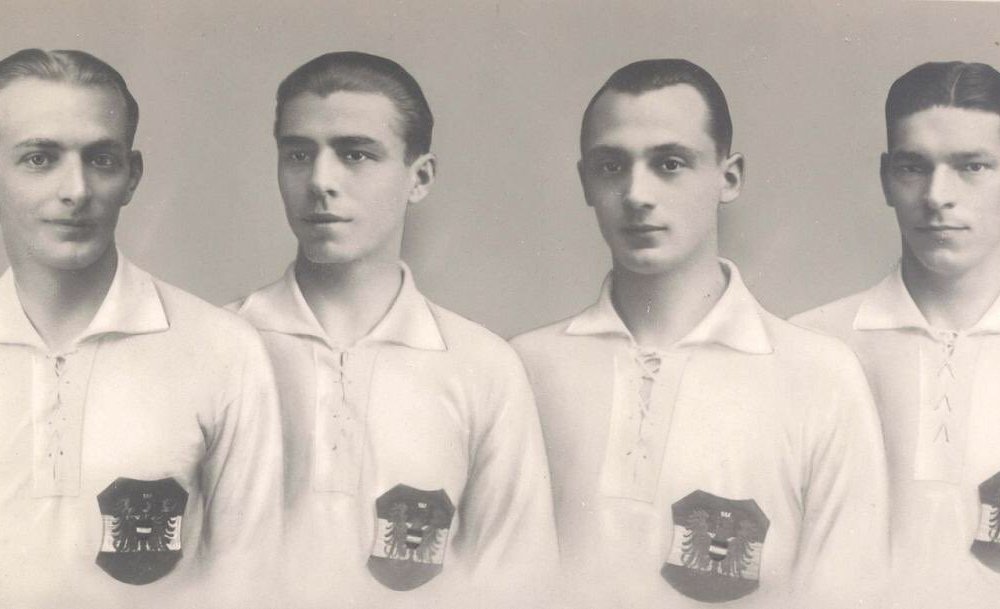
A simple photograph of four teammates, stars for club and country, in their homeland they are viewed as part of a footballing golden age, central to the rise of one of the strongest national teams in Europe. For their club they regularly challenged for trophies and beat the best that Europe had to offer. The photo shows the men in the jersey of the Austrian national team rather than their club FK Austria Vienna. It is taken around the early to mid-1930s with the players wearing thick white jerseys with lace-up collars, their hair slicked and brushed back in the style of the time. They look confident, at ease, a hint of a smile plays on more than one of their faces. By the end of that decade two of those men would be dead, one under mysterious circumstances that still provokes discussion to this day, and the other two? One would have to flee the newly arrived forces of Nazi Germany and escape the country with his Jewish wife, partly as a result of the actions of the man standing next to him; a committed fascist who helped overthrow the management of Austria Vienna. This is an attempt to tell the story of these four men – Matthias Sindelar, Karl Gall, Hans Mock and Walter Nausch and that of the club Austria Vienna, in their journey from triumph to tragedy in the 1930s.

In 1936 an Austrian side dubbed, the Wunderteam beat England 2-1 in Vienna. It was only the second time ever that the English had been beaten by Continental opposition after a defeat to Spain some seven years earlier. This was a special side, one born out of a vibrant and developing footballing culture. The Austrians were among the most progressive footballing nations in Continental Europe. Their league centred around the capital city of Vienna was the first on the Continent to go professional in 1924 and only a few years later the visionary Austrian coach and administrator Hugo Meisl helped create the Mitropa Cup or Central European Cup. This was one of the first international club tournaments and it began in 1927 and featured two top professional teams from Austria, Hungary, Czechoslovakia and Yugoslavia, and later teams from Italy, Switzerland and Romania would enter as the tournament expanded.

By the 1930s the Austrians were a major force in European football, in 1931 they trounced Scotland 5-0 in Vienna, that result was sandwiched between a 0-0 draw with England (also in Vienna in 1930) before an unlucky 4-3 defeat to them in Stamford Bridge in 1932. And it wasn’t just the hapless Scots who the Austrians were racking up the goals against. Right after that win against Scotland the Austrians put six past the German national team in Berlin and five in the return fixture in Vienna. The following months would see them put eight past Switzerland in Basel and another eight past Hungary in Vienna. In 1932 and 1933 there were wins over Italy, Sweden, France and Belgium (twice) and the Netherlands as the Austrians geared up for the 1934 World Cup.

In qualification Austria had been drawn in a group with Hungary and Bulgaria but only had to play a single game, dispatching the Bulgarians with ease 6-1. Bulgaria had also suffered two defeats against Hungary and withdrew from qualifying which guaranteed Austria a spot in the World Cup in Italy after just a single game.

The 1934 tournament ran on a simple knock-out cup format without any group stages. Austria were drawn in the first round against France. Now, the Austrians had comfortably beaten the French 4-0 just a year earlier but faced a different proposition in the opening game of the World Cup. The French looked to curb the influence of the Austrians, centre-forward, talisman and playmaker Matthias Sindelar by man-marking him with their half-back Georges Verriest. Though Sindelar opened the scoring in the Stadio Benito Mussolini in Turin, it was a much tighter game and Austria only prevailed 3-2 after the French had taken the game into extra-time.

Austria defeated neighbours Hungary in the quarter finals by a margin of 2-1 in a bad-tempered game and were drawn against hosts Italy in the semi-finals. The hosts won the match 1-0 thanks to a controversial first-half goal in the San Siro. For the 3rd place play-off the Austrians made numerous changes, which included dropping Sindelar and having to wear a borrowed set of blue Napoli jerseys as their white and black kit clashed with their opponents Germany. Despite high-scoring wins over the Germans in the previous years it was the Austrians’ larger neighbours who would prevail. Austria seemed cocky with full-back Karl Sesta (sometimes written as Szestak) taunting German attacker Edmund Conen by sitting on the ball when Conen tried to dispossess him. On the second occasion he did this Conen managed to dispossess him and scored a vital goal. Sesta did make some amends in the second half by scoring himself but it was not enough, the Germans had won 3-2.

Of the squad that went to Italy for the World Cup three players were on the books of FK Austria Vienna; forward Rudolf Viertl, the young, skilful attacker Josef “Pepi” Stroh, and the team’s star, Matthias Sindelar, while directly after the World Cup they were joined by Karl Sesta who moved from Wiener AC.

Two years later when that famous win against England rolled around the contingent of FK Austria Vienna players had risen; Sindelar started against England at centre-forward, with Viertl at outside left, young Stroh played at inside-right while the team was captained by Walter Nausch another Austria Vienna player. Two more players from the club featured, Johann (Hans) Mock at centre-half and Karl Sesta at right-back while it was Viertl that opened the scoring in the 2-1 win for the Austrians.

The high concentration of players from Austria Vienna was not to be unexpected, the club were enjoying one of their most successful periods, winning the Austrian Cup in the 1934-35 and 1935-36 seasons and would finish runners-up in the league in 1936-37. During the 30s they also won two Mitropa Cups in 1933 and again in 1936 with final wins over Inter Milan (then styled as Ambrosiana after St. Ambrose of Milan, the Italian fascists deemed their original name too “international”) and Sparta Prague respectively. They had a genuine claim to be one of the strongest club sides on central Europe. While the second leg of the 1933 final has gone down in history as one of the finest ever performances by Mattias Sindelar – with Austria Vienna trailing 2-1 from the first leg he scored a hat-trick of spectacular quality to win the match 3-1 and secure the trophy would return with him to Vienna.

However, one cannot write about the FK Austria Vienna team of this era and ignore what came next. 1936 had seen them win both the Austrian Cup and Mitropa Cup and supply numerous players to the Austrian National team, but less than two years later there would not be an Austrian national team, and there very nearly was not an Austria Vienna at all. The Anschluss, the effective annexation of Austria into a greater Germany ruled by Adolf Hitler took place in March 1938. This was an especially dangerous time for Austria Vienna as they were viewed as a “Jewish club” and featured many members of the city’s large Jewish community among their players, board and fans. The club’s first president, Erwin Müller was Jewish, as was their president at the time of the Anschluss, Emanuel “Michl” Schwarz.

The club faced huge upheaval after March 1938, they were initially suspended for not being under “Ayrian management” until a former amateur player, and leading member of the local SA (Sturmabteilung, commonly known as the Brownshirts), Hermann Haldenwang was installed as the new head of the club. He arrived at the club in full SA uniform, accompanied by first team player Hans Mock, who was similarly attired. Haldenwang wanted to change the club’s name to SC Ostmark as the use of the name Austria was considered too nationalistic. Jewish players and officials were no longer allowed at the club, and the clubs stadium was taken over by the German army for training purposes.

By the summer Haldenwang had been transferred and the club were unique in being able to return to the use of their former name. By this stage most of their board and many of their players had fled. Emanuel Schwarz initially hoped that he would be protected by virtue of his “mixed marriage” to a non-Jewish woman and he stayed in Vienna and waited for a visa for the United States. Ultimately, he was forced to divorce to try and protect his wife and son. When his visa failed to materialise, he decided to flee, first to Bologna, which he managed through his contact Giovanni Mauro within the Italian FA. And then with the support of FIFA President Jules Rimet, he obtained an entry permit for France in 1939, where he was forced into hiding after the German invasion. In 1945 at the War’s end he was reinstated as Chairman with the club recognising him as their only legitimate leader stating that the role remained his despite his absence.

Hans Mock who had effectively helped to oust Schwarz, had been an Austrian international, however with no Austria in existence to compete at the 1938 World Cup he was representing a newly enlarged Germany at the competition. He had been a member of the SA even when the organisation was illegal in an independent Austria, he surely was happy to get the chance to represent the Reich. He even got the opportunity to captain Germany in their opening game at World Cup against Switzerland. The match finished a 1-1 draw and Mock was dropped for the replay which the Swiss won, eliminating Germany in the first round. Mock would continue at Austria Vienna until 1942, playing his last game for them at the age of 36. Mock survived the War and after dabbling in coaching ran a wine bar in Vienna until his death in 1982 aged 76.

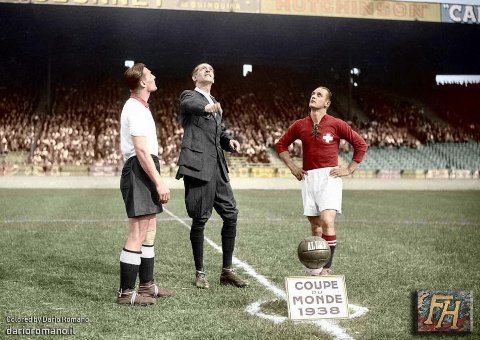
Hans Mock Germany v Switzerland 1938

Hans Mock captains Germany v Switzerland at the 1938 World Cup photo

While Mock may appear an obvious villain of the piece, selling out teammates and club members he must have known would have to be removed from the club and likely flee the country, the decisions made by other Austria Vienna players less obviously sympathetic to the new regime bare further scrutiny. One result of the Anschluss was that all sport was to return to being notionally amateur, thus at a stroke the entire professional playing staff of Austria Vienna was out of a job. While some had trades to fall back on others sought to leave the club for other professional leagues, notably the French league, while still others tried their hands at new business ventures.

By the time of the Anschluss Austria’s star footballer Sindelar was already 35 and increasingly injuries were taking their toll on him, by 1938 he was featuring less-regularly for Austria Vienna and when he did play he was pushed out to the right wing and not afforded as central an attacking role. He decided to follow a route well-trodden for footballers coming to the end of their careers and go into the hospitality business, running his own café, the Annahof Coffee House in the district of Favouriten, somewhere that Sindelar knew well in his local neighbourhood. Most reports note that Sindelar got a café at an attractive price as it was owned by a man named Leopold Drill, because Drill was Jewish he was no longer permitted to own a business and was forced to sell. Sindelar, an ageing footballer coming to the end of a career for which he could no longer legally be paid was the clear beneficiary of this transaction.

Sindelar was not alone in this, his teammate Karl Sesta similarly bought a Jewish owned bakery and it took until 1953 for the bakery’s rightful owner, Josef Brand to get the business returned to him. While Sesta survived the War and continued playing until 1946, earning a living from the bakery throughout, Sindelar did not get to benefit from ownership of the café for long. One night after drinking with friends in January 1939 Sindelar left to go to the apartment of his girlfriend Camilla Castagnola, it was the last time he was seen alive. Friends worried about Sindelar the next day broke down the door to Castagnola’s apartment to find her unconscious on the bed with Sindelar already dead beside her. Castagnola would later die in hospital and both deaths were judged to have been as a result of carbon monoxide poisoning.

Despite this judgement theories abounded that Sindelar had been killed by the Nazis, with various reasons put forward to justify this suspicion: Sinderlar’s supposed Social Democratic leanings (despite his calling for Austrians to ratify the Anschluss in a referendum), his refusal to play for a Greater Germany side, supposed Jewish heritage either in Sindelar’s family or in that of Castagnola. Even today many still point to these theories and as a result for many, Sindelar has been cast as a symbol of resistance to Nazi rule. While his personal life and legacy remain complex his role at the heart of one of the greatest players in Austrian history remains more safely uncontested.

The death of Sindelar’s teammate Karl Gall was more brutally straightforward, the skillful winger had 11 international caps to his name. He had spent three years playing in France for Mulhouse until the outbreak of War had prompted his return to Austria Vienna in 1939. By 1942 he was still playing at the age of 37 when he was conscripted into the Wehrmacht and sent to the Eastern front. On February 27th 1943, in the harshness of the Russian winter a landmine tore apart one of the most elegant players ever to represent Austria Vienna.

He was not the only member of Austria Vienna to die violently during the War years. Josef Adelbrecht, like Gall, died on the Eastern Front, while a young player named Franz Riegler died in an air-raid on Vienna. Robert Lang, an early player, then later coach and board member of the club fled after the Anschluss, first to Switzerland and later to Yugoslavia, rightly fearing for his safety as a Viennese Jew. He continued coaching, but after Belgrade fell to the Nazis in 1941 he was imprisoned and murdered.

The final member of our foursome was Walter Nausch. A talented, cerebral midfielder, Nausch was a born leader, he had been a captain of Austria Vienna and key to many of their successes. While Nausch was not Jewish, his wife was, and he was “advised” that he should seek a divorce. Rather than do so Nausch and his wife fled across the border to neutral Switzerland where he began his coaching career. After the War Nausch was able to return to Vienna and in 1948 he became national team coach of Austria. In 1954, some twenty years after being part of the Wunderteam that reached the semi-finals Nausch was able to lead the Austrians to another World Cup semi-final, while they lost heavily against eventual winners West Germany they would do slightly better than Italy 1934 by beating the Uruguayans 3-1 in the third place play-off. It remains Austria’s best-ever World Cup performance.

With special thanks to Clemens Zavarsky for his assistance. A version of this article appeared in issue 3 of View Magazine.

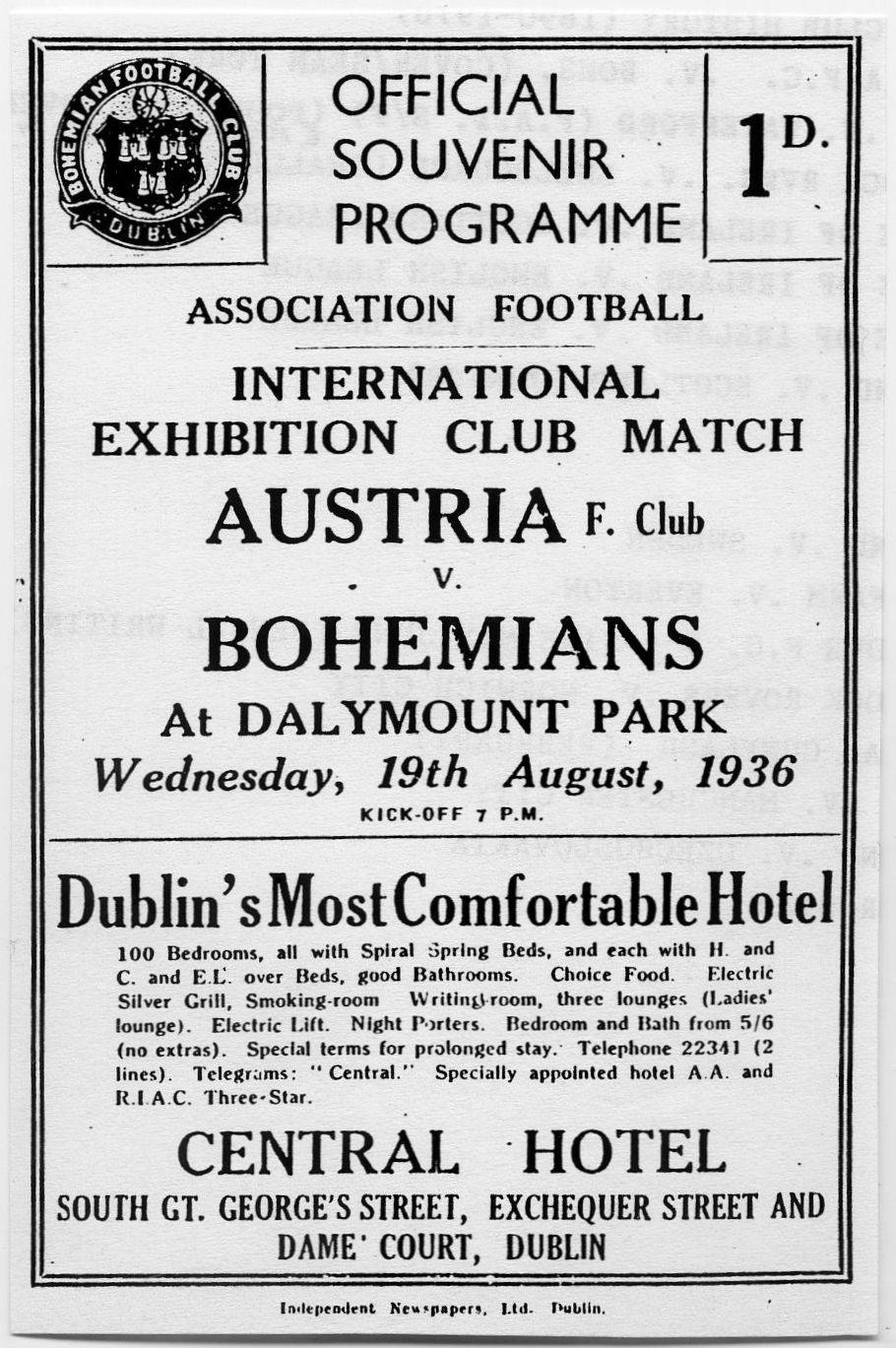
Bohemians v Austria Vienna

The life of O’Reilly

It all began in a two room house that no longer stands, on a street that no longer exists. In the summer of 1911, Joseph O’Reilly, a man who go on to be one of the greatest Irish footballers of his era was born at number 4, Willet’s Place. And, like the street where he was born, O’Reilly tends to be forgotten by history.

While Willet’s Place was just one of the many lanes and courts that snaked through Dublin’s impoverished north inner city, a place that many perhaps willingly forgot, Joe is someone who should be more familiar, especially to Irish football supporters. He was the first Irish player to win twenty international caps, a total that would have been significantly higher had the outbreak of World War Two not intervened. O’Reilly’s appearance record wouldn’t be broken until Johnny Carey won his 21st cap in 1949.

He was also a star of the domestic game, winning both a League and an FAI Cup with St. James’s Gate and represented the League of Ireland XI on many occasions. However, despite being a cultured half-back with a rocket of a shot, enjoying club success and scoring on his international debut in a win against the Netherlands, O’Reilly’s name provoked little response when typed into a search bar – a two line wikipedia entry being scant reward for an impressive career.

One reason that Joe O’Reilly is not a more prominent name in the history of Irish football could be down to the man himself. I spoke with Joe’s son Bob about his father and he stressed how little his father courted the limelight, describing him as a quiet and very humble man. Indeed the few articles and interviews that one can find on Joe O’Reilly see him focus praise and attention on his erstwhile teammates and rivals rather than on himself.
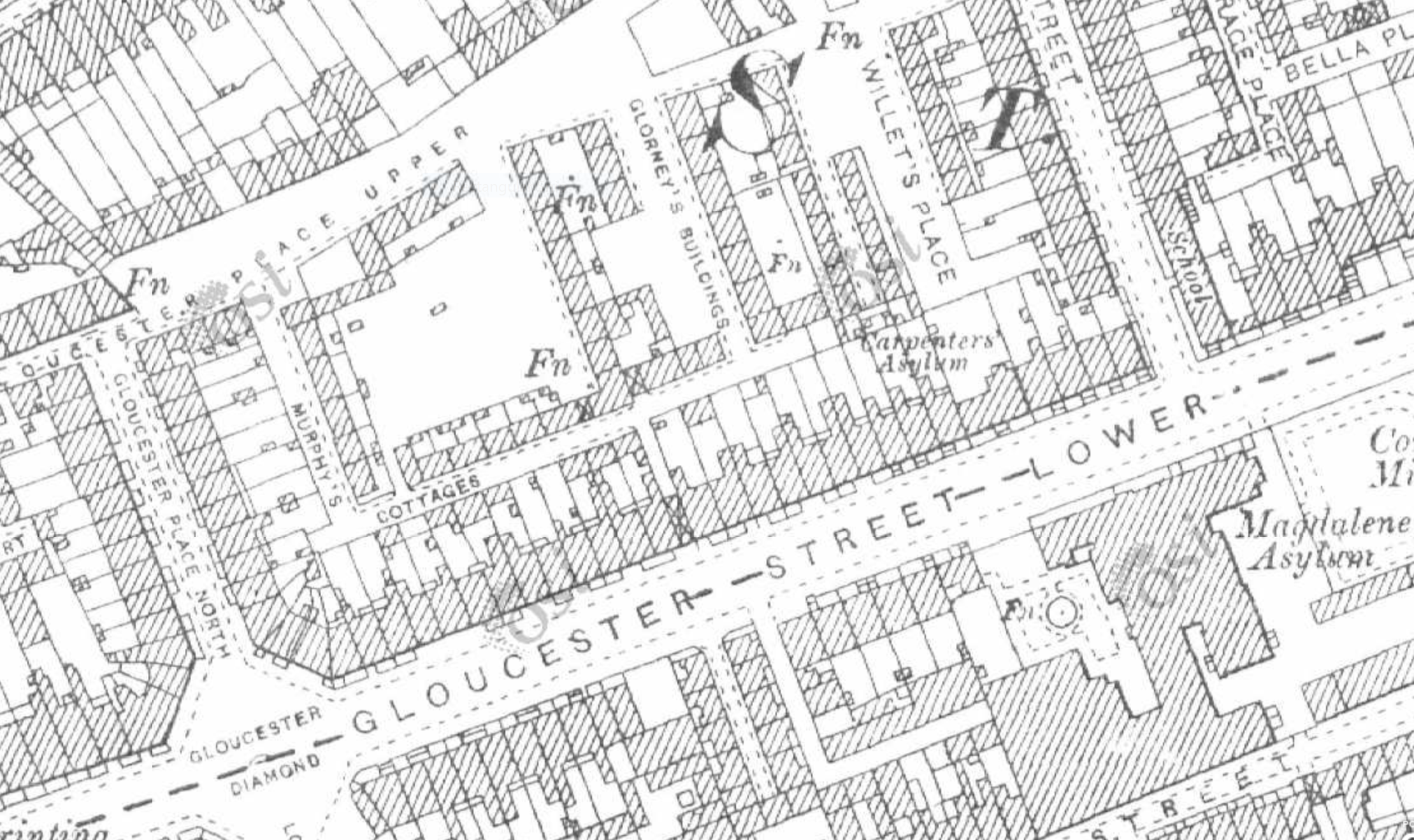
Map of Willet's Place

Ordnance survey map showing Willet’s Place (top centre right) c.1913 the Gloucester Diamond is shown bottom left.

Off the Diamond

To redress the balance I’ve tried to piece together a descriptive timeline of Joe’s life and career. In doing so let’s return to that two bedroom house in Willet’s Place, a back lane off what we know today as Sean McDermott Street. On May 27th 1911 a son is born to Michael and Mary O’Reilly, they christen him Joseph. This is an area that will become synonymous with Dublin football and footballers, Graham Burke, Jack Byrne and Wes Hoolahan are some of the more recent residents from the area who have worn the green, while the Gloucester Diamond became famous across the city for its 7-a-side matches that often featured the cream of Dublin’s footballing talent.
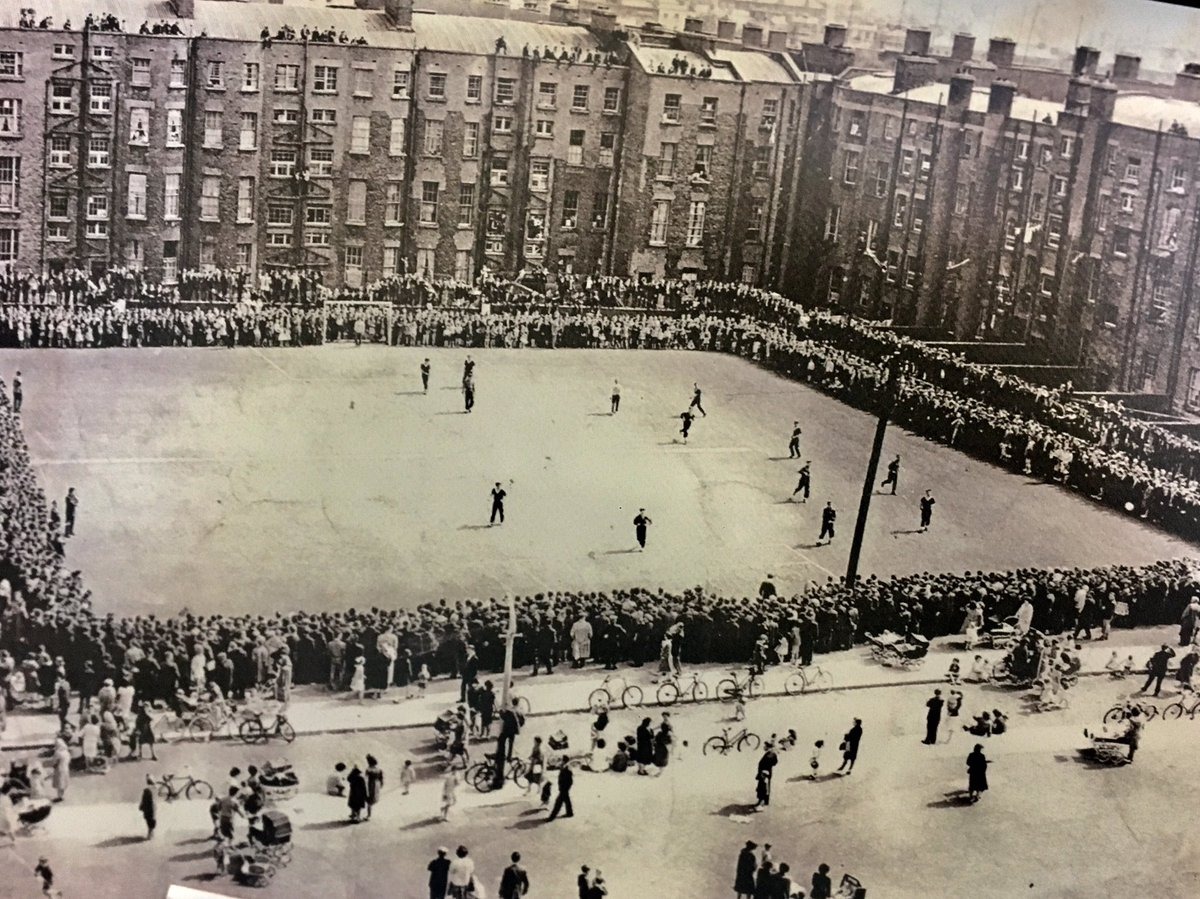
Diamond

The Gloucester Diamond and its famous 7 a side concrete pitch – photo from local historian Terry Fagan

However, the O’Reilly family would not remain in the area long, they moved to another hotbed of Dublin football; Ringsend on the southern banks of the Liffey. Michael was a soldier in the Royal Dublin Fusiliers at the time of Joe’s birth and he was predominantly based out of Beggar’s Bush barracks, a short distance from the Ringsend/Irishtown area. The cramped house on Willet’s Place was the family home of mother Mary and shared with her parents Joseph and Mary-Anne Cooling. By 1916, when Joe’s younger brother Peter was born the family were living in one of the newly constructed houses in Stella Gardens, Ringsend. Named after Stella O’Neill, the daughter of local Nationalist Councillor Charles O’Neill these would have been an improvment on Willet’s Place and would have been highly sought after.

The family remained in the Ringsend area although the moved addresses at various times, being listed as living on the likes of South Lotts Road and on Gerald Street. Joe was the third child in a growing family that eventually would welcome seven children, four boys and three girls. Ringsend is of course an area synonymous with soccer, being the original home to both Shamrock Rovers and Shelbourne as well as one of Dublin’s oldest football clubs, Liffey Wanderers. The district has supplied the Irish national team with literally dozens of international players over the years and should count O’Reilly among its number, although he didn’t make the list when the Sunday Tribune set out to map all of Ringsend’s footballers back in 1994 (see below).
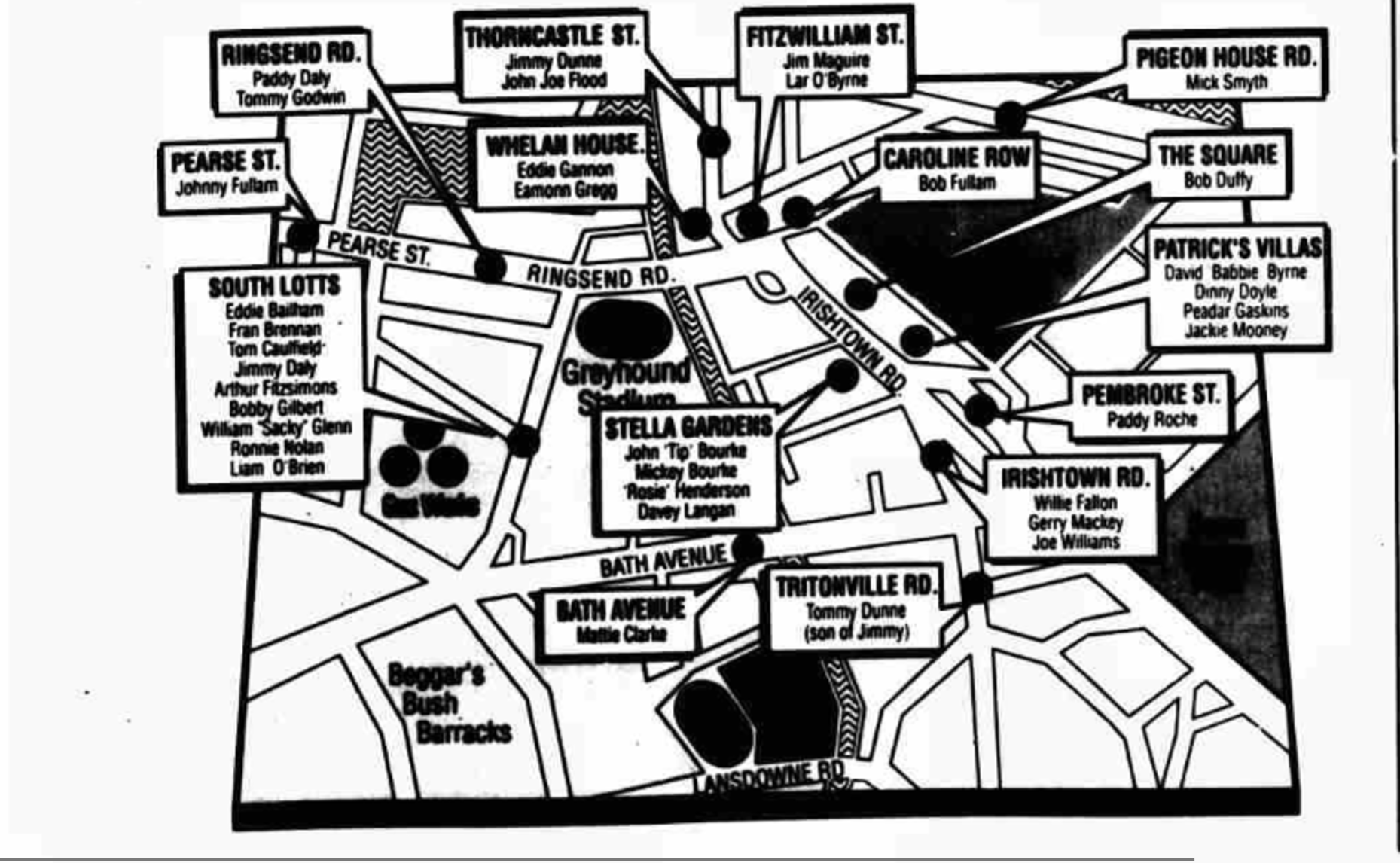
Football map of Ringsend

Sunday Tribune 1994 map of Ringsend’s footballers

The Ringsend Cycle

While born on the northside of the Liffey, and later to spend much of his life living in the then rural village of Saggart, south county Dublin it would be Ringsend that would provide formative influences on young Joe O’Reilly. Ringsend was home to Jimmy Dunne, who O’Reilly played with on numerous occasions for the national team, a man that he would continue to tell tales about years after he had hung up his boots. Ringsend was also home to Bob Fullam, one of the bona fide stars of Irish football in the 1920s, when terraces used to echo to the chants of “Give it to Bob”, in the hope that his rocket like left foot would create something spectacular. We’ll come on to Fullam later in our story but let’s begin with Dunne.

Jimmy Dunne was born in 1905, six years senior to Joe O’Reilly and packed a lot into those early years. While still a teenager he was interned by the Free State forces in the “Tintown” camp in the Curragh due to his involvement with the anti-treaty IRA, his older brother Christopher was also involved. By that stage Dunne was already something of a footballing prodigy and fellow footballer, and internee Joe Stynes remembered playing matches with Dunne in the cramped confines of the camp. According to O’Reilly’s son Bob, the Republican exploits of Jimmy Dunne extended back even further. During the War of Independence he remembered his father saying that Jimmy Dunne (then no more than 15 or 16) was a delivery boy for a local baker, and would use this job as a way to bring IRA messages across the city on his bicycle, hidden inside a loaf of bread.

An additional layer is added to this when we turn to the life and career of Joe’s father Michael. As mentioned above Michael O’Reilly was a soldier with the Royal Dublin Fusiliers. More than that he was a career soldier, having joined aged 18 and risen to the rank of Sergeant-Major and becoming and physical education instructor for the troops. He was a veteran of the Second Boer War and had an unblemished service record. Well – unblemished apart from one incident which caused him to be “severely reprimanded”. This reprimand related to a “disregard of battalion orders” when his battalion was based in Beggar’s Bush barracks in Dublin on the 24th of April, 1916. The day the Easter Rising began.
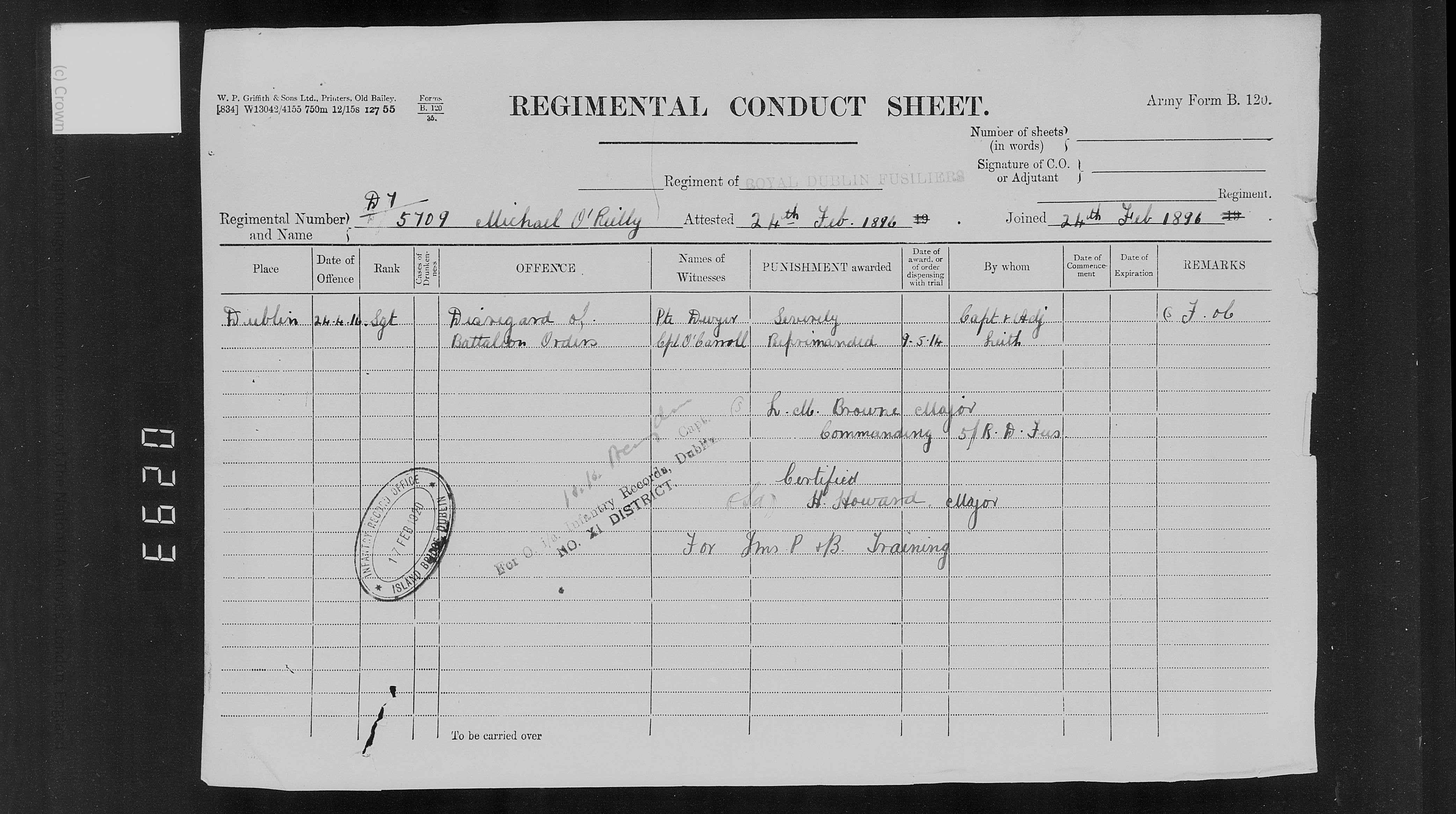
Reprimand sheet for MOR

Reprimand issued to Michael O’Reilly on the outbreak of the Easter Rising

The specifics of this incident remain unclear but it worth noting that Michael O’Reilly was not a callow recruit, he was a 29 year old Sergeant with over ten years service and battle experience. According to family history Michael gradually became disillusioned with life in the Army and even began training IRA volunteers during the War of Independence after leaving the British Army in early 1920. We do know that he would go on to join the newly created Free State army and would be based in the Curragh camp during the War of Independence, perhaps he even watched his son’s future teammate Jimmy Dunne play a match in the Tintown prisoner camp?

Debuts and defeats

Joe O’Reilly would follow his father into the Army as a young man and was a member of the Army No. 1 band as a clarinet player. While in the army he also lined out for an unofficial Army football team, Bush Rangers (the Association game wasn’t recognised as an official army sport at the time) and it was clear that football was his first love. Aged just 18, Joe O’Reilly made his debut in the League of Ireland, helping Brideville to a win over Dundalk in October 1929. Joe started at the inside right position and scored in the win over Dundalk. Of his debut the newspaper Sport recorded –

“O’Reilly the newcomer, lacks training but he was responsible for many clever touches and a fine goal. He should be persevered with.”

And persevere they did. By the end of that seasons the teenage O’Reilly was a regular for Brideville as they finished fifth in the League of Ireland and was lining out in a Cup final  against Shamrock Rovers who were embarking on a famous Cup dynasty. O’Reilly remembered being somewhat overawed by the occasion. He was not yet 19 and here he was starting in front of almost 20,000 in Dalymount Park, facing off against Irish internationals. He recalled years later that he must have looked somewhat of a nervous wreck as Rovers’ star Bob Fullam, a fellow Ringsend man, had a quiet word saying “I know you’re nervous, just do your best”. A small gesture but one which stuck with Joe.

The match didn’t go so well for Brideville though, ending in dramatic and controversial circumstances. With the game entering the 90th minute and the score level at 0-0 it looked like a lucrative replay might be on the cards. Rovers had a late attack and a hopefully ball was lofted into the box. David “Babby” Byrne, the Rovers striker got in between Brideville’s Charlie Reid and goalkeeper Charlie O’Callaghan and leaping with all of his 5’5″ frame guided the ball into the goal with an outstretched arm. 56 years before the dimunitive Diego Maradona did it, the FAI Cup had its own Hand of God moment.

The game’s colourful, English referee Captain Albert Prince-Cox saw no infraction and blew for the final whistle shortly afterwards. Joe had been denied the Cup in his debut season in cruel circumstances. By the end of that season Joe had moved further back on the pitch and instead of playing outside right he had moved into the half back line and his favoured role.

Despite the disappointment of losing the 1930 final further success on the pitch was not far off. In May 1932, just weeks before his 21st birthday Joe O’Reilly made his debut in Amsterdam against the Netherlands. Things got even better when just twenty minutes in O’Reilly scored the game’s opening goal with a rasping, curling shot from the edge of the box, in the second half Paddy Moore, the man who had replaced Bob Fullam as the talismanic figure at Shamrock Rovers scored a second to give Ireland a comfortable 2-0 victory in front of a crowd estimated at 30,000.

That first game for Ireland was an important one in Joe’s career as directly afterwards he, Paddy Moore and Shamrock Rovers’ winger Jimmy Daly, who had also featured against the Netherlands were signed for Aberdeen manager Paddy Travers for the combined fee of just under £1,000. The British transfer record at the time was £10,900 paid by Arsenal for Bolton Wanderers David Jack back in 1928, so to get three internationals for under a grand can count as a canny bit of business by the former Celtic player Travers. Joe became a full-time pro and was paid the princely sum of £6 a week for his efforts.

To the Granite City and back to the Gate

Things started well in the granite city for Joe, he was a first team regular for much of the season, alongside his international teammate Moore. While Jimmy Daly made a mere four appearances before returning to Shamrock Rovers, Joe would make 26 appearances in all competitions that first season, while Moore started off spectacularly, scoring 27 goals in 29 league games (including a double hat-trick against Falkirk) to help Aberdeen to 6th place in the League in the 1932-33 season.

However, the following season would be less successful for both men, while Moore still scored a respectable 18 goals in 32 appearances his strike rate had decreased and he eventually ended up going AWOL after returning to Ireland for a match against Hungary in December 1934, blaming injury and a miscommunication with Aberdeen. It seems that Moore’s problematic relationship with alcohol was impacting his performances, to the point that manager Paddy Travers had effectively chaperoned him back to Dublin for an international match against Belgium. Whatever Travers did seemed to work as Paddy Moore would score all four goals in a 4-4 draw in that game.

Joe’s issues were more prosaic, he felt alone and deeply homesick in Aberdeen which affected his form, he also faced stiff competition for a starting berth from club captain Bob Fraser who often played in the same position at right-half. While he would technically remain on the Aberdeen books by the beginning of 1935 Joe O’Reilly had returned to Dublin and Brideville.

After a year with Brideville he relocated the short distance to the Iveagh Grounds to sign for St. James’s Gate and it would be with the Gate that Joe would enjoy his greatest success domestically. While his first season with the Guinness team was not hugely successful the 1936-37 showed significant promise. For one thing the side featured a versatile teenager by the name of Johnny Carey who would be spotted by Manchester United and go on to captain them to League and FA Cup success during his 17-year stint with the club. While Joe and Johnny would only spend a few months together in the Gate first team they would don the green of Ireland together on many occasions.

The season would also bring around another FAI Cup final for Joe O’Reilly, more mature now, with international experience under his belt, surely this would be different to that teenage cup final defeat against a heavily fancied Rovers side? Alas for Joe this wasn’t to be the case, it was Waterford who triumphed in the final 2-1, bringing the cup to the banks of the Suir for the first time thanks to goals from makeshift centre-forward Eugene Noonan (more accustomed to playing at right back) and Tim O’Keeffe, with the Gate’s Billy Merry scoring a consolation goal late on.

Two lost cup finals by the age of 25 – perhaps Joe thought he was cursed never to lift the trophy? But a year is a long time in football and 12 months later St. James’s Gate were back in the final again, and this time they would emerge triumphant, defeating Dundalk 2-1. Goals from Dickie Comerford and a second half peno from Irish international Peadar Gaskins sealing the win. Incidentally the consolation goal for Dundalk was scored by Alf Rigby, who had been a part of the St. James’s Gate side who lost the cup a year earlier, being on two different losing cup final teams, two years in a row is not a distinction that any player would enjoy.

That cup win in 1938 would mark itself out as an emerging high point in Joe’s career, not only had he won the cup, he had been the victorious captain, leading the Gate to their first win in 16 years. “A marvellous day and one I still treasure” recalled Joe in an Irish Independent interview decades later.
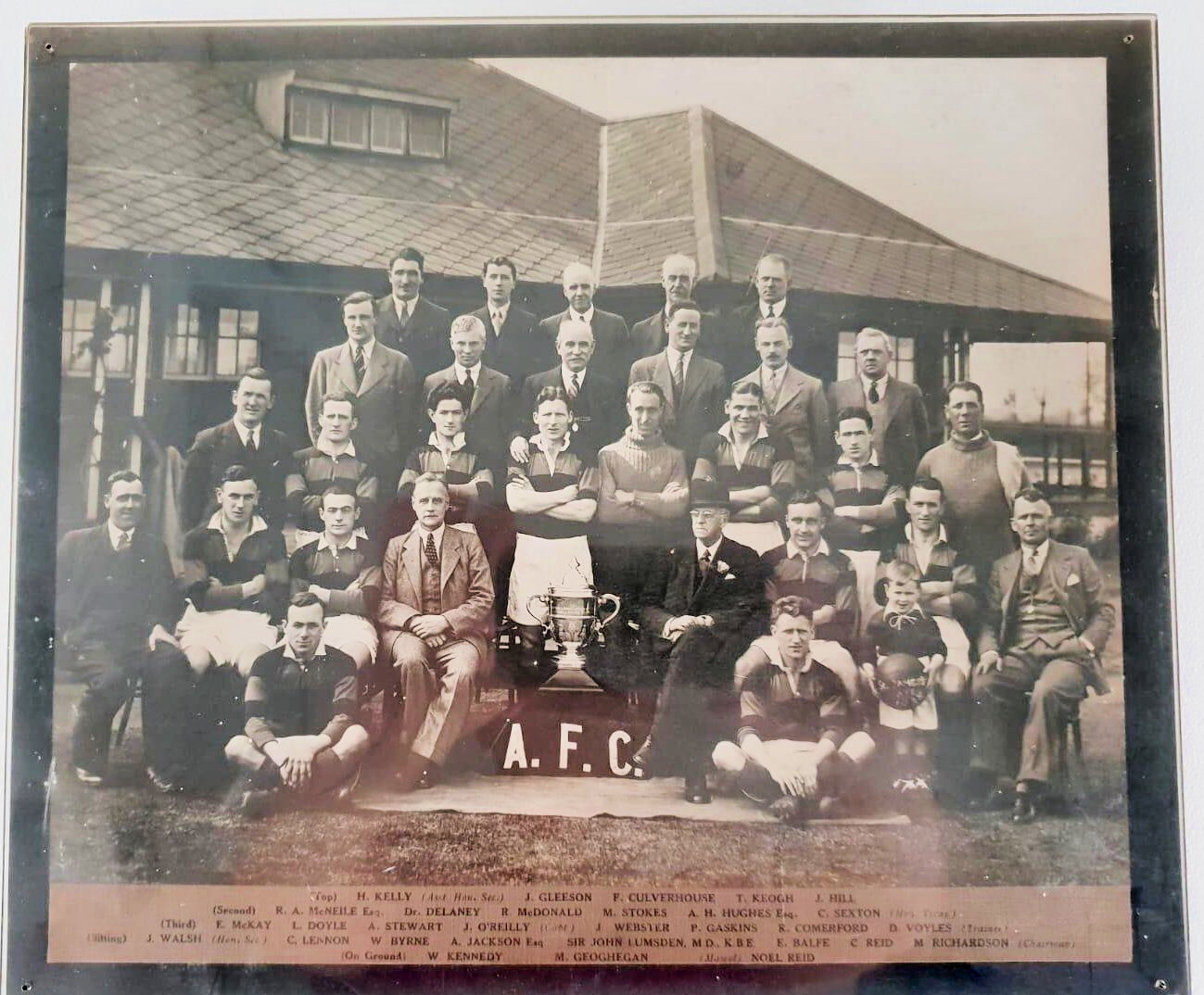
Gate cup winning team.jfif

Joe standing behind the cup he had lifted in 1938 as team captain. (Credit Ger Sexton)

At international level Joe’s career was entering its prime. When he had made his debut in 1932 international opposition was difficult for the Irish team to find, near neighbours in Britain were refusing to play the national team in friendly matches for example. 1934 saw the first qualifying matches for the World Cup, Ireland were drawn in a group with the Netherlands and Belgium with Joe playing in both games.

The Belgium match entered the annals of Irish football history as one of the all time great international matches held in Dublin (and would perhaps set a national precedent for celebrating draws!) when Ireland drew 4-4. with Joe’s clubmate Paddy Moore scoring all four goals. The game against the Netherlands would be a disappointment however, despite taking the lead a late onslaught by the Dutch saw them run out 5-2 victors.

For the remaining five years Joe was pretty much an ever-present in the Irish team, playing a then record 17 consecutive international matches. He would score a second international goal in a 3-3 draw with Hungary in Budapest. Jimmy Dunne, also in record breaking form grabbed the other two.
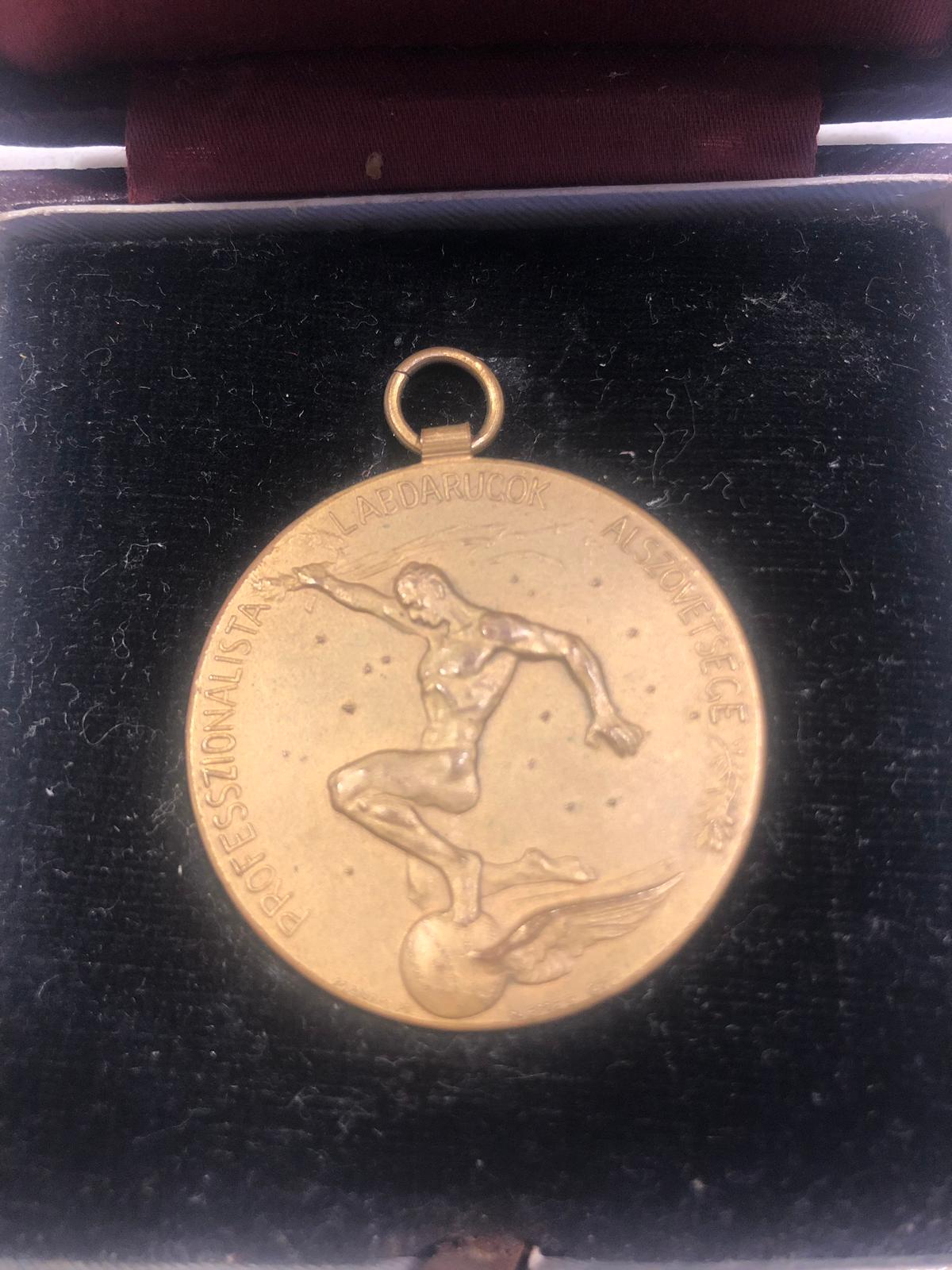
Budapest medal

A commemorative medal awarded to Joe after playing against Hungary in Budapest.

Joe also featured in both 1938 World Cup qualifying matches (home and away against Norway) however after a 3-2 defeat in Oslo a 3-3 draw in Dalymount wasn’t enough to get the side to France for the third installment of the tournament. Ultimately Joe’s international record read – played 20, won 8, lost 5, drew 7. This included some stand out victories over the likes of France, Switzerland, Poland and Germany.

The Germans

Two matches against Germany formed some of the clearest memories of Joe’s football career, which he discussed with both the Sunday World and Irish Independent many years later. The first of these matches took place in 1936 in Dalymount.
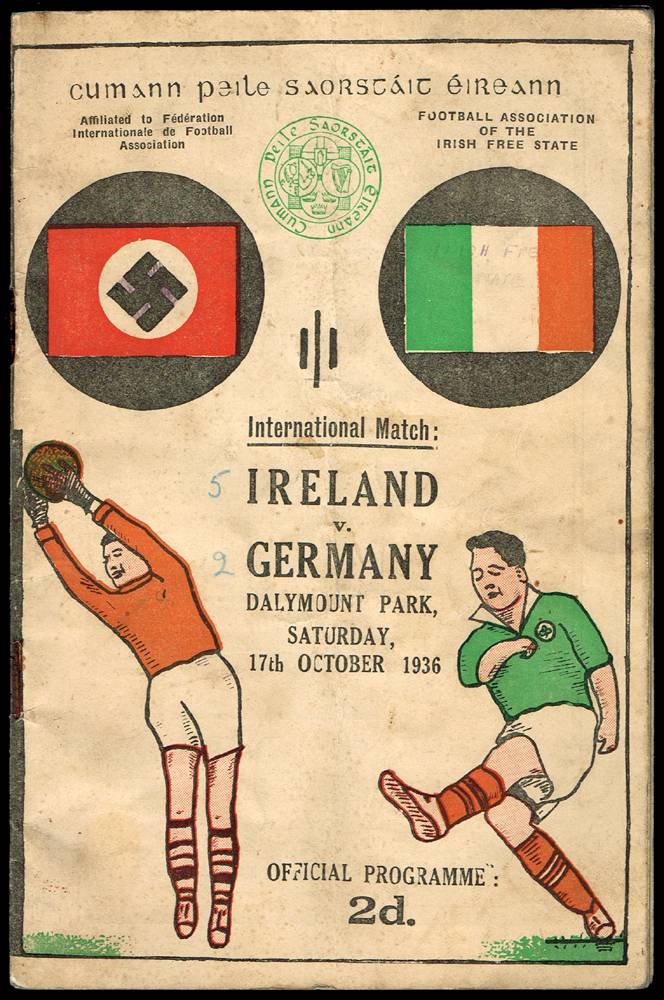
55398

Infamous match programme from the 1936 game against Germany as presented for sale at Whyte’s auctioneers.

It was in this game that the German team, and over 400 German dignitaries gave the Nazi salute at Dalymount Park. Given the lens of history it is understandable that these events have tended to overshadow the team performance but it was something that shouldn’t be overlooked. The Irish side ran out 5-2 winners with Oldham’s Tom Davis scoring a brace on his debut, and Paddy Moore, slower, less mobile, but still perhaps the most skillful player on the pitch pulling the strings from the unusual position for him of inside left and creating three of the five goals.

This was something of an Indian Summer in Moore’s career (a strange thing to say about a man aged just 26), he was back at Rovers and was instrumental in helping the Hoops win the 1936 FAI Cup and he lit up Dalymount that day against Germany. It was his second last cap for Ireland, followed by an unispiring display in a 3-2 defeat to Hungary two months later. Injury and Moore’s well- documented problems with alcohol had, not for the last time, derailed a hugely promising football career. He finished his Ireland career with nine caps and seven goals.

Joe O’Reilly knew Paddy Moore well, from their time in Aberdeen, their outings together on the Irish national team and from facing him in the League of Ireland. When interviewed in the 1980s by journalist Seán Ryan, he said this of Moore;

He was a wonderful footballer, a wonderful personality. The George Best of his time… He was a very cute player. If, in a match, things weren’t going his way, he could produce the snap of genius to turn the match around – and he was always in the right spot. I had a good understanding with him.

Of that 5-2 win O’Reilly remembered it as the highlight of his playing career, telling Robert Reid in the Sunday World many year later;

The highlight for me was our 5-2 win against the Germans in 1936. Their ultra-nationalism acted as an incentive for us… what they weren’t going to do to us… and we beat them 5-2!

The second game against the Germans was even more controversial and took place three years later in May 1939, it would be the last international match played by the German national team before the outbreak of the Second World War. Similarly it would be the Irish team’s last international match until 1946. Of the eleven Irish players who took to the pitch in Bremen in 1939, only two, Johnny Carey and Kevin O’Flanagan would play for Ireland again.

The match was also a personal landmark for Joe O’Reilly as he became the first player to win 20 caps under the stewardship of the FAI. I’ve written previously on the details of that game in Bremen, the views of the FAI, and more widely about Ireland’s sporting relationship with Germany at this time.  It was Joe’s recollections that however, provided one of the quotes that has endured, and it wasn’t even a direct quote from Joe, but rather his memories of Jimmy Dunne.

Dunne, who had never lost his socialist, Republican ideals, gave the Nazi salute under duress. As Joe recalled:

As we stood there with our right arm outstretched, Jimmy kept saying to me ‘Remember Aughrim. Remember 1916.’ By the time the anthem finished, I wasn’t quite sure who was more agitated the Germans or us.

As well as an interest in politics Dunne obviously seemed to have some interest in Irish history. O’Reilly recalls ahead of a game against Norway the usually laconic Dunne riled up his Irish teammates with references to Brian Boru’s victory over the Norse at the Battle of Clontarf. However, Dunne’s attitude in Germany stood in contrast with the official view of the FAI was recorded in the words of Association Secretary Joe Wickham. who said, “In Bremen our flags were flown though, of course, well outnumbered by the Swastika. We also, as a compliment, gave the German salute to their Anthem, standing to attention for our own. We were informed this would be much appreciated by their public which it undoubtedly was.” That the Irish athem was even played was in part down to Joe. On learning that the German band didn’t have the right sheet music Joe was able to write the notation to Amhrán na bhFiann from memory, thanks to his days in the Irish Army band.

Reflecting on his last cap more than 50 years later Joe felt the benefit of hindsight, appreciating things he perhaps didn’t as a sportsman in his 20s. He told Robert Reid;

But war was in the air. You could see it all around you, although you didn’t fully appreciate the extent of what was about to happen. How could anyone have known?

The anti-semetic feeling was already evident. But it was difficult to fathom what was really going on.

I remember the German soldiers. The shouts of “Heil Hitler” and the way we reciprocated their gesture. It was done in pure innocence. It just seemed like the thing to do at the time. I remember the young faces. I still remember them and wonder whatever happened to most of those young people, Germans, Jews, all the nationalities…

This match would be the last that Joseph O’Reilly played for his country, his international career ended, a week before his 28th birthday and three months before the Schleswig-Holstein battleship fired the first shots of World War Two.

This slideshow requires JavaScript.

Above are the panels on an international cap awarded by the FAI reprepsenting games that Joe O’Reilly played for Ireland in 1938 and 1939.

Epilogue

While Joe’s international career had come to a premature end his club career continued unabated. Unlike many European leagues the League of Ireland continued in as close to a normal capacity as was possible, during the years of the Second World War.

The 1939-40 season was to be one of great success for Joe as he captained St. James’s Gate to the league title. The men from the brewery finishing six points clear of nearest rivals Shamrock Rovers, while the Gate’s Paddy Bradshaw (who had scored in the 1-1 draw against Germany in Bremen) would end as the league’s top scorer with 29 goals.

Joe continued with the Gate until the 1943-44 season when the club disappointingly finished bottom of the league and failed to gain re-election, the club announcing that they were to revert to an amateur status thereafter. This wasn’t quite the end of Joe’s top flight career, as the club that replaced St. James’s Gate was his former side Brideville, returning to the League of Ireland after one of their periodic absences. Joe, now in his mid 30s signed on for one more season with the men from the Liberties before eventually hanging up his boots.

By this stage Joe had relocated to Saggart in south county Dublin and was working with Swiftbrook paper mills, a well established business who made official paper for the likes of the Irish Government, and according to historian Mervyn Ennis, James Connolly used the paper milled in Saggart for the publication of the Socialist Magazine, and when it came time to print it, the 1916 Proclamation. By this stage Joe had met and married his wife Helen and together they would eventually have six children; Geraldine, Helen, Maureen, Patricia, Bob and Brian.
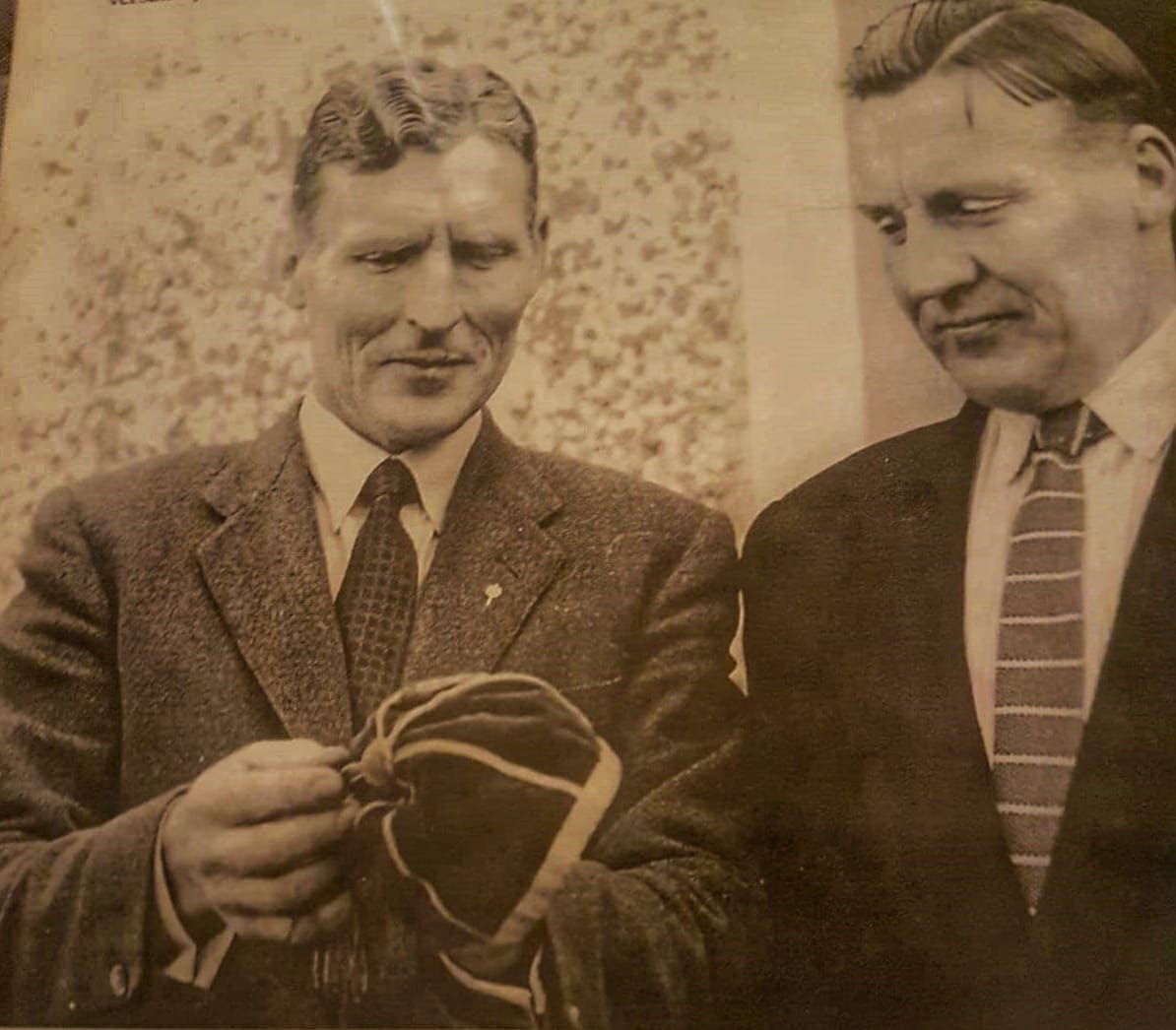
Joe and Peter

Joe and Peter O’Reilly

Sport remained an interest throughout the family, from Joe’s father Michael, the physical education army man who later trained Kildare’s footballers for All-Ireland success in 1928, while his brother Peter who won an All-Ireland with Dublin in 1942. Even his son Bob made the Dublin GAA team league panel in the early 80s as well as playing soccer on the books of Shelbourne.

By all accounts a quite and humble man who preferred to amplify the achievements of others, Joe did gain some wider recognition later in life, being a recipient in 1991 of an Opel Hall of Fame award alongside Paddy Coad and Dundalk’s Joey Donnelly.
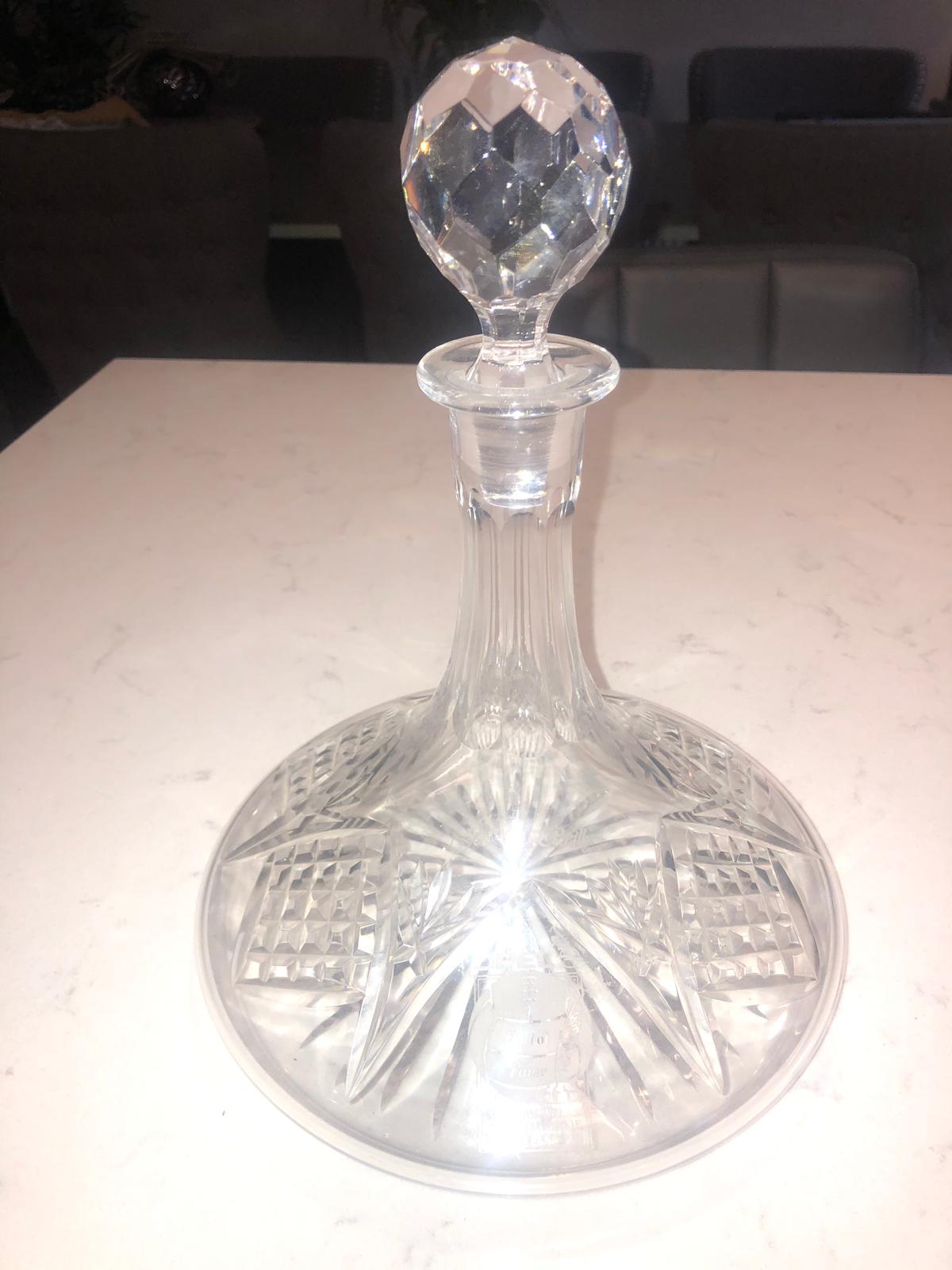
 

Opel crystal

The Opel hall of fame award presented to Joe in 1991.

Joe passed away in October 1992 just a year after the receipt of this award. While he surprisingly remains little remembered in many Irish football circles he was one of the most talented and technically astute players for Ireland and an early international record breaker.


A special thank you to Bob O’Reilly for sharing memories of his father as well as many of the photos that feature in this article.
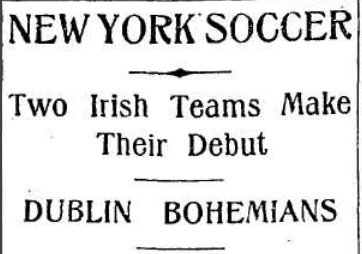
Bohemians in America (Podcast)

A podcast recorded with sports researcher Michael Kielty – a lively discussing which covers early patterns of emigration by Irish footballers, the emergence of  the New York Bohemians in the 1920s, as well as the stories of unique characters like Billy Synott and Joe Stynes.


This slideshow requires JavaScript.

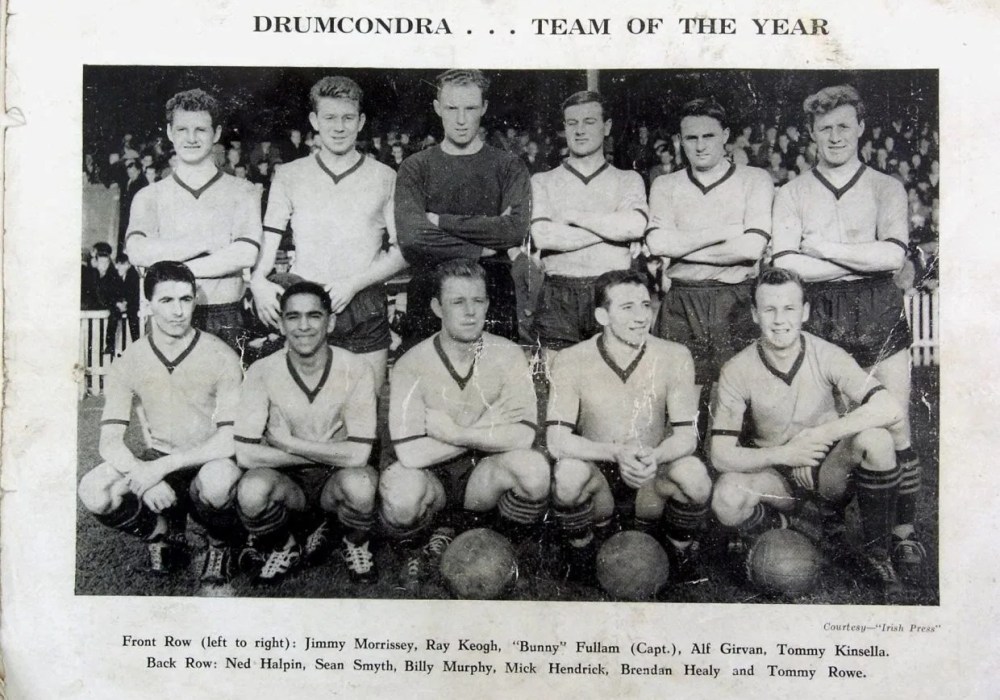
Ray Keogh – a pioneer in Irish football (Podcast)

Recordings of my talk on the life and career of Ray Keogh from January 2020. This talk took place in Drumcondra Library and I would like to thank Conor Curran and Emma Kelly for their assistance in organising everything on the night.

Also discussed are topics like the demise of Drumcondra FC as a league club, as well as the career of other players of colour in the League of Ireland and the Irish League. Also heard at the end of the talk is Ray’s former Drumcondra teammate Alf Girvin who shares some of his memories of Ray and Drums.

Some photos included below are provided by Ray’s family as well as some images from the evening of the talk.

This slideshow requires JavaScript.

Barefoot in the (Dalymount) Park

In 1957, at the dawn of its history as a post-colonial, independent nation Ghana chose its flag. The defining symbol of any nation, it shows three colours; green, representing the country’s lush, tropical vegetation, red, representing the blood of those who had died in the nation’s struggle for independence, and gold, representing Ghana’s mineral wealth. This mineral wealth had led Britain to formally name it the colony of the Gold Coast when they formalised their colonial rule in 1867.

The flag was designed by Theodosia Okoh, a young woman in her mid 30’s who was also a keen sportswoman. Theodosia became President of the Ghana Hockey Federation and such was her influence on the sport that the national hockey stadium in the capital, Accra was named after her within her own lifetime. Sport and national identity intertwined from the very beginning.

The newly independent country adopted the name Ghana, a word meaning “warrior king” harking back to the glory days of the Ghana Empire. The new President, Kwame Nkrumah wanted Ghana to be an inspiration to other African nations, they had become the first of Britain’s African colonies to gain majority-rule independence and their flag consciously invoked a spirit of Pan-Africanism with its use of a Black Star in the middle above the stripe of gold.

This symbol was a reference back to the Marcus Garvey founded, Black Star Line. Garvey was a Jamaican-born writer and politician whose philosophy was to inspire a global mass movement and economic empowerment focusing on Africa, the Black Star shipping line aimed to facilitate this by supporting African trade and assisting people of African descent in returning to the Continent.

In this spirit of aspirant self-confidence, sport would play a huge role in the new government of Nkrumah’s. By the time of independence football was already the most popular sport in Ghana and the country boasted the oldest football association in Africa which dates back to 1920. For much of that time they were known as the Gold Coast XI but the name was officially changed to Ghana in 1957, their nickname became the Black Stars, the symbol that adorns the national team jerseys as well as the country’s flag.

This football team soon became a sort of ambassadorial service for the nascent Ghanaian state. As other African nations began to look to the example set by Ghana in casting off the strictures of colonialism the Black Stars began to receive invitations from around the continent. As their star forward Osei Kofi recalled “We were invited by Jomo Kenyatta in the 1960s. When we met them, we beat Kenya 13-2. We destroyed their independence celebrations”.

However, this touring was not a new phenomenon for the Black Stars. The man who coached the national side on that visit to Kenya, and who later became the most successful manager in the history of the Africa Cup of Nations, leading Ghana to three titles, had been the main attraction in a Gold Coast XI that toured to Ireland and Britain as far back as 1951. Back then Charles Kumi Gyamfi, better known simply as “CK” was a 21 year old striker with Asante Kotoko S.C. when he was selected as part the touring squad.

The rationale for this tour was in part related to political motives, a subtle piece of PR at a time when the Gold Coast’s colonial rulers were celebrating the Festival of Britain, focusing on the achievements of British culture, technology, and indeed sport. There were many football matches with an international dimension including several Irish clubs who were invited to play friendly matches with teams throughout Britain as part of a sporting element to this festival.

In Northern Ireland a rare international game against non-British opposition was played when France visited Windsor Park in May of 1951 for a “Festival Match”, several Dutch sides played friendly games against the likes of Cliftonville, Ards and Glentoran, and an invitation was extended to the Gold Coast to send a selection to tour Ireland and Britain with the first games of their visit arranged for Belfast in August of 1951 before taking in a quick game in Dublin, then catching the boat to Wales and later, London.

It was hoped that this would demonstrate the harmonious relationship that supposedly existed between Britain and the Gold Coast, especially after violence witnessed in Accra just three years earlier when British colonial police had opened fire killing three demobbed World War Two soldiers after Gold Coast war veterans had marched protesting the lack of jobs and unfulfilled promises regarding their military pensions. In the days of rioting that followed in Accra those viewed as leaders of the United Gold Coast Convention, a pro-independence political party, including Kwame Nkrumah, were arrested and held for a month before finally being released in April of 1948.

By early 1951, in part as a response to the violence of the 1948 riots there was a free election held under universal suffrage, Nkrumah’s Convention People’s Party would win 34 of the 38 seats available. In this context a touring Gold Coast football team visiting Britain would show that all was well, peace restored, free elections, and present an image of benign colonial rule…

Belfast was to be the first stop for the squad of twenty players, in all the Gold Coast XI would spend just under a month playing ten leading amateur sides around Ireland and Britain, including the amateur international sides of both Northern Ireland and the Republic of Ireland. In both cases the two Irish FAs selected all home-based XI’s for those games.

Things did not start well for the Gold Coast tour, playing their first game in Glentoran’s home ground, the Oval in east Belfast they took to the field in their green shirts, white shorts and bare feet. They were a goal down by half time and would lose the game by a three goal margin, succumbing 5-2 in the end and having lost their impressive goalkeeper Tommy Wilberforce to injury with 15 minutes left to play. Wilberforce left the field with his leg bound with a corner flag as a makeshift splint with the cheers of the near 10,000 crowd ringing in his ears.

While the scoreline would suggest the Northern amateurs had enjoyed a comfortable victory that was far from the truth, newspaper reports rated the Gold Coast as the better side in the first half and called the Irish win “flattering”, the Northern Whig praised the “smart football” of the Ghanaian players and said that of the Gold Coast side there were “a number of players who would be assets to any Irish League clubs”. This turned out to be more than a mere idle comment, Tommy Wilberforce the injured goalkeeper would later join Cliftonville after winning a scholarship to study electrical engineering in the College of Technology in Belfast, he was on the books of the Belfast club between 1958 and 1960 before a heart condition forced his early retirement.

Two days later the Gold Coast faced amateur side Cliftonville, again they played in bare feet and were somewhat hampered by an August shower towards the end of the game, but once again they were deemed to have played some of the best football, “showing the crowd a number of touches not often seen here” and playing “delightful, open football”, according to the Northern Whig. Though the Gold Coast side lost 4-2, the reports raved about the skilful play of inside left James Adjei and several of his teammates.

Adjei would become one of the stars of the independent Ghana national team, indeed Stanley Matthews encountered Adjei on a visit to Ghana some years later and rated him the equal of any player in the English league at that time.

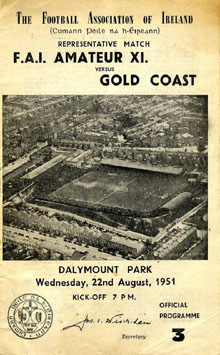
The Gold Coast’s final game in Ireland was a trip south to Dublin to take on the Republic of Ireland amateur side in Dalymount Park. This was a considered a full international game for the Irish amateurs who were all drawn from League of Ireland sides, including Bohemians, Shamrock Rovers, Waterford, Cork Athletic and another Cork side, Evergreen.

Despite this being an amateur game Dalymount Park was very well attended for what doubled up as a pre-season run-out for many of the League of Ireland players. Some 17,000 supporters turned up for a midweek game in August and they weren’t to be disappointed. Though once again the Gold Coast side were on the losing side of the scoreline, their skill and talent was obvious. The Irish Times declared them “glorious in defeat” and praised a “display of delightful football and teamwork”.

Interestingly there is some discussion about the tactical layout of the Gold Coast side in the various match reports, they are described as playing with an advanced centre-half. This type of tactic is one which would be more common in the formations of the 1920s, when teams played with two full-backs in front of the goalkeeper, while the centre half played in front of them as a type of pivot between defence and attack, rather than as a third defender. This third defender formation was popularised by Herbert Chapman as Arsenal manager and became known as the W-M due to the formation of players on the pitch. It also suggests that this formation perhaps wasn’t common in Ghana in the early 50s and why the touring Gold Coast side seemed to concede more heavily despite their all-round play being routinely praised. Many years later CK Gyamfi recalled “while we were busy dribbling well and passing nicely, our hosts were mechanical and precise. They used the W-M on us.”

According to the match reports the Irish side were fortunate to come away with the win, scoring twice in quick succession on a counter attack when the scores were tied at 2-2, first a quick break from Cork Athletic’s pacey winger John Vaughan and then just a minute later another quick counter led to Waterford’s Dinny Fitzgerald getting his hat-trick and the game finishing 4-3 to the Irish amateurs.

Among those players who impressed in this game were Oscar Gasper, who despite playing in bare feet struck a ferocious free-kick to level the scores at 2-2, while CK Gyamfi also caught the eye. Gyamfi would end up as the top scorer of the tour, scoring 11 of the Gold Coast’s 25 goals. Among the other starters in that game was the impressive defender Emmanuel Christian Briandt. Both Briandt and Gyamfi would play important roles in modernising the game in their home country.

By the end of the tour the Gold Coast side had played ten games in total and lost eight of them, only defeating Barnet and an Athenian League selection, however Sid Ackun the team secretary had blamed wet weather and treacherous pitches for many of those defeats. They returned home in September of 1951 and using the small fees that had been paid to them for participating both Gyamfi and Briandt came home with a pair of football boots. Gyamfi played for Asante Kotoko, while Briandt lined out for Hearts of Oak in the capital Accra, two of the country’s biggest clubs.

Despite both men only being in their early 20s they became evangelists for the use of football boots in Ghana despite resistance from many of their teammates. Gary Al-Smith who interviewed Gyamfi for The Blizzard noted that it was Gyamfi’s view that football  boots were kept from local players deliberately noting “the colonial masters taught the locals football, but never with boots. CK Gyamfi told me it was just one way in which the British decided to delay the black man’s progress”.

Despite strong initial resistance both Gyamfi and Briandt were successful in getting the local game to move away from barefoot football and with independence in 1957 Ghana soon became a continental footballing power in Africa. Many of the side that toured Ireland and Britain were part of a Gold Coast team that destroyed Nigeria 7-0 in Accra in 1955, which remains a record defeat for the Super Eagles.

In 1963, Ghana won their first ever African Cup of Nations, defeating Sudan 3-0 in the final which was held in Accra. This was to be the first of three tournament wins for their coach CK Gyamfi. He was a history maker in many fields, becoming the first African player to play in Germany when he starred for Fortuna Düsseldorf in the early 60s,  before coming home to take up his coaching role with the Ghana FA. Of Gyamfi’s success one of his proteges Osei Kofi, a talented and skillful winger, could see the hand of Ghana’s President Kwame Nkrumah who always said “the black man was capable of managing his own affairs” , Kofi contrasted the success of Ghana with a domestic, black local manager with many other African nations who paid large salaries for European coaches who often could not deliver.

The 1951 tour by the Gold Coast XI should not be underestimated. They became the first African touring side featuring black players to come to Ireland since the Orange Free State team visited Belfast back in 1899 and by all press accounts won over the Irish crowds in Dublin and Belfast with their skill and creativity. It was also important for the development of football in modern day Ghana, with players and future coaches learning a great deal tactically during their month touring Britain and Ireland and bringing back ideas that within a decade would make the newly independent Ghana champions of Africa.

Bohs in Europe – the early years (podcast)

A recording of the talk I gave on Bohs in Europe – the early years in Liberty Hall in December 2019, now available on all the main podcast platforms for you to listen to below. Also enclosed is a slideshow of photographs relating to the games and personalities that are mentioned. With thanks to Dubin City Council Libraries, Bohemian F.C. and Simon in Con Artist events.


This slideshow requires JavaScript.

Bohs in the time of influenza

We’re all stuck at home, talking a good game about catching up on our reading or perhaps finally completing that DIY project, more likely if you’re anything like me you’re mindlessly scrolling on your phone, or binge-watching lurid TV series on Netflix. Things are obviously a lot different if you are a frontline worker, in one of our hospitals, a member of our emergency services or working in essential retail businesses. The stress is very real. But this is not unique or unprecedented. This too shall pass.

Just over 100 years ago Ireland faced a not dissimilar epidemic. While the Spanish Flu was something of the misnomer, it was very real, and very deadly. Conservative estimates place the Irish death toll from the virus at over 20,000 from Summer 1918 to Spring 1919. Consider also that this came towards the end of the First World War which claimed the lives of perhaps 50,000 Irish people and saw a country in a state of turmoil on the topics of nationhood, conscription, poverty and on the brink of a violent War of Independence. We can perhaps sympathise with their plight.

Unlike today however, the people of Dublin in 1918 and 1919 had football. Despite schools closing, and many businesses shutting due to illness and self-quarantine measures, football continued in something akin to its usual patterns. To set the scene; at the end of the 1914-15 season due to rising costs, loss of players and supporters to the war-effort and the general disruption brought by the War, the Irish League split into regional competitions for the rest of the War. Bohemians and Shelbourne, the two Dublin sides in an eight-team league dominated by the main Belfast clubs, returned to the Leinster Senior League, and this in effect was our main league for the War and its immediate aftermath. The main Irish Cup competition still ran on an all-Ireland basis, though the early round draws were regionalised, while other trophies such as the Leinster Senior Cup were major priorities.

If anything, the years 1918 and 1919 brought almost a return to normality for Bohemians, the club had lost dozens of players to the War and many more in terms of supporters. At a conservative estimate some 50,000 Dubliners ended up in the battlefields of the First World War and perhaps 8,000 of them never made it home. This impacted not just Bohemians but every football club in Ireland. The Leinster Football Association (LFA) saw a reduction in affiliated clubs which declined by 50% during wartime and by 1919 the LFA had to go cap in hand seeking a grant or loan from the IFA to try and keep the Association afloat. A major concern for Bohemians (and many other clubs) was getting players released from their regiments in order to play for the team. In several games Bohs were hamstrung because of missing key players due to the refusal of the British armed forces to release players for matches, even after the armistice.

Willits army updated

A clipping from Sport showing Bohemian FC player Harry Willitts in army uniform in 1917

Despite all this upheaval there were still notes of optimism to be found, Bohemians won the Leinster Senior League – the highest level played by clubs outside of Belfast, in the 1917-18 season and came second to Shelbourne the following year. It should be noted that Bohs, despite the loss of numbers due to the War, were still fielding at least two teams at the time, with a Bohemian “B” side competing at Leinster Senior League Division Two against the like of St. James Gate and Glasnevin F.C.

The influenza epidemic first noticeably hit Ireland in early summer of 1918 as the football season was ending, but arguably had its peak in Dublin in October and November 1918, as well as continuing into the Spring of 1919. There were perhaps three different peaks of the epidemic. One theory for the surge in cases in November 1918 was that people congregated en masse to celebrate the end of the War and inadvertently helped spread the virus. Unlike most of the Covid-19 cases at present the “Spanish flu” (thus described because neutral Spain reported the first cases, it had been rife in the trenches of France and Belgium months earlier) seemed to affect younger, healthier people, with many in their 20s and 30s dying and leaving young families without parents.

One report in The Irish Times on November 16th 1918 noted that between September 28th and November 9th some 756 people had died of the influenza virus in Dublin City alone. Two days later Shelbourne beat Bohs in the league in front of what was described as “a record crowd of the season”. It was a good time for Shels at this point, they seemed to have the upper hand over their main Dublin rivals, the famous Bohemians, in both 1918 and 1919 they knocked Bohs out of the first round of the Irish Cup. In February 1919 they won their Cup match in Dalymount (at another resurgent point for the flu epidemic) in front of a crowd of over 8,000, which was described as a record attendance in Dublin since the outbreak of War.

Indeed, not happy with just the usual run of fixtures Bohs decided to host an alternative Cup final on 29th March 1919. On the same day that Linfield were playing Glentoran in the first of three finals (two drawn games followed by an eventual Linfield victory on the 7th of April) Bohs agreed to host beaten semi-finalists Belfast Celtic in front of a bumper crowd in Dalymount. The Bohs would triumph 2-1 on the day.

thumbnail_Belfast Celtic 1918

Belfast Celtic teams of the era

While the Dublin public were waylaid from all sides by death, whether from War, revolution or disease, somehow football continued, in the case of Bohemians the club saw suffering and death in the war, former players like Fred Morrow, Harold Sloan, Francis Larkin and others had died in action and many more were seriously injured. But during the Spanish Flu epidemic, partially spread by the return of so many soldiers from the front in 1918, while some quarantine measures and closures of businesses and schools did take place football continued as usual.


This article originally appeared in the Bohemian F.C. lockdown match programme which you can read in its entirety here.

When the Paper man came to town (podcast)

One of Bohemians greatest victories against European opposition, a thrilling game that finished 5-4 in Dalymount. So much excitement in fact that a spectator had a heart attack at the match!

This also covers the story of Austria Vienna and their triumphs and tragedies in the 1930s as they went from one of the finest teams in Europe to a club targeted by the Nazis after the annexation of Austria.